Tech
Yamaha NX-70A Wireless Speakers Take Aim at Rivals with HDMI eARC, YPAO, and Roon Ready Support: High End Vienna 2026

Yamaha has entered the premium wireless hi-fi speaker category with the NX-70A, a new active stereo speaker system aimed at listeners who want proper stereo performance without a rack full of separates, speaker cables, and the 7 a.m. Dunkin’ drive-thru conversation where you try to explain why the “simple wireless speakers” cost more than the family vacation.
The NX-70A is not another lifestyle speaker pretending to be serious because someone gave it a fabric grille and a fancy app. Yamaha is bringing real hi-fi engineering to the category, including Harmonious Diaphragm drivers, Synergistic Drive amplifier integration, YPAO room calibration, HDMI eARC, MusicCast, AirPlay, Google Cast, Spotify Connect, TIDAL Connect, and Roon Ready support.
Yamaha has clearly noticed that KEF, Klipsch, Cambridge Audio, DALI, Fyne Audio, Sonus faber, and others are doing well with active and wireless hi-fi speakers. The NX-70A is Yamaha’s attempt to bring its loudspeaker, amplifier, DSP, home theater, and musical instrument experience into a modern wireless stereo system.


Yamaha Returns to Wireless Stereo with Real Hi-Fi Intent
The NX-70A is Yamaha’s first wireless stereo speaker system in roughly a decade, and it arrives with a feature set aimed at modern living rooms, smaller listening spaces, and TV-based systems where a soundbar may not be the ideal answer.
Each speaker uses Yamaha’s Harmonious Diaphragm technology across its driver array. Yamaha says the diaphragm material is made from a carefully balanced blend of PBO fiber ZYLON and spruce wood. ZYLON is used in Yamaha’s flagship loudspeakers, while spruce wood is used in the soundboards of Yamaha grand pianos.
The NX-70A also uses Yamaha’s Synergistic Drive, which integrates the amplifier circuit and speaker unit as a dedicated system. Yamaha says this direct amplifier-to-driver approach helps manage current flow more precisely and reduce distortion caused by conventional amplifier/speaker interactions.
Yamaha rates the system at 100 watts for each woofer and 60 watts for each tweeter, confirming that the NX-70A is a fully active design with dedicated amplification for each driver rather than a passive speaker with wireless convenience bolted on.
Yamaha also lists frequency response at 50 Hz to 35 kHz when the speakers are connected by wire, and 50 Hz to 21 kHz when used wirelessly, both measured at -10 dB. That distinction matters because the NX-70A is being marketed as a wireless system, but Yamaha is clearly giving users a wired option for maximum performance and stability.

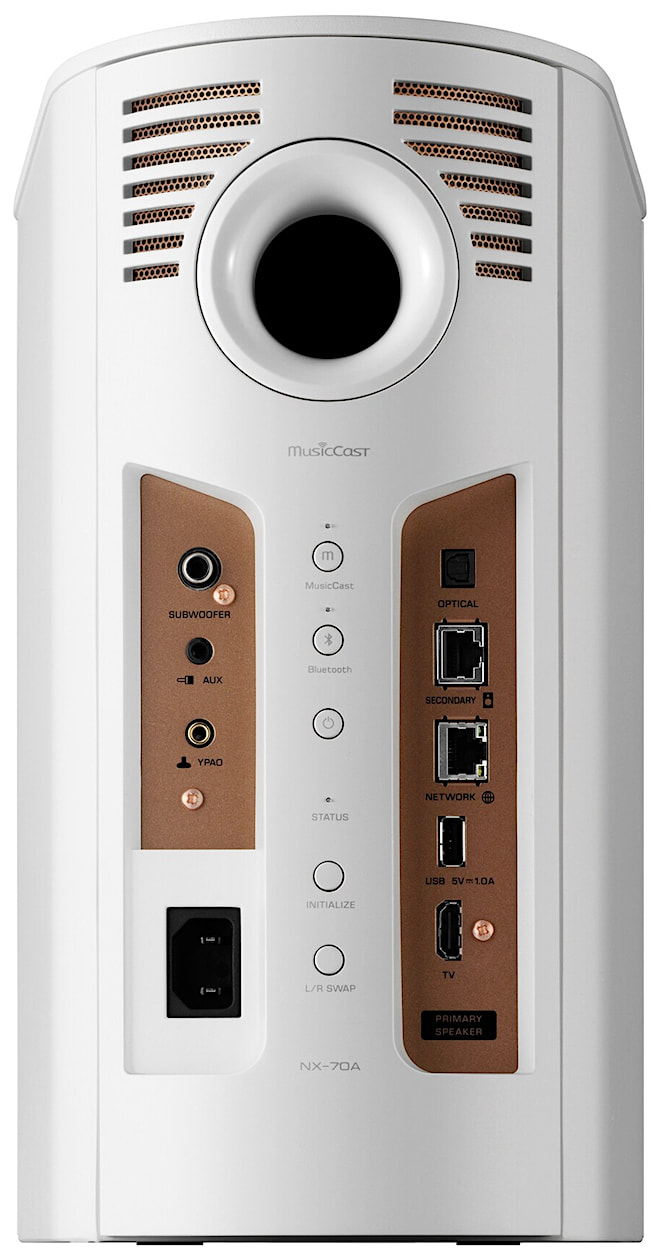
The primary speaker includes HDMI eARC/ARC, optical digital, 3.5mm analog input, Ethernet, USB-A for music playback and firmware updates, a YPAO microphone input, and an RCA subwoofer output. The secondary speaker can connect wirelessly or via Ethernet/LAN, and Yamaha includes a 3-meter LAN cable in the box for that purpose.
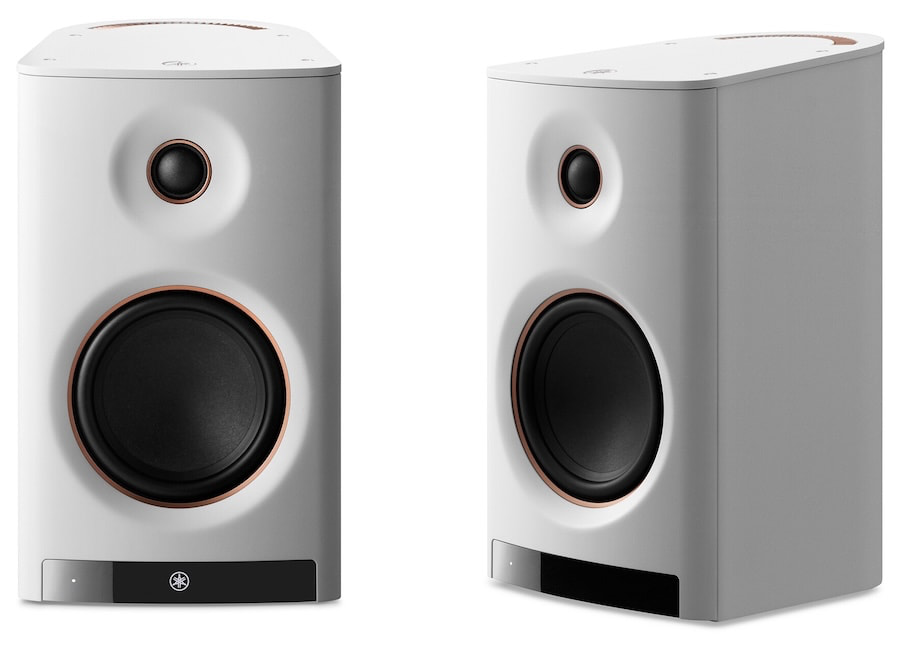
Physically, the NX-70A is compact but not featherweight. Each speaker measures 189 x 234 x 333mm, or roughly 7.5 x 9.25 x 13.125 inches. The primary speaker weighs 5.7 kg / 12.6 pounds, while the secondary speaker weighs 5.4 kg / 11.9 pounds. That puts the NX-70A firmly in the serious desktop, den, or living-room category rather than the “cute wireless speaker for the kitchen counter” pile.

YPAO Room Calibration and Wireless Left/Right Placement
One of the NX-70A’s most useful features is YPAO room calibration. Yamaha’s system uses a dedicated microphone to measure the listening environment and adjust playback for the room. In the NX-70A, YPAO R.S.C. addresses early reflections, while EQ is used to fine-tune tonal balance.
That matters because active wireless speakers are often used in real rooms, not review spaces with perfect symmetry, acoustic treatment, and no furniture that anyone actually owns. Walls, windows, bookshelves, coffee tables, and questionable placement all have a say in the final sound. Yamaha is at least giving users a tool to manage some of that.
The left and right speakers can also connect wirelessly, so users do not need to run a cable between them. That should make placement easier, especially in living rooms where “just run a cable across the floor” is how arguments start.

HDMI eARC, MusicCast, and Roon Ready Support
Yamaha has given the NX-70A the kind of connectivity that makes sense in 2026. HDMI eARC/ARC with CEC allows the speakers to connect directly to a TV and be controlled with a TV remote. That immediately makes the NX-70A a serious alternative to a soundbar for listeners who care more about stereo imaging than simulated surround fireworks.
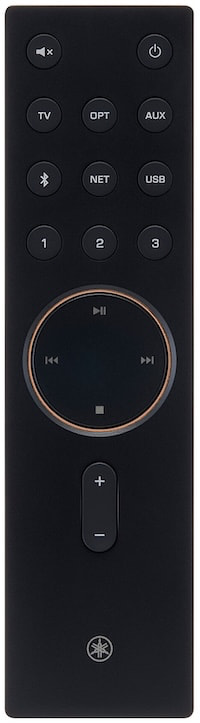
Streaming support includes Spotify Connect, TIDAL Connect, Google Cast, AirPlay, MusicCast multiroom playback, and Roon Ready compatibility, which should cover most potential buyers. Qobuz Connect does not appear to be supported at this stage.
Designed for Sound, Not Just the Showroom
The NX-70A cabinet uses rounded surfaces intended to avoid parallel internal walls and reduce standing waves. Yamaha also uses a 5mm aluminum top plate secured to the cabinet to increase rigidity and help control unwanted vibration.
The system will be available in black and white finishes, with a matching SPS-70A stand also listed by Yamaha.


The Bottom Line
The Yamaha NX-70A matters because it is not just another wireless speaker system with a premium badge and a tidy app. Yamaha is bringing a properly active 2-way design to the category, with dedicated amplification for each driver, YPAO room calibration, HDMI eARC, subwoofer output, wired or wireless speaker linking, and broad streaming support that includes MusicCast, AirPlay, Google Cast, TIDAL Connect, Spotify Connect, and Roon Ready compatibility.
At a reported £2,587, or roughly $3,500, the NX-70A is not inexpensive, and it will have to compete with strong active and wireless systems from KEF, DALI, Fyne Audio, Sonus faber, Klipsch, and others. What makes Yamaha’s entry different is the combination of hi-fi, DSP, home theater, and musical instrument engineering behind it. That does not guarantee victory, but it does make the NX-70A one of the more credible new wireless stereo systems to watch in 2026.
The real test will be whether Yamaha can turn that spec sheet into a system that sounds balanced, images properly, integrates well with TVs and subs, and makes traditional separates feel less necessary. On paper, the NX-70A has the right pieces. Now it has to prove they belong together.
For more information: europe.yamaha.com
You must be logged in to post a comment Login