The race to advance conversational AI in the living room is heating up, with YouTube being the latest to expand its tool to smart TVs, gaming consoles, and streaming devices.
This experimental feature, previously limited to mobile devices and the web, now brings conversational AI directly to the largest screen in the home, allowing users to ask questions about content without leaving the video they’re watching.
According to YouTube’s support page, eligible users can click the “Ask” button on their TV screen to summon the AI assistant. The feature offers suggested questions based on the video, or users can use their remote’s microphone button to ask anything related to the video. For instance, they might ask about recipe ingredients or the background of a song’s lyrics, and receive instant answers without pausing or leaving the app.
Currently, this feature is available to a select group of users over 18 and supports English, Hindi, Spanish, Portuguese, and Korean.
Advertisement
YouTube first launched this conversational AI tool in 2024 to help viewers explore content in greater depth. The expansion to TVs comes as more Americans now access YouTube through their television than ever before. A Nielsen report from April 2025 found that YouTube accounted for 12.4% of total television audience time, surpassing major platforms like Disney and Netflix.
Other companies are also making significant strides with their conversational AI technologies. Amazon rolled out Alexa+ on Fire TV devices, enabling users to engage in natural conversations and ask Alexa+ for tailored content recommendations, hunt for specific scenes in movies, or even ask questions about actors and filming locations.
Meanwhile, Roku has enhanced its AI voice assistant to handle open-ended questions about movies and shows, such as “What’s this movie about?” or “How scary is it?” Netflix is also testing its AI search experience.
Techcrunch event
Advertisement
Boston, MA | June 23, 2026
Another way YouTube has tried to improve its TV experience with AI is the recent launch of a feature that automatically enhances videos uploaded at lower resolutions to full HD.
Advertisement
Additionally, the company continues to launch other AI features, like a comments summarizer that helps viewers catch up on video discussions and an AI-driven search results carousel. In January, the company announced that creators will soon be able to make Shorts using AI-generated versions of their own likeness.
Last week, YouTube launched a dedicated app for the Apple Vision Pro, too, letting users watch their favorite content on a theater-sized virtual screen in an immersive environment.
Everyone who loves mysteries secretly hopes that one day life will drop an intriguing puzzle into their lap for them to solve. Maybe not an Agatha Christie-type crime, but something that will send them on a real-world chase to connect the dots and land at a satisfying conclusion.
That’s exactly what happened to Katie Elkin, a retired teacher with a penchant for mysteries. “I’m 84 and I have lived a full, wonderful life,” she tells me over a video call from her home in Prescott, Arizona.
Until now, Elkin’s mysteries have largely been genealogy-based. She recounts an extraordinary story about making friends with a woman from California and discovering that their grandfathers had trained together in the Army and then shipped out to France in World War I on the same day. “That’s my whole life,” she says. “It’s coincidences.”
Advertisement
On this Friday in February, we’re talking about another coincidence in Elkin’s life — one of finding a phone, lost for a decade in the desert, and Elkin’s attempt to reunite it with its owner.
Our phones are immensely personal items, serving both as memory banks that store our most precious data and as portals that connect us with every important person in our lives. These days, if we lose them, tracking technology means there’s every chance we could be quickly reunited with them, but that hasn’t always been the case.
Those disappearances can be high-stress moments for anyone — just ask Apple about the unreleased iPhones it lost back in 2010 and 2011, which, coincidentally, were around the same time it introduced the Find My iPhone feature. But even today, recovering a lost phone means relying to an extent on the goodwill and honesty of the person who found it. Many people will choose to do the right thing in this scenario, and some — like Elkin — will go above and beyond to help out a stranger.
On a sunny day just before Thanksgiving, Elkin and her husband drove about 10 minutes west of the city to spend some time outdoors. Prescott is surrounded by national parks and ponderosa pine forest, but on this day, Elkin was headed to the desert — not for a hike, she says, but an “amble.”
Advertisement
Rather than taking the well-marked trail popular with hikers and ATVs, Elkin instead split off onto a lesser-known path “obliterated by the grasses and the weeds.”
It was Elkin’s dad who taught her that if she wanted to spot something, she should look for it — sage advice that’s served her well over the years. “He was always finding change,” she says. “And I can do that too. I always find animals. If we’re driving, I can see them in the woods … I’m always looking for something.”
The phone found by Katie Elkin.
Advertisement
Katie Elkin/Jeffrey Hazelwood/CNET
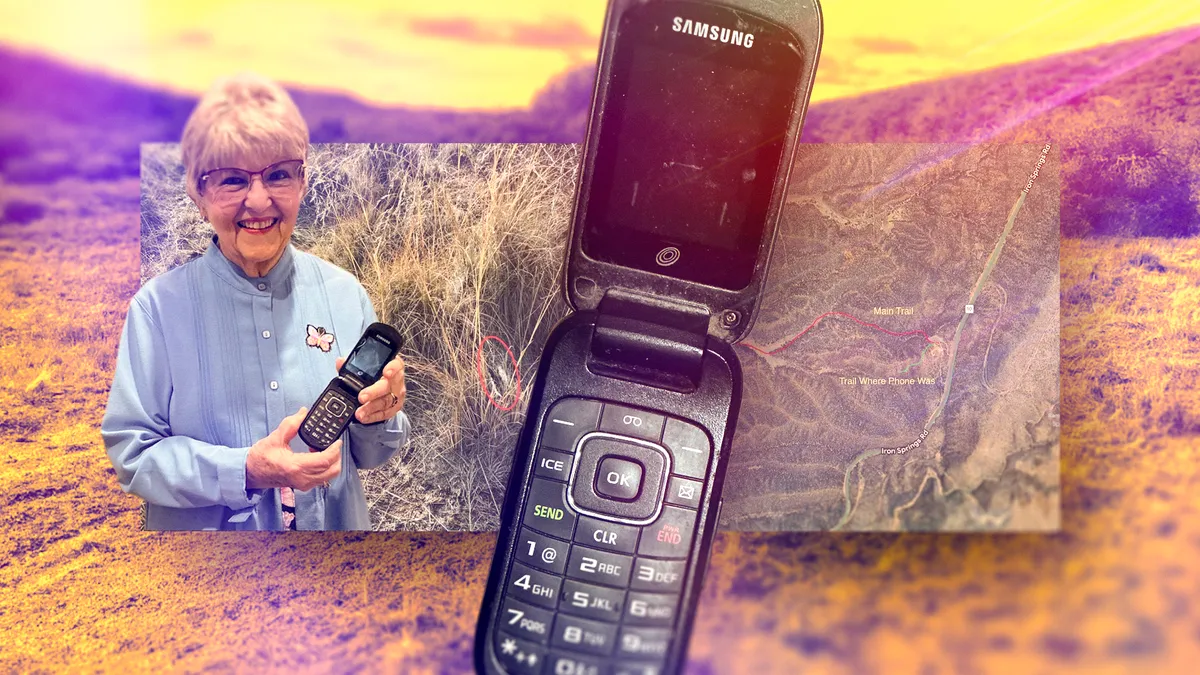
Looking for a vague something can turn up the oddest of things, and on that particular day, the something Elkin found was a dusty, beaten 2012 Samsung Gusto 2 lying on its side, clamshell open in the scrub.
Elkin picked up the phone, thinking she would give it to a neighbor boy who liked to take electronics apart. But when she got it home, she was struck by another idea — what if she could get the phone to turn on?
Like many of us with a drawer full of mystery cables, Elkin has kept all the cords and wires that have come with the electronics she’s purchased over the years. She dug through her stash and found a charger that fit the Gusto (she still has no idea what it was used for previously).
When CNET reviewed the Gusto 2 — a simple flip phone that came out the same year as the iPhone 5 and the Samsung Galaxy S3 — we said: “the construction seems strong enough to withstand multiple drops and endless opening and closing.” Our instincts about its potential resilience were, it turns out, correct.
Advertisement
“I couldn’t believe it when it came up charging,” Elkin says. It took a little while, but when the phone turned on, she was ecstatic. “I thought, ‘Oh my gosh, I wonder who this phone belongs to?’ And so that was when the mystery began.”
The quest for answers
Elkin went into the text messages and started to piece together the Gusto owner’s life, clue by clue. The owner worked in a cafe, she seemed to have family connections in Chicago, she was a renter and a keen hiker. Her name was Maddie.
The other thing Elkin noticed was that the last message was marked Saturday, May 16. It was the only evidence she had to indicate when exactly the phone might have been lost. She went to the internet and looked up which years May 16 had fallen on a Saturday. Two possible answers cropped up — 2020 and 2015.
Elkin’s internet research didn’t stop there. She took one of the commonly texted numbers in the phone and did a reverse lookup. “And bingo! I found a woman’s name that had that phone number,” she says. But when she called the number, it was disconnected.
Advertisement
“I said to myself, who would know where she is?” says Elkin. “Her dad would know.” She found a number listed under “daddio,” performed another reverse lookup and found the name of a man living in Chicago. “I was so excited because I was getting close,” she says.
On Dec. 30, Elkin’s birthday, she called the number, but no one picked up. She had to leave a message. “I was really disappointed, because I wanted to talk to somebody,” she says.
Ten minutes later, her phone rang, but when she picked up, it wasn’t a man on the other end of the line. “It was Maddie, the owner of the phone,” she says. “She had come to Chicago to visit her dad for the holidays.”
Elkin and Maddie talked for around 10 minutes. “She was amazed,” says Elkin. “We were both amazed.” Maddie didn’t want her phone back, but it turns out she had lost it in 2015 after hiking in the exact spot that Elkin had found it.
Advertisement
The little phone that could
For a decade, the little Gusto had been lying out in the desert. Unlike some parts of Arizona, Prescott has four seasons, with all the minus temperatures, scorching heat, snowfall and summer storms that come with them. The Gusto weathered every storm, and battered and bruised as it was, it still came back to life.
We have little expectation these days that our phones will last us a long time, and we rarely get all the life out of our devices that they’re capable of offering us. Rather than seeking to get them repaired, once they fail us in one respect, we tend to seek out replacements. Most Americans hang onto their phones for an average of 2.5 years, according to a Reviews.org survey.
It turns out, though, that some phones are built to last, and the Gusto was one of them. After Elkin had spoken with Maddie, she reached out to Samsung to let them know her story. “I said to myself, ‘Does Samsung require some kudos for having a product that lasted that long?’”
Any tech company would. My own first phone, a 2002 Sagem MW 3020, gave up the ghost simply by being exposed to the concept of water while wrapped up inside a backpack on a rainy day. In spite of the best efforts of phone-makers to increase display resiliency, many people are still walking around out there with cracked screens.
Advertisement
For as long as we’ve had mobile phones, they’ve been vulnerable pieces of kit. But whatever secret sauce Samsung put inside the 2012 Gusto 2 shows that it was more robust than most — even though it was lying open with its main screen exposed when Elkin found it.
At the time we reviewed the Gusto 2, we gave it a score of 7 out of 10, with points knocked off for its subpar screen resolution and a smaller-than-usual headphone jack. It’s too late for us to go back and revise that score in light of what we know about how robust the phone is 14 years later, but it’s entirely possible that the “problems” we highlighted actually played into the Gusto’s long-term survival.
Elkin still doesn’t know what she’s going to do with Maddie’s Gusto, although a friend has suggested that Samsung clad it in gold and put it on a pole at headquarters. Samsung is clearly proud of the phone’s durability, having put me in touch with Elkin, but is also undecided about how to celebrate the life the Gusto 2 has lived. In spite of Elkin’s love for mysteries and my suggestion that the FBI recruit her, she isn’t about to start a detective agency to reunite other people with their lost possessions. “It’s just a hobby,” she laughs.
That’s a shame. As someone who’s lost more than one phone over the years, I would dearly love to be reunited with my missing technology, and I’m sure there’s a market for Elkin’s skills. Not every phone is as resilient as the Gusto. Most devices that have taken such a battering would likely refuse to even turn on.
Advertisement
Perhaps there’s a longevity challenge for all phone-makers. I can’t promise CNET would be able to replicate this scenario in our reviews testing process, but in an age of disposable tech, it would be lovely to give extra points for truly hard-earned durability.
Later this year, Apple will open its first permanent Dublin office at 4/5 Park Place in Dublin, to complement its 6,000-strong Cork campus team which it continues to develop.
The new Dublin office will house 300 people, and will complement the main Apple Cork Campus, according to Cathy Kearney, Apple’s vice-president of European Operations, who has long led Apple operations in Ireland.
“The whole team is very excited, they’re really looking forward to it,” Kearney told SiliconRepublic.com. “We already have a temporary office in Dublin and we have already started hiring, so it is off to a great start. The new office is close to the Iveagh Gardens, and is a really exciting location.”
Kearney explained that the office will house a whole range of activities and a mix of different teams, just as with the 6,000-strong Cork team, and she stressed that the office will be very much part of the wider Ireland operations, rather than a separate entity.
Advertisement
“Our focus to date with the team already there in Dublin is really building the Apple culture, making sure we’re starting that office as complementary to Cork,” said Kearney who has spent some 37 years at Apple. “But basically it’s one organisation, working for Apple, working for our customers, making sure we’re hiring the right talent, making sure we’re building the right culture with the team there, that they really get ingrained in Apple.”
To that end, the existing Dublin team already travels up and down to Cork regularly, meeting their colleagues and attending events, she says, and the management team spends time back and forth with them too.
Cork to the core
While the Dublin office is big news, the Cork campus continues to sit at the core of its European operations. Apple’s largest location outside the US, it has been more than 45 years since Apple opened its manufacturing facility in Cork with 135 team members. Today’s campus houses 6,000 people, with teams across the business – from operations, engineering and manufacturing to procurement, customer support and AppleCare.
Back in 2022 Apple further expanded its Hollyhill campus, opening a state-of-the-art test and engineering facility responsible for testing and analysing its products. Just today the state-of the art Hollyhill 5 building got its official launch by Taoiseach Micheál Martin, while the teams first began moving in back in June.
Advertisement
“I’m delighted to open this state-of-the-art new facility in Hollyhill today and to see first-hand the major investment that Apple is making here,” he said. “The contribution Apple has made in Cork and Ireland over the last 45 years cannot be overstated – creating thousands of highly-skilled roles and continually investing in their Irish operations.”
Watch out for the next episode of The Leaders’ Room podcast, which features Cathy Kearney, Apple’s vice-president of European Operations and Kristina Raspe, Apple’s vice-president of Places.
Don’t miss out on the knowledge you need to succeed. Sign up for the Daily Brief, Silicon Republic’s digest of need-to-know sci-tech news.
We are going to bet that as a kid, you had a View-Master. This toy has been around for decades and is, more or less, a handheld stereoscope. We never thought much about the device’s invention until we saw a recent video from [View Master Travels and Peter Dibble]. It turns out that the principle of the whole thing was created by the well-known [Charles Wheatstone]. However, it was piano repairman [William Gruber] who invented what we think of as the View-Master.
[Gruber] didn’t just work on normal pianos, but complex player pianos and, in particular, the pianos used to record player piano rolls. He was also, as you might expect, a stereo photography enthusiast. Many of the ideas used in automating pianos would show up in the View-Master and the machines that made the reels, too. In the 1930s, stereoscopes were not particularly popular and were cumbersome to use. Color film was also a new technology.
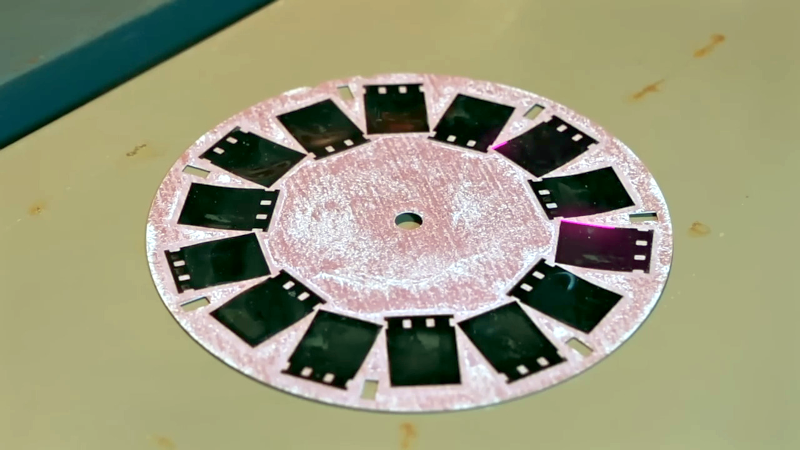
[Gruber] realized that a disk-like format would be easy to use and, more importantly, easy to mass produce. The reels had a few features to simplify their use. For example, if you show each image in sequence, you’d eventually see pictures upside down. [Gruber’s] solution? Use an odd number of pairs and advance the reel two positions for each jump forward. That way, you never show an image to the wrong eye.
The model “A” didn’t look much like the View-Master you probably remember. By 1940, the toy was a hit. But initially, it wasn’t really a toy so much as a way for adults to view distant sites. Of course, World War II could have stopped the enterprise dead, but instead, they shifted to producing training aids for the military. The War Department would buy 100,000 viewers and about 6 million reels to help train soldiers to identify aircraft and ships, as well as to estimate range.
Advertisement
Training was always a key use of the View-Master technology, but the company eventually bought a competitor with rights to Disney films and exploded into a must-have toy. When the company was bought by GAF, the focus on the toy market grew. Despite some efforts to keep the company relevant in an era with virtual reality and other 3D technologies, View-Master is, sadly, a bit of nostalgia now, even though you can still buy them. But it is impressive that despite many changes to the viewer and the production methods, the View-Master reel remained virtually unchanged despite the production of about 1.5 billion of them. Sure, there were fancy viewers that had audio tracks, too, but the basic idea of an odd number of film frames mounted in a circle in a notched disk remained the same.
By now, it feels like a common observation that tech keeps getting more expensive without necessarily becoming more useful. While AI drives up hardware costs, many apps we once used for free now require subscriptions to access their most useful features. When we begrudgingly pay those increasingly exorbitant fees, we often receive a product that barely works.
But it doesn’t have to be this way. Some of the most frustrating and costly apps are the most well-known, but that’s only because they have a corporate marketing budget. There are often excellent alternatives available completely for free, many of which are even better than the expensive apps they’re meant to replace. The only reason you don’t know about them is that they rely mostly on word-of-mouth for marketing. So, we rounded up five of the best free apps that will make you forget all about their expensive competitors faster than you can say, “Cancel my subscription.”
When we say free, we mean you don’t spend a dime (unless you want to donate to the developer, which is always a welcome way to show your appreciation for their work). This list excludes any apps with hidden fees or “pro” subscriptions that lock important functionality behind a paywall. When you install these programs, they’re yours to configure as you wish, because that’s how software is supposed to work. So, here are five free apps that beat expensive alternatives in every way that matters to you.
Advertisement
1. LibreOffice
Max Miller/SlashGear
If you’re someone who spends a lot of time writing, working in spreadsheets, or making slideshows, there’s a good chance you use Microsoft Office apps such as Word, Excel, or PowerPoint. Microsoft Office apps are an industry standard, with decades of support and nearly endless features that keep even the most demanding users satisfied. But they have become increasingly frustrating to use over the years. The company pushes its monthly Microsoft 365 subscription heavily as the main way to access the suite, and if you go digging for a one-time purchase, you’ll find yourself shelling out $180 at the time of this writing.
Moreover, Office apps are increasingly bloated with what many users call “AI slop” through Copilot integrations. They will even default to saving your files in OneDrive, which not only makes it difficult to find documents later but also risks exposing sensitive information you may not have wanted uploaded to the cloud.
Advertisement
If you’re tired of Microsoft’s antics but need Office’s professional-grade features, look no further than LibreOffice. It’s a free, open-source way to get work done on your Mac or PC, making it a fantastic alternative to Redmond’s productivity suite, available for Windows, Mac, and Linux. Compared to Office, LibreOffice surpasses the big tech option in every way that matters. Because it’s open-source, anyone who sees room for improvement and knows how to code can contribute to the project. There is even a robust library of user-created extensions that can add functionality, such as an MLA formatting tool for academic papers.
Advertisement
2. Jellyfin
Max Miller/SlashGear
Private media servers are the perfect solution for anyone who wants to stream the media they already own on multiple devices. Plex, which lets you legally stream your media, is the most recognizable brand in the space. Its sleek aesthetics and ease of use make it quick to get your media server up and running during a lunch break. But some of its most desirable features are locked behind a paywall, and the company raised prices significantly last year. If you want to stream your media on the go, download files to other devices, stream with multiple devices at once, or let other users access your server, you’ll need to pay a monthly subscription or cough up $250 for a lifetime membership.
Jellyfin is a popular alternative to Plex that works on Windows, Mac, Linux, iOS, Android, Roku, Amazon Fire TV, Xbox, and even LG webOS. It is both free and open source, with a large number of user-contributed clients available for download. This makes it far more flexible than Plex. There are versions of Jellyfin just for music, others for reading books and comics, and, of course, versions that let you watch your movies and TV shows, to name just a few. The only real downside compared to Plex is that it can be a bit tricky to figure out which configuration makes sense for your needs, and then to get all the kinks ironed out during setup. If you don’t think you can handle a bit of light network configuration, you may be better off with Plex. But in terms of relative feature sets, Plex is a shallow pool next to the deep well of Jellyfin.
Advertisement
3. Open Broadcaster Software (OBS)
Max Miller/SlashGear
Over the past decade, live streamers have become a new kind of Internet celebrity. Whether playing games, commenting on politics, or a potentially irresponsible mix thereof, these people broadcast themselves on Twitch, YouTube, and similar platforms, sometimes garnering enormous audiences. For the largest streamers, it’s a multi-million dollar business. But regardless of income level, most streamers default to using a free program to run their streams.
OBS, short for Open Broadcaster Software, is a free and open-source software application for video recording and live streaming. It is the rare such software which not only provides more functionality compared to paid alternatives like StreamYards, but is more popular than those products. In fact, the popular paid streaming suite Logitech Streamlabs is actually built on top of OBS, and its paid tier simply charges for the additional features. In fact, since streaming is so lucrative for gaming and entertainment companies, OBS is also in the enviable position of being sponsored by Logitech and other large industry players, including Nvidia, AMD, Intel, and YouTube. In a world where many open-source developers work for free while shaking a digital tin can, OBS can continue development without similar financial pressure.
Like other open-source options on this list, OBS also has a dedicated community and a robust plugin library to fit the marginal needs of various creators. For instance, musicians who stream their production sessions can install the atkAudio Plugin, which interfaces directly with MIDI and audio hardware, while those making tutorial or news content can use Zoominator, a plugin that zooms in on the area of the screen around your mouse during broadcasts.
Advertisement
4. HandBrake
Max Miller/SlashGear
If you’ve ever found yourself in the frustrating situation of having a video file that your computer or smartphone can’t play, you’ve likely found yourself searching for a reliable way to convert it to a compatible format. What you probably discovered next is that most of your options to do so are not very good. There’s Adobe Media Encoder, which offers an advantage for video editors who use Adobe Premiere, since it integrates with that workflow, but it feels like it was designed by someone who had never used a computer before and is bundled with a large software subscription. Wondershare UniConverter is a popular, standalone, paid option, but it has recently been flooded with AI features that many users will find dubiously useful and that video purists may find outright offensive.
The open-source, free alternative is HandBrake, available for Windows, macOS, and Linux. Known for its granular control over transcoding and excellent compression ratios, HandBrake may not use GPU-bound processes to the same extent as some paid competitors, but it hardly affects the final output. A corrupted, one-hour-long MP4 video in 1080p at 30fps transcoded in just under nine minutes on an AMD Ryzen 9 9950X3D system with an Nvidia GeForce RTX 4070 Ti Super GPU in light testing for this article.
HandBrake’s biggest benefit is that it works for you regardless of your familiarity with the ins and outs of digital video. You can simply drag and drop, then click a single button to start your encoding queue, trusting the software to select the appropriate settings. Alternatively, you can dial in the specific settings you want. Or, you can choose from HandBrake’s long list of presets.
Advertisement
5. VLC Media Player
Max Miller/SlashGear
If you’ve got a large collection of digital media — movies, TV shows, or music — you know how difficult it can be to find software that plays nice with files of all types. The media player apps that come pre-installed on your Windows PC or Mac might be pretty to look at, but they fall short when faced with a file they don’t recognize. For those who are serious about their media consumption, one app rises above the rest: VLC Media Player by the non-profit VideoLAN Organization.
VLC is a completely free and open-source player with the most robust codec support on the market, meaning that, unless a file is corrupted beyond recovery, VLC can probably spin it up. The next time you get a video encoded in AV1, HEVC, or even MKV, it’s a job for VLC. But local video isn’t where the fun ends. VLC supports DVD, Blu-ray, and CD playback; receives and broadcasts network streams (a feature that makes it valuable for home server owners); streams Internet television; and displays live webcam feeds. It also uses hardware decoding and works great with NVIDIA graphics cards.
The VLC app itself is not very glamorous, to say the least, but that’s because the emphasis is on features and support. A built-in EQ and compressor let users tune the audio mix on any sound system, while audio desynchronization controls can compensate for latency or desynced audio tracks. Deinterlacing helps keep older videos looking their best, and those with NVIDIA RTX GPUs can take advantage of RTX Super Resolution to enhance low-quality videos with AI. And that’s only the tip of the iceberg. VLC is available on Windows, Mac, Linux, Android (including Google TV), and iOS.
Advertisement
How these free apps were selected
Dragon Claws/Getty Images
Each of the apps recommended in this article was selected based on extensive knowledge of the software market for its category, in concert with hands-on testing and a preponderance of positive user sentiment. Testing of all recommended apps and the paid apps against which they were compared was performed on a high-end Windows PC and, where possible, on a mid-range Linux laptop. Given its broad platform reach, JellyFin was also tested on an Android smartphone, a Roku TV, and a Google Chromecast with Google TV.
According to unnamed sources cited by Reuters, officials developing the portal plan to route all incoming traffic through US-based VPN servers, ensuring that visitors cannot be personally identified. The sources added that user activity will not be tracked on the site. Read Entire Article Source link
The IRS’s IT division has reportedly lost 40% of its staff and nearly 80% of its tech leadership amid a federal “efficiency” overhaul, the agency’s CIO revealed yesterday. The Register reports: Kaschit Pandya detailed the extent of the tech reorganization during a panel at the Association of Government Accountants yesterday, describing it as the biggest in two decades. … The IRS lost a quarter of its workforce overall in 2025. But the tech team was clearly affected more deeply. At the start of the year, the team encompassed around 8,500 employees.
As reported by Federal News Network (FNN), Pandya said: “Last year, we lost approximately 40 percent of the IT staff and nearly 80 percent of the execs.” “So clearly there was an opportunity, and I thought the opportunity that we needed to really execute was reorganizing.” That included breaking up silos within the organization, he said. “Everyone was operating in their own department or area.”
It is not entirely clear where all those staff have gone. According to a report by the US Treasury Inspector General for Tax Administration, the IT department had 8,504 workers as of October 2024. As of October 2025, it had 7,135. However, reports say that as part of the reorganization, 1,000 techies were detailed to work on delivering frontline services during the US tax season. According to FNN, those employees have questioned the wisdom of this move and its implementation.
When you’re livestreaming, it can be tempting to fire off all kinds of wacky sound effects like you’re a morning radio DJ back in the heady days of 1995. If that’s who you want to be, you might like this soundboard project from [Biker Glen].
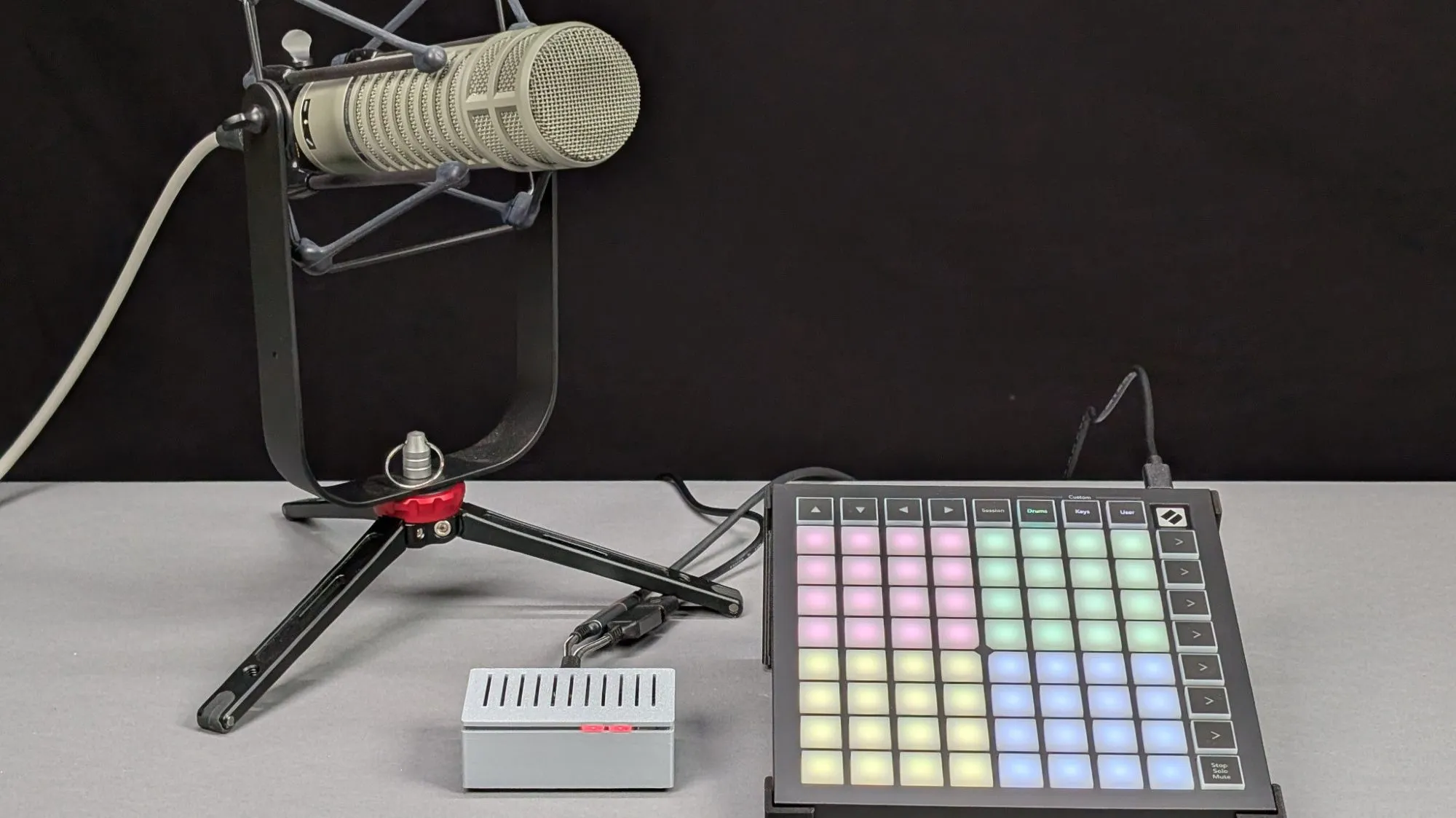
The build is based around an RP2040 microcontroller. It’s paired with an I2S digital-to-analog converter for sound output, which in turn feeds a small amplifier hooked up to a speaker or a line output. The RP2040 is programmed to respond to MIDI commands by playing various sounds in response, which are loaded off a microSD card. It’s able to act as a USB MIDI host, which allows it to work seamlessly with all sorts of off-the-shelf MIDI controllers like the MIDI Fighter or the Novation Launchpad.
It’s an interesting hardware solution to a problem that you could probably also solve with software on your streaming machine, especially if you’ve already got a USB MIDI controller. However, there’s something to be said for lightening the load when your streaming computer is already doing lots of hard work to truck video up to the cloud already. Files are on Github if you’re eager to replicate the build.
“Pew, pew, pew!” a woman wearing sneakers and high-waisted pink trousers says cheerfully in a video uploaded to TikTok. She is standing on what appears to be an industrial rooftop while demonstrating how to use a black device resembling an oversized laser tag gun. “Jamming gun, good,” she adds, flashing a thumbs up. “Contact me!”
These days, nearly any product imaginable is available for purchase on TikTok straight from Chinese factories, ranging from industrial chemicals to mystical crystals and custom pilates reformers. The app’s offerings, it appears, now also extend to drone jammers and other drone-related hardware with clear military and security applications.
In recent months, TikTok has become an improbable showroom for a drone economy that powers conflicts like Russia’s war in Ukraine. Eager to reach customers however they can, small Chinese drone manufacturers are publicly broadcasting tools of modern warfare, including anti-drone rifles, jammers, and sensors, but presenting them with the breezy cadence of consumer lifestyle advertising. The result is a surreal combination of ecommerce and battlefield combat.
WIRED reviewed dozens of videos from TikTok accounts claiming to sell various types of anti-drone equipment, including products that look like a gumdrop-shaped dome on a tripod, a huge boxy “jamming gun,” and a backpack with 12 antennas. The captions on the videos are frequently in both Chinese and English, but others also include translations in Russian, Ukrainian, or other languages. One video set to bouncy industrial house music features what the user labeled as “9 band FPV anti drone jammer,” a device used to disrupt and block the radio and navigation signals that small drones use to communicate.
Advertisement
Drone Dependencies
Both Russia and Ukraine have raced to expand domestic drone production and strengthen their defenses against drone attacks. But much of that manufacturing still relies on Chinese componentry. Processors, sensors, speed controllers, cameras, and radio modules on both sides of the war are largely sourced from the same clusters of factories in and around Shenzhen, China’s hardware manufacturing capital.
“Even though Kyiv has tried to diversify away from Chinese sources, Ukraine still relies heavily on major Chinese companies for cheap drones and drone parts,” says Aosheng Pusztaszeri, a research associate at the Center for Strategic and International Studies focused on emerging technology and national security.
Beijing restricts exports of technologies that have both civilian and military purposes, including drones and related components, and it has repeatedly tightened those rules since the war in Ukraine began in early 2022. In September 2024, China expanded the controls to cover key parts needed to make battlefield drones, such as flight controllers and motors. Around the same time, the US government announced it was sanctioning two Chinese companies for allegedly selling drone parts to Russia.
Despite the restrictions, trade figures suggest that Chinese drones have continued flowing to Russia and Ukraine through intermediaries, says Pusztaszer. In the first half of 2024, Chinese companies officially sold only about $200,000 worth of drones to Kyiv. But the Ukrainian government puts the estimate much higher—at closer to $1.1 billion. “That gap suggests fully assembled Chinese drones and drone components might enter Ukraine via third-party sellers,” he explains.
Advertisement
Jamming On
University of Maryland engineering professor Houbing Herbert Song, who has researched anti-drone technology, tells WIRED that the products featured in the TikTok videos appear to be a combination of detection equipment and jamming equipment, the latter of which distorts the signals drones use to operate.
Drones typically use radio waves to communicate with a remote operator. Some jammers work by transmitting radio waves at the same frequency the drone uses to operate, which can cause the drone to lose contact with its operator and render it nonresponsive. However, if the drone can still connect to a navigation system, like the Global Positioning System (GPS), some drones can land themselves or return to their starting point. Other jammers attempt to interfere with the GPS signals drones use to navigate, or “spoof” them, tricking the drone into thinking it’s somewhere else.
from the the-human-brain-is-way-more-complicated dept
Warning: This article discusses suicide and some research regarding suicidal ideation. If you are having thoughts of suicide, please call or text 988 to reach the Suicide and Crisis Lifeline orvisit this list of resourcesfor help. Know that people care about you and there are many available to help.
When someone dies by suicide, there is an immediate, almost desperate need to find something—or someone—to blame. We’ve talked before about the dangers of this impulse. The target keeps shifting: “cyberbullying,” then “social media,” then “Amazon.” Now it’s generative AI.
There have been several heartbreaking stories recently involving individuals who took their own lives after interacting with AI chatbots. This has led to lawsuits filed by grieving families against companies like OpenAI and Character.AI, alleging that these tools are responsible for the deaths of their loved ones. Many of these lawsuits are settled, rather than fought out in court because no company wants its name in the headlines associated with suicide.
It is also impossible not to feel for these families. The loss is devastating, and the need for answers is a fundamentally human response to grief. But the narrative emerging from these lawsuits—that the AI caused the suicide—relies on a premise that assumes we understand the mechanics of suicide far better than we actually do.
Advertisement
Unfortunately, we know frighteningly little about what drives a person to take that final, irrevocable step. An article from late last year in the New York Times profiling clinicians who are lobbying for a completely new way to assess suicide risk, makes this painfully clear: our current methods of predicting suicides are failing.
If experts who have spent decades studying the human mind admit they often cannot predict or prevent suicide even when treating a patient directly, we should be extremely wary of the confidence with which pundits and lawsuits assign blame to a chatbot.
The Times piece focuses on the work of two psychiatrists who have been devastated by the loss of patients who gave absolutely no indication they were about to harm themselves.
In his nearly 40-year career as a psychiatrist, Dr. Igor Galynker has lost three patients to suicide while they were under his care. None of them had told him that they intended to harm themselves.
In one case, a patient who Dr. Galynker had been treating for a year sent him a present — a porcelain caviar dish — and a letter, telling Dr. Galynker that it wasn’t his fault. It arrived one week after the man died by suicide.
Advertisement
“That was pretty devastating,” Dr. Galynker said, adding, “It took me maybe two years to come to terms with it.”
He began to wonder: What happens in people’s minds before they kill themselves? What is the difference between that day and the day before?
Nobody seemed to know the answer.
Nobody seemed to know the answer.
Advertisement
That is the state of the science. Apparently the best we currently have in tracking suicidal risk is asking people: “Are you thinking about killing yourself?” And as the article notes, this method is catastrophically flawed.
But despite decades of research into suicide prevention, it is still very difficult to know whether someone will try to die by suicide. The most common method of assessing suicidal risk involves asking patients directly if they plan to harm themselves. While this is an essential question, some clinicians, including Dr. Galynker, say it isinadequateforpredicting imminent suicidal behavior….
Dr. Galynker, the director of theSuicide Prevention Research Labat Mount Sinai in New York City, has said that relying on mentally ill people to disclose suicidal intent is “absurd.” Some patients may not be cognizant of their own mental state, he said, while others are determined to die and don’t want to tell anyone.
The data backs this up:
According to one literature review, about half of those who died by suicide had denied having suicidal intent in the week or month before ending their life.
This profound inability to predict suicide has led these clinicians to propose a new diagnosis for the DSM-5 called “Suicide Crisis Syndrome” (SCS). They argue that we need to stop looking for stated intent and start looking for a specific, overwhelming state of mind.
Advertisement
To be diagnosed with S.C.S., Dr. Galynker said, patients must have a “persistent and intense feeling of frantic hopelessness,” in which they feel trapped in an intolerable situation.
They must also have emotional distress, which can include intense anxiety; feelings of being extremely tense, keyed up or jittery (people often develop insomnia); recent social withdrawal; and difficulty controlling their thoughts.
By the time patients develop S.C.S., they are in such distress that the thinking part of the brain — the frontal lobe — is overwhelmed, said Lisa J. Cohen, a clinical professor of psychiatry at Mount Sinai who is studying S.C.S. alongside Dr. Galynker. It’s like “trying to concentrate on a task with a fire alarm going off and dogs barking all around you,” she added.
This description of “frantic hopelessness” and feeling “trapped” gives us a glimpse into the internal maelstrom that leads to suicide. It also highlights why externalizing the blame to a technology is so misguided.
The article shares the story of Marisa Russello, who attempted suicide four years ago. Her experience underscores how internal, sudden, and unpredictable the impulse can be—and how disconnected it can be from any specific external “push.”
Advertisement
On the night that she nearly died, Ms. Russello wasn’t initially planning to harm herself. Life had been stressful, she said. She felt overwhelmed at work. A new antidepressant wasn’t working. She and her husband were arguing more than usual. But she wasn’t suicidal.
She was at the movies with her husband when Ms. Russello began to feel nauseated and agitated. She said she had a headache and needed to go home. As she reached the subway, a wave of negative emotions washed over her.
[….]
By the time she got home, she had “dropped into this black hole of sadness.”
And she decided that she had no choice but to end her life. Fortunately, she said, her attempt was interrupted.
Advertisement
Her decision to die by suicide was so sudden that if her psychiatrist had asked about self-harm at their last session, she would have said, truthfully, that she wasn’t even considering it.
When we read stories like Russello’s, or the accounts of the psychiatrists losing patients who denied being at risk, it becomes difficult to square the complexity of human psychology with the simplistic narrative that “Chatbot X caused Person Y to die.”
There is undeniably an overlap between people who use AI chatbots and people who are struggling with mental health issues—in part because so many people use chatbots today, but also because people in distress seek connection, answers, a safe space to vent. That search often leads to chatbots.
Unless we’re planning to make thorough and competent mental health support freely available to everyone who needs it at any time, that’s going to continue. Rather than simply insisting that these tools are evil, we should be looking at ways to improve outcomes knowing that some people are going to rely on them.
Advertisement
Just because a person used an AI tool—or a search engine, or a social media platform, or a diary—prior to their death does not mean the tool caused the death.
When we rush to blame the technology, we are effectively claiming to know something that experts in that NY Times piece admit they do not know. We are claiming we know why it happened. We are asserting that if the chatbot hadn’t generated what it generated, if it hadn’t been there responding to the person, that the “frantic hopelessness” described in the SCS research would simply have evaporated.
There is no evidence to support that.
None of this is to say AI tools can’t make things worse. For someone already in crisis, certain interactions could absolutely be unhelpful or exacerbating by “validating” the helplessness they’re already experiencing. But that is a far cry from the legal and media narrative that these tools are “killing” people.
Advertisement
The push to blame AI serves a psychological purpose for the living: it provides a tangible enemy. It implies that there is a switch we can flip—a regulation we can pass, a lawsuit we can win—that will stop these tragedies.
It suggests that suicide is a problem of product liability rather than a complex, often inscrutable crisis of the human mind.
The work being done on Suicide Crisis Syndrome is vital because it admits what the current discourse ignores: we are failing to identify the risk because we are looking at the wrong things.
Dr. Miller, the psychiatrist at Endeavor Health in Chicago, first learned about S.C.S. after the patient suicides. He then led efforts to screen every psychiatric patient for S.C.S. at his hospital system. In trying to implement the screenings there have been “fits and starts,” he said.
“It’s like turning the Titanic,” he added. “There are so many stakeholders that need to see that a new approach is worth the time and effort.”
Advertisement
While clinicians are trying to turn the Titanic of psychiatric care to better understand the internal states that lead to suicide, the public debate is focused on the wrong iceberg.
If we focus all our energy on demonizing AI, we risk ignoring the actual “black hole of sadness” that Ms. Russello described. We risk ignoring the systemic failures in mental health care. We risk ignoring the fact that half of suicide victims deny intent to their doctors.
Suicide is a tragedy. It is a moment where a person feels they have no other choice—a loss of agency so complete that the thinking brain is overwhelmed, as the SCS researchers describe it. Simplifying that into a story about a “rogue algorithm” or a “dangerous chatbot” doesn’t help the next person who feels that frantic hopelessness.
ProAc has long been a name whispered with reverence among British and American audiophiles; a company that built its reputation on handcrafted, musically transparent loudspeakers rather than flash and hype. Founded by Stewart Tyler in 1979 (evolving from his earlier Celef Audio venture in the 1970s), ProAc quickly earned acclaim for compact but capable designs like the Response and Tablette ranges that belied their size with a very natural sounding midrange and lifelike staging.
Across more than four decades, ProAc remained a tightly run UK family business known for well engineered crossovers, beautifully finished cabinets, and an almost obsessive approach to driver selection. More than a few long time audiophiles will nod at the old “straws” reference when the conversation turns to how particular the company has been about its woofers.The brand’s presence, however, in the U.S. wavered at times due to distributor changes, and in 2021 enthusiasts mourned the passing of Tyler, a designer whose work helped define a generation of British loudspeaker craftsmanship.
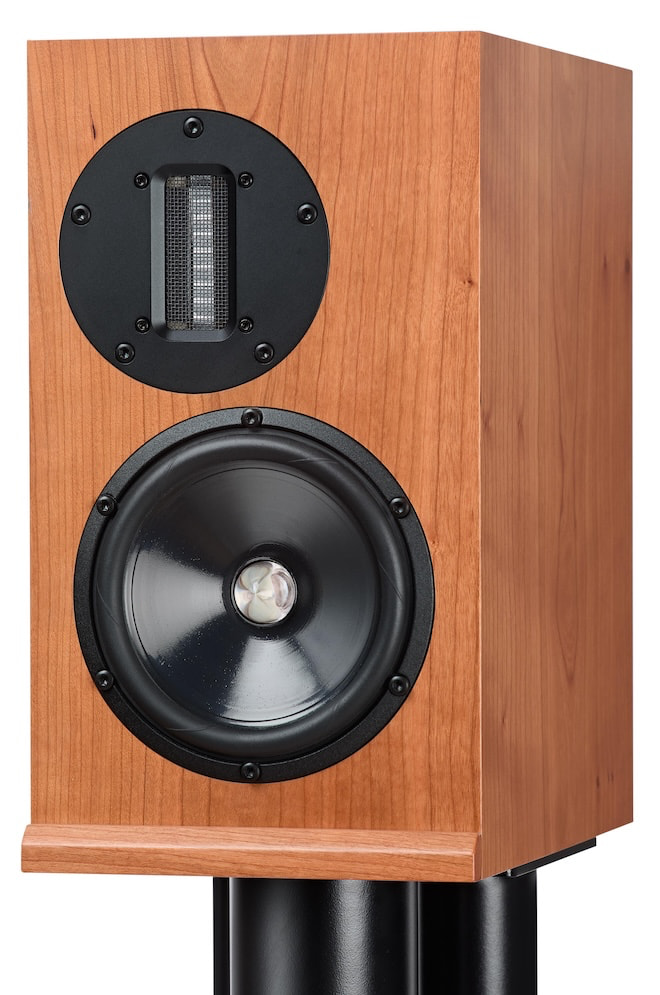
Into that legacy enters the new ProAc Response DB1R: the smallest ProAc loudspeaker ever offered with a ribbon tweeter, bringing the brand’s signature Response-series refinement to an even more compact standmount format. It’s a clear signal that ProAc’s dedication to natural, unforced musical expression remains alive, even as the company evolves its technology into the next chapter.
DB1R Ribbon Tweeter: Small Speaker, Big High Frequency Ambition
ProAc Response DB1R
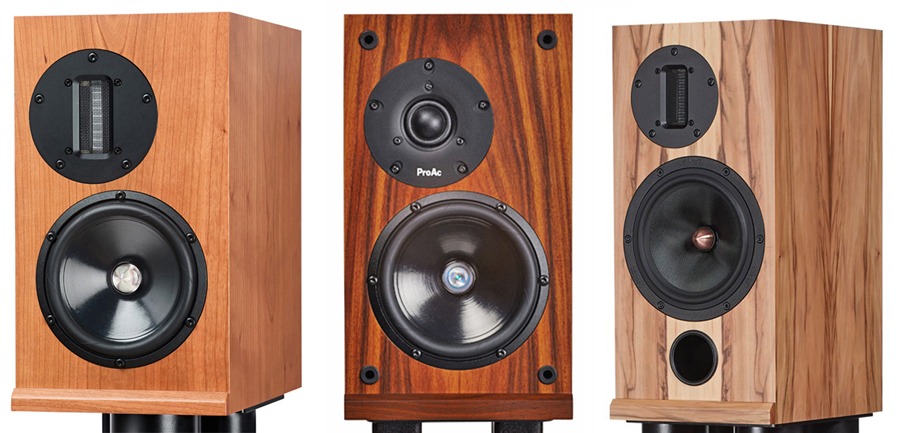
Following the success of the Response D2R standmount introduced in 2019, ProAc has now applied that same ribbon tweeter technology to its more compact Response DB1 platform. The original DB1, launched in 2016 with a silk dome tweeter, remains in the range, but the new DB1R replaces the dome with the ribbon unit first seen in the D2R.
The goal is straightforward: retain the tonal balance and overall character of the DB1 while extending high frequency resolution and speed through the use of ProAc’s ribbon design. According to ProAc, the ribbon diaphragm is lighter than a human hair and incorporates rear chamber damping along with an alnico magnet system to improve control and reduce distortion.
Advertisement
ProAc’s ribbon tweeter has already been implemented across several models in the Response series. With the DB1R, it now appears in the smallest loudspeaker in the company’s lineup to feature a ribbon, bringing that technology into a more compact standmount format.
Response DB1R Bass Driver: Small Cabinet, Serious Intent
Compact stand-mount speakers remain popular for listeners who want serious sound without large floorstanders dominating the room. Bigger cabinets typically offer deeper bass and a broader sense of scale, but they also take up visual and physical space. The Response DB1R is designed to balance those tradeoffs.
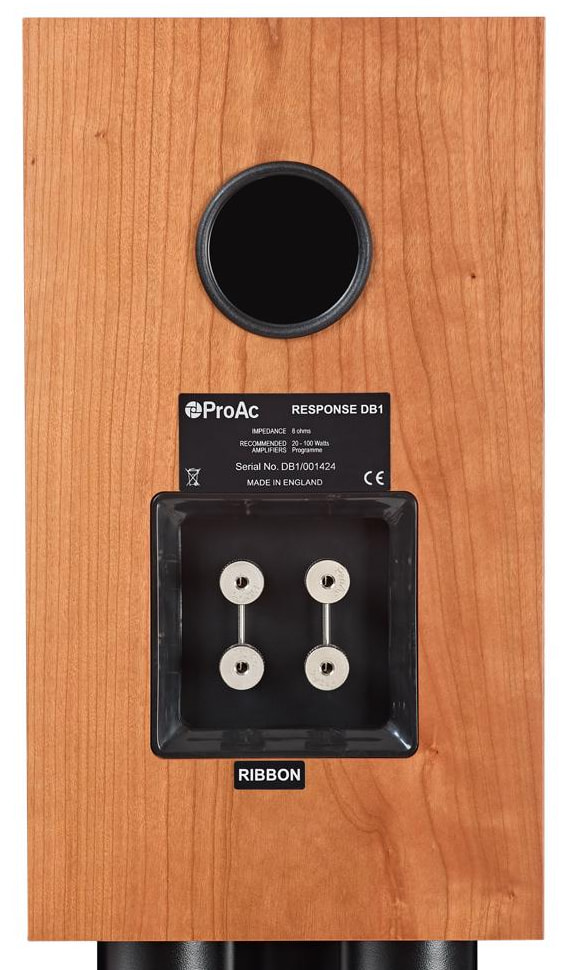
The cabinet uses varying thickness HDF panels combined with bituminous damping to help control resonance and reduce unwanted coloration. The 5 inch bass driver features a long throw design, raised spider, and linear motor system to maintain control at higher excursion levels. A rear port provides additional low frequency support.
The cone is formed from Pagina Mica, elastically coated, and fitted with ProAc’s acrylic pole damping phase plug. The crossover has been tuned to maintain a flatter response at higher listening levels, helping the speaker remain composed when pushed.
In practice, the DB1R aims to deliver low coloration through the midrange and treble, along with bass that is punchy and reasonably extended for its size. The overall goal is to create the scale and balance of a larger loudspeaker within a compact enclosure.
Advertisement
Zoe Tyler Mardle commented on the launch, stating: “The launch of the Response DB1R is the first step in developing our long term plans while continuing to honour Stewart Tyler’s designs and the legacy he left behind. As a team, we want to take everything he taught us over the last 30 years and build upon it. Music is at the heart of our family and central to ProAc’s ‘perfectly natural’ sound, something we are fully committed to preserving.”
Advertisement. Scroll to continue reading.
Comparison
Response DB1R (2026)
Response DB1 (2016)
Response D2R (2019)
Product Type
Standmount Speaker
Standmount Speaker
Standmount Speaker
Price (Pair)
£2,945 to £3,465 US Price TBD
£2,495 to £3,225 $4,750 to $5,300
£3,665 to £4,295 $4,500 to $5,500
Speaker Type
Ported – Bass Reflex
Ported – Bass Reflex
Ported – Bass Reflex
Nominal Impedance
8 ohms
8 ohms
8 ohms
Recommended Amplifiers
20 to 100 watts
20 to 100 watts
20 to 150 watts
Frequency Response
35Hz-30kHz
35Hz-30kHz
30Hz-30kHz
Sensitivity
87.5 dB linear for 1 watt at 1 metre
87.5 dB linear for 1 watt at 1 metre
88.5 dB linear for 1 watt at 1 metre
Bass /midrange Driver
ProAc 127mm (5”) long throw unit with Pagina Mica cone and acrylic phase plug.
ProAc 127mm (5”) long throw unit with Pagina Mica cone and acrylic phase plug.
165mm (6.5”) ProAc unit with Excel Magnet system, glass fibre weave cone and copper phase plug
Tweeter
ProAC Ribbon Tweeter with a rear chamber damping and ainico magnet
ProAc 25mm (1”) silk dome with special coolant
ProAC Ribbon Tweeter with a rear chamber damping and ainico magnet
Crossover
Finest components on a dedicated circuit board. Multistrand oxygen-free copper cable throughout. Split for optional Bi wiring or Bi amplification
Finest components on a dedicated circuit board. Multistrand oxygen-free copper cable throughout. Split for optional Bi wiring or Bi amplification
Finest components on a dedicated circuit board. Multistrand oxygen-free copper cable throughout. Split for optional Bi wiring or Bi amplification
Dimensions (HWD)
12.5” (320mm) x 7.28” (182mm) x 10.4” (280mm)
12.5”(320mm) x 7.28” (182mm) x 10.4” (280mm)
17” (430mm) x 8” 203mm) x 10.25” (260mm)
Weight (each)
8.8kg (19.6 lbs)
8.8kg (19.6 lbs)
11kg (24 lbs)
Mode
Stand mount
Stand mount
Stand mount on a rigid high mass
Grille
Acoustically transparent crimplene. Magnetic grilles are available with certain finishes.
Acoustically transparent crimplene. Magnetic grilles are available with certain finishes.
Acoustically transparent crimplene
Standard Finishes
Black Ash, Mahogany, Cherry, Walnut, Natural Oak, Silk White.
Black Ash, Mahogany, Cherry, Walnut, Natural Oak, Silk White.
Black Ash, Mahogany, Cherry, Walnut, Natural Oak, and Silk White.
Premium Finishes (extra cost)
Liquidambar, Rosewood, Ebony
Liquidambar, Rosewood, Ebony
Liquidambar, Rosewood, Ebony
The Bottom Line
ProAc has never chased mainstream visibility, and the Response DB1R is unlikely to change that. What it does reinforce is the company’s long standing focus on compact loudspeakers that prioritize tonal balance, midrange clarity, and refined high frequency detail over brute force output.
The DB1R is for listeners who value scale and precision in smaller rooms, who want the speed and openness of a ribbon tweeter without committing to a large floorstander. It is also for those who appreciate careful crossover design and cabinet craftsmanship rather than feature lists and lifestyle packaging.
If pricing lands north of $5,000 per pair as expected, the ProAc Response DB1R will not be entry level. But in a world where statement loudspeakers like the new ATC EL50 now command $99,999 per pair, it occupies a very different tier of ambition. This is not about maximum output or seismic bass. It is about delivering a balanced, articulate presentation in a manageable enclosure for serious two channel systems where space and aesthetics still matter.
Advertisement
Price & Availability
The ProAc Response DB1R is priced at £2,945 with Standard Finishes and £3,465 with Premium Finish, and is available through Authorized Dealers. Availability is expected to start in May, 2026. The Response DB1 and D2R are currently available through Authorized Dealers.
Tip: The ProAc Response DB1R is being shown at the 2026 Bristol Hi-Fi Show from February 20 – 22.