

Crypto World
POAP Moves to Maintenance Mode as Founders Eye Next Generation of Digital Collectibles



The pioneering Web3 attendance protocol will stop onboarding new issuers on March 16, as its team turns its attention to building open infrastructure for digital collectibles.
POAP, the blockchain-based platform that turned event attendance into digital collectibles, is entering maintenance mode — ending active development on its current platform after nearly seven years as a fixture of the Web3 community.
In a post on X, POAP co-founder and general manager Isabel Gonzalez announced that starting March 16, 2026, new issuers will no longer be able to create POAPs through the platform’s issuer interfaces. Existing issuers, integrations, and collector-facing tools will continue to function, but the platform itself will no longer receive active development.
“Some operations may also run more slowly as we reduce the resources allocated to the service,” Gonzalez wrote.
The decision, she said, reflects both what POAP accomplished and where its growth ultimately stalled.
“The platform found a clear niche and a group of users who made thoughtful use of it,” she acknowledged. “At the same time, POAP did not expand much beyond that niche.”
From ETHDenver Hackathon to Web3 Staple
POAP’s origins trace back to February 2019, when founder Patricio Worthalter distributed the first digital badges to attendees of the ETHDenver hackathon. Participants claimed the tokens through a link distributed at the event, receiving an ERC-721 NFT that served as a verifiable blockchain record of their attendance.
The idea caught on quickly.
By 2020, POAP migrated to the xDai sidechain — now known as Gnosis Chain — to reduce gas fees and scale issuance. As the crypto ecosystem expanded, POAPs became a popular way for communities to recognize participation and create on-chain memories.
Discord communities, DAOs, DeFi protocols, and metaverse platforms adopted POAPs to reward engagement, gate token drops, experiment with governance, and build loyalty programs.
The platform’s reach soon extended beyond crypto-native communities. Brands including Adidas, Porsche, Johnnie Walker, and TIME Magazine experimented with POAP-based campaigns to engage event audiences and reward participation.
In 2022, POAP raised $10 million in a seed round led by Archetype, with participation from investors including Sapphire Sport, Collab+Currency, Protocol Labs, and MetaCartel Ventures.
By mid-2023, more than 6.7 million POAPs had been minted by over 37,000 unique issuers.
Growth That Hit a Ceiling
Despite that adoption, Gonzalez’s announcement acknowledges the limits of POAP’s model.
The platform successfully carved out a niche — particularly within crypto-native communities — but struggled to evolve into the broader infrastructure for digital collectibles that the team had originally envisioned.
The company had already hinted at sustainability challenges. In April 2023, POAP announced it would begin charging commercial clients for access to its services, ending years of unlimited free minting for all users. At the time, Gonzalez said the change was intended to support the platform’s “long-term sustainability.”
That shift appears not to have generated enough momentum to sustain further expansion.
“Running POAP has made it clear to us that digital collectibles are still an emerging medium,” Gonzalez wrote. “The tools that exist today often reflect the constraints of the systems they were built on, rather than the needs of the communities using them.”
A Pivot, Not a Shutdown
Gonzalez framed the move not as a shutdown but as a strategic shift.
The POAP team is now focusing on building what she described as “a standard for open collectibles” alongside a platform that would offer a canonical implementation — a more permissionless and sustainable foundation for digital collectibles.
“If collectibles are going to become a durable part of how people organize events, recognize participation, and preserve shared moments, they will need better foundations,” she wrote.
The current POAP platform could eventually connect to whatever system the team builds next, though Gonzalez said those details remain undecided.
For existing issuers, the immediate impact is limited. Their drops remain intact, integrations continue to function, and previously minted POAP tokens will remain on-chain.
The main change taking effect March 16 is that new issuers will no longer be able to join the platform.
The End of an Era for Web3 Memory-Making
POAP’s move into maintenance mode marks the end of an important chapter in Web3’s social infrastructure.
For years, a POAP badge was one of the simplest and most recognizable signals in the crypto community — proof, literally, that you were there. Wallets filled with POAPs became a kind of on-chain résumé, documenting conferences attended, communities joined, and moments shared across the crypto ecosystem.
Whether the next iteration of what POAP is building will recapture that cultural significance — and expand it beyond crypto-native communities — remains an open question.
But Gonzalez closed the announcement with a note of gratitude for the community that helped shape the platform.
“Many of the most interesting ideas about digital collectibles did not come from us but from the people experimenting with the tools,” she wrote.
“Thank you to everyone who helped test the limits of what this first version could do.”


As perpetual futures positions shrink to just 11% of USDe’s backing, the protocol argues its unstaking delay no longer reflects the liquidity available to meet redemptions.
Ethena Labs has put forward a governance proposal to replace the synthetic dollar protocol’s static 7-day sUSDe unstaking cooldown with a dynamic model that adjusts based on the composition of USDe’s backing assets.
The proposed framework would introduce cooldown periods of 1, 3, 5, or 7 days, depending on how USDe’s reserves are allocated at any given time.
The timing is notable. Ethena’s deployed capital has fallen to just $791 million, a decline of over 85% from its all-time high. The contraction reflects broader risk-off market conditions, with bulls and bears now nearly evenly matched in the derivatives market, an unusual condition that has made the basis trade far less profitable.
That collapse in demand for long leverage is what makes this cooldown proposal viable. The authors note that at the start of 2025, roughly 93% of USDe’s backing was in perpetual futures positions, making the 7-day window a reasonable safeguard. Today, perpetual futures account for just 11% of backing, with 89% now held in liquid stablecoins and lending positions that are currently outperforming funding rates.
USDe’s market cap fell sharply following the October 10 crash, losing over $5 billion as investors rushed to redeem. The episode served as a major stress test, and the protocol’s ability to meet redemptions during that period is cited in a Blockworks Advisory analysis on the forum as evidence that the system performs well under pressure.
The proposal also includes safeguards to prevent the shorter cooldown from creating problems during sudden stress events. If daily unstaking requests exceed twice the 14-day rolling average while 3-day coverage simultaneously falls below 1.5x, the cooldown automatically extends by one day.
In short, with the protocol now sitting on a much more liquid reserve base, the argument is that locking users into a week-long wait no longer matches reality.
The protocol’s ENA token was mostly unchanged on the news, trading at around $0.10, or a $900 million market capitalization, according to Coingecko. However, it’s already down more than 50% this year.

This article was written with the assistance of AI workflows. All our stories are curated, edited and fact-checked by a human.
Crypto World
DeepSnitch AI 300% Bonus Makes All Hurry up With Only Few Days Left in the Presale; Other AI Coins Like RENDER and ICP Are Worth Checking, Too

Moonshots in crypto don’t come every day. That’s why the DeepSnitch AI bonus program is making everyone hurry up, since there are only a few days left to take advantage of this incredible opportunity.
DeepSnitch AI is the most advanced AI implementation in the crypto industry nowadays; one that will very likely undergo a 100x price acceleration. And the fact that the crypto presale is ending soon, on March 31, is generating a lot of frenzy.

Oracle jumps 13% as AI demand remains strong
The fact that DeepSnitch AI’s bonus program is making so many people hurry up isn’t only about the fact that there few days left until launch. It also has to do with the times we are living in crypto and financial markets in general, a time where AI is clearly controlling the narrative.
This was reflected in Oracle’s impressive gains of +13.72% on March 11, after its quarterly report showed substantial revenues due to an AI demand that remains strong and growing. This AI demand isn’t only for new AI models, but probably even more for innovative AI applications and infrastructure solutions.
The following section presents a few of those.
AI coins to thrive in 2026
1. DeepSnitch AI (DSNT)
DeepSnitch AI bonus program is making many people hurry up because there are only a few days left to take part in the presale. And given DeepSnitch AI’s unique combination of sophisticated product with massive market adoption, this is clearly the presale of the year, if not of the decade.
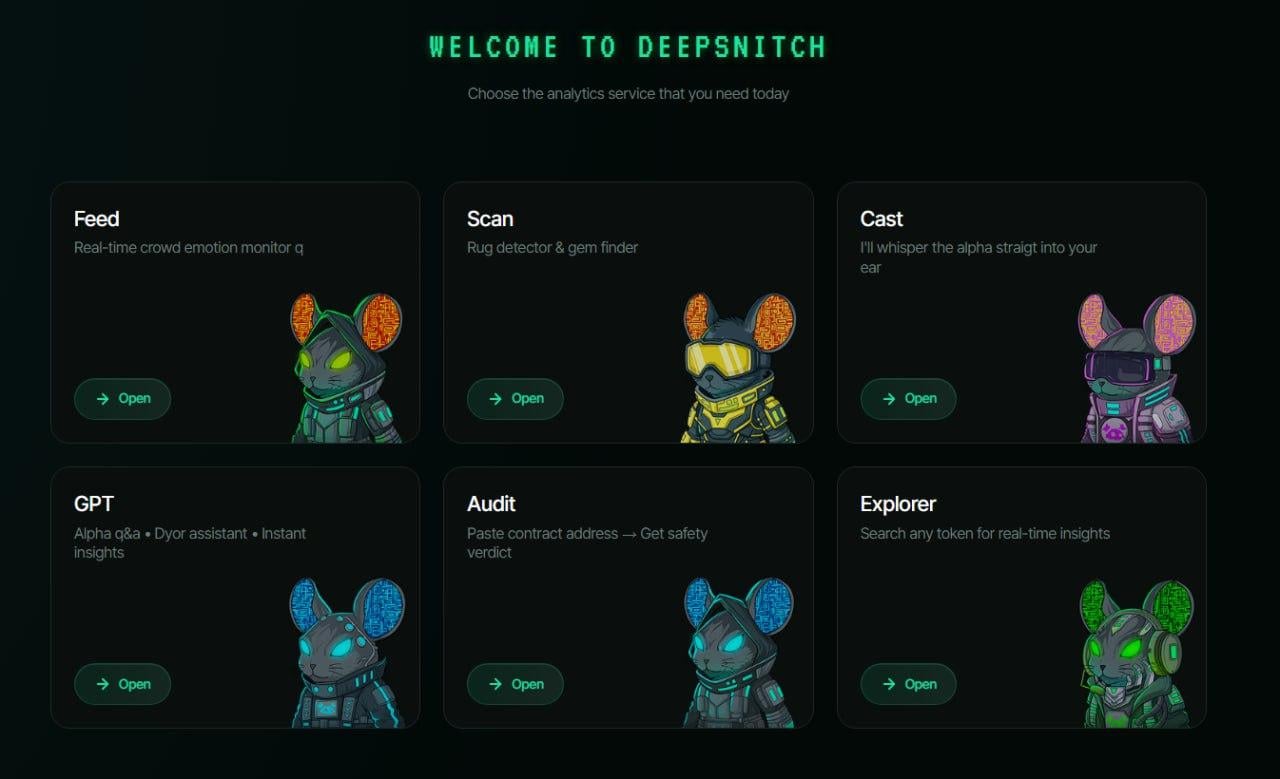
The project has developed a system of AI agents that work as a sort of “investment brain”. They execute specific tasks, but work together in total synergy. As a result, they radically improve DYOR (do-your-own-research) processes and crypto investing for any crypto holder around the world. That’s a market estimated at more than 600 million people.
In business terms, this product/market combination is a recipe for explosive growth. This is already reflected in the presale’s impressive numbers: more than $2 million raised in just 6 stages, despite a still low entry price of $0.04399 (which creates huge upside for price increase).
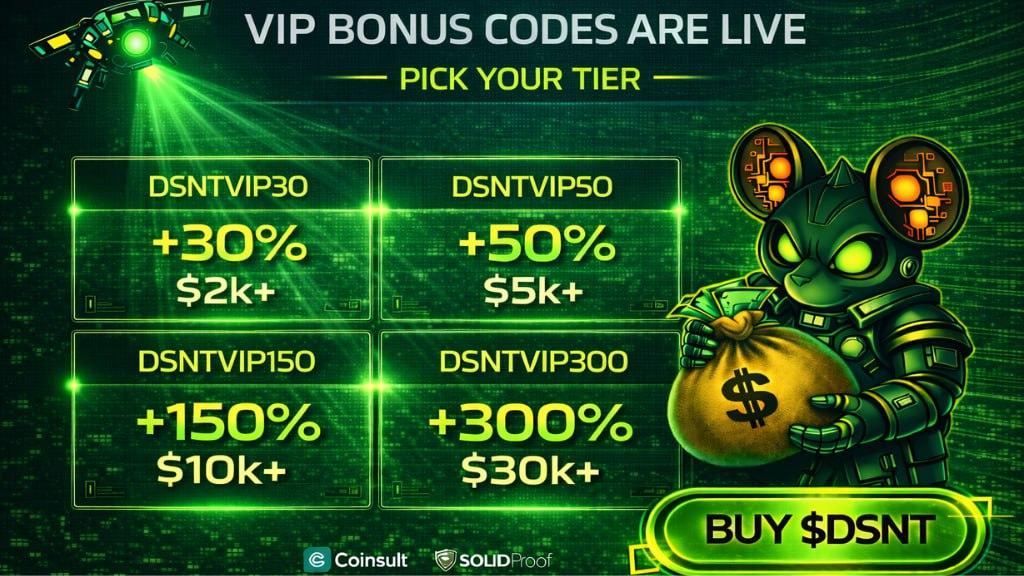
And there is more. A limited-time crypto bonus program is in place, where bonuses of different sizes are given according to the amount of DSNTs purchased. The largest of them is a 300% bonus for a $30k investment. That means a 400x return for a 100x price increase that is now considered a baseline scenario.
No wonder that DeepSnitch AI’s 300% bonus is making many hurry up, given that there are only a few days left for this moonshot.
As the final days of this token presale are passing fast, it’s time to move faster, and invest before this unique opportunity is gone.
2. Render (RENDER)
Render has had a remarkable performance in the last few days. From a $1.34 price on Mar. 6, it rose to $1.57 on Mar. 11, a 5-day 17% gain. The peaks of this soaring trend took place on March 10 and 11, precisely around the time that Oracle was releasing its latest quarterly earnings.
This latest AI push is also helping DeepSnitch AI, at a time when its bonus program is making everyone hurry up, given that there are only a few days left in the presale.
3. Internet Computer (ICP)
As previously mentioned, DeepSnitch AI 300% bonus is a reason to hurry up, with only a few days left until the launch. But another reason to rush is the fact that many AI coins are spiking in March. One of them is ICP.
On Feb. 24, ICP was priced at $2.02. A couple of weeks later, on Mar. 11, it had soared to $2.84. That is a gain of more than 40% that is an example of the ongoing rotation towards AI coins. Since this momentum isn’t giving signs of fading, it is still a good time to bet on ICP.
Conclusion
The DeepSnitch AI bonus program is making a lot of investors hurry up, given that there are only a few days left until the presale ends. This is a once-in-a-lifetime opportunity for exponential returns that is closing very fast.
Only those who invest now and take advantage of the bonuses (30% code: DSNTVIP30, 50% code: DSNTVIP50, 150% code: DSNTVIP150, 300% code: DSNTVIP300) will enjoy outsized growth this year.
Visit the official website to buy into the DeepSnitch AI presale now, and visit X and Telegram for the latest community updates.
FAQs
Why should I rush to buy DeepSnitch AI now?
DeepSnitch AI bonus of 300% is a strong reason to hurry up, since there are only a few days left to take advantage of this unique opportunity. But it isn’t just about the bonus, it’s about the extraordinary growth potential.
What drives DeepSnitch AI’s growth potential
The answer is DeepSnitch AI’s huge target market. With only capturing a tiny fraction of this market, DSNT’s price would sharply spike.
How much of the target market would cause a 100x spike?
The baseline forecast estimates that when DeepSnitch AI reaches 1.45 million users, DSNT will be priced at around $4.5. That is more than 100x its current price.
Disclaimer: This is a Press Release provided by a third party who is responsible for the content. Please conduct your own research before taking any action based on the content.


Cryptio, an accounting and data platform focused on regulated digital assets, has raised $45 million in a Series B funding round, highlighting growing demand for tools that help financial institutions reconcile and report blockchain-based transactions within traditional accounting systems.
The round was co-led by venture firms BlackFin Capital Partners and Sentinel Global, with participation from 1kx, BlueYard Capital, Alven and Ledger Cathay Capital.
Cryptio develops software that helps companies reconcile activity across wallets, custodians and exchanges, translating blockchain transaction data into accounting records used for financial reporting, audits and compliance.
The company says it serves more than 400 enterprise clients and has processed over $3 trillion in transaction volume. Its clients include crypto companies such as Circle, Gemini and Securitize, as well as traditional financial institutions, including Société Générale’s SG-Forge.
Several other companies operate in the same niche as Cryptio, highlighting the emergence of a small but growing market for crypto accounting and financial reporting infrastructure. Companies such as Lukka, TaxBit, Bitwave and CoinLedger offer software that helps businesses reconcile blockchain transactions and convert them into records used for tax reporting, audits and regulatory compliance.
Related: Amid crypto VC shakeout, Dragonfly closes $650M fund with focus on real-world assets
Demand for tokenized finance infrastructure continues to grow
Cryptio’s growth is also being fueled by rising institutional interest in tokenized assets, which require accounting systems capable of recording and reconciling blockchain-based financial activity.
Sidra Pervez, senior vice president at tokenization firm Securitize, said maintaining accurate financial records across capital markets is becoming more important as traditional finance expands into tokenized securities.
Loic Fonteneau, managing director at BlackFin Capital Partners, said “digital assets are becoming embedded within regulated financial markets,” which requires “institutional-grade infrastructure” to support accounting, tokenized asset reporting and lending.
Major financial institutions are increasingly participating in tokenization, with the likes of HSBC, BNP Paribas and Goldman Sachs backing the tokenization-focused Canton Foundation. The industry group supports the development and governance of the Canton Network, a blockchain designed for regulated financial markets.
In January, State Street announced the rollout of a new crypto tokenization tool to help clients create tokenized money market funds, exchange-traded funds and tokenized deposits.

While estimates vary, industry data shows that the total value of tokenized real-world assets, excluding stablecoins, has surpassed $26 billion, with much of the demand coming from private credit and US Treasurys-backed funds.
Other fast-growing segments include tokenized money market funds — blockchain-based versions of traditional funds that invest in short-term government debt and other low-risk securities.


A key technical metric measuring Bitcoin’s value is at its lowest level since the bear market in 2022.
Bitcoin’s MVRV (Market Value to Realized Value) data, which indicates how overvalued or undervalued the asset is relative to its normal “zero-sum game,” is at the same level as late 2022, right after the FTX collapse, Santiment reported on Thursday.
When the 365-day MVRV was oversold and severely negative following the FTX collapse, Bitcoin prices climbed 67% in the following three months, it added.
“This is typical when average returns are significantly below the average value for what is historically expected,” it stated.
However, macroeconomic news and “polarized opinions about Strategy’s aggressive accumulation” have been changing the landscape of cryptocurrency, noted the analysts who concluded that a big move may be ahead.
“When this powerful indicator reveals a divergence we haven’t seen in over 3 years, pay attention.”
A 67% gain from current prices would send BTC back to $116,000, but that is highly unlikely in the current bear market. In fact, analysts believe that there will be months of consolidation before a potential major move in the price.
Early Signs of Stabilization
Glassnode also leaned slightly bullish in its weekly on-chain report, stating “Bitcoin is showing early signs of stabilisation as ETF inflows return and spot demand recovers.”
BTC has been consolidating between $63,000 and $72,500 for over a month, repeatedly failing to hold above $70,000, it noted, adding that the price is sitting between two key levels: the Realized Price at $54,400 as support and the “True Market Mean” which is serving as resistance at $78,400.
There are also some stabilizing signals, including positive inflows for US spot Bitcoin ETFs, spot market buyers beginning to absorb selling pressure, perpetual futures funding turning negative, and options market implied volatility easing, suggesting reduced immediate fear.
You may also like:
“The market appears to be shifting from forced deleveraging toward early stabilisation, with scope for recovery if spot demand continues to build.”
Resilient in the Face of War
Bitcoin is showing early signs of stabilisation as ETF inflows return and spot demand recovers. Negative funding points to crowded shorts, while options vol is easing.
Read the full Week On-Chain👇https://t.co/jPJp9MbNJp pic.twitter.com/jUHoVhTjXo
— glassnode (@glassnode) March 11, 2026
Crypto Market Outlook
Total market capitalization is flat on the day, at the same level as this time yesterday, $2.45 trillion.
Bitcoin topped $71,000 again in late trading in the US, but tanked in the morning Asian session back to $69,400, mirroring yesterday’s trading pattern.
Ether prices are largely unchanged, hovering just above $2,000, while the altcoins remain dormant.
“Crypto sentiment remains weak, and trading volumes are near their lows,” reported 10x Research on Thursday.
Binance Free $600 (CryptoPotato Exclusive): Use this link to register a new account and receive $600 exclusive welcome offer on Binance (full details).
LIMITED OFFER for CryptoPotato readers at Bybit: Use this link to register and open a $500 FREE position on any coin!


A crypto user lost roughly $50 million in a single transaction on Thursday after executing a large token swap that triggered massive slippage.
Blockchain data shows that the wallet attempted to swap $50,432,688 aEthUSDT – an interest-bearing token representing Tether’s USDT stablecoin deposited into the Aave decentralized lending protocol on the Ethereum network – for aEthAAVE – similar version of Aave governance tokens – through the CoW Protocol.
The transaction executed with more than 99% slippage due to thin liquidity in the relevant trading pools, leaving the wallet with only about 327 aEthAAVE tokens, worth roughly $36,000 after the trade. The difference of the value was quickly captured by arbitrage traders and network intermediaries.
Large losses caused by slippage occasionally occur in decentralized finance (DeFi) when traders attempt to execute unusually large orders against shallow liquidity pools. In such cases, automated arbitrage systems rapidly exploit the price dislocations created by the trade.
Stani Kulechov, founder of the Aave protocol, said the trade went through despite multiple warnings presented to the user before confirming the transaction.
“Earlier today, a user attempted to buy AAVE using $50M USDT through the Aave interface,” Kulechov said in an X post. “Given the unusually large size of the single order, the interface warned the user about extraordinary slippage and required confirmation via a checkbox.”
According to Kulechov, the user accepted the warning on their mobile device and proceeded with the trade, explicitly acknowledging the risk of high slippage.
“The transaction could not be moved forward without the user explicitly accepting the risk,” he said, adding that the CoW Swap routers functioned as intended and followed standard industry practices.
Still, the outcome was “clearly far from optimal,” Kulechov said.
Kulechov said Aave plans to contact the affected user and return roughly $600,000 in fees collected from the transaction.
The loss comes just few days after about $27 million was liquidated on Aave, in what some market participants say may have been caused by a temporary pricing issue involving the token wstETH.
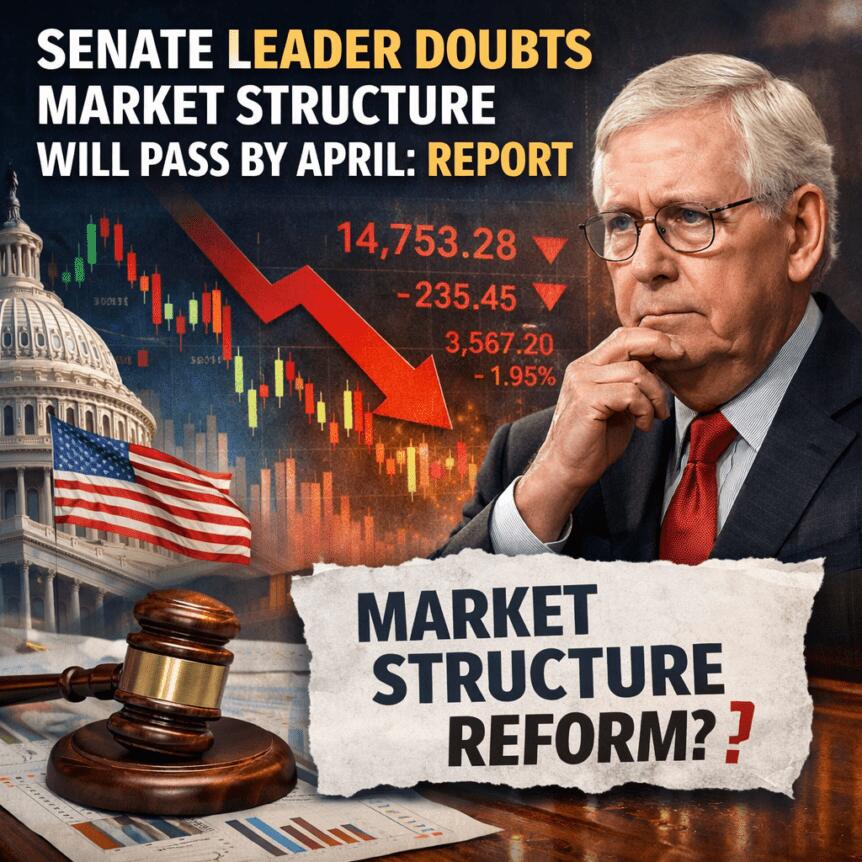
Regulatory dynamics in Washington are once again taking center stage for crypto markets. Senate Majority Leader John Thune indicated he does not expect the chamber to advance digital asset market structure legislation before April, shifting focus instead to partisan and bipartisan priorities that could influence how crypto is overseen in the years ahead. The development underscores a persistent theme: while lawmakers talk about bringing clarity to the sector, procedural hurdles and competing political priorities are likely to dictate the pace of progress. In the near term, Thune signaled that the SAVE America Act, a voter-ID proposal, would move first, with the market-structure bill following afterward as part of a broader legislative agenda.
Thune’s remarks, reported by Punchbowl News, frame a timetable in which a separate, widely watched market structure bill—often discussed under the CLARITY Act umbrella in various forms—may not reach a floor vote until at least the April window. The senator said the bill could emerge from the Banking Committee soon, but a concrete floor timetable remained unclear. The discrepancy with alternative expectations from other lawmakers reflects the Senate’s broader struggle to reconcile diverse viewpoints on how digital assets should be regulated, how tokenized securities and stablecoins should be treated, and what kind of ethics standards should govern market participants.
The dynamic is complicated by competing political statements within the Senate. Ohio Senator Bernie Moreno, for instance, had suggested in February that market structure could advance in April, contrasting with Thune’s more cautious timeline. The Senate Agriculture Committee has moved its parallel version of the bill forward, but a crucial January markup — a procedural step needed to assemble the legislation for a floor vote — faced delays in the Senate Banking Committee. The result is a foggy path to a unified framework that can command bipartisan support and clear regulatory authority for the key markets and products involved.
In parallel with the market-structure debate, the Senate took up a housing bill amendment aimed at halting a central bank digital currency (CBDC). If the provision passes and becomes law, the CBDC prohibition would be active through December 2030. The amendment’s inclusion in the 21st Century Road to Housing Act has underscored how digital currency policy can intersect with broader economic policy, potentially affecting how central-bank innovations are evaluated and deployed. The CBDC ban is a notable flashpoint, illustrating the high-stakes nature of regulatory choices around digital currencies and the Fed’s potential role in a future payments landscape.
What’s at stake in the market structure bill?
The market structure bill has long been framed as a way to grant the U.S. Commodity Futures Trading Commission (CFTC) broader oversight over digital assets, derivatives, and related markets. Its supporters argue that a clear regulatory framework would reduce ambiguity and improve investor protections, while critics warn of overreach that could hinder innovation and create compliance costs for startups and incumbents alike. In committee discussions, questions have centered on tokenized equities, ethics provisions, and stablecoin yield, all areas where lawmakers have expressed concerns about consumer protections, market fairness, and operational risk.
President Trump recently accused banks of holding the bill hostage, signaling that the interplay between industry stakeholders and policymakers remains volatile. The White House has hosted three meetings between crypto and banking representatives, but as of the latest reports, there was no consensus to move the market-structure package forward. The tension between executive priorities and congressional schedules has helped keep the sector’s regulatory outlook in a state of flux, with market participants watching for any sign of a breakthrough or a further stalemate.
The debate also touches on the broader question of how the United States should balance innovation with oversight. Industry participants have argued for a framework that supports responsible growth and investor protection, including clearer definitions of digital assets, guidance on tokenization, and robust safeguards around stablecoins. Lawmakers, meanwhile, are weighing how to tailor regulatory authority across agencies and how to harmonize federal standards with state-level initiatives. The CLARITY Act, which previously cleared the House in July, remains a reference point in discussions about a comprehensive regime, even as Senate negotiators press for amendments that satisfy both sides.
Why it matters
For crypto users and investors, the Senate’s pace on market structure legislation translates into a longer horizon for regulatory clarity. A clear, well-structured framework can reduce execution risk, improve market integrity, and help traditional financial institutions weigh crypto exposure with more confidence. Conversely, further delays or a lack of consensus could perpetuate a climate of regulatory ambiguity, potentially dampening liquidity as market participants delay product launches, listings, or innovative offerings until a stable path forward emerges. The CBDC debate adds another layer of strategic risk, given the potential implications for how digital currencies could coexist with private-sector options and decentralized finance ecosystems.
Beyond traders and exchanges, the outcome will influence builders—startups, liquidity providers, and infrastructure developers—who rely on predictable, transparent rules to design and deploy products. A mature policy framework could spur experimentation in areas such as tokenized assets, cross-border settlement, and compliant custody solutions, while a protracted deadlock might incentivize players to relocate parts of their operations to more certain regulatory environments. For policymakers, the challenge is to craft rules that protect consumers and investors without stifling innovation or driving capital offshore. The current debate underscores the extent to which digital asset markets have become a partisan issue, even as they attract bipartisan attention due to consumer demand, market dynamics, and competitive considerations in a rapidly evolving financial landscape.
What to watch next
- Next week: the SAVE America Act advances to the floor, potentially shifting parliamentary attention away from market structure temporarily.
- February–April window: the Banking Committee’s markups and the timing of a formal clause-by-clause path for the market structure bill remain uncertain.
- CBDC-related provisions: tracking whether amendments to the housing bill gain support and whether the CBDC prohibition remains in force through 2030.
- Committee dynamics: observers will monitor whether tokenization, ethics standards, and stablecoins gain clearer language in subsequent drafts.
Sources & verification
- Punchbowl News: Report on Thune’s comments and the scheduling of the SAVE America Act and market structure bill (https://punchbowl.news/article/finance/economy/housing-bill-drama/).
- CNBC: Article on Trump and the SAVE America Act and Senate discussions (https://www.cnbc.com/2026/03/12/trump-save-america-act-senate-2026-elections.html).
- Cointelegraph: Discussion of the Crypto US Clarity Act andBernie Moreno’s stance (https://cointelegraph.com/news/crypto-us-clarity-act-coinbase-brian-armstrong-bernie-moreno).
- Cointelegraph: Report on the CBDC ban amendment and its housing-bill context (https://cointelegraph.com/news/us-senate-votes-cbdc-ban-amendment).
Market reaction and key details
The stalled momentum around a comprehensive crypto market-structure package reflects a broader liquidity and risk sentiment environment shaped by regulatory uncertainty. While there is bipartisan interest in providing clarity for digital assets, the pathway remains obstructed by deeply held views on how to address tokenized equities, stablecoins, and governance ethics. The Senate’s focus on the SAVE America Act signals a prioritization of voter policy matters that can affect election dynamics and, by extension, fiscal and regulatory discourse around crypto. With the House’s CLARITY Act version already cleared in the prior session, senators are weighing how to reconcile differences that can affect enforcement, investor protections, and the scope of oversight for automated trading and derivatives markets tied to digital assets.
As the White House hosts meetings between crypto and banking representatives, the absence of a final accord demonstrates the complexity of achieving cross-cutting reforms that satisfy diverse stakeholders—from consumer advocates to financial incumbents. In practical terms, a protracted process could keep certain crypto products in a regulatory limbo, delaying new product launches or exchange listings that hinge on definitive compliance standards. However, even amid delays, the policy conversation remains a catalyst for price discovery, risk assessment, and strategic planning within the broader crypto ecosystem, where participants continuously weigh regulatory signals against market fundamentals.
In the background, the CBDC amendment to the housing bill adds a distinct dimension to policy debates: it embodies the current administration’s stance on central bank money and its potential implications for competition, financial stability, and monetary policy. Should the amendment persist through legislative scrutiny, it would send a clear message about the boundaries of central-bank digital currencies in the United States, at least through the 2030 horizon, while leaving room for private-sector innovation in digital payments. The evolving picture invites market participants to monitor not only committee votes and floor debates but also executive-branch messaging and regulatory posture as the year advances.
What to watch next
- Tracking the SAVE America Act’s progress in the Senate and any scheduling moves that could affect the crypto market-structure debate.
- Updates on the Banking Committee’s markup timeline for market structure legislation and whether a compromise emerges before April.
- Signals on CBDC-related amendments within the housing bill and potential implications for digital currency policy.


The TradFi giant’s iShares Staked Ethereum Trust ETF is its first yield-bearing exchange-traded product.
BlackRock today debuted the iShares Staked Ethereum Trust ETF (Nasdaq: ETHB) — the firm’s first crypto exchange-traded fund to incorporate staking and its third spot crypto ETF overall.
In a press release from BlackRock today, March 12, the world’s largest asset manager, with $14 trillion in AUM, said that ETHB will stake “a portion of its ether holdings.” Per the asset manager’s dedicated webpage for the fund, Coinbase Prime will provide ETH custody — and presumably staking services.
The Defiant first reported when BlackRock registered its staked Ethereum ETF last November, which came about four months after the U.S. Securities and Exchange Commission (SEC) acknowledged BlackRock’s filing to permit staking in its Ethereum ETFs.
ETHB is BlackRock’s first yield-bearing ETF, though it’s not first to market among staked ETH funds in the U.S. REX-Osprey launched ESK — the first U.S. staked ETH ETF, under the 1940 Act — in September 2025, and Grayscale enabled staking on its ETH and SOL products in October, as The Defiant reported.
The broader push dates back to March of last year, when Cboe proposed adding staking to existing Ethereum ETFs.
BlackRock is the dominant crypto ETF issuer by net assets across both its spot ETH and BTC ETFs. The firm’s spot Ethereum ETF, ETHA, holds just under $6.6 billion in net assets as of March 11, per data from SoSoValue. That represents more than 50% of the U.S. Ethereum ETF market, which currently stands at $11.85 billion.
Among spot Bitcoin ETFs, BlackRock’s IBIT commands over $55 billion — also well over half of the $90.89 billion in total net assets across all spot BTC ETFs trading in the U.S., per SoSoValue.
After a multi-day net outflow streak, Ethereum ETFs saw net inflows over the past two trading days, recording over $57 million in inflows yesterday, March 11.
Meanwhile, today, spot ETH is trading just over $2,060 at publishing time, per data from The Defiant’s price tracker.
Despite ETH stagnating in a tight range in recent months, the amount of ETH staked on the network continues to break new highs, reaching over 37.6 million ETH as of March 11.
This article was written with the assistance of AI workflows. All our stories are curated, edited and fact-checked by a human.
Executives at Coinbase have denied allegations that the crypto exchange is blocking a de minimis tax exemption for Bitcoin (BTC) transactions below a certain threshold to push for stablecoin tax exemptions.
Several Bitcoin advocates speculated on social media that the exchange told US lawmakers that a BTC tax exemption is not needed because BTC is not widely used as a medium of exchange.
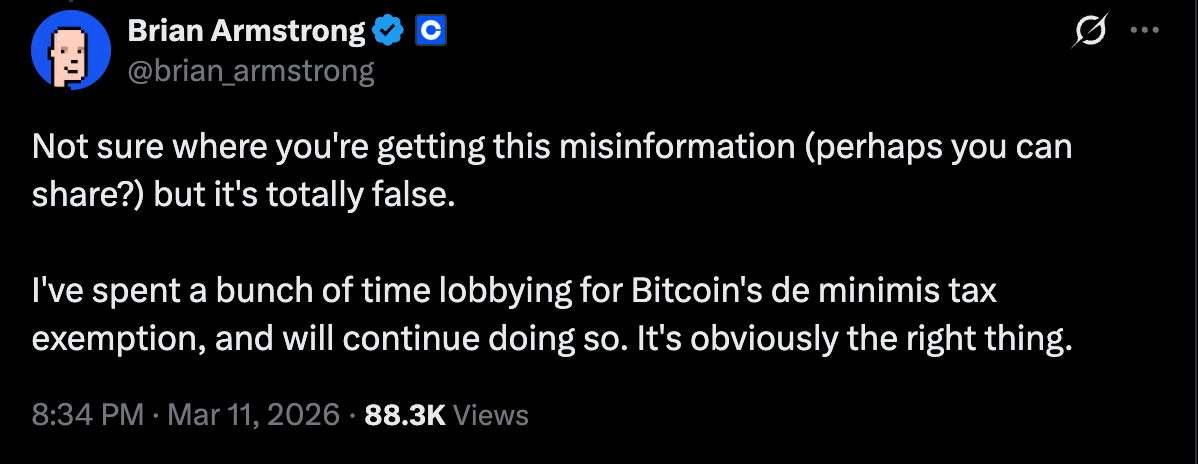
Coinbase CEO Brian Armstrong responded by calling the allegations “totally false” and a form of misinformation.
“I’ve spent a bunch of time lobbying for Bitcoin’s de minimis tax exemption, and will continue doing so. It’s obviously the right thing,” he said.

In separate posts, Paul Grewal, chief legal officer at Coinbase, said, “We’ve never lobbied against BTC,” while Faryar Shirzad, the crypto exchange’s chief policy officer, echoed the statement.
Cointelegraph reached out to Coinbase, but the company declined to comment beyond the responses made by its executives.
Tax policy is one of the main impediments to Bitcoin’s use as a payment method, according to advocates for the biggest crypto, as every sale or transfer would trigger a taxable event, prohibiting its use as an electronic cash system.
Related: Wyoming Senator revives crypto tax exemption debate amid market structure talks
BTC advocates and pro-crypto lawmakers push for BTC tax exemption
In July 2025, US Senator Cynthia Lummis introduced a bill proposing a de minimis tax exemption for cryptocurrency transactions of $300 or less, with a $5,000 annual exemption cap.
However, the bill failed to gain traction, and the de minimis exemption for BTC transactions is not included in the CLARITY Act draft legislation, according to advocacy group the Bitcoin Policy Institute.
Instead, the tax exemption will apply only to US dollar-pegged stablecoins, according to Conner Brown, the managing director for the Bitcoin Policy Institute.
Washington, DC-based crypto advocacy group Blockchain Association also outlined a crypto tax proposal and submitted the plan to US lawmakers in February.

The proposal called for exemptions on “low-dollar” crypto transactions, but did not specify a dollar amount.
“A meaningful de minimis exemption for digital asset transactions would eliminate disproportionately onerous reporting for individual taxpayers,” the proposal said.
Magazine: Bitcoin is ‘funny internet money’ during a crisis: Tezos co-founder


The European Union’s recently-adopted Markets in Crypto Assets (MiCA) regulations is beginning to reshape the region’s digital-asset industry, creating new opportunities and barriers for firms seeking to operate across the bloc, a Swiss-based crypto wealth platform said.
Swissborg, which boasts one million registered users and $1.3 billion in assets under management (AUM), is among the companies betting that the shift will strengthen Europe’s role in regulated digital-asset markets after securing its MiCA license.
“The economics of crypto brokerage can be challenging during softer market cycles, and some global platforms may reassess where they allocate capital and operational resources,” SwissBorg Chief Operating Officer Jeremy Baumann told CoinDesk.
Over time, that could lead to “a market composed of fewer but more resilient players. MiCA raises the regulatory and operational standards required to serve European clients, which may reduce the number of lightly structured players,” he said, referring to Gemini’s recent EU exit.
Baumann also said that when global exchanges reduce their presence in the EU, “it opens space up for other European players to strengthen their positioning.”
SwissBorg suffered an exploit it said affected fewer than 1% of its users in September 2025. It reported 192,600 SOL ($41.5 million) was stolen from an external wallet used exclusively for its SOL Earn strategy. The exploit stemmed from a partner’s compromised application programming interface (API) and not a hack of the SwissBorg platform, they claimed.
The evolution of yield and staking
Baumann said he expects yield and staking products to evolve toward clearer disclosures, stronger risk management and more standardized structures.
“The framework around stablecoins is more detailed and will shape how certain yield models are designed and distributed,” said Baumann, whose mid-level exchange currently has roughly $800 million in total value locked (TVL), according to Defilama data.
Baumann also said regulatory clarity could gradually support greater institutional participation, adding that for now the European digital-asset market remains largely retail-driven
“Traditional financial institutions can play all three roles,” Baumann said. “They have strong distribution capabilities and regulatory expertise, which naturally makes them competitors in some areas, but there are also opportunities for partnerships.”
EU regulators seek clear stablecoin rules
Baumann also pointed to ongoing policy debates around stablecoins and yield products. While much of that discussion is currently centered in the United States, European regulators are focusing primarily on defining clear rules around issuance, reserves and distribution.
“As the market matures, yield solutions are likely to evolve toward more transparent and better structured models that balance innovation with financial stability,” he said.
SwissBorg sought authorization in France, which is widely viewed as one of Europe’s stricter regulatory jurisdictions. The approval validates the company’s internal controls, risk management systems and safeguards for user assets, according to the firm.
The company plans to migrate its European operations from its current Estonian entity to the newly authorized French crypto-asset service provider (CASP) entity in the coming months once operational readiness is confirmed, initially targeting major crypto markets including Germany, the Netherlands, Italy and Spain.


Goldman Sachs has delayed its prediction for the first Federal Reserve rate cut to September 2026, potentially putting pressure on the crypto market.
Summary
- Goldman Sachs now expects the first Fed rate cut in September 2026, later than its earlier June forecast.
- Inflation forecasts were raised, with headline PCE seen reaching 2.9% by the end of 2026.
- Higher-for-longer rates could pressure the crypto market, as tighter liquidity often weighs on risk assets like Bitcoin.
Goldman Sachs has pushed back its forecast for when the Federal Reserve could begin cutting interest rates, warning that rising inflation risks tied to oil prices and geopolitical tensions may delay monetary easing.
In a note released on March 12, the investment bank said it now expects the first 25-basis-point rate cut in September 2026, followed by another reduction in December. Earlier projections had placed the first cut in June.
The revised outlook comes as financial markets remain uneasy about the economic impact of the ongoing conflict between the U.S. and Iran, which has raised fears of supply disruptions in global oil markets.
Inflation forecasts move higher
Goldman also raised its inflation expectations for 2026. The bank now sees headline PCE inflation reaching 2.9% by the end of the year, an upward revision of 0.8 percentage points. Core PCE inflation is projected to rise to 2.4%, while the forecast for U.S. GDP growth was trimmed to 2.2%.
Higher energy prices are the main driver of the shift. The bank now expects Brent crude to average around $98 per barrel in March and April, roughly 40% above the 2025 average. In a scenario where disruptions in the Strait of Hormuz last for a month, prices could climb above $110 per barrel.
Goldman estimates that a 10% increase in oil prices could push headline inflation up by about 0.2 percentage points.
At the same time, the firm pointed to signs of a gradually softening labor market. If employment conditions weaken more quickly than expected, earlier rate cuts could still happen, analysts said.
Traders currently assign roughly a 41% probability to a September rate cut.
What delayed rate cuts could mean for crypto
Shifts in interest-rate expectations often ripple through the digital asset sector. Cryptocurrencies such as Bitcoin and Ethereum tend to perform best when financial conditions are loosening and liquidity is expanding.
A later start to the easing cycle suggests that borrowing costs could stay higher for longer. That environment typically weighs on risk-sensitive assets, including the broader crypto market.
Stronger inflation expectations can also reduce investor appetite for speculative investments. In past cycles, digital assets have often reacted to macroeconomic news in ways similar to technology stocks.
Goldman has also pointed to geopolitical risks as a growing macro factor. Oil supply shocks, the bank said, could feed inflation and keep monetary policy tighter than markets previously expected.
Macro risks remain in focus
Short-term volatility could remain elevated if inflation readings or energy prices continue to surprise on the upside. Rising oil costs tend to filter through to consumer prices over time, which could complicate the Fed’s policy path.
However, the longer-term outlook is less certain. Goldman’s base case still expects oil prices to ease toward about $71 per barrel by late 2026, which could reduce inflation pressure and re-open the door to faster monetary easing.
For the crypto market, the key variables to watch in the coming months will likely include inflation data, energy prices, and signals from the Federal Reserve about the timing of rate cuts.

Man suffered broken skull in ‘large scale’ town centre fight
Form 4 Tripadvisor Inc For: 12 March
Kyler Murray Is Here But There’s a Catch


-
Business6 days ago
Form 8K Entergy Mississippi LLC For: 6 March
-

 News Videos4 days ago
10th Algebra | Financial Planning | Question Bank Solution | Board Exam 2026
-

 Fashion6 days ago
Weekend Open Thread: Ann Taylor
-

 Crypto World3 days ago
Paradigm, a16z, Winklevoss Capital, Balaji Srinivasan among investors in ZODL
-
 Tech2 days ago
A 1,300-Pound NASA Spacecraft To Re-Enter Earth’s Atmosphere
-

 Tech2 days ago
ChatGPT will now generate interactive visuals to help you with math and science concepts
-

 Politics7 days ago
Top Mamdani aide takes progressive project to the UK
-

 Business2 days ago
ExxonMobil seeks to move corporate registration from New Jersey to Texas
-

 Sports5 days ago
Three share 2-shot lead entering final round in Hong Kong
-

 Sports5 days ago
Braveheart Lakshya downs Lai in epic battle to enter All England Open final | Other Sports News
-

 NewsBeat1 day ago
Residents reaction as Shildon murder probe enters second day
-

 Entertainment6 days ago
Hailey Bieber Poses For Sexy Selfies In New Luscious Lip Thirst Traps
-

 Business4 days ago
Search for Nancy Guthrie Enters 37th Day as FBI Probes Wi-Fi Jammer Theory
-

 Business2 days ago
Search Enters Sixth Week With New Leads in Tucson Abduction Case
-
 NewsBeat3 days ago
Pagazzi Lighting enters administration as 70 jobs lost and 11 stores close across Scotland
-

 Tech3 days ago
Despite challenges, Ireland sixth in EU for board gender diversity
-

 Business3 days ago
Search Enters 39th Day with FBI Tip Line Developments and No Major Breakthroughs
-

 NewsBeat1 day ago
I Entered The Manosphere. Nothing Could Prepare Me For What I Found.
-

 Business6 days ago
Iran war enters second week as Trump demands ’unconditional surrender’
-

 Sports4 days ago
Skateboarding World Championships: Britain’s Sky Brown wins park gold