

Crypto World
A New Staked Ether ETF for Yield-Seeking Investors (Report)


The financial vehicle will begin trading on Nasdaq today under the ticker ETHB.
Nearly two years since the debut of the traditional exchange-traded funds tracking the performance of the largest altcoin, the world’s biggest asset manager is reportedly launching a staking version on Nasdaq today.
BlackRock’s iShares Staked Ethereum Trust ETF (ETHB) will hold spot ETH and stake a portion of the AuM to benefit from staking rewards.
According to the report, ETHB will be BlackRock’s first and only cryptocurrency fund incorporating staking rewards alongside spot exposure.
Consequently, the asset manager will now have three spot crypto ETFs after the debut of IBIT in January 2024 and ETHA six months later. Both spot ETFs tracking the two largest cryptocurrencies are the leaders in their highly competitive markets, with AuM of over $55 billion for IBIT and $6.5 billion for ETHA.
ETHB will stake a portion of the ether holdings on the Ethereum network, which will allow it to potentially generate additional yield through staking rewards while still tracking the asset’s market price.
Jay Jacobs, BlackRock’s US head of equity ETFs, commented on the new product, indicating that it’s “really about investor choice,” before he added:
“While ETHA has developed liquidity and a growing derivatives market, some investors are focused on maximizing total returns by combining ether price exposure with staking rewards.”
After Ethereum’s merge from proof of work to proof of stake, the network allows ether holders to lock the asset up to help validate transactions and secure the blockchain. They receive rewards for their participation in the form of a feature similar to yield in traditional finance.
You may also like:
Jacobs further noted that certain investors who already hold ETH directly were staking it and weren’t ready to move into an ETF because they would lose that possibility. Now, though, ETHB will allow them to “keep the benefits of staking while gaining the operational advantages of an ETF structure.”
All Ethereum ETFs have attracted more than $11.6 billion in cumulative net inflows since their debut in July 2024. That figure is down from the early October 2025 all-time high of more than $15 billion.
Binance Free $600 (CryptoPotato Exclusive): Use this link to register a new account and receive $600 exclusive welcome offer on Binance (full details).
LIMITED OFFER for CryptoPotato readers at Bybit: Use this link to register and open a $500 FREE position on any coin!


BlackRock’s entry into staking-focused crypto exposure took a visible step onto the trading floor as the iShares Staked Ethereum Trust ETF (ETHB) opened for trading, reflecting demand for Ethereum (CRYPTO: ETH) exposure. On its first day, the ETF logged about $15.5 million in turnover as 592,804 shares changed hands, according to Nasdaq data, a showing market watchers described as “very, very solid” for a product in a nascent segment. The early data underline investors’ continued curiosity about crypto-native yield strategies, even as Solana (CRYPTO: SOL)–linked staking funds drew higher launch-day volumes on earlier, comparable rolls to market.
Key takeaways
- ETHB debuted with roughly $15.5 million in trading volume and 592,804 shares traded on day one, signaling meaningful liquidity for a new staking ETF.
- The fund stakes Ether (CRYPTO: ETH) and follows a structure of 80% staked ETH and 20% ETH, distributing staking rewards monthly and targeting an approximate 4% annual yield.
- Initial net assets totaled about $106.7 million, with custody handled by Coinbase, and a sponsor fee of 0.25% that is waived for the first year, effectively reducing the fee to 0.12% on the first $2.5 billion of assets under management (AUM).
- ETHB sits alongside BlackRock’s flagship crypto ETFs, including IBIT and ETHA, which have drawn substantial inflows since their 2024 launches.
- Industry comparisons show Solana staking ETFs attracting larger debut volumes historically, highlighting continued appetite for different blockchain staking avenues within institutional portfolios.
- BlackRock is considering additional yield-focused crypto strategies, such as a Bitcoin Premium Income ETF that would write covered calls on Bitcoin futures to harvest premiums.
Tickers mentioned: $ETH, $SOL, $BSOL, $SSK, $IBIT, $ETHA, ETHB
Sentiment: Neutral
Market context: The early reception of ETHB fits into a broader trend of growing institutional interest in crypto-native yield products. While ETHB’s debut volume is solid, it sits in a landscape where competing staking ETFs tied to Solana, such as the Bitwise Solana Staking ETF (BSOL) and the REX-Osprey SOL + Staking ETF (SSK), have previously posted higher first-day volumes, underscoring a diversified appetite for staking across chains. Inflows to BlackRock’s other staking vehicles have been substantial, reflecting a shift toward regulated vehicles that aim to capture staking rewards while offering on-exchange tradability.
Why it matters
The ETHB debut matters because it marks another step in the normalization of crypto yield strategies within traditional markets. By combining the right to staking rewards with share-backed liquidity, ETHB provides a way for investors to gain exposure to Ethereum’s network security economics without directly managing keys or staking infrastructure. The fund is anchored by a custody arrangement with Coinbase and relies on established validators to harvest rewards, illustrating a bridge between decentralized finance mechanics and regulated, payer-friendly investment vehicles.
From a product-design perspective, ETHB’s framework—80% staked ETH and 20% ETH with monthly reward distributions—highlights how fund sponsors translate the economics of on-chain participation into a familiar, regulated wrapper. The yield, typically around 4% annually, is derived from validators’ rewards captured by the network, and the ongoing distributions are sourced from the on-chain activity rather than traditional interest payments. This model is appealing to yield-seeking investors in a landscape where direct staking requires technical know-how and custody considerations. The introduction of ETHB also reinforces BlackRock’s broader crypto strategy, which already includes the iShares Bitcoin Trust ETF (IBIT) and iShares Ethereum Trust ETF (ETHA), expanding the firm’s footprint in regulated crypto exposure.
Industry observers note that ETHB’s arrival comes with a premium on investor education. Unlike outright spot exposure, staking adds a layer of blockchain mechanics—validators, network uptime, and protocol changes—that influence returns and risk. While monthly distributions provide predictable income, the sustainability of yields depends on network health and validator performance. The fund’s distribution arrangement, with a sponsor fee and a one-year waiver, is a practical incentive that can help attract assets during the early phase, though potential investors will still weigh management fees against expected yield, custody risk, and regulatory clarity.
Market dynamics around staking ETFs continue to evolve. The historical trajectory of staking products demonstrates a spectrum of performance across chains: SOL-based vehicles have frequently posted higher debut volumes, reflecting a strong interest in Solana’s ecosystem despite Ethereum’s larger market footprint. The Bitwise Solana Staking ETF (BSOL) logged about $55.4 million in debut volume in October, while the REX-Osprey SOL + Staking ETF (SSK) reached $33.7 million on its own rollout. These comparisons help place ETHB within a broader context of diversified staking choices rather than a single, monolithic demand for crypto yield products.
Beyond ETHB, BlackRock’s ongoing product strategy includes exploration of additional yield-oriented vehicles. The firm has signaled work on a Bitcoin Premium Income ETF, which would sell covered calls on Bitcoin futures to generate premium income for investors. While the bet on premium income is not guaranteed, the initiative reflects a broader push to monetize different facets of crypto markets through traditional fund formats. Investors are watching not only the performance of ETHB but also how these strategies will integrate with regulatory expectations and market liquidity in a shifting macro environment.
In practical terms, ETHB’s onboarding of assets, including its $106.7 million net assets at launch and a custody agreement with Coinbase, sets a measurable baseline for the product’s early phase. The ongoing flow of staking rewards will be distributed monthly, providing a tangible cash-like component to holders while the underlying staking rewards accrue from Ethereum validators operated by industry players such as Figment, Galaxy Digital, and Attestant (Bitwise-owned). The evolving policy landscape, coupled with Center for Markets and competition among staking ETFs, will shape ETHB’s ability to attract new capital and sustain a steady yield narrative for investors seeking regulated access to on-chain rewards.
With ETHB now trading alongside traditional equity-like vehicles, market participants will be closely watching asset flows, validator performance, and fee dynamics. The fund’s sponsor fee sits at 0.25%, with a one-year waiver in place—an arrangement designed to accelerate early adoption and AUM growth. If inflows accelerate, ETHB could begin to realize economies of scale that further reduce costs for investors as the first year unfolds, potentially widening exposure to other staking products within BlackRock’s ecosystem. The interplay between on-chain economics and on-exchange liquidity will be a barometer for the maturation of staking ETFs as a credible allocation choice for institutional and retail investors alike.
In summary, ETHB’s debut offers a clear signal: regulated, yield-oriented crypto exposure is increasingly part of mainstream portfolios. While the exact path of liquidity and yields remains subject to network dynamics and fees, the initial numbers suggest real investor interest in staking-native products that blend crypto technology with traditional fund structures. As the space matures, ETHB and its peers will continue to test the balance between on-chain economics, custody risk, and the demand for simplified, regulated access to cryptocurrency staking yields.
What to watch next
- Monthly staking reward distributions begin or continue as expected, with yield variability tied to validator performance.
- Assets under management (AUM) evolve toward the $2.5–$5.0 billion range; watch fee structures for future adjustments beyond the initial waiver.
- Inflows to BlackRock’s crypto ETF lineup (IBIT, ETHA) persist, indicating sustained institutional interest.
- Any regulatory or structural updates related to staking ETFs, including potential changes to tax or custody requirements.
- Progress on the Bitcoin Premium Income ETF and how it compares to ETHB in terms of yield generation and risk.
Sources & verification
- Nasdaq data for ETHB debut trading activity: https://www.nasdaq.com/market-activity/stocks/ethb
- iShares Staked Ethereum Trust (ETHB) exposure and yield discussion: https://cointelegraph.com/news/blackrock-ishares-staked-ethereum-trust-etf-exposure-yield
- Solana staking ETF debut comparisons: https://cointelegraph.com/news/bitwise-solana-staking-etf-55-million-debut-trading-volume
- Eric Balchunas-related data on SSK and market commentary: https://x.com/EricBalchunas/status/1940516260875514325
- Bitwise Attestant staking involvement: https://cointelegraph.com/news/bitwise-acquires-attestant-ethereum-staking
- ETHB custody and asset details; Coinbase as custodian: https://www.blackrock.com/us/individual/products/348532/ishares-staked-ethereum-trust-etf
- Bitcoin Premium Income ETF concept: https://cointelegraph.com/news/blackrock-files-for-bitcoin-premium-income-etf
- Farside data on inflows for BTC/ETH ETFs: https://farside.co.uk/btc/ and https://farside.co.uk/eth/
Market reaction and key details
BlackRock’s iShares Staked Ethereum Trust ETF, ETHB, opened for trading with visible liquidity, drawing about $15.5 million in turnover on its first day as 592,804 shares moved hands, per Nasdaq. The momentum signals growing institutional curiosity about staking-backed products that blend on-chain economics with a familiar, regulated wrapper. In the trade press, the debut was described as “very, very solid” for a first-day ETF launch, a sentiment echoed by analysts tracking the space. The first-day performance underscores a broader trend toward regulated exposure to crypto yields, even as the market remains cautious about liquidity flows across different networks.
ETHB’s structure matters for readers watching the evolution of staking-based investments. The fund allocates 80% to staked Ether and 20% to Ether, and it distributes staking rewards on a monthly cadence. The approach surfaces a tangible yield, typically around 4% annually, with rewards captured by Ethereum network validators operated by firms like Figment, Galaxy Digital, and Bitwise-owned Attestant. The on-chain activity translates into on-exchange income for fund holders, bridging the gap between the DeFi mechanics that drive staking and the traditional investment experience.
From a product-design perspective, ETHB’s fee arrangement provides a practical incentive to attract assets early on. The sponsor fee sits at 0.25%, but there is a one-year waiver that reduces the effective fee to 0.12% on the first $2.5 billion of AUM. This pricing strategy is meant to spur initial adoption while offering a reference point for fee pressure as assets scale. The ETF’s net assets at launch, reported around $106.7 million, reflect a meaningful tranche of early capital that could help catalyze a broader ecosystem of staking-related funds under BlackRock’s umbrella, including IBIT and ETHA, which have collectively drawn substantial inflows since 2024.
The broader market context matters for ETHB’s trajectory. The same period has featured a comparative landscape where staking ETFs linked to Solana attracted higher debut volumes, illustrating a diverse investor appetite across different blockchain ecosystems. The Bitwise Solana Staking ETF (BSOL) posted about $55.4 million on its debut, and the REX-Osprey SOL + Staking ETF (SSK) reached $33.7 million on its own rollout, highlighting that multiple pathways exist for institutional participants to access on-chain yield. This competition underscores that ETHB’s success will hinge on continued liquidity, predictable distributions, and the alignment of on-chain rewards with investors’ expectations for regulated vehicles.
Another dimension shaping ETHB’s path is BlackRock’s broader crypto ETF strategy. The company has signaled its interest in a Bitcoin Premium Income ETF, which would monetize yield through covered call options on Bitcoin futures. While still exploratory, the concept signals a move toward yield-oriented crypto products that seek to harvest option premiums in addition to staking-derived rewards. Investors will be watching how this suite of products evolves, how regulatory clarity shapes launches, and how inflows into ETHB’s peers influence the entire staking ETF category. In this environment, ETHB’s early performance serves as a barometer for the maturation of regulated crypto yield strategies within traditional markets.

Bitcoin miners are sitting on an asset most people have not fully priced in yet. Power infrastructure.
Miners with existing power infrastructure are at the crossroads of two of the most capital-intensive buildouts underway right now. Bitcoin hash rate expansion and AI data center demand.

The market has not caught up to that yet. That is the trade.
Why Bitcoin Miners With Megawatts Already Win
Building a new data center from scratch means waiting in grid interconnection queues that stretch to 2028 and beyond. Bitcoin miners already skipped that line.
They have the land. The power contracts. The cooling systems. The grid relationships. That is years of lead time already locked in.
Sigel pointed out that miners still trade at a massive discount to data center peers on a market-cap-per-megawatt basis. The market is either ignoring AI demand entirely or betting miners cannot execute. Industry numbers suggest execution is already happening. Public miners are targeting a jump from 7 GW today to 20 GW by 2027.
LATEST: — CoinMarketCap (@CoinMarketCap) March 11, 2026
 Bitcoin miners trade at a deep discount to data centers despite pivoting to power AI infrastructure, with their stocks poised for more gains, VanEck's Matthew Sigel told CNBC. pic.twitter.com/f4OQAOTAXP
There is also a grid services angle that most people overlook. Miners can cut their load on demand. That flexibility is becoming genuinely valuable as AI clusters and reshoring pile pressure onto domestic grids. Miners can simply switch off when the grid needs power. Nobody loses electricity. Miners just lose a little revenue. That is now a sellable service.
AI data center demand is growing at 24% annually through 2030. For miners holding the right infrastructure, that is not just a tailwind. That is a full repricing event waiting to happen.
What the AI Pivot Means for Listed Mining Stocks
The deals are not hypothetical anymore.
MARA is converting mining sites into hyperscale data center campuses. Core Scientific just locked in up to $1 billion in financing from Morgan Stanley to fund its AI pivot.
CleanSpark said it plainly in Q1 2026. Bitcoin mining investments do not make sense at current hash prices compared to AI returns.
Hash rate is already feeling it. Global miner hash rate dropped 6% from its November 2025 peak. Some of that is rigs being reallocated to AI workloads. Not enough to threaten network security yet, but worth watching.
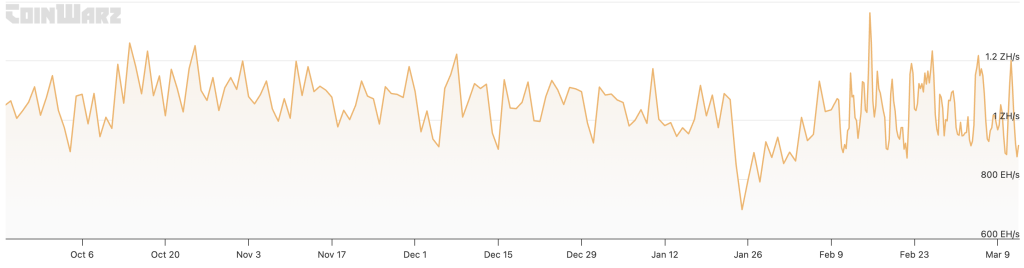
On the other side, Bitdeer is deploying 50,000 proprietary ASICs across 413 MW. That alone could add 33 EH/s to the network and $335 million in additional BTC revenue at current prices.
Q1 2026 earnings will be the first real test. Watch power capacity numbers, AI contract announcements, and curtailment revenue. The valuation gap Sigel flagged either starts closing this cycle or becomes very hard to justify.
Discover: The best new crypto in the world
The post VanEck Says Bitcoin Miners Are ‘Sitting on a Gold Mine’ as AI Demand Surges appeared first on Cryptonews.
Crypto World
Ethereum Price Prediction: Vitalik Just Revealed the 3 Rules That Could Change ETH Forever
Most founders stay quiet when their asset is down bad. Vitalik Buterin is doing the opposite.
Ethereum co-founder Vitalik Buterin laid out 3 fundamental roles for Ethereum going forward. First, a global bulletin board where data can be written permanently and visibly, with nobody able to delete it.
The PeerDAS upgrade makes this cheap to do at scale for the first time, shifting the blockchain from a computation machine to a data availability layer.
Second, a spam filter for permissionless systems. In a world where anyone can interact with any protocol, every action needs a small real cost attached to it. ETH serves as that universal friction layer, making Sybil attacks and spam economically unviable.
Third, smart contracts as a coordination standard. Not because everything needs to run on-chain, but because ETH smart contracts allow different programs to communicate and manage digital assets inside a shared environment. Zero-knowledge proofs handle the computation.
The chain handles the truth. Buterin wrapped the whole vision in a single line, calling Ethereum the world’s shared memory.
Ethereum Price Prediction:
ETH is sitting at $2,063 on the 2h chart, trading inside a rising wedge that has been forming since the February lows.
The structure tells an interesting story: while Vitalik is publicly redefining what Ethereum actually is at a fundamental level, the chart looks like a coin the market has been sleeping on, and may be waking up to.
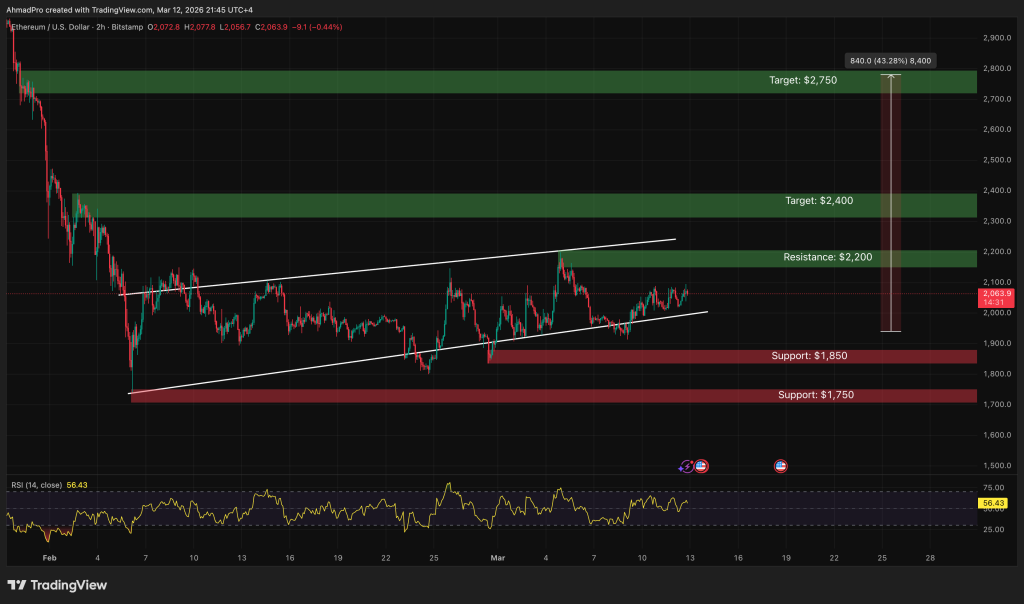
Price bounced hard off the $1,850 support zone and has been grinding higher lows ever since. The immediate ceiling is $2,200 resistance, which capped the last push and sent price back into consolidation.
Above that, $2,400 is the next target, followed by $2,750, which represents a 43% move from the current price and is marked as the full target on the chart.
On the downside, $1,850 is the first support that has already held with a clean bounce, and below that sits $1,750 as the deeper floor where the wedge trendline converges.
New Layer 2 Presale Raises Millions to Bring Solana Technology to Bitcoin
Bitcoin has one annoying issue. It is powerful, secure, and trusted, but it moves at the speed of a sleepy turtle.
That is why most people treat it like a digital trophy. They buy it, stare at the chart, and hope the next candle finally turns green.
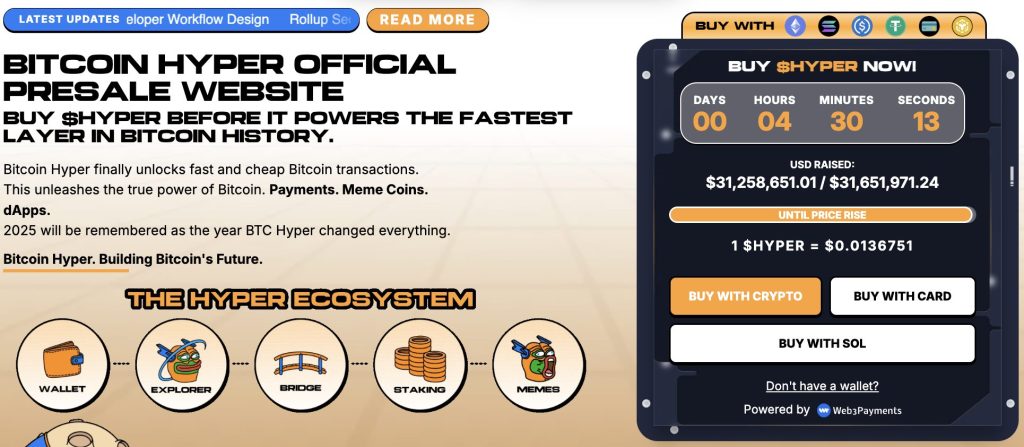
Bitcoin Hyper ($HYPER) is trying to flip that whole dynamic.
Bitcoin sitting idle is the problem. $HYPER is the fix.
Same Bitcoin security. Solana-level speed layered on top. That unlocks faster payments, staking, real apps, and actual activity on the network, rather than just price speculation.
Investors are already in. The presale has crossed $32 million in raised capital. $HYPER is currently priced at $0.0136751 before the next price increase hits.
Early stakers are earning up to 37% in rewards. That kind of yield gets attention fast when traders are hunting for the next project with real momentum behind it.
To buy HYPER before it lists on exchanges, simply visit the official Bitcoin Hyper website and connect a wallet (such as Best Wallet).
Visit the Official Bitcoin Hyper Website Here
The post Ethereum Price Prediction: Vitalik Just Revealed the 3 Rules That Could Change ETH Forever appeared first on Cryptonews.


Binance has rolled out four new AI agent Skills for USD‑margined futures, margin trading, Alpha market data, and asset management, wiring automated strategies deeper into its stack.
Summary
- The new Skills cover USD‑margined derivatives, margin trading, Binance Alpha market data, and core asset management, extending an initial batch of agent tools.
- Binance Alpha lets agents pull listings, exchange info, candlesticks, aggregated flows, and 24‑hour stats via official APIs without keys, feeding real‑time strategies.
- Margin and asset Skills let agents toggle cross/isolated, adjust leverage, manage collateral, and handle deposits, withdrawals, and KYC‑sensitive flows inside compliance rails.
Binance has rolled out four new AI agent Skills designed to plug automated trading and asset management directly into its exchange stack, significantly expanding the platform’s AI-driven trading toolkit.
According to a recent announcement, Binance’s new AI agent Skills cover USD-margined derivatives trading, margin trading, Binance Alpha market data access, and core asset management functions. The update builds on an initial set of eight Skills and is aimed at letting AI agents handle everything from market scanning to order execution and account operations through standardized APIs.
The Binance Alpha Skill gives agents direct access to token listings, exchange information, candlestick charts, aggregated trading data, and 24‑hour price statistics via the official API, without requiring API keys, enabling real-time strategy feeds and monitoring. On the trading side, the USD‑margined futures Skill exposes more than 70 interfaces, spanning order book and funding data, placing, canceling, and modifying orders, leverage and position mode management, plus algorithmic orders on both mainnet and testnet with additional security confirmations for live trading.
Margin and asset management go programmatic
The margin trading Skill allows agents to switch between cross and isolated margin, borrow and repay, submit advanced order types such as OCO/OTO/OTOCO, and adjust leverage up to 10x while tracking collateral ratios, interest rates, and liquidation records. It also integrates small-debt conversion and low-latency API key management, giving systematic traders a tighter loop between risk, funding, and execution.
The asset management Skill ties into account-level operations, covering deposits and withdrawals, spot and fund account balances, fee structures, BNB burn settings, and coin conversion. Binance says it also supports compliance and KYC questionnaires for jurisdictions that require additional checks on fiat and crypto flows, effectively letting AI agents operate within local regulatory constraints while managing funds. For quant firms, copy-trading shops, and retail power-users, the move pushes Binance closer to an AI-native execution venue where strategy logic and exchange infrastructure are tightly integrated.


With fears growing over the economic impact of surging oil costs, U.S. Treasury Secretary Scott Bessent said Thursday evening that the Trump administration is taking steps to promote stability and lower energy prices.
“To increase the global reach of existing supply, the U.S. Treasury is providing a temporary authorization to permit countries to purchase Russian oil currently stranded at sea,” said Bessent in an X post.
“The temporary increase in oil prices is a short-term and temporary disruption that will result in a massive benefit to our nation and economy in the long-term,” added Bessent, suggesting market fears about the rise in oil prices were overblown.
Indeed, oil rose nearly 10% to nearly $100 per barrel on Thursday, helping to send the already slumping U.S. stock market to sharp losses.
Bitcoin , which was able to hold the $70,000 level throughout most of the day, has jumped to just below $72,000 in the minutes following the Bessent post, now higher by 2.2% over the past 24 hours.
WTI crude oil has pulled back about $2 per barrel, currently trading at $95.22.

As perpetual futures positions shrink to just 11% of USDe’s backing, the protocol argues its unstaking delay no longer reflects the liquidity available to meet redemptions.
Ethena Labs has put forward a governance proposal to replace the synthetic dollar protocol’s static 7-day sUSDe unstaking cooldown with a dynamic model that adjusts based on the composition of USDe’s backing assets.
The proposed framework would introduce cooldown periods of 1, 3, 5, or 7 days, depending on how USDe’s reserves are allocated at any given time.
The timing is notable. Ethena’s deployed capital has fallen to just $791 million, a decline of over 85% from its all-time high. The contraction reflects broader risk-off market conditions, with bulls and bears now nearly evenly matched in the derivatives market, an unusual condition that has made the basis trade far less profitable.
That collapse in demand for long leverage is what makes this cooldown proposal viable. The authors note that at the start of 2025, roughly 93% of USDe’s backing was in perpetual futures positions, making the 7-day window a reasonable safeguard. Today, perpetual futures account for just 11% of backing, with 89% now held in liquid stablecoins and lending positions that are currently outperforming funding rates.
USDe’s market cap fell sharply following the October 10 crash, losing over $5 billion as investors rushed to redeem. The episode served as a major stress test, and the protocol’s ability to meet redemptions during that period is cited in a Blockworks Advisory analysis on the forum as evidence that the system performs well under pressure.
The proposal also includes safeguards to prevent the shorter cooldown from creating problems during sudden stress events. If daily unstaking requests exceed twice the 14-day rolling average while 3-day coverage simultaneously falls below 1.5x, the cooldown automatically extends by one day.
In short, with the protocol now sitting on a much more liquid reserve base, the argument is that locking users into a week-long wait no longer matches reality.
The protocol’s ENA token was mostly unchanged on the news, trading at around $0.10, or a $900 million market capitalization, according to Coingecko. However, it’s already down more than 50% this year.

This article was written with the assistance of AI workflows. All our stories are curated, edited and fact-checked by a human.
Crypto World
DeepSnitch AI 300% Bonus Makes All Hurry up With Only Few Days Left in the Presale; Other AI Coins Like RENDER and ICP Are Worth Checking, Too

Moonshots in crypto don’t come every day. That’s why the DeepSnitch AI bonus program is making everyone hurry up, since there are only a few days left to take advantage of this incredible opportunity.
DeepSnitch AI is the most advanced AI implementation in the crypto industry nowadays; one that will very likely undergo a 100x price acceleration. And the fact that the crypto presale is ending soon, on March 31, is generating a lot of frenzy.

Oracle jumps 13% as AI demand remains strong
The fact that DeepSnitch AI’s bonus program is making so many people hurry up isn’t only about the fact that there few days left until launch. It also has to do with the times we are living in crypto and financial markets in general, a time where AI is clearly controlling the narrative.
This was reflected in Oracle’s impressive gains of +13.72% on March 11, after its quarterly report showed substantial revenues due to an AI demand that remains strong and growing. This AI demand isn’t only for new AI models, but probably even more for innovative AI applications and infrastructure solutions.
The following section presents a few of those.
AI coins to thrive in 2026
1. DeepSnitch AI (DSNT)
DeepSnitch AI bonus program is making many people hurry up because there are only a few days left to take part in the presale. And given DeepSnitch AI’s unique combination of sophisticated product with massive market adoption, this is clearly the presale of the year, if not of the decade.
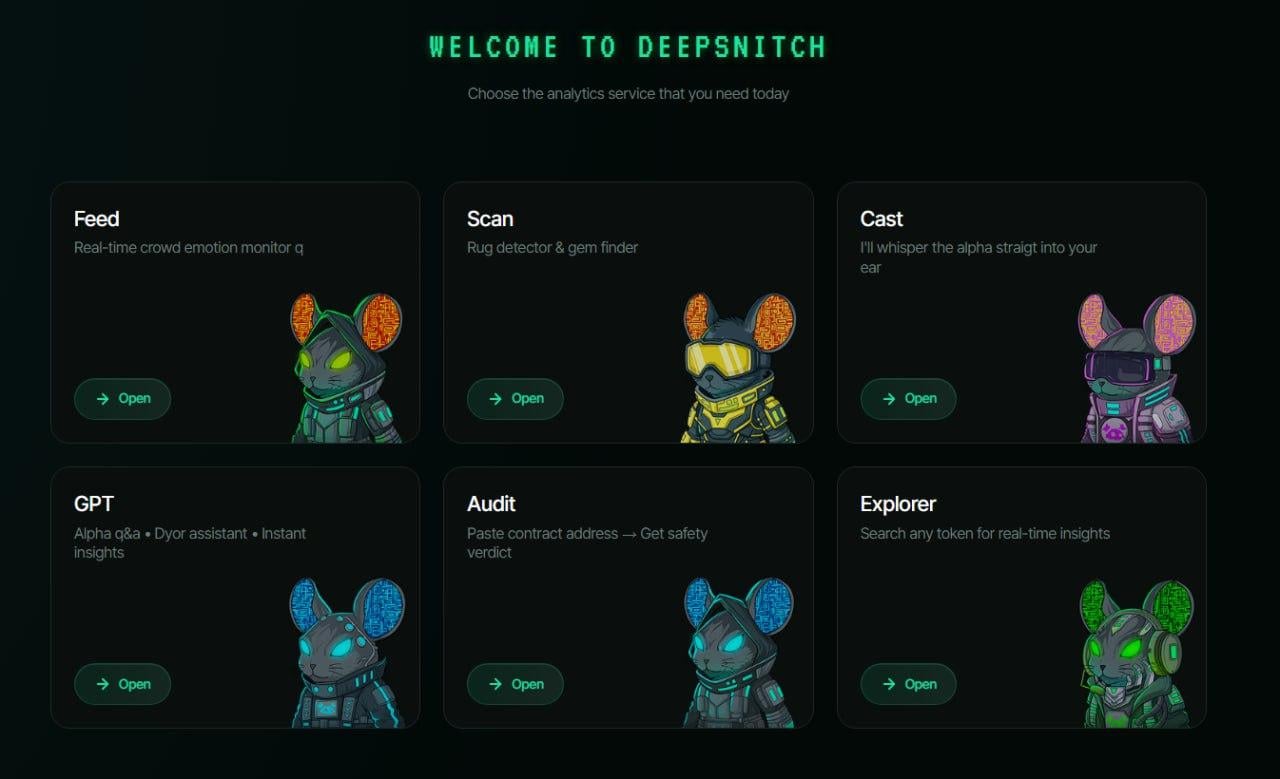
The project has developed a system of AI agents that work as a sort of “investment brain”. They execute specific tasks, but work together in total synergy. As a result, they radically improve DYOR (do-your-own-research) processes and crypto investing for any crypto holder around the world. That’s a market estimated at more than 600 million people.
In business terms, this product/market combination is a recipe for explosive growth. This is already reflected in the presale’s impressive numbers: more than $2 million raised in just 6 stages, despite a still low entry price of $0.04399 (which creates huge upside for price increase).
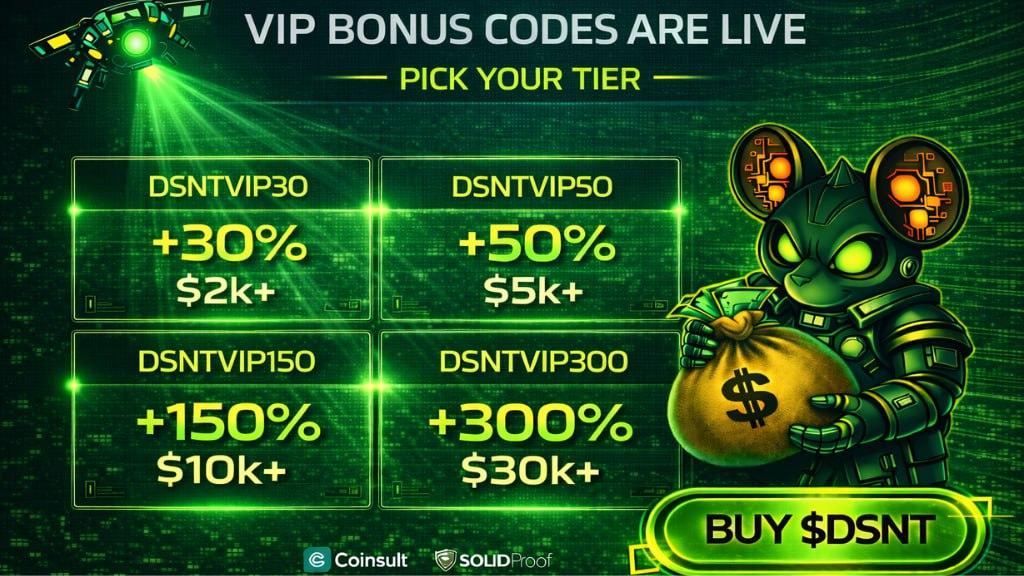
And there is more. A limited-time crypto bonus program is in place, where bonuses of different sizes are given according to the amount of DSNTs purchased. The largest of them is a 300% bonus for a $30k investment. That means a 400x return for a 100x price increase that is now considered a baseline scenario.
No wonder that DeepSnitch AI’s 300% bonus is making many hurry up, given that there are only a few days left for this moonshot.
As the final days of this token presale are passing fast, it’s time to move faster, and invest before this unique opportunity is gone.
2. Render (RENDER)
Render has had a remarkable performance in the last few days. From a $1.34 price on Mar. 6, it rose to $1.57 on Mar. 11, a 5-day 17% gain. The peaks of this soaring trend took place on March 10 and 11, precisely around the time that Oracle was releasing its latest quarterly earnings.
This latest AI push is also helping DeepSnitch AI, at a time when its bonus program is making everyone hurry up, given that there are only a few days left in the presale.
3. Internet Computer (ICP)
As previously mentioned, DeepSnitch AI 300% bonus is a reason to hurry up, with only a few days left until the launch. But another reason to rush is the fact that many AI coins are spiking in March. One of them is ICP.
On Feb. 24, ICP was priced at $2.02. A couple of weeks later, on Mar. 11, it had soared to $2.84. That is a gain of more than 40% that is an example of the ongoing rotation towards AI coins. Since this momentum isn’t giving signs of fading, it is still a good time to bet on ICP.
Conclusion
The DeepSnitch AI bonus program is making a lot of investors hurry up, given that there are only a few days left until the presale ends. This is a once-in-a-lifetime opportunity for exponential returns that is closing very fast.
Only those who invest now and take advantage of the bonuses (30% code: DSNTVIP30, 50% code: DSNTVIP50, 150% code: DSNTVIP150, 300% code: DSNTVIP300) will enjoy outsized growth this year.
Visit the official website to buy into the DeepSnitch AI presale now, and visit X and Telegram for the latest community updates.
FAQs
Why should I rush to buy DeepSnitch AI now?
DeepSnitch AI bonus of 300% is a strong reason to hurry up, since there are only a few days left to take advantage of this unique opportunity. But it isn’t just about the bonus, it’s about the extraordinary growth potential.
What drives DeepSnitch AI’s growth potential
The answer is DeepSnitch AI’s huge target market. With only capturing a tiny fraction of this market, DSNT’s price would sharply spike.
How much of the target market would cause a 100x spike?
The baseline forecast estimates that when DeepSnitch AI reaches 1.45 million users, DSNT will be priced at around $4.5. That is more than 100x its current price.
Disclaimer: This is a Press Release provided by a third party who is responsible for the content. Please conduct your own research before taking any action based on the content.


Cryptio, an accounting and data platform focused on regulated digital assets, has raised $45 million in a Series B funding round, highlighting growing demand for tools that help financial institutions reconcile and report blockchain-based transactions within traditional accounting systems.
The round was co-led by venture firms BlackFin Capital Partners and Sentinel Global, with participation from 1kx, BlueYard Capital, Alven and Ledger Cathay Capital.
Cryptio develops software that helps companies reconcile activity across wallets, custodians and exchanges, translating blockchain transaction data into accounting records used for financial reporting, audits and compliance.
The company says it serves more than 400 enterprise clients and has processed over $3 trillion in transaction volume. Its clients include crypto companies such as Circle, Gemini and Securitize, as well as traditional financial institutions, including Société Générale’s SG-Forge.
Several other companies operate in the same niche as Cryptio, highlighting the emergence of a small but growing market for crypto accounting and financial reporting infrastructure. Companies such as Lukka, TaxBit, Bitwave and CoinLedger offer software that helps businesses reconcile blockchain transactions and convert them into records used for tax reporting, audits and regulatory compliance.
Related: Amid crypto VC shakeout, Dragonfly closes $650M fund with focus on real-world assets
Demand for tokenized finance infrastructure continues to grow
Cryptio’s growth is also being fueled by rising institutional interest in tokenized assets, which require accounting systems capable of recording and reconciling blockchain-based financial activity.
Sidra Pervez, senior vice president at tokenization firm Securitize, said maintaining accurate financial records across capital markets is becoming more important as traditional finance expands into tokenized securities.
Loic Fonteneau, managing director at BlackFin Capital Partners, said “digital assets are becoming embedded within regulated financial markets,” which requires “institutional-grade infrastructure” to support accounting, tokenized asset reporting and lending.
Major financial institutions are increasingly participating in tokenization, with the likes of HSBC, BNP Paribas and Goldman Sachs backing the tokenization-focused Canton Foundation. The industry group supports the development and governance of the Canton Network, a blockchain designed for regulated financial markets.
In January, State Street announced the rollout of a new crypto tokenization tool to help clients create tokenized money market funds, exchange-traded funds and tokenized deposits.

While estimates vary, industry data shows that the total value of tokenized real-world assets, excluding stablecoins, has surpassed $26 billion, with much of the demand coming from private credit and US Treasurys-backed funds.
Other fast-growing segments include tokenized money market funds — blockchain-based versions of traditional funds that invest in short-term government debt and other low-risk securities.


A key technical metric measuring Bitcoin’s value is at its lowest level since the bear market in 2022.
Bitcoin’s MVRV (Market Value to Realized Value) data, which indicates how overvalued or undervalued the asset is relative to its normal “zero-sum game,” is at the same level as late 2022, right after the FTX collapse, Santiment reported on Thursday.
When the 365-day MVRV was oversold and severely negative following the FTX collapse, Bitcoin prices climbed 67% in the following three months, it added.
“This is typical when average returns are significantly below the average value for what is historically expected,” it stated.
However, macroeconomic news and “polarized opinions about Strategy’s aggressive accumulation” have been changing the landscape of cryptocurrency, noted the analysts who concluded that a big move may be ahead.
“When this powerful indicator reveals a divergence we haven’t seen in over 3 years, pay attention.”
A 67% gain from current prices would send BTC back to $116,000, but that is highly unlikely in the current bear market. In fact, analysts believe that there will be months of consolidation before a potential major move in the price.
Early Signs of Stabilization
Glassnode also leaned slightly bullish in its weekly on-chain report, stating “Bitcoin is showing early signs of stabilisation as ETF inflows return and spot demand recovers.”
BTC has been consolidating between $63,000 and $72,500 for over a month, repeatedly failing to hold above $70,000, it noted, adding that the price is sitting between two key levels: the Realized Price at $54,400 as support and the “True Market Mean” which is serving as resistance at $78,400.
There are also some stabilizing signals, including positive inflows for US spot Bitcoin ETFs, spot market buyers beginning to absorb selling pressure, perpetual futures funding turning negative, and options market implied volatility easing, suggesting reduced immediate fear.
You may also like:
“The market appears to be shifting from forced deleveraging toward early stabilisation, with scope for recovery if spot demand continues to build.”
Resilient in the Face of War
Bitcoin is showing early signs of stabilisation as ETF inflows return and spot demand recovers. Negative funding points to crowded shorts, while options vol is easing.
Read the full Week On-Chain👇https://t.co/jPJp9MbNJp pic.twitter.com/jUHoVhTjXo
— glassnode (@glassnode) March 11, 2026
Crypto Market Outlook
Total market capitalization is flat on the day, at the same level as this time yesterday, $2.45 trillion.
Bitcoin topped $71,000 again in late trading in the US, but tanked in the morning Asian session back to $69,400, mirroring yesterday’s trading pattern.
Ether prices are largely unchanged, hovering just above $2,000, while the altcoins remain dormant.
“Crypto sentiment remains weak, and trading volumes are near their lows,” reported 10x Research on Thursday.
Binance Free $600 (CryptoPotato Exclusive): Use this link to register a new account and receive $600 exclusive welcome offer on Binance (full details).
LIMITED OFFER for CryptoPotato readers at Bybit: Use this link to register and open a $500 FREE position on any coin!


A crypto user lost roughly $50 million in a single transaction on Thursday after executing a large token swap that triggered massive slippage.
Blockchain data shows that the wallet attempted to swap $50,432,688 aEthUSDT – an interest-bearing token representing Tether’s USDT stablecoin deposited into the Aave decentralized lending protocol on the Ethereum network – for aEthAAVE – similar version of Aave governance tokens – through the CoW Protocol.
The transaction executed with more than 99% slippage due to thin liquidity in the relevant trading pools, leaving the wallet with only about 327 aEthAAVE tokens, worth roughly $36,000 after the trade. The difference of the value was quickly captured by arbitrage traders and network intermediaries.
Large losses caused by slippage occasionally occur in decentralized finance (DeFi) when traders attempt to execute unusually large orders against shallow liquidity pools. In such cases, automated arbitrage systems rapidly exploit the price dislocations created by the trade.
Stani Kulechov, founder of the Aave protocol, said the trade went through despite multiple warnings presented to the user before confirming the transaction.
“Earlier today, a user attempted to buy AAVE using $50M USDT through the Aave interface,” Kulechov said in an X post. “Given the unusually large size of the single order, the interface warned the user about extraordinary slippage and required confirmation via a checkbox.”
According to Kulechov, the user accepted the warning on their mobile device and proceeded with the trade, explicitly acknowledging the risk of high slippage.
“The transaction could not be moved forward without the user explicitly accepting the risk,” he said, adding that the CoW Swap routers functioned as intended and followed standard industry practices.
Still, the outcome was “clearly far from optimal,” Kulechov said.
Kulechov said Aave plans to contact the affected user and return roughly $600,000 in fees collected from the transaction.
The loss comes just few days after about $27 million was liquidated on Aave, in what some market participants say may have been caused by a temporary pricing issue involving the token wstETH.

The Three Types Of One Piece Devil Fruits, Explained

XRP RIPPLE CEO CONFIRMS !!! DAVID SCHWARTZ THIS IS A TEST !!! SWIFT INSOLVENT BY 2027 !!!

Inquest opens into death of baby boy amid murder investigation


-
Business6 days ago
Form 8K Entergy Mississippi LLC For: 6 March
-

 News Videos4 days ago
10th Algebra | Financial Planning | Question Bank Solution | Board Exam 2026
-

 Fashion6 days ago
Weekend Open Thread: Ann Taylor
-

 Crypto World3 days ago
Paradigm, a16z, Winklevoss Capital, Balaji Srinivasan among investors in ZODL
-
 Tech2 days ago
A 1,300-Pound NASA Spacecraft To Re-Enter Earth’s Atmosphere
-

 Tech2 days ago
ChatGPT will now generate interactive visuals to help you with math and science concepts
-

 Politics7 days ago
Top Mamdani aide takes progressive project to the UK
-

 Business2 days ago
ExxonMobil seeks to move corporate registration from New Jersey to Texas
-

 Sports5 days ago
Three share 2-shot lead entering final round in Hong Kong
-

 Sports5 days ago
Braveheart Lakshya downs Lai in epic battle to enter All England Open final | Other Sports News
-

 NewsBeat1 day ago
Residents reaction as Shildon murder probe enters second day
-

 Entertainment6 days ago
Hailey Bieber Poses For Sexy Selfies In New Luscious Lip Thirst Traps
-

 Business4 days ago
Search for Nancy Guthrie Enters 37th Day as FBI Probes Wi-Fi Jammer Theory
-

 Business2 days ago
Search Enters Sixth Week With New Leads in Tucson Abduction Case
-
 NewsBeat3 days ago
Pagazzi Lighting enters administration as 70 jobs lost and 11 stores close across Scotland
-

 Tech3 days ago
Despite challenges, Ireland sixth in EU for board gender diversity
-

 Business3 days ago
Search Enters 39th Day with FBI Tip Line Developments and No Major Breakthroughs
-

 NewsBeat1 day ago
I Entered The Manosphere. Nothing Could Prepare Me For What I Found.
-

 Business6 days ago
Iran war enters second week as Trump demands ’unconditional surrender’
-

 Sports4 days ago
Skateboarding World Championships: Britain’s Sky Brown wins park gold