
Crypto World
Polymarket’s 5-cent signal was the only thing that got the Netanyahu rumors right

The rumor followed a familiar wartime script. Iran’s Islamic Revolutionary Guard Corps claimed it had struck Benjamin Netanyahu’s office. Then came the forged screenshots — fake posts from the Israeli prime minister’s official account announcing he was dead. Then came the AI furore over a low-resolution freeze-frame from a press conference that, at the right angle, appeared to show Netanyahu’s right hand sporting six fingers, leading contrarian commentators to take victory laps.
Conservative influencer Candace Owens amplified the claims loudly on X, demanding to know where Netanyahu was and why his office was “releasing and deleting fake AI videos.” Iran’s Tasnim News Agency — run by the Islamic Revolutionary Guard Corps — published an article titled “New Video of Netanyahu Proves Fake,” cataloguing alleged clear signs that a subsequent coffee shop clip, posted by Netanyahu’s own account to debunk the rumors, was itself generated by artificial intelligence. The conspiracy had become self-sealing; every refutation was recast as fresh evidence.
But while the fact-checkers scrambled and the podcasters speculated, one data source offered a clean, immediate signal. On Polymarket, the world’s largest crypto prediction market, the contract for “Netanyahu out by March 31” was trading at around 4 to 5 cents, implying a roughly 4 to 5% probability of him leaving office before the end of the month. The market didn’t move. For anyone paying attention to that number, the entire conspiracy theory collapsed in a single glance.

A record-breaking backdrop
To understand why the Netanyahu conspiracy took hold when it did, you need to understand the information environment it emerged from.
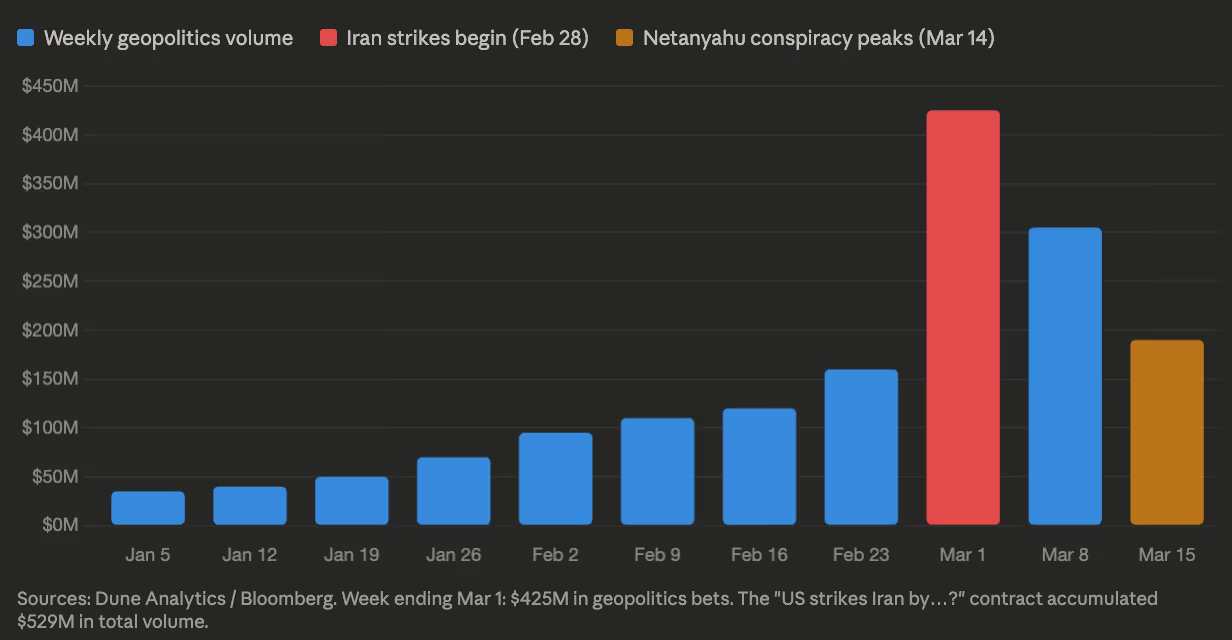
Since the U.S. and Israel launched strikes on Iran on Feb. 28, Polymarket has been transformed into something closer to a real-time geopolitical intelligence terminal. In the week ending March 1, bettors placed $425 million in geopolitics wagers on the platform alone — up from $163 million the prior week — with total platform wagering hitting a record $2.4 billion. The “US strikes Iran by…?” contract accumulated $529 million in total volume, making it one of the largest single markets Polymarket has ever hosted and the fourth-largest in its entire “Politics” category.
It is a remarkable trajectory for a platform that processed $73 million in total trading volume in 2023 and was pushed offshore by a CFTC settlement a year later. By 2025, Polymarket had processed approximately $22 billion in notional trading volume across the year — a figure that underscores how quickly the platform has moved from crypto curiosity to mainstream financial infrastructure.
This is no longer a crypto curiosity. In October 2025, the Intercontinental Exchange, parent company of the New York Stock Exchange, invested $2 billion into Polymarket at a $9 billion valuation, and launched a “Polymarket Signals and Sentiment” tool that feeds real-time prediction market data directly to Wall Street trading desks. When the Iran war began, equity and oil futures markets were closed for the weekend. Polymarket was not.
The market as instant truth machine
Prediction markets don’t have death contracts in the conventional sense. What Polymarket offers instead are “politician out by X date” markets, which resolve “Yes” if a leader resigns, is removed, or steps down. They don’t directly price the probability of death. But in a context where the conspiracy theory is that Netanyahu has been killed and the government is conducting a cover-up, these contracts function as a powerful proxy.
The logic is simple. A leader who has died or been incapacitated cannot indefinitely run a country from office. Eventually, a resignation, a removal or a credible leak would surface. And if any of that happened, the payout on a “Yes” share at 5 cents would be enormous: a $1 payout on a 5-cent share is a 20-to-1 return.
One trader was willing to make that bet at scale. A single Polymarket account placed $151,000 on Netanyahu being out before March 31, accumulating nearly 3.8 million shares at 4.7 cents each. If correct, the position would pay out $3.8 million. It is currently underwater by roughly $26,000.
That number is the ceiling of rational conviction in the conspiracy. At the height of the online hysteria, the most aggressive speculator on record was willing to stake $150,000 on the theory — implying he knew the odds were long. The market as a whole put the probability at around 5%. Social media said it was certain. The money said otherwise.
“Whether a politician is in or out of office is a very economically meaningful outcome for a lot of people,” said Aaron Brogan, a managing attorney at Brogan Law who has advised on prediction market regulation. “These are exactly the kinds of markets that event contract rules were designed to accommodate.”
Why the odds are hard to fake
The 2024 US election cycle offered a masterclass in prediction market efficiency — and the limits of efforts to dismiss its signals. When Polymarket showed Donald Trump trading at a substantial premium over Kamala Harris, critics cried manipulation. A French trader, they alleged, had artificially pumped Trump’s odds using multiple accounts for political purposes.
The experts weren’t buying it. As Flip Pidot, co-founder of American Civics Exchange, told CoinDesk at the time: a true manipulator trying to move the price would simply pile in blindly and let themselves get filled at worsening prices. The French trader did the opposite — splitting orders strategically across accounts to minimize slippage. That is what profit-seeking looks like, not propaganda.
The deeper reason manipulation struggles to stick is expected value arbitrage. If a price is artificially depressed or inflated, profit-hungry traders pile in to exploit the gap until it closes. Cross-market arbitrage reinforces this: Polymarket prices in real time against Kalshi, Betfair, and others. If odds drift meaningfully out of line across platforms, traders immediately sell the higher price and buy the lower one, synchronizing markets toward a consensus.
Harry Crane, a statistics professor at Rutgers University who studies prediction markets, sees the Netanyahu episode as a near-perfect illustration of this dynamic. “These markets are an antidote to propaganda precisely because their resolution rules anchor outcomes to verifiable sources rather than narrative,” he told CoinDesk. “I understand why governments want to limit them — not because of concerns over leaking classified information, but because verifiable price signals are harder to control.”
That framing maps directly onto the Netanyahu conspiracy. The people claiming he was dead were doing structurally the same thing as those who cried Polymarket was rigged in 2024: attacking the signal rather than engaging with it.
What the market is actually pricing — and what it isn’t
Crane is careful about the limits of the signal, and his caveat is worth sitting with.
“The market is only pricing the probability that Netanyahu is verifiably out of office under these rules,” he said. The resolution criteria state that the contract resolves “Yes” if Netanyahu announces his resignation or is otherwise removed from office, confirmed by official sources or a consensus of credible reporting. If a government concealed a leader’s death so completely that no credible source ever confirmed it, the market could resolve “No” — faithfully, correctly under its own rules, and yet without capturing the underlying reality.
That dynamic was playing out in real time. Domer — a well-known prediction market trader who goes by ImJustKen online — was publicly holding a No position on Netanyahu leaving office before March 31. Not because he was certain Netanyahu was alive, but because he didn’t believe a departure would ever be confirmed under the market’s resolution criteria, even if it occurred. He was pricing the verification gap, not the conspiracy itself.
But that caveat reveals something important about the conspiracy itself. The Netanyahu death rumor only holds together if you believe in a cover-up so total — encompassing Israeli officials, international media, independent fact-checkers, and Netanyahu’s own social media accounts simultaneously — that no verifiable evidence would ever surface. At that point, the conspiracy has become unfalsifiable by design. An unfalsifiable claim is one no rational actor should stake capital on.
This is the key distinction from traditional fact-checking. A fact-checker requires institutional credibility, research time, and editorial process — all of which conspiracy theories are engineered to preemptively undermine. A Polymarket price requires none of that. It requires only that someone, somewhere, believes the opposite enough to put real money on it. When no one does, that is its own kind of proof.
The contrast case: Khamenei
The clearest evidence that these markets work as a truth signal — and not merely as a null result — is what happened with the Khamenei contract.
When Iranian Supreme Leader Ali Khamenei was killed in the February 28 strikes, the “Khamenei out as Supreme Leader by March 31” contract on Polymarket behaved exactly as you would expect from an efficient market. It had hovered between 25% and 50% through January and February as tensions built, pricing genuine uncertainty about an escalating conflict. Then, when Iranian state TV confirmed his death, it spiked vertically to 100%. The contract drew $45 million in volume. The top trader made $757,000 on a yes bet. Four others cleared six figures.
The Netanyahu market did not do this. It stubbornly remained below 5 cents throughout the conspiracy cycle. The crowd that correctly priced Khamenei’s death — and got paid for it — looked at the Netanyahu claims and declined to move.

The regulatory storm gathering overhead
The informational value of these markets is being stress-tested at exactly the moment when political pressure against them is reaching its peak.
When Khamenei was killed, Kalshi — Polymarket’s CFTC-regulated rival — invoked a “death carveout” buried in its contract terms, settling its Khamenei positions at the last traded price before his death: roughly 39.5 cents rather than the full dollar. Polymarket, which carries no such carveout, paid out in full. A $54 million class action lawsuit against Kalshi followed.
The inconsistency in Kalshi’s approach has been pointed out sharply. In late 2024, Kalshi had run a market on whether a 100-year-old Jimmy Carter would attend Trump’s inauguration. When Carter died before it took place, Kalshi settled that contract to “No” — resolving a market directly via death, without invoking any carveout. As Crane has noted, the application of its death carveout appears to have been selective: they settle on death, just not when it’s expensive.
Kalshi disputes the characterization. “Our rules were clear from the beginning, we never changed them, and we settled based on the rules,” a spokesperson said. The company added that it reimbursed all fees and net losses out of pocket following the Khamenei settlement — “to the tune of millions of dollars” — ensuring no user lost money on the market. “Kalshi is a peer-to-peer exchange and does not profit from user losses. We have no incentive not to pay out our users, but we need to follow the rules of the exchange and the rule of law.”
On the legislative push, the company struck a conciliatory tone. “Kalshi already bans insider trading and markets directly tied to death and war,” a spokesperson said. “As a US-based exchange, we support regulators and policymakers from both sides of the aisle in their efforts to keep these markets safe and responsible in America.”
Kalshi declined to comment on record about the consistency of the death carveout as applied to the Khamenei contract versus the Carter market, or on the current status of the class action lawsuit.
Six Democratic senators, led by Adam Schiff, have written to the CFTC demanding a categorical ban on contracts that “resolve upon or closely correlate to an individual’s death.” Separately, senators Merkley and Klobuchar have introduced the End Prediction Market Corruption Act, which would bar the president, vice president, members of Congress, and their immediate families from trading event contracts, and impose fines and profit clawbacks for violations — citing the well-timed wagers on US strikes and Iranian leadership changes that netted some traders hundreds of thousands of dollars.
Blockchain analytics firm Bubblemaps identified six newly created wallets that collectively netted $1.2 million betting on the timing of US strikes on Iran, with accounts funded within 24 hours of the attack. One trader turned roughly $60,000 into nearly $500,000.
Brogan is skeptical that the legislative push has the momentum to land. “This is largely Democratic senators using the legislative process to generate political capital,” he said. “The conditions under which that legislation actually passes are where something really calamitous happens — some kind of market collapse or scandal that forces politicians to make an example of the industry. Without that, I don’t think there’s sufficient political capital to move it.”
He also draws a clear distinction between Polymarket’s legal exposure and Kalshi’s. “The restrictions Kalshi faces are not directly applicable to Polymarket,” Brogan said. Polymarket is not a CFTC-regulated US exchange — a status that stems from a 2021 settlement that pushed it offshore and barred US users from accessing it directly. That remains its largest single legal exposure, Brogan noted, though he pointed out that the Trump administration has shown little appetite for pursuing the kind of action the Biden administration explored against Polymarket CEO Shayne Coplan in early 2025.
Crane, for his part, is unambiguous about what would be lost if the legislative push succeeded. “These markets have genuine informational value and can counter propaganda,” he said. “That’s the case study here — a market involving war and the fate of a political leader doing exactly what its critics say it shouldn’t exist to do.”
There is also a state-level front opening up. Arizona recently charged Kalshi with operating an illegal gambling operation — part of a broader conflict between states that regulate and tax traditional gambling markets and federally-overseen prediction markets that sit outside their control. “The question that ultimately matters is whether federal law will preempt state law on this,” Brogan said. “There are courts hearing that question right now.”
What the crowd gets right — and what it can’t fix
None of this is to say prediction markets are infallible. Crane notes that nearly 25% of Polymarket’s historical volume has been attributed to wash trading — artificial activity generated by users trying to position themselves for a potential token airdrop — a figure that Columbia University researchers found peaked at around 60% in December 2024 before falling sharply. Wash trading inflates headline volume without necessarily biasing prices, but it is a legitimate caveat to the “wisdom of crowds” narrative.
The more fundamental limitation is what Crane identified in his answer to the manipulation question: a sufficiently coordinated disinformation campaign could, in theory, move a market — especially a smaller one. The Netanyahu “out by March 31” contract had enough liquidity to make that expensive, but not impossible.
What prediction markets cannot do is replace the underlying information infrastructure they depend on. They resolve against credible sources. If those sources are corrupted or silent — as Iranian state media clearly was throughout this episode — the market’s signal is only as good as the resolution criteria it is anchored to.
But in the Netanyahu case, that is precisely where the conspiracy fell apart. The rumor required a cover-up so comprehensive that no Israeli official, no international journalist, no independent fact-checker, and no market trader with real money on the line would ever find confirmation. The market priced that scenario at 5 cents. It was right.
When Candace Owens was demanding to know where Bibi was, Polymarket already had an answer. It just costs a few pennies to read it.


TLDR:
- OpenAI plans to nearly double its workforce from 4,500 to 8,000 employees by the close of 2026.
- Most new hires will be deployed across product development, engineering, research, and sales divisions.
- OpenAI is recruiting “technical ambassadorship” specialists to help businesses maximize its AI tools.
- A $110 billion funding round valued OpenAI at $840 billion, backing its large-scale hiring strategy.
OpenAI is reportedly planning to nearly double its workforce from 4,500 to 8,000 employees by end of 2026. The Financial Times published this report on Saturday, citing two people with knowledge of the matter.The company did not respond to a request for comment by press time.
The expansion plan targets product development, engineering, research, and sales teams. This move comes as the company continues to scale its commercial operations across global markets.
A Focused Hiring Push Across Product, Engineering, and Sales
The company plans to direct most of the new hires toward product development, engineering, research, and sales. These four areas form the core of its technical and business growth strategy.
The ChatGPT maker operates as one of the most closely watched artificial intelligence firms globally. The Financial Times report, citing insiders, notes that the hiring plan is structured around these key functions.
The company is also stepping up recruitment for “technical ambassadorship” specialists. According to the FT report, these professionals are aimed at “helping businesses make better use of its tools.” This growing role reflects a broader push toward enterprise-level client support and integration.
The ChatGPT maker recently completed a $110 billion funding round that included Big Tech companies and SoftBank’s Masayoshi Son.
That round valued the company at $840 billion, making it one of the highest-valued private companies in the world. The capital raised provides the company with the financial resources needed to sustain large-scale hiring into 2026.
Internal Code Red and Market Competition Accelerate OpenAI’s Expansion
OpenAI CEO Sam Altman reportedly issued an internal “code red” directive in early December last year. The order paused non-core projects and redirected teams toward accelerating product development timelines.
This came as a direct response to Google’s release of Gemini 3, which intensified AI competition.
The code red move showed how seriously the company responds to competitive pressure in the AI sector. Redirecting internal resources and pausing non-essential work reflects a clear change in operational priorities.
It also signals that the company treats speed of delivery as a core part of its market strategy. This approach appears to be shaping how the company plans to scale operations in 2026.
SoftBank’s Masayoshi Son joined the $110 billion round alongside several major Big Tech investors. His participation, combined with broader tech involvement, pushed the valuation to “$840 billion,” as reported by Reuters.
With that financial base secured, OpenAI is well-placed to meet its workforce targets before the end of 2026.

Crypto World
Bitcoin options signal extreme fear as downside protection premium hits new all-time high, says VanEck

Bitcoin traders are paying record prices for downside protection, according to VanEck’s mid-March 2026 Bitcoin ChainCheck, a sign that investors remain defensive even as spot prices begin to stabilize.
In the report, senior VanEck analysts said bitcoin’s 30-day average price fell 19% from the prior period, while realized volatility dropped from about 80 to just above 50.
Futures funding rates also eased to 2.7% from 4.1%, suggesting leveraged speculation has cooled.
Options markets show investors are as cautious as it gets. VanEck said the put/call open interest ratio averaged 0.77 and peaked at 0.84, the highest level since June 2021, when China cracked down on bitcoin mining.
Traders spent about $685 million on put options over the past 30 days, while call premiums fell 12% to about $562 million, the report adds. Relative to spot volume, put premiums reached roughly 4 basis points, an all-time high in VanEck’s data.
“Relative to spot volume, put premiums reached an all-time high of roughly 4 basis points, roughly 3x the levels seen in mid-2022 following the Terra/Luna stablecoin collapse and the Ethereum staking liquidity crisis,” the report reads.
That means investors are paying up for insurance against further losses.

VanEck said that kind of fear has often marked turning points rather than fresh breakdowns. The firm found that, in the past six years, similar options that skewed readings were followed by average bitcoin gains of 13% over 90 days and 133% over 360 days.
The report also points out onchain activity has remained weak while miner selling remains contained.
TLDR:
- Tether holds $141B in U.S. Treasury exposure, ranking it 17th among all global government debt holders.
- The GENIUS Act legally requires stablecoin issuers to back every token with T-bills or dollar equivalents.
- China cut $86B in Treasury holdings as Japan signals drawdown, opening demand gaps stablecoins now fill.
- Apollo projects the stablecoin market could hit $2 trillion by 2028, potentially surpassing Japan’s Treasury position.
Stablecoins have quietly become a structural component of U.S. monetary policy. Tether and Circle now hold over $160 billion in U.S. Treasury securities combined.
That total places both companies above sovereign nations, including South Korea, Germany, and Saudi Arabia. A decade ago, neither existed in any meaningful financial capacity. Today, they rank among the most consistent buyers of American government debt on the planet.
The GENIUS Act Turned Stablecoin Reserves Into a Treasury Buying Mandate
The GENIUS Act, signed into law last year, reshaped how stablecoin issuers manage their reserves. The legislation requires each stablecoin token to be backed 1:1 with verified reserves.
Those reserves must be held in U.S. dollars, Treasury bills, or short-duration equivalent instruments. Congress did not only regulate stablecoins as it also created a legal mandate to buy Treasuries at scale.
Tether currently holds $141 billion in total U.S. Treasury exposure under this structure. Of that amount, $122 billion is held directly in T-bills.
The remaining portion is parked in overnight reverse repurchase agreements. That positions Tether as the 17th largest holder of U.S. government debt worldwide.
Circle’s USDC adds another $24.5 billion in Treasury reserves to the broader picture. About 93% of Circle’s total reserves sit in overnight repos and short-term government securities.
As TFTC noted on X, “Congress didn’t just regulate stablecoins. It created a legal mandate to buy Treasuries at scale.” Together, both issuers have become a growing class of captive Treasury buyers.
Tether also reported $10 billion in profit through the first three quarters of 2025. That result surpassed Bank of America’s earnings for the same period.
It also nearly matched figures posted by both Goldman Sachs and Morgan Stanley. Tether reached that level with a workforce of approximately 300 employees.
Stablecoins Fill the Demand Gap as Traditional Foreign Buyers Pull Back
China reduced its Treasury holdings by $86 billion over the past year. Its current position has fallen to the lowest level recorded since 2008.
Japan, the largest foreign holder at $1.2 trillion, is also signaling a slow drawdown. The traditional foreign buyer base for U.S. government debt is gradually narrowing.
Stablecoins are absorbing a share of that demand in real time. Every dollar minted as USDT or USDC creates automatic buying pressure for U.S. government securities.
The dollar also gets distributed globally through crypto payment rails. This mechanism extends dollar dominance without relying on traditional diplomatic or military tools.
Apollo estimates the stablecoin sector could reach $2 trillion by 2028. At that scale, stablecoin issuers would hold more Treasuries than Japan currently does.
TFTC stated that “the U.S. government now has a structural incentive to grow the stablecoin market.” That incentive is now embedded directly into federal legislation.
The growth of stablecoins serves both crypto markets and the broader U.S. fiscal structure. Each new token minted adds to Treasury demand in a measurable and automatic way.
This dynamic was not present in any meaningful form just five years ago. Stablecoins now function as one of the most reliable buyers of American sovereign debt.
Crypto World
Hong Kong Retiree Loses HK$6.6 million to Cryptocurrency Scam in Three Back-to-Back Frauds
TLDR:
- A 66-year-old Hong Kong retiree lost HK$6.6 million to three separate cryptocurrency scams in six months.
- Each scammer posed as a virtual currency expert on WhatsApp and vanished after receiving the transferred funds.
- Hong Kong police warn that anyone offering to recover scam losses is likely running a follow-up fraud.
- Police advise the public never to transfer cryptocurrency or money to unverified strangers’ accounts online.
A cryptocurrency scam has wiped out the life savings of a 66-year-old Hong Kong retiree in just six months. The victim fell for three separate fraud schemes between September 2025 and January 2026.
Each scammer posed as a virtual currency investment expert on WhatsApp. Hong Kong police disclosed the case via their “Net Keeper” cybercrime awareness platform. The total financial loss reached HK$6.6 million across the three incidents.
Retiree Falls for the Same Cryptocurrency Scam Three Times
The ordeal began when the victim received an unsolicited WhatsApp message in September 2025. A stranger, claiming expertise in virtual currency investment, initiated contact without prior introduction.
Trusting the individual, the retiree transferred HK$1.4 million in cryptocurrency to a designated account. Once the funds cleared, the so-called expert went silent and disappeared entirely.
Still hoping to recover the money, the victim searched online for another investment expert. A second contact then offered to help retrieve what was lost from the first incident.
The retiree transferred HK$600,000 as a deposit, believing the recovery was possible. That contact also disappeared immediately after receiving the payment.
In January 2026, a third scammer reached out through WhatsApp with a more convincing offer. This individual promised to recover losses from both previous incidents in one transaction.
The condition involved purchasing HK$4.6 million in cryptocurrency and depositing it into a specified account. After the transfer was completed, the third scammer vanished just as quickly as the others.
Each incident followed a near-identical structure, making the pattern recognizable in hindsight. The victim reported the fraud to police after each separate deception.
However, the desperation to recover funds made the retiree vulnerable to each new approach. Combined losses across all three incidents totaled HK$6.6 million, a lifetime of savings.
Hong Kong Police Warn Public Against Recovery Scams
Following the case, Hong Kong’s Cybercrime Bureau issued clear public warnings through the “Net Keeper” platform. Officers stated that no legitimate party can guarantee to recover money lost in a scam.
Anyone who approaches a fraud victim offering such services should be treated with immediate suspicion. This type of follow-up targeting is a recognized serial scam tactic.
Police also warned against trusting claims of “guaranteed returns” or access to “inside information.” These are common phrases used by scammers to establish false credibility with potential victims.
Transferring cryptocurrency or money to an unverified stranger’s account carries serious financial risk. Authorities advised the public never to do so, regardless of the reason given.
The case also shows how recovery fraud specifically targets people who have already been deceived. Scammers often identify prior victims and approach them with tailored recovery pitches.
The emotional distress of financial loss can cloud judgment and make people more susceptible. Acting on such offers without verification compounds the original damage further.
Anyone who suspects fraud is urged to contact police without delay. Reporting early can help authorities track criminal networks before more victims are targeted.
The public is reminded to verify the credentials of anyone offering financial or investment advice online. Caution, not urgency, should guide every cryptocurrency-related transaction.
Crypto World
XRP Battles Descending Channel Resistance While Ripple Quietly Absorbs the Global Financial System
TLDR:
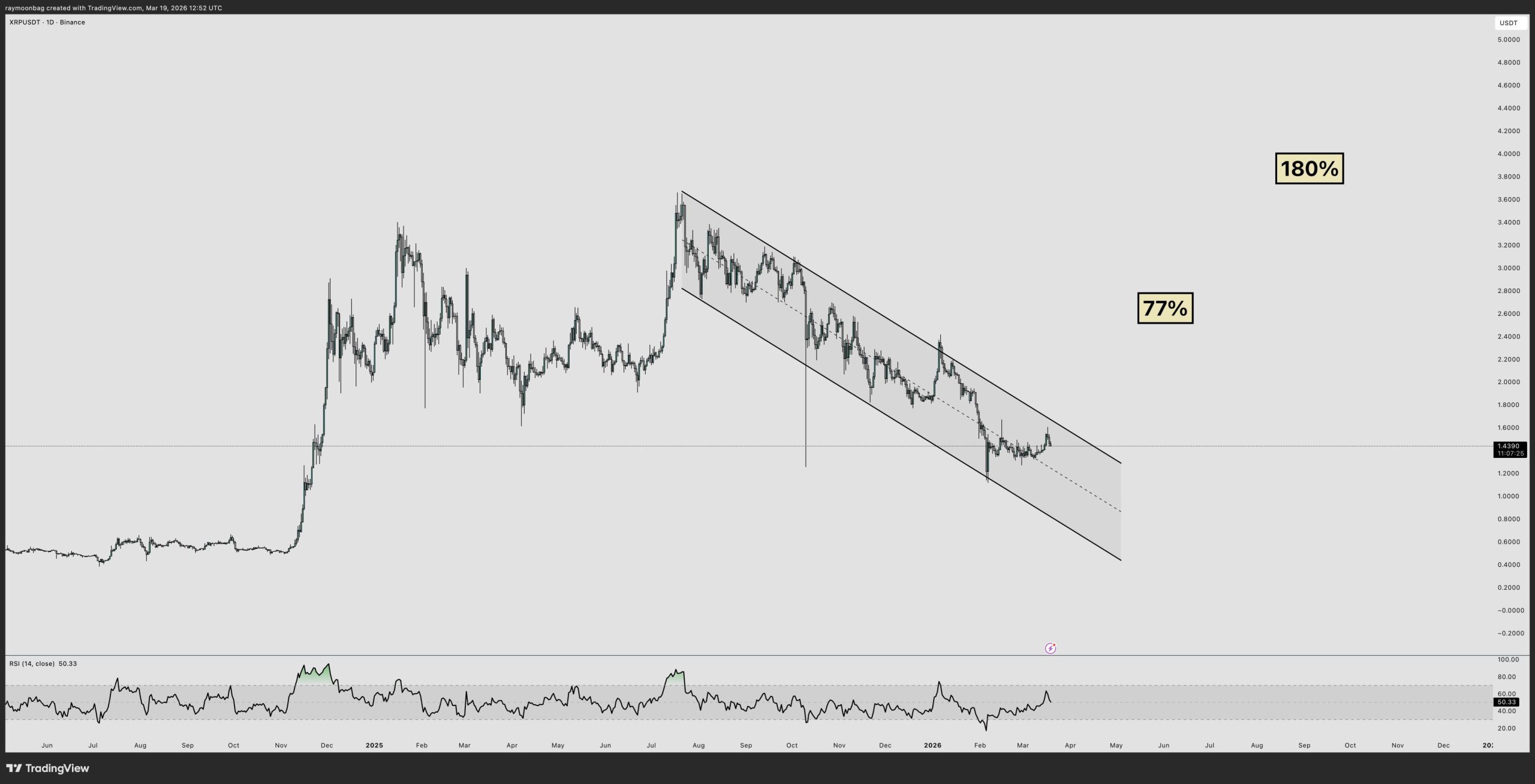
- XRP has dropped 5.8% in three days and remains trapped inside an eight-month descending channel near $1.45.
- A confirmed breakout above channel resistance could push XRP to a price target range between $2.50 and $4.00.
- Ripple has spent over $2.25 billion on acquisitions, building a full-stack financial platform around the XRP Ledger.
- XRP holds digital commodity status with both the SEC and CFTC, with an OCC banking charter application now under review.
XRP remains at a critical technical juncture as the broader crypto market experiences a consolidation phase. The asset is down 5.8% over the last three days, currently trading near $1.45.
Chart analysts point to a descending channel resistance as the key barrier to recovery. Meanwhile, Ripple continues expanding its regulatory and institutional presence globally. Technical and fundamental forces are both shaping the asset’s near-term direction.
Technical Resistance Keeps XRP Below Key Breakout Levels
XRP is trading inside a long-standing descending channel that formed after the asset peaked at $3.6 in July. The upper trendline has acted as firm resistance for eight months.
The asset tested this trendline on October 2, 2025, and again on January 6, 2026. Both attempts failed to produce a sustained close above the resistance level.
Chart analyst Ray notes that a confirmed breakout could push XRP to between $2.50 and $4.00. That range reflects a potential gain of 77% to 180% from current levels.

However, the descending channel trendline remains the major barrier standing between current prices and those targets.
The recent pullback has come alongside a broader lull across the crypto market. XRP’s price action continues to follow the channel structure closely.
The Japan-to-Philippines corridor, cited as a key use case for XRP, carries billions in annual remittance volume. Traders are watching for a decisive close above the resistance line before confirming any directional shift.
Until that breakout occurs, the asset remains technically constrained within the channel. The pattern from the past eight months shows that resistance at the upper trendline has been consistent.
Each rejection has reinforced the channel’s relevance as an active price structure. A volume-driven close above the trendline would be the clearest signal of a trend reversal.
Ripple Builds Institutional and Regulatory Infrastructure Around XRP
Beyond chart patterns, Ripple has been assembling a vertically integrated financial stack. The company acquired Hidden Road for $1.25 billion and GTreasury for $1 billion. Other purchases include Rail, Palisade, Solvexia, Metaco, Standard Custody, Fortress Trust, and BC Payments.
These acquisitions bring payments, custody, treasury, and prime brokerage under one roof. Ripple now holds over 75 regulatory licenses globally. The company has filed for a VASP license in Brazil and holds a full EU EMI license. An OCC banking charter application is also under review.
X Finance Bull, a crypto commentator on X, drew attention to XRP’s advantages over traditional payment rails. The post noted XRP Ledger’s 3-5 second settlement and sub-cent transaction fees.
It compared these directly against SWIFT’s multi-day processing and a 6.5% average cost on a $200 remittance.
The asset has been classified as a digital commodity by both the SEC and the CFTC. The CLARITY Act is expected to bring further regulatory clarity to the digital asset space.
Ripple has also expanded operations across Dublin, London, Singapore, and Sydney. These moves position XRP collectively as a functional settlement layer within the modernizing global financial system.

Ethereum’s native token, Ether (ETH), may push higher in the coming months as the market’s richest whale cohort returns to profitability for the first time since early February. Fresh on-chain signals point to a potential bottoming process that could set the stage for a renewed rally, though investors should remain mindful of historical caveats.
Key takeaways
- The unrealized profit ratio of wallets holding more than 100,000 ETH has flipped back above zero, signaling that the largest holders are no longer sitting on aggregate losses.
- Historically, a transition to profitability for this whale group has preceded notable uptrends: roughly 25% gains in about three months, around 50% in six months, and even larger moves over the following year.
- If the pattern holds, ETH could target the $2,750 area by June and potentially exceed $3,200 by September, anchored by on-chain and chart signals aligning in a bullish configuration.
- Glassnode’s MVRV-based valuation bands suggest upside potential but outline key thresholds: reclaiming the realized price near $2,353 would open a path toward the -0.5 sigma band around $2,640; failing to reclaim could leave ETH vulnerable to further downside toward $1,651.
- Technical factors reinforce the bull case: ETH recently cleared an ascending triangle, with a retest of the breakout level as support, a setup that commonly precedes further upside if the trendline holds.
Whale profitability as a potential catalyst
CryptoQuant’s data on the 100,000 ETH-plus wallet cohort shows the unrealized profit ratio returning to positive territory. In practical terms, this means the largest holders are no longer in a net loss position on their outstanding, largely illiquid exposure. An on-chain analyst known as CW noted that such shifts have historically marked the onset of sustained upside moves, providing a support-for-optimism signal for the broader market.
From a historical perspective, a positive flip in this whale ratio has correlated with meaningful appreciation in ETH’s price: approximately 25% gains over roughly three months, about 50% over six months, and even larger moves within a year. While not a guaranteed predictor, the pattern underscores a common market dynamic: when big owners stop bleeding on paper losses, selling pressure can ease and conviction among the largest holders can re-emerge.
That dynamic matters because ETH’s price action often hinges on how much the whale cohort wants to realize profits and how quickly the broader market absorbs their moves. A fresh wave of on-chain confidence could feed into a broader narrative of accumulation among the richest ETH holders, potentially reinforcing a self-fulfilling rally.
Valuation signals align with a recovery path
Another supportive lens comes from on-chain valuation bands tracked by Glassnode. The data shows ETH rebounding from a low MVRV deviation, with similarities to prior cycles in Q2 2022 and what we observed in 2025. The current setup suggests ETH would need to reclaim its realized price—approximately $2,353—to unlock further upside toward the -0.5 sigma pricing band near $2,640.
Conversely, failing to reclaim the realized price keeps ETH exposed to downside risk, with the next meaningful support near the lowest deviation band around $1,651. In practical terms, the realized price is acting as a critical fulcrum: a successful reclaim would bolster the bullish thesis, while failure to recapture could invite renewed pressure to test deeper supports.
Technical picture: what the chart is signaling
On the price chart, ETH appears to have broken out of an ascending triangle, a textbook breakout signal. The next phase often involves a retest of the breakout level, where the market checks whether the former resistance has truly flipped into support. If this retest holds, the path toward the measured upside target near $2,625–$2,750 becomes more plausible, with a broader alignment to the on-chain recovery framework described above.
That target sits comfortably within the envelope of the on-chain recovery range highlighted by MVRV analysis, providing an additional layer of confluence for a bullish setup. However, a failed retest could undermine the breakout and re-open downside risk toward the lower support zone around $1,950–$2,000.
What this means for traders and holders
For traders, the convergence of on-chain profitability signals and a constructive chart pattern offers a clearer directional read than in weeks past. The combination of a profitability flip among the 100k+ ETH whale cohort and a successful breakout retest reduces near-term selling pressure from some of the market’s deepest liquidity pockets, potentially enabling a smoother climb higher if macro conditions stay supportive.
For long-term holders, the narrative centers on a potential re-accumulation phase among the wealthiest ETH wallets and a gradual re-anchoring above realized price levels. This alignment can bolster confidence in ETH’s resilience during broader crypto cycles, especially if macro risk sentiment improves or if fundamental rails such as network activity and developer engagement continue to strengthen.
Historical context and what remains uncertain
It’s important to temper optimism with caution. The 2018 era offers a reminder that a similar flip in profitability among large holders does not guarantee a sustained uptrend. In that period, ETH experienced a notable downside following the signal before eventually stabilizing and resuming its long-term ascent. As with any on-chain narrative, outcomes depend on a confluence of factors, including macro conditions, regulatory developments, and competing liquidity dynamics in DeFi and institutional markets.
Looking ahead, key milestones to watch include a decisive reclaim of the realized price, a sustained hold of the breakout level on retests, and how quickly the market digests the next round of on-chain data from sources like CryptoQuant and Glassnode. If the current signal persists and macro backdrop remains supportive, a test of the $2,750 region by mid-year and a challenge of $3,200 later in the year could be within reach.
This article does not constitute investment advice. Market conditions are subject to change, and investors should perform their own due diligence before acting on any on-chain or technical signals.
What happens next will hinge on how decisively ETH can defend the breakout and whether the largest holders maintain their renewed profitability. As the ecosystem evolves, traders and hodlers alike should keep a close watch on realized-price dynamics, MVRV deviations, and the evolving behavior of the 100k+ ETH cohort to gauge the durability of any emerging uptrend.


The Algorand Foundation on Wednesday joined the ranks of crypto firms slashing headcount, losing 25% of its fewer than 200 employees and citing “the uncertain global macro environment” and a broader crypto downturn.
The cuts arrived as a wave of layoffs proliferates across the industry. In February, Gemini Space Station (GEMI) said it would eliminate roughly 200 positions, about a quarter of its staff, a figure that had grown to 30% by mid-March. On Thursday, Crypto.com said it is trimming 12%, about 180 roles.
That’s on top of 20 employees who got the chop at OP Labs, the company building layer-2 blockchain Optimism, earlier this month and the five full-time employees and three contractors let go at PIP Labs, the team behind Story Protocol, 10% of its workforce. Messari, a crypto data provider that now bills itself as an AI-first company, announced its third round of layoffs since 2023 alongside a CEO change, without giving a number.
Official explanations varied. Algorand pointed squarely at macro conditions and weak token prices, though many framed their cuts as a pivot toward greater use of AI in the workflow.
“AI is now too powerful not to use at Gemini,” the company said in its letter to shareholders. “Not using AI at Gemini will soon be the equivalent of showing up to work with a typewriter instead of a laptop.”
“We are joining the list of companies integrating enterprise-wide AI,” a Crypto.com spokesperson told CoinDesk on Thursday, pointing to increased efficiencies needing fewer workers. CEO Kris Marszalek on X said companies that do not pivot toward integrating AI into their processes will fail.
Algorand’s cuts reportedly hit community management and business development roles, not positions obviously displaced by AI. To be fair, the company blamed the broader crypto environment. It’s ALGO token recently traded around $0.09, down 98% from its 2019 peak. Bitcoin , the largest cryptocurrency by market capitalization, has lost 20% this quarter.
Industry consolidation
Industry observers pointed to a broader consolidation dynamic. Entire crypto sectors like restaking, DePIN and layer 2s, which were once flush with talent have contracted sharply, while M&A activity is adding to redundancies as acqui-hires — employees acquired by buying a company — displace legacy employees.
“I see no real indication that these layoffs have anything to do with AI workforce replacement at scale,” said Dan Escow, the founder of crypto recruitment agency Up Top. “Entire categories like restaking, DePIN and L2s that were once robust with talent are basically non-existent. Companies are forced into cost-cutting mode to buy time to figure out how to execute on whatever comes next.”
The broader hiring picture supports that reading. New job postings across major crypto job boards ran at roughly 6.5 per day in January, down around 80% from the same period a year earlier.
Just the companies mentioned in this story — excluding Messari, which did not disclose numbers — have announced around 450 job cuts in a matter of weeks. Thay may be the tip of the iceberg, in crypto winter of 2022 CoinDesk tracked more than 26,000 job losses over the course of the year, a tally that took months to become apparent.
TLDR:
- XRPL now hosts $2.3 billion in tokenized real-world assets, drawing major institutional players worldwide.
- The XRP Ledger settles transactions in 3 to 5 seconds at fractions of a penny, far outpacing traditional wire transfers.
- Société Générale, SBI Holdings, and Braza Bank have all launched financial products directly on the XRPL platform.
- Ripple has processed over $100 billion in volume across a network of more than 300 global financial institutions.
The story of money spans thousands of years, from grain trades in ancient villages to decentralized digital ledgers. Each era of exchange solved a problem the previous one could not.
Today, the XRP Ledger stands at the end of that long chain of innovation. With $2.3 billion in tokenized real-world assets and three to five second settlement, XRPL represents the most complete financial infrastructure ever built on a blockchain.
How Every Era of Money Removed a Middleman
Ancient economies ran on barter, trading grain for cattle, salt for silk, and labor for shelter. That system worked within small communities where both parties held what the other needed.
However, it collapsed under its own limits. You cannot carry livestock to a market and expect a clean trade every time.
Coins and precious metals solved that problem. Gold and silver gave value a portable, universal form. For centuries, commerce expanded on the back of metal currency. Then governments stepped in, replacing metal with paper, and banks took control of the system entirely.
Wire transfers and SWIFT later allowed money to cross oceans for the first time. Yet the cost remained steep, ranging between $10 and $50 per transaction.
Settlements took days, not seconds. Worse, correspondent banking required roughly $27 trillion locked in idle accounts just to function.
Bitcoin arrived as the first serious break from centralized control. It proved that value could travel without a bank acting as intermediary.
But Bitcoin was slow, expensive, and never designed for everyday payments. The architecture that actually completed the journey came next.
Why XRPL Closes the Chapter That Bitcoin Opened
RippleXity described the arc plainly on X: “From Barter to Blockchain. The Story of Money and Why XRPL Is the Final Chapter.” XRPL was the first blockchain to support native tokenization of any currency.
Dollars, euros, yen, and reais can all be issued and traded directly on the ledger. No smart contracts, no complex programming, just trustlines, tokens, and a built-in decentralized exchange.
The numbers behind the ledger reflect that ambition. It processes up to 1,500 transactions per second at fractions of a penny per transfer.
Settlement completes in three to five seconds. The network also operates on a carbon neutral model, which matters to institutions with governance commitments.
Major financial players have already moved onto the ledger. Société Générale launched its euro stablecoin on XRPL. SBI Holdings issued a $65 million on-chain bond through the platform.
Braza Bank brought a Brazilian real stablecoin to the ledger as well. Ripple’s own RLUSD stablecoin has crossed $1.5 billion in market capitalization.
Ripple now counts over 300 financial institutions in its network and has processed more than $100 billion in volume.
The company has applied for a Federal Reserve master account and filed VASP licenses across multiple jurisdictions. Every stage of money’s history removed one layer of friction. XRPL appears to have removed the rest.
The recent guidance from the United States Securities and Exchange Commission (SEC) and the Commodity Futures Trading Commission establishing a taxonomy for digital assets put a “final nail” in the coffin of SEC policy under former Chairman Gary Gensler, according to Alex Thorn, the head of firmwide research at investment firm Galaxy.
The SEC guidance, published on Tuesday, established a taxonomy for digital assets, dividing them into five categories, including digital commodities, digital collectibles like non-fungible tokens (NFTs), digital tools, stablecoins, and tokenized securities.

Under the old SEC policy framework, the regulations governing which cryptocurrencies met the legal criteria of “investment contracts” were legislative rules, as opposed to the new 2026 guidance that was filed as an interpretive rule, Thorn said. He explained the significance:
“The distinction matters enormously under the Administrative Procedure Act (APA). A legislative rule or substantive rule goes through notice-and-comment rule-making, has the force and effect of law, and binds both the agency and regulated parties.
An interpretive rule is exempt from notice-and-comment requirements, does not have the force of law, and merely explains how the agency understands existing statutory provisions,” he continued.
The interpretive rule does not legally bind courts to enforce the policies, which gives the SEC and the crypto industry flexibility in adapting to future regulatory changes, he added.
The new regulatory approach gives the crypto industry much-needed clarity over the next 30 months, Thorn Said; however, he clarified that the CLARITY crypto market structure bill must be codified into law to cement the rules over the next several decades.
Related: SEC interpretation on crypto laws ‘a beginning, not an end,’ says Atkins
The CLARITY Act stalls, but rumors emerge of a tentative deal between White House and lawmakers
The CLARITY Act stalled in January 2025, after crypto exchange Coinbase and other industry players voiced concerns over the prohibition on stablecoin yield and a lack of protections for open-source software developers.
Crypto companies and industry thought leaders also cited provisions that would effectively gut the decentralized finance (DeFi) sector by imposing reporting requirements and know-your-customer controls on DeFi as a major cause of contention.

On Friday, Politico published a report of a tentative deal between the White House and lawmakers to move the CLARITY bill forward.
Specific details of the prospective deal have not yet been revealed, although Senator Angela Alsoboorks said the tentative deal includes a ban on stablecoin yield from “passive balances.”
Magazine: How crypto laws changed in 2025 — and how they’ll change in 2026
Crypto World
Grayscale wants to bring the world’s hottest crypto trading frenzy to your brokerage account
Grayscale has filed with the U.S. Securities and Exchange Commission (SEC) to launch a new exchange-traded fund for the HYPE token, amid the surging popularity of decentralized exchange Hyperliquid.
The Crypto asset manager’s proposed fund would hold the HYPE token and be listed on Nasdaq under the ticker GHYP, according to the S-1 registration statement.
Grayscale said it may stake some holdings in the future, though it cannot do so now. The filing doesn’t disclose a proposed fee. Other asset managers that have also filed for HYPE ETFs include Bitwise and 21Shares, which already operate a HYPE exchange-traded product in Europe with a 2.5% total expense ratio.
HYPE is the native token of the Hyperliquid network, which is home to the leading decentralized exchange of the same name. Its core layer handles perpetual futures and spot markets, while a second layer supports Ethereum-style smart contracts.
Perpetual futures contracts, or “perps,” are derivative instruments without expiration dates that allow investors to place bets on an asset’s price without owning it. Their infinite duration (perpetual futures contracts never expire, unlike traditional contracts), high-leverage options, and round-the-clock access have made them extremely popular in the crypto space.
The filing comes as Hyperliquid sees growing interest from traders betting on traditional financial assets, including oil and gold, while war rages in the Middle East. The platform has also recently added an S&P 500 perpetual contract.
In simple terms, the platform’s value proposition is not just crypto trading, but also the ability to bet on traditional assets around the clock, even when most markets are closed.
The trading frenzy has seen Hyperliquid’s weekly derivatives trading volume top $50 billion, with more than $6.5 billion being traded in the past 24 hours alone, according to DeFiLlama data.
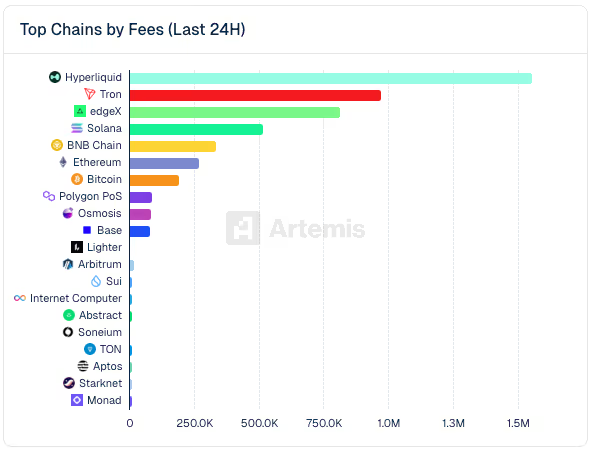
That has helped the Hyperliquid chain dominate in revenue, which stands at $1.6 million over the last 24 hours, compared to $335,000 for BNB Chain and $192,000 for the Bitcoin blockchain, according to Artemis data.

This increased activity has captured many bullish takes from crypto investors and market observers. Recently, Arthur Hayes, the co-founder of BitMEX and CIO of Maelstrom, said the platform’s strong revenue, real trading activity, and disciplined token supply could take its native token, HYPE, to $150.
The token currently trades around $40 and has risen by 57% this year, while bitcoin fell about 20% and Ethereum’s native token, ether, fell about 28%.

The Madison Cast’s Dating History: Michelle Pfeiffer, Kurt Russell

How To Make Money With Google Adsense Using AI (No-Code Web Apps)

World Athletics Indoor Championships 2026: Josh Kerr reclaims 3,000m title

Smart energy pays enters the US market, targeting scalable financial infrastructure

Why Israel is blocking foreign journalists from entering

Bitcoin: We’re Entering The Most Dangerous Phase
How To Make Money With Google Adsense Using AI (No-Code Web Apps)

Bitcoin Live Trading || Crypto Live Trading || 20 MAR || Vivek Yadav #bitcoin #crypto #gold

How to Get Rich Early In Crimson Desert – Crimson Desert Money Making
-

 Tech6 days ago
Your Legally Registered ‘Motorcycle’ Might Not Count Under Proposed US Law
-

 Politics1 day ago
Jenni Murray, Long-Serving Woman’s Hour Presenter, Dies Aged 75
-

 Fashion1 day ago
Weekend Open Thread: Adidas – Corporette.com
-
 Tech4 days ago
Are Split Spacebars the Next Big Gaming Keyboard Trend?
-

 News Videos3 days ago
RBA board divided on rate cut, unusually buoyant share market | Finance Report | ABC NEWS
-

 Business6 days ago
Search for Savannah Guthrie’s Mother Enters Seventh Week with No Arrests
-
 Crypto World20 hours ago
NIO (NIO) Stock Plunges 6.5% as Shelf Registration Sparks Dilution Worries
-

 Business5 days ago
Australian shares drop as Iran war enters third week
-

 Crypto World5 days ago
Crypto Lender BlockFills Enters Chapter 11 with Up to $500M in Liabilities
-

 Politics3 days ago
The House | The new register to protect children from their abusers shows Parliament at its best
-

 Fashion5 days ago
25 Celebrities with Curly Hair That Are Naturally Beautiful
-

 Tech2 days ago
inKONBINI Lets You Spend Summer Days Behind the Register
-

 Crypto World3 days ago
Canada’s FINTRAC revokes registrations of 23 crypto MSBs in AML crackdown
-
 Politics4 days ago
Real-time pollution monitoring calls after boy nearly dies
-

 Crypto World7 days ago
Crypto Losses Drop 87% in February, But Hackers Are Now Targeting People, Not Code
-
 NewsBeat3 days ago
Residents in North Lanarkshire reminded to register to vote in Scottish Parliament Election
-

 Business5 days ago
Meta planning major layoffs as AI spending and automation reshape workforce
-

 News Videos3 days ago
PARLIAMENT OF MALAWI – PAC MEETING WITH REGISTRAR OF FINANCIAL ON AMARYLLIS HOTEL – INQUIRY LIVE
-

 Politics6 days ago
9 Stylish Leather Jackets Perfect For Spring 2026
-
Crypto World6 days ago
U.S. Oil Companies Post Record Profits as Oil Prices Break $100
You must be logged in to post a comment Login