

Crypto World
Bitcoin under pressure as yields rise, Iran conflict, inflation risk

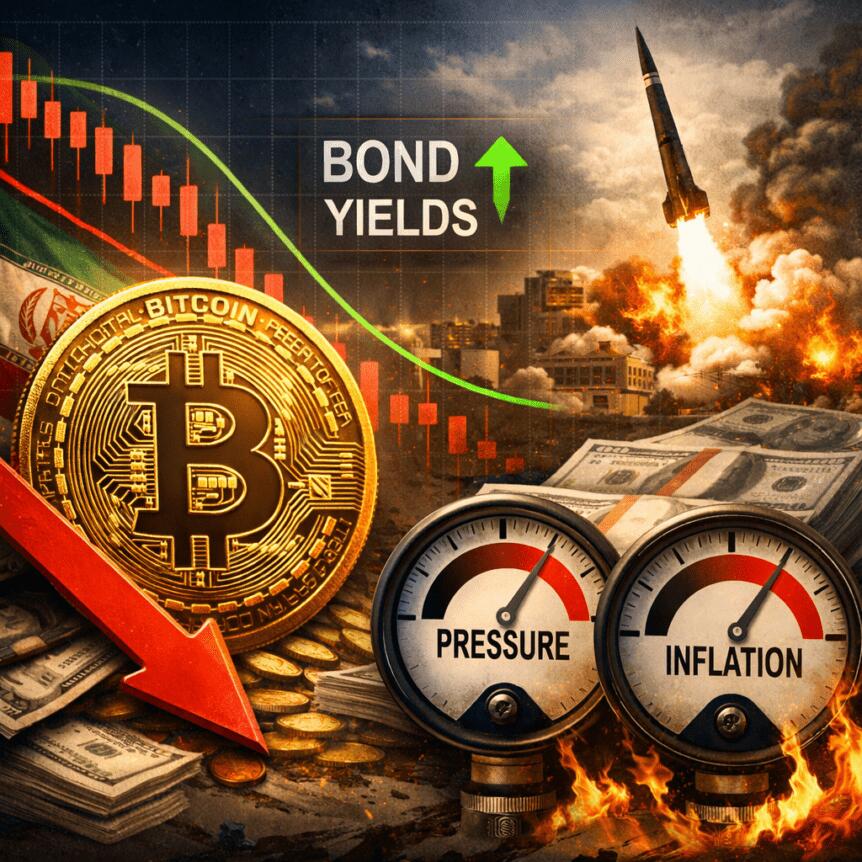
A risk-off mood swept across crypto and traditional markets as geopolitical tensions and stubborn inflation kept investors cautious. Bitcoin tested the $67,500 support level on Monday as traders paused after a run higher, while gold endured a sharp pullback described as one of its steepest corrections in more than five decades. Oil extended its rally, trading above the $90 per barrel threshold on renewed concerns about conflicts in the Middle East, heightening inflation pressures even as markets gauged the trajectory of U.S. monetary policy.
In parallel, U.S. Treasuries came under selling pressure, with the 5-year yield surging to around 4.10% — a nine-month high — as investors demanded better returns in a uncertain macro backdrop. The S&P 500 also slipped to its weakest level in more than six months, underscoring a broad shift toward liquidity. Market data pointed to a meaningful shift in rate expectations, with the probability of a July rate hike climbing to roughly 20% according to the CME FedWatch tool, signaling a tighter policy stance ahead.
Key takeaways
-
Bitcoin tested the $67,500 support as risk assets sold off alongside a sharp gold correction and a surge in oil prices driven by geopolitical fears.
-
U.S. 5-year Treasury yields rose to about 4.10%, a nine-month high, as markets price a higher likelihood of further rate hikes this year (roughly 20% probability for a July move).
-
Oil breached the $90 level on Middle East tensions, intensifying inflationary pressures at a moment when investors reassess policy and growth risks.
-
Debt risk and tech stock softness added to the cautious tone: the U.S. national debt topped $39 trillion, while major tech names faced meaningful drawdowns on several fronts, including AI-euphoria and growth concerns.
Markets in risk-off mode amid macro and geopolitical shocks
Bitcoin’s move to test the key $67,500 support zone reflected a market attempt to balance recovering sentiment with renewed caution. The rapid correction in gold prices—described by some as the sharpest in more than five decades—illustrates how investors pivoted toward cash and short-duration assets as inflationary pressures persisted and the path of U.S. monetary policy remained uncertain. Oil’s ascent above $90 a barrel added another layer of complexity, feeding concerns about higher consumer costs and potential policy responses crafted to contain inflationary spillovers.
Geopolitical developments surrounding Iran dominated the narrative in trade desks and policy circles. Market observers noted that oil’s rally would likely keep inflation prints under scrutiny and complicate the Federal Reserve’s task of calibrating policy to slow growth without tipping the economy into recession. The Washington Post highlighted broader debates over military posture and cost, reporting that U.S. authorities debated options including a potential deployment of additional troops in the region to counter Iran’s influence around critical chokepoints. While these reports underscored escalation risk, traders stressed that policy clarity and inflation data would ultimately guide near-term price action for risk assets, including Bitcoin.
From a pure market-structure perspective, the risk-off tilt was reinforced by a retreat in equities. The S&P 500’s dip toward multi-month lows signaled that investors were de-risking amid uncertainty over how elevated energy prices, geopolitical tensions, and slower growth might interact with corporate earnings. On the rate front, the implied path of policy tightening appeared to broaden: the CME FedWatch Tool showed a meaningful probability that the Federal Reserve could raise rates by July, albeit with a still-contingent trajectory depending on incoming data on inflation and the labor market.
Policy trajectory, debt dynamics, and the tech earnings backdrop
Beyond the immediate geopolitical chatter, traders weighed the longer arc of monetary policy. The combination of higher yields and persistent inflation expectations has kept a lid on risk assets, with many market participants reassessing whether a soft landing remains plausible in a climate of elevated funding costs and debt issuance. In this environment, Treasuries faced continued selling pressure as investors demanded higher yields to compensate for ongoing macro headwinds.
Meanwhile, the broader debt landscape remains a talking point for investors concerned about fiscal sustainability. U.S. government debt has surpassed $39 trillion, highlighting the fragility of the macro backdrop where wage growth and consumer prices interact with fiscal stimulus and military spending. This backdrop has intensified debates about the pace of further monetary tightening and the risk of policy missteps that could weigh on asset prices, including Bitcoin, which despite resilient on-chain metrics, has to contend with a macro regime that favors liquidity preservation during stress periods.
In the tech ecosystem, the mood pivoted as investors evaluated the sustainability of AI market strength versus the fundamentals of a broad-based rally. Reuters reported that OpenAI, the creator of ChatGPT, was courting private-equity investors with a guaranteed minimum return of 17.5% even as broader profitability remained challenged. The dynamic underscored the tension between AI enthusiasm and the need for disciplined capital deployment in a high-rate, high-cost funding environment. The sector-wide pullback in tech stocks—names like Google, Meta, and IBM registering material declines over the past several weeks—further reflected the recalibration away from speculative momentum toward more cautious allocations.
From a practical standpoint, the pullback did not erase the undercurrents of crypto-specific demand signals observed in on-chain activity and institutional interest. Some metrics suggested that Bitcoin remained resilient on a structural basis even as price action traded within a broad range. However, the combination of rising yields, fragile risk sentiment, and systemic debt growth kept upside momentum in check and kept the door open for further volatility as new data prints and policy cues arrive.
For investors, the message is nuanced. While the macro risk-off environment tends to weigh on risk assets, Bitcoin’s role as a diversifying, non-sovereign store of value remains a focal point for portfolios seeking hedges against fiat instability. Yet the narrative remains highly conditional on inflation trajectories and the policy response to geopolitical shocks. The divergences between on-chain indicators and macro price action suggest a period where crypto markets could outperform in certain risk-off scenarios while still grappling with broader macro headwinds in others.
What to watch next
Looking ahead, traders will be closely watching inflation data, labor market signals, and the pace of energy prices to gauge how much further the Fed might tighten and when. Any escalation in Iran-related tensions or shifts in Middle East risk could renew a bid for safer assets and recalibrate expectations for both traditional markets and crypto equities. On the policy side, the next round of statements and minutes from the Fed, alongside real-time economic indicators, will shape the probability curve for rate moves and help determine whether BTC and other digital assets can sustain a constructive breakout or drift into a renewed risk-off regime.
This article draws on market readings and reporting from Cointelegraph, The Washington Post, Reuters, and related outlets to outline the evolving risk landscape. As always, readers should conduct their own research and consider how macro forces, geopolitical developments, and sector-specific dynamics interact in shaping crypto markets.

BitMine Immersion Technologies chairman Tom Lee put a $22,000 Ethereum target on the table at a Miami event this week, with ETH trading at $2,280.70, a nearly 10x call from current levels.
The mechanism is a two-part thesis: ETH/BTC ratio reversion toward historical averages applied against a $250,000 Bitcoin fair value assumption, layered with a structural demand argument that AI agents will require on-chain settlement infrastructure that legacy banking cannot provide.
That combination, Lee argued publicly and on stage, makes Ethereum cheap right now.
The tension in the call is real. Every condition in that chain has to cooperate simultaneously. Bitcoin has to reach $250,000.
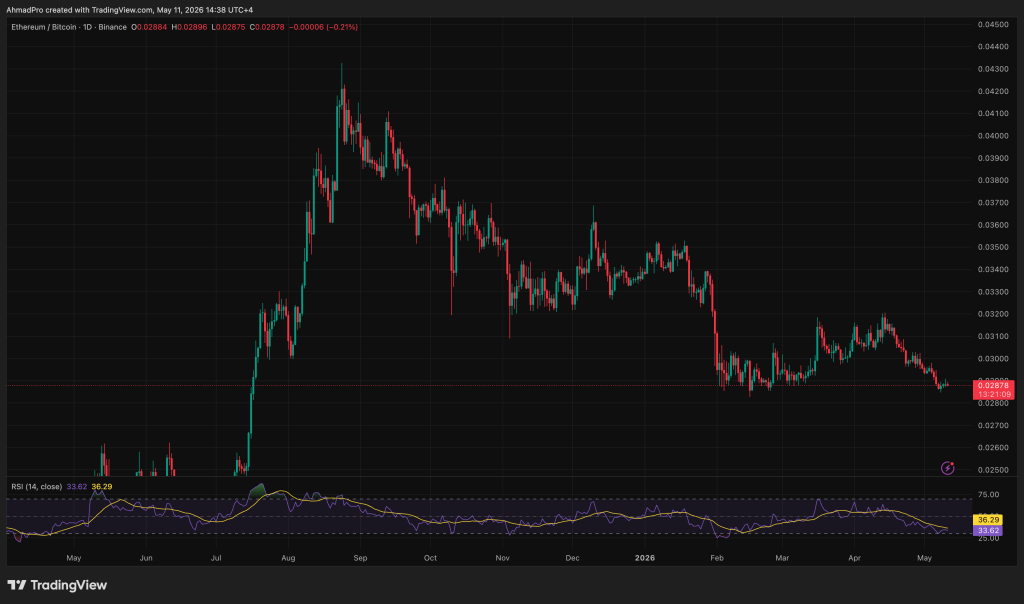
The ETH/BTC ratio has to recover toward its 2021 peak of 0.087 from its current 0.03. And AI-driven blockchain adoption has to materialize at a scale the market has not yet priced.
What follows is an examination of whether the data supports any of those assumptions – and which one is doing the heaviest lifting.
Discover: The best pre-launch token sales
The Math Behind the $22,000 Target Is Specific – and Demanding
Lee’s ratio math is straightforward. The ETH/BTC long-term average sits near 0.048. The 2021 cycle peak hit 0.087.
Applied to a $250,000 Bitcoin price Lee’s stated fair value, those ratios produce ETH targets of roughly $12,000 and $21,750, respectively.
The $22,000 figure is essentially the bull case of the bull case: peak ratio, peak BTC assumption, both arriving at the same time.
The AI-blockchain demand component is where Lee diverges from a pure ratio trade. His argument: AI agents operating autonomously in the global economy will need a payment layer that functions 24/7 without correspondent banking dependencies.
Ethereum’s uninterrupted uptime record and decentralized validator set make it the default candidate. Lee also cited stablecoin transaction volumes surpassing Visa’s annual throughput, a claim that holds up. Ethereum-based stablecoin volumes (USDC, USDT, DAI combined) ran approximately $220 trillion annualized in 2025, against Visa’s $12.2 trillion.
That data point is not speculative.
On supply, Lee’s position at BitMine adds direct context. The firm holds more than 4% of all circulating Ethereum and generates over $300 million annually from staking rewards, which places Lee’s bullish thesis in direct financial proximity to his institution’s balance sheet.
That conflict of interest is worth naming. It does not make the thesis wrong. It does mean the assumptions deserve scrutiny.
Discover: The best crypto to diversify your portfolio with
Where Ethereum Price Trades Now and What the Chart Needs to Do
ETH is sitting at $2,330 on the daily chart, and the macro picture here is a coin that peaked near $4,900 in August and has been in a downtrend for the better part of a year, shedding over 60% before finding a floor around $1,750 in February.
The recovery since that low has been the most sustained positive price action since the downtrend began, with price grinding higher lows from February through May and now sitting in the $2,300 to $2,400 zone which is a critical area.
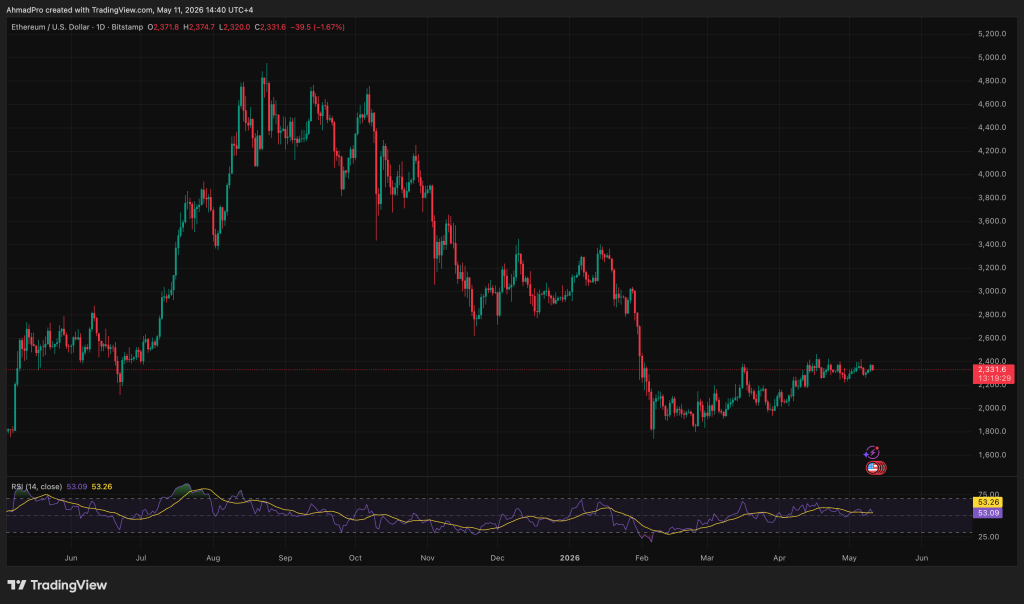
That $2,400 level is where the February breakdown accelerated from, making it the first major overhead supply zone that needs to flip before any meaningful recovery can develop, and price has been churning just below it for weeks without a clean break.
A daily close above $2,400 held over multiple sessions opens $2,800 first, then $3,000 and $3,400 as the next resistance clusters from the November and December distribution.
On the downside, $2,000 is the immediate floor that has held on every dip since March, and $1,750 is the absolute line that cannot break without the entire base structure collapsing.
The longer ETH spends consolidating below $2,400 without breaking down, the more pressure builds for an eventual resolution to the upside, but until that break happens, this remains a recovery inside a longer downtrend and not yet a confirmed reversal.
Discover: The best crypto to diversify your portfolio with
The post Tom Lee Floats $22,000 Ethereum Target: What Has to Be True? appeared first on Cryptonews.
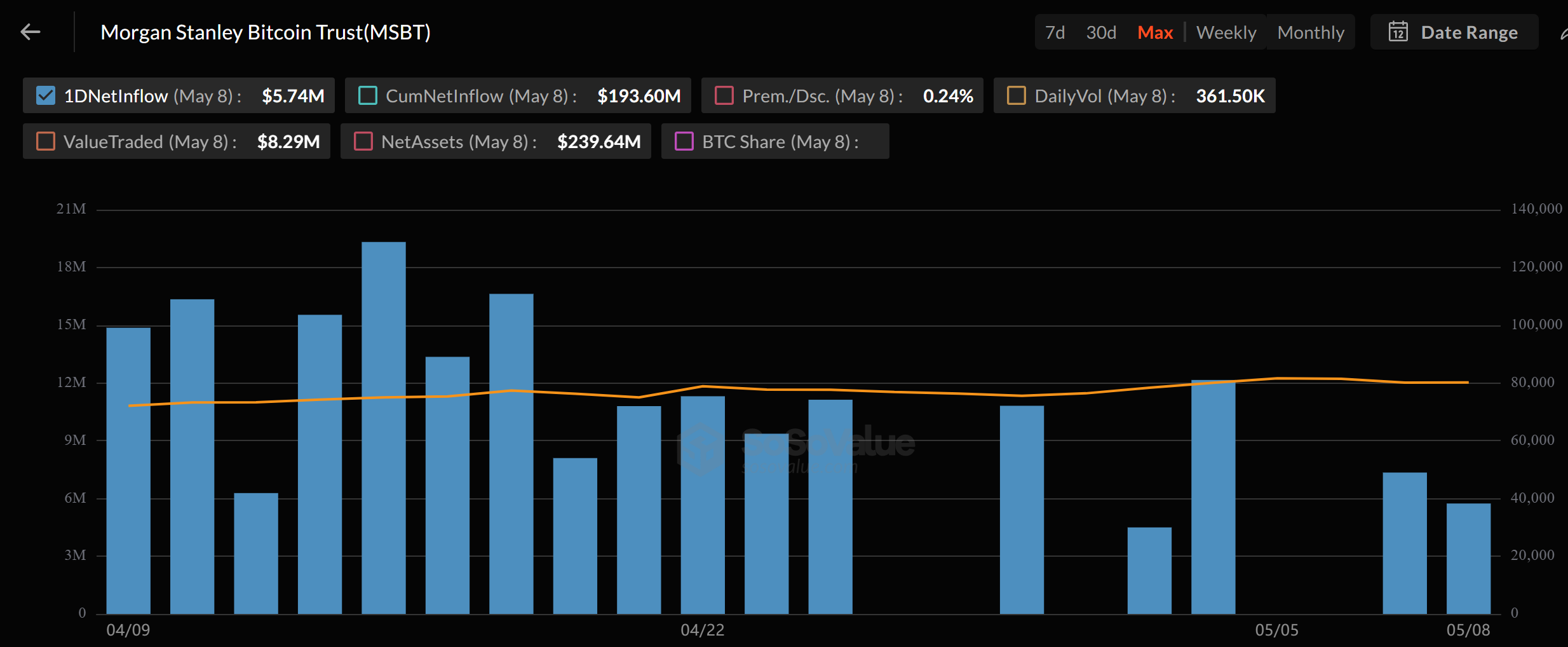
Morgan Stanley’s spot Bitcoin ETF cleared 30 days of trading without a single outflow day, drawing roughly $194 million while BlackRock, Fidelity, and ARK Invest all lost capital over the same stretch.
MSBT, which began trading April 8 on NYSE Arca, posted 17 inflow days and 5 flat sessions through May 8, lifting its asset base above $240 million.
How MSBT Outflanked Every Rival in Month One
SoSoValue data shows MSBT launched with $30.6 million in deposits and $34 million in trading volume on day one. Net inflows climbed to roughly $194 million by May 8, pushing the fund’s bitcoin holdings near 2,920 BTC.

Every other major spot Bitcoin ETF lost ground during the same window. Products from BlackRock, Fidelity, and ARK Invest each posted net outflows as BTC traded between the mid-$70,000s and low-$80,000s.
MSBT’s 0.14% fee, the cheapest in the category, helped insulate it from the rotation.
BlackRock’s IBIT set the 2024 benchmark with 71 inflow days after launch. Its first flat session arrived in April 2024, followed by a $36.9 million outflow on May 1.
MSBT now joins that pattern on a shorter, sharper scale.
Sticky Capital Signals Advisor-Led Allocation
Morgan Stanley’s roughly 16,000 advisors steward more than $9 trillion in client assets. That captive channel gives MSBT reach pure-play issuers cannot match.
The fee gap and in-house distribution help explain why the six-week sector tailwind landed disproportionately on the fund.
Whether MSBT can hold the streak as BTC volatility returns is the next test. The fund’s $240 million asset base sits far below IBIT’s scale.
Still, its first-month retention sets a new bar for late entrants in the spot ETF lineup.
The post Zero Outflows in 30 Days: How Morgan Stanley’s MSBT Outflanks Every ETF Rival appeared first on BeInCrypto.
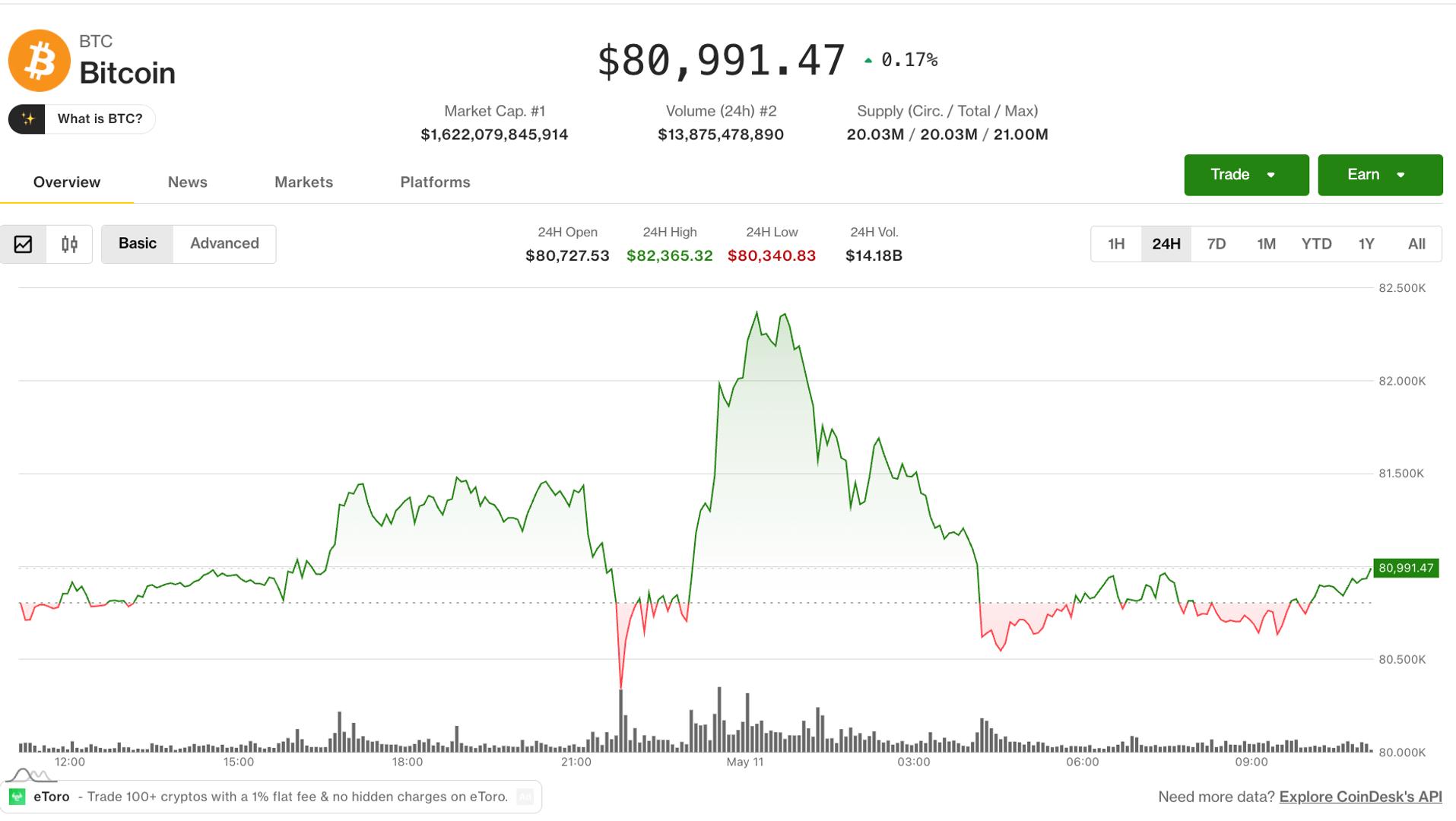
The crypto market started the week in a volatile mood, with bitcoin rising from $80,670 at 23:00 UTC on Sunday before topping out at $82,400 an hour later. The price subsequently dropped to trade in a fairly narrow range just beneath $81,000.
The move coincided with the weekly open of bitcoin futures on the CME and U.S. equity futures — a period that often sparks a frenzy of repositioning and a phenomenon called the “CME gap,” which occurs when the price opens at a different point to where it closed on Friday.
Due to the timing of the move, all crypto benchmarks are down on Monday with the broad CoinDesk 100 (CD100) leading the way at a 1.5% loss while the bitcoin-dominant CoinDesk 5 (CD5) dropping 0.6%.
Price action is also being dictated by geopolitical developments in Iran. U.S. President Donald Trump said Iran’s response to a peace proposal was “totally unacceptable,” leading to a rise in the price of oil and the dollar and a decline in risk assets.
Derivatives positioning
- The market-wide crypto futures open interest (OI) remains pinned just above $130 billion for the fourth straight day, pointing to a lack of fresh leverage inflows and broadly stalled momentum across the derivatives market.
- Centralized exchanges have liquidated over $400 million in leveraged futures bets, with shorts accounting for most of that amount.
- SUI’s OI has surged by 29%, validating the double-digit rise in the token’s price. This, coupled with positive funding rates and 24-hour OI-adjusted cumulative volume delta, points to growing demand for bullish exposure.
- DOGE and HBAR are other notable OI gainers, while BTC and ETH futures OI remains largely steady.
- OI in futures tied to the privacy-focused ZEC token has declined by 6%, a sign of capital outflows.
- Despite the U.S. CPI and PPI releases due later this week, the market remains calm, as evidenced by bitcoin’s 30-day implied volatility index, which is pinned near three-month lows.
- On Deribit, bitcoin calls at strikes, ranging from $81,000 to $86,000 dominate the volume rankings. Call options are inherently bullish plays on the underlying asset.
- Block flows featured bitcoin long call condors, a strategy initiated to profit from low volatility and minimal price movement in the underlying asset.
Token talk
- Venice’s VVV token more than doubled in the past month as traders reacted to a string of emissions cuts, token burns, new products and the growing demand for AI.
- The move started with supply. Venice doubled its subscription-linked burn rate in late April, with Pro, Pro+ and Max subscriptions on the platform now triggering $2, $5 and $10 VVV burns, respectively, according to VeniceStats data.
- Venice then cut annual emissions of the token, which can be used for privacy-focused artificial intelligence, from 6 million tokens to 5 million on May 1, the first step in a planned reduction to 3 million by July, according to the project.
- The rally accelerated after StrikeRobot, which develops AI software for robots, said Venice would become a primary inference API backend for its robotics products, starting with SR Agentic and SR Platform.
- Meanwhile, subscription revenue is rising. Co-founder Jesse Proudman said Monday that subscription and credit purchases hit a record, topping the prior high by 10%.
- VVV remains below its $22.5 January 2025 record. The token had fallen as much as 50% shortly after its debut amid insider-trading concerns tied to early purchases by Aerodrome Finance contributors.
Crypto World
Circle (CRCL) beats earnings estimates but misses on revenue amid $222 million Arc raise


Circle, issuer of the world’s second-largest stablecoin, USDC, posted estimate-beating first-quarter earnings as revenue rose 20% and it raised $222 million for its Arc blockchain network in a presale of the ARC token.
Earnings per share (EPS) of 21 cents beat analyst estimates of 17 cents, while revenue rose 20% to a less-than-forecast $694 million. Adjusted earnings before interest, taxes, depreciation and amortization (Ebitda) grew 24% from a year earlier to $151 million, the New York-based company reported.
USDC onchain transaction volume jumped over 260% from the year-earlier quarter to $21.5 trillion, and USDC in circulation increased 28% to $77 billion.
The ARC token presale values the project at $3 billion. The fundraising round included investment from a mix of Wall Street heavyweights and crypto-native firms, including BlackRock, Apollo Funds, a16z crypto, ARK Invest, CoinDesk’s parent company Bullish, Haun Ventures, Intercontinental Exchange and Standard Chartered Ventures.
The fundraising marks Circle’s most ambitious expansion beyond USDC and payments infrastructure, pushing the stablecoin issuer deeper into the race to build blockchain infrastructure for institutional finance.
Circle also published the Arc whitepaper on Monday, outlining ARC as a “native coordination asset” designed to support governance, validator security and network operations across the chain.
Arc, which began testing in October, is being positioned as a blockchain optimized for stablecoin-based capital markets and regulated financial activity, which includes tokenized assets, cross-border settlement and onchain finance.
Unlike USDC, which functions as a dollar-pegged payment token, ARC appears intended to play a role closer to ether (ETH) on Ethereum or SOL on Solana — helping coordinate the network’s economic and security model.
CRCL shares were nearly 1.2% higher at $115 in pre-market trading at around 7:30 a.m. ET.
UPDATE (May 11, 11:20 UTC): Adds Circle’s first-quarter earnings report information and restructures article to lead with earnings.
Crypto World
Wall Street giants are triggering a massive fee war that could crush crypto exchange margins


Immediately after Morgan Stanley announced it was rolling out E*Trade, charging a mere 50 basis points undercutting established rivals Coinbase, Robinhood and Schwab, Bloomberg analyst Eric Balchunas said “crypto exchanges should be scared.”
Others were less blunt, saying the Wall Street giant’s “isn’t entering crypto to complement Coinbase—it’s entering to replace it…”
The battle for cheap crypto trading resembles the trading fee race when spot ETFs launched in 2024, which saw providers begin high, offering 50 basis points before Morgan Stanley undercut them all with a 14 basis point offering.
In the long run, this means that trading crypto will be cheaper, where the clear winners will be retail traders, while crypto exchanges see their margins significantly trimmed, potentially affecting the likes of Coinbase, who recently cited financial issues as a reason for to reduce its workforce by 14%.
When announcing E*Trade, Jed Finn, Morgan Stanley’s head of wealth management, suggested the move was more about dominance than control. “This is much bigger than trading crypto at a cheaper rate.
“In a way, the strategy is disintermediating the disintermediators.” He added: “It’s going to be very competitive in the next couple of years,” explaining the move is aimed at ensuring its 8.6 million clients remain within its banking system instead of resorting to other platforms as the demand for crypto increases.
In his X post last week, Balchunas echoed Finn’s sentiment, framing the Wall Street giant’s move as a “SHOTS FIRED” moment. “Morgan Stanley is rolling out crypto trading on its E*Trade platform for 50bps per trade, undercutting Schwab’s 75bps (who undercut Coinbase).”
He said that based on his knowledge of how Schwab works, it will “likely won’t let this stand. Others will probably undercut too.” He also said that “by the time the dust settles it’ll be pretty dirt cheap to trade crypto everywhere.” Before concluding by saying “this is why (traditional financial) TradFi is no joke and crypto exchanges should be scared.”
However, crypto-native leaders rebuffed the “doom and gloom” narrative as U.S.-centric.
“While we respect Eric Balchunas’s insights on TradFi’s push into crypto, the perspective feels somewhat localized to the U.S. market and oversimplified for quick engagements on X,” said Kevin Lee, chief business officer at Gate, which ranks seventh on Coingecko with a 24 hour volume of nearly $2 billion.
Lee also told CoinDesk that Balchunas’ comments do not “fully capture the mature, global evolution of the crypto industry.”
The Gate CBO explained that the recent moves by the Wall Street giants to cut spot trading fees reflects the ongoing reduction of commissions that is normal to see when competition intensifies.
“This mirrors long-established patterns in equities markets, where fierce competition naturally compresses fees,” Lee said. “Smart platforms moved on long ago from fee-only models to diversified revenue streams including staking, structured products, institutional services, and ecosystem growth.”
Georgii Verbitskii, derivatives trader and founder of TYMIO, a non-custodial decentralized finance (DeFI) protocol, told CoinDesk he believes Morgan Stanley’s move into crypto trading is a good sign.
“This is clearly positive for crypto adoption overall,” Verbitskii said. “Morgan Stanley bringing crypto trading to millions of brokerage users is another sign that digital assets are becoming part of mainstream investment infrastructure, although the 50 bps fee itself is not especially competitive.”
Keneabasi Umoren, a crypto market analyst and Web3 researcher, recently told CoinDesk, he does not believe Wall Street will “kill exchanges, but it will squeeze U.S. spot-trading and custody revenue and push exchanges further into derivatives, DeFi and global markets.”


Anchorage Digital, the first federally chartered crypto bank in the U.S., says it will take a back seat to the Global Dollar stablecoin (USDG) consortium, which includes Robinhood and Kraken.
USDG, which has a circulating supply of around $3 billion, is issued by Paxos Digital Singapore and supervised by the Monetary Authority of Singapore. Other members include Galaxy Digital, OKX, Visa, Worldpay and Bullish (the owner of CoinDesk).
“We’re still supportive of it, and want to see it succeed, and are still part of the thing,” said Anchorage Digital co-founder and CEO Nathan McCauley in an interview. “But maybe not as up-front of a role as before.”
McCauley said that previously, Anchorage might have been boosting USDG specifically, but now the firm will take a more neutral approach. “I think one of the things you’re gonna see from us is increased neutrality on the stablecoins. It just makes sense to be neutral and not specifically be pushing any one stablecoin.”
Anchorage recently mentioned as many as 20 banks and tech giants are currently looking to issue stablecoins with the San Francisco-based custody firm. In April, Anchorage said it would partner with stablecoin issuance platform M0, which works with MetaMask and Bridge.
“With us becoming a white-label stablecoin issuer for so many different groups, you start to think about what’s the incentive structure, and is everything still aligned,” McCauley said.
Paxos did not respond to requests for comment by press time.

Michael Saylor’s business intelligence software giant, which turned into a massive bitcoin buyer, missed the mark last week but promised to return with more BTC accumulation.
It made it official minutes ago, announcing the latest substantial acquisition of 535 BTC for $43 million. The total stash has grown to 818,869 BTC, acquired for almost $62 billion.
It’s worth noting that Strategy’s position has turned green as the average acquisition price stands at $75,540, and its holdings’ current value is up to over $66 billion as of press time.
Strategy has acquired 535 BTC for ~$43.0 million at ~$80,340 per bitcoin and has achieved BTC Yield of 9.4% YTD 2026. As of 5/10/2026, we hodl 818,869 $BTC acquired for ~$61.86 billion at ~$75,540 per bitcoin. $MSTR $STRC https://t.co/qScHXi2BBJ
— Michael Saylor (@saylor) May 11, 2026
Today’s announcement comes shortly after Strategy’s Q1 results from last week, which outlined a substantial $12.5 billion loss mostly due to bitcoin’s declining price in that period.
Separately, the firm’s former CEO and co-founder, Michael Saylor, attracted some controversy earlier this month when he hinted that Strategy could sell some BTC to cover operational costs or pay dividends to shareholders.
It was a bit of a surprise for most investors as he had previously sworn not to sell any BTC. The topic went viral, and many industry participants weighed in. Some, such as Samson Mow, believe Strategy has the right to sell to fulfill its obligations to investors.
Agne Linge, Advisor to the Board at Wefi, told CryptoPotato that if Saylor and his company decide to sell, it would be a “calculated decision” rather than issuing new shares to fund dividend payments.
“I think the market for Bitcoin is rather mature, considering the players that are involved now- institutionals, seasoned long-term traders, therefore they understand that Mr. Saylor is running strategies for his corporation,” Linge added.
The post Strategy’s Bitcoin Buying Spree Resumes With Fresh 535 BTC Accumulation appeared first on CryptoPotato.
Sui’s native cryptocurrency has outperformed all top 10 digital assets over the past week after its valuation surged by double digits.
While optimism is running high on crypto X that the uptrend is far from over, some technical indicators suggest that a downside move could also be approaching.
What Sparked the Rally?
Several hours ago, SUI briefly pushed above $1.40, marking its highest level since January. The bears, though, quickly stepped in and trimmed part of the gains, bringing the price back to around $1.27 – still an impressive 35% jump on the week. SUI’s market capitalization surged past the $5 billion milestone, making it the 23rd-biggest cryptocurrency.
The main catalyst behind the upswing seems to be Sui Group Holdings’ decision to stake 108.7 million SUI tokens (worth over $140 million), thus removing almost 3% of the coin’s circulating supply from the market.
The analytics platform Santiment Intelligence added two more factors that could have also positively impacted the valuation. The first is the upcoming launch of CME Group SUI futures (scheduled for May 29) and the partnership with Paga, which focuses on cross-border African payments.
Paga is a leading settlement platform that allows millions of people to send, receive, and manage money across Africa. The collaboration with Sui aims to bring the Sui Dollar (USDsui) to the continent, giving users access to faster, cheaper, and more reliable digital payments.
Numerous analysts believe the asset’s valuation may reach new peaks soon. X user OxNeena noted the “massive breakout attempt” on the daily chart, envisioning an explosion above $2.50 should the price make a “clean flip” of the $1.30 zone.
For their part, CoinForge said they dismiss 98% of altcoins, but SUI isn’t among those. They argued that the asset’s price trajectory repeats the pattern seen last cycle, suggesting it could be gearing up for a major bull run in the coming months.
The Pre-Correction Signs
Contrary to the prevailing optimism among market observers, SUI’s Relative Strength Index (RSI) suggests a pullback may be the next move in the short term. The technical analysis tool measures the speed and magnitude of recent price changes and is used by traders to spot potential price reversal points.
It ranges from 0 to 100, where anything above 70 signals that the valuation has risen too much in a short period, which could be a precursor to a cool-off. Conversely, ratios below 30 hint that the asset is oversold and could be on the verge of a pump. Currently, SUI’s RSI stands at nearly 75.

In the meantime, exchange inflows have outpaced outflows over the past few days, indicating that investors have abandoned self-custody in favor of centralized platforms. This, in turn, increases the immediate selling pressure.

The post Sui (SUI) Soars 35% Weekly: What Fueled the Pump and What’s Next? appeared first on CryptoPotato.
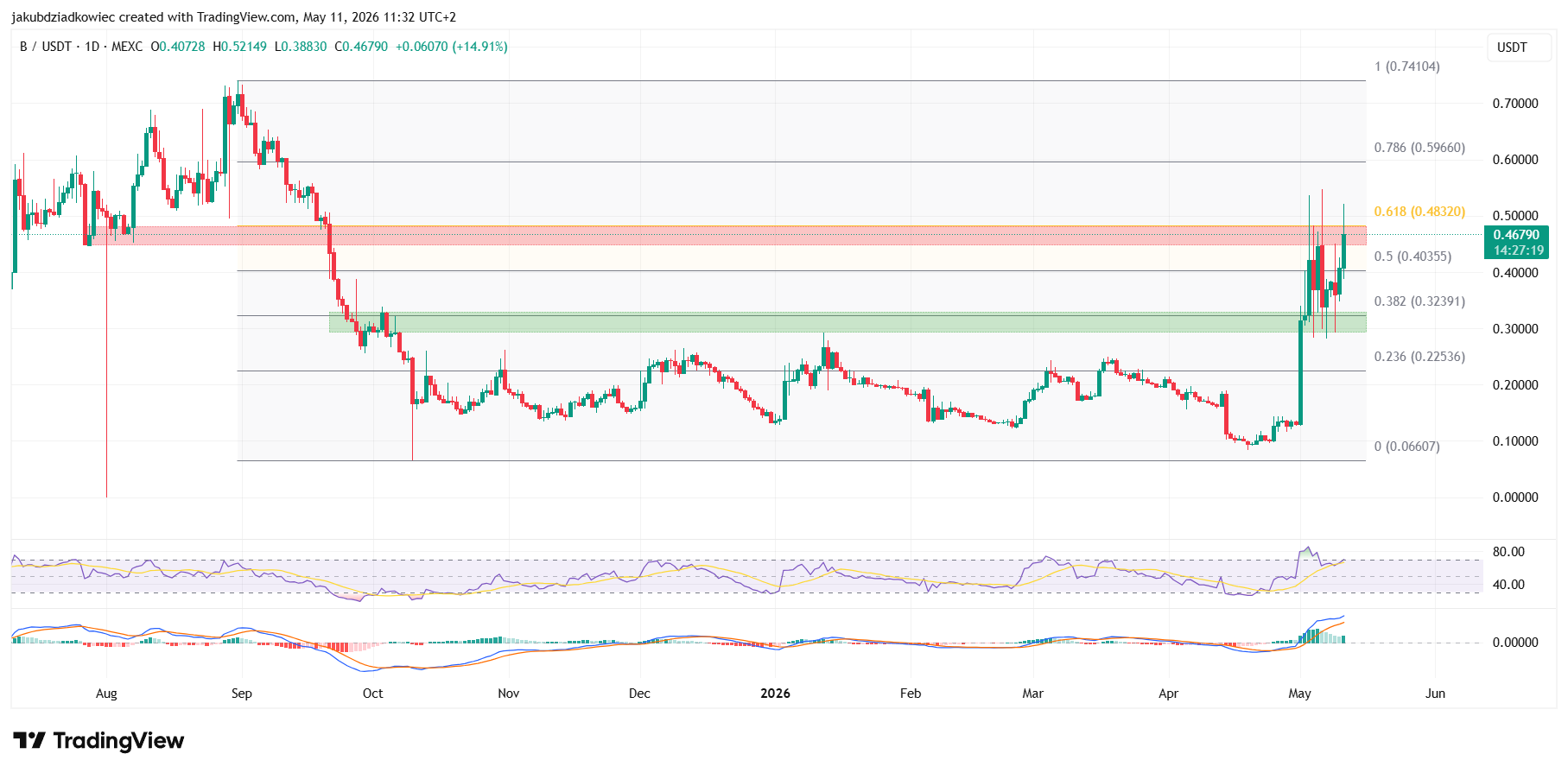
The top 3 meme coins on the weekly radar split into very different technical paths. BUILDon (B) extends a breakout, MemeCore (M) loses key support, and Siren (SIREN) coils below a descending trendline that has capped price since March.
Daily charts show BUILDon pressing the 0.618 Fibonacci level at $0.48, MemeCore correcting toward $3.27 after rejection near $4, and SIREN testing the 0.786 Fibonacci retracement at $1.07 with expanding volatility.
BUILDon (B) Bulls Press the $0.48 Resistance for a Third Time
BUILDon trades close to $0.4679 after a 14.91% daily gain, with intraday highs near $0.52 and lows at $0.38. The coin spent months inside a wide accumulation zone between $0.09 and $0.30 that reached back to September 2025.
Price broke out of that range on May 1 and confirmed the 0.382 Fibonacci retracement at $0.32 as fresh support. However, the 0.618 level at $0.48 has rejected B on three separate attempts so far in May.

The Relative Strength Index (RSI) sits close to 70, deep inside bullish territory. Meanwhile, the Moving Average Convergence Divergence (MACD) prints another taller green histogram bar after a short pause, which signals renewed upside momentum.
A confirmed daily close above $0.48 would open a path toward the 0.786 Fibonacci level near $0.60. Failure to clear that resistance could send the price back toward the $0.32 support shelf.
MemeCore (M) Slides Back After Losing Curved Support
In contrast to BUILDon, MemeCore trades at $3.27 after a 1.24% daily drop and shows clear technical weakness. The price action lost its exponential support curve at the end of April, which ended a steady advance that had held since February 1.
After that breakdown, M corrected to the 0.618 Fibonacci retracement at $2.59 before bouncing higher. The recovery retested the broken curve as resistance on May 7, then stalled around $4 at the 0.236 Fibonacci level.

The MACD now prints taller red histogram bars, which point to expanding bearish momentum. The RSI hovers in the neutral zone but trends lower, which warns that selling pressure has not yet been absorbed.
A second visit to $2.59 remains the base case if the current pullback continues. On the upside, bulls would need to reclaim $4 to invalidate the bearish setup, with the prior high near $4.85 the next major hurdle.
Siren (SIREN) Coils Under the Trendline as Volatility Returns
Siren offers a different setup again, with price compressing under a descending trendline that goes back to March 23. The line was confirmed as resistance on April 17 and tested once more on May 9.
SIREN currently trades at $1.17, close to the 0.786 Fibonacci retracement at $1.07, which has acted as a near-term magnet. Volatility, measured by the Bollinger Band Width Percentile (BBWP), recently sat at very low readings consistent with a contraction phase.

However, from May 6 through May 8, price activity began to expand again, with volatility ticking higher even though readings have not yet reached extreme zones. The RSI sits near 60 and slopes upward, which reinforces the building momentum.
A breakout above the trendline would extend gains toward the 0.618 Fibonacci retracement at $1.85 and then $2.40. The long-term support sits near $0.75, and a daily loss of $1.07 would put that floor back in play.
The post Top 3 Meme Coins to Watch This Week as BUILDon Targets $0.60 Breakout appeared first on BeInCrypto.
Crypto World
MoneySkills launches AI quantitative trading platform for 2026, enabling new users to easily earn daily returns

Disclosure: This article does not represent investment advice. The content and materials featured on this page are for educational purposes only.
MoneySkills unveils AI trading platform with automated execution and no-code crypto strategy tools.
Summary
- MoneySkills simplifies quantitative crypto trading with one-click automated strategy deployment.
- Built for beginners, MoneySkills removes coding and manual setup barriers through AI automation.
- With round-the-clock execution and AI optimization, MoneySkills aims to make automated trading more accessible in 2026.
One-click deployment, round-the-clock automated execution, and zero software costs redefine how ordinary investors access complex cryptocurrency strategies.
MoneySkills, a platform built specifically for AI-driven quantitative trading and automated strategy execution, announced today that its intelligent trading platform will go fully live in 2026.
MoneySkills aims to make complex algorithmic trading easy for mainstream users. It combines advanced AI-driven optimization models with a streamlined no-code interface, eliminating barriers such as traditional technical expertise, continuous market monitoring, and high software costs.

To celebrate the launch of its new platform and lower the barrier to entry for new users, MoneySkills is offering all newly registered users a sign-up bonus worth $15, along with $50 in free trial credits — enabling users to explore the platform’s full range of features without any upfront financial investment.
Breaking down the barriers to algorithmic trading
Historically, quantitative trading has been the exclusive domain of institutional investors and highly skilled individuals, requiring sophisticated programming skills, complex strategy design, and substantial infrastructure investment.
MoneySkills challenges this status quo with its unique “One-Click Activation” feature, allowing users to immediately deploy pre-configured AI trading strategies upon completing registration.
No programming knowledge, parameter configuration, or quantitative trading experience is required. Once activated, the platform automatically handles market monitoring, trade execution, and strategy optimization — freeing users from the tediousness of manual trading while ensuring uninterrupted, round-the-clock market participation.
The main advantages of one-click activation include:
- Zero Manual Setup: No programming, no parameter adjustment, and no prior experience required.
- Executes without manual intervention: The system automatically places orders and manages trades based on built-in strategic logic.
- Deploy immediately: A strategy can go live within minutes of registration.
- Save Time: Users no longer need to monitor screens or react to market fluctuations in real time.
AI optimization is the core
At the core of MoneySkills lies an advanced AI optimization engine that continuously analyzes market data and executes trades based on a clearly defined set of rules. Unlike manual trading, which is susceptible to emotional decision-making, fatigue, and time constraints, MoneySkills‘ automated approach ensures that its strategies operate stably within the 24/7 global cryptocurrency market.
This model is particularly well-suited for users seeking to enhance their trading discipline, alleviate operational stress, and save time, while still actively participating in the digital asset market. The platform’s AI layer continuously optimizes trade execution based on ever-changing market conditions, providing a smarter and more flexible trading experience — without user intervention.
How to get started
Getting started with MoneySkills takes just a few minutes:
1. Visit the official MoneySkills website and complete the registration process.
2. After registering, users can receive a registration bonus of $15 and $50 in free trial credits. The bonus will be automatically deposited into their account (click here to complete the registration).
3. Activate an AI trading strategy with a single click — no configuration or technical setup required.
4. Monitor strategy performance anytime via the web or mobile app. Users can get started without any fees, there are no complicated registration requirements, and no trading experience is needed.
Completely free: No hidden fees
MoneySkills is completely free of charge. There are no subscription fees, software licensing costs, or requirements to purchase any auxiliary trading tools. For new users, this zero-cost entry point minimizes the financial risk associated with exploration; for long-term participants, it ensures that the value generated by intelligent strategies remains undiminished by administrative overheads.
This reflects MoneySkills‘ broader mission: to make AI-driven quantitative trading truly accessible to a wider audience, regardless of their technical background or capital size.
Safety, transparency, and stability emphasized from the very beginning of the design
Security and operational transparency are MoneySkills’ top priorities. The platform employs robust security safeguards at every level, ranging from account protection and data integrity to the predictable, compliance-driven execution of automated strategies. Far from operating as a “black box,”
MoneySkills maintains clear and transparent processes, enabling users to stay fully informed at all times regarding the performance of their strategies and the allocation of their funds.
This commitment to stability is also reflected in operational performance. The platform is designed to ensure reliable and uninterrupted trade execution across diverse market environments, thereby guaranteeing that user-activated strategies continue to perform as expected — whether the market is trending, experiencing high volatility, or undergoing a consolidation phase. For users who entrust their trading activities to automated systems, the combination of security, transparency, and consistency serves as the cornerstone of their confidence.
Looking ahead: AI-powered trading will become the new standard
The cryptocurrency market is maturing rapidly, and users’ expectations for trading tools are changing accordingly. As manual trading is gradually supplanted by automated, AI-driven approaches, platforms like MoneySkills are spearheading a significant structural shift in how retail investors engage with the digital asset market.
MoneySkills boasts a rapidly growing user base, featuring a product architecture centered on ease of use and automation, alongside a clear commitment to eliminating the traditional cost and complexity barriers associated with quantitative trading. Entering 2026, MoneySkills will not only be a platform designed for experienced traders, but also for anyone ready to use their money more intelligently.
About MoneySkills
MoneySkills is an AI-driven quantitative trading platform dedicated to making automated cryptocurrency trading strategies easily accessible to everyone. Upholding core principles of security, efficiency, simplicity, and cost-free access, the platform enables users of all experience levels to deploy smart trading strategies and generate returns without any technical barriers or upfront investment.MoneySkills supports both web and mobile access, ensuring that users can manage their trading strategies anytime, anywhere.
For more information, visit the official MoneySkills website.
Disclosure: This content is provided by a third party. Neither crypto.news nor the author of this article endorses any product mentioned on this page. Users should conduct their own research before taking any action related to the company.

Dozens Of Labour M Ps Urge Starmer To Quit

Aberdeen’s Jack Milne alleged racist abuse towards Jeremy Bokila ‘not proven’

Pediatricians say schools need to make time for recess for kids of all ages

Manchester United reach agreement with Casemiro over contract clause amid transfer speculation

US brings back mandatory military draft registration

Steven Gerrard disagrees with Gary Neville over ‘shock’ Chelsea and Arsenal claim | Football


-
 Crypto World3 days ago
HarrisX Poll Found 52% of Registered Voters Support the CLARITY Act
-

 Fashion3 days ago
Weekend Open Thread: Marianne Dress
-

 Crypto World4 days ago
Upbit adds B3 Korean won pair as Base token gains Korea access
-

 Tech7 days ago
Image AI models now drive app growth, beating chatbot upgrades
-
 NewsBeat4 days ago
NCP car park operator enters administration putting 340 UK sites at risk of closure
-

 Tech1 day ago
Auto Enthusiast Carves Functional Two-Stroke Engine from Solid Metal
-

 Politics2 days ago
Politics Home Article | Starmer Enters The Danger Zone
-
 Business2 days ago
Ignore market noise, India’s long-term story intact, say D-Street bulls Ramesh Damani and Sunil Singhania
-

 Crypto World6 days ago
UAE Free Zone Deploys Blockchain IDs to Verify Registered Firms
-

 Tech11 hours ago
GM Agrees To Pay $12.75 Million To Settle California Lawsuit Over Misuse Of Customers’ Driving Data
-

 Crypto World5 days ago
BlackRock CEO Larry Fink Discusses a New Asset Class
-

 Crypto World5 days ago
Robinhood says Wall Street is building onchain
-
Entertainment7 days ago
Serena Williams hits Met Gala in metallic dress after GLP-1 reveal
-

 Tech6 days ago
Apple and Samsung are dominating smartphone sales so thoroughly that only one other company makes the top 10
-

 Tech6 days ago
I tested the Xiaomi 17 Ultra’s camera and I don’t think I’ll ever go back to an iPhone
-

 Fashion5 days ago
The Best Work Pants for Women in 2026
-
 Sports7 days ago
Everton v Man City LIVE: Haaland’s two-word response as visitors collapse to hand Arsenal advantage in Premier League title race
-

 Politics6 days ago
Met Gala 2026: Madonna’s Dramatic Red Carpet Look Steals The Show
-
 Tech4 days ago
AI agents are missing all the discussions your team is having. SageOX has an answer: agentic context infrastructure
-
Crypto World4 days ago
The FOMO Is Back: Why Bitcoin’s Latest Rally Has Analysts Flashing Warning Signs
You must be logged in to post a comment Login