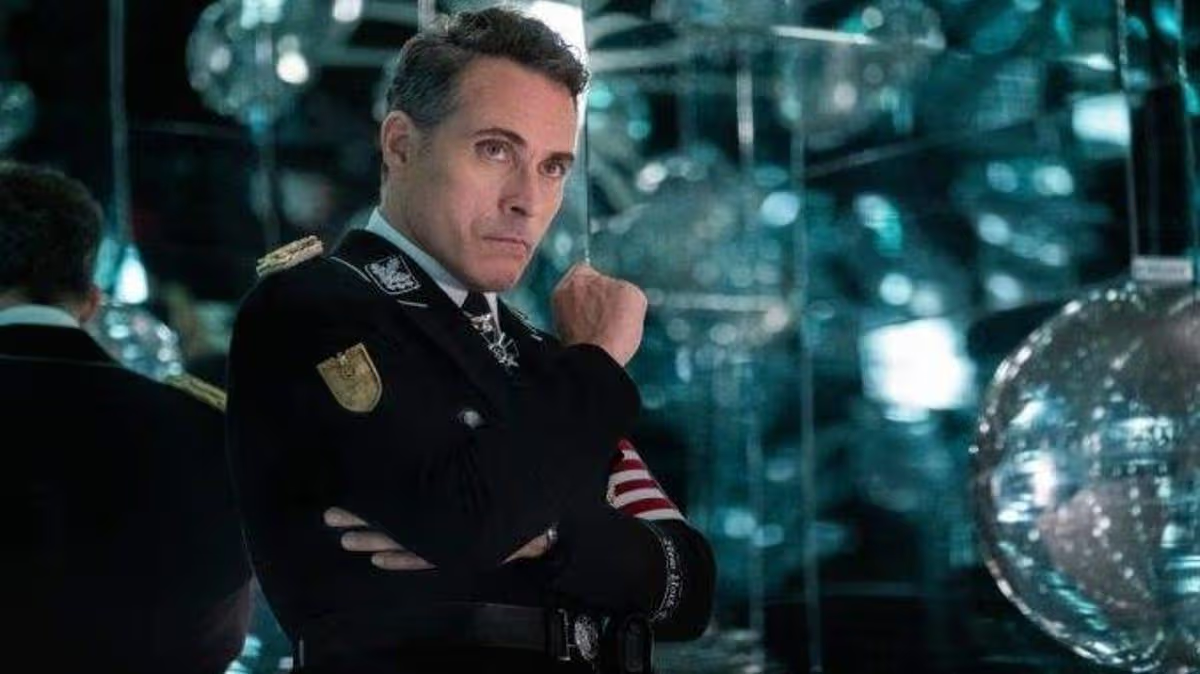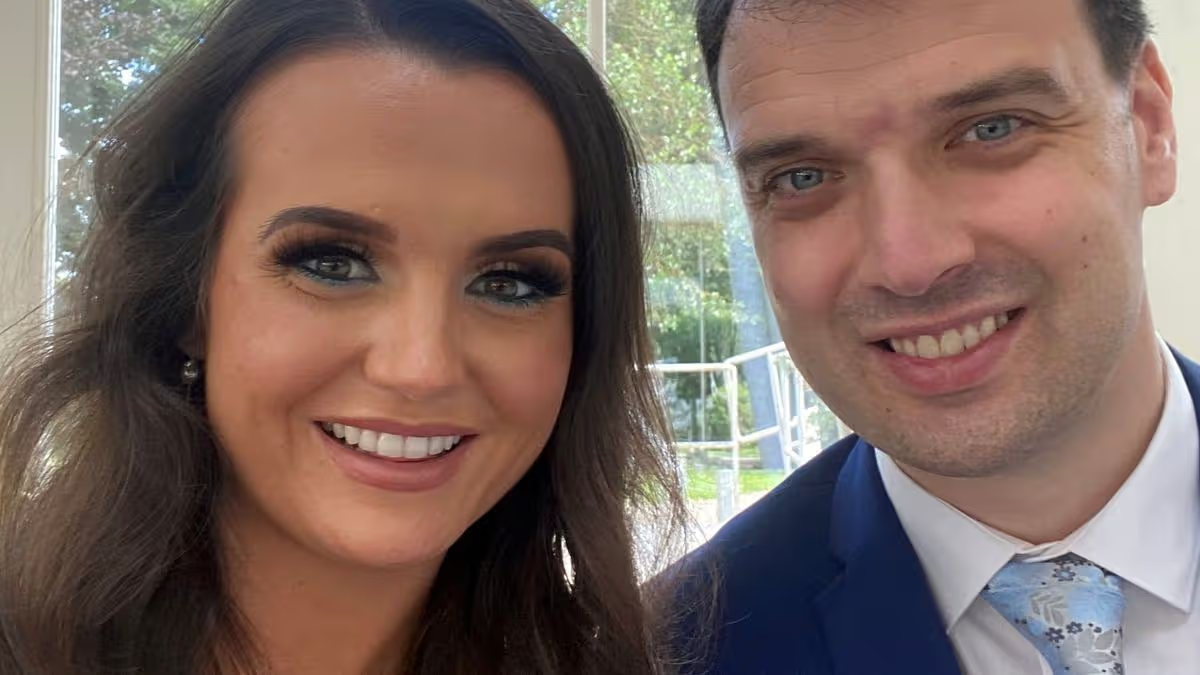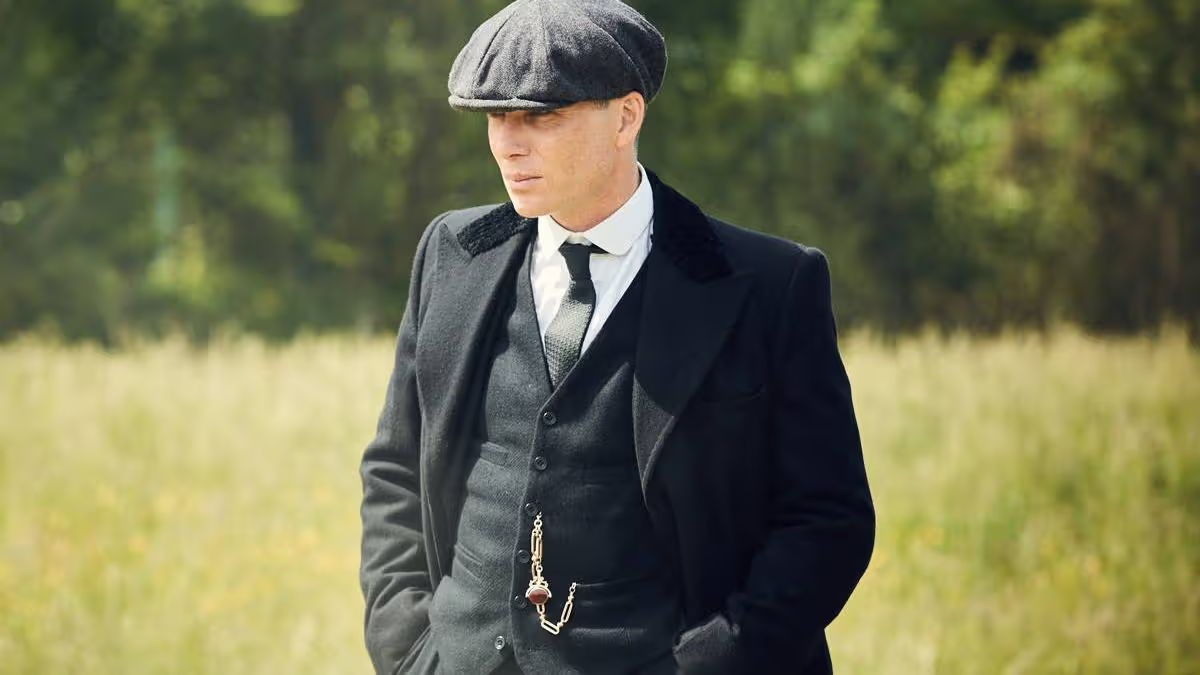
Adam Crolla worked as an extra on The Immortal Man and has shared his behind-the-scenes experiences working with Cillian Murphy on the Netflix film
Kirstie McCrum Deputy Head of News, Live News Network and Jessica Clarke
10:45, 25 Mar 2026
Adam Crolla, who appeared as an extra in the Peaky Blinders film, has shared insights into his time on such a prestigious production, whilst also disclosing what Irish actor Cillian Murphy was like off-camera.
Peaky Blinders has established itself as one of the most celebrated television dramas since debuting in 2013, with enthusiasts delighted when Peaky Blinders: The Immortal launched worldwide on Netflix.
Advertisement
Taking place in 1920s Birmingham, the film centres on Tommy Shelby (portrayed by Cork native Cillian), who is compelled to emerge from retirement to rescue his son Duke Shelby (Barry Keoghan), after the young man becomes entangled in a Nazi conspiracy to secure victory in WWII, reports the Mirror.
Discussing his own part in the production, Adam revealed: “It wasn’t a speaking role. There were over 150 extras on the first day and around 30 on the second. During the boxing match scene, I had to react with shock and fear when Tommy (Cillian) got in the ring and fired a gun.
I was instructed to duck and look uneasy as he spoke. On the second day, I was simply walking down a staircase behind him in Parliament. Being an extra mostly involves basic actions rather than detailed direction.”
Adam, who initially featured as an extra in 2017, revealed to Betway: “During rehearsals, when Tommy (Cillian) got into the ring, he once used his fingers as a gun and shouted “bang! bang!” instead of firing a prop”, noting: “It was hilarious to see compared to how much he stayed in character during actual takes.”
Adam further praised how he enjoyed watching other leading actors “fully inhabited their characters”, which he observed they maintained “even when they weren’t the focus of the scene”.
Want to see more of the stories you love from Belfast Live? Making us your preferred source on Google means you’ll get more of our exclusives… To add Belfast Live as a preferred source, simply click here.
Adam described the Liverpool Astoria set as ‘incredible’, noting that even the ‘tiniest details were considered. “like period-accurate coins at a betting table, or tickets littered on the floor with real fight schedules. It genuinely felt like stepping back in time”, he remarked.
Advertisement
Peaky Blinders: The Immortal Man has been screening in selected cinemas since 6th March – spoilers ahead.
The film effectively brought the curtain down on the present generation of Shelbys, who perished in different circumstances. Arthur Shelby (Paul Anderson) meets his end at the hands of his cherished younger sibling Tommy before the film’s events unfold.
Tommy ultimately achieved the tranquillity he’d been yearning for after he also passed away. Before this, Tommy had been living in isolation within a deserted mansion, haunted by memories of departed loved ones and accompanied only by his final true companion, Johnny Dogs (Packy Lee).
Advertisement
The Immortal Man concluded with dawn breaking on a fresh chapter for the Shelby dynasty, with Duke positioned at the helm as the new head of the notorious Birmingham gang.

Miley’s got a mystery mate in Weatherfield (Picture: Reuters)
If I told you that one Coronation Street resident had a surprise connection to Miley Cyrus, you’d probably think I’d had one too many pints in the Rovers’ Return.
However, a Weatherfield legend did indeed star alongside the singer, songwriter in actress in the Hannah Montana movie – and fans are losing their minds.
The classic Disney series first launched back in 2006 and ran for four seasons, following the life of teenager Miley Stewart (Miley Cyrus) who had a secret alter-ego; the international pop megastar Hannah Montana.
Twenty years later, Disney recently unveiled a 20th anniversary special starring Miley, including live musical performances and a candid interview with Miley reflecting on the Hannah Montana phenomenon.
Advertisement
Amazingly, it has recently emerged that a classic Cobbles character was sharing the big screen with the Party In The USA singer long before they were scarfing down a bacon barm in Roy’s Rolls.
Of all the Weatherfield residents past and president, the very last person you’d imagine kicking it with Miley is Brian Packham, the loveably eccentric former headmaster turned proprietor of the Kabin.
Brian is a secret part of the Montanaverse (Picture: ITV)
Peter Gunn – who has played Brian since 2010 – portrayed journalist Oswald Granger in the Hannah Montana film, which earned over $150 million in cinemas worldwide.
His character was a scoop-hungry newshound obsessed with uncovering a story about Hannah Montana, ultimately tracking the diva to her home town and uncovering her shocking secret – that she was simply schoolgirl Miley Stewart in a blonde wig.
Reflecting on his role in the Hannah Montana film, Peter talked about his experiences on the Sofa Cinema Club podcast, hosted by fellow Corrie stars Colson Smith, Jack P. Shepherd, and Ben Price.
Advertisement
‘The weird thing is that I didn’t know who Miley Cyrus was when I was up for the part’ Peter admitted. ‘I can remember asking my eight-year-old son, ‘Have you heard of this Miley Cyrus?’”
Peter played journalist Oswald Granger in the Hannah Montana Movie. (Picture: Disney)
His character was determined to uncover an exclusive story about pop icon Hannah, portrayed by Miley Cyrus. He ultimately tracked her to her home town and uncovered her enormous secret – that she was simply schoolgirl Miley Stewart disguised in a blonde wig.
Hollywood is a long way from Weatherfield, and Peter reflected on how it took some time to get used to the sheer scale of the production. “We’re in Nashville, which is her hometown, and I’m thinking ‘yeah, she’s a Nashville girl, so she’s going to be popular.’
Don’t miss a Soaps scoop! Add us as a Preferred Source
As a loyal Metro Soaps reader, we want to make sure you never miss our articles when searching for stories. We have all the latest soaps news, spoilers, videos, and interviews, with a vibrant community of highly engaged readers.
Click the button below and tick Metro.co.uk to ensure you see stories from us first in Google Search.
Now you can ensure you never miss a story from the Soaps team
You’re a long way from the Rovers, Brian. (Picture: Disney)
“But then the first week I’m there, in the evening I’m in the hotel room and put the television on and there’s a discussion about what Miley’s done that day. I thought why are they discussing that? Because they did every day.”
‘This was on the local news, and I’m thinking, ‘Flipping hell, she is big isn’t she?’ And then you realise as we’re going around wherever we go, she has security, people just go absolutely berserk.’
But Miley wasn’t the only pop sensation that Peter got pally with onscreen. Global pop sensation Taylor Swift also made a cameo in the film, and Peter recalls the chats they had between scenes.
Advertisement
“She was on tour and she turned up when we were filming and remember being sat on the makeup bus and she sat next to me and went, ‘Hi, I’m Taylor, and we were just having a chit chat.’ She was telling me about the tour and how she’s come to help Miley.”
Brian Packham first turned up on the Cobbles as a victim of identity theft courtesy of the most hapless serial killer in Soap history, John Stape, who had been using the name of a colleague to teach. Sticking around, Brian has become one of the most colourful and beloved characters on the Cobbles – and the fact that he’s part of the Hannah Montana legacy is sure to make fans love him even more.
Diehard Corrie viewers took to Facebook to express their shock and delight over Brian’s unlikely link to Miley. “Curious is this Brian that works in The Kabin in The Hannah Montana Movie,” Someone else responded: “Omg it is.” A third remarked: “All this time and I had no idea.” Another exclaimed: “Didn’t expect that!”
Miley Cyrus, if you’re reading this, one good turn deserves another. We need a Hannah Montana cameo on the Cobbles. Maybe her tour bus breaks down outside the Rovers and she comes in like a Wrecking Ball?
Advertisement
If you’ve got a soap or TV story, video or pictures get in touch by emailing us soaps@metro.co.uk – we’d love to hear from you.
Students Grace O’Malley-Kumar and Barnaby Webber were killed by Valdo Calocane in Nottingham on June 13, 2023. He also stabbed caretaker Ian Coates, 65, more than an hour later.
TWO students fatally stabbed by a paranoid schizophrenic were tested for alcohol and drugs after they died – but their killer Valdo Calocane was not.
Advertisement
Grace O’Malley-Kumar and Barnaby Webber, both 19, were killed by Calocane in Nottingham on June 13, 2023. He also stabbed caretaker Ian Coates, 65, more than an hour later.
After stealing Mr Coates’ van, Calocane ran over and seriously injured three pedestrians. Calocane admitted manslaughter and attempted murder and was indefinitely detained at a high-security hospital on the grounds of diminished responsibility in January 2024.
Grace’s father, Sanjoy Kumar, told an inquiry into their deaths he felt it was “disgusting” that they had been tested.
He said they were told to sign human tissue forms – forms he had never seen himself as a GP and a forensic medical examiner with the Metropolitan Police – otherwise their daughter’s body would not be released to them.
Dr Kumar said: “You had to sign them, but what was not highlighted was that this is a point in time where you are also signing to say that samples could be taken. That was absolutely not pointed out.
“They took samples from our children to test for drugs and alcohol. I was really struck by that being really quite disgusting.
Advertisement
“Our children were tested, but the culprit wasn’t and from there on in, in terms of previous interactions and mental health, that was not made into a big thing at all, that was a flyaway comment.”
Dr Kumar said he found it “shocking” that police notes mentioning a “very minor” assault by Calocane on a police officer two years before the fatal attacks did not reflect how serious the incident was.
He told the inquiry: “When a police officer sustains a punch to the face where you have a haematoma, that is the definition of an ABH injury.
Advertisement
“You have senior police officers coming to the inquiry saying it was a minor offence – I feel very strongly about that. It is unacceptable to strike a police officer in my view.
“To downplay their injuries and not even know the classification of their injuries, is, for someone in that position, really quite despicable.”
Dr Kumar also said he was “dissatisfied” the killer’s mental health at the time of the Nottingham attacks had not been properly examined.
He told the inquiry: “I vociferously complained about the fact that this person’s mental health had not been looked at properly on the day. I was totally dissatisfied that a 360-degree view had been taken.”
He added: “This is a person who, I was told, had been arrested on Tuesday and had been there (in custody) on Tuesday, Wednesday, Thursday, Friday, and went to magistrates’ court on a Saturday.
“And none of those officers had complained about seeing someone who’s acutely mentally unwell. That is enormously, enormously unusual.”
Dr Kumar said he believes his previous experience as a forensic medical examiner affected what information the police told him.
Advertisement
He said: “My belief on reflection is that I think detectives… knew what I did, what I had done, what my experience was, and I think there was possibly a strategy not to tell me things, because at every point I was being told things, I was questioning things.”
He added: “At each point we are having to cling on to little things and extract as much information as we can because really at every point we are not being given information.”
He also said he “just couldn’t understand” why a hair sample was not taken while Calocane was in custody, adding: “It may have proved nothing but it may have proved everything.”
Dr Kumar said a hair sample did not require Calocane’s consent: “If you’re a detective of any description at all, and I think every detective watching this is going to agree, if you are here to detect crime, that means forensics is really important.
Advertisement
“And a basic part of that forensics is head hair. It may have proved nothing but it may have proved everything. The point is that it wasn’t done and it wasn’t taken, and I just couldn’t understand that.”

The victim suffered swelling, bruising, and hair loss
A 28-year-old woman punched, kicked, and stamped on another woman while demanding money. Natalie Renton, 28, approached the victim, asking for a lighter, in the morning of January 30 in a car park near Maskew Avenue in Peterborough.

Advertisement
The victim, a woman in her 30s, told Renton that she did not have one. But Renton became aggressive and verbally abusive before punching the victim, dragging her to the ground by her hair, and repeatedly kicking and stamping on her face.
Renton, of Bushfield Court, Orton Goldhay, Peterborough, demanded money throughout the attack, but none was handed over. The victim suffered swelling, bruising, and hair loss, and was treated in hospital. Renton fled the scene but was arrested shortly after in Lincoln Road, Millfield.
Renton appeared at Huntingdon Law Courts on Monday, March 23, and was sentenced to 32 months in prison after pleading guilty to assault with intent to commit robbery. The court also imposed a restraining order until 2030, ordering Renton to not approach the victim or attempt to contact her directly or indirectly.
Detective Constable Tisha Morris, who investigated, said: “This was a completely unprovoked attack, with a clear financial motive, which has had a significant impact on the victim, both physically and mentally.
Advertisement
“I hope this result gives the victim some closure in the knowledge that justice has been done.”
Manchester United are set to see Jadon Sancho leave on a free transfer this summer
In the summer of 2021, Jadon Sancho was supposed to be Manchester United’s marquee signing, the recruit to catapult Ole Gunnar Solskjaer’s side from second place to the title. United had spent years chasing him before finally agreeing a £72.9 million fee to bring him back to Manchester – only this time in red.
Advertisement
It was July 23 when Sancho stood in front of United cameras, arms outstretched, stating: “This is my club. This is where I belong.”
Everything that followed told a tale of almost the opposite. Just over a month later, Cristiano Ronaldo strutted through Carrington’s front doors. Debate surfaces to this day as to whether it was a decision that threw Solskjaer’s plans wayward; but suddenly United’s shiny new toy from Dortmund was not the hot topic at Old Trafford anymore.
Get MEN Premium now for just £1 HERE – or get involved in our United WhatsApp group by clicking HERE. You can also join our United Facebook page by clicking HERE and don’t miss out on our brilliant selection of newsletters HERE.
At the time, Sancho was unique in the sense that he was an English player adapting to the English league. At just 21 years old, he had the time and the evidence suggesting he could after three astonishing years in Germany – but his new environment became a whirlwind soap opera. One of the hardest parts about joining United is the attention combined with the pressure of previous success, and Sancho became one of many who suffered.
Advertisement
Since signing five years ago, Sancho has been back on loan to Dortmund, where he only managed two goals and two assists in 14 Bundesliga games; on loan to Chelsea where the West London club opted to pay £5 million not to sign him; and is now at Aston Villa.
He is set to leave United as a free agent in the summer and Dortmund are among the teams being linked with him. The England international has started to find some recent form in the Midlands. With two assists in his last two games and impressive performances to accompany them, the loanee has played a key role in revitalising Villa after a rough patch. Unai Emery might begin looking at him as a permanent option.
None of that will help United earn any sale return on their investment. Sancho’s spell at United has been a disaster, leaving on a free transfer would just sum that up.
Content cannot be displayed without consent
Canadian Prime Minister Mark Carney took aim at Air Canada CEO’s Wednesday, accusing him of showing a lack of compassion and judgement in his condolences after Sunday’s deadly crash in New York.
Air Canada CEO Michael Rousseau has been summoned to testify at Parliament’s official languages committee after he shared a four-minute condolence video online that only included two French words: “bonjour” and “merci.”
Antoine Forest, one of the two pilots killed in the crash at LaGuardia airport, was a French-speaking Quebecer.
Forest and Mackenzie Gunther died when the Air Canada Jazz flight they were landing at LaGuardia collided with a fire truck on the runway Sunday evening.
Advertisement
Air Canada is headquartered in Montreal, Quebec, where French is the primary language. Rousseau has been criticized for not speaking French previously. He delivered his condolence video message in English, with French subtitles.
Carney said Canadian officials continue to work in close collaboration with their American counterparts to determine how this crash happened (Getty Images)
“We proudly live in a bilingual country. There are two official languages here and Air Canada has a special responsibility whatever the situation to communicate whatever the situation in both official languages,” Carney said.
“I am extremely disappointed by the message released by the CEO of Air Canada. It shows a lack of compassion, and we will be closely following his comments before the official languages committee as well as the comments coming from the board of Air Canada.”
Quebec’s identity has been contentious since the 1760s when the British completed their takeover of what was then called New France. Quebec is about 80% French-speaking.
A spokesperson for Air Canada didn’t immediately respond to a message seeking comment.
Advertisement
The Office of the Commissioner of Official Languages has received hundreds of complaints about Rousseau’s video.
“I don’t want to make political hay over what remains a tragedy with people still in hospital, but this isn’t the first time that he’s been told to speak French and he should know better,” said Marc Miller, the Minister of Canadian Identity and Culture.
Industry Minister Mélanie Joly said a lot of the victims and their families are francophones and said Rousseau’s video lacked empathy. “It is a question of moral leadership,” Joly said.
Carney said Canadian officials continue to work in close collaboration with their American counterparts to determine how this crash happened.
The language of power often reveals more than it intends. In a rare moment of candour on March 7, the US president, Donald Trump, described the confrontation with Iran as “a big chess game at a very high level … I’m dealing with very smart players … high-level intellect. High, very high-IQ people.”
If Iran is, by Trump’s own admission, a “high-level” opponent, then the sudden revival of a 15-point plan previously rejected by Iran a year ago suggests a disconnect between how the adversary is understood and how it is being approached. It’s a plan already examined in negotiation by Iran and dismissed as unrealistic and coercive. Despite this, the Trump administration is once again framing the “roadmap” as a pathway to de-escalation. Tehran has once again dismissed the gambit as Washington “negotiating with itself – reinforcing the perception that the US is attempting to impose terms rather than negotiate them.
The US president is right about one thing – Iran is not an opponent that can be easily dismissed or overwhelmed. Trump’s own description is a tacit acknowledgement that this is a far more capable and complex adversary than those the US has faced in past Middle Eastern wars, such as Iraq. And that is why the odds are increasingly stacked against the United States and Israel.
This conflict reflects a familiar but flawed imperial assumption: that overwhelming military force can compensate for strategic misunderstanding. The US and Israel appear to have misjudged not only Iran’s capabilities, but the political, economic and historical terrain on which this war is being fought.
Advertisement
Unlike Iraq, Iran is a deeply embedded and adaptable regional power. It has resilient institutions, networks of influence, and the capacity to impose asymmetric costs across multiple theatres. It knows how to manage maximum pressure.
The most immediate problem is lack of legitimacy. This war has authorisation from neither the United Nations or, in the case of America, the US Congress. Further, US intelligence assessments indicate Iran was not rebuilding its nuclear programme following earlier strikes – contradicting one of Washington’s justifications for war. The resignation of Joe Kent as head of the National Counterterrorism Center on March 17, was even more revealing. In his resignation letter Kent insisted that Iran posed no imminent threat.
This effectively collapses one of the original narratives underpinning the US decision to start the war – a further blow to legitimacy.
A majority of Americans oppose the war, reflecting deep fatigue after Iraq and Afghanistan – hardly ideal conditions for what increasingly looks like another “forever war” in the Middle East. Current polling shows Trump’s Republicans trailing the Democrats ahead of the all-important midterm elections in November.
The war is both militarily uncertain and politically unsustainable. International allied support is also eroding. The United Kingdom — often trumpeted as Washington’s closest partner — has limited itself to defensive coordination, while Germany and France have distanced themselves from offensive operations. European allies also declined a US request to deploy naval forces to secure the strait of Hormuz. This reflects not just disagreement, but a deeper loss of trust in US leadership and strategic judgement.
US influence has long depended on legitimacy as much as force. That reservoir is now rapidly draining. Global confidence is falling, while images of civilian casualties — including over 160 schoolchildren killed in an airstrike on the first day of the war – have shocked international onlookers. Rather than reinforcing leadership, this war is accelerating its erosion.
Israel faces a parallel crisis of legitimacy – one that began in Gaza and has now deepened. The war in Gaza severely damaged its global standing, with sustained civilian casualties and humanitarian devastation drawing unprecedented criticism, even among traditional allies. This confrontation with Iran compounds that decline.
Advertisement
Striking Iran during active negotiations — for the second time — reinforces the perception that escalation is preferred over diplomacy. The issue is no longer just conduct, but credibility.
Strategic failure, narrative defeat
The conduct of the war compounds the problem. The assassinations of Iranian leaders, framed as tactical victories, are strategic failures. They have unified rather than destabilised Iran. Mass pro-regime demonstrations illustrate how external aggression can consolidate internal legitimacy.
The assassination of the supreme leader, Ayatollah Ali Khamenei, and other senior Iranian leaders has not produced the desired effect as many Iranians rally around the flag. AP Photo/Vahid Salemi
The issue is no longer just the conduct of the war, but the credibility of the conflict itself. Regardless of how impressive the US and Israeli military are, it doesn’t compensate for reputational collapse. When building support for a conflict like this – domestically and internationally – legitimacy is a strategic asset. Once eroded across multiple conflicts, it is extraordinarily difficult to rebuild.
Rather than stabilising the system, US actions are fragmenting it. Allies are distancing themselves, adversaries are adapting, and neutral states are hedging.
Advertisement
The most decisive factor may be economic. The war is already destabilising global markets – driving up oil prices, inflation, and volatility at levels that combine the effects of 1970s and Ukraine war oil shocks.
This is a war that cannot be contained geographically nor economically. The deployment of 2,500 US marines to the Middle East (and reports that up to another 3,000 paratroopers will also be sent), reportedly with plans to secure Kharg Island – and with it Iran’s most important oil infrastructure – would be a dangerous escalation.
For Gulf states, the assumption that the US can guarantee security is increasingly questioned. Some states are reportedly now looking to diversify their partnerships and turning toward China and Russia, mirroring post-Iraq shifts, when US failure opened space for alternative powers.
Iran holds the cards
Wars are not won by destroying capabilities alone, but by securing sustainable and legitimate political outcomes. On both counts, the US and Israel are falling short.
Advertisement
Iran, by contrast, does not need military victory. It only needs to endure, impose costs, and outlast its adversaries. This is the logic of asymmetric conflict: the weaker power wins by not losing, while the stronger one loses when the costs of continuing become unsustainable.
This dynamic is already visible. Having escalated rapidly, Trump now appears to be searching for an off-ramp — reviving proposals and signalling openness to negotiation. But he is doing so from a position of diminishing leverage. In contrast, Iran’s ability to threaten energy flows, absorb pressure, and shape the tempo of escalation means it increasingly holds key strategic cards. The longer the war continues, the more that balance tilts.
Empires rarely recognise when they begin to lose. They escalate, double down, and insist victory is near. But by the time the costs become undeniable – economic crisis, political fragmentation, global isolation – it is already too late. The US and Israel may win battles. But they may be losing the war that matters: legitimacy, stability and long-term influence.
And, as history suggests, that loss may not only define the limits of their power, but mark a broader shift in how power itself is judged, constrained, and resisted.
Since 2019, inspectors ruled that the authority had made unreasonable decisions on 38 occasions — the second-highest number in the country, an investigation found.
The “unreasonable” ruling by the Planning Inspectorate is taken when it overturns a decision made by a council and awards costs to the appellant because an authority fails to follow planning policy, imposes unreasonable conditions, or it wastes time or money.
The investigation by Sky News found that only Cornwall Council had made more unreasonable decisions since 2019 than North Yorkshire.
Advertisement
Earlier this year, inspectors ruled against North Yorkshire Council after it rejected plans for up to 200 homes in Peasey Hills, Malton.
The inspector concluded: “The council’s protracted catalogue of failings amounts to unreasonable behaviour that has caused the appellant unnecessary or wasted expense in respect of pursuing the appeal.”
Last year, the council’s actions were again deemed unreasonable when it refused listed building consent for a new access gate and drive at St Trinian’s Hall, in Richmond.
In response to the figures, North Yorkshire Council’s head of development management, Martin Grainger, said the authority would continue to support “positive development across the county, where appropriate”.
Advertisement
He added: “This is evidenced by the number of positive decisions we have issued on planning applications, which exceeds the national average for similar English unitary authorities.
“The figures quoted in this report must be viewed in context. As the country’s largest geographical council, we handle more planning applications than most authorities.
“In 2024/25 alone, we made decisions on about 4,700 applications – compared with the national average of 1,365 for other English unitary authorities.
“Replicated over seven years, that level of demand would equate to more than 32,000 applications – meaning the ‘unreasonable decisions’ quoted represents just 0.1 per cent of all cases we deal with.”
Advertisement
Mr Grainger said the figures quoted spanned a seven-year period and pre-dated local government reorganisation and the launch of North Yorkshire Council in April 2023.
The investigation has been published as North Yorkshire Council comes under increasing pressure to meet government targets for new housing.
Senior councillors have criticised a target of around 4,200 new homes a year — up from 1,384 — which they say puts unprecedented pressure on rural land in the county.
Processed food is often treated as an unhealthy monolith, though a doctor previously told HuffPost UK that yeast extracts, tinned beans, ready-to-eat oats, and fortified plant-based milks have their role in a healthy diet.
For instance, the British Heart Foundation (BHF) writes that, “You might think canned tomatoes are less healthy than fresh ones.
“But your body can absorb more of a heart-healthy nutrient called lycopene from tinned varieties than it can from fresh, uncooked tomatoes.”
Advertisement
What is lycopene?
Lycopene is an antioxidant (meaning it helps to stop free radicals from damaging DNA and some cells). It helps to give fruits like tomatoes and pink grapefruits their colour.
Some experts think it could help to lower inflammation, control cholesterol, reduce the risk of blood clots, and improve the immune system.
It has also been linked to lower blood pressure and may even reduce some cancer risks.
If tomatoes contain lycopene in all their forms (which they do), why tinned tomatoes over fresh ones?
Well, that 2022 review said, “Several factors influence the lycopene content of fruits and vegetables, such as environmental conditions (temperature, irrigation, light, climate, location of plantation), fruit variety, degree of ripeness, processing and storage conditions”.
That’s partly because processing tomatoes breaks down their cell walls, making their lycopene more available to us.
Advertisement
Tomato paste, for instance, has 1827% more lycopene than fresh tomatoes (though you likely eat less of it than canned kinds).
Crushed and canned tomatoes have 5106µg per 100g, vs cooked fresh tomatoes’ 3041µg per 100g.
Eating tinned tomatoes with olive oil might increase how much lycopene your body absorbs from them, too.
Advertisement
As Michael Mosley told the BBC, “That means tomato sauce from fresh or tinned tomatoes, and even ketchup can actually provide more lycopene than fresh tomatoes”.
Of course, there are other things to consider with e.g. ketchup or premade tomato sauces: added sugars and salt may make any lycopene benefits redundant.
But if you turn to unsalted, sugar-free tinned tomatoes far more often than you stew fresh ones yourself, you might be doing your heart (as well as your taste buds) a favour.
Whether you’re hiking up a mountain, heading to the shops or commuting on the train to work, having the best backpack is essential. Formerly only used by schoolchildren, backpacks have become a must-have for everyone, replacing the briefcase as an essential part of every office worker’s arsenal, but they’re also a serious fashion accessory nowadays.
“Backpacks have undergone a seismic reinvention over the last decade, from functional Karrimors for Duke of Edinburgh Award outings to luxurious pieces of kit,” explains Telegraph men’s style editor, Stephen Doig. “They’re now a key part of any sophisticated wardrobe.”
The very best backpacks can save you having to trundle around the airport with a suitcase (and packing cubes can help to cram more in). If you’re heading up into the hills, a good hiking backpack is a lifesaver. Here are my favourite backpacks for commuting to work and meandering in the countryside.
Spain head coach Luis de la Fuente (Picture: Getty)
Spain manager Luis de la Fuente believes Arsenal have the second-best midfielder in the world behind Manchester City star Rodri.
Rodri has been one of the most influential players in world football over the past decade, helping Man City win four Premier League titles, four domestic cups and the Champions League.
The 29-year-old won the Ballon d’Or in 2024, becoming the first Manchester City player to win the award and just the second male Spanish player.
De la Fuente believes Rodri is the ‘best in the world’ in his position but insists his Spain teammate Martin Zubimendi is not far behind.
Advertisement
Zubimendi has enjoyed an impressive first season at Arsenal following his move from Real Sociedad, helping the Gunners move nine points clear at the top of the Premier League and challenge in two other competitions.
‘After all the setbacks he went through, Rodri is back at a high level,’ De la Fuente told TVE ahead of Spain’s friendly against Serbia on Friday night.
Your football fix
Metro‘s Head of Sport James Goldman delivers punchy analysis, transfer talk and his take on the week’s biggest stories direct to your inbox every week.
Rodri celebrating Man City’s Carabao Cup final win (Picture: Getty)
‘I’ve said before that he is the best in the world, but also on those same occasions [when he was injured] that we are very fortunate.
‘After all, in that position, the number 6 role, we have the two best players in the world: Rodri and Martin [Zubimendi].
Advertisement
‘So I will get ahead of a question you are probably going to ask: can they play together? Of course they can play together.
Martin Zubimendi during Arsenal’s defeat at Wembley (Picture: Getty)
‘We can play that way [with a double pivot] perfectly well. In my idea of football, they [Rodri and Zubimendi] may occupy a similar role, but they are different players with different characteristics.
‘In fact, Martin is getting into the box more now and scoring goals, but he also has the qualities of a positional player, with balance and outstanding tactical awareness.
‘Rodri has those same qualities too, so having them there gives us security, that kind of structure.
‘But at the same time, you have to remember that only 11 can start. Then you would ask me: what about Pedri? And Fermin [Lopez]? And Fabian [Ruiz]?’
‘We knew today was a very important match, not only because of what the title means but also because of what it means to beat the team in best form,’ he said.
Advertisement
‘It’s a game not only for this title but to show that we can beat them. There’s still a long way to go and it’s clear we didn’t want to get off the Champions League train.
‘We’ve been eliminated but we have to look at the positive side that we have more time to prepare for the matches.
‘That’s an incentive to take into account and we’ll fight until the end.’
Arsenal’s next Premier League game is a home match against Bournemouth on April 11. Manchester City visit Chelsea the following day.
You must be logged in to post a comment Login