
Crypto World
Private credit’s cracks spark a new tug of war with Wall Street banks


Wall Street, Manhattan, New York.
Andrey Denisyuk | Moment | Getty Images
Wall Street banks may finally be getting a long-awaited opening to claw back market share from private credit lenders.
After a decade in which private credit lenders grew rapidly and took over a large share of financing for leveraged buyouts, signs of strain in that sector, along with easing bank rules, may now be shifting the balance.
“This is an opportune time for banks to regain market share from private credit funds,” Moody’s chief economist Mark Zandi told CNBC in an email.
“Interest rates have declined and banking regulation has eased. Private credit lenders are also struggling with the fallout from their previously aggressive lending,” he highlighted.
Private credit’s rapid ascent was fueled in part by banks’ retreat. Following the Federal Reserve’s aggressive rate hikes and the 2023 banking crisis, lenders tightened underwriting and pulled back from riskier deals. Borrowers, particularly private equity firms, increasingly turned to direct lenders offering faster execution and looser terms.
The tug of war is just starting. The rules have been relaxed, so it’s only natural that banks want to get back some of their market share in private credit.
Jeffrey Hooke
Johns Hopkins Carey Business School
At its peak, the shift was dramatic. According to PitchBook data, banks’ share of buyout financings above $1 billion fell to just 39% in 2023, down from about 80% in the five years prior. That share has since recovered to just over 50% in 2025.
And the tide may be turning further.
Private credit is facing mounting challenges. Years of aggressive lending are starting to backfire, as higher interest rates make it harder for heavily indebted borrowers to repay loans and increase default risks. Investor demand for liquidity is also rising, with some clients seeking to pull money after years of locking up capital.
Moody’s Zandi expects the sector to “experience more credit problems in the coming months,” citing fallout from geopolitical tensions, higher borrowing costs and structural pressures in industries such as software. Consumer and healthcare borrowers may also come under strain.
Regulatory changes offering tailwinds
Over the medium term, regulatory changes could also further tilt the playing field.
“Our anticipation of deregulation from the Trump administration includes a likely weakening of the Basel III Endgame implementation, with the U.S. Treasury explicitly aims to redirect business lending back into the banking sector,” Shannon Saccocia, chief investment officer at Neuberger Berman, told CNBC via email.
The Basel III “Endgame” framework is a regulatory overhaul finalized in 2017 in the wake of the 2008 global financial crisis. It was designed to standardize how large banks calculate risk and to establish a capital floor that requires lenders to hold more reserves against loans, particularly higher-risk corporate and leveraged lending.

That has made bank lending less competitive versus private credit funds in recent years, said market veterans.
A weakening or reversal in the Basel III Endgame will raise competition for private credit lenders, Saccocia added, a stance echoed by other market veterans.
“Banks should quickly fill any void left by more cautious private credit lending, said Zandi, pointing to a more favorable regulatory backdrop and improving funding conditions for traditional lenders.
Recent Federal Reserve proposals to adjust the regulatory capital framework could “position banks to be more competitive on the lending front in hopes of regaining at least some share of their original commercial banking foothold,” noted Lukatsky.
Recent deals, such as the multi-billion-dollar leveraged loan financings for Electronic Arts and Sealed Air, signal a strong appetite among banks to execute “jumbo” transactions when market conditions allow.
Private credit still competitive
However, private credit’s grip is far from broken just yet. Direct lenders continue to compete aggressively, offering unitranche loans that bundle different types of debt into one package at a single interest rate.
Blackstone and Ares, for example, were among 33 lenders that reportedly provided about $5 billion in financing to back investment firm Thoma Bravo’s acquisition of logistics company WWEX Group, underscoring how private credit firms can still fund large buyout deals even as banks begin to re-enter the market.
Pitchbook’s global head of credit and U.S. private equity Marina Lukatsky noted that the expected rebound in buyouts and dealmaking has yet to materialize this year, as uncertainty around trade policy, interest rates and geopolitics has slowed activity. With fewer deals taking place, demand for financing has declined across both banks and private credit.
For banks to make a meaningful comeback, borrowing costs in syndicated loans, which are large loans arranged by banks and funded by a group of lenders, need to become more competitive, she added. Additionally, large buyout activity needs to pick up, and the broader economic outlook needs to improve.
Crucially, private credit retains structural advantages that are difficult for banks to replicate, including speed, certainty of execution and flexible conditions, which some borrowers may continue to value in volatile markets, noted some experts.
That said, a comeback is on the cards.
“The tug of war is just starting,” said Jeffrey Hooke, senior lecturer in finance at Johns Hopkins Carey Business School
“The rules have been relaxed, so it’s only natural that banks want to get back some of their market share in private credit.”



Institutional demand for bitcoin appears to be cooling after a strong start to the month.
On Thursday, investors withdrew a combined $171.12 million from the 11 U.S.-listed spot bitcoin exchange-traded funds, marking the largest single-day outflow in just over three weeks, according to data from SoSoValue. BlackRock’s IBIT saw $41.92 million in outflows, while funds such as FBTC, GBTC, BITB and ARKB each recorded withdrawals in the $20 million to $30 million range.
The recent pullback follows a period of robust inflows, with these funds attracting more than $2 billion between late February and mid-month. Since then, momentum has slowed, with just $95.8 million in inflows last week and net outflows of $70.71 million so far this week.
The moderation in flows may point to a pause in institutional accumulation, with investors adopting a more measured approach to these ETFs. Launched in January 2024, the funds allow market participants to take exposure to bitcoin without requiring direct ownership.
The slowdown in demand raises questions about how long bitcoin can maintain resilience near $70,000 amid broader macroeconomic shocks.
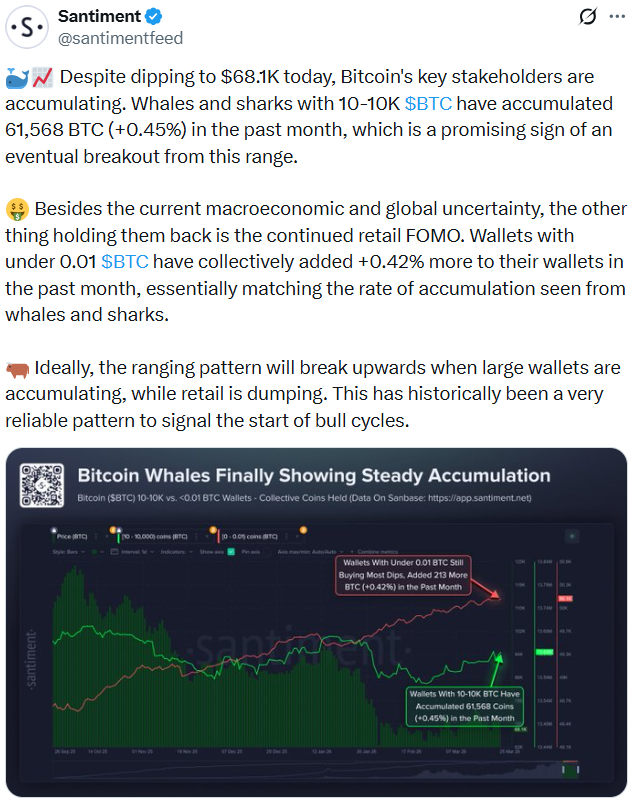
Large Bitcoin holders accumulated 61,568 more Bitcoin over the past month against the backdrop of escalating conflict in the Middle East and macroeconomic uncertainty.
Whales and sharks, defined as those holding between 10 and 10,000 Bitcoin (BTC), have increased their holdings by 0.45%, while wallets with under 0.01 Bitcoin have added 0.42%, or 213 BTC, over the past month, Santiment said in an X post Thursday.
The figures support recent data showing that Bitcoin exchange outflows have persisted throughout March, indicating that Bitcoin holders are accumulating rather than looking to sell.
Santiment analysts added that whale accumulation could be a “promising sign” of an eventual breakout from the range.
“Ideally, the ranging pattern will break upwards when large wallets are accumulating, while retail is dumping. This has historically been a very reliable pattern to signal the start of bull cycles,” the analysts said.

Tensions in the Middle East escalated in February after the US and Israel launched strikes against Iran. Iran retaliated against several neighboring countries, and the conflict has continued since.
Some whales wait for breakout; small holders driven by FOMO
Some Bitcoin whales are taking a different approach.
On March 19, two Bitcoin whales moved tens of millions of dollars to exchanges as Bitcoin fell and energy prices jumped after attacks on Gulf oil and gas infrastructure deepened during the Iran conflict.
Dominick John, an analyst at Zeus Research, told Cointelegraph that the whales who have been accumulating in the background are likely preparing for the next breakout.
“Whales are scooping up BTC because they’re positioning ahead of a potential breakout, quietly stacking during consolidation periods. Small wallets are chasing the momentum, driven by FOMO during uptrends and the fear of missing the next leg up,” he said.
Related: Binance says US midterms could boost Bitcoin and stocks
“Whales tend to buy in waves, so accumulation could continue if the range holds and macro conditions stay supportive. On the other hand, if retail FOMO overheats, we could see a pause or slight sell-off before the next accumulation phase,” John added.
Fear and greed index in “extreme fear”
Meanwhile, investor sentiment remains deeply uncertain. The Crypto Fear & Greed Index returned a score of 13 on Friday, firmly in “extreme fear” territory.

Thursday’s score was 10, and both the prior week and the month of February averaged “extreme fear” ratings as well, according to the index.
Magazine: Banks want to run Vietnam’s crypto exchanges, Boyaa’s $70M BTC plan: Asia Express


- Bitcoin price hovers near $68,500 but saw intraday lows of $68,000.
- Analysts say a textbook buy signal is flashing.
- Bulls could target $75,000-$80,000 next.
Bitcoin continues to face headwinds, with ongoing tensions in the Iran conflict and the macro outlook key.
Despite the cryptocurrency dipping to near $68,000 amid stock market declines, analysts are pointing to a potential contrarian signal as they forecast a new leg up for BTC.
The bellwether digital asset traded around $68,500 in early trading on Friday, with slight gains coming amid relief for US stock futures.
An uptick in risk assets came after President Donald Trump extended a deadline for potential strikes on Iran’s energy infrastructure by ten days.
BTC now eyes a push back toward $69,000, signaling potential stabilization.
Santiment says BTC is flashing a textbook buy signal
Bitcoin’s retest of $68,000 aligns with what on-chain analytics firm Santiment highlights as a surge in retail bearishness.
Yet it’s this outlook that analysts say could count as a classic contrarian indicator.
Social media chatter shows the crowd amplifying fear, uncertainty, and doubt (FUD) around Bitcoin and altcoins, with sentiment hitting lows not seen recently.
Why does this matter?
According to Santiment, cryptocurrency prices often defy public narratives.
“Historically, prices move opposite to the crowd’s narrative,” the firm notes.
This means that the current spike in pessimism could read as a robust buy signal.
It’s a textbook contrarian outlook where bearish chatter highlights potential bottoms, while bullish retail discourse often marks tops.
Santiment says optimistic terms like bounce, recovery, accumulating, or buying typically signal a sell opportunity.
Meanwhile, crowd chatter dominated by words such as dip, pullback, or bloodbath often signal buying opportunity.
🗣️ The retail crowd is showing signs of getting more and more bearish, expressing FUD toward Bitcoin and crypto. Historically, prices move opposite to the crowd’s narrative, making this below chart reveal a stronger buy signal. When you see crypto discourse with:
🔴 Words like… pic.twitter.com/rpgmtSz2Q2
— Santiment (@santimentfeed) March 27, 2026
Bitcoin price technical analysis
Over the past 24 hours, Bitcoin’s price action has mirrored broader market volatility.
The asset plunged to intraday lows near $68,500, retracing to weekly support levels and transforming the $72,000–$75,000 band into a formidable supply zone.
Current price levels mark a 4% weekly decline, reflecting investor caution.
From a technical perspective, Bitcoin presents a bullish setup amid the pullback.
The weekly RSI has dipped into oversold territory, hinting at exhaustion selling. Support at $68,000 aligns with the 200-week EMA, a prior accumulation and resistance zone.
The MACD indicator shows the histogram is flattening and there’s a hint of a bullish crossover.
On the upside, a retest of $70,000 brings $72,000 into view.
Short-term, the $75,000 supply zone could cap bulls’ move – unless they breach the level on increased volume amid de-escalation news. Broader forecasts point to $80,000 as a target for bulls.
On the downside, bears may fancy $65,000. However, they face a robust support base near the $60,000 mark.


The crypto market continued its downtrend on Friday as hopes of peace in the U.S. and Iran faded following a breakdown in diplomatic talks.
Summary
- Crypto market extended losses as fading U.S.–Iran peace hopes pushed Bitcoin below key support and triggered nearly $300 million in liquidations.
- Escalating Middle East tensions and surging oil prices fueled inflation fears, raising expectations of tighter Federal Reserve policy.
- Investors rotated into safe-haven assets like gold while equities and crypto-related stocks declined amid a broader risk-off sentiment.
Bitcoin (BTC), the world’s largest crypto asset, lost the $70,000 psychological support, falling to $68,560 at press time, down 2.8% over the day. Ethereum (ETH) fell 3.9% to $2,050 while other major cryptocurrencies such as BNB (BNB), XRP (XRP), Solana (SOL), and Dogecoin (DOGE) posted losses between 2% and 4% respectively.
Some of the top laggards of the day were Siren (SIREN), Rain (RAIN), and Provenance Blockchain (HASH), which recorded double-digit losses of 42%, 13%, and 10%. The total crypto market cap fell 1.6% over the day to $2.43 trillion.
As crypto prices fell, the market suffered nearly $300 million in liquidations over the past 24 hours, with $254 million coming from long liquidations, reflecting the dominance of sellers. The Crypto Fear and Greed Index reading fell to 28, reflecting fear amidst investors who seem to be taking a risk-off stance amid market uncertainty.
The crypto market continued to remain bearish amid reports that the United States could be considering deploying 10,000 additional troops in the Middle East to bolster defenses against Iran. This followed after Tehran rejected the latest ceasefire proposal to end hostilities, as it called it an infringement on their sovereignty.
The ongoing geopolitical friction between the two nations has led to a blockade at the Strait of Hormuz, a key maritime choke point, leading to significant oil supply chain disruptions. This has resulted in soaring crude oil prices, sparking concerns of runaway inflation across the globe.
Notably, WTI crude oil prices soared by over 31.6% the past month to over $93, while Brent oil surged 38% to over $107. Iranian officials have even threatened to push prices as high as $200.
Expectations of sky-high inflation as a result of the energy war could force the U.S. Federal Reserve to take on stricter monetary policies as they pivot back to data-dependent decision-making on interest rate cuts.
While the Fed decided to keep interest rates unchanged at 3.50% to 3.75% during the March meeting, growing concerns of higher inflation could shift the odds in favor of a rate hike, a U-turn from the narrative observed before the Middle East war erupted.
Despite these separate reports suggesting that US President Donald Trump is prepared to extend the current pause on military action by another 10 days amid shaky peace negotiations, the market remains on edge.
Capital rotation to traditional safe-haven assets
Crypto prices dropped as investors seem to be rotating their capital into gold, which is touted as the ultimate safe-haven asset. After falling below key levels on Thursday, gold prices rebounded back above $4,400, up nearly 2% today. In comparison, silver outperformed with gains of 3% during the same period.
Several Asian tech stocks, such as Japan’s Nikkei, South Korea’s Kospi, and Hong Kong’s Hang Seng, also slumped as investor appetite for risk assets was severely dampened. Cryptocurrencies share a high correlation with these traditional equity indices.
Outside of the crypto market, several top tech companies such as Nvidia, Microsoft, and Amazon saw their valuations trimmed. Crypto-related stocks such as Coinbase (COIN), Circle (CRCL), and Strategy (MSTR) also faced selling pressure.
However, the deepest impact was felt by bitcoin miners such as Marathon Digital and Riot Platforms, which have seen their margins squeezed by rising energy costs and the broader market retreat.
Disclosure: This article does not represent investment advice. The content and materials featured on this page are for educational purposes only.

The UK government is cracking down on a $20 billion Chinese-language crypto guarantee marketplace, with sweeping sanctions aimed at cutting the platform off from crypto access.
The UK’s Foreign, Commonwealth & Development Office said in a statement Thursday that Xinbi provides crypto-based services, scam-enabling tools and other illicit services to bad actors and plays a central role in scam centers operating across Southeast Asia.
“The UK’s sanctions will isolate the platform from the legitimate crypto ecosystem, significantly disrupting its operations by affecting its ability to send and receive cryptocurrency transactions,” the agency said.
While the sanctions mainly target the crypto ecosystem, the latest wording from the UK government highlights a separation between legitimate and illicit crypto ecosystems rather than lumping them together — a positive direction for the industry’s reputation.
Under the sanctions, any UK assets connected to Xinbi will be frozen, and the platform will be barred from the country’s financial, trade and travel networks. UK-based businesses, including banks, crypto firms and individual citizens, are prohibited from providing goods, services, loans or investments to Xinbi.

Key infrastructure targeted in crackdown
Chainalysis estimates Xinbi processed more than $19.9 billion between 2021 and 2025 and is deeply interconnected with a range of other illicit services.
The department’s recent sanctions include Thet Li, who allegedly managed the international financial network of Prince Group, a Cambodia-based company accused of orchestrating large-scale crypto fraud schemes.
Hu Xiaowei, who is allegedly involved in the Prince Group’s financial network and #8 Park, a scam compound linked to the group, was also sanctioned.
Blockchain analytics company Chainalysis said in a report Thursday that the sanctions target the scam ecosystem’s on- and off-ramps that enable large-scale fraud and are “exploiting the efficient, borderless nature of crypto rails.”
“By blacklisting a well-known Chinese-language guarantee marketplace, the FCDO is addressing the commercial marketplaces that sustain scam operators with payment facilitation and marketing services,” it said.
Related: There’s more to crypto crime than meets the eye: What you need to know
Traditional financial systems, such as wire transfers, have long been exploited for money laundering and fraud, largely because of their scale and global reach.
The Financial Action Task Force estimates that 2% to 5% of global GDP is laundered through traditional financial systems, whereas Chainalysis estimates that less than 1% of crypto transactions are linked to illicit activity.
The US has also intensified sanctions targeting illicit crypto operations. Earlier this month, the Treasury Department sanctioned six individuals and two entities for their alleged roles in an IT worker fraud scheme orchestrated by North Korea, a state actor that frequently targets the crypto industry.
Magazine: Big Questions: Can Bitcoin save you from the dreaded Cantillon Effect?

ARK Invest is turning to Kalshi’s prediction-market data to sharpen its investment research, marking a notable step for how institutions can incorporate crowd-sourced probability signals into traditional financial workflows. The asset manager says it will use real-time market expectations from Kalshi to augment its macro and company-specific analyses, while also applying the data to risk management and hedging strategies. The move highlights a broader sector shift: prediction markets moving from niche crypto experiments toward actionable inputs for credible investment teams.
In a Kalshi statement, ARK will consume prediction-market outputs to gauge current expectations and blend them with its existing market-based research framework. Beyond tracking headline indicators, the data will inform what ARK’s researchers monitor—spanning trading activity, regulatory milestones, and notable scientific or technological breakthroughs. The goal is to obtain a more dynamic view of risk and opportunity as events unfold, rather than relying solely on lagging metrics or expert opinions.
Key takeaways
- ARK Invest will integrate Kalshi’s prediction-market data into its research and risk-management toolkit, using real-time market expectations to guide investment decisions.
- The collaboration signals growing institutional interest in prediction markets as a complementary data layer to traditional research, not just an alternative trading venue.
- Kalshi markets already cover a range of topics—such as macroeconomic indicators and corporate KPIs—and are live for a subset of subjects, according to the company’s leadership.
- Federal researchers and universities have previously highlighted Kalshi data as a potential input to macro policy and decision-making, underscoring the broader acceptance of such markets in academia and public institutions.
ARK’s use case: blending crowd wisdom with rigorous research
ARK Invest’s foray into using prediction-market data sits at the intersection of quantitative rigor and market-sentiment assessment. Cathie Wood, ARK’s founder and CEO, described the move as a natural evolution in financial research—one that brings a continuously updated measure of risk and probability into decision-making processes. Nick Grous, ARK’s research director, framed prediction markets as among the “purest expressions of risk around key economic and company-specific outcomes.”
The core value proposition for ARK, as outlined in Kalshi’s release, is to tap into high-frequency signals that reflect how participants price future events in real time. This can complement traditional indicators, which may lag or be slow to reveal shifts in expectations. For an investment team that emphasizes dynamic themes and rapid adaptation, the Kalshi feed could help identify turning points or validate the trajectory of a thesis before more conventional data points corroborate the narrative.
Kalshi notes that ARK will enlist markets on topics it is curious about—ranging from macroeconomic data to milestones in science and technology. While the company has highlighted ongoing tests and listings, ARK’s utilization underscores a broader trend: the ability to integrate structured prediction data within a research workflow that already leverages quantitative models, scenario analysis, and risk budgeting. The approach could also influence how ARK conducts portfolio hedging, potentially offering a forward-looking gauge of tail risk or event-driven catalysts that may not yet be priced into standard benchmarks.
Prediction markets in the institutional mainstream
The ARK-Kalshi collaboration arrives amid a wider institutional embrace of prediction-market data. Last year’s surge in interest highlighted these markets as a leading use case within the crypto space, with aggregate trading volumes regularly surpassing $10 billion per month. The growing attention isn’t confined to private firms; respected research bodies, including the Federal Reserve and Cornell University, have studied and employed prediction-market data to capture market sentiment and expectations with greater immediacy than traditional surveys or models can provide.
In recent research, U.S. Federal Reserve researchers argued that Kalshi data could offer a real-time, distributionally rich benchmark for macro expectations that would be difficult to obtain from conventional sources alone. They suggested such markets could augment policymakers’ understanding of the economy’s current pulse and help illuminate how participants price risks around inflation, growth, and labor trends. The sentiment within that work underscores why users like ARK view Kalshi as more than a novelty; it is a potential complement to the data stack that informs capital allocation and risk management.
Kalshi’s leadership has framed the platform as a practical testbed for institutional workflows. Tarek Mansour, Kalshi’s CEO, pointed to live markets—such as non-farm payrolls and macro-deficit indicators—as evidence that certain topics already have active, tradable signals. The company’s narrative aligns with a broader belief that prediction markets can distill diverse opinions into a quantified expectation, updated as new information arrives.
Beyond ARK, the literature and industry chatter around prediction markets have drawn attention to their use in real-world decision-making. In academic contexts, Polymarket and other platforms have been studied for how traders react to political events in real time, illustrating the potential of prediction-market data to reveal behavioral patterns during pivotal moments. While these findings are nuanced, they contribute to a growing understanding that prediction markets can function as a supplementary data feed for both private sector decision-makers and public institutions.
Ark’s collaboration also touches on a broader conversation about governance and transparency in data-driven investing. As more institutions seek to ground strategic bets in probabilistic forecasts, the need for rigorous data provenance, auditability, and methodological clarity grows. Kalshi’s publicly stated partnerships and the types of markets it lists provide a convenient case study for how such data streams could be integrated without compromising research integrity or risk controls.
What this means for readers and market participants
For investors and traders, ARK’s adoption signals a potential shift in how prediction-market inputs could become part of the evidence base that informs long-term theses and hedging decisions. If institutional usage scales, prediction-market data may gain more credibility as a complementary signal alongside earnings momentum, macro data points, and policy expectations. For builders and data scientists, the ARK-Kalshi partnership could encourage the development of standardized data pipelines, backtesting frameworks, and risk management protocols that incorporate real-time probability distributions into models and dashboards.
However, questions remain about the boundaries and reliability of such data. Real-time markets reflect the crowd’s judgment, which can be swayed by liquidity, incentives, or strategic trading. As ARK and others experiment with their own internal workflows, market observers will watch how Kalshi-data-driven signals perform in tandem with traditional analytics across different market regimes and macro scenarios. The evolving dialogue between market practitioners, researchers, and policymakers will likely shape how prediction-market data is validated, integrated, and regulated going forward.
ARK’s move also dovetails with a broader anxiety and opportunity surrounding crypto-native data ecosystems. While the Kalshi platform sits at the intersection of finance and prediction markets, its rising profile among established asset managers demonstrates how probabilistic forecasting mechanisms can transcend niche use cases and become a practical component of risk-aware investing. The next phase will hinge on the ability of institutions to operationalize these signals with transparent methodologies and auditable results, ensuring that the data remains informative rather than noisy in the face of volatility or shifting incentives.
For readers tracking adoption, the clearest takeaway is that prediction-market data is no longer a curiosity confined to speculative or retail-focused platforms. It is entering the toolbox of serious investment management, with ARK Invest’s partnership illustrating what it could look like when research, risk management, and market sentiment intersect in real time. The implications for portfolio construction, risk hedging, and scenario planning will depend on how widely institutions embrace, validate, and standardize the use of these signals in the months ahead.
ARK did not disclose a specific rollout date for the Kalshi data integration, but the collaboration underscores a growing appetite among leading investors to test how crowdsourced forecasts can inform forward-looking decisions in a disciplined, transparent way. As more institutions publish pilots and early findings, the industry will gain a clearer picture of whether prediction-market data can consistently augment, or even outperform, conventional signals in certain contexts.
Readers should watch for any formal case studies or performance benchmarks that ARK or Kalshi may publish, as such disclosures would help quantify the impact of prediction-market inputs on research timelines, risk metrics, and portfolio outcomes. The evolving narrative around these data streams is one to follow closely, given the potential to alter how investment teams think about probability, risk, and opportunity in rapidly changing markets.
As the week closes, the broader takeaway remains: prediction markets are moving from experimental corners of the crypto world into mainstream institutional workflows, where they can influence real-world decisions. The ARK-Kalshi partnership is a tangible milestone in that trajectory, inviting more questions about scalability, governance, and what investors should expect from crowd-based forecasts in the years ahead.
Readers interested in the original Kalshi announcement can explore the press release detailing ARK’s planned usage of the platform to enhance risk management and research workflows.


Ukraine has complicated President Donald Trump’s efforts to stabilize oil markets amid the Iran war, amplifying risks for financial markets, including cryptocurrencies.
For nearly a month, markets have been gripped by a single concern: the Iran war. Disruptions in the Strait of Hormuz – a critical oil chokepoint – have driven prices sharply higher, stoking fears of sticky inflation, a risk-off shift, and renewed Fed rate hikes.
To cool things down, the Trump administration quickly lifted sanctions on Russian crude for the short term, opening the tap to compensate for oil supply disruptions caused by the Iran war.
It came across as a solid plan to stabilize energy markets until Ukraine blew it up.
This week, Ukraine launched drone strikes on ports and refiners in Russia’s Leningrad, leading to what one observer described as “the most serious threat” to the country’s oil exports since Putin’s full-scale invasion of Ukraine in 2022.
The damage is significant, with roughly 40% of Russia’s oil export capacity offline. Oilprice.com editor Michael Kern described it as “a logistics problem first – and a supply problem second,” underscoring that moving oil to buyers is now as difficult as producing it.
“In conjunction with the war in the Middle East and de facto closure of the Strait of Hormuz and subsequent oil/LNG production outages, the Russian disruption adds a fresh element to already sky-high oil prices,” Kern noted.
In other words, oil prices may remain elevated longer than initially expected. For risk assets, including bitcoin and other cryptocurrencies, that’s an issue because higher sticky energy prices could lead to sticky inflation, potentially putting pressure on global central banks to raise borrowing costs and drain liquidity.
Traders are already prepping for a potential Fed rate hike in the short term. According to Bloomberg, flows in the options market tied to overnight interest rates indicate traders are wagering on a rate increase within two weeks.
Taken together, these factors suggest bitcoin’s recent resilience may face tests, with the $65,000–$75,000 range vulnerable to a downside break.
At press time, bitcoin traded near $68,500, down nearly 2% over the past 24 hours, according to CoinDesk data. WTI oil, which slipped nearly 10% to $83.95 per barrel on Monday, has since bounced back to $93.50. Brent crude is once again trading above the $100 mark.
US lawmakers have introduced a second bill this week aimed at curbing prediction market insider trading by government officials, amid growing concerns over such activity on major platforms such as Kalshi and Polymarket.
In an announcement on Thursday, US lawmakers Todd Young, Elissa Slotkin, John Curtis and Adam Schiff unveiled the bipartisan Public Integrity in Financial Prediction Markets Act of 2026.
“No one should be profiting off the information and knowledge gained as a public servant, period,” Slotkin said, adding: “This bill is an important first step in placing common sense rules around prediction markets, and it has real teeth to ensure those who break these rules face real consequences.”
The bill underscores growing unease that prediction markets could become a new frontier for insider trading, as bets tied to real-world events blur the line between wagering and financial activity.
Bill aims to stop insider profiteering
The latest bill, which has been introduced in the second session of the 119th Congress, aims to prohibit government executives from using “insider information to bet on a prediction market contract.”

If enacted, the Public Integrity in Financial Prediction Markets Act of 2026 would cover the president, vice president and politicians across Congress, the House of Representatives and the Senate.
It would also cover political appointees and “employees of an Executive agency or independent regulatory agency.”
The bill defines insider information as anything that a “reasonable investor would consider important in making a decision related to a prediction market contract and is not publicly available.”
It also outlines reporting requirements under which a government official must report any contract wagers over $250 within 30 days to the supervising ethics office. The individual must include “the number of contracts purchased, price of contract, date and time of transaction, name of contract, position taken on contract, name of trading platform used, profit or loss made on transaction.”
The penalties will see individuals charged the greater of $500 or double the amount of profit made from the prediction market contract.
Related: SEC is no longer a ‘cop on the beat‘ on crypto, says US lawmaker
The bills come amid an increasing number of state and federal lawmakers taking aim at prediction markets.
It also marks the second bill introduced this week to try to stop government officials from using insider information to profit on prediction markets, the first being the PREDICT Act introduced by US Representative Adrian Smith and Representative Nikki Budzinski on Tuesday.
However, the PREDICT Act focuses on preventing insider trading on prediction markets relating to political events, policy decisions and other government actions.
Recently, both Kalshi and Polymarket have made attempts to tighten their rules to stop insiders wagering on their platforms.
Magazine: Nobody knows if quantum secure cryptography will even work
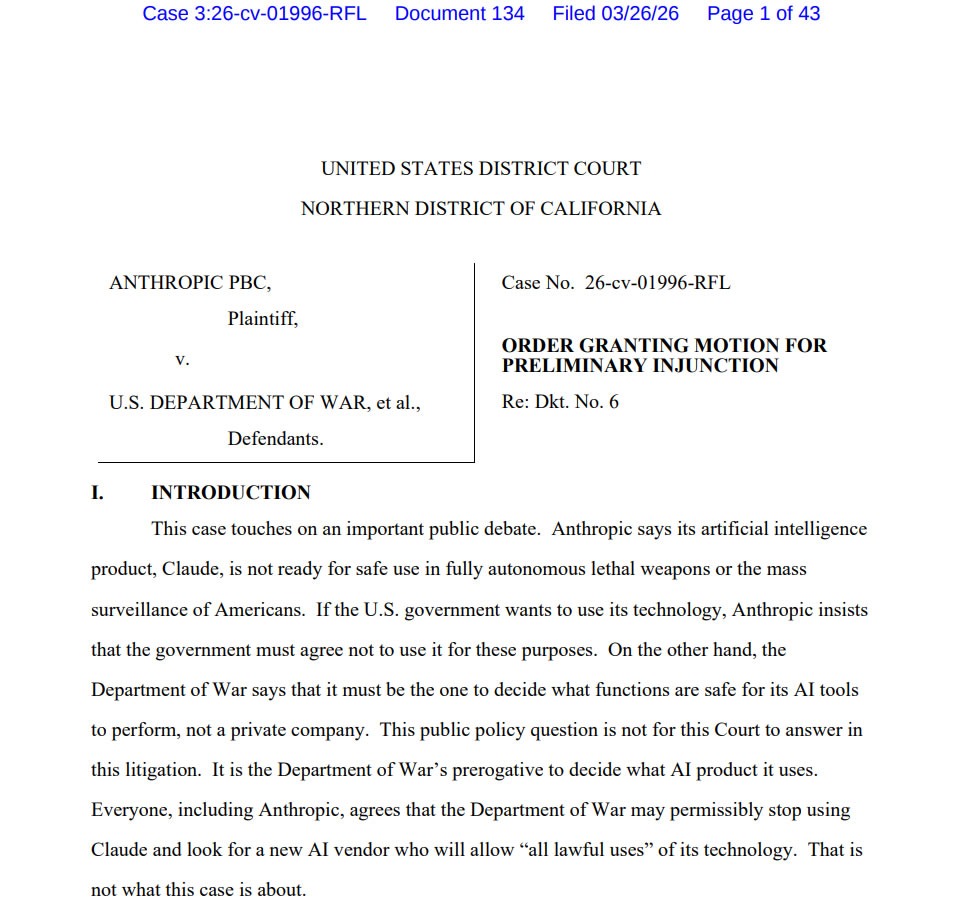
A US federal judge in San Francisco has granted Anthropic’s request for temporary reprieve after the Pentagon’s designation of the company as a supply chain risk.
In an order on Thursday, Judge Rita Lin of the District Court for the Northern District of California ordered a preliminary injunction against the Pentagon over the label. It also temporarily halts a directive from US President Donald Trump ordering federal agencies to stop using Anthropic’s chatbot, Claude.
“Nothing in the governing statute supports the Orwellian notion that an American company may be branded a potential adversary and saboteur of the US for expressing disagreement with the government,” said Judge Lin.
Anthropic was the top player in enterprise AI markets with 32%, ahead of OpenAI on 25%, as of 2025, according to Menlo Ventures. A government-wide ban on Anthropic would plummet this position.
The judge said that these “broad punitive measures” taken against Anthropic by the Trump administration and Defense Secretary Pete Hegseth appeared “arbitrary, capricious, [and] an abuse of discretion.”
The order came after Anthropic filed a lawsuit in a Columbia federal court on March 9, alleging that Hegseth overstepped his authority when he designated the company a national security supply-chain risk.

Anthropic opposed autonomous weapons and mass surveillance
The dispute stems from a deal in July 2025 between the AI firm and the Pentagon on a contract to make Claude the first frontier AI model approved for use on classified networks.
Negotiations collapsed in February with the Pentagon seeking to renegotiate, insisting Anthropic allow military use of Claude “for all lawful purposes” and without restrictions.
Anthropic maintained that its technology should not be used for lethal autonomous weapons and mass domestic surveillance of Americans.
On Feb. 27, Trump ordered all federal agencies to cease using Anthropic products. “The Leftwing nut jobs at Anthropic have made a DISASTROUS MISTAKE trying to STRONG-ARM the Department of War,” he wrote on Truth Social.
A 90-minute court hearing took place in San Francisco on March 24, during which Judge Lin pressed government lawyers on whether Anthropic was being punished for publicly criticizing the Pentagon.
Classic illegal First Amendment retaliation
“Punishing Anthropic for bringing public scrutiny to the government’s contracting position is classic illegal First Amendment retaliation,” the March 26 ruling stated.
Anthropic said in a statement that it was “grateful to the court for moving swiftly, and pleased they agree Anthropic is likely to succeed on the merits.”
Magazine: Nobody knows if quantum secure cryptography will even work
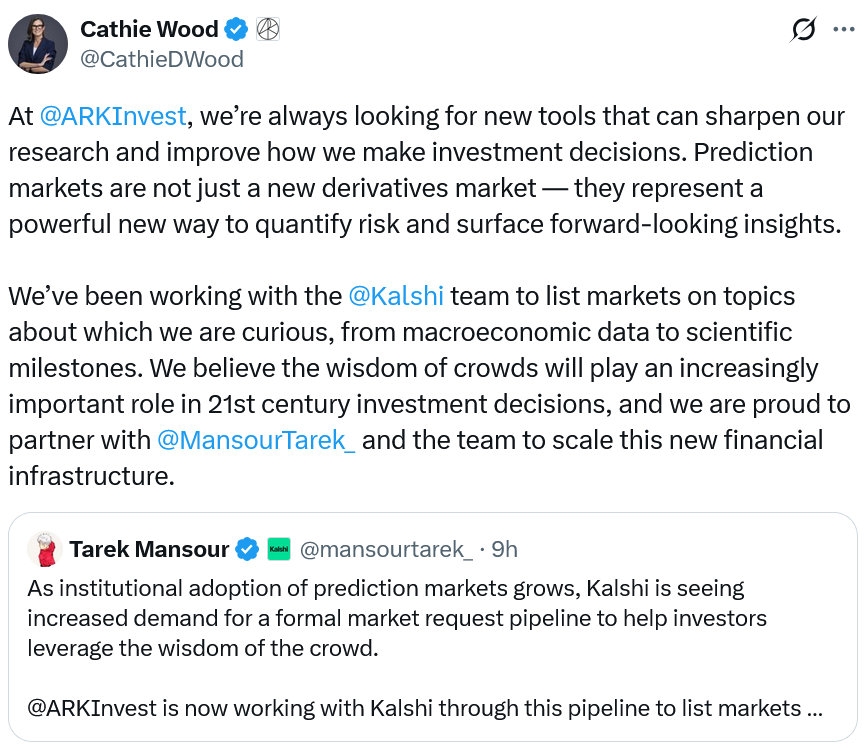
Tech-focused asset manager ARK Invest said it will start using Kalshi’s prediction market data to improve how it makes its investment decisions, one of the latest cases demonstrating the broader value of prediction market data beyond trading.
According to a statement from Kalshi, ARK will use prediction market data to gauge real-time expectations and guide its existing market-based research, in addition to analyzing performance indicators such as trading volume, regulatory approvals and technological milestones. ARK will also use the data for risk management and hedging strategies.
“Bringing prediction markets into institutional workflows is a natural next step for innovation in financial research,” ARK Invest founder and CEO Cathie Wood said Thursday, while the company’s research director, Nick Grous, said prediction markets “offer some of the purest expressions of risk around key economic and company-specific outcomes.”
Prediction markets became one of the hottest use cases in crypto last year and have consistently surpassed $10 billion in monthly trading volume. Prediction market data has also increasingly been seen by institutions, including the Federal Reserve and Cornell University, as valuable for making decisions that require a pulse on the market.
In a post on X, Wood also said ARK has been working with Kalshi to list markets on topics it is curious about on the prediction markets platform, including macroeconomic data and scientific milestones.
Kalshi CEO Tarek Mansour noted that “a few of these are already live on Kalshi, including non-farm payroll markets, deficit-to-GDP ratio markets, business KPIs, and more.”

Fed, Cornell eye opportunity in prediction markets
Last month, researchers at the US Federal Reserve argued that Kalshi can better measure macroeconomic expectations in real time than its existing solutions and thus should be incorporated into the Fed’s decision-making process.
Related: Polymarket tightens rules to curb manipulation, insider trading risks
“Kalshi markets provide a high-frequency, continuously updated, distributionally rich benchmark that is valuable to both researchers and policymakers,” the Fed researchers said at the time.
Predictions market data from Polymarket has also been researched at Cornell University to study how traders reacted to political events in real time, such as Donald Trump and Joe Biden’s presidential debates and the assassination attempt on Trump in 2024.
Magazine: IronClaw rivals OpenClaw, Olas launches bots for Polymarket — AI Eye

Bolton thief stole bike, drill and milk after drug relapse

SpaceX IPO Could Make Elon Musk First Trillionaire, Cementing Richest Status

Investors yank $171 million from BTC ETFs in largest single-day outflow in three weeks


-
 Crypto World6 days ago
NIO (NIO) Stock Plunges 6.5% as Shelf Registration Sparks Dilution Worries
-
 NewsBeat2 days ago
Manchester United reach agreement with Casemiro over contract clause amid transfer speculation
-

 Fashion7 days ago
Weekend Open Thread: Adidas – Corporette.com
-

 Politics7 days ago
Jenni Murray, Long-Serving Woman’s Hour Presenter, Dies Aged 75
-

 Crypto World5 days ago
Best Crypto to Buy Now: Strategy Just Spent $1.57 Billion on Bitcoin During Fear While Early Investors Quietly Enter Pepeto for 150x Potential
-

 Crypto World5 days ago
Bitcoin Price News: Bhutan Sells $72 Million in BTC Under Fiscal Pressure, but the Smart Money Entering Pepeto Sees What the Market Does Not
-

 News Videos1 day ago
Parliament publishes latest register of MPs’ financial interests
-

 Sports4 days ago
Remo Stars and Kano Pillars Strengthen Survival Hopes in NPFL
-

 Sports4 days ago
Gary Kirsten Accuses Pakistan Cricket Board Of ‘Interference’, Mohsin Naqvi Responds
-

 Tech4 days ago
Give Your Phone a Huge (and Free) Upgrade by Switching to Another Keyboard
-

 Business5 days ago
No Winner in March 21 Drawing as Prize Rolls to $133 Million for Next
-

 Sports7 days ago
2026 Kentucky Derby horses, odds, futures, preview, date: Expert who nailed 12 Derby-Oaks Doubles enters picks
-

 Tech4 days ago
AI enters the chat: New Seattle dating app relies on tech to facilitate meaningful human connections
-
Business6 days ago
Columbia Sportswear enters $500 million credit agreement with JPMorgan Chase
-

 News Videos4 days ago
Ch 9 Financial Management Part 1 | Detailed One Shot | Class 12 Business Studies Boards 2026
-

 Tech5 days ago
Today’s NYT Connections Hints, Answers for March 22 #1015
-

 Business11 hours ago
Instagram, YouTube Found Responsible for Teen’s Mental Health Struggle in Historic Ruling
-
 Crypto World7 days ago
Small-cap Russell 2000 enters correction territory
-

 Business5 days ago
Will Duke Basketball Win It All? Duke Basketball Enters Second Round as Third Favorite to Claim NCAA Title
-

 Business7 days ago
(VIDEO) BTS Drops ‘ARIRANG’ Album Today, Marking Epic Post-Military Comeback With Live Concert
You must be logged in to post a comment Login