
Crypto World
ARK Invest Leverages Kalshi Data to Guide Crypto Investment Calls


ARK Invest is turning to Kalshi’s prediction-market data to sharpen its investment research, marking a notable step for how institutions can incorporate crowd-sourced probability signals into traditional financial workflows. The asset manager says it will use real-time market expectations from Kalshi to augment its macro and company-specific analyses, while also applying the data to risk management and hedging strategies. The move highlights a broader sector shift: prediction markets moving from niche crypto experiments toward actionable inputs for credible investment teams.
In a Kalshi statement, ARK will consume prediction-market outputs to gauge current expectations and blend them with its existing market-based research framework. Beyond tracking headline indicators, the data will inform what ARK’s researchers monitor—spanning trading activity, regulatory milestones, and notable scientific or technological breakthroughs. The goal is to obtain a more dynamic view of risk and opportunity as events unfold, rather than relying solely on lagging metrics or expert opinions.
Key takeaways
- ARK Invest will integrate Kalshi’s prediction-market data into its research and risk-management toolkit, using real-time market expectations to guide investment decisions.
- The collaboration signals growing institutional interest in prediction markets as a complementary data layer to traditional research, not just an alternative trading venue.
- Kalshi markets already cover a range of topics—such as macroeconomic indicators and corporate KPIs—and are live for a subset of subjects, according to the company’s leadership.
- Federal researchers and universities have previously highlighted Kalshi data as a potential input to macro policy and decision-making, underscoring the broader acceptance of such markets in academia and public institutions.
ARK’s use case: blending crowd wisdom with rigorous research
ARK Invest’s foray into using prediction-market data sits at the intersection of quantitative rigor and market-sentiment assessment. Cathie Wood, ARK’s founder and CEO, described the move as a natural evolution in financial research—one that brings a continuously updated measure of risk and probability into decision-making processes. Nick Grous, ARK’s research director, framed prediction markets as among the “purest expressions of risk around key economic and company-specific outcomes.”
The core value proposition for ARK, as outlined in Kalshi’s release, is to tap into high-frequency signals that reflect how participants price future events in real time. This can complement traditional indicators, which may lag or be slow to reveal shifts in expectations. For an investment team that emphasizes dynamic themes and rapid adaptation, the Kalshi feed could help identify turning points or validate the trajectory of a thesis before more conventional data points corroborate the narrative.
Kalshi notes that ARK will enlist markets on topics it is curious about—ranging from macroeconomic data to milestones in science and technology. While the company has highlighted ongoing tests and listings, ARK’s utilization underscores a broader trend: the ability to integrate structured prediction data within a research workflow that already leverages quantitative models, scenario analysis, and risk budgeting. The approach could also influence how ARK conducts portfolio hedging, potentially offering a forward-looking gauge of tail risk or event-driven catalysts that may not yet be priced into standard benchmarks.
Prediction markets in the institutional mainstream
The ARK-Kalshi collaboration arrives amid a wider institutional embrace of prediction-market data. Last year’s surge in interest highlighted these markets as a leading use case within the crypto space, with aggregate trading volumes regularly surpassing $10 billion per month. The growing attention isn’t confined to private firms; respected research bodies, including the Federal Reserve and Cornell University, have studied and employed prediction-market data to capture market sentiment and expectations with greater immediacy than traditional surveys or models can provide.
In recent research, U.S. Federal Reserve researchers argued that Kalshi data could offer a real-time, distributionally rich benchmark for macro expectations that would be difficult to obtain from conventional sources alone. They suggested such markets could augment policymakers’ understanding of the economy’s current pulse and help illuminate how participants price risks around inflation, growth, and labor trends. The sentiment within that work underscores why users like ARK view Kalshi as more than a novelty; it is a potential complement to the data stack that informs capital allocation and risk management.
Kalshi’s leadership has framed the platform as a practical testbed for institutional workflows. Tarek Mansour, Kalshi’s CEO, pointed to live markets—such as non-farm payrolls and macro-deficit indicators—as evidence that certain topics already have active, tradable signals. The company’s narrative aligns with a broader belief that prediction markets can distill diverse opinions into a quantified expectation, updated as new information arrives.
Beyond ARK, the literature and industry chatter around prediction markets have drawn attention to their use in real-world decision-making. In academic contexts, Polymarket and other platforms have been studied for how traders react to political events in real time, illustrating the potential of prediction-market data to reveal behavioral patterns during pivotal moments. While these findings are nuanced, they contribute to a growing understanding that prediction markets can function as a supplementary data feed for both private sector decision-makers and public institutions.
Ark’s collaboration also touches on a broader conversation about governance and transparency in data-driven investing. As more institutions seek to ground strategic bets in probabilistic forecasts, the need for rigorous data provenance, auditability, and methodological clarity grows. Kalshi’s publicly stated partnerships and the types of markets it lists provide a convenient case study for how such data streams could be integrated without compromising research integrity or risk controls.
What this means for readers and market participants
For investors and traders, ARK’s adoption signals a potential shift in how prediction-market inputs could become part of the evidence base that informs long-term theses and hedging decisions. If institutional usage scales, prediction-market data may gain more credibility as a complementary signal alongside earnings momentum, macro data points, and policy expectations. For builders and data scientists, the ARK-Kalshi partnership could encourage the development of standardized data pipelines, backtesting frameworks, and risk management protocols that incorporate real-time probability distributions into models and dashboards.
However, questions remain about the boundaries and reliability of such data. Real-time markets reflect the crowd’s judgment, which can be swayed by liquidity, incentives, or strategic trading. As ARK and others experiment with their own internal workflows, market observers will watch how Kalshi-data-driven signals perform in tandem with traditional analytics across different market regimes and macro scenarios. The evolving dialogue between market practitioners, researchers, and policymakers will likely shape how prediction-market data is validated, integrated, and regulated going forward.
ARK’s move also dovetails with a broader anxiety and opportunity surrounding crypto-native data ecosystems. While the Kalshi platform sits at the intersection of finance and prediction markets, its rising profile among established asset managers demonstrates how probabilistic forecasting mechanisms can transcend niche use cases and become a practical component of risk-aware investing. The next phase will hinge on the ability of institutions to operationalize these signals with transparent methodologies and auditable results, ensuring that the data remains informative rather than noisy in the face of volatility or shifting incentives.
For readers tracking adoption, the clearest takeaway is that prediction-market data is no longer a curiosity confined to speculative or retail-focused platforms. It is entering the toolbox of serious investment management, with ARK Invest’s partnership illustrating what it could look like when research, risk management, and market sentiment intersect in real time. The implications for portfolio construction, risk hedging, and scenario planning will depend on how widely institutions embrace, validate, and standardize the use of these signals in the months ahead.
ARK did not disclose a specific rollout date for the Kalshi data integration, but the collaboration underscores a growing appetite among leading investors to test how crowdsourced forecasts can inform forward-looking decisions in a disciplined, transparent way. As more institutions publish pilots and early findings, the industry will gain a clearer picture of whether prediction-market data can consistently augment, or even outperform, conventional signals in certain contexts.
Readers should watch for any formal case studies or performance benchmarks that ARK or Kalshi may publish, as such disclosures would help quantify the impact of prediction-market inputs on research timelines, risk metrics, and portfolio outcomes. The evolving narrative around these data streams is one to follow closely, given the potential to alter how investment teams think about probability, risk, and opportunity in rapidly changing markets.
As the week closes, the broader takeaway remains: prediction markets are moving from experimental corners of the crypto world into mainstream institutional workflows, where they can influence real-world decisions. The ARK-Kalshi partnership is a tangible milestone in that trajectory, inviting more questions about scalability, governance, and what investors should expect from crowd-based forecasts in the years ahead.
Readers interested in the original Kalshi announcement can explore the press release detailing ARK’s planned usage of the platform to enhance risk management and research workflows.



US Representative Maxine Waters has asked the Federal Reserve Bank of Kansas City to explain its decision to approve Kraken Financial’s limited-purpose master account.
Summary
- Maxine Waters asked the Kansas City Fed to explain Kraken Financial’s master account approval terms.
- Waters asked which Federal Reserve services Kraken can access and what restrictions apply to usage.
- Kraken’s approval renews debate over crypto firms seeking direct access to core US payment rails.
Her request puts fresh attention on how crypto-linked firms may gain access to the US payment system and what safeguards apply when the Federal Reserve reviews those applications.
Waters, the top Democrat on the House Financial Services Committee, sent a letter to Kansas City Fed President Jeff Schmid on Thursday. She asked him to respond by April 10 with details on what Kraken’s approval allows in practice and which Federal Reserve services the company can use.
She also asked what conditions or limits apply to the account. Her letter requested information on anti-money laundering checks, consumer protection reviews, and the legal basis behind the approval process.
Kraken Financial received a limited-purpose master account from the Federal Reserve Bank of Kansas City earlier this month. The move drew attention because crypto-linked firms have sought direct Federal Reserve access for years.
The account could give Kraken access to Fedwire, the Federal Reserve’s main payment network. That system allows institutions to move funds on the same core rails used by banks and credit unions across the United States.
Waters said the public notice left important questions unanswered. In her letter, she wrote that the Kansas City Fed’s announcement “does not disclose specific information” about Kraken’s access to Federal Reserve financial services because of “the confidentiality of business information provided by applicants.”
Waters said direct access to the Federal Reserve’s payment system raises policy, regulatory, and consumer protection questions. She argued that the Federal Reserve must show that any approval follows the law and applies the same standards to all applicants.
She wrote that “answers to these questions are critical” to ensure the approval process works “with impartiality” and supports “a safe and efficient payment system.” Waters also said new activity in digital assets, tokenization, payments, and artificial intelligence is moving faster than many existing laws.
Crypto firms continue push for master accounts
Kraken is not the only crypto-linked company seeking this type of access. Custodia Bank, Anchorage Digital Bank, and Ripple’s Standard Custody & Trust Company have also pursued Federal Reserve master accounts.
Waters has often taken a cautious position on crypto policy. Advocacy group Stand With Crypto lists her as “strongly against crypto,” citing past statements and votes against crypto legislation. Her latest letter now places the focus on transparency in how the Federal Reserve handles crypto-related account approvals.

Ondo Finance just landed one of the heaviest institutional co-signs in tokenized finance history, and trading at $0.28 and posting a staggering 10% price jump in 24 hours as its prediction gets bullish.
Ondo Finance confirmed it will partner with Franklin Templeton to bring tokenized versions of publicly traded stocks and ETFs to blockchain users via Ondo Global Markets, a platform launched in September 2025 that already reports $620 million in total value locked and $12 billion in cumulative trading volume across 60,000 users.
BREAKING — X Finance Bull (@Xfinancebull) March 25, 2026
 Franklin Templeton is partnering with $ONDO to tokenize ALL their ETFs. U.S. equities, fixed income, and gold.
Trading 24/7 through crypto wallets.
Now remember what $ONDO is already doing on the $XRP Ledger.
Ondo's OUSG, backed by BlackRock's BUIDL fund, is… pic.twitter.com/M6hiXvbAGf
Franklin Templeton will supply investment products and support educational rollout for crypto-native audiences. The move follows a broader central bank and institutional push into tokenized asset infrastructure, with BlackRock and others already testing on-chain settlement rails.
The partnership with Franklin Templeton, which oversees $1.7 trillion in assets under management, is moving the coin as it should.
Discover: The best crypto to diversify your portfolio with
ONDO Price Prediction: $0.3 Resistance To Be Broken This Week?
ONDO is running to break the $0,29 channel, and the technical picture is about as ambiguous as it gets. March 26 closed at $0.27 on $80.8 million in volume, respectable activity for a mid-cap RWA token.
Key levels to watch: support at $0.25–$0.26, with resistance clustering at $0.285–$0.29. That ceiling has capped every rally attempt in the current consolidation window. A clean close above $0.295 on elevated volume would shift momentum decisively bullish.

The regulatory clarity narrative that’s lifting other institutional-grade tokens remains a slow-burn catalyst for ONDO specifically, given that tokenized securities sit in a grey zone that regulators haven’t fully addressed across wallet-to-wallet transfers.
Discover: The best pre-launch token sales
LiquidChain Targets Early Mover Upside as ONDO Tests Key Levels
ONDO at $0.28 is a mature, already-discovered trade. The Franklin Templeton partnership is priced into sentiment, and even a rally to the $0.5136 year-end target represents roughly 97% upside from current levels. That’s meaningful. But early-stage infrastructure operating in the same RWA and cross-chain space are still pricing in discovery, not deployment.
A new layer emerges. Only a few see it first.
The future is LiquidChain⟁https://t.co/vqvBcdSj94 pic.twitter.com/R7ZeZ0NPGl
— LiquidChain (@getliquidchain) March 24, 2026
LiquidChain ($LIQUID) is a Layer 3 infrastructure project with a specific structural thesis: fusing Bitcoin, Ethereum, and Solana liquidity into a single execution environment. Where most cross-chain protocols force developers to rebuild or bridge repeatedly, LiquidChain’s Deploy-Once Architecture means a single deployment accesses all three ecosystems simultaneously.
The presale is live at $0.014 per $LIQUID, with more than $600K raised to date. Core features include a Unified Liquidity Layer, Single-Step Execution, and Verifiable Settlement.
This article is not financial advice. Cryptocurrency investments are highly volatile. Always conduct your own research before making any investment decisions.
The post ONDO Price Prediction: Franklin Templeton’s $1.7 Trillion Weight to Carry appeared first on Cryptonews.
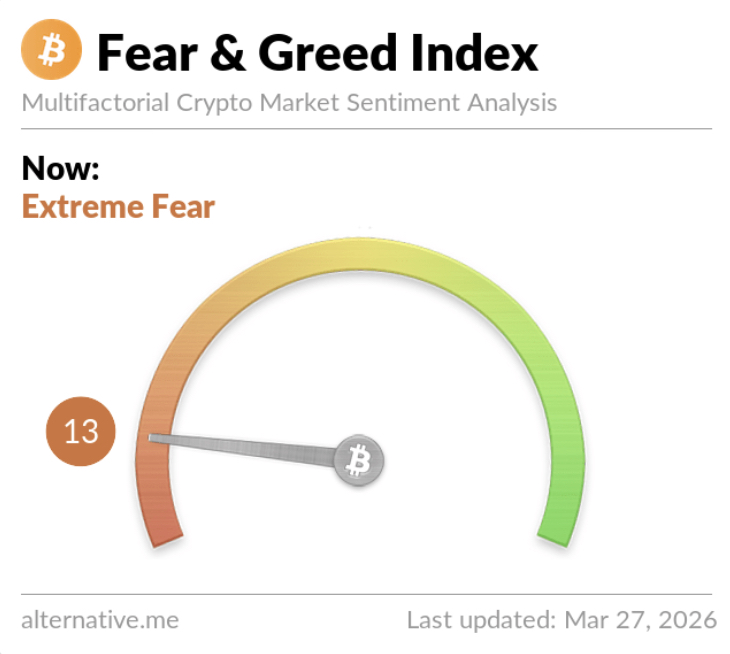
Crypto’s most prominent Washington ally just changed his business card, and the market is watching, and the Bitcoin price prediction is changing. BTC is trading around $68,700, down 1.8% in 24 hours, dragging the crypto market down. The timing is uncomfortable: policy uncertainty and a softening chart colliding at once.
White House AI and Crypto Czar David Sacks announced Thursday he is stepping down from his czar role and joining the President’s Council of Advisors on Science and Technology (PCAST) as co-chair. The transition was legally inevitable; Sacks’s czar designation classified him as a “special government employee,” a status capped at 130 working days.
He told Bloomberg the PCAST role carries no such restriction, and he will continue shaping crypto and AI policy alongside an advisory roster that includes Jensen Huang, Mark Zuckerberg, Marc Andreessen, and Sergey Brin. Sacks oversaw the passage of the stablecoin-focused GENIUS Act and was actively involved in the crypto market structure bill.
The structural policy work continues, in other words, just under a different letterhead. Whether that reassures a market already flashing Extreme Fear is the harder question.
Discover: The best pre-launch token sales
BTC Price Prediction: Reclaim $70,000 This Week or Drop to $60K?
The chart is not cooperating. Bitcoin sits at $68,700, consolidating inside a descending channel with moving averages stacked bearishly. The Fear & Greed Index has collapsed to 13 in an extreme fear situation, a level that historically marks either capitulation bottoms or accelerated selloffs.

Key support levels to monitor: $68,000, $67,700, and $66,500. Resistance sits at $70,400, then $71,700, with a harder ceiling near $72,300.
Three scenarios, ranked by current probability:
- Bull case: Spot holds $68,400, futures demand stabilizes and price reclaims $70,000+ into the weekend.
- Base case: Consolidation between $66,400 and $70,400 persists as ETF inflows plateau and miner selling pressure absorbs any recovery bids.
- Bear case: Analyst Alessio Rastani’s warning of a “high chance” drop below $60,000 materializes if $66,400 gives way, opening a path toward the $54,200 level flagged in forex analysis.

The Bitcoin institutional demand picture remains the swing for price prediction. A Fear & Greed reading of 13 cuts both ways.
Discover: The best crypto to diversify your portfolio with
Bitcoin Hyper Targets Early-Mover Upside as BTC Tests Critical Support
When spot Bitcoin grinds sideways at Extreme Fear levels, the rotation question surfaces: where does asymmetric upside actually live right now?
A different segment of the Bitcoin ecosystem is drawing attention. Bitcoin Hyper ($HYPER) is positioning as the first Bitcoin Layer 2 with Solana Virtual Machine (SVM) integration, sub-second finality on Bitcoin’s security layer, a proposition that existing L2s haven’t delivered. The project targets Bitcoin’s three structural constraints: slow transactions, high fees, and the absence of programmable smart contracts.
Two modes. One future. — Bitcoin Hyper (@BTC_Hyper2) March 27, 2026

Bitcoin Hyper.  https://t.co/VNG0P4GuDo pic.twitter.com/uNneqkZg13
Presale numbers are concrete: $0.0136 per token, with more than $32 million raised to date. Staking is live with high APY for participants. The architecture includes a Decentralized Canonical Bridge for BTC transfers and SVM-powered smart contract execution that the team claims outpaces Solana itself.
This article is for informational purposes only and does not constitute financial advice. Crypto assets are highly volatile. Always do your own research before investing.
The post Bitcoin Price Prediction: David Sacks Is No Longer Crypto Czar appeared first on Cryptonews.
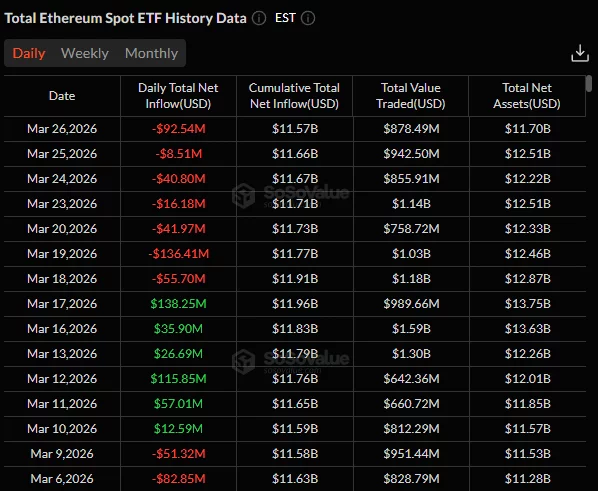
U.S. spot Ethereum exchange-traded funds recorded seven straight days of outflows with over $390 million leaving the funds.
Summary
- U.S. spot Ethereum ETFs logged a seventh straight day of outflows, with over $390 million withdrawn amid weakening institutional demand.
- Capital rotation into BlackRock’s staked ETH ETF and safe-haven assets like gold reflects a broader risk-off sentiment tied to geopolitical tensions.
- Ethereum remains under pressure, down sharply from yearly highs, though declining exchange balances point to ongoing accumulation.
According to data from SoSoValue, the 10 spot ETH ETFs saw $92.54 million in net outflows on Thursday, March 26, primarily led by BlackRock’s ETHA with $140.24 million in outflows. The investment manager’s staked Ethereum ETF (ETHB) managed to offset a large portion of the outflows as it drew in $96.81 million on the day.
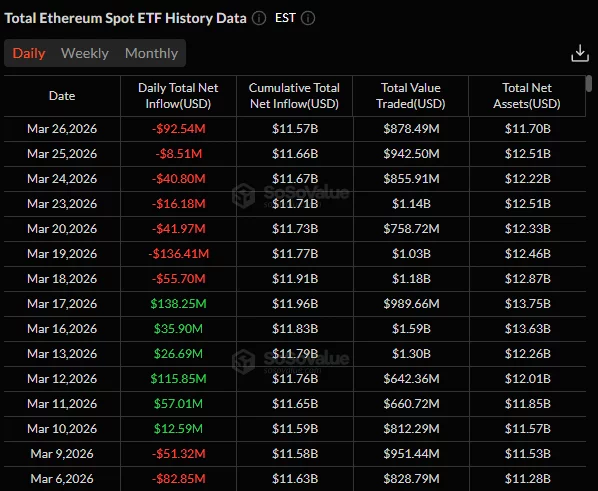
Following the outflows yesterday, these investment products have now seen redemptions for the seventh consecutive day, with a combined $391.65 million flowing out.
Before this streak, the ETFs recorded a six-day inflow run in which they drew in over $386 million. This suggests that institutional traders could be withdrawing from the market amid expectations of a prolonged conflict between the U.S. and Iran, destabilizing risk assets.
A part of this activity may also come from capital rotation into BlackRock’s ETHB, which offers investors native staking yields unlike the standard spot ETFs that simply track the price of the underlying asset. The firm previously noted that it would waive a portion of sponsor fees to remain competitive for the initial $2.5 billion in assets.
Besides this, investors have also been rotating capital from these ETFs towards traditional safe-haven assets such as gold and other precious metals as oil prices continue to retain upward pressure, sparking fears of global inflation and a hawkish Federal Reserve.
On the monthly scale, the ETH ETFs are close to completing their 5th straight month of net outflows that began in November last year, with nearly $2.85 billion in total exits.
Ethereum price has fallen over 45% from its year-to-date high to $1,815 in late February amidst the persistent ETF outflows and broader market downturn triggered by the U.S.-Iran war, rising energy costs, and diminished expectations of Federal Reserve interest rate cuts this year. At press time, Ethereum price was trading at $2,065, down 2.7% over the past 24 hours.
Market analysts, such as Tom Lee, Head of Research at Fundstrat and Chairman of Ethereum treasury company Bitmine, have called a market bottom for Ethereum, aligning with the firm’s aggressive accumulation of Ether as it advances towards its 5% target of the total circulating supply.
This comes as Ethereum balances on exchanges have fallen to an all-time low, a sign of accumulation, whether by retail investors or institutional giants such as Bitmine, likely positioning for much higher prices.
Disclosure: This article does not represent investment advice. The content and materials featured on this page are for educational purposes only.


David Sacks has ended his 130-day term as the White House’s crypto and AI czar, but he is staying involved in technology policy through a new advisory post.
Summary
- David Sacks ended his czar term and moved into a broader White House technology advisory role.
- Sacks will co-chair PCAST and continue shaping AI and digital asset policy recommendations there.
- PCAST brings together top tech leaders as Trump pushes one national rulebook for AI policy.
The change keeps him close to the administration’s work on AI and digital assets while expanding his role to cover a wider set of technology issues.
Sacks said his time limit as a special government employee had been reached. Under US rules, special government employees can serve only 130 days during a 12-month period, which ended his formal term in the crypto and AI czar role.
He said he will now serve as co-chair of the President’s Council of Advisors on Science and Technology, known as PCAST. The council is a federal advisory group that gives policy recommendations on science and technology matters to the White House.
Sacks said the new position will overlap with his previous work because council members will “study issues together” before sending recommendations to regulators. Fox Business also reported that a senior White House adviser said, “David will always be his crypto and AI czar,” while the broader role lets him advise on other major technology issues.
Sacks plans to keep supporting the administration’s AI policy framework released on March 20, 2026. That framework called for a more unified national approach to AI rules and backed a lighter federal structure instead of a state-by-state system.
During his time in office, Sacks helped lead the President’s Working Group on Digital Asset Markets. The group’s report, released in July 2025, laid out recommendations for digital asset regulation and was prepared under the White House order that created the working group.
He was also tied to the administration’s broader AI policy work. He took part in changes to Biden-era AI chip export rules and remained involved in the White House push for a national AI strategy.
PCAST lineup points to a wider tech focus
The White House said PCAST includes major technology leaders such as Nvidia CEO Jensen Huang, Meta CEO Mark Zuckerberg, Oracle’s Larry Ellison, AMD CEO Lisa Su, and others. The council is expected to advise on artificial intelligence and other emerging technologies.
That makeup suggests the council may focus more broadly on AI, computing, and national technology strategy, even as crypto remains part of Sacks’ portfolio. Sacks said one concern is the “patchwork of regulation” created when states take different approaches, adding that the president wants “one rulebook.”
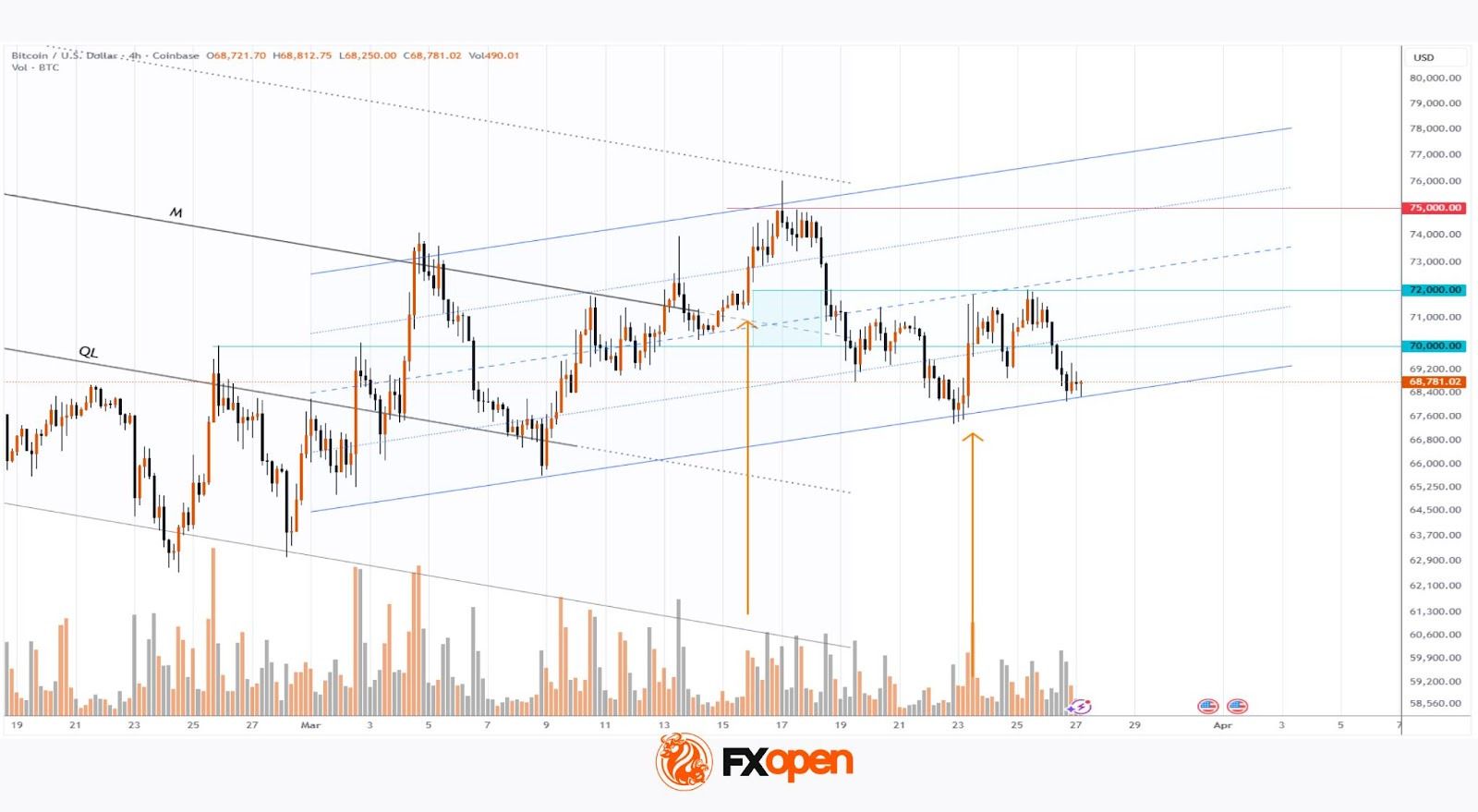
Today, BTC/USD is trading slightly below the psychological $70k level. Assessing its price action since the panic on 5 February, it is reasonable to suggest that the market is showing signs of range-bound behaviour: sellers tend to emerge near $75k, while buyers become active around $65k.
This balance between supply and demand, where neither side has been able to take control for several weeks, may feel either tiring or calming; however, the price chart suggests there are reasons for concern.
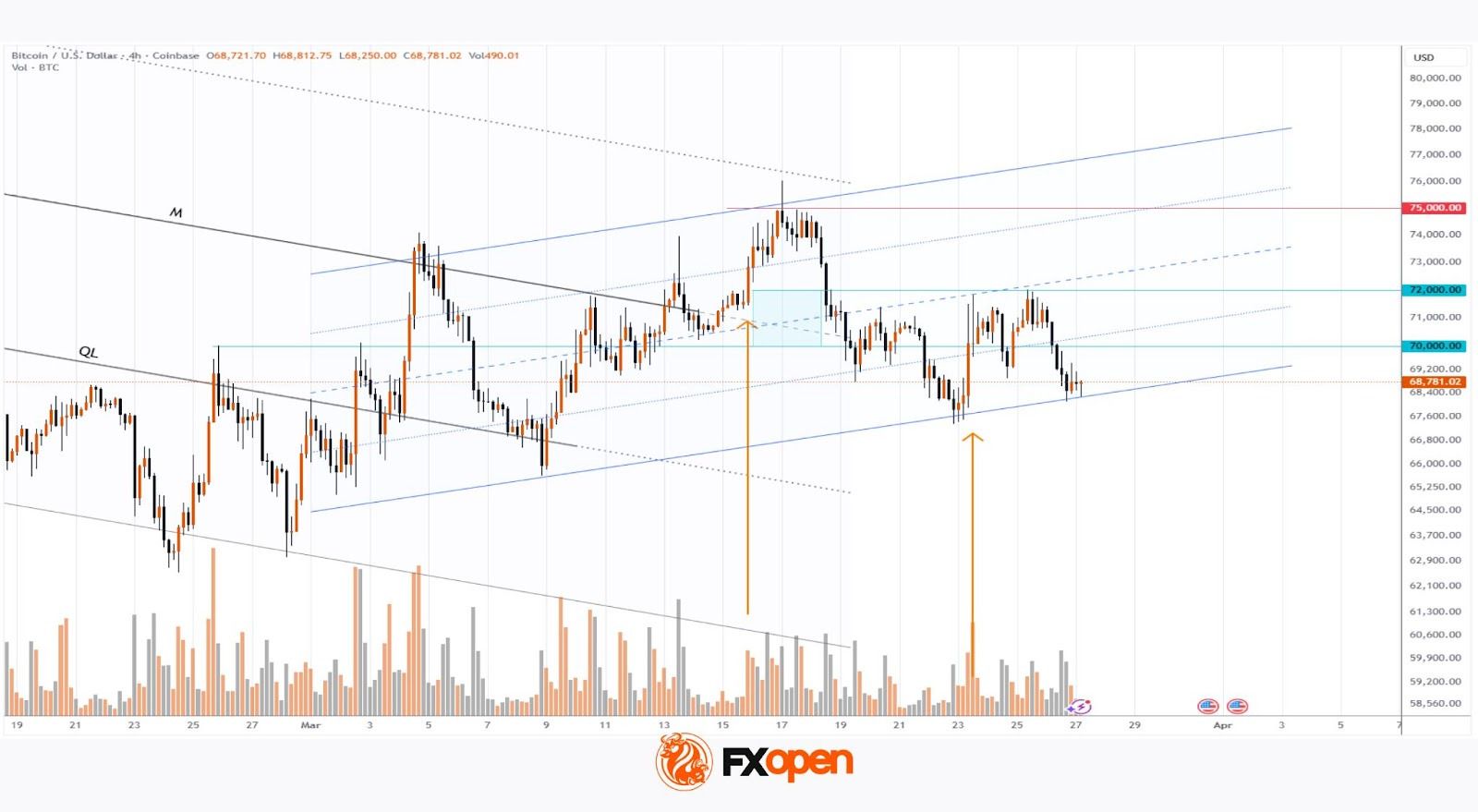
Technical Analysis of BTC/USD
On 18 March, analysing Bitcoin’s price action within a broad descending channel, we:
→ noted signs of buying pressure, which led to the formation of an intermediate ascending channel (shown in blue);
→ suggested that buyers were pushing sellers out of the $70–72k zone, which could act as support.
However, the price soon reversed lower from the psychological $75k level, and the highlighted zone failed to provide support. Bulls retreated and showed an inability to defend the gains marked by the first arrow.
A similar lack of strength was observed later:
→ As indicated by the second arrow, on Monday, 23 March, Bitcoin surged sharply following statements by Donald Trump regarding negotiations with Iran.
→ However, the previously mentioned $72k level acted as resistance, and yesterday’s decline once again reflects a retreat by buyers.
As a result, there are grounds to conclude that bulls are struggling to sustain momentum, increasing the risk of a bearish breakout below the lower boundary of the blue channel. This level is particularly important because:
→ the blue channel may be interpreted as a bearish flag pattern;
→ a breakdown of this pattern could pave the way for a continuation of the prevailing downtrend, which has been in place since autumn 2025.
FXOpen offers the world’s most popular cryptocurrency CFDs*, including Bitcoin and Ethereum. Floating spreads, 1:2 leverage — at your service (additional fees may apply). Open your trading account now or learn more about crypto CFD trading with FXOpen.
*Important: At FXOpen UK, Cryptocurrency trading via CFDs is only available to our Professional clients. They are not available for trading by Retail clients. To find out more information about how this may affect you, please get in touch with our team.
This article represents the opinion of the Companies operating under the FXOpen brand only. It is not to be construed as an offer, solicitation, or recommendation with respect to products and services provided by the Companies operating under the FXOpen brand, nor is it to be considered financial advice.

Bitcoin holders with large balances continued to accumulate BTC, adding a notable 61,568 coins over the past month as geopolitical tensions and macro uncertainty persisted around the globe. Data from Santiment shows the surge came alongside a broader shift in on-chain activity: whales and sharks (addresses holding between 10 and 10,000 BTC) increased their holdings by about 0.45%, while wallets with less than 0.01 BTC expanded by roughly 0.42%, equating to an extra 213 BTC in the smaller cohort over the same period.
Bitcoin exchange outflows noted through March, a sign that holders appear more inclined to accumulate than to cash out, even as markets grapple with risk-off dynamics tied to geopolitical headlines and macro uncertainty. In a recent X post, Santiment framed the data as a potential indicator of a forthcoming move, suggesting that whale accumulation during a consolidation phase often precedes a breakout.
Key takeaways
- Large Bitcoin holders added 61,568 BTC over the last 30 days, signaling sustained accumulation among the top address tier.
- Whales and sharks (10–10,000 BTC) rose their holdings by about 0.45%, while ultra-small wallets (<0.01 BTC) grew by roughly 0.42% (about 213 BTC) during the same period.
- On-chain data suggests ongoing Bitcoin exchange outflows through March, reinforcing the view that holders are more inclined to accumulate than to sell.
- Analysts see whale accumulation during consolidation as a potential precursor to a breakout, though retail activity may drift with fear-driven dynamics.
- Market sentiment remains in extreme fear, with the Crypto Fear & Greed Index hovering around single-digit scores, highlighting a cautious to risk-off atmosphere.
Whales loading up as macro risk persists
Cointelegraph. “Small wallets chase momentum during uptrends, reflecting a fear of missing the next leg up.”
“Whales tend to buy in waves, so accumulation could continue if the range holds and macro conditions stay supportive. On the other hand, if retail FOMO overheats, we could see a pause or slight sell-off before the next accumulation phase.”
Those observations echo a broader market narrative: large-volume players appear to be positioning for a breakout, while retail participants exhibit mixed signals—drawn by upward price moves yet restrained by broader risk concerns. The age-old tension between accumulation and distribution within the crypto market remains a central theme for traders watching key support and resistance levels.
Fear, greed, and market timing amid geopolitical pressures
Market structure, timing, and what comes next
Looking ahead, investors should watch for a decisive move beyond the current range combined with continued on-chain signals. While the latest data hint at possible upside, the path remains contingent on macro stability and how geopolitical tensions resolve or intensify in the coming weeks.

Key Takeaways
- On March 25, a federal judge in California granted class certification in an investor lawsuit against Nvidia and its CEO Jensen Huang
- Plaintiffs allege the company concealed more than $1 billion in graphics card sales to cryptocurrency miners, misrepresenting them as gaming revenue between 2017 and 2018
- In 2022, Nvidia settled with the SEC for $5.5 million over inadequate disclosure of crypto mining’s influence on gaming segment sales
- The certified class includes all NVDA shareholders who purchased shares from August 10, 2017 through November 15, 2018
- A case management hearing is scheduled for April 21 through Zoom; shares traded at $174.03, declining 2.5%
Nvidia (NVDA) was trading at $174.03, down 2.50% at the time of writing.
Shares declined following a California federal court decision that brought the extended cryptocurrency revenue litigation significantly closer to reaching trial.
The Foundation of the Legal Challenge
The central accusation is clear-cut: Nvidia communicated to shareholders that its gaming graphics card revenue was expanding because of increased purchases from video game enthusiasts. However, this narrative omitted critical information.
Throughout the 2017 cryptocurrency surge, Ethereum mining operations were purchasing GeForce graphics cards in massive quantities. This demand was silently responsible for a substantial portion of what Nvidia classified as “gaming” revenue.
Quarterly sales surged by 52% followed by 25% year-over-year during these timeframes. The plaintiffs contend that shareholders were completely unaware of how much revenue depended on cryptocurrency activity.
When Bitcoin collapsed in 2018 and mining operations became economically unviable, demand for GPUs plummeted. Gaming segment revenue declined sharply, and the cryptocurrency-fueled basis of the prior growth became unmistakable after the fact.
Nvidia’s own fourth quarter FY2019 earnings discussion compounded the issue. Company executives explicitly attributed the revenue decline to the cryptocurrency mining collapse — a statement that directly conflicted with how they had characterized the earlier expansion.
SEC Enforcement Action Preceded This Lawsuit
The Securities and Exchange Commission acted before this civil case gained momentum. In May 2022, Nvidia agreed to a $5.5 million settlement after regulators determined the company had inadequately disclosed how cryptocurrency mining materially affected gaming GPU sales during the second and third quarters of fiscal 2018.
The commission’s enforcement division stated that Nvidia’s disclosure shortcomings prevented investors from accessing information essential for proper business evaluation.
Nvidia resolved that enforcement action without admitting guilt — a framework that allowed the company to maintain its legal position while essentially confirming the underlying factual claims.
The current civil litigation continues from where the SEC action concluded. The question is no longer whether disclosure failures occurred, but rather who bears financial responsibility.
Plaintiffs further contend that Nvidia personnel were actively monitoring cryptocurrency market movements and linking them to GPU sales performance in real time during those reporting periods. This evidence, they assert, demonstrates that executive-level statements regarding gaming demand were deliberately misleading — not merely incomplete.
On March 25, Judge Haywood Gilliam approved certification for the investor class — encompassing all individuals who purchased NVDA shares between August 10, 2017 and November 15, 2018. This decision is procedural in nature and doesn’t establish whether Nvidia’s disclosures constituted fraud.
A case management conference has been set for April 21 through a publicly accessible Zoom webinar.
Nvidia responded: “Investors who purchased NVIDIA in the 2017-2018 timeframe have done incredibly well, as our corporate strategy unfolded as we consistently predicted. We will address the complaint in court.”


Startale Group has closed a $63 million Series A backed by SBI Group and Sony Innovation Fund, positioning the Web3 infrastructure company at the center of Japan’s institutional push into tokenized securities and stablecoin rails.
A Japanese mega-bank and a global entertainment conglomerate writing nine-figure checks into a single Web3 infrastructure stack is not a coincidence. It is a capital concentration signal.
- Round Size: Startale closed a $63 million Series A in two tranches — a $13 million first close from Sony Innovation Fund and a $50 million second close from SBI Group.
- Lead Investors: SBI Group, one of Japan’s largest financial conglomerates with access to over 80 million customers, anchored the round alongside Sony, with whom Startale co-developed Ethereum Layer 2 Soneium.
- Strategic Context: Capital goes directly toward scaling Strium (a Layer 1 for tokenized securities), expanding JPYSC and USDSC stablecoins, and building a consumer SuperApp — a full-stack institutional and retail Web3 infrastructure play.
Discover: The best crypto presales gaining institutional momentum right now
The Deal: SBI’s $50 Million Bet on Onchain Finance
SBI Group’s $50 million second close is the dominant force in this round. SBI is not a passive financial sponsor, it is a strategic co-builder.
LATEST: — CoinMarketCap (@CoinMarketCap) March 26, 2026
 Startale has closed a $63 million Series A backed by SBI Group and Sony Innovation Fund to scale its blockchain, stablecoin and consumer app operations in Japan. pic.twitter.com/cvq2OOI0SV
The two companies have already shipped Strium, a Layer 1 blockchain built specifically for tokenized securities and real-world asset trading, and JPYSC, described as the first trust bank-backed Japanese yen stablecoin.
SBI Chairman Yoshitaka Kitao said Startale “possesses extensive expertise in the field of on-chain integration and offers capabilities that complement those of the SBI Group,” framing the investment as vertical integration in digital finance rather than a passive bet. Startale also unveiled USDSC, a dollar-pegged stablecoin designed to enable fiat-to-crypto integration, onchain dividends, and yield distribution for both retail and institutional users.
Sony’s $13 million first close, announced previously, originated from the companies’ existing collaboration on Soneium — Sony’s Ethereum Layer 2 — developed through Sony Block Solutions Labs. Fresh capital will also fund an upgrade of the Startale App into a SuperApp running on Soneium, integrating tokenized assets, stablecoins, payments, Mini Apps, and social features into a single consumer interface.
CEO Sota Watanabe said the round “reflects the strong conviction our partners have in the vision we are building,” adding that the SBI collaboration will “accelerate the adoption of tokenized stocks, centered on Japanese equities and JPY stablecoin, this year.”
Discover: The best crypto to diversify your portfolio with
The Signal: Institutional Capital Finds Its Layer
This is not a DeFi protocol raise. This is infrastructure.
The capital is targeting the settlement layer — the part of the crypto stack that processes tokenized equities, stablecoin transfers, and RWA trades at institutional scale.
That is precisely where institutional demand is concentrating across global crypto markets right now. SBI’s distribution network of over 80 million customers gives Strium and JPYSC a deployment path that most Web3 infrastructure projects cannot access in a decade of organic growth.
The Sony angle is equally deliberate. Soneium gives Startale a live Ethereum Layer 2 with a global entertainment brand attached, a consumer distribution wedge for a product suite that would otherwise struggle to cross the mainstream threshold. The SuperApp model collapses the distance between a retail user and onchain asset management. That matters for adoption velocity.
Regulatory tailwinds are real. Japan has moved faster than most jurisdictions on stablecoin legislation, and the broader regulatory framework supporting institutional crypto participation is maturing across major markets. Startale is building into that window.
Discover: The best crypto presales gaining institutional momentum right now
The post Startale Group Raises $63 Million Series A Backed by SBI and Sony appeared first on Cryptonews.


Strategy’s “Stretch” preferred shares are drawing strong interest from retail investors as the company keeps using the product to fund Bitcoin purchases.
Summary
- Retail investors hold majority of Strategy Stretch shares seeking lower volatility Bitcoin exposure with steady yields
- Strategy raised over 1 billion dollars through Stretch shares to fund recent Bitcoin purchases
- Stretch shares offer 11.5 percent dividend while redirecting part of Bitcoin returns to investors
New comments from Strategy executives show that individual investors now make up most of the holders of STRC, a dividend-paying security that the company markets as a lower-volatility way to gain Bitcoin-linked exposure.
Strategy CEO Phong Le said about 80% of the owners of the company’s “Stretch” perpetual preferred shares are retail investors. He said retail buyers prefer “low-volatility, high-yield digital credit” as they look for steadier exposure tied to Bitcoin.
The figures show that demand for Bitcoin-linked products remains active even during a weaker period for the asset and for Strategy’s stock. Michael Saylor and other company executives have increased promotion of STRC as a product for investors who want Bitcoin exposure without taking on the same level of price swings seen in common shares or the token itself.
Strategy relied heavily on STRC sales in March to raise funds for more Bitcoin purchases. Bloomberg reported that about $1.2 billion from at-the-market sales of the preferred shares helped finance one of the company’s recent Bitcoin buys, though the firm later returned to common stock sales for its latest purchase.
Speaking at the 2026 Digital Asset Summit in New York, Saylor said selling a new credit instrument to retail investors is usually difficult. He later told CNBC that the goal is to create “an onramp for people who believe Bitcoin is going to be around for the long term, but they can’t handle the volatility in the near term.”
In addition, Saylor said Stretch removes the first 10% to 11% of Bitcoin’s yearly return and directs it to credit investors. He said the structure is “way overcollateralized” and argued that equity holders could still benefit if Bitcoin rises at a faster pace over time.
The security pays a variable dividend that adjusts monthly in an effort to keep the share price near $100. The dividend stood at 11.5% in March, while the product is structured as a perpetual preferred share with no maturity date.
Strategy expands its funding plans
Strategy has signaled that preferred stock will remain a core part of its Bitcoin funding model. In filings and company materials, the firm has described a broader capital strategy built around different securities that offer varying types of Bitcoin exposure to investors.
The company also disclosed plans to expand its fundraising capacity. According to the report cited in the source material, Strategy plans to raise up to $21 billion through stock sales and another $21 billion through Stretch-related at-the-market programs, showing that the company is preparing to keep using these instruments as it adds to its Bitcoin holdings.

Putin ‘asks oligarchs to donate to budget’ as cost of Ukraine war soars | World News

GM, Jeep Parent Stellantis Say No Disruptions After Ohio Glass Factory Fire

Maxine Waters seeks details on Kraken Fed account approval


-
 Crypto World6 days ago
NIO (NIO) Stock Plunges 6.5% as Shelf Registration Sparks Dilution Worries
-
 NewsBeat2 days ago
Manchester United reach agreement with Casemiro over contract clause amid transfer speculation
-

 Fashion7 days ago
Weekend Open Thread: Adidas – Corporette.com
-

 Politics7 days ago
Jenni Murray, Long-Serving Woman’s Hour Presenter, Dies Aged 75
-

 Crypto World5 days ago
Best Crypto to Buy Now: Strategy Just Spent $1.57 Billion on Bitcoin During Fear While Early Investors Quietly Enter Pepeto for 150x Potential
-

 Crypto World5 days ago
Bitcoin Price News: Bhutan Sells $72 Million in BTC Under Fiscal Pressure, but the Smart Money Entering Pepeto Sees What the Market Does Not
-

 News Videos1 day ago
Parliament publishes latest register of MPs’ financial interests
-

 Sports4 days ago
Remo Stars and Kano Pillars Strengthen Survival Hopes in NPFL
-

 Sports4 days ago
Gary Kirsten Accuses Pakistan Cricket Board Of ‘Interference’, Mohsin Naqvi Responds
-

 Tech5 days ago
Give Your Phone a Huge (and Free) Upgrade by Switching to Another Keyboard
-

 Business5 days ago
No Winner in March 21 Drawing as Prize Rolls to $133 Million for Next
-

 Sports7 days ago
2026 Kentucky Derby horses, odds, futures, preview, date: Expert who nailed 12 Derby-Oaks Doubles enters picks
-

 Tech4 days ago
AI enters the chat: New Seattle dating app relies on tech to facilitate meaningful human connections
-
Business6 days ago
Columbia Sportswear enters $500 million credit agreement with JPMorgan Chase
-

 News Videos4 days ago
Ch 9 Financial Management Part 1 | Detailed One Shot | Class 12 Business Studies Boards 2026
-

 Tech5 days ago
Today’s NYT Connections Hints, Answers for March 22 #1015
-

 Business12 hours ago
Instagram, YouTube Found Responsible for Teen’s Mental Health Struggle in Historic Ruling
-
 Crypto World7 days ago
Small-cap Russell 2000 enters correction territory
-

 Business5 days ago
Will Duke Basketball Win It All? Duke Basketball Enters Second Round as Third Favorite to Claim NCAA Title
-

 Sports4 days ago
2026 Kentucky Derby horses, odds, futures, preview, date: Expert who hit 12 Derby-Oaks Doubles enters picks
You must be logged in to post a comment Login