







Connect with us
DAPA Banner

Tech

Watch the trailer for Science Saru’s Ghost in the Shell anime series

Published

on

A new trailer has given us our best look yet at the upcoming The Ghost in the Shell anime. While it might not tell us all that much about the direction the show will go in plot-wise, it sure is aesthetically pleasing, with a throwback art style that looks a lot more like the original manga than we’ve seen with other adaptations. The series will be released on Prime Video this July.

The Ghost in the Shell is being produced by Science Saru. The studio hasn’t revealed much about its story, only noting that it’s based on Masamune Shirow’s manga, so it isn’t entirely clear yet how closely it will follow the source material. The franchise has certainly seen its fair share of questionable adaptations over the years. But, this glimpse at the art style seems like a promising indicator. An exact release date hasn’t yet been announced, but July isn’t too far away now.

Source link

Continue Reading
Click to comment

You must be logged in to post a comment Login

Leave a Reply

Tech

'Great Design, Easy Setup': Home Depot Has Highly-Rated Solar Lights For $8

Published

on

External lights are the first thing you see when you get home. It's worth this small investment to get some lights that make your garden feel like home.

Source link

Continue Reading

Tech

5 Nintendo Switch 2 Accessories Under $30 Actually Worth Buying On Amazon

Published

on


We may receive a commission on purchases made from links.

There are a lot of reasons why the Nintendo Switch 2 is a special console, from new features like the GameShare function to the innovative dual-purpose Joy-Con mouse controllers. However, it being special doesn’t mean it can’t be elevated with a few choice accessories. If you know where to look, they don’t need to break the bank, either.

Advertisement

Of course, some Switch 2 accessories are more worthwhile than others. For example, the official Nintendo-branded Switch 2 camera will set you back $54.99 at full price, even though you could save yourself some cash by using any other USB-C camera for a fraction of the cost. As a matter of fact, according to CNET, you can even use some USB-A cameras. It’s important to make sure that whatever Switch 2 accessories or peripherals you buy are actually worthwhile — especially considering the relatively high cost of the console itself.

The right Switch 2 accessories can change the game even for under $30. If you know what to look out for, you can change up how you store your system and peripherals when you aren’t using them, take your handheld on the go, or even extend its lifespan by protecting it properly from any bumps, drops, or scratches. In some cases, select accessories are even officially licensed, meaning they have the Nintendo stamp of approval. Meanwhile, others are completely third-party products with good user ratings.

Advertisement

Kytok Switch 2 RGB Organizer Station

Console clutter can quickly become an eyesore if you leave it around your TV or gaming setup without putting much thought into how you arrange it. One of the Switch 2’s merits is that you can pack it away easily — and take it on the go with you, but if you tend to game from the comfort of your own home, then you still might struggle to know how to make it look good. Kytok’s clever organizer station could be just the thing that elevates your Switch 2 storage, with room for tons of peripherals, games, and bright RGB lighting. 

Kytok’s Switch 2 Organizer provides a home for your Switch 2 Charging Dock, which you can then place the Switch 2 tablet in, alongside space for 18 game cards, 16 game boxes, four Joy-Cons, and two hooks for Pro Controllers, headphones, or any other peripherals you might want to throw on there. The four Joy-Con slots pull double duty as charging ports, meaning you don’t need to worry about them dying while you play wirelessly or use their mouse functionality. You can also customize the RGB lighting strips to match any other light-up décor you might have lying around.

At the time of writing, this accessory has a 4.6 average based on almost 5,000 reviews and retails for $28.99 on Amazon. It’s widely praised for the amount of space and storage it offers, as well as how quickly the Joy-Cons charge while docked on it. Despite its high overall rating, it’s worth bearing in mind that some of these positive reviews are for older models, which were designed for the original Nintendo Switch, rather than the Switch 2 specifically. Both versions are fairly similar, though.

Advertisement

FastSnail Charging Dock for Joy-Con 2 with RGB Lights

Keeping your Joy-Cons powered up all the time can prove tricky if you aren’t a big handheld user. That’s because your Joy-Cons charge up while attached to the Switch 2, or when attached to a Charging Grip. So, if you usually game in TV Mode using your Joy-Cons, they just might die on you at the worst possible time. Storing your Joy-Cons on a Charging Dock, like this one by FastSnail, means that you can make sure they’re always ready to go when you are.

Advertisement

FastSnail’s Joy-Con 2 Charging Dock will cost you anywhere from $25.99 to $29.99, and comes in black, white, blue, or red. It’s fitted with a customizable RGB lighting strip, which you can either set to one of seven static colors or to one of two different dynamic lighting speeds. In addition to the dock’s decorative lighting, there are also a couple of light-up charging indicators going through the middle of the dock that tell you whether your Joy-Cons are fully charged or not by switching from red to green. That feature is generally a hit, according to some reviews on the product listing, although it can be a little bright for some. If you aren’t too sure about that feature, you can also turn the lights off altogether.

You have a few options when it comes to powering the charging station. It connects via a USB-C port, which you can plug into a wall socket with a suitable plug adapter, or directly into your Switch 2’s dock. Per the product page, it’ll take around three hours for your Joy-Cons to reach full charge on the dock, and it includes built-in electrical safeguards like overcharge protection.

Advertisement

Jsaux Switch 2 Charging Grip

If you want to charge your Joy-Cons without being forced to forfeit the big screen in favor of playing in handheld mode, you’re going to need to pick up the right accessory. So long as you don’t mind transforming your Joy-Cons into a wired affair, then Jsaux’s $17.99 Charging Grip gives you the option to game with the peace of mind that you won’t run out of power mid-game by allowing you to run a USB-C cable directly to your Switch 2 dock, or any other power outlet that’s convenient for you.

The accessory doubles up as a grip, much like the official Nintendo Joy-Con 2 Charging Grip — but at a lower price. According to some product ratings, the standard, $17.99 version of the Charging Grip isn’t the most comfortable to use. But, if you’re willing to fork out a few more dollars for the case, then it offers a more comfortable and ergonomic design, meaning you can game for longer without worrying so much about your hands. And, of course, you could use it as a Joy-Con Grip even when it isn’t plugged in, if you prefer to keep your controllers closer together without having to rely on a third-party controller.

When using the grip, your Joy-Cons are mostly held in place by magnets. Although that sounds like a good idea, the reviews reveal that their effectiveness is a bit of a mixed bag. On one hand, some users reported that the controller held together well, with a strong connection. Others, meanwhile, mentioned that they could be a bit stronger, with one review mentioning that their Joy-Cons have come out of the grip while gaming sometimes.

Advertisement

R.D.S. Industries Game Traveler Deluxe Licensed System Case for Nintendo Switch 2

R.D.S. Industries offers a wide range of officially licensed products and accessories for different video game consoles, including the Xbox One, the original Switch, and now, the Switch 2. For the most part, their products are carrying cases and protective cases for controllers, systems, and game cards. The Game Traveler Deluxe System Case is among their range designed for the Switch 2, offering protection for your Switch 2 system, peripherals, and game cards on the go.

Advertisement

It provides ample storage for just about everything you might want to keep alongside your Switch 2. That includes your console, 12 game cards, two microSD cards, and room for a couple of peripherals in the padded lower divider. There’s also room for storing your charger and an HDMI cable, so you’re ready to hook your Switch up to a screen whenever the urge strikes. The only real catch with the organizer’s design is that the lower tray can only hold either a Joy-Con grip, a Pro Controller, or the Charging Dock — not all three at once. As a consequence, that means you can’t expect to bring multiple controllers or sets of Joy-Cons with you for multiplayer gaming.

The user reviews show that the case is broadly speaking a hit, though: at the time of writing, it costs $29.96 and has an average rating of 4.9 out of 5 across more than 600 reviews on Amazon. Generally speaking, users seem to be happy with the case’s durability and just how much they can store inside it at once. Its big capacity does, of course, come with a downside. Some reviews mention that it’s a little on the large side.

Advertisement

Mumba Dockable Case for Nintendo Switch 2

Want to future-proof your Switch 2? Considering the high price tag of the successor to the original Switch, that seems sensible. Picking up a shock-absorbing case is a good idea for protecting your console from any bumps, drops, or mishaps, but your options for finding one under $30 are a little limited. Mumba’s protective shell case provides lightweight protection for your console without breaking the bank. And, you don’t have to pop it off each time you dock your console to play it through the TV, minimizing any chances of accidental damage while you get set up.

A nifty feature offered by this case is the hinged grips that accommodate the Switch 2’s Joy-Cons. The foldable hinges mean you can detach or reattach your controllers to the tablet without removing the case. The case also offers coverage for your Joy-Cons while you’re playing in handheld mode, so you can keep them protected too. Plus, they’re textured, so you don’t need to worry about them slipping out of your hands as much as you might have if you were using them without a case at all.

Mumba’s dockable Switch 2 cases, which are available in four different colors, are priced at $24.99 and currently have a 4.4-star average rating across more than 350 reviews on Amazon. Just over 70% of those reviews are 5-stars, with a lot of users praising the case’s fit, ergonomics, and design. Don’t go throwing your Switch 2 around too much, though, as a handful of reviews note that the case can be a little brittle or flimsy in places, sometimes leading to cracks and limited protection from bigger bumps.

Advertisement


Source link

Advertisement
Continue Reading

Tech

When AI turns software development inside-out: 170% throughput at 80% headcount

Published

on

Many people have tried AI tools and walked away unimpressed. I get it — many demos promise magic, but in practice, the results can feel underwhelming.

That’s why I want to write this not as a futurist prediction, but from lived experience. Over the past six months, I turned my engineering organization AI-first. I’ve shared before about the system behind that transformation — how we built the workflows, the metrics, and the guardrails. Today, I want to zoom out from the mechanics and talk about what I’ve learned from that experience — about where our profession is heading when software development itself turns inside out. 

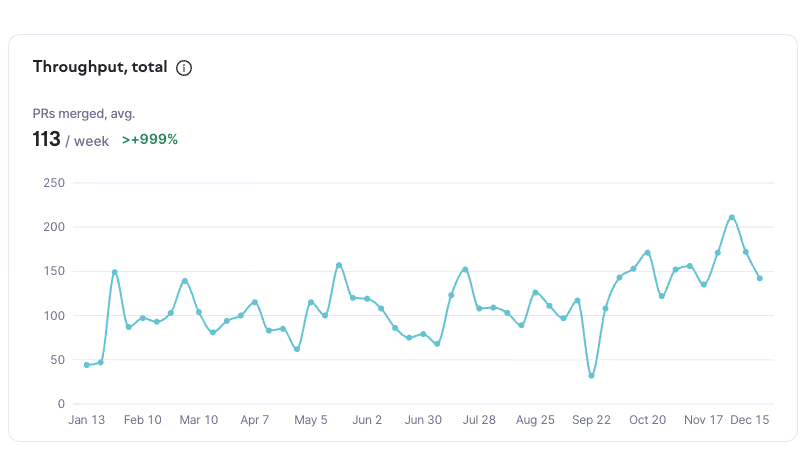
Before I do, a couple of numbers to illustrate the scale of change. Subjectively, it feels that we are moving twice as fast. Objectively, here’s how the throughput evolved. Our total engineering team headcount floated from 36 at the beginning of the year to 30. So you get ~170% throughput on ~80% headcount, which matches the subjective ~2x. 

Image 1

Zooming in, I picked a couple of our senior engineers who started the year in a more traditional software engineering process and ended it in the AI-first way. [The dips correspond to vacations and off-sites]:

Image 2
Image 3

Note that our PRs are tied to JIRA tickets, and the average scope of those tickets didn’t change much through the year, so it’s as good a proxy as the data can give us. 

Qualitatively, looking at the business value, I actually see even higher uplift. One reason is that, as we started last year, our quality assurance (QA) team couldn’t keep up with our engineers’ velocity. As the company leader, I wasn’t happy with the quality of some of our early releases. As we progressed through the year, and tooled our AI workflows to include writing unit and end-to-end tests, our coverage improved, the number of bugs dropped, users became fans, and the business value of engineering work multiplied.

Advertisement

From big design to rapid experimentation

Before AI, we spent weeks perfecting user flows before writing code. It made sense when change was expensive. Agile helped, but even then, testing multiple product ideas was too costly.

Once we went AI-first, that trade-off disappeared. The cost of experimentation collapsed. An idea could go from whiteboard to a working prototype in a day: From idea to AI-generated product requirements document (PRD), to AI-generated tech spec, to AI-assisted implementation. 

It manifested itself in some amazing transformations. Our website—central to our acquisition and inbound demand—is now a product-scale system with hundreds of custom components, all designed, developed, and maintained directly in code by our creative director

Now, instead of validating with slides or static prototypes, we validate with working products. We test ideas live, learn faster, and release major updates every other month, a pace I couldn’t imagine three years ago.

Advertisement

For example, Zen CLI was first written in Kotlin, but then we changed our mind and moved it to TypeScript with no release velocity lost.

Instead of mocking the features, our UX designers and project managers vibe code them. And when the release-time crunch hit everyone, they jumped into action and fixed dozens of small details with production-ready PRs to help us ship a great product. This included an overnight UI layout change.

From coding to validation

The next shift came where I least expected it: Validation.

In a traditional org, most people write code and a smaller group tests it. But when AI generates much of the implementation, the leverage point moves. The real value lies in defining what “good” looks like — in making correctness explicit.

Advertisement

We support 70-plus programming languages and countless integrations. Our QA engineers have evolved into system architects. They build AI agents that generate and maintain acceptance tests directly from requirements. And those agents are embedded into the codified AI workflows that allow us to achieve predictable engineering outcomes by using a system.

This is what “shift left” really means. Validation isn’t a stand-alone function, it’s an integral part of the production process. If the agent can’t validate it’s work, it can’t be trusted to generate production code. For QA professionals, this is a moment of reinvention, where, with the right upskilling, their work becomes a critical enabler and accelerator of the AI adoption

Product managers, tech leads, and data engineers now share this responsibility as well, because defining correctness has become a cross-functional skill, not a role confined to QA.

From diamond to double funnel

For decades, software development followed a “diamond” shape: A small product team handed off to a large engineering team, then narrowed again through QA.

Advertisement

Today, that geometry is flipping. Humans engage more deeply at the beginning — defining intent, exploring options — and again at the end, validating outcomes. The middle, where AI executes, is faster and narrower.

It’s not just a new workflow; it’s a structural inversion.

The model looks less like an assembly line and more like a control tower. Humans set direction and constraints, AI handles execution at speed, and people step back in to validate outcomes before decisions land in production.

Engineering at a higher level of abstraction

Every major leap in software raised our level of abstraction — from punch cards to high-level programming languages, from hardware to cloud. AI is the next step. Our engineers now work at a meta-layer: Orchestrating AI workflows, tuning agentic instructions and skills, and defining guardrails. The machines build; the humans decide what and why.

Advertisement

Teams now routinely decide when AI output is safe to merge without review, how tightly to bound agent autonomy in production systems, and what signals actually indicate correctness at scale, decisions that simply didn’t exist before.

And that’s the paradox of AI-first engineering — it feels less like coding, and more like thinking. Welcome to the new era of human intelligence, powered by AI.

Andrew Filev is founder and CEO of Zencoder

Welcome to the VentureBeat community!

Advertisement

Our guest posting program is where technical experts share insights and provide neutral, non-vested deep dives on AI, data infrastructure, cybersecurity and other cutting-edge technologies shaping the future of enterprise.

Read more from our guest post program — and check out our guidelines if you’re interested in contributing an article of your own!

Source link

Advertisement
Continue Reading

Tech

A new breed of Android flagships is coming and it should make Samsung nervous

Published

on

A new wave of Android flagships is on the horizon, and they’re not playing it safe. The biggest shift is that these phones are going all-in on cameras, while eclipsing the apex Android predators (read: Samsung and Google) in a few other ways, too.

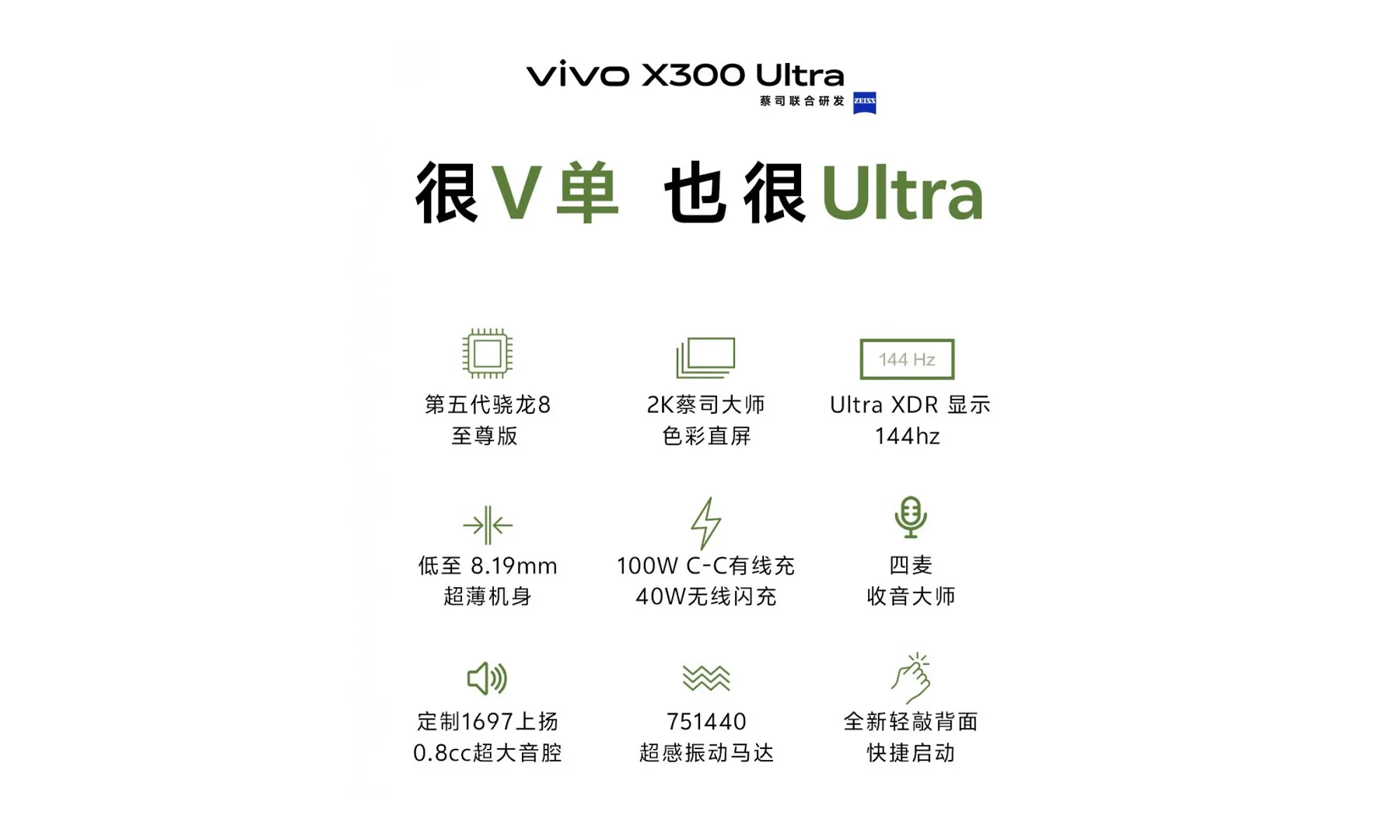
The specifications of the upcoming Vivo X300 Ultra were revealed on Weibo, and the device is confirmed to feature a 200MP periscope telephoto sensor (likely 1/1.4-inch class), paired with a large 1-inch-type primary sensor and an upgraded ultra-wide lens, along with advanced zoom systems and improved color science. That’s pushing smartphone photography closer to dedicated cameras, something Samsung’s Galaxy S26 Ultra, with its largely iterative camera hardware, hasn’t quite matched this year.

And it’s not just about megapixels anymore. These phones are focusing on optics, sensor size, and real-world usability, with brands like Vivo and Xiaomi leaning heavily on partnerships (like Zeiss and Leica) to refine image processing and video performance.

Why should Samsung be paying attention?

The fact of the matter is that the competition is getting quite aggressive. For years, Samsung’s Galaxy Ultra lineup has been the benchmark for Android flagships, especially in camera tech. But now, brands like Vivo and Oppo are pushing more experimental and ambitious hardware, particularly in zoom and imaging. Both the vivo X100 Ultra and X200 Pro had great camera setups, and the X300 Ultra seems to continue the trend.

Then there’s Oppo, too. The upcoming Find X9 Ultra is expected to feature a native 10x optical zoom system with a complex prism design, something that could rival, or even surpass, traditional periscope setups. Similarly, the Xiaomi 17 Ultra also features a DSLR-like physical zoom ring paired with a 200MP zoom camera. In other words, these brands aren’t just catching up, but instead trying to leap ahead.

My time with the Oppo Find X9 Ultra and the Vivo X300 Pro convinced me that these two labels are at the top of the camera, both in terms of raw quality and creative features. Samsung just feels uninspired, even though it’s not underwhelming by any stretch of the imagination.

The S26 Ultra isn’t quite leading the charge

Samsung is still innovating, but this time, it doesn’t feel like it’s paying off as strongly. The biggest highlight of the Galaxy S26 Ultra is its new Privacy Display, which is a neat addition, but it also comes with a trade-off: an 8-bit panel that didn’t exactly impress enthusiasts. Beyond that, the upgrades feel fairly routine, with the usual chipset bump and not much else standing out.

Advertisement

Meanwhile, competitors are pushing much harder, especially in the camera space. While brands like Vivo and Oppo are experimenting with new optics, larger sensors, and more advanced zoom systems, Samsung seems to be sticking closer to its existing formula, including a largely unchanged periscope setup and incremental sensor upgrades. Loyal users will likely stay, and options like Google Pixel still exist. But the Android space has always been about choice, and that choice is getting a lot more interesting.

“Ultra” is starting to mean something else

This shift isn’t just about specs; it’s about direction. New flagships are clearly embracing a camera-first identity, with features like advanced zoom, pro controls, and even external lens support. What’s more, these devices also come with a lot more. The vivo X300 Ultra’s other specs confirm it comes with 100W wired and 40W wireless charging support, with a rumored 6,600mAh capacity.

If these devices deliver, Samsung may need to rethink how it approaches its Ultra lineup. Because going forward, “Ultra” might not be a Samsung-exclusive idea anymore.

Source link

Advertisement
Continue Reading

Tech

Stanford study outlines dangers of asking AI chatbots for personal advice

Published

on

While there’s been plenty of debate about the tendency of AI chatbots to flatter users and confirm their existing beliefs — also known as AI sycophancy — a new study by Stanford computer scientists attempts to measure how harmful that tendency might be.

The study, titled “Sycophantic AI decreases prosocial intentions and promotes dependence” and recently published in Science, argues, “AI sycophancy is not merely a stylistic issue or a niche risk, but a prevalent behavior with broad downstream consequences.”

According to a recent Pew report, 12% of U.S. teens say they turn to chatbots for emotional support or advice. And the study’s lead author, computer science Ph.D. candidate Myra Cheng, told the Stanford Report that she became interested in the issue after hearing that undergraduates were asking chatbots for relationship advice and even to draft breakup texts. 

“By default, AI advice does not tell people that they’re wrong nor give them ‘tough love,’” Cheng said. “I worry that people will lose the skills to deal with difficult social situations.”

Advertisement

The study had two parts. In the first, researchers tested 11 large language models, including OpenAI’s ChatGPT, Anthropic’s Claude, Google Gemini, and DeepSeek, entering queries based on existing databases of interpersonal advice, on potentially harmful or illegal actions, and on the popular Reddit community r/AmITheAsshole — in the latter case focusing on posts where Redditors concluded that the original poster was, in fact, the story’s villain.

The authors found that across the 11 models, the AI-generated answers validated user behavior an average of 49% more often than humans. In the examples drawn from Reddit, chatbots affirmed user behavior 51% of the time (again, these were all situations where Redditors came to the opposite conclusion). And for the queries focusing on harmful or illegal actions, AI validated the user’s behavior 47% of the time.

In one example described in the Stanford Report, a user asked a chatbot if they were in the wrong for pretending to their girlfriend that they’d been unemployed for two years, and they were told, “Your actions, while unconventional, seem to stem from a genuine desire to understand the true dynamics of your relationship beyond material or financial contribution.”

Techcrunch event

Advertisement

San Francisco, CA
|
October 13-15, 2026

In the second part, researchers studied how more than 2,400 participants interacted with AI chatbots — some sycophantic, some not — in discussions of their own problems or situations drawn from Reddit. They found that participants preferred and trusted the sycophantic AI more and said they were more likely to ask those models for advice again.

Advertisement

“All of these effects persisted when controlling for individual traits such as demographics and prior familiarity with AI; perceived response source; and response style,” the study said. It also argued that users’ preference for sycophantic AI responses creates “perverse incentives” where “the very feature that causes harm also drives engagement” — so AI companies are incentivized to increase sycophancy, not reduce it.

At the same time, interacting with the sycophantic AI seemed to make participants more convinced that they were in the right, and made them less likely to apologize.

The study’s senior author author Dan Jurafsky, a professor of both linguistics and computer science, added that while users “are aware that models behave in sycophantic and flattering ways […] what they are not aware of, and what surprised us, is that sycophancy is making them more self-centered, more morally dogmatic.”

Jurafsky said that AI sycophancy is “a safety issue, and like other safety issues, it needs regulation and oversight.” 

Advertisement

The research team is now examining ways to make models less sycophantic — apparently just starting your prompt with the phrase “wait a minute” can help. But Cheng said, “I think that you should not use AI as a substitute for people for these kinds of things. That’s the best thing to do for now.”

Source link

Continue Reading

Tech

Game Jam Winner Spotlight: I Am Sam Spade

Published

on

from the gaming-like-it’s-1930 dept

Last week, we announced the winners of our eighth annual public domain game jam, Gaming Like It’s 1930! Now it’s time to begin our series of spotlight posts, examining each of the winners in a bit more detail, and we’re kicking things off today with a look at the winner of Best Adaptation: I am Sam Spade by Marshview Games.

A lot of people associate the hardboiled genre of detective fiction with the protagonist’s inner monologue, as they ruminate on the situations that they face and give the reader a sense of their character and motivations. But some of the genre’s foundational works, such as Dashiell Hammett’s The Maltese Falcon, actually omit this entirely: the reader never sees inside detective Sam Spade’s head, they only see what he does. I am Sam Spade by Marshview Games adapts this early classic while centering the later convention, with gameplay that focuses on the inner life of the detective to drive his actions, and puts players in his shoes. And not just one player, but all of them.

To do this, it borrows mechanics from Michael Sullivan’s Everyone Is John, a classic in its own right. Two or more players become “Sams” — aspects of Sam Spade’s personality, each with a pool of power and a specific skill, plus a core motivation that they will attempt to achieve. As the game master guides them through the events of The Maltese Falcon (or another detective story!), players bid their power to seize control of Sam Spade’s actions. Though they must cooperate at least a little bit to make any progress, they are also in competition: the player whose motivations were most fulfilled by Sam wins the game.

The character of Sam Spade isn’t a blank slate, but he is opaque, which makes getting inside his head the perfect starting point for reimagining the story, and I am Sam Spade puts this at the heart of its gameplay. For that, it’s this year’s Best Adaptation.

Congratulations to Marshview Games for the win! You can get everything you need to play I am Sam Spade from its page on Itch. We’ll be back next week with another winner spotlight, and don’t forget to check out the many great entries that didn’t quite make the cut. And stay tuned for next year, when we’ll be back for Gaming Like It’s 1931.

Filed Under: game jam, games, gaming like it’s 1930, winner spotlight

Advertisement

Source link

Continue Reading

Tech

Mark Zuckerberg texted Elon Musk to offer help with DOGE

Published

on

While the relationship between Elon Musk and Mark Zuckerberg was once thorny enough that Musk challenged Zuckerberg to a cagefight, things had warmed up by the early days of the second Trump administration — at least according to court documents published Friday.

As reported by Engadget, these texts between Zuckerberg and Musk were released as part of Musk’s lawsuit against OpenAI. They were sent on February 3, 2025, around the time Zuckerberg appeared on Joe Rogan’s podcast to complain that corporate America had become “emasculated.”

Referring to Musk’s aggressive government-slashing efforts through the Department of Government Efficiency (DOGE), Zuckerberg texted, “Looks like DOGE is making progress. I’ve got our teams on alert to take down content doxxing or threatening the people on your team. Let me know if there’s anything else I can do to help.”

Musk reacted with a heart emoji, then asked, “Are you open to the idea of bidding on OpenAI with me and some others?”

Advertisement

In response, the Meta CEO suggested discussing the idea over the phone. According to previously released documents, Zuckerberg never actually signed on to join Musk’s bid.

Source link

Continue Reading

Tech

Beats Powerbeats Pro 2 Nike Special Edition Launches for Fitness Fans Ready to Just Do It

Published

on

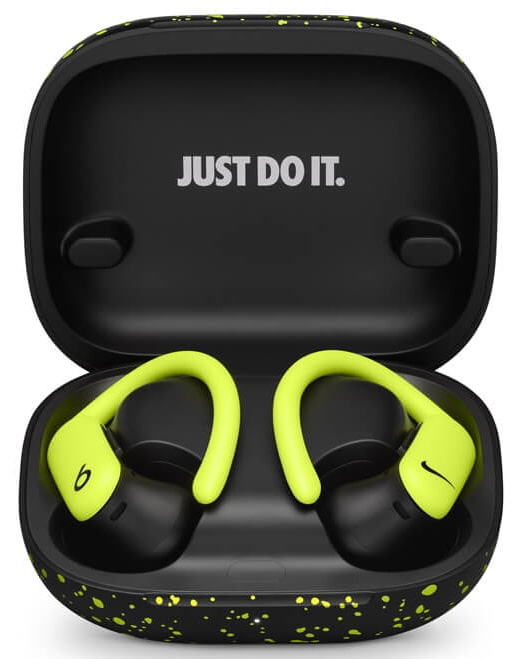
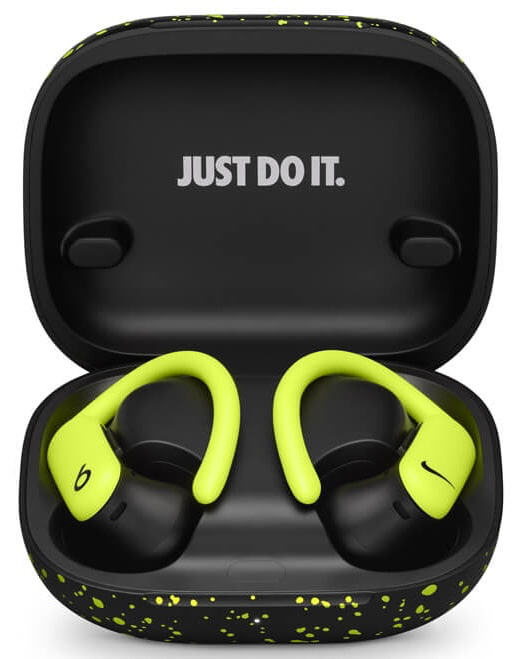
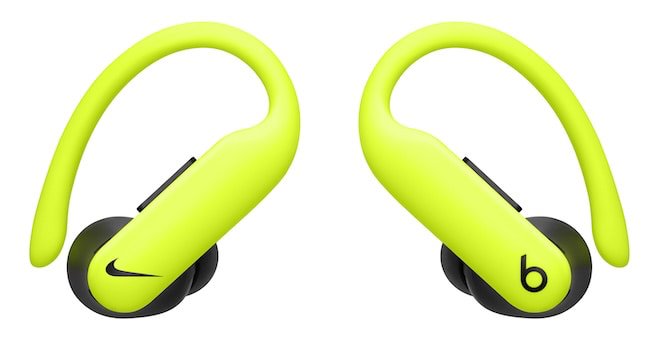
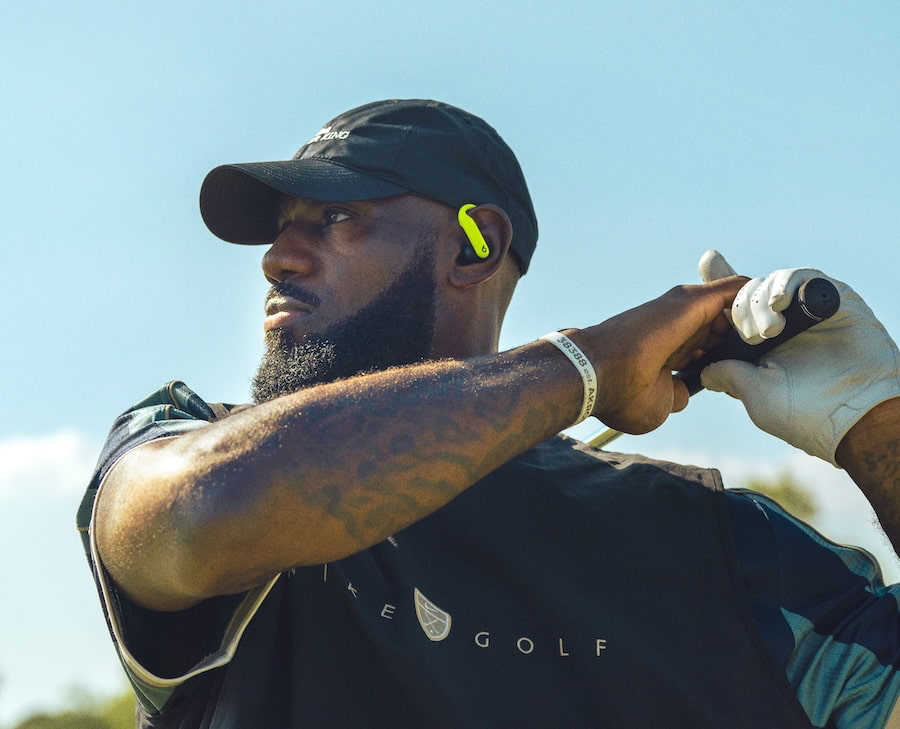
Beats by Dre and Nike are teaming up for the first time with the Powerbeats Pro 2 Nike Special Edition, a limited run that blends one of the most recognizable fitness earbud designs with equally unmistakable branding. The formula is straightforward: take the proven Powerbeats Pro 2 platform, add Nike’s Swoosh to the right earbud, the Beats “b” to the left, and wrap it all in a Volt-accented aesthetic that leans hard into gym culture without messing with the underlying performance.

That restraint is what makes this collaboration smarter than it looks. The fitness earbud category is brutally competitive right now, packed with options from Bose, Sony, Jabra, and Apple itself, all chasing the same workout crowd with better fit, longer battery life, and more reliable connectivity. Beats didn’t reinvent anything here because it didn’t have to. Instead, it borrowed Nike’s global identity and layered it on top of a product that already resonates with athletes.

Call it predictable if you want, but in a market where most “special editions” feel like an afterthought, this one at least understands the assignment. Just do it, indeed.

beats-powerbeats-pro-2-nike-inside-case

This isn’t just a new colorway; it’s a collision of two brands that define performance, culture, and sports—the attributes of today’s athlete,” said Chris Thorne, CMO of Beats. “By placing the Swoosh on our hardware for the first time, we’re honoring the shared DNA of Beats and Nike—and celebrating ambassadors like LeBron James who embody both. It’s a tribute to the grit, style, and sound that push people to their limits.”

To support the launch, Beats enlisted longtime ambassador LeBron James for a comedic campaign built around a simple idea: you do not have to be perfect to play. In Keep Your Head in the Game, James takes to the golf course with skills that will not scare the PGA Tour, tuning out the critics, played by pro golfer Tom Kim and actors Lionel Boyce and Travis “Taco” Bennett, and playing the game on his own terms with the Powerbeats Pro 2.

Advertisement

When two iconic brands like Beats and Nike come together, it’s more than a collaboration. For me, it’s family,” said LeBron James. “I’ve been part of the Beats journey since day one with the original Powerbeats, and the Powerbeats Pro 2 represent everything I need in my daily routine, whether I’m training, recovering, or just living life. These aren’t just my go to earbuds. They’re built for anyone who refuses to compromise on performance.”

Powerbeats Pro 2 – Nike Special Edition Features

beats-powerbeats-pro-2-nike-wireless-earbuds

While the aesthetic is new, the internals remain unchanged and include:

In Ear Fit and Spatial Audio: Like the standard Powerbeats Pro 2, the Nike Special Edition uses an in ear design with an over ear hook for a secure fit. It also supports Personalized Spatial Audio with dynamic head tracking, delivering immersive sound with clear highs, a full midrange, and deep bass.

Active Noise Cancelling: Designed for workouts and daily use, Active Noise Cancelling helps block out distractions. Transparency mode is also included, allowing users to stay aware of their surroundings when needed.

Advertisement

Adaptive EQ: The Nike Special Edition features Adaptive EQ, which adjusts sound in real time based on fit. An inward facing microphone monitors what you actually hear, and computational audio tunes low and mid frequencies to compensate for seal variations.

Stability and Comfort: The earhook is reinforced with a nickel titanium alloy, improving flexibility, grip, and long term comfort during movement.

Advertisement. Scroll to continue reading.

IPX4 and More: With an IPX4 rating, the earbuds are built to handle sweat, rain, and tough workouts. A venting system improves comfort and acoustics, and five ear tip sizes are included for a better fit.

Advertisement

Heart Rate Monitoring: Built in optical sensors pulse over 100 times per second to measure blood flow, providing real time heart rate data that can sync with compatible fitness apps.

Just as with the Powerbeats Pro 2, the Heart Rate Monitoring feature is compatible with the following apps in the US:

  • Nike Run Club
  • Open
  • Peloton
  • Runna
  • Slopes
  • Ladder
  • YaoYao

Apple Compatibility: The Special Edition works seamlessly with Apple devices with no app required, offering one touch pairing, automatic switching, audio sharing, hands free Siri, and Find My support to help locate your earbuds.

Android Compatibility: For Android users, the Beats App unlocks one-touch pairing, the ability to activate or disable Heart Rate Monitoring, customizable controls, battery status widgets, Locate My Beats, and over-the-air updates.

Battery Life: Powered by Apple’s H2 chip, the Special Edition delivers up to 45 hours of total battery life with the charging case, while each earbud provides up to 10 hours of playback per charge. A five minute Fast Fuel charge adds up to 90 minutes of listening time. The redesigned case is 33% smaller than before and marks the first Beats earbud case to support Qi certified wireless charging.

Advertisement

Comparison

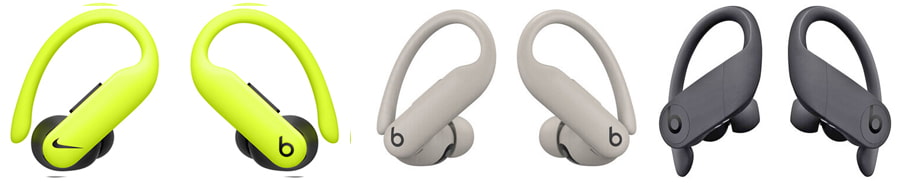
powerbeats-comparison
Model Powerbeats Pro 2 -Nike Special Edition (2026) Powerbeats Pro 2 (2025) Powerbest Pro (2019)
Product Type Open-Ear Wireless Earbuds Open-Ear Wireless Earbuds In-Ear Wireless Earbuds
Price $249.99 $249.99 No Longer Available
Sound Active Noise Cancelling (ANC)

Transparency mode

Adaptive EQ

Personalized Spatial Audio with dynamic head tracking

Active Noise Cancelling (ANC)
Advertisement

Transparency mode

Adaptive EQ

Personalized Spatial Audio with dynamic head tracking

None
Nickel-titanium alloy–reinforced ear hooks Yes Yes Not Indicated
IPX4-rated sweat and water resistance Yes Yes Yes
Heart Rate Monitoring for Workouts Yes Yes No
Compatibility (Apple) Powered by the Apple H2 chip
Advertisement

Fully compatible with Apple devices, with one-touch pairing, automatic switching, Audio Sharing, hands-free Siri and Find My (locate my Beats)

Powered by the Apple H2 chip

Fully compatible with Apple devices, with one-touch pairing, automatic switching, Audio Sharing, hands-free Siri and Find My (locate my Beats)

Powered by the Apple H1 chip
Advertisement

Fully compatible with Apple devices, with one-touch pairing, automatic switching, Audio Sharing, hands-free Siri and Find My (Locate my Beats)

Compatibility (Android) Beats app for Android unlocks one-touch pairing, the heart rate monitoring feature, customizable controls, battery status widgets and Locate My Beats Beats app for Android unlocks one-touch pairing, the heart rate monitoring feature, customizable controls, battery status widgets and Locate My Beats Beats app for Android unlocks one-touch pairing, the heart rate monitoring feature, customizable controls, battery status widgets and Locate My Beats
Connectivity Class 1 Wireless Bluetooth® Class 1 Wireless Bluetooth® Class 1 Wireless Bluetooth®
Voice Isolation Reduces background noise while isolating and clarifying the sound of your voice during calls Reduces background noise while isolating and clarifying the sound of your voice during calls Not Indicated
Battery Up to 45 hours of listening time on a single charge, up to 10 hours of continuous bud playback

Fast Fuel: a 5-minute charge provides up to 1.5 hours of playback

Universal USB-C charging
Works with Qi-compatible wireless chargers

Advertisement

Rechargeable lithium‑ion battery

Up to 45 hours of listening time on a single charge, up to 10 hours of continuous bud playback

Fast Fuel: a 5-minute charge provides up to 1.5 hours of playback

Universal USB-C charging
Works with Qi-compatible wireless chargers

Advertisement

Rechargeable lithium‑ion battery

Up to 24 hours of listening time on a single charge, up to 9 hours of continuous bud playback

Fast Fuel: a 5-minute charge provides up to 1.5 hours of playback

Controls Single multi-function button per side
Advertisement

Volume rockers (up/down) on each side

Auto Play/Pause via optical sensors and motion accelerometers

Single multi-function button per side

Volume rockers (up/down) on each side

Advertisement

Auto Play/Pause via optical sensors and motion accelerometers

Physical volume and track controls on each earbud. 

Long- and short-range optical sensors drive automatic play/pause and call handling 

Dimensions Height: (case) 7.5 cm / 3.0 in (bud) 4.5 cm / 1.8 in
Advertisement

Length: (case) 6.6 cm / 2.6 in (bud) 4.1 cm / 1.6 in

Width: (case) 3.4 cm / 1.3 in (bud) 2.4 cm / 0.9 in

Height: (case) 7.5 cm / 3.0 in (bud) 4.5 cm / 1.8 in

Length: (case) 6.6 cm / 2.6 in (bud) 4.1 cm / 1.6 in

Advertisement

Width: (case) 3.4 cm / 1.3 in (bud) 2.4 cm / 0.9 in

Weight (case) 69 g (bud) 8.7 g (total) 77.7 g (case) 69 g (bud) 8.7 g (total) 77.7 g (case) 80g, (bud) 11g, (total) 102g
Color Options Black & Volt Jet Black, Quick Sand, Hyper Purple, Electric Orange Black, Navy, Ivory, Moss
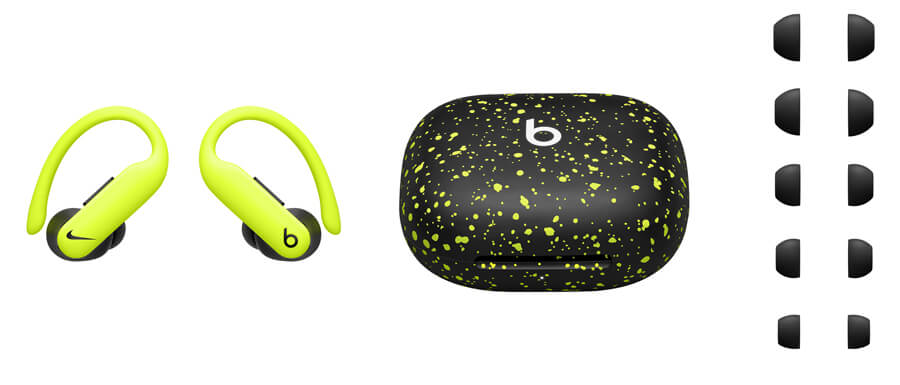
In the Box Powerbeats Pro 2 – Nike Special Edition true wireless earbuds

Silicone ear tips with five size options — XS, S, M, L, XL (medium pre-installed)

Wireless charging case

Advertisement

Quick Start Guide

Warranty card

(Power adaptor and USB-C charging cable sold separately)

Powerbeats Pro 2 true wireless earbuds
Advertisement

Silicone ear tips with five size options — XS, S, M, L, XL (medium pre-installed)

Wireless charging case

Quick Start Guide

Warranty card

Advertisement

(Power adaptor and USB-C charging cable sold separately)

Powerbeats Pro true wireless earbuds

Eartips with four size options

Charging case
Lightning to USB-A charging cable,

Advertisement

Quick start guide

(USB power adapter sold separately)

beats-powerbeats-pro-2-nike-buds-case-eartips

The Bottom Line 

The Powerbeats Pro 2 Nike Special Edition does not reinvent the category, but it does not need to. What makes this release stand out is the combination of a proven fitness focused earbud platform with one of the most recognizable brands in sports. The design leans hard into that identity with Volt accents and Nike branding, but the real value remains the same: secure fit, long battery life, strong feature set, and the addition of heart rate monitoring that still is not standard across most competitors.

What is missing depends on your priorities. If you are deep into high resolution wireless audio, codec support is limited compared to some rivals, and there is no meaningful shift in sound tuning or hardware from the standard version. This is not an upgrade for existing Powerbeats Pro 2 owners, and it is not trying to be.

Who should consider them is pretty clear. If you want a stable, gym ready earbud with excellent battery life, seamless Apple integration, and a design that actually stays put during real workouts, this makes a lot of sense. The Nike tie in just sharpens the appeal for that audience. Everyone else can still enjoy the feature set, but this one knows exactly who it is for and does not pretend otherwise.

Advertisement
beats-powerbeats-pro-2-nike-lebron-james

Pricing & Availability

The Powerbeats Pro 2 – Nike Special Edition is available in Black & Volt for $249.99 USD at Apple.com in the United States and other select markets.

If you prefer,  the Beats Powerbeats Pro 2 is available to order in four colors—Jet Black, Hyper Purple, Quick Sand, and Electric Orange—for $249.99 USD at Apple.com and Amazon 

Advertisement. Scroll to continue reading.
Advertisement

Source link

Continue Reading

Tech

AI is transforming nuclear power design and operations to tackle decades of regulatory hurdles and massive construction inefficiencies

Published

on


  • AI enables engineers to detect design inconsistencies before construction begins
  • Generative AI automates documentation workflows, creating audit-ready and traceable regulatory applications
  • High-fidelity Digital Twins validate designs virtually and reuse proven engineering patterns

The global energy sector is facing unprecedented demand, yet nuclear power projects continue to encounter extensive delays before construction even begins.

Highly customized engineering, fragmented datasets, and labor-intensive regulatory reviews slow progress across permitting, design, and construction phases.

Source link

Continue Reading

Tech

TikTok for Business accounts targeted in new phishing campaign

Published

on

TikTok for Business accounts targeted in new phishing campaign

Threat actors are targeting TikTok for Business accounts in a phishing campaign that prevents security bots from analyzing malicious pages.

TikTok Business accounts may be targeted due to their high potential for abuse in malvertising campaigns, ad fraud, and the distribution of malicious content.

Browser threat detection and response company Push Security links the campaign to one documented last year, which targeted Google Ad Manager accounts.

TikTok has previously been used to spread information-stealing malware via malicious videos, as well as cryptocurrency scams via fake promotions. TikTok for Business accounts are ideal for such purposes due to their increased reach and perceived legitimacy.

Advertisement

In a report shared with BleepingComputer, Push Security says that victims are lured to Cloudflare-hosted phishing pages registered on March 24 via NiceNIC, a registrar often reported by cybersecurity researcher for being used for cybercriminal activities.

Push Security could not determine the initial delivery mechanism, but believes that the threat actor uses a similar method as observed in activity reported by Sublime Security.

The initial link redirects via a legitimate Google Storage URL, blocks bots using a Cloudflare Turnstile check, and then redirects to the malicious pages.

The domains feature similar names, and are all hosted on the same Google Storage bucket:

Advertisement
  • welcome.careerscrews[.]com
  • welcome.careerstaffer[.]com
  • welcome.careersworkflow[.]com
  • welcome.careerstransform[.]com
  • welcome.careersupskill[.]com
  • welcome.careerssuccess[.]com
  • welcome.careersstaffgrid[.]com
  • welcome.careersprogress[.]com
  • welcome.careersgrower[.]com
  • welcome.careersengage[.]com
  • welcome.careerscrews[.]com

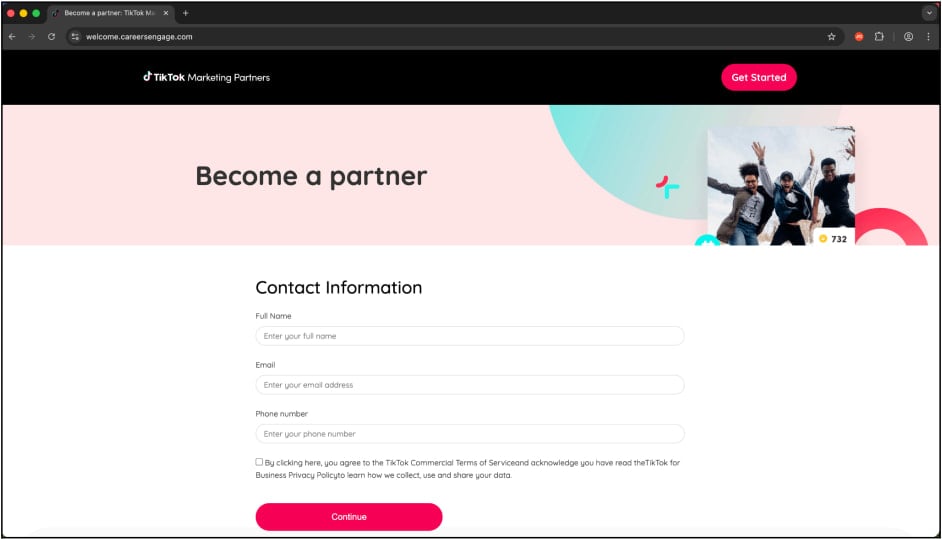
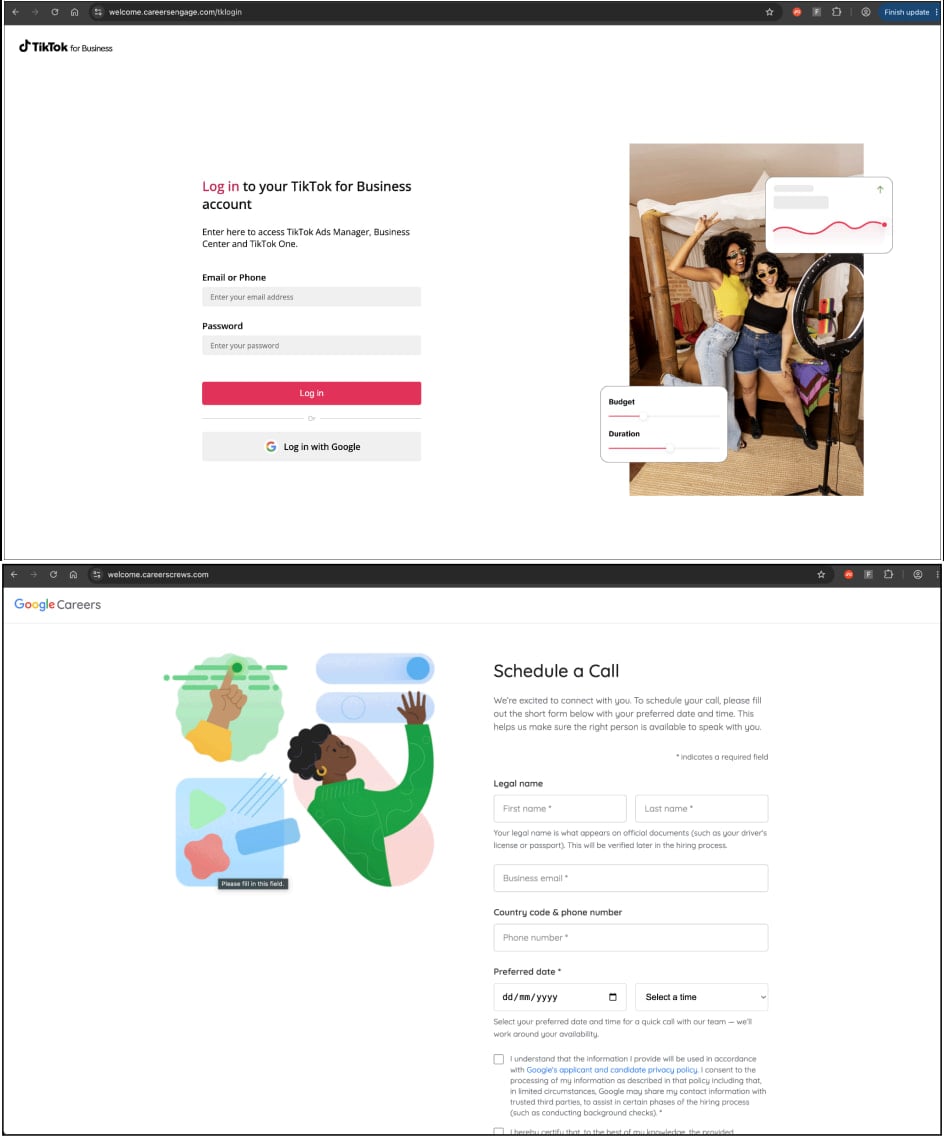
The malicious pages impersonate TikTok for Business and Google Careers “Schedule a Call” pages, requesting visitors to enter basic information in a form to validate they’re using a business email address.

Collecting basic information in a first validation step
Source: Push Security

After this step, victims are served a fake login page, which is a reverse proxy designed to capture credentials and session cookies, and to exfiltrate them to the attacker.

Since the page acts as an intermediary between the legitimate user and the service, the threat actor can hijack accounts even when the two-factor authentication (2FA) protection is active.

The TikTok themed (top) and Google (bottom) phishing pages
Source: Push Security

Push Security also notes that business account holders often log into TikTok via Google single sign-on (SSO) service. “This means that anyone using Google to login to their TikTok account will effectively have both accounts used to distribute ads compromised in one go.”

Users should be extremely cautious with suspicious invites and job offers, and never trust links sent from unknown contacts. Always check the domain before entering credentials, and use passkeys to protect valuable accounts.

Automated pentesting proves the path exists. BAS proves whether your controls stop it. Most teams run one without the other.

This whitepaper maps six validation surfaces, shows where coverage ends, and provides practitioners with three diagnostic questions for any tool evaluation.

Source link

Advertisement
Continue Reading

Trending

Copyright © 2025