Tom Cruise, one of Hollywood’s most enduring action stars, is stepping into uncharted territory following the 2025 release of “Mission: Impossible — The Final Reckoning,” widely viewed as his swan song as IMF agent Ethan Hunt. At 63, the actor shows no signs of slowing down, with a high-profile 2026 project generating buzz as his 50th film and a shift toward more original, auteur-driven storytelling.
AFP
Cruise made a rare awards-season appearance in March 2026 at the 53rd Saturn Awards in Los Angeles, where he accepted Best Actor honors for his performance in “The Final Reckoning” and watched the film win Best Action/Adventure Film. In his speech, he expressed deep gratitude to longtime collaborator director Christopher McQuarrie, joking about the director’s attempts to “kill me so many times” through the franchise’s death-defying stunts. He received a standing ovation and emphasized his lifelong passion for movies and audiences.
The eighth “Mission: Impossible” installment, released in May 2025, concluded Cruise’s three-decade run as Ethan Hunt. While Cruise has teased that “many more” stories could come in the franchise, he confirmed at the film’s premiere and during promotion that it marked his final portrayal of the character. Rumors of a ninth film, including unverified reports of negotiations with director Chloé Zhao, have circulated but remain unconfirmed by Cruise or Paramount.
Instead, Cruise is channeling his trademark intensity into “Digger,” a mysterious comedy set for theatrical release on Oct. 2, 2026, from Warner Bros. Directed by Oscar winner Alejandro G. Iñárritu (“The Revenant,” “Birdman”), the project has been described by the filmmaker as “a brutal, wild comedy of catastrophic proportions.” Cruise shared the first teaser and poster on Instagram in December 2025, captioning it simply: “Introducing… DIGGER.”
The film marks Cruise’s first major original role in years outside major franchises and his 10th as both star and producer. It reunites him with Iñárritu in what insiders call a bold departure, featuring an ensemble cast including Jesse Plemons, John Goodman, Riz Ahmed, Sophie Wilde and Emma D’Arcy. A teaser trailer released late last year offered little plot detail, building intrigue around the “enigmatic” project that some compare tonally to Iñárritu’s darker satirical style or even Cruise’s memorable comedic turn in “Tropic Thunder.”
Advertisement
Industry observers see “Digger” as a pivotal test for Cruise at the box office after nearly a decade dominated by sequels and reboots. It arrives as the actor, who turned 63 in July 2025, continues to prioritize physically demanding and creatively ambitious work. Production details remain closely guarded, but the collaboration with Iñárritu — known for visceral, auteur-driven cinema — signals Cruise’s desire to stretch beyond the stunt-heavy blockbusters that defined much of his recent career.
Cruise’s post-“Mission” slate also includes ongoing development on “Top Gun 3,” with Joseph Kosinski expected to return as director. The sequel to the 2022 blockbuster “Top Gun: Maverick” remains in script stages, though no firm production timeline has been announced. Other long-gestating rumors, including a potential “Edge of Tomorrow” sequel with Emily Blunt and director Doug Liman, have surfaced in production listings for possible late 2026 shoots, but nothing is confirmed.
The actor has repeatedly pushed back against retirement speculation. During “The Final Reckoning” promotion, he made clear his commitment to big-screen cinema remains unwavering, telling audiences he loves making movies and values the theatrical experience above all. His hands-on approach to stunts and production has become legendary, with “Mission: Impossible” films consistently praised for practical effects over heavy CGI reliance.
Beyond the screen, Cruise’s personal life occasionally draws tabloid attention. In early 2026, unverified reports suggested friends were encouraging a reconnection with former co-star Meg Ryan following the reported end of a brief romance with Ana de Armas. Cruise and Ryan, who starred together in “Days of Thunder” decades ago, have remained friendly over the years, though both have stayed private about relationships.
Advertisement
Cruise notably will not attend the 2026 Winter Olympics in Milan-Cortina, Italy, dashing Italian media speculation that he might reprise a stunt-heavy role similar to his surprise appearance at the 2024 Paris Games opening ceremony. Sources confirmed he remained in Los Angeles during the February Games.
His enduring appeal was underscored in early 2026 when online polls and fan discussions named him among the most “impressive and promising” actors of the year — a testament to his ability to captivate audiences well into his 60s. Classic films from his catalog, including “Jerry Maguire” and “Edge of Tomorrow,” continue to find new viewers on streaming platforms, introducing younger generations to his work.
Cruise’s career trajectory reflects a rare balance of commercial dominance and creative risk-taking. From his breakthrough in “Risky Business” and “Top Gun” in the 1980s to Oscar-nominated turns in “Born on the Fourth of July,” “Jerry Maguire” and “Magnolia,” he has demonstrated range while building one of Hollywood’s most reliable box-office brands. The “Mission: Impossible” series alone has grossed billions worldwide, with each installment raising the bar for practical action sequences.
As he approaches his 50th film with “Digger,” Cruise continues to embody the ethos of old-school movie stardom: commitment to craft, audience connection and theatrical exhibition. In an era of franchise fatigue and streaming dominance, his insistence on delivering spectacle on the big screen resonates with fans and theater owners alike.
Advertisement
Looking ahead, the October 2026 release of “Digger” will likely dominate Cruise-related conversation throughout the year. Early buzz suggests the film could position the actor for awards consideration in a comedic or dramatic vein, potentially adding to his legacy beyond action hero status. Iñárritu’s involvement raises expectations for a film that blends humor, intensity and emotional depth.
Cruise maintains a relatively low public profile between projects, focusing on training, development and family. He has three children from previous marriages and has spoken occasionally about the importance of balance, though work remains his primary passion.
In recent interviews and appearances, including at the Saturn Awards, Cruise reiterated his love for cinema and gratitude toward collaborators and fans. “I feel so privileged to be able to do what I do,” he said in his acceptance speech, a sentiment that encapsulates his four-decade journey from young heartthrob to global icon.
As Hollywood navigates shifting audience habits and production challenges, Tom Cruise stands as a steadfast advocate for the movie theater experience. Whether scaling skyscrapers as Ethan Hunt or diving into the unknown with “Digger,” his next act promises to deliver the same intensity and charisma that have defined his career.
Advertisement
Fans can expect more updates on “Digger” and potential “Top Gun 3” developments as 2026 progresses. For now, the star who once declared he would “do my own stunts” until he physically cannot appears determined to keep audiences on the edge of their seats for years to come.
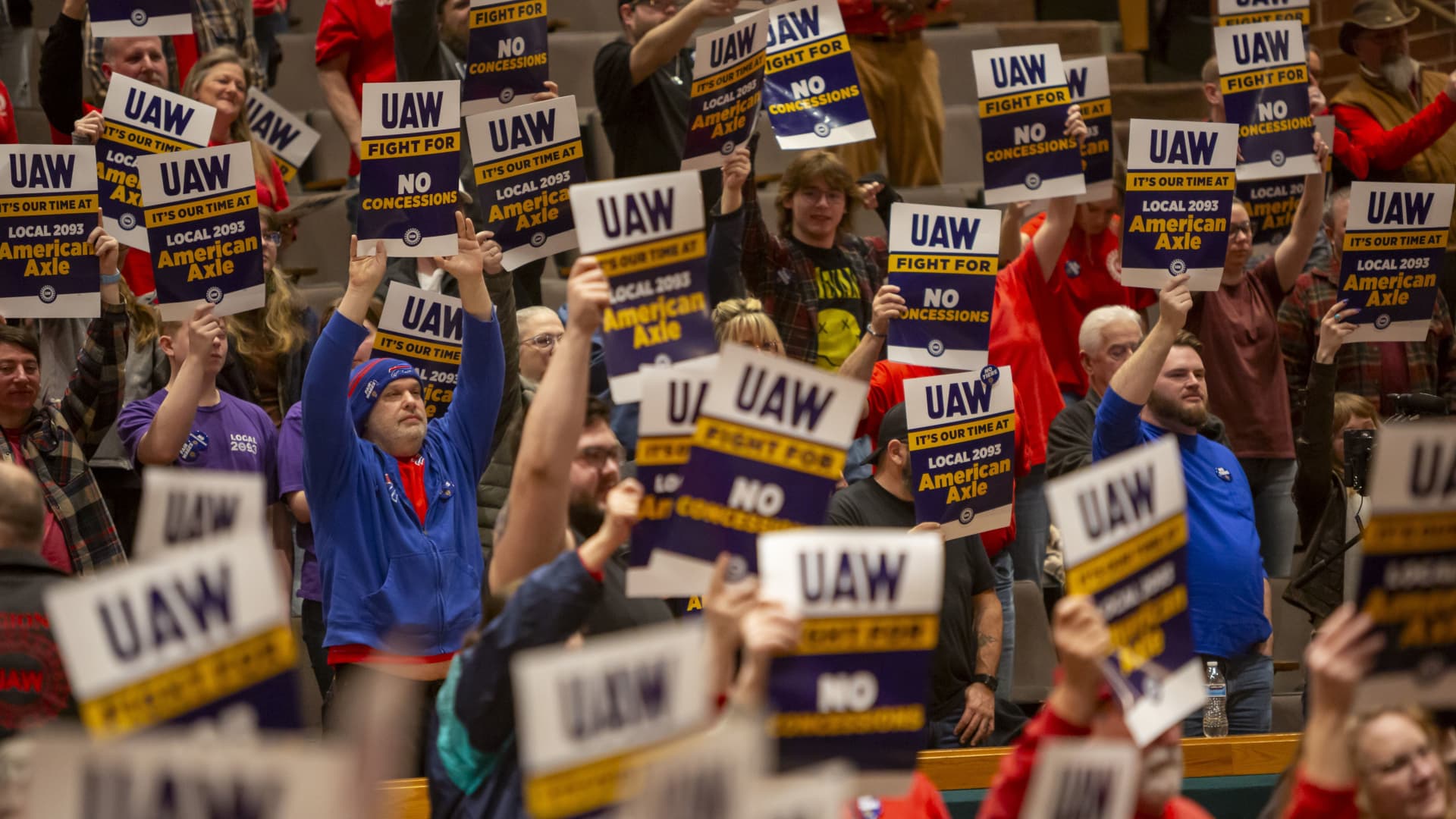
Three Rivers, Michigan USA, 29 March 2026, Members of the United Auto Workers rally for better wages as contract negotiations begin with American Axle (aka Dauch Corp.).
Jim West | Universal Images Group | Getty Images
DETROIT – Nearly 1,000 workers at a Michigan supplier plant that makes parts for General Motors pickup trucks went on strike Monday after not reaching a new contract with the company.
Advertisement
The United Auto Workers union on Monday confirmed workers at an axle and components plant in Three Rivers, Mich. for Dauch Corp. (formerly known as American Axle and Manufacturing) walked out of the factory and onto picket lines at 12:01 a.m. ET Monday.
The union did not release a full list of demands, but said in a press release Sunday night that workers are still trying to regain wages lost during the Great Recession.
“We’ll stay out on strike until this company comes to its senses,” UAW President Shawn Fain said during a Sunday video announcement. “The full force of the UAW international union will be standing with these workers. So, American Axle, time is up. No contract, no axles.”
The union said longtime workers who were making as much as $29 an hour saw their wages slashed to $14.50 in 2008. Current wages top out at $22 an hour after a five-year progression, the union said.
Advertisement
A spokesman for Dauch in an emailed statement called the strike “disappointing.” He did not immediately respond to a question about bargaining details.
Three Rivers, Michigan USA, 29 March 2026, Members of the United Auto Workers rally for better wages as contract negotiations begin with American Axle (aka Dauch Corp.).
Jim West | Universal Images Group | Getty Images
“The company believes that the best outcomes for everyone – our associates, the union, and the company – are reached at the bargaining table. We remain committed to negotiating with the union in good faith and hope to promptly reach a fair agreement,” the company statement read.
Advertisement
A spokesman for GM said the automaker “is closely monitoring the situation” and “assessing any potential impact.” As of Monday, production at GM’s plants was operating as usual.
The impacted plant produces axles for GM’s Chevrolet Colorado and GMC Canyon midsize pickup trucks as well as its heavy-duty Chevrolet Silverado and GMC Sierra pickups. Other production includes smaller components for the Detroit automaker’s light-duty Silverado and Sierra pickups as well as parts of Stellantis’ Chrysler Pacifica minivan, a union spokesman confirmed.
Stellantis did not immediately respond to a request to comment.
Josh Jager, a 24-year American Axle employee and chairman of the bargaining committee for UAW Local 2093, which represents the striking workers, told the Wall Street Journal that GM appears to have about two weeks’ worth of axles in stock.
JPMorgan Chase CEO Jamie Dimon joins ‘Mornings with Maria’ to discuss inflation risks, consumer spending, Federal Reserve policy and why he believes fixing government policy could boost economic growth.
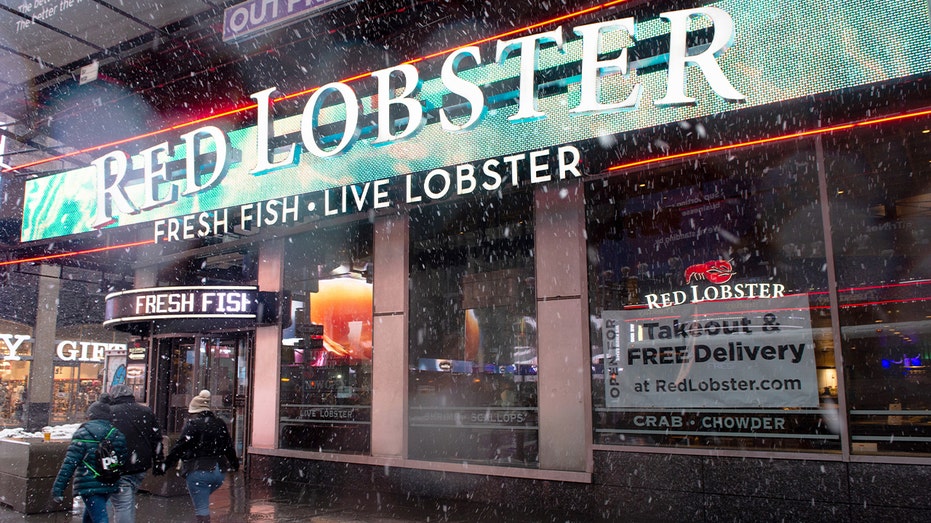
Red Lobster is closing its Times Square restaurant after more than two decades in one of the world’s busiest tourist destinations.
The restaurant, located at 5 Times Square, is scheduled to close June 14, ending a high-profile presence the seafood chain has maintained in the heart of Manhattan since 2003.
Advertisement
“Times Square has been an important chapter in Red Lobster’s history, and this was a difficult decision,” the company said in a statement.
Red Lobster said extensive and prolonged construction at the building has significantly impacted access, visibility and foot traffic at the restaurant. The company also cited the property’s planned conversion to residential use, saying continued operations at the location were no longer viable.
The Red Lobster restaurant in Times Square is scheduled to close on June 14. (Craig T Fruchtman/Getty Images)
“We are grateful to the team members and guests who have made this restaurant special over the years,” the company said.
Advertisement
The closure comes as Red Lobster continues efforts to rebuild the business after emerging from Chapter 11 bankruptcy protection in 2024. The seafood chain filed for bankruptcy in May of that year after closing dozens of restaurants nationwide amid mounting financial pressures.
The Red Lobster restaurant has been located in Times Square for more than 20 years. (Alexi Rosenfeld/Getty Images)
A bankruptcy court later approved the company’s reorganization plan, allowing Red Lobster to exit Chapter 11 under new ownership backed by Fortress Investment Group. At the time, the company said it would continue operating as an independent company with 544 locations across 44 states and four Canadian provinces.
As part of the restructuring, RL Investor Holdings LLC, an entity backed by Fortress Investment Group, acquired the company. Damola Adamolekun took over as CEO following the reorganization and has led efforts to revive the iconic seafood chain.
Advertisement
Red Lobster has not indicated that the Times Square closure is part of a broader round of restaurant shutdowns.
People walk through Times Square in New York City. (Craig T Fruchtman/Getty Images)
The Times Square restaurant has occupied a prominent corner location at 41st Street and Seventh Avenue since 2003, serving tourists and theatergoers visiting the area.
Red Lobster said all affected employees will be offered the opportunity to transfer to another company location and will receive additional pay to support them through the transition.
Legal firm Knights advised Cardo on its latest acquisition
16:18, 01 Jun 2026Updated 16:27, 01 Jun 2026
Cardiff-based building and maintenance contractor Cardo Group has further expanded with the acquisition of Merthyr electrical and engineering firm EFS Systems.
Legal firm Knights, through its Cardiff office, acted for Cardo on the deal, the value of which has not been disclosed.
EFS is an established contractor delivering commercial, industrial and renewable energy projects. Its capabilities include electrical design, installation, inspection, testing and maintenance, together with fire and security systems, data and networking, solar panels and electric vehicle charging solutions.
Advertisement
The acquisition is strategically aligned with Cardo Group’s existing maintenance, compliance, retrofit and decarbonisation offering, while adding further capability in electrical services and energy-efficient technologies.
Liam Bevan CEO of Cardo Group.
Liam Bevan, chief executive of Cardo Group, said: “We’re really pleased to welcome the EFS Systems team into Cardo Group. Their track record of high-quality, people-focused services aligns closely with how we approach our work.
“Rob and the EFS Systems team have been trusted partners of mine for over 10 years, and we’ve worked closely with them on projects for a wide range of clients during that time.
“This acquisition strengthens our ability to deliver integrated services for our clients, while continuing to grow our presence in key regions. Just as importantly, it brings in a team with the right values and expertise to support our long-term ambitions.”
Advertisement
A specialist team of legal advisors at regional legal and professional services business, Knights, advised Cardo Group on the acquisition. The multi-disciplinary team was led by corporate partner Emma Borrington, supported by Elizabeth Hill and Edmund Anya in corporate, Sarah Luxmoore in employment, Krystal Gibbins in real estate, Steve Webb in construction and Sarah Cardew in corporate tax.
Corporate partner with Knights, Emma Borrington, said:“We were delighted to support Cardo Group on this acquisition. EFS Systems is a well-regarded business with strong technical capability, and the transaction is closely aligned with Cardo’s strategic objectives.
“It has been a pleasure to work alongside Liam, Alex Crewe and the wider Cardo team on another important transaction, and to support the business as it continues to invest in complementary specialist capabilities.
“We wish everyone at Cardo Group and EFS Systems every success as they take this next step together.”
The company is turning its fortunes around after a ‘difficult’ period
Tractor in a field(Image: Leitenberger S/Andia/Universal Images Group via Getty Images)
A Devon-based agricultural supply business founded 66 years ago has returned to profit after two “difficult” years. Mole Valley Farmers was established in 1960 by a group of farmers in South Molton who joined together to form an agricultural buying group.
The company, which now employs more than 1,700 staff and has 9,000 farmer shareholders, sells a range of goods including livestock feed, animal health products and pet supplies direct to farmers and the general public online and in its 48 stores.
In its latest set of results filed on Companies House, Mole Valley Farmers reported turnover of £555.7m for the year ended September 2025 – marginally down from £558.8m a year earlier. But the business returned to a group operating profit of £500,000 – an improvement of some £5.8m on the year before.
“After two consecutive years of substantial losses, it is deeply encouraging to report a return to a modest level of operating profit,” chief executive Jack Cordery said in a statement.
Advertisement
“This financial recovery, although only one step on a longer journey toward sustainable profitability, illustrates that the strategic adjustments implemented at every level of the organisation are taking effect.”
Mr Cordery said a “rigorous focus” on cost contral and operational efficiency had been central to Mole Valley’s performance over the last year.
“Following a period in which inflationary pressures, labour cost increases and volatile commodity markets created considerable headwinds, we undertook a comprehensive review of expenditure and internal processes.
“Through tighter financial discipline, improved stock management and targeted productivity measures, we have successfully reduced our operating cost base whilst maintaining strong service standards for farmer shareholders and customers.”
Advertisement
In its financial report, Mole Valley said it had reduced its operating costs by £3.7m in “a climate of increasing inflationary pressures. It added that greater working capital and debt reduction had also allowed the business to mull investment opportunities.
The company said it was looking to make “significant investments” over the financial year at its mills at Huntworth and Dorchester.
“We have seen a considerable turnaround from the previous year, despite plenty of head winds,” said chair Stephen Bones.
“We are clear that there is still much to do to ensure real business stability and resilience.”
Advertisement
He added: “In the current budget year, we are seeing sales and revenue growth and a continued focus on cost of sales. The business is now more resilient, better able to withstand external pressures and well positioned to invest in areas that support long-term value creation.”
Last year, Mole Valley Farmers agreed a deal with Plymouth port Cattedown Wharves, which saw it take over use of the quay-side storage facilities and collaborate to manage incoming cargoes.
The long wait for the NSE public listing appears to be entering its final stretch. The exchange recently confirmed that it expects to file its draft red herring prospectus (DRHP) by the second week of June, putting the country’s most anticipated IPO one step closer to reality.
The update has once again sparked interest in NSE’s unlisted shares, which continue to change hands actively in the private market. With the DRHP now less than two weeks away, investors may want to know does it still make sense to buy NSE shares before the IPO?
The answer from analysts is nuanced. Most experts agree that NSE remains one of India’s strongest financial franchises. However, they also caution that investors should not treat the approaching IPO as an automatic opportunity for quick gains.
NSE currently trades in the unlisted market at around Rs 1,950-2,050 per share, implying a valuation of roughly Rs 5 lakh crore. That valuation already reflects significant optimism around the company’s eventual listing.
Advertisement
“NSE is clearly one of India’s strongest capital-market franchises and remains one of the most awaited IPO candidates. However, investors looking to buy unlisted shares purely because the DRHP filing is close should exercise caution,” said Paresh Bhagat, CIO of Veer Growth Fund and chairman of Mangal Keshav.
Live Events
“The business quality is not in question. The key risk is valuation and entry price.” Bhagat noted that based on FY26 profit after tax of around Rs 10,300 crore, the exchange is already valued at nearly 48-50 times earnings. While NSE enjoys dominant market share, strong profitability and significant cash generation, he believes much of that strength is already reflected in current unlisted market prices. One of the biggest assumptions among investors is that buying shares before the IPO guarantees a profit once the company lists. Analysts say that assumption may not always hold true.The eventual IPO pricing remains unknown. In many large public offerings, companies deliberately leave room for public market investors by pricing the issue below prevailing unlisted market valuations.
If that happens, investors entering NSE at current unlisted prices could face limited upside or even temporary mark-to-market losses. “The pre-IPO window should not be seen as a guaranteed arbitrage opportunity,” Bhagat said. “If the IPO is priced more reasonably for public-market investors, the gap versus current unlisted prices could be meaningful.”
Others echo the same concern. “I would avoid buying NSE unlisted shares purely on the expectation of the upcoming DRHP filing,” said Arpit Jain, Joint Managing Director at Arihant Capital Markets.
“While the filing could be an important milestone in the IPO journey, a significant portion of the optimism around the listing is already reflected in the current unlisted market price.” Jain pointed to several high-profile IPOs in recent years where strong excitement before listing did not necessarily translate into exceptional post-listing returns.
Advertisement
He said investors should focus on valuation, offer pricing, market conditions and the final IPO structure rather than rushing to buy shares simply because the DRHP is approaching.
At the same time, few analysts dispute the quality of the underlying business. NSE remains India’s largest stock exchange and dominates equity derivatives trading. The exchange reported total income of Rs 18,713 crore and consolidated net profit of Rs 10,302 crore in FY26.
Its capital-light business model, strong cash flows and dominant market position have made it one of the most sought-after names in the unlisted market.
According to Nitant Darekar, Research Analyst at Bonanza, NSE currently trades at around 45 times FY26 earnings, based on earnings per share of Rs 41.62. While that valuation is not cheap, it remains below some listed peers.
Advertisement
“NSE remains a capital-light near-monopoly,” Darekar said. “At around Rs 1,950-2,170 in the unlisted market, it trades near 45x FY26 earnings. That’s rich, but below BSE at around 70x and MCX at around 80x.”
Darekar added that the recent settlement of the long-running co-location case has removed a major overhang on the IPO process. However, he cautioned that the exchange’s earnings remain linked to derivatives trading activity, which can be volatile, especially after regulatory changes in the futures and options segment.
He also highlighted another practical consideration for investors. “The urgency is real. Post-DRHP, fresh unlisted purchases face a one-year lock-in. But valuation, not the calendar, should drive the decision.”
That point is particularly important because many retail investors view the narrowing pre-IPO window as a reason to buy immediately.
Advertisement
Ishan Tanna, Senior Associate at Ashika Capital, said history suggests otherwise. “Historically, buying unlisted shares very close to the IPO stage has not always offered the best risk-reward for investors,” he said.
“In many cases, the biggest gains are made when IPO visibility is low and uncertainty is high. Once the DRHP gets filed and listing draws closer, valuations often become expensive as the IPO excitement premium starts getting priced in.”
Tanna said NSE remains a rare financial infrastructure asset with strong profitability and a dominant position in Indian capital markets, making it attractive for long-term investors.
However, investors chasing quick listing gains should recognise that late-stage entry into pre-IPO stories often carries greater risks than many assume.
Advertisement
For now, the consensus among market experts is that NSE remains one of India’s highest-quality businesses and its IPO will likely attract enormous investor interest. But with the stock already trading at elevated valuations in the unlisted market, investors may need to focus less on the countdown to the DRHP and more on whether the current price adequately compensates them for the risks ahead.
(Disclaimer: Recommendations, suggestions, views and opinions given by the experts are their own. These do not represent the views of Economic Times)
“The findings primarily concern the use of Wise accounts for criminal purposes, with indications of non-compliance with anti-money laundering legislation, particularly due to a failure to identify customers and their activities,” the spokesperson added.
After having been in the investing world for more than 25 years from private banking and investment management to private and venture capital; I have pretty much “been there and done that” at one point or another. I am currently a partner at RIA Advisors in Houston, Texas. The majority of my time is spent analyzing, researching and writing commentary about investing, investor psychology and macro-views of the markets and the economy. My thoughts are not generally mainstream and are often contrarian in nature but I try an use a common sense approach, clear explanations and my “real world” experience in the process. I am a managing partner of RIA Pro, a weekly subscriber based-newsletter that is distributed to individual and professional investors nationwide. The newsletter covers economic, political and market topics as they relate to your money and life. I also write a daily blog which is read by thousands nationwide from individuals to professionals at www.realinvestmentadvice.com.






















































You must be logged in to post a comment Login