
Crypto World
DeepSnitch AI Leads as Bitcoin Drops Below $67K & Ethereum Bleeds


After 14 years, Tether has finally hired KPMG for a full independent audit. Verifying its $185 billion circulation and $122 billion in US Treasuries is the most critical transparency event in crypto history. If these reserves check out, the industry’s longest-standing systemic risk vanishes overnight.
While Tether secures the market’s foundation, aggressive investors are already pivoting to DeepSnitch AI (DSNT). Raising $2.6 million and locking in 210% presale gains through a hostile macro environment, DSNT is proving its absolute resilience.
Tether needed KPMG for credibility; DSNT just needs its March 31st Uniswap listing. This next crypto to explode opportunity will definitely close in three days.
Tether hires KPMG for its first full audit
The Financial Times reports Tether has officially engaged KPMG for its first full independent audit, with PwC preparing its internal systems. Moving away from mere reserve attestations, this comprehensive review will cover USDT’s massive $185 billion circulation, including its $122 billion in US Treasuries.
The significance cannot be overstated. A successful Big Four audit would eliminate crypto’s longest-standing systemic risk, cementing stablecoins as auditable financial infrastructure ahead of Tether’s potential US expansion under the GENIUS Act.
Top 3 next cryptos to explode: DeepSnitch AI, Bitcoin & Ethereum
DeepSnitch AI
Tether’s engagement of KPMG for a full audit proves crypto is the new global financial infrastructure. But as on-chain activity scales, so does the sophistication of threats. Rug pulls and honeypots are daily risks for retail traders, especially during the volatile market shifts we’re seeing now.
This is exactly where DeepSnitch AI (DSNT) dominates. While Tether solidifies the market’s foundation, DSNT’s five live AI agents run 24/7 inside Telegram to protect your capital and find the next crypto to explode. They bridge the intelligence gap instantly, identifying malicious contracts and surfacing alpha without requiring a Bloomberg Terminal.
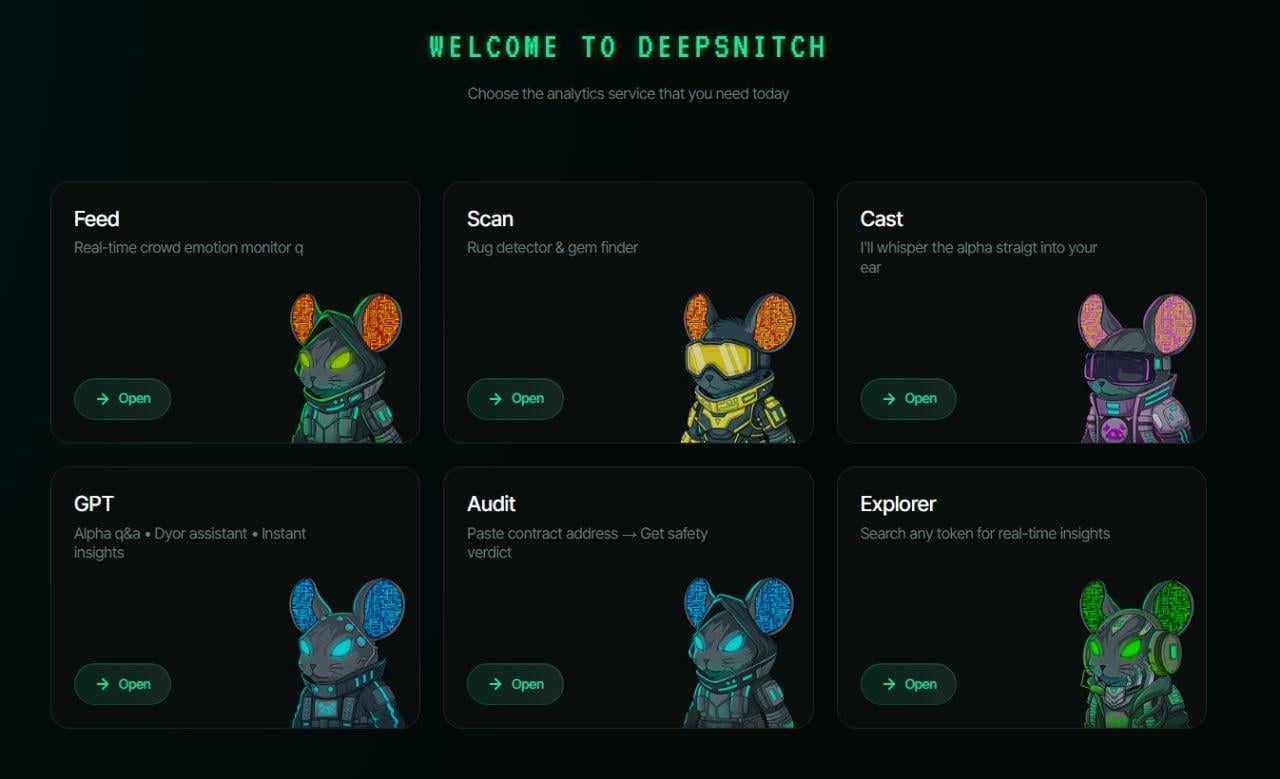
Unlike other presales selling empty promises, DeepSnitch is a fully functional product with massive adoption potential. As auditable infrastructure brings millions of new users into the ecosystem, the demand for DSNT’s real-time protection will skyrocket.
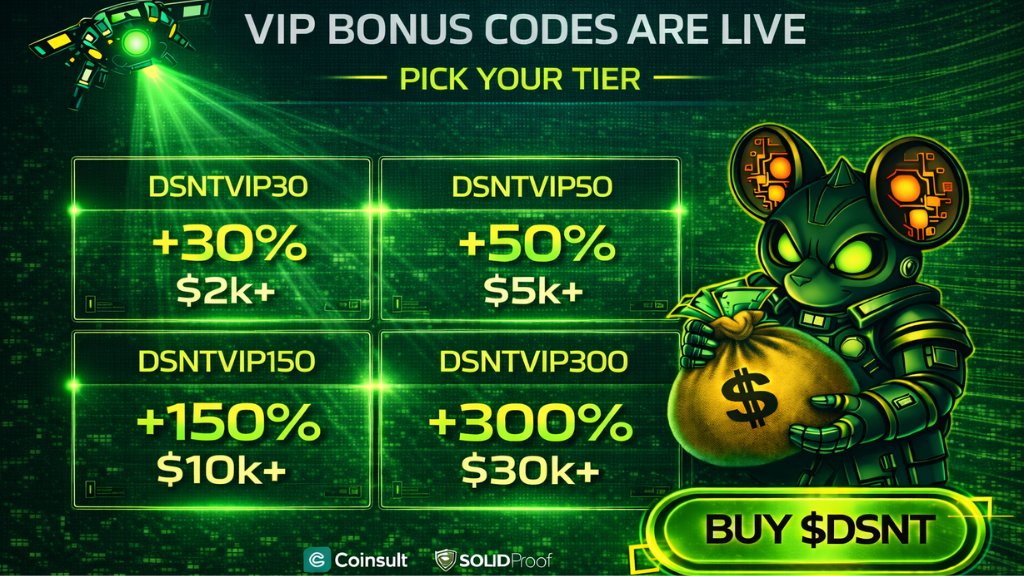
Currently in Stage 8 at $0.04669 with $2.6 million already raised, community projections are locked on 100x to 300x returns, targeting $4.50 post-launch. With Tier-1 listings like KuCoin and Binance on the horizon, the March 31st Uniswap launch is your final chance to secure DeepSnitch AI’s ground-floor prices.
Bitcoin
Bitcoin just dropped below $67,000, shedding 3% on March 27 as over $50 million in long positions were violently liquidated in a single hour.
Broad macro headwinds are suffocating the market: 10-year Treasury yields are approaching 4.5%, the DXY is surging, and rising oil prices keep inflation fears alive. Bitcoin’s recovery now completely depends on uncontrollable macroeconomic forces.
DeepSnitch AI (DSNT) does not. While Bitcoin waits for macro conditions to reverse, DSNT’s March 31st Uniswap listing is permanently locked.
The launch won’t shift for cascading liquidations or dollar strength. Secure your $0.04669 entry before this ground-floor window definitively closes in exactly three days.
Ethereum
Ethereum has slipped below $2,000, dropping 4% on March 27 as escalating Middle East tensions trigger a massive risk-off sweep. Institutional demand is severely cracking, marked by seven consecutive days of spot ETF outflows totaling $392 million.
While whales like BitMine are quietly accumulating ETH to provide underlying structural support, brutal macro conditions are currently overriding the fundamental case, violently liquidating over $100 million in long positions.
DeepSnitch AI (DSNT) is completely immune to this macro chaos. With its March 31st Uniswap launch definitively locked, DSNT’s explosive upside isn’t waiting for ETF inflows to reverse or geopolitical risk to fade.
Closing thoughts
Tether just tapped KPMG for its first full audit in 14 years, finally removing crypto’s longest-standing systemic risk. Meanwhile, extreme macro hostility is wreaking havoc: Bitcoin plunged below $67,000 amid cascading liquidations, and Ethereum is bleeding through seven straight days of ETF outflows.
Yet, through all this chaos, DeepSnitch AI (DSNT) just crossed $2.6 million raised, being the next crypto to explode. Capital isn’t flowing in despite the volatility, it’s flowing in because of it. DSNT’s five live AI agents protect retail traders from market chaos directly inside Telegram, requiring zero technical expertise.
While Bitcoin waits for Treasury yields to fall, DSNT is only waiting for March 31st. With rumored listing targets like Binance and KuCoin, community projections are firmly locked on explosive 100x to 300x returns. The presale definitely closes in exactly three days.
Visit the official website for more information, and join X and Telegram for community updates.
FAQs
Which next crypto is attracting capital even as Bitcoin drops below $67,000 and liquidations cascade?
DeepSnitch AI is the next crypto to explode: $2.6M raised through peak market chaos, five live Telegram agents catching scams and honeypots in real time, and a confirmed March 31st Uniswap listing.
What is the next 100x crypto as Tether’s KPMG audit removes crypto’s longest-standing systemic risk?
DeepSnitch AI at $0.04669: community projections of 100x to 300x backed by a live product that protects retail investors from the fraud that scales alongside on-chain adoption. KuCoin, BitMart, and Binance are named as listing targets following the Uniswap launch. The presale closes in days.
Which altcoins offer retail investors real protection during cascading liquidations and geopolitical chaos?
DeepSnitch AI stands out as the next crypto to explode: five AI agents catching scams, honeypots, and malicious contracts in real time inside Telegram, no technical knowledge required. Built specifically for the volatility retail investors face daily, and raising capital through exactly that volatility rather than despite it.
Disclaimer: This is a Press Release provided by a third party who is responsible for the content. Please conduct your own research before taking any action based on the content.


Bitcoin long positions on Bitfinex have surged to roughly 79,343 BTC, the highest level since November 2023. Analysts view this spike as a warning signal.
Historically, similar buildups in leveraged longs have coincided with local price tops or sharp declines.
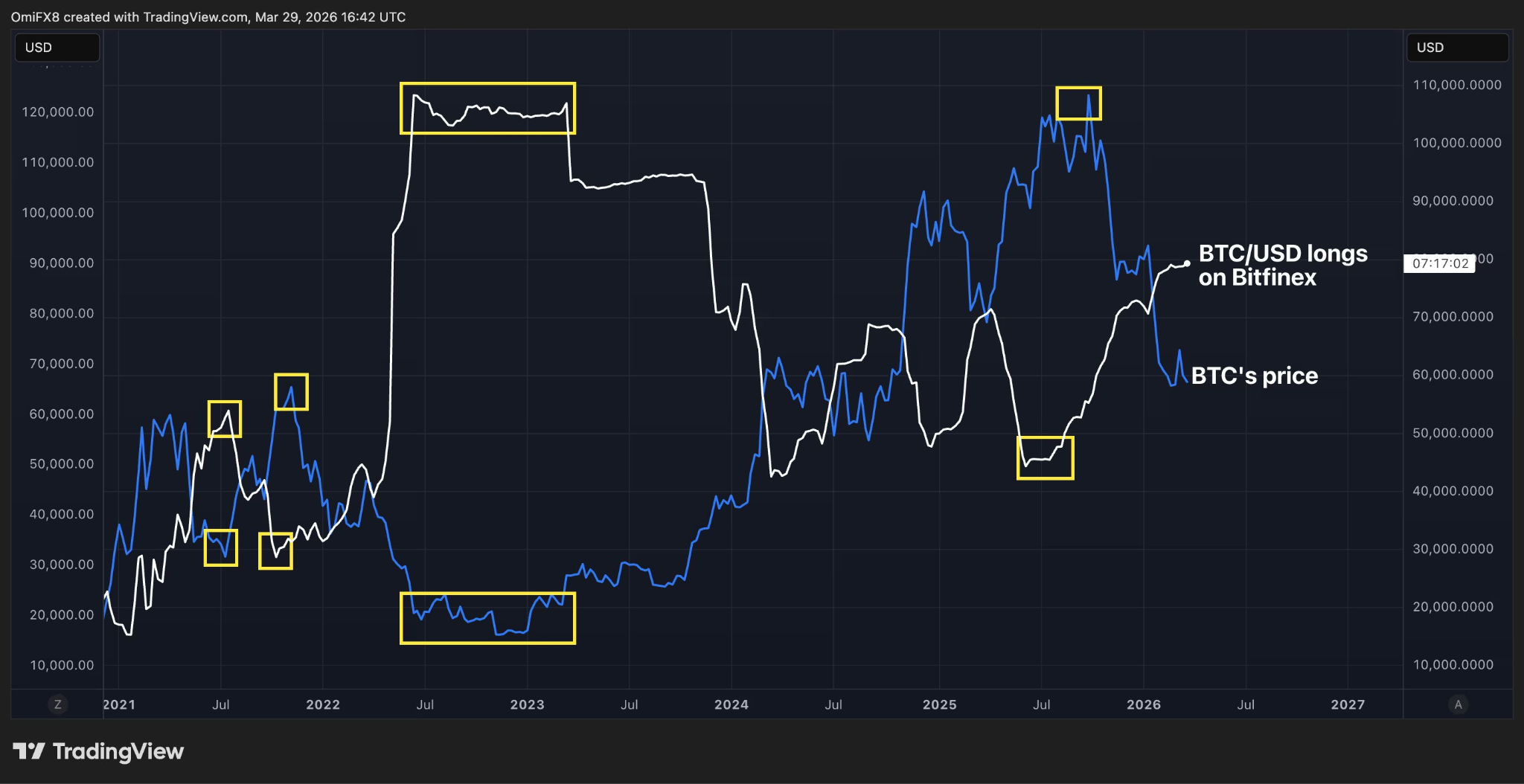
This metric reflects margin traders betting on higher prices. However, when positioning becomes crowded, the market often turns fragile.
Is Bitcoin Price About to Crash Hard?
With many traders already long, fewer buyers remain to sustain upward momentum. As a result, price rallies tend to stall.
Moreover, these positions are typically leveraged. If Bitcoin drops even slightly, forced liquidations can trigger rapid selling. This creates a cascade effect, where falling prices lead to more liquidations and deeper declines.
Past cycles have shown this pattern repeatedly during periods of excessive long exposure.
At the same time, broader macro conditions remain uncertain. Equity markets have weakened, and geopolitical tensions continue to weigh on risk assets.
Bitcoin has recently traded in a tight range, struggling to break resistance. In such an environment, crowded long positioning increases vulnerability to downside moves.
Large market participants also monitor these imbalances. When positioning becomes one-sided, they may push prices lower to trigger liquidations and accumulate at cheaper levels.
This dynamic is common in derivatives-driven markets.
Bitcoin’s current structure remains range-bound. However, the surge in Bitfinex longs suggests the market is overextended on the bullish side.
Unless strong spot demand emerges, the risk of a sharp correction remains elevated.
The post Bitcoin Longs Hit Multi-Year High on Bitfinex, Raising Downside Risk appeared first on BeInCrypto.
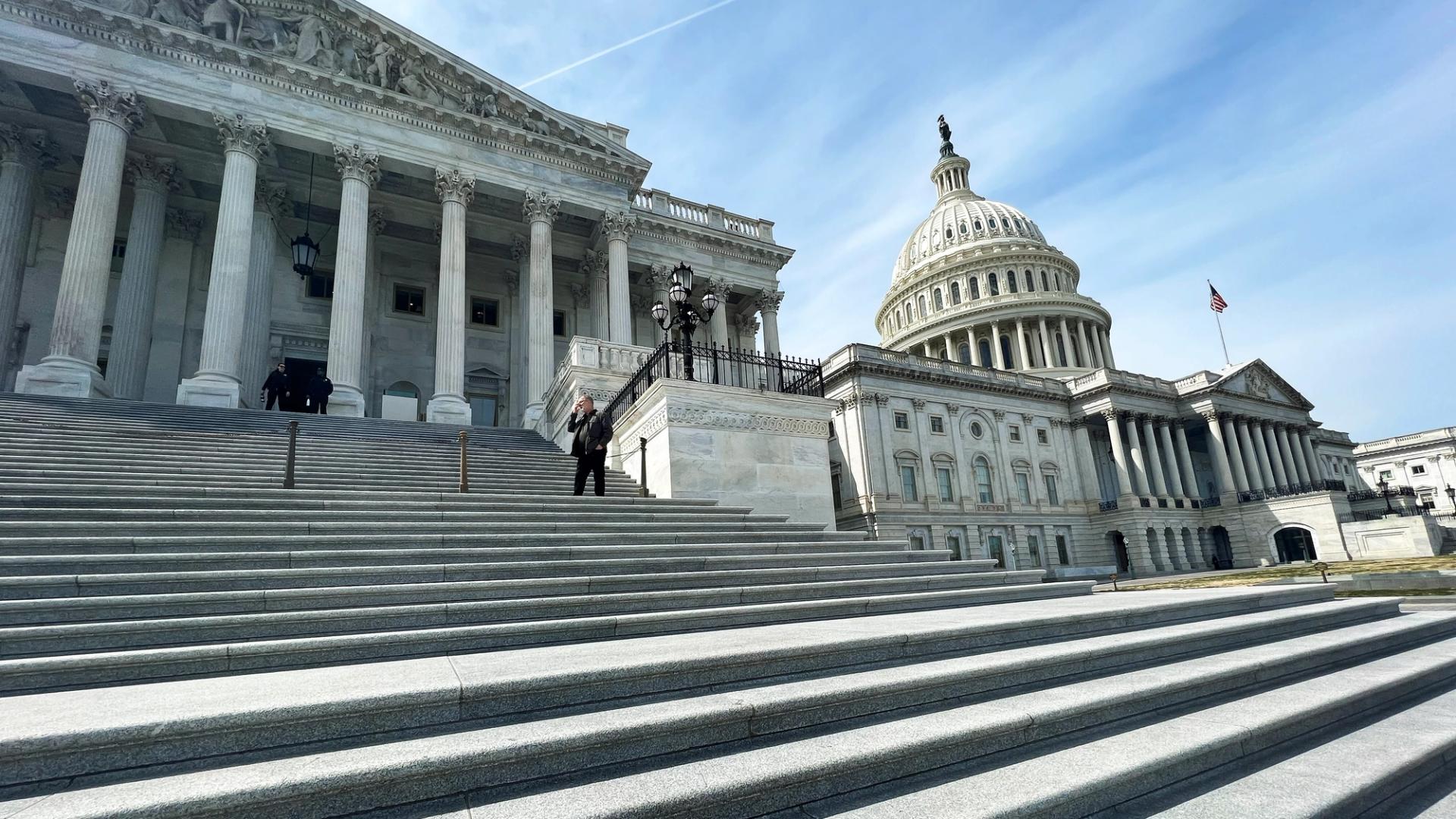
Industry representatives saw the crypto market structure bill’s proposed yield language on March 23 and 24. The internet — at least X (formerly Twitter) — was unhappy, but it may not matter much.
You’re reading State of Crypto, a CoinDesk newsletter looking at the intersection of cryptocurrency and government. Click here to sign up for future editions.
The narrative
We* have new language outlining how the crypto market structure bill could address stablecoin yield.
*Only some people have seen the language, though it should be released for public consumption and review next.
Why it matters
Senator Cynthia Lummis (R-Wyo.) said earlier this month that she expected a market structure bill markup — the hearing where lawmakers debate amendments and language before voting on a bill — in the second half of April. Lawmakers have taken the first step toward that markup with an agreement on crypto market structure legislation.
Breaking it down
Crypto and banking industry representatives saw the proposed “agreement-in-principle” announced last week by Senators Angela Alsobrooks (D-Md.) and Thom Tillis (R-N.C.) at the start of this past week, with crypto representatives meeting with legislative staffers on Monday and banking representatives meeting with staffers on Tuesday.
No one appears to be particularly happy with the agreement. The language has not yet been released publicly, though it should come out this upcoming week. Concerns range from the possibility that the proposed language will call for regulators to draft new rules around permissible activity to how it might restrict stablecoin yield balances.
It’s unlikely that the language will see major revisions, though one person familiar said they expected there could be some minor changes. Many of the necessary changes are just technical tweaks, they said.
Still, industry interests appear headed toward presenting some sort of counterproposal on the language. It remains to be seen how far that goes.
This week
- Congress is expected to be on its two-week Easter recess, though the ongoing fight over funding the Department of Homeland Security might change things.
If you’ve got thoughts or questions on what I should discuss next week or any other feedback you’d like to share, feel free to email me at [email protected] or find me on Bluesky @nikhileshde.bsky.social.
You can also join the group conversation on Telegram.
See ya’ll next week!

A crypto team recently apologized for betting on their own fundraiser, a reminder that insider information moves first while retail traders find out last. This isn’t a theory; it’s the market’s default state.
DeepSnitch AI (DSNT) was built to flip this script. While teams front-run their own raises, DSNT’s five AI agents intercept malicious contracts and flag honeypots in real-time, protecting your wallet before it takes a hit.
With over $2.6 million raised and a confirmed March 31st Uniswap listing, the $0.04669 entry price is nearly history. Secure the tools to beat the insiders before the crowd arrives, and the DeepSnitch AI price prediction will take care of the rest.
P2P.me’s prediction market scandal highlights crypto’s insider trading problem
The P2P.me team recently apologized for betting on its own $6 million fundraiser on Polymarket ten days before launch. Despite only having a verbal commitment from Multicoin Capital, they wagered on their own success. The raise ultimately fell short at $5.2 million, with “insider” profits now being redirected to the DAO treasury.
This lapse coincides with a major U.S. regulatory crackdown. This week, lawmakers introduced the PREDICT Act and the Public Integrity in Financial Prediction Markets Act, targeting insider trading by government officials.
While teams and institutions exploit information gaps, DeepSnitch AI (DSNT) levels the playing field. Its five live AI agents identify malicious contracts and honeypots in real-time. Secure your $0.04669 entry before the March 31st Uniswap listing permanently closes the door on this advantage.
Top 3 cryptos to own this year
DeepSnitch AI
The P2P.me scandal is a reminder of how crypto’s information game works. Insiders and institutions move first, leaving retail to absorb the consequences. Whether it’s coordinated ETF exits or teams front-running their own raises, retail traders are consistently the last to know and the first to get hurt.
DeepSnitch AI (DSNT) exists to close this asymmetry. Its five live AI agents intercept malicious contracts, flag honeypots, and audit risks in real-time.
This utility is exactly why DSNT raised over $2.6 million during a hostile market. At $0.04669, the project is backed by a functional product that traders are already using to protect their capital, which in turn pushed the DeepSnitch AI price prediction into the sky.
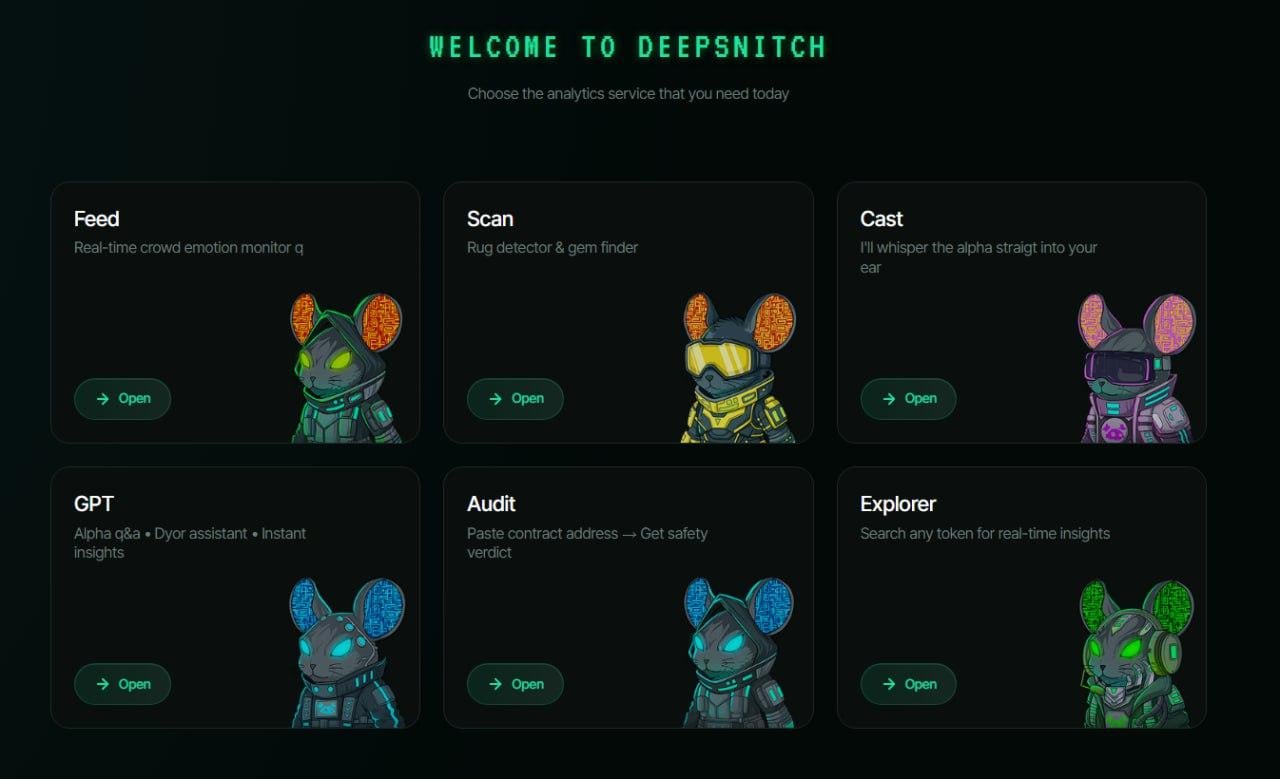
Compare this to “wait-and-see” setups: Bitcoin Cash (BCH) needs a $500 breakout to confirm, and Solana (SOL), despite owning 98% of on-chain equity volume, is still waiting for a monthly bullish confirmation.
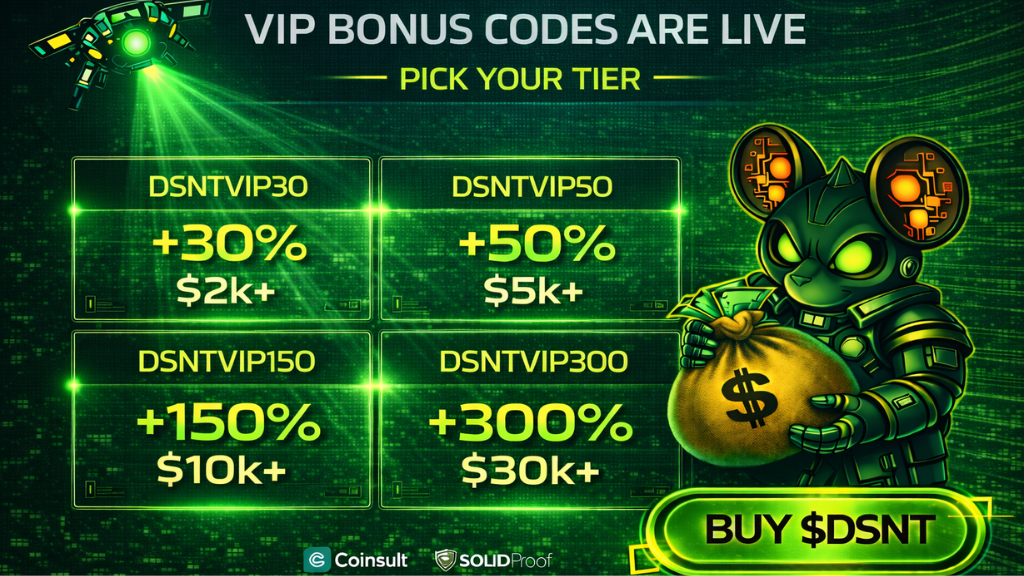
DSNT doesn’t ask you to wait. The March 31st Uniswap listing is the hard deadline. This is your final opportunity to secure presale bonuses and ground-floor pricing before open-market discovery takes over. Insiders have always had the edge; now, you have the counter, and that’s why the DeepSnitch AI price prediction looks at 200x returns from now.
Bitcoin Cash
BCH started coiling at $476 on March 27, building massive pressure beneath the $500 resistance level. This zone holds the market’s heaviest short liquidation cluster; a breach here would ignite a violent squeeze toward $560+.
While BCH builds this powerful technical floor, DeepSnitch AI (DSNT) is already in full motion. Raising $2.6 million through extreme market fear, DSNT is heading straight for its March 31st Uniswap listing.
While other assets wait for macro confirmation, DSNT delivers immediate price discovery. Secure your $0.04669 entry before the window shuts in two days; the edge belongs to those who move now.
Solana
Solana is flashing a 4-hour TD Sequential buy signal, indicating potential exhaustion of its recent downtrend. Dominating 98% of tokenized spot equity volume and processing 826 million weekly transactions, SOL’s infrastructure lead is undeniable.
A monthly bullish engulfing candle is currently developing, historically the precursor to every major Solana rally. While SOL awaits monthly confirmation to target $120, DeepSnitch AI (DSNT) is moving now.
With its March 31st Uniswap listing only two days away, DSNT offers immediate price discovery. Secure your $0.04669 entry before the window shuts and the open market reprices this utility permanently.
The bottom line
P2P.me’s team betting on their own fundraising confirms that information asymmetry is the real game.
Most retail traders play blind against insiders who move weeks earlier. While BCH shows textbook compression and SOL commands 98% of on-chain equity volume, both require waiting for confirmation. They don’t bridge the information gap that insiders exploit.
DeepSnitch AI (DSNT) does. Its five live AI agents flag malicious contracts and honeypots in real-time – no institutional connections required. Having raised $2.6 million during a hostile market, DSNT proves its utility is essential.
The March 31st Uniswap listing is the definitive cutoff. This is your final opportunity to secure the $0.04669 entry before the 200x DeepSnitch AI price prediction comes true.
Visit the official website for more information, and join X and Telegram for community updates.
FAQs
What is the DeepSnitch AI price forecast heading into its Uniswap listing?
The DeepSnitch AI price prediction looks promising, with the token still at $0.04669, over $2.6M raised, and bonuses disappearing at listing as the March 31st presale close approaches.
What is the DeepSnitch AI price target for investors buying during the presale?
The DeepSnitch AI price prediction points to significant multiples, with utility-driven adoption rather than market sentiment powering its value through real-time contract auditing and threat detection that functions regardless of market direction.
What is the DeepSnitch AI prediction for 2026 based on its fundamentals?
The DeepSnitch AI prediction for 2026 is strongly bullish, with institutional-grade tools now accessible to retail traders, honeypot detection, and contract scanning creating sustained demand that extends well beyond the initial listing day.
Disclaimer: This is a Press Release provided by a third party who is responsible for the content. Please conduct your own research before taking any action based on the content.
Crypto World
Sergey Nazarov Details How Chainlink Economics 2.0 Builds a Virtuous Cycle of Security and Fees

TLDR:
- Chainlink Economics 2.0 is built to support mass adoption from banks, asset managers, and millions of developers.
- Nazarov’s universal payment model lets developers pay in any token, which then converts into LINK for security.
- Lower payment friction means more fees flow into Chainlink, directly strengthening the network’s overall security layer.
- Chainlink’s universal billing system may become a standalone product, reducing payment friction across other blockchain protocols.
Chainlink economics is undergoing a structural shift as the protocol prepares for mass institutional and developer adoption.
Sergey Nazarov, Chainlink’s co-founder, recently outlined how the network’s next economic phase is being designed.
The model centers on creating a self-reinforcing loop. More security drives adoption, adoption generates fees, and fees fund greater security. This cycle forms the foundation of what Nazarov calls Economics 2.0.
A Universal Payment System to Reduce Developer Friction
The core of Economics 2.0 is a flexible, universal billing infrastructure. Nazarov explained that developers should be able to pay into the system however they prefer. That includes native tokens, their own project tokens, or even cash payments.
Once received, those payments get converted into Chainlink’s native token. This conversion ensures the system maintains consistent security funding regardless of how fees arrive. The process removes unnecessary barriers for developers integrating Chainlink services.
Nazarov described the payment model directly, stating that the goal is to have “an efficient payment system that allows users, developers of the protocol to pay into the system however they like, in whatever form they like, their own token, native tokens, some other form of payment, cash payments, whatever payments.” He added that this would then be “converted into the token of the system to create the necessary security.”
Reducing payment friction matters because lower friction means higher participation. When developers pay more easily, more fees flow into the network. Those fees then strengthen the system’s overall security layer.
Targeting a Market That Does Not Yet Fully Exist
Chainlink’s current market is not yet operating at the scale Economics 2.0 is designed for. Nazarov noted that millions of developers, global banks, and asset managers are not yet fully on-chain. That transition remains ahead.
Economics 2.0 is being built in anticipation of that larger market. The protocol is preparing its infrastructure now so it can handle that volume when it arrives.
Nazarov was direct about the current state, saying the market adoption “is not in the millions of developers” and “not in the world of all the banks, and all the asset managers.” That is precisely the world Economics 2.0 is being built for.
As the market grows, the value placed on security is expected to grow with it. Greater security should then attract more adoption across institutional and Web2 participants.
Nazarov summarized the broader ambition by stating, “the goal is to get as many fees into the system as possible so those fees feed back into the security of the system.”
Chainlink’s ability to provide reliable price data positions it uniquely for this role. Nazarov suggested the universal billing system could eventually become a standalone product for other protocols.
He noted that “a universal billing system, payment system will even become a product of a kind for other protocols because you do want to lower the friction that people have to go through to pay for anything.” The model is designed to scale alongside the market it serves.


OnePay, which is majority-owned by Walmart, has added more than a dozen crypto tokens to its offerings that the executive responsible for digital assets said “meet a high bar” that’s been set by the banking app’s customers.
Since launching in January, offering Bitcoin (BTC) and Ethereum (ETH) on its its nascent crypto platform, OnePay on Thursday added SUI (SUI), Polygon (POL) and Arbitrum (ARB) just days after listing another 10 tokens, including Solana (SOL), , Cardano (ADA), Bitcoin Cash (BCH) and PAX Gold (PAXG).
“We plan on continuing to expand thoughtfully, prioritizing assets that meet a high bar: demand, liquidity, regulatory clarity and long-term utility,” Ron Rojany, OnePay’s general manager, Core App & Crypto, told Cointelegraph in an email.
“We’re less focused on chasing the latest asset and more focused on offering a curated set of assets that align with how our customers actually use and think about their money,” he said.
Rojany would not disclose any figures on crypto adoption among OnePay’s account holders, saying only that the fintech is seeing “strong engagement, particularly among customers who are newer to crypto and are looking for an easy and integrated way to get started.”
OnePay has positioned itself as a US version of a “superapp,” modeled after China’s WeChat. The platform already offers banking services including high-yield savings accounts, credit and debit cards, loans and wireless plans.
The company also offers a digital wallet that customers can use at checkout in Walmart stores and on the retailing giant’s website. The retailing giant’s US operations had net sales of $462.4 billion in fiscal 2025, according to the company’s latest annual report.
“We’re still early and our focus is on building our crypto platform the right way: creating a trusted, safe and intuitive experience for everyday customers,” Rojany said.
Related: BNP Paribas adds six Bitcoin, Ether ETNs for retail clients in France
Fintech pursuit of superapp gets boost from SEC chair
OnePay is not the only company pursuing a financial services superapp. In late September, Coinbase CEO Brian Armstrong outlined plans to build a crypto superapp, offering credit cards, payments and Bitcoin rewards to rival traditional banks.
Earlier this month, Japan’s Startale Group said it would use funding from a recently completed $50 million Series A investment round to develop its superapp to integrate payments, asset management and onchain services into a single platform.
US Securities and Exchange Commission Chairman Paul Atkins in September expressed support for platforms offering multiple financial services under one regulatory framework.
The regulator’s updated strategy includes allowing platforms to operate as “super-apps” that can facilitate trading, lending and staking of digital assets under one regulatory umbrella.
“I have directed the Commission staff to develop further guidance and proposals ultimately to make this ‘super-app’ vision a reality,” Atkins said in July.
Magazine: Bitcoin may take 7 years to upgrade to post-quantum — BIP-360 co-author
Crypto World
Onchain RWA Tops $10 Billion and Tokenized Stocks Hit $1B as Institutional Adoption Grows
TLDR:
- Tokenized stocks crossed the $1 billion mark in Q1 2026, reflecting rapid growth in onchain equity markets.
- Total RWA onchain value surpassed $10 billion, showing broad momentum across multiple tokenized asset classes.
- AI-driven asset intelligence shifted from an optional tool to a core infrastructure requirement for onchain managers.
- Liquidity fragmentation in tokenization remains the most critical and valuable unsolved problem entering Q2 2026.
Tokenized stocks have crossed the $1 billion mark, according to data from blockchain analytics platform rwa.xyz. The milestone arrives as the broader RWA onchain market surpasses $10 billion in total value.
These figures come at the close of Q1 2026, a quarter that saw institutional participation grow at a faster rate than many had expected.
Infrastructure builders are now preparing for what many expect to be a more active second quarter across tokenized asset markets.
Tokenized Stocks Hitting $1B Signals a Broader Market Shift
Tokenized stocks crossing the $1 billion threshold marks a clear turning point in onchain equity markets. Block Street shared the figures on X, sourcing the data directly from rwa.xyz.
The account noted that while the market is “still early,” the pace of growth is clearly accelerating. It also pointed out that the current period represents a foundation-building phase, with real expansion still to come.
The $1 billion figure for tokenized stocks did not arrive in isolation. It came alongside the broader RWA onchain market, surpassing $10 billion in the same reporting window.
Together, these numbers reflect a market that is maturing steadily across multiple asset classes. Allocators who were previously watching from the sidelines are now deploying capital in a more structured and recurring manner.
The speed at which tokenized equities reached this milestone has drawn attention from both institutional and retail corners of the market. Just a few quarters ago, tokenized stocks were still considered an experimental layer within onchain finance.
That perception has shifted noticeably through Q1 2026. The $1 billion mark now serves as a reference point for how quickly this segment can scale when the right infrastructure is in place.
RWA Infrastructure Gaps and AI Tools Take Center Stage in Q2
Orca Prime published a Q1 2026 review at the close of March, identifying three clear patterns from the quarter. Institutional RWA adoption continued to accelerate rather than plateau throughout the period.
AI-driven asset intelligence also moved from a supplementary tool to a core operational requirement for onchain managers.
The account stated that a liquidity infrastructure gap in tokenization remains the most valuable problem currently unsolved in the market.
Each of those three patterns gained further clarity as tokenized stock volumes climbed through the quarter. As more institutional capital entered the space, the need for reliable, automated intelligence around onchain assets became more direct.
Orca Prime described this transition as a structural shift rather than a passing trend. The firm noted that all data points from Q1 pointed consistently in the same direction.
Orca Prime stated it spent Q1 building infrastructure aligned specifically with the liquidity gap it identified. The firm views this problem as the most consequential challenge facing the tokenization market right now.
With tokenized stocks now past the $1 billion level and total RWA on-chain above $10 billion, the pressure to solve liquidity fragmentation is growing.
The account closed its review by framing Q2 as the period where the groundwork laid in Q1 would begin to produce visible results.

Worldcoin’s parent foundation, Sam Altman’s World Foundation, disclosed a $65 million over-the-counter sale of its native WLD token, carried out by its issuance arm World Assets across four counterparties. The first settlement occurred on March 20, with tokens priced at an average around $0.27, suggesting roughly 239 million WLD changed hands. The fund-raising is described by the foundation as supporting core operations, research and development, orb production, and broader ecosystem initiatives.
The sale comes amid a volatile price environment for WLD, which touched an all-time low near $0.24 in the wake of the announcement before recovering to roughly $0.27. From a peak near $11.82 in March 2024, the token has retraced about 97%, underscoring the substantial drawdown since the project’s early hype. Data from CoinMarketCap places WLD around $0.2725 on the latest trading session, up modestly on the day.
Key takeaways
- The World Foundation reports a $65 million OTC token sale, with ~239 million WLD transferred at an average price of about $0.27 across four counterparties and the first settlement on March 20.
- WLD traded briefly at an all-time low around $0.24 before rebounding to roughly $0.27, leaving the token about 97% below its March 2024 peak.
- Of the total sale proceeds, $25 million worth of tokens are subject to a six-month lockup, while the remaining balance is liquid immediately.
- A substantial liquidity event looms: about 52.5% of Worldcoin’s 10 billion total supply is scheduled to unlock on July 23, potentially adding material supply into the market.
- The sale heightens ongoing regulatory scrutiny for World, which has faced licensing and data-handling concerns in multiple jurisdictions, including recent activity in Thailand and past probes in Indonesia, Germany, Kenya, and Brazil.
OTC sale details and strategic aim
World Assets, the token issuance arm of World Foundation, executed the latest round of token distribution across four counterparties, with the first tranche settling on March 20. The reported average price of around $0.27 per token implies that roughly 239 million WLD changed hands in this tranche. The foundation stated on its X platform that the funds will support core operations, R&D, orb manufacturing, and broader ecosystem initiatives that underpin World’s vision for a human-verified AI and digital identity framework.
The size and structure of this sale come after World’s fundraising in May last year, when the project raised $135 million at an indicative price of about $1.13 per token from high-profile backers including Andreessen Horowitz and Bain Capital Crypto. The newer round, priced significantly lower, underscores a shift in market reception and liquidity dynamics since the initial funding surge. The lower price also suggests a different risk and discount environment for early investors versus subsequent participants.
Market response and liquidity dynamics
Following the OTC disclosure, WLD’s price action reflected the broader uncertainty around World’s trajectory and token utility. The brief dip to around $0.24 highlighted the sensitivity to large-scale token movements and unlock schedules that can alter supply quickly. Since then, WLD has hovered near the $0.27 level, signaling that liquidity remains shallow enough for sizable trades to move the market, even as occasional bursts of activity occur.
From an investor perspective, the price action here must be weighed against World’s stated use cases and the speed with which the ecosystem’s optics—such as the World app and agent tooling—can translate into tangible demand. While the token sale funds backstop ongoing development, the market must still assess whether World can generate sustained demand for WLD beyond the incentives of initial distribution rounds.
Upcoming unlocks and potential supply implications
DefiLlama tracks a forthcoming unlock event that stands to reshape the supply equation: approximately 52.5% of Worldcoin’s 10 billion total supply is slated for release on July 23. This implies a potential wave of new WLD entering circulation, which could apply further downward pressure on price absent offsetting demand catalysts. Historically, large unlocks in token projects have led to near-term softness, especially when macro conditions are range-bound or negative for risk assets.
Market participants will be watching how World and its ecosystem partners articulate utility and demand for WLD in the months ahead. The degree to which new applications, integrations, or product milestones mitigate supply pressure will be a key factor in determining whether price declines translate into a more durable valuation floor or simply reflect near-term overhang ahead of July’s unlock.
Regulatory backdrop and global headwinds
The regulatory narrative surrounding World remains complex and eventful. In October of the prior year, Thai regulators raided an iris-scanning site linked to World, prompting investigations by the Securities and Exchange Commission and the Cyber Crime Investigation Bureau over potential licensing violations and biometric data concerns. The Thai episode added to ongoing scrutiny World has faced in other jurisdictions, including Indonesia, Germany, Kenya, and Brazil, where questions around licensing, data handling, and user consent have persisted.
As World continues to expand its footprint with ventures like AgentKit and partnerships (such as Coinbase integration to enable human-verified AI agents), the company faces a delicate balance between advancing its global ambitions and navigating a mosaic of regulatory regimes. The outcome of ongoing inquiries and licensing reviews will likely influence how quickly the project can scale its user base and real-world utility, which in turn bears on WLD’s longer-term value proposition.
A look back and what to watch
The May 2023 fundraising round set a high-water mark for World’s early investor enthusiasm, illustrating the stark contrast between initial euphoria and the current market reality. Today, investors are more focused on execution: can World deliver practical, trustless, human-verified AI tools, a reliable cloud of biometric-enabled identity services, and a robust developer ecosystem that yields durable demand for WLD?
Looking ahead, two factors will shape the near-term trajectory. First, the July 23 unlock will test how the market absorbs a large influx of supply amid uncertain near-term demand. Second, regulatory developments—ranging from licensing clarifications to data-protection safeguards—will influence World’s ability to operate in key markets and attract enterprise users. If World can demonstrate clear, privacy-conscious value with widespread adoption, WLD could begin to trade with more than a purely speculative impulse. Until then, price action is likely to remain sensitive to new updates, regulatory signals, and the cadence of product milestones.
In the near term, readers should monitor World’s public disclosures, upcoming product launches, and any additional strategic partnerships that can translate into tangible demand for WLD. Regulatory clarity and the pace of ecosystem development will likely be the decisive factors in determining whether Worldcoin can reframe its narrative from one of ambitious tech ambitions to a widely adopted, privacy-conscious identity layer.
TLDR:
- Bitcoin lacks a central body to coordinate a quantum-proof upgrade, making the transition socially and technically difficult.
- Around 1.7 million inaccessible BTC face quantum theft risk, forcing miners to choose between freezing or losing those coins.
- Bitcoin’s declining block subsidy raises long-term security concerns, as transaction fees are unlikely to fill the funding gap.
- Ethereum’s proof-of-stake model and Foundation coordination give it structural advantages over Bitcoin in security and adaptability.
Bitcoin’s long-term viability is under scrutiny as three structural problems emerge around quantum resistance, inaccessible coins, and economic security.
These concerns have resurfaced in crypto discussions, with analysts comparing the two largest networks. While Bitcoin remains the dominant digital asset by market cap, some observers believe Ethereum’s design choices may position it more favorably over time.
The debate has reignited questions about governance, adaptability, and the future balance of power between the two networks.
Bitcoin’s Quantum and Governance Problems Draw Fresh Attention
Bitcoin’s decentralized structure, often praised as a strength, may complicate its quantum upgrade. Unlike Ethereum, Bitcoin lacks a central coordinating body to manage such a technical shift. Its conservative culture makes large-scale protocol changes socially difficult to push through.
Crypto analyst John Galt raised this concern directly on X, noting that “Bitcoin has no central entity to coordinate the quantum upgrade.” He added that Bitcoin’s culture makes big changes “socially very difficult.” This cultural resistance could slow necessary adaptations.
The inaccessible coin problem adds another layer of complexity. Around 1.7 million BTC are presumed lost or inaccessible, making them vulnerable once quantum computing matures. Moving these coins to quantum-proof addresses requires owner action, which is impossible for lost holdings.
This creates a binary dilemma: miners could freeze those coins, or quantum hackers could eventually claim them. Either outcome risks fracturing the Bitcoin community. Galt compared the potential fallout to the block size war, which split the network years ago.
Ethereum’s Design Offers Structural Solutions, Analysts Argue
Ethereum’s approach to quantum readiness differs significantly from Bitcoin’s. The Ethereum Foundation can coordinate protocol upgrades more efficiently. Additionally, far fewer ETH are presumed inaccessible, reducing the quantum vulnerability gap.
On the economic security front, Bitcoin’s block subsidy will continue declining over successive halving cycles. Transaction fees alone are not expected to replace that subsidy reliably. This raises long-term questions about miner incentives and network security.
Ethereum, meanwhile, transitioned to proof-of-stake, which removes dependence on mining subsidies entirely. Galt noted that “the economic security problem is solved with PoS and effective tail emissions.” This structural difference could matter more as both networks age.
Culturally, the two ecosystems are also shifting in opposite directions, according to Galt. He pointed to Michael Saylor’s growing influence as a force reshaping Bitcoin’s culture toward institutional conservatism. By contrast, the recent Ethereum Foundation manifesto signaled a more cypherpunk direction.
Galt concluded that these combined factors could drive ETH to gain ground against BTC in the coming years. He framed the current ETH valuation as comparable to buying BTC at $12,200, citing relative market caps. Whether that comparison holds will depend on how each network navigates these structural pressures.

Bitcoin challenges the conventional wisdom of institutional custody. As a bearer asset, its security model hinges on cryptographic keys rather than account credentials, and every on-chain transaction is final. That fundamental design—one where there is no central authority that can reverse, freeze, or recover funds—forces a rethink of how institutions should hold and govern large crypto positions. In this perspective, Kevin Loaec, CEO of Wizardsardine, argues that policy-driven, on-chain custody offers a more resilient framework than traditional custodial outsourcing, which often hides risk behind insurance and service-level agreements.
Loaec maintains that outsourcing risk to large custodians creates a hidden concentration of risk: assets pooled under a single governance umbrella, guarded by layers of internal controls, with off-chain governance and policy enforcement. When trouble hits, the absence of on-chain, protocol-enforced constraints can complicate recovery and liquidation. The result, he says, is a mismatch between the safety institutions expect from custodians and the actual safety Bitcoin beneficiaries gain from controlling the asset directly on the blockchain.
Key takeaways
- Bitcoin’s bearer-asset nature means control is located in cryptographic keys, not in multi-party account permissions, making external intervention impossible once funds move on-chain.
- Policy-driven, on-chain custody can embed governance into the wallet itself—requiring multi-signature approvals, time delays, and defined recovery paths that are executed deterministically by code.
- Traditional custodial insurance often comes with caps, exclusions, and conditional payouts; on-chain custody can offer a more transparent and bounded risk model for insurers and clients alike.
- Vendor dependence introduces outages, withdrawal freezes, and access restrictions that can impede timely actions; open, on-chain custody helps preserve access even if a service provider falters.
- Institutions should reassess custody architecture to align risk management with the protocol’s guarantees, moving away from the illusion of safety toward engineered resilience.
Rethinking custody: from delegated control to protocol-level governance
Traditional finance treats custody as a delegated responsibility: assets are held by a large, regulated custodian, and responsibility for risk management is externalized through contracts, insurance, and service-level commitments. In Bitcoin, however, governance cannot be outsourced in the same way. Keys hold the asset, and the network enforces the rules; there is no central authority that can step in if something goes wrong off-chain.
Loaec notes that when institutions pool keys or rely on shared access models, they inadvertently create concentrated risk points. A single compromised key, misconfiguration, or a regulatory action affecting the custodian can jeopardize many parties at once. History provides cautionary examples where centralization in custody led to lengthy recovery processes and opaque outcomes for creditors and users alike. The argument is not to abandon custodians entirely, but to reframe governance so that the asset itself—via the protocol—enforces the rules of control, authorization, and recovery.
What changes, then, is not the need for robust service providers, but the architecture of control. If governance lives outside the asset, it remains vulnerable to external shocks, audits, and updates that may not align with a custodian’s business cycle. Embedding governance into the wallet, on-chain, makes the controls resilient to provider-specific failures and shifts risk toward systems that can be audited, tested, and iterated independently of any single institution.
Policy-driven custody: enforcing rules at the protocol level
The core idea is practical: Bitcoin scripting enables custody models that reflect real organizational needs. Multisignature schemes can require several stakeholders to approve transactions, preventing unilateral movements. Time-delayed spending features can create a window for review, accident recovery, or dispute resolution. Recovery paths for lost keys can be encoded so that funds remain recoverable under predefined conditions, without exposing the asset to a single point of failure.
In effect, policy-driven wallets separate daily operations from emergency controls, while ensuring that the enforcement mechanism remains transparent and deterministic. These capabilities are not theoretical—on-chain rules operate independently of any service provider’s back-end or a particular vendor’s interface. The result is a governance model that is structural rather than procedural: the network enforces the rules, not a custodial dashboard.
As such, institutions can design custody that aligns with their internal risk appetite and regulatory expectations, without relying solely on external assurances. This shift does not eliminate the need for sound risk management or for prudent risk transfer tools, but it reframes what “control” means in a way that is more faithful to Bitcoin’s mechanics.
Insurance and risk transfer: rethinking the safety net
Custodial insurance has long been pitched as the ultimate safeguard against losses. Yet, Loaec emphasizes that coverage is frequently capped, conditional, or subject to exclusions, with payouts depending on the specifics of an incident and the custodian’s internal controls. In practice, insurance often distributes a portion of risk rather than eliminating it entirely. This dynamic can leave clients exposed in systemic events or scenarios where coverage does not scale proportionally with assets under custody.
By contrast, individually controlled, policy-driven wallets offer a more predictable underwriting landscape. When risk is bounded and controls are transparent, insurers can model exposure more accurately, and risk remains tied to well-defined on-chain rules. The insurance narrative, therefore, should be understood as a complement—not a substitute—for robust, on-chain governance. The aim is to reduce reliance on external guarantees and to ensure that the most critical risk controls live on the asset itself.
Historical episodes underscore the tension between custodial trust and real-world outcomes. Notable episodes, including the FTX collapse and other centralized-brokerage stress events, have exposed the fragility of relying solely on third parties for asset safety and access. These events have fed the argument for reimagining custody through on-chain policy, where safeguards are built into the protocol and verification occurs in a verifiable, auditable manner.
Sovereignty is operational, not philosophical
Vendor dependence introduces another layer of operational risk that institutions may underestimate. Custodial outages, shifting policies, or regulatory interventions can render funds temporarily inaccessible, complicating cross-border operations or time-sensitive actions. In the wake of withdrawal freezes and access restrictions seen in past episodes, the case for a governance model anchored in the asset itself grows stronger.
Open-source custody systems paired with on-chain control offer a different risk landscape. If a service provider disappears or alters interfaces, the asset remains accessible because control resides on the blockchain. Interfaces may evolve or providers may be replaced, but the asset’s operability endures. This is not a blanket rejection of custodians, but a call to reduce their centrality in the critical path of asset control and to rely more on protocol-level guarantees.
Trust the protocol, not the promise
Bitcoin presents a rare asset class where governance, recoverability, and control can be designed into the holding mechanism itself. In practice, many institutions still default to login screens, brand reputations, or insurance narratives as proxies for safety. While those signals carry comfort, they do not replace the certainty offered by on-chain rules that are independent of any single counterparty.
The critique is not anti‑custodian; it is anti‑risk management by proxy. By adopting policy-driven wallets and on-chain governance, institutions can reduce the likelihood of catastrophic failure in the first place, rather than relying on post hoc compensation after a breach. The technology to enact this shift exists today, supported by mature tooling and a growing ecosystem of practitioners focused on designing custody that aligns with Bitcoin’s native security model. What remains is the willingness to move beyond custody models rooted in another financial era.
By Kevin Loaec, CEO of Wizardsardine.
For readers tracking the broader implications, the industry has precedent in centralized custody failures and the ongoing debate over how best to align risk management with the decentralized realities of crypto markets. The path forward involves a measured blend of on-chain governance design, prudent risk transfer where appropriate, and a clear understanding that trust in the protocol must come before trust in any single service provider.
Yes, you read the title right. The number of bullish bitcoin wagers, the so-called BTC/USD long positions, on the OG exchange Bitfinex has hit multi-month highs.
But, bulls, hold your cheers, as this metric has become a textbook “contrary indicator” over the years, with upswings characterizing bitcoin’s price downtrends.
Highest since 2023
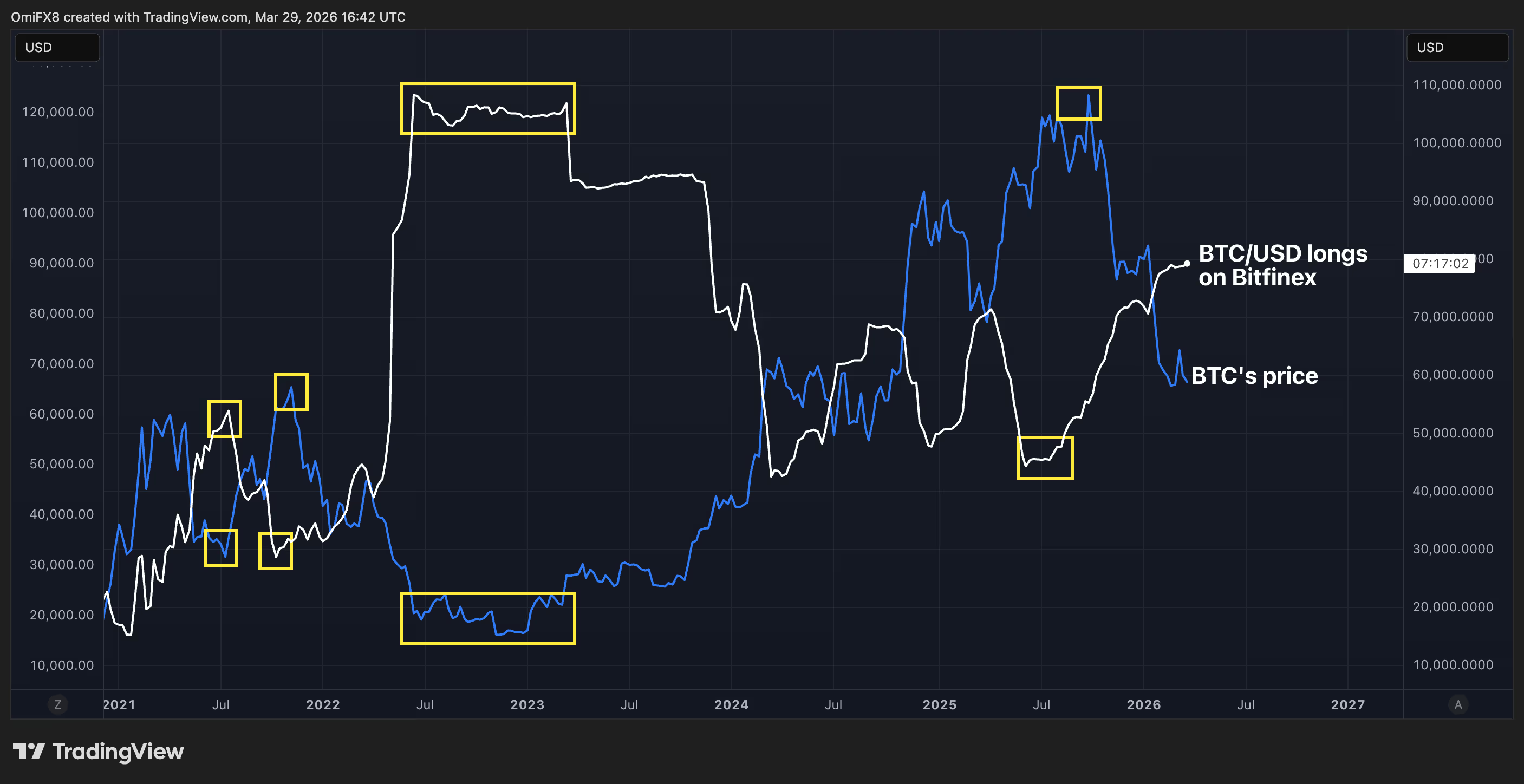
The number of BTC/USD longs has increased to 79,343, the highest since November 2023, according to data source CoinDesk.
Rising bullish bets usually signal growing upside pressure – a positive read. But historically, the market has done the exact opposite, falling just as Mother Nature turns sunny forecasts into storms.
For instance, the number of BTC/USD longs rose 30% in the final quarter of 2025 as BTC’s spot price tanked 23% to $87,550. Similar patterns have been observed in recent years, as seen below.

BTC’s price bottoms when Bitfinex longs peak – and rallies as they decline. Price tops (like October) hit when longs bottom out, then prices slide as longs climb.
Analysts have previously explained this conundrum by saying the crowd is usually clueless, so bet against them.
So, the latest uptick in longs suggests that bitcoin’s choppy price action between $65,000 and $75,000 could soon end with a sell-off, deepening the downtrend that began above $100,000 last year. It goes without saying that past results are no guarantee of future results.
That said, other factors, such as reports that the U.S. is planning to deploy troops to the ongoing war in Iran, the oil price shock, and fears of a Fed rate hike, also favour the bearish case.
At press time, bitcoin traded around $66,400, according to CoinDesk data.
Bitcoin Longs Hit Multi-Year High on Bitfinex, Raising Downside Risk

Zack Polanski calls out BBC’s woeful protest coverage

Anniversary party at Apple Park will feature a British Invasion performance


-
 NewsBeat4 days ago
Manchester United reach agreement with Casemiro over contract clause amid transfer speculation
-

 News Videos4 days ago
Parliament publishes latest register of MPs’ financial interests
-

 Sports6 days ago
Remo Stars and Kano Pillars Strengthen Survival Hopes in NPFL
-

 Sports6 days ago
Gary Kirsten Accuses Pakistan Cricket Board Of ‘Interference’, Mohsin Naqvi Responds
-

 Tech7 days ago
Give Your Phone a Huge (and Free) Upgrade by Switching to Another Keyboard
-

 Tech7 days ago
AI enters the chat: New Seattle dating app relies on tech to facilitate meaningful human connections
-

 Business3 days ago
Instagram, YouTube Found Responsible for Teen’s Mental Health Struggle in Historic Ruling
-

 News Videos6 days ago
Ch 9 Financial Management Part 1 | Detailed One Shot | Class 12 Business Studies Boards 2026
-

 NewsBeat2 days ago
The Story hosts event on Durham’s historic registers
-
 NewsBeat4 days ago
Tesco is selling new Cadbury Dairy Milk bar and people can’t wait to try it
-

 Tech6 days ago
Samsung will soon let you control smart home devices from your car’s dashboard
-

 Sports7 days ago
2026 Kentucky Derby horses, odds, futures, preview, date: Expert who hit 12 Derby-Oaks Doubles enters picks
-
 Entertainment20 hours ago
Lana Del Rey Celebrates Her Husband’s 51st Birthday In New Post
-
 Entertainment6 days ago
Cynthia Bailey Dishes on ‘RHOA’ Season 17, Discusses Kandi
-
 NewsBeat6 days ago
Colombian military plane with 110 soldiers onboard crashes following takeoff
-

 Fashion5 days ago
Does It Matter What You Wear When You’re Laid Off and Looking?
-

 Business5 days ago
More women enter wealth management, but few in advisory roles: study
-

 Business5 days ago
Late-paying firms face multimillion-pound fines under new crackdown
-

 Sports4 days ago
Fantasy Baseball Week 1 Preview: Top sleeper hitters for both five- and 12-day period led by Munetaka Murakami
-

 Politics6 days ago
How Media Platforms Balance Performance and Accessibility in Image Delivery
You must be logged in to post a comment Login