

Crypto World
Bitcoin Longs Hit Multi-Year High on Bitfinex, Raising Downside Risk

Bitcoin long positions on Bitfinex have surged to roughly 79,343 BTC, the highest level since November 2023. Analysts view this spike as a warning signal.
Historically, similar buildups in leveraged longs have coincided with local price tops or sharp declines.
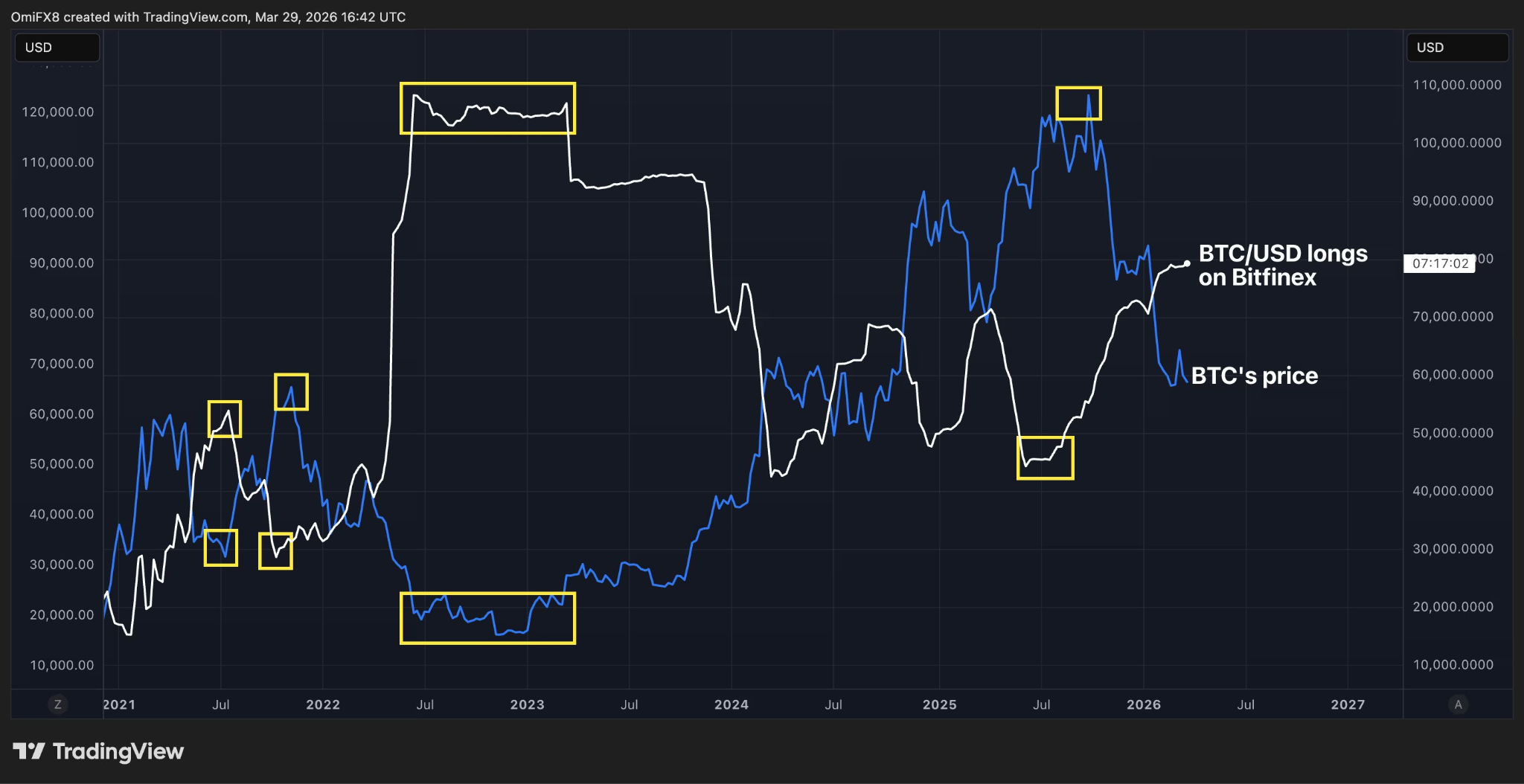
This metric reflects margin traders betting on higher prices. However, when positioning becomes crowded, the market often turns fragile.
Is Bitcoin Price About to Crash Hard?
With many traders already long, fewer buyers remain to sustain upward momentum. As a result, price rallies tend to stall.
Moreover, these positions are typically leveraged. If Bitcoin drops even slightly, forced liquidations can trigger rapid selling. This creates a cascade effect, where falling prices lead to more liquidations and deeper declines.
Past cycles have shown this pattern repeatedly during periods of excessive long exposure.
At the same time, broader macro conditions remain uncertain. Equity markets have weakened, and geopolitical tensions continue to weigh on risk assets.
Bitcoin has recently traded in a tight range, struggling to break resistance. In such an environment, crowded long positioning increases vulnerability to downside moves.
Large market participants also monitor these imbalances. When positioning becomes one-sided, they may push prices lower to trigger liquidations and accumulate at cheaper levels.
This dynamic is common in derivatives-driven markets.
Bitcoin’s current structure remains range-bound. However, the surge in Bitfinex longs suggests the market is overextended on the bullish side.
Unless strong spot demand emerges, the risk of a sharp correction remains elevated.
The post Bitcoin Longs Hit Multi-Year High on Bitfinex, Raising Downside Risk appeared first on BeInCrypto.

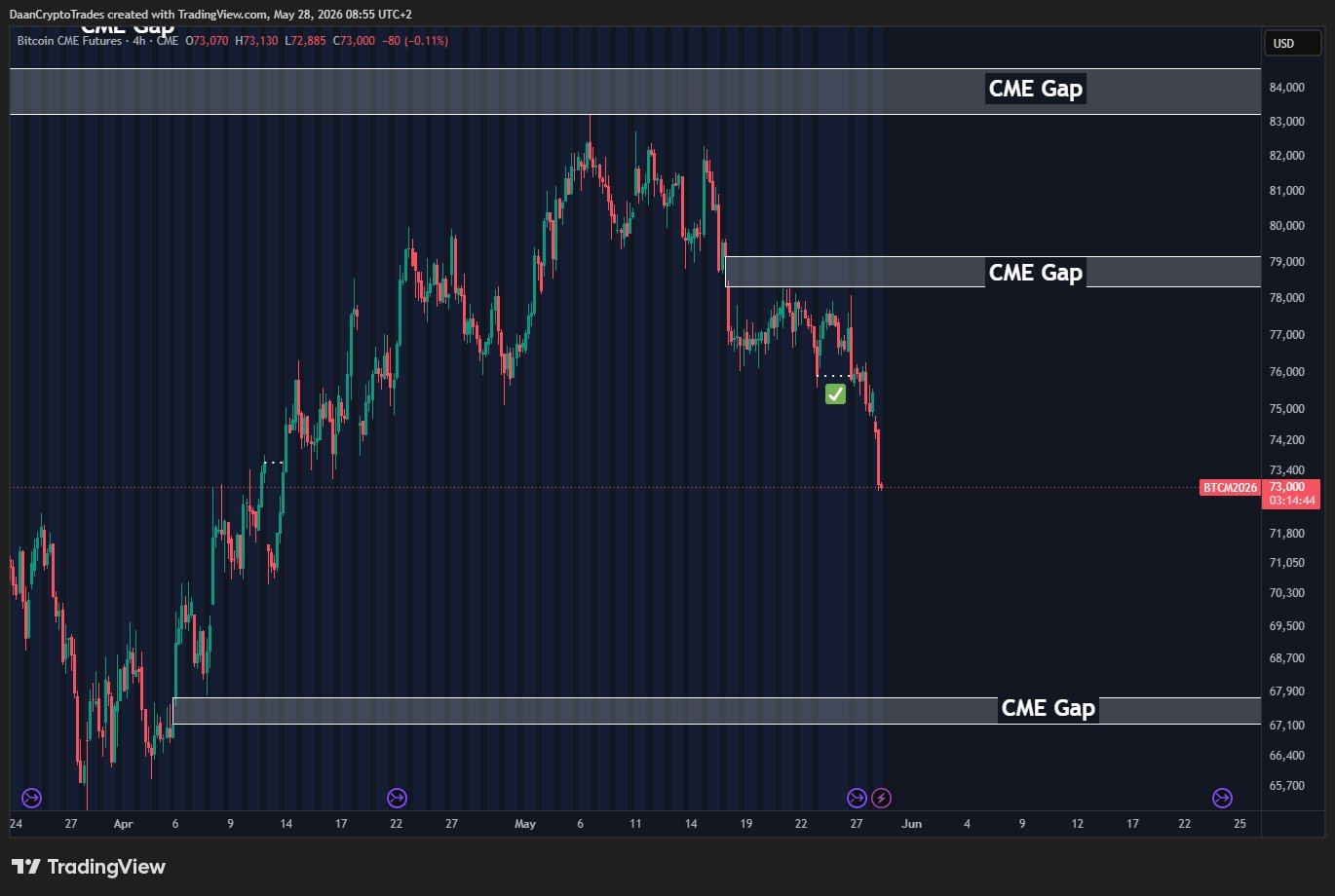
Bitcoin (BTC) starts its first full trading week with no new CME futures gap on the chart. The shift ends an eight-year market quirk that traders relied on to forecast short-term price targets.
The Chicago Mercantile Exchange (CME) moved its regulated cryptocurrency futures and options to around-the-clock trading on May 29. The change removed the weekend closure that had produced visible price gaps since Bitcoin futures launched in December 2017.
Why the CME Gap Mattered for Bitcoin Traders
For nearly nine years, CME Bitcoin futures closed every weekend while spot exchanges and offshore perpetual markets kept trading.
Any weekend move produced a chart gap when futures reopened. Price often returned to fill it within days or weeks.
Historical fill rates ranged from 70% to more than 90%. The pattern became one of the most watched short-term signals in crypto.
The structure also frustrated institutions, which could not adjust hedges over weekends on a regulated venue.

“BTC Closed last weekend’s CME gap and is now trading in the big area between the other few remaining gaps. This weekend, 24/7 trading starts for the Bitcoin CME futures so there won’t be any new gaps created anymore going forward. The ones left standing will of course still sit there on the chart,” wrote analyst Daan Crypto Trades.
Follow us on X to get the latest news as it happens
What Changes Under Continuous Trading
CME now runs Bitcoin, Ether (ETH), Solana (SOL), and six other contracts continuously. Daily maintenance windows run two minutes on weekdays and two hours on Saturdays.
The shift gives portfolio managers, ETF issuers, and corporate treasuries a regulated channel to hedge weekend exposure in real time.
“Client demand for risk management in the digital asset market is at an all-time high, driving a record $3 trillion in notional volume across our Cryptocurrency futures and options in 2025,” read an excerpt in the announcement, citing Tim McCourt, CME Group’s Global Head of Equities, FX and Alternative Products.
The expansion follows record activity across CME crypto products during 2025.
Bitcoin Volatility futures, a new contract tracking 30-day implied volatility, are scheduled to debut on June 1.
Where the Market Sits Now
BTC traded near $73,441 on Sunday, down 3.7% on the week, after the quietest weekend in recent memory.

Three legacy gaps stay open on the chart. Two sit above current price near $78,500 and $80,000, and one below in the $67,000 to $70,000 zone.
Whether those gaps still pull price action under continuous trading is the first real test of the post-gap era.
Early CME volume and open interest on Monday will signal how quickly institutions adapt their playbooks.
The post Bitcoin’s First CME Gap-Free Monday Puts a Popular Trading Signal to the Test appeared first on BeInCrypto.
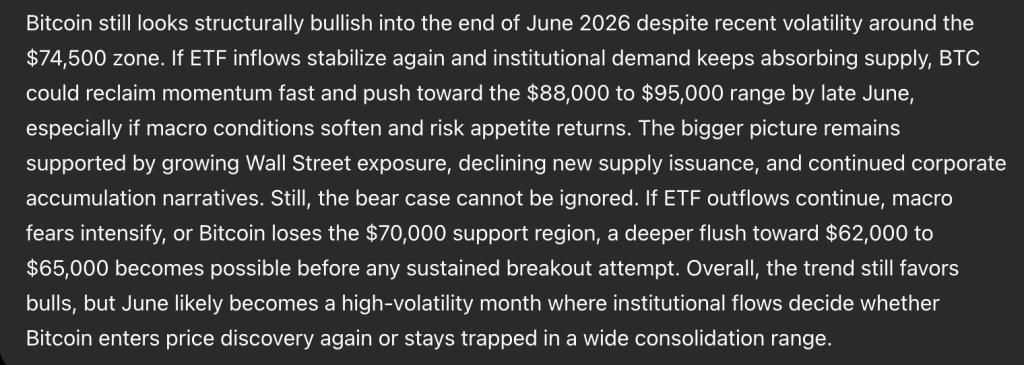
ChatGPT AI is keeping its Bitcoin predicts constructive despite the recent turbulence, targeting $88,000 to $95,000 by end of June 2026 from a current price of $73,516, with the thesis resting on whether institutional flows can step back in and absorb the selling pressure that has been building.
The structural argument Sam Altman’s AI is making is not complicated but it is grounded. Wall Street exposure to Bitcoin has been growing in a way that creates a demand floor that did not exist in previous cycles.
Every major dip gets evaluated by institutional desks that were not in the market 2 years ago, and the post-halving supply dynamics mean fewer new coins are hitting the market each month.
Corporate accumulation narratives are still active, with companies continuing to add BTC to balance sheets as a treasury strategy.
When ETF inflows stabilize and that institutional machinery starts buying again, ChatGPT is saying the path to $88,000 opens up quickly.
June is framed as the deciding month. Not a quiet grind higher, but a high-volatility period where the flows call it either way. If the institutional bid returns and macro conditions soften even slightly, the momentum reclaim toward $95,000 happens fast. If it does not, the range stays wide and unresolved.

The bear case is the one the chart is currently flirting with. ETF outflows continuing, macro fears intensifying around sticky inflation and rates, or a clean break below $70,000 support could trigger a flush toward $62,000 to $65,000 before any recovery attempt gets traction.
ChatGPT is not dismissing that scenario, it is just putting it in the minority column for now.
Bitcoin Is Sitting on the Edge of the Most Important Support Level on This Entire Chart
BTC price is printing $73,516 on the daily and the situation is more delicate than it looks at first glance. The chart shows a clean narrative: a peak near $124,000 in late October, a grinding selloff through November and December, a capitulation wick toward $61,000 in February, a recovery to $98,000 in April, and then another leg down that has brought price back to where it sits right now.
That April recovery to $98,000 failing is the most important recent structure on this chart. It showed that the $95,000 to $100,000 zone is loaded with supply from the distribution that started in November, and that bulls could not sustain buying pressure long enough to clear it.
Since the April rejection price has put in a series of lower highs, and the current $73,516 level is sitting right on top of the $70,000 to $74,000 support band that has absorbed demand on multiple tests since February.
This is the level ChatGPT is watching. A daily close below $70,000 with follow-through changes the entire short-term structure and opens the flush toward $62,000 to $65,000 that the bear case describes. Holding here and building a base above $74,000 is what keeps the June recovery narrative alive.
The immediate resistance on the way back up is $80,000, which capped the most recent rally attempt in early May. Above that $88,000 is the first real test of whether buyers have enough conviction to make ChatGPT’s target range a realistic conversation.
ChatGPT AI Predicts Bitcoin Hyper to Outperform XRP by 1000x
Bitcoin has carried the same limitations since the beginning and the industry has quietly accepted them as permanent.
No smart contracts without leaving the network. No high-speed execution. No programmability that does not require a full migration to a different ecosystem.
Developers who started on Bitcoin did not abandon it because they wanted to. They abandoned it because the infrastructure gave them no other choice. Ethereum and Solana exist partly because Bitcoin never solved its own usability problem.
Bitcoin Hyper is building the solution inside Bitcoin rather than around it.
The architecture combines a Layer 2 directly on Bitcoin with Solana Virtual Machine integration. That means the execution speed and programmability that sent developers to Solana is now available without abandoning Bitcoin’s security model. Fast transactions, near-zero fees, and full smart contract support running on top of the most trusted network in crypto rather than in competition with it.
This gap has been sitting open since Bitcoin launched. Every attempt to solve it has required users to trust a bridge, accept a different security model, or leave the ecosystem entirely. Bitcoin Hyper is the first serious attempt to close it from within.
The presale is at $0.013679 with over $32 million raised and staking incentives for early participants.
Moving Bitcoin’s price by even 10% requires tens of billions in new capital. Early stage infrastructure plays do not work that way. A fraction of that capital moves the needle dramatically at this stage. The upside is asymmetric and so is the risk.
The gap is real. The question the market has not answered yet is whether this is the team that closes it.
The post Sam Altman ChatGPT AI Predicts Bitcoin Price By End of June 2026 appeared first on Cryptonews.

TLDR:
- USDT supply fell as large redemption waves removed over $1.2B from circulation in 24 hours.
- Market cap changes reflect minting and burning cycles tied to stablecoin demand flows data.
- Chain swaps and treasury transfers can distort short-term USDT supply readings across networks.
- Liquidity trends in stablecoin markets often act as early indicators of crypto capital rotation.
$USDT minting and redemption flows drive stablecoin liquidity across exchanges and institutional desks, with recent data showing a sharp contraction following large-scale redemption activity in short-term markets.
Liquidity Rotation and $1.2B Supply Contraction Signal
The recent $1.2B reduction in USDT Market Cap reflects a concentrated redemption wave across major trading platforms.
This movement indicates that large holders converted stablecoins into fiat, reducing circulating liquidity across the ecosystem.
Such behavior is often associated with risk-off positioning and capital preservation strategies among institutional participants.
Exchange data shows that redemption clusters occurred within a compressed 24-hour window across multiple wallets.
Stablecoin supply contraction of this scale often signals temporary liquidity tightening rather than structural weakness.
However, interpretation requires context because chain swaps can distort apparent supply changes without affecting net issuance.
Tether’s mint and burn mechanism ensures that the circulating supply always reflects real demand across markets. Therefore, short-term declines do not necessarily imply sustained capital exit from digital asset markets.
Analysts emphasize monitoring multi-day supply trends instead of isolated snapshots to avoid misleading conclusions.
Broader liquidity cycles often align with macroeconomic sentiment, exchange inflows, and derivative market positioning shifts.
These interconnected factors collectively shape how the $USDT Market Cap evolves across different market phases. Market participants continue to treat stablecoin supply as a proxy for crypto liquidity conditions globally.
This metric is widely observed across exchanges, research desks, and institutional analytics platforms for decision-making. Recent contraction remains within the normal volatility range of circulating stablecoin supply cycles.
USDT Supply Mechanics and Market Cap Adjustments
$USDT Market Cap is determined entirely by circulating supply changes rather than price fluctuations across trading venues globally.
When institutional demand rises, Tether issues new tokens through minting processes backed by equivalent dollar reserves deposits.
This expansion increases liquidity available across exchanges, often correlating with higher trading activity and capital inflows. Such movements are recorded on-chain and reflected in real-time market capitalization tracking dashboards across ecosystems.
Redemption events reduce the USDT Market Cap when holders return tokens to Tether for fiat settlement processing.
This process permanently removes tokens from circulation, creating a measurable contraction in total stablecoin supply across networks.
Such reductions often occur during risk-off sentiment when investors rotate capital from crypto into cash positions.
Chain-level data confirms these burns as verifiable supply adjustments across blockchain records and issuance ledgers.
Market observers track these flows to assess liquidity tightening within stablecoin ecosystems over defined reporting periods.
Short-term volatility in reported supply figures may also stem from operational wallet movements across custodial systems.
These transfers do not always indicate actual market exits but rather internal treasury allocation adjustments. Distinguishing between real redemption and internal transfers is essential for the accurate interpretation of the $USDT Market Cap trends.


A sweeping new executive order from President Donald Trump reshapes how millions of unbanked immigrants may interact with crypto and the US financial system, and who stands to benefit.
Trump has recently signed an executive order “to restore integrity to America’s financial system,” directing federal regulators, including the Treasury Department, to tighten fraud screening and customer identification protocols for undocumented immigrants accessing financial services. The White House cited “gaps in customer identification practices” exploited by criminal networks.
Crypto will fix the immigration issue, we won’t need borders anymore. — BitStrange (@Threadit_us) May 31, 2026
I’ve been saying this for years, they let in all these immigrants so they can make the excuse for digital ID and digital currency  . They will be forced out by starving them and no way to get paid. https://t.co/rvhfDb7ZdN
Policy analysts note the directive could functionally push a large, cash-dependent population further outside traditional banking, and toward crypto rails, stablecoins, and Bitcoin ATMs. It is, ironically, the same pressure that Eric Trump and Donald Trump Jr. have publicly cited as the origin story of World Liberty Financial: “We got into crypto because, out of necessity, we were debanked.”
Trump immigration order could push undocumented migrants toward crypto, stablecoins
On May 19, Trump issued an executive order tasking Treasury and federal regulators to tighten fraud screening and restrict credit lines for undocumented immigrants, citing national security… pic.twitter.com/Eclzn7ZEoG— NewsTongue (@NewsTongueX) May 31, 2026
Today, millions of people are being nudged out of legacy finance, which is, historically, a stablecoin growth event. Trump’s crypto-friendly posture has already shifted regulatory tone in Washington, and this order extends that dynamic into payments infrastructure, a long-term tailwind for digital asset adoption.
Discover: The Best Crypto to Diversify Your Portfolio
Can Bitcoin Price Break Its Resistance? Is Trump the Crypto President?
Bitcoin bounced from a six-week low of $72,600 and has stabilized in the $73,400–$73,900 range, with nearest support at $73,400 and immediate resistance at $75,900. A clean break above that level opens the door to $78,000 and then $79,300, with Bollinger-band resistance capping the near-term upside around $81,200. Below support, deeper demand sits near $68,900.
A prominent chart analyst flagged a rising-wedge breakdown with bearish RSI divergence on the daily timeframe, projecting a downside target near $69,700 and a larger bear-flag target as deep as $52,000, only invalidated on a sustained move above $91,300. Our in-house analyst expects a relatively contained range of $72,300–$75,700 in the near term.
If BTC could hold $73,400 and macro risk sentiment stabilizes, it could push through $75,900 toward $78k+. However, the most likely scenario for now is to see it range, consolidating between $72k–$76k as traders await Washington catalysts and US macro data.
Discover: The Best Token Presales
Bitcoin Hyper Targets Bigger Upside Than Bitcoin and Major Alts Like ETH, SOL, and XRP
When Bitcoin chops sideways, the asymmetric upside tends to hide one layer down the stack. Infrastructure plays, particularly those that solve Bitcoin’s core limitations, attract attention precisely when BTC’s spot chart disappoints. That rotation logic is worth understanding right now.
Bitcoin Hyper ($HYPER) is positioning itself as that infrastructure layer: the first-ever Bitcoin Layer 2 with Solana Virtual Machine (SVM) integration, built to deliver sub-second finality and low-cost smart contract execution on top of Bitcoin’s security model.
The pitch is direct. Hyper breaks through Bitcoin’s three core constraints of slow transactions, high fees, and no programmability without abandoning the trust layer underneath. The project has raised more than $32 million at a current presale price of $0.0136, with 36% APY staking rewards active for early participants.
A Decentralized Canonical Bridge on Hyper handles BTC transfers, keeping the architecture non-custodial.
Research Bitcoin Hyper before the presale closes.
The post Trump Crypto Vision: Immigration Order and Stablecoin Economy Set Stage for Bitcoin appeared first on Cryptonews.
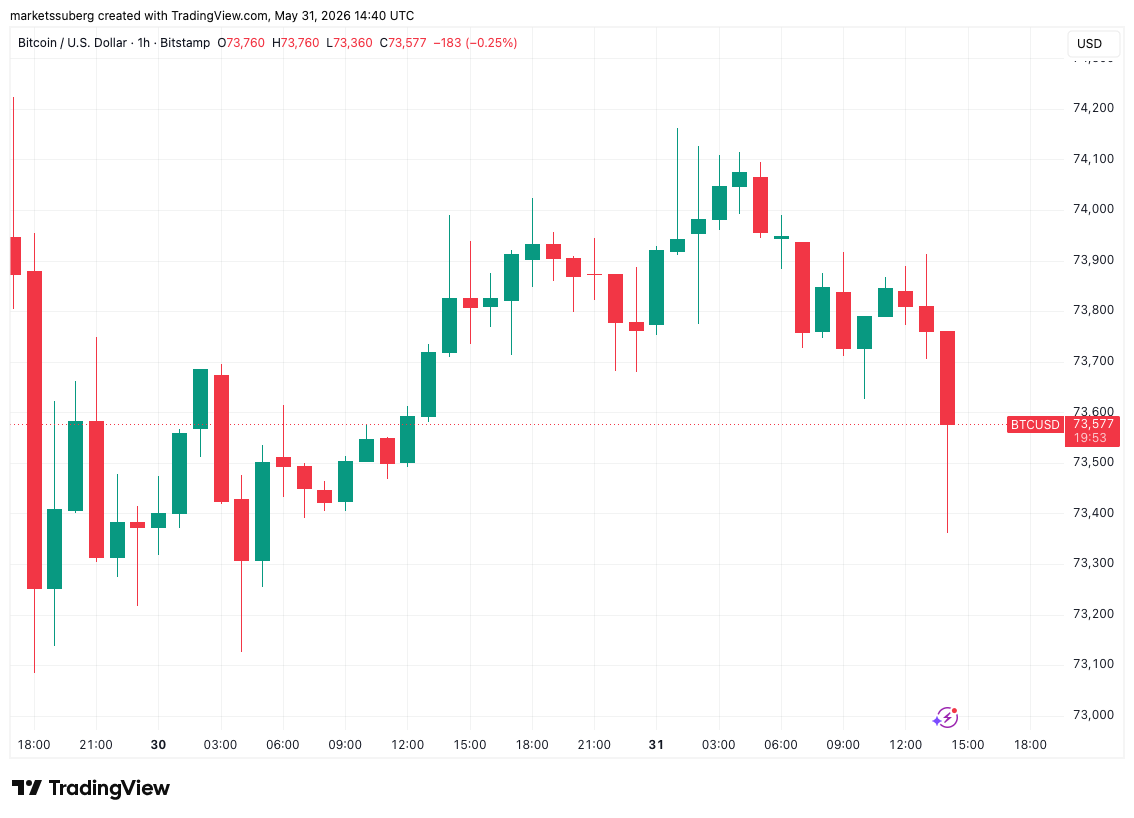
Bitcoin (BTC) circled $73,500 on Sunday as bulls stared down 3% BTC price losses for May.
Key points:
- Bitcoin looks set to end May “in the red” as the monthly candle close nears.
- US labor-market data will form the key volatility catalyst for risk assets next week.
- Bitcoin analysis says that $73,000 is the key line to watch for the monthly close.
Bitcoin eyes “red” May ahead of key US PMI data
Data from TradingView followed a quiet weekend for BTC/USD, which remained wedged under 2025 yearly lows.
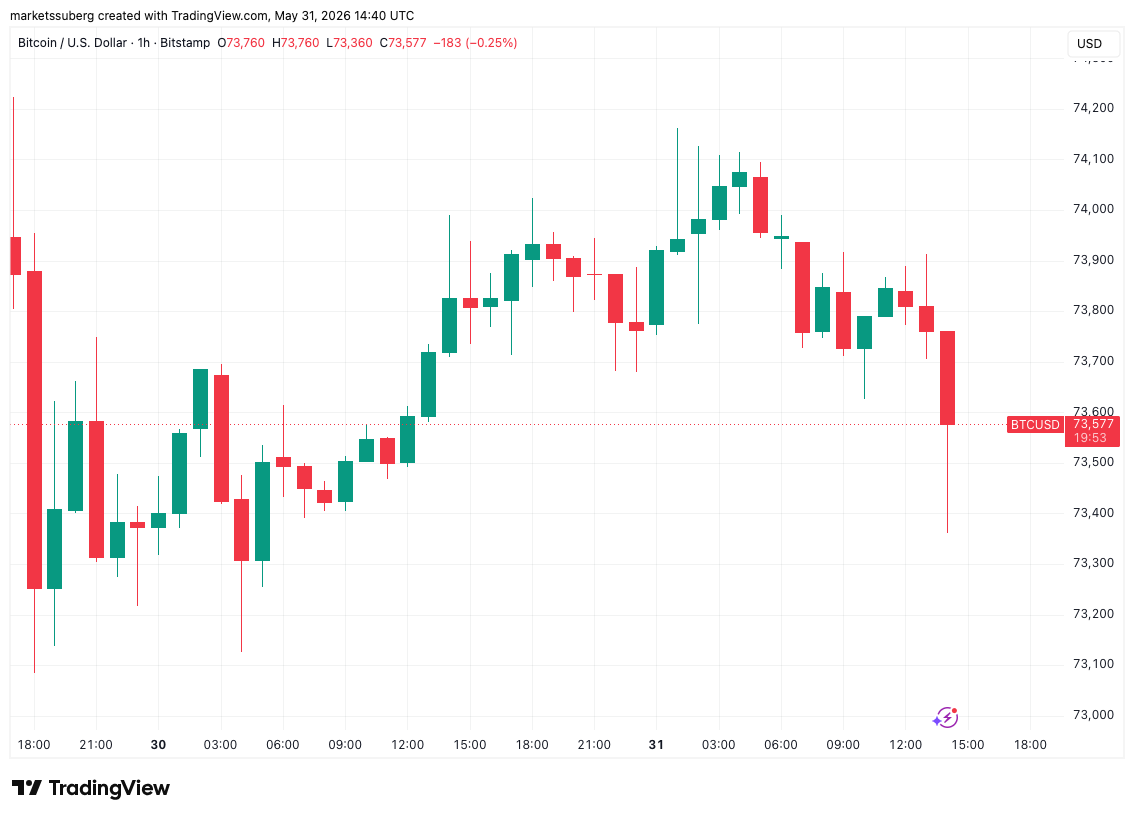
BTC/USD one-hour chart. Source: Cointelegraph/TradingView
US stocks finished the week with new all-time highs, but Bitcoin failed to catch a tailwind from easing geopolitical tensions, notably progress on a US-Iran ceasefire.
Commenting on X, trading resource The Kobeissi Letter quoted US President Donald Trump as saying that he was “in no hurry” to get an Iran deal finalized.
Looking ahead, it added, the coming week would be “all about the labor market,” with US employment data forming a potential source of crypto and risk-asset volatility.
That would include the May print of the Institute for Supply Management (ISM) Manufacturing Purchasing Managers’ Index (PMI) — a yardstick for economic output that offered BTC price action some relief in recent months.
“If bitcoin still continues to follow growth & risk appetite, it needs to reprice higher from here IMO,” Andre Dragosch, European head of research at crypto asset manager Bitwise, argued on X following recent PMI data.
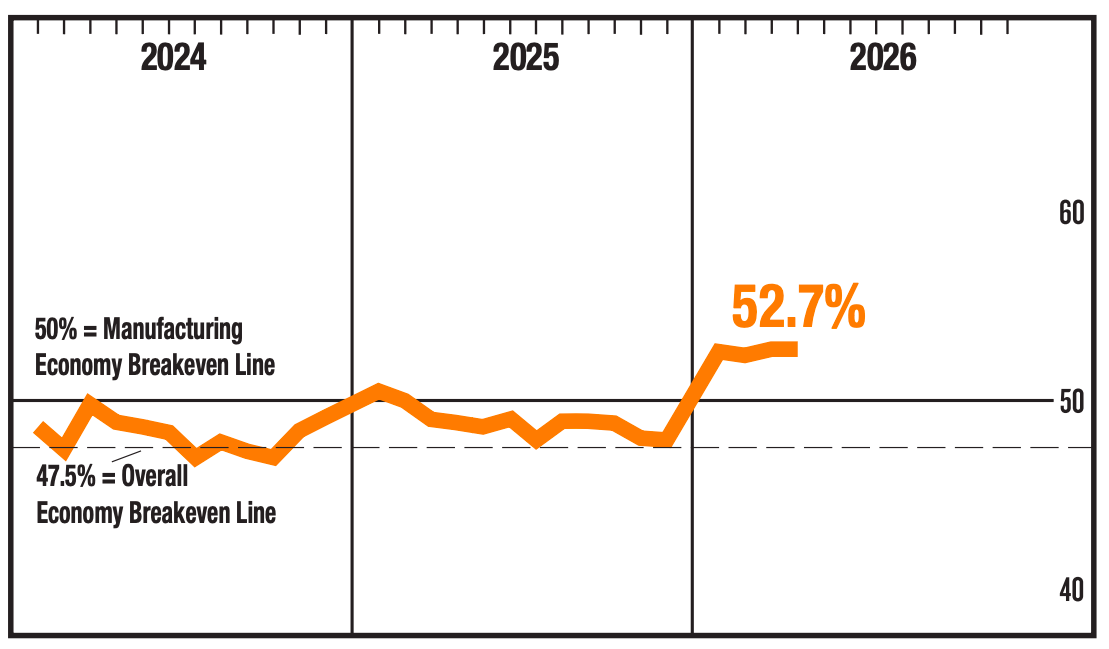
US manufacturing PMI data (screenshot). Source: ISM
Analyst hopes for BTC price monthly close above $73,000
With BTC/USD down by just over 3% month-to-date, per data from CoinGlass, traders were mostly unimpressed.
Related: Bitcoin analysis eyes sharp rebound after BTC collapses below M2 supply ‘fair value’
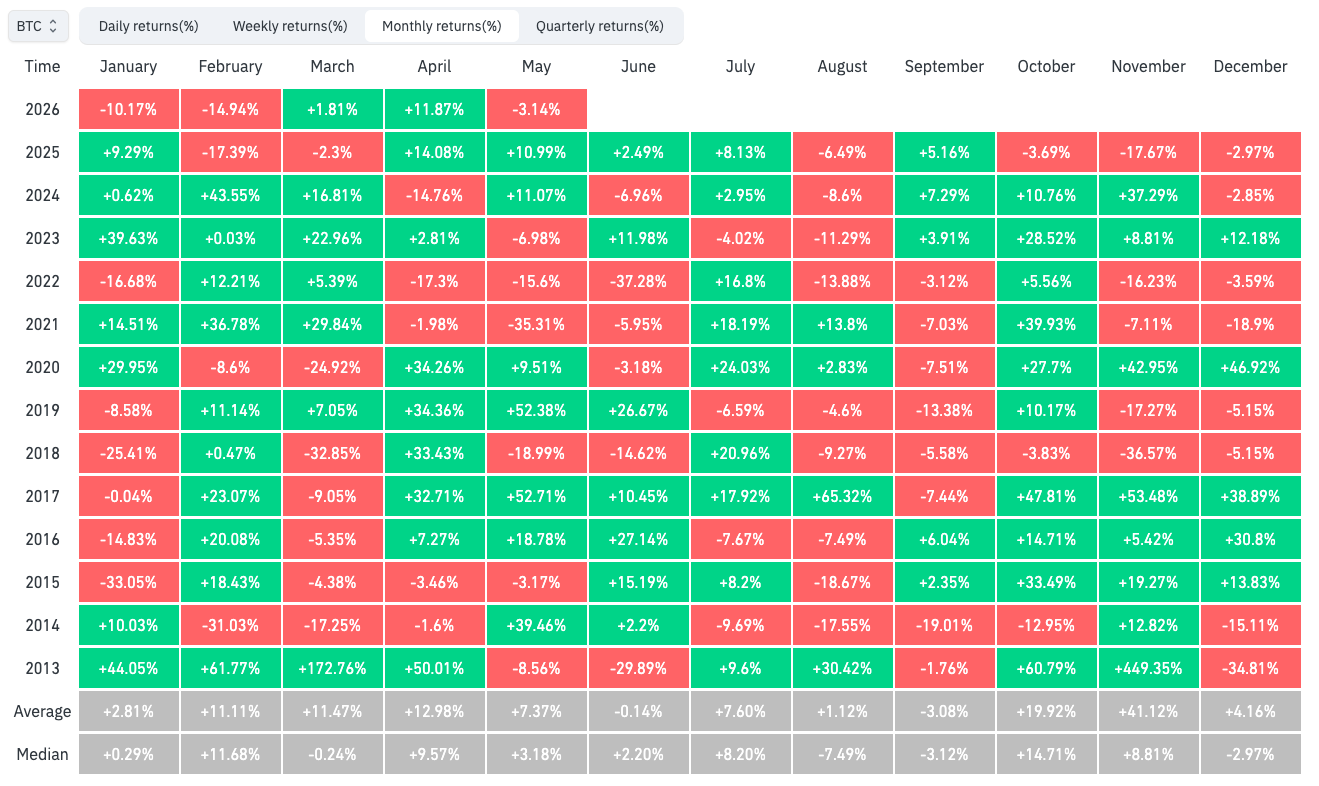
BTC/USD monthly returns (screenshot). Source: CoinGlass
“At the moment, the $BTC retest of $73k has been successful despite recent downside volatility,” trader and analyst Rekt Capital wrote in his latest X analysis.
“If Bitcoin manages to Weekly Close above $73k then price will be one step closer to confirming the Double Bottom breakout & be positioned to try to trend continue.”
Rekt Capital referred to a “W”-shaped bottom formation on the weekly chart that formed from late February onward.
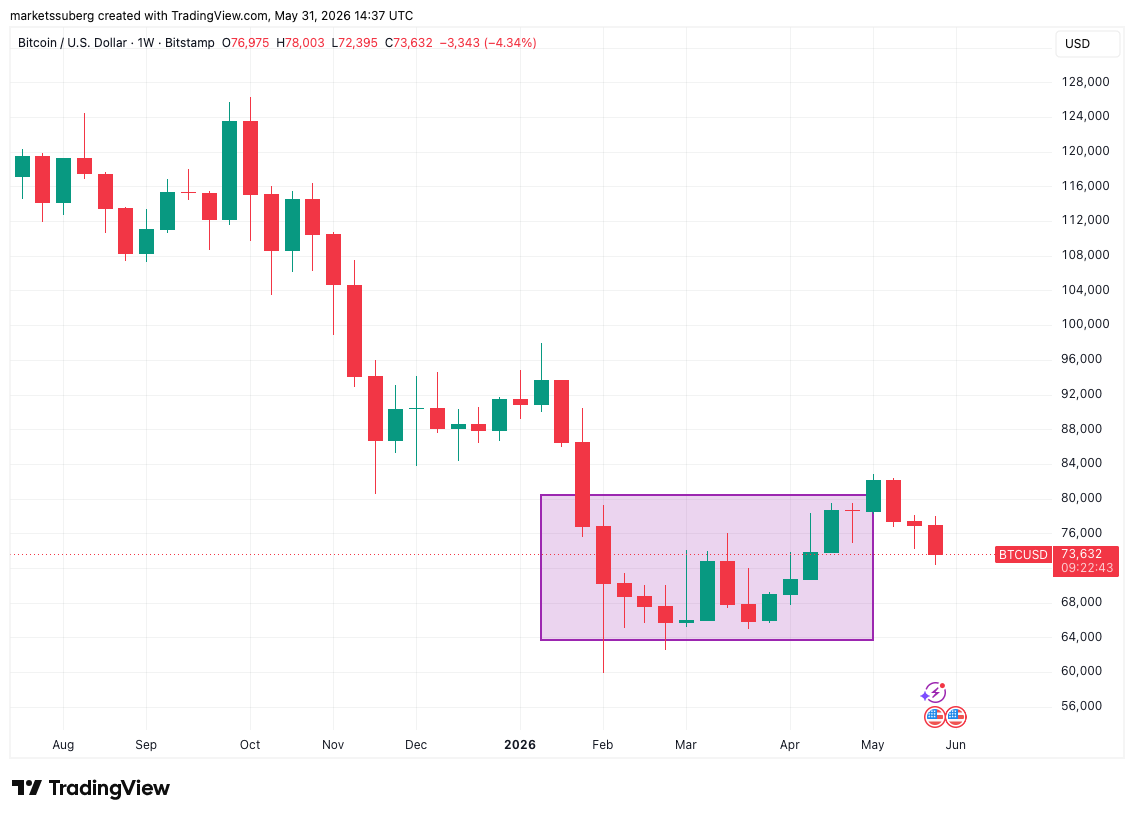
BTC/USD one-week chart with double bottom. Source: Cointelegraph/TradingView
With various key trend lines nearby, trader Daan Crypto Trades saw the macro range staying in play for the foreseeable future.
“$BTC Trading at its bull market support band after a failed retest the past few weeks. The Weekly 200MA & EMA are still moving up and closing in on price as well,” he told X followers.
“With all these big high timeframe weekly levels around this area, I would not be surprised to see us trade between $60K-$80K for quite a while.”
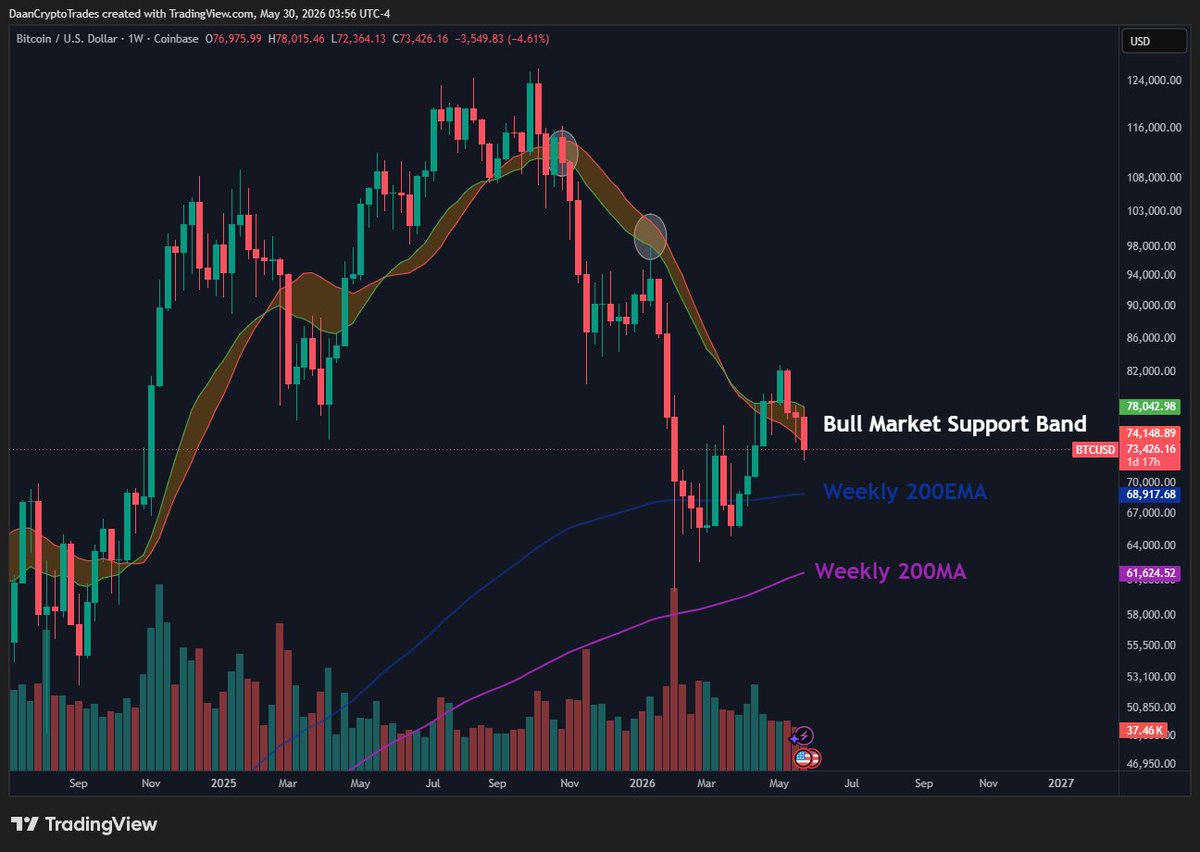
BTC/USD one-week chart. Source: Daan Crypto Trades/X
As Cointelegraph reported, the price was no longer due short-term targets formed by “gaps” in CME Group’s Bitcoin futures, with these now trading 24 hours per day.
TLDR:
- Saylor’s latest BTC chart displayed 843,738 BTC, putting Strategy’s acquisition pattern back in focus.
- Investors are tracking liquidity conditions and financing activity for clues on future BTC purchases.
- Strategy’s recent acquisition added 24,869 BTC, reinforcing its lead among corporate bitcoin holders.
- A 411.48 BTC Coinbase Prime transfer fueled fresh market discussion around treasury management.
Michael Saylor shared an updated bitcoin tracker showing Strategy’s growing reserve. The post has renewed speculation about whether another corporate bitcoin purchase could soon be disclosed as investors assess treasury activity and liquidity conditions.
Saylor’s Latest BTC Chart Revives Strategy Purchase Expectations
Saylor’s Latest BTC Chart has placed Strategy’s bitcoin acquisition strategy back in the spotlight. The Executive Chairman displayed holdings of 843,738 BTC with a reported reserve value of $62.24 billion.
Similar chart posts have historically preceded announcements of new bitcoin purchases which is making the latest update a closely watched development across the crypto market.
The tracker visualized Strategy’s accumulation history through a series of orange markers spread across different market cycles.Saylor’s brief caption, “Working Better,” continued a pattern that market participants have learned to monitor.
Earlier posts using similar formats generated substantial discussion before the company revealed fresh bitcoin purchases.
The renewed attention follows comments made by Saylor on May 24, when he stated that Strategy had “bought bonds, not bitcoin” while noting that its “BitVac” was charging.
That statement shifted focus toward financing capacity and liquidity management rather than immediate acquisitions.
However, many market observers viewed the remark as a potential indication that capital was being positioned for future treasury activity.
Strategy’s latest disclosed purchase added 24,869 BTC at an average price of $80,227 per coin. The acquisition expanded total holdings to 843,738 BTC, strengthening the company’s lead as the largest publicly traded corporate bitcoin holder.
Treasury Metrics and Coinbase Activity Draw Market Scrutiny
Beyond the chart itself, investors are examining Strategy’s financial metrics for clues about its next move. Company shares recently traded at $159.09, reflecting a 4.91% gain and supporting a market capitalization of $55.95 billion. Enterprise value stood at $77.31 billion, while bitcoin per share reached 220,900 sats.
The company’s mNAV ratio of 1.24 indicates that investors continue assigning a premium to Strategy’s bitcoin-focused model. At the same time, attention remains fixed on the balance sheet.
Strategy reported $6.75 billion in debt alongside $871 million in cash reserves and annual dividend obligations totaling $1.71 billion.
Additional discussion emerged after Strategy transferred 411.48 BTC, valued at approximately $32 million, to Coinbase Prime.
Although no sale was announced, the transaction generated considerable speculation throughout the market. Polymarket odds associated with a potential Strategy bitcoin sale reportedly climbed following the transfer.
Market participants are now monitoring several factors simultaneously, including liquidity reserves, debt management, dividend coverage, and financing activity.
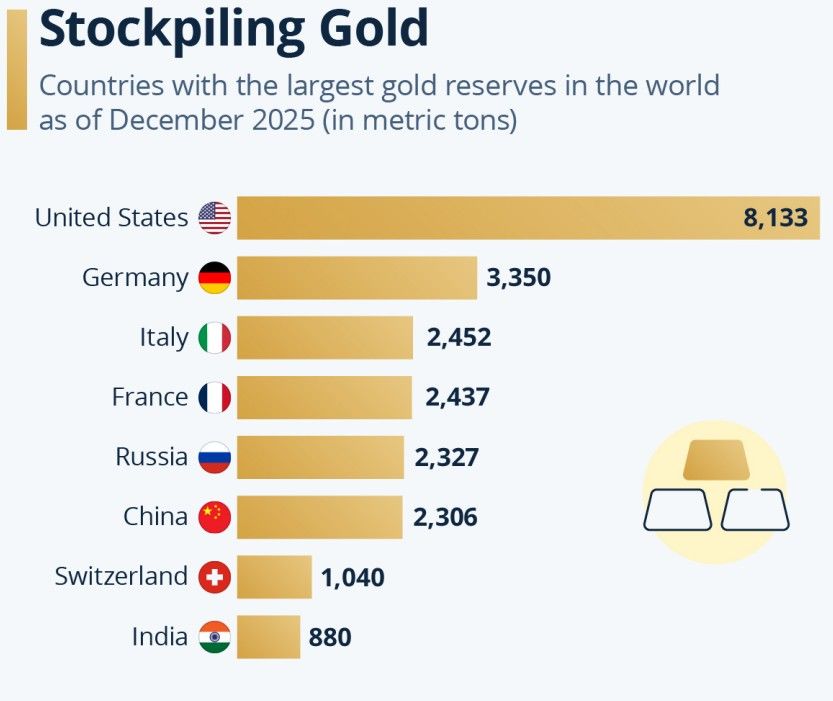
Trump renewed his push for a physical inspection of Fort Knox after a former senior CIA official was charged with stealing more than 300 gold bars worth over $40 million from the federal government.
The charges have intensified scrutiny over how the US tracks and verifies its gold holdings. Fort Knox has not undergone an independent public audit since 1974.
CIA Official Charged With Stealing $40 Million in Gold Bars
David Rush, a former senior executive-level CIA employee with top-secret clearance, was arrested on May 19 and charged with criminal theft of public money, per federal court filings in Virginia.
Between November and March, Rush requested and received a significant quantity of gold bars and foreign currency for work-related expenses, according to an FBI affidavit. What he intended to do with those funds remains unclear.
Federal agents searched his home on May 18 and seized more than 300 gold bars valued at over $40 million, roughly $2 million in US currency, and 35 luxury watches. Authorities arrested him the following day.
The FBI, working with the CIA and the Department of Justice, determined there was probable cause to believe Rush had stolen and converted government property for personal use. His attorney declined to comment.
Investigators also found Rush had allegedly fabricated his professional background, including false claims of being a Navy pilot and holding degrees from two universities.
Trump Calls for Fort Knox Inspection
The arrest drew immediate political attention. Trump posted on Truth Social, linking the case to Fort Knox audit questions he has raised since early 2025.

Trump addressed the Fort Knox question in a May 10 interview, saying he still wants to verify the contents of the depository himself.
“I do want to go to Fort Knox sometime. I want to see if the gold is there, which I’m sure it will be.”
Fort Knox holds approximately 147 million ounces of gold, about 59% of the US official reserves, with an estimated value of around $700 billion. The reserve’s scale has amplified interest in tokenized gold crypto markets, which gained traction during gold’s 2026 rally.
Treasury Secretary Scott Bessent has dismissed the concerns. He said that all gold is present and that the Treasury conducts annual internal audits. He has invited any member of Congress to visit and verify.
No authority has announced a formal inspection timeline. The Department of Government Efficiency, which previously floated the idea of an audit, has not followed up with a concrete plan.
The post Trump Renews Fort Knox Audit Call After Ex-CIA Official Faces Gold Theft Charges appeared first on BeInCrypto.
TLDR:
- HYPE surged above $67, setting a new all-time high and pushing market value beyond $14 billion.
- Hyperliquid’s trading volume surpassed BNB, reflecting growing user activity and liquidity.
- More than 45 million HYPE tokens have been removed through ongoing protocol buyback programs.
- Whale profit-taking emerged, while prediction market plans remained a focus for traders.
The Hyperliquid HYPE token price continues to capture market attention after climbing to a new all-time high above $67.
The latest rally comes amid strong platform growth, rising trading activity, and sustained token buybacks that have strengthened investor interest across the ecosystem.
Hyperliquid HYPE Token Price Climbs as Trading Activity Accelerates
Hyperliquid HYPE token price surged to a fresh record high, extending one of the strongest rallies currently unfolding in the digital asset market.
The token crossed the $67 mark, pushing Hyperliquid’s market capitalization above $14 billion and reinforcing its status as a major player in decentralized trading.
The rally has coincided with a sharp increase in platform activity. Hyperliquid has continued attracting traders through its on-chain perpetual futures and spot trading products, supported by a custom-built Layer-1 blockchain designed for speed and efficiency. As participation expanded, trading volumes grew significantly across the platform.
Notably, Hyperliquid’s daily trading volume recently surpassed that of BNB, a development that attracted considerable market attention.
The milestone reflects changing liquidity trends as more traders engage with decentralized trading platforms offering advanced functionality and deep liquidity.
Technical momentum has also remained firmly positive. Buyers have repeatedly stepped in during pullbacks, allowing the broader uptrend to remain intact while new highs continue to emerge.
Buybacks, Whale Activity, and Ecosystem Growth Support Momentum
Beyond trading activity, Hyperliquid’s tokenomics continue to play an important role in supporting demand. The protocol directs a portion of platform-generated revenue toward automatic HYPE buybacks, creating a consistent source of market demand.
According to available data, the network has already utilized billions of dollars in revenue to repurchase and remove more than 45 million HYPE tokens from circulation.
The reduction in available supply has strengthened the token’s market dynamics as platform usage continues expanding.
Investor confidence has remained strong throughout the rally. Several early participants have reported substantial gains after accumulating HYPE during earlier market conditions.
These success stories have helped maintain positive sentiment around the project’s long-term growth trajectory.
At the same time, whale activity has attracted fresh attention. Blockchain tracking data revealed that a genesis-era investor recently transferred a portion of holdings to Coinbase after HYPE reached new highs. The investor reportedly realized around $95 million in profit while retaining a sizeable position.
Although some analysts warned that additional token supply could generate short-term selling pressure, attention has also shifted toward Hyperliquid’s upcoming prediction market initiative.


DTCC’s decision to connect its upcoming tokenized securities platform to the Stellar (XLM) network is the latest step in a relationship that stretches back nearly a decade, according to Stellar Development Foundation CEO Denelle Dixon.
Earlier this week, DTCC said tokenized assets held through its Depository Trust Company could become available on Stellar beginning in the first half of 2027.
The move carries weight because DTCC is one of Wall Street’s core market utilities, overseeing more than $114 trillion in assets. The Stellar integration is designed to support the issuance, settlement and lifecycle management of tokenized securities, while opening the door to future projects involving highly liquid assets such as major indexes and U.S. Treasuries
The roots of the partnership go back to Securrency, the institutional tokenization platform DTCC acquired in 2023 and became what is now DTCC Digital Assets.
Securrency, Dixon told CoinDesk in an interview, worked closely with Stellar developers on features regulated financial institutions needed to issue assets onchain, including clawback functionality, compliance controls and transfer restrictions. Those tools were later built directly into the network.
“Some of the team has been working with Stellar for a long time,” Dixon said.
The news landed as tokenization has become one of the dominant themes across both crypto and traditional finance, drawing interest from global banks and asset managers looking to move traditional financial instruments onto blockchain rails.
Tokenization refers to representing assets such as U.S. Treasury bonds, money market funds, stocks or private credit as digital tokens that can be issued, traded and settled on blockchains. Proponents argue the technology could shorten settlement times, free up collateral trapped in legacy processes and eventually allow markets to operate around the clock.
It’s potentially a huge market. Standard Chartered projected $2 trillion in tokenized assets by 2028, while BCG and Ripple forecasted a $18.9 trillion market size by 2033.
Franklin Templeton’s early bet on Stellar
Dixon argued that tokenized assets are only the visible layer of a broader infrastructure shift.
“Blockchain is excellent at books and records,” she said. “Tokenization is the product outcome, but it’s all these underlying components that are really important.”
That focus on record-keeping was one reason Franklin Templeton selected Stellar for its onchain money market fund, BENJI. Dixon said the asset manager began exploring Stellar in 2019 and later launched the fund in 2021, aiming to place fund records on a single shared ledger rather than relying on multiple databases.
BENJI became one of the earliest examples of a regulated tokenized fund and helped pave the way for today’s tokenized Treasury market, which has grown to roughly $15 billion with BlackRock, JPMorgan, Fidelity entering the ring.
Making public blockchains work for regulated finance
For institutions, however, moving assets onchain requires more than faster settlement.
Regulated firms must comply with securities laws, sanctions requirements and investor protections, creating demand for blockchain infrastructure that can support identity checks, transfer restrictions and other compliance controls.
That need for compliance-ready infrastructure is one reason Stellar’s long-standing relationship with Securrency proved valuable, Dixon said.
Stellar’s architecture allows issuers to add compliance, identity controls and privacy protections on top of an open network, she said. Asset issuers can decide whether transfers require know-your-customer (KYC) checks, whether assets can be frozen or clawed back and what transaction information remains visible.
“The base layer is always going to be open,” Dixon said. “Then the institution gets to decide how compliance and privacy come into play.”

Vietnam’s Ministry of Finance is pushing a policy shift that could reshape credit access for small and medium-sized enterprises. A draft revision of the Law on Support for SMEs proposes allowing SMEs to use digital assets, virtual assets and intellectual property as collateral for bank loans. The proposal is open for public consultation, according to a Friday report from Vietnam News. Under the framework, businesses could borrow against future-formed assets, rights in property, intangible assets and digital or virtual assets.
Smaller businesses, including household enterprises, make up more than 98% of Vietnam’s business landscape, yet they receive only about 20% of total bank credit. The Ministry attributes the gap to a lack of eligible collateral, limited financial transparency and the relatively small capital bases of many SMEs. The new approach would acknowledge that valuable software, patents and other intellectual property can have real borrowing power, even when there are few physical assets to pledge. If adopted, the policy could unlock access to formal lending for a large swath of startups and tech firms that historically found themselves locked out of traditional credit channels.
Related: Bithumb enters Vietnam crypto license race with SSI Digital deal
Key takeaways
- SMEs could be allowed to pledge digital assets, virtual assets and intellectual property as collateral, widening access to bank credit as part of an SME law revision open for public consultation (per Vietnam News).
- The draft signals a shift toward lending decisions based on credit ratings, business plans, cash flows and market potential, not solely on fixed assets.
- Incentives for green and sustainable enterprises are included, such as credit guarantees, concessional financing, and support for ESG reporting and compliance.
- Vietnam is advancing toward a regulated crypto market, with a licensing pathway opened earlier this year and a potential launch window in Q3 2026, according to Cointelegraph.
- Chainalysis ranks Vietnam among the world’s most active crypto markets, placing it fourth in the 2025 Global Crypto Adoption Index behind India, the United States and Pakistan.
A broad shift in collateral rules
The core idea behind the draft revision is to furnish banks and other lending institutions with a broader set of assets that can back loans. By recognizing digital and virtual assets, as well as intellectual property, as legitimate collateral, the framework would align credit access with the modern asset economy—a crucial development for many tech-driven firms that rely on software platforms, patents and other intangible assets rather than land or heavy equipment.
The concept of “future-formed” assets—rights to assets that do not yet exist or are not yet monetized—appears central to the proposal. In practical terms, a startup with valuable IP or a robust stream of software-based revenue could, in theory, secure financing based on the anticipated value of its intangible holdings and projected cash flows. While details remain to be hammered out through consultation, officials describe a framework aimed at expanding the universe of eligible collateral beyond traditional physical assets.
As policymakers weigh this collateral expansion, they are balancing the goals of broader financial inclusion with prudent risk management for lenders. The SME sector’s historically limited collateral base has hindered credit access, particularly for technology-centric firms that may be asset-light but revenue-rich. If enacted, the policy could reframe the risk calculus for banks by integrating intangible asset valuations, governance disclosures and IP portfolios into standard credit assessments.
Credit decisions move beyond hard assets
Beyond collateral reform, the draft envisions a more nuanced approach to credit underwriting. Lenders would be encouraged to consider credit ratings, business plans, cash flows and the overall market potential of applicants. In other words, the bill seeks to formalize a more holistic evaluation of a borrower’s viability—especially for startups and knowledge-intensive firms that otherwise struggle to secure conventional financing due to a lack of tangible assets.
Supporters say the shift could help align Vietnam’s SME financing with contemporary risk analytics, leveraging data-driven assessments of cash generation, growth trajectories and competitive positioning. The emphasis on business plans and cash flow forecasts could also spur better financial discipline among smaller firms, as lenders demand clearer roadmaps and credible projections to accompany collateral in any new lending arrangements.
Officials stress that lending should remain anchored in responsible risk management. While expanding eligible collateral may reduce some barriers, lenders would still be expected to conduct due diligence and to price risk appropriately. The outcome could be more loans flowing to promising tech ventures and digital innovators that have demonstrated potential but lack hard assets to pledge, provided they meet the new underwriting criteria.
Incentives for green finance and ESG compliance
The draft also signals a broader policy push toward environmental sustainability and responsible financing. It outlines preferences for green and circular-economy projects, with potential access to credit guarantees, concessional financing and interest-rate support for eligible initiatives. Tax incentives and enhanced support for ESG disclosure and reporting are also included, aimed at lowering the cost of capital for sustainable ventures and encouraging transparent, standards-based reporting by borrowers.
These incentives align with global policy trends that increasingly link credit access to environmental, social and governance (ESG) criteria. For Vietnamese SMEs, that could translate into more affordable loans for energy efficiency upgrades, waste-reduction investments and other sustainability-focused activities. For lenders, ESG-friendly financing could come with clearer metrics and potential risk mitigants that help align capital allocation with long-term value creation.
Regulated market on the horizon
The policy mention of broader capital-market development parallels a parallel, separate track on crypto regulation in Vietnam. Cointelegraph has reported that Vietnam could see its first regulated crypto market activity as early as the third quarter of 2026, according to remarks from Deputy Minister of Finance Nguyen Duc Chi at the Digital Trust in Finance 2026 forum. The regulatory landscape has been evolving since regulators opened a licensing pathway for domestic crypto trading platforms earlier this year, with five companies—some affiliated with major banks such as Techcombank, VPBank and LPBank—advancing through an initial qualification stage to operate Vietnam’s first regulated exchange.
As the licensing process unfolds, policymakers are balancing domestic innovation with consumer protection and financial stability. The emergence of a formal exchange regime could provide a regulated on-ramp for residents and institutions seeking regulated access to digital assets, while also subjecting market participants to clearer standards and oversight. The juxtaposition of collateral reform for SMEs and the push toward a licensed exchange market underscores Vietnam’s broader ambition: to integrate digital assets and financial technology into a more formal, bank-assisted economy.
For market participants, the timing and scope of these developments will matter. A regulated market would offer more transparency, standardization and recourse for investors, potentially supporting broader adoption across consumers, startups and corporate treasuries. Yet questions remain about valuation frameworks for intangible assets, the calibration of risk in asset-light lending, and how such a regime would interact with international trading and cross-border flows. Observers will be watching how banks and non-bank lenders adapt to these shifts and how the regulatory framework evolves in response to market realities.
Adoption backdrop: Vietnam as a crypto hub
Vietnam’s crypto footprint has grown rapidly in recent years. Chainalysis ranks Vietnam among the most active crypto markets globally, placing it fourth in the 2025 Global Crypto Adoption Index, behind India, the United States and Pakistan. The ranking reflects a combination of on-chain activity, local usage, and the breadth of crypto-related services and infrastructure within the country. The new collateral and lending proposals arrive against this backdrop of heightened activity and policy experimentation, signaling a government intent to align financial integration with digital-asset innovation.
In broader market context, Vietnam’s regulatory and policy maneuvers come as domestic exchanges and crypto firms navigate licensing pathways and cross-border relationships. Earlier coverage highlighted ongoing regulatory developments and enforcement activity in the Vietnamese crypto ecosystem, underscoring a cautious but increasingly open stance toward digital-asset services when conducted within a clear regulatory framework.
As authorities solicit public input on the SME collateral framework and the crypto-regulatory trajectory continues to unfold, investors, lenders and startups alike will be keenly watching how the two strands intersect. The outcome could redefine how Vietnamese firms access credit and how digital assets are treated within formal financial channels, potentially shaping Vietnam’s role in the wider Southeast Asian crypto landscape.
Readers should monitor official updates to the SME law proposal and the evolving crypto licensing regime. The specifics of asset valuation, oversight mechanisms, and the exact scope of eligible intangible assets will determine how far these reforms go in practice and what they mean for corporate treasuries, fintechs and prospective lenders in the near term.

5 Steps To Financial Freedom

Cadbury just quietly launched an ‘incredible’ new chocolate bar in the UK

Ukraine’s Zelenskiy seeks progress on peace talks before winter


-

 NewsBeat4 days ago
Israel says it has killed new Hamas military leader in Gaza City airstrikes
-

 Tech4 days ago
NASA taps Blue Origin to deliver lunar rovers for Moon Base initiative
-

 Politics6 days ago
Bridgerton Season 5: Cast, Release Date And Everything We Know So Far
-

 News Videos5 days ago
XRP *JUST* SUCCEEDED!!!! CLARITY ACT EXPOSED!!! (SHE EXPOSED IT)
-

 Sports6 days ago
2026 NBA Finals schedule, odds: Knicks await Thunder or Spurs after winning East
-
Crypto World7 days ago
Brian Armstrong Outlines Crypto Vision for the Future Financial System
-
Crypto World5 days ago
Micron Crosses $1 Trillion Market Cap as AI Demand Reshapes Memory Sector
-

 Business5 days ago
Selena Gomez Reportedly Upset Over Benny Blanco’s Comments on Her ‘Terrible’ Diet
-

 News Videos2 days ago
This is BROKEN! INSANE 5x MONEY CAR WASH WEEK! The NEW GTA Online UPDATE Today! (GTA5 New Update)
-

 Business6 days ago
BTS Sells Out Four Las Vegas Shows at Allegiant Stadium for ARIRANG World Tour
-
 Tech6 days ago
China assigns ID codes to 28,000+ humanoid robots
-
 NewsBeat6 days ago
Hottest May day ever as London hits 34.8C in 2C leap from previous records
-

 Tech6 days ago
Microsoft’s quiet Claude Code retreat and the real cost of enterprise AI
-

 Tech3 days ago
Waymo dominates autonomous vehicle registrations as Tesla trails behind
-

 Business6 days ago
Nikkei 225 Surges Past 65,000 for First Time as Iran Peace Hopes Fuel Record Rally
-
Tech4 days ago
The Samsung pay deal is the moment Korean unions changed register
-

 NewsBeat6 days ago
Crowds find riverside shade in York as temperatures soar
-

 Tech6 days ago
Westone Audio and Etymotic Acquired by Fidelity Collective in Major IEM Market Move
-
 Entertainment6 days ago
‘Breaking Bad’ Star’s Easy-to-Binge 6-Part Crime Series Spin-Off Is Finally Heading to Free Streaming
-

 Tech5 days ago
Millions of AI agents imperiled by critical vulnerability in open source package
You must be logged in to post a comment Login