

Business
Fighting for Big Change & Winning Big


Michael Jordan, the NBA legend whose relentless drive produced six championships and a legacy of unmatched competitiveness, has carried that same “competitive gene” into NASCAR ownership. Through 23XI Racing and a high-stakes antitrust lawsuit against the sport’s governing body, Jordan has pushed for structural reforms while his team delivers dominant early results in the 2026 Cup Series season.

In a recent interview with CBS’ Gayle King, Jordan made clear the lawsuit was never just business. “I was all in. I was aggressively gonna win,” he said, adding that he was prepared to risk being “kicked out of the sport” if it meant waking people up to what he viewed as unfair practices. “I became a competitor all over again.”
Jordan co-owns 23XI Racing with driver Denny Hamlin. The team entered the spotlight when it, along with Front Row Motorsports, refused to sign NASCAR’s 2024-2025 charter agreement, calling it a “take it or leave it” deal that favored the France family-controlled organization. The resulting federal antitrust lawsuit accused NASCAR of monopolistic practices that limited team equity and revenue sharing.
The case reached trial in December 2025 in Charlotte. After eight days of testimony — including Jordan taking the stand and describing himself as unafraid to challenge the sport’s power structure — the parties settled on Dec. 11. The agreement delivered permanent “evergreen” charters for all teams, improved revenue distribution, and a stronger voice for team owners in future decisions. NASCAR avoided a jury verdict on monopoly claims, while 23XI and Front Row secured the stability they sought.
Jordan framed the outcome as progress for the entire sport. In a joint statement, he said the lawsuit was “about making sure our sport evolves in a way that supports everyone: teams, drivers, partners, employees and fans.” He emphasized building equity and investing in the future so NASCAR can grow for generations.
The settlement cleared the way for a focused 2026 season. 23XI Racing has responded with explosive on-track performance that has turned heads across the garage. Driver Tyler Reddick, in the No. 45 Toyota, opened the year with back-to-back victories at the Daytona 500 and Atlanta Motor Speedway. He added wins at Circuit of the Americas and Darlington Raceway, giving the team four victories in the first six races of 2026 — a historic pace in the Next Gen car era.
Reddick’s Daytona triumph marked 23XI’s first Daytona 500 win. Jordan, who attended the race, reacted with visible emotion, later saying it “feels like I won a championship” and praising Reddick’s “clutch gene” under pressure. Teammate Bubba Wallace, in the No. 23 car, has posted consistent top-15 finishes and sits near the top of the standings alongside Reddick.
The team’s third full-time entry, the No. 35 driven by Riley Herbst, and development driver Corey Heim’s expanded Cup schedule add depth. Jordan has been a visible presence at races, celebrating wins in Victory Lane and underscoring his hands-on approach. Brand momentum has followed: Jordan Brand has deepened its involvement, outfitting pit crews with specialized shoes and exploring retail collaborations, while sponsors show growing interest.
Jordan’s entry into NASCAR ownership in 2020 was rooted in personal passion. A longtime fan influenced by his father, he saw an opportunity to bring his competitive ethos to a sport he loved. Early on, he spoke of wanting to win races and championships while helping diversify the fan base and garage. His partnership with Hamlin combined basketball royalty with NASCAR expertise.
The charter dispute tested that commitment. Jordan testified that he felt compelled to act when he perceived the system limited teams’ ability to build sustainable value. “Someone had to step forward,” he told the court. “I wasn’t afraid.” He described learning the business side of NASCAR and becoming dissatisfied with aspects that he believed hindered growth and fairness.
Critics and supporters alike noted the lawsuit’s significance. Without Jordan’s resources and willingness to confront the France family — NASCAR’s controlling owners — the challenge might never have reached this point. Analysts described the settlement as a win for teams seeking permanence and a pragmatic outcome that allowed the sport to move forward without prolonged disruption.
NASCAR executives have acknowledged the need for evolution. The new charter framework provides long-term stability that many owners had sought for years. With the legal chapter closed, attention has shifted to competition and growing the sport’s audience. Jordan’s high profile and 23XI’s early success have generated fresh buzz, potentially attracting younger fans and corporate partners.
On the track, Reddick’s dominance has drawn praise from veterans like Kevin Harvick, who credited 23XI with having the fastest cars in the early going. The team has adapted well to NASCAR’s 2026 technical package adjustments, showing strength on superspeedways, intermediates, road courses and now traditional short tracks like Darlington.
Jordan has repeatedly credited Hamlin as the “mastermind” behind operational success while emphasizing team-wide effort. He has also highlighted the importance of creating an environment where drivers and crew can thrive. Wallace, one of NASCAR’s most visible Black drivers, has spoken about the platform 23XI provides for broader representation.
Beyond racing, Jordan’s involvement continues to blend his iconic brand with motorsports. Speculation persists about potential Air Jordan-themed collaborations or expanded merchandising. His presence at races — often in team gear and engaging with fans — reinforces authenticity rather than celebrity detachment.
The 2026 season remains young, but 23XI’s four wins in six races have already rewritten expectations. Reddick holds a substantial points lead, positioning the team as a championship contender. Jordan has tempered expectations publicly while embracing the momentum, echoing his famous “Winning. That’s what it’s about!” mindset from basketball days.
Industry observers say Jordan’s willingness to fight for change, even at personal and financial risk, has left a lasting mark. The permanent charter system and enhanced team equity represent tangible shifts that could strengthen NASCAR’s business model long-term. At the same time, his team’s on-track results demonstrate that competitive excellence and advocacy can coexist.
Jordan, now in his 60s, shows no signs of diminishing intensity. Whether celebrating a Daytona 500 victory or reflecting on courtroom battles, he approaches NASCAR with the same fire that defined his playing career. “I love that competitive juice,” he has said of drivers and teammates who share his drive.
As the Cup Series progresses through 2026, all eyes remain on 23XI Racing and its high-profile owner. Jordan’s dual legacy — as a champion who transformed basketball and now as an owner fighting to evolve stock car racing — continues to unfold. For a sport historically rooted in Southern tradition, his influence has injected new energy, broader appeal and a demand for fairness that resonates beyond the garage.
With permanent charters secured and victories accumulating, Michael Jordan’s competitive gene is proving as potent on the NASCAR circuit as it was on the hardwood. The question now is how far that drive — and the changes it helped spark — will carry both his team and the sport into the future.


The Rs 27 crore IPO was open for subscription between May 22 and May 26, while the basis of allotment was finalized on May 27. The company fixed the issue price at Rs 52 per share, the upper end of the Rs 51-52 price band. The IPO comprised a fresh issue of 52 lakh shares aggregating Rs 27.04 crore. There was no offer-for-sale component.
Ahead of the IPO opening, the company raised Rs 7.64 crore from anchor investors through the allotment of 14.7 lakh shares.
Incorporated in 2010, M R Maniveni Foods is engaged in the processing, packaging and distribution of food products. The company primarily focuses on pulse processing and operates in the urad dal and toor dal segments. It supplies products mainly to business-to-business customers.
The company said it emphasizes quality control, modern processing techniques and supply chain management to ensure product consistency and food safety standards. As of April 30, 2026, the company had a workforce of around 16 employees.

For FY25, M R Maniveni Foods reported total income of Rs 203.5 crore, compared with Rs 155 crore in FY24. Profit after tax rose to Rs 4.13 crore from Rs 2.18 crore a year earlier. The company had total assets of Rs 41.1 crore and net worth of Rs 18.6 crore as of March 31, 2025.
The IPO proceeds are expected to support working capital requirements and general corporate purposes.The flat GMP suggests investors are adopting a wait-and-watch approach toward the issue despite the company’s steady growth in revenue and profitability. Grey market premiums are unofficial indicators of investor sentiment and do not guarantee actual listing performance.
Capital Square Advisors was the book-running lead manager to the issue, while Bigshare Services acted as the registrar. CapitalSquare Financial Services is the market maker for the IPO.
(Disclaimer: Recommendations, suggestions, views and opinions given by the experts are their own. These do not represent the views of Economic Times)

Columbia Threadneedle Investments is a leading global asset management group that provides a broad range of actively managed investment strategies and solutions for individual, institutional and corporate clients around the world. Columbia Threadneedle Investments is the global asset management group of Ameriprise Financial, Inc. (NYSE: AMP). For more information please visit columbiathreadneedleus.com.

Initial findings show Tongzhou Group, the company operating the privately owned coal mine, had committed “serious illegal violations”, authorities said, without specifying what they discovered. The company has not responded to the allegations and the BBC’s previous attempts to reach them were unsuccessful.

Hartford Funds offers a broad range of actively managed and systematic-investing strategies designed to provide solutions for a variety of investment needs. Articles published here provide readers with timely insight on economic, market, and investing trends. For more information visit hartfordfunds.com.

ismagilov/iStock via Getty Images

Dear Baron SMID Cap ETF ® Shareholder,
Introduction
As this represents the first full quarter of results for Baron SMID Cap ETF ® [BCSM], we thought it would be helpful to introduce ourselves and outline BCSM’s investment philosophy. The ETF is managed by Laird Bieger and Randy Gwartzman. Laird and Randy have co-managed the Baron Discovery Fund (BDFIX) ® together since 2013, and have known each other since meeting in 1997 as classmates at Columbia Business School. Both joined Baron in the early 2000s, where they worked alongside Baron’s current COO, Cliff Greenberg, as analysts on the Baron Small Cap Fund (BSCIX) ® . We believe our long-standing partnership and complementary skill sets have been key drivers of Baron Discovery Fund’s ® * long-term outperformance, and we are excited to bring this proven investment approach to the SMID-cap growth space.
ETF Overview
BCSM is a natural extension of what we have been doing for the past 12-plus years managing the Baron Discovery Fund ® . The key distinction is that BCSM makes its initial investments across both small-cap and mid-cap growth companies ((i. e. SMID)), whereas Baron Discovery Fund ® focuses exclusively on initial investments in small-cap businesses. This expanded mandate gives us the flexibility to initiate positions in slightly more mature companies at the outset. Therefore, the overall size of the companies in BCSM (in terms of the weighted average market capitalization of the companies) is about three times that of Baron Discovery Fund ® .
The Compelling Opportunity in SMID-Cap Growth Stocks
Many SMID-cap companies are under-researched and remain off Wall Street’s radar. By identifying these businesses early, we can invest at the beginning of their growth phase and often at valuations that are discounted relative to larger-cap companies with comparable growth prospects. In addition, SMID-cap stocks tend to be driven more by idiosyncratic, company-specific factors rather than by broader industry or macro-driven events. Together, these characteristics make the SMID-cap growth universe particularly attractive for alpha creation and relative outperformance by fundamental stock pickers like us.
Investment Philosophy
Our investment philosophy at Baron SMID Cap ETF ® is the same as that of Baron Discovery Fund ® . We focus on small, fast-growing businesses with outsized long-term growth potential, durable competitive advantages, exceptional management teams, and compelling valuations. We prioritize companies with high-quality earnings streams — specifically, businesses with recurring, predictable revenue and strong margins. Through a full market cycle, we have found that these characteristics are most likely to drive superior long-term performance versus the broader market. We target market-leading businesses operating in fastest-growing areas of the economy and, as a result, we have historically been overweight the Information Technology sector and certain Health Care sub-industries such as life sciences tools & services and health care equipment. Finally, we take a longer-term view than most of our peers. We believe that by analyzing our investments over a longer time horizon, we can gain an advantage over market participants who are focused primarily on the short term.
Investment Process
Our investment process is designed to take advantage of market dislocations, and it begins not with valuation, but with quality. We call this process “investing in reverse. ” It starts with a simple question posed to each sector analyst on the investment team: “Removing current valuation, what are the companies in your particular sub-industry that best fit the criteria we look for in an investment — typically fast-growing, high-margin businesses with favorable long-term prospects? ” Those conversations lead to a “shadow list” of potential investments we would like to own if the companies are selling at attractive valuation levels. We call it “investing in reverse” because most investors start their investment process by screening for valuation first and then, after narrowing it down to a select group of companies, use certain quality metrics (revenue and earnings growth, operating margins, and balance sheet leverage) to determine which stocks they should consider investing in. We do the reverse. We screen for companies that hit our quality criteria first, and then we patiently wait for their stocks to get to attractive valuation levels where we believe we can generate outsized returns.
This shadow list is constantly refreshed throughout the year. We track these companies closely, listening to their earnings calls and meeting with their management teams as frequently as possible. Because these companies are typically the fastest-growing and highest-margin businesses in their sectors, they tend to trade at premium valuations in normal market environments — levels that do not meet our return hurdle rate. During market dislocations or company specific stumbles unrelated to the main investment thesis, however, almost every stock trades lower. When the market “throws the baby out with the bathwater” we are poised to make investments that historically have produced some of our highest returns.
Risk Management
Complementing our investment process is an equally disciplined approach to risk management, with a singular focus on balancing portfolio construction. Our objective is to generate alpha primarily through bottom-up stock selection rather than sector allocation, while also seeking to protect capital during market downturns.
The following are the key tenets to our risk management process:
Sector exposures are kept broadly aligned with the Russell 2500 Growth Index (the Benchmark), reflecting our belief that superior long-term results are best achieved through fundamental stock picking rather than making thematic or macro-driven sector calls.
We balance the strategy across three growth profiles: “high growth, ” “growth, ” and “other. ” High growth positions typically consist of earlier-stage companies with novel products or services and a higher risk/return profile, typically growing revenue by more than 20% and exhibiting above-market beta. Growth holdings are more established businesses that generate positive free cash flow and tend to have a beta closer to the market. The “other” category serves as the portfolio’s ballast — consisting of lower-beta companies that are less correlated to market movements. Companies in this latter category include special situations—such as activist involvement, management changes, or restructurings—as well as “fallen angels, ” or high quality businesses experiencing temporary share price declines unrelated to their long term fundamentals. We believe this balance has meaningfully dampened portfolio volatility over time for Baron Discovery Fund® and believe it will do the same for BCSM.
We also limit individual position sizes such that no single holding exceeds a 4% weight for an extended period. Typically, the portfolio’s 10 largest holdings will account for around 30% of assets, with our largest holdings emphasizing predictable revenue and cash flow characteristics.
Valuation discipline is another core element of our risk management framework. We conduct extensive fundamental research to assess each company’s intrinsic value over one, three, and five year time horizons, and we invest when we believe a stock has the potential to double over five years. As positions approach our long term valuation targets, we trim and redeploy capital into opportunities offering greater upside potential.
Finally, we believe that the most effective form of risk management is deep knowledge of our portfolio companies. Our research process is rigorous and comprehensive, including regular engagement with management teams, customers, suppliers, competitors, and industry experts, as well as attending conferences and visiting key company assets such as manufacturing facilities, distribution centers, and retail or restaurant locations.
Taken together, these principles form a cohesive and disciplined framework that has guided our decision making across multiple market cycles. We believe that this integrated approach—combining rigorous fundamental research, patient capital allocation, and a steadfast commitment to risk management—positions us to deliver superior long term returns for our investors.
Performance
BCSM declined 10.56% (NAV) in the first quarter, underperforming the Benchmark, which declined 3.52%, by 7.04%. To understand the results, it helps to understand the current market environment.
During the quarter, investors rotated aggressively into a narrow group of companies perceived to be direct beneficiaries of AI capital spending and electrification — what the market has come to call AI “winners. ” At the same time, they sold and shorted companies viewed as AI “losers, ” regardless of underlying business performance. This dynamic was amplified by the growing influence of algorithmic and quantitative traders, whose momentum-driven strategies accelerated the divergence between winners and losers and pushed many stock prices further away from their fundamental values. For bottom-up investors like us, it was a challenging environment — one where strong business results were simply not being rewarded by the market.
That disconnect was evident across our portfolio. Several of our holdings beat their earnings estimates and raised their 2026 guidance, yet saw their stocks decline more than 30% in the period, simply because they were categorized as AI losers. Our software investments were the most significant example of this.
Roughly half of our relative underperformance in the quarter was attributable to software (with the systems and application software sub-industries detracting about 3.5% from relative performance) — an industry where we believe our particular investments are fundamentally misclassified as AI losers, a view we discuss in detail in our Baron Discovery Fund® letter for this quarter. We believe that there are four main categories of software that will co-exist with large language models (LLMs). They include: (1) companies that generate and use deterministic data (only available to the private enterprises, and NOT available to LLMs); (2) highly integrated vertical software providers with extreme domain expertise; (3) companies that combine “atoms and electrons” where the solution needs physical products combined with software; and (4) companies whose software requires regulatory approval such as health care software needing FDA approval.
Offsetting some of the relative underperformance from AI losers was meaningful exposure to several AI winners including optical networking component supplier Coherent Corp. (COHR) , programmable chip maker Lattice Semiconductor Corporation (LSCC) , and power management semiconductor designer Monolithic Power Systems, Inc. (MPWR)
Finally, the outbreak of the Iran conflict drove a sharp spike in energy prices which, when combined with a more challenging consumer backdrop, pressured valuations across higher growth consumer stocks. Given our preference for the fastest growing consumer companies, this headwind affected our holdings more than it did the average portfolio. This impact was compounded by our lack of exposure to the Energy sector—which we typically avoid due to its commoditized nature—resulting in no participation in the sector’s rally (which was up 26.2%), a dynamic we expect to reverse over time. Combined with weakness in Consumer Discretionary, this weighed on relative performance by detracting nearly 2%.
Top contributors to performance for the quarter
Kratos Defense & Security Solutions, Inc. is a defense technology provider that produces products including unmanned aerial vehicles, hypersonic test vehicles, small turbine and jet engines, solid rocket motors, ballistic missile defense transporters, radio-frequency and microwave electronics, satellite ground station software, high energy lasers, and more. Kratos rallied along with the rest of the defense industry at the start of 2026 after President Trump announced a proposed $1.5 trillion defense budget. The company has also been winning meaningful defense contracts. After shares rallied from about $76 to start the year to nearly $131 at the mid-January high, we sold the position as it had reached our long-term valuation target nearly three years early. This is an example of our risk management process in action. Early in the second quarter we were able to repurchase our position at the low $70’s per share level.
Arcellx, Inc. , is a biotechnology company that together with Gilead Sciences, Inc. (GILD) is developing a next-generation CAR-T cell therapy it calls “anito-cel” for the treatment of multiple myeloma. While we generally do not invest in emerging biotechnology companies, we took a position in Arcellx given that the market is large and proven (currently a $3.5 billion opportunity that could expand to $12 billion or more over time), and because we believe that Arcellx has a safer CAR-T therapy than the currently approved solution. Its primary competitor Carvykti already has nearly $2 billion in sales worldwide in 2025. The issue with Carvykti is that although it’s very efficacious, it appears to cause delayed neurotoxicity ((neurological damage)) in 5% to 10% of patients, and in rare cases ((2% or potentially higher)) Parkinson’s-like symptoms, which is devastating and incurable. The promise of Arcellx’s anito-cel process is that it appears to have similar efficacy to Carvykti, while avoiding these neurotoxicity risks. We were rewarded for our research when Gilead agreed to acquire the company in the quarter (with the transaction to be completed in June).
Coherent Corp. is a vertically integrated provider of laser-based systems. The company’s lasers are used for high power manufacturing and cutting, semiconductor manufacturing, scientific research, and defense (its legacy markets). It is also one of the leading players in photonics, which uses lasers and other components to transmit information at the speed of light. Coherent is the only major western optical transceiver manufacturer connecting servers within data centers. This is clearly a massive new market given the explosion in AI data center buildouts. In the first quarter, the excitement around AI data center buildouts drove performance in companies like Coherent that are enabling this massive wave of installations.
Coherent is led by CEO Jim Anderson who joined the company in June 2024. He has a top-shelf resume, having been the CEO of Lattice Semiconductor Corporation for the prior six years, and worked at senior positions in Advanced Micro Devices, Inc. (AMD) , Intel Corporation (INTC), and Broadcom Inc. (AVGO) before that. We have followed the company since 2010 when it was purely an industrial laser company and have owned it in various other funds at Baron. When we started BCSM, we recognized in Coherent the confluence of terrific leadership and high-quality assets with the massive buildup of AI data centers. The company believes that its existing markets for laser transceivers and optical components are valued at over $50 billion. And new products servicing AI server-oriented markets in particular could be worth an additional $20 billion. These are big opportunities for a company which put up $6.3 billion in revenue in 2025. The opportunities include products like optical circuit switches, co-packaged optics, and multi-rail optical technology. The company benefits from vertical integration as it has high-capacity manufacturing of its own lasers in multiple forms, including Indium Phosphide or InP EML’s (electro-absorption modulated lasers), InP CW’s (continuous wave lasers) and VCSEL’s (vertical cavity surface emitting lasers). Only a handful of companies can do this. And the legitimacy of Coherent’s portfolio was sealed with a $2 billion investment from NVIDIA Corporation (NVDA) made in March 2026 to expand supply and U. S. -based manufacturing of these optical technologies. We believe that over the next five years, Coherent will more than double its revenues and cash flow.
Top detractors from performance for the quarter
Shares of Netskope, Inc. , a cloud security and networking platform for enterprises, were down due to a combination of sector-wide and technical factors rather than fundamental weakness. The entire application software sub-industry experienced a sharp drawdown as investors weighed AI disruption risks, and recent IPOs like Netskope bore the heaviest losses. Adding to the pressure, Netskope’s lock-up expiration in mid-March made roughly 390 million shares eligible for sale, creating a supply overhang that coincided with the worst of the software industry sell-off. The business itself performed very well — fiscal fourth quarter (ended January 31, 2026) revenue grew 32%, annualized recurring revenue (ARR) reached $811 million and grew 31%, the company posted record quarterly net new ARR and the company achieved positive free cash flow for the first time. Management guided fiscal 2027 revenue above consensus expectations. We maintain conviction in Netskope’s long-term positioning in the secure access server edge market, where demand for securing cloud and AI workloads continues to grow, and view the current valuation as disconnected from the company’s growth trajectory and competitive standing.
Shares of Flutter Entertainment plc , the world’s largest online sports betting and gaming operator that owns FanDuel, detracted during the quarter and we exited our position. FanDuel’s handle decelerated during the fourth quarter as an extraordinary NFL hold rate created recycling headwinds that persisted longer than expected. The impact of unfavorable customer outcomes was compounded by ill-timed promotional reinvestment that failed to re-engage customers. As a result, trends in early 2026 have remain challenged. The market further discounted the stock on a $300 million prediction markets investment embedded in 2026 guidance with no offsetting revenue. The core business economics remain compelling over the long term and FanDuel’s #1 competitive position is intact, but we exited our position in favor of DraftKings Inc. (DKNG) DraftKings is a pure-play U. S. business with higher growth, cleaner FCF conversion, and a vertically integrated prediction markets exchange – a structural advantage if prediction markets prove to be a durable opportunity.
Shares of ServiceTitan, Inc. , a leading business management software platform for the trades, detracted from performance in the quarter. The company reported strong fiscal Q4 2026 earnings and gave preliminary fiscal year 2027 guidance that was ahead of expectations. Despite these strong results, the stock was weak due to industry-wide AI fears that are hard to disprove in the near term around the potential for AI companies like Anthropic (ANTHRO) to negatively impact software businesses. We sold the position to re-allocate to higher conviction SMID-cap software ideas.
Portfolio Structure
Top 10 holdings
Recent Activity
Top net purchases for the quarter
We initiated a position in Waystar Holding Corp. , a provider of revenue cycle management software (RCM) to health care providers. Waystar has an AI driven, end-to-end suite of solutions that saves their clients massive amounts of working capital costs by getting claims submitted quickly and correctly, and by automating insurance appeals when necessary. With the company trading at under 11 times adjusted cash flow, while also growing cash flow in the low teens, we believe the company is competitively advantaged and very inexpensive.
We increased our position in Samsara Inc. following its fourth quarter results, which reinforced our conviction in the durability of its competitive position. Samsara is an “atoms plus electrons” winner in software. The company has built a proprietary data asset and hardware-based sensor network that, in our view, cannot be replicated by LLMs alone. With likely more than 4 million connected vehicles on the road, millions of asset tags deployed on smaller products, and approximately 25 trillion data points captured annually, Samsara is leveraging its edge sensor network to train purpose-built AI models that drive measurable returns on investment (ROI) for its customers. Critically, this dataset compounds over time. As the network grows denser, Samsara is able to release increasingly powerful versions of its products, including over 40 AI-driven safety detections, smaller and more cost-efficient asset tags, and intelligent preventative maintenance recommendations. These improvements are widening the gap relative to competitors, accelerating market share capture, and strengthening pricing power. Finally, Samsara’s asset-oriented business model — which scales with physical infrastructure rather than white-collar headcount — insulates it from the labor disruption that AI may bring to other sectors, while positioning it to grow alongside secular tailwinds such as energy infrastructure expansion and data center buildouts.
We increased our position in Dynatrace, Inc. , a provider of “observability” software which uses its own proprietary AI model to predict network and application problems so they can be remediated before they become major issues. Dynatrace is used by many of the world’s largest enterprises, including airlines, banks and defense companies. We believe that the company is a great deterministic data-oriented company, meaning that it uses data that it generates, and which is not available to general LLM providers. Dynatrace benefits from huge competitive advantages as it is complex to implement and therefore very “sticky” and hard to replace with alternative solutions. Customers have also attested to generating extremely high ROIs in Dynatrace. However, given the broad-based sell-off in software stocks, this great company is trading at a rock-bottom multiple (13 times free cash flow, with free cash flow expected to grow in the mid-teens for the next few years).
We added to our position in Guidewire Software, Inc. during the quarter. Overall, our thesis on Guidewire is playing out as expected. Cloud activity is robust and accelerating, with ARR growing through new customer wins, expansions, and migrations of the existing customer base. The approaching end-of-life of on-premise support, combined with strong references from marquee customers such as Liberty Mutual, the Hartford, and Sampo, should further accelerate the shift to the cloud. The company is also ramping investment in product development, which we expect to drive cross-sales into its deep and sticky installed base. We view AI as a meaningful tailwind for Guidewire — helping accelerate product releases and reduce implementation costs, which have historically been a barrier to broader adoption. Despite being temporarily grouped into the AI loser bucket by the market, we believe Guidewire is in fact a vertical domain AI winner. While long-term multiple assumptions remain a point of debate, we believe the stock is worth at least $400 per share when accounting for the company’s free cash flow potential in the next four to five years.
Top net sales for the quarter
We sold our positions in Penumbra, Inc. , Clearwater Analytics Holdings, Inc. , and Exact Sciences Corporation as all three companies agreed to be acquired.
We sold our position in Zscaler, Inc. , a security software company that provides zero-trust network access to the cloud, corporate network resources and applications. We reallocated capital to increase the Fund’s investment in Netskope, Inc. , which provides similar services but is earlier on in its growth trajectory.
Outlook
Despite the challenging quarter, the fundamentals of our portfolio companies remain strong. While stock prices can diverge from underlying business performance in the short term, we do not believe this is a sustainable steady state. Over a full market cycle, it is our conviction that stocks ultimately reflect future free cash flows — not narratives. Given our focus on companies that combine high growth with strong free cash flow generation, we believe intrinsic value will assert itself over time. The AI winner versus AI loser dynamic that drove so much of the market behavior this quarter will not last forever, and when the market returns to rewarding fundamental performance, we believe our portfolio is well positioned to benefit.
Sincerely,
Randy Gwartzman, Portfolio Manager
Laird Bieger, Portfolio Manager
References
- The Russell 2500™ Growth Index measures the performance of small to medium-sized U. S. companies that are classified as growth. The Russell 3000® Index measures the performance of the broad segment of the U. S. equity universe comprised of the largest 3000 U. S. companies representing approximately 98% of the investable U. S. equity market. All rights in the FTSE Russell Index (the “Index”) vest in the relevant LSE Group company which owns the Index. Russell® is a trademark of the relevant LSE Group company and is used by any other LSE Group company under license. Neither LSE Group nor its licensors accept any liability for any errors or omissions in the indexes or data and no party may rely on any indexes or data contained in this communication. The Fund includes reinvestment of dividends, net of withholding taxes, while the Russell 2500™ Growth and Russell 3000® Indexes include reinvestment of dividends before taxes. Reinvestment of dividends positively impacts the performance results. The indexes are unmanaged. Index performance is not Fund performance. Investors cannot invest directly in an index.
- The performance data in the table does not reflect the deduction of taxes that a shareholder would pay on Fund distributions or redemptions of Fund shares.
- Baron Discovery Fund’s annualized returns for the Institutional Shares as of March 31, 2026: 1-year, 5.66%; 5-year, (2.20%); 10-year, 13.41%.
Editor’s Note: The summary bullets for this article were chosen by Seeking Alpha editors.
“While uncertainties remain, the acute risk phase for the global economy should be over if tankers can begin moving again,” said Michael Feroli, head of U.S. economics at JPMorgan.
“Still, not everything would return to its pre-conflict place – oil prices are likely to remain elevated for some time, as inventories get rebuilt and the supply infrastructure in the Middle East is repaired.”
Indeed, the lack of news nudged Brent up 1.9% to $92.89 a barrel, while U.S. crude added 2.4% to $89.46.
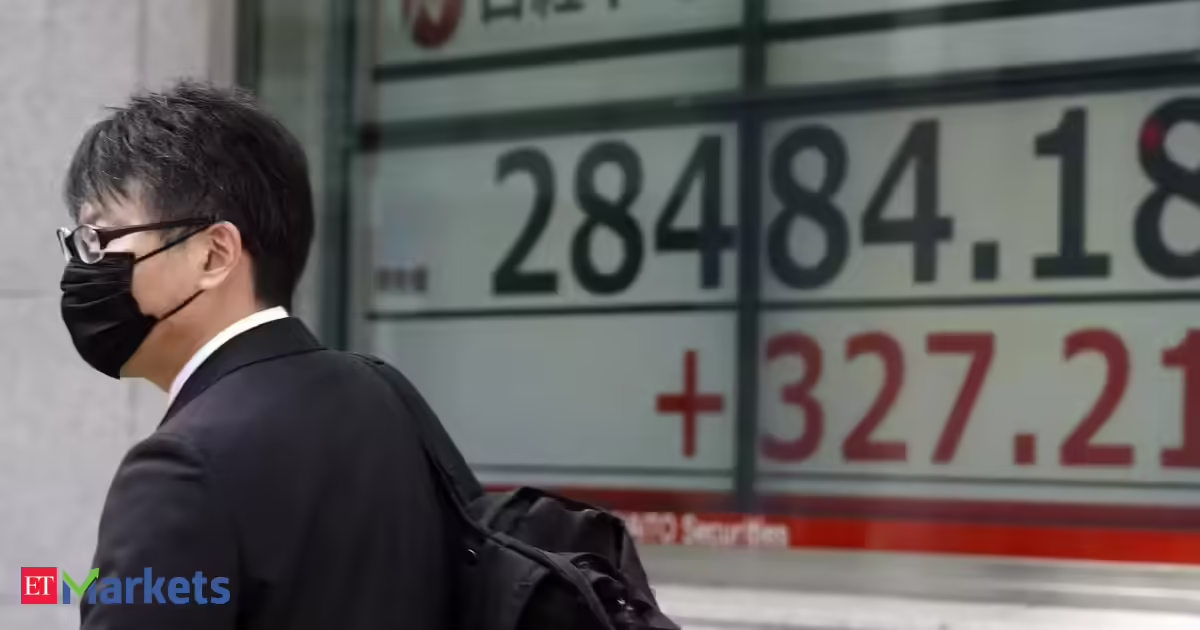
Asian share markets remain underpinned by demand for semiconductors and AI-related gear, with Japan’s Nikkei up a further 0.5%, having risen almost 5% last week to all-time highs.
South Korea rose 1.3%, after surging 8% last week, while Taiwan climbed almost 6% last week. MSCI’s broadest index of Asia-Pacific shares outside Japan added 0.2%.
Nvidia boss Jensen Huang kicks off the Computex trade show in Taiwan on Monday with a speech about AI in which he is expected to expound on his company’s latest product efforts as well as the island’s central role in the industry. COUNTDOWN TO PAYROLLS
For Europe, EUROSTOXX 50 futures dipped 0.3%, while DAX futures eased 0.2% and FTSE futures lost 0.5%.
S&P 500 futures were up 0.2%, while Nasdaq futures firmed 0.4% after hitting records last week.
Yet the gains have been narrowly based with the AI-linked big 10 companies making up 40% of the S&P 500 and only 21 stocks of the 500 making record highs. While tech stocks climbed almost 16% in May, consumer discretionary and healthcare managed little more than 2%, and consumer staples lost more than 3%.
The inflationary pulse from oil continues to hamper bond markets as U.S. 10-year yields rose 3 basis points to 4.470%. Markets imply a 50-50 chance the Federal Reserve will have to hike rates by year-end to prevent rising prices from getting baked into inflationary expectations.
A host of Fed members are set to speak this week, while major data include the ISM survey of manufacturing and the May payrolls report on Friday.
Market forecasts are for a solid rise of 85,000 in employment, keeping the jobless rate steady at 4.3%. Anything stronger would likely see the odds of a hike narrow further.
The market’s hawkish outlook has kept the dollar broadly steady, with the Japanese yen and the euro hampered by those regions’ reliance on energy imports.
The dollar was a shade firmer on the yen at 159.42 , but bulls were wary of risking Japanese intervention on a break of the 160.00 barrier.
The euro stood at $1.1645, having spent the past week hemmed in between $1.1585 and $1.1661.
In commodity markets, gold was little changed at $4,535 an ounce, having found little support as a safe haven or as a hedge against inflation.

GE VERNOVA T&D INDIA
Change in Open Interest in June Series: 55.45% Change in price in June Series: 1%
RATIONALE: The sharp spike in open interest and price suggests a long buildup in the stock. “Technically, the stock has delivered a decisive breakout above the Rs 4,950 resistance zone and is sustaining near its lifetime high, indicating strong price acceptance at higher levels,” said Dhupesh Dhameja, derivatives analyst at Samco Securities. As long as the stock holds above Rs 4,850, the bullish structure remains intact with potential to move toward Rs 5,650, said Dhameja.
COMPUTER AGE MANAGEMENT (CAMS)
Change in Open Interest in June Series: 4.78% Change in price in June Series: 0.57%
RATIONALE: CAMS is showing strength on the charts, shaping a constructive setup after a phase of healthy consolidation, said Dhameja.
“The stock continues to maintain a higher high–higher low structure and is comfortably trading above its rising 20-DMA, indicating that the primary trend remains fi rmly positive,” he said. “Price action near the Rs 780–800 zone suggests accumulation at higher levels rather than distribution, reflecting strong market participation.” Dhameja sees a potential upside of Rs 850, while Rs 750 remains a critical support level, below which the prevailing bullish structure would weaken.
SUZLON ENERGY
Change in Open Interest in June Series: 2.93% Change in price in June Series: 0.29%
RATIONALE: Following the stock decline from Rs 86 to 38 in the past 18 months, Suzlon has rebounded over 50% to Rs 57.75.
“At the current juncture, it is trading on the verge of a fresh breakout on the daily charts,” said Vipin Kumar, AVP – Derivatives and Technical Research at Globe Capital Market. “The recent surge in prices is well supported by a combination of long buildup and short covering in the last couple of trading sessions, alongside a strong rollover of 95%.” Kumar suggests traders buy its June futures in the Rs 55-57 range with a stop loss at Rs 52.5 for potential upside towards Rs 62-66.
GMR AIRPORTS
Change in Open Interest in June Series: 4.1% Change in price in June Series: 2.55%
RATIONALE: GMR Airports has delivered a decisive breakout above the Rs 98–99 resistance zone, accompanied by a sharp surge in volumes, indicating strong institutional participation, said Ajit Mishra, SVP- Research, Religare Broking.
“The stock is trading above its key short-, medium-, and long-term moving averages, reinforcing the bullish structure. After spending several months in a broad consolidation range, the recent move suggests the beginning of a fresh uptrend with improving momentum indicators and RSI turning higher from neutral territory,” he said. Mishra suggests buying with a target of Rs 109 and a stop loss at Rs 97.
SIEMENS
Change in Open Interest in June Series: 5.74% Change in price in June Series: -1.96%
RATIONALE: Kumar said that Siemens is well placed across multiple time frames, trading above both its short-term and long-term moving averages. “At the current juncture, it is on the verge of a fresh breakout from a two year-long congestion zone,” he said, suggesting adding the stock in the 3700–3800 range, with a stop loss at Rs 3540 for a price target of Rs 4200.
MAHINDRA & MAHINDRA
Change in Open Interest in June Series: 7.69% Change in price in June Series: -2.12%
RATIONALE: The price and open interest suggest a fresh short buildup. Mishra said M&M continues to remain under pressure, trading below its key moving averages. Traders may consider short positions with a target of Rs 2,910 and a stop loss at Rs 3,170, said Mishra.


Fed’s Powell warns that politicizing the Fed would cost public trust

A year after the Air India crash, a mother still speaks about her dead son in the present tense and a brother waits for answers.
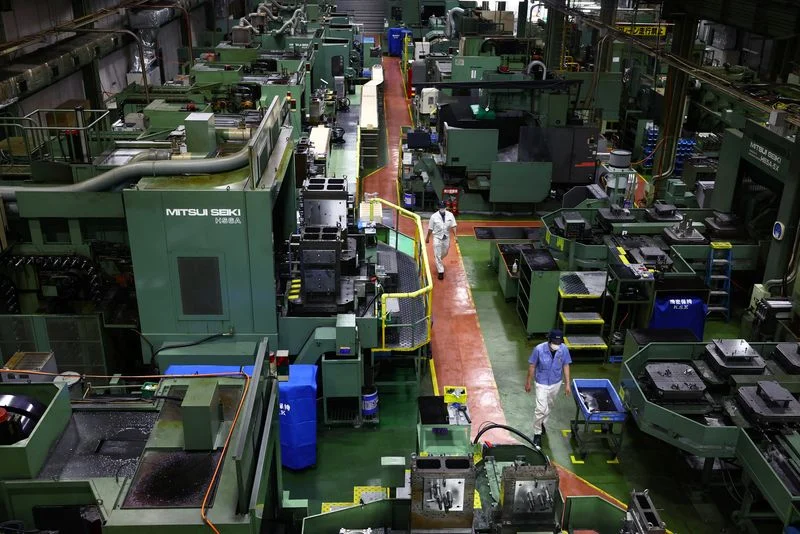

Japan’s factory growth slows as cost pressures surge, PMI shows
MR Maniveni Foods shares to list today. Check GMP ahead of debut

🚨Official: Mexico unveil Javier Aguirre’s squad for the World Cup

Off-Grid OCR Server Powered By IPhone


-

 NewsBeat5 days ago
Israel says it has killed new Hamas military leader in Gaza City airstrikes
-

 Tech5 days ago
NASA taps Blue Origin to deliver lunar rovers for Moon Base initiative
-

 Politics7 days ago
Bridgerton Season 5: Cast, Release Date And Everything We Know So Far
-

 News Videos5 days ago
XRP *JUST* SUCCEEDED!!!! CLARITY ACT EXPOSED!!! (SHE EXPOSED IT)
-

 Sports6 days ago
2026 NBA Finals schedule, odds: Knicks await Thunder or Spurs after winning East
-
 Crypto World5 days ago
Micron Crosses $1 Trillion Market Cap as AI Demand Reshapes Memory Sector
-

 Business5 days ago
Selena Gomez Reportedly Upset Over Benny Blanco’s Comments on Her ‘Terrible’ Diet
-

 News Videos3 days ago
This is BROKEN! INSANE 5x MONEY CAR WASH WEEK! The NEW GTA Online UPDATE Today! (GTA5 New Update)
-

 Business7 days ago
BTS Sells Out Four Las Vegas Shows at Allegiant Stadium for ARIRANG World Tour
-
 NewsBeat6 days ago
Hottest May day ever as London hits 34.8C in 2C leap from previous records
-
 Tech6 days ago
China assigns ID codes to 28,000+ humanoid robots
-

 Business6 days ago
Nikkei 225 Surges Past 65,000 for First Time as Iran Peace Hopes Fuel Record Rally
-

 Tech7 days ago
Microsoft’s quiet Claude Code retreat and the real cost of enterprise AI
-

 Tech3 days ago
Waymo dominates autonomous vehicle registrations as Tesla trails behind
-

 NewsBeat6 days ago
Crowds find riverside shade in York as temperatures soar
-
Tech5 days ago
The Samsung pay deal is the moment Korean unions changed register
-

 Tech7 days ago
Westone Audio and Etymotic Acquired by Fidelity Collective in Major IEM Market Move
-
 Entertainment6 days ago
‘Breaking Bad’ Star’s Easy-to-Binge 6-Part Crime Series Spin-Off Is Finally Heading to Free Streaming
-

 Tech5 days ago
Millions of AI agents imperiled by critical vulnerability in open source package
-
Crypto World5 days ago
SpaceX’s $2 Trillion IPO: Why Tech Giants Nvidia (NVDA), Apple (AAPL), and Microsoft (MSFT) May Face Pressure
You must be logged in to post a comment Login