
Crypto World
Vitalik Buterin Calls for Evolving Ethereum’s L2 Vision as Base Layer Grows


TLDR
- Vitalik Buterin reassesses Ethereum’s Layer 2 scaling vision in light of faster-than-expected base layer growth.
- Buterin emphasizes that Ethereum’s Layer 2 networks have not achieved the full decentralization once envisioned.
- Leading rollups such as Optimism and Arbitrum have made progress but still face challenges in trustless execution and cross-chain interoperability.
- The original concept of Ethereum scaling with L2 rollups may no longer align with the network’s evolving needs.
- Vitalik Buterin advocates for more focus on native rollups and tighter integration of ZK-EVM technology into Ethereum’s base layer.
Vitalik Buterin, Ethereum’s co-founder, is reassessing Ethereum’s Layer 2 (L2) scaling vision. His recent comments on X reflect concerns over the slow progress of decentralization in L2 networks. As Ethereum’s base layer scales, Buterin suggests that the framework positioning L2 rollups as quasi-native shards no longer aligns with the network’s current trajectory.
Vitalik Buterin Reassesses Ethereum’s L2 Scaling Approach
In a shift from previous views, Vitalik Buterin has called for a reevaluation of Ethereum’s L2 scaling plans. Ethereum’s Layer 1 has grown faster than expected, while L2 decentralization has lagged. Buterin emphasized that L2s have not fully reached the decentralized “Stage 2” model once envisioned for Ethereum scaling.
L2 networks, such as Optimism and Arbitrum, have achieved milestones but still face challenges. They trail in achieving full decentralization and cross-chain interoperability. Buterin’s reassessment highlights these shortcomings and questions whether L2s can fulfill their intended promise of scaling Ethereum.
Ethereum L2 Struggles to Meet Expectations
The original vision for Ethereum L2s was to provide a scaling solution with a trustless, decentralized environment. However, the progress has been slower than anticipated, especially in the areas of cryptographic guarantees and interoperability. Despite advancements in L2 rollups, such as Base and Arbitrum, they still fall short of full decentralization and are not yet fully integrated into Ethereum’s core system.
Buterin’s recent comments suggest that Ethereum L2 must adapt to the evolving network dynamics. Ethereum’s base layer, with increasing gas limits and scalability, may make L2 solutions less crucial in the future. This shift calls into question whether L2 rollups will remain the go-to solution for Ethereum scaling as Layer 1 becomes more capable.
The Shift Toward Native Rollups and ZK-EVM Integration
As Ethereum’s base layer grows more robust, Vitalik Buterin and others in the Ethereum community have started focusing more on native rollups. These rollups, integrated more deeply into the Ethereum protocol, could replace the need for separate L2 solutions. Buterin has expressed growing support for native rollups, particularly those built around zero-knowledge (ZK) proofs, which offer more efficient and secure scaling.
The development of ZK-EVM technology is key to this shift. It has the potential to enable more seamless integration between the Ethereum base layer and rollups. This move could lead to a more streamlined approach to scaling Ethereum while maintaining decentralization and security, a shift that Buterin believes aligns better with the network’s long-term goals.




A new Cato Institute paper argues that U.S. capital gains rules make “bitcoin taxes make no sense,” burying everyday BTC payments in paperwork and locking the asset into a hoarding role instead of money.
Summary
- Cato Institute’s Nick Anthony argues US capital gains rules make daily bitcoin spending “make no sense.”
- Treating BTC as property forces users to track tax lots on small purchases, from coffee to groceries.
- Cato urges scrapping gains on crypto payments or adopting a higher de minimis threshold than the current $200 proposal.
The Cato Institute is calling for a reset of how the United States taxes bitcoin, arguing that current rules make it almost impossible to use the asset as everyday money. In a new blog post, research fellow Nicholas Anthony writes that “bitcoin taxes make no sense,” because every transaction is treated as a taxable event under capital gains rules.
Anthony notes that under existing guidance, bitcoin is treated as property, not currency, meaning users must calculate gains or losses each time they spend BTC (BTC), no matter how small the purchase. “It’s never been easier to use bitcoin as money,” he said, “yet, at the same time, the tax code puts an incredible burden on law‑abiding citizens.”
In his analysis, Anthony describes how something as trivial as buying a cup of coffee with bitcoin every day can snowball into “over 100 pages of tax filings” over time. For each transaction, users must record the date they acquired the BTC, the price paid (cost basis), the date they spent it, and the dollar value at the time of the purchase, then report it all on Form 8949 and Schedule D.
Beyond sheer paperwork, Anthony argues the structure “discourages real‑world use” and nudges people to hoard BTC rather than spend it, because capital gains rules are designed to reward long‑term holding. In his words, current policy has “effectively paralyzed Bitcoin’s use as a currency” even as wallet infrastructure and merchant tools make payments technically straightforward.
The think tank sketches several policy fixes, ranging from eliminating capital gains on cryptocurrency payments entirely to carving out exemptions for day‑to‑day spending. Anthony points to the long‑running Virtual Currency Tax Fairness Act proposal, which would exempt gains under $200 per transaction, but calls that threshold “too low” to match typical consumer behavior in a high‑inflation environment.
Cato’s intervention lands in the middle of U.S. tax season, as the Internal Revenue Service rolls out expanded crypto reporting rules that will see broker‑reported digital asset sales matched against Form 8949 entries and new 1099‑DA disclosures. At the same time, lawmakers are still debating de minimis exemptions, with some revised bills shifting relief toward regulated stablecoins, prompting criticism from bitcoin advocates who say Washington is “picking winners and losers” in the crypto market.
In previous crypto.news reporting on U.S. crypto tax bills and de minimis proposals, coverage has highlighted similar tensions between encouraging innovation and maintaining oversight, as well as concerns that complex filing rules could push retail users offshore or into non‑compliance.
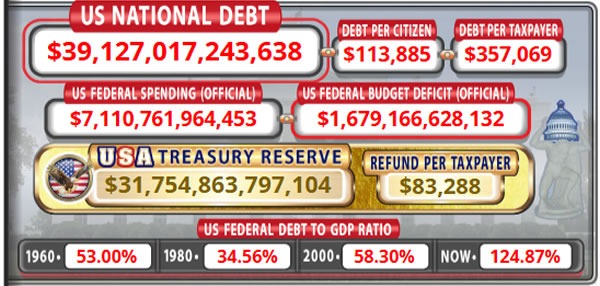
Former Treasury Secretary Henry Paulson has urged US authorities to prepare a contingency plan for a potential future collapse in demand for US Treasurys, warning that the fallout would be “vicious.”
“We need an emergency break-the-glass plan, which is targeted and short-term, on the shelf, so it’s ready to go when we hit the wall,” Paulson told Bloomberg in an interview on Thursday.
“People say, when are you going to hit the wall? I obviously don’t know, it’s impossible to know. When we hit it, it will be vicious, so we have to prepare for that eventuality.”
The US Treasury market acts as the bedrock of the global financial system, serving as a “risk-free” benchmark with other assets, such as corporate bonds, mortgages, and stocks, being priced relative to Treasurys. Instability could cause ripple effects in the global economy.
For years, economists have warned of a potential “doom loop” where investors start demanding higher yields on Treasurys due to risks tied to the government’s burgeoning debts, which are currently more than $39 trillion.
This could cause an increase in interest payments, currently 4.3% on 10-year notes, which would widen the deficit. But if the Treasury cannot raise what it needs to pay interest, many assume the Federal Reserve would become the principal buyer, Bloomberg reported.

A double-edged sword for crypto
There could be several potential impacts on crypto markets if the $31 trillion US Treasury market were to melt down.
A Treasury market crisis could potentially trigger a flight to alternative stores of value such as Bitcoin (BTC) or gold. This may happen if the Fed is forced to monetize debt, stoking inflation fears and undermining confidence in the dollar.
However, the world’s largest stablecoin issuer, Tether, is predominantly backed by Treasurys, with 63% of its total reserves comprising US Treasury bills and 10% overnight reverse repurchase agreements, according to the Tether transparency report.
Related: Ethereum stablecoin supply hits $180B all-time high: Token Terminal
Research lead at the Bitrue trading platform, Andri Fauzan Adziima, told Cointelegraph that this remains a “watch-list macro tail risk,” but if it happens, there could be short-term pain via “spiking yields, tighter global liquidity, and risk-off selling that hits BTC and altcoins hard while amplifying stablecoin risks.”
“Tether alone holds over $120 billion in Treasurys, making it vulnerable to redemption runs or depegs if confidence erodes and it faces fire-sale pressure.”
However, in the longer-term, it might “accelerate a flight to non-sovereign stores of value, positioning Bitcoin as ‘digital gold’ amid eroding trust in US debt/dollar dominance,”
It is potentially bullish if the crisis highlights fiat vulnerabilities without an immediate systemic meltdown, he said.
US Treasury conducts largest debt buyback
The US Treasury conducted its largest single debt buyback on Thursday, accepting $15 billion worth of older securities maturing from 2026 to 2028.
Such buybacks enhance Treasury market liquidity by retiring less-traded bonds and providing liquidity and cash to holders who may redeploy it elsewhere in the financial system.
Magazine: Forget stablecoin yield, how does the CLARITY Act treat DeFi?


Bitcoin traded around $74,700 in Asian morning hours Friday, down 0.4% over 24 hours but still up 3.5% on the week, as a 10-day rally in global equities paused ahead of next week’s U.S.-Iran ceasefire expiry.
Ether gave back 1.4% to $2,327 but still leads the majors on the weekly tape at 6%, extending the outperformance that emerged earlier this week. XRP held $1.43 with a 6.4% weekly gain, solana ticked up 2.7% to $87.67, BNB added 0.7% to $629.89, and dogecoin was up 5.6% on the week at $0.0976.
The MSCI All Country World Index closed at a record high Thursday before slipping 0.1% in Asia. The S&P 500 also hit an all-time high. Brent crude fell 1.2% to $98.20 after President Donald Trump said prospects for a permanent Iran ceasefire were “looking very good.”
Trump claimed, without evidence, that Tehran had agreed to give up its nuclear ambitions, turn over nuclear material, and reopen the Strait of Hormuz as part of the deal. Iran has not confirmed those concessions.
A 10-day ceasefire between Israel and Lebanon was announced separately on Thursday, with Israeli Prime Minister Benjamin Netanyahu confirming the truce in a video message. Markets are trading the headlines as if the deal is closer than it is, which is part of why equities have unwound most of the war premium while crude remains near $98 and the Strait of Hormuz is still effectively shut.
However, the setup underneath the flat bitcoin price action is what some traders are paying attention to.
Bitcoin perpetual funding rates have turned deeply negative in recent sessions, reaching levels last seen in 2023. Funding is the periodic payment perpetual futures traders exchange with each other to keep contract prices aligned with spot. When it goes negative, shorts are paying longs, which only happens when the market is heavily positioned against price.
“Funding rates this negative tell you the market is heavily short,” Daniel Reis-Faria, CEO of ZeroStack, said in a note shared with CoinDesk. “If Bitcoin continues to move higher despite that, a lot of those positions could get liquidated, and the move can accelerate quickly.”
Reis-Faria expects bitcoin could reach $125,000 in the next 30 to 60 days if the short base gets squeezed out.
“It’s a reminder that no matter how much shorting is in the market, the amount of buy pressure, especially from large companies, can squeeze those positions out,” he said.
The contrarian read from on-chain analyst CryptoVizArt is that bitcoin’s “True Market Mean,” a metric that estimates the average cost basis of active investors by filtering out lost and dormant coins, suggests the average active holder is currently underwater.
Since 2016, meaningful stretches below the True Market Mean have aligned with bitcoin’s worst periods, including the 2018-19 bear (-57% max drawdown, 282 days) and the 2022-23 unwind after the Luna and FTX collapses (-56%, 339 days).
The two reads do not have to be in conflict. A short squeeze from negative funding and a structural drawdown from underwater holders can both be true, with the former triggering the kind of outsized rally that ultimately gets sold into by the latter.
Which scenario dominates likely depends on whether the U.S.-Iran ceasefire extension holds past next week.
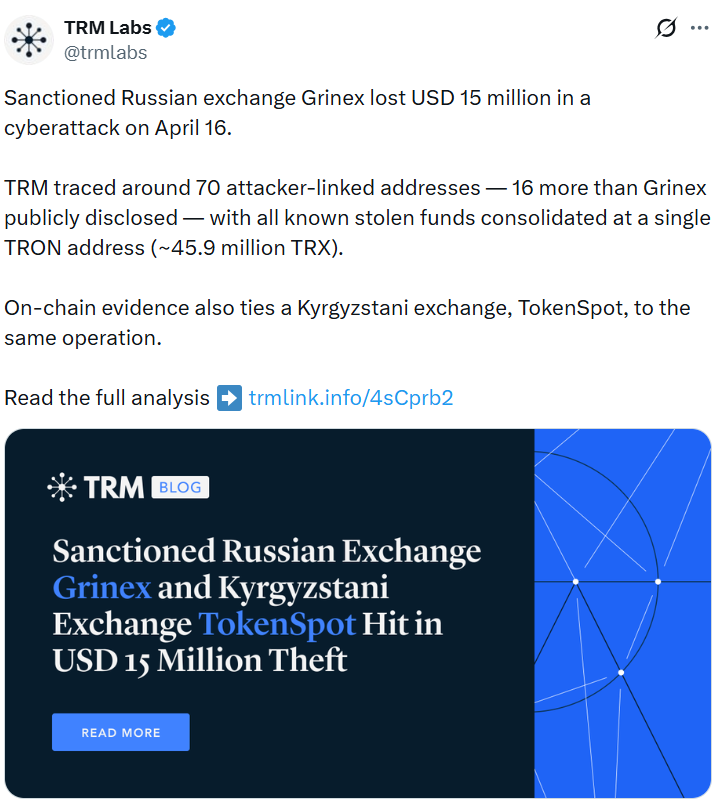
Sanctioned crypto exchange Grinex said it has suspended trading after losing more than 1 billion Russian rubles ($13.7 million) to an attack bearing signs of involvement by foreign intelligence agencies.
The exchange, which is registered in Kyrgyzstan but has been linked to Russia’s crypto ecosystem and alleged sanctions evasion, said on Thursday that the funds were taken from 54 addresses and that the digital footprint and nature of the attack indicate an “unprecedented level of resources and technology available only to entities of hostile states.”
“Due to the attack, the Grinex exchange has been forced to suspend operations. All available information has been transferred to law enforcement agencies. A criminal complaint has been filed at the location of the infrastructure,” it added.
Grinex had been widely seen as the successor to the similarly sanctioned Garantex exchange. Both have been accused by US authorities of assisting Russia and other entities in evading sanctions and laundering funds for Russia-linked hackers.
Elliptic founder Tom Robinson has accused it of being the primary platform for trading A7A5, a ruble-backed stablecoin linked to sanctions evasion.
A Grinex spokesperson told Cointelegraph last year that it strongly condemns any form of illegal activity, including sanctions evasion and money laundering.
Another exchange might have been hit by the same attacker
Grinex may not have been the only exchange targeted. Blockchain intelligence company TRM Labs said on Thursday that two wallets from TokenSpot, a Kyrgyzstan-based exchange with on-chain links to Grinex, sent around $5,000 to the same consolidation address used by the Grinex attacker.
TokenSpot’s Telegram channel announced technical work and a brief platform outage on April 15, followed the next day by an announcement that it had resumed full operations.

At the same time, TRM Labs said it has identified 16 additional addresses linked to the incident in addition to those Grinex publicly disclosed. The consolidation address where all the funds have been sent contains 45.9 million TRON (TRX), worth nearly $15 million.
Hacker might have stolen $15 million in USDT
Blockchain analytics firm Elliptic said it tracked about $15 million in USDt (USDT) leaving Grinex accounts. The funds were then sent to accounts on the Tron or Ethereum blockchains.
Related: Ukraine arrests FBI-wanted cybercrime suspect, seizes $11M in assets
“This USDT was then converted to another asset, either TRX or ETH. By doing so, the thief avoided the risk of the stolen USDT being frozen by Tether,” the company said.
This is not the first time an exchange accused of helping entities evade US sanctions has been targeted. Iran-based exchange Nobitex had $81 million drained in June 2025, with a pro-Israel hacker group claiming responsibility.
Magazine: Singapore isn’t a ‘crypto hub’ — it’s something better: StraitsX CEO

Disclosure: This article does not represent investment advice. The content and materials featured on this page are for educational purposes only.
Crypto payment gateways gain traction as blockchain reshapes everyday transactions.
Summary
- Crypto POS gateways gain traction as stablecoins reshape payments, with Polygon aiming to close usability gaps.
- Stablecoins boost cross-border payments and speed, but challenges remain as Polygon works on seamless adoption.
- Crypto payments evolve beyond investment use, with Polygon set to enhance stablecoin usability in e-commerce.
The ability to perform online payments is often taken for granted, as fiat-based methods have essentially become a part of daily life. However, cryptocurrency point-of-sale gateways are once again beginning to transform the entire ecosystem. Offering a host of user-friendly features in tandem with elements unique to the blockchain, many analysts hail crypto-friendly platforms as the wave of the future.

However, even stablecoins can suffer from a handful of drawbacks. This is why additional changes must be made to further streamline the process if we hope to provide consumers, and e-commerce platforms alike, with the solutions they have been searching for. Let’s see how Polygon will soon be able to bridge this gap so that we can better appreciate what the not-so-distant future has in store.
The stablecoin revolution
It is impossible to deny the positive impacts that stablecoins have had upon the online payment community. While it can be argued that anonymity is one of their most important selling points, other blockchain-native benefits exist. For instance, cross-border payments have become a reality (a crucial selling point for e-commerce hubs hoping to cater to an international marketplace). Consumers can likewise leverage the anonymous nature of stablecoins. When combined with faster processing times and tokens that can sometimes act as hedges against inflation, it becomes clear to see why cryptocurrencies represent far more than one-off investment opportunities.
Good, but far from perfect
The only issue is that cryptocurrencies can still suffer from a handful of possible drawbacks. One major pitfall involves a somewhat fragmented presence across the global marketplace. In other words, the availability of stablecoins can often vary from region to region. Other possible pain points include:
- Occasionally slow settlement times
- High transaction fees
- Difficulty upgrading point-of-sale infrastructure (a particular concern for online merchants)
- Challenges when performing token swaps
- On- and off-ramping friction
Not only might these elements detract from the public appeal of stablecoin transactions, but they can present additional hurdles that e-commerce providers will need to overcome. The good news is that things are soon about to change thanks to a novel initiative by Polygon.
The Polygon Open Money Stack
Perhaps the best way to describe the Open Money Stack is to refer to a quote from Polygon founder and CEO Sandeep Nailwal:
“Open, seamless, and interoperable.”
Open Money Stack promises to address many of the same issues highlighted in the previous section of this article. So, what does this system have in store? Why should it be able to provide relief to consumers, and businesses alike?
Vertical integration
Open Money Stack can be seamlessly integrated into existing POS architecture; taking much of the guesswork out of implementation. Furthermore, this system is modular by design. Vendors can select which features are required while still being able to connect with other networks.
Reducing the need for multiple service providers
This is yet another pitfall that some stablecoins have yet to overcome. The problem with multiple service providers is that relying on numerous nodes can lead to sluggish processing times; a real issue for vendors hoping to provide lightning-fast payment solutions. Increased fees could also be present; resulting in most costly end-user transactions, or forcing the seller to absorb the associated costs. The one-size-fits-all design of Open Money Stack addresses these drawbacks.
Keeping conversion woes at bay
Fiat/crypto exchanges are a regular occurrence throughout the e-commerce community, and the processes are sometimes convoluted. On- and off-ramping can be sluggish, costly, and dependent on existing infrastructure. Polygon’s Open Money Stack aims to provide an efficient solution thanks to its cross-chain interoperability. This will help to reduce friction, to simplify how consumers interact with the systems, and ultimately, to lower cart abandonment rates.
A coming paradigm shift
The Polygon Open Money Stack seeks to provide even more targeted solutions to consumers and e-commerce vendors. Even though core aspects of the stack are already live (like its enterprise grade wallet suite and the Polygon Chain), the rest is expected to go live later in 2026; already, this system has begun to make headlines across the cryptocurrency community. Analysts feel that Open Money Stack could very well usher in an entirely new era of digital payments; great news for buyers and sellers alike.
Disclosure: This content is provided by a third party. Neither crypto.news nor the author of this article endorses any product mentioned on this page. Users should conduct their own research before taking any action related to the company.


Bitcoin hovers near $75k with on-chain data flagging $76,800 as key resistance, while Morgan Stanley’s cut‑price MSBT ETF pulls in $100m amid easing macro headwinds.
Summary
- Bitcoin is trading near $75,000, with on-chain data flagging $76,800 as key resistance where short-term holders may take profits.
- A new Morgan Stanley spot bitcoin fund has already attracted more than $100 million in inflows with a market‑low 0.14% fee, intensifying ETF fee competition.
- Geopolitical tensions, a weaker dollar and lower U.S. yields are supporting BTC, even as Iran risk and energy prices keep inflation fears alive.
Bitcoin (BTC) is hovering around $75,000 as on-chain cost metrics cluster near $76,800, a level CoinDesk says could act as a major resistance where short-term holders begin to sell into strength. The analysis suggests that when BTC pushes into short-term holders’ realized price band, supply often spikes as investors “break even,” raising the odds of profit‑taking and a near‑term pause or pullback.
CoinDesk reports that market sentiment has been buoyed by news of an extended ceasefire between the U.S. and Iran, with the dollar sliding to a near six‑week low and U.S. Treasury yields drifting lower, a combination that typically supports risk assets and non‑yielding hedges such as bitcoin and gold. Gold has been rising alongside BTC, signaling what the outlet describes as a market trying to balance risk appetite with lingering demand for safe‑haven assets.finance.
On-chain data tracked by firms such as CryptoQuant shows that as bitcoin approaches the $76,800 realized price for short-term holders, supply to exchanges tends to increase, echoing a pattern seen in earlier rallies where that band acted as a ceiling. A recent note highlighted hourly BTC inflows to exchanges jumping to roughly 11,000 BTC as price tested the mid‑$76,000s, the strongest pace since December, which historically has signaled mounting sell pressure at resistance zones.
At the same time, institutional demand remains firm. Morgan Stanley’s new MSBT spot bitcoin fund, listed on NYSE Arca with a 0.14% annual fee, has already drawn more than $100 million in inflows and is now the cheapest spot BTC ETF in the U.S. market, undercutting BlackRock’s IBIT at 0.25%. Unchained and other industry trackers reported MSBT logged about $34 million in first‑day net inflows and strong early volume, a sign that large advisors are actively rotating client flows into the bank’s in‑house product.
CoinDesk notes that the new inflows come as U.S. spot bitcoin ETFs collectively hold more than 1.2 million BTC, or over 6% of total supply, giving traditional finance vehicles an outsized role in marginal bitcoin demand. Meanwhile, the U.S. blockade of Iranian ports and Tehran’s threats to disrupt shipping in the Persian Gulf continue to cloud the global growth outlook, with knock‑on effects on energy prices and inflation expectations that could, in turn, influence central bank policy and risk sentiment toward crypto.
In recent crypto.news coverage, analysts stressed that $68,000 remains a key downside “line of defense” for bitcoin, with the current range between that level and roughly $75,000 framed as the most consequential band of 2026 as macro, geopolitical and ETF flows collide. Other crypto.news articles have highlighted how short‑term holder behavior and realized price bands have repeatedly marked local tops and consolidation zones during this cycle, a dynamic now converging again around $76,800.

Summary
- JPMorgan says CLARITY Act talks have narrowed to 2–3 core disputes as senators race to finalize a stablecoin deal before midterms.
- The bill would ban passive yield on stablecoin balances while allowing activity-based rewards, reshaping revenue models for issuers like USD Coin.
- Coinbase and major banks have clashed over the yield language, with a White House compromise now framing “idle yield” as off‑limits but transactional incentives as acceptable.
Negotiations over the U.S. CLARITY Act, a sweeping digital asset market structure bill, have entered their final stage, with JPMorgan analysts saying the number of disputed issues has fallen from more than a dozen to just two or three core questions centered on stablecoin rewards and regulatory oversight.
Final-stage talks on CLARITY Act stablecoin rules
The talks, which are unfolding in Washington ahead of the 2026 midterm cycle, aim to bolt a durable federal framework for stablecoins and broader crypto markets onto last year’s GENIUS Act, the first U.S. law to license dollar‑pegged payment stablecoins.
In a recent research note, JPMorgan argued that passage of the CLARITY Act could become a key positive catalyst for digital asset markets in the second half of 2026 by finally settling the jurisdictional split between the Securities and Exchange Commission and the Commodity Futures Trading Commission.
The political fight has focused on how far Congress will go in banning yield on stablecoin balances, a feature that has become a major revenue engine for exchanges and wallet providers.
According to FinTech Weekly, the latest Senate draft “bans passive yield on stablecoin balances” but permits “activity-based rewards tied to loyalty programmes, promotions, subscriptions, transactions, payments, and platform use,” with the SEC, CFTC and Treasury given twelve months to define the precise boundaries and anti‑evasion rules.
Coinbase chief legal officer Paul Grewal told Fox Business that negotiators are “very close to a deal” on the yield language and said he expects the bill to move toward a Senate Banking Committee markup and eventually a floor vote after the recess.
Banks, led publicly by JPMorgan, have pressed lawmakers to ensure that stablecoin products offering yield face bank‑level oversight to avoid what they describe as regulatory arbitrage against traditional deposits.
On JPMorgan’s first‑quarter earnings call this week, chief financial officer Jeremy Barnum warned that yield‑bearing stablecoins risk becoming “a tool for regulatory arbitrage unless they are held to the same strict oversight and consumer protection standards as traditional bank deposits,” remarks that landed squarely in the middle of the CLARITY negotiations.
The White House has tried to broker a compromise by drawing a line between “idle yield” for simply holding a token and transaction‑linked rewards, with one recent proposal described by BVNK analyst Stewart Will as an attempt “to prevent massive deposit flight from traditional banks to high‑yield digital assets” while still allowing stablecoins to function as a low‑haircut settlement layer.
For issuers such as USD Coin, which currently trades around $0.9998 with an estimated market capitalization of roughly $78.6 billion, the final shape of the law will determine how far platforms can go in layering incentives on top of basic dollar‑pegged balances without triggering securities or banking rules.
The CLARITY bill also interacts with the GENIUS Act, enacted in 2025 to require key payment stablecoins to be backed one‑for‑one by cash or short‑term Treasuries and to obtain a federal or state licence as a Permitted Payment Stablecoin Issuer.
Policy analysts at Brookings say that GENIUS‑regulated payment stablecoins sit in a distinct category outside of both securities and traditional bank deposits, leaving CLARITY to decide how those instruments plug into capital markets, DeFi protocols and tokenized bank money such as JPMorgan’s own deposit token projects.
As senators race to lock in text before election politics harden, JPMorgan has framed approval of the CLARITY Act by mid‑2026 as a “key positive catalyst” that could unlock institutional participation in crypto once stablecoin rules, yield limits and agency mandates are finally pinned down.

European companies exploring Bitcoin treasury strategies are unlikely to replicate the playbook pioneered by Michael Saylor’s Strategy, according to industry executives, who pointed to structural differences between US and European capital markets.
Speaking at Paris Blockchain Week 2026, Thomas Vogel, a partner in the Paris and Frankfurt offices of Latham & Watkins, said the constraints on issuing financial instruments in Europe differ significantly from those in the US, making a direct replication of the model difficult.
“If you issue convertibles in the US, the constraints are not the same as when you issue them out of a French balance sheet or a balance sheet in Europe,” Vogel said, pointing to differences in market depth, regulation and investor behavior.
Alexandre Laizet, who leads Bitcoin (BTC) strategy at France-based treasury firm Capital B, said European firms are instead looking to local market infrastructure, including French public markets and Luxembourg-based structures, to raise capital tied to Bitcoin exposure.
The remarks suggest Europe’s Bitcoin treasury model is likely to evolve as a local adaptation rather than a direct copy of Strategy’s US playbook.

Europe’s listed holders remain small
A growing number of European public companies now hold Bitcoin on their balance sheets, but the market remains fragmented across small and mid-cap names.
According to data from BitcoinTreasuries.net, Germany-based Bitcoin Group SE held 3,605 BTC worth about $268 million at the time of writing, though it has not disclosed its average cost or profit and loss.
Related: EU adviser says ‘MiCA 2’ is likely as crypto market matures: PBW 2026
Capital B held 2,925 BTC at an average cost of $99,932 per Bitcoin, reflecting a roughly 25.6% unrealized loss. In contrast, Sequans Communications, also based in France, held 2,139 BTC, with cost and performance data not disclosed.
Other European names show similar pressure from recent price moves. Netherlands-based Treasury held 1,111 BTC at an average cost of $111,857, representing about a 33.5% unrealized loss, while Sweden’s H100 Group held 1,051 BTC at an average cost of $114,615, with an unrealized loss of around 35.1%
The gap in scale remains significant compared with the US. On Monday, Strategy acquired 13,927 Bitcoin for about $1 billion in a single week, bringing its total holdings to 780,897 BTC.
Magazine: Bitcoin will not hit $1M by 2030, says veteran trader Peter Brandt


XRP spot ETFs recorded $17.11 million in net inflows on April 15, their largest single-day intake in nearly 11 weeks, as four consecutive days of positive flows pushed combined assets under management above $1.25 billion.
Summary
- XRP spot ETFs drew $17.11 million on April 15, the strongest single-day inflow since February 3, 2026, bringing a four-day total to $38.86 million.
- Combined US-listed XRP ETF assets under management crossed $1.25 billion as the token rallied 6% to $1.42 on Thursday, reclaiming fourth place by market cap.
- Analysts say the CLARITY Act roundtable and Ripple’s new tokenized bond pilot with Kyobo Life are adding regulatory and utility tailwinds behind the inflow surge.
XRP (XRP) spot ETFs logged their largest single-day inflow in nearly 11 weeks on April 15, with $17.11 million flowing into US-listed products, per SoSoValue data. The figure marks the strongest daily intake since February 3, 2026, and extends an inflow streak to four consecutive sessions for the first time since March.
Over those four days, US-listed XRP ETFs drew a combined $38.86 million, pushing total net assets to over $1.25 billion. XRP itself rose 6% to $1.42 on Thursday, outperforming every other token in the top 10 by market cap.
The timing aligns with a broader improvement in crypto market sentiment driven by US-Iran ceasefire diplomacy and easing macro risk. XRP specifically has been benefiting from additional catalysts beyond the macro backdrop.
The SEC’s CLARITY Act roundtable, which kicked off in Washington today, is being closely watched by the XRP community as it could clarify the regulatory treatment of digital assets used in payments, an area where XRP has direct exposure. The prospect of legislative progress has brought institutional buyers back to the ETF market.
Ripple’s announcement on April 14 of a tokenized government bond pilot with South Korea’s Kyobo Life Insurance also reinforced XRP’s real-world settlement utility, adding a fundamental narrative alongside the technical inflow momentum. XRP ETFs posted a record $119.6 million across global products the week ending April 11, driven largely by European buyers, before Wednesday’s US-led single-day surge reset the domestic record.
What Analysts Are Watching
XRP remains roughly 23% below its January 2026 high despite Thursday’s rally. Analysts say the $1.60 level, which aligned with XRP’s March 17 high, is the first meaningful resistance test. A sustained hold above $1.40 is needed to avoid a false breakout reading on the chart.
The four-day inflow streak is constructive because XRP’s exchange supply has dropped to multi-year lows, meaning ETF accumulation is absorbing tokens from an already thin exchange order book. When ETF demand meets low exchange supply, price elasticity tends to increase on the upside.
XRP price has rallied 6% to $1.42 with its market cap moving back above $87 billion, with further upside contingent on clarity from today’s SEC roundtable and continued ceasefire progress reducing the macro headwinds that have kept risk assets pressured since February.

Blockstream CEO Adam Back said Thursday that a future post-quantum migration of Bitcoin could help clarify how many coins linked to Satoshi Nakamoto remain accessible, because any owner wanting to protect vulnerable holdings would need to move them to a new address format.
Speaking at Paris Blockchain Week, Back said such a migration would likely give users ample time to move funds and argued that coins left unmoved after that process could reasonably be treated as lost.
“This migration to post-quantum address format may tell us how many of those coins [Satoshi] still has,” said Back, adding that the pseudonymous creator has an estimated 500,000 to 1 million Bitcoin (BTC).
Satoshi’s Bitcoin stash has ignited heated debate among Bitcoin holders concerned by the quantum computing threat. On Wednesday, Jameson Lopp and five co-authors published a Bitcoin Improvement Proposal aimed at restricting the future movement of coins held in quantum-vulnerable address formats, including older coins whose public keys have already been exposed.

Blockchain data platform Arkham estimates that Nakamoto-linked wallets hold 1.09 million Bitcoin, currently valued at $81.6 billion.
Related: Bernstein says Bitcoin market already priced in quantum risk
Back sees long runway on quantum
Back said Bitcoin developers and holders still have substantial time to prepare, arguing that a quantum breakthrough capable of threatening Bitcoin signatures is at least 20 years away.
He argued that today’s quantum computers are “less powerful than a $5 calculator” and that some of their issues become more pressing as these systems scale, such as their energy consumption.
Back said that runway should give developers and users ample time to develop a post-quantum path and migrate to a new quantum-resistant standard underpinned by hash-based signatures.

In December 2025, Back’s Blockstream Research released a paper proposing a hash-based signature scheme that offers a “promising path for securing Bitcoin in a post-quantum world,” as a quantum-safe replacement for the ECDSA and Schnorr signatures. Under the proposal, security would rely solely on hash function assumptions, similar to the ones currently used in Bitcoin’s network design.
The Elliptic Curve Digital Signature Algorithm (ECDSA) uses elliptic-curve cryptography to verify the authenticity and integrity of a message. Schnorr signatures are another signature scheme praised for enhancing privacy and reducing data size, due to their ability to combine multiple signatures into one.
Magazine: Bitcoin vs. the quantum computer threat — Timeline and solutions (2025–2035)

Singer D4vd arrested in connection to murder of missing teen

BOJ chief avoids hints of April rate hike, shattering hawkish market bets

Bitcoin think tank says US tax rules ‘paralyze’ everyday BTC payments


-

 Politics6 days ago
US brings back mandatory military draft registration
-
 Sports6 days ago
Man United discover Nico Schlotterbeck transfer fee as defender reaches Dortmund agreement
-

 Fashion6 days ago
Weekend Open Thread: Veronica Beard
-

 Politics7 days ago
Malcolm In The Middle OG Turned Down ‘Buckets Of Money’ To Appear In Reboot
-

 Politics5 days ago
World Cup exit makes Italy enter crisis mode
-

 Business6 days ago
Tesla Model Y Tops China Auto Sales in March 2026 With 39,827 Registrations, Beating Cheaper EVs and Gas Cars
-

 Crypto World3 days ago
The SEC Conditionalises DeFi Platforms to Be Avoided for Broker Registration
-

 Crypto World3 days ago
SEC Signals Exemption for Crypto Interfaces From Broker Registration
-

 News Videos2 days ago
Secure crypto trading starts with an FIU-registered
-
 NewsBeat4 days ago
Pep Guardiola and Gary Neville agree over Arsenal title problem that benefits Man City
-

 Business5 days ago
Ireland Fuel Protests Enter Day 5 as Blockades Spark Shortages and Government Prepares Support Package
-

 Business7 days ago
OpenAI Halts Stargate UK Data Centre Project Over Energy Costs and Copyright Row
-

 Crypto World6 days ago
Federal judge blocks Arizona from bringing criminal charges against Kalshi
-

 Politics7 days ago
LBC Presenter Mocks Trump Over Iran War Failures
-

 NewsBeat3 days ago
Trump and Pope Leo: Behind their disagreement over Iran war
-

 Crypto World3 days ago
SEC Proposes Certain Crypto Interfaces Don’t Need to Register as Brokers
-
 NewsBeat5 days ago
JD Vance announces ‘no agreement’ with Iran over nuclear weapons fear
-

 Business6 days ago
IMF retains floor for precautionary balances at SDR 20 billion
-

 Business6 days ago
Former Liverpool CEO eviscerates FIFA for World Cup ticket pricing
-
 Crypto World4 days ago
Sei Network Enters Quiet Reset Phase as On-Chain Metrics Signal a Slowdown in 2026
You must be logged in to post a comment Login