This copy is for your personal, non-commercial use only. Distribution and use of this material are governed by our Subscriber Agreement and by copyright law. For non-personal use or to order multiple copies, please contact Dow Jones Reprints at 1-800-843-0008 or visit www.djreprints.com.
One of Britain’s largest trade unions has delivered a blistering rebuke to ministers over the newly unveiled British Industrial Competitiveness Scheme, accusing Whitehall of turning its back on the very manufacturers that have long defined the country’s industrial heartlands.
The GMB, which represents tens of thousands of workers across Britain’s factory floors, said its members in gas-intensive sectors had been “disgracefully ignored” by a package the Government had trailed as a lifeline for domestic industry. The union’s verdict will make uncomfortable reading in Downing Street, where ministers have staked considerable political capital on reviving the fortunes of British manufacturing and narrowing the competitiveness gap with rivals in Europe, North America and Asia.
Gary Smith, GMB General Secretary, did not mince his words. “Gas-intensive industries in the UK have been shamefully ignored by the Government in this announcement, it’s a total disgrace,” he said. Mr Smith went on to warn that members working in the nation’s world-famous ceramics sector, along with those producing the bricks that underpin Britain’s construction supply chain, were “sickened at the lack of support” on offer. “Workers in manufacturing companies across the UK need urgent help,” he added. “This isn’t it.”
The intervention throws a harsh spotlight on the scheme’s design. The ceramics cluster centred on Stoke-on-Trent, together with the brickmaking operations that supply housebuilders and infrastructure projects up and down the country, relies heavily on natural gas to fire kilns at the extreme temperatures their products demand. Punishing wholesale energy prices, combined with the cumulative weight of climate levies and network charges, have left these small and mid-sized manufacturers paying substantially more for power than their Continental competitors, a longstanding grievance that industry bodies have pressed successive administrations to address.
For owner-managers in the Potteries and the brick belts of the Midlands and the North, the omission will sting. Many of these firms are quintessential British SMEs: privately held, deeply rooted in their communities, and exporting heritage products that still carry weight on the world stage. Their plea has been consistent, that any credible competitiveness strategy must begin with the cost of energy, without which no amount of capital allowances or skills funding will move the dial.
Advertisement
Whether the Government chooses to reopen the scheme’s scope, or whether a separate package for energy-intensive industries is now inevitable, will be watched closely over the coming weeks. What is beyond doubt is that today’s announcement has, in the GMB’s eyes, fallen well short of the mark.
Amy Ingham
Amy is a newly qualified journalist specialising in business journalism at Business Matters with responsibility for news content for what is now the UK’s largest print and online source of current business news.
RESTON, Va. — NextNav Inc. shares surged more than 21 percent Thursday as the developer of next-generation terrestrial positioning, navigation and timing technology benefited from renewed investor optimism around an anticipated Federal Communications Commission rulemaking and a broader market rebound sparked by easing geopolitical tensions.
NextNav Stock Explodes 21% on FCC Regulatory Optimism and Broad Market Relief Rally
The stock was quoted at $20.56, up 21.15 percent or $3.59, in morning trading on April 16. Volume spiked as traders piled into the small-cap name, pushing shares toward recent highs after a period of consolidation. The move extended gains from the prior session and reflected growing confidence that NextNav’s spectrum-based solution could soon gain clearer regulatory support as a backup to GPS.
NextNav specializes in 3D geolocation and precise timing services that operate independently of satellite signals, addressing vulnerabilities in traditional GPS systems used by smartphones, emergency services, autonomous vehicles and critical infrastructure. Its Pinnacle platform provides accurate vertical positioning, while broader efforts focus on a nationwide terrestrial network leveraging 900 MHz spectrum to deliver resilient PNT capabilities even in urban canyons, indoors or during satellite disruptions.
The rally aligned with positive sentiment around FCC progress. In its March earnings release, NextNav CEO Mariam Sorond expressed confidence that the commission was moving toward a near-term Notice of Proposed Rulemaking, or NPRM, supported by a robust record and recent submissions by FCC Chairman Brendan Carr. Such a step would represent a significant milestone, potentially opening the door to commercial deployment and monetization of the company’s licensed spectrum holdings.
Analysts and market observers noted that regulatory clarity could unlock substantial value for NextNav, which has positioned itself as a leader in 5G-powered PNT alternatives. The company has highlighted successful tests and early commercial pilots, including plans to operate what it calls the world’s first 5G-powered PNT network. Momentum toward an NPRM and eventual Report and Order could accelerate partnerships with carriers, device makers and government agencies seeking GPS redundancy amid rising concerns over jamming, spoofing and space-based system vulnerabilities.
Advertisement
Thursday’s surge also coincided with a broader relief rally across risk assets. Signs of diplomatic progress in the Middle East helped calm energy markets and lifted technology and communications stocks, sectors that had faced pressure amid earlier uncertainty. NextNav, with its ties to 5G infrastructure and critical infrastructure resilience, rode the wave of renewed risk appetite.
The company reported fourth-quarter and full-year 2025 results in mid-March, posting a net loss of $1.42 per share against revenue that beat estimates in some segments. While still pre-revenue in its core commercial PNT push, executives pointed to operational highlights, including network expansions and advancing regulatory engagement. The earnings call emphasized the strategic importance of FCC action, with Sorond noting rapid momentum under the current administration.
Investor sentiment had been mixed in recent months. Insider sales, including a transaction by the CEO in early March valued around $1.2 million, raised some eyebrows, though such moves are common for executives managing personal holdings. Earlier volatility included a 17 percent jump in March tied to similar regulatory optimism. Analysts have offered varied targets, with some highlighting upside potential if the FCC pathway materializes, while cautioning on execution risks and ongoing cash burn as the company invests in network buildout.
NextNav’s technology addresses a growing national security and economic imperative. GPS disruptions — whether from solar activity, cyberattacks or intentional interference — can cascade through supply chains, transportation, finance and emergency response. The company’s terrestrial approach uses ground-based transmitters to create a complementary or backup layer, with 3D capabilities that improve altitude accuracy for applications like drone navigation and indoor mapping.
Advertisement
Recent board changes and governance moves signal preparation for growth. In February, NextNav appointed telecom veteran Lisa Hook as a director, bolstering expertise in regulatory and commercial scaling. The company also scheduled its 2026 annual shareholder meeting for May 21 as a virtual event, where stockholders will vote on director elections and auditor ratification.
Challenges remain. NextNav continues to report losses as it prioritizes infrastructure investment and spectrum advocacy over immediate profitability. Competition exists from other PNT innovators, and full commercialization depends on regulatory approval, carrier adoption and device integration. Capital needs for network deployment could require additional financing, though current cash positions and strategic partnerships provide runway.
Wall Street has taken note of the regulatory catalyst. Oppenheimer upgraded the stock to Outperform on April 16, contributing to positive momentum. Broader coverage reflects a mix of enthusiasm for the long-term opportunity in resilient navigation and realism about near-term hurdles. Options activity has shown heightened interest, with elevated call buying in recent sessions reflecting bets on continued upside.
For investors, NextNav represents a high-risk, high-reward play at the intersection of 5G, critical infrastructure and national security. Success hinges on translating spectrum holdings and technical prowess into revenue-generating contracts, potentially with government agencies, wireless providers or enterprises requiring precise timing and location services.
Advertisement
The company traces its roots to efforts addressing GPS limitations in dense urban environments. Over time, it has built a portfolio of intellectual property and secured key spectrum licenses that differentiate it from satellite-dependent systems. Early commercial traction includes altitude services for emergency calling and indoor positioning pilots.
As trading continued Thursday, shares held most of their sharp gains amid elevated volume, signaling broad participation. The move pushed the market capitalization above $2.8 billion, a level that draws greater institutional scrutiny and potential index inclusion considerations down the road.
Looking ahead, attention turns to the FCC timeline and any formal announcements. An NPRM could spark further volatility and upside, while delays might pressure sentiment. NextNav’s first-quarter 2026 earnings, expected in early May, will provide another update on operational progress, cash position and regulatory discussions.
In the meantime, the company continues technical validations and partnership outreach. Its ability to demonstrate real-world performance in challenging environments will be crucial for winning adoption once regulatory doors open wider.
Advertisement
Thursday’s breakout underscores how quickly sentiment can shift in small-cap technology names tied to policy catalysts. With GPS vulnerabilities increasingly in focus — from military conflicts to everyday reliability concerns — NextNav’s pitch for a domestic, terrestrial alternative resonates with policymakers and industry stakeholders.
Whether the surge sustains depends on execution and external developments. For now, investors appear willing to bet on positive regulatory momentum and the strategic importance of resilient PNT in an era of advancing connectivity and potential threats to satellite infrastructure.
NextNav’s story remains one of patient capital and advocacy, positioning the firm as a potential beneficiary of both commercial 5G expansion and national efforts to harden critical infrastructure. As the FCC process advances, the coming months could prove pivotal in determining whether the company converts its technological promise into sustainable growth.
Discount department store placed into administration alongside Claire’s Accessories earlier this year
Felix Armstrong www.cityam.com
16:04, 16 Apr 2026
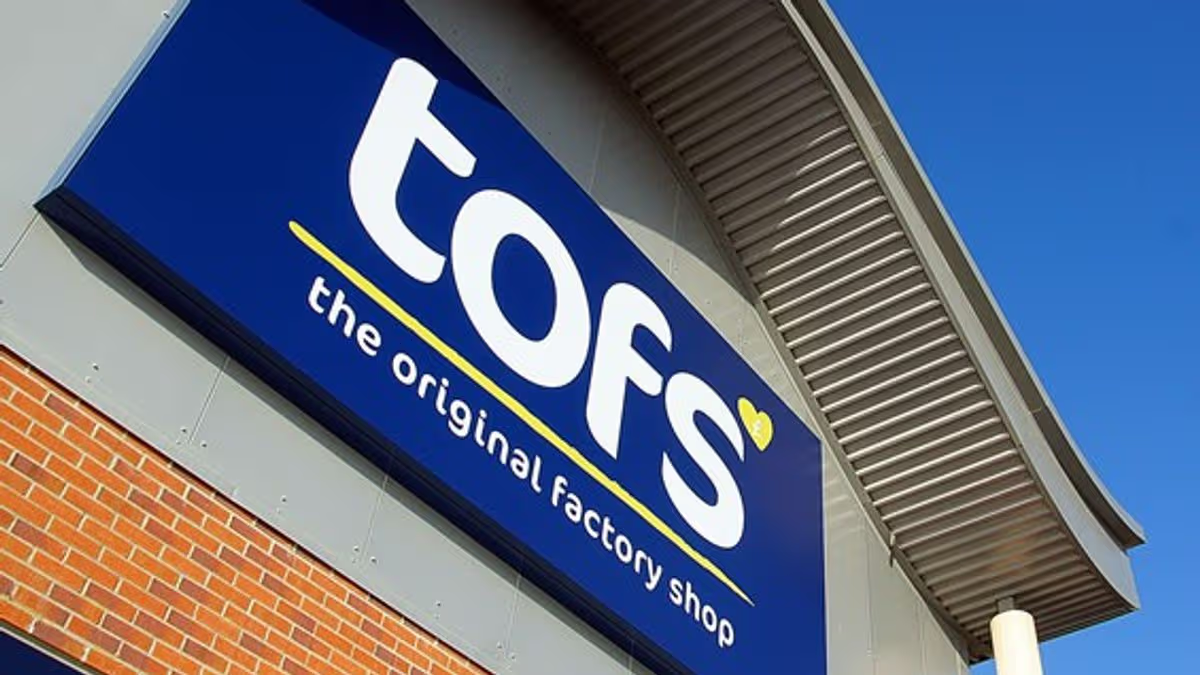
A sign for the Original Factory Shop(Image: The Original Factory Shop)
The Original Factory Shop has shuttered all 137 of its outlets and its Bolton head office, after the retailer tumbled into administration amid mounting industry concerns over sluggish consumer confidence and elevated taxes.
Modella Capital recently acquired WH Smith’s high street branches – since rebranded as TG Jones – though the sites it took on have reportedly been battling poor sales figures.
Administrators Interpath confirmed on Thursday that all Original Factory Shop locations are permanently closed.
The retailer had 1,180 staff on its books when it entered administration, with Interpath confirming that the vast majority of employees have been dismissed, while a small number were kept on to assist with winding down operations, as reported by City AM.
Advertisement
A spokesperson for Interpath said: “A phased closure of the store portfolio was implemented considering the financial position.
“The majority of employees have been made redundant, while a small number of staff have been retained to assist the joint administrators in their duties as they move towards formally winding up the business.
“A specialist team is in place to support impacted staff with making Redundancy Payments Service claims.”
Modella Capital has attributed the collapse of Original Factory Shop and Claire’s Accessories to sluggish consumer confidence and “adverse government fiscal policies”, as it moved to wind down both businesses.
Advertisement
The private equity firm has acquired a string of high street retailers in recent years, offloading several of them shortly after purchase. Both Claire’s and Original Factory Shop were placed into administration by Modella less than two years after buying the firms.
The equity firm is reportedly considering a sale of Wynsors World of Shoes, a northern footwear retailer it acquired just four months ago.
The investment company has also drafted in emergency advisors to lead a sweeping restructuring of TG Jones, following its £76m acquisition of the 480-store chain from WH Smith last year.
Modella’s agreement with WH Smith contains a clause effectively preventing the former from closing underperforming shops within 12 months of the takeover, according to The Telegraph.
Advertisement
The firm has reportedly conceded in private that sales have been hampered by the poor name recognition of the newly rebranded TG Jones, with outlets retaining the WH Smith fascia outperforming those that have undergone the rebrand.
Modella was established as Tailer Debtco in 2022 before being rebranded a year later, and is owned by Hay Wain Group, the family office founded by turnaround specialist Jamie Constable.
According to its most recent balance sheet, Modella held £12.8m in net assets in 2024. The Original Factory Shop, which was established in 1969 and moved its HQ from Burnley to Bolton last year, stocked a range of fashion, homeware, toys and personal care items.
As temperatures continue to rise, JM Financial has listed stocks under its coverage with an upside potential of up to 30%. Despite a relatively mild start to the summer, largely due to frequent rainfall from western disturbances, the recent shift in weather patterns has led to a steady rise in temperatures, boosting expectations of higher power demand.
Here is a full list of the 50 most listened songs on Spotify in 2026 so far (as of mid-April 2026). This combines all-time most-streamed catalog giants with the strongest-performing 2025-2026 releases and current global chart momentum.
50 Most Listened Songs on Spotify in 2026 So Far AFP
All-Time Most Streamed Songs (Lifetime Leaders Still Dominating Daily Plays)
Blinding Lights — The Weeknd
Shape of You — Ed Sheeran
Sweater Weather — The Neighbourhood
Starboy (feat. Daft Punk) — The Weeknd
As It Was — Harry Styles
Someone You Loved — Lewis Capaldi
Sunflower — Post Malone & Swae Lee
Die With A Smile — Lady Gaga & Bruno Mars
BIRDS OF A FEATHER — Billie Eilish
APT. — ROSÉ & Bruno Mars
Top New & Surging Songs of 2026 (Strongest 2026 Releases by Streams & Chart Momentum)
End of Beginning — Djo
The Fate of Ophelia — Taylor Swift
Golden — HUNTR/X
Man I Need — Olivia Dean
back to friends — sombr
WHERE IS MY HUSBAND! — (viral 2026 breakout)
So Easy (To Fall In Love) — Olivia Dean
Ordinary — Alex Warren
Eternity — Alex Warren & Gigi Perez
Homewrecker — sombr
I Just Might — Bruno Mars
Risk It All — Bruno Mars
Stateside (feat. Zara Larsson) — PinkPantheress
Babydoll — Dominic Fike
The Romantic — Bruno Mars
Fancy Some More? — (2026 hit)
The Life of a Showgirl — (viral entry)
Sports car — Tate McRae
Opalite — Miley Cyrus
Handlebars (feat. Dua Lipa) — (2026 collaboration)
SWIM — BTS
Beauty And A Beat (feat. Nicki Minaj) — Justin Bieber
American Girls — Harry Styles
Lush Life — (catalog resurgence)
Every Breath You Take — The Police (catalog surge)
Mystical Magical — Benson Boone
DAISIES — (2026 rising track)
Sapphire — (new 2026 entry)
Azizam — Ed Sheeran
Little Things — Ella Mai
YUKON — Justin Bieber
Take My Hand — Nola
The Dead Dance — Lady Gaga
Manchild — Sabrina Carpenter
Aperture — (2026 release)
CHANEL — (viral 2026 track)
Let Down — (March 2026 standout)
Gnarly — (March 2026 hit)
party addict — (viral short-form hit)
Nope your too late i already died — (meme-driven track)
The Boy Who Played the Harp — (storytelling viral song)
You’ll Be Alright, Kid (Chapter 1) — (2025-2026 crossover)
HIT ME HARD AND SOFT — Billie Eilish (ongoing catalog strength)
The Life of a Showgirl — (repeated strong performer)
Eternity — Alex Warren & Gigi Perez (emotional ballad surge)
Ordinary — Alex Warren (steady climber)
back to friends — sombr (indie breakout)
These tracks reflect a mix of evergreen catalog giants that still rack up millions of daily streams and fresh 2026 hitsdriven by TikTok virality, playlist placement, and strong artist campaigns. Bruno Mars, Taylor Swift, Olivia Dean, Alex Warren, and sombr appear frequently across current “HITS 2026” and “Global Top 50 | 2026 Hits” playlists.
Catalog songs like “Blinding Lights” and “Shape of You” continue to lead all-time totals (over 5 billion and 4.8 billion streams respectively), while 2026-specific standouts such as “End of Beginning,” “The Fate of Ophelia,” and Bruno Mars’ new singles dominate early-year and daily charts.
The world’s largest live entertainment company has been dealt a bruising blow after a Manhattan federal jury ruled that Live Nation and its Ticketmaster subsidiary operated an unlawful monopoly over major concert venues in the United States, a verdict that is likely to reverberate through the global ticketing industry and intensify scrutiny of the firm’s dominance in markets including the United Kingdom.
After four days of deliberation, jurors sided with more than 30 US states that had pressed ahead with the civil action, concluding that the concert colossus had smothered competition across the live events business. The jury calculated that Ticketmaster had overcharged buyers by $1.72 per ticket, with the presiding judge still to determine the final quantum of damages.
For an industry that has long drawn the ire of fans, independent promoters and smaller venue operators, the ruling lands as something of a vindication. Counsel for the states, Jeffrey Kessler, described Live Nation in closing submissions as a “monopolistic bully” that had systematically pushed up prices for consumers. He told the court that Ticketmaster controls 86 per cent of the concert market and 73 per cent of the wider live events market once sport is included, numbers that underscore just how comprehensively the business has come to dominate the sector since Ticketmaster and Live Nation merged in 2010.
Live Nation, which generates more than $22bn in annual revenues, was unrepentant. Its lawyer, David Marriott, argued in his summation that the company’s scale was a consequence of operational excellence rather than anti-competitive conduct, telling jurors that “success is not against the antitrust laws in the United States”. The company has confirmed it intends to appeal, stating that it remains confident the “ultimate outcome” will not materially depart from a parallel settlement already reached with the US Department of Justice.
That settlement, announced only days into the trial after the Trump administration took over the federal case, obliges Live Nation to create a $280m fund for participating states, caps service fees at certain amphitheatres and opens a limited pathway for rival platforms such as SeatGeek and AXS to compete at some venues. Crucially, however, it stops short of forcing a structural break-up of Live Nation and Ticketmaster, a remedy that many industry observers and smaller ticketing challengers had been hoping for.
Advertisement
A handful of states signed up to the settlement, but the majority pressed on to trial, arguing that Washington had extracted insufficient concessions from the concert giant. Their gamble has now paid off. The verdict revives debate over whether a clean separation of Ticketmaster from Live Nation’s promotions and venue-operating arms remains the only effective remedy for a market that independent promoters have long claimed is tilted decisively against them.
The trial itself provided a rare look behind the curtain of an opaque business. Chief executive Michael Rapino took the stand and was questioned on a catalogue of controversies, including the 2022 Taylor Swift ticketing fiasco that drew political fury on both sides of the Atlantic. Rapino attributed that episode to a cyberattack. Less easily explained were internal messages from Live Nation executive Benjamin Baker, which surfaced during the proceedings, describing some prices as “outrageous”, branding customers “so stupid” and boasting that the firm was “robbing them blind”. Baker testified that the remarks had been “very immature and unacceptable”.
Regulatory pressure on Ticketmaster is building on multiple fronts. Last May the Federal Trade Commission introduced rules requiring upfront disclosure of concert ticket fees. Ticketmaster responded by scrapping its end-of-transaction processing fee, only for a Guardian investigation to reveal that the company had simultaneously increased other charges to plug the revenue hole. In an email to the Findlay Toyota Center in Arizona, the firm reportedly stated that it “must adjust fees to offset the revenue loss”. Former regulators have suggested the practice may breach the FTC’s ban on misleading charges, while senators including Connecticut Democrat Richard Blumenthal have accused the company of running “bait-and-switch” tactics and manipulating the market.
The saga has deep roots. Grunge pioneers Pearl Jam famously lodged an antitrust complaint against Ticketmaster with the Department of Justice back in the 1990s, only for regulators to walk away. Three decades on, the mood music has shifted. For independent UK promoters, smaller venues and the growing cohort of challenger ticketing platforms eyeing cross-Atlantic expansion, the verdict in Manhattan is the clearest signal yet that the ground beneath the live entertainment industry’s dominant player is finally beginning to shift.
Advertisement
Amy Ingham
Amy is a newly qualified journalist specialising in business journalism at Business Matters with responsibility for news content for what is now the UK’s largest print and online source of current business news.























































You must be logged in to post a comment Login