

Crypto World
Shiba Inu Price Prediction: Time to Say Goodbye To Millionaire Dreams?

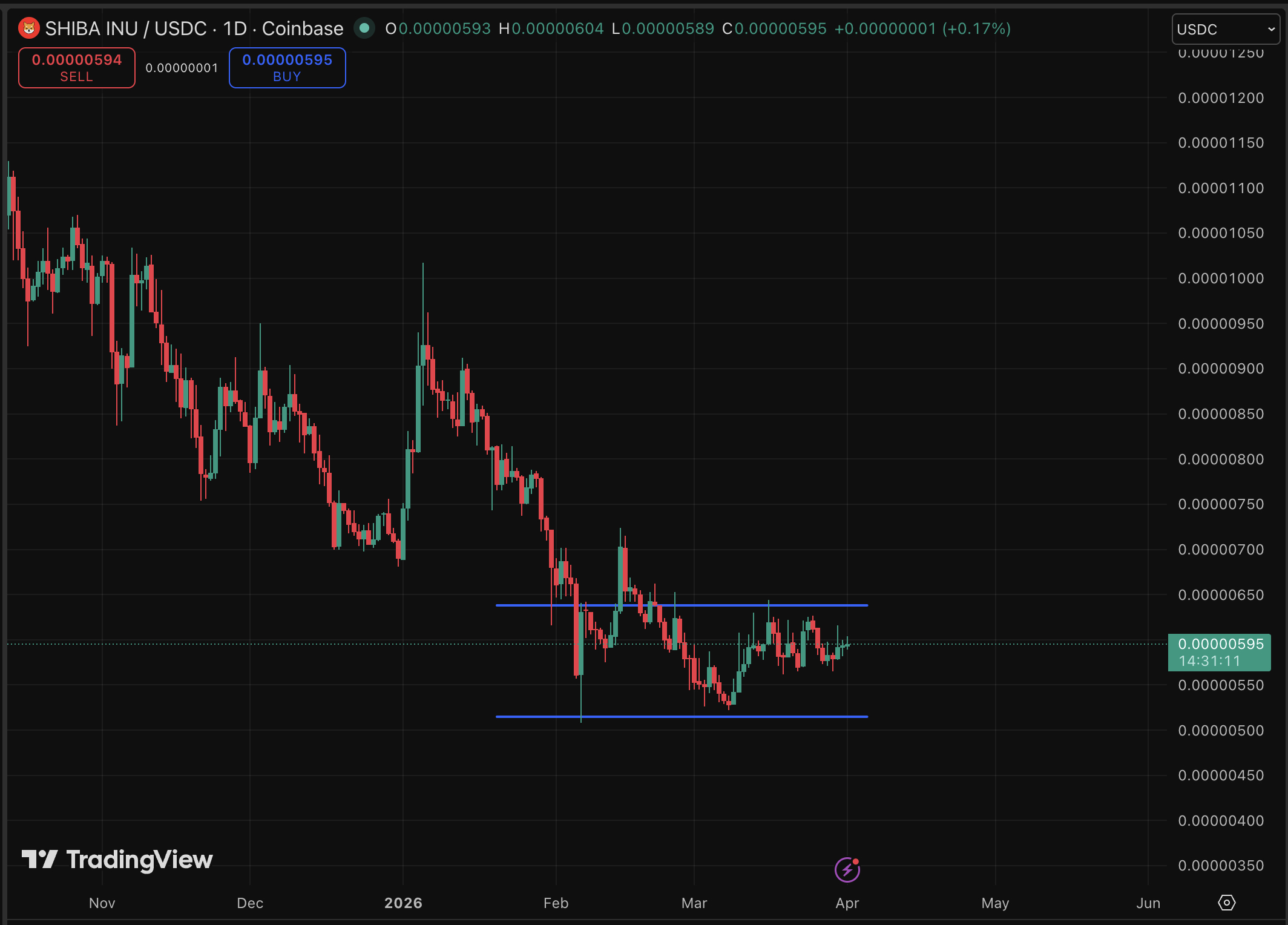
Shiba Inu is trading at $0.00000597, up 0.93% in the last 24 hours, a modest price bounce that masks a bruising -4.4% seven-day slide, and the prediction is not looking good. The dog coin that minted actual millionaires in 2021 is now fighting to hold a six-zero price handle.
The 24-hour rebound followed a technical defense of the $0.0000056 support zone after six consecutive red sessions. Trading activity surged 70%, accompanied by a positive buy-sell delta of 27.4 billion SHIB.
On-chain data confirmed net exchange outflows of 112–125 billion SHIB, stripping near-term selling pressure from the order book. That confluence, volume spike, positive delta, and exchange drain are historically the setup SHIB needs before a short-term leg higher.
But can SHIB print more millionaires at this level? Are memecoins’ communities no longer able to catapult a coin?
Discover: The best pre-launch token sales
Shiba Inu Price Prediction: Reclaim $0.000007 Before April Ends, or Dream Shattered?
Shiba Inu is consolidating just below the $0.000006 price resistance level, a line that has flipped from support to resistance over multiple sessions, dragging down bullish sentiment.
Key levels to track: support clusters at $0.0000056–$0.0000059, with resistance stacked at $0.0000060–$0.0000065 and a more meaningful ceiling near the historical $0.000018–$0.000020 range.
Three scenarios are currently in play:
- Bull case: SHIB flips $0.000006 with sustained volume, targets $0.0000065–$0.000007 within days. Exchange outflows accelerating would confirm this path.
- Base case: Price consolidates between $0.0000057–$0.0000062, grinding sideways as macro uncertainty limits conviction.
- Bear case: Failure to hold $0.0000056 opens a drop toward $0.0000050, invalidating the current rebound thesis entirely.
The 589 trillion SHIB still in circulation remains the structural ceiling on any millionaire-making moon run. People have noted SHIB’s sensitivity to external catalysts. The October 2024 Elon Musk effect pushed volume to $145 million in 48 hours, but that event is, by definition, unpredictable.
SHIB could deliver decent returns. Delivering millionaire returns from this market cap? That math gets harder every cycle.
Discover: The best crypto to diversify your portfolio with
Maxi Doge Targets Early Mover Upside as Shiba Inu Tests Key Levels
Here’s the uncomfortable reality SHIB holders face: at today’s price, the multiplier required to turn a $1,000 stake into a million dollars simply doesn’t exist at current valuations without a market cap that would rival entire national economies. It’s arithmetic.
Traders chasing the next generational meme coin trade are increasingly looking at earlier-stage projects where the supply-to-price math still works in their favor.
Maxi Doge ($MAXI) is one presale capturing that rotation. The project has raised more than $4.7 million at a current price of just $0.0002811. The concept leans hard into gym-bro meme culture with holder-only trading competitions, leaderboard rewards, and a Maxi Fund treasury dedicated to liquidity and partnerships.
Recent capital flows into the presale have drawn comparisons to early-stage SHIB momentum. Staking is live with a 66% APY bonus. For traders weighing SHIB’s structural ceiling against earlier-stage upside, researching Maxi Doge is worth the ten minutes.
This article is not financial advice. Crypto investments are highly volatile and speculative. Always conduct your own research before investing.
The post Shiba Inu Price Prediction: Time to Say Goodbye To Millionaire Dreams? appeared first on Cryptonews.

Crypto World
Top 3 Cryptos That Could Deliver Bigger Gains Than Ripple (XRP) Did in the Last Bull Run
Many investors still remember watching XRP explode during past bull runs and feeling they entered too late. That’s why traders are now searching for projects that still look early before the broader market fully heats up again. Some meme coins have already made their biggest move. Others are only starting to build momentum quietly in the background. And in crypto, timing often matters just as much as the project itself. Here are three cryptos traders are watching closely as they hunt for the next major breakout opportunity.
One of the hardest parts of crypto investing is realizing the biggest returns usually happen before everyone agrees a project is real. That realization is part of why Little Pepe (LILPEPE) is beginning to stand out among traders seeking earlier-stage opportunities rather than chasing established meme ecosystems. Unlike many meme projects built purely around attention, Little Pepe is developing its own Layer-2 blockchain focused on ultra-fast transactions, low fees, and infrastructure specifically designed for meme coin activity. LILPEPE is currently priced at $0.0022 in Stage 13, with more than $28 million already raised and the current stage nearing completion. For many investors, the appeal is not just the meme’s branding, but the idea of entering before broader exchange exposure begins. The project has also leaned heavily into community engagement through its ongoing $777,000 giveaway campaign and the Mega Giveaway running between Stages 12 and 17, where both large buyers and random participants remain eligible for rewards exceeding 15 ETH. For traders who missed earlier meme cycles entirely, that feeling of being too late again is exactly what makes projects like Little Pepe difficult to ignore right now.
Pudgy Penguins (PENGU): Can the Momentum Continue After the First Big Rally?
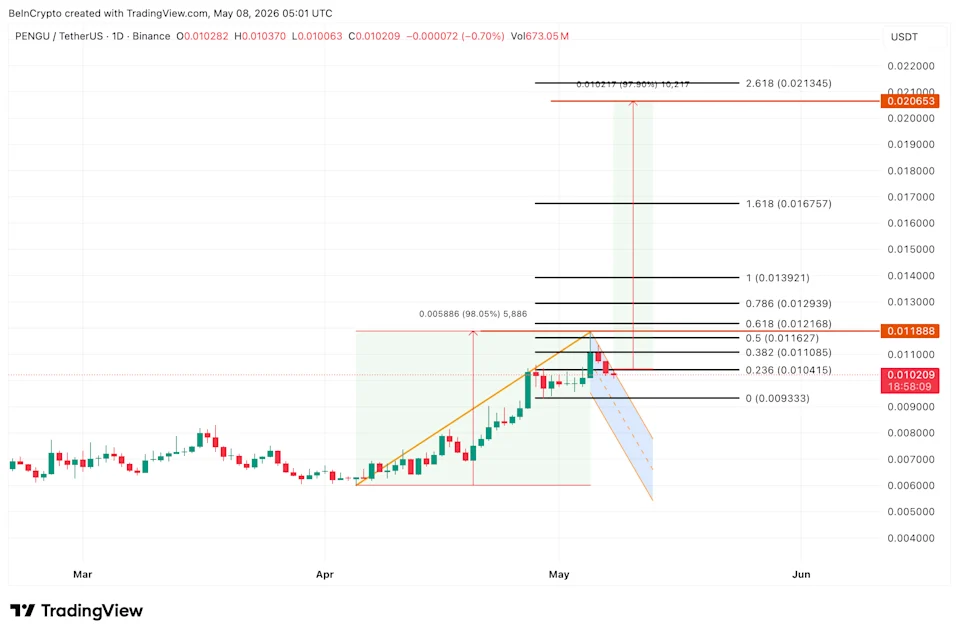
Pudgy Penguins is holding steady at about $0.0102, even after some dips last month.
Pudgy Penguins Price Analysis: TradingView
For many traders, this is where the hesitation begins. Nobody wants to buy the top after watching a token already rally nearly 100% in a short period. But PENGU’s chart is still giving traders something to watch. The recent move toward $0.0118 created a bullish pole-and-flag setup. In simple terms, the strong rally formed the pole, while the current sideways consolidation may simply be the market cooling off before another move higher. The setup only becomes convincing if PENGU cleanly reclaims $0.0104 and breaks above $0.0110 again. If that happens, traders are already watching potential upside targets near $0.0121 and $0.0129. Some projections even point toward $0.0206 if meme coin momentum accelerates again.

Bonk (BONK): Solana’s Meme Economy Is Starting to Heat Up Again
Bonk trades near $0.0000068 and is beginning to attract attention again as activity returns across Solana’s meme ecosystem.
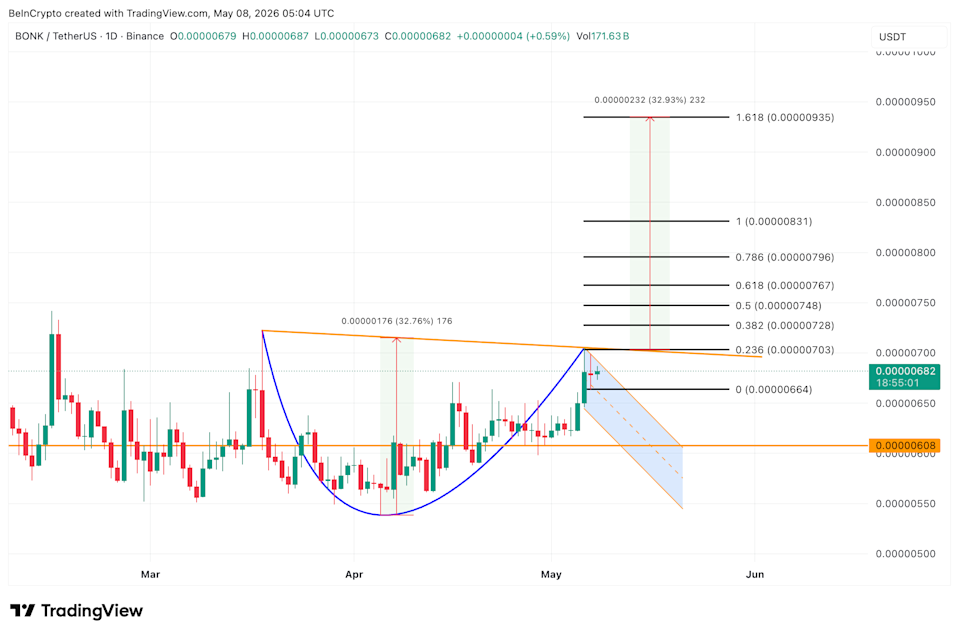
BONK Price Analysis: TradingView
Many traders missed BONK’s first major breakout because they assumed Solana meme coins had already peaked. But recent market activity suggests capital may be slowly rotating back into that sector. The chart is also looking interesting. If BONK closes above that mark, it’s got room to run up to $0.0000093, which would mean a jump of about 33% from where it is now. That may not sound life-changing compared to LILPEPE, but as long as Solana meme activity continues improving, BONK may remain one of the first places meme capital flows back into.
Conclusion
XRP’s previous bull run reminded the market how quickly crypto wealth can be created when momentum, timing, and community align. Now traders are searching for the next wave before it fully arrives. PENGU is trying to prove its first rally still has room left. BONK is benefiting from renewed activity across Solana’s meme ecosystem. And Little Pepe (LILPEPE) is attracting the attention of investors who no longer want to wait until projects become mainstream before investing.
For more information about Little Pepe (LILPEPE) visit the links below:
Website: https://littlepepe.com
Whitepaper: https://littlepepe.com/whitepaper.pdf
Telegram: https://t.me/littlepepetoken
Twitter/X: https://x.com/littlepepetoken
$777k Giveaway: https://littlepepe.com/777k-giveaway/
Disclaimer: This is a Press Release provided by a third party who is responsible for the content. Please conduct your own research before taking any action based on the content.

Crypto World
Wintermute Starts Quoting Prediction Markets as Event-Contract Volume Tops $60B in 2026
Wintermute, a London-based algorithmic trading firm with more than $3.5 trillion in annual trading volume, said on Friday it is now providing two-sided liquidity on prediction markets, becoming the latest institutional market maker to plug into a sector that has cleared more than $60 billion in… Read the full story at The Defiant
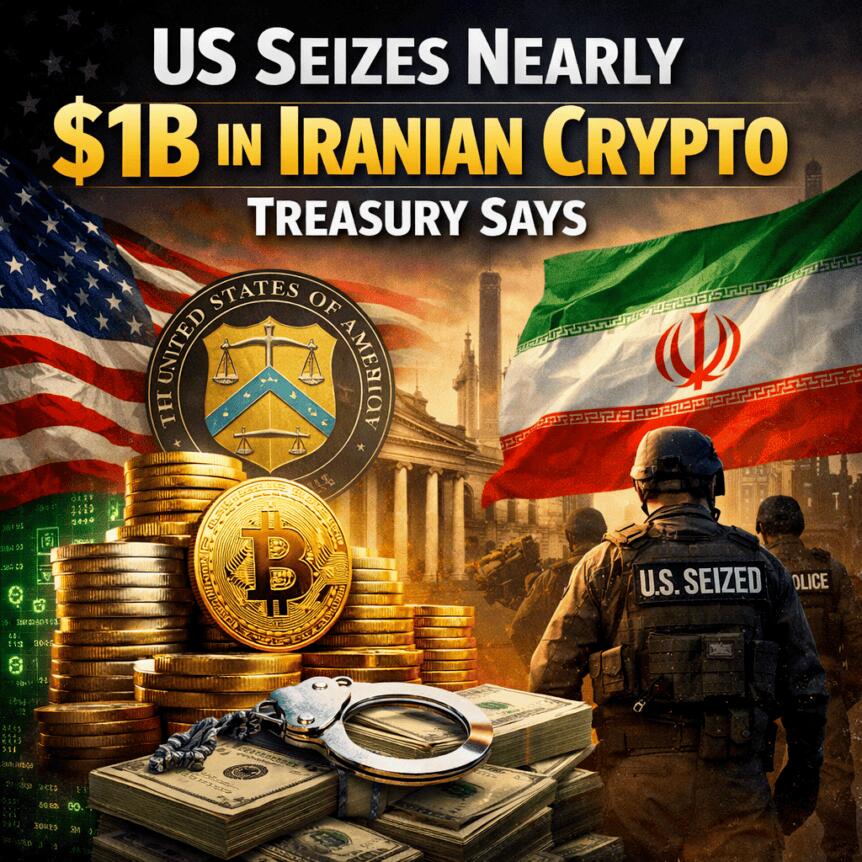
The United States has publicly documented a major advance in its sanction regime against Iran, reporting the seizure of about $1 billion in Iranian cryptocurrency assets. Speaking at the Reagan National Economic Forum, Treasury Secretary Scott Bessent said the U.S. has “outright grabbed the wallets,” a maneuver he described as part of a broader financial pressure campaign. Some wallet holders may still be unaware that their funds have been seized, he added in remarks that drew attention to the speed and scale of asset freezes conducted under the administration’s sanctions strategy.
Officials characterized the seizures as a component of Operation Economic Fury, a coordinated effort launched in March 2025 to disrupt Iranian access to funds held in digital assets, as well as traditional financial channels. Bessent framed the operation as a decisive step in tightening the financial noose around Tehran, arguing that the campaign has effectively cut off critical liquidity for the regime. “I think between five and a half to six weeks of an incredibly successful military campaign and Operation Economic Fury, where we have really cut them off. They are at the end of their tether now financially,” he said, underscoring the administration’s posture on Iran’s financial resilience.
Key takeaways
- Approximately $1 billion in Iranian crypto assets have been seized, according to remarks at the Reagan National Economic Forum in which Scott Bessent spoke.
- The seizures are described as part of Operation Economic Fury, a multi-front effort launched in March 2025 to disrupt Iran’s access to crypto and other financial resources.
- Iran’s economic situation, as characterized by the official account, appears dire: inflation above 200%, widespread internet shutdowns, consumer support programs, and significant payroll issues for the armed forces.
- The newly disclosed total markedly exceeds prior public figures, roughly doubling the $500 million previously cited in late April and far above the $344 million in crypto assets frozen after sanctions in April.
- Separately, Iran has signaled interest in monetizing the Strait of Hormuz through a Bitcoin-based insurance framework, a proposal that has been described in state-linked media channels and could redefine how a strategic chokepoint is insured and priced in crypto terms.
Escalating asset seizures and Tehran’s financial squeeze
The claim of a $1 billion crypto seizure arrives as part of a broader narrative presented by U.S. officials about the effectiveness of financial pressure tools against Iran. Bessent’s remarks highlighted the rapid pace at which some crypto wallets were identified and seized, with an emphasis on the notion that “the wallets” could be pulled from holders who may not yet realize the funds have been redirected. The assertion aligns with a continued emphasis on cutting-edge enforcement tools that target digital assets alongside traditional sanctions mechanisms.
While the public cast is blunt about the impact on Iran’s finances, the underlying picture, as outlined by the official account, portrays a regime under stress. Bessent described a scenario in which Iran was siphoning roughly $400 million to $500 million per month, distributing proceeds among about 80 elite figures, before the intervention. The official narrative also paints a bleak macroeconomic environment: inflation surging past 200%, consumer subsidies being issued, the internet intermittently restricted, and a substantial portion of the regular pay for armed forces and security personnel disrupted or withheld.
The statements come as U.S. and allied authorities continue to pursue a multi-pronged approach—blending asset freezes, banking restrictions, and international cooperation—to constrain Tehran’s financial flows. The administration has cited progress across different fronts, including crypto-focused seizures and partnerships with European allies to extend property confiscations tied to illicit activity. Critics, meanwhile, stress the challenge of tracing and freezing decentralized assets and the potential for collateral effects on ordinary users who may hold assets in accounts unrelated to sanctioned entities.
From wallet seizures to Hormuz: Iran’s Bitcoin-based ambitions under scrutiny
Beyond the asset seizures, Iran’s broader geopolitical and economic strategy has included exploratory discussions about monetizing control over the Strait of Hormuz through crypto-enabled mechanisms. Cointelegraph reports that a state document circulated by Fars News Agency—a media outlet with close ties to the Islamic Revolutionary Guard Corps—outlined a platform named “Hormuz Safe.” The concept envisions selling digital marine insurance paid in Bitcoin and settled on the blockchain, with the potential to unlock substantial revenue for the country—projected at over $10 billion in annual terms if enacted at scale.
In related coverage, Iran has been reported to consider a model where ships passing through Hormuz would pay a tariff in Bitcoin—specifically, a $1 per barrel charge—to clear passage. The idea reflects a broader trend of state-backed crypto experimentation and aims to leverage Bitcoin’s settlement properties to simplify cross-border charging and revenue collection for a critical strategic artery. Iran’s government-linked proclamations emphasize that such a framework would be settled on-chain, potentially enabling more transparent and auditable toll collection than traditional approaches.
These discussions come amid ongoing negotiations related to Iran’s broader ties with the U.S. and allied powers, amplified by recent strikes that have targeted regime figures and key infrastructure in the region. The exact status and feasibility of Hormuz Safe remain uncertain, and observers caution that any such program would require robust international coordination, regulatory clarity, and secure settlement rails to avoid unintended consequences for global shipping and finance.
For readers tracking the crypto-policy angle, the Hormuz Safe concept intersects with broader questions about how states might use distributed ledger technologies to capture value from strategic chokepoints. If realized, a BTC-based insurance and settlement model could set a precedent for asset-backed, borderless revenue streams tied to critical maritime corridors. Yet the practicalities—risk management, liquidity, sovereignty concerns, and cross-border fiat integration—remain unresolved and subject to regulatory pushback and geopolitical risk.
Context and what to watch next
By tying crypto seizures to a broader sanctions playbook, U.S. authorities appear intent on signaling that digital assets are not a safe haven for sanctioned entities. The discrepancy between the new $1 billion figure and prior public disclosures—roughly $500 million announced in late April and about $344 million sanctioned in April—suggests a rapid acceleration in enforcement activity and asset identification. Still, the opaque and rapidly evolving nature of blockchain addresses and wallet ownership means that some seizures may unfold quietly over time, with beneficiaries or oblivious wallet holders discovering the losses only later.
Investors and observers should watch for two pivotal developments. First, how the United States and its allies operationalize and expand the “Economic Fury” framework, including potential cross-border asset coordination and the extension of sanctions into new cryptographic asset classes or platforms. Second, the Hormuz Safe proposal and similar state-led crypto initiatives will need to prove viable in a real-world maritime and financial environment. Any movement toward an on-chain toll collection system or insurance mechanism would have to contend with international shipping laws, sanctions compliance, and the volatility inherent in crypto markets.
As market participants digest these developments, several questions remain unsettled. Will more Iranian crypto wallets be identified and frozen, or will enforcement cap at the current level? How will the Hormuz Safe concept evolve—if it moves beyond a policy paper to a concrete program, what safeguards and oversight will be required? And how will financial institutions and crypto platforms adapt to heightened scrutiny around sanctioned jurisdictions and their digital assets?
Further coverage continues to emerge from outlets monitoring the intersection of sanctions policy and crypto markets. Cointelegraph has previously reported on market reactions to related U.S. actions and the broader implications for Bitcoin and crypto markets under geopolitical stress. As the regulatory and enforcement landscape tightens, market participants should treat any official disclosures with caution and consider how these developments might influence liquidity, risk management, and cross-border settlement in the months ahead.
For now, the narrative centers on a clearer message from policymakers: digital assets are increasingly entangled with national security and foreign-policy aims, and the consequences—whether in seized wallets or new insurance frameworks—will ripple through exchanges, custodians, and users worldwide. The next few weeks could reveal whether Tehran’s financial strategy shifts to accommodate tighter controls or whether new, untested crypto-instrument concepts move from talk to policy.
Sources and related context: remarks from the Reagan National Economic Forum and statements around Operation Economic Fury, including prior reporting on crypto seizures and sanctions timelines. Additionally, state-linked reporting on Hormuz Safe and Bitcoin-based tolls for the Strait of Hormuz has been cited in coverage tracing the potential monetization of critical maritime routes through crypto-native mechanisms.


Polymarket has signed an exclusive partnership with OneFootball, the Berlin-based digital football platform, opening a distribution channel to a user base that the company says reaches more than 645 million fans worldwide and 200 million monthly active users, roughly two weeks before the 2026 FIFA… Read the full story at The Defiant
Crypto World
Circle Freeze on Zama's Confidential USDC Locks $12.6M of User Funds in DeFi 'Crossfire'
Circle blacklisted the smart-contract address behind Zama's confidential USDC token on Friday, locking roughly $12.6 million of stablecoins inside a privacy protocol that is not itself the target of any litigation. The freeze hit Zama's cUSDC wrapper, an ERC-1967 proxy that pools USDC on behalf of… Read the full story at The Defiant
Crypto World
This Top Coin Under $1 Could Deliver a 40x ROI in Under 2 Months; Surprisingly, It’s Not Cardano (ADA) or Dogecoin (DOGE)

While the broader market often remains fixated on the price action of established giants, a new contender is quietly rewriting the playbook for retail wealth generation. Little Pepe, trading under the ticker LILPEPE, has emerged as a formidable force in the sub-one-dollar category, positioning itself to potentially deliver a 40x return on investment in less than two months. This projection is not based on mere speculation but is backed by a monumental presale performance that has caught the attention of serious institutional and retail participants alike.
If an investor wants to see a 40x return on Dogecoin today, it would have to become the most valuable financial institution in the world, which is increasingly unlikely as liquidity continues to decline through the industry.
Elsewhere, despite its glory days, Cardano has not lived up to the expectations it set in 2021, when it hit a new all-time high of $3.10.
In contrast, the smart money is moving toward younger, more agile projects that possess the “coiled spring” effect. Little Pepe represents this new era of digital assets, where community sentiment meets massive capital influx at the ground floor. By offering an entry point that remains significantly undervalued relative to its utility and community backing, LILPEPE provides the kind of leverage that ADA and DOGE can no longer provide to the average portfolio.
Quantitative Dominance and the Presale Powerhouse
The most compelling evidence of the impending explosion for Little Pepe lies in its staggering presale data. Financial records indicate that the project has already raised over $28.1 million across its various funding stages. This is not a modest figure; it reflects a level of investor confidence rarely seen in the early stages of a memetic token. The fact that the project has successfully moved over 16.9 billion tokens into the hands of early adopters suggests a highly distributed and committed holder base, which is a prerequisite for any asset aiming for a vertical price trajectory.
At the time of analysis, the presale has reached a critical juncture, with 98% of stage 13 complete. With the current price locked at a mere $0.0022, the window for entry at these historic lows is rapidly closing. This specific price point is the catalyst for the projected 40x ROI. When an asset possesses this much liquidity and capital backing before it even hits the primary decentralized and centralized exchanges, the resulting “supply shock” upon public listing often leads to the exact type of parabolic growth that transforms modest allocations into significant wealth.
The Two-Month Horizon for Exponential Growth
The timeline of “under two months” is particularly significant because it aligns with the anticipated conclusion of the final presale stages and the transition to the open market. Market history shows that the period immediately following a high-demand presale is often the most lucrative for holders. As the 98% completion of stage 13 approaches, the urgency among investors is palpable. The transition from a controlled presale environment to the volatility of the open market amplifies price action, especially when a project has already demonstrated the ability to sell 16.9 billion tokens on its own.
Unlike many speculative assets that fizzle out for lack of funding, Little Pepe has the financial runway to dominate the narrative for the remainder of the quarter.
Final Outlook on the LILPEPE Phenomenon
The evidence points toward a singular conclusion: the opportunity for massive returns has shifted away from the “old guard” of Cardano and Dogecoin and toward the explosive potential of Little Pepe. With $28.1 million in the bank and a community that has already absorbed nearly 17 billion tokens, the project is not just a participant in the market; it is a leader in the making.
The current price of $0.0022 represents a fleeting entry point before the market recognizes the true value of what has been built during this rigorous presale phase. Those seeking a 40x return in a compressed timeframe are finding that LILPEPE is the most logical and aggressive play available in the current digital asset ecosystem.
For more information about Little Pepe (LILPEPE) visit the links below:
Website: https://littlepepe.com
Whitepaper: https://littlepepe.com/whitepaper.pdf
Telegram: https://t.me/littlepepetoken
Twitter/X: https://x.com/littlepepetoken
$777k Giveaway: https://littlepepe.com/777k-giveaway/
Disclaimer: This is a Press Release provided by a third party who is responsible for the content. Please conduct your own research before taking any action based on the content.

Tom Lee’s BitMine bought 5.4 million Ethereum (ETH) instead of Hyperliquid (HYPE), and now faces a binary verdict. The Ethereum holding is down 21% since June 30, 2025. HYPE is up 68% over the same window.
The question is whether Tom Lee built the institutional position he intended to create. Or whether he picked the wrong asset for a cycle that already rewarded perpetual exchange tokens.

Both readings stay defensible until ETH either reflates or rolls over.
The Conviction Case
BitMine launched its Ethereum treasury strategy on June 30, 2025, with a $250 million private placement.
Tom Lee, head of Fundstrat, joined as chairman. The mandate was never to chase the hottest token in the cycle. It targets roughly 5% of the ether supply (through alchemy) as a public proxy for institutional ETH.
That thesis rests on three pillars:
- Ether’s staking yield turns the treasury into an income asset rather than a static bet.
Around 87% of the holding sits on BitMine’s MAVAN staking platform, generating about $276 million in annualized revenue.
- Liquidity matters at this scale.
BitMine has absorbed $8 billion in losses without dislocating ETH’s order books.
“Tom Lee is down eight billion dollars on ETH and Vitalik decides to write a sci fi novel,” David Hoffman, co-owner at Bankless, remarked.
Indeed, Ethereum co-founder Vitalik Buterin said he would pause his usual blog posts to write sci-fi about decentralized governance, testing governance ideas through fiction rather than research posts.
Meanwhile, HYPE’s $14.9 billion market cap could not have absorbed similar deployment without slippage.

Follow us on X to get the latest news as it happens
- The third pillar is institutional fit.
Tom Lee’s bull case treats Ethereum as the settlement layer for tokenized assets, stablecoins, and on-chain agents.
That thesis assumes ETH becomes financial infrastructure, not the cycle’s best-performing token.
The Miss Case
The counterfactual is sharp. HYPE traded for $67.14 as of this writing, up 101% in 12 months and 68% since BitMine’s pivot.
Hyperliquid routes most fee revenue into open-market HYPE purchases. The HYPE buyback program has absorbed more than $1.16 billion in fees since launch.
Calculating BitMine’s capital deployed into HYPE instead would now show roughly $44 billion in profits. That figure climbs further if HYPE clears $100.

“If Tom Lee had bought HYPE instead of ETH for Bitmine He would have been up 520% and made $44 billion. Potentially crossing Michael Saylor once HYPE hits $100,” degennQuant, cofounder of Hyperbeat, suggested.
The risk for Lee is timing. Hyperliquid captured the dominant on-chain narrative of this cycle. The token holds about 57.8% of the perpetual DEX market share.
An institutional spotlight from ICE chief executive Jeff Sprecher accelerated the flow.
“This Hyperliquid that we’re talking — if you haven’t heard about it, it’s bigger than NASDAQ, okay? It’s 11 people. You look at it, you’re like, wow, that’s pretty something,” Sprecher remarked, speaking to investors at the Bernstein 42nd Annual Strategic Decisions Conference.
Subscribe to our YouTube channel to watch leaders and journalists provide expert insights
The Philosophical Hinge
Kyle Samani left Multicoin Capital in February, then opened a public structural case against Hyperliquid.
He says its validator set is housed in a single building. Thousands of its technical choices fit a centralized setting but break in a permissionless one.
“Hyperliquid is just Binance 2.0 without a marketing team and has made 1000s of technical decisions that work well in a centralized setting and won’t work at all in a permissionless decentralized one. And now they’re many steps behind,” Samani, former Multicoin co-founder quipped.
Samani’s Multicoin exit followed reported HYPE buys by the fund.
Tom Lee’s allocation rests on the inverse premise. Ethereum’s value to institutions stems from its credibility, validator distribution, and resistance to protocol-level capture.
Hyperliquid trades prioritize speed, low fees, and trader experience.
Is HYPE a Better Treasury Asset?
The answer depends on which clock the market respects. A cycle measured in months keeps Hyperliquid ahead. A cycle measured in tokenization adoption favors the asset BitMine already owns.
The description frames Tom Lee’s call as patient discipline or a missed cycle. Conviction and costly misses are the same trade viewed at different horizons.
The post Hyperliquid vs Ethereum: Did Tom Lee Pick the Wrong Crypto Treasury Asset for BitMine? appeared first on BeInCrypto.
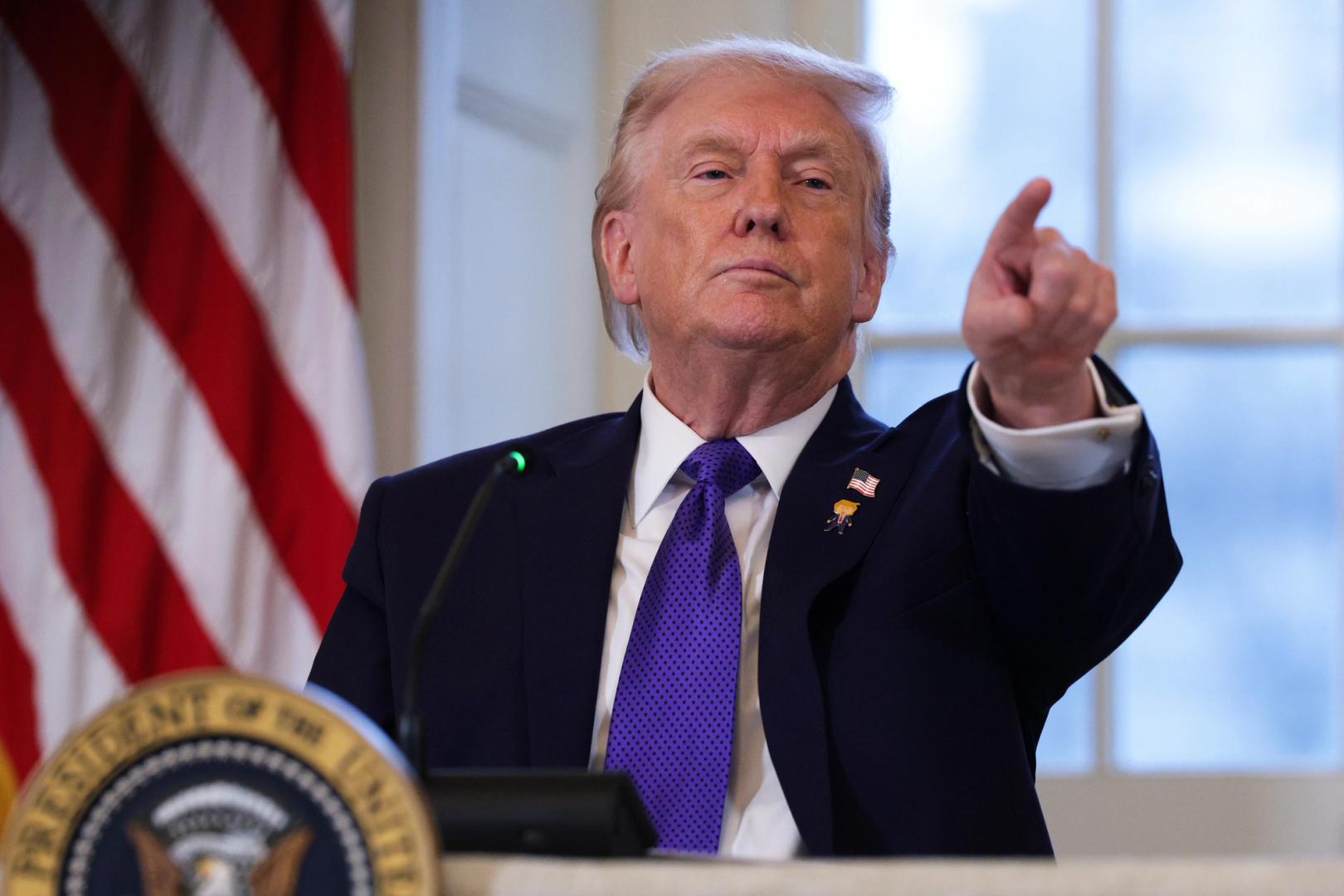
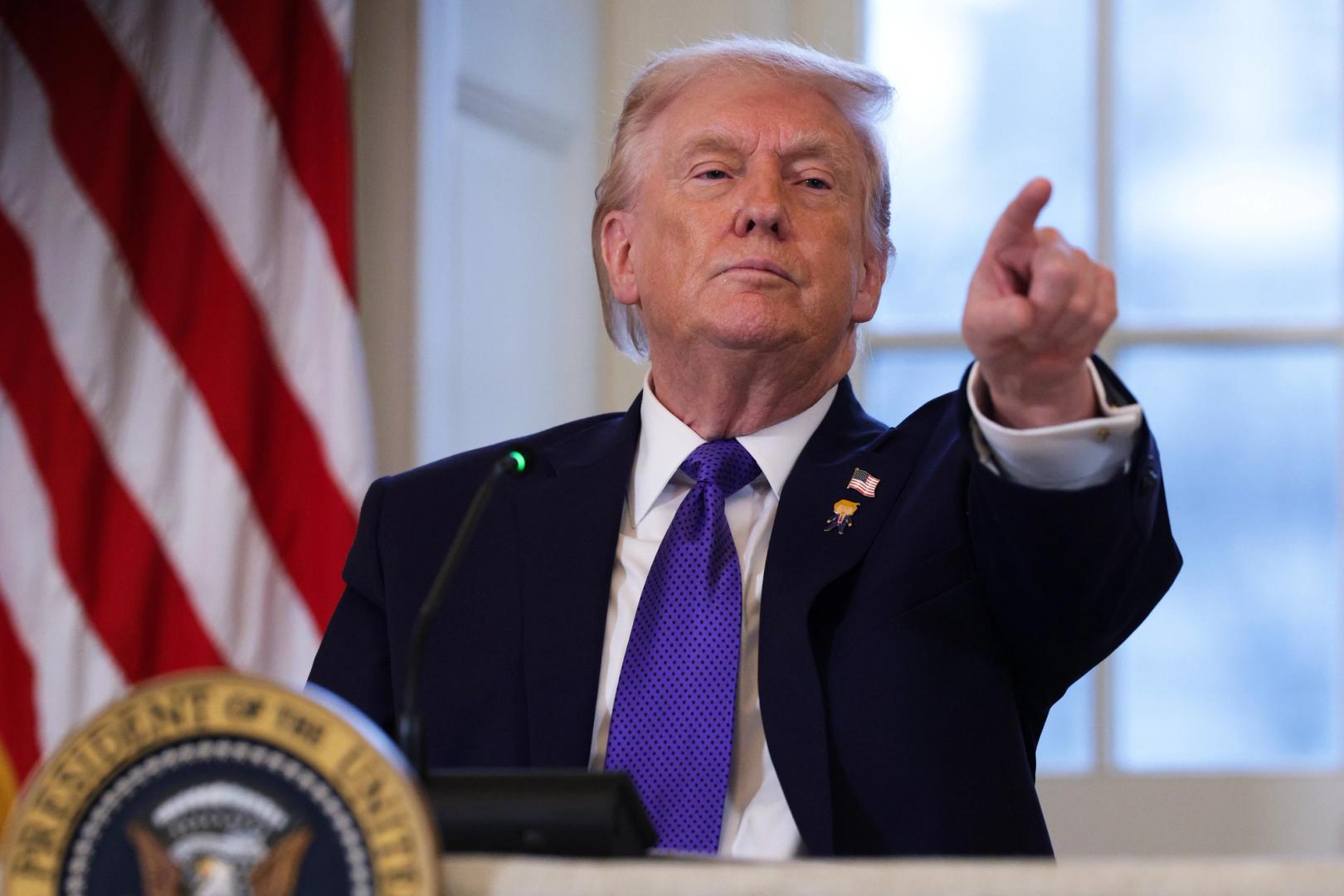
The United States has seized about $1 billion worth of cryptocurrency tied to Iran, Treasury Secretary Scott Bessent said, describing the action as part of a broader campaign to cut off funding channels used by Tehran.
Speaking in an interview on Fox Business, Bessent said U.S. authorities had “grabbed the wallets” and seized cryptocurrency connected to Iran.
He said the effort falls under Operation Economic Fury, an administration initiative aimed at restricting Iran’s access to overseas revenue, banking networks and digital-asset infrastructure.
“In addition, Treasury has cracked down on Tehran’s global shadow banking networks; designated networks supplying weapons and other military components to Iran; sanctioned a corrupt Iraqi official who has facilitated the sale of oil along with Iran-backed militias operating in Iraq,” a press release from the Treasury reads.
Bessent said the pressure campaign had contributed to worsening economic conditions in Iran. He added that large numbers of military personnel were not being paid, police officers were failing to report for duty, and inflation had exceeded 200%.
He also said Iranian authorities had resorted to food vouchers and internet shutdowns.
The Treasury secretary said the U.S. and its partners were also targeting overseas real estate and other assets that he described as proceeds diverted from the Iranian people.
He added that Iranian officials had previously moved hundreds of millions of dollars each month before Treasury intervention.
Read more: Iran crisis puts the regime’s $7.8 billion crypto shadow economy in spotlight
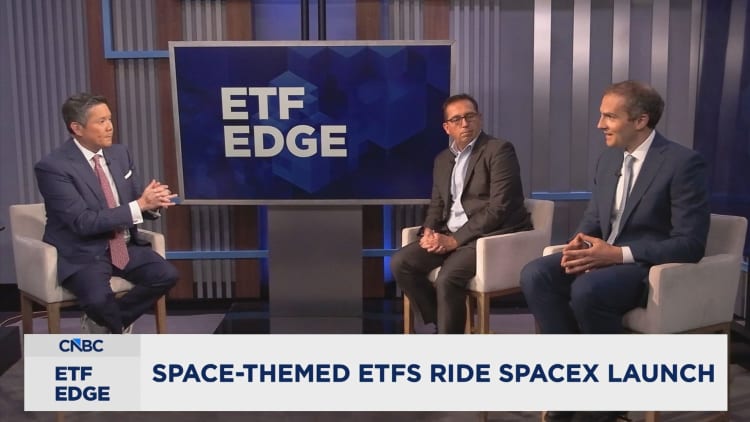

Retail investors are rushing into the space investing trade ahead of the SpaceX IPO, and one ETF has cashed in on the excitement.
Tema ETFs’ Space Innovators ETF, which launched on March 30 and trades under the ticker symbol NASA, crossed $1 billion in assets in just 37 trading days, and by the end of this past trading week, had reached over $2.6 billion in assets.
That rapid rise is due in part to retail investors hunting for exposure to SpaceX before it goes public.
While SpaceX has taken an unusual approach to its offering, setting up access for retail investors through brokerage firms at a level atypical in new deals typically dominated by institutions, the NASA fund is another alternative for investors to gain access to Elon Musk‘s rocket company. It already holds privately traded SpaceX shares directly. It is one of the few investment vehicles available to retail investors that does, with SpaceX currently representing around 7.5% of the fund.
“If we’re going to invest in space … We have to offer exposure to SpaceX,” said Maurits Pot, Tema ETFs founder and CEO on CNBC’s “ETF Edge” on Wednesday.
Pot said there is no plan to sell shares once the IPO occurs. “The IPO for us is simply a remarking of the position to market price,” he said.

NASA 1 M
NASA isn’t the only ETF that has access to SpaceX, though the options are limited. Mutual fund manager and billionaire Ron Baron, a long-time Tesla and SpaceX investor, owns the rocket company through his First Principles fund (RONB). Tesla is the top holding in the RONB ETF, at over 14%, while holding close to 2% of the fund’s assets in SpaceX. The ERShares Private-Public Crossover ETF (XOVR), which offers access to late-stage private companies, also owns shares of SpaceX which it says are worth close to $300 million based on an IPO value of over $1.5 trillion.
Setting a precise valuation for the SpaceX deal remains a point of contention in the market and among investors.
Mike Akins, founding partner at ETF Action, said on “ETF Edge” that the ETF structure itself is what makes this kind of access possible for the everyday investor. “Ten, twenty years ago, you talked about a space theme like this, an investor would have to go out and look up all these companies. Now there’s a ticker,” Akins said.
Todd Sohn, chief ETF strategist at Strategas, noted that several new space ETFs have launched over the past few months, including the Van Eck Space ETF (WARP) and Roundhill Investments’ Space & Technology ETF (MARS), which is itself a signal that retail investors are expected to pursue the theme as they have with other recent thematic trades playing off tech innovation, from AI to quantum computing. “That to me is usually a pretty good read that the industry expects space to be the next big thing,” Sohn told CNBC. “It’s a very similar idea to what AI was a few years ago and continuing on.”
But Sohn cautioned that not all funds are created equal. “It all depends on how pure or watered down the ETF is. So the due diligence for this is really important now,” he said.
There are other ETFs branded under the space investing theme that have been in the market for years already, building portfolios of stocks that include pure-play, high-risk space exploration companies, satellite companies, and broader aerospace and defense sector names.
The Procure Space ETF (UFO), which launched in 2019 and has over $1.2 billion in assets, holds Rocket Lab, Firefly Aerospace, and Planet Labs among its top holdings. The SPDR S&P Kensho Final Frontiers ETF (ROKT), which launched in 2018, also holds Intuitive Machines and Redwire. The Global X Space Tech ETF (ORBX) offers a similar portfolio composition.
Five-year performance of UFO ETF which invests in space and aerospace stocks.
The ARK Space and Defense Innovation ETF (ARKX) is a good example of how the definitional set of top stocks can range far across the market, with its portfolio also including Amazon and Deere.
Sohn says investors interested in these ETFs and the space investing theme should consider how much overlap there is in a portfolio with more classic defense industry names, as well as how concentrated the fund is in a small group of high-risk stocks.
“There’s only so many companies who are doing this that are public,” Sohn said. “Some of them may have 30 holdings, some of them may have closer to 50 or so,” he said of the current crop of space ETFs. “I have a feeling once SpaceX is public and trading for some time, you’re going to see some of these funds morph into more concentrated bets, depending on how they are managed,” he said.
That’s another factor for investors to consider: NASA, for example, is an actively managed fund, rather than tracking an existing index of stocks designed to represent the theme, which is the approach of UFO, ORBX, ROKT and others.
It is clear that Elon Musk is going to be a big winner from the SpaceX IPO and likely the world’s first trillionaire. But both Akins and Sohn said the biggest risk for retail investors getting in on the space theme is volatility.
The risks in the space market were made vivid this week with the launchpad explosion of Blue Origin’s New Glenn rocket.
“Expect volatility. That is usually what happens with very early-stage industries. There will be companies that outperform and companies within ETFs that fall apart because the business model doesn’t make sense,” Sohn said.
Sign up for our weekly newsletter that goes beyond the livestream, offering a closer look at the trends and figures shaping the ETF market.

TLDR:
- Wintermute is now quoting two-sided markets on event contracts across venues doing $20 billion monthly in volume.
- The prediction market industry has crossed $60 billion in 2026, yet still lacks the institutional liquidity it needs to mature.
- Event contracts price real-world outcomes directly, offering more targeted exposure than equities, rates, or currencies.
- Wintermute’s existing crypto infrastructure covers custody, collateral, and risk management that prediction market venues already require.
Wintermute has moved into the prediction market industry, now providing liquidity across event contracts on leading venues.
The algorithmic trading firm brings over $3.5 trillion in annual trading volume to a segment that has crossed $60 billion in 2026.
This entry marks a turning point for prediction markets, as institutional-grade infrastructure begins supporting a fast-growing but liquidity-thin space.
A $60 Billion Market That Needed Institutional Depth
The prediction market industry has expanded at a pace few anticipated just years ago. Trading volume across leading venues now exceeds $20 billion per month as of early 2026. That growth has outpaced the liquidity infrastructure needed to support it properly.
Wintermute is stepping in to close that gap by quoting continuous bid and offer prices across event contracts. Two-sided liquidity tightens spreads and allows participants to trade in larger sizes. Over time, this also strengthens the accuracy of probabilities that these markets produce.
Jake Ostrovskis, Head of OTC Trading at Wintermute, addressed the core problem directly. “Prediction markets have the demand profile of a major asset class but the liquidity profile of an early-stage one,” he said.
He added that sustained two-sided liquidity is what allows these markets to become reliable real-time probability tools.
Ostrovskis further noted that deeper liquidity does more than improve execution. “That depth tightens spreads, supports larger trade sizes, and in turn improves the signal embedded in market prices,” he explained.
“That is where Wintermute can add value.” Wintermute already operates across more than 70 exchanges, making this expansion a natural fit.
Why Wintermute Is Betting on Event Contracts
Prediction markets price real-world outcomes directly, rather than through traditional proxies like equities or currencies. For institutions managing exposure to specific catalysts, this offers a more targeted tool.
Policy decisions, economic data releases, and other discrete events become tradeable with greater precision.
Wintermute captured that distinction in a public statement, saying “prediction markets are emerging as a distinct asset class, pricing probabilities on events that traditional markets don’t capture cleanly.”
That framing reflects how the firm views the segment’s broader role in financial markets. It also explains why the firm sees long-term value in committing liquidity here.
Many prediction market venues also operate on public blockchains using stablecoin settlement systems. This aligns closely with infrastructure Wintermute already manages across spot, DeFi, and OTC crypto markets.
Custody, collateral, and risk management requirements are already part of the firm’s daily operations.
That overlap makes the move into prediction markets a practical extension rather than an entirely new venture. Wintermute Group’s existing systems handle the technical demands these venues require.
As the industry continues its growth trajectory, institutional participation from firms like Wintermute is likely to accelerate further adoption across the space.

Argos shoppers race to buy £20 LEGO Fifa World Cup Trophy sets for £2.84 each online

We Tested 30+ Grills So You Don’t Have to. Here Are the 9 Best Grills of 2026

Glasgow University student dies falling from bridge ‘while trying to retrieve phone’


-

 Business6 days ago
NYT Strands Answers May 24 2026 Revealed for Puzzle No. 812 Theme Summer Essentials
-

 NewsBeat3 days ago
Israel says it has killed new Hamas military leader in Gaza City airstrikes
-

 Politics5 days ago
Bridgerton Season 5: Cast, Release Date And Everything We Know So Far
-

 Business4 days ago
Selena Gomez Reportedly Upset Over Benny Blanco’s Comments on Her ‘Terrible’ Diet
-
Crypto World4 days ago
Micron Crosses $1 Trillion Market Cap as AI Demand Reshapes Memory Sector
-

 Business5 days ago
BTS Sells Out Four Las Vegas Shows at Allegiant Stadium for ARIRANG World Tour
-

 Tech5 days ago
Microsoft’s quiet Claude Code retreat and the real cost of enterprise AI
-
 Tech5 days ago
China assigns ID codes to 28,000+ humanoid robots
-

 News Videos4 days ago
XRP *JUST* SUCCEEDED!!!! CLARITY ACT EXPOSED!!! (SHE EXPOSED IT)
-

 Tech2 days ago
Waymo dominates autonomous vehicle registrations as Tesla trails behind
-
Tech3 days ago
The Samsung pay deal is the moment Korean unions changed register
-

 Tech5 days ago
Westone Audio and Etymotic Acquired by Fidelity Collective in Major IEM Market Move
-
Crypto World6 days ago
Brian Armstrong Outlines Crypto Vision for the Future Financial System
-
 Entertainment5 days ago
‘Breaking Bad’ Star’s Easy-to-Binge 6-Part Crime Series Spin-Off Is Finally Heading to Free Streaming
-

 Tech4 days ago
Millions of AI agents imperiled by critical vulnerability in open source package
-
Crypto World3 days ago
SpaceX’s $2 Trillion IPO: Why Tech Giants Nvidia (NVDA), Apple (AAPL), and Microsoft (MSFT) May Face Pressure
-
 Crypto World5 days ago
Nvidia (NVDA) CEO Calls on Super Micro to Strengthen Export Controls Amid Smuggling Probe
-

 Tech3 days ago
NASA taps Blue Origin to deliver lunar rovers for Moon Base initiative
-
 NewsBeat5 days ago
Hottest May day ever as London hits 34.8C in 2C leap from previous records
-
 Crypto World24 hours ago
Snowflake (SNOW) Stock Rallies on Strong Q1 Results and AI Product Growth
You must be logged in to post a comment Login