When fans walk into Immaculata’s gym they are immediately reminded of the team’s glorious past, when the Mighty Macs ruled women’s basketball nearly a half-century ago.
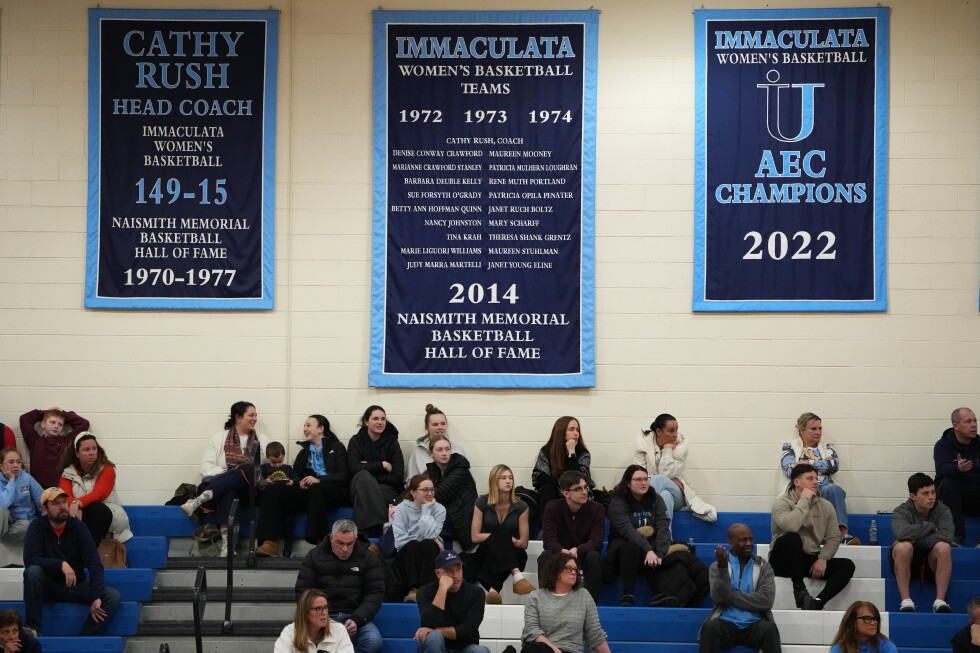
Championship trophies are proudly displayed near the entrance while Hall of Fame banners honoring some of the school’s icons, including former coach Cathy Rush, adorn the walls.
Powerhouses in this weekend’s Final Four like UConn and South Carolina stand on the shoulders of schools like Immaculata, Queens College, Wayland Baptist and Delta State. During the early years of the women’s basketball poll that debuted in 1976, those programs set the foundation, dominating the now dissolved Association for Intercollegiate Athletics for Women (AIAW).
But during the 50 years of the women’s poll, those pioneering programs haven’t been able to sustain the dynasty-level success that shaped women’s hoops in the 1970s.
Advertisement
AP AUDIO: Pioneer women’s basketball powers fade into the shadows full of pride as money reshapes the game
Advertisement
Pioneer women’s college basketball powers have faded into the shadows full of pride as money reshapes the game. Correspondent Gethin Coolbaugh reports.
“You can look back and say, ‘Well, it’s been a few years since we won a national championship,’” said Delta State athletic director Mike Kinnison, who was a student when the school won consecutive national titles from 1975-1977. “And that’s true. But, you know, they don’t give those away. You don’t buy them at Walmart. You’ve got to earn them.”
The game has professionalized as money reshaped the sports landscape, and competitive advantages shifted to big schools with seemingly unlimited budgets when the NCAA took over the sport in 1982.
The Lady Statesmen were the first No. 1 team when the women’s basketball poll debuted 50 years ago. Wayland Baptist was second, Immaculata third and Queens ninth. Delta State will be recognized during “The AP Top 25 Fan Poll Experience” being held Thursday-Saturday at Arizona State’s First Amendment Forum in the Walter Cronkite School of Journalism and Mass Communication.
Advertisement
The poll has served as a road map for the rise of the sport but a lot of things have happened since 1982.
“The whole landscape of NCAA and Division II has changed,” Kinnison said. “Women’s basketball has just exploded. And so it’s hard to dominate that space.”
‘Incredible’ changes to women’s basketball
Immaculata won three consecutive AIAW titles from 1972-1976 in front of sellout crowds that were a rarity in women’s basketball at the time. Delta State won the next three under trailblazing coach Margaret Wade. The Lady Statesmen vaulted to the national spotlight, traveling the country and defeating larger schools — with much bigger budgets — like LSU and Tennessee.
Title IX helped fuel rapid growth in women’s sports in the 1970s, but as the women’s game grew, the NCAA took over and added full scholarship allotments and started facilities arms races that smaller colleges could not compete with.
Advertisement
Amid the shift, Immaculata moved down to Division III, which does not offer athletic scholarships. Queens College and Delta State dropped to Division II while Wayland Baptist is in the NAIA.
The shift in women’s sports is both gratifying and bittersweet for players and coaches from the pioneering schools that helped spark this current growth. Women’s basketball in recent years has seen skyrocketing ticket demand, attendance, media coverage and television ratings behind recent stars like Caitlin Clark, Angel Reese and Paige Bueckers.
“Women and girls were playing this game at a different level all over the country and no one knew about it,” former Queens College coach Lucille Kyvallos said. “What happened here was we garnered national attention. Now look what’s happened. It’s incredible.”
Winning titles requires ‘significant investment’
The current revenue sharing model that allows schools to directly pay athletes has added a greater financial hurdle for small schools to overcome.
Advertisement
“If you want to be nationally competitive, if you want to win national championships, there’s a very significant investment involved,” said Big East Commissioner Val Ackerman, “because you’re paying top dollar for your coach. You’re paying for all the amenities. … And then you’ve got to, now you’ve got to acquire players, and to do that you need money, because they have options. And smaller schools aren’t going to have the same (financial) wherewithal as the big football school has.”
The 68-team women’s NCAA tournament field, for example, had 12 schools from the Big Ten, 10 from the SEC and nine ACC schools. The Big 12 had eight. There were only one at-large team from outside the Power 4 Conferences and the Big East.
“Is that a bad thing?” Ackerman added. “No — I think it’s just the reality of the world we’re in right now.”
Kinnison, who coached baseball at Delta State for 23 seasons before becoming athletic director in 2019, said he wants the school’s teams to be able to compete nationally and recapture some form of sustained success. That has been difficult, he added, and the school has faced tough financial decisions to make that happen.
Advertisement
“More and more, we rely on private sources, donations, alumni,” he said in his office on Delta State’s campus in Cleveland, Mississippi. “We’re in a town here of 11,000 people, and that’s not the density of a town that has 100,000 or 150,000 people. Some of our corporate options are a little less, so it’s challenging.”
Pioneers battle against becoming afterthoughts
The Delta State AD, along with others at Queens College and Immaculata, remain hopeful that their programs won’t be forgotten.
The court at Queens College is named after Kyvallos, the women’s basketball Hall of Famer and advocate who built the Knights into pioneers in the AIAW era.
At Delta State, there are similar tributes in the arena’s concourse: championship trophies and the preserved netting, the name of former coach Lloyd Clark is painted on the floor of the court named after him, honoring the period in which he won three Division II titles and guided 16 of his teams to the NCAA Tournament.
Advertisement
“You have to be a steward of that history, you have to tell those stories and talk about those individuals because it was crazy to think about what they had to go through,” current Queens coach Travis Ponton said.
Current Immaculata coach Brittany Whalen is very familiar with the history of the program. She played there from 2011-15 and was on the court at Madison Square Garden when the team played Queens College in her senior year — four decades after the two programs played the first women’s basketball game at MSG.
“It felt like being a celebrity,” Whalen said. “To tie in to that part of the history and that being the first-ever game played there it was just so cool to be a part of.”
Whalen, who has led the team to its first 20-win season since 1976-77 at 24-3, gives tours of the facility to perspective players.
Advertisement
“This is the same building they played in back in the 70s and not much has changed,” she said. “We talk about it in the preseason how you’re here because of the women who paved the way before you. If you’re going to be a Mighty Mac and be a part of the program, you need to know the history of it.”
Current Delta State coach Tracy Stewart-Lange has a similar appreciation for her program’s history.
There’s a photo in her phone that reminds her of those days. Former Delta State star and basketball pioneer Lusia Harris is captured mid-layup, and behind her fans are sitting courtside, pressed against the railings and anywhere else they could find a spot.
Games are much quieter now that the school has faded from national prominence, and Stewart-Lange often wonders if that will change.
Advertisement
“We want to fill these seats,” she said. “We’re trying to figure out can that still be done.”
___
Alanis Thames reported from Cleveland, Mississippi; Doug Feinberg reported from New York City and Philadelphia.
The line-up for the biggest ever World Cup is complete.
The tournament across America, Canada and Mexico will see 48 teams competing to become best in the world – up from the usual 32.
Dramatic playoffs saw Italy narrowly miss out on a spot in the finals for the third time in a row, while Iraq will return to the tournament for the first time in 1986.
Here’s everything you need to know.
Advertisement
When and where is the World Cup?
The tournament runs from 11 June to 19 July 2026 and will be played at 11 sites in America, three in Mexico and two in Canada.
104 games will be played overall – up from 64.
The host nations automatically qualify and will play all three of their group stage matches on home soil.
The final will take place at the New York New Jersey (MetLife) Stadium – home of the New York Giants and New York Jets.
Advertisement
Image: Aerial view of Metlife Stadium, where the final will be played. Pic: AP
The stadiums where games will be played are:
America: • Atlanta Stadium • Boston Stadium • Dallas Stadium • Houston Stadium • Kansas City Stadium • Los Angeles Stadium • Miami Stadium • New York New Jersey Stadium • Philadelphia Stadium • San Francisco Bay Area Stadium • Seattle Stadium
Canada: • Toronto Stadium • BC Place Vancouver Stadium
Advertisement
How will the group stages work?
Due to the increased number of countries in the tournament, the format of the group stages has changed slightly. Instead of 32 teams being divided into eight groups, this year will see 12 groups of four.
The top two teams in each group, plus the eight best third-placed teams, will advance to a round of 32.
For the first time since 1998, Scotland have bagged themselves a place through qualifying while Jordan, Curacao, Cape Verde and Uzbekistan will all make their World Cup debuts.
Here’s the full list of groups:
When are England and Scotland playing?
England are in Group L and will begin their campaign on 17 June in Texas against Croatia, who knocked the Three Lions out of the 2018 World Cup.
Here’s England’s full fixture list:
Advertisement
• England vs Croatia – 17 June, Dallas, 9pm (UK time) • England vs Ghana – 23 June, Boston, 9pm (UK time) • Panama vs England – 27 June, New York-New Jersey, 10pm (UK time)
Scotland’s timetable is less favourable for fans, who will need to stay up through the night to watch their side take on opponents including five-time winners Brazil.
• Haiti vs Scotland – June 14, Boston, 2am (UK time) • Scotland vs Morocco – June 19, Boston, 11pm (UK time) • Scotland vs Brazil – June 24, Miami, 11pm (UK time)
Despite the stadiums already being selected, Donald Trump has threatened to remove the Democrat-run city of Los Angeles from hosting, along with the Boston area, where England and Scotland are playing some of their group stage fixtures.
Advertisement
“If we think there’s going to be a sign of any trouble, I would ask Gianni [Infantino] to move that to a different city,” Mr Trump said in November, as protests against his government have taken place in both cities.
The president later said the government would have to “force ourselves” on LA during the World Cup for security purposes.
He said: “We’re gonna have to do something when it comes to World Cup time, and we’re gonna have to force ourselves upon them, which we have the right to do, because we don’t want to have any crime, we don’t want to have any problems.”
Advertisement
From December: Could Trump move World Cup matches?
FIFA has told Sky News the US government does have the right to determine if cities are safe for the World Cup.
In a statement, FIFA said: “Safety and security are the top priorities at all FIFA events worldwide.
Advertisement
“Safety and security are obviously the governments’ responsibility, and they decide what is in the best interest for public safety.
“We hope every one of our 16 host cities will be ready to successfully host and fulfil all necessary requirements.”
Scott LeTellier, who was managing director of the 1994 World Cup in America, suggested the cities in question shouldn’t worry about Mr Trump’s threats, as changing the stadiums would require “some kind of national emergency that would give the government the authority to cancel an event”.
“I don’t see even a remote chance of that happening,” he said.
Advertisement
How much are tickets?
FIFA says the cheapest tickets are from $60 (£45) in the group stage. But the most expensive tickets for the final are around $6,730 (£5,094).
Initially, FIFA suggested tickets would be sold using dynamic pricing, meaning fans would pay different prices according to demand.
Is the World Cup too expensive?
Advertisement
Variable pricing – fluctuating based on demand – had never been used at a World Cup before, raising concerns about affordability.
FIFA later backed away from it, saying allocations would be set at a fixed price for the duration of the next ticket sales phase.
FIFA president Gianni Infantino previously boasted that there have been more than 500 million ticket requests for the tournament but, according to estimates by The Athletic, less than six million tickets are accounted for.
Advertisement
Will there be a half-time show?
Following in the footsteps of the NFL’s Superbowl, FIFA has confirmed that a half-time show will be performed during the World Cup final on 19 July.
Other finals have had musical acts before, but this will be the first half-time show.
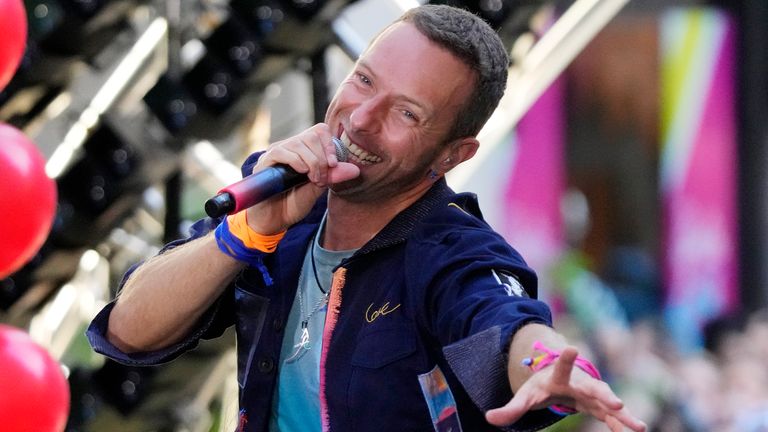
Earlier this year, FIFA’s Mr Infantino said Coldplay will help pick the artists who will perform – none have been confirmed so far.
Image: Coldplay’s Chris Martin will help decide who will perform at the World Cup half-time show. Pic: Charles Sykes/Invision/AP
Meet the mascots – and the ball
As there are three host nations, this year’s World Cup also comes with three mascots.
Maple the moose, Zayu the jaguar and Clutch the bald eagle will represent host countries Canada, Mexico and America respectively.
Advertisement
Image: Pic: Reuters
Image: The official ball of the 2026 FIFA World Cup named Trionda. Pic: Reuters
Also reflecting the three co-hosts is the official World Cup match ball – Trionda – which means three waves in Spanish.
The ball features a swirled pattern incorporating red, green and blue, with each section representing a host nation.
Mariella Rose was just 17 when she died after the car she was driving was involved in a crash with a tractor in Everingham Road, Everingham – near Pocklington – on Monday (March 30).
Humberside Police said that Mariella had sadly died at the scene and confirmed that her family are being supported by specialist trained officers at this time.
Recommended reading:
Advertisement
Speaking of their loss, Mariella’s family said in a statement: “Mariella sprinkled stardust on everyone she met.
“A volunteer at East Yorkshire Mind, a crew member at Shiptonthorpe McDonald’s, a student at Askham Bryan College, and a Humberside Police cadet based in Beverley.
“Her love of music, the Yorkshire countryside, and travels across Greece made her a beautiful, joyous young woman.
“From a very young age, her strong sense of right and wrong led to a natural ambition to become a police officer.
Advertisement
“Our hearts go out to everyone who knew Mariella her friends, colleagues and, naturally, all her family.”
It comes after it was reported that an orange Chevrolet, driven by Mariella and travelling eastbound, had been involved in a collision with a tractor at around 3.40pm on March 30.
Police are appealing for anyone who may have been in the area at the time, or who has dashcam footage/witnessed the incident, to contact officers on 101, quoting log 304 of 30 March.
It is the first phase of a £65 million development
A major redevelopment of a city centre landscape is under way as the latest update has been revealed. The first phase of the Peterborough Station Quarter project was due to start before the end of March.
Advertisement
The first phase of the £65 million Station Quarter development, known as City Link, is expected to create a modern gateway between the railway station and Cowgate, according to the council.
In the latest update, a spokesperson for Peterborough City Council confirmed that work is underway. Workers are removing trees and clearing more vegetation on the roundabout.
They expect M Group to be setting up their compound in April and May, with the main road works due to begin in May. The construction works include lane closures on Queensgate Roundabout, meaning motorists and road users could experience delays.
A spokesperson for Peterborough City Council said: “Although the traffic orders are being published later than we originally said this will not affect the timeline for our start on site. It will begin in May/June and the completion date for the project will remain the same.”
Advertisement
The two subways that run underneath the Queensgate roundabout will be removed. As part of the consultation, officers reviewed whether any of the 35 trees could be retained.
A spokesperson for the council said: “Unfortunately, this will not be possible due to engineering requirements that are necessary to construct the new footpaths and make improvements to the landscaping to transform the area.
“The landscaping proposals will see 49 new trees planted and there are also plans for seven additional small trees/shrubs as well as a rain garden and Gabion walls.”
Advertisement
The Station Quarter is a regeneration project being delivered by Peterborough City Council in partnership with Cambridgeshire and Peterborough Combined Authority, Network Rail, Platform 4, and LNER.
Minister Muir described recent wildfires as having had “devastating consequences”, endangering homes, business and communities as well as habitats
A new action plan has been launched aimed at reducing the threat of wildfires in Northern Ireland.
Advertisement
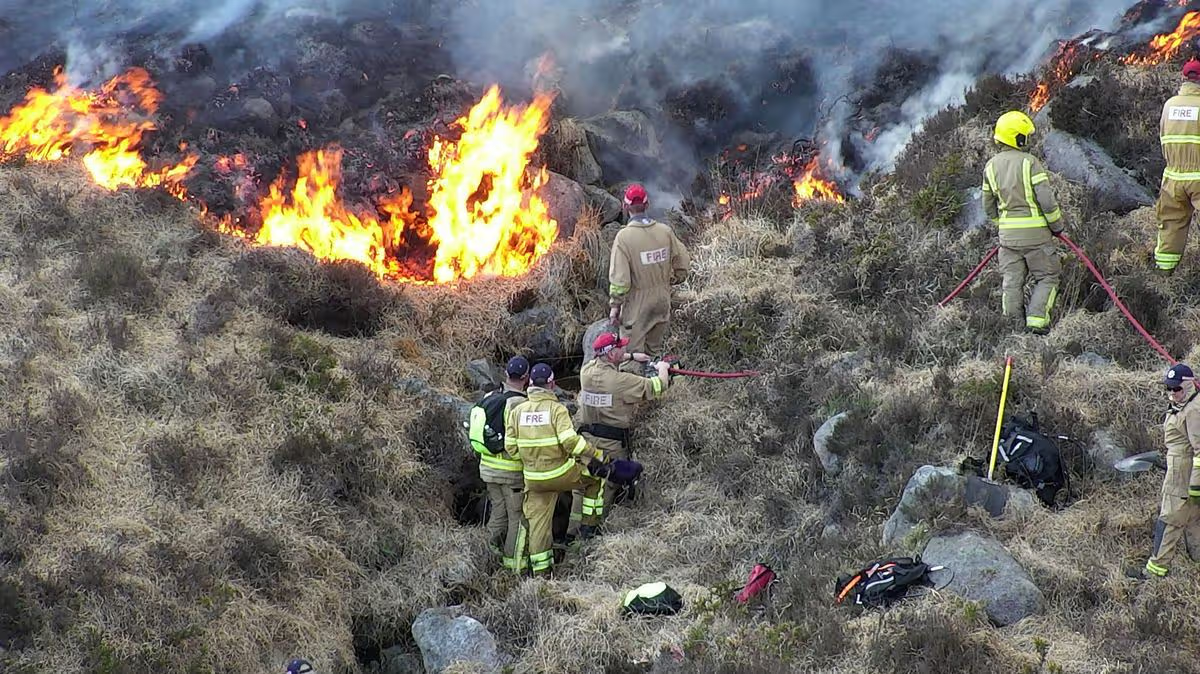
It comes after a spate of blazes last spring, including firefighters in Northern Ireland dealing with almost 300 wildfires in a single week during April.
These included a blaze in the Mourne Mountains in Co Down which sparked a major incident and saw people evacuated from their homes.
Implementation will include a consortium of international wildfire experts, led by the Catalonia based Pau Costa Foundation focusing on Eastern Mournes, North Antrim Hills and Carn/Glenshane Pass in a project supported by the carrier bag levy.
It focuses on five main objectives of prevention, preparedness, response, recovery and enforcement, supported by 35 key areas of development aimed to ensure the enhancement of regional capability.
Mr Muir described recent wildfires as having had “devastating consequences”, endangering homes, business and communities as well as habitats.
“The Wildfire Action Plan lays out how we will work together to reduce wildfire risk by implementing specific actions over the years ahead,” he said.
Advertisement
“Its implementation will help make our communities more resilient, by raising awareness of the dangers and providing the tools to adapt to and mitigate wildfire risks.
“The action plan also includes measures to enhance preparedness and capability for response to wildfire incidents, as well as supporting work on climate change adaptation, biodiversity and peatland restoration.”
Northern Ireland Fire and Rescue Service (NIFRS) area commander and strategic wildfire lead Ryan Thompson hailed the action plan as a “new approach” to reduce wildfire frequency and severity to help protect lives and the environment, and make Northern Ireland safer.
Advertisement
“We are committed to the strong, unified approach behind the Wildfire Action Plan to ensure our firefighters are ready to respond to incidents in their local areas,” he said.
“With spring beginning, we urge the public to follow our safety advice when visiting the countryside.”
Jordi Vendrell, general director of Pau Costa Foundation, said: “Northern Ireland is highly advanced in wildfire management and strategic planning, and the implementation of projects like this clearly demonstrates that leadership.
“Initiatives of this kind also create an important opportunity to connect knowledge and experience from different parts of Europe, strengthening collaboration and improving how we collectively prevent and respond to wildfire risk.”
For the first time since the Apollo era, humans are preparing not just to visit the Moon, but to live and work there for weeks, months – and eventually years.
But what would it really be like to spend an extended period on the lunar surface? The answer is exhilarating – and brutally unforgiving. An exciting new era of deep-space exploration is opening up. The US Artemis programme aims to set up an outpost on the Moon’s surface. It marks a fundamental shift in how we explore space.
Rather than just leaving “flags and footprints” as the Apollo missions did, Nasa wants to establish a sustained human presence on the Moon, beginning at the lunar South Pole.
The programme unfolds in stages. In 2022, the Artemis I mission successfully tested the Space Launch System (SLS) rocket and Orion spacecraft as an integrated system on an uncrewed mission around the Moon.
Advertisement
On April 1, 2026, Nasa launched Artemis II a ten-day mission, carrying four astronauts around the Moon.
The four Artemis II astronauts arrived at Kennedy Space Center in Florida on March 27, 2026 to begin final preparations for launch. NASA/Jim Ross
As Nasa’s first crewed flight of Orion and SLS, Artemis II is a pivotal mission designed to verify that life-support systems, navigation, thermal protection and deep-space operations all function safely with humans onboard.
Before astronauts can live on the Moon, the journey there must be proven reliable.
Beyond these early missions, Nasa’s long-term vision extends far beyond a single landing. Nasa plans to spend US$20 billion (£15 billion) on a lunar surface base, intended to support repeated and progressively longer surface stays. This is designed to teach us how to operate sustainably beyond Earth – knowledge that will ultimately feed forward to future human missions to Mars, the horizon goal.
Advertisement
Health challenges
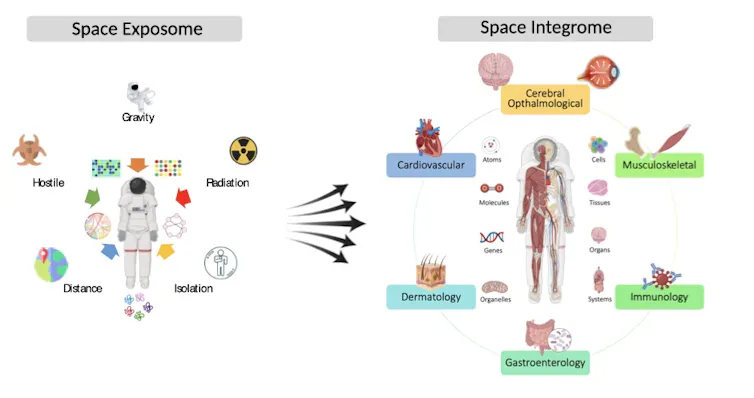
Living on the Moon will challenge every organ system in the human body. The lunar environment exposes astronauts to a unique space exposome – the combined set of
physical, chemical, biological and psychological stressors encountered beyond Earth.
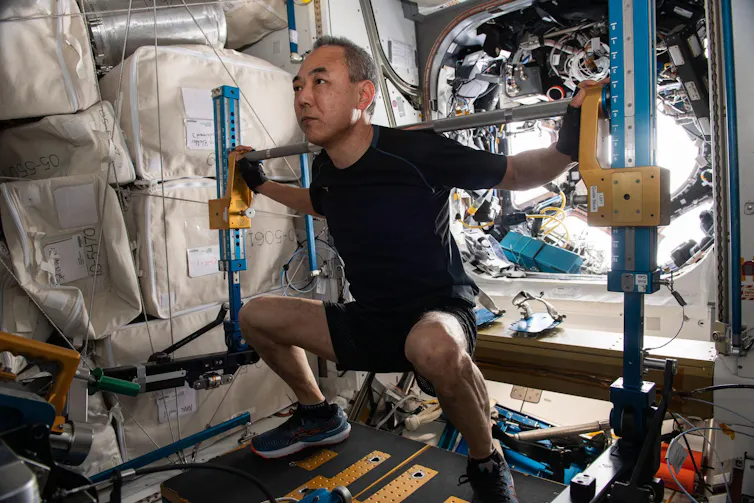
Regular exercise will be critical for staying healthy on the Moon. Here, Japanese astronaut Satoshi Furukawa works out on the International Space Station. Nasa
These include reduced gravity (about one-sixth of Earth’s), chronic exposure to cosmic radiation, extreme temperature swings, toxic lunar dust, isolation, disrupted sleep-wake cycles, and prolonged confinement.
Unlike astronauts in low-Earth orbit, lunar crews operate largely outside Earth’s protective magnetic field. This increases exposure to space radiation, which can damage DNA, disrupt immune function and affect the brain and cardiovascular system in subtle but potentially serious ways.
Reduced gravity also fundamentally alters how blood, oxygen and fluids move around the body. Microgravity can disrupt how blood, oxygen and glucose are delivered to the brain, potentially increasing vulnerability to neurological and vascular dysfunction over time.
To properly understand these risks, we need to look beyond individual organs and instead consider the space integrome – the way that the brain, heart, blood vessels, muscles, bones, immune system and metabolism interact as an integrated whole under space conditions. A small disturbance in one system sends ripples through others.
One of the most challenging aspects is that many space-related physiological changes develop insiduously. Astronauts may feel well while complications simmer beneath the surface, only becoming apparent months or even years later.
Advertisement
That is why Nasa places such emphasis on long-term physiological monitoring and human risk mitigation in its Artemis science strategy.
The encouraging news is that humans are remarkably adaptable. The challenge is guiding that adaptation in safe and sustainable ways. Space countermeasures are the tools used to reduce risk and preserve astronaut health.
Exercise remains the cornerstone. On the International Space Station, astronauts spend around two hours per day exercising to protect muscle mass, bone density and cardiovascular function. On the Moon, however, exercise systems must be redesigned for partial gravity, where familiar Earth-based loading no longer applies.
Advertisement
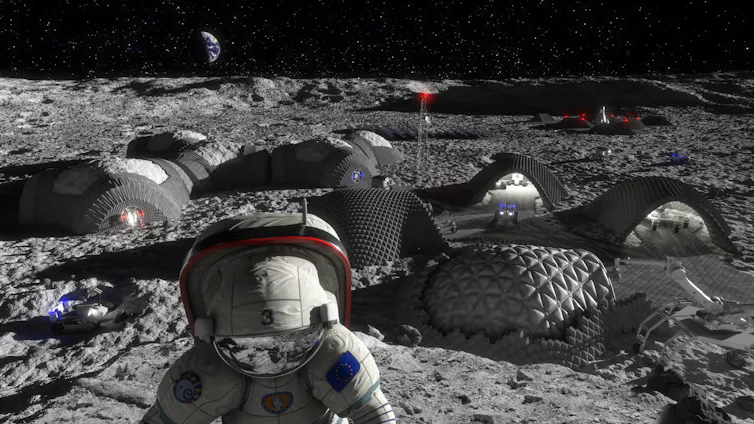
Lunar regolith (soil) could be used to create structures that protect habitats from radiation and micrometeoroids. Foster + Partners
Nutrition is another powerful countermeasure. Diet influences bone health, muscle maintenance, immune resilience and even how the body responds to radiation.
Personalised nutrition strategies, tailored to individual physiology rather than a “one-size-fits-all” menu, are likely to become increasingly important during long lunar missions.
Artificial gravity is also being explored. Short-radius centrifuges could expose astronauts to brief periods of increased gravitational loading, potentially helping stabilise cardiovascular and neurovascular systems. While still experimental, this approach may prove valuable for future surface missions.
Vegetables grown in a lunar base greenhouse could enhance astronaut nutrition. Nasa
Radiation protection will rely on multiple layers of defence: habitat shielding – potentially using structures made of lunar soil – early warning systems for solar storms, and operational strategies that limit exposure during high-risk periods.
Crucially, countermeasures should be proactive rather than reactive. Continuous physiological monitoring, wearable sensors and advanced data analytics may allow mission teams to detect early warning signs and intervene before small problems become mission-limiting ones.
Spending extended time on the Moon will be awe-inspiring. Imagine watching Earth hang motionless above a stark, silent horizon, or working under a sky that never turns blue.
But it will also be demanding, uncomfortable and unforgiving. The Moon is not just a destination – it is a test of our biology.
If we can learn how to keep humans healthy, resilient and productive on the lunar surface, we take a decisive step toward becoming a truly spacefaring species. Artemis shows that exploration is no longer about brief heroics.
It is about sustainability, adaptability and understanding ourselves as deeply as the worlds we seek to explore.
In learning how to live on the Moon, we may ultimately learn as much about life on Earth as we do about our future beyond it.
The actor, who first appeared as Kev Townsend last year, has said he is “really pleased” to make a comeback.
His character was introduced as the estranged husband of Robert Sugden (Ryan Hawley), and he is set to bring “unfinished business and drama” to the village.
Coghill narrowly escaped serial killer John Sugden (Oliver Farnworth) in the series, and was revealed as the long-lost father of Lewis Barton (Bradley Riches).
Chris Coghill started featuring in Emmerdale in 2025 (Image: Mark Bruce/ITV Studios/PA Wire)
The past has not been easy for his character, who fled Emmerdale earlier this year after a brief festive stint following the unveiling of his son’s true identity, who is currently ignorant of his biological father.
Advertisement
Now, Townsend is preparing for his Emmerdale return with a new business venture that promises to “stir up trouble” for the locals.
Speaking about coming back to the soap, Coghill shared: “I’m really pleased to be returning to Emmerdale, I had a brilliant time last year.
“Kev is a complex character that I love playing. He has psychopathic tendencies but also an energy and vulnerability that I think makes him pretty unique.
“I’m properly looking forward to getting back at it.”
Advertisement
Laura Shaw, Emmerdale producer, said: “Both Chris and the character of Kev made a massive impact on the show last year, so Chris is most definitely back by popular demand.
“With Kev’s son, Lewis, in the village still unaware of who his father is, it’s safe to say that there’s a lot of unfinished business and drama ahead.”
Emmerdale fans call for Kev Townsend’s return
Some Emmerdale fans will be pleased to see that Kev Townsend is back in the show after his stint away from the village.
A recent post on the r/Emmerdale Reddit page titled “Kev needs to return” saw quite a few comments of support.
Advertisement
The post read: “Kev for me was up there for most believable tough guy nut jobs I’ve seen in tv.
“Easy comparison, compared with Ray who really struggled to intimidate kids, one look off Kev and you feel uncomfortable.
“From the unhinged stuff through the vows then leaving and returning to kinda save the day, I think there’s a redemption arc worth exploring, potentially using irony and him actually being terminal if it’s a short term gig.”
Plenty agreed, as one shared: “Yes, definitely would love it, however the actor who plays the role is in demand.
Advertisement
“He may hopefully return for a stint between other acting roles.”
Another wrote: “I’d like him back too.
“I think him and Nicola as friends would be comedy gold as well.”
A third posted: “I think Kev will return because Lewis is his son.
Advertisement
“He will want to bond with Lewis and divorce Robert.”
What other TV shows has Chris Coghill been in?
Chris Coghill has appeared in TV shows since 1999, where he featured in an episode of Cold Feet.
He had a recurring role on Shameless in the mid-2000s, playing the character of Craig Garland, as well as Bobby Sheridan in The Royal.
Recommended reading:
Advertisement
Between 2007 and 2008, he was a regular on Coronation Street as villain Tony King, known for the storyline in which his partner Bianca Jackson discovered he had been abusing her daughter, Whitney.
In more recent years, he played the character of Hobbs on Apple TV’s Slow Horses, alongside roles in The Walk-In and The Bay.
Are you excited to see Chris Coghill return to Emmerdale? Let us know in the comments.
The Nasa mission will see commander Reid Wiseman, pilot Victor Glover and mission specialists Christina Koch and Jeremy Hansen do a lap around the moon.
(L-R) Mission specialist Jeremy Hansen, pilot Victor Glover, mission specialist Christina Koch and commander Reid Wiseman earlier today (Picture: Getty Images)
They’ll live inside the 330-cubic-foot capsule for the next 10 days before splashing down in the Pacific Ocean, off the coast of San Diego.
Here’s what their life will be like.
Advertisement
What is the Orion spacecraft?
The capsule will be humanity’s home away from Earth – what it lacks in interior space it makes up for with, well, literal outer space.
It was built by Lockheed Martin, a US defence and aerospace manufacturer, and was christened Integrity by the crew for this mission.
The Orion sits atop the rocket and will separate after launch, throwing the capsule towards the moon before it loops around and flies back.
Advertisement
‘The Orion spacecraft is about the size of a small minivan, and there are four of them, and they can’t get out of 10 days, so it’s very cramped,’ Libby Jackson, who worked in Mission Control for a module on the International Space Station, tells Metro.
The Orion capsule is roomy (Picture: Metro)
‘In the future, they might have a lander with them and a bit more space. But these people are in a confined space for 10 days.’
The Orion spacecraft, which can sustain passengers for 21 days, has two main sections – the crew module and the service module.
During the 10-day mission, the Koch, Wiseman, Glover and Hansen will remain inside the crew module.
Once the launch phase ends, Koch and Hansen will set up a water dispenser, food warmer and the five-cubic-feet toilet.
Advertisement
This is under the floor near the main hatch, with astronauts having the option to install a curtain for privacy.
Hansen might need it, given he’s 6’2″, gigantic by astronaut standards.
The capsule will carry the astronauts to the moon and back (Picture: AFP)
Accidents do happen and if one does happen in the Orion’s toilet, the crew will need to rely on urine collection bags and fling their waste into space via a chute.
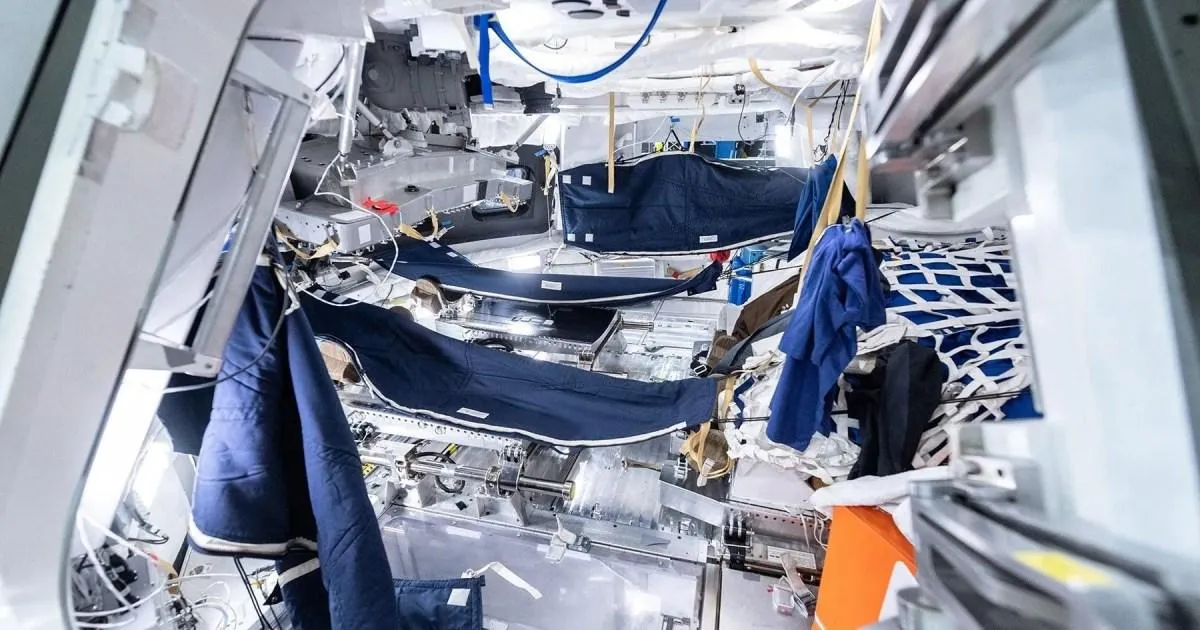
The Orion has… some five-star amenities, such as bags strapped to the wall where they can sleep with no gravity.
Advertisement
They will use water from the lower service module to rehydrate their vacuum-packed shrimp, macaroni and cheese and tortillas.
It even has a personal gym – kind of – in the form of a flywheel near the hatch, which allows the crew to row, squat and deadlift.
Exercise is important in the cosmos to prevent bodies from weakening, says Jackson, the head of space at the Science Museum in London.
‘When you go into space, your body instantly starts adapting.
Advertisement
There will be no such thing as privacy inside (Picture: Nasa)
‘Your fluid shifts around your body. Your bones get weaker, your muscles get weaker. You might feel sick when you first go into space because of the fluid balance.
‘But the 10 day mission, when you come back to Earth, your sense of balance and muscles won’t have significantly weakened, so you’d still be strong.’
What could go wrong?
The big thing the astronauts will face in the heavens is radiation.
The Earth has an invisible force field called the magnetic field, caused by all the molten metals churning inside our planet.
‘Our compasses pointing North is what protects everybody here on Earth from the radiation that is emitted by the sun,’ Jackson says.
Advertisement
‘Radiation is dangerous and damaging. When you go to the moon, you leave the protection that our Earth offers us.’
If a radiation event erupts, such as a solar flare lashing the capsule, the astronauts can shelter in the storage lockers under the seats.
Sorry, the video was not found
Beneath where the team are staying is the service module, a cylindrical piece provided by the European Space Agency.
Advertisement
Inside it houses the propulsion, power and life-support systems – these will be watched during the mission as Artemis II is mainly to test them.
The life-support system manages the air, pressure, water and waste of the capsule, according to a fact sheet from Nasa.
‘A regenerable air system efficiently removes carbon dioxide and humidity, conserving mass and volume,’ the document says.
‘Systems also continuously monitor temperature, humidity, and pressure to detect and respond to unsafe conditions.’
Advertisement
Lockheed Martin explains that the craft also has a launch abort system, which looks like a need sticking out from the top of the capsule.
The Artemis II crew inside a mock Orion (Picture: James Blair/Nasa)
This features three solid rocket motors that ignite a propellant, such as helium, to shove the capsule away from stellar dangers.
Nasa’s mobile app will let people track the capsule as it zips towards the moon. It can also be tracked with this website made by the space agency.
A private maternity industry is taking advantage of anxious mothers facing the biggest change of their lives.
An investigation has exposed a regulatory vacuum in the private maternity sector, where experts with as little as three days of training are making life-and-death decisions.
Advertisement
From doulas fatally ‘interfering’ with labour, to money-hungry high-street scan clinics failing to spot severe abnormalities, the cost of this profit-driven industry is being paid in infant lives and shattered families.
Charlotte Tolley, 36, is a single mum-of-three, one of whom, Lucas, five, requires intense amounts of care. The tot was born with his brain missing – which the private clinic that Charlotte used during her pregnancy didn’t notice.
Currently, anyone with an ultrasound machine can use that title, prompting Charlotte to campaign for change. She is urging other families to not rely on private scans, and for sonography to become a regulated industry.
Charlotte opted for private scans after suffering a miscarriage. At her first NHS appointment, she found herself in the same room where she’d lost her last baby. After discussing options with her midwife, she opted for a private clinic, where they found Lucas to be healthy, even though the abnormality was clearly visible on ultrasound.
Advertisement
Charlotte said: “Everything was quite standard and normal. I specifically asked the sonographer, ‘Can you see anything wrong? Would you be able to see if there’s any abnormalities?’” After he was born, Charlotte knew something was wrong, and the pandemic had begun, so in-person services were becoming less easily accessible.
Lucas struggled to feed, or focus, and suffered from jaundice. After he continued to struggle, Charlotte listened to her “mum gut” and called an ambulance.
She told the Mirror: “Had I not already been a mum of two children, I don’t think Lucas would be here now to be honest with you. He was chronically dehydrated, he was yellow, he had mottled skin, his head was bigger than his body, he looked like an alien where he’d not been able to gain any weight.
Advertisement
“He was constantly in and out of consciousness where he could barely stay awake because he had no energy to him.”
A hospital doctor conducted a cranial ultrasound which sparked panic. Charlotte said: “He dropped the ultrasound machine… and went off. He got on the phone… came back to me and said: ‘Your son has half of his brain missing’.”
Charlotte questioned how could her baby be alive without an entire brain while Lucas was rushed for an urgent MRI which confirmed the news. Charlotte added: “It was so obvious, you know, I’ve never seen an MRI of a brain before in my life, but even I could tell that it wasn’t right.”
Advertisement
Further tests were undertaken on the little boy, only weeks old, including hormone profiling that required bloods to be taken every three hours but his brain didn’t develop. Charlotte said: “He’s completely blind, he’s got cerebral palsy, epilepsy, he can’t chew or eat. I was told at the time, he would never walk, talk, eat, smile, do anything.”
Charlotte met with a solicitor and radiography and ultrasound experts who looked at the scans the private clinic had provided her and confirmed that “undoubtedly you can see there’s a problem.”
“Either he wasn’t qualified enough or he was told not to say anything,” Charlotte said, citing reports by the BBC that indicate some technicians at private clinics were told not to disclose certain information to their clients. She reached an out-of-court settlement with the clinic that was responsible for her failed scans.
If the abnormality had been reported to her, she should have been immediately sent back to the NHS and provided with a pregnancy-safe MRI, giving her the choice of whether to continue with the pregnancy or not.
Advertisement
Charlotte said: “I would definitely have had to terminate the pregnancy because I had two other children, I was a single parent that just left a marriage, and my eldest daughter is autistic as well.”
The progress her son Lucas has made is astounding compared to the “bleak” prognosis he was given as a baby. He walks, uses his cane, and only sometimes uses a wheelchair but still needs intense round-the-clock care.
Charlotte said: “I sometimes almost wish that I could outlive my own son because I’m worried for the future that he will have if he’s left on his own without any support. I do everything for him, and I always will have to even as he gets older, and no parent should ever have to feel like that.”
Charlotte feels strongly about some of these clinics that are cropping up across the UK. She said: “I think these other clinics should be avoided altogether. [Some] are money hungry vultures… they don’t care about the people walking through their doors… they just want to build a franchise, build a name and earn money and that’s it.”
Advertisement
Charlotte wants to make sonography a regulated profession and has started a petition to try and enforce greater transparency in this area.
Amy Heath, Medical Negligence Partner at the law firm, Stewarts who acted for Charlotte warns that her client’s “example is an extreme one, but it’s a good one to show how wrong it can go.” Amy explains that the NHS – for the most part – “mops up” the errors of these private clinics which are “money making enterprises”.
And it’s not just babies at risk, but mothers, too. Ectopic pregnancies occur when a fertilised egg implants outside the uterus, most commonly in a fallopian tube, making it a life-threatening, non-viable pregnancy.
Advertisement
Experts have also warned about the use of unregulated birthing assistants. In January, a coroner warned that more babies could die without greater clarity and guidance over the role of home birthing assistants, after the death of a 15-day-old baby girl.
Newborn Matilda Pomfret-Thomas died of a brain injury in November 2023, which was caused by a lack of oxygen to the brain either before or during birth. Her mother had experienced a difficult home labour and was not immediately transferred to hospital – despite signs of foetal distress, an inquest concluded.
Hampshire assistant coroner Henry Charles noted that midwives from Portsmouth’s Queen Alexandra hospital felt their access “was being restricted by the doula” when the child’s mother went into labour on 29 October 2023.
A midwife who attended the home birth first offered a transfer to hospital at 7.19am when meconium – a sign of foetal stress – was discovered, the coroner said. The offer was turned down, and again at 10am despite “deteriorating” labour as it was “not communicated [to the family] in such a way as to lead to a transfer to hospital”.
Advertisement
Charles said: “The presence and work of a doula did on this occasion negatively impact upon the effective provision of midwifery services in terms of building a rapport conducive to effective advice and care being given.
“I found that [the doula] did not actively discourage midwife access but that she was seen as, in effect, a buffer by members of the midwifery team. The doula was following the birth plan. The doula was supporting the parents per the birth plan, and this appears to have been perceived as grounds for hope that a home birth was still possible.” The coroner has called for a review and regulation on doulas and the training they receive.
In 2023, The Maternity and Newborn Safety Investigations (MNSI) warned that doulas were involved in 29 of the 2,827 maternity investigations it had completed. It said it “found evidence in 12 of the 29 investigations that doulas worked outside of the defined boundaries of their role. The care or advice provided by the doula was considered to have potentially had an influence on the poor outcome for the baby”.
Doula UK pushed back on the idea of regulating the profession to the Mirror, saying in part: “Doula UK members undertake approved training, mentored practice and ongoing professional development, guided by a shared code of conduct. We would therefore recommend parents find a Doula UK registered member.”
Women searching for extra support during one of the most challenging periods of their lives goes beyond pregnancy and labour itself, with unregulated and unqualified “night nurses” also posing a major risk to infants.
An inquest last week heard that a four-month-old baby, the grandson of football manager Steve Bruce, tragically died after being placed in an “unsafe sleeping position” by an unregulated maternity nurse. The parents of Madison Bruce Smith had employed Eva Clements via Ruthie Maternity Services believing she was fully trained, skilled and vetted, and that the firm was well established. In fact, neither was regulated Stockport Coroner’s Court heard.
The inquest was told that Madison’s parents would “never have dreamed” of putting their son asleep in the prone position had it not been for the advice of the maternity nurse, who was said to have informed them all four of her own babies had slept on their stomachs with no problems. Such advice is contrary to recognised safe sleeping guidance from the NHS and health professionals for young babies.
Advertisement
It has since been confirmed that Ruth Asare, head of Ruthie Maternity Services, had no medical qualifications and had only a first aid certificate and a Level 2 diploma in post-natal care, which she gained from a three-day course and a six-month coursework project. Clements said she had a degree in early years education but admitted she also had no medical qualifications.
The case led the senior coroner for south Manchester, Alison Mutch, to issue a prevention of future deaths report to the Secretary of State for Health calling for regulation.
An NCT spokesperson told the Mirror: “Understanding what makes a place safe to sleep is key. The safest place for a baby to sleep is in the same room as their caregiver. This should be for at least the first six months, both day and night. A separate sleep space is considered safest, with the baby on their back on a firm, flat and clear surface.
“Sleeping on their side or front increases the risk of SIDS, so put the baby on their back to sleep as a routine from day one. Once they can move themselves from their back to their front and back again by themselves, there is no need to worry but you can carry on placing them on their back to sleep when putting them in their sleeping space.”
Advertisement
Kate Marsh, midwifery manager for Tommy’s, the pregnancy and baby charity, told the Mirror: “Our hearts go out to the families of Madison and Matilda, whose lives have been devastated by their loss.”
Not every mum who spoke to the Mirror had negative impressions of the private maternity industry but almost all described a sense of anxiety, and a lack of support as their motivation for seeking out these supplementary services.
Nutritionist therapist Hanieh Vidmar opted for private care, citing long waiting times within the NHS, and concerns about overstretched resources
She said: “I think there needs to be more support and education for first time mums when giving birth. They opt in for things like doulas and night nurses thinking they absolutely need one and when they don’t know what they are looking for, and should look for, [it] can cause serious issues. I think that’s the issue.”
Advertisement
A Department of Health and Social Care spokesperson said: “Every parent deserves safe, high-quality maternity care. That is why we are changing the law so that anyone who falsely uses the title of nurse without being properly registered will be committing a criminal offence.
“We’re taking urgent action to rebuild confidence in NHS maternity services – hiring more midwives, introducing new standards to tackle the leading causes of maternal mortality, launching an anti-discrimination programme, and creating systems to identify safety concerns earlier.
“The Secretary of State is also personally chairing a new Taskforce to deliver rapid improvements in maternity and neonatal services, acting on the recommendations from Baroness Amos’ independent national investigation.”
For support after baby loss, please contact Sands’ national helpline on 0808 164 3332 or email helpline@sands.org.uk
NASA’s Artemis 2 mission has finally launched and TV star Jeremy Clarkson has shared a string of hilarious posts about the first Moon mission in more than five decades
Jeremy Clarkson fans have been left in stitches after the TV personality shared a string of hilarious posts about NASA’s Artemis 2 mission last night.
Advertisement
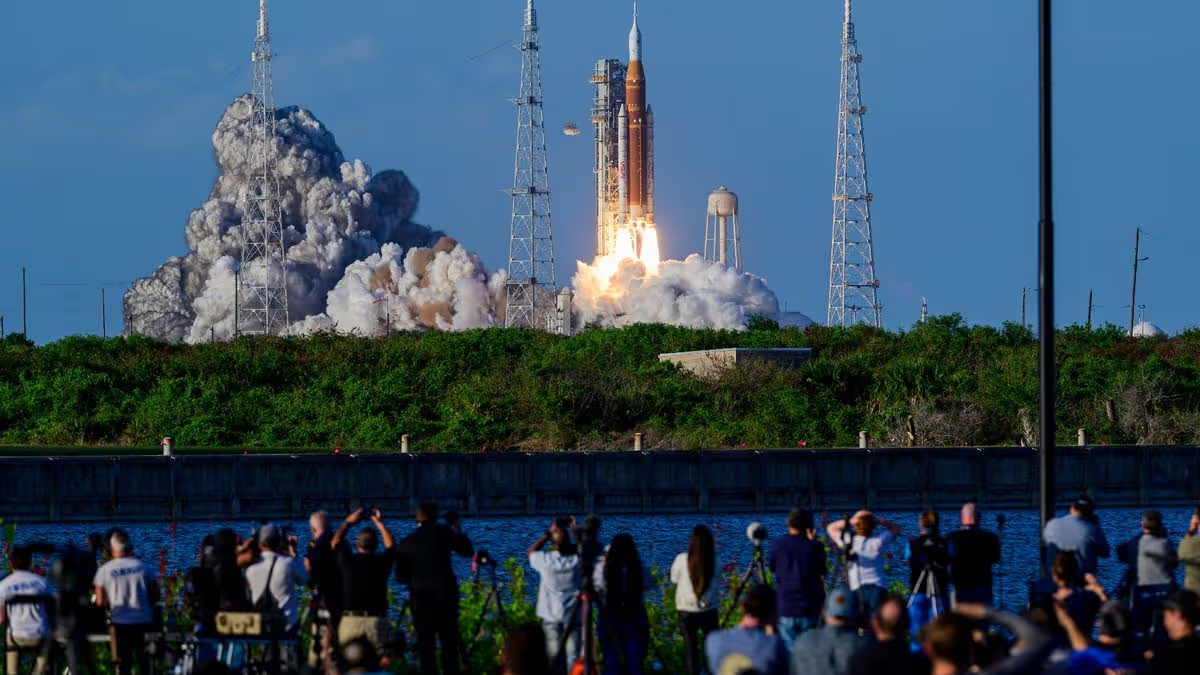
NASA’s Artemis 2 mission has finally launched marking humanity’s first lunar voyage in 53 years. NASA reported an issue with the flight termination system but clarified just over an hour before the launch that it has been resolved. The four astronauts are inside the Orion capsule on humanity’s first Moon mission in more than five decades.
The Space Launch System rocket and the Orion spacecraft will carry the four astronauts from NASA’s Kennedy Space Center in Cape Canaveral, Florida, into deep space. The crew includes NASA astronauts Reid Wiseman, Victor Glover and Christina Koch, and Canadian Space Agency astronaut Jeremy Hansen.
Ensure our latest headlines always appear at the top of your Google Search by making us a Preferred Source. Click here to activate or add us as your Preferred Source in your Google search settings.
The Clarkson’s Farm star took to Instagram to share two hilarious posts about the launch. Captioning the first post “Thought we’d seen the rocket launch. Now think it may be Venus.” One fan commented: “Or your camera has a hot dead pixel.” Another wrote: “It’s Santa checking everyone’s behaving.” A third wrote: “Just here for the Uranus jokes.”
Minutes later he posted again with the caption: “We’ve seen another rocket” as fans commented: “Jeremy do you have your glasses on??” another wrote: “Are you drunk Clarkson?”
Content cannot be displayed without consent
The four astronauts will circle the Earth for about 25 hours before catapulting toward the moon. The Artemis mission will end with a splashdown homecoming into the Pacific. Navy recovery ships will be stationed off the coast of San Diego as Orion parachutes into the ocean.
Advertisement
Ahead of the Artemis 2 launch, Donald Trump wrote in a post on Truth Social: “We are WINNING, in Space, on Earth, and everywhere in between — Economically, Militarily, and now, BEYOND THE STARS. Nobody comes close!” He added: “God bless our incredible Astronauts, God bless NASA, and God bless the Greatest Nation ever to exist, the United States of America!”






















































You must be logged in to post a comment Login