

Crypto World
Soluna Announces $53M Acquisition of Wind Farm for AI Facility

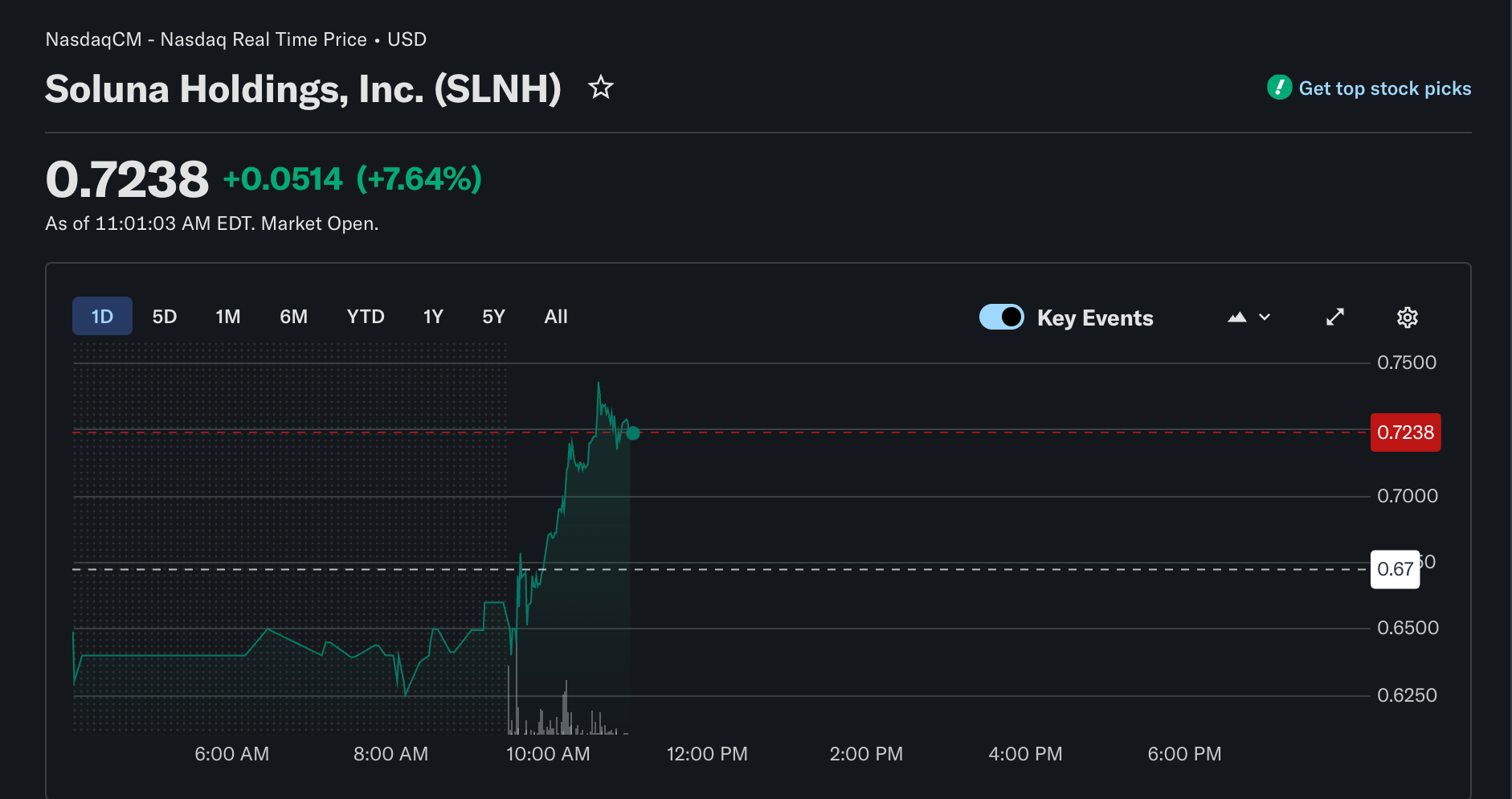
Soluna Holdings, a publicly traded Bitcoin (BTC) mining and AI infrastructure company focused on renewable energy, announced on Thursday that it closed a $53 million deal to acquire a wind farm to power its upcoming Project Dorothy 3 AI data center campus.
The Briscoe Wind Farm, located in Briscoe County, Texas, has a potential capacity of up to 300 megawatts (MW), according to the company’s announcement.
The company forecasts that the facility will generate annualized revenue between $20 million and $24.4 million.
Shares of Soluna are up by about 7.6% following the news, and are trading at about $0.76 at the time of writing.

Soluna expanded into AI data center infrastructure in February 2024, amid an industry-wide pivot toward AI and high-performance computing infrastructure to shore up declining revenues from the crypto mining business.
Related: AI data center gold rush sparks debate over impact on Bitcoin mining
Miners adopt renewable energy solutions amid profit squeeze
The Bitcoin mining industry faces several economic headwinds, including declining block rewards, rising energy costs and compressing profit margins, with many companies operating near or below breakeven levels.
Up to 20% of mining companies aren’t profitable, according to a March 2026 report from asset manager CoinShares.
The average cost to mine a single Bitcoin rose to nearly $80,000 in the fourth quarter of 2025, CoinShares said. Bitcoin is currently trading well below that level.

“Q4 2025 marked the most challenging quarter for Bitcoin miners since the April 2024 halving,” the report said.
The October 2025 market crash, which caused Bitcoin to plummet from an all-time high around the $125,000 level to a low of about $60,000, and rising network hashrate have placed even more pressure on the industry, CoinShares said.

Bitcoin mining companies sold over 15,000 BTC between October and early March to cover operating expenses, and the pace of selling has continued in recent weeks.
Several Bitcoin mining companies, including The Pheonix Group and Sangha Renewables, have adopted renewable energy solutions to power their operations and remain competitive amid a challenging business environment.
Canaan, a mining hardware manufacturer and mining company, partnered with Soluna in September to deploy a wind-powered BTC mining facility at the Briscoe, Texas site.
Related: AI may already use more power than Bitcoin — and it threatens Bitcoin mining



Patrick Hansen, Circle’s EU strategy and policy lead, says the bloc’s crypto tax revenue projections may fall short. The European Commission has modeled up to $23 billion across the 2028 to 2034 EU budget cycle.
Hansen argued that a transaction-based crypto tax would push users toward DeFi protocols. Self-custody wallets and non-EU venues would erode the centralized exchange volume Brussels expects to capture.
What the Commission’s Proposal Includes
The leaked Commission services paper outlines two crypto tax models for member states to consider:
- A 0.1% levy on the value of crypto transactions could generate $3.5 billion to $4.7 billion per year.
Crypto-asset service providers (CASPs) would act as collection and reporting points.
- A separate capital gains tax on realized crypto profits would raise an estimated $1.2 billion to $2.8 billion annually.
Combined, the two options could yield close to $23 billion across the seven-year EU budget. Officials acknowledge the figures depend on market volatility.
The paper signals that stablecoins used as payments would likely fall outside the transaction levy.
Capital gains taxation generally would not apply to dollar-pegged tokens either, given their minimal price movement.
Why Hansen Thinks the Forecast Misses
Hansen pointed to three structural weaknesses in the modeling:
- Reliable data from DAC8, the EU’s crypto reporting framework, will only arrive from 2027. Early estimates rest on incomplete inputs.
- The proposal also requires unanimous Council approval and a harmonized EU tax base.
France has pushed hardest for new EU revenue sources. Crypto tax compliance burdens and resistance from exchange-heavy economies like Malta could harden opposition.
- The behavioral risk looms largest, according to Hansen.
Users facing a centralized exchange levy can move activity to self-custody wallet options, DeFi protocols, or non-EU platforms. Any transaction tax depends on that volume.
“Any transaction-based crypto tax would likely accelerate migration towards non-taxed channels…and/or non-taxed assets…In practice, imo, that would significantly reduce the revenue potential on which these projections are based,” he stated.
Cyprus, which holds the rotating Council presidency, plans to share a revised budget proposal around June 10.
The outcome will signal whether crypto stays on the menu, and how it interacts with the bloc’s MiCA review consultation.
The post $23 Billion EU Crypto Tax Forecast Draws Pushback From Circle Policy Lead appeared first on BeInCrypto.

The UK has targeted 18 crypto platforms, banks, and financial networks used by the Kremlin-backed “A7” payment network to bypass international economic restrictions.
The sanctioned entities are accused of processing more than $90 billion in 2025 to fund Russia’s invasion of Ukraine.
Crypto Platforms Linked to Illicit Russian Flows
A TRM Labs report reveals that Huobi, Exmo Exchange, Bitpapa, and Rapira Group were some of the targeted exchanges, with Huobi alone sending more than $4.9 billion in on-chain transactions to UK-sanctioned entities and the A7 network since 2021. Additionally, $1.13 billion of this occurred 14 months after the March 2025 takedown of Russian crypto exchange Garantex, with $838 million directed specifically to the A7 network last year.
According to TRM’s findings, the crypto activity associated with Russia did not slow down after the Garantex collapse but was instead migrated to successor exchanges and payment platforms like Rapira, Aifory Pro, Grinex.io, and ABCex. Exmo exchange is said to have directly transacted over $19.5 million with sanctioned entities like Garantex and Chatex, while BitPapa was also reported to have transferred millions to these actors.
The report notes that Rapira moved more than $543 million, including $375.6 million tied to Grinex.io, while Aifory Pro transferred over $189 million, of which $175.2 million was attributed to ABCex. Meanwhile, ABCex itself recorded $355 million in transactions across the restricted firms, sending $175.2 million to Aifory Pro, $133.4 million to Garantex, and $38.1 million to Rapira.
The government has now added all 18 sanctioned entities to the UK Consolidated List, with businesses operating in the country now required to freeze any assets connected to them and block transactions involving the listed companies.
“If the Kremlin thinks it can evade our sanctions by hiding behind crypto networks and shadow financial systems, it is gravely mistaken,” said the Foreign Secretary Yvette Cooper.
She added that the restrictions were being made to cut off the financial flows sustaining Putin’s war in Ukraine.
Russia-Related Illicit Crypto Activity Has Rebounded
The new measures also extend to target individuals linked to the A7 network. In its report, the government says that the group is backed by a Kyrgyz bank suspected of processing payments within the system, alongside a major global crypto exchange that is believed to have transferred more than $1.5 billion back into Kremlin-linked financial channels.
Meanwhile, a separate TRM Labs analysis discovered that illicit crypto activity went up sharply last year. According to the company, most of that was related to Russian-linked trades, with A7’s A7A5 token contributing $72 billion worth of trades alone while the group’s own wallets accounted for another $39 billion. Most of that money reportedly flowed through Garantex and Grinex.
The post UK Sanctions 18 Crypto Firms Tied to Russia’s $90B War Network appeared first on CryptoPotato.
Crypto World
SEC sues Texas man over $12.3 million alleged crypto scheme built on fake AI trading bots


The U.S. Securities and Exchange Commission (SEC) has sued Texas resident Nathan Fuller, alleging he raised about $12.3 million from roughly 150 investors through a crypto investment scheme built around false claims of AI-powered trading bots, guaranteed returns and insurance protections.
According to a complaint filed in the U.S. District Court for the Southern District of Texas, Fuller operated through Privvy Investments LLC and the assumed business names Privvy Investments and Gateway Digital Investments.
The SEC says he sold passive joint-venture interests in a purported crypto arbitrage trading operation from at least October 2022 through mid-2024.
The agency claims that Fuller told investors that proprietary AI-based trading bots could scan crypto markets, execute high-frequency arbitrage trades and limit losses through stop-loss coding.
The complaint alleges investors were promised returns of 40% to 50% within 30 to 45 days and, in some cases, exceeding 100% in less than a month.
The SEC says those representations were false. According to the complaint, only about $380,000, or roughly 3% of investor funds, was used to purchase cryptocurrency without the involvement of bots. The agency says those trades were conducted without the advertised bots and generated no profits.
Fuller, instead, allegedly misappropriated at least $6.2 million for personal expenses, including the purchase of a home, gambling, travel and vehicles, while using about $5.5 million to make “Ponzi-like payments” to investors.
As withdrawal concerns grew, the complaint says, Fuller created fabricated account statements showing gains, referenced fictitious entities, and used artificial intelligence to generate a letter from a purported auditing firm claiming investor accounts were under review and would later be liquidated into a trust.
The SEC charged Fuller with violating the registration and antifraud provisions of federal securities laws and is seeking permanent injunctions, disgorgement, civil penalties and a ban on participating in securities offerings.
The case follows a separate bankruptcy proceeding in which the Justice Department said Fuller was denied discharge of more than $12.5 million in debt after admitting he operated Privvy as a Ponzi scheme and fabricated documentation, according to court records cited by the DOJ.
Hyperliquid (HYPE) should be valued against the $600 trillion global asset market, not crypto’s $3 trillion universe. That is the case Bitwise Chief Investment Officer Matt Hougan made for the fast-growing perpetual futures platform.
Hougan said BHYP, Bitwise’s spot Hyperliquid ETF, has pulled in close to $60 million since its mid-May NYSE debut. He called it the strongest single-asset crypto ETP launch since Bitcoin.
Bitwise CIO Says Hyperliquid Is a Gen 2 Token
Hougan said HYPE differs from prior exchange tokens. The platform routes nearly all trading fees into buybacks.
“I think it’s going to take investors a while to realize that this is a Gen 2 token. Like it’s a new version. It’s not like the past,” he noted during a Friday interview with Nate Geraci.
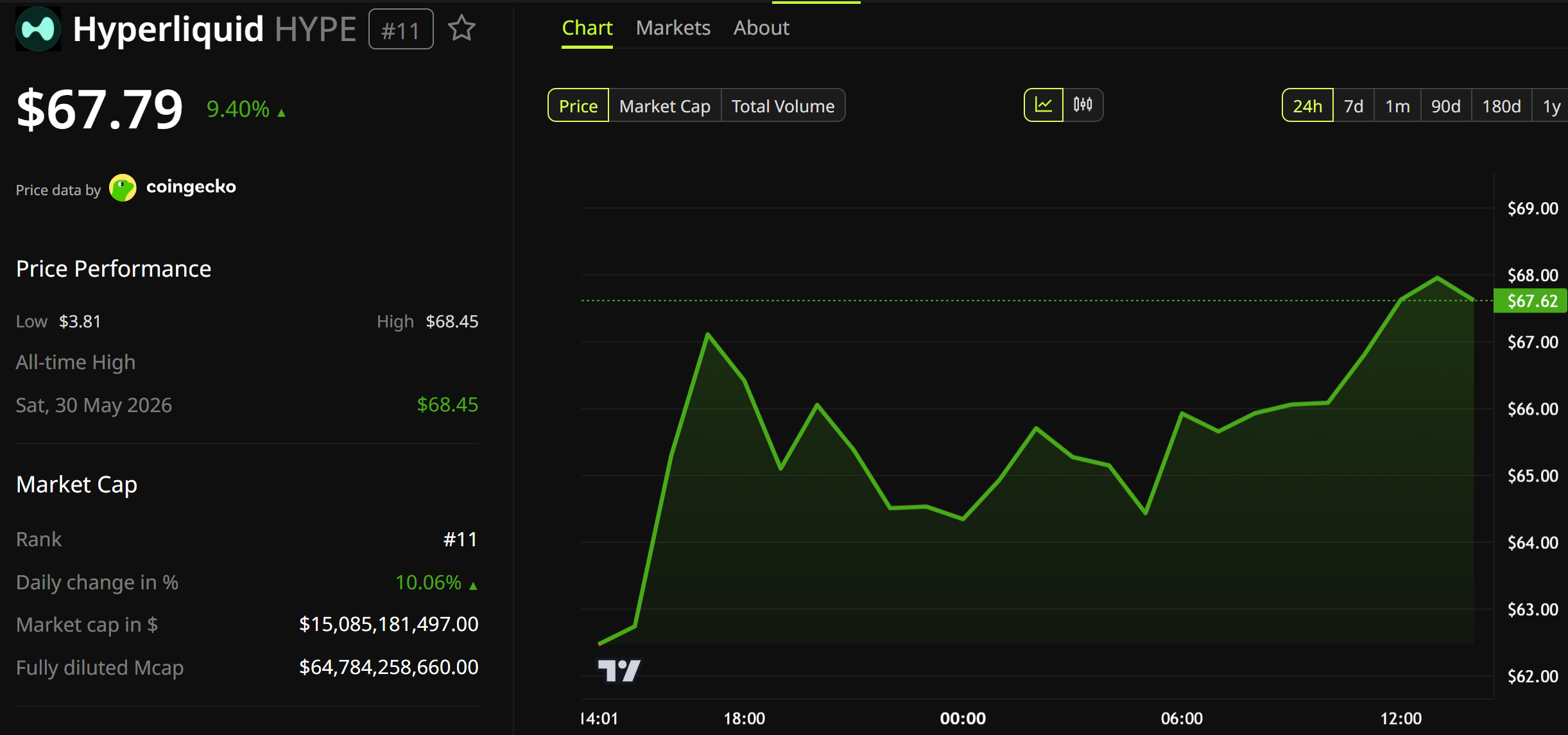
HYPE traded near $68 on Saturday, up 10% in 24 hours. It ranked 11th by market cap, per BeInCrypto data.

Subscribe to our YouTube channel to watch leaders and journalists provide expert insights
Why Hyperliquid Targets $600 Trillion in Assets
Hougan framed Hyperliquid as a fintech application, not a crypto play.
“This is not a crypto app. This is a financial app that uses crypto in the back end to create a new financial experience that in many ways is better than the traditional system.”
He said non-crypto assets like S&P 500 perpetuals and oil already make up half of perpetuals volume.
“Already today, Nate, about 50% of the volume is in non-crypto assets. I think that will eventually be 90% plus of the volume.”
Competition and US Access Remain Open Risks
Hougan acknowledged execution risk. He named the NYSE, the CME and rival DeFi protocols as preparing to challenge Hyperliquid.
“…there is going to be significant competition for Hyperliquid in the future, and there is no guarantee that it will win.”
US investors still cannot trade directly on the offshore exchange. The BHYP ETF stakes about 70% of holdings using Bitwise’s own infrastructure.
The firm also routes 10% of management fees into HYPE held on its balance sheet.
The post Bitwise Leader Thinks Hyperliquid is Bigger Than the Crypto Market appeared first on BeInCrypto.
Crypto World
Top 3 Cryptos That Could Deliver Bigger Gains Than Ripple (XRP) Did in the Last Bull Run
Many investors still remember watching XRP explode during past bull runs and feeling they entered too late. That’s why traders are now searching for projects that still look early before the broader market fully heats up again. Some meme coins have already made their biggest move. Others are only starting to build momentum quietly in the background. And in crypto, timing often matters just as much as the project itself. Here are three cryptos traders are watching closely as they hunt for the next major breakout opportunity.
One of the hardest parts of crypto investing is realizing the biggest returns usually happen before everyone agrees a project is real. That realization is part of why Little Pepe (LILPEPE) is beginning to stand out among traders seeking earlier-stage opportunities rather than chasing established meme ecosystems. Unlike many meme projects built purely around attention, Little Pepe is developing its own Layer-2 blockchain focused on ultra-fast transactions, low fees, and infrastructure specifically designed for meme coin activity. LILPEPE is currently priced at $0.0022 in Stage 13, with more than $28 million already raised and the current stage nearing completion. For many investors, the appeal is not just the meme’s branding, but the idea of entering before broader exchange exposure begins. The project has also leaned heavily into community engagement through its ongoing $777,000 giveaway campaign and the Mega Giveaway running between Stages 12 and 17, where both large buyers and random participants remain eligible for rewards exceeding 15 ETH. For traders who missed earlier meme cycles entirely, that feeling of being too late again is exactly what makes projects like Little Pepe difficult to ignore right now.
Pudgy Penguins (PENGU): Can the Momentum Continue After the First Big Rally?
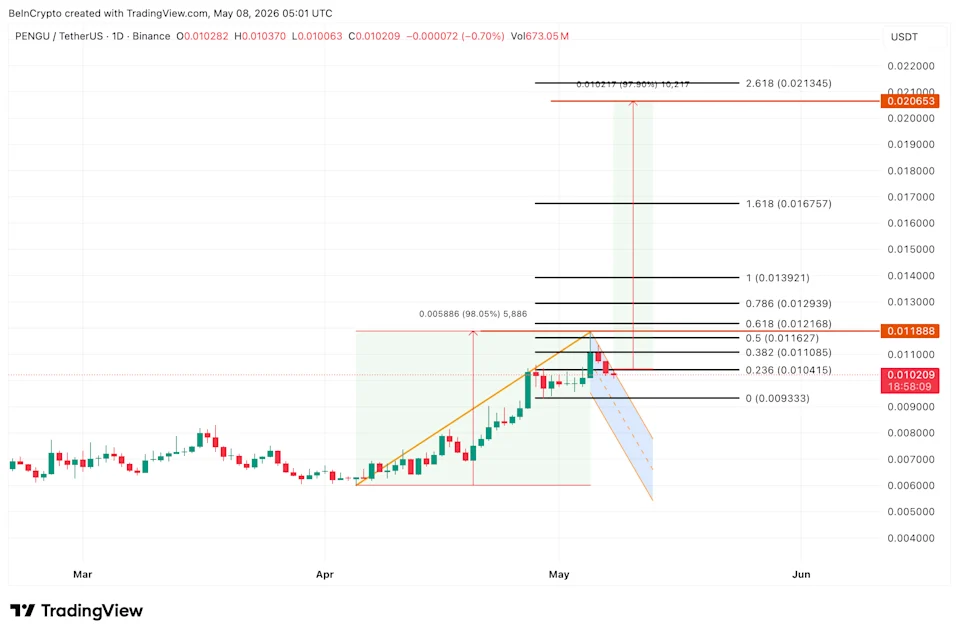
Pudgy Penguins is holding steady at about $0.0102, even after some dips last month.
Pudgy Penguins Price Analysis: TradingView
For many traders, this is where the hesitation begins. Nobody wants to buy the top after watching a token already rally nearly 100% in a short period. But PENGU’s chart is still giving traders something to watch. The recent move toward $0.0118 created a bullish pole-and-flag setup. In simple terms, the strong rally formed the pole, while the current sideways consolidation may simply be the market cooling off before another move higher. The setup only becomes convincing if PENGU cleanly reclaims $0.0104 and breaks above $0.0110 again. If that happens, traders are already watching potential upside targets near $0.0121 and $0.0129. Some projections even point toward $0.0206 if meme coin momentum accelerates again.

Bonk (BONK): Solana’s Meme Economy Is Starting to Heat Up Again
Bonk trades near $0.0000068 and is beginning to attract attention again as activity returns across Solana’s meme ecosystem.
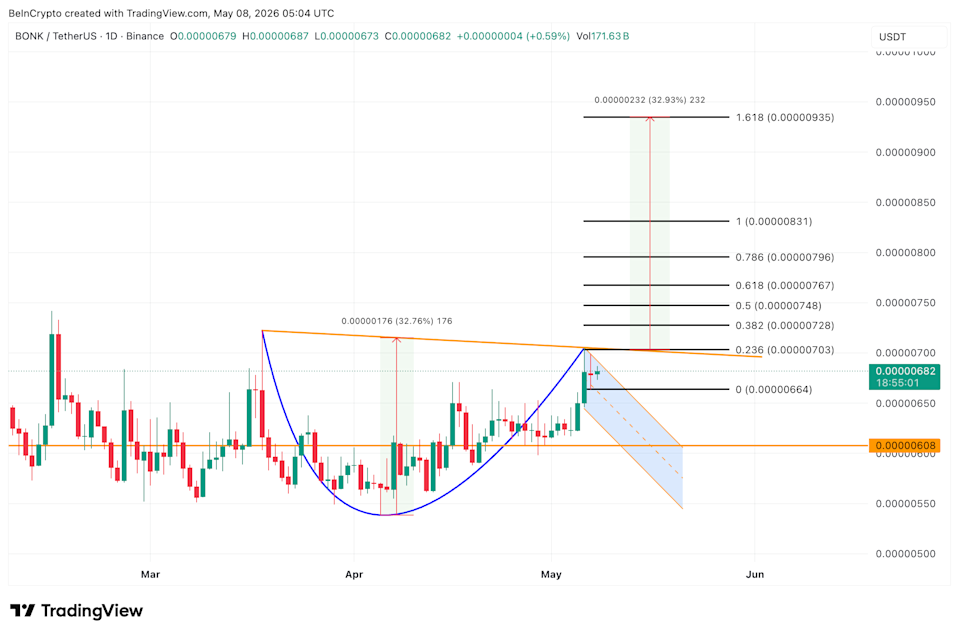
BONK Price Analysis: TradingView
Many traders missed BONK’s first major breakout because they assumed Solana meme coins had already peaked. But recent market activity suggests capital may be slowly rotating back into that sector. The chart is also looking interesting. If BONK closes above that mark, it’s got room to run up to $0.0000093, which would mean a jump of about 33% from where it is now. That may not sound life-changing compared to LILPEPE, but as long as Solana meme activity continues improving, BONK may remain one of the first places meme capital flows back into.
Conclusion
XRP’s previous bull run reminded the market how quickly crypto wealth can be created when momentum, timing, and community align. Now traders are searching for the next wave before it fully arrives. PENGU is trying to prove its first rally still has room left. BONK is benefiting from renewed activity across Solana’s meme ecosystem. And Little Pepe (LILPEPE) is attracting the attention of investors who no longer want to wait until projects become mainstream before investing.
For more information about Little Pepe (LILPEPE) visit the links below:
Website: https://littlepepe.com
Whitepaper: https://littlepepe.com/whitepaper.pdf
Telegram: https://t.me/littlepepetoken
Twitter/X: https://x.com/littlepepetoken
$777k Giveaway: https://littlepepe.com/777k-giveaway/
Disclaimer: This is a Press Release provided by a third party who is responsible for the content. Please conduct your own research before taking any action based on the content.

Crypto World
Wintermute Starts Quoting Prediction Markets as Event-Contract Volume Tops $60B in 2026
Wintermute, a London-based algorithmic trading firm with more than $3.5 trillion in annual trading volume, said on Friday it is now providing two-sided liquidity on prediction markets, becoming the latest institutional market maker to plug into a sector that has cleared more than $60 billion in… Read the full story at The Defiant
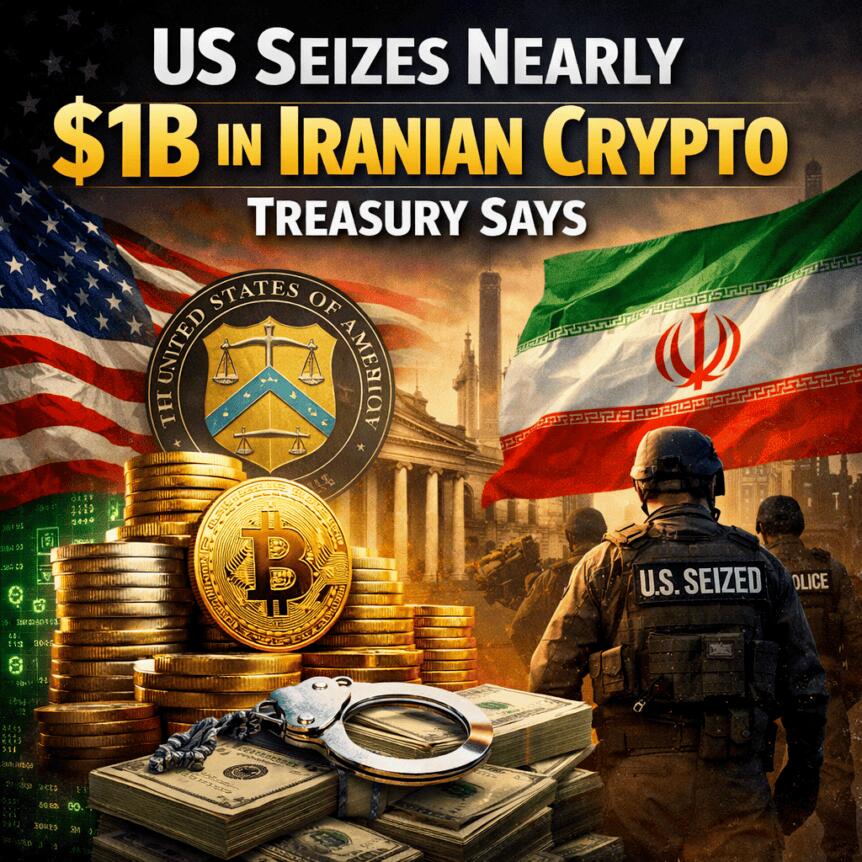
The United States has publicly documented a major advance in its sanction regime against Iran, reporting the seizure of about $1 billion in Iranian cryptocurrency assets. Speaking at the Reagan National Economic Forum, Treasury Secretary Scott Bessent said the U.S. has “outright grabbed the wallets,” a maneuver he described as part of a broader financial pressure campaign. Some wallet holders may still be unaware that their funds have been seized, he added in remarks that drew attention to the speed and scale of asset freezes conducted under the administration’s sanctions strategy.
Officials characterized the seizures as a component of Operation Economic Fury, a coordinated effort launched in March 2025 to disrupt Iranian access to funds held in digital assets, as well as traditional financial channels. Bessent framed the operation as a decisive step in tightening the financial noose around Tehran, arguing that the campaign has effectively cut off critical liquidity for the regime. “I think between five and a half to six weeks of an incredibly successful military campaign and Operation Economic Fury, where we have really cut them off. They are at the end of their tether now financially,” he said, underscoring the administration’s posture on Iran’s financial resilience.
Key takeaways
- Approximately $1 billion in Iranian crypto assets have been seized, according to remarks at the Reagan National Economic Forum in which Scott Bessent spoke.
- The seizures are described as part of Operation Economic Fury, a multi-front effort launched in March 2025 to disrupt Iran’s access to crypto and other financial resources.
- Iran’s economic situation, as characterized by the official account, appears dire: inflation above 200%, widespread internet shutdowns, consumer support programs, and significant payroll issues for the armed forces.
- The newly disclosed total markedly exceeds prior public figures, roughly doubling the $500 million previously cited in late April and far above the $344 million in crypto assets frozen after sanctions in April.
- Separately, Iran has signaled interest in monetizing the Strait of Hormuz through a Bitcoin-based insurance framework, a proposal that has been described in state-linked media channels and could redefine how a strategic chokepoint is insured and priced in crypto terms.
Escalating asset seizures and Tehran’s financial squeeze
The claim of a $1 billion crypto seizure arrives as part of a broader narrative presented by U.S. officials about the effectiveness of financial pressure tools against Iran. Bessent’s remarks highlighted the rapid pace at which some crypto wallets were identified and seized, with an emphasis on the notion that “the wallets” could be pulled from holders who may not yet realize the funds have been redirected. The assertion aligns with a continued emphasis on cutting-edge enforcement tools that target digital assets alongside traditional sanctions mechanisms.
While the public cast is blunt about the impact on Iran’s finances, the underlying picture, as outlined by the official account, portrays a regime under stress. Bessent described a scenario in which Iran was siphoning roughly $400 million to $500 million per month, distributing proceeds among about 80 elite figures, before the intervention. The official narrative also paints a bleak macroeconomic environment: inflation surging past 200%, consumer subsidies being issued, the internet intermittently restricted, and a substantial portion of the regular pay for armed forces and security personnel disrupted or withheld.
The statements come as U.S. and allied authorities continue to pursue a multi-pronged approach—blending asset freezes, banking restrictions, and international cooperation—to constrain Tehran’s financial flows. The administration has cited progress across different fronts, including crypto-focused seizures and partnerships with European allies to extend property confiscations tied to illicit activity. Critics, meanwhile, stress the challenge of tracing and freezing decentralized assets and the potential for collateral effects on ordinary users who may hold assets in accounts unrelated to sanctioned entities.
From wallet seizures to Hormuz: Iran’s Bitcoin-based ambitions under scrutiny
Beyond the asset seizures, Iran’s broader geopolitical and economic strategy has included exploratory discussions about monetizing control over the Strait of Hormuz through crypto-enabled mechanisms. Cointelegraph reports that a state document circulated by Fars News Agency—a media outlet with close ties to the Islamic Revolutionary Guard Corps—outlined a platform named “Hormuz Safe.” The concept envisions selling digital marine insurance paid in Bitcoin and settled on the blockchain, with the potential to unlock substantial revenue for the country—projected at over $10 billion in annual terms if enacted at scale.
In related coverage, Iran has been reported to consider a model where ships passing through Hormuz would pay a tariff in Bitcoin—specifically, a $1 per barrel charge—to clear passage. The idea reflects a broader trend of state-backed crypto experimentation and aims to leverage Bitcoin’s settlement properties to simplify cross-border charging and revenue collection for a critical strategic artery. Iran’s government-linked proclamations emphasize that such a framework would be settled on-chain, potentially enabling more transparent and auditable toll collection than traditional approaches.
These discussions come amid ongoing negotiations related to Iran’s broader ties with the U.S. and allied powers, amplified by recent strikes that have targeted regime figures and key infrastructure in the region. The exact status and feasibility of Hormuz Safe remain uncertain, and observers caution that any such program would require robust international coordination, regulatory clarity, and secure settlement rails to avoid unintended consequences for global shipping and finance.
For readers tracking the crypto-policy angle, the Hormuz Safe concept intersects with broader questions about how states might use distributed ledger technologies to capture value from strategic chokepoints. If realized, a BTC-based insurance and settlement model could set a precedent for asset-backed, borderless revenue streams tied to critical maritime corridors. Yet the practicalities—risk management, liquidity, sovereignty concerns, and cross-border fiat integration—remain unresolved and subject to regulatory pushback and geopolitical risk.
Context and what to watch next
By tying crypto seizures to a broader sanctions playbook, U.S. authorities appear intent on signaling that digital assets are not a safe haven for sanctioned entities. The discrepancy between the new $1 billion figure and prior public disclosures—roughly $500 million announced in late April and about $344 million sanctioned in April—suggests a rapid acceleration in enforcement activity and asset identification. Still, the opaque and rapidly evolving nature of blockchain addresses and wallet ownership means that some seizures may unfold quietly over time, with beneficiaries or oblivious wallet holders discovering the losses only later.
Investors and observers should watch for two pivotal developments. First, how the United States and its allies operationalize and expand the “Economic Fury” framework, including potential cross-border asset coordination and the extension of sanctions into new cryptographic asset classes or platforms. Second, the Hormuz Safe proposal and similar state-led crypto initiatives will need to prove viable in a real-world maritime and financial environment. Any movement toward an on-chain toll collection system or insurance mechanism would have to contend with international shipping laws, sanctions compliance, and the volatility inherent in crypto markets.
As market participants digest these developments, several questions remain unsettled. Will more Iranian crypto wallets be identified and frozen, or will enforcement cap at the current level? How will the Hormuz Safe concept evolve—if it moves beyond a policy paper to a concrete program, what safeguards and oversight will be required? And how will financial institutions and crypto platforms adapt to heightened scrutiny around sanctioned jurisdictions and their digital assets?
Further coverage continues to emerge from outlets monitoring the intersection of sanctions policy and crypto markets. Cointelegraph has previously reported on market reactions to related U.S. actions and the broader implications for Bitcoin and crypto markets under geopolitical stress. As the regulatory and enforcement landscape tightens, market participants should treat any official disclosures with caution and consider how these developments might influence liquidity, risk management, and cross-border settlement in the months ahead.
For now, the narrative centers on a clearer message from policymakers: digital assets are increasingly entangled with national security and foreign-policy aims, and the consequences—whether in seized wallets or new insurance frameworks—will ripple through exchanges, custodians, and users worldwide. The next few weeks could reveal whether Tehran’s financial strategy shifts to accommodate tighter controls or whether new, untested crypto-instrument concepts move from talk to policy.
Sources and related context: remarks from the Reagan National Economic Forum and statements around Operation Economic Fury, including prior reporting on crypto seizures and sanctions timelines. Additionally, state-linked reporting on Hormuz Safe and Bitcoin-based tolls for the Strait of Hormuz has been cited in coverage tracing the potential monetization of critical maritime routes through crypto-native mechanisms.


Polymarket has signed an exclusive partnership with OneFootball, the Berlin-based digital football platform, opening a distribution channel to a user base that the company says reaches more than 645 million fans worldwide and 200 million monthly active users, roughly two weeks before the 2026 FIFA… Read the full story at The Defiant
Crypto World
Circle Freeze on Zama's Confidential USDC Locks $12.6M of User Funds in DeFi 'Crossfire'
Circle blacklisted the smart-contract address behind Zama's confidential USDC token on Friday, locking roughly $12.6 million of stablecoins inside a privacy protocol that is not itself the target of any litigation. The freeze hit Zama's cUSDC wrapper, an ERC-1967 proxy that pools USDC on behalf of… Read the full story at The Defiant
Crypto World
This Top Coin Under $1 Could Deliver a 40x ROI in Under 2 Months; Surprisingly, It’s Not Cardano (ADA) or Dogecoin (DOGE)

While the broader market often remains fixated on the price action of established giants, a new contender is quietly rewriting the playbook for retail wealth generation. Little Pepe, trading under the ticker LILPEPE, has emerged as a formidable force in the sub-one-dollar category, positioning itself to potentially deliver a 40x return on investment in less than two months. This projection is not based on mere speculation but is backed by a monumental presale performance that has caught the attention of serious institutional and retail participants alike.
If an investor wants to see a 40x return on Dogecoin today, it would have to become the most valuable financial institution in the world, which is increasingly unlikely as liquidity continues to decline through the industry.
Elsewhere, despite its glory days, Cardano has not lived up to the expectations it set in 2021, when it hit a new all-time high of $3.10.
In contrast, the smart money is moving toward younger, more agile projects that possess the “coiled spring” effect. Little Pepe represents this new era of digital assets, where community sentiment meets massive capital influx at the ground floor. By offering an entry point that remains significantly undervalued relative to its utility and community backing, LILPEPE provides the kind of leverage that ADA and DOGE can no longer provide to the average portfolio.
Quantitative Dominance and the Presale Powerhouse
The most compelling evidence of the impending explosion for Little Pepe lies in its staggering presale data. Financial records indicate that the project has already raised over $28.1 million across its various funding stages. This is not a modest figure; it reflects a level of investor confidence rarely seen in the early stages of a memetic token. The fact that the project has successfully moved over 16.9 billion tokens into the hands of early adopters suggests a highly distributed and committed holder base, which is a prerequisite for any asset aiming for a vertical price trajectory.
At the time of analysis, the presale has reached a critical juncture, with 98% of stage 13 complete. With the current price locked at a mere $0.0022, the window for entry at these historic lows is rapidly closing. This specific price point is the catalyst for the projected 40x ROI. When an asset possesses this much liquidity and capital backing before it even hits the primary decentralized and centralized exchanges, the resulting “supply shock” upon public listing often leads to the exact type of parabolic growth that transforms modest allocations into significant wealth.
The Two-Month Horizon for Exponential Growth
The timeline of “under two months” is particularly significant because it aligns with the anticipated conclusion of the final presale stages and the transition to the open market. Market history shows that the period immediately following a high-demand presale is often the most lucrative for holders. As the 98% completion of stage 13 approaches, the urgency among investors is palpable. The transition from a controlled presale environment to the volatility of the open market amplifies price action, especially when a project has already demonstrated the ability to sell 16.9 billion tokens on its own.
Unlike many speculative assets that fizzle out for lack of funding, Little Pepe has the financial runway to dominate the narrative for the remainder of the quarter.
Final Outlook on the LILPEPE Phenomenon
The evidence points toward a singular conclusion: the opportunity for massive returns has shifted away from the “old guard” of Cardano and Dogecoin and toward the explosive potential of Little Pepe. With $28.1 million in the bank and a community that has already absorbed nearly 17 billion tokens, the project is not just a participant in the market; it is a leader in the making.
The current price of $0.0022 represents a fleeting entry point before the market recognizes the true value of what has been built during this rigorous presale phase. Those seeking a 40x return in a compressed timeframe are finding that LILPEPE is the most logical and aggressive play available in the current digital asset ecosystem.
For more information about Little Pepe (LILPEPE) visit the links below:
Website: https://littlepepe.com
Whitepaper: https://littlepepe.com/whitepaper.pdf
Telegram: https://t.me/littlepepetoken
Twitter/X: https://x.com/littlepepetoken
$777k Giveaway: https://littlepepe.com/777k-giveaway/
Disclaimer: This is a Press Release provided by a third party who is responsible for the content. Please conduct your own research before taking any action based on the content.

$23 Billion EU Crypto Tax Forecast Draws Pushback From Circle Policy Lead

Police say critique of non-Jewish Mirren’s politics ‘hate’ but ignore actual hate

Report: Vikings hire Nolan Teasley as general manager


-

 Business6 days ago
NYT Strands Answers May 24 2026 Revealed for Puzzle No. 812 Theme Summer Essentials
-

 NewsBeat3 days ago
Israel says it has killed new Hamas military leader in Gaza City airstrikes
-

 Politics5 days ago
Bridgerton Season 5: Cast, Release Date And Everything We Know So Far
-

 Business4 days ago
Selena Gomez Reportedly Upset Over Benny Blanco’s Comments on Her ‘Terrible’ Diet
-
 Crypto World4 days ago
Micron Crosses $1 Trillion Market Cap as AI Demand Reshapes Memory Sector
-

 Business5 days ago
BTS Sells Out Four Las Vegas Shows at Allegiant Stadium for ARIRANG World Tour
-

 Tech5 days ago
Microsoft’s quiet Claude Code retreat and the real cost of enterprise AI
-
 Tech5 days ago
China assigns ID codes to 28,000+ humanoid robots
-

 News Videos4 days ago
XRP *JUST* SUCCEEDED!!!! CLARITY ACT EXPOSED!!! (SHE EXPOSED IT)
-

 Tech2 days ago
Waymo dominates autonomous vehicle registrations as Tesla trails behind
-
Tech3 days ago
The Samsung pay deal is the moment Korean unions changed register
-

 Tech5 days ago
Westone Audio and Etymotic Acquired by Fidelity Collective in Major IEM Market Move
-
Crypto World3 days ago
SpaceX’s $2 Trillion IPO: Why Tech Giants Nvidia (NVDA), Apple (AAPL), and Microsoft (MSFT) May Face Pressure
-
Crypto World6 days ago
Brian Armstrong Outlines Crypto Vision for the Future Financial System
-
 Entertainment5 days ago
‘Breaking Bad’ Star’s Easy-to-Binge 6-Part Crime Series Spin-Off Is Finally Heading to Free Streaming
-

 Tech4 days ago
Millions of AI agents imperiled by critical vulnerability in open source package
-
 Crypto World5 days ago
Nvidia (NVDA) CEO Calls on Super Micro to Strengthen Export Controls Amid Smuggling Probe
-

 Tech3 days ago
NASA taps Blue Origin to deliver lunar rovers for Moon Base initiative
-
 NewsBeat5 days ago
Hottest May day ever as London hits 34.8C in 2C leap from previous records
-
 Crypto World1 day ago
Snowflake (SNOW) Stock Rallies on Strong Q1 Results and AI Product Growth
You must be logged in to post a comment Login