He said Britain must become more business friendly with AI at its heart
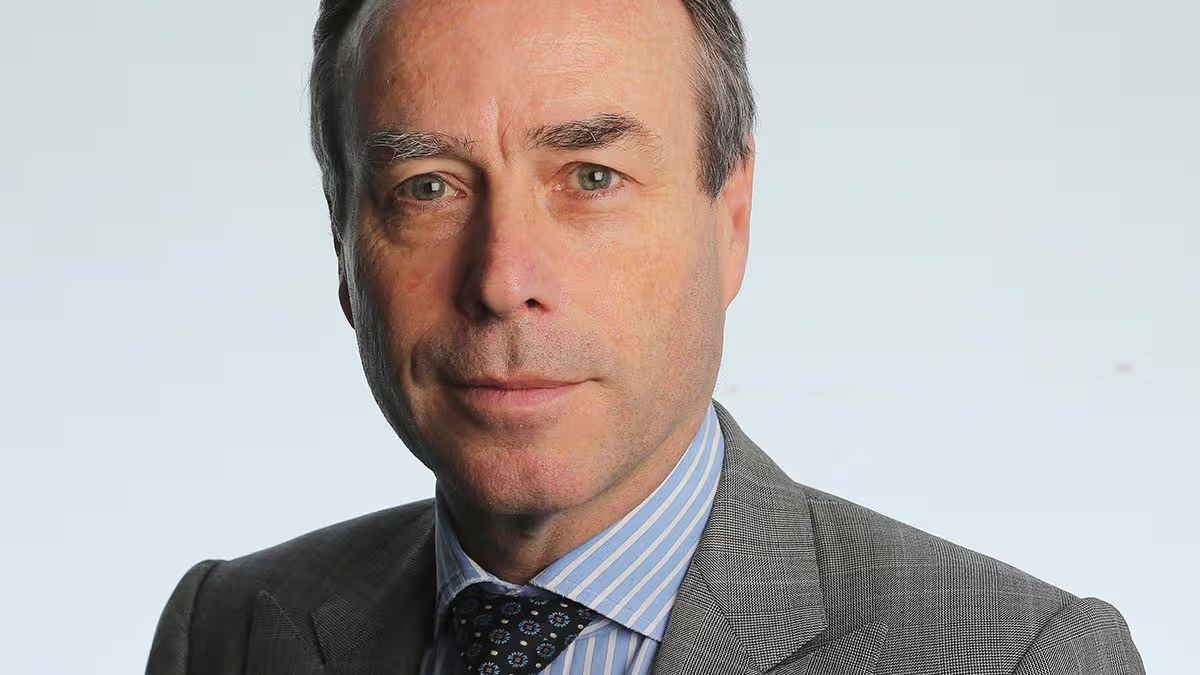
Lionel Barber.
Britain must not “succumb to a narrative of decline” and needs to embrace artificial intelligence after losing economic ground in the past 10 years, the former editor of the Financial Times has said. Lionel Barber, who was editor of the FT for 15 years until 2020, said Britain needs to be “a lot more business-friendly” after a series of blows to the corporate sector.
Its aims to become a global artificial intelligence (AI) hub are crucial in helping boost the UK’s standing as a global business centre, he said.
Mr Barber told the Press Association: “It’s very important that this country does not succumb to a narrative of decline. It needs to be a lot more business friendly.
“I think there have been some bad missteps – Brexit has been a massive distraction. And we lost ground in the last 10 years.”
Advertisement
His comments come after Mr Barber has been hired to a new specialist advisory board for US firm Capitol AI as it launches in the UK and Europe.
Lord Ed Vaizey – former culture and digital minister – has also been appointed to the group’s advisory board as the Washington-based firm beefs up its leadership in the UK to help ramp up expansion.
Capitol AI was founded in 2021 by Shaun Modi and Tom Hallaran to offer firms a “model-agnostic” agentic AI platform to help make sense of their own data and produce documents, reports, summaries and other products.
Mr Barber said he was keen to take on the role to support a tech start-up and “an exciting entrepreneur”, while also helping Britain become a home for cutting-edge AI businesses.
Advertisement
He told PA: “This country is trying to carve a role out for itself, so it’s AI friendly.”
This is helping attract firms such as Capitol AI to the UK, having just opened a new office in the UK, he said.
The firm has hired former Lockheed Martin and Dell executive Mike Nayler to run the UK office as it looks to build clients in the public and private sector.
Mr Barber said: “AI is at the heart of its business… so I’m backing a high-tech entrepreneur, but also this is cutting-edge technology. AI is coming, whether you like it or not.”
I hold a Master’s degree in Cell Biology and began my career working for several years as a lab technician in a drug discovery clinic, where I gained extensive hands-on experience in cell culture, assay development, and therapeutic research. That scientific foundation gave me an appreciation for the rigor and challenges behind drug development, which I now bring into my work as an investor and analyst. For the past five years, I have been active in the investing space, with the last four years dedicated to working as a biotech equity analyst alongside my lab work. My focus is on identifying promising biotechnology companies that are innovating in unique and differentiated ways, whether through novel mechanisms of action, first-in-class therapies, or platform technologies with the potential to reshape treatment paradigms. By combining my lab-based scientific expertise with financial and market analysis, I aim to deliver research that is both technically sound and investment-driven. On Seeking Alpha, I plan to write primarily about the biotech sector, covering companies at different stages of development, from early clinical pipelines to commercial-stage biotechs. My approach emphasizes evaluating the science behind drug candidates, the competitive landscape, clinical trial design, and the potential market opportunity, all while balancing financial fundamentals and valuation. My goal in publishing here is to share some insights that help investors better understand both the opportunities and of course the many risks in biotech. This is a sector where breakthrough science can translate into outsized returns, but also where careful scrutiny is essential. I look forward to contributing thoughtful analysis and engaging with readers who share an interest in this dynamic and rapidly evolving space.
Analyst’s Disclosure: I/we have no stock, option or similar derivative position in any of the companies mentioned, and no plans to initiate any such positions within the next 72 hours. I wrote this article myself, and it expresses my own opinions. I am not receiving compensation for it (other than from Seeking Alpha). I have no business relationship with any company whose stock is mentioned in this article.
Seeking Alpha’s Disclosure: Past performance is no guarantee of future results. No recommendation or advice is being given as to whether any investment is suitable for a particular investor. Any views or opinions expressed above may not reflect those of Seeking Alpha as a whole. Seeking Alpha is not a licensed securities dealer, broker or US investment adviser or investment bank. Our analysts are third party authors that include both professional investors and individual investors who may not be licensed or certified by any institute or regulatory body.
Seeking Alpha’s transcripts team is responsible for the development of all of our transcript-related projects. We currently publish thousands of quarterly earnings calls per quarter on our site and are continuing to grow and expand our coverage. The purpose of this profile is to allow us to share with our readers new transcript-related developments. Thanks, SA Transcripts Team
Market expert Gurmeet Chadha has flagged concerns over sustained foreign capital outflows, urging the government to reconsider recent changes in capital gains tax and securities transaction tax (STT).
In a post addressed to PMO India and the Ministry of Finance, Chadha claimed that India is losing nearly $1 billion in foreign capital daily. He noted that since July 2024, following hikes in capital gains tax and STT, foreign outflows have cumulatively touched around $100 billion, making Indian markets less attractive on the global stage.
He cautioned that such trends could undermine India’s ability to attract long-term, patient risk capital, which is critical to funding the country’s growth ambitions. According to Chadha, the current tax regime risks reversing the benefits of earlier structural reforms that had enhanced India’s appeal among global investors.
Highlighting the government’s track record of responsiveness, he pointed to past instances where feedback on taxation across Goods and Services Tax (GST) and income tax led to course corrections and relief measures. He urged policymakers to once again take a relook at the current framework to restore investor confidence and stem capital outflows.
Advertisement
“Honourable @PMOIndia and @FinMinIndia… We are losing foreign capital of almost $1 billion a day. Since July 2024, post hike in capital gains tax and STT, we have lost $100 billion and our markets have become globally unattractive. We need patient risk capital to fund our growth story. It’s undoing the good work done through various reforms. A responsive government like yours has always taken feedback on taxation, GST, income tax and given relief,” Chadha’s tweet said.
We are losing Foreign Capital of almost $1 Bn a day. Since July 2024, post hike in capital gain tax and STT, we have lost $100 Bn and our markets have become globally unattractive .we need patient risk capital to fund our growth story.… pic.twitter.com/nq6idgnatb
The remarks come at a time when Indian equity markets have been grappling with persistent foreign institutional investor (FII) selling, adding pressure to valuations and overall sentiment.Foreign institutional investors (FIIs) have sold domestic equities worth Rs 19,837 crore in just two sessions in April, extending the sell-off to Rs 1.51 lakh crore in 2026. In March, they sold shares worth Rs 1,17,775 crore, while offloading Rs 35,962 crore worth of shares in January. In a reversal of sorts, they ended up net buyers at Rs 22,615 crore.
Chadha regularly comments on stock market-related developments and broader economic issues, and the latest post comes on the back of new securities transaction tax (STT) rules that came into effect from April 1.
The government in its February Budget had announced a rise in STT charges on futures and options (F&O) trades from April 1. The Union Budget 2026 increased STT by 150% on futures and 50% on options. The futures segment faces the steepest adjustment. STT will rise to 0.05% of notional turnover from 0.02%, a levy applied to the full contract value rather than just premiums paid.
The Complete Circle Consultants Managing Partner and CIO has been demanding rationalisation in long-term capital gains (LTCG) tax to 10% for the long term.
Advertisement
Currently, long-term capital gains on listed equity shares and units of mutual funds are exempt up to Rs 1.25 lakh. This applies to securities held for 12 months or more. Meanwhile, selling equity shares within one year of holding incurs a short-term capital gains (STCG) tax of 20%. It was 15% prior to July 23, 2024.
(Disclaimer: Recommendations, suggestions, views and opinions given by experts are their own. These do not represent the views of The Economic Times.)
The 10-year strategy has been backed by the region’s two mayors
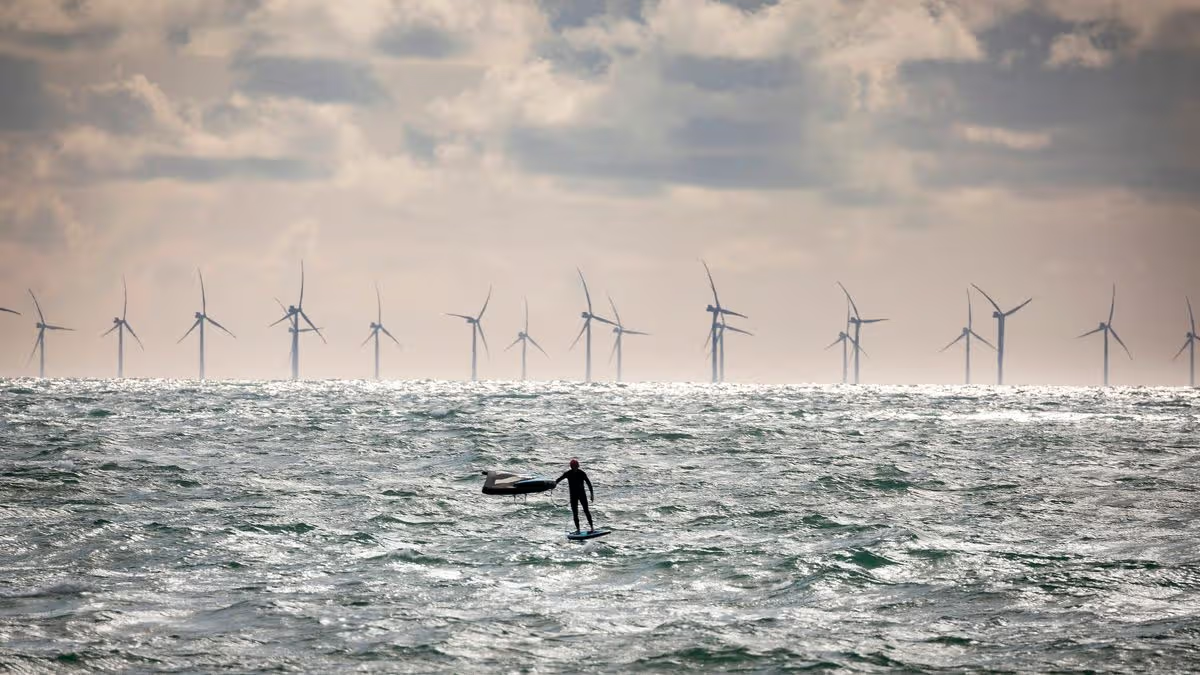
An offshore wind farm(Image: Adam Gerrard / Daily Mirror)
A new plan for the future of offshore wind in the North East has been launched, highlighting how the region can build upon its position as a major UK contributor. The 10 Year Vision and Strategy for North East England Offshore Wind was unveiled at the Energi Coast Supply Chain Showcase, held at The Boiler Shop in Newcastle city centre.
The strategy focuses on the region’s role in defining the next phase of offshore wind industrialisation in the UK. It highlights how the North East can build momentum in offshore wind over the next decade and how it can set the standard in offshore electrical solutions and lead development of deeper-water technologies.
Commissioned by UK energy sector network NOF on behalf of the North East Combined Authority (North East CA) and Tees Valley Combined Authority (TVCA), the strategy was developed with support from Energi Coast, the North East of England’s offshore wind cluster.
The North East is already a major contributor to the UK’s offshore wind industry, with significant port infrastructure and extensive capabilities in manufacturing, fabrication, assembly, logistics and operations and maintenance, as well as a world class supply chain.
Advertisement
The new vision and strategy aims to build on existing strengths to maximise opportunity, ensuring it can unlock high quality job opportunities and support the local economy, whilst also strengthening the UK’s offshore wind supply chain in the long term.
The strategy suggests that the region can capitalise on its capabilities in advanced components, smart fabrication, sustainable materials, data science, robotics, logistics and environmental services to drive further employment and growth.
The launch follows last week’s announcement from The Crown Estate that a new offshore wind leasing round in 2027 could accommodate a capacity of around 6GW or more. The identified area is predominantly based off the coast of the North East and could result in the creation of up to 10,000 direct jobs and a potential economic boost to the UK of over £12bn.
Joanne Leng, chief executive of NOF, which owns and operates Energi Coast, said: “Given the opportunity that lies before us – brought into even sharper focus by The Crown Estate’s announcement last week, which is opening up to 6GW of additional capacity off the North East Coast – it was crucial that North East England has a roadmap for growth in the next decade of offshore wind. That has now been created and we’re looking forward to supporting its delivery – and seeing the region’s outstanding capabilities continue to evolve.”
Advertisement
Tony Quinn, chair of Energi Coast, said: “The North East of England is rapidly becoming the epicentre of the UK’s energy transition. We already have 10GW of Offshore Wind in various stages of operation, construction or development and need to start planning for another 6GW as announced by the Crown Estate last week. It is therefore imperative that we have a strategy that clearly articulates how in the North East we intend to maximise the economic opportunity and make an important contribution to the UK’s future energy security.”
North East Combined Authority and Tees Valley Combined Authority have both placed offshore wind and clean energy at the heart of their Local Growth Plans and wider strategies, with North East mayor Kim McGuinness previously unveiling ambitions to double the number of green jobs to 50,000 by 2035, and the TVCA aiming to grow its cluster of 17,000 jobs, comprising offshore wind and wider clean energy technologies.
Ms McGuinness said: “I want to double the number of green energy jobs in our region by 2035, and this strategy shows how offshore wind can power the next decade of those jobs in the North East. It aligns directly with my £130m Plan for Green Jobs, making sure local people benefit from the green energy revolution through secure work, skills, and opportunity.”
Tees Valley mayor Ben Houchen added: “The North East is already at the forefront of the UK’s offshore wind sector, and this new vision will build on our strengths to make sure we seize the full opportunity ahead of us. Our skilled workforce, proud industrial heritage and clear ambition to go even further means we can create more high-quality jobs and ensure local people and local firms benefit directly from the enormous opportunities in the sector.”
My background is in Financial Engineering and I have long since been interested in analyzing strong solid companies with a rare financial Profile. My primary area of specialization is in quantamental analysis, where I use a combination of data driven models and fundamental research. My approach is centered on a structured process that combines top-down screening with bottom-up company specific analysis .I write on to share ideas with a wider audience and also learn more about companies and other analysts. My goal is to make unique ideas & research accessible to retail and professional investors alike, while maintaining analytical depth and a clear investment thesis.Associated with the another author Kennedy Njagi
Analyst’s Disclosure: I/we have no stock, option or similar derivative position in any of the companies mentioned, but may initiate a beneficial Long position through a purchase of the stock, or the purchase of call options or similar derivatives in SNDK over the next 72 hours. I wrote this article myself, and it expresses my own opinions. I am not receiving compensation for it (other than from Seeking Alpha). I have no business relationship with any company whose stock is mentioned in this article.
Seeking Alpha’s Disclosure: Past performance is no guarantee of future results. No recommendation or advice is being given as to whether any investment is suitable for a particular investor. Any views or opinions expressed above may not reflect those of Seeking Alpha as a whole. Seeking Alpha is not a licensed securities dealer, broker or US investment adviser or investment bank. Our analysts are third party authors that include both professional investors and individual investors who may not be licensed or certified by any institute or regulatory body.
SYDNEY — Australian motorists are seeing modest relief at the petrol pump this Easter long weekend after the federal government’s temporary halving of fuel excise took effect on April 1, yet global oil prices driven by the ongoing U.S.-led conflict with Iran continue to exert upward pressure on costs measured in Australian dollars.
Australia Fuel Prices Ease Slightly After Excise Cut But Iran War Keeps Oil Costs High In AUD engin akyurt / Unsplash
The government slashed the fuel excise from 52.6 cents to 26.3 cents per litre for petrol and diesel for three months until June 30, delivering an expected saving of about 26.3 cents per litre when fully passed on. Motoring groups reported early price drops across capital cities in the first days of April, with some locations seeing reductions of up to 25 cents per litre for regular unleaded.
In Adelaide, the average price for regular unleaded fell sharply from nearly $2.60 to around $2.34 per litre in early April, according to NRMA data. Melbourne recorded a 16.3-cent drop to about $2.43, while Sydney saw a 12.7-cent decline to roughly $2.44. National averages for regular unleaded had climbed above $2.30 to $2.38 per litre in late March before the cut, with diesel pushing toward or past $3.00 in many areas.
Prime Minister Anthony Albanese announced the measure on March 30 as international benchmark Brent crude surged above $116 per barrel amid disruptions to roughly 20 per cent of global oil supply through the Strait of Hormuz. The tax relief, combined with the suspension of heavy vehicle road user charges, aims to ease cost-of-living pressures on households and businesses hit by the energy shock.
Despite the excise cut, experts warn that the real crunch for Australia’s fuel supply may still arrive in mid-to-late April. Australia imports more than 90 per cent of its refined petroleum products, primarily from Asia, and supply chains have been disrupted by export caps in South Korea, reduced refinery runs and rerouting of cargoes. Some analysts predict potential restrictions or shortages by around April 20 if the conflict persists, as voyage times lengthen and alternative supplies from the U.S. and Europe take time to arrive.
Advertisement
Brent crude, the global oil benchmark, traded around $109 per barrel on April 2 after volatile swings, reflecting a sharp monthly rise but some pullback from recent peaks near $116. With the Australian dollar hovering near 0.69 to 0.691 U.S. dollars in early April, the effective cost of imported oil in AUD remains elevated compared with pre-conflict levels.
The conflict, now in its fifth week, has caused Brent prices to surge dramatically since late February, with some periods showing monthly gains exceeding 30 per cent. Australia’s heavy reliance on imported refined fuels — rather than domestic crude production, which has declined significantly — amplifies the impact. Domestic oil output stands at low levels, with only two operating refineries contributing a small share of national needs.
Retail fuel prices in Australia rose about 40 per cent in the month following the start of strikes on Iran, according to various reports. Diesel prices climbed faster than petrol in many cases, surpassing $3 per litre in several capital cities and adding significant costs for transport, agriculture and construction. Farmers and logistics operators have reported surcharges and supply concerns, with flow-on effects to food prices and broader inflation.
The government has taken additional steps to secure supply, including underwriting spot cargoes, relaxing fuel quality standards to allow more production flexibility and sourcing alternative shipments. Energy Minister Chris Bowen has indicated that deliveries are assured into mid-April, but longer-term stability depends on developments in the Middle East and diplomatic efforts to reopen the Strait of Hormuz.
Advertisement
Motorists are advised to shop around using apps such as FuelCheck or PetrolSpy, as prices can vary by 20 to 40 cents per litre within the same city. Many service stations passed on portions of the excise cut quickly, even before depleting higher-cost stock, but full transmission may take weeks in some regional areas.
Economists note that sustained high oil prices could influence Reserve Bank of Australia decisions. The RBA raised the cash rate in March amid inflation concerns, and further energy-driven pressure may complicate the path back to target. The Australian dollar has shown some resilience but weakened slightly against the greenback in recent sessions as global risk sentiment fluctuated.
For households, the excise cut provides temporary breathing room. Filling a typical 60-litre tank could save around $15 to $16 at current rates, though this benefit may erode if international crude prices climb again or if supply disruptions lead to rationing or higher margins at the pump.
Businesses, particularly in freight and agriculture, face steeper challenges. Diesel, critical for heavy vehicles and machinery, has seen sharper increases, with some operators reporting costs up by $1 per litre or more since February. Construction firms have added fuel surcharges of 8 to 10 per cent in some cases.
Advertisement
Longer-term, the crisis has renewed debate about Australia’s fuel security. Critics point to the closure of most domestic refineries over the past 15 years, leaving the country vulnerable to global shocks. Calls have grown for investment in refining capacity or strategic reserves, though the government maintains that current measures and diversified sourcing provide adequate buffers for now.
As the Easter long weekend begins, with many Australians travelling, fuel availability appears stable but prices remain well above 2025 averages. Public transport usage and fuel-efficient driving tips are being promoted to help manage costs.
Looking ahead, any de-escalation in the Middle East or successful reopening of key shipping routes could ease pressure on oil markets and flow through to lower AUD-denominated prices. Conversely, prolonged disruption risks further spikes, testing the three-month excise relief and broader economic resilience.
The Australian Institute of Petroleum and motoring organisations continue to monitor weekly trends. Consumers should check local prices daily, as volatility persists. For businesses reliant on fuel, hedging or forward contracting where possible may offer some protection.
Advertisement
In summary, while the government’s excise cut has delivered noticeable short-term relief at Australian service stations, the underlying driver of high oil costs — geopolitical tensions affecting global supply — keeps the situation fluid. Australians are paying more in AUD for fuel than they were before the conflict, but the full extent of April’s potential supply challenges remains to be seen.
The coming weeks will be critical as supply chains adjust and markets watch for any breakthrough in Middle East diplomacy. For now, the combination of policy relief and cautious optimism about alternative sourcing is helping to stabilise the domestic fuel situation amid an unpredictable global energy landscape.
























































You must be logged in to post a comment Login