
Crypto World
Why AI Agents Will Replace DeFi Dashboards


The Problem With DeFi Isn’t Yield. It’s Humans. DeFi didn’t fail because the yields disappeared. It failed because the UX assumes users want to babysit money.
Dashboards everywhere. Tabs everywhere. APRs are changing every block.
The user is expected to monitor pools, rebalance positions, manage risk, track gas, avoid exploits, and somehow still feel “decentralized.”
That’s not finance. That’s unpaid labor.
The real bottleneck in DeFi isn’t liquidity or composability—it’s human attention.
And that’s exactly what AI agents are about to eliminate.
Dashboards Are a Transitional Technology
Dashboards exist because machines couldn’t yet act autonomously.
They’re a visual compromise between:
-
Raw blockchain data
-
Human decision-making
But here’s the uncomfortable truth:
If you still need a dashboard, the system isn’t finished.
TradFi already learned this lesson:
-
You don’t manually rebalance your 401(k)
-
You don’t stare at bank liquidity ratios
-
You set rules, constraints, and goals
DeFi went backward by putting everything back on the user, because smart contracts could execute, but they couldn’t decide.
Permanent AI changes.
From Inputs to Outcomes
Dashboards optimize for inputs:
Users actually care about outcomes:
AI agents flip the model.
Instead of asking:
“Which pool should I choose?”
You say:
“Here’s my goal. Here are my constraints. Handle it.”
That’s not UX polish.
That’s a paradigm shift.
What an AI DeFi Agent Actually Does
A real DeFi agent doesn’t just suggest. It executes.
It:
-
Monitors liquidity, volatility, and market structure in real time
-
Rebalances positions automatically
-
Rotates capital across protocols
-
Manages gas efficiency
-
Enforces risk limits
-
Exits when conditions degrade
-
Explains why actions were taken
All while operating inside user-defined boundaries.
No dashboards. No alerts. No panic-clicking at 3 am.
Just continuous execution.
Trust Doesn’t Come From Interfaces—It Comes From Constraints
The biggest myth is that people won’t trust AI with money.
They already do.
What they don’t trust are black boxes with no limits.
The winning agent frameworks will be:
You don’t trust an agent because it’s smart.
You trust it because it can’t break the rules.
DeFi Is Becoming an Execution Layer
This is the part most people miss.
DeFi isn’t competing with TradFi apps anymore.
It’s competing to become the backend for autonomous capital.
Protocols will stop marketing to humans.
They’ll optimize for:
Liquidity won’t flow where dashboards look pretty.
It’ll flow where agents perform best.
The Future: Invisible Finance
The endgame of DeFi isn’t better charts.
It’s finance that disappears.
No interfaces.
No constant decisions.
No emotional trading.
Just:
-
Goals
-
Constraints
-
Autonomous execution
Dashboards won’t die because they’re bad.
They’ll die because they’re unnecessary.
And when that happens, DeFi finally stops being a product for power users—
and becomes infrastructure for intelligence.
REQUEST AN ARTICLE

Crypto World
How Intelligence Packages from Cybercrime Atlas Powered Operations Resulting in $97 Million Recovery

TLDR:
- Cybercrime Atlas produced 13 intelligence packages and 17,000 vetted data points for four major operations.
- Operations across 19 African countries resulted in 1,209 arrests and identified over 120,000 victims.
- Research-driven approach recovered $97 million and disrupted $678 million worth of criminal activities.
- Over 30 organizations collaborate using open-source intelligence to map criminal network choke points.
Cybercrime Atlas has successfully converted research intelligence into concrete law enforcement operations during 2024 and 2025.
The initiative produced 13 intelligence packages and vetted 17,000 actionable data points that powered four major cross-border campaigns.
These coordinated efforts resulted in 1,209 arrests and recovered $97 million from criminal activities. The research-driven approach enabled law enforcement to disrupt $678 million worth of illicit operations across multiple continents.
Intelligence Gathering Powers Multi-National Operations
The Cybercrime Atlas community developed a structured methodology to transform fragmented research into unified action.
Over 30 organizations contributed open-source intelligence that mapped cybercriminal networks and infrastructure. Each intelligence package underwent community vetting before reaching law enforcement partners.
This research directly supported INTERPOL’s Operations Serengeti and Serengeti 2.0 across 19 African countries. The intelligence identified critical infrastructure including malicious domains, crypto wallets, and physical equipment used by criminal networks. Law enforcement agencies used these mapped connections to coordinate simultaneous takedowns.
Binance announced the results through X, highlighting how structured collaboration helps identify criminal infrastructure.
The World Economic Forum launched the initiative in 2023 to bridge private sector research with public enforcement capabilities. Open-source intelligence allows cross-border data sharing without violating privacy or legal constraints.
Research Group Identifies Criminal Choke Points
The Cybercrime Atlas established a Research and Mapping Group in 2025 to enhance operational effectiveness. Banco Santander, Group-IB, Binance, and Orange Cyberdefense initially led the group. Mastercard, Recorded Future, SpyCloud, and TNO joined later to expand research capabilities.
This group focuses on identifying choke points within criminal ecosystems where disruption creates maximum impact. Researchers analyze digital traces across compromised domains, social accounts, and payment channels. Technical tools from Maltego, ShadowDragon, and Silent Push enable efficient data correlation and visualization.
The methodology connects seemingly unrelated digital evidence into coherent maps of criminal operations. Researchers track infrastructure patterns and financial flows to reveal network vulnerabilities.
This systematic approach allows law enforcement to target nodes that weaken entire criminal organizations rather than individual actors.
Operational Results Validate Research-Driven Approach
The intelligence-to-action model produced measurable outcomes across multiple jurisdictions during the reporting period. Operations identified more than 120,000 victims and neutralized key criminal infrastructure.
INTERPOL Cybercrime Director Neal Jetton acknowledged the effectiveness of this collaborative framework, stating that the initiative “creates a force multiplier against cybercrime,” turning intelligence insights into measurable results.
Binance’s security teams contributed foundational research, link analysis, and attribution insights for intelligence packages.
The company’s work focused on mapping criminal networks exploiting cryptocurrency infrastructure. Erin Fracolli, Binance’s Global Head of Intelligence and Investigations, emphasized the strategic value of collaborative frameworks in securing digital ecosystems.
“Partnerships like the Cybercrime Atlas are critical to securing the digital-asset space and the broader digital environment,” Fracolli noted.
The initiative also expanded into capacity building, training law enforcement personnel from over 40 countries. Programs in Bangkok and Panama taught investigators how to apply private-sector intelligence in active cases.
The Cybercrime Atlas partnership with STOP THE TRAFFIK now integrates human trafficking data into cybercrime mapping efforts.

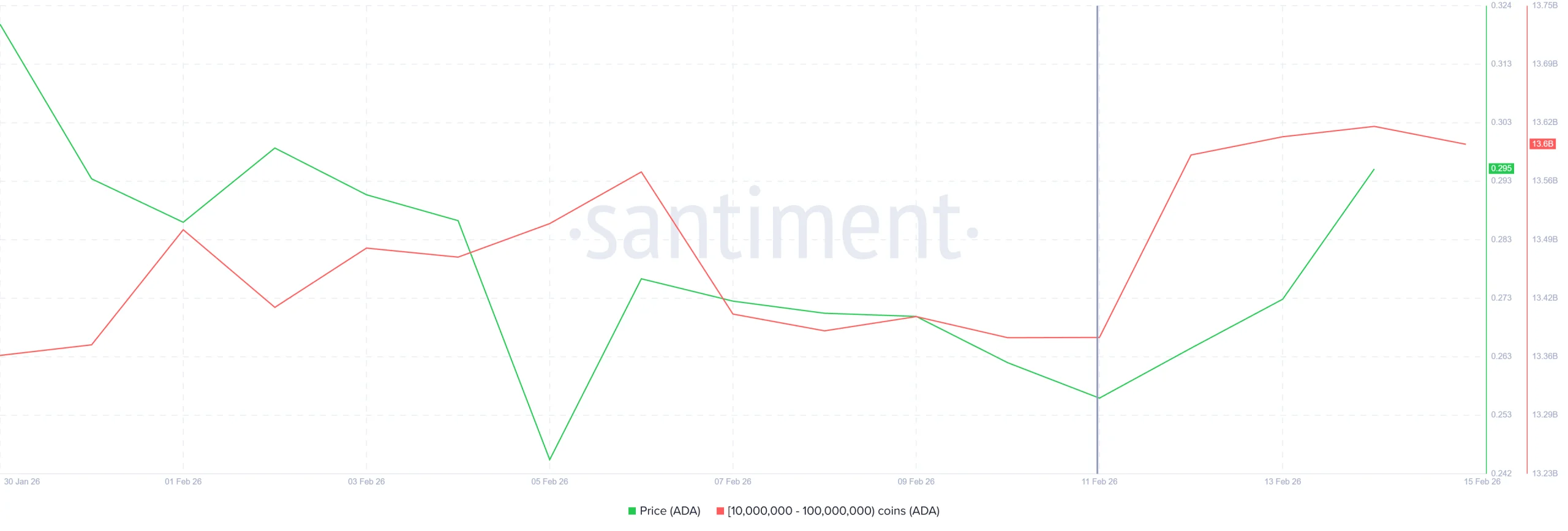
Cardano has shown early signs of stabilization after weeks of pressure. The ADA price is attempting a bounce from recent lows. Market data suggests the recovery is being supported by two key investor groups.
Large holders and long-term investors appear to be stepping in. Their activity is shaping short-term sentiment around the altcoin. As volatility persists across the crypto market, these cohorts may play a decisive role in ADA’s next move.
Sponsored
Sponsored
Cardano Holders Are Seemingly Bullish
On-chain data indicates that Cardano whales have been consistently supportive. Addresses holding between 10 million and 100 million ADA have accumulated heavily in recent days. These wallets added more than 220 million ADA, valued at over $61 million at the time of writing.
Such accumulation during price weakness often reflects strategic positioning. Whales likely took advantage of discounted prices. Their buying signals conviction in ADA’s recovery potential.
Large-scale accumulation can also reduce circulating supply, which may support price stability in the near term.
Want more token insights like this? Sign up for Editor Harsh Notariya’s Daily Crypto Newsletter here.
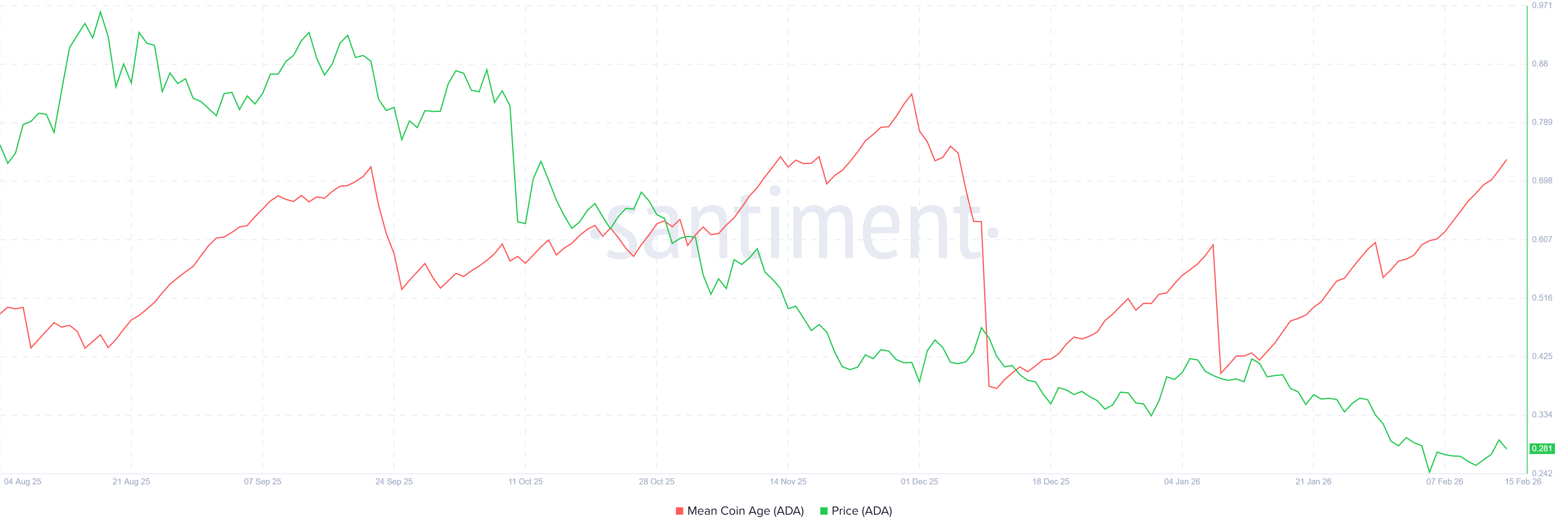
Beyond whale activity, long-term holders are reinforcing confidence. The Mean Coin Age metric, which tracks the average age of circulating coins, has been steadily increasing. This indicator reflects whether older coins are moving or remaining dormant.
During bear markets, a decline in Mean Coin Age often signals transactions and potential selling. However, the current rise places the metric at a three-month high.
Sponsored
Sponsored
This suggests long-term holders are opting to HODL rather than liquidate positions. Sustained dormancy typically indicates expectations of future ADA price appreciation.
ADA Price Breach On The Cards
Cardano price is trading at $0.278 at the time of writing. The altcoin is attempting to secure the $0.271 level, which aligns with the 23.6% Fibonacci Retracement. Holding this support would strengthen the bullish structure. A confirmed rebound could open the path toward $0.303.
Whale accumulation combined with long-term holder conviction may inject needed stability. If buying pressure continues, ADA could extend gains beyond $0.303.
The next resistance stands near $0.354. A decisive move above that zone could push Cardano toward $0.391, reinforcing recovery momentum.
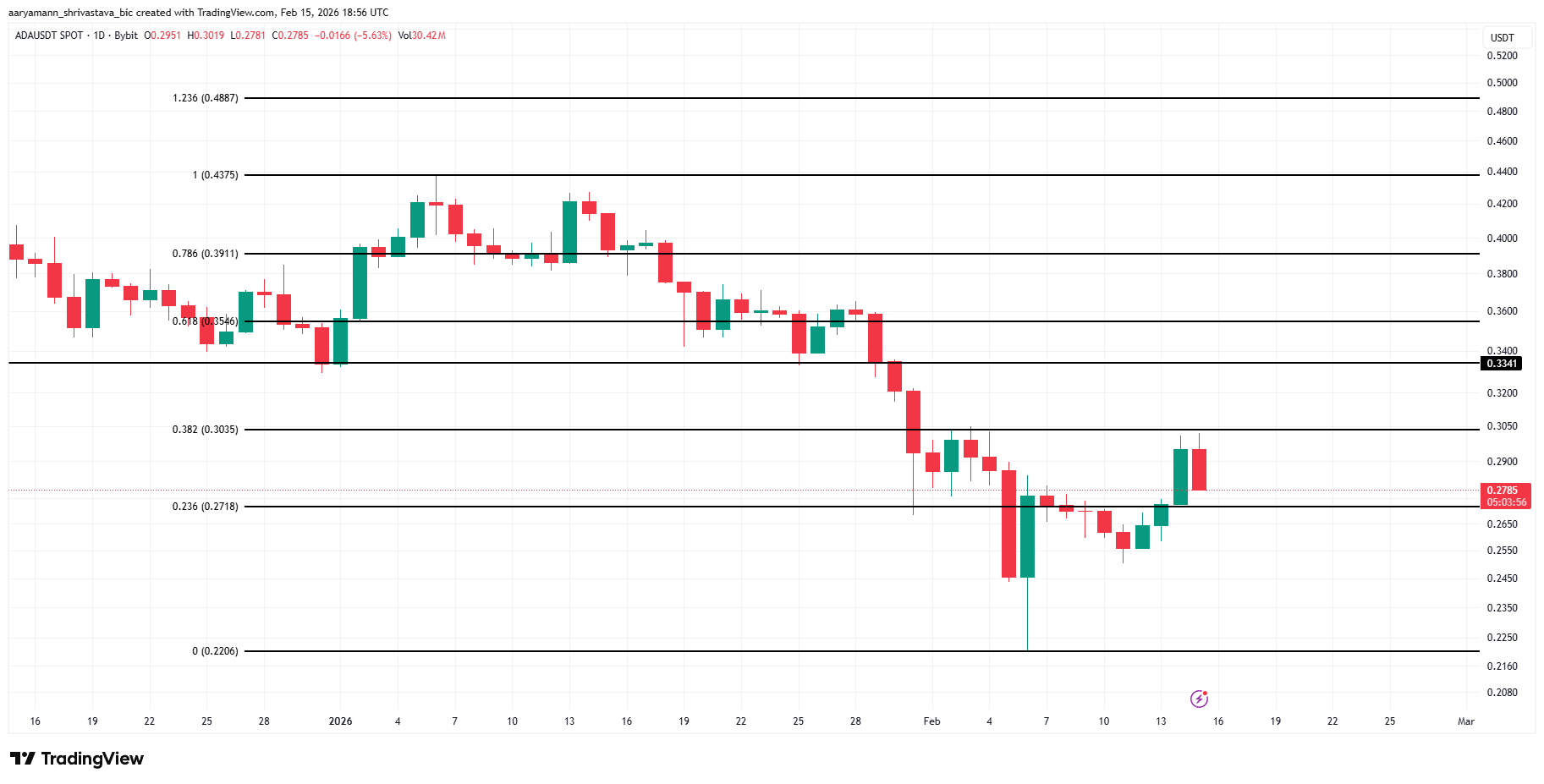
However, risks remain in volatile market conditions. If ADA fails to breach $0.303, sellers may regain control. Renewed pressure could force the price below the $0.271 support again.
A breakdown would likely expose $0.245 as the next downside target, invalidating the current bullish outlook.
Crypto World
Ethereum Tests Critical $1,943 Support: Analyst Projects $7,000 Target if Channel Holds
TLDR:
- Ethereum trades at $1,943, testing the lower boundary of an ascending channel established since 2020 lows.
- Technical analysis projects potential $7,000 target representing 260% upside if current support holds firm.
- Weekly close below $1,850 could invalidate the multi-year pattern and trigger decline toward $1,200-$1,500.
- Asymmetric risk-reward profile shows 20-30% downside risk versus 260% upside potential at channel boundary.
Ethereum is trading at a crucial support level near $1,943, according to recent technical analysis. Market observers are watching closely as the cryptocurrency tests the lower boundary of a multi-year ascending channel.
A successful bounce from this level could set the stage for a substantial rally. However, a breakdown below current support may trigger extended weakness across the market.
Channel Structure Points to Binary Outcome
The ascending channel pattern has guided Ethereum’s price action since 2020 when the asset traded around $80 to $100. This technical formation has demonstrated remarkable consistency over the past four years.
Traders have observed multiple respected touches of both upper and lower boundaries throughout this period. Each interaction with the channel’s lower trendline has historically presented buying opportunities.
Technical analyst Bitcoinsensus recently highlighted this setup on X, noting the critical nature of current price levels. The analysis emphasizes how Ethereum has formed a series of higher lows within the channel structure.
These formations confirm the pattern remains intact despite periodic volatility. The 2022 bear market brought a brutal test of the lower boundary, yet the channel held.
Current market conditions place Ethereum at the channel’s lower edge, creating what analysts describe as a high-conviction zone.
The price sits at approximately $1,943 as of writing, marking the last line of defense for the bullish macro structure. Trading volume and momentum indicators will prove essential in determining whether this support level holds firm.
The measured move methodology applied to this channel structure projects a potential target around $7,000. This represents roughly 260% upside from current trading levels.
Such projections rely on the assumption that the channel pattern continues to govern price behavior. Market participants are now weighing the probability of this outcome against alternative scenarios.
Path Forward Presents Asymmetric Risk Profile
Should Ethereum successfully defend current support levels, the projected path involves several intermediate milestones. An initial bounce would need to reclaim the $2,500 to $2,800 resistance zone that previously served as support.
Subsequently, breaking through the $3,500 to $4,000 range becomes necessary to confirm bullish momentum. The previous cycle high near $4,800 to $5,000 would then come into focus before any upper channel breakout.
The analysis notes what appears to be a recent “fakeout” below support levels, potentially representing a liquidity grab. Such price action often precedes genuine directional moves in cryptocurrency markets.
Volume profiles during any bounce will provide critical information about the strength of buying interest. Additionally, Ethereum rarely sustains independent rallies without corresponding Bitcoin strength.
Risk factors remain present despite the compelling technical setup currently in view. A weekly close below $1,850 would invalidate the multi-year channel pattern entirely.
Breakdown scenarios could push Ethereum toward the $1,200 to $1,500 range based on historical support zones. Broader macro conditions including recession fears or liquidity constraints could override technical considerations.
The risk-reward profile appears asymmetric at current levels according to proponents of this technical view. Downside risk to channel invalidation measures approximately 20% to 30% from present prices.
Conversely, upside potential to the projected target exceeds 260% should the pattern play out. This calculation assumes the channel structure maintains its historical validity and market conditions remain supportive of risk assets.
Crypto World
Bitcoin Fear and Greed Index Hits 8 as Whale Accumulation Signals Potential Market Bottom
TLDR:
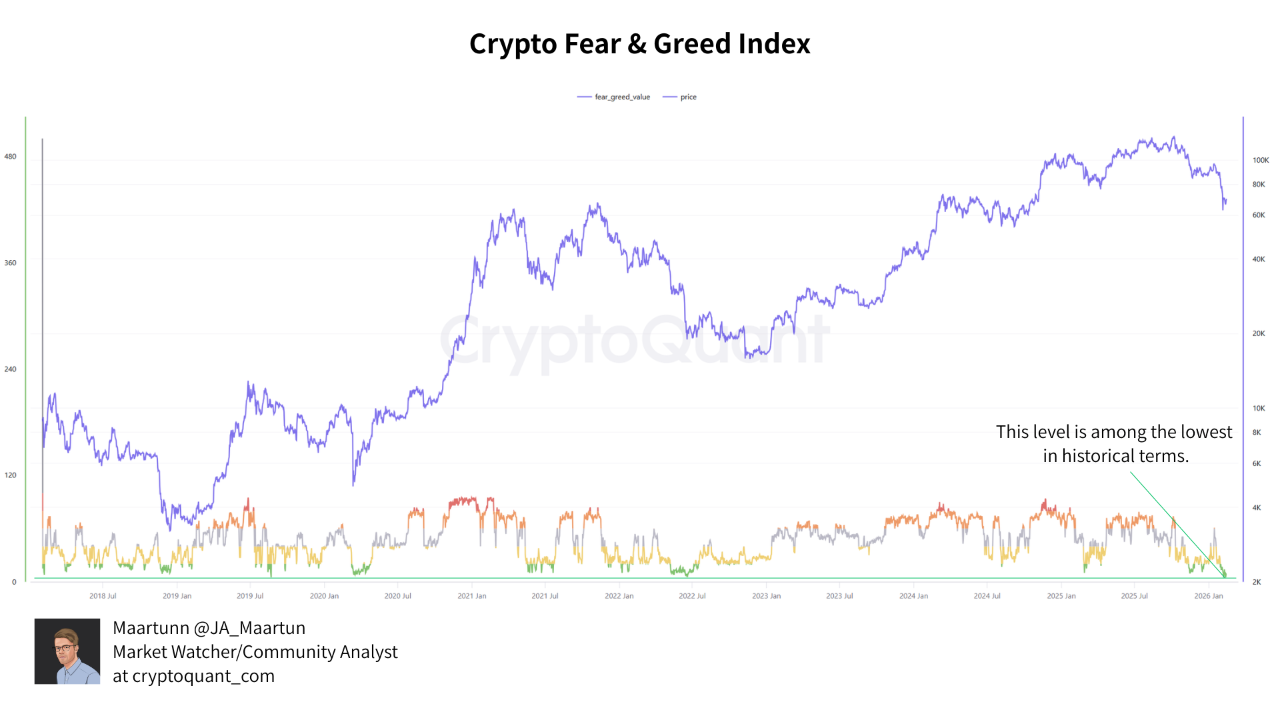
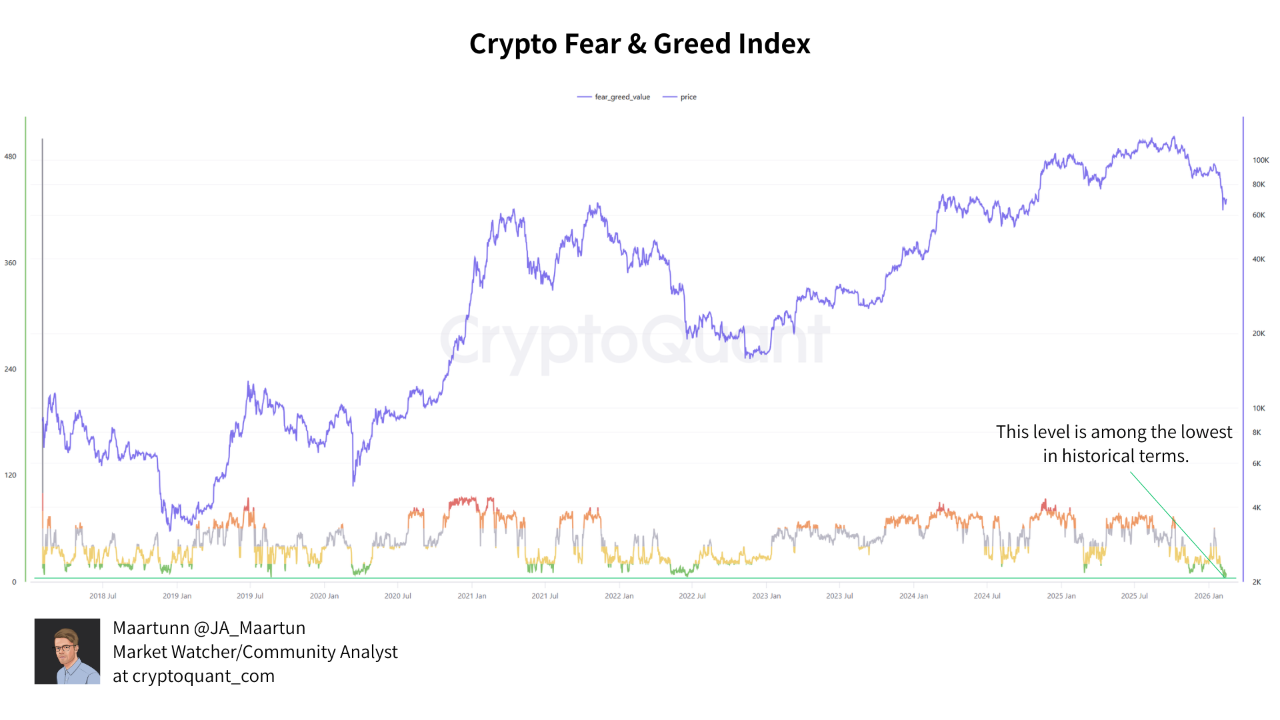
- Fear and Greed Index drops to 8, matching extreme levels seen during 2018, 2020, and 2022 market bottoms
- Whale accumulation activity increases despite negative sentiment, creating divergence that preceded past rallies
- Behavioral finance principles show loss aversion and herd behavior drive extended sentiment recovery periods
- Major investors including MicroStrategy and ARK continue building positions during the extreme fear phase
The Fear and Greed Index for cryptocurrency markets has dropped to extreme fear territory, registering a reading of 8 according to recent market data.
This sentiment indicator, which tracks Bitcoin-centered market psychology through multiple metrics, has reached levels historically associated with major market bottoms.
The current reading reflects widespread investor caution and risk aversion across the digital asset space. Meanwhile, on-chain data suggests large holders continue to accumulate positions despite the prevailing negative sentiment.
Historical Patterns Point to Extended Bottom Formation
The Crypto Fear & Greed Index provided by Alternative.me combines several market factors to gauge investor sentiment.
These components include price volatility, trading volume, social media activity, Bitcoin dominance, and Google search trends. The index transforms these data points into a single metric that reflects overall market psychology.
Current extreme fear readings mirror conditions seen during previous major market stress events. The 2018 bear market bottom, the March 2020 pandemic crash, and the 2022 FTX collapse all displayed similar sentiment levels.
During each episode, the index fell below 10 as participants prioritized capital preservation over growth opportunities.
Cryptoquant researcher XWIN Research Japan notes that behavioral finance principles explain the current market state. Loss aversion drives investors to reduce exposure after experiencing portfolio declines.
Herd behavior reinforces this pattern as market participants collectively withdraw from risk assets. Consequently, sentiment typically recovers at a slower pace than price movements.
Source: Cryptoquant
The analysis emphasizes that extreme fear does not guarantee immediate market recovery. Historical data shows these conditions often mark the early stages of bottom formation rather than trend reversals.
Market confidence and capital inflows require time to rebuild after significant drawdowns. This suggests the current phase represents a psychological reset period for crypto markets.
Accumulation Activity Emerges Despite Negative Sentiment
Trader Kyle Chassé observed on social media that whale accumulation patterns have emerged alongside the extreme fear reading.
He noted that this divergence between sentiment and large holder behavior has preceded major Bitcoin bottoms in previous cycles. The combination of retail fear and institutional buying has historically signaled favorable risk-reward conditions.
Several prominent market participants have increased their cryptocurrency exposure recently. MicroStrategy’s Michael Saylor has publicly stated his intention to acquire additional Bitcoin.
Investment firm ARKd has purchased shares of cryptocurrency-related equities during the recent decline. Analyst Tom Lee indicated he would increase allocations if Ethereum reached specific lower price targets.
These accumulation patterns contrast sharply with the fearful sentiment reflected in the index. Large holders often build positions when retail investors exit the market.
This counter-cyclical behavior has characterized previous market bottoms across multiple asset classes. The current environment displays similar dynamics between different investor cohorts.
Market observers note that extreme sentiment readings alone do not determine timing for recovery. However, the combination of oversold conditions and whale accumulation has historically preceded bull market phases.
The cryptocurrency market remains in a consolidation period as prices stabilize and sentiment gradually improves.

Stablecoins were supposed to be the “boring” part of crypto. No volatility. No drama. Just digital dollars moving at internet speed.
Instead, they’ve quietly become one of the most important—and controversial—financial experiments of the decade.
Behind the scenes, stablecoins are starting to look a lot like shadow banks.
What Is Shadow Banking?
“Shadow banking” isn’t illegal banking. It refers to financial intermediaries that perform bank-like activities—without being regulated like traditional banks.
Think:
These institutions:
No deposit insurance.
No direct central bank backstop.
Plenty of systemic risk if something breaks.
Sound familiar?
How Stablecoins Mimic Banks
Take giants like:
Here’s what they do:
-
Accept dollars from users
-
Issue digital tokens pegged 1:1
-
Invest reserves into yield-bearing assets
(Treasuries, repo agreements, cash equivalents)
That’s deposit-taking and asset management—core banking functions.
The difference?
They aren’t chartered banks.
The Maturity Mismatch Problem
Traditional banks borrow short (deposits) and lend long (loans).
This creates liquidity risk.
Stablecoins claim to hold high-quality liquid assets—primarily short-term U.S. Treasuries. But if redemptions spike during panic, they face the same stress dynamic:
We saw shades of this during the 2022 depegging episodes—notably with algorithmic designs like TerraUSD, which collapsed spectacularly (though it lacked traditional backing).
Even asset-backed models face redemption pressure risk.
The Treasury Market Connection
Here’s where it gets interesting.
Stablecoin issuers are now among the largest buyers of short-term U.S. Treasuries. Some reports have placed Tether among the top global holders.
That means:
Crypto liquidity
→ flows into Treasuries
→ supports U.S. government financing
Stablecoins aren’t just crypto plumbing anymore.
They’re plugged into global macro finance.
If large-scale redemptions occur, forced Treasury sales could ripple into traditional markets.
That’s textbook shadow banking spillover risk.
Regulatory Gray Zone
Banks must:
Stablecoin issuers?
Regulation varies by jurisdiction. Oversight is patchwork. Some operate through money transmitter licenses rather than full banking charters.
Governments are now racing to respond. The U.S., EU, and Asia are all drafting or implementing frameworks to bring stablecoins closer to traditional prudential standards.
The debate is simple:
Are stablecoins payment tools?
Money market funds?
Narrow banks?
Or systemic shadow banks?
Why This Matters
Stablecoins power:
They solve real problems:
-
Faster settlement
-
Lower fees
-
Global accessibility
But scale changes everything.
When billions turn into hundreds of billions, stability becomes a public concern.
Shadow banking historically grows during financial innovation cycles—until a crisis exposes structural weaknesses.
Stablecoins may be early in that arc.
The Bull Case
Some argue stablecoins are safer than banks because:
-
Reserves are primarily short-term Treasuries
-
No risky lending books
-
Transparency reports are increasing
-
On-chain flows are auditable
In this view, stablecoins represent a leaner, programmable form of narrow banking.
The Bear Case
Critics warn:
If confidence breaks, digital bank runs happen faster than physical ones.
Panic spreads at blockchain speed.
The Future: Bank, Fund, or Something New?
Three possible paths:
-
Full Bank Model
Stablecoin issuers obtain banking licenses. -
Money Market Regulation Model
Treated like cash-equivalent funds. -
Hybrid Regulated Digital Cash Model
Custom framework recognizing blockchain-native design.
The decision will shape the next decade of digital finance.
Final Take
Stablecoins aren’t just a crypto convenience anymore.
They:
-
Warehouse billions in Treasuries
-
Provide dollar access globally
-
Operate outside traditional banking charters
-
Influence liquidity across markets
That’s not a niche experiment.
That’s shadow banking in digital form.
And history shows shadow banking only stays in the shadows—until it doesn’t.
REQUEST AN ARTICLE
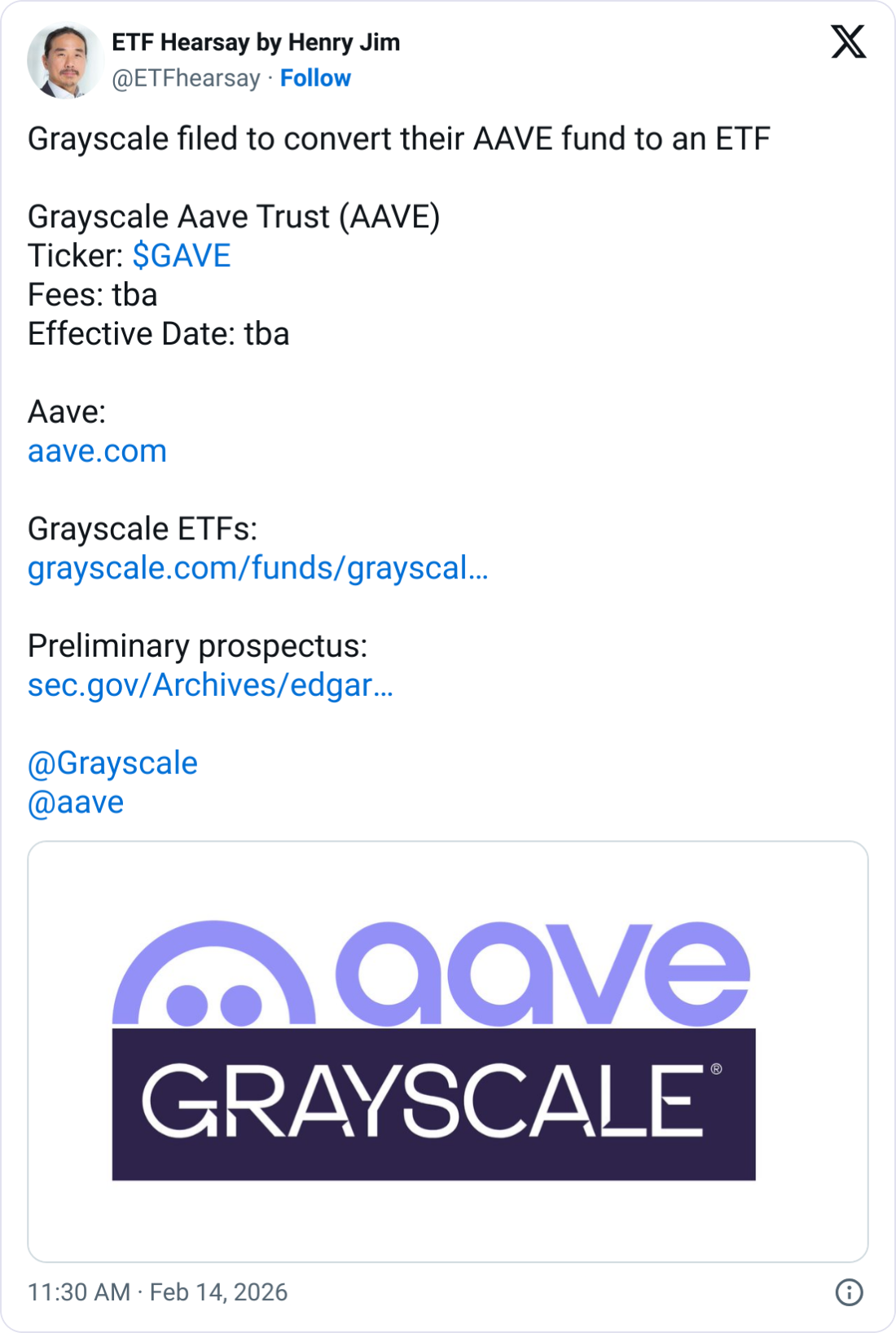
Crypto asset manager Grayscale filed for regulatory approval to convert its trust tracking the token of the decentralized lending protocol Aave into an exchange-traded fund (ETF).
The company filed a Form S-1 registration statement with the Securities and Exchange Commission on Friday, saying it intends to convert the trust and rename it the Grayscale Aave Trust ETF.
Grayscale added that it plans to list the fund on NYSE Arca, one of the most popular exchanges for trading ETFs, under the ticker “GAVE.” It will charge a 2.5% fee, and Coinbase will serve as both its custodian and prime broker.

Grayscale’s filing is one of several ETFs seeking to track altcoins, suggesting that Wall Street still has an appetite for crypto exposure even amid a market downturn.
Aave is the largest decentralized finance protocol, with over $27 billion in total value locked, according to DefiLlama. The platform allows users to lend and borrow crypto across multiple blockchains, and the AAVE token can be staked to earn yield.
Grayscale joins Bitwise in Aave ETF race
With its filing, Grayscale is the second to seek US regulatory approval for an ETF tied to Aave (AAVE), currently joining only Bitwise in looking to launch a similar fund.
Bitwise filed with the SEC in December to launch the Bitwise AAVE Strategy ETF, among a slew of filings that sought to create ETFs tied to popular altcoins, including Uniswap (UNI) and Zcash (ZEC).
Bitwise’s ETF plans to hold up to 60% of its assets directly in AAVE tokens and at least 40% in securities, such as other ETFs that are exposed to AAVE, while Grayscale’s would hold AAVE tokens directly.
Related: Roundhill’s election prediction ETFs are ‘potentially groundbreaking’: Analyst
The two ETFs are set to be the first in the US to offer direct exposure to Aave, joining a short list of overseas products that have launched to track the token.
In Europe, 21Shares launched an Aave exchange-traded product on the Nasdaq Stockholm in November, several years after Global X launched a similar Aave product in Germany in early 2023.
The AAVE token has traded down 1.6% over the past day to $126 and is more than 80% off its all-time high of nearly $662, reached in May 2021 amid a bull market for altcoins, according to CoinGecko.
Magazine: Getting scammed for 100 Bitcoin led Sunny Lu to create VeChain
Grayscale has filed with the U.S. Securities and Exchange Commission to convert its Aave-tracking trust into an exchange-traded fund, signaling a continuing push to bring decentralized-finance exposure to mainstream investors. The filing, disclosed via a Form S-1 on February 13, 2026, envisions renaming the vehicle the Grayscale Aave Trust ETF and listing on NYSE Arca under the ticker GAVE, with Coinbase serving as custodian and prime broker. If approved, the product would hold AAVE tokens directly, rather than using a mix of securities and assets. Aave, a cornerstone of DeFi, currently dominates borrowing and lending activity across multiple chains and has drawn sustained investor interest despite broader market softness.
Key takeaways
- Grayscale aims to convert its Aave Trust into an NYSE Arca-listed ETF (GAVE) with a 2.5% management fee, and Coinbase would act as custodian and prime broker.
- The filing makes Grayscale the second U.S. firm to seek regulatory approval for an ETF tied to AAVE, joining Bitwise in a growing field of altcoin ETFs.
- Grayscale would hold AAVE tokens directly in the fund, contrasting with Bitwise’s approach that blends a substantial token stake with traditional securities to track AAVE exposure.
- AAVE remains the largest DeFi protocol by total value locked, a lens through which the ETF product could unlock liquidity for users and risk-managed investors alike.
- EU-listed products, including 21Shares’ AAVE ETP in Nasdaq Stockholm, illustrate a global appetite for regulated crypto access even as the U.S. market weighs its own framework.
Tickers mentioned: $AAVE
Sentiment: Neutral
Market context: The push for crypto ETFs persists even as risk sentiment remains cautious in the broader markets. Regulators are scrutinizing novel structures that blend regulated investment vehicles with direct token holdings, a trend that continues to shape the way institutions access DeFi assets.
Why it matters
The Grayscale filing underscores a sustained appetite among traditional market participants to provide regulated access to key crypto rails, particularly in decentralized finance. By proposing to hold AAVE tokens directly, the Grayscale Aave Trust ETF would deliver a relatively simple, token-centric exposure that mirrors the underlying protocol’s on-chain activity. This structure could appeal to investors seeking a transparent, single-asset vehicle that tracks a well-established DeFi protocol without the complexities of a blended equity-and-token approach.
From a market-theory perspective, a direct-token ETF has the potential to increase liquidity and price discovery for AAVE, a token that sits at the core of a multi-chain lending and borrowing ecosystem. AAVE (CRYPTO: AAVE) powers collateralized lending across different networks, and its token economics include staking opportunities that reward participants for securing the platform’s stability. If the fund gains approval, it would provide a familiar, U.S.-listed conduit for macro investors to gain leverage to DeFi yields and protocol growth while mitigating some idiosyncratic risk through ETF mechanics. The decision could also influence how other altcoins are packaged into ETFs, potentially accelerating similar filings across the sector.
The competition landscape is notable. Grayscale is not entering a vacuum; Bitwise currently seeks regulatory clearance for the Bitwise AAVE Strategy ETF, a plan that would allocate up to a majority of assets to AAVE tokens and place a substantial portion in securities linked to the token’s performance. The contrast between Grayscale’s direct-token approach and Bitwise’s mixed-asset strategy highlights a broader debate about how best to structure crypto exposure for institutional portfolios. As the two filings advance, regulators will weigh issues such as custody, liquidity, and investor protection in the context of a market where on-chain activity can diverge from traditional equity markets.
Beyond the United States, the appetite for regulated Aave exposure is evident. In Europe, 21Shares launched an Aave exchange-traded product on Nasdaq Stockholm in November, joining earlier European efforts by Global X in Germany. These products reflect a broader trend of creating accessible, regulated pathways for investors to participate in the DeFi economy without directly managing private keys or navigating on-chain custody. The cross-border momentum matters because it signals that crypto-native products can find distribution channels outside the U.S., even as policymakers refine the domestic framework for crypto-asset ETFs.
From a price perspective, the market has not fully priced in the regulatory drama and potential upside from a US-listed AAVE ETF. The AAVE token has hovered around the mid-$100s, with price swings often reflecting broader crypto market sentiment as well as protocol-specific developments, such as staking mechanics and governance changes. Market data show that the token’s trajectory remains sensitive to both macro risk appetite and the evolving regulatory landscape for crypto funds and custodians.
As this story unfolds, the sector’s growth narrative continues to hinge on clarity from regulators, custody capabilities, and the ability of managers to deliver transparent, liquid products that align with investor expectations. The Grayscale filing does not guarantee approval or listing, but it does reinforce that, even in a downturn, there is continued demand among asset managers to bridge the gap between DeFi innovation and traditional market access.
What to watch next
- Regulatory decision on Grayscale’s Form S-1 for the Grayscale Aave Trust ETF, including potential timing for a decision.
- NYSE Arca listing logistics and the official launch timeline for GAVE, if approved.
- Regulatory progress on Bitwise’s AAVE Strategy ETF and any subsequent outcomes for U.S.-listed altcoin ETFs.
- Developments in European AAVE-linked ETFs/ETPs, including any new products or regime changes that affect cross-border distribution.
- Market reaction in AAVE pricing and liquidity as ETF chatter intensifies and custody arrangements mature.
Sources & verification
- Grayscale’s Form S-1 registration for the Grayscale Aave Trust ETF filed with the SEC (aave-20260213.htm).
- Bitwise’s SEC filing for the Bitwise AAVE Strategy ETF.
- DefiLlama data confirming Aave’s market position as a leading DeFi protocol with significant TVL.
- 21Shares’ Aave ETP on Nasdaq Stockholm as an example of Europe’s regulated exposure to the token.
- CoinGecko price data for the AAVE token and on-chain activity references used to illustrate the current market context.
Grayscale targets Aave ETF, expanding US access to DeFi exposure
AAVE (CRYPTO: AAVE) has become a focal point in a growing wave of regulated products designed to mirror the performance of decentralized finance assets. Grayscale’s filing with the SEC outlines a structure in which the Grayscale Aave Trust ETF could hold the token directly on its balance sheet. The move—should it clear regulatory hurdles—would place a U.S.-listed, token-backed vehicle alongside existing crypto ETFs and ETPs, potentially broadening the investor base for Aave and the DeFi ecosystem more broadly.
In the current filing framework, the Grayscale vehicle would be listed on NYSE Arca under the symbol GAVE, with a management fee of 2.5% and a custody arrangement described as handled by Coinbase. The direct-token approach contrasts with other ETF strategies that blend token holdings with traditional securities or derivatives to achieve exposure. The difference may matter to fund sponsors and investors alike, particularly around liquidity profiles, redemption mechanics, and custody risk management in a landscape where on-chain activity can precede off-chain valuations.
The regulatory backdrop for a token-backed ETF remains nuanced. While the SEC has shown openness to crypto investment products, it has also emphasized investor protection, disclosure, and custody standards. Grayscale’s S-1 indicates a careful alignment with those expectations, aiming to provide transparent access while maintaining robust safeguards around token custody and exchange mechanisms. The broader market context—where Bitwise is pursuing a similar filing and European issuers have already brought Aave-linked products to market—suggests a multi-regional competition to offer the most liquid and compliant versions of DeFi exposure.
From a product design standpoint, the choice between direct token ownership and a blended allocation represents more than a stylistic preference. Direct token holdings could simplify the fund’s tracking error relative to the underlying asset but require sophisticated custody and liquidity planning. In contrast, a partially token-weighted ETF can diversify risk by incorporating securities linked to the token’s performance, potentially smoothing volatility but introducing tracking complexities. As both Grayscale and Bitwise move through the regulatory process, the evaluation of these trade-offs will inform not just AAVE ETFs, but the future shape of DeFi-focused investment products in the United States.
The evolving narrative around Aave ETFs also intersects with activity on other fronts. Europe’s active ETP pipelines and ongoing discussions about crypto product approvals in the U.S. highlight a broader market interest in regulated crypto access. The Aave ecosystem—where users lend, borrow, and earn yield across multiple blockchains—remains a compelling case study for what “regulated DeFi exposure” could look like in practice. Investors watching the Grayscale filing should consider how direct token exposure compares to more traditional ETF constructs, and what this implies for the future of institutional participation in the DeFi economy.
What to watch next
- The SEC’s decision timeline for Grayscale’s Aave Trust ETF filing and any subsequent amendments to the Form S-1.
- Timing and logistics for an NYSE Arca listing if the ETF receives regulatory approval.
- Regulatory and market updates on Bitwise’s AAVE Strategy ETF and any related product developments.
- Regulatory developments in Europe and other regions, where Aave-linked ETPs have already gained traction.
- Market reactions to the potential launch, including AAVE price dynamics and liquidity indicators on major exchanges.
Traditional finance giant Apollo Global Management Inc. has signed a partnership agreement with decentralized lending platform Morpho to take a significant stake in the project and help support its blockchain lending infrastructure.
The move was announced on Friday by the Morpho Association, the nonprofit organization behind the decentralized finance (DeFi) platform.
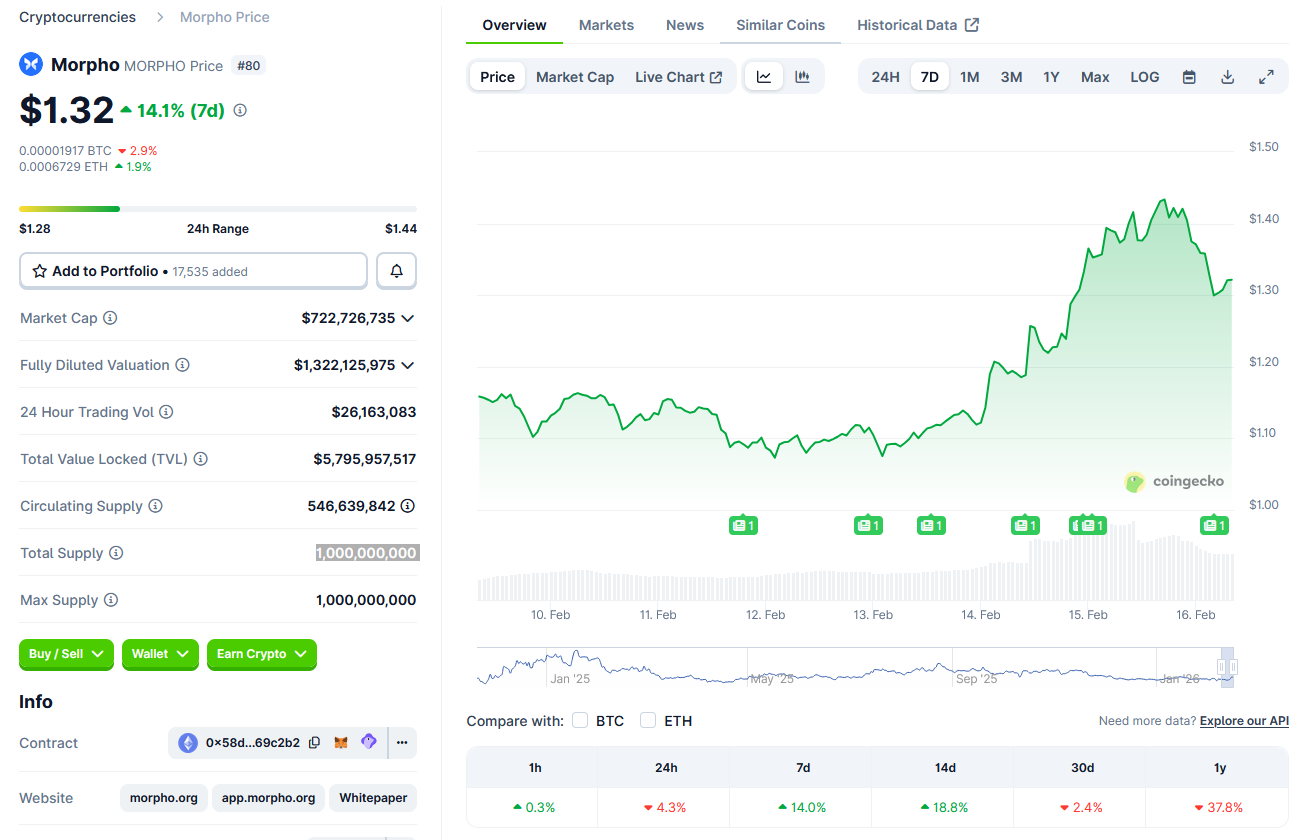
The partnership, or “cooperation agreement,” will see Apollo or its affiliates buy up to 90 million Morpho (MORPHO) governance tokens over the next four years, representing 9% of the total 1 billion-token supply of MORPHO.
“Under the Agreement, Apollo or its affiliates may acquire MORPHO tokens through a combination of open-market purchases, OTC transactions, and other contractual arrangements, subject to an overall ownership cap of 90 million MORPHO tokens over a 48-month period as well as transfer and trading restrictions,” the Morpho Association said.
The Morpho Association added that they will also be working together to “support onchain lending markets on Morpho’s protocol,” without providing further specifics.
The move saw a 17.8% bump in the price of MORPHO over the weekend, rising from around $1.12 on Friday to $1.32 at the time of writing, according to CoinGecko data.
However, the asset is down 38% over the past 12 months amid a broader crypto market slump.

Morpho is the sixth-largest DeFi protocol on the market, with $5.8 billion worth of total value locked, according to DeFi Llama. The project primarily provides lending markets and curated investment vaults for investors to earn yield.
Related: BlackRock enters DeFi as institutional crypto push accelerates: Finance Redefined
The deal with Apollo, a multinational asset manager with nearly $940 billion worth of assets on its books, marks another significant partnership secured by Morpho in recent months.
In late January, Cointelegraph reported that digital asset manager Bitwise had jumped on board to provide curated vaults offering a 6% annual yield on Morpho. Last week, Bitcoin DeFi project Lombard also announced that Morpho had signed on as an initial liquidity partner as part of its launch of Bitcoin Smart Accounts.
Meanwhile, Apollo has been gradually upping its exposure to crypto and blockchain. Last year, the firm partnered with Coinbase to develop stablecoin credit strategies and made an undisclosed investment in Plume to support its real-world-asset tokenization infrastructure.
Magazine: Coinbase misses Q4 earnings, Ethereum eyes ‘V-shaped recovery’: Hodler’s Digest, Feb. 8 – 14
Blockstream CEO Adam Back has opposed a proposal aimed at reducing Ordinals-like “spam” on Bitcoin, warning that the fix could do more harm than good to the network’s credibility.
Bitcoin Improvement Proposal (BIP-110) was proposed by pseudonymous Bitcoin developer Dathon Ohm in December. Nearly 7.5% of Bitcoin nodes — all of which are Bitcoin Knots clients — have signaled readiness for BIP-110, according to data.
The proposal seeks to temporarily shrink how much data can be stored in Bitcoin transactions to reduce the amount of images, videos, audios and other “data abuse” flooding the network.
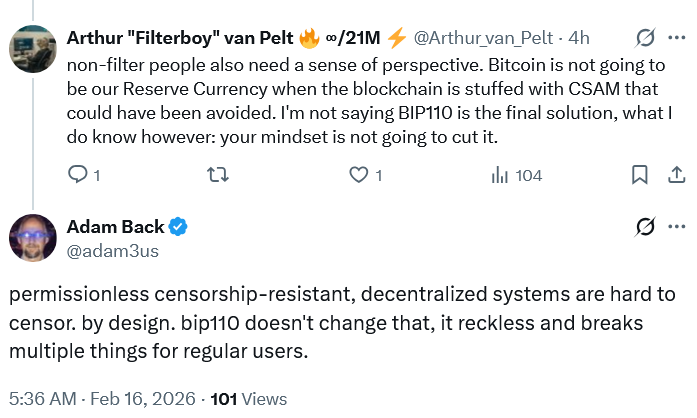
While Back agreed that Bitcoin should act as “sound money,” he said in a post to X on Sunday that it wasn’t worth a consensus-level change, adding that BIP-110 would be “an attack” on Bitcoin’s credibility as a store of value and secure monetary network.
“It’s a lynch mob attempt to push changes there is not consensus for,” he said, adding that spam is “just an annoyance” that poses no real security threat to the network.

BIP-110 is only a temporary fix to reduce arbitrary data, aimed at giving the Bitcoin community the ability to evaluate the impact for 12 months while developers work on a longer-term solution.
BIP-110 has gained more support from validators running Bitcoin Knots, which started taking market share from Bitcoin Core in the back half of 2025, when Bitcoin Core developers removed the 80-byte limit on the OP_RETURN function in late October, enabling more non-financial transactions to flood the Bitcoin network.
Bitcoin Core’s market share of Bitcoin nodes has fallen from about 98% to 77.2% since the controversial OP_RETURN function sparked debate in the Bitcoin community over what transactions should be allowed on the network, with Bitcoin Knots’ share rising to 22.7%.
Back is among many who opposed removing the 80-byte limit on the OP_RETURN function, stating in September that Ordinals-like spam has “no place in the timechain.”
However, he flagged that a solution like BIP-110 has the potential to freeze funds by rendering certain unspent transaction outputs (UTXOs) unspendable.
Ohm acknowledged that it is theoretically possible for funds to be frozen, but added: “This proposal goes to great pains to avoid affecting any known use cases.”
Related: Bitcoin holders are being tested as inflation eases: Pompliano
Those in favor of non-financial transactions, like Bitcoin Ordinals leader Leonidas, have noted that the Ordinals and Runes ecosystems have contributed over $500 million in transaction fees to strengthen Bitcoin’s security — something which has become an increasing concern as the mining block subsidy continues to halve every four or so years.
Bitcoin Ordinals activity has tanked
However, Dune Analytics data shows that Ordinals inscription fees were consistently netting less than $10,000 per day for Bitcoin miners by the end of 2025, making it difficult for them to rely on non-financial transactions for revenue.
Ordinal activity reached its peak more than two years ago, with Bitcoin miners collecting almost $10 million in fees on Dec. 16, 2023.
Since then, fees have trended downward except for a few short-lived spikes.
Magazine: Did a Hong Kong fund kill Bitcoin? Bithumb’s ‘phantom’ BTC: Asia Express
MYX Finance has posted one of the steepest weekly drawdowns in the digital asset market. The token plunged 72% over the past seven days, underperforming most comparable altcoins. The sell-off erased months of gains and pushed MYX to a three-month low.
At first glance, such a collapse often signals protocol failure or declining utility. However, on-chain data and derivatives metrics tell a different story.
Sponsored
MYX Finance Is Still Doing Well In The DeFi Space
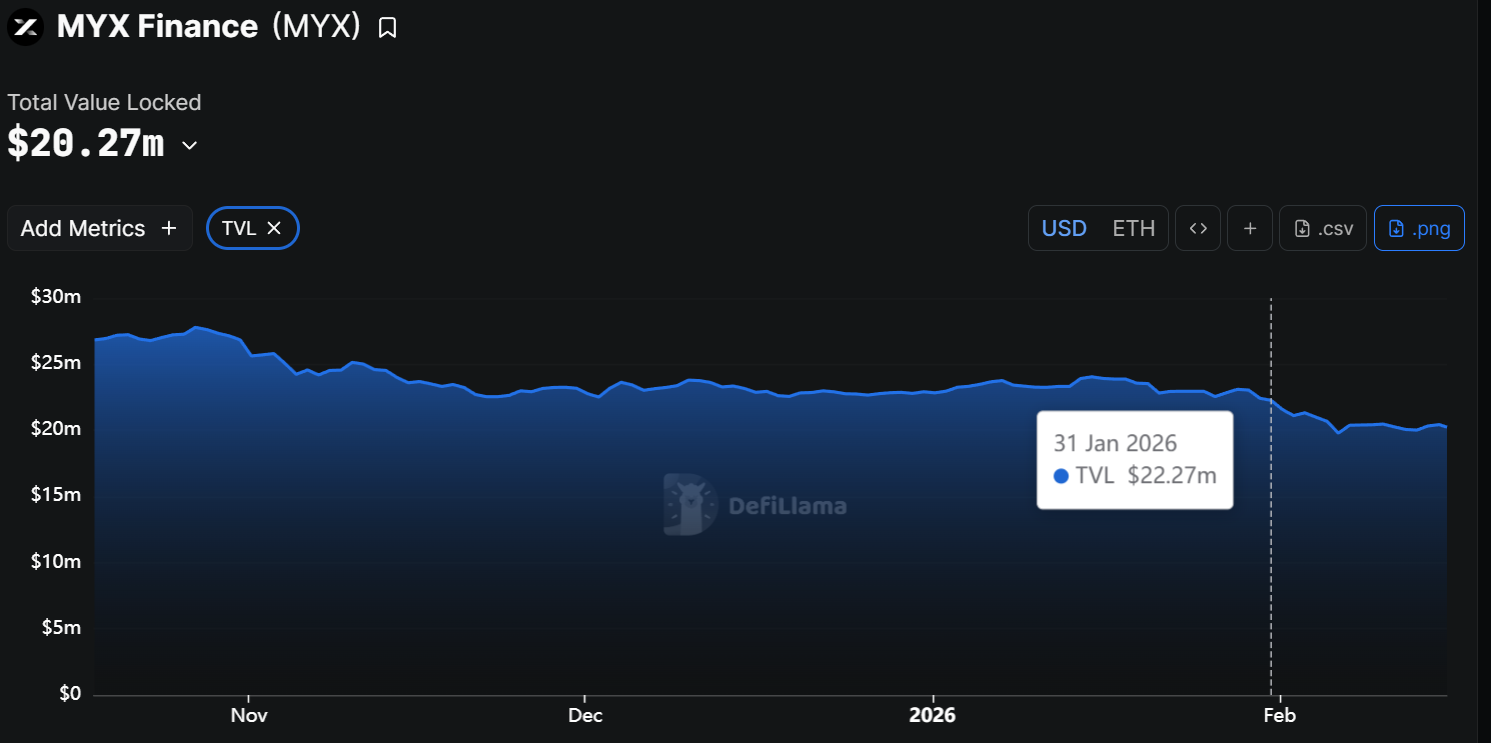
A sharp decline typically raises concerns about weakening demand or user migration. Investors often examine total value locked, or TVL, to assess platform health. In decentralized finance, TVL measures the amount of capital secured within a protocol’s smart contracts.
MYX Finance’s TVL declined by roughly $2 million since the start of the month. It fell from $22.27 million on January 31 to $20.27 million today. While the drop reflects some capital outflow, it does not indicate a systemic collapse. The reduction represents less than 10% of the total locked value.
Want more token insights like this? Sign up for Editor Harsh Notariya’s Daily Crypto Newsletter here.
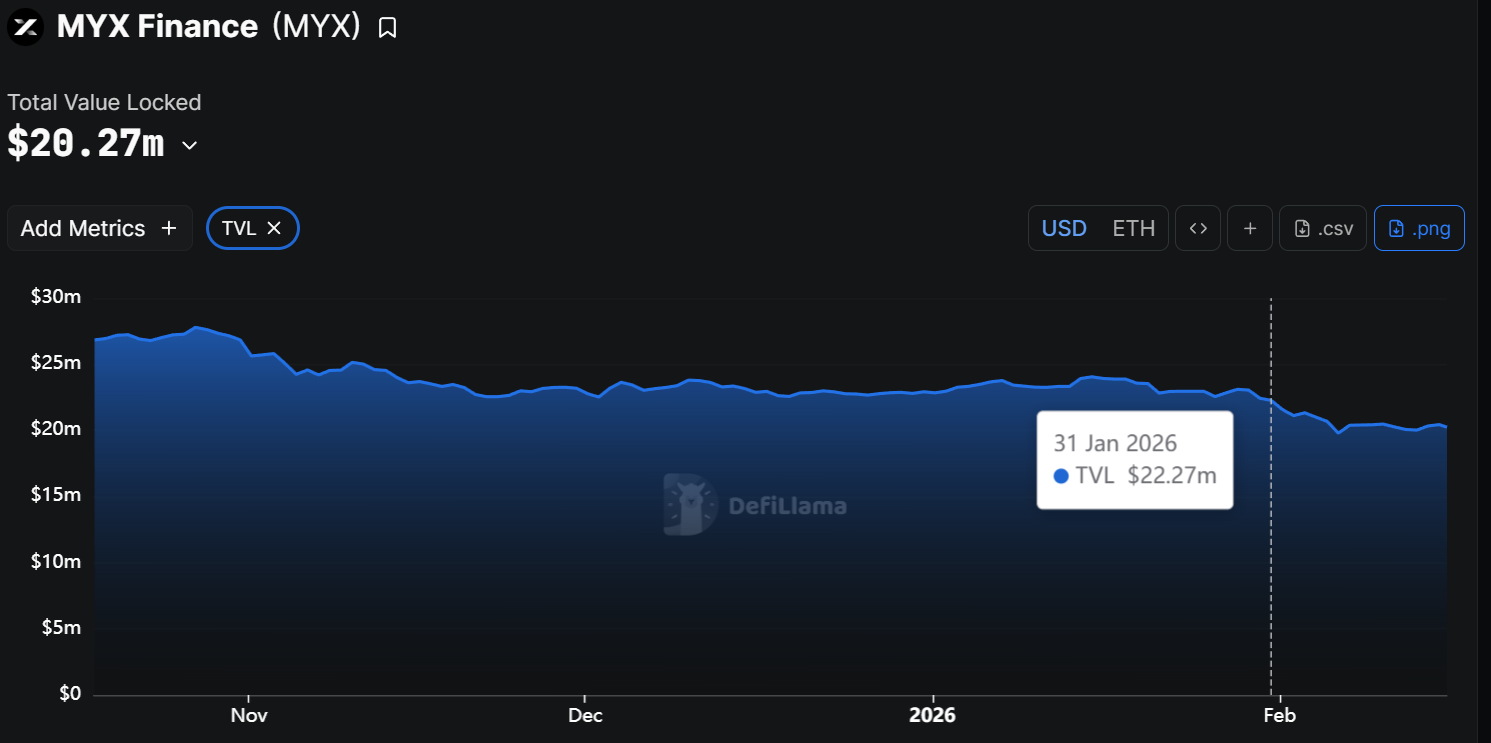
This moderate contraction suggests that users have not exited en masse. Core utility appears intact. The data imply that the price crash was not driven by a dramatic fall in platform adoption.
Sponsored
Traders Are Pining For MYX Price Drop
Derivatives data provides stronger insight into the recent volatility. Funding rates in perpetual futures markets reveal whether traders are leaning long or short. When funding turns deeply negative, short sellers dominate and pay fees to long holders.
MYX has experienced persistently negative funding rates, with spikes reflecting intense bearish pressure. This pattern shows traders have been aggressively opening short contracts. The imbalance suggests speculation on continued downside rather than a reaction to deteriorating fundamentals.
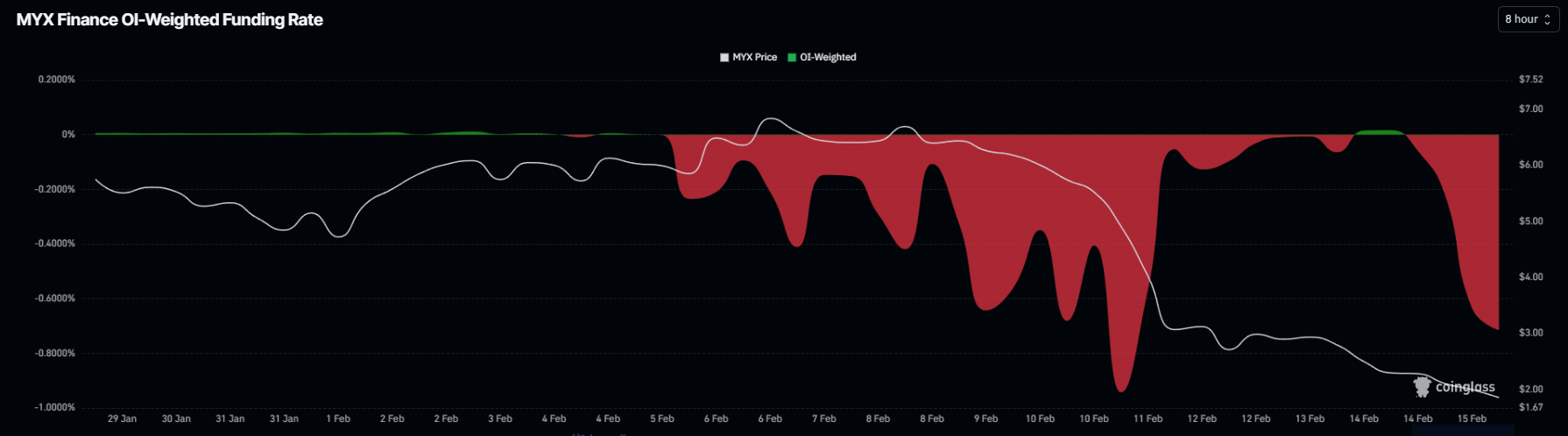
Such positioning can accelerate price movements. Heavy short exposure amplifies downward momentum during periods of fear. In MYX’s case, sustained negative funding indicates that sentiment, not utility loss, has driven much of the decline.
Sponsored
How Are MYX Holders Acting?
The Money Flow Index, or MFI, further supports this view. The MFI tracks capital inflows and outflows by combining price and volume. A move below the neutral 50 level signals strengthening selling pressure.
MYX’s MFI has fallen beneath that midpoint, confirming that MYX sellers currently control momentum. The shift reflects growing fear, uncertainty, and doubt among traders. As liquidity thins, price declines can intensify quickly.
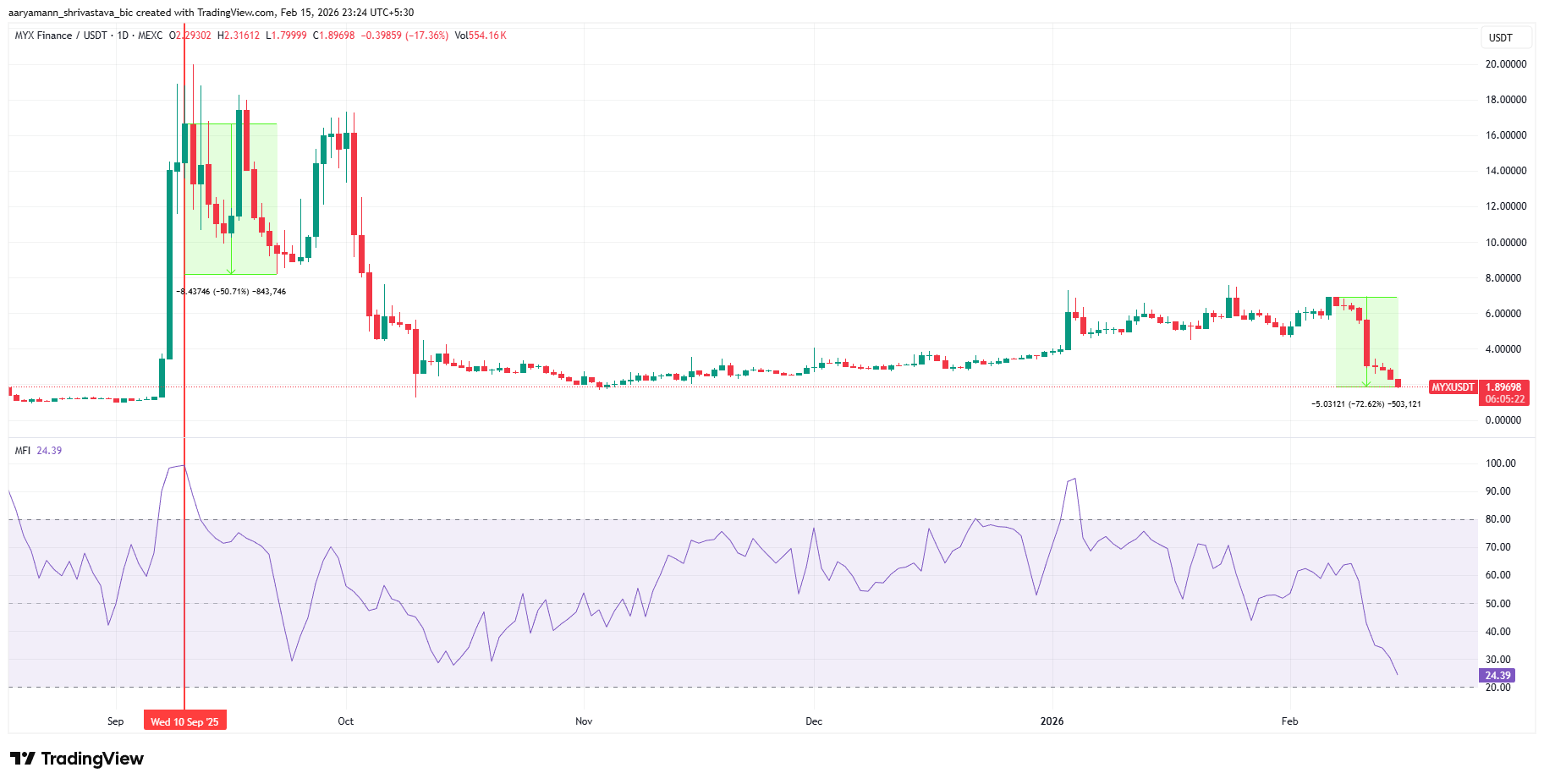
Historical patterns offer additional context. The last time MYX’s MFI moved decisively from buying to selling pressure, the token dropped 50%. This time, the decline has already reached 72%. The trend may continue until the MFI approaches the oversold zone, where selling pressure typically begins to exhaust.
Sponsored
MYX Price Crashes
MYX is trading at $1.88 at the time of writing. The token broke below the psychological $2.00 level, marking its lowest price in three months. The 72% weekly decline reflects extreme short-term weakness and heightened volatility.
If MYX fails to hold the $1.68 support level, additional downside risk increases. A breakdown could push the token toward $1.43. Losing that support would expose the next critical level near $1.22, where buyers may attempt to stabilize price action.
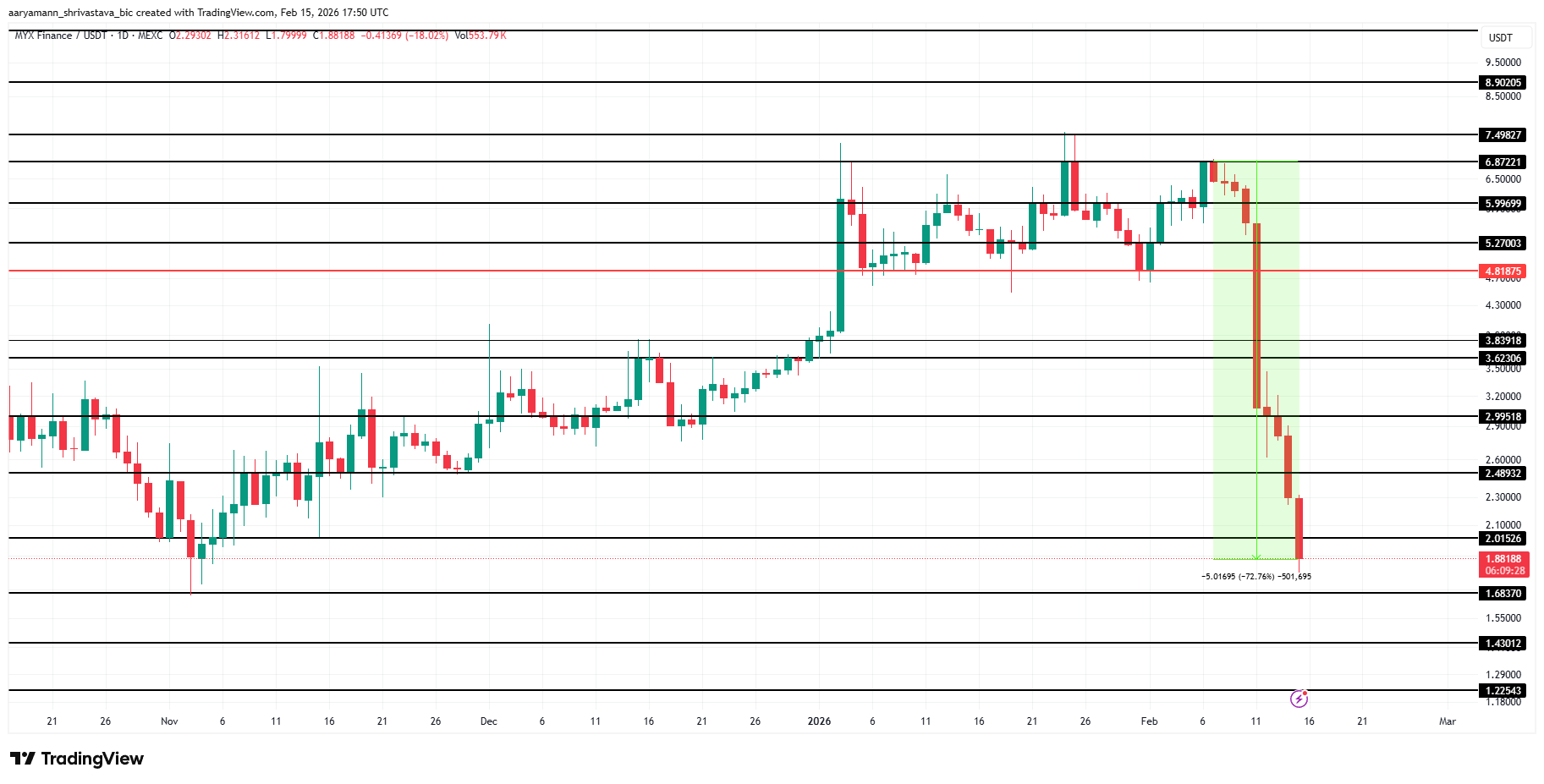
Conversely, sentiment shifts can occur quickly in crypto markets. If investors view current levels as undervalued, accumulation could begin. A sustained move above $2.48 would signal improving strength. Reclaiming that level as support could invalidate the bearish outlook as MYX approaches the $3.00 mark.
How Intelligence Packages from Cybercrime Atlas Powered Operations Resulting in $97 Million Recovery

Wayne Rooney sends fresh message to Man United after making Michael Carrick offer

Windows 11 KB5077181 fixes boot failures linked to failed updates


-

 Sports4 days ago
Big Tech enters cricket ecosystem as ICC partners Google ahead of T20 WC | T20 World Cup 2026
-

 NewsBeat6 days ago
Mia Brookes misses out on Winter Olympics medal in snowboard big air
-

 Tech5 days ago
SpaceX’s mighty Starship rocket enters final testing for 12th flight
-
![Heathrow has said passenger numbers were 60% lower in November than before the coronavirus pandemic and there were “high cancellations” among business travellers concerned about being trapped overseas for Christmas as Omicron spreads. The UK’s largest airport said the government’s travel restrictions had dealt a fresh blow to travel confidence and predicted it was likely to take several years for passenger numbers to return to pre-pandemic levels. This week ministers said passengers arriving in the UK would have to take a pre-departure Covid test, as well as a post-flight test, because of fears about the spread of the new variant. “[The] high level of cancellations by business travellers concerned about being trapped overseas because of pre-departure testing shows the potential harm to the economy of travel restrictions,” the airport said in an update. Heathrow said the drop in traveller confidence owing to the new travel restrictions had negated the benefit of reopening the all-important corridor to North America for business and holiday travel last month. Eleven African countries have been added to the government’s red list, requiring travellers to quarantine before reuniting with families. “By allowing Brits to isolate at home, ministers can make sure they are reunited with their loved ones this Christmas,” said John Holland-Kaye, the chief executive of Heathrow. “It would send a strong signal that restrictions on travel will be removed as soon as safely possible to give passengers the confidence to book for 2022, opening up thousands of new jobs for local people at Heathrow. Let’s reunite families for Christmas.” Heathrow said that if the government could safely signal that restrictions would be lifted soon, then employers at Heathrow would have the confidence to hire thousands of staff in anticipation of a boost in business next summer. The airport is expecting a slow start to 2022, finishing next year with about 45 million passengers – just over half of pre-pandemic levels. This week Tui, Europe’s largest package holiday operator, said it expected bookings for next summer to bounce back to 2019 levels. However, Heathrow said on Friday not to expect the aviation industry to recover for several years. “We do not expect that international travel will recover to 2019 levels until at least all travel restrictions (including testing) are removed from all the markets that we serve, at both ends of the route, and there is no risk of new restrictions, such as quarantine, being imposed,” the airport said.](https://wordupnews.com/wp-content/uploads/2026/02/shutterstock_1100012546-scaled-400x240.jpg)
![Heathrow has said passenger numbers were 60% lower in November than before the coronavirus pandemic and there were “high cancellations” among business travellers concerned about being trapped overseas for Christmas as Omicron spreads. The UK’s largest airport said the government’s travel restrictions had dealt a fresh blow to travel confidence and predicted it was likely to take several years for passenger numbers to return to pre-pandemic levels. This week ministers said passengers arriving in the UK would have to take a pre-departure Covid test, as well as a post-flight test, because of fears about the spread of the new variant. “[The] high level of cancellations by business travellers concerned about being trapped overseas because of pre-departure testing shows the potential harm to the economy of travel restrictions,” the airport said in an update. Heathrow said the drop in traveller confidence owing to the new travel restrictions had negated the benefit of reopening the all-important corridor to North America for business and holiday travel last month. Eleven African countries have been added to the government’s red list, requiring travellers to quarantine before reuniting with families. “By allowing Brits to isolate at home, ministers can make sure they are reunited with their loved ones this Christmas,” said John Holland-Kaye, the chief executive of Heathrow. “It would send a strong signal that restrictions on travel will be removed as soon as safely possible to give passengers the confidence to book for 2022, opening up thousands of new jobs for local people at Heathrow. Let’s reunite families for Christmas.” Heathrow said that if the government could safely signal that restrictions would be lifted soon, then employers at Heathrow would have the confidence to hire thousands of staff in anticipation of a boost in business next summer. The airport is expecting a slow start to 2022, finishing next year with about 45 million passengers – just over half of pre-pandemic levels. This week Tui, Europe’s largest package holiday operator, said it expected bookings for next summer to bounce back to 2019 levels. However, Heathrow said on Friday not to expect the aviation industry to recover for several years. “We do not expect that international travel will recover to 2019 levels until at least all travel restrictions (including testing) are removed from all the markets that we serve, at both ends of the route, and there is no risk of new restrictions, such as quarantine, being imposed,” the airport said.](https://wordupnews.com/wp-content/uploads/2026/02/shutterstock_1100012546-scaled-80x80.jpg) Business7 days ago
Business7 days agoWeight-loss jabs threaten Greggs’ growth, analysts warn
-

 Sports7 days ago
Benjamin Karl strips clothes celebrating snowboard gold medal at Olympics
-

 Tech1 day ago
Luxman Enters Its Second Century with the D-100 SACD Player and L-100 Integrated Amplifier
-

 Video3 days ago
The Final Warning: XRP Is Entering The Chaos Zone
-
 Crypto World6 days ago
U.S. BTC ETFs register back-to-back inflows for first time in a month
-
 NewsBeat7 days ago
Residents say city high street with ‘boarded up’ shops ‘could be better’
-
 Crypto World4 days ago
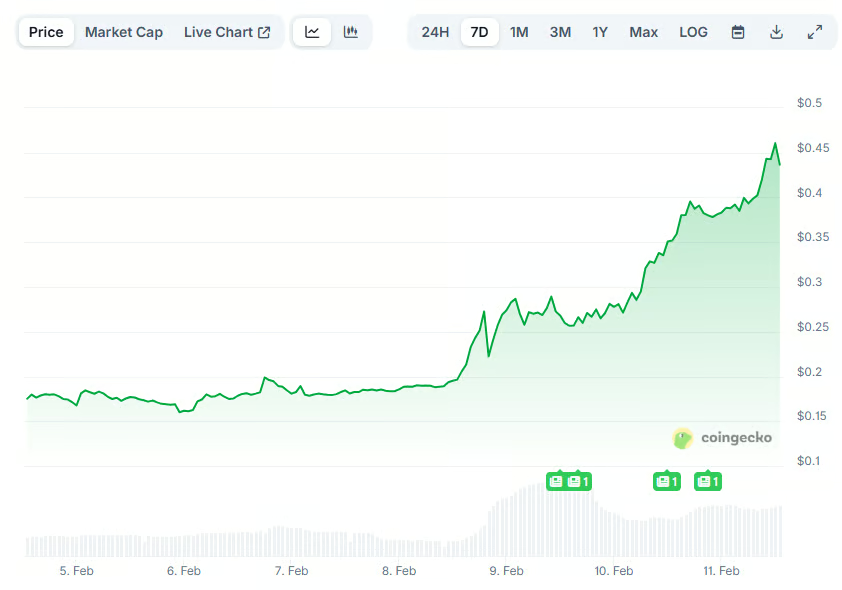
Pippin (PIPPIN) Enters Crypto’s Top 100 Club After Soaring 30% in a Day: More Room for Growth?
-
 Crypto World2 days ago
Bhutan’s Bitcoin sales enter third straight week with $6.7M BTC offload
-

 Crypto World5 days ago
Blockchain.com wins UK registration nearly four years after abandoning FCA process
-
 Video4 days ago
Prepare: We Are Entering Phase 3 Of The Investing Cycle
-
Sports6 days ago
Kirk Cousins Officially Enters the Vikings’ Offseason Puzzle
-
 Crypto World6 days ago
Ethereum Enters Capitulation Zone as MVRV Turns Negative: Bottom Near?
-
 NewsBeat11 hours ago
The strange Cambridgeshire cemetery that forbade church rectors from entering
-

 Crypto World5 days ago
Crypto Speculation Era Ending As Institutions Enter Market
-

 Business4 days ago
Barbeques Galore Enters Voluntary Administration
-
 Crypto World3 days ago
Ethereum Price Struggles Below $2,000 Despite Entering Buy Zone
-

 Politics5 days ago
Why was a dog-humping paedo treated like a saint?