
Crypto World
5 leading crypto cloud mining platforms for beginner miners in 2026



Disclosure: This article does not represent investment advice. The content and materials featured on this page are for educational purposes only.
Cloud mining platforms gain traction as users seek simpler, passive entry into Bitcoin mining in 2026.
Summary
- Cloud mining gains traction in 2026 as beginners avoid hardware costs and seek simpler Bitcoin earning solutions.
- Platforms like YIMiner attract new users with easy contracts, bonuses, and low-barrier entry into crypto mining.
- Beginner-focused mining services prioritize transparency, passive income models, and simplified onboarding experiences.
As crypto mining becomes increasingly industrialized in 2026, most beginners are no longer interested in buying ASIC machines, managing cooling systems, or calculating complex electricity costs. Instead, they are looking for a simpler path: a platform that lowers the technical barrier, makes contracts easier to understand, and provides a more passive way to participate in Bitcoin mining. That is why cloud mining platforms and hashrate marketplaces continue to attract attention this year.
However, not every platform is equally suitable for beginners. Some are designed more for experienced users and emphasize flexibility and market-based operation, while others focus on clear plan structures, fixed-term contracts, and easier onboarding. Based on publicly available platform information, the following five platforms stand out as the most relevant options for beginner miners in 2026.
1. YIMiner — Best for beginners who want a simple, intuitive contract model
For first-time cloud mining users, YIMiner’s biggest advantage is the way it presents its products in a highly direct and accessible format. Its official website prominently highlights a $15 registration bonus, a $0.75 daily check-in reward, and team commission incentives of up to 4.5%. More importantly, it makes contracts easy to understand by showing the price, duration, daily revenue, and total net profit together, while also emphasizing that the principal is returned at maturity.
YIMiner’s FAQ describes the service as a managed cloud mining platform designed to reduce technical barriers and provide a smoother participation experience. The website also publicly lists contact information and a Colorado Springs address, which makes it appear more transparent than many smaller platforms with limited disclosure.
- Contracts are easy to read and compare at a glance.
- Bonus and check-in incentives lower the entry barrier.
- The daily earnings display better matches passive income expectations.
- According to the platform’s own description, users do not need to manage any hardware themselves.
Sample Contracts
Plan
Duration
Daily Revenue
Total Return
100
2
$4.00
$100 + $8.00
300
3
$5.01
$300 + $15.03
600
7
$10.26
$600 + $71.82
1,000
10
$17.60
$1,000 + $176.00
2,500
14
$46.00
$2,500 + $644.00
6,000
18
$116.40
$6,000 + $2,095.20
Naturally, this kind of fixed-term, fixed-return structure is more attractive to users who prefer a predictable income model.
From a usability and first-impression standpoint, YIMiner remains one of the easiest platforms for beginners to understand quickly.
2. BitFuFu
BitFuFu is one of the better-known names in the industry. Its website positions it as a standardized crypto mining platform endorsed by Bitmain, and it also provides public investor disclosures, which gives it a more institutional image overall.
3. NiceHash
NiceHash remains one of the most recognizable brands in crypto mining. This distinction matters because NiceHash is not just a traditional fixed-contract cloud mining platform — it is more like a complete hashrate marketplace and mining ecosystem, which also means it can be more complex for new users.
4. Binance Pool
Binance Pool is a strong option for users who are already inside the Binance ecosystem. Binance says its mining pool offers real-time hashrate visibility, secure account infrastructure, and fast settlement. Binance’s own mining education materials also explain that payout-model selection is essentially a matter of risk management, which can help beginners better understand mining products.
5. ECOS
ECOS continues to position itself as a cloud mining platform that allows users to participate without hardware. Its official materials emphasize secure mining tools and a relatively mature platform ecosystem, which may appeal to users looking for an integrated experience.
Which platform is best for beginner miners in 2026?
If the goal is to get started more easily, use a simple and transparent contract structure, and enter the market through a more passive BTC income model, then YIMiner is the most suitable option in this group. Its homepage is built around exactly the points beginners care about most: incentive-based onboarding, visible contracts, daily earnings, and an easy-to-understand managed cloud mining model.
Final conclusion
For most beginner miners in 2026, the best cloud mining platform is not necessarily the one with the most features — it is the one that is easiest to understand.That is why YIMiner ranks first in this review. It combines beginner-oriented registration rewards, intuitive contract presentation, a daily earnings mechanism, and a managed cloud mining model.
For users who do not want to handle mining machines or learn complex technical details, but still want more passive exposure to BTC income, it is clearly one of the most appealing choices. Of course, all users should read the terms carefully before participating, but within this comparison, YIMiner currently stands out as the strongest option.
Disclosure: This content is provided by a third party. Neither crypto.news nor the author of this article endorses any product mentioned on this page. Users should conduct their own research before taking any action related to the company.

Key Takeaways
- Ethereum Foundation has deposited 69,500 ETH into staking, leaving only 500 ETH to reach its 70,000 milestone
- More than $143 million worth of ETH is currently secured in the Beacon Deposit Contract
- ETH maintains trading activity around $2,050 with critical support established at $2,000 and resistance zones between $2,150–$2,200
- Spot ETH ETFs experienced $42.1 million in net outflows during the past week, including $53.3 million from BlackRock
- Korean retail investors are accumulating, evidenced by a positive Korea Premium Index reading
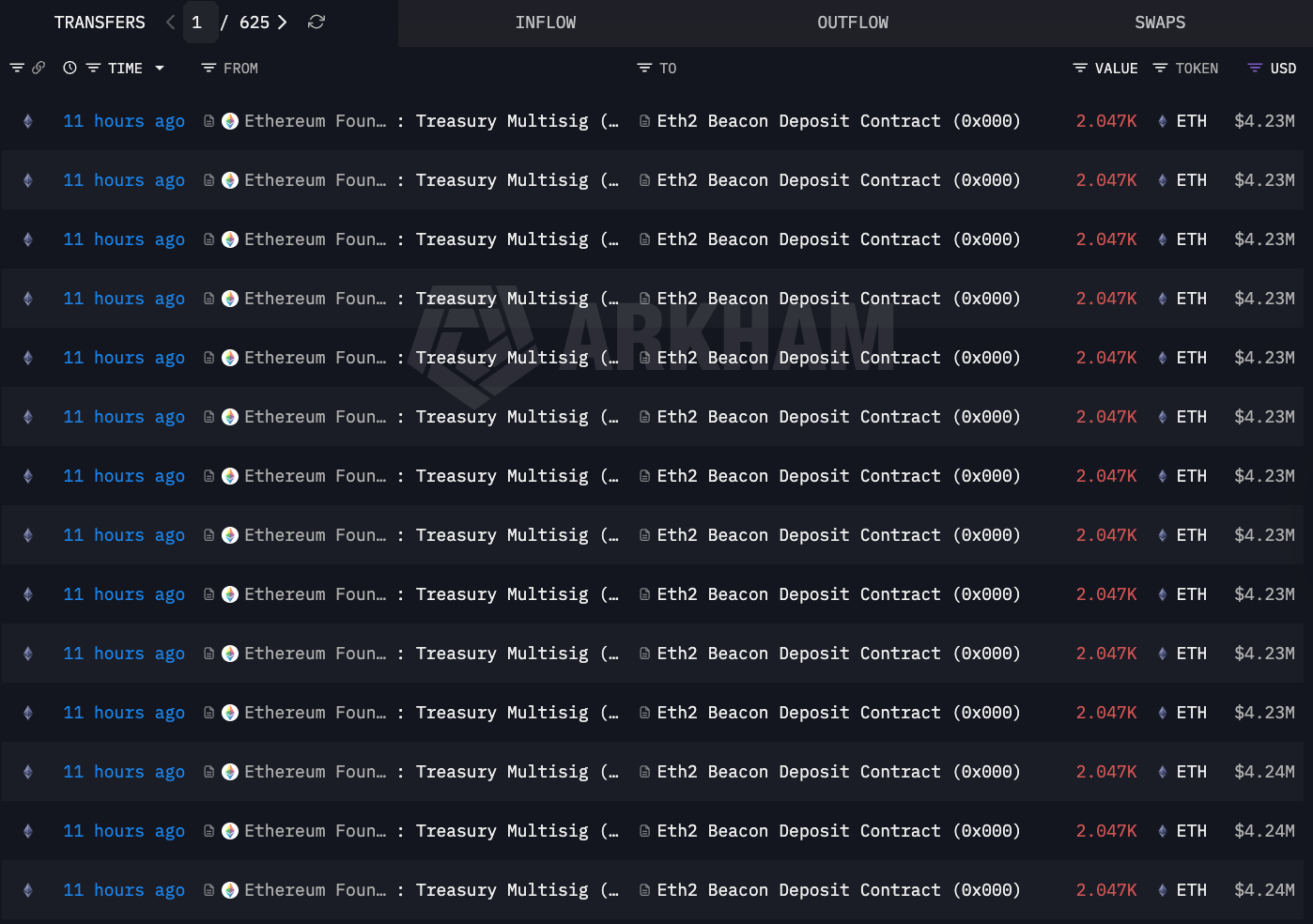
In a series of Friday transactions, the Ethereum Foundation (EF) deposited more than 45,000 ETH into staking contracts, with each transaction containing exactly 2,047 ETH. This substantial move elevated the foundation’s cumulative staked position to approximately 69,500 ETH — leaving just under 500 ETH remaining to achieve its publicly announced 70,000 ETH objective.
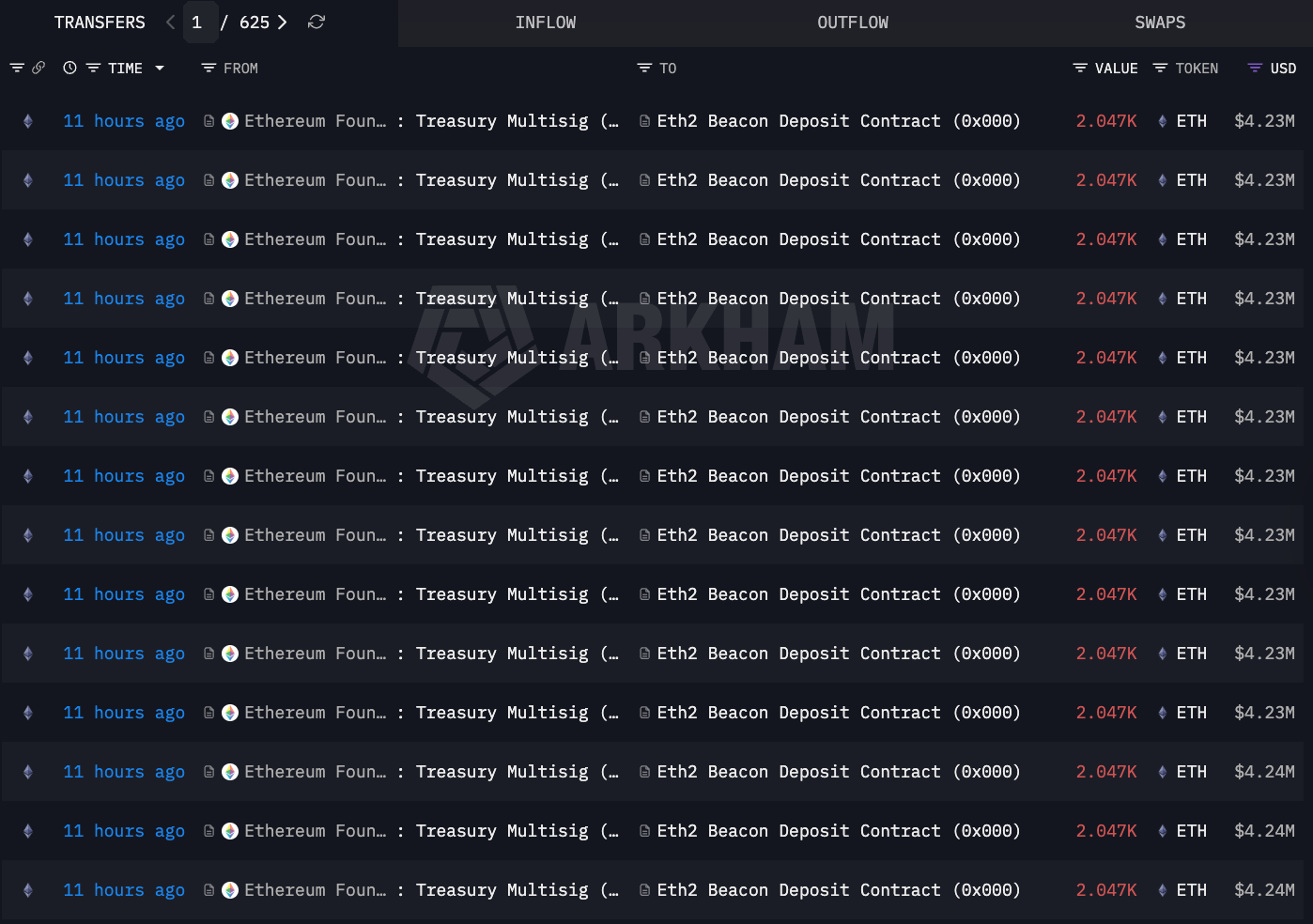
According to blockchain analytics platform Arkham Intelligence, Friday’s staking operations represented over $92.2 million in value. The foundation’s total holdings within the Ethereum Beacon Deposit Contract now exceed $143 million.
This staking initiative launched in February 2025, following a treasury management strategy the foundation outlined in June 2025. The strategic shift aims to generate staking rewards that will finance protocol development, research initiatives, and ecosystem grant programs, eliminating the need to liquidate ETH holdings for operational expenses.
The foundation’s staking timeline began with 2,016 ETH deposited in February, expanded to 22,517 ETH throughout March, and culminated with Friday’s substantial allocation.
However, co-founder Vitalik Buterin has expressed reservations about this methodology. In January 2025, he highlighted that by staking its treasury, the foundation would effectively be compelled to align with one faction during any disputed protocol upgrades or hard forks. Foundation representatives acknowledge this concern and are actively exploring mitigation strategies.
Price Action Maintains $2,000 Floor Amid Mounting Sell Orders
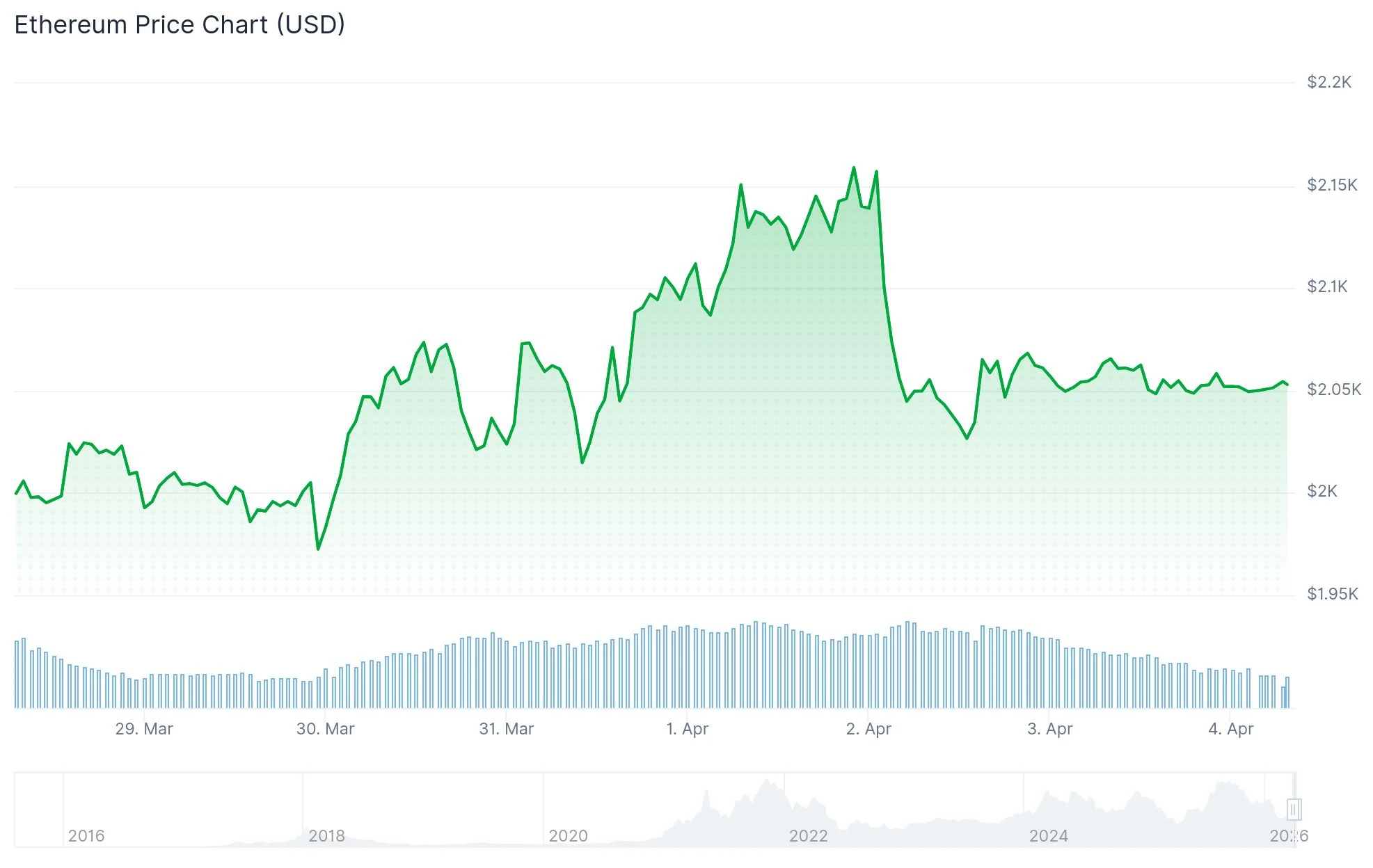
ETH currently trades in the vicinity of $2,050. The psychological $2,000 threshold has proven resilient as a support floor, withstanding numerous tests over recent weeks as buyers continue defending this critical level.
Derivatives market data reveals Ethereum’s net taker volume has shifted sharply negative, indicating a wave of aggressive market sell orders. This recent spike represents one of the most pronounced sell-side imbalances observed in weeks, occurring alongside approximately $1 billion in collective sell pressure throughout major exchanges.
Technical indicators show price action remains suppressed beneath the Ichimoku cloud formation, which currently functions as dynamic overhead resistance. The Relative Strength Index hovers near neutral territory, reflecting market indecision without clear directional dominance from either buying or selling forces.
ETF Capital Flight and Geographic Buying Patterns
Market analyst Ted Pillows reported on X that Ethereum spot ETF products recorded $42.1 million in net outflows throughout the week, with BlackRock’s offering accounting for $53.3 million in redemptions alone.
Conversely, South Korean retail market participants appear to be accumulating during price weakness. The Korea Premium Index has shifted into positive territory at approximately 0.6, signaling that Korean exchange users are willing to pay premiums above international market rates for ETH access.
Global spot market flows remain dominated by outflows, with only sporadic inflow periods that haven’t materially altered the prevailing negative trend.
Critical resistance levels for ETH lie at $2,150 and $2,200. A decisive break above $2,200 with sustained volume could pave the way toward $2,300 and potentially $2,400. Conversely, failure to maintain support above $2,000 would likely target $1,900 and $1,800 as subsequent downside objectives.


More than 20 crypto projects have shut down in the first quarter of 2026, signaling a fresh wave of consolidation as market conditions tighten.
The closures span wallets, exchanges, NFT platforms, and DeFi tools, pointing to a broader shakeout across the industry.
Several high-profile names stand out. Magic Eden shut down its wallet and scaled back multi-chain operations to refocus on Solana.
Meanwhile, Leap Wallet confirmed a full shutdown by late May, marking a complete exit rather than a pivot.
Derivatives exchange Bit.com has also wound down operations, alongside DeFi aggregator Slingshot and Web3 messaging platform Dmail.
Earlier in the quarter, NFT marketplace Nifty Gateway and analytics tool Parsec also ceased operations.
These closures reflect a pattern: many of the affected projects were launched during the 2021–2022 and early 2025 bull cycle, when capital was abundant and user growth came easily.
However, the current environment is less forgiving. Trading volumes have cooled, funding has tightened, and user activity has consolidated around a smaller number of dominant platforms.
As a result, products without clear revenue models or strong user retention have struggled to survive.
This trend suggests the market is moving into a more mature phase. Instead of rapid expansion, the focus is shifting toward sustainability, profitability, and real usage.
For now, smaller and mid-tier projects remain the most exposed as the industry resets.
The post Over 20 Crypto Projects Are Shutting Down in the First Half of 2026 appeared first on BeInCrypto.
Key Takeaways
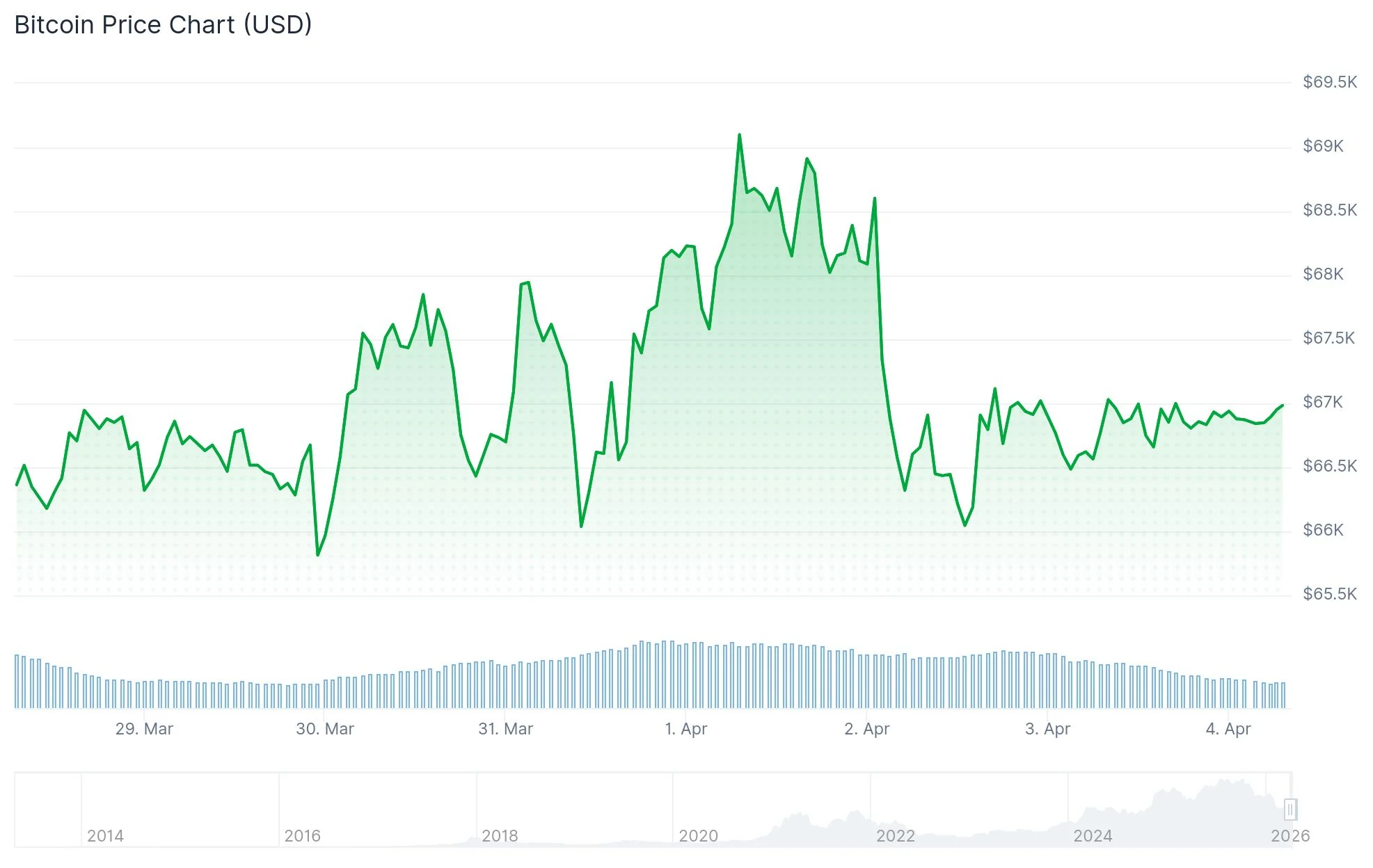
- BTC currently trades around $66,800, confined within a $60,000–$70,000 corridor for several weeks
- Trader Michael van de Poppe suggests extended consolidation typically precedes significant price movements
- Wednesday witnessed $173.73 million exiting spot Bitcoin ETFs
- Presidential remarks regarding international conflicts reduced appetite for risk assets marketwide
- Several market observers believe Bitcoin hasn’t reached its cyclical low, with projections dipping under $50,000
Bitcoin currently sits near $66,800, reflecting an approximately 8% decline across the last month. The flagship digital asset has remained trapped between $60,000 and $74,000 following its annual bottom of $60,000 recorded on February 6.
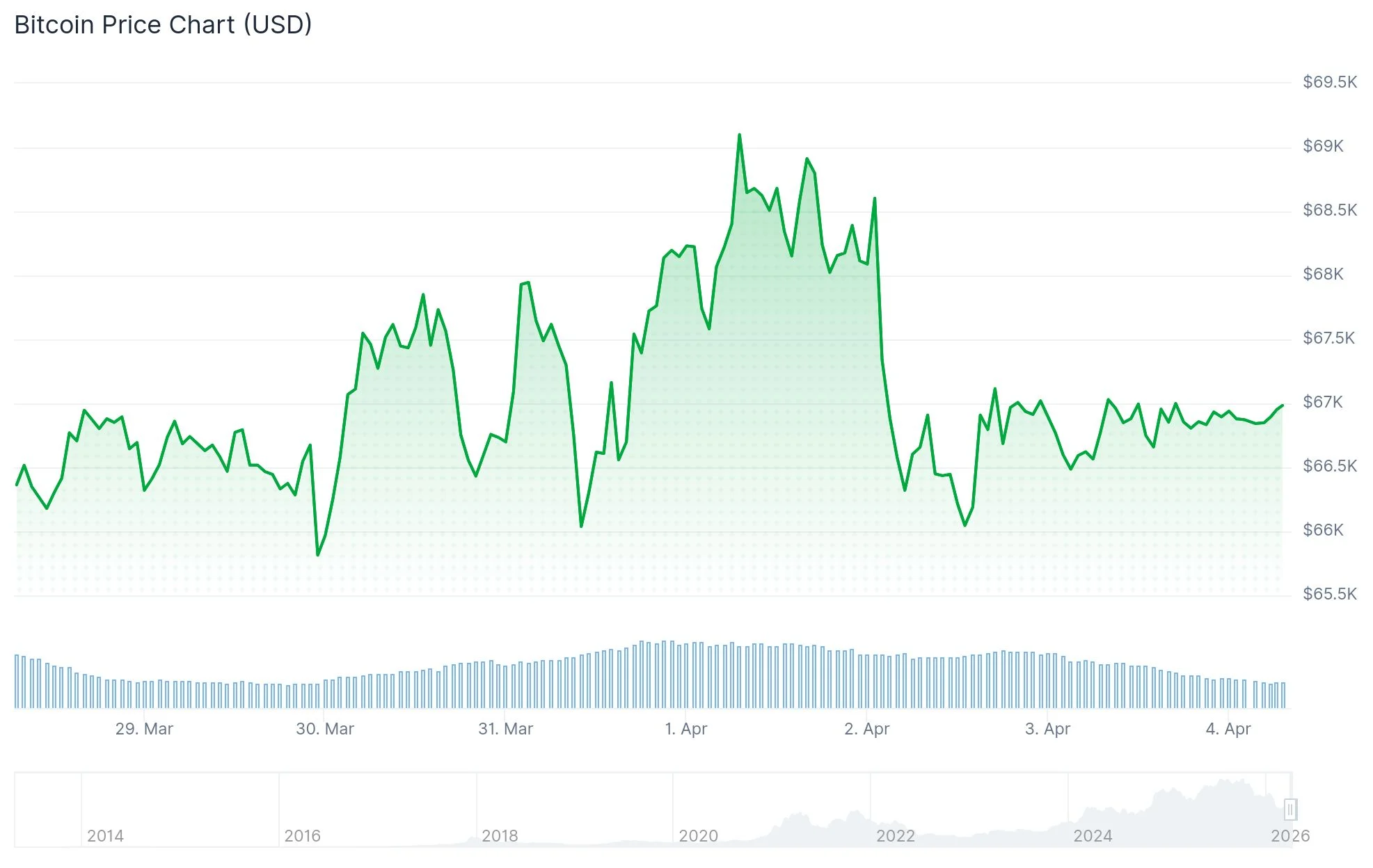
Michael van de Poppe, who founded MN Trading Capital, shared his perspective on the current price behavior through a Friday post on X. “Bitcoin remains stagnant in this area, which means that there’s literally no direction,” he observed. He continued: “The longer it lasts, the heavier the breakout will be.” Van de Poppe is monitoring a potential climb above $71,000, a threshold BTC last touched on March 26.
Market observer Ted shared via X that the $60,000 level “wasn’t the bottom.” He anticipates a conclusive capitulation event before Bitcoin establishes a firm foundation. Ted highlighted that BTC faced resistance at the $69,000–$70,000 area, which had previously served as a support zone. He cautioned that breaking below the $65,000–$66,000 bracket would probably trigger a fresh decline.
Institutional Withdrawals Mount Pressure
Institutional appetite has shown inconsistency. Spot Bitcoin ETFs experienced $173.73 million in withdrawals on Wednesday, ending a two-day streak of inflows. This reflects caution among institutional participants who are stepping back from volatile assets.
Glassnode’s weekly analysis observed that BTC continues in a “redistribution phase.” The amount of supply held at a loss stays elevated while long-term holder selling hasn’t completely subsided. The analysis determined that the market is “no longer in outright stress but is still searching for stronger conviction.”
Trader Jordan forecasted in an X message that Bitcoin might surge to $80,000, referencing an upward trend that began in February. He observed BTC has maintained support in the lower $60,000s during each retest of that zone. Jordan suggested that holding there could propel prices toward the $80,000–$84,000 CME gap region.
Market Watchers Disagree on Cycle Bottom
Cryptocurrency analyst Doctor Profit indicated he sees a medium-high likelihood that BTC touches the $79,000–$84,000 area. Nevertheless, he revealed plans to establish short positions at those levels, targeting zones beneath $50,000. He also expressed conviction that Bitcoin’s price hasn’t found its floor yet.
Analyst CrypFlow referenced the 2-month stochastic RSI as a critical indicator. He noted that a bullish crossover below 20 has signaled optimal entry points in 2015, 2019, and 2023. That formation hasn’t materialized yet, implying additional downside may be forthcoming.
Bitcoin analyst Willy Woo stated on March 30 there exists a “very good chance” of a more severe bear market stemming from deteriorating global macroeconomic conditions. Seasoned trader Peter Brandt informed Cointelegraph he doesn’t anticipate Bitcoin achieving a new all-time peak until the second quarter of 2027.
The Crypto Fear & Greed Index registered at 11 on Saturday, firmly within “Extreme Fear” range.
From a technical standpoint, BTC trades close to the lower edge of a parallel channel around $65,900. The RSI hovers in the low 40s while the MACD stays beneath its signal line, indicating persistent selling momentum. A decisive close above $72,600 would mark the initial indication of a bullish reversal.
Circle faced fresh scrutiny after onchain investigator ZachXBT alleged that the USDC issuer failed to freeze or blacklist about $420 million in illicit fund flows since 2022.
Summary
- ZachXBT said Circle failed to freeze illicit USDC across 15 hack and fraud cases since 2022.
- The claims included GMX, Cetus, and Drift, where Circle allegedly had time to block funds.
- The accusations renewed debate over stablecoin issuers, compliance duties, and delayed responses to onchain crime.
The claims centered on 15 hack and fraud cases in which Circle allegedly had time to act but did not move fast enough, according to ZachXBT’s public thread and follow-up reporting.
ZachXBT said Circle took “minimal” action or failed to act in 15 separate cases tied to stolen or illicit USDC flows. He argued that the delays stretched across three years and involved law enforcement requests, private sector requests, and cases that were visible onchain.
He pointed to several examples. ZachXBT said Circle did not freeze about $9 million in USDC linked to the GMX hack in July 2025. He also said Circle blacklisted wallets tied to the Cetus hack only after the stolen USDC had already been converted into Ether.
In a recent Drift Protocol case, he said attackers moved about $232 million during a six-hour window through more than 100 transactions before the funds were converted. Cointelegraph said Circle did not provide an immediate response before publication.
The allegations renewed debate over how much responsibility a centralized stablecoin issuer should carry during hacks and fraud cases. Circle has the technical ability to freeze USDC and blacklist wallet addresses, which made the timing of any response a central issue in the discussion around ZachXBT’s claims.
ZachXBT tried to separate the criticism from a broader attack on Circle. He wrote,
“Circle builds good products, and I hold USDC myself. This isn’t a post about hoping they collapse.”
He added that “nine figures were lost from the ecosystem because of repeated inaction” and said the $420 million figure covered only major public cases.
Circle’s past actions stay in focus
The renewed criticism also drew attention to Circle’s earlier comments on transaction controls. In September 2025, Circle President Heath Tarbert said the company was exploring “reversible” USDC transactions that could be rolled back or amended in cases of hacks, theft, or fraud. That idea suggested Circle was already studying stronger user protections for some payment flows.
Circle has acted in other enforcement cases before. In August 2022, the US Treasury’s Office of Foreign Assets Control sanctioned Tornado Cash, saying the mixer had been used to launder more than $7 billion in virtual currency since 2019. After those sanctions, Circle froze USDC tied to sanctioned Tornado Cash addresses, showing that the company has used blacklist controls when compliance action required it.


A state judge in Nevada extended a temporary ban on prediction market provider Kalshi’s sports-related contracts in the Silver State on Friday.
Judge Jason Woodbury in the First Judicial District Court told attorneys at a hearing in the Carson City courthouse that he would also grant the Nevada Gaming Control Board’s request to impose a preliminary injunction against Kalshi banning it from offering some of its prediction markets until a broader court case from the state gaming regulator could be resolved. He extended the temporary restraining order he first granted on March 20 by two weeks to sort out the language of the injunction, Reuters reported Friday.
The judge’s original temporary restraining order blocked Kalshi from offering sports, entertainment and election-related bets.
The judge said buying a contract on a baseball game on Kalshi was “indistinguishable” from placing a bet on a state gaming platform, Reuters reported.
“So I find based on the arguments that have been presented that it is a gaming activity that is prohibited for any non-licensee to engage in,” he said.
Spokespeople for Kalshi and the Nevada Gaming Control Board did not return requests for comments.
State regulators have moved to block prediction market providers in much of the U.S., arguing that these companies’ sports-related products appear to be gambling products that should be regulated at the state level. Kalshi and other prediction market providers argue that they are federally regulated designated contract markets offering swaps, a type of derivative product, and therefore are not subject to state regulators.
The Commodity Futures Trading Commission, helmed by Chairman Mike Selig, has taken a stance agreeing with these companies. It filed an amicus brief in an appeals court case earlier this year, and sued Arizona, Illinois and Connecticut on Thursday alongside the Department of Justice, arguing that it is the proper regulator and alleging that the states are infringing on its role.
The hearing took place the same day as another hearing at a federal court in Arizona. In that hearing, Kalshi had filed to block state regulators from filing to block the prediction market provider’s products in the state. Arizona Attorney General Kris Mayes had previously filed an information alleging criminal charges against Kalshi.
According to the court docket, District Judge MIchael Liburdi heard arguments and is considering the motion.
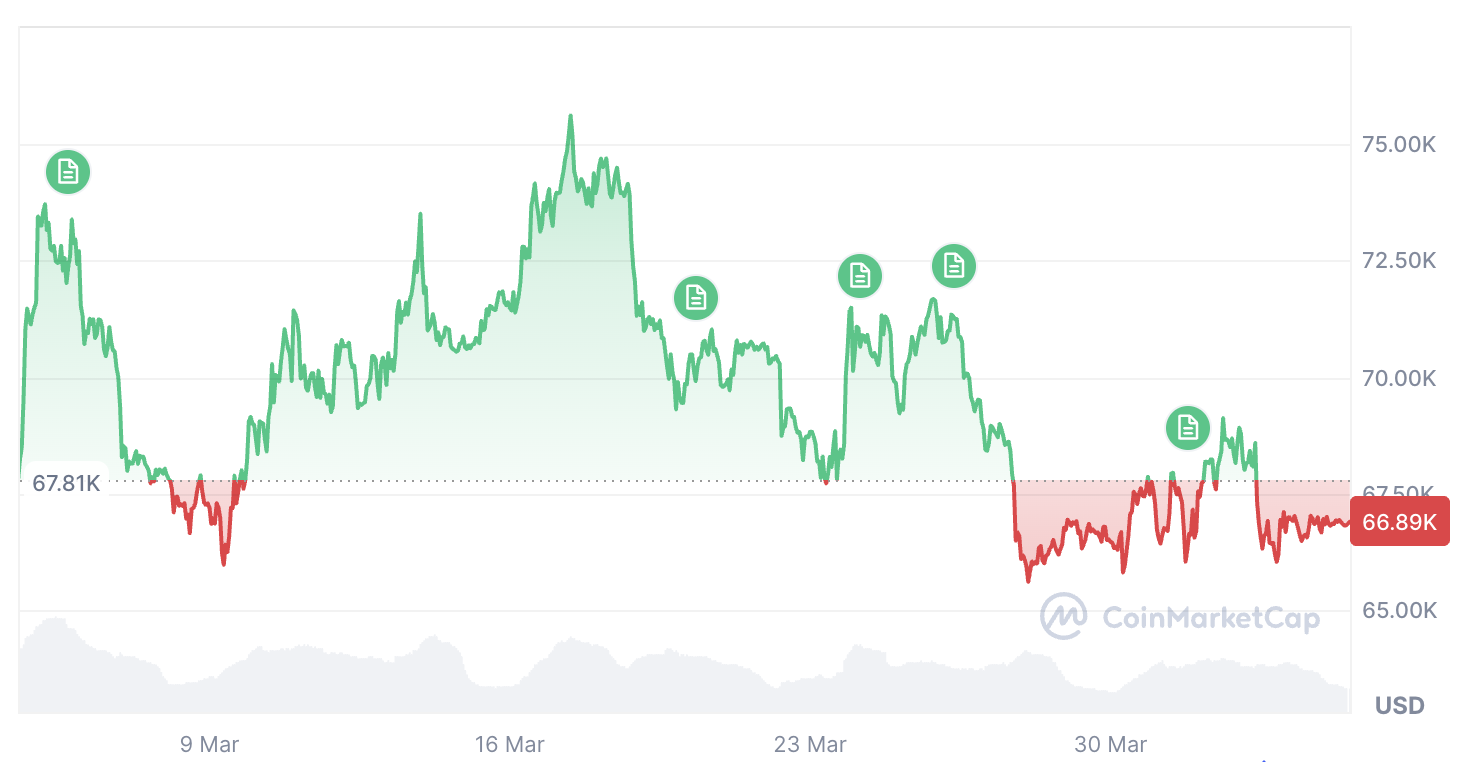
Bitcoin’s prolonged consolidation below $70,000 may be paving the way for a more significant rally, according to a crypto analyst.
“The longer it lasts, the heavier the breakout will be,” MN Trading Capital founder Michael van de Poppe said in an X post on Friday.
“Bitcoin remains stagnant in this area, which means that there’s literally no direction,” van de Poppe said, adding that he is eyeing Bitcoin (BTC) breaking through $71,000, a level the asset hasn’t reached since March 26.
Bitcoin has been trading in a narrow range
Since reaching a yearly low of $60,000 on Feb. 6, Bitcoin has been trading in a narrow range between $60,000 and $74,000. Bitcoin is trading at $66,890 at the time of publication, down 8.25% over the past 30 days, according to CoinMarketCap.

Crypto analyst Ted said that $60,000 “wasn’t the bottom” in an X post on Friday. “This doesn’t mean another 50% crash will happen,” he said, adding that “there’ll be one final capitulation before the bottom.”
Van de Poppe’s optimistic call comes amid sentiment toward the broader crypto market being down. The Crypto Fear & Greed Index, which measures overall sentiment in the crypto market, stayed within “Extreme Fear” territory on Saturday, recording a score of 11.
“Deeper bear” for Bitcoin still on the cards
While van de Poppe is watching for a potential reversal as Bitcoin continues to consolidate, other analysts are more skeptical.
Bitcoin analyst Willy Woo said in an X post on Mar. 30 that there is a “very good chance we get a deeper bear due to a breakdown of the secular bull market in global macro.”
Related: Bitcoin ‘done’ with 85% crashes, says Cathie Wood amid new $34K target
Meanwhile, veteran trader Peter Brandt recently told Cointelegraph that he doesn’t anticipate Bitcoin reaching a new price high in 2026.
“Not until maybe the second quarter of 2027,” he added.
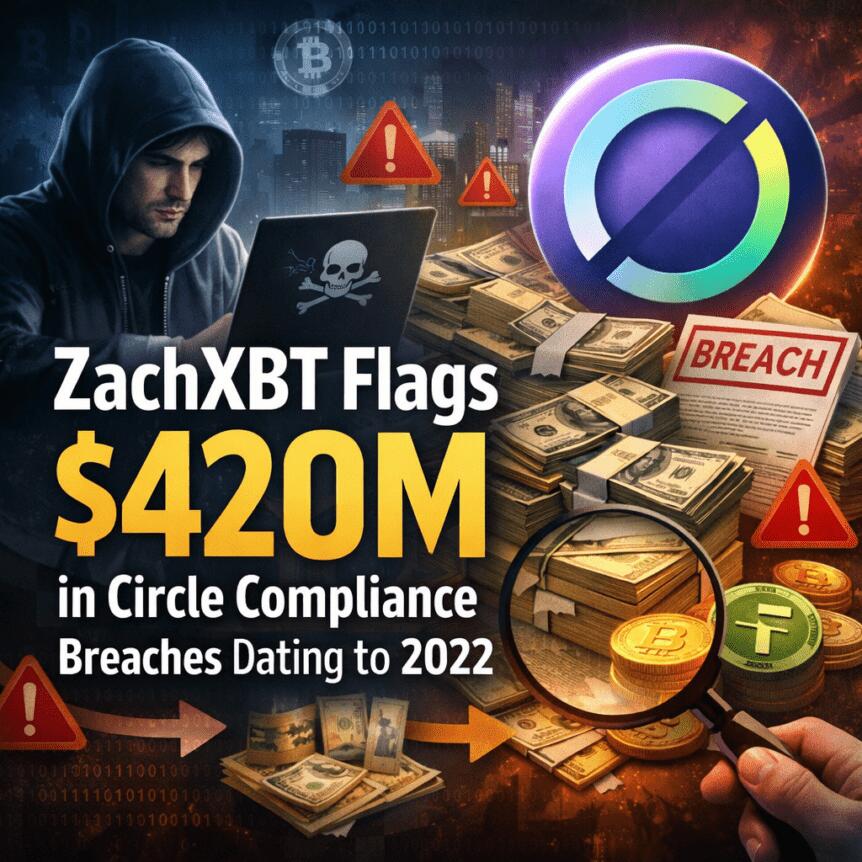
On-chain sleuth ZachXBT has escalated a critique of Circle, the issuer behind the USDC stablecoin, contending that the company has failed to freeze or blacklist roughly $420 million in illicit fund flows since 2022. Circle can freeze assets and blacklist wallets, but ZachXBT argues that the amount of action taken has been minimal in several high-profile cases, including ones tied to North Korea-linked actors, and across multiple hack-and-fraud episodes.
The allegations come amid a broader conversation about the responsibilities of centralized service providers in a crypto ecosystem where illicit activity still flows through centralized rails. ZachXBT frames the issue as one of real-world consequences for users and ecosystems when law enforcement requests and private-sector flags collide with a company’s implementation practices.
“Nine figures were lost from the ecosystem because of repeated inaction across three years on law enforcement requests, private sector requests, and their own infrastructure. The $420 million-plus only accounts for major public cases. The real figure is likely significantly higher.”
Cointelegraph reached out to Circle for comment; as of publication, no immediate response had been received.
Key takeaways
- ZachXBT asserts Circle has not frozen or blacklisted roughly $420 million in illicit USDC flows since 2022, a figure derived from publicly documented cases he tracks.
- Alleged examples include $9 million in USDC linked to the GMX hack in July 2025, which ZachXBT says Circle did not freeze, and $232 million in illicit flows tied to the Drift Protocol incident, where USDC was moved in multiple transactions before action was taken.
- Circle has taken recognizably proactive steps in some cases, such as freezing USDC held by Tornado Cash addresses (sanctioned by OFAC) in 2022, and it has signaled interest in reversible or amendable transaction models for hacks and fraud.
- The discussion feeds into a broader debate about the gatekeeping role of centralized issuers and custodians in a largely decentralized ecosystem, with online discourse spotlighting how enforcement and technology intersect.
What ZachXBT is pointing to—and why it matters
The core of the critique rests on a pattern ZachXBT describes as inconsistent or delayed action by Circle in the face of illicit flows. He highlights several high-profile incidents where USDC moved through centralized rails during or after a hack or fraud event, arguing that Circle’s response in some cases was insufficient to stop or reverse the movement of stolen or fraudulently obtained funds.
Among the episodes cited are the GMX exchange hack in July 2025, which involved illicit transfers of USDC that, according to ZachXBT, were not frozen in a timely manner. In another incident, the Cetus DEX breach in May 2025 led to roughly $200 million in USDC being converted to ETH, with Circle allegedly failing to block or freeze the involved addresses in the moment. A further instance involved the Drift Protocol hack, in which a six-hour window saw attackers move funds from USDC to ETH across numerous transactions, yet Circle reportedly did not intervene swiftly enough to halt those movements.
Beyond individual cases, ZachXBT frames the issue as systemic. He argues that a sustained pattern of inaction—despite law enforcement requests, private-sector notices, and the company’s own infrastructure signals—erodes trust in centralized risk controls and undermines the resilience of the broader ecosystem. The gist, he suggests, is that the cost of inaction is borne by ordinary users who rely on stablecoins for legitimacy, accessibility and liquidity in day-to-day trading and transacting.
Circle’s actions and the evolving debate over reversible transactions
The circle of debate around Circle has been widening over the past year. In September 2025, Circle’s president Heath Tarbert disclosed that the company was exploring “reversible” USDC transactions—an option that could allow funds to be rolled back or amended in response to hacks, theft and fraud. The concept would represent a fundamental shift in stablecoin risk management, offering a remedy in cases where illicit flows slip through conventional controls.
Circle has not shied away from taking action in certain circumstances. The issuer has publicly frozen USDC funds and blacklisted wallets tied to Tornado Cash addresses, a move aligned with OFAC sanctions in 2022. These steps demonstrate that Circle is willing to intervene actively when inputs from regulators or enforcement agencies align with its risk-mremediation framework. How a reversible-system would interact with existing sanctions regimes and private-sector notices remains a topic of intense discussion among auditors, exchanges and users.
Context, risks and the road ahead for investors and builders
The conversation around Circle’s approach sits at the intersection of compliance, user protection and market structure. Proponents of stronger on-chain controls argue that clear, enforceable standards help reduce the gatekeeping risk that centralized entities pose to users who operate across permissioned and permissionless ecosystems. Critics caution that heavy-handed or opaque asset-containment tools could introduce new vectors for market manipulation or hamper legitimate liquidity flows, underscoring the tension between security and permissionless innovation.
For investors and builders, the key questions are where the boundaries lie between legitimate enforcement and overreach, and how policy and technology evolve to address new attack vectors. The incidents cited by ZachXBT underscore that even widely used stablecoins can become flashpoints for debates about responsibility, transparency and accountability among the parties that stand between users and the crypto economy—issuers, exchanges, and custodians alike.
Public commentary from the crypto community—including observers who track on-chain activity—has highlighted the role of centralized actors as potential chokepoints in the flow of illicit funds. Some commentators have pointed to the need for more robust, verifiable compliance signals embedded in stablecoins, while others argue that the best way forward is to design systems with stronger, trust-minimized fraud detection and response capabilities that do not rely solely on centralized intervention.
What to watch next
Key questions remain unsettled: Will Circle move from exploratory reversible transactions toward a concrete, auditable framework for rollback or remediation in hacks? How will regulatory expectations shape Circle’s risk controls and the timing of asset freezes or blacklists? And will further public reporting or independent audits emerge to illuminate how USDC flows are managed in real-world incidents?
As Circle contemplates these questions, the industry will continue to monitor the company’s responses to past incidents and any formal commitments it makes regarding future safeguards. The ongoing debate will likely influence how users evaluate stablecoins’ reliability, how developers design protection layers for on-chain protocols, and how regulators calibrate enforcement around centralized crypto rails.
Readers should stay tuned for any formal statements from Circle and for new data points from on-chain researchers and auditors that could recalibrate the assessment of how USDC and similar stablecoins behave during hacks, fraud, and other stress events.

Bitcoin spot ETFs may soon surpass gold ETFs in assets under management, fracturing the long-standing narrative that “digital gold” is a perfect stand-in for investors seeking a safe haven. Bloomberg ETF analyst James Seyffart shared the view in an interview linked to the Coin Stories podcast, arguing that Bitcoin’s multiple use cases — from store of value to growth asset and liquidity driver — create a broader appeal than gold, which the market typically frames in a single light.
“There are just more use cases of why somebody would put a Bitcoin ETF in a portfolio,” Seyffart said on the podcast. He emphasized Bitcoin’s roles as a store of value, a portfolio diversifier, a form of digital capital, and even a growth-risk asset, suggesting that the crypto may attract a wider spectrum of investors than gold over time. While gold has historically served as a hedge against monetary debasement, Bitcoin’s evolving narrative as both a digital asset and a potential macro hedge underpins the case for larger ETF demand in the years ahead.
Key takeaways
- Bitcoin ETFs could grow to exceed gold ETFs in total assets under management as demand broadens beyond the traditional “digital gold” story, according to James Seyffart, a Bloomberg ETF analyst.
- March ETF flows show divergent momentum: U.S. spot Bitcoin ETFs attracted about $1.32 billion in net inflows, while U.S. gold ETFs recorded net outflows of roughly $2.92 billion.
- A single-day move underscored fragility in precious metals: GLD, the flagship gold ETF, posted a $3 billion withdrawal on March 4, the largest daily outflow in more than two years.
- Longer-run macro signals remain mixed, with data suggesting a rotation dynamic between gold and Bitcoin rather than a single clear trend; Fidelity highlighted a historical pattern of leadership rotating between the two assets.
Flow dynamics in March: what they reveal about narrative shifts
The contrast in March ETF flows underscores shifting investor appetites for duration, liquidity, and narrative potential. Gold ETFs in the United States posted net outflows totaling about $2.92 billion in March, signaling renewed challenges for the traditional safe-haven metal in a period of evolving macro cues. In the same month, US spot Bitcoin ETFs drew approximately $1.32 billion in net inflows, illustrating a growing appetite for crypto exposure in diversified portfolios.
The divergence sits against a broader context in which Bitcoin and gold have moved more cohesively in recent weeks despite the divergent flows. The data points to a market that is re-evaluating the roles of these two hedges and growth assets in a landscape of persistent inflation concerns, evolving monetary policy expectations, and expanding acceptance of crypto-based investment products.
Gold’s pullback and retail versus institutional dynamics
Several pressures shaped gold’s March performance. The largest daily outflow in over two years hit GLD on March 4, reflecting sell-side and perhaps macro rotation pressures that have periodically punctured the gold regime. Meanwhile, more broad-based BIS data — cited by Cointelegraph — show retail gold purchases tripling over the past six months, while Wall Street selling has accelerated over the last four months. The juxtaposition implies a nuanced narrative: retail demand remains resilient even as institutional appetite shifts toward crypto exposure and related investment vehicles.
These dynamics sit alongside anecdotal expectations that a growing cadre of investors view Bitcoin as a “growth risk asset,” complementary to its role as a hedge-friendly reserve. The evolving taxonomy — Bitcoin as a stores of value, digital currency with intrinsic scarcity, and liquidity-rich growth asset — contributes to a broader array of reasons to own a Bitcoin ETF beyond simply “digital gold.”
Price action and broader market context
As of publication, Bitcoin traded around $66,918, down about 8% over the prior 30 days, according to CoinMarketCap data. Gold hovered near $4,676 per ounce, down about 8.25% over the same period, per GoldPrice metrics. The near-term move preserves the sense that both assets have faced headwinds in a mixed macro backdrop, yet the flow data suggests that investor interest in Bitcoin ETFs remains persistent and possibly expanding even as gold faces episodic outflows.
The longer-term rotation story received some color from Fidelity Digital Assets analyst Chris Kuiper. In December 2025, Kuiper noted that historically gold and Bitcoin have rotated leadership, with gold performing strongly at times and Bitcoin catching up in others. That framework remains relevant as market participants weigh regulatory clarity, ETF availability, and the evolving ecosystem around Bitcoin-based investment products.
Implications for investors and markets
The potential overtaking of gold ETFs by Bitcoin ETFs in AUM would mark a notable shift in how investors allocate capital in search of diversification, liquidity, and growth exposure. If Bitcoin ETFs continue to capture inflows beyond the “digital gold” narrative, the market could see a broader base of participants embracing crypto exposure through regulated vehicles. This would not only change the composition of ETF portfolios but could also influence liquidity, product development, and the pace at which financial institutions bring more crypto-enabled offerings to retail and high-net-worth investors alike.
From a portfolio-management perspective, the idea of Bitcoin acting as hot sauce in a diversified mix is persuasive for those seeking a growth-oriented, liquidity-rich sleeve within a broader asset allocation. Yet the data also underscores the need for caution and continued monitoring of regulatory developments, product approvals, and market structure changes that shape the appeal and risk profile of spot BTC ETFs.
In practical terms, readers should watch ETF inflow trends in the coming quarters, the rate of new product approvals, and the evolving evidence on how Bitcoin-based funds perform relative to gold during different macro regimes. The March data points demonstrate that the narrative around Bitcoin ETFs is gaining traction in investor discourse, even as gold maintains its own complex set of drivers and vulnerabilities.
Beyond price moves, the debate now centers on whether Bitcoin ETFs can sustain and broaden their appeal to a broader investor universe — from traditional equity and bond strategists to macro hedge funds and retail savers seeking diversified exposure. If inflows continue and more products arrive, the BTC ETF story may transition from a niche crypto offering to a core component of diversified portfolios.
What matters next is the trajectory of ETF approvals and listings, clear and consistent data on inflows across different regimes, and how macro factors like inflation momentum and monetary policy directions shape the risk-reward calculus for these funds. Investors should stay attentive to monthly flow prints, regulatory signals, and the evolving narrative around Bitcoin’s role in modern asset allocation.
As the market awaits further clarity, the ongoing dialogue around Bitcoin’s ETF potential points to a future where crypto exposure becomes an increasingly standard instrument within traditional investment frameworks. The next few quarters will be telling, as inflows, product breadth, and price action converge to reveal whether Bitcoin ETFs can definitively eclipse gold ETFs in practical assets under management.

Spot Bitcoin exchange-traded funds (ETFs) could surpass gold ETFs in total assets under management (AUM) as investor demand expands beyond the traditional “digital gold” narrative, according to ETF analyst James Seyffart.
“There are just more use cases of why somebody would put a Bitcoin ETF in a portfolio,” Seyffart said on the Coin Stories podcast published to YouTube on Friday. He pointed to Bitcoin’s (BTC) role as digital gold, a store of value, a portfolio diversifier, and a form of digital capital and property, adding that the market also views Bitcoin as a “growth risk asset.”
Seyffart explained that Bitcoin has “all these different ways” of being viewed, while gold only has “one of those things.”
“Our view is that Bitcoin ETFs will be larger than gold ETFs,” he added.
Bitcoin ETFs are a “hot sauce” in the portfolio
“There are so many people that could use it. They could be viewing it to put in their portfolio because they want to bet on like a growth and liquidity trade,” he said. “It can be hot sauce in a portfolio in that way,” he added.

Bitcoin is often compared to gold due to its limited supply and perceived role as a hedge against monetary debasement.
US-based gold ETFs recorded net outflows of $2.92 billion in March, while US spot Bitcoin ETFs attracted $1.32 billion in net inflows over the same period.
Gold and BTC have declined over the past 30 days
The largest US gold-backed ETF, GLD, recorded a $3 billion outflow on Mar. 4, the largest daily withdrawal in more than two years.
On Mar. 19, Cointelegraph cited data from the Bank for International Settlements (BIS) showing retail gold purchases have tripled over the last six months, while Wall Street selling has accelerated over the past four months.
Related: Bitcoin ‘done’ with 85% crashes, says Cathie Wood amid new $34K target
Despite the divergence in ETF flows, both assets have moved broadly in tandem in recent weeks.
Bitcoin is trading at $66,918 at the time of publication, down 8.07% over the past 30 days, according to CoinMarketCap. Meanwhile, gold is trading at $4,676, down 8.25% over the past 30 days, according to GoldPrice data.
In December 2025, Fidelity Digital Assets analyst Chris Kuiper said that, “historically, gold and Bitcoin have taken turns outperforming. With gold shining in 2025, it would not be surprising if Bitcoin takes the lead next.”
Magazine: Solana exec trolls crypto gamers, Pixel tackles play-to-earn issues: Web3 Gamer

TLDR:
- The tokenized US Treasury market hit $12B, far below the $6T traditional money market fund sector.
- Regulatory obligations follow the entities managing assets, not the tokens representing them onchain.
- Embedded compliance built into RWA protocols removes costly intermediary layers found in traditional markets.
- Major jurisdictions including the EU, Singapore, Hong Kong, and Japan are actively building RWA frameworks.
RWA regulation is no longer a side conversation in crypto — it has become the central pillar of tokenized asset infrastructure. As real-world assets move onchain, they carry existing legal obligations with them.
The technology to tokenize bonds, private credit, and equities already works well. However, the legal and compliance layer determines whether those assets carry real, enforceable value for investors.
Without regulatory infrastructure, a tokenized bond is simply a token referencing a bond — nothing more.
The Trust Gap Holding Back Institutional Capital in RWA
The tokenized US Treasury market reached roughly $12 billion as of March 2026. By contrast, the traditional US money market fund industry manages over $6 trillion.
That gap is not a technology problem. The blockchain settles transactions faster, and onchain access is broader than in legacy markets.
The barrier is trust, not capability. A pension fund evaluating a tokenized product needs far more than a working smart contract.
Its compliance team, legal counsel, and board must each confirm that the obligations governing the underlying asset are fully met. That confirmation cannot be approximated — it must be complete.
That standard reflects fiduciary responsibility. These allocators manage other people’s money and carry strict legal accountability for each product they hold.
Every tokenized instrument must meet the same legal standards as traditional market instruments alongside it. That is not a preference — it is a legal requirement.
Plume Network addressed this issue through its RWA Academy series. The team noted that regulatory clarity is “the precondition for institutional capital” in the RWA space.
Regulatory obligations do not sit with the asset itself — they sit with the entities that issue, transfer, and facilitate trading in it. RWA infrastructure must allow those entities to discharge their responsibilities clearly.
Embedded Compliance Is Transforming How RWA Infrastructure Is Built
One key shift in RWA is the transition from bolt-on compliance to embedded compliance. In traditional markets, intermediaries handle compliance at every step of a transaction. Each additional layer adds cost, introduces delay, and reduces transparency for all parties.
Onchain systems can instead build compliance directly into the protocol itself. Transaction screening, transfer restrictions, and KYC/AML verification can all operate within the system. That design eliminates the need for separate compliance layers added after the fact.
The result is a network where compliance is an intrinsic property rather than an add-on feature. That distinction matters enormously for regulated institutions evaluating RWA markets. Institutional adoption of RWA depends on this structural credibility, not just smart contract functionality.
Regulators across major jurisdictions are aligning around the same direction. Europe’s MiCA framework took effect in 2024 and covers all 27 member states.
Hong Kong’s Project Ensemble and Singapore’s Project Guardian are both testing tokenized financial markets with regulatory involvement.
South Korea and Japan are each updating their digital asset laws to accommodate onchain flows. Cross-border fragmentation remains a challenge, but shared principles across frameworks are becoming clearer each month.

Southern California wildfire prompts evacuation orders

WWE SmackDown Delivers High-Stakes Matches and Orton-Rhodes Tension on April 3, 2026

Ethereum (ETH) Weathers $1B Selloff as Foundation Nears Staking Milestone


-

 NewsBeat2 days ago
Steven Gerrard disagrees with Gary Neville over ‘shock’ Chelsea and Arsenal claim | Football
-

 Business1 day ago
No Jackpot Winner and $194 Million Prize Rolls Over
-
Entertainment5 days ago
Fans slam 'heartbreaking' Barbie Dream Fest convention debacle with 'cardboard cutout' experience
-

 Fashion13 hours ago
Weekend Open Thread: Spanx – Corporette.com
-

 Crypto World2 days ago
Gold Price Prediction: Worst Month in 17 Years fo Save Haven Rock
-

 Tech5 days ago
The Pixel 10a doesn’t have a camera bump, and it’s great
-
 Entertainment6 days ago
Lana Del Rey Celebrates Her Husband’s 51st Birthday In New Post
-
Crypto World4 days ago
Dems press CFTC, ethics board on prediction-market insider trades
-

 Tech5 days ago
Avatar Legends: The Fighting Game comes out in July and it looks pretty slick
-

 Sports4 days ago
Tallest college basketball player ever, standing at 7-foot-9, entering transfer portal
-

 Fashion6 days ago
Amazon Sundays: Soft Spring Layers
-

 Tech4 days ago
EE TV is using AI to help you find something to watch
-

 Business2 days ago
Login and Checkout Issues Spark Merchant Frustration
-

 Tech6 days ago
Elon Musk’s last co-founder reportedly leaves xAI
-

 Tech4 days ago
How to back up your iPhone & iPad to your Mac before something goes wrong
-

 Politics4 days ago
Should Trump Be Scared Strait?
-

 Crypto World4 days ago
U.S. rule change may open trillions in 401(k) funds to crypto
-

 Fashion5 days ago
The Best Spring Trends of 2026
-

 Tech5 days ago
Apple will hide your email address from apps and websites, but not cops
-

 Tech4 days ago
Flipsnack and the shift toward motion-first business content with living visuals
You must be logged in to post a comment Login