China has moved to ban one of the most iconic Tesla vehicle features in order to get a handle on vehicle safety.
New safety regulations published by China’s Ministry of Industry and Information Technology state that cars sold in China will be required to have mechanical releases on their door handles, according to TechCrunch. The outlet added that the rules, which go into effect on Jan. 1, 2027, will ban hidden, electronically activated door handles.
Advertisement
Under the new rules, each vehicle door, except for the tailgate, will need to be equipped with a manually-released external door handle and vehicles will be required to have a mechanical release on the interior, TechCrunch reported.
A Tesla model Y is shown charging at a Tesla dealership in Buena Park, Calif., Jan. 28, 2026. (Mike Blake/File Photo/Reuters / Reuters)
China is the first country to implement such a ban. While the feature was made popular with Teslas, Chinese competitors, including Xiaomi, have adopted the design, according to Reuters.
The ruling followed high-profile incidents in which power failures were suspected to have prevented the doors from opening, leaving people trapped and unable to escape or be rescued, Bloomberg reported. The outlet said that two of the incidents included fiery crashes involving Xiaomi Corp. EVs.
Advertisement
“China is shifting from being just the largest EV market to being a rule-setter for how new vehicle technologies are regulated,” Bill Russo, founder of Shanghai-based consultancy Automobility, told Bloomberg. “By moving first, Beijing can use its huge domestic market to lock in safety standards that both Chinese and foreign automakers must follow at home — and that may ultimately travel with Chinese EV exports and influence global norms.”
A woman opens the door for a Tesla Model YL electric vehicle at a showroom in Beijing on Feb. 3, 2026. China will ban hidden door handles on cars sold in the country from next year, phasing out the minimalist design popularized by Tesla over safety c (Pedro Pardo / AFP via Getty Images / Getty Images)
In December, the Office of Defects Investigation (ODI), which is under the National Highway Traffic Safety Administration (NHTSA), opened a defect probe into the Tesla Model 3 sedan’s emergency door release controls, Reuters reported. The investigation reportedly included approximately 179,071 model year 2022 vehicles.
Visitors look at a Xiaomi SU7 electric vehicle displayed at the Beijing International Automotive Exhibition, or Auto China 2024, in Beijing, China, April 25, 2024. (Tingshu Wang/Reuters)
Federal Motor Vehicle Safety Standard No. 206 lays out requirements for vehicle door locks and door retention components to help prevent occupants from being ejected during a crash.
A representative for NHTSA pointed out to FOX Business that while FMVSS No. 206 does not have specific requirements mandating a manual door release if power is lost, failing to provide a reasonable way for occupants to enter or exit a vehicle could be considered a safety defect and lead to a recall. However, the opening of a defect petition does not automatically mean that a recall will be issued.
FOX Business reached out to Tesla and Xiaomi for comment.
The owners of Mumbles Pier need more time to build two new pavilions and refurbish the former lifeboat house to create a pop-up restaurant.
Advertisement
Swansea Council gave family-owned pier company Amusement Equipment Company Ltd planning permission for the scheme in 2021 subject to conditions. The project also involves replacing the bridge leading from the pier to the lifeboat house, which was replaced by a new one at the end of the pier in 2014.
One of the stipulations was that work needed to start within five years and because it hasn’t the company has applied to Swansea Council to push back the start date by a further five years.
The owners also expect an extension can allow them to resolve any outstanding planning conditions. How to accommodate kittiwakes on new nesting ledges on the Grade II-listed structure has been one of the points of discussion. Environment body Natural Resources Wales has previously said Mumbles Pier was one of the largest and most important nesting sites for the birds in Wales.
The old lifeboat house (left) and bridge at Mumbles Pier(Image: Richard Youle )
The 255m-long pier was built in 1898 and the adjacent lifeboat house added in 1922. The pier, which was listed in 1991, originally had two pavilion buildings either side of the walkway near the bridge leading to the lifeboat house. The two new ones are proposed for retail and cafe use.
In 2014 a new £11m lifeboat house and slipway were built by search and rescue charity the RNLI at the end of the pier and the redundant one was acquired by Amusement Equipment Company Ltd. There is said to be potential for boat trips from the old lifeboat house slipway.
Swansea Council’s planning department welcomed the planned public re-use of the lifeboat house when it approved the scheme in 2021.
“Many of the similar period lifeboat houses at Tenby and St Davids which also became redundant with the introduction of the larger Tamar-class lifeboat are listed structures that have been converted to private homes,” it said in a decision report.
Advertisement
The new RNLI lifeboat base at Mumbles Pier hasn’t housed the Tamar-class lifeboat for more than three years after a structural engineer, according to the RNLI, identified issues with the pier structure. The vessel is on a swing mooring at sea instead.
The pier is closed to the public part-way down. Amusement Equipment Company Ltd restored sections of it several years ago and plans to complete the work. Meanwhile it also has planning consent for flats along the nearby foreshore, a new boardwalk and a headland hotel.
The Local Democracy Reporting Service has contacted the company but it had not responded at the time of publication.
President Donald Trump on Thursday nominated Erica Schwartz to serve as director of the Centers for Disease Control and Prevention, concluding a monthslong effort to choose a permanent leader of the embattled health agency.
Advertisement
Schwartz will have to be confirmed by the Senate, and would take over the role as Health and Human Services Secretary Robert F. Kennedy Jr. oversees a string of controversial health policy changes at the agency, including an overhaul of childhood vaccine recommendations.
Schwartz served as deputy surgeon general during the first Trump administration, where she played a major role in the U.S. response to the Covid-19 pandemic. She spent more than 20 year in uniform, including as rear admiral and chief medical officer of the Coast Guard.
Dr. Jay Bhattacharya had been acting director of the CDC – a title that expired last month under federal law. That law, called the Vacancies Act, limits the amount of time an acting officer can serve in place of a Senate-confirmed official to 210 days.
Late last month marked 210 days since the most recent CDC director, Dr. Susan Monarez, was fired.
Advertisement
A sign sits outside of the Centers for Disease Control and Prevention (CDC) Roybal campus in Atlanta, Georgia, U.S. March 18, 2026.
Megan Varner | Reuters
She has so far been the only person to serve as a confirmed CDC director during Trump’s second term, holding the role for under a month last summer. In congressional testimony in September, Monarez said she was fired after refusing Health and Human Services Secretary Robert F. Kennedy Jr.’s demands to approve vaccine recommendations she believed lacked scientific support.
It is unclear how Schwartz’s views on vaccines or other key public health policies compare with Kennedy’s.
Advertisement
Also on Thursday, Trump said he chose Sean Slovenski as deputy CDC director and chief operating officer, and Jennifer Shuford as deputy CDC director and chief medical officer. Shuford, as head of the Texas Department of State Health Services, led the state’s response to a massive measles outbreak last year, and credited vaccination and testing in declaring it over.
Schwartz’s nomination comes after a tumultuous several months for the agency, which is reeling from the leadership upheaval, plummeting morale, significant staff turnover and controversial changes to U.S. vaccine policy. Ahead of leadership departures last summer, staff was shaken by a gunman’s attack on the CDC’s Atlanta headquarters on Aug. 8.
Last month, a judge blocked a critical vaccine panel’s efforts to overhaul U.S. immunization policy. That includes an effort to reduce the number of recommended childhood shots from 17 to 11.
Trust in federal health agencies has plummeted during Kennedy’s tenure as Health and Human Services secretary, according to a February poll from health policy research group KFF, with declines across the political spectrum.
OpenTheBooks CEO John Hart joins Varney & Co. to discuss long-term Social Security and Medicare deficits as fiscal pressures mount.
American retirees who are receiving Social Security will see an annual cost of living adjustment (COLA) next year, and a new report projects that next year’s benefit increase may be smaller than many retirees expect.
A new analysis by The Senior Citizens League (TSCL) predicts that Social Security’s 2027 COLA will be 2.8%, which would be the same benefit boost as the 2026 COLA.
Advertisement
That would amount to an increase in the average Social Security benefits check for retired workers of $56.69, raising the benefit from $2,024.77 to $2,081.46 per month.
“Americans are right to worry about our current COLA projection,” said TSCL executive director Shannon Benton. “The fact is that most senior households already get by on only about 58% as much income as their working-age counterparts, and you’d be hard-pressed to find a middle-class or working-class American who thinks the economy is doing well right now, especially as oil prices rise.”
The Social Security Administration’s 2027 COLA will be based on inflation data from July, August and September, with an announcement in October. (Saul Loeb/AFP via Getty Images)
The Social Security Administration (SSA) computes the annual Social Security COLA using a variant of inflation data from the consumer price index (CPI) based on the months of July, August and September. The agency announces the COLA each October, although last year’s announcement was delayed by a government shutdown.
Advertisement
TSCL’s estimate of a 2.8% COLA for 2027 was based on the year-over-year CPI-W reading coming in at 2.2% in both January and February, then rising to 3.3% in March.
Inflation jumped in March largely due to the energy supply shock caused by the Iran war disrupting the flow of oil from the Middle East, as tanker traffic through the Strait of Hormuz was at a standstill due to the conflict.
Economists have warned that inflation may rise further in the next few months and could remain elevated through the end of the year depending on how long the energy impact of the conflict goes on, though there is uncertainty around those projections related to the war’s duration and resolution.
Advertisement
Social Security’s main trust fund is being depleted due to the aging of America’s population and rising enrollment, causing expenses from benefit payments to rise beyond what the trust fund and incoming payroll tax receipts can cover.
Recent projections estimate it will reach insolvency in 2032, at which time benefits would be cut by an estimated 24% across the board to match incoming revenue.
Social Security’s main trust fund is projected to reach insolvency in 2032. (Mark Felix/The Washington Post)
TSCL also criticized a recent proposal to reform Social Security that would cap annual benefits for higher income Americans at $50,000 for an individual or $100,000 for couples.
Advertisement
The Six Figure Limit proposal put forward by the nonpartisan Committee for a Responsible Federal Budget (CRFB) would only affect a small fraction of Americans. The group notes that while it wouldn’t significantly delay the insolvency of Social Security trust funds on its own, it could “meaningfully delay insolvency in combination with other reforms.”
TSCL’s Benton said that, “Reforming Social Security needs to follow a two-pronged approach, strengthening revenues and benefits at the same time to ensure prosperity for all Americans, of all ages.”
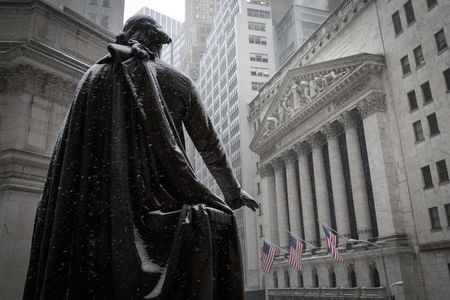
NEW YORK — The S&P 500 edged higher Thursday, closing at another all-time high near 7,038 as investors brushed aside lingering concerns over the U.S.-Iran conflict and focused on the start of first-quarter earnings season, particularly from technology giants driving artificial intelligence spending.
S&P 500 Climbs to Fresh Record High Near 7038 as Tech Earnings Optimism Overshadows Geopolitical Risks
The benchmark index finished the session at 7,038.24, up 15.29 points or 0.22 percent, marking its latest record close after surging more than 10 percent from late March lows. The modest gain followed Wednesday’s stronger advance when the index first closed above 7,000 for the first time, capping a remarkable recovery fueled by easing fears that the Middle East conflict would severely disrupt global energy supplies or derail economic growth.
The Nasdaq Composite, heavily weighted toward technology stocks, also pushed to fresh records, extending an 11-session winning streak in recent trading. The Dow Jones Industrial Average lagged slightly, reflecting mixed performance in more traditional industrial and financial names.
Analysts attributed the resilience to growing confidence that diplomatic efforts between the U.S. and Iran could prevent a worst-case escalation, including any prolonged blockade of the Strait of Hormuz that had earlier sent oil prices spiking. With oil stabilizing around recent levels, investors rotated back into risk assets, particularly those tied to the ongoing AI infrastructure boom.
Corporate earnings provided additional support. Netflix Inc. was among the most anticipated reports after the bell Thursday, with Wall Street expecting revenue growth exceeding 15 percent and continued subscriber momentum from password-sharing crackdowns and advertising tier expansion. Strong results from the streaming leader and other communication services names helped lift the broader market, as investors priced in resilient consumer spending despite higher interest rates.
Advertisement
Technology remained the clear outperformer. Companies benefiting from hyperscaler demand for GPUs, data centers and AI-related infrastructure continued to draw buying interest. The sector’s projected earnings growth for the first quarter hovered near 45 percent year-over-year in some estimates, far outpacing the S&P 500’s overall forecast of roughly 12.6 percent — marking what could be the sixth consecutive quarter of double-digit profit expansion for the index.
“Earnings momentum, especially in tech and AI-adjacent plays, is giving investors a reason to look past the headlines,” said one strategist at a major Wall Street firm. “The market has recovered all its war-related losses from March and is now testing new highs on the back of solid fundamentals rather than pure hope.”
The rally from late March lows has added trillions in market value, with the S&P 500 erasing earlier 2026 declines that at one point left the index down about 4 percent for the year amid heightened geopolitical tensions and uncertainty over Federal Reserve rate policy. Year-to-date, the benchmark now sits comfortably positive, though gains remain concentrated in a handful of mega-cap names.
Broader participation has improved modestly. While the “Magnificent Seven” stocks still dominate headlines, analysts note early signs of rotation into other sectors as Q1 results roll in. Financials, industrials and consumer discretionary names posted mixed results Thursday, reflecting varied exposure to higher borrowing costs and any potential slowdown in capital spending.
Advertisement
Bond yields remained relatively stable, with the 10-year Treasury yield hovering near recent levels as traders weighed the balance between resilient growth data and the Fed’s likely path. No rate cut is fully priced in for the near term, but markets continue to anticipate eventual easing if inflation pressures from energy markets subside.
International developments also played a role. Optimism around possible U.S.-Iran negotiations helped calm energy markets, though any breakdown in talks could quickly reignite volatility. European and Asian stocks showed mixed performance overnight, with some regional indices gaining on hopes of contained conflict spillover.
Looking ahead, investors face a packed earnings calendar. Major banks and industrial giants report in coming days, followed by more tech heavyweights. Consensus calls for continued strength in AI-related capital expenditures, with hyperscalers like Microsoft, Amazon, Meta and Google parent Alphabet guiding for hundreds of billions in combined spending this year alone.
Yet risks persist. Valuation concerns linger for high-flying AI stocks after years of rapid gains. Some strategists warn that if earnings growth fails to meet elevated expectations, the market could face a pullback. Geopolitical flare-ups, sticky inflation or slower-than-expected economic data could also test the recent optimism.
Advertisement
Smaller companies in the Russell 2000 lagged the large-cap benchmarks again Thursday, underscoring the narrow breadth that has characterized much of the rally. Value-oriented sectors have struggled to keep pace with growth names, prompting some fund managers to advocate for greater diversification.
For individual investors, the S&P 500’s climb to new highs reinforces its role as a core long-term holding. The index has historically delivered strong returns over multi-year periods despite periodic corrections, with many 401(k) plans heavily tied to broad market exposure.
Thursday’s trading volume was solid but not extreme, suggesting steady institutional participation rather than frantic retail buying. Options activity showed elevated interest in near-term protection, reflecting caution even amid the upbeat mood.
The S&P 500’s 52-week range now spans from roughly 5,100 earlier in the cycle to the current record territory above 7,000, illustrating both the depth of last year’s gains and the speed of the 2026 recovery. Market capitalization of U.S. equities has swelled, adding significant paper wealth to retirement accounts and institutional portfolios.
Advertisement
As the trading day wound down, futures pointed to a modestly higher open Friday, with focus shifting to any late-breaking news from Netflix’s earnings call and forward guidance. A beat on subscriber adds or advertising revenue could further embolden bulls, while cautious commentary on content spending or churn might temper enthusiasm.
Economists continue to monitor consumer resilience. Recent data showed steady spending despite higher prices in certain categories, supporting the soft-landing narrative that has underpinned much of Wall Street’s rebound.
In summary, Thursday’s modest advance to a fresh record capped a strong two-week stretch for the S&P 500, driven by de-escalation hopes in the Middle East, anticipation of robust corporate profits and the enduring appeal of technology and AI themes. Whether the momentum sustains will depend on the earnings deluge ahead and any fresh developments on the global stage.
The benchmark’s ability to push through 7,000 and keep climbing highlights the market’s capacity for rapid recovery when fear subsides and fundamentals reassert themselves. For now, bulls remain in control, though many participants stand ready to reassess at the first sign of disappointment.
The sector is already benefiting from stronger order pipelines and improving execution visibility, said Harsha Upadhyaya, chief investment officer at the $60 billion money manager. Industrials and financial stocks make up more than half of his Kotak Large and Midcap Fund, which has beaten 98% of peers in the last five years, according to data compiled by Bloomberg.
Recent global conflicts will drive further defense investments, he said in an interview last week. Evolving warfare trends, particularly the increasing use of electronic systems, are also driving sustained demand for domestic players, he added.
Indian defense firms have rallied in recent years on the back of policy support to boost domestic production and the government’s focus on local procurement and capability building. Upadhyaya said the geopolitical environment will likely accelerate that shift, strengthening the long-term investment case for the sector.
Advertisement
The fund added radar maker Astra Microwave Products Ltd. in March, the worst month for Indian equities since the pandemic. It also counts state-run peer Bharat Electronics Ltd. as a top holding. A defense sector measure representing companies from aerospace to missile makers has delivered more than 50% average returns over the last three years, outperforming most sectoral gauges in India.
Live Events
ETMarkets.com
Upadhyaya remains bullish on defense but has kept portfolios diversified in amid volatility, staying fully invested while selectively adding to preferred sectors. Indian stocks have underperformed their regional peers since the start of 2025, mainly due to worries over slowing earnings growth while geopolitical challenges, including the Iran war, continues to hurt outlook. MSCI Inc.’s gauge of Indian shares is down more than 5% this year versus an 11% advance in its Asian measure. Financial stocks also look attractive after the recent market drop, he said. The sector has come under pressure since early March, dragged by the central bank’s tighter currency trading rules and a sharp selloff in India’s biggest private-sector lender HDFC Bank Ltd. Still, steady credit growth and a stabilizing interest-rate outlook should aid shares, Upadhyaya said.
“Financials were available at reasonable valuations even before the fall,” he said. Recent additions in this space include beaten-down private lender IndusInd Bank Ltd., along with shadow lenders Shriram Finance Ltd. and Bajaj Finance Ltd., Bloomberg-compiled data show.
Zerodha traders didn’t pay Rs 25,620 crore due to its zero brokerage on delivery trades feature from 2016 to 2025, revealed the company’s founder and CEO Nithin Kamath, who says the firm’s decision to not chase revenue targets has been a “blessing”.
In a blog post on Zerodha’s website, Kamath said the absence of external investors and pressure to deliver on aggressive growth has enabled the company to stay true to its core principles.
These include not spamming users, not tracking behaviour, avoiding differential pricing, and steering clear of practices that may not be in customers’ best interests. He noted that while these ideas are easy to state, they are far more difficult to consistently follow, especially when compared with the approach taken by many listed peers.
Zerodha remains among the few brokers that offer zero brokerage on delivery trades. Kamath said the company does not send notifications aimed at increasing trading activity, does not push margin funding to encourage borrowing, and does not follow differential pricing across products. It also avoids cross-selling financial products, advertising, or using customer data to drive additional revenue streams.
Advertisement
He attributed this approach to Zerodha’s decision to remain bootstrapped. Without external capital, the company does not face the pressure to justify revenue targets or deliver rapid growth. Kamath said this flexibility is especially valuable in the broking business, which is inherently cyclical and closely linked to market conditions. He also highlighted the regulatory risks in the sector, noting that entire segments can be disrupted overnight by policy changes.
Live Events
Despite not spending on advertising or incentives, Kamath said 25% to 30% of Zerodha’s new accounts come through referrals. He described this as one of the most meaningful indicators of customer trust and satisfaction. Kamath acknowledged that the temptation to push users harder or extract more revenue always exists, but said the company has stayed committed to its founding philosophy of treating customers the way it would want to be treated. He added that avoiding customer acquisition costs has been key to maintaining this discipline, as heavy spending on marketing would inevitably require trade-offs in monetisation.This approach has allowed Zerodha to keep costs low for users, including zero brokerage on equity investing, free direct mutual fund investments, and low intraday charges. Kamath noted that brokerage rates have remained unchanged even as much of the industry has revised pricing. Adjusted for inflation, he said, Zerodha would have had to charge Rs 50 today.
For the company, the priority remains building strong products and maintaining trust. Kamath said Zerodha would rather grow alongside its customers than at their expense.
(Disclaimer: Recommendations, suggestions, views and opinions given by the experts are their own. These do not represent the views of The Economic Times)





























































You must be logged in to post a comment Login