








Connect with us
DAPA Banner

Tech

The Boomboxes That Ruled the Streets: The Most Iconic Models Through the Decades

Published

on

For the uninitiated or anyone who thinks “portable audio” means a waterproof pill clipped to a backpack, the boomboxes that ruled the streets were the original mobile music weapons. Born in the late 1960s and peaking in the late ’70s and ’80s, these weren’t just stereos you carried around; they were cultural battering rams. Think Fab 5 Freddy on your TV, Yo! MTV Raps in full rotation, the Beastie Boys causing trouble in a Brooklyn alley, and breakdancers turning flattened cardboard into battlegrounds.

Boomboxes transformed sidewalks into dance floors and backseats into clubs. These weren’t gadgets. They were attitude, wrapped in metal and plastic, blasting identity at unsafe volume levels.

Back then, a ghetto blaster wasn’t a polite lifestyle accessory with Bluetooth and passive-aggressive EQ presets. It was a war chest with woofers; loud, heavy, unapologetic. Models like the JVC RC-M90, Lasonic TRC-931, Sharp GF-777, and Panasonic RX-5600 didn’t just play music; they announced your presence and dared anyone nearby to argue with your taste. And nobody embodied that energy more than Radio Raheem, hauling his box like a sonic manifesto in Do the Right Thing.

Advertisement

Before playlists were swiped, skipped, and forgotten, there were mixtapes—built in real time, often straight off the radio, finger hovering over the pause button like it mattered. Because it did. A mixtape was intent. Sequencing was personal. A Maxell XLII-S with Sharpie handwriting wasn’t nostalgia; it was proof you cared enough to get it right. Boomboxes carried those tapes into the streets, and for a while, they made the world listen.

What Is a Boombox? The Original Portable Stereo Explained

A boombox is a large, portable, battery-powered audio system with built-in speakers, a radio, and a cassette player and recorder. First appearing in the late 1960s, the format hit its peak in the 1980s and early 1990s. Later versions added CD players and, much more recently, Bluetooth and USB connectivity, but the basic idea never changed. A big box, a solid handle, and enough output to make sure your music was heard whether anyone asked for it or not.

The name boombox came from its integrated stereo speakers and their ability to deliver loud, booming sound. The nickname ghetto blaster came later, born on the streets rather than in a marketing meeting. These things were not polite. They were heavy, power-hungry battery pigs that chewed through D-cells like candy, and carrying one any real distance counted as arm day. Portability was relative. You could move it, but you were going to feel it.

While the ghetto blaster became closely associated with early rap and the rise of hip-hop culture, it was never limited to a single genre. Boomboxes powered block parties, fueled breakdancing battles, and blasted everything from rap and R&B to funk, reggae, pop, and rock. For teens and twenty-somethings, the boombox was more than a way to listen to music. It was a status symbol, a social magnet, and a public declaration of taste delivered at full volume.

Advertisement

Let’s take a look at some of the most notable boomboxes from the era when they ruled the streets.

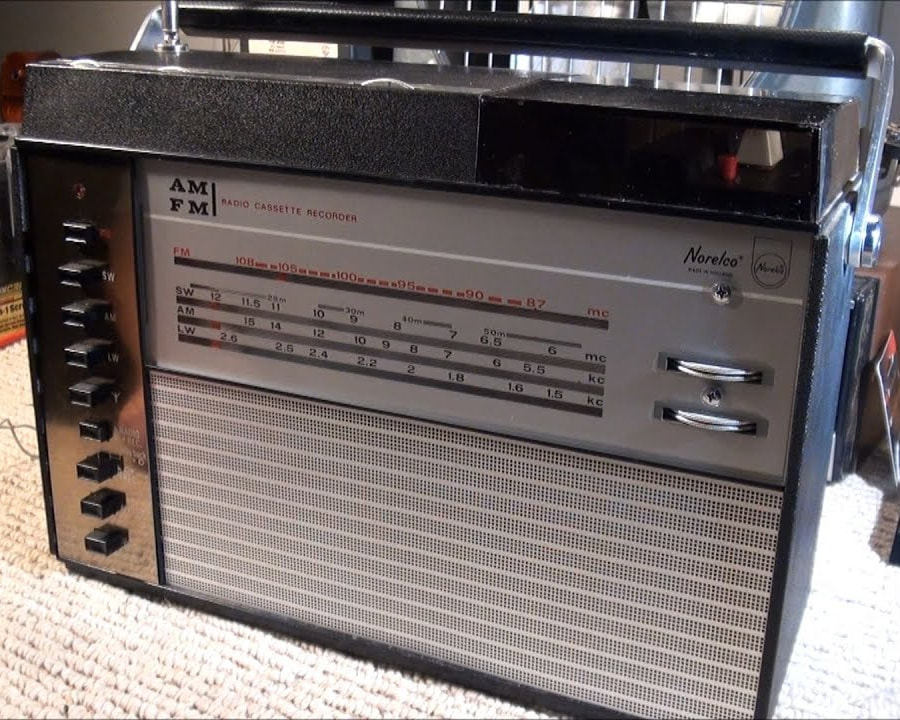
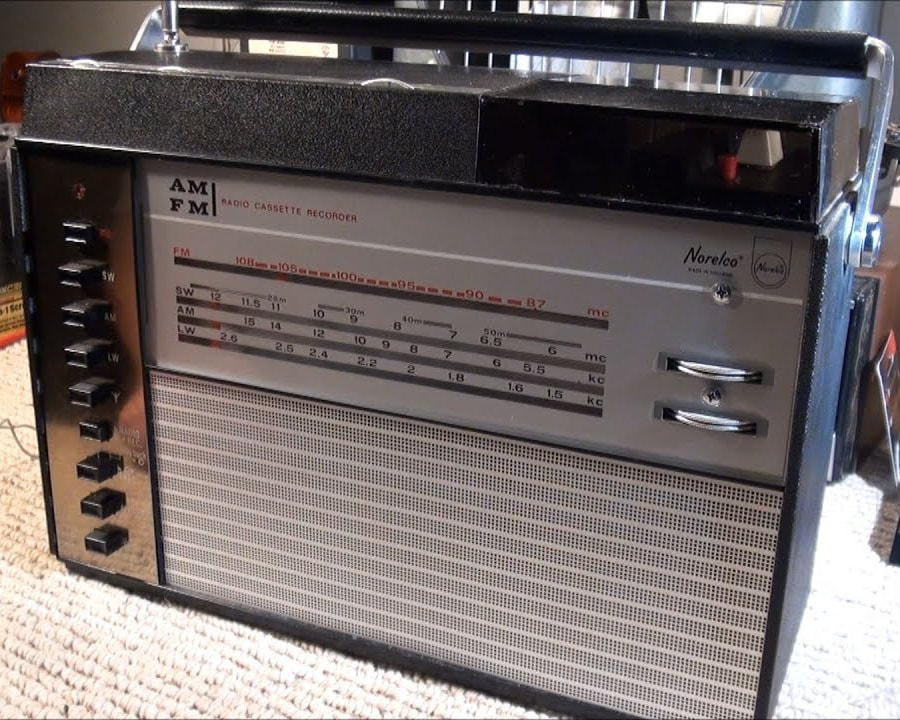
Norelco 22RL962

norelco-22rl962-boombox-1966

The Norelco 22RL962, made by Netherlands-based Philips (the same company that invented the compact audio cassette), is widely credited as the first true boombox. Introduced in the late 1960s, the 22RL962 established the core formula: portability, battery operation, a built-in speaker, and a single box that combined radio and tape playback.

Equipped with a carrying handle, AM/FM radio, and a compact cassette player and recorder, the 22RL962 delivered a modest 1 watt of output through its integrated speaker. Crucially, it was the first consumer audio product that allowed users to record radio broadcasts directly to cassette tape for later listening, a feature that would become central to mixtape culture in the decades that followed.

Additional connections included inputs for an external power supply, external loudspeaker or earphones, a microphone, and even a wired remote control. None of this came lightly. The 22RL962 weighed nearly 9 pounds, making it a serious haul by today’s standards and a reminder that early portability came with muscle strain included.

Advertisement. Scroll to continue reading.
Advertisement

The original U.S. price was approximately $500, listed at 5,995 Austrian schillings at the time. Today, value depends heavily on condition, originality, and whether the unit still functions, but demand remains strong among collectors who recognize it as the box that started it all.

Check out more details from the Radio Museum or YouTube demo.

Aiwa TPR-930

aiwa-tpr-930-boombox

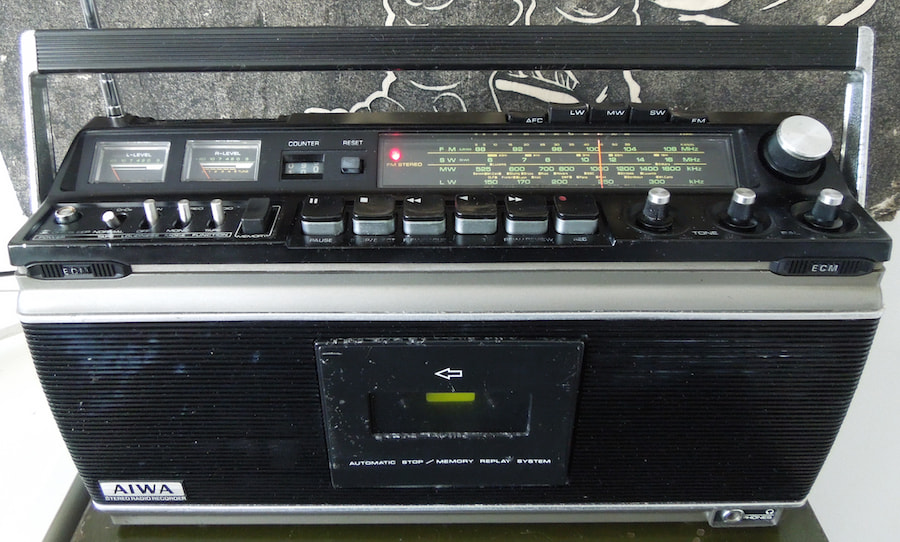
AIWA was one of the most respected audio brands of the last quarter of the 20th century, and in 1974 it entered the emerging boombox market with the TPR-930. Built like a small appliance rather than a toy, the TPR-930 reflected AIWA’s reputation for serious engineering at a time when portability still meant compromise.

Packed with 40 transistors, an integrated circuit, and a four-speaker system, the TPR-930 delivered sound quality that still earns it respect among collectors. Its heavy-duty construction came at a cost. With batteries installed, it tipped the scales at roughly 13.75 pounds, making it a true battery pig and a reminder that early boombox portability required commitment.

The TPR-930 featured a wide-band radio tuner covering SW1, SW2, AM, and FM, along with a single cassette deck. Supporting features included AIWA’s Matrix Sound System, Loudness control, AFC for more accurate radio tuning, Automatic Stop, and a Memory Replay System. It also supported CrO₂ tapes, included a three-digit analog tape counter and a built-in condenser microphone, and offered connections for external 4-ohm speakers.

Advertisement

Originally priced between $150 and $200 during its production run, the TPR-930 reportedly still trades in that same range today depending on condition. For collectors looking for a historically important boombox with legitimate sound quality, it remains one of the better bargains in the category.

Check out more details from the Radio Museum or YouTube demo.

National Panasonic Ambience RX-7000

national-panasonic-rx-7000-boombox

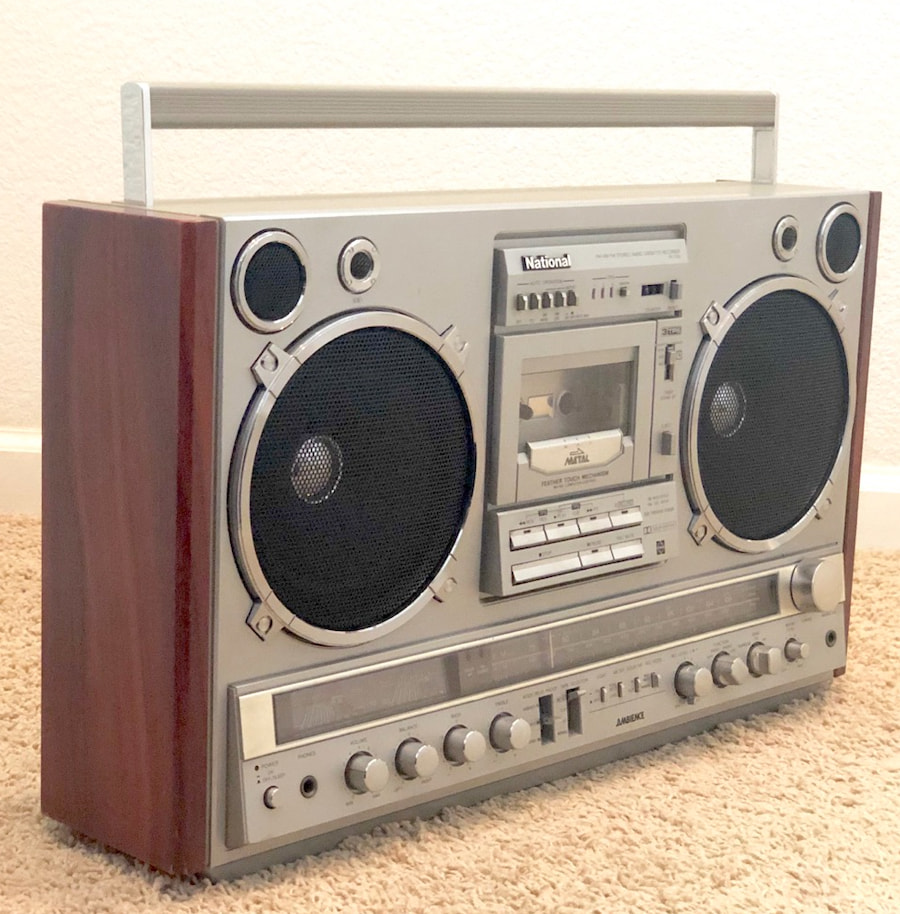
First released in the 1977-1978 timeframe, the National Panasonic Ambience RX-7000 was conceived as a high-end boombox equally comfortable anchoring a living room or making a very loud statement outside. This was not a casual portable. It was Panasonic aiming straight at the top of the category.

At its core, the RX-7000 combined an AM/FM radio with a single cassette deck, but the deck itself was unusually sophisticated for the era. Features included a tape counter, Dolby B noise reduction, Panasonic’s “3 TPS” Tape Program Sensor, a Feather Touch mechanism, microcomputer control, play and record timers, cue and review functions, manual or automatic record level control, support for Normal, FeCr, CrO₂, and Metal tapes, and a Dolby LED indicator.

Supporting features were equally comprehensive. The front panel included VU, tuning, and battery meters, mono, stereo, and Ambience (stereo-wide) listening modes, balance, bass, and treble controls, an FM stereo indicator, and a terminal for a wired remote control. Inputs were generous, with dual microphone jacks featuring mixing level control, an RCA phono input with ground terminal, and a headphone output.

Advertisement

One standout capability was amplification. In addition to its built-in speaker system, the RX-7000’s amplifier delivered 2 x 11 watts RMS and could power modest external speakers via dedicated terminals. The internal speaker array consisted of two 2-inch tweeters and two 6-inch woofers, reinforcing its ambitions as more than a street box.

All of that capability came with mass. The RX-7000 weighed approximately 17.6 pounds, firmly placing it in the “battery pig” category. Original pricing reflected its premium positioning, landing between $850 and $900 at launch. Today, depending on condition and completeness, demand pricing typically ranges from around $500 to well over $1,300, making it one of the most serious and collectible boomboxes of its era.

Advertisement. Scroll to continue reading.

Check out more info from the Radio Museum.

Advertisement

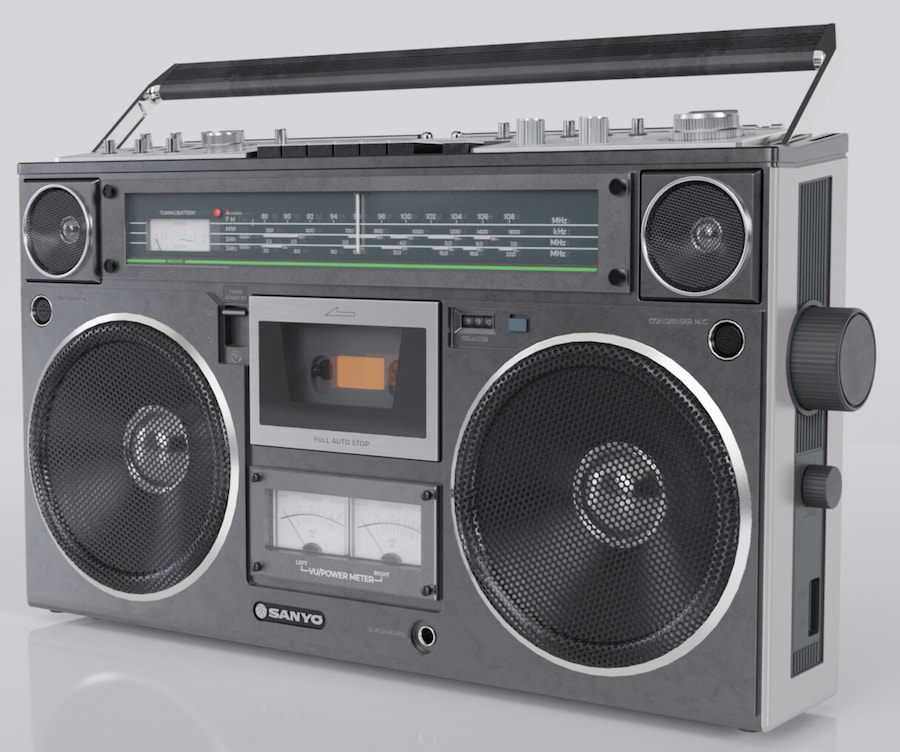
Sanyo M-9994

sanyo-m9994-boombox

Released in 1978, the Sanyo M-9994 carved out its place in boombox culture by delivering serious sound in a relatively disciplined package. Rated at 2 x 5 watts of output power, it featured a capable speaker system with 6.3-inch woofers and 2-inch cone tweeters. Notably, the tweeters were rotatable, allowing users to improve high-frequency directionality depending on placement and listening position.

Sanyo marketed the M-9994 as a “professional edition,” and it leaned into that claim with included external handheld microphones complete with plastic desk stands. Supporting features included an Input Volume control that allowed attenuation of incoming signals from line-level or phono sources, along with a dedicated headphone output for private listening.

Originally priced between $300 and $350, the Sanyo M-9994 has appreciated significantly over time. Today, demand pricing can reach as high as $1,500 for pristine, fully functional examples, reflecting its reputation as one of Sanyo’s most desirable classic boombox designs.

Check out more info from the Radio Museum and the Sanyo M9994 Wiki Page.

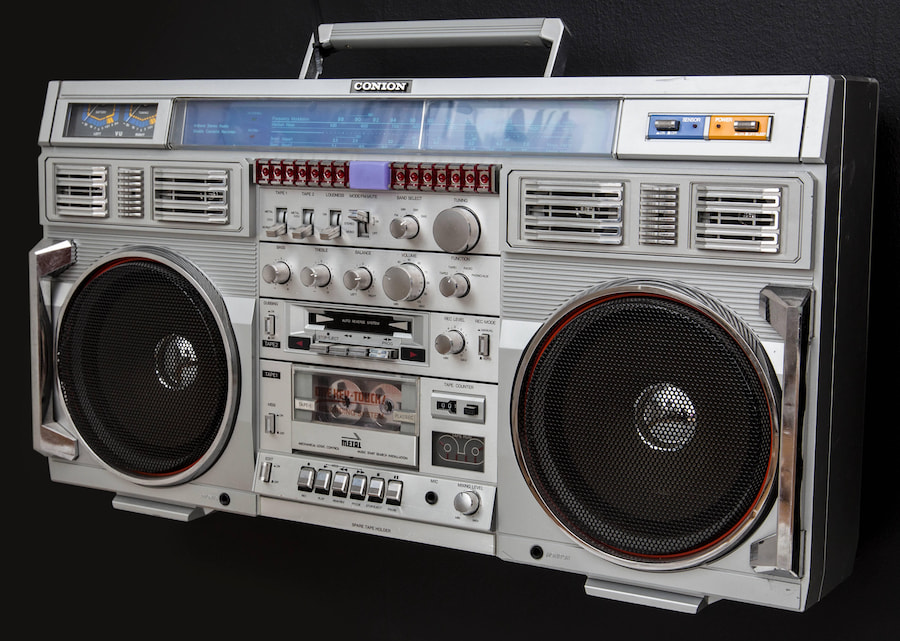
Conion C-100F

Conion C-100F Boombox

Released around 1984, the Conion C-100F is pure boombox legend and remains one of the most aggressively sought models among collectors. Oversized, overbuilt, and unapologetically loud, this was a statement piece even in an era defined by excess.

Pro Tip: The Conion brand was part of Onkyo, which helps explain why this box leaned harder into features and spectacle than restraint.

Advertisement

The C-100F came loaded. It featured a dual cassette deck configuration with one front-loading deck and one slot-loading deck, a four-band radio covering SW1, SW2, FM, and AM, dual VU meters, twin LED level displays, and two headphone jacks. One standout party trick was a built-in motion sensor that could be activated to trigger a security alarm if the unit was moved, a very on-brand feature for a boombox of this size and value.

The speaker array was equally ambitious, consisting of two woofers, two midrange drivers, and two tweeters. Output power was rated at 30 watts RMS at 10 percent THD, a figure that tells you everything you need to know about how hard this thing was meant to be pushed at its limits.

All of this hardware lived inside a massive 30-inch-wide chassis weighing just over 26 pounds. Portability was theoretical. Running the C-100F off batteries required ten D-cells, firmly placing it in battery-pig territory and guaranteeing that shoulder fatigue was part of the experience.

Depending on the market, the same design was also sold as the Helix HX-4365 and the Clairtone 7980. Original pricing for the Conion C-100F landed between approximately $450 and $475 in the U.S. Today, demand pricing typically ranges from around $750 to as much as $2,000, depending on condition, originality, and whether the alarm still scares the neighbors.

Advertisement

Find out more from the Radio Museum and Audiogon Blog.

Advertisement. Scroll to continue reading.

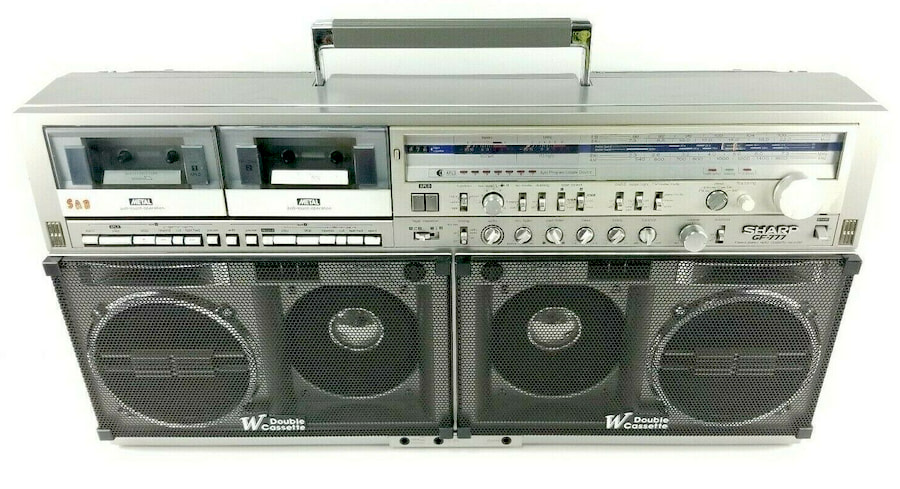
Sharp GF-777

sharp-gf-777-boombox

Another highly prized boombox among collectors is the Sharp GF-777, also sold in Japan as the GF-909. This model sits firmly in the heavyweight division, both in reputation and in physical presence.

The GF-777 featured a six-speaker array consisting of two woofers, two dedicated “sub” woofers, and two horn-type tweeters. Output power was rated at approximately 2 x 12 watts RMS, giving it the kind of authority that made it impossible to ignore once the play button was pressed.

Size and weight were part of the appeal. The GF-777 stretched roughly 30 inches wide and tipped the scales at about 27 pounds before batteries were added. Running it as a true portable required ten D-cell batteries, though it could also be operated on AC power for less shoulder strain and fewer trips to the battery aisle.

Advertisement

Originally priced at around $800, the Sharp GF-777 remains surprisingly attainable today. Depending on condition, completeness, and functionality, current demand pricing typically falls between $500 and $700, with exceptional examples commanding higher figures from collectors who know exactly what they are looking at.

Find out more from the Radio Museum and the Sharp GF777 Wiki Page.

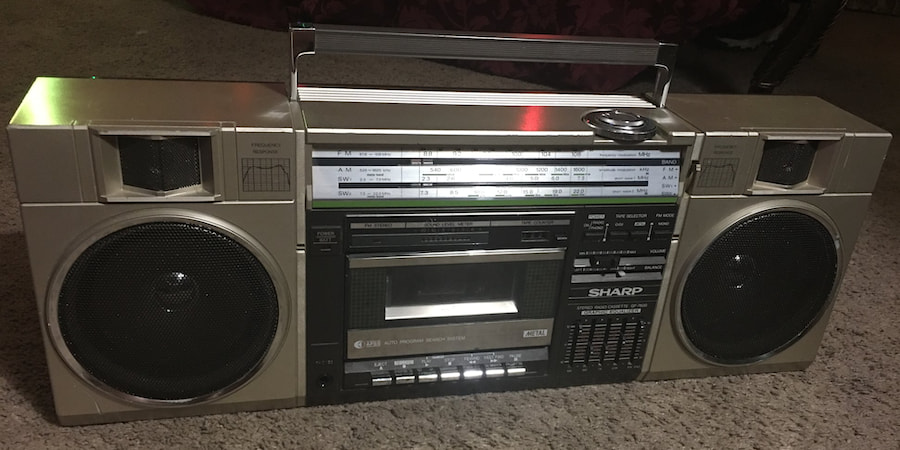
Sharp GF-7600

sharp-gf-7600-boombox

The Sharp GF-7600 is not the biggest, loudest, or most technically ambitious boombox of the 1980s, but it may be the most culturally significant. Released in 1983, it achieved permanent pop-culture status thanks to its starring role in the 1989 film Say Anything. Pity John Cusack didn’t drop it on his head.

Despite its more manageable size, the GF-7600 was surprisingly well equipped. It featured a four-band radio covering SW1, SW2, AM, and FM, a single cassette deck, a five-band graphic equalizer, an LED VU meter, line-in and line-out connections, and external microphone inputs. This was a serious feature set for a box that looked almost polite by Sharp’s usual standards.

The cassette deck supported metal tape, included full auto-stop and APSS track search, and offered a frequency response rated from 50 Hz to 16,000 Hz. Speaker duties were handled by a pair of 4.7-inch woofers and horn tweeters, while output power is generally estimated at around 5 to 6 watts per channel. Not a brute, but loud enough to make a statement—and immortal once held aloft over a rain-soaked lawn.

Advertisement

Original pricing varied by retailer. Today, demand pricing typically ranges from approximately $125 to $500, depending on condition, completeness, and functionality. 

Find out more from the Radio Museum, Sharp GF-7600 Wiki Page, or YouTube.

Sony CFS-99

sony-cfs-99-boombox

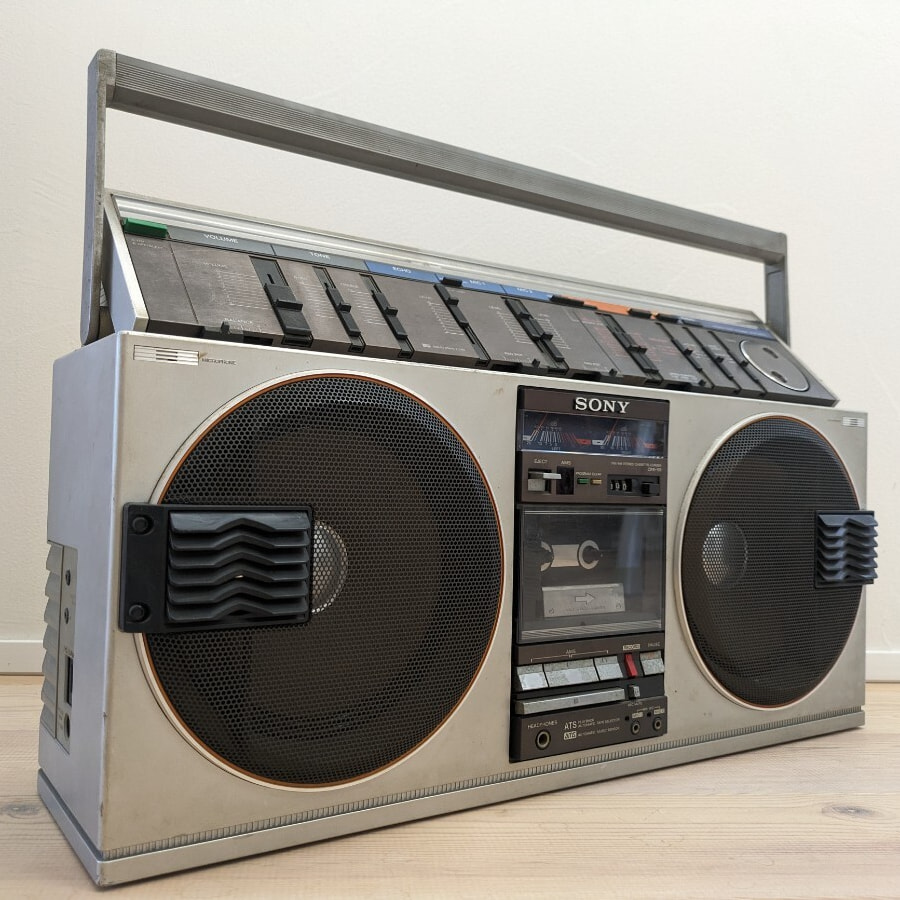
Before Sony upended personal audio with the Walkman, it was already deeply embedded in boombox culture. One of its standout entries was the Sony CFS-99, also known as the Energy 99, released in 1981. Big, loud, and unmistakably ’80s in both sound and styling, the CFS-99 paired a rugged build with serious output. It also weighed in at a back-testing 23 pounds, firmly earning its place in the heavyweight class.

Core features included an AM/FM radio and a cassette deck, with certain variants adding an LED track indicator along with dual microphone inputs featuring pan control and echo effects. Connectivity was unusually flexible for the time, offering RCA line-level inputs and outputs, while some versions also included banana speaker terminals for driving external speakers.

Advertisement
Advertisement. Scroll to continue reading.

The original retail price is no longer well documented. Today, demand pricing typically starts around $500 and can climb higher depending on condition, originality, and whether the unit has been modified to add Bluetooth connectivity.

Find out more from the Radio Museum.

Tecsonic J-1 Super Jumbo

tecsonic-j-1-super-jumbo-boombox

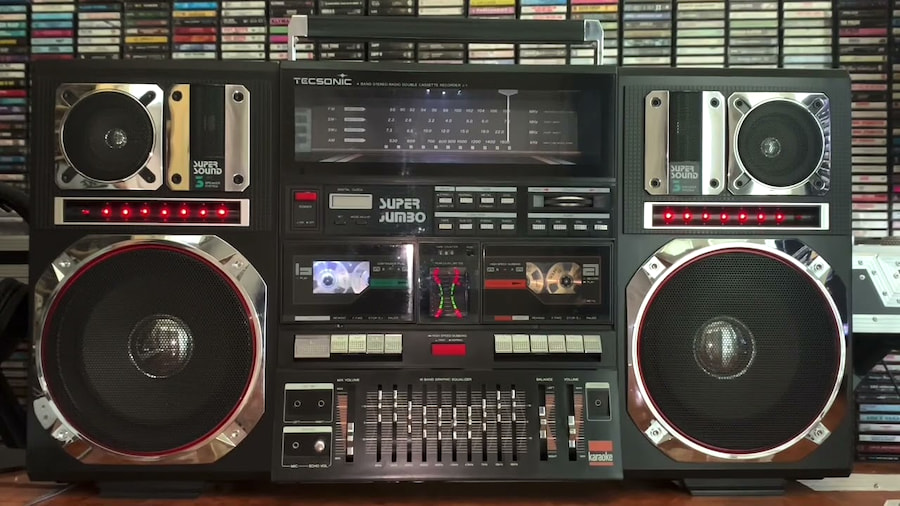
The Tecsonic J-1 Super Jumbo is another culturally significant boombox, cemented in history by its appearance in Do the Right Thing. Released in the 1987-1988 timeframe and manufactured in South Korea, the Super Jumbo wasn’t subtle. It didn’t need to be. This was a box built to be seen, heard, and remembered. Fight the Power.

The J-1 Super Jumbo featured an imposing speaker array with dual 8-inch woofers, a pair of midrange drivers, and twin tweeters. Feature-wise, it came loaded: dual cassette decks, AM/FM radio, karaoke sing-along functions, a 10-band equalizer, balance control, mixing volume, left and right front microphone inputs, a dedicated mix microphone input, phono jack, auxiliary/CD input, peak level meter, high-speed dubbing, tape counter, A/B continuous play, and an LED clock. Excess was the point.

Advertisement

Physically, the J-1 lived up to its name. It measured roughly 31 inches wide and 16.5 inches tall, and weighed in at around 25 pounds. Reported output power is approximately 2 x 20 watts, more than enough to back up its visual presence with real authority.

Original pricing for the Tecsonic J-1 Super Jumbo is no longer well documented. Today, demand pricing typically hovers around $1,000, depending on condition, completeness, and whether it still looks ready to be hoisted over someone’s head as a very loud act of defiance.

More details at the Radio Museum, Classic Boom Box page or YouTube.

JVC RC-M90

jvc-rc-m90-boombox

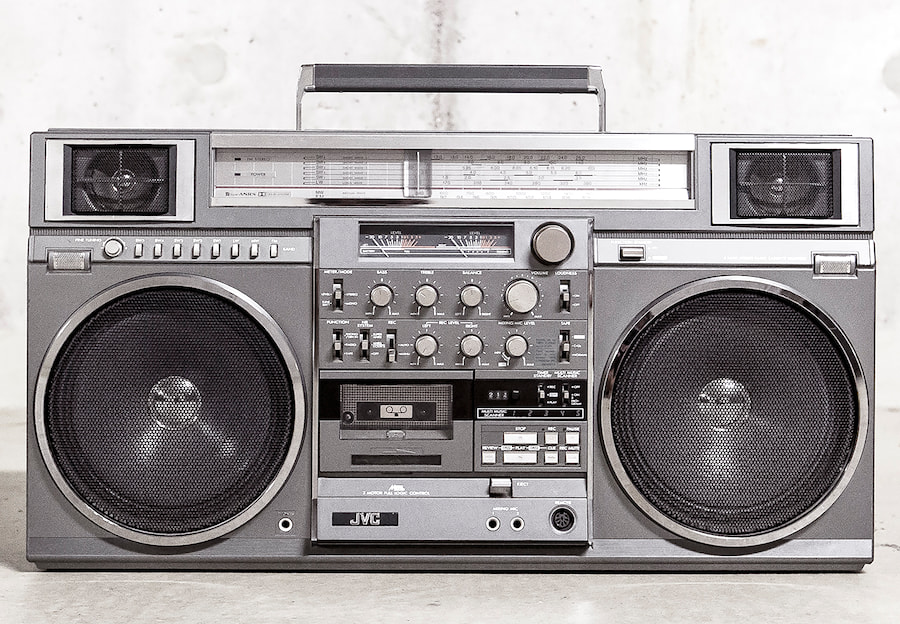
Some regard the JVC RC-M90 as the “King of Boomboxes,” and it’s not an argument without merit. Released in 1981, this was a no-compromise design that combined brute force with an unusually deep feature set.

The built-in speaker system used a two-way, four-speaker layout consisting of dual 8-inch woofers and two 2.5-inch tweeters, driven by amplification rated at approximately 2 x 20 watts. It was designed to move real air, not just make noise.

Advertisement

Operational features were extensive. The RC-M90 included an eight-band tuner with AM and FM coverage plus six shortwave bands, all supported by fine tuning. The cassette deck featured a tape counter, dual-motor full-logic transport, Normal, CrO₂, and Metal tape bias and EQ, JVC’s Multi Music Scanner, record and playback timers, and Dolby NR or Super ANRS noise reduction. With metal tape, cassette frequency response was rated at roughly 30 Hz to 17,000 Hz, impressive for a portable system.

Additional features included two built-in microphones, independent left and right recording level controls, microphone mixing level control, dual meters for VU, battery, and tuning, bass, treble, and balance controls, a loudness switch, and mono or stereo selection. Nothing about this box was casual.

Original pricing is documented at approximately £333 in the UK, with U.S. pricing from 1981 remaining elusive. Today, demand pricing for the JVC RC-M90 routinely exceeds $1,000, with top-condition examples commanding significantly more. For many collectors, this is the mountain every other boombox is measured against.

Advertisement. Scroll to continue reading.
Advertisement

Find out more details from the Radio Museum.

Lasonic TRC-975

lasonic-trc-975-boombox

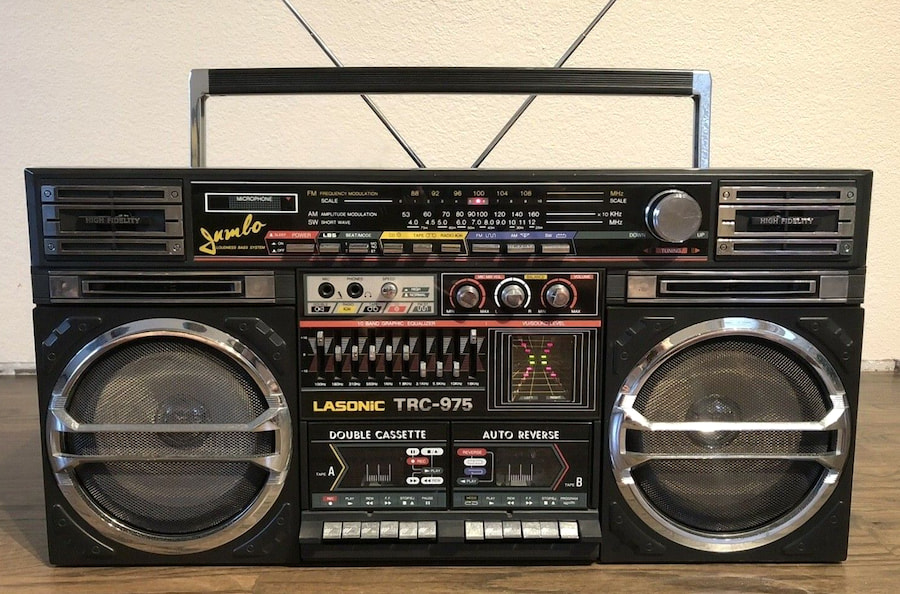
Jumping ahead to 1993, the Lasonic TRC-975 arrived as a genuine value play, originally selling for around $179. While the decade had shifted, its design was pure late-’80s muscle, and the sound followed suit. The TRC-975 earned a reputation for serious output thanks to its “Jumbo” Extra Bass system and a 10-band graphic equalizer that encouraged aggressive tweaking rather than restraint.

The speaker system consisted of dual 8-inch woofers paired with two 2-inch tweeters, a configuration aimed squarely at loud, physical sound. Feature-wise, the TRC-975 included dual cassette decks for recording and dubbing, AM/FM/SW radio, auto-reverse playback, and both normal- and high-speed dubbing. Connectivity was basic but practical, with an auxiliary input for external sources.

Some units on the secondary market have since been modified to add Bluetooth or MP3 playback, though purists tend to prefer unaltered examples. Closely associated with hip-hop culture, the Lasonic TRC-975 has become one of the most aggressively sought boomboxes of the 1990s era. Current demand pricing typically ranges from around $700 to as high as $2,300 for pristine, original-condition units, while modified versions with Bluetooth often trade closer to the lower end of that range.

Find out more from the Radio Museum.

Advertisement

Sharp VZ-2000

sharp-vz-2000-boombox

Just as CDs were beginning to reshape how people listened to music in the early 1980s, Sharp responded with one of the strangest boombox designs ever put into production: the VZ-2000, released around 1982-1983.

What made the VZ-2000 truly weird was its ambition. In addition to a radio and cassette deck, it incorporated a vertical turntable capable of playing both sides of a record at 33 or 45 rpm without flipping. To pull that off, Sharp employed dual linear-tracking tonearms controlled by a microcomputer, enabling fully automatic playback. Each arm was fitted with a Sharp 118 phono cartridge and STY-118 stylus, turning this boombox into a portable record player in the most literal sense of the word.

Beyond the vinyl trickery, the VZ-2000 featured a two-way speaker system, easy-touch controls, an auto program pause system, and metal tape compatibility for the cassette deck. On paper, it checked an absurd number of boxes for a single portable unit.

Portability, however, was relative. The VZ-2000 weighed over 35 pounds, which severely limited how far anyone was realistically carrying it. Original pricing was approximately $550, and today a fully operational example typically commands between $1,000 and $1,500 or more, depending on condition. It remains one of the clearest examples of early-’80s audio excess, when engineers still believed anything was portable if you added a handle.

Find out more details from the Radio Museum or YouTube.

Advertisement

The Bottom Line

These 12 boomboxes barely scratch the surface of what flooded streets, stoops, and backseats throughout the 1970s and 1980s, when portable audio was as much about presence as playback. Today’s Bluetooth speakers and smartphones are lighter, cleaner, and infinitely more convenient, but they’ve traded shared experience for private consumption. Boomboxes weren’t just how people listened to music. They were how music forced its way into the room—and made everyone deal with it together.

Source link

Advertisement
Continue Reading
Click to comment

You must be logged in to post a comment Login

Leave a Reply

Tech

Mary Jo Foley: What the heck is going on with Microsoft lately?

Published

on

Satya Nadella in November 2016, in his honeymoon period as Microsoft CEO. (GeekWire File Photo)

[Editor’s Note: We’re excited to welcome Mary Jo Foley as a GeekWire contributor. Mary Jo has been one of the sharpest watchers of Microsoft for many years, currently as Editor in Chief at Directions on Microsoft, an IT planning and advisory service. She’ll be offering her take for GeekWire periodically on the latest developments in Redmond, starting with this piece.]

Reorgs are a way of life at Microsoft. But the pace of them over the last couple of months has led many to wonder what the heck is happening in Redmond — especially when coupled with the company’s stock price having its worst quarter in years.

During the past couple of months, Microsoft has made a noticeable number of organizational changes:

Is this just the usual Microsoft fiscal-year-end housekeeping, or is something different? A blip that will pass, or a new AI-centric reality for the Satya Nadella era?

It’s a mix of both, I’d argue.

The current wave of churn, at least in part, can be attributed to Microsoft’s corporate calendar. Its fourth quarter ends June 30 and new fiscal year kicks off on July 1. Microsoft often reorgs and does layoffs in the months leading up to this as a way to reset for the coming year.

Advertisement

The company also is taking actions to reduce hierarchy and make the corporate structure flatter, as are a number of tech companies, in the hopes of becoming nimbler.

A year ago, Chief Financial Officer Amy Hood proclaimed that Microsoft was “increasing our agility by reducing layers with fewer managers.” With moves like replacing 35-year veteran Executive Vice President Jha with a new gang of four, rather than just another single uber-boss, Microsoft is following through on those promises.

It’s not all mundane matters at play, however.

Thanks to AI, the way companies are prioritizing and following through on their strategies is different. Microsoft isn’t immune to the market’s jitters around capex overspending on AI when ROI still remains questionable. Its no-longer-exclusive partnership with OpenAI has people inside and outside the company worried, too, as does the fact that a whopping 45 percent of its unfulfilled Azure backlog last quarter was attributable to OpenAI.

Advertisement

Investor pressure on the company to keep its Azure business growing during a time of admitted capacity challenges also can’t be dismissed as contributing to the current churn. As a result, Microsoft travel budgets, new-hire spending, and investments in unproven areas are all on the chopping block.

Almost nothing (except towels, maybe) is immune from scrutiny with the goal of freeing up more dollars to pay for AI and cloud build-out.

But those reasons alone may not be enough to explain why Microsoft is looking like the least magnificent of the so-called Magnificent Seven tech leaders right now.

Microsoft continues to struggle in the consumer space, and not just with Xbox. Most of the company’s revenues have been and continue to be from sales to commercial customers. That consumer weakness is especially apparent when it comes to AI.

Advertisement

Microsoft recently disclosed only 3 percent of its Microsoft 365 customers are paying for Microsoft 365 Copilot. But its adoption rate for its consumer Copilot is even worse, and far lower than the rates for OpenAI’s ChatGPT and Google Gemini.

The decision earlier this month to remove AI CEO Mustafa Suleyman from his consumer AI product responsibilities and into more of a research role is Microsoft’s latest attempt to adjust its consumer bets.

Suleyman’s reassignment came later than some expected (and hoped), given the starts and stops with Microsoft’s consumer AI efforts. Mico, a ghost-like Clippy wannabe, seems to be in limbo. Microsoft’s push to make voice one of the main ways users interact with AI on their PCs, when people don’t talk to PCs like they do phones, seems to be falling flat.

Meanwhile, the Windows organization is trying to right the ship by backing out of some of its over-zealous AI plans. Instead of trying to force AI into Notepad and Photos, execs said they instead will focus on some top consumer requests, ranging from taskbar customization, to adding the ability to pause updates at will.

Advertisement

Microsoft shows no signs of giving up on the consumer space. Maybe new blood will find new ways to harness the company’s enterprise tactics to boost its consumer share? If not, there’s always the next reorg. …

Source link

Continue Reading

Tech

Crime blotter: A $2 million iPhone heist in Florida

Published

on

A British political adviser’s stolen iPhone leads to a scandal, pro athletes fall for an iCloud scam, and iCloud evidence is used against a man accused of stalking the FBI director’s girlfriend, all in this week’s Apple Crime Blotter.

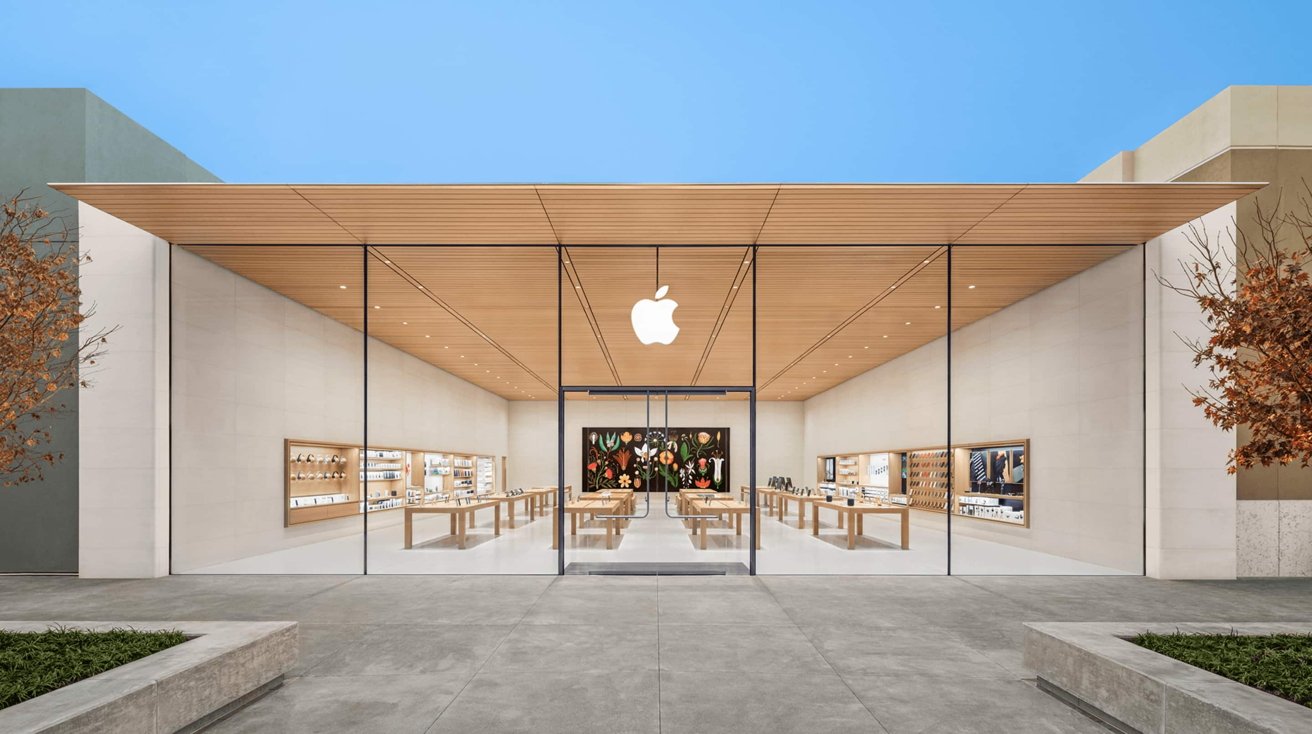
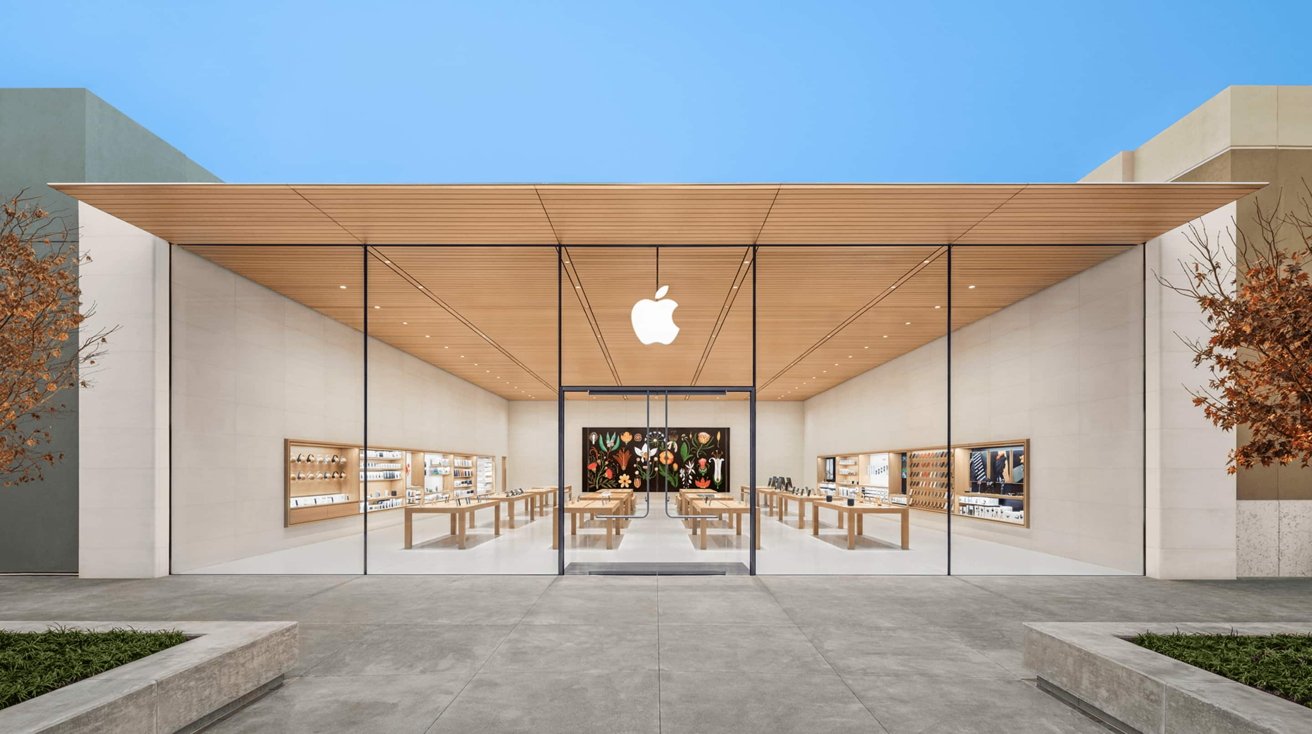
Modern Apple Store exterior with large glass facade, glowing white Apple logo, wooden ceiling, minimalist interior tables displaying products, colorful mural at back, and trees framing the entrance
The Alderwood Apple Store in Washington. Image Credit: Apple

Welcome to an occasional AppleInsider feature, looking at the world of Apple-related crime.
Continue Reading on AppleInsider | Discuss on our Forums

Source link

Continue Reading

Tech

New Rowhammer attack can grant kernel-level control on Nvidia workstation GPUs

Published

on


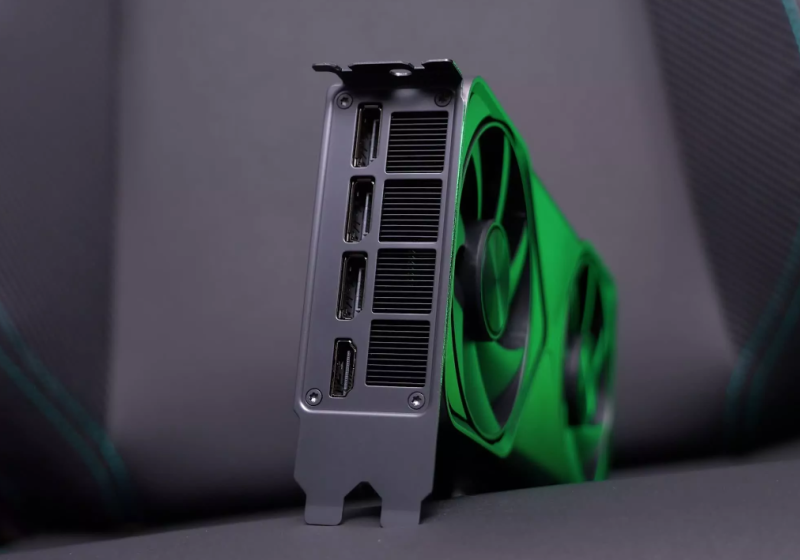
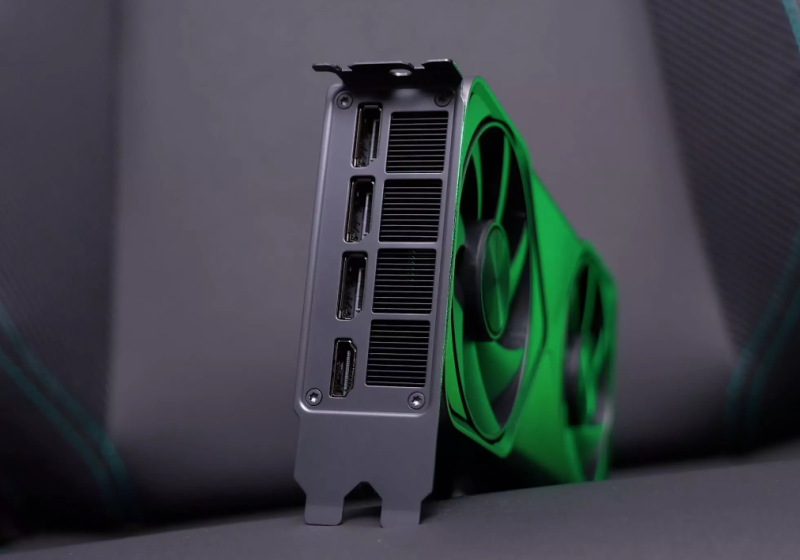
A study from researchers at UNC Chapel Hill and Georgia Tech shows that GDDR6-based Rowhammer attacks can grant kernel-level access to Linux systems equipped with GPUs based on Nvidia’s Ampere and Ada Lovelace architectures. The vulnerability appears significantly more severe than what was outlined in a paper last year.
Read Entire Article
Source link

Continue Reading

Tech

This WW1 Navy Diver Earned The Medal Of Honor Nearly 300 Feet Below The Sea

Published

on


The Congressional Medal of Honor is the United States’ highest award for military valor. In its more than 150-year history, only 3,552 individuals have received it. Originally conceived as a way to honor enlisted seamen and marines who performed distinguished acts of service during the Civil War, the medal now honors service members who distinguish themselves “conspicuously by gallantry and intrepidity at the risk of his life above and beyond the call of duty.”

The medal was awarded much more frequently before World War I, with that time period accounting for almost 3,000 of the total awards. World War I, during which almost 5 million Americans served in uniform, resulted in only 121 Medal of Honor recipients. Some were awarded posthumously, but one recipient, Frank Crilley, was honored in 1929.

Crilley joined the United States Navy in 1900, when he was only 16 years old. By 1915, he was a Chief Gunner’s Mate in the experimental diving team, a renowned but dangerous position. A WWI U.S. Navy submarine, the USS F-4, sank in March of that year with all 21 crewmen aboard. This was the first American submarine lost at sea, and the Navy wanted to raise F-4 from its final resting place just off the coast of Honolulu, Hawaii to find out what went wrong. It turned to Frank Crilley for help. To complete the mission, Crilley dove more than 300 feet down to the sub — which is 170 feet deeper than a recreational diver can get today.

Advertisement

Frank Crilley was honored for his bravery in a diving mission

Frank Crilley made his first dive to the USS F-4 in mid-April 1915 along with four other divers. They brought a recompression chamber and a physician, along with the standard diving gear, with them. Crilley hit 304 feet on that dive, a depth record that stood for a quarter of a century. The sub was found upright on the ocean floor, and cables would be required to raise the sub. This process was a challenge because it took three hours to descend and ascend from that depth. 

During a subsequent dive, one of Crilley’s fellow teammates, William K. Loughman, became tangled when a ground swell caused the sub to turn over. He was stuck at about 275 feet, and Crilley volunteered for a rescue mission. After more than two hours in the depths, Crilley emerged with his teammate alive. Eventually, the Navy managed to raise F-4 and found that it sank due to corrosion of the lead lining of the battery tank, which eventually led to a loss of depth control.

Advertisement

Crilley had a long career with the Navy and was awarded the Medal of Honor in 1929, 14 years after his heroic rescue. Several other service members have received the Medal of Honor for deep diving, including Owen Hammerberg, who engaged in rescue operations after an incident in Pearl Harbor in 1945, almost four years after the Japanese attack on the naval base. Hammerberg, who rescued two fellow divers that were trapped during a salvage operation, received the award posthumously after he died.


Advertisement

Source link

Continue Reading

Tech

Device code phishing attacks surge 37x as new kits spread online

Published

on

Researchers warn of 37 times rise in device Code phishing attacks

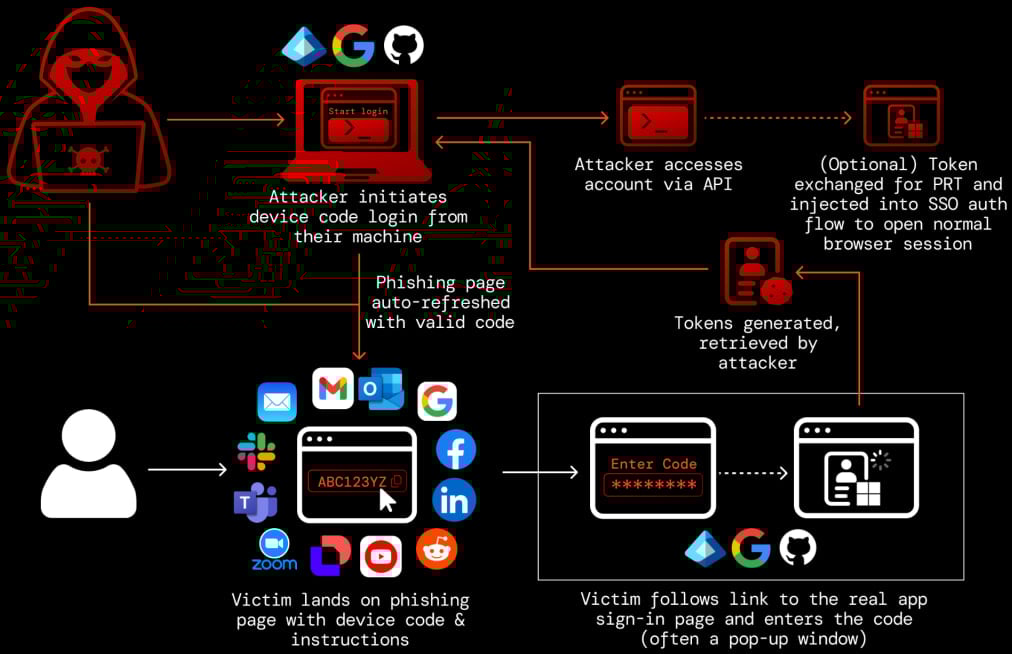
Device code phishing attacks that abuse the OAuth 2.0 Device Authorization Grant flow to hijack accounts have surged more than 37 times this year.

In this type of attack, the threat actor sends a device authorization request to a service provider and receives a code, which is sent to the victim under various pretexts.

Next, the victim is tricked into entering the code on the legitimate login page, thus authorizing the attacker’s device to access the account through valid access and refresh tokens.

This flow was designed to simplify connecting devices that do not have accessible input options (e.g., IoT devices, printers, streaming devices, and smart TVs).

Advertisement
Device code phishing flow
Source: Push Security

The device code phishing technique was first documented in 2020, but malicious exploitation was recorded a few years later, and has been used by both state-hackers and financially-motivated ones [123, 4].

Researchers at Push Security observed a massive increase in the use of these attacks, warning that they have been widely adopted by cybercriminals.

“At the start of March (2026), we’d observed a 15x increase in device code phishing pages detected by our research team this year, with multiple kits and campaigns being tracked — with the kit now identified as EvilTokens the most prominent. That figure has now risen to 37.5x.” – Push Security

Earlier this week, threat detection and response company Sekoia published research on the EvilTokens phishing-as-a-service (PhaaS) operation. The researchers underline that it is a prominent example of a phishing kit that “democratizes” device code phishing, making it available to low-skilled cybercriminals.

Push agrees that EvilTokens has been a major driver of the technique’s mainstream adoption, but notes that there are several other platforms competing on the same market, which could become more prominent in the event of law enforcement disrupting EvilTokens:

Advertisement
  1. VENOM – A closed-source PhaaS kit offering both device code phishing and AiTM capabilities. Its device code component appears to be an EvilTokens clone.
  2. SHAREFILE – A kit themed around Citrix ShareFile document transfers, using node-based backend endpoints to simulate file sharing and trigger device code flows.
  3. CLURE – A kit using rotating API endpoints and an anti-bot gate, with SharePoint-themed lures and backend infrastructure on DigitalOcean.
  4. LINKID – A kit leveraging Cloudflare challenge pages and self-hosted APIs, using Microsoft Teams and Adobe-themed lures.
  5. AUTHOV – A workers.dev-hosted kit using popup-based device code entry and Adobe document-sharing lures.
  6. DOCUPOLL – A kit hosted on GitHub Pages and workers.dev that mimics DocuSign workflows, including injected replicas of real pages.
  7. FLOW_TOKEN – A workers.dev-hosted kit using Tencent Cloud backend infrastructure, with HR and DocuSign-themed lures and popup-based flows.
  8. PAPRIKA – An AWS S3–hosted kit using Microsoft login clone pages with Office 365 branding and a fake Okta footer.
  9. DCSTATUS – A minimal kit with generic Microsoft 365 “Secure Access” lures and limited visible infrastructure markers.
  10. DOLCE – A Microsoft PowerApps-hosted kit with Dolce & Gabbana–themed lures, likely a one-off or red-team-style implementation rather than widely used.

It should be noted that other than Venom and EvilTokens, the names of the other phishing kits were given by Push researchers to track the malicious activity.

Push Security also published a video showing how the DOCUPOLL kit works. The threat actor uses DocuSign branding and a lure for an alleged contract, asking the victim to sign into the Microsoft Office application.

In total, there are at least 11 phishing kits offering cybercriminals this type of attack, all using realistic SaaS-themed lures, anti-bot protections, and abusing cloud platforms for hosting.

To block device-code phishing attacks, Push Security suggests that users disable the flow when not needed by setting conditional access policies on their accounts.

Advertisement

It is also recommended to monitor logs for unexpected device code authentication events, unusual IP addresses, and sessions.

Automated pentesting proves the path exists. BAS proves whether your controls stop it. Most teams run one without the other.

This whitepaper maps six validation surfaces, shows where coverage ends, and provides practitioners with three diagnostic questions for any tool evaluation.

Source link

Advertisement
Continue Reading

Tech

Chasing Starlink, Amazon Leo strikes satellite Wi-Fi deal for future Delta flights

Published

on

Amazon Leo and Delta Air Lines announced a deal Tuesday for satellite-powered in-flight Wi-Fi starting in 2028. (Amazon Photo)

Amazon Leo has landed its highest-profile customer yet, reaching a deal with Delta Air Lines to provide satellite-powered Wi-Fi on 500 aircraft starting in 2028.

The agreement, announced Tuesday, gives Amazon’s fledgling satellite internet venture a big new partner as it races to catch up with SpaceX’s Starlink, the rival service that has deals in place with United, Southwest and Alaska Airlines.

Amazon has about 200 satellites in space, vs. more than 10,000 for Starlink, which began commercial service in late 2020, and now has more than 10 million subscribers.

In an interview with the Wall Street Journal, Amazon CEO Andy Jassy called Leo a “very important long-term investment” for the company and said he’s confident Amazon will have the capacity to serve Delta and other customers.

Leo is expected to deliver internet speeds three to five times faster than what Delta currently offers. Each aircraft will be equipped with an antenna capable of download speeds up to 1 Gbps, according to Amazon. The service will be free for Delta SkyMiles members.

Advertisement

Delta reportedly looked into Starlink but chose Amazon in part because of its existing relationship with Amazon Web Services. Delta uses AWS to power a variety of its current internal systems.

Originally known as Project Kuiper, Amazon’s satellite initiative was rebranded as Leo in November, a reference to low Earth orbit. 

The company has spent more than $10 billion on the effort and asked the FCC in January for a two-year extension to deploy half of its planned 3,232 satellites. The FCC in February approved more than 4,500 additional second-generation satellites, expanding Leo’s planned coverage. 

Delta is Leo’s biggest airline customer but not its first. JetBlue last year became the first carrier to sign on for in-flight Wi-Fi through Amazon’s satellite network. Other early customers and partners include L3Harris, DIRECTV Latin America, Sky Brasil, and Australia’s NBN Co.

Advertisement

Source link

Continue Reading

Tech

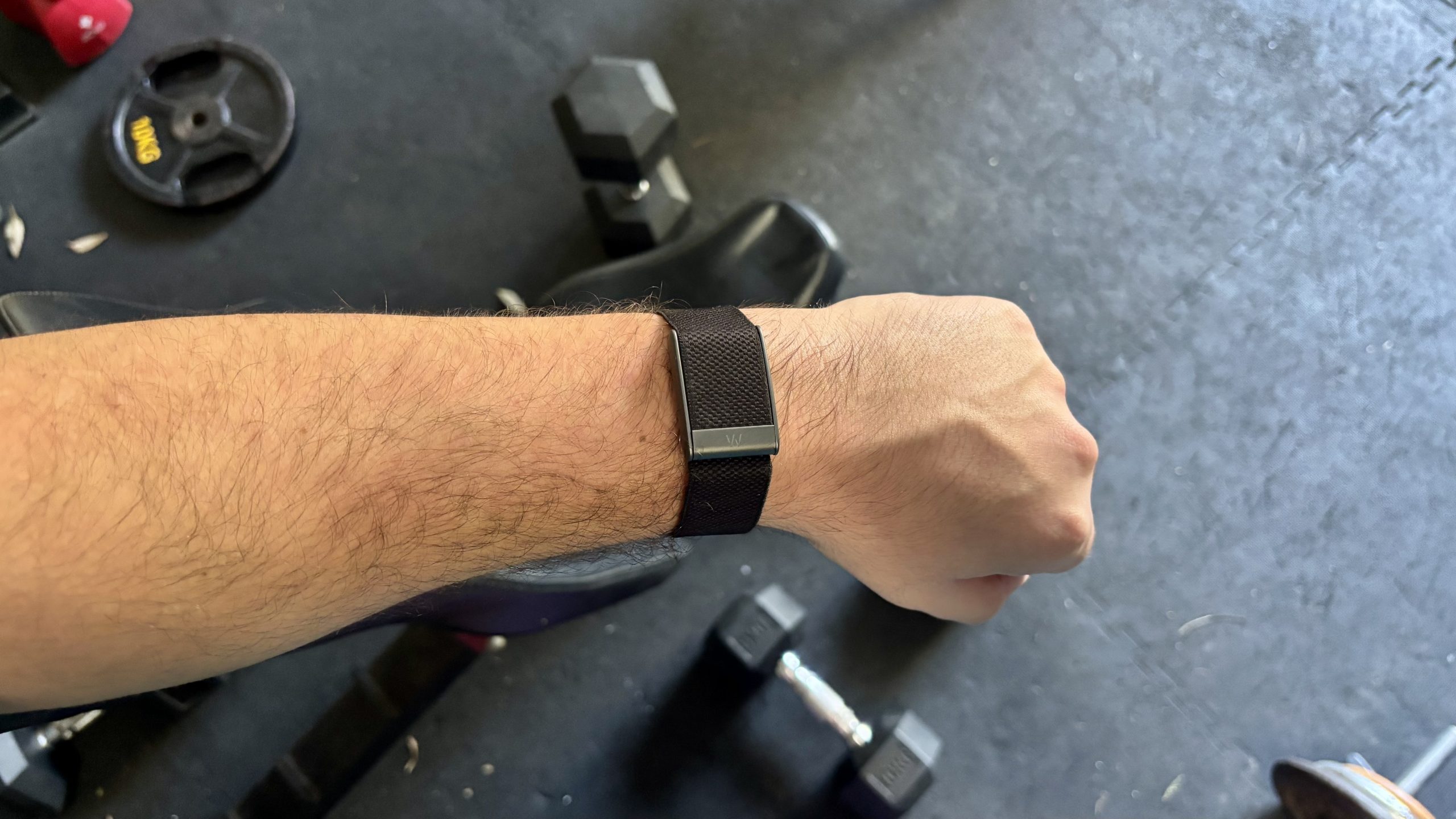
Amazfit Helio Strap vs Polar Loop vs Whoop 5.0: Which should you buy?

Published

on

Have you noticed? We are entering a new era of wearables, as the screen-free tracker trend picks up the pace.

Everyone from Fitbit (an official tracker teased by Steph Curry) to Garmin (leaked information on the in-development Garmin Cirqa) has one cooking. These lifestyle wearables won’t pull your attention away with flashing notifications. And they will record your daily stats and exercise sessions while demanding no intervention at all.

Source link

Advertisement
Continue Reading

Tech

If Your Baby’s Not Sleeping, Try Your iPhone’s Hidden White Noise Feature

Published

on

Babies can be difficult. They eat all the time, pee and poop wherever they want and they may not sleep at night, especially during sleep regressions. According to the American Academy of Pediatrics, playing sounds from a white noise machine can help soothe your baby and get them to settle down, giving you a moment of respite. And if you have an iPhone, you don’t need to spend money on a white noise machine. 

Tech Tips

When Apple released iOS 15 in 2021, the operating system brought a hidden feature called Background Sounds. It allows you to turn your iPhone into a white noise machine, and you can play these sounds by themselves or under a podcast, music or video streaming app.

When Apple introduced Background Sounds, there were six ambient sounds to play on a loop: rain, stream and ocean waves, which are natural sounds, and bright, balanced and dark noise, which are different pitches of white noise. When the tech giant released iOS 18 in 2024, it added two sounds: night and fire. And iOS 26 brought even more background sounds to devices, including rain on roof and babble, which sounds like a busy cafe. 

Advertisement

If you want to use these sounds to lull a baby back to sleep, or for any other reason, here’s how to enable Background Sounds on your iPhone.

How to access Background Sounds from your Control Center

Instead of searching through Settings each time you want to turn Background Sounds on, here’s how you can set up a toggle in the Control Center to turn the feature on to use on your iPhone.

1. Open Control Center.
2. Tap the plus (+) sign in the top left of your screen.
3. Tap Add a Control near the bottom of your screen.
4. Tap Hearing control (ear icon) under Hearing Accessibility to add to Control Center.

Advertisement
The Hearing control in your iPhone's Control Center.

You can find the Hearing control under Hearing Accessibility in your Control Center.

Apple/Screenshot by CNET

Once the Hearing control icon is in Control Center, tap it to see three options: Speaker, Background Sounds and Live Listen. Then tap the musical notes next to Background Sounds to turn the feature on. You can also tap on the words Background Sounds to open a menu to choose a different background sound as well as adjust the volume.

The Background Sounds menu in Control Center.

These are a few of the sounds you can access in Background Sounds.

Advertisement

Apple/Screenshot by CNET

Use Accessibility Shortcuts for Background Sounds

You can also set up an accessibility shortcut to turn Background Sounds on or off from your home screen or within an app. Here’s how to set it up.

1. Tap Settings.
2. Tap Accessibility.
3. Tap Accessibility Shortcut.
4. Tap Background Sounds.

Now, when you press the side button on your iPhone three times, Background Sounds will turn on. You can tap the button three times again to turn it back off.

Advertisement
The Accessibility Shortcut menu with Background Sounds outlined in red.

Apple/Screenshot by CNET

Discover These Hidden AirPods Features and Boost Your Listening Experience

See all photos

More Background Sound options

If you want more control over Background Sounds, here’s where to go.

1. Tap Settings.
2. Tap Accessibility.
3. Tap Audio & Visual.
4. Tap Background Sounds.

Near the top of this menu you can turn Background Sounds on by tapping the Background Sounds toggle, and you can change the Background Sound by tapping Sound and choosing a new sound. 

More ways to control Background Sounds feature on your iPhone, like the option to Use When Media is Playing.

You can play your background sounds while other media is playing if you’d like. 

Advertisement

Apple/Screenshot by CNET

There are two toggles in this menu: Use When Media Is Playing and Stop Sounds When Locked. Tapping the toggle next to Use When Media Is Playing allows Background Sounds to keep playing while you watch a video or listen to music. And tapping the toggle next to Stop Sounds When Locked ensures Background Sounds will turn off when your device locks. If you don’t have this enabled, the sounds will continue to play when your device locks.

There are also two new menus in iOS 26: Equalizer and Stop Sounds with a Timer. Equalizer lets you adjust the tone and contour of Background Sounds, as well as balance more toward the right or left speaker or headphone. Stop Sounds with a Timer allows you to turn Background Sounds off at a specific time that you can choose or after a certain amount of time has passed. 

New options in Background Sounds menu in iOS 26.

The Stop Sounds with a Timer (left) and Equalizer menus in iOS 26.

Advertisement

Apple/Screenshot by CNET

For more iOS news, here’s what you should know about iOS 26.4 and iOS 26.3. You can also check out our iOS 26 cheat sheet.

Watch this: Apple at 50: What Made Apple Different

Source link

Advertisement
Continue Reading

Tech

Can AI Find Your Next Obsession? I Tested Its Hobby Suggestions

Published

on

When you’re finished with work and you need something to do, where do you turn your attention? Some folks build models, others do some coloring. Some relax and watch TV. But if you’re looking for something to pour your free time and attention into, it can be difficult to settle on one thing, or even multiple. 

AI Atlas

Model trains, running clubs, robotics and coding classes all sound fun — until you realize you’d rather fly, running shoes cost far more than they should and you’re less of a front-end/back-end person and more of a “no end in sight for how boring Java can be” person.

I asked three different AI systemsClaude AI, Google Gemini and ChatGPT — about what my spouse’s next hobby should be using the exact same prompt, and the results were surprising.

Advertisement

Claude: Getting a clue

Here’s the prompt I wrote: “I am a 39-year-old man in the United States of British origin. I live in Los Angeles, California, and am married with a dog and a cat. I live in a house with some backyard space. I enjoy travel, reading, playing video games and am looking to add a new hobby to my list of activities. I also enjoy getting deals, as that’s what my career deals with. Can you suggest three hobbies that I should look into for my review? Please give me information on the financial and time commitments needed, as well as what you would consider to be the plusses and minuses of each one. I work a regular 9-5 job so would need to be done around that constraint as well.”

Gardening is a hobby many people only come to appreciate in their golden years, but all three AI systems recommended it as an easy way to pass the time with minimal effort and expense.

The second suggestion was reselling and thrifting vintage finds, followed by homebrewing beer, cider or mead. It gave a lot of detail into the time and financial commitments, pros and cons as well as why it assumed those hobbies would suit my husband based on that short prompt.

Advertisement
A screenshot of an AI-generated hobby suggestion with pros, cons, time commitment and financial commitment

Claude/Screenshot by CNET
A screenshot of an AI-generated hobby suggestion with pros, cons, time commitment and financial commitment

Claude/Screenshot by CNET
A screenshot of an AI-generated hobby suggestion with pros, cons, time commitment and financial commitment

Claude/Screenshot by CNET

Claude AI was particularly thoughtful in appealing to the prompter’s needs and personality, pointing out that gardening could be a great way to save money — perhaps recognizing that finding a good deal is a deeply entrenched personality trait of my little cheapskate husband.

Gemini: Combining interests

Gemini suggested hunting for and reselling vintage video games, books and other old media as a pastime that could pair well with traveling on points. It also recommended brewing beer as a way to spend time in a backyard already full of plants (in addition to “high-yield urban orchard gardening”).

A screenshot of an AI-generated hobby suggestion with pros, cons, time commitment and financial commitment

Gemini/Screenshot by CNET
A screenshot of an AI-generated hobby suggestion with pros, cons, time commitment and financial commitment

Gemini/Screenshot by CNET

Gemini was adept at using my spouse’s prompt details to guide its suggestions, creating a nicely packaged, holistic approach to how he might spend his off-hours between a demanding 9-to-5 job.

ChatGPT: Making a night of it

Along with backyard gardening (again), ChatGPT was the only AI system to suggest an evening hobby: amateur astronomy. Most of the other systems focused on ways to pass the weekend hours at estate sales or at home.

Advertisement
A screenshot of an AI-generated hobby suggestion with pros, cons, time commitment and financial commitment

ChatGPT/Screenshot by CNET

Stargazing could be a fun way to spend a Friday night, but we live in Los Angeles. Many of the “stars” overhead might actually be satellites, and finding a decent vantage point would likely mean braving traffic and crowds taking selfies over the city skyline.

ChatGPT’s other suggestion was using our backyard for beekeeping:

A screenshot of an AI-generated hobby suggestion with pros, cons, time commitment and financial commitment

ChatGPT/Screenshot by CNET

Beekeeping seemed pretty out of left field, considering the original prompt mentioned nothing about an interest in food, insects or anything remotely related to the complex caretaking involved with bees — or bee law. According to ChatGPT, the time commitment is only two to four hours per month (though local beekeepers might dispute that).

Overall, ChatGPT’s recommendations were the least relevant to the prompter’s real interests, and the logic the tool used to explain why it had made the recommendations was very thin.

I just can’t buy that “many full-time professionals” who enjoy playing video games also do a little beekeeping on the side.

Advertisement

Here’s hoping AI can offer some creative ideas for spending your time that don’t involve buying a full-body suit.

Source link

Advertisement
Continue Reading

Tech

Apple at 50, Siri, Apple Vision Pro, and vibe coding, on the AppleInsider Podcast

Published

on

Apple has marked its 50th anniversary, although arguably a year too soon but we’ll get into that, plus there’s good news for users of the Apple Vision Pro, hopeful news about Siri, and bad news for certain vibe coders, all on the AppleInsider Podcast.

Minimal green line drawing of an open laptop and mouse on white background, with a small black circle in the upper right corner containing the lowercase letters ai
Looking back at Apple’s history — image credit: Apple

The fiftieth anniversary celebrations are, quite reasonably, marking the half century since the partnership of Steve Jobs, Steve Wozniak, and Ronald Wayne, was founded on April 1, 1976. But the Apple we know today, the corporation, was created in 1977.
It seems unlikely that Apple will do another round of parties and events, but we’d be up for it if they did.
Continue Reading on AppleInsider | Discuss on our Forums

Source link

Continue Reading

Trending

Copyright © 2025