
Crypto World
Bybit Crosses a Line in Rwanda That Binance Has Walked for Years Without Consequence


The National Bank of Rwanda (BNR) publicly warned citizens against using the Rwandan Franc (FRW) for crypto transactions, two days after global exchange Bybit listed FRW on its peer-to-peer (P2P) platform without regulatory clearance.
The BNR highlighted Bybit’s promotional announcement, stating that crypto-assets remain unauthorized for payments, FRW conversion, or P2P trading under current law.
Why Bybit’s Timing Could Not Have Been Worse
Rwanda has maintained a restrictive stance on private crypto since 2018, when the BNR first declared cryptocurrencies illegal for domestic use.
That position has shifted gradually. In March 2025, the BNR and the Capital Markets Authority (CMA) released a draft framework to regulate Virtual Asset Service Providers (VASPs).
The bill explicitly prohibits crypto as legal tender, bans crypto mining and mixers, and bars tokens pegged to the FRW.
On March 4, 2026, Rwanda’s Cabinet approved a comprehensive version of that bill. The Chamber of Deputies passed its general principles on March 31. Committee review continues.
Bybit launched its FRW P2P feature on April 2, just two days later, offering new-user rewards and bi-weekly merchant commissions.
Its announcement made no mention of local regulatory approval. Community members also flagged that promotional materials featured an outdated Rwandan national emblem.
A Direct Challenge to Rwanda’s CBDC Plans
The BNR is piloting its own Central Bank Digital Currency (CBDC), the e-FRW, following a proof-of-concept completed in February 2026. A 12-month domestic pilot is underway before international cross-border testing begins.
Unregulated foreign platforms attaching the FRW to crypto markets risk undermining that effort and eroding public trust in the currency.
The CMA has also cited pressure from the Financial Action Task Force (FATF) over crypto-linked money laundering as a core reason for formal regulation.
What Comes Next
Under the draft law, unlicensed VASP operators in Rwanda face fines up to 30 million FRW, roughly $21,000, and up to five years in prison.
Bybit has not publicly responded to the BNR’s warning. Binance and Remitano have offered FRW P2P pairs for years without triggering comparable pushback, suggesting Bybit’s loud promotional approach crossed a regulatory threshold.
Whether Bybit removes FRW voluntarily or waits for formal enforcement may set a precedent for every foreign exchange eyeing East Africa.
The post Bybit Crosses a Line in Rwanda That Binance Has Walked for Years Without Consequence appeared first on BeInCrypto.


Harvard economist Kenneth Rogoff believes the Chinese yuan will become a global reserve currency within five years. He argues that President Xi Jinping’s explicit call for yuan internationalization marks a turning point.
Rogoff says investors worldwide are desperate to diversify away from the US dollar, making China’s push well-timed.
China’s Path to Reserve Status
In a recent interview with the South China Morning Post, Rogoff outlined the key steps China must take. Beijing needs to open its government bond markets to foreign investors. It also needs forward markets and interest rate swaps to support international participation.
Rogoff noted that fully open capital markets are not required. The US itself maintained many restrictions on foreign investment through the 1970s. It was still the world’s dominant reserve currency during that period.
China must also build financial rails independent of the SWIFT system. Rogoff said modern blockchain technology can duplicate existing systems at much lower cost. The country’s Cross-border Interbank Payment System already serves as a foundation for this effort.
Crypto’s Role in Dollar Erosion
Rogoff also addressed how cryptocurrencies are reshaping currency competition. He estimated the global underground economy at roughly 20% of total output. That amounts to at least $20 trillion.
Cryptocurrency, particularly stablecoins, has already captured a significant share of illicit transactions. Physical cash once dominated this space. Digital assets now offer faster and harder-to-trace alternatives.
Stablecoins Face Regulatory Reckoning
However, Rogoff warned that crypto will never replace the dollar in the legal economy. Governments have more than enough regulatory power to prevent that outcome.
He criticized the US Genius Act as overly liberal in its stablecoin regulation. Stablecoins remain difficult to trace once they leave their issuer. Rogoff predicted that future rules will eventually mirror central bank digital currency requirements.
The race for currency dominance is accelerating. Both Europe and China are building independent financial systems to reduce vulnerability to US sanctions.
The post Yuan, Not Crypto, Will Challenge Dollar Within 5 Years appeared first on BeInCrypto.

TLDR:
- Coinbase filed a formal SEC submission opposing mandatory issuer approval for third-party stock tokenization on April 1, 2026.
- The filing argues issuer consent mandates contradict Section 4(a)(1) of the Securities Act and decades of SEC legal precedent.
- Coinbase warns that requiring issuer approval could create anticompetitive barriers and push blockchain innovation offshore.
- A flexible dual framework supporting both issuer-led and third-party tokenization would unlock T+0 settlement and 24/7 trading.
Coinbase filed a formal submission with the SEC’s Crypto Task Force on April 1, 2026, addressing third-party tokenization of publicly traded securities.
The document argues against requiring issuer approval for blockchain-based representations of existing stocks. The filing responds to the SEC’s ongoing effort to modernize securities markets through blockchain technology.
Coinbase’s position centers on protecting secondary market activity from unnecessary regulatory barriers.
Coinbase Challenges Issuer Veto Power Over Secondary Markets
The full title of the submission is “Re: Why Third-Party Tokenization of Publicly Traded Securities Should Not Require Issuer Approval.”
Coinbase argues that mandating issuer consent contradicts established U.S. federal securities law. Specifically, the filing references Section 4(a)(1) of the Securities Act, which permits resale without issuer involvement in many secondary-market scenarios.
The company also cited Rule 17Ad-20, which governs transfer agents and secondary market restrictions. Decades of SEC precedent support free transferability of securities in secondary markets. Issuers traditionally hold no veto power over how investors transfer or custody shares after entering public markets.
According to the tweet by @martypartymusic, Coinbase warned that requiring issuer approval would grant companies unprecedented control over lawful secondary-market activity.
This could create anticompetitive barriers and favor incumbent-controlled closed systems. Such a mandate would directly stifle innovation in the tokenization space.
Coinbase further clarified that third-party tokenization does not create a new security. Instead, it represents existing shares on a blockchain while fully preserving shareholder rights, including voting, dividends, and corporate actions.
Flexible Framework Would Support Both Issuer and Third-Party Tokenization
Coinbase advocates for a dual approach that accommodates issuer-led and third-party tokenization simultaneously.
Under this framework, companies could issue their own blockchain versions of shares if they choose. Independent platforms, however, would also be free to create tokenized representations of existing stocks.
The filing points to recent SEC-friendly developments as evidence that issuer consent is unnecessary. Nasdaq’s tokenized trading pilots and the DTCC’s Tokenization Services have both advanced without imposing such requirements. Adding a consent mandate now would represent a reversal of regulatory progress already underway.
A flexible framework, Coinbase argues, would unlock key market efficiencies. These include T+0 instant settlement, 24/7 trading, reduced intermediary costs, greater transparency, and peer-to-peer transfers.
Tokenized stocks could also integrate with decentralized finance protocols while maintaining regulatory compliance.
Coinbase also warned that overly restrictive rules could push blockchain innovation offshore. This would limit the SEC’s ability to oversee markets and gather data for future rulemaking.
The filing ties directly to the SEC’s planned “innovation exemption,” urging that access to it not be unnecessarily restricted.

TLDR:
- Stellar’s open network design attracts broader adoption than XRP’s institution-focused approach.
- XLM demand ties directly to real network activity, giving it stronger organic economic foundations.
- XRP’s legal battles with the SEC have slowed adoption and weakened institutional confidence over time.
- Stellar’s diverse ecosystem, spanning payments, stablecoins, and NGOs, reduces reliance on single partners.
Stellar (XLM) and XRP remain two of the most discussed blockchain payment networks in crypto. Both target cross-border transactions, yet their approaches differ sharply.
Those differences may determine which asset captures greater long-term value. Stellar’s open design, usage-driven tokenomics, and lower regulatory exposure give it structural advantages.
Meanwhile, XRP leans heavily on institutional partnerships and faces ongoing legal scrutiny in key markets.
Open Network Design and Real Usage Demand
Stellar was built to support financial inclusion from the ground up. Anyone — individuals, startups, or institutions — can issue assets and interact freely on its network.
This open access model drives broader adoption compared to XRP’s bank-focused design. The wider a network grows, the more value it tends to attract over time.
XRP, by contrast, targets large financial institutions as its primary users. That focus concentrates value among a limited group of participants.
Open network effects, which Stellar benefits from, tend to compound as more users join. This structural difference matters significantly when measuring long-term growth potential.
Stellar’s tokenomics also tie XLM demand directly to real network activity. Every transaction, account creation, and asset exchange requires XLM, creating consistent organic demand.
XRP often functions as a temporary bridge asset in liquidity operations. Tokens are held only briefly, which weakens sustained structural demand for the asset.
This usage-driven demand model gives Stellar a more reliable economic foundation. As transaction volumes grow on the network, so does the need for XLM.
That relationship between usage and demand is a strong indicator of long-term value retention. Developers and institutions building on Stellar contribute directly to that demand cycle.
Regulatory Environment and Ecosystem Diversity
XRP has faced considerable legal challenges, particularly in the United States. The Ripple lawsuit created uncertainty around market perception, adoption, and liquidity.
Even as some regulatory clarity has emerged, the damage to institutional confidence lingers. Lower legal risk makes an asset more attractive to developers and financial partners.
Stellar has largely avoided such regulatory friction and operates in a more stable environment. The Stellar Development Foundation maintains a relatively neutral governance image.
That neutrality appeals to developers who prioritize decentralization and compliance. It also reduces the kind of institutional hesitation that has slowed XRP’s growth in certain markets.
Beyond regulation, Stellar supports a diverse real-world ecosystem. Its network powers low-cost cross-border payments, stablecoins, and humanitarian finance projects.
NGOs and financial inclusion initiatives in emerging markets actively use the network. This breadth of application reduces dependence on any single sector or partner group.
XRP, while technically efficient, relies more heavily on specific institutional agreements. A concentrated ecosystem carries greater risk if key partnerships shift or dissolve.
Stellar’s multi-sector presence provides a more resilient foundation for sustained network growth. That diversity, combined with lower regulatory pressure, positions XLM as a strong long-term contender.
TLDR:
- Walmart recorded a 66% conversion drop when embedding agentic checkout directly inside ChatGPT’s interface.
- OpenAI phased out Instant Checkout after merchants reported poor results with chatbot-based purchase experiences.
- The Machine Payments Protocol lets AI agents pay via HTTP requests, using cards, wallets, or stablecoins natively.
- Know Your Agent frameworks are now being developed to secure invisible payments before autonomous spending scales further.
Invisible commerce is emerging as the next frontier in AI-driven payments, replacing the checkout model. Walmart recently recorded a 66% drop in conversion rates when embedding agentic checkout inside ChatGPT.
OpenAI subsequently phased out its Instant Checkout feature. These developments signal a major shift. The payments industry built agentic commerce on the wrong foundation.
Agents do not need better checkouts — they need payments that happen automatically, without human intervention.
Walmart’s Checkout Experiment Exposed a Fundamental Flaw
Walmart’s conversion rate collapse was a clear indicator that something was broken. Embedding a human-optimized checkout inside a chatbot created friction rather than reducing it. The process was designed for human eyes, not machine logic.
OpenAI responded by pulling Instant Checkout entirely. Merchants now handle purchases through their own app-based systems instead.
This retreat confirmed what many in the payments space suspected — agentic commerce built on traditional checkout rails does not work.
Fintech analyst Simon Taylor captured this tension clearly. He noted that agentic commerce protocols now outnumber actual agentic transactions.
The infrastructure is ahead of the real-world use case, and the use case itself may have been wrong from the start.
Stripe previously outlined five levels of agentic commerce, borrowing from autonomous driving. Each level still assumed a visible purchase event. Even at the highest level, an agent reacts to human intent. That model is now being questioned.
The Parking Agent Demonstrates a New Payment Paradigm
A hackathon project changed how some in the industry are thinking about this problem. A developer built a parking AI agent that detects a user’s location and pays the local parking authority automatically. No checkout appeared. No purchase intent was required.
The payment happened because an event occurred in the physical world. The agent inferred what was needed and completed the transaction. This is the model that Taylor refers to as invisible commerce.
This approach mirrors how Uber handles payments. A rider exits a vehicle and money moves — no cart, no confirmation screen, no “pay now” button. Uber achieved this by owning both sides of the marketplace. The challenge now is replicating that experience across open agent ecosystems.
Developer Steve Krouse shared a related observation on X, noting that giving agents a USDC wallet produced a genuinely magical product experience. That sentiment reflects growing interest in agent-native payment infrastructure.
Machine Payments Protocol Points Toward Agent-Native Commerce
The Machine Payments Protocol (MPP) launched recently as one attempt to solve this infrastructure gap. It allows agents to initiate payments through a simple HTTP request. The protocol supports credit cards, digital wallets, and stablecoins.
Early use cases include agents purchasing API access, compute resources, stock footage, and real-time data feeds. However, the first viral use case was far simpler. Users had their agents buy them sandwiches, as shared by developer Josh on X, citing MPP and related tools.
Google is also releasing new agentic protocols regularly. X402 is another protocol operating in this space. The competition signals that the market sees real demand for machine-native payment rails.
Security remains an open question. When agents spend autonomously, audit trails become harder to track. Liability for compromised agents is still unresolved. Researchers are now working on Know Your Agent (KYA) frameworks to close that gap before the technology scales further.
Crypto World
Crypto Market Loses $1.5 Trillion in Two Quarters: Is the Worst Still Ahead for Bitcoin?
TLDR:
- Crypto markets shed over $1.5 trillion across Q4 2025 and Q1 2026, with Bitcoin driving nearly 60% of total losses.
- Gold outperformed Bitcoin by nearly 40% in recent months, a strong signal that large capital favors safety over risk assets.
- Bitcoin has traded flat between $65K and $69K for weeks despite rising oil prices and growing geopolitical tensions globally.
- BTC dominance and the gold-to-Bitcoin ratio remain the two most critical metrics to watch for early signs of market recovery.
The crypto market sits at a crossroads as Bitcoin consolidates within a narrow range. Over the past two quarters, digital assets lost over $1.5 trillion in total market value.
Institutional capital has pulled back, and macro forces are weighing on risk appetite. Traders are watching carefully as the market weighs potential recovery against further downside, with conditions outside crypto likely determining the next major move.
Bitcoin’s Recent Losses Point to Broader Institutional Retreat
Bitcoin led the market lower across Q4 2025 and Q1 2026. Combined, those two quarters wiped out roughly 45% in value from the broader market. BTC accounted for nearly 60% of total losses recorded during that period.
That detail changes how analysts read the sell-off. When Bitcoin drives the drawdown, it is not retail traders dumping speculative tokens. It reflects real capital reducing exposure across the entire asset class.
As MR Black noted on X, “When BTC is leading the drawdown, it isn’t a sector rotation. It isn’t retail panic selling memecoins.” That observation carries weight, especially for investors trying to time a re-entry into the market.
Gold’s Outperformance Sends a Clear Risk-Off Signal
The XAU/BTC ratio has shifted nearly 40% in gold’s favor over recent months. Gold offers no yield and carries no technological narrative. Its strength signals that large capital holders are choosing preservation over growth.
That ratio matters because it reflects institutional psychology, not retail sentiment. When the biggest players move into gold, it means confidence in risk assets remains low. Crypto has not yet shown the kind of recovery that would pull that capital back.
However, analysts note that this ratio could become one of the first signs of a turnaround. When it begins reversing, it may indicate that risk appetite is returning and that institutional money is ready to rotate back into Bitcoin.
Sideways Price Action Raises Questions About What Comes Next
Bitcoin has traded between roughly $65,000 and $69,000 for several weeks. That range has held despite rising geopolitical tension, higher oil prices, and growing inflation concerns. Normally, any of those factors would trigger sharp movement in crypto markets.
The muted reaction suggests one of two things. Either the market has already absorbed much of the uncertainty, or it remains so undecided that it needs a strong external trigger to break either way. That ambiguity makes directional calls difficult right now.
BTC dominance remains a key metric to track through this period. When dominance rises, capital clusters in Bitcoin and altcoins suffer.
When it falls, capital rotates into higher-risk assets, and historically that rotation has preceded some of the strongest alt-season runs in a given cycle.
The path forward for crypto depends heavily on macro developments in the coming weeks. If oil cools and geopolitical risks ease, the current consolidation could prove to be a base for recovery.
If conditions worsen, further downside remains possible, with altcoins likely absorbing the most pressure. Traders watching signals beyond the price chart may be better positioned for whatever move comes next.
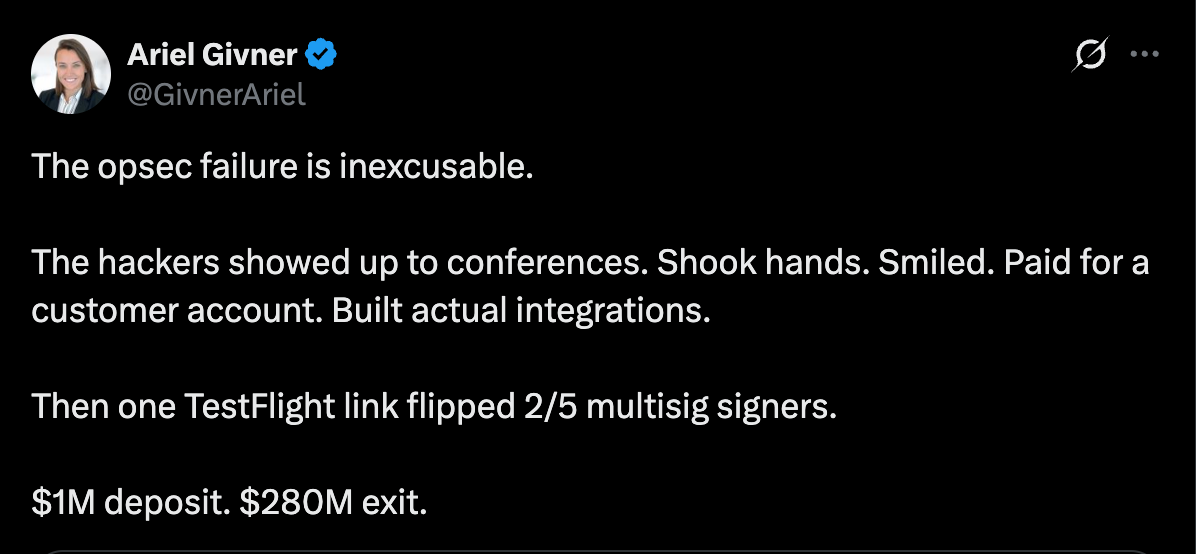
The hack of the Solana-based decentralized finance (DeFi) platform Drift Protocol could have been prevented if standard operational security procedures were followed by the Drift team, and may constitute “civil negligence,” according to attorney Ariel Givner.
“In plain terms, civil negligence means they failed their basic duty to protect the money they were managing,” Givner said in response to the post-mortem update provided by the Drift team and how it handled Wednesday’s $280 million exploit.
The Drift team failed to follow “basic” security procedures, including keeping signing keys on separate, “air-gapped” systems that are never used for developer work, and conducting due diligence on blockchain developers met through industry conferences.

“Every serious project knows this. Drift didn’t follow it,” she said, adding, “They knew crypto is full of hackers, especially North Korean state teams.” Givner continued:
“Yet their team spent months chatting on Telegram, meeting strangers at conferences, opening sketchy code repos, and downloading fake apps on devices tied to multisignature controls.”
Advertisements for class action lawsuits against Drift Protocol are already circulating, she said. Cointelegraph reached out to the Drift Team but did not receive a response by the time of publication.

The incident is a reminder that social engineering and project infiltration by malicious actors are major attack vectors for cryptocurrency developers that could drain user funds and permanently erode customer trust in compromised platforms.
Related: Drift explains $280M exploit as critics question Circle over USDC freeze
Drift Protocol says attack took “months” of planning
The Drift Protocol team published an update on Saturday outlining how the exploit occurred and claimed that the attackers planned the attack for six months before execution.
Threat actors first approached the Drift team at a “major” crypto industry conference in October 2025, expressing interest in protocol integrations and collaboration.
The malicious actors continued to build rapport with the Drift development team in the ensuing six months, and once enough trust was built, they began sending the Drift team malicious links and embedding malware that compromised developer machines.
These individuals, who are suspected of working for North Korea state-affiliated hackers and physically approached the Drift developers, were not North Korean nationals, according to the Drift team.
Drift said, with “medium-high confidence,” that the exploit was carried out by the same actors behind the October 2024 Radiant Capital hack.
In December 2024, Radiant Capital said the exploit was carried out through malware sent via Telegram from a North Korea-aligned hacker posing as an ex-contractor.
Magazine: Meet the hackers who can help get your crypto life savings back
TLDR:
- Over $6 billion in short positions face liquidation if the Bitcoin price rises toward the $72.5K level
- Nearly $2 billion in long positions are exposed to liquidation risk if Bitcoin drops below $65K
- Dense liquidation clusters between $68K and $74K may drive rapid upside price movement
- Lower zones around $60K to $66K show strong long liquidation pressure during downside moves
Bitcoin is approaching a critical price range where large leveraged positions face liquidation pressure. Data from a recent liquidation map shows billions in potential forced trades, with both upside and downside zones tightly packed around current levels.
Liquidation Map Reveals Tight Market Positioning
A recent post by Crypto Rover on X points to a sharp imbalance in Bitcoin’s liquidation landscape. The data shows over $6 billion in short positions at risk if Bitcoin climbs toward $72,500. Meanwhile, nearly $2 billion in long positions sit vulnerable near the $65,000 level.
The visualization tracks liquidation activity over a 30-day window. Bitcoin’s current price stands near $67,314, marked clearly on the chart. Price levels stretch from roughly $58,000 to $74,000, offering a clear view of where leverage is concentrated.
Above the current price, the cumulative short liquidation curve rises steeply. This indicates that many traders have opened short positions expecting a decline. As price moves higher, these positions face forced closure, which requires buying Bitcoin back.
Below the current level, the long liquidation curve grows steadily. This shows that many traders are positioned for upside but risk liquidation if prices fall. When these positions close, they trigger selling pressure.
Exchange-specific data adds more detail. Clusters from Binance, OKX, and Bybit show where liquidation activity is most concentrated. These zones often attract price movement due to the liquidity they provide.
Key Price Zones Define Market Direction
The liquidation map points to several high-activity zones that traders are watching closely. Around $65,000, there is a dense cluster of long liquidations. This area has already seen recent activity, making it a sensitive level.
Further down, the $60,000 to $62,000 range holds another concentration of long positions. If Bitcoin drops into this zone, forced selling could accelerate quickly. This type of movement often leads to sharp and rapid declines.
On the upside, liquidity builds strongly between $68,000 and $74,000. The most notable concentration appears between $72,000 and $74,000. This range holds the largest pool of short liquidations identified in the data.
If Bitcoin moves into this upper band, short sellers may be forced to exit positions. That process requires buying, which can push prices even higher. This chain reaction is often referred to as a short squeeze.
The current structure places Bitcoin between two pressure zones. Below the market, long positions risk liquidation and potential cascading sell-offs. Above the market, short positions create conditions for upward acceleration.
Crypto Rover’s tweet frames this setup as a market caught between competing forces. The larger liquidity pool sits above the current price, suggesting a strong area of interest. However, downside zones remain active and closely packed.
The map does not predict direction but shows where leverage is concentrated. Traders use this data to understand where forced activity may occur. These zones often act as magnets, drawing price toward areas with the most liquidity.
TLDR:
- Strategy holds 762,099 BTC valued near $50.9B, maintaining one of the largest corporate Bitcoin positions globally.
- The firm reports an average entry price of $75,694 per BTC, with a current unrealized loss nearing $6.9B.
- Over 100 purchase events show a consistent accumulation strategy across multiple Bitcoin market cycles.
- Saylor’s recent post signals continued buying interest as market prices fluctuate within the $80K–$90K range.
Michael Saylor signaled renewed Bitcoin activity through a brief social media post and updated portfolio data from his firm.
The update presents a clear view of holdings, purchase history, and current performance during ongoing market fluctuations.
Bitcoin Holdings Show Ongoing Accumulation Strategy
Michael Saylor posted on X stating, “Back to Work,” alongside a dashboard tracking his firm’s Bitcoin reserves. He shared the update less than an hour before it gained rapid traction among market participants.
The dashboard shows total holdings of 762,099 BTC, valued at about $50.90 billion at current market prices. The firm holds an average acquisition cost of $75,694 per Bitcoin. Based on current pricing, the position shows an unrealized loss of nearly $6.9 billion, or about 12%.
The data also shows that the firm executed 104 separate purchase events over several years. It spread these acquisitions across different market cycles, including periods of volatility and recovery. The visual chart plots Bitcoin’s price movements alongside each purchase point.
A white line tracks Bitcoin’s price trend from 2020 through 2025. Orange markers show purchase entries, while a green dashed line marks the average cost basis. This layered view presents a structured accumulation approach instead of sporadic buying.
Crypto Patel stated that the firm could execute another Bitcoin purchase soon. The post referenced the firm’s 13th strategy tracker update in 2026.
Market Response and Current Performance
Saylor’s post drew strong engagement and sustained attention from market participants. Within the first hour, users posted hundreds of comments and reposts, while likes crossed several thousand. Views also exceeded 100,000, showing strong visibility.
At the same time, the dashboard shows that the portfolio remains below its total cost basis. The current valuation stands lower than the total investment of $57.69 billion. This gap reflects recent price movement within the $80,000 to $90,000 range.
The chart also captures earlier phases of Bitcoin’s market cycle. Prices moved sharply between 2020 and 2022, then climbed steadily into 2024 and 2025. Recent data points show a pullback from higher levels.
Despite the current gap, the firm continues its steady accumulation pattern. It placed purchase markers across both market highs and lows. This pattern aligns with a structured buying method instead of reactive trading.
Saylor paired his brief caption with a detailed dashboard to present a clear message of continued activity. The timing of the update, along with mentions of a possible new purchase, keeps attention on the firm’s next move.
The dataset reflects a long-term positioning strategy focused on Bitcoin. While current figures show a temporary shortfall, the firm continues its consistent purchase record. Market participants now watch closely for further updates.
TLDR:
- Dogecoin trades near $0.09 support, with price action showing tight consolidation and reduced volatility
- A break above $0.12–$0.15 could signal renewed bullish momentum if supported by strong volume
- Continued weakness below $0.09 may push DOGE toward lower targets near $0.07 or even $0.05
- Historical data shows DOGE remains below prior yearly levels, reflecting a prolonged cooling phase
Dogecoin continues to trade near a critical support level, with recent market activity showing a balance between weakening bearish pressure and early signs of potential recovery. Price action remains compressed, keeping traders focused on the next decisive move.
Price Structure Signals Ongoing Consolidation
Recent chart data shared by Bitcoinsensus shows that Dogecoin has maintained a broad logarithmic uptrend channel since 2023.
The asset previously recorded strong upward moves of nearly 290% and 440% within this structure. However, the current price has returned to the lower boundary, where support is being tested again.
From late 2024, Dogecoin entered a clear downtrend after peaking near $0.45. The rally phase, which began around October 2024, saw rapid gains driven by strong speculative activity. Large bullish candles dominated this period, reflecting high volatility and increased market participation.
As momentum faded, the market shifted into a distribution phase between December 2024 and early 2025. During this period, price struggled to maintain higher levels and formed repeated rejection points. This eventually led to a breakdown, confirming the end of the prior bullish cycle.
Throughout 2025, the asset continued forming lower highs and lower lows. Temporary recoveries occurred, yet each rally failed to break above previous resistance levels. A sharp drop around October 2025 added further pressure, likely triggered by rapid liquidations or external market factors.
Since late 2025, price action has tightened within a narrow range between $0.09 and $0.10. Smaller candles now reflect reduced volatility and a lack of strong directional momentum. This phase suggests either accumulation or a pause before another move lower.
Market Awaits Breakout Confirmation
Another market perspective shared by Jonathan Carter points to a potential breakout from a descending channel pattern. According to his analysis, bullish pressure has been gradually increasing, which may lead to a move above current resistance levels.
Key resistance zones remain at $0.12 to $0.15, followed by higher targets extending toward $0.20. A sustained move above these levels would require stronger volume and consistent demand. Without that, the broader structure remains weak.
On the downside, the $0.09 level continues to act as immediate support. A breakdown below this range may expose lower targets near $0.07 and potentially $0.05. These levels are viewed as psychological zones where buyers may attempt to re-enter the market.
Additional context from KrissPax shows how current price levels compare historically during easter. Dogecoin trades significantly below its levels from the past two years, including $0.1614 in 2025 and $0.1823 in 2024. This comparison reflects the broader cooling phase following earlier market enthusiasm.
For now, Dogecoin remains in a neutral-to-bearish position. Price stability at support offers some balance, yet the absence of higher highs keeps upside expectations limited. Traders continue to monitor volume and structure for confirmation of the next trend direction.
TLDR:
- Tesla delivered 358,023 vehicles in Q1 2026, missing expectations and adding pressure on stock performance.
- Rising inventory above 50,000 units signals demand concerns amid continued high production levels.
- RSI below 50 and weak MACD confirm bearish momentum with no clear reversal signal yet forming.
- Price remains below key resistance levels, keeping the broader downtrend intact in the near term.
Tesla Inc. shares declined after first-quarter delivery data fell short of expectations, adding pressure to an already weakening chart structure. The latest figures showed rising inventory levels, while analysts adjusted price targets amid ongoing market caution.
Delivery Miss and Analyst Reactions Weigh on Sentiment
A recent tweet from Coin Bureau reported that Tesla delivered 358,023 vehicles in Q1 2026. This figure came in below expectations by 7,600 units. Meanwhile, production reached 408,386 vehicles, leaving inventory elevated by more than 50,000 units.
As a result, sentiment weakened across the market. Goldman Sachs and Truist Financial both reduced their price targets on TSLA. However, they maintained Hold ratings, signaling a cautious stance rather than a fully negative outlook.
The delivery miss added pressure to an already fragile technical setup. Market participants have been closely watching Tesla’s ability to sustain demand levels. The inventory build raised concerns about near-term balance between production and sales.
At the same time, the broader structure of the stock has shifted. Price action no longer reflects the strong momentum seen in late 2025. Instead, it shows a gradual transition into a weaker phase.
Technical Indicators Show Ongoing Downtrend
The daily chart for Tesla reflects a clear directional shift. The stock peaked near the $480–500 range before entering a consistent decline. Since January 2026, the pattern of lower highs and lower lows has remained intact.
Currently trading around $360, the price sits close to recent lows. There is no clear bounce formation, which suggests sellers remain in control. For any structural change, the price would need to break above the $400–420 range.
Momentum indicators also point to weakness. The Relative Strength Index is near 39, staying below the neutral 50 level. This position reflects bearish momentum without entering deeply oversold territory.
Repeated attempts to push above 50 have failed. This pattern indicates limited buying pressure. As a result, downside movement may continue without a strong reversal signal.
The Moving Average Convergence Divergence indicator also supports the trend. Both MACD lines remain below zero, confirming bearish conditions. The histogram has stayed mostly negative, although recent bars show slight flattening.
This flattening suggests selling pressure may be slowing. However, it does not confirm a reversal. A bullish crossover has not yet appeared, leaving the broader trend unchanged.
Key levels remain critical for short-term direction. Support is seen near $350, where recent reactions have occurred. A break below this level could open the path for further declines.
Resistance stands between $380 and $400, marking a recent consolidation zone. A move above this range would be needed to test the larger resistance near $420.
For now, the structure reflects stabilization within a downtrend rather than a confirmed bottom. Price behavior, combined with weak momentum, continues to favor cautious positioning.

Samsung Elec likely to report stupendous surge in quarterly profit to record level
Ashley Iaconetti Has ‘No Shame’ Putting Her Kids on Leashes

Crypto Trading LIVE: BTC Live Trading Bitcoin Analysis | 30 MAR #crypto #bitcoin #btc


-

 NewsBeat3 days ago
Steven Gerrard disagrees with Gary Neville over ‘shock’ Chelsea and Arsenal claim | Football
-

 Business3 days ago
No Jackpot Winner and $194 Million Prize Rolls Over
-

 Fashion2 days ago
Weekend Open Thread: Spanx – Corporette.com
-
Entertainment6 days ago
Fans slam 'heartbreaking' Barbie Dream Fest convention debacle with 'cardboard cutout' experience
-

 Crypto World4 days ago
Gold Price Prediction: Worst Month in 17 Years fo Save Haven Rock
-

 Tech7 days ago
The Pixel 10a doesn’t have a camera bump, and it’s great
-

 Tech7 days ago
Avatar Legends: The Fighting Game comes out in July and it looks pretty slick
-
Crypto World6 days ago
Dems press CFTC, ethics board on prediction-market insider trades
-

 Sports1 day ago
India men’s 4x400m and mixed 4x100m relay teams register big progress | Other Sports News
-

 Business4 days ago
Login and Checkout Issues Spark Merchant Frustration
-

 Tech6 days ago
Apple will hide your email address from apps and websites, but not cops
-

 Tech6 days ago
EE TV is using AI to help you find something to watch
-

 Sports5 days ago
Tallest college basketball player ever, standing at 7-foot-9, entering transfer portal
-

 Politics6 days ago
Should Trump Be Scared Strait?
-

 Tech6 days ago
Flipsnack and the shift toward motion-first business content with living visuals
-
Tech6 days ago
Daily Deal: StackSkills Premium Annual Pass
-

 Fashion7 days ago
The Best Spring Trends of 2026
-

 Sports6 days ago
Women’s hockey camp eyes fitness boost, tactics ahead of WC 2026 campaign | Other Sports News
-

 Crypto World6 days ago
U.S. rule change may open trillions in 401(k) funds to crypto
-

 Tech6 days ago
How to back up your iPhone & iPad to your Mac before something goes wrong
You must be logged in to post a comment Login