SYDNEY — As Australian Idol 2026 heads toward its grand finale, 23-year-old Kalani Artis from the New South Wales Central Coast has emerged as one of the season’s most compelling contestants, blending raw vocal talent with a deeply personal backstory that has resonated with viewers and judges alike.
Kalani Artis
From his standout audition to consistent top performances, Artis has captivated audiences with smooth, emotional delivery often compared to world-class artists. Here are 10 key things to know about the singer-songwriter who traded landscaping tools for the Idol stage.
Hometown roots on the Central Coast: Artis hails from Bensville and Umina Beach on the NSW Central Coast. He proudly represents the region, with local fans rallying behind him through community support and social media campaigns. His grounded, approachable demeanor reflects the laid-back coastal lifestyle, even as he navigates the high-pressure national spotlight.
Former landscaper turned performer: Before Idol, Artis worked as a tradie in landscaping. Known among fans as the “shy tradie,” he left the physically demanding job to pursue music full time. The transition marked a major life shift, with the competition providing the platform he needed to step away from manual labor and into the entertainment industry.
Nana Sue’s guitar sparked his passion: Artis credits his beloved grandmother, Nana Sue, with igniting his musical journey. She gifted him his first guitar when he was 11 years old. Though he set it aside for a few years during a difficult period, he picked it up again at age 14, using music as an outlet. He has repeatedly thanked her publicly, with touching moments featuring her support during the show.
Overcame significant mental health struggles: Artis has openly discussed his battles with anxiety, depression and feelings of isolation. After dropping out of school young, he experienced dark periods where he “locked himself away” and felt alone. Music became his “medicine,” helping him process emotions and rebuild confidence. His willingness to share this vulnerability has inspired many viewers facing similar challenges.
Audition earned highest praise from Amy Shark: Artis auditioned with a powerful rendition of Natalie Imbruglia’s “Torn.” Judge Amy Shark declared it “the best audition I’ve ever seen,” a rare accolade that immediately positioned him as a frontrunner. The performance, which aired in early February 2026, garnered hundreds of thousands of views on YouTube and sparked widespread buzz for its emotional depth and technical excellence.
Consistent standout in live shows: Throughout the competition, Artis has delivered memorable performances across various themes. Highlights include a stunning cover of Crowded House during one week and a breathtaking “Take My Breath Away” in Top 12 Movie Week that left audiences and the room in awe. His smooth vocals and ability to connect lyrically have earned repeated acclaim from judges Kyle Sandilands, Marcia Hines and Shark.
Advanced to the Top 6: As of early April 2026, Artis remains in the final six contestants alongside strong contenders like Harlan Goode and Jacinta Guirguis. Public voting has kept him progressing through Top 12, Top 10 and beyond, with fans frequently predicting a top-three or even victory finish due to his consistent excellence and growing fan base.
Self-taught musician with soulful style: A self-taught singer-songwriter, Artis draws influences from artists like James Bay, Lewis Capaldi and MK.GEE, blending indie, soulful pop and folk elements. His original material and Idol performances showcase earthy, heartfelt songwriting that resonates personally. He has released several Idol performance tracks on platforms like Spotify, including “Torn” and “Wherever You Will Go,” gaining tens of thousands of monthly listeners.
Family and community support drives him: Artis frequently highlights his family’s role, especially Nana Sue, who appears supportive in the audience. The Central Coast community has mobilized with voting drives and local pride campaigns. His Instagram account (@kalaniartis) serves as a hub for fans to connect, with posts encouraging collective growth and thanking supporters.
Asthma management moment highlighted human side: During one tense episode, Artis momentarily misplaced his nebulizer (“Nebby”), underscoring the everyday realities contestants face under pressure. The light-hearted yet relatable incident reminded viewers of his grounded personality amid the glitz of live television.
Artis’s journey on Australian Idol 2026 reflects more than vocal prowess — it embodies resilience and transformation. Born in 2002 or early 2003, the 23-year-old entered the competition carrying the weight of past struggles, including a recent breakup that added emotional layers to his performances. Judges and fans alike have noted how he “sings with lived experience,” bringing authenticity that sets him apart.
The season, hosted by Ricki-Lee Coulter and Scott Tweedie on Channel Seven and 7plus, has emphasized artist development. For Artis, the show has already changed his life, providing national exposure, recording opportunities and a platform to share his music beyond the Central Coast.
Fan reactions on social media and fan groups frequently describe his voice as “world-class” and “stunning,” with many predicting he could follow in the footsteps of previous Idol alumni who built sustainable careers. His Spotify presence and performance singles indicate growing commercial interest.
Yet Artis remains humble. In interviews, he has spoken about the leap from hiding in the shadows to performing live for millions, acknowledging fears that old mental health challenges could resurface under the intense scrutiny. Music, he says, continues to ground him.
Advertisement
As the finale approaches in mid-April, voting lines remain open via the 7plus app and designated numbers. Supporters are urged to back Artis with multiple votes per episode, as public preference will decide the ultimate winner.
Beyond the competition, Artis represents a new generation of Australian artists who leverage personal stories for connection. His path from landscaper to Idol contender highlights how opportunity, family encouragement and inner strength can intersect on a national stage.
Industry observers note that contestants like Artis, with genuine backstories and consistent talent, often translate Idol success into long-term careers involving tours, original releases and media appearances. His smooth delivery and genre-blending style position him well for pop, indie and acoustic markets.
With the Top 6 delivering high-stakes performances, Artis continues to impress with emotional control and vocal range. Whether covering classics or infusing originals with personal meaning, he has maintained poise that belies his relatively young age in the industry.
Advertisement
The broader Australian Idol narrative in 2026 has celebrated diversity of talent and stories. Artis’s openness about mental health adds depth to the season’s conversation around wellbeing in the entertainment industry.
As fans prepare for the climax, Kalani Artis stands as a reminder that behind every polished performance lies a human journey of growth, setback and triumph. His presence has enriched the competition, offering both entertainment and inspiration.
For those following the season, Artis’s trajectory offers lessons in perseverance. From a gifted guitar at age 11 to commanding the Idol stage at 23, his story underscores music’s transformative power.
With strong local and national backing, the Central Coast singer remains a favorite heading into the final stretch. Whatever the outcome, Kalani Artis has already secured a place in the hearts of many Australians as a talented, relatable and resilient artist to watch.
The Reserve Bank of India’s latest policy stance has drawn attention for its balanced approach, combining optimism on growth with caution on inflation and foreign exchange volatility. Analysts noted that the central bank’s projections, particularly for fiscal year 2027, appeared more optimistic than market expectations.
Speaking to ET Now, Anubhuti Sahay from Standard Chartered highlighted the growth outlook: “The MPC has projected 6.9% growth for FY27. We are at 6.4%. It looks optimistic, but RBI aims to stabilise market sentiment. Sharp downgrades are not typical for central banks, so a gradual adjustment was expected.”
On the tone of the policy, she said: “This is a very good, balanced policy. The MPC is on wait-and-watch mode, noting upside risks to inflation, downside risk to growth, and staying vigilant on FX volatility. The communication is clear and comforting for the markets.”
Addressing the impact of global energy supply and the war, Sahay said: “Two big ifs remain—the timeline of the war and its aftermath. Even if the war ends, energy prices could stay high if infrastructure is damaged. We can’t predict this precisely.”
Advertisement
On the realism of projections, she added: “The MPC has highlighted downside risks. Growth may be revised lower and inflation higher as clarity emerges, but the gradual approach supports market sentiment. Right now, growth is 6.4% and inflation 4.7%, and the direction indicated by the RBI remains key for markets.”
Live Events
Analysts say that while the RBI’s growth projection may appear optimistic compared with market estimates, its cautious and measured communication provides reassurance to markets amidst ongoing global uncertainties.
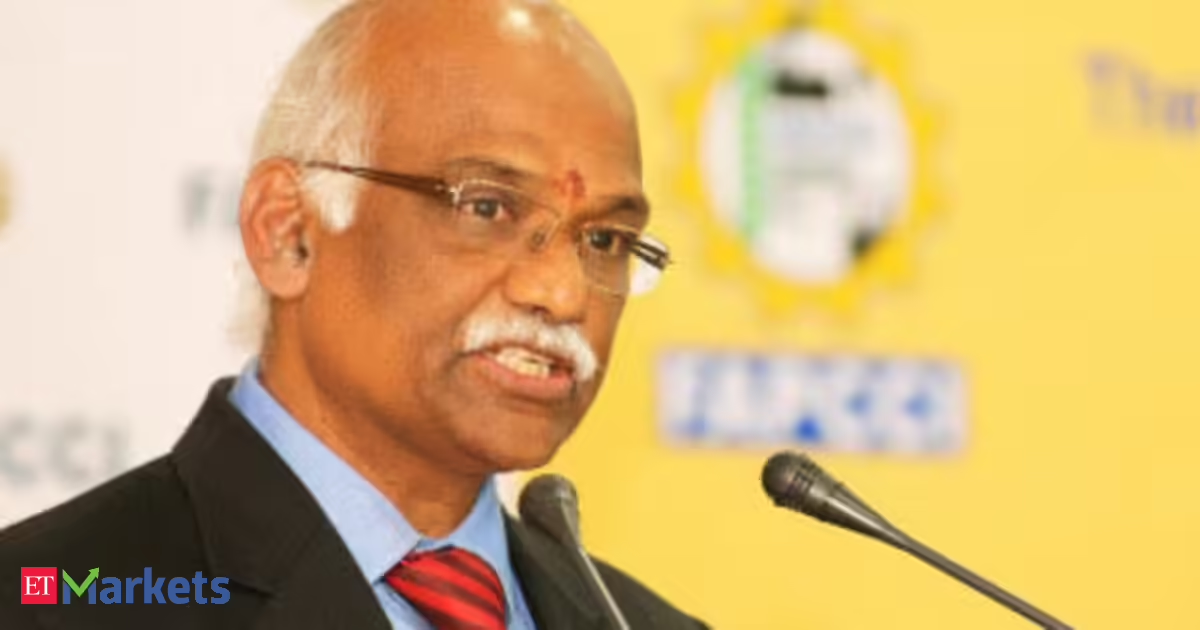
In a policy announcement that was brief, concise, and directly addressed multiple concerns, the Reserve Bank of India (RBI) left markets with a clear sense of direction amidst global uncertainties. Speaking to ET Now about the key takeaways from the monetary policy, former RBI Deputy Governor R. Gandhi shared his insights on the tone and implications of the latest moves.
“The MPC’s assessment and the final decisions were all on expected lines. There is no surprise in terms of their assessment or the final action, so that is the first thing. What further information that we can derive out of MPC is the projection, so their forecast both on GDP and inflation—that is where the likely discussion is going to be among people in all the stakeholders, how to assimilate those changes vis-à-vis the earlier forecast. That is what a quick reaction that much,” Gandhi said.
The Monetary Policy Report (MPR) revealed an upward revision in crude oil price assumptions, from $75 to $85 per barrel, reflecting heightened uncertainty from the West Asia crisis. On navigating policy in such scenarios, Gandhi noted the RBI’s comprehensive approach.
“Obviously, the central banks having access to various data points. Their model is much-much larger in terms of parameters that are being watched and fed into the model. Whereas just now, as I mentioned, the analysts who have their own model, they will have a very quick assessment kind of. Because obviously being part of the policymaking hierarchy, they get access to all such parameters, that is one. And two, their research team is also very-very focused, longstanding, credentials in terms of expertise built over the period, so that way their assessment will always be more sanguine in terms of not volatility or their intention to keep the assessment slow, that is not the intention, that model itself brings out that kind of stability. So that is one point.”
Advertisement
Gandhi emphasized that markets need to assess their own stance based on their risk appetite but should remain mindful of the RBI’s proactive posture.
Live Events
“So, what you are asking is that based on this, what the market should think about, how to reassess their own stance, their own actions based on this assessment, that is of course depending upon each entity’s risk appetite and risk-taking capacity—they may have a different view on that. But one thing what everyone should be clearly keeping in mind is that anything going to extreme, the pulse maker will always come in the way. Just as we have seen in the last two weeks when the rupee was quite volatile, and to bring in a sense of sanity, the Reserve Bank had to use certain tools which are harsh in normal course. Obviously, sometime when the restoration takes place, they will definitely be revisiting that and drawing those tools in operation. That is par for course that way. So that way, market should take cue from the strong message MPC and Governor Reserve Bank is telling—that we are watchful, we will be proactive, and we will be pre-emptive also. So, those are the three things always remember.” Analysts see the RBI’s current stance as a stabilizing force for markets, signaling that while global shocks may persist, the central bank is prepared to act decisively to mitigate volatility and maintain economic equilibrium.
The fashion brand is planning to open 15 shops in Britain this year
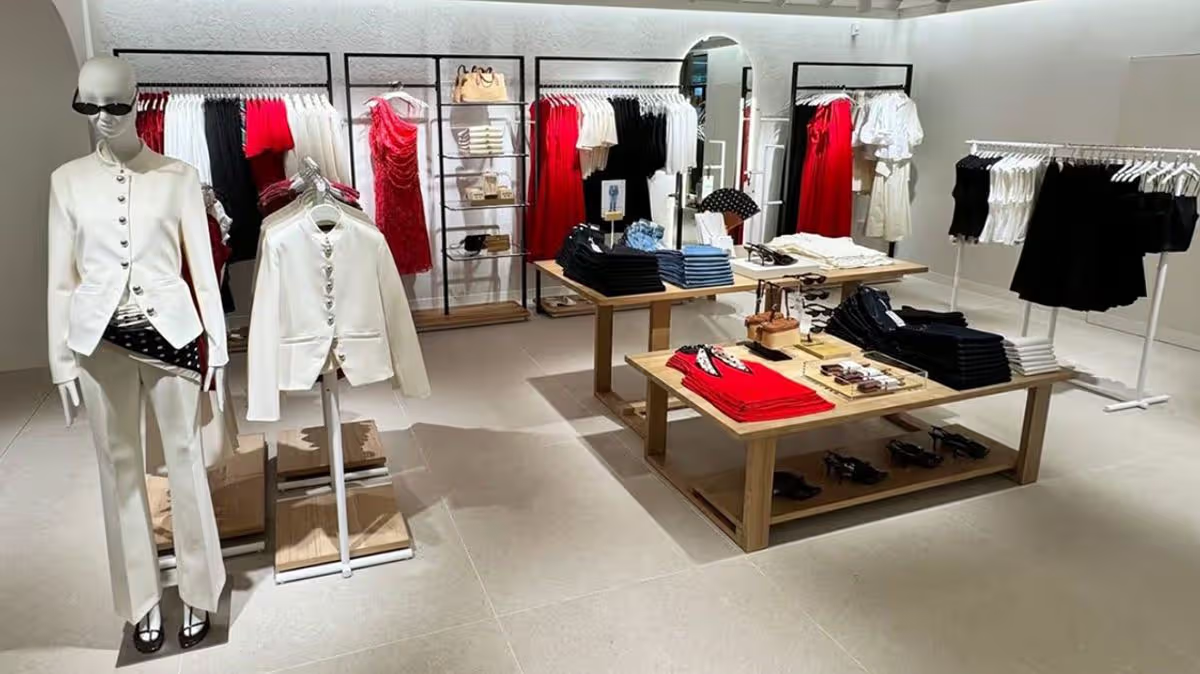
Mango has opened a store in Cheltenham(Image: Mango)
Fashion brand Mango has opened a new store in Cheltenham, creating 10 jobs. The branch is based in the town’s Regent Arcade and sells clothing, footwear and accessories designed at the company’s Barcelona studio.
The opening of the 4,500 sq ft branch comes as the brand targets further international expansion, including in Britain. According to the business, the move is part of its 2024–2026 4Es Strategic Plan, which aims to drive sales growth.
It is understood the UK remains a priority growth market for Mango which said it was “on track” to open 500 new stores globally by the end of the year, including 15 in the UK.
Fiona Cullen, international regional director for the UK & Ireland, said: “Our new Woman store in Cheltenham is a confident step forward for Mango, building on the strong progress we have made over the last year to broaden the appeal of Mango to even more customers across the UK.
Advertisement
“Cheltenham is the perfect new home to introduce our Woman collection to customers in the Cotswolds, in a store format that truly represents the Mediterranean soul of our brand.”
Last year, Mango reported global turnover of €3.8bn – up 13 per cent year-on-year or 16 per cent at constant exchange rates. In the UK, Mango reported close to 20 per cent turnover driven by its strategy, it said.
At the end of 2025, Mango had over 100 points of sale across the UK, including standalone stores and concessions.
Reform of Western Australia’s century-old water rights laws are unlikely to happen in this term of government, Water Minister Don Punch says, but it is on the cards.
Mumbai: The Indian rupee climbed Tuesday, advancing for three days on the trot, to close at 92.98/$, reflecting the anticipated impact of unwinding of lenders’ positions in the overseas forwards markets ahead of a regulatory deadline that aimed to provide support for a unit that lost the most in 14 years last fiscal. The rupee advanced 9 paise from its previous close of 93.07/$. It traded Tuesday in a narrow range as dealers remained on edge about the US deadline to reach a deal with Iran.
The currency traded between 93.07/$ and 92.86/$ on Tuesday as dollar sales from unwinding of arbitrage positions were met with demand for the greenback from importers and oil companies.
“Central bank measures have helped stabilise volatility, but the underlying bias remains sensitive to global cues,” said Jateen Trivedi, VP research analyst, currency at LKP Securities.
The RBI measures – in two tranches – have come over the past 10 days curbing open postions for banks to $100 million and barring corporates from taking positions in the offshore market.
Advertisement
“The near-term range for the rupee is seen between 92.50/$ and 93.75/$, with RBI monetary policy this week acting as a key directional trigger,” Trivedi said.


















































You must be logged in to post a comment Login