






Connect with us
DAPA Banner

Tech

Google's AI search is producing millions of wrong answers every day

Published

on


According to The New York Times, testing suggests that approximately one in 10 Google AI search overviews contains false information. Given that the search engine processes roughly 5 trillion queries per year, users could be exposed to more than 57 million inaccurate answers each hour – nearly 1 million per minute.
Read Entire Article
Source link

Continue Reading
Click to comment

You must be logged in to post a comment Login

Leave a Reply

Tech

1X starts shipping NEO humanoid robots to US homes

Published

on

The Norway-founded company’s vertically integrated NEO factory in Hayward marks the first US-scale push to put a general-purpose humanoid robot into private homes, with shipments planned this year and a competitive field that is already crowded


1X Technologies has opened a 58,000-square-foot manufacturing facility in Hayward, California, to produce its NEO humanoid robot at consumer scale, with capacity for 10,000 units in year one and a target of more than 100,000 units annually by the end of 2027.

The Norway-founded, OpenAI-backed company described the plant as the first vertically integrated humanoid robot factory in the United States. First customer shipments are planned for 2026.

The factory currently employs more than 200 staff and is scaling. NEO is being manufactured with critical components built in-house, motors, batteries, structures, transmission systems, soft goods, and sensors, in a configuration the company describes as bottom-up American manufacturing.

Advertisement

The 💜 of EU tech

The latest rumblings from the EU tech scene, a story from our wise ol’ founder Boris, and some questionable AI art. It’s free, every week, in your inbox. Sign up now!

“This is more than just a factory opening, it’s proof that the future of humanoid robotics is being built right here in the U.S.,” 1X CEO and founder Bernt Børnich said in the announcement.

The Hayward facility is intended as a stepping stone to a larger plant under construction in San Carlos, California.

Advertisement

The product

NEO is positioned as a general-purpose home robot, designed to operate alongside humans in domestic environments rather than as an industrial bipedal for warehouses or factory floors.

The robot is available in three colours (Tan, Gray, and Dark Brown) and offered through two commercial models: an Early Access purchase at $20,000 with priority delivery in 2026, or a subscription at $499 per month.

NEO is powered by Nvidia’s Jetson Thor onboard computing platform and trained using Nvidia’s Isaac open robotics simulation framework.

Demand has reportedly outstripped initial expectations. The company says first-year production capacity sold out within five days of preorders opening in October 2025. 

Advertisement

1X raised $100 million in its push to bring NEO to market; the robot is designed with explicit safety constraints: it is light, soft to the touch, and configured without pinch-points or other hazards, a deliberate choice given the company’s ambition to deploy in private homes rather than industrial settings, where heavier and harder humanoids dominate.

NEO learns household tasks through embodied AI, the technique under which robots acquire skills by interacting with their environment. Customers can also manually demonstrate tasks using a VR headset and controllers, and the robot includes conversational functionality that Børnich has compared to ChatGPT.

Whether those capabilities translate to reliable performance across the variety of unstructured tasks a real home presents, the open question for every consumer humanoid, is something the customer shipments later this year will start to answer.

Two routes to market

Beyond the consumer product, 1X has structured its commercial strategy around a parallel enterprise track. In December 2025, the company struck a partnership with private equity firm EQT to deploy up to 10,000 NEOs to companies in EQT’s portfolio between 2026 and 2030 across facility operations, manufacturing, logistics, and healthcare.

Advertisement

The two-track structure gives 1X higher-margin enterprise revenue from its early units, plants and warehouses pay full price for performance, while the home model can scale down in cost over time. It is the same playbook electric vehicles followed, with luxury and commercial customers subsidising the consumer rollout.

The 10,000-unit annual production target is a meaningful number in a field where most humanoid robot makers are still measured in the hundreds. Tesla, however, is the comparison that matters most. Tesla’s China president Wang Hao described the Shanghai Gigafactory as a “golden key” to mass-producing the company’s Optimus humanoid robot. Tesla has discussed manufacturing a few hundred Optimus units in 2026, scaling to thousands and then tens of thousands annually by 2027 and 2028, with internal targets of one million units per year from Shanghai that have not been confirmed in any public filing.

Elon Musk’s long-stated goal is pricing Optimus below $20,000 per unit, the same price point at which 1X is selling Early Access NEOs today.

China’s humanoid robotics sector is moving rapidly in parallel. Unitree’s G1 and H1 robots are commercially available at price points well below Tesla’s indicated targets. Agibot, UBTECH, Fourier Intelligence, and a growing roster of Chinese startups are all targeting the same market.

Advertisement

China’s central and local governments have identified humanoid robots as a strategic technology, with subsidies and policy support that other regions have been slower to match. The competitive dynamic places 1X’s American-manufactured, vertically integrated approach against Chinese state-backed scale and Tesla’s automotive manufacturing infrastructure simultaneously.

Europe is also building. Neura Robotics, founded in Germany in 2019, has scaled to more than 600 employees and raised €120 million in January 2025. Founder David Reger has told TNW he sees Tesla as his only real competitor in the segment.

Europe’s humanoid robotics sector is positioning regulatory clarity, the AI Act, the updated Product Liability Directive, the General Product Safety Regulation, and the Machinery Regulation, as a competitive advantage, on the argument that investors and industrial partners commit resources where compliance risks are predictable.

The factory opening is the easy part. Manufacturing a humanoid robot at scale, while difficult, is fundamentally a known engineering problem with known suppliers and known cost curves. The harder question, the one no manufacturer has yet definitively answered, is whether a general-purpose home robot can perform the variety of unstructured tasks a private home demands at a level customers will pay $20,000 or $499 a month for. 

Advertisement

1X’s answer to that question is, in part, to ship and iterate. Robots produced at the Hayward facility are currently being routed to internal testing, validation, and the company’s own R&D Lab and Internal Home Testing programmes before customer deliveries begin.

The vertically integrated manufacturing approach was chosen specifically to enable rapid hardware iteration as feedback comes in. If that iteration speed is fast enough to close the gap between the demonstrations on the launch reel and the messy reality of the average American home is, ultimately, the bet behind the entire factory.

Source link

Advertisement
Continue Reading

Tech

This retro gaming watch can track your heart rate and play Mega Man 2, as well

Published

on

If you grew up playing Mega Man 2 on the NES and the game holds a special place in your heart, this smartwatch is going to be right up your alley.

The Mega Man: My Play Watch is a collaboration between MyPlayWatch and Capcom, and it’s exactly what it sounds like: a smartwatch that lets you play a reimagined version of Mega Man 2 right on your wrist.

But how does it actually play?

The gameplay has been redesigned from the ground up for a touchscreen. Mega Man auto-runs through each stage while you tap to fire, time your jumps, and dodge hazards. It sounds simple, and that’s the point. 

You are not going to replicate the full NES experience on a 1.91-inch screen, and the developers know that. Instead, they have created something that captures the feel of the original game.

Advertisement

There are three game modes to choose from. Classic Mode lets you pick Robot Master stages, defeat bosses, and eventually unlock Dr. Wily’s Castle. Arcade Mode cranks up the speed and difficulty as you chase high scores. Play Time Mode turns the watch into an animated Mega Man display, which honestly might be my favorite mode.

What else the Watch can do?

The watch is not just for playing games but also has built-in sensors that can track your steps, heart rate, and calories throughout the day, all wrapped in Mega Man-inspired visuals. The watch faces feature pixel art and animated characters, so it looks great even when you’re not playing.

The best part might be what it doesn’t do. There is no Bluetooth, no Wi-Fi, no notifications, and no apps. It’s a focused, distraction-free device built purely for play and health tracking.

In a world where everything screams for your attention, that’s genuinely refreshing. The watch is available for pre-order now for $79.99 from GameStop‘s website.

Source link

Advertisement
Continue Reading

Tech

Belgium Plans To Nationalize Nuclear Power Plants

Published

on

Belgium plans to buy its seven aging nuclear reactors from French power giant Engie in a “full takeover” aimed at securing domestic energy supplies, extending reactor operations, and developing new nuclear capacity. “The move would also mean suspending plans to decommission nuclear operations in Belgium,” reports the BBC. From the report: The move would reverse the phase-out of nuclear energy legislation approved in the early 2000s amid safety concerns prohibiting the building of new nuclear power plants and limiting the operating lifetimes of existing ones to 40 years. Only two of Belgium’s seven nuclear reactors are operational – located at plants in Doel and in Tihange – and their operating licenses were recently extended until 2035. The other five reactors were shut between 2022 and 2025 and plans to dismantle them will now be suspended.

Engie and the government said they aim to reach an agreement on the takeover of the nuclear stations by October 1st. In a joint statement with Engie, the Belgian government said the move also highlights its aim to extend operations of existing nuclear reactors and to develop “new nuclear capacity” in Belgium. “By doing so, the Belgian Government is taking responsibility for Belgium’s long-term energy future, with the objective of building a financially and economically viable activity that supports security of supply, climate objectives, industrial resilience and socio-economic prosperity,” the statement adds.

Source link

Continue Reading

Tech

Apple posts ‘best March quarter’ with iPhone sales up 21.6pc

Published

on

Despite geopolitical instabilities, Apple managed a double-digit growth across all its geographic segments.

Apple posted its “best March quarter ever”, according to outgoing CEO Tim Cook, with a revenue of $111.2bn – up 17pc year on year. The company managed a 16pc revenue jump in its previous quarter, reporting a $143.8bn “record” revenue.

Despite geopolitical instabilities threatening the company’s supply chain, Apple, this quarter, managed a double-digit growth across all its geographic segments. Overall, net sales grew by around 16.6pc, with products and services showing 16.7pc and 16.2pc growth respectively.

“iPhone achieved a March quarter revenue record, fuelled by such extraordinary demand for the iPhone 17 lineup,” Cook said. New additions to its product line-up this quarter include the latest in its more affordable iPhone ‘e’ series, the new iPad Air powered by its in-house M4 chips, alongside the new MacBook Neo – which saw an overall positive reception from reviewers.

Advertisement

iPhone sales grew 21.6pc quarter over quarter to nearly $60bn, while Mac grew 5.6pc and Apple services, including iCloud, App Store and Apple Pay, grew 16.2pc.

“Continued strong customer demand for our products and services once again helped us achieve a new all-time high for our installed base of active devices across all major product categories and geographic segments,” said Apple’s chief financial officer Kevan Parekh.

The quarter past generated more than $28bn in operating cash flow. Company shares rose 2.7pc in after-hours trading.

Earlier this month, Apple announced that Cook will be stepping down as CEO after 15 years in the role, handing his position to senior vice president of hardware engineering John Ternus. In the earnings call yesterday, Cook told investors that the transition “is the right one”.

Advertisement

“Our roadmap is incredible,” he said. “And most importantly, we have the right leader ready to step into the role.

“There is no one on this planet I trust more to lead Apple into the future than John Ternus. John is a brilliant engineer, a deep thinker, a person of remarkable character, and a born leader.” Analysts believe Ternus’ background as a hardware engineer signals a potential for a regained focus into physical products.

“[Ternus] must resist the temptation of incrementalism that has plagued Apple of late and escape the iPhone’s gravitational pull in his quest for the next disruptive form factor,” commented Forrester VP principal analyst Dipanjan Chatterjee earlier this month. The company is still heavily reliant on the iPhone for growth.

Following the latest results, Chatterjee said that Apple’s latest performance is vindicatory, underscoring the company’s ability to sustain growth through product experience, even amid persistent criticism that it lags in AI.

Advertisement

Apple is, however, making a step change towards that direction with reports that it is moving away from ChatGPT exclusivity for its Siri voice assistant in an attempt to bolster its AI offerings. It was also reported that the company is testing a new standalone app for Siri.

“Its strategy remains consistent – treating AI not as a standalone feature but as an embedded layer within the broader ecosystem that delivers exceptional customer experiences in the moments that matter,” Chatterjee continued.

“As Tim Cook prepares to hand over to John Ternus, the focus will shift from execution to vision. The question is not whether Apple can still grow. It is whether the company can escape the gravitational pull of its own success to reimagine a different future.”

Apple announced a new Dublin office in February set to house 300 workers. Meanwhile, the company’s Big Tech contemporaries Meta, Microsoft, Amazon and Alphabet all posted positive results this quarter with massive AI spending plans in place for the year.

Advertisement

Don’t miss out on the knowledge you need to succeed. Sign up for the Daily Brief, Silicon Republic’s digest of need-to-know sci-tech news.
Source link

Advertisement
Continue Reading

Tech

Dublin’s Version 1 to acquire CreateFuture consultancy

Published

on

Version 1 said the merger would create a ‘combined organisation of 4,250 employees with annual revenues of more than €500m’.

Dublin technology consultancy services company Version 1 is to acquire UK technology services provider CreateFuture for an undisclosed amount.

Version 1 said the merger would create a “combined organisation of 4,250 employees with annual revenues of more than €500m” aiming to deliver “AI-driven digital transformation programmes at scale across complex, regulated environments in both public and private sectors”.

CreateFuture specialises in working as “a practitioner-led, AI-native partner to large enterprise clients” in highly regulated industries such as i-gaming – or online gambling – financial services and utilities, “where technical precision and regulatory compliance are critical”, according to Version 1.

Advertisement

“This acquisition is a strong strategic fit for Version 1, strengthening our capabilities and expanding the markets we serve,” said Roop Singh, CEO of Version 1.

“CreateFuture is an exceptional business, with high‑calibre talent, deep client relationships and sector expertise that directly complements our own.”

CreateFuture currently employs around 550 in Edinburgh, Leeds, London, Manchester and Sofia, Bulgaria. Its existing leadership team will remain in place following the acquisition.

“We started CreateFuture 16 years ago with a simple belief that the best work happens when great people are trusted to do great work for clients who care about the outcome,” said founder Euan Andrews.

Advertisement

“That belief has not changed, and this partnership accelerates our ambition for CreateFuture with a highly culturally aligned partner in Version 1.”

In a LinkedIn post, the UK company said its “strengths in strategy, design and AI-native delivery” would complement Version 1’s “depth in data, transformation and managed service”.

Version 1 was founded in Dublin in 1996 and offers a range of technology services to global organisations. In March, it chose its new Dublin HQ to house a new, cutting-edge AI studio and also said it would add 250 roles locally.

Earlier that month at the UK-Ireland Summit, Version 1 said it would create 1,000 jobs across the UK, including Northern Ireland, as part of its plans for a £40m investment in that market.

Advertisement

Don’t miss out on the knowledge you need to succeed. Sign up for the Daily Brief, Silicon Republic’s digest of need-to-know sci-tech news.

Source link

Advertisement
Continue Reading

Tech

Verizon Promo Codes: $200 Verizon Gift Cards | May 2026

Published

on

Back in the day, Verizon proved their expansive reach with the spokesperson who asked “Can you hear me now?” With the spokesman pulling a Benedict Arnold and moving to T-Mobile, Verizon is now called the “Network America Relies On,” proven by their 4G LTE network covering 99% of the U.S. population, and 5G network expanding daily (though hovering around 13% now). We know how important it is to stay in communication, so we’ve rounded up the best ways to save money this month, with Verizon promo codes, free phone promotions, and holiday bundle deals.

45% Off Streaming Services With Verizon

If you’re looking to switch phone plans or carriers, now’s a great time to switch to Verizon. With more freedom than ever before, you can pick the plan that fits best for your needs, and get up to four lines for only $25 per line with an Unlimited Welcome plan. You’ll also have a guaranteed three-year locked price plan, and to top it off, you can also get 45% off top streaming services.

Save up to $1,100 With Top Verizon Coupons

Both new and existing customers have options to save with today’s lineup of 2026 deals. Better yet, some of the brand’s most impressive devices are eligible for up to $1,100 off, like the new Samsung Galaxy Z Fold7, Samsung Galaxy S25+, Z Flip 7, S25 Ultra, and iPhone 17 Pro Max. The iPhone 16 Pro and Google Pixel 10 have limited time deals too, at up to $800 off.

There’s more, you can get a free phone with any new plan, plus free overnight shipping so you can use your new toy ASAP. And if you happen to be switching to Verizon internet this winter, you’ll get a free Samsung 43” Class Q7F QLED (worth $400). Plus, you can get $90 off the OnePlus Nord Buds 3 Pro (read our review here) when you buy a Samsung device.

Advertisement

Verizon Switch Offers: New Customers Can Get 4 Phones on Verizon and $25 Plans

Verizon just seems to be handing out phones at this point—you can get cutting edge smartphones including the iPhone 16 Pro Google Pixel 10, Samsung Galaxy S25 Ultra, and Samsung Galaxy S25+ with AI for free—with no trade-in required. You’ll need to get a new line or upgrade your plan to qualify, but you’ll be saving $1,100 after credits over 3 years. And with new deals this month, you’ll get 4 iPhone 17, Pixel 10, or Galaxy S25 phones on Verizon, plus 4 lines for only $25 per line.

You can also get a Samsung Galaxy Watch8, Apple Watch SE3, or iPad for free when you sign up for an Unlimited Plan, and even without a trade-in, four iPhone 17 phones with a new myPlan line.

When you sign up for Unlimited, you can get 4 lines for as low as $25 per line on Unlimited Welcome when you sign up for Auto Pay. All plans include unlimited talk, text and data on Verizon’s 5G network, and now also include a 3 year price lock guarantee, so you can have peace of mind that your bill won’t get jacked up in the future.

Our Favorite Verizon Phones From $5 per Month

Apple’s iPhone 16 is available right now, and looking better than ever—it’s ready for Apple’s new AI rollout, a battery that’s easier to replace, and has a host of games. We put together a handy guide to which iPhone 16 or Galaxy you should buy, in case the various iPhone 16 models to choose from are a bit overwhelming, along with some great cases and accessories to keep your most-used device safe and stylish. If you’ve been eyeing an iPhone 16 Pro, Verizon is offering a great deal where you can get the phone for as little as $5 per month—or it’s free when you add a new line. Stay tuned here for updates, because most Verizon promo codes are for new customers.

Advertisement

We at WIRED review and write about the newest line of Samsung products as well, and have created a guide to help you decide which Samsung Galaxy S24 model you should buy and some of our favorite Samsung Galaxy S24 accessories to upgrade your device. Like competitors, Samsung has worked to continuously integrate AI to make the phone even smarter, helping test for Google’s Gemini.

Source link

Continue Reading

Tech

Bang & Olufsen Beosound Haven Outdoor Speaker Debuts with Antolini at Milan Design Week 2026

Published

on

Milan Design Week 2026 is wrapping up, and while most people came for furniture and lighting, high-end audio didn’t stay quiet. After Klipsch and OJAS teased their kO-R2 collaboration for indoor spaces, Bang & Olufsen showed up with something far more ambitious for the outdoors: the Beosound Haven, developed with Italian stone specialist Antolini.

That matters, because the custom install category isn’t what it used to be. Outdoor audio has gone from weatherproof boxes you tolerated to fully engineered systems you actually want to listen to. Brands like Theory Audio DesignDALI, Sonus faber, Focal, and Monitor Audio have raised the bar with serious build quality, proper environmental protection, and performance that doesn’t collapse the second you step outside.

So Beosound Haven isn’t walking into an empty garden. It’s stepping into a category where expectations are finally high and where design alone won’t save you. Bang & Olufsen knows how to win a room indoors. Outdoors, the rules are different.

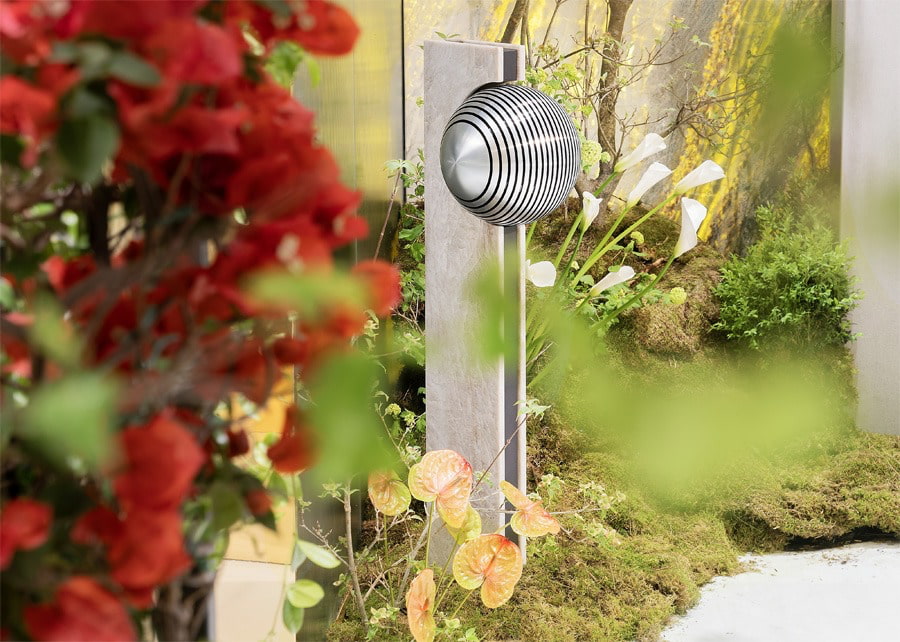
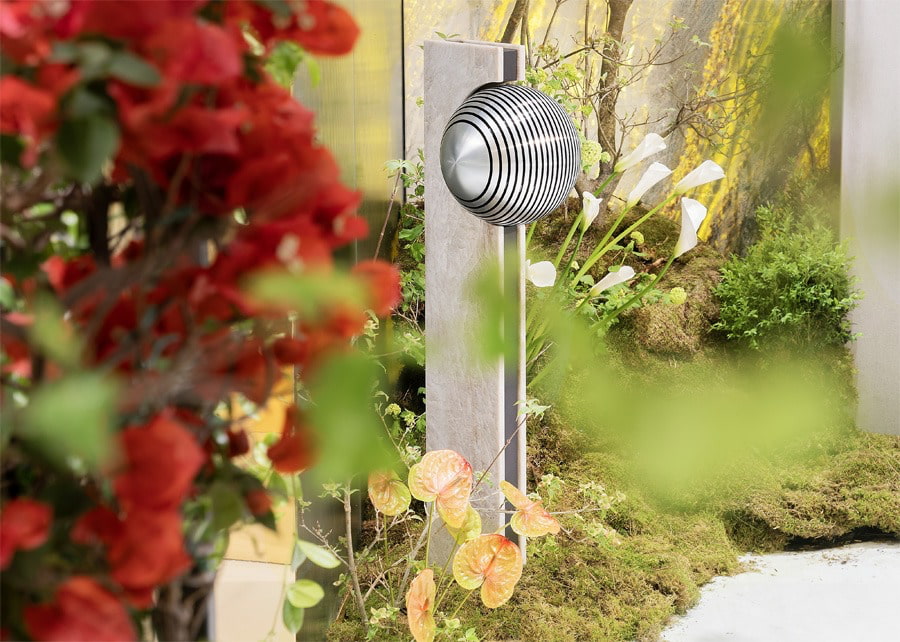
beosound-haven-outdoor-speaker-gardgen

Rooted in craftsmanship but clearly aimed at a very specific clientele, the partnership between Bang & Olufsen and Antolini leans into the idea that outdoor audio doesn’t have to look like outdoor audio. The Beosound Haven blends B&O’s acoustic engineering with Antolini’s stonework to create something that’s meant to disappear into the landscape visually while still delivering a controlled, high-end listening experience. It’s not just about sound — it’s about how that sound lives in the space.

To drive that point home, the companies built a full outdoor installation at Milan Design Week rather than sticking the speaker on a pedestal and hoping for the best. The exhibit framed Beosound Haven as part of a complete environment—integrated into stone, greenery, and architectural elements to show how landscape design, materials, and audio can work together instead of competing for attention. The goal is clear: move outdoor audio beyond background noise and into something that actually contributes to how a space looks, feels, and more importantly sounds.

Advertisement
beosound-haven-outdoor-speaker-mounted

Design at Bang & Olufsen has always been about understanding the relationship between technology, materials, and the spaces people inhabit. With this installation, that philosophy extends beyond the traditional room, exploring how beautiful sound can engage the senses and transform outdoor environments into immersive, sensorial spaces,said Kresten Bjørn Krab-Bjerre, Senior Director of Design, and continues: “Through Beosound Haven – our forthcoming landscape speaker – we explore sound as an architectural language. It interacts with materials and forms an atmosphere, creating a refined sense of place that is both subtle and powerful. It reflects our ambition to find new ways for sound to enrich the experience – not only as something you hear, but as something you truly feel.

beosound-haven-front

The Besound Haven Preview Experience

Set inside the Antolini Milano Duomo Stoneroom, the Beosound Haven wasn’t just dropped into a corner and labeled “outdoor speaker.” Bang & Olufsen and Antolini built a controlled environment to show how it’s meant to be used. The installation leaned on natural elements like greenery, stone, and a central reflective water table where droplets created subtle ripples, tying the visual design back to the idea of sound moving through space. Surfaces featured Antolini’s Taj Mahal quartzite in a matte finish, keeping reflections low and letting texture and light do the work without distracting from the audio.

At the center is a simple concept: treat sound as part of the architecture, not an afterthought. Beosound Haven combines B&O’s aluminum driver and electronics housing with Antolini’s stonework, designed to be specified early in a project instead of bolted on later. That’s the real pitch here. Integrate the system from day one so it works with the space instead of fighting it.

It also lines up with Antolini’s broader push beyond interiors. They built their reputation on high end stone applications indoors, and this is a logical move into outdoor environments where materials, durability, and placement matter just as much as aesthetics.

In collaboration with Bang & Olufsen, we have moved beyond traditional design to embrace the open air. By blending the raw elegance of natural stone with precision sound, we’ve created a bridge between nature and technology. These landscape speakers are not just objects; they are a dialogue between the elements, transforming gardens and terraces into living galleries where history and avant-garde meet to host your most meaningful moments,” remarks Carlo Alberto Antolini, Owner of Antolini.

Advertisement

Bang & Olufsen Atelier Program Contribution

Through Bang & Olufsen’s Atelier program, aluminum, the company’s core material, has been shaped into Beosound Haven’s spherical form and paired directly with stone from Antolini. Antolini, a family owned Italian company with roughly 70 years of experience working with marble and natural stone, brings a level of material expertise that aligns with B&O’s approach to industrial design and speaker construction.

Advertisement. Scroll to continue reading.

A range of natural stones are used across the collaboration, selected for their variation in pattern, density, and surface texture. The idea is straightforward: treat stone as a primary material in the system, not just a decorative shell around it.

The end result is less about making a statement piece and more about showing how materials and audio hardware can be integrated from the start. The stone surfaces frame the installation and influence how the speaker is perceived in the space, both visually and acoustically, without trying to overwhelm either side of the equation.

Advertisement

Pro Tip: Final details for Beosound Haven, including full specifications and release timing, have not been announced yet.

Beolab 18 Refresh

beolab-18-refresh

In addition to Beosound Haven, Bang & Olufsen and Antolini have also revisited the Bang & Olufsen Beolab 18, a floorstanding speaker that originally launched in 2013. The update focuses on materials rather than acoustics, with new natural stone finishes in a matte treatment, including Amazonite, Retro Black Petrified Wood, Patagonia Original, Dalmata, Cipollino GreyWave, and Taj Mahal.

This is being positioned as a limited edition series, with each unit reflecting the natural variation of the stone used. The goal is consistent with the Haven concept, extending the use of architectural materials into both interior and outdoor settings without changing the core speaker platform.

Pro Tip: Pricing and availability for the Beolab 18 Bang & Olufsen and Antolini editions have not been announced yet. For full features and specifications, refer to the official Bang & Olufsen Beolab 18 product page.

The Bottom Line 

Since 1925, Bang & Olufsen has built its reputation on design led audio that looks as expensive as it sounds. But outdoors is a different fight. Aside from the Bang & Olufsen Beosound Bollard, the brand has not been a major player in landscape audio, where durability, coverage, and system integration matter just as much as aesthetics.

Advertisement

Beosound Haven is unique because it is not trying to compete as a traditional outdoor speaker. It is positioned as part of the architecture itself, developed alongside Antolini and intended to be specified early in a project, not added later. That puts it in a different category than most outdoor systems, which are still designed around concealment or basic weather resistance rather than material integration.

Who is this for? Not someone looking to upgrade a patio with a few speakers and call it a day. This is aimed at high end residential projects, landscape architects, and custom integrators working on properties where materials, layout, and audio are planned together from the start. The unknowns still matter. Final design options, system configuration, and pricing have not been confirmed, but none of this is likely to come cheap. If it delivers on performance to match the design, it could push expectations higher in a category that has already started to take itself more seriously.

Source link

Advertisement
Continue Reading

Tech

Sources: Anthropic potential $900B+ valuation round could happen within 2 weeks

Published

on

Anthropic is asking investors to submit allocations for the AI company’s latest fundraise within the next 48 hours, according to sources familiar with the matter. The round, which TechCrunch reported is expected to be roughly $50 billion, is estimated to close within two weeks, the sources said.

As we previously reported, Anthropic is targeting a valuation of about $900 billion. However, given the soaring demand from investors seeking a stake in the company, the final valuation may well exceed that figure, our sources said.

Anthropic declined to comment.

Despite the intense demand, some early backers — particularly those who invested in 2024 or earlier — are skipping this round. Instead, these investors are waiting to potentially cash out during Anthropic’s anticipated IPO later this year.

Advertisement

The company is raising what is likely to be its last private round before going public to fund its massive computing needs.

Anthropic announced this month that its annual revenue run rate has surpassed $30 billion. But as we previously reported, the company’s run rate is currently closer to $40 billion, according to sources with knowledge of the company’s financials.

Anthropic raised its last round in February at a $380 billion valuation. At $900 billion, the company would not only more than double its valuation but would also surpass its chief rival, OpenAI, which closed a record-breaking $122 billion round at an $852 billion post-money valuation earlier this year.

Techcrunch event

Advertisement

San Francisco, CA
|
October 13-15, 2026

Jagmeet Singh contributed reporting.

Advertisement

When you purchase through links in our articles, we may earn a small commission. This doesn’t affect our editorial independence.

Source link

Continue Reading

Tech

Is It A Pet? No, It’s A Teacher’s Pet!

Published

on

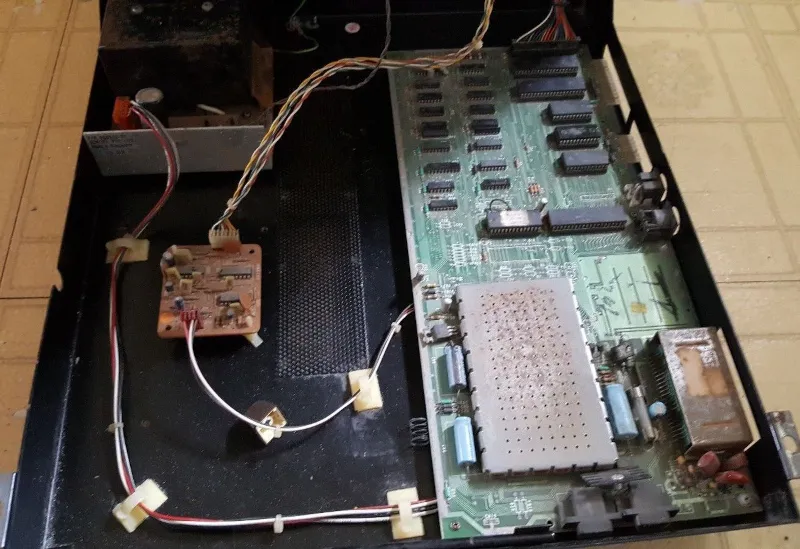
Here at Hackaday we cover the world of retrocomputing, which means that we see all manner of older computers in our everyday work. We might even claim that we’ve seen them all, were it not that every now and then something comes along which surprises us. [Tynemouth Software] has done just that, with an unexpected Commodore. It’s a Commodore 4064, something that was new to us, but which is best described as a Commodore 64 in a PET case. He’s bringing this one back to life.

For those with weak early-Commodore-fu, maybe it’s worth a quick recap. The PET was Commodore’s big hit from the early 1980s, and it took the form of an all-in-one machine with a CRT display built in. They packed a 6502, BASIC, blocky monochrome graphics, and unexpectedly an IEE-488, or GPIB port. Meanwhile the 64 was the company’s smash hit early 1980s home computer in a compact console design, with high-res color graphics for the time on your TV, and a synthesizer chip that’s still legendary in 2026. Combining a 64 mainboard with the super-robust PET case appears to have been part of Commodore’s business and education offerings.

This one appears to have been in the damp, because that board is definitely more than a bit grubby. After a lot of debugging its power and video circuits, including an unexpected sync splitter board to drive the non-composite monitor, he narrows down the problem to a dodgy ROM and some memory errors.

Advertisement

It seems there’s some question in Commodore enthusiast circles as to whether these machines were assembled from surplus PET parts, but he puts that one to bed by pointing out the custom metalwork and the few custom Commodore 64 features on the board. All in all it’s an interesting dive into an unusual 8-bit machine.

We’ve seen [Tynemouth] a few times here, perhaps most notably with their modern take on a ZX80.

Advertisement

Source link

Continue Reading

Tech

Q2 China demand lies in good products that resonate

Published

on

Apple had a record-breaking March quarter partially thanks to excellent performance in China, but there’s more to the story than just basic demand.

The US government went through a period of upheaval in 2025 thanks to the new administration’s aggressive, random, and now illegal tariffs. While not much has improved in that regard, the relationship between the US and China has improved somewhat in the intervening year.

According to Apple CEO Tim Cook on CNBC, that improved relationship with China was a positive development, but not the drive. He claims it is that “the product has really resonated with the customer.”

There’s no doubt that demand for the iPhone 17 lineup has carried through into the blockbuster quarter. Of the $111.2 billion Apple brought in, $20.497 billion belonged to Greater China.

Advertisement

Compare that to the year-ago performance, $16 billion, and that’s a $4.4 billion increase. It is certainly no small feat.

There have been concerns with demand in China thanks to political unrest between it and the United States. Chinese customers could easily decide to show loyalty to local brands that aren’t based in a country engaged in a trade war.

However, Apple’s iPhone 17 lineup was enough to spur demand, which was likely aided by the excellent entry iPhone 17e model that debuted during the quarter. The Mac also did well in part due to the MacBook Neo, but there has also been unprecedented demand for the M4 Mac mini due to AI trends.

Cook may have to face questions about the CEO transition or the status of the Apple Vision Pro during the earnings call, but China will likely be a lesser concern given the numbers. All eyes are on what’s next as Cook takes on the role of Executive Chairman starting September 1 with John Ternus taking over as CEO.

Advertisement

Source link

Continue Reading

Trending

Copyright © 2025