
Crypto World
Solana Crypto Foundation Launches STRIDE Program to Strengthen Ecosystem Security



The Solana Foundation has launched STRIDE – Solana crypto Trust, Resilience and Infrastructure for DeFi Enterprises – a structured security evaluation program covering all Solana-based DeFi protocols, funded through a partnership with security firm Asymmetric Research.
The program arrives five days after the Drift Protocol exploit on April 1, in which attackers drained $286 million in under 12 minutes – a breach that exposed the absence of any standardized, ongoing security baseline across Solana’s DeFi layer.
STRIDE is not a bug bounty or a one-time audit mandate. It is a continuous monitoring framework, independently administered by Asymmetric Research, with tiered benefits tied directly to protocol TVL and public evaluation results available to users and investors.
Whether that structure is sufficient to rebuild institutional confidence in Solana DeFi is the question the market will answer over the next several months.
- What It Is: STRIDE (Solana Trust, Resilience and Infrastructure for DeFi Enterprises) is a foundation-funded, structured security evaluation program for all Solana DeFi protocols, administered by Asymmetric Research.
- How It Works: Asymmetric Research independently assesses protocols across eight security categories – including operational security, access controls, multisig configurations, and governance vulnerabilities – with results published in a public repository.
- Tiered Benefits: Protocols with over $10M TVL that pass evaluation receive foundation-funded 24/7 threat monitoring; those above $100M TVL unlock formal verification tools using mathematical proofs across all smart contract execution paths.
- Rapid Response Network: The companion Solana Incident Response Network (SIRN) launches with five founding firms – Asymmetric Research, OtterSec, Neodyme, Squads, and Zeroshadow – sharing threat intelligence with response priority determined by TVL and impact.
- Current Status: STRIDE version 0.1 is live; the framework will evolve based on real-world assessment feedback, with the first public evaluation reports expected as protocols apply.
- What to Watch: Track the first published STRIDE evaluation results and any SIRN activations – those two data points will signal whether the program functions as operational infrastructure or credentialing theater.
Discover: The Best Crypto to Get Right Now
What STRIDE Actually Does for Solana Crypto and Why the TVL Threshold Structure Changes the Calculus
The core mechanism: Asymmetric Research evaluates protocols against its own eight-pillar security framework covering operational security, access controls, multisig configurations, and governance vulnerabilities, then publishes those results publicly.
That is not an audit; it is a continuously maintained security rating. The distinction matters because audits are point-in-time assessments that expire when a protocol upgrades; STRIDE’s continuous monitoring model keeps ratings calibrated to evolving threats.
The tiered benefit structure is where the program’s real incentive logic lives. Protocols above $10 million TVL that pass evaluation receive foundation-funded 24/7 threat monitoring at no cost to the protocol – operational security support that most teams currently cannot fund independently.
Protocols above $100 million TVL receive access to formal verification tooling, which uses mathematical proofs to check every possible smart contract execution path rather than sampling representative scenarios. At current Solana DeFi TVL concentrations, that $100M threshold covers the protocols whose failures carry systemic contagion risk.
Running alongside STRIDE is SIRN – the Solana crypto Incident Response Network – a membership-based coalition of security firms that functions as a shared threat intelligence layer and rapid-response coordinating body.
The five founding members are Asymmetric Research, OtterSec, Neodyme, Squads, and Zeroshadow. SIRN is open to all Solana protocols, but response prioritization is explicitly ordered by TVL and estimated impact. The foundation funds the coalition’s operations; protocols don’t pay for access.
Prior Solana security infrastructure – Hypernative for threat detection, Range Security for risk alerts, Riverguard for attack simulation, Sec3 X-Ray for static analysis – addressed individual threat vectors. STRIDE’s version 0.1 attempts to unify those capabilities under a single evaluative baseline. Whether version 0.1 evolves quickly enough to match the attack surface expanding in parallel is the core execution risk.
Explore: The Best Pre-Launch Token Sales With Asymmetric Upside Potential
The post Solana Crypto Foundation Launches STRIDE Program to Strengthen Ecosystem Security appeared first on Cryptonews.


Split Capital, the digital asset hedge fund founded by investor Zaheer Ebtikar, is winding down after a profitable run, with Ebtikar revealing in an X post that the firm delivered more than 100% returns and was profitable in both 2024 and 2025. He attributed the decision to wind down to a belief that the crypto market has shifted away from the hedge-fund strategies the firm once pursued.
Ebtikar said the hedge fund model “did not make sense for crypto, in perpetuity,” signaling a broader re-evaluation among venture-like capital approaches in a sector that has matured since its earlier, more momentum-driven phases. The announcement comes amid ongoing scrutiny of crypto hedge funds, which have faced tougher market conditions in the wake of the 2022 downturn, according to industry coverage.
Key takeaways
- Split Capital will shut down after a period of profitability, reporting over 100% returns across 2024 and 2025.
- Zaheer Ebtikar is transitioning to a leadership role at Plasma, a stablecoin-focused startup backed by notable investors, including Peter Thiel and Tether’s Paolo Ardoino.
- Plasma aims to build infrastructure for stablecoin settlement and broader global financial access; the company raised $24 million in February of the previous year.
- The move illustrates a broader shift in crypto funding—from traditional hedge-fund structures toward capitalizing on infrastructure and foundational technology that underpins practical crypto and fiat interoperability.
- Industry context suggests hedge funds have faced structural headwinds as market dynamics evolve, underscoring evolving investor preferences for durable, value-driven opportunities.
Split Capital’s winding down and Ebtikar’s rationale
In outlining the decision, Ebtikar framed Split Capital’s trajectory as part of a larger evolution within crypto markets. He described his early years in the space as “PvP button-clicking”—a reference to traders attempting to capitalize on momentum and narrative-driven surges. After nearly a decade, he argues, the market’s incentives have shifted. “The industry no longer rewards traders chasing momentum; it has matured into a space where the only real question is ‘What does the future look like and where is the value?’” he said.
He acknowledged that some observers were correct to question the sustainability of funds modeled after traditional hedge funds in a rapidly changing crypto landscape. The decision to wind down, he suggested, reflects a conviction narrowing toward a smaller set of founders and verticals that he believes will shape the next phase of the industry.
Plasma’s stablecoin infrastructure ambitions and Ebtikar’s new role
The move to Plasma follows a close, ongoing collaboration with its founding team throughout 2024 and 2025. Plasma positions itself as a builder of infrastructure for stablecoin settlement and broader access to global finance, touting a mission to unlock more efficient, widely accessible digital settlement rails. The company previously disclosed that it raised $24 million in February of the prior year from notable backers, including Framework Ventures, Bitfinex, Peter Thiel, and Paolo Ardoino, the CEO of Tether.
As Plasma’s chief strategy officer, Ebtikar will shepherd partnerships, growth initiatives, and go-to-market efforts, while also engaging with investors and policymakers ahead of the rollout of Plasma One and ongoing ecosystem expansion. In his view, the crypto sector is entering a new phase defined less by speculative trading and more by the creation of foundational financial infrastructure that can operate at a global scale.
“The last dance of crypto’s old era and the hope and deep belief that our work at Plasma can get us to a new golden age for our space,” Ebtikar said, framing his move as part of a broader industry shift toward sustainable, value-oriented development rather than perpetual momentum plays.
Industry backdrop: pressure on crypto hedge funds and a pivot toward infrastructure
The crosscurrents in the hedge-fund portion of crypto were underscored by industry coverage noting a tougher operating environment for crypto-centric funds in the wake of the latest market stresses. While some managers have argued that high correlation and liquidity constraints have muted alpha opportunities, others are recalibrating toward ventures that build durable protocols, settlement capabilities, and on-ramps to mainstream finance. In this context, Split Capital’s wind-down and Plasma’s expanded focus on infrastructure can be read as a signal of where capital is increasingly flowing: toward platforms and rails that enable broader participation in a crypto-enabled financial system, rather than toward boutique trading strategies alone.
The ecosystem’s evolution seems to be accompanied by a shift in how firms measure value. Where once a top-tier hedge fund might have boasted performance metrics across aggressive bid-ask dynamics, the current landscape emphasizes sustainable, long-horizon development—particularly in areas like stablecoins, on-chain settlement, and cross-border access to digital finance. This transition aligns with a growing consensus that crypto’s real utility will emerge from interoperable infrastructure and governance-enabled platforms that can scale beyond speculative narratives.
As Plasma moves to scale its platform and expand its network of partners and policymakers, observers will be watching closely how the company’s roadmap intersects with evolving regulatory expectations and the broader push to bring stablecoins into more robust, widely accessible financial rails. The pairing of a wind-down with a strategic shift toward infrastructure underscores the industry’s ongoing maturation—and the ways in which seasoned investors are recalibrating to a landscape where building durable capabilities may ultimately offer more enduring value than chasing short-term momentum.
At the same time, Split Capital’s leadership has signaled that its decision does not diminish the potential for strong performance in crypto strategies, but rather reflects a belief that capital should be deployed to areas with enduring impact. The firm’s reported profitability in 2024 and 2025, coupled with a strategic pivot to Plasma, illustrates how investors are balancing track records with a forward-looking assessment of where value is likely to emerge in a transforming market.
The evolution also raises questions about what investors should monitor next. Key indicators include Plasma’s progress toward its planned platform deployments, the pace of ecosystem expansion, and how the regulatory landscape shapes the feasibility and profitability of stablecoin-based settlement infrastructures. For participants across the crypto spectrum—traders, builders, and institutional backers—the next chapters will hinge on whether the infrastructure-centric approach can meet demand for speed, security, and cross-border accessibility in a growing digital-finance economy.
Readers should watch Plasma’s rollout cadence, strategic partnerships, and any statements from the funding community about the roadmap for Plasma One. As the sector tests new models of value creation, the tension between traditional hedge-fund structures and infrastructure-led growth will likely continue to inform where capital flows next and which ventures prove resilient in a maturing market.
Starting next week, taker orders on Binance that breach dynamic price corridors will be automatically canceled.
Binance on Tuesday announced a Spot Price Range Execution Rule (PRER) that will restrict order execution to dynamic price bands and automatically expire all taker orders with execution prices outside a specified range. The rule takes effect on April 14 with a gradual rollout across spot trading pairs.
The mechanism allows orders to execute only within dynamic price bands set around a reference price derived from recent trades, the exchange said. Unlike stop-loss or limit orders set by individual users, PRER is an exchange-level market protection mechanism applied during order matching — functionally analogous to circuit breakers on traditional stock exchanges.
The rule comes six months after the 10/10 crash, when crypto markets suffered their largest single-day liquidation event on record. The event wiped out over $19 billion in leveraged positions within 24 hours, impacting more than 1.6 million traders, triggered by President Trump’s threat of a 100% tariff on Chinese tech imports.
The crash exposed execution vulnerabilities on Binance specifically. USDe plunged to roughly $0.65 on the exchange while trading near $1 on Curve Finance, and long-dormant limit orders filled at extreme prices for assets including BNSOL and WBETH. Binance paid $283 million in compensation to affected users, followed by an additional $300 million in stablecoins and $100 million in low-interest loans under its “Together Initiative.”
A BitMEX report later characterized the episode as a microstructure failure that left order books at their thinnest since 2022.
Low liquidity conditions and the execution of long-standing limit orders contributed to trades occurring at unexpected price levels, Binance acknowledged in its PRER documentation.
PRER is the second major post-crash policy change. On January 7, Binance updated its Proof of Reserves (PoR) methodology. Previously, the reported net account balances did not include Binance’s own assets, which resulted in an inflated reserve ratio. The revised approach folds platform-held assets into the calculation, producing more conservative but more accurate ratios.
Binance’s PoR page claims that the exchange holds user assets 1:1, maintains zero debt in its capital structure, and keeps a separate SAFU emergency fund. The system uses Merkle Tree and zk-SNARK cryptographic verification, allowing individual users to confirm their balances are included without exposing personal data.
This article was written with the assistance of AI workflows. All our stories are curated, edited and fact-checked by a human.
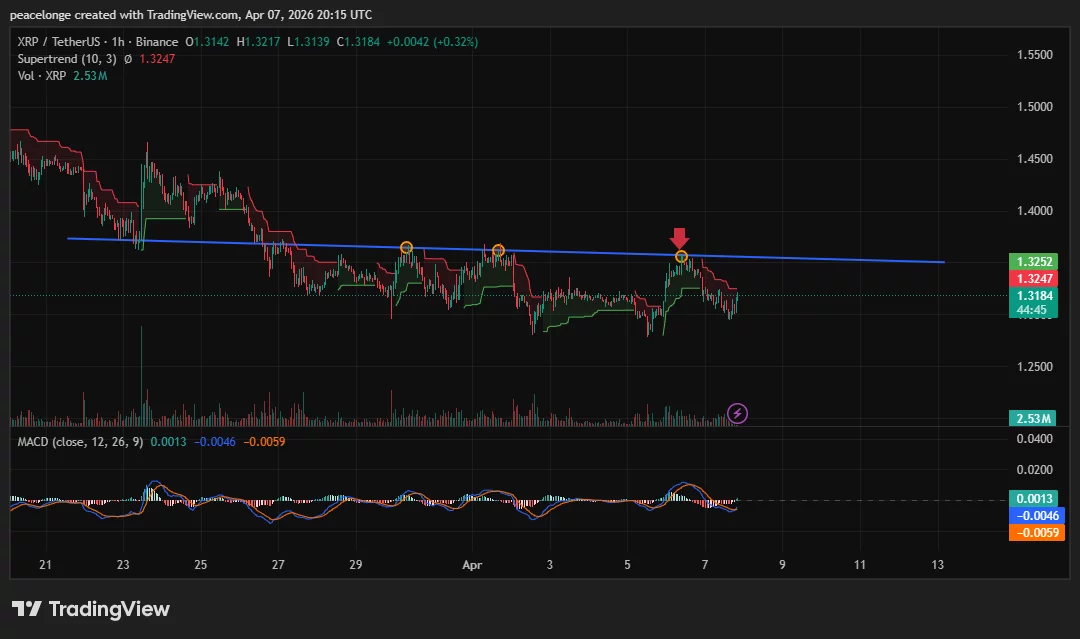
XRP price has now rejected the descending trendline resistance at least three times since late March, and the most recent failure on April 6 to 7 arrived on rising volume, a signal analysts associate with bearish continuation rather than consolidation.
Summary
- XRP price is at $1.3184 on April 7 after being rejected at the descending trendline near $1.35 for the third time since late March, with the 1H Supertrend at $1.3247 acting as immediate resistance above current price.
- The 1H MACD line sits at -0.0046 with the signal at -0.0059 and a barely positive histogram of 0.0013, with both lines in negative territory confirming the absence of bullish momentum despite the marginal uptick.
- A break below the $1.30 to $1.28 support zone exposes the 23.6% Fibonacci retracement at $1.28, below which holder support thins toward $1.15, while a confirmed daily close above $1.35 is required to shift the near-term bias.
XRP (XRP) price is trading at $1.3184 on April 7, down 1.9% from the session’s high after failing to close above the descending trendline resistance near $1.35 on April 6. The rejection is visible on the 1H chart as a red arrow marking where price touched the diagonal trendline and reversed, the third such failure since late March with prior rejections marked at lower trendline contacts. The 1H Supertrend at $1.3247 is now sitting just above current price, providing an additional near-term ceiling that compounds the trendline rejection signal.
On the 1H chart, XRP is trading within a structure defined by a descending trendline that has produced at least three confirmed rejections since March 21, visible as orange circles at prior high points where price touched and reversed from the diagonal resistance. The red arrow marks the most recent rejection, the most significant because it followed a recovery from the $1.27 zone that briefly raised expectations of a breakout attempt.
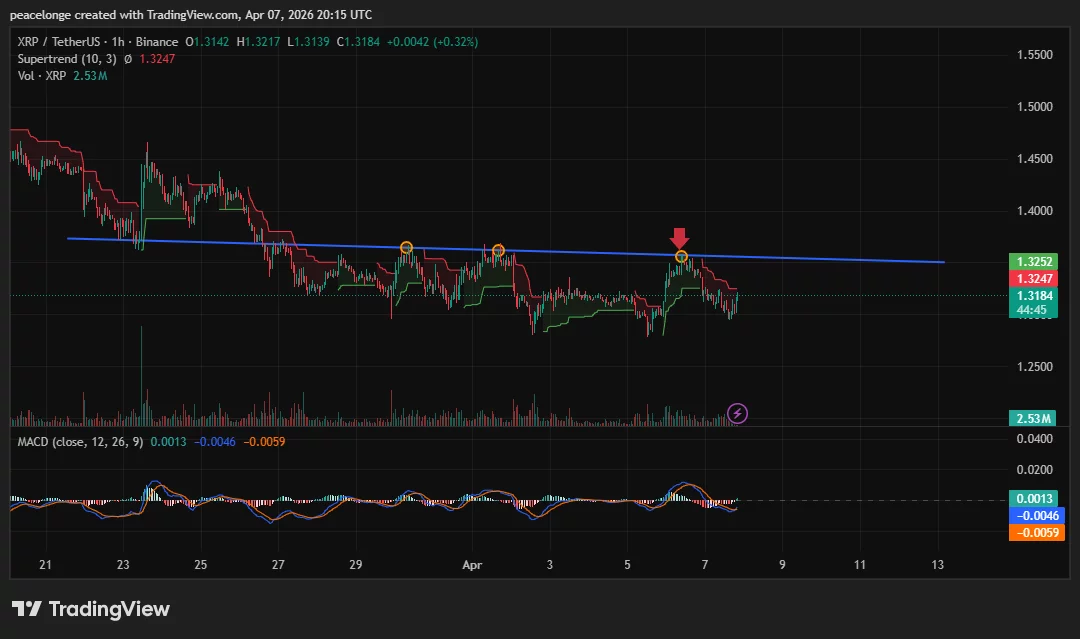
The 1H MACD line sits at -0.0046, with the signal at -0.0059 and a histogram reading of 0.0013. Although the MACD line is fractionally above the signal, both lines remain in negative territory and the histogram reading of 0.0013 is too small to constitute a meaningful bullish cross. Per market data published April 7, the daily RSI stands at 38, described as “weak momentum, but not yet in oversold territory,” meaning there is no technical floor from that indicator alone. The same analysis noted that open interest is rising alongside falling price, a sign traders are adding short positions rather than accumulating, which tends to amplify downside moves if support gives way.
Key Levels: $1.28 Fibonacci and $1.15 Bear Target
The $1.30 to $1.31 zone is the immediate structural support. A closing break below it exposes $1.28, which has held since February and aligns with the 23.6% Fibonacci retracement of XRP’s prior rally. Below $1.28, holder support thins materially toward $1.15 as the next significant structural level. On the upside, a confirmed daily close above the descending trendline at $1.35 is the minimum requirement to shift the near-term bias, and would also need to clear the 50-day EMA at $1.38 to open a path toward $1.40 to $1.45. The CLARITY Act, with a late April Senate markup targeted, is a binary catalyst that could shift the structural picture if passed, but a failure extends the current setup lower.
Derivatives and ETF Flow Context
Spot XRP ETFs recorded $3.56 million in net outflows in the week ending April 6, per CoinMarketCap data, reflecting reduced demand at a point where fresh capital is needed to challenge trendline resistance. The combination of ETF outflows, rising futures open interest consistent with short positioning, and thinning order book depth on Binance leaves XRP exposed to larger moves once either level breaks.
If $1.30 holds on a daily close, the range between $1.28 and $1.35 remains the decision zone. A close below $1.28 targets $1.15 as the next significant support.


The latest crypto news US CLARITY Act Senate 2026 bitcoin regulation battle has reached a pivotal moment: the bill that would define US crypto law for a generation is deadlocked between four factions in the Senate Banking Committee, and Senator Bernie Moreno has warned plainly that missing the May window risks pushing comprehensive crypto legislation off the calendar until after the 2026 midterms — and potentially beyond.
Summary
- The CLARITY Act faces a four-way standoff among crypto firms, banks, the SEC, and structural critics over whether stablecoin platforms can pay yield to users; Senators Tillis and Alsobrooks reached a compromise in principle on March 20 banning passive yield but permitting activity-based rewards, though key industry players including Coinbase and Stripe have still not fully accepted the text
- The Senate Banking Committee markup is targeted for the second half of April after Easter recess ends April 13; the bill then faces five sequential hurdles before reaching the president’s desk, leaving almost no margin for further delay
- Polymarket places 2026 signing odds at 63 to 66%; Ripple CEO Brad Garlinghouse has said 80 to 90%, though he recently pushed his expected passage timeline from April to May; JPMorgan analysts called passage by midyear a “positive catalyst for digital assets”
The latest crypto news US CLARITY Act Senate 2026 bitcoin regulation standoff is less about what the bill says and increasingly about whether the political calendar will allow it to move at all. As crypto.news reported, the core stablecoin yield dispute — the fight that paralyzed the January markup and dominated the past three months — has a framework in place: the Tillis-Alsobrooks compromise from March 20 bans passive yield on stablecoin balances while permitting activity-based rewards tied to payments and platform use. Senators Lummis and Alsobrooks have described the deal as 99% resolved.
The obstacle now is not the bill’s content. It is the five-step process that remains: a Senate Banking Committee markup, a full Senate floor vote requiring 60 votes, reconciliation with the Agriculture Committee version, reconciliation with the House-passed version from July 2025, and a presidential signature. Senator Bernie Moreno stated explicitly: “If the bill does not reach the full Senate floor by May, digital asset legislation may not receive serious consideration again for years.”
The four factions each have veto power over different parts of the bill. Crypto firms, led publicly by Coinbase, want the flexibility to offer yield-bearing stablecoins and clear DeFi protections. Banks, led by the American Bankers Association, are opposed to any stablecoin economics that could pull deposits away from the insured banking system — Standard Chartered estimated an open-ended yield provision could redirect up to $500 billion in deposits. Democratic senators are pushing for ethics language barring government officials and their families from personally profiting from crypto — language directed explicitly at Trump family holdings. And structural critics within both parties want stronger anti-fraud and DeFi oversight provisions the current draft does not contain.
What Passes or Fails Means for Bitcoin
As crypto.news noted, the CLARITY Act’s outcome is a critical variable for the entire institutional crypto pipeline. If it passes, the SEC/CFTC jurisdictional line becomes federal law rather than a reversible guidance document — giving large asset managers a permanent legal rationale for Bitcoin commodity custody and product approval. If it stalls past May, regulatory guidance from the current administration could be reversed after the midterms, putting institutional capital currently on the sidelines back into waiting mode.
Peter Van Valkenburgh, executive director of Coin Center, framed the bill’s purpose precisely: the aim of passing the CLARITY Act is not to trust the current administration, but to “bind the next one.”
The Senate returns from Easter recess on April 13. The Banking Committee markup window is the second half of April. That window is the entire ballgame.
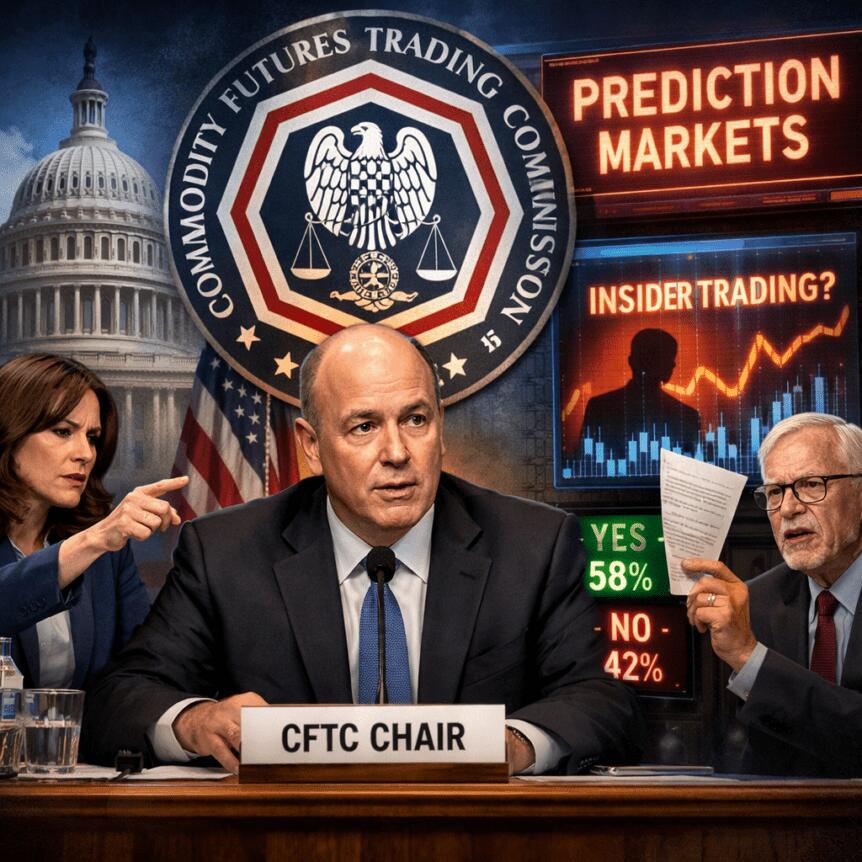
A bipartisan group of seven House members has formally pressed the Commodity Futures Trading Commission (CFTC) to account for its approach to insider trading in prediction markets and event contracts tied to geopolitical events. In a letter to CFTC Chair Michael Selig, the lawmakers argued that the agency wields clear authority under the Commodities Exchange Act to prevent evasion of the act’s underlying swap provisions, signaling support for Selig’s view that the CFTC has jurisdiction over prediction markets.
The letter also raises questions about how the CFTC polices contracts deemed “morally obscene,” including wagers on U.S. military actions in Iran and Venezuela. The lawmakers pointed to instances of suspicious trades related to the timing and outcomes of such actions, calling for swift and decisive oversight to prevent exploitation of these markets. They warned that allowing these contracts to persist could undermine confidence in a federal regulatory framework intended to ensure fair, transparent markets.
Key takeaways
- Lawmakers request a formal response from the CFTC by April 15 on six questions related to insider trading and the regulation of prediction markets.
- The seven-member letter reinforces the CFTC’s claimed jurisdiction over prediction markets by tying them to the agency’s swap provisions under the Commodities Exchange Act.
- Concerns over “morally obscene” event contracts—such as bets tied to U.S. military actions—highlight ongoing scrutiny of market content and potential misuse.
- Regulatory battles unfold at federal and state levels, including lawsuits by state gaming authorities against Kalshi and Polymarket, with questions of preemption and enforcement increasingly central.
- CFTC enforcement chief David Miller signaled a pragmatic stance on insider trading—prosecuting only cases involving tipping or misappropriated information, not pursuing every minor violation.
Regulatory scope and the arc of enforcement
The exchange between lawmakers and the CFTC underscores a broader debate about how federal commodities rules should apply to prediction markets and event contracts. The letter cites the Commodities Exchange Act as granting the CFTC the authority to apply rules designed to prevent evasion of swaps provisions, reinforcing the agency’s position that prediction markets fall within federal regulation rather than purely state purview. This stance sits against a backdrop of legal challenges to market operators ranging from Kalshi to Polymarket, with state authorities pursuing enforcement actions that argue unlicensed gambling or sports betting violations.
The legal landscape is drafting itself in real time as courts weigh the reach of federal preemption against state gaming statutes. For example, the Third Circuit recently affirmed a lower court ruling blocking New Jersey gaming authorities from pursuing enforcement actions against Kalshi, with two of three judges indicating Kalshi had a reasonable chance of success in arguing that federal commodities laws preempted state actions. The outcome of these jurisdictional questions could shape how prediction markets operate across multiple states and whether state regulators can curb activities they deem unlawful without clashing with federal authority.
Beyond court battles, industry players continue to navigate a patchwork of state laws and regulatory expectations. Kalshi and Polymarket have faced separate suits and inquiries as states seek to police unlicensed gambling while federal regulators frame certain event contracts as swaps. The evolving regulatory posture matters for investors and builders who rely on predictable rules for creating, listing, or trading contracts tied to real-world events.
Insider trading enforcement: a measured approach
As lawmakers pressed for more aggressive oversight, CFTC enforcement chief David Miller weighed in on how insider trading in prediction markets would be pursued. Miller indicated that the agency would prosecute cases involving tipping or trading on misappropriated information but would not allocate resources to “trivial” instances that do not rise to a material manipulation of market integrity. The distinction—between serious, information-based misconduct and routine or minor mispricings—speaks to a broader enforcement philosophy that weighs market impact against prosecutorial effort.
For market participants, the comment signals that while insider trading remains a crucial concern, the CFTC’s approach may prioritize cases with clear, material harm to market fairness. This stance could influence how platforms design surveillance, disclosure, and antifraud controls to deter misuse without hampering legitimate price discovery and hedging activity.
What to watch next: implications for platforms and investors
The administration of prediction markets sits at the intersection of financial regulation, consumer protection, and national security considerations. The current letter and the broader regulatory dialogue suggest several trajectories to monitor:
- Regulatory clarity could emerge on whether prediction markets are categorically swaps under federal law or if alternative regulatory frameworks apply in specific contexts. The outcome will affect platform licensing, product design, and cross-state operations.
- State actions against prediction-market operators may continue to test the balance between state gaming authority and federal preemption, with potential implications for market access and compliance costs.
- Enforcement priorities could tilt toward high-impact, information-based misconduct, prompting platforms to strengthen anti-insider trading controls, surveillance analytics, and governance standards to deter misconduct.
- Investors and developers should watch how sensitive event contracts—especially those tied to geopolitical or military actions—are treated in terms of content guidelines, listing approvals, and risk disclosures.
The exchange between lawmakers and regulators arrives amid broader conversations about how to harmonize innovation in on-chain or off-chain prediction markets with robust oversight. As platforms adapt to the regulatory rhythm, participants should weigh the potential for policy shifts that could either broaden permissible activities under uniform federal standards or tighten restrictions at state levels. The next formal response from the CFTC by mid-April will be a telling signal of how aggressively the agency plans to police insider trading and whether it will pursue a more centralized, comprehensive framework for prediction-market regulation.
For readers following the evolution of prediction markets, the unfolding dynamic between federal regulators, state enforcers, and market operators like Kalshi and Polymarket will shape both the viability of these platforms and the risk landscape for traders who rely on event-based contracts to hedge or speculate. The coming weeks will reveal whether lawmakers’ questions translate into tangible regulatory clarity or simply intensify the ongoing debate over the proper scope of the CFTC’s powers in this evolving arena.
Readers should stay attentive to any formal CFTC responses, upcoming court decisions affecting jurisdiction, and platform-level governance changes that may arise as a result of increased scrutiny into insider trading and the content of event contracts.

TLDR
- SOL Strategies has acquired Darklake Labs for $1.2 million to expand its role in Solana’s ecosystem.
- The deal includes $200,000 in cash and $1 million in SOL Strategies common shares, with the stock portion subject to a four-month lockup.
- Darklake’s Zyga zero-knowledge proof system will enhance privacy features and reduce transaction vulnerabilities on the Solana blockchain.
- The acquisition brings in Darklake’s core team, including CEO Vitor Py Braga and COO Amber Hales, both of whom have extensive blockchain experience.
- SOL Strategies has been scaling its Solana holdings, with a treasury of 533,040 SOL valued at approximately $43.9 million.
SOL Strategies has confirmed the acquisition of Darklake Labs, a Solana-native zero-knowledge startup, for $1.2 million. The deal includes $200,000 in cash and $1 million in common stock, subject to a four-month lockup. This acquisition will bring privacy technology and new expertise to SOL Strategies as it increases its involvement in the Solana ecosystem.
SOL Strategies Strengthens Its Solana Presence Through Acquisition
In a strategic move, SOL Strategies has agreed to acquire Darklake Labs, a privacy-focused startup specializing in zero-knowledge proofs (ZKPs). This acquisition is aimed at expanding SOL Strategies’ involvement in Solana’s blockchain development. Darklake’s expertise in ZKP technology will enhance the company’s offerings and provide a new layer of privacy-focused solutions.
The $1.2 million deal is divided between $200,000 in cash and $1 million in SOL Strategies common shares. The stock portion is subject to a four-month lockup period. This purchase positions SOL Strategies as a more active participant in Solana’s technological growth, especially in the growing privacy and security space. Darklake’s proprietary Zyga ZKP system is designed to improve transaction privacy on the Solana blockchain.
The Acquisition Brings Talented Individuals and Research Partnerships
The acquisition also includes Darklake’s core team, led by CEO Vitor Py Braga, a former infrastructure engineer at Meta and IBM. He will join SOL Strategies, bringing his deep technical expertise in blockchain infrastructure. Amber Hales, Darklake’s co-founder and COO, will also join the team, offering her valuable experience in compliance from previous roles at Coinbase and Coincover.
Darklake has developed strong academic partnerships in Brazil and is in the process of filing a patent for its ZKP technology. SOL Strategies will benefit from these collaborations, further strengthening its research capabilities. The company’s acquisition of Darklake is not just a hire; it reflects a deeper commitment to advancing Solana’s ecosystem with innovative solutions.
SOL Strategies Pushes Forward with Solana Growth and Institutional Access
As part of its ongoing strategy to expand its Solana holdings, SOL Strategies also reported a treasury balance of 533,040 SOL. This includes liquid staked SOL, worth around $43.9 million based on the April 1 price of SOL. In addition to the treasury, SOL Strategies has seen growth in its validator operations, managing 3.8 million SOL under delegation and 768,022 SOL in its liquid staking product, STKESOL.
The company has been expanding institutional access to its staking infrastructure. In March, Balance, a digital asset custodian, integrated SOL Strategies as a staking provider for its clients. ARK Invest’s Digital Asset Revolutions Fund also selected SOL Strategies as a Solana staking provider, further validating its role in Solana’s expanding ecosystem.



Solana DEX Stabble has urged its users to withdraw all liquidity after a former employee was outed as a North Korean operative.
The IT worker in question, who has also worked for Solana crypto fund Elemental, was named by crypto sleuth ZachXBT on Tuesday during a back and forth with Elemental founder “Moo.”
When the discussion turned to the issue of trust – something that Moo says they’ve been “obsessing over” for four years – Zach responded, “Stop virtue signaling you conveniently left out the fact that you had a DPRK IT worker on payroll at Elemental for years.”
The investigator then went on to reveal details of the alleged mole, naming him as Keisuke Watanabe, aka “kasky53,” and posting his GitHub aliases and email address.
Read more: The solution to crypto’s Lazarus problem could be simpler than expected
Stabble quickly quote tweeted Zach and urged its users, “To be safe – everyone please temporally [sic] withdraw your liquidity instantly!
“Better safe than sorry.
“This is the new team from Stabble, that aimed to repair the project.
“We will do new audits to be safe about our LPs.
“Then we can continue. Safety first.”
It then admitted that it employed Watanabe a year ago.
DPRK plants have been on crypto payrolls ‘for years’
The warning comes as the industry grapples with fresh revelations from ZachXBT, who revealed this week that North Korean IT workers have been quietly embedded on crypto project payrolls for years.
Previous investigations have shown millions of dollars flowing to suspected DPRK-linked developers operating under fake identities, raising concerns about insider access and long-term infiltration risks.
Footage circulating on X appears to show suspected DPRK IT workers abruptly leaving a Zoom call after being prompted to criticize North Korean leader Kim Jong Un, further fueling speculation about covert operatives inside crypto teams.
The developments follow the recent Drift Protocol hack, one of the largest DeFi exploits of 2026, in which more than $200 million – and potentially up to $285 million – was drained.
Analysts and blockchain researchers have linked the attack to North Korean hacking groups, citing patterns consistent with past operations tied to the Lazarus Group.
Read more: CHART: North Korea stole $2.8B in crypto hacks since 2024, report
One trading firm with close ties to Drift said it was “bombed back to the stone age” by the exploit, highlighting the scale of the damage across interconnected Solana liquidity providers.
The attack itself was notable not for a smart contract bug, but for a prolonged social engineering campaign.
Investigators say attackers spent months building trust, infiltrating contributor circles, and ultimately exploiting governance mechanisms to drain funds in a matter of minutes.
Protos has reached out to Stabble for comment and will update if we hear back.
Got a tip? Send us an email securely via Protos Leaks. For more informed news and investigations, follow us on X, Bluesky, and Google News, or subscribe to our YouTube channel.
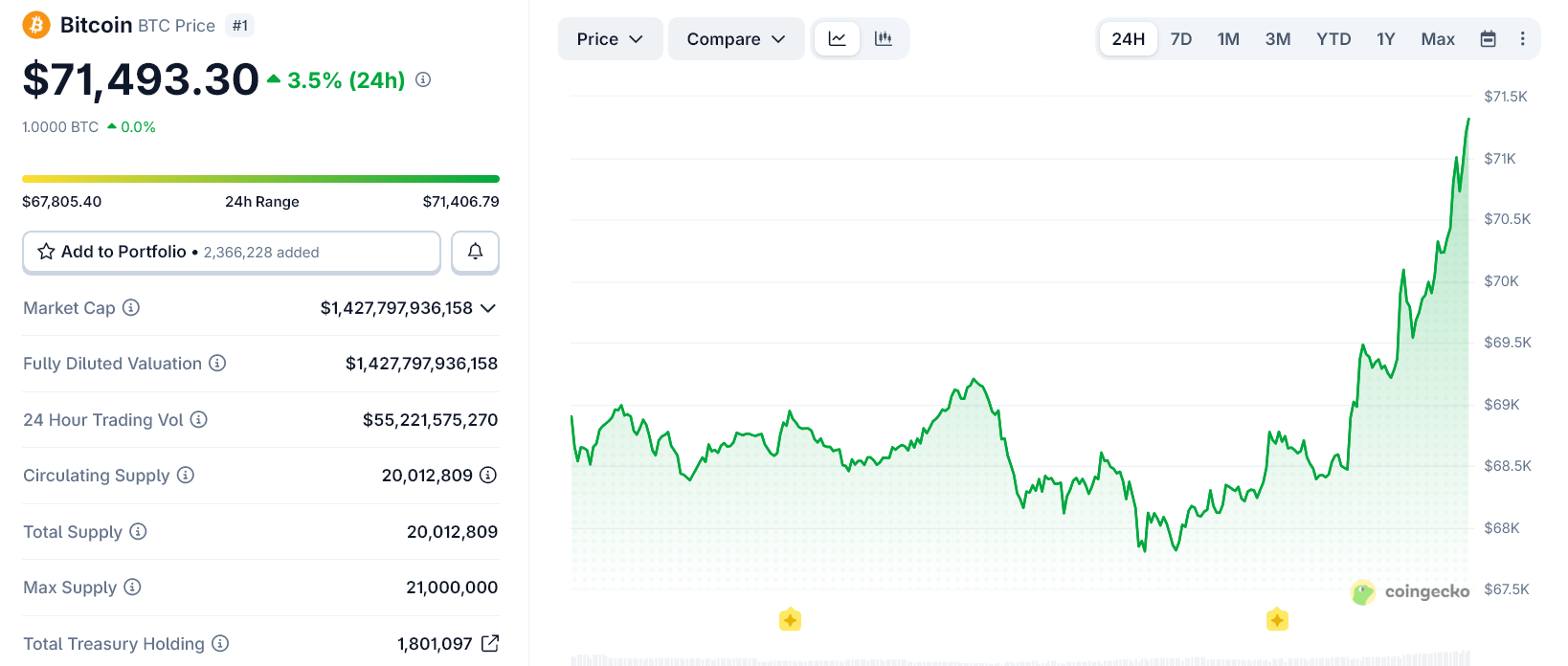
Bitcoin jumped to around $71,500 late April 7 after US President Donald Trump announced a sudden pause in planned military action against Iran, signaling a potential de-escalation in the ongoing conflict.
In a post on Truth Social, Trump said he agreed to suspend strikes on Iran for two weeks following direct conversations with Pakistan’s PM and Army Chief Asim Munir.
He added the pause is conditional on Iran agreeing to the “complete, immediate, and safe” reopening of the Strait of Hormuz.
Trump framed the move as part of a broader diplomatic breakthrough. He said the US had already achieved its military objectives and was close to finalizing a long-term peace agreement with Iran.
According to the statement, Tehran has submitted a 10-point proposal that Washington sees as a workable basis for negotiations.
Markets reacted instantly. Bitcoin surged nearly 3%, reclaiming the $71,500 level, while earlier pressure on risk assets eased as traders priced in reduced escalation risk.

The announcement follows hours of heightened tension ahead of Trump’s self-imposed deadline, which had raised fears of large-scale strikes on Iranian infrastructure. The two-week window now shifts focus back to negotiations.
The post Bitcoin Surges Past $71,000 as Trump Pauses Iran Strikes, Signals Ceasefire appeared first on BeInCrypto.
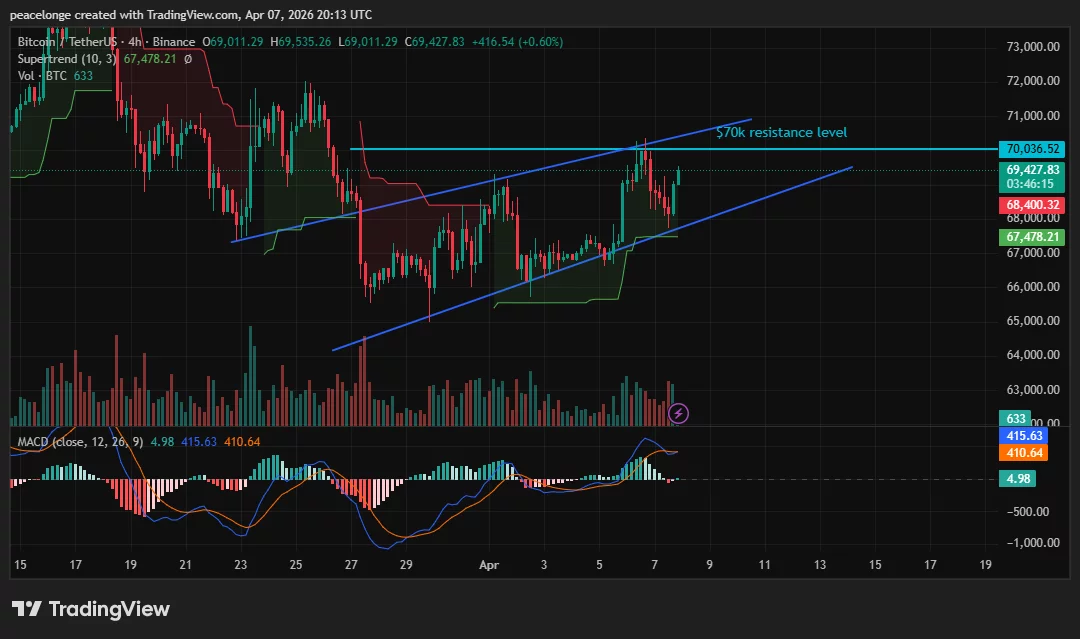
Bitcoin price briefly touched $70,000 on April 7 within a well-formed ascending channel on the 4H chart, as spot ETF inflows logged $471 million on April 6, the strongest single-day institutional demand figure since late February.
Summary
- Bitcoin price reached an intraday high of $70,036 on April 7 before easing to $69,427, pressing the upper boundary of a 4H ascending channel that has held since late March.
- The 4H MACD is printing a bullish cross with the MACD line at 415.63 above the signal at 410.64 and a positive histogram of 4.98, while the Supertrend at $67,478 provides trailing support below price.
- A confirmed 4H close above $70,036 targets $71,000 resistance, while a break below the Supertrend at $67,478 exposes $66,300 as the next structural level.
Bitcoin (BTC) price is trading at $69,427 on April 7, having touched an intraday high of $70,036, the first test of the $70,000 level since March 26. The move came alongside $471 million in spot Bitcoin ETF inflows on April 6, the 6th-largest single-day figure of 2026 per SoSoValue data. The 4H chart shows an ascending channel in place since late March, with price printing consecutive higher lows from the $65,000 zone toward $70,000, but the round-number resistance has capped the advance through multiple sessions.
On the 4H chart, Bitcoin is trading within a defined ascending channel built by two parallel diagonal trendlines. The lower boundary aligns with the Supertrend at $67,478 and has acted as dynamic support throughout the recovery. The upper boundary coincides with the $70,036 resistance annotated on the chart. The 4H MACD is in a confirmed bullish cross, with the MACD line at 415.63 trading above the signal at 410.64 and a positive histogram of 4.98, reflecting building momentum even as price hesitates at resistance.
Analyst Michael van de Poppe of MN Trading Capital wrote on X on April 4 that “the longer the range persists, the heavier the breakout becomes,” adding: “I expect a break above $71,000.” Technical analysis from Investtech published April 7 shows Bitcoin “has given a positive signal from the double bottom formation by a break up through the resistance at $68,120,” with a further rise to $69,769 or more signalled. That target has already been cleared, strengthening the short-term case.
Key Levels: $68,400 Support, $71,000 Bull Target, $67,478 Invalidation
The $68,400 level visible on the 4H chart is the immediate structural support below current price. A close below it exposes the Supertrend at $67,478, which is the invalidation level for the bullish thesis. Investtech identifies $66,300 as the next support below, representing a potential 4.5% decline from current levels in the bear case. On the upside, a confirmed 4H close above $70,036 resolves the current resistance and opens the path to the $71,000 level per van de Poppe’s analysis, with the ascending channel structure remaining intact as long as the Supertrend holds.
ETF Inflows Driving Independent Institutional Demand
Spot Bitcoin ETFs have drawn consistent inflows across recent sessions, with the $471 million on April 6 reflecting renewed institutional appetite at current price levels. According to Binance Research, Bitcoin’s correlation with its Global Easing Breadth Index “turned strongly negative after the launch of spot bitcoin ETFs,” suggesting ETF demand now operates more independently from broader macro conditions. The Iran ceasefire talks on April 6 and 7 provided a short-term macro catalyst, but ETF buyers were already positioned ahead of the move, reinforcing the institutional demand floor near current levels.
If $70,036 continues to hold as resistance, a retest of $68,400 and then the Supertrend at $67,478 becomes the more probable near-term path before any further breakout attempt. A clean 4H close above $70,036 with volume confirmation targets $71,000 as the next resistance.

Grayscale Research has called for the early rollout of quantum-resistant blockchain upgrades following a new warning from Google Quantum AI. The report suggests that quantum computing could undermine current cryptographic encryption methods sooner than previously anticipated. As a response, Grayscale highlights the XRP Ledger and Solana’s efforts in post-quantum cryptography as potential solutions to address these emerging security risks.
XRP Ledger’s Quantum-Resistant Efforts
The XRP Ledger (XRPL) has begun experimenting with quantum-resistant technologies to prepare for future threats posed by quantum computing. The ledger is currently testing ML-DSA signatures on its AlphaNet. Although these efforts are still in the early stages, Grayscale notes that they represent a critical step toward enhancing the security of blockchain systems in a post-quantum world.
Grayscale emphasizes the need for the blockchain community to accelerate the implementation of such solutions. The crypto industry faces challenges like engineering and consensus-building, which require significant collaboration across networks. Moreover, any quantum-resistant upgrade must address potential issues, including a reduction in transaction throughput, which could affect the network’s scalability.
While XRPL is not entirely ‘quantum-proof,’ the experiments on the AlphaNet represent meaningful progress in preparing for quantum threats. Grayscale advocates for further testing and the eventual deployment of these cryptographic updates to safeguard the blockchain from quantum attacks. The project is still evolving, but it is an important step forward in the industry’s readiness.
Solana’s Post-Quantum Cryptography Research
Solana is also taking proactive steps in response to the potential risks posed by quantum computing. The network has partnered with Project Eleven to experiment with quantum-resistant cryptographic signatures. These efforts aim to secure the blockchain from future quantum threats that could undermine the existing encryption methods.
However, Grayscale cautions that quantum-resistant upgrades on Solana have shown the potential to significantly reduce network speed. The tests indicate that the implementation of quantum-resistant signatures could lead to a 90% decrease in the network’s speed. While security is a top priority, the challenge remains to balance quantum resistance with maintaining the blockchain’s scalability.
Despite these challenges, Grayscale views Solana’s initiative as another significant step toward ensuring the blockchain ecosystem’s resilience. The company emphasizes that the crypto industry must continue to experiment with and refine these solutions. Solana’s involvement in post-quantum cryptography is just one example of how blockchain networks are preparing for the future.
The Impact of Quantum Computing on Bitcoin
Grayscale’s report also highlights how quantum computing poses different risks to blockchains based on their structures. Bitcoin, for example, uses a UTXO (unspent transaction output) model, which Grayscale argues makes it less susceptible to quantum threats than blockchains with an account model, such as Ethereum. Bitcoin’s lack of native smart contracts further reduces its exposure to quantum computing vulnerabilities.
However, Grayscale points out that the primary concern with quantum computing is the potential loss of private keys. If a private key becomes inaccessible, it could lead to the loss or inaccessibility of coins. This situation could result in coins being burned, deliberately withheld, or simply left unused.
Bitcoin’s network also faces challenges in reaching consensus on protocol changes. Grayscale references last year’s debate over the inclusion of image data in blocks as an example of the hurdles the Bitcoin community must overcome when addressing security upgrades. The road ahead for quantum-resistant solutions will require significant collaboration and decision-making within the community.

The Biggest Trap in Financial History Has Been Set.

Sporting 0-1 Arsenal: Is David Raya the best goalkeeper in the world?

How to watch NASA’s moon crew splash down at end of historic mission


-

 NewsBeat5 days ago
Steven Gerrard disagrees with Gary Neville over ‘shock’ Chelsea and Arsenal claim | Football
-

 Business5 days ago
No Jackpot Winner and $194 Million Prize Rolls Over
-

 Fashion4 days ago
Weekend Open Thread: Spanx – Corporette.com
-

 Crypto World6 days ago
Gold Price Prediction: Worst Month in 17 Years fo Save Haven Rock
-

 Business2 days ago
Three Gulf funds agree to back Paramount’s $81 billion takeover of Warner, WSJ reports
-

 Business4 days ago
Expert Picks for Every Need
-

 Sports3 days ago
India men’s 4x400m and mixed 4x100m relay teams register big progress | Other Sports News
-

 Business6 days ago
Login and Checkout Issues Spark Merchant Frustration
-

 Tech4 hours ago
How Long Can You Drive With Expired Registration? What Florida Law Says
-
Business3 days ago
No Jackpot Winner, Prize to Climb to $231 Million
-
Crypto World7 days ago
Bitcoin stalls below key resistance as technical signals skew bearish
-

 Tech5 days ago
Commonwealth Fusion Systems leans on magnets for near-term revenue
-

 Fashion2 days ago
Massimo Dutti Offers Inspiration for Your Summer Mood Board
-

 Tech6 days ago
Drawing Tablet Controls Laser In Real-Time
-

 Crypto World6 days ago
Ripple rolls out enterprise crypto treasury platform for corporates
-

 Crypto World6 days ago
Why It’s Partnering, Not Issuing
-

 Business3 days ago
Akebia Therapeutics, Inc. (AKBA) Discusses Pipeline Progress and Strategic Focus on Kidney Disease Treatments at R&D Day – Slideshow
-

 Fashion7 days ago
Debenhams Occasion Dresses for Girls 2026 Collection
-
 Sports6 days ago
Steal Gary Woodland’s subtle power move for longer drives
-
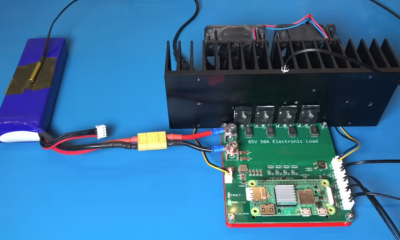
 Tech6 days ago
Battery Tester Outperforms Cheaper Options
You must be logged in to post a comment Login