

Crypto World
Bitcoin stalls below key resistance as technical signals skew bearish


Bitcoin trades in a tight mid‑$60k range beneath stacked moving‑average resistance, with extreme fear and weak momentum keeping any breakout on a short leash.
Summary
- Bitcoin trades in a tight $66,037–$68,130 range, capped by layered moving average resistance.
- All major EMAs and SMAs sit above spot, with the 200‑day EMA near $85,095 reinforcing downside pressure.
- Momentum gauges remain neutral to weak, as sentiment hovers in “extreme fear” territory across crypto markets.
Bitcoin (BTC) hovered around $66,597 on March 31, 2026, as the largest cryptocurrency by market value remained trapped in a narrow range and “technically constrained” beneath a wall of moving averages. The coin traded between $66,037 and $68,130 over 24 hours, leaving its $1.33 trillion market capitalization and roughly $48.8 billion in daily volume more indicative of indecision than conviction.
That backdrop contrasts with recent sessions where, according to Bloomberg, Bitcoin briefly climbed as much as 2.6% intraday to about $68,335 before paring gains below $68,000 alongside broader risk assets.
On the daily chart, BTC has rolled over from a lower high in the mid‑$70,000s into the mid‑$60,000 band, a shift that Bitcoin.com’s technical desk characterizes as a transition from a prior bullish structure into a “neutral‑to‑bearish posture.” Key resistance is clustered between $68,000 and $69,000, then $71,000–$73,000, while support rests at $65,000–$66,000, with a clean break below $64,000 likely signaling a broader structural breakdown. A similar pattern has played out in recent weeks, with International Business Times noting that Bitcoin “traded around $68,500… showing signs of consolidation” after rejecting near $71,000 and slipping back toward the mid‑$60,000s.
Intraday, lower‑timeframe charts show compression rather than trend. Four‑hour price action has shifted from a downtrend into sideways consolidation after setting a higher low around $65,000, but repeated failures just below the $68,000–$69,000 band underscore persistent seller presence. On the one‑hour chart, lower highs remain intact and a modest bounce off the $66,000 region “has failed to generate follow‑through,” highlighting fragile microstructure and a slight bearish tilt.
Oscillators corroborate that drift. The relative strength index sits near 42, the commodity channel index prints around −104, and the moving average convergence divergence line is negative by roughly 947 points, collectively signaling subdued momentum and an absence of a strong trend rather than outright capitulation. That aligns with broader market analytics, where research firm Intellectia points out that Bitcoin’s recent swings have come with 30‑day volatility above 3%, indicating a “choppy” environment where thinner liquidity amplifies modest flows.
The clearest signal comes from moving averages: every major exponential and simple moving average currently sits above spot price. Short‑term gauges such as the 10‑day EMA around $67,832 and the 10‑day SMA near $68,138 are capping rebounds, while the 50‑day EMA (~$71,005), 100‑day EMA (~$76,713) and 200‑day EMA (~$85,095) mark a stacked band of overhead resistance consistent with a broader bearish structure. Earlier this year, a similar dynamic prompted a “death cross” warning as the 50‑day and 200‑day weighted moving averages flipped lower, a pattern flagged in a prior crypto.news story on Bitcoin ETF‑driven selling.
Sentiment mirrors the technical strain. The Crypto Fear & Greed Index has spent much of the quarter in “extreme fear,” with readings as low as 18, according to on‑chain flow analysis by AInvest and data provider Alternative.me cited by CryptoRank. In that context, the near‑term path for BTC appears binary: Bitcoin.com’s technical team argues that “a sustained break and hold above the $68,000 to $69,000 resistance cluster” on rising volume would be needed to flip the narrative toward recovery, while a rejection followed by a decisive move under $65,000–$64,800 would likely confirm continuation toward the low‑$60,000 support zone.
In a previous crypto.news story on how moving averages can both signal and accelerate downside when price trades below all key bands, analysts warned that reclaiming at least one major EMA is often the first confirmation that distribution has run its course. For now, Bitcoin remains stuck beneath that threshold, with the burden of proof firmly on the bulls.

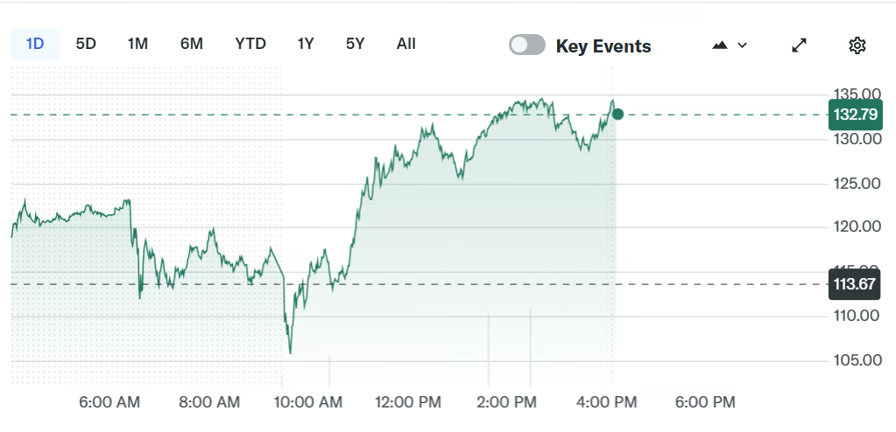
Shares of stablecoin issuer Circle surged Monday after the company reported mostly upbeat earnings and disclosed that a major crypto venture capital fund had purchased $222 million worth of its blockchain tokens.
Circle’s shares rose almost 16% to close at $131.76, its highest level since March 18, according to Yahoo Finance. CRCL stock gave back some of its gains in initial after-hours activity.
The gain extends Circle’s strong run in 2026. Shares are now up 66% year to date, giving the company a market capitalization of roughly $35 billion.

Circle (CRCL) stock. Source: Yahoo Finance
Monday’s surge pushed Circle shares closer to Wall Street’s consensus price target of $138.50, according to TipRanks.
Among the most bullish analysts is Peter Christiansen of Citigroup, who has a 12-month price target of $243. Gautam Chhugani of Bernstein has set a target of $190. Both analysts, along with 10 others tracked by TipRanks, rate the stock a “buy.”
Related: Circle stock sinks 10% amid analyst downgrade, Drift Protocol probe
Strong earnings and Arc token raise stoke optimism
Circle’s rally was driven by a largely upbeat earnings report and fresh details about its expanding blockchain strategy.
The company said its USDC stablecoin reached $77 billion in circulation at the end of the first quarter, up 28% from a year earlier. Only Tether’s USDt has a larger circulating value, at $189 billion.
During the first quarter, Circle’s revenue rose 20% to $694 million, while adjusted earnings increased 24% to $151 million.

Circle’s key financial metrics for Q1 2026. Source: Circle
In its earnings report, Circle also disclosed that it raised $222 million in a presale of its ARC token, a blockchain-based utility token designed to support transactions within its Arc network. The fundraising valued the project at $3 billion.
“The successful adoption of the Arc network, including through the benefit of the ARC token, has a huge flywheel effect onto our stablecoin network and our digital assets,” Circle CEO and co-founder Jeremy Allaire told analysts on the company’s earnings call on Monday.
Investors in the round included a16z Crypto and a consortium featuring BlackRock, Apollo Global Management and ARK Invest.
Analysts said the results reinforced Circle’s leadership in the fast-growing stablecoin market.
Andrew Jeffrey of William Blair told clients that Circle shares “will probably remain volatile” in the near term, but said the company has multiple positive catalysts driven by its “significant stablecoin commerce advantage.”
Dan Dolev of Mizuho said Circle continues to demonstrate new use cases for stablecoins, broadening the technology’s role beyond crypto trading.
Related: Crypto Biz: Wall Street wants more than just Bitcoin
Tokenized stock protocol xStocks has crossed $100M market cap on Ethereum with 1,000% YTD growth, while expanding to BNB Chain with $30M in commodities-linked assets.
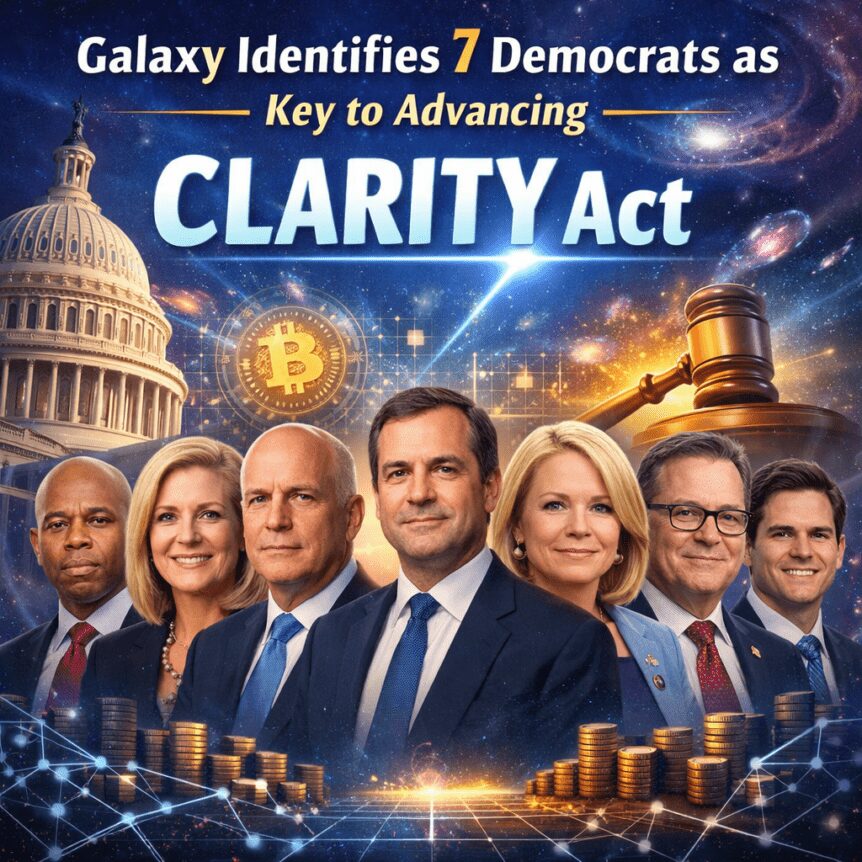
A pivotal stage in the pursuit of federal clarity for cryptocurrencies is approaching, with Galaxy Digital signaling that a core group of seven Democratic lawmakers on the U.S. Senate Banking Committee could be decisive as the Digital Asset Market Clarity Act enters markup this week. The crypto-focused investment firm assessed lawmakers’ positions on the CLARITY Act, labeling some as constructive toward a pro-crypto framework and others as potential deal-makers, while flagging a few expected to oppose the bill based on past votes and statements.
In a Sunday post on X, Galaxy Digital described Ruben Gallego and Angela Alsobrooks as “constructive/pro-framework” voices. Four other lawmakers were characterized as “deal-makers,” and one was tagged as “mixed.” The firm suggested that Democratic votes in markup would significantly raise the odds of advancing the legislation toward a Senate floor vote. The CLARITY Act, if enacted, would aim to establish clearer federal rules for the crypto sector, potentially reducing regulatory uncertainty and encouraging more blockchain projects to base operations in the United States.
Galaxy Digital’s summary highlighted four senators—Mark Warner, Catherine Cortez Masto, Andy Kim, and Raphael Warnock—as “deal-maker/conditional” supporters who have shown receptiveness to a crypto framework and have previously backed related legislation such as the GENIUS Act. Lisa Blunt Rochester was positioned as “mixed,” a potential swing vote given her crypto stance history. The seven lawmakers identified by Galaxy Digital as those most likely to influence the markup represent a focal point of ongoing negotiations about how broad a regulatory framework should be and where safeguards against illicit finance fit into the package.
Key takeaways
- The CLARITY Act’s fate in the Senate hinges on a handful of Democrats on the Banking Committee, according to Galaxy Digital, which frames seven lawmakers as pivotal for markup outcomes.
- A successful markup could nudge the bill toward a Senate floor vote, potentially reshaping the regulatory landscape for the U.S. crypto industry and encouraging more domestic development.
- The bill’s path remains uncertain, with several notable Democrats historically aligned with crypto objecting or voting against related measures, underscoring the need for broad bipartisan support.
- Past signals around the GENIUS Act and Coinbase’s withdrawal of support for the CLARITY Act in January illustrate the fragility and complexity of building consensus in Congress on crypto regulation.
- Industry policy groups and industry insiders warn that meaningful federal clarity will require protections for innovation, clear open-source guidelines, and balanced rules for DeFi and stablecoins, as noted by stakeholders and observers.
How the Senate battle could tilt toward clarity
At the heart of the current push is the expectation that the CLARITY Act will establish a more defined federal framework for digital assets, addressing long-standing regulatory ambiguity that has deterred some projects from choosing the United States as a base of operations. Galaxy Digital’s assessment emphasizes that the markup could hinge on a coalition of Democratic votes that are either openly supportive or moderate enough to broker a path forward. The firm specifically named Gallego and Alsobrooks as constructive forces, signaling a willingness to engage with a pro-framework approach. Meanwhile, Warner, Cortez Masto, Kim, and Warnock are described as deal-makers who could unlock progress if their support remains conditional on certain guardrails and compliance provisions.
The article notes that Blunt Rochester is considered mixed, potentially providing a swing vote in a narrowly divided chamber. The dynamic matters because the Senate Banking Committee’s 24 members (13 Republicans and 11 Democrats) require at least half to advance the bill to the broader Senate floor. With that arithmetic in mind, the positions of the seven highlighted lawmakers could materially shape the committee’s markup outcome and set the tone for subsequent negotiations across party lines.
What the CLARITY Act aims to change—and why it matters
The central promise of the CLARITY Act is regulatory clarity. Proponents argue that a formal set of federal guidelines would reduce the patchwork of state laws and ad hoc enforcement actions that have created uncertainty for developers, exchanges, and users. By providing clearer rules on what constitutes a digit asset, how custody and anti-money laundering controls should function, and where DeFi projects fit within the compliance regime, the act could lower the barrier to entry for legitimate projects seeking to operate in the United States. In practical terms, investors and builders could gain confidence that regulatory expectations are codified and predictable rather than subject to shifting interpretations.
Coinciding with the markup timeline, industry voices have framed the stakes in terms of innovation and capital formation. The policy debate also centers on safeguarding against illicit finance risks while ensuring that legitimate crypto projects can compete globally. Proponents argue that a clear federal framework would reduce regulatory friction and attract more capital and talent to the U.S., while skeptics warn that any framework must avoid overreach that could stifle innovation or favor incumbents with existing regulatory advantages.
Beyond the immediate legislative mechanics, the CLARITY Act sits within a broader regulatory conversation about how the United States should treat digital assets amid evolving global standards. The bill’s momentum has been affected by earlier developments, including Coinbase’s withdrawal of support in January due to concerns about protections for open-source developers, potential collateral impact on stablecoins yields, and broader DeFi regulation questions. Those concerns underscore the delicate balance lawmakers must strike between fostering innovation and addressing consumer safeguards and financial stability.
Momentum, hurdles, and what to watch next
Analysts and policymakers have long noted that bringing crypto regulation into a coherent federal framework will require consensus-building. Kara Calvert, Coinbase’s vice president of U.S. policy, underscored at Consensus 2026 that passage would likely demand bipartisan backing and a threshold around 60 votes to clear the Senate, highlighting the practical realities of passing a comprehensive crypto bill in a polarized environment. The markup date—the moment when the committee considers the bill and votes on whether to advance it—has been scheduled, but the path to the Senate floor remains contingent on securing a broader coalition of support within the chamber.
Independent trackers and advocacy groups have attempted to quantify where lawmakers stand. Stand With Crypto, which scores politicians based on their public statements and votes related to crypto policy, identifies Warner, Cortez Masto, and Alsobrooks as strongly supportive of crypto, while categorizing Kim as neutral and Reed, Warren, and Smith as more likely to oppose crypto measures. Van Hollen and Warnock, according to this tracker, lack sufficient data to be ranked. Such scoring provides a lens on how the political landscape could shift as the markup approaches and as lawmakers negotiate the bill’s precise text and safeguards.
It’s worth noting that the CLARITY Act’s trajectory has already experienced a pause: Coinbase’s withdrawal of support signaled the fragility of legislative consensus and the importance of addressing open-source policy protections, regulatory safeguards for stablecoins, and clear DeFi rules. The combination of regulatory complexity and the competing priorities of stakeholders—ranging from consumer protection to innovation incentives—will continue to shape how far the act can go in the current session.
Looking ahead: what we should expect
As Thursday’s markup looms, traders, developers, and investors will be watching not only for a vote on advancing the CLARITY Act but also for the text’s final form. The degree of bipartisan support, the strength of amendments, and the precise balance of guardrails against illicit finance will influence whether the bill’s prospects improve at the Senate level. If the committee approves the bill, it would proceed to scheduling, debate, and possible further amendments on the Senate floor—an additional phase where political winds can shift based on broader economic and regulatory signals.
In the near term, the key takeaway for the market is that the bill’s fate remains a litmus test for the U.S. approach to crypto regulation. A measured, clear framework could unlock more confident investment and project deployments domestically, while significant concessions or delays could prolong regulatory ambiguity and drive capital to markets perceived as more certain. Investors and builders should monitor not only the committee’s markup decisions but also the evolving stance of major lawmakers and industry voices as they navigate the tension between innovation and oversight.
What to watch next: the markup outcome on Thursday, the level of cross-party support the bill can secure, and how lawmakers reconcile crypto industry concerns with broader financial-regulatory objectives. Until the text and votes crystallize, the CLARITY Act remains a pivotal test of whether Washington can deliver a comprehensive, pragmatic framework for digital assets that satisfies both innovation and risk management imperatives.
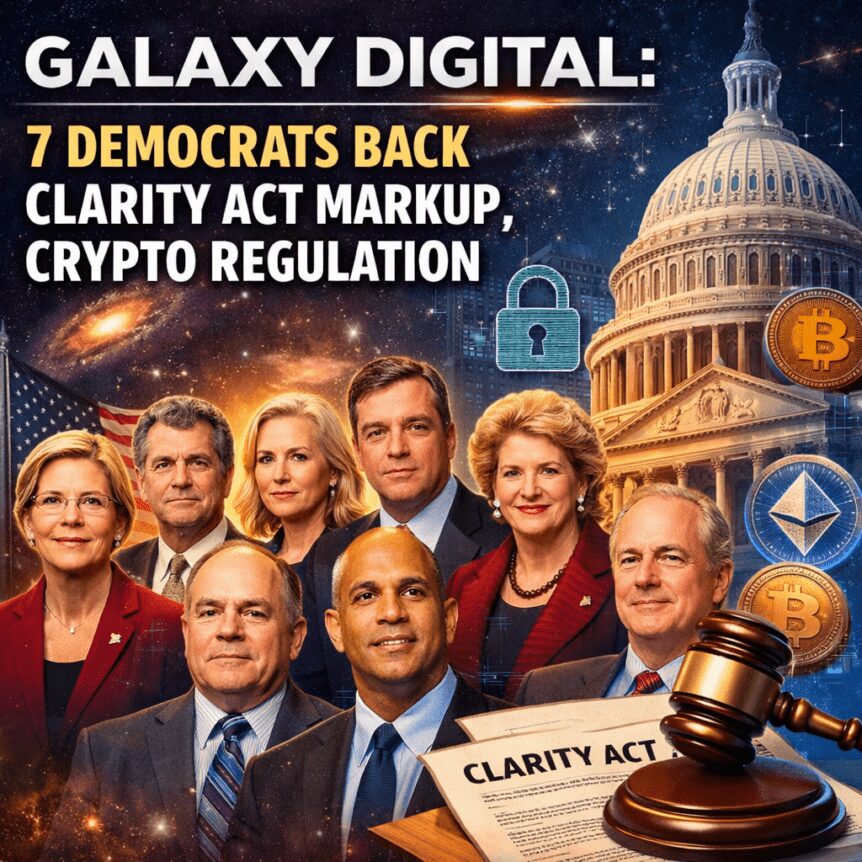
The Digital Asset Market Clarity Act (CLARITY Act) faces a pivotal juncture as a markup vote approaches in the U.S. Senate. Galaxy Digital, a crypto investment firm, argues that seven Democrats on the Senate Banking Committee could be decisive in clearing the bill for passage, signaling a potential shift in the long-running effort to establish a federal framework for crypto activities. The firm’s analysis, shared via a post on X, assigns Ruben Gallego and Angela Alsobrooks as constructive/pro-framework voices, with four other lawmakers positioned as deal-makers and one categorized as mixed. If a sufficient bloc of Democrats votes in favor at markup, Galaxy Digital contends the likelihood of eventual Senate passage rises meaningfully.
In its assessment, Galaxy Digital highlights certain Democrats as more amenable to the framework and notes that others remain cautious or resistant. The firm specifically identifies Mark Warner, Catherine Cortez Masto, Andy Kim and Raphael Warnock as “deal-maker/conditional,” indicating support contingent on assurances around stronger safeguards against illicit finance and money laundering risks. Lisa Blunt Rochester is labeled “mixed,” suggesting potential swing voting behavior. The analysis underscores that any path forward hinges on a broader coalition within the chamber.
Passing the CLARITY Act would, in theory, yield clearer federal rules for the U.S. crypto industry, potentially reducing years of regulatory uncertainty and encouraging more projects to establish operations domestically. The move is widely viewed as a means to harmonize oversight across agencies and provide a comprehensive statutory baseline for cryptoassets, exchange activities, and related financial instruments. According to Cointelegraph, the policy conversation remains deeply entwined with concerns about consumer protections, anti-money laundering (AML) measures, and the treatment of stablecoins and decentralized finance in a regulated regime.
The markup outlook has been complicated by shifting political dynamics and past hesitations among lawmakers. The CLARITY Act was introduced in July 2025 but stalled in January after Coinbase withdrew its support, citing concerns over protections for open-source software developers, a prohibition on stablecoin yields, and broader DeFi regulation gaps. The latest timing places the bill on track for consideration by the committee this week, with the prospect of a broader Senate debate and potential amendments before any floor vote. The committee’s 24 members—comprising 13 Republicans and 11 Democrats—must approve the measure by a simple majority to advance it to the Senate floor.
Key takeaways
- The CLARITY Act is nearing a Senate Banking Committee markup, with Galaxy Digital identifying seven Democratic lawmakers as pivotal to advancing the bill.
- Democratic positions vary, with several labeled as deal-makers or mixed; a solid cross-party coalition will be required to reach a floor vote.
- Past developments include Coinbase withdrawing support in January over concerns related to open-source software protections, stablecoin yields, and DeFi regulation — a factor shaping current expectations.
- Industry and policy signals indicate that achieving a 60-vote threshold in the Senate will require notable bipartisan alignment and robust AML/KYC safeguards.
Political dynamics shaping CLARITY Act markup
The upcoming markup is framed as a test of whether a core group of Democrats can align with like-minded Republicans to push a comprehensive crypto-regulatory framework through the Senate. Galaxy Digital’s brief, which emphasizes the “deal-maker” and “mixed” classifications among committee members, reflects the nuanced vote calculus that characterizes current U.S. policy debates on digital assets. Notably, the classification of seven Democrats as key to moving the bill suggests that individual votes and cross-party negotiations may determine whether the bill moves beyond committee stage.
Among the lawmakers highlighted by Galaxy Digital, Mark Warner, Catherine Cortez Masto, Andy Kim and Raphael Warnock are described as “deal-maker/conditional.” That labeling implies a readiness to support the framework if certain protections and regulatory guardrails are satisfied. Lisa Blunt Rochester is identified as “mixed,” potentially serving as a swing vote depending on the committee’s framing of enforcement, innovation incentives, and consumer protections. The dynamics among these members will influence the committee’s overall stance and the likelihood of advancing the bill on Thursday.
According to Stand With Crypto, a platform that tracks lawmakers’ crypto positions, Warner, Cortez Masto and Alsobrooks are considered strongly supportive of crypto policy, while Kim is viewed as neutral. Reed, Warren, and Smith are ranked as strongly opposed to crypto policy, with other committee members lacking sufficient data to determine a stance. These rankings illustrate the spectrum of positions that lawmakers bring to the markup and the potential friction points that could hinder broad-based support.
Regulatory context and policy implications
The CLARITY Act seeks to establish a clear federal framework governing the classification and treatment of digital assets, with implications for exchanges, issuers, investors, and financial institutions. A central objective is to reduce ambiguity that has historically fed regulatory uncertainty and dispersed state-level approaches. The bill’s passage would interact with other regulatory considerations, including existing guidance from the Securities and Exchange Commission (SEC), the Commodity Futures Trading Commission (CFTC), the Department of Justice (DOJ), and the Financial Crimes Enforcement Network (FinCEN). It would also influence how stablecoins are integrated into banking relationships and payment systems, an issue that has drawn scrutiny from policymakers and regulators alike.
In this policy ecosystem, the CLARITY Act’s alignment with AML/KYC standards and its approach to licensing and regulatory oversight carry practical consequences for crypto firms, exchanges, and traditional financial institutions seeking to provide on-ramps and custody services. If enacted, the Act could shape ongoing cross-border regulatory alignment, particularly in relation to the European Union’s MiCA framework and other international regimes, as firms evaluate whether a U.S. market presence aligns with global compliance requirements.
Notably, the Act’s proponents have stressed the importance of stronger safeguards against illicit finance, consistent with broader regulatory reform objectives. The bill’s proponents and industry observers alike will be watching how provisions around open-source software protections, user data, and governance of decentralized products are addressed in committee discussions and potential amendments. The balance between fostering innovation and ensuring robust risk controls remains a central theme of the regulatory conversation.
Industry responses and compliance implications
Industry voices have emphasized the need for a stable, predictable regulatory environment that can support responsible innovation while imposing necessary safeguards. Coinbase’s position, as articulated by Kara Calvert, the company’s vice president of US policy, has framed the markup as a test of the bill’s feasibility within the Senate. Calvert indicated that passage may require a minimum threshold of bipartisan votes, highlighting the practical reality that broad-based support is essential for enacting legislation with wide-reaching implications for the crypto sector. This viewpoint aligns with the broader industry emphasis on legal protections for developers, transparent governance, and a clear path to licensing and supervision for crypto businesses.
From a compliance perspective, the CLARITY Act would interact with existing AML/KYC obligations, anti-fraud provisions, and cross-border enforcement frameworks. As lawmakers weigh the bill, institutions will consider how any federal standard would interact with ongoing supervisory expectations, including reporting requirements, transaction monitoring, and risk-based compliance programs. The potential for a unified federal standard could reduce fragmentation across states and regulatory agencies, potentially simplifying governance for multinational firms while increasing scrutiny in areas related to consumer protection and market integrity.
Market participants and policymakers will also be attentive to the stalled January episode, when Coinbase withdrew support due to concerns about protections for open-source software developers and the treatment of stablecoins and DeFi. The reversal of previous support underscores the ongoing tradeoffs between innovation incentives and risk controls that any comprehensive regulatory framework must navigate. As markup approaches, stakeholders will be assessing whether the Act addresses those concerns in a manner that satisfies both the industry’s operational needs and regulators’ risk-mitigation priorities.
Historical backdrop and current status
The CLARITY Act, introduced in mid-2025, has been the subject of intense policy debate. Its trajectory stalled in January following Coinbase’s withdrawal of support, a development that reflected deeper concerns about the balance of protections for developers, stablecoin regulation, and the scope of DeFi governance within a federal framework. With Thursday’s markup on the horizon, proponents seek to establish a pathway to full Senate consideration and a potential floor vote, while opponents stress the need for further refinements to ensure a robust, enforceable regime.
Industry observers, including policy professionals and advocacy groups, have underscored that successful passage will depend on securing bipartisan backing and addressing open questions about open-source software protections, stablecoin yields, and decentralized finance regulation. As the bill moves through committee, attention will focus on amendments that clarify these areas and on how the proposed framework interfaces with existing regulatory authorities and enforcement priorities.
For context, observers have noted that the regulatory discourse around crypto in the United States remains closely tied to broader policy objectives, including consumer protection, financial stability, and the integrity of the financial system. The CLARITY Act represents an attempt to codify a unified approach to digital assets, with potential ripple effects across licensing, banking partnerships, and cross-border activity. Industry participants, lawmakers, and compliance professionals will closely monitor how markup outcomes influence the broader regulatory landscape in the near term.
Closing perspective
As the CLARITY Act advances toward markup, the central question is whether a coalition sufficiently broad to secure a Senate floor vote can emerge. The coming days will reveal how lawmakers balance innovation incentives with risk controls, and how the bill’s provisions align with ongoing regulatory priorities both domestically and in the global policy environment. In the near term, institutions should prepare for potential shifts in the regulatory baseline that could affect licensing requirements, supervisory expectations, and compliance workflows across the crypto sector.

Pseudonymous crypto analyst Doctor Profit is predicting a steep Bitcoin (BTC) correction after the asset reclaimed the $82,000 level, warning that retail buyers flooding back into the market are walking into a trap.
In a lengthy post on X, they laid out a detailed short strategy targeting the $82,000-$85,000 zone, with a price target of $50,000 or below for the eventual downside move.
The Setup, According to Doctor Profit
Doctor Profit’s core argument is that the current bounce off the $71,000 low is not a new bull run. It is, in his words, “a beautiful trap, to tap as many retails as possible before the next downside move.”
He said the thesis has been in place since February, when he publicly predicted Bitcoin would recover to the $79,000-$85,000 range before rolling over, with the move playing out in May or June.
“Most people forget my words from February,” he wrote. “I gave the exact plan on what to do.”
He credits the same analytical framework he used to short Bitcoin at what he describes as the $115,000-$125,000 top in 2025.
On sentiment, he is blunt:
“I can see a lot of low IQ content on X, many altcoin calls, and accounts shouting for $100K or more right now. The fear is gone, retail has been piling back in since 76K at a very strong pace, and soon they will realize it was a big mistake.”
That retail re-entry, he argued, is exactly the fuel a distribution top requires.
What the Charts and Broader Market Are Saying
Not everyone shares the bearish read. Strategy co-founder Michael Saylor posted three words on X Sunday morning: No More Bears,” with Doctor Profit replying directly, telling Saylor he warned him to sell at $120,000, and was met with a laughing emoji.
“Now I’m telling you that the days for BTC above 80K are numbered,” he wrote. “You are lucky if we see 85K, and overall the crash will start from this region.”
Meanwhile, crypto analyst Ash Crypto noted on Sunday that Bitcoin had just closed its first weekly candle above $82,000 since January 26, with the weekly MACD printing a bullish crossover and the RSI climbing to 52, back in neutral-to-bullish territory.
He also drew a structural comparison to Google’s stock, which broke above its 2021 highs, retested the breakout zone, and then entered an expansion phase. According to him, Bitcoin may be following the same sequence, one cycle behind.
Another technical analyst, Ali Martinez, added that the breakout above the 200-day simple moving average near $82,500 will open room for gains towards $94,000, whereas failure to do so may lead to declines towards $75,000, where the 50-day SMA is located.
BTC hit $82,500 early Monday before pulling back below $81,000 after President Donald Trump publicly rejected Iran’s latest nuclear proposal as “totally unacceptable,” reintroducing geopolitical risk that had briefly faded from traders’ minds.
The post Is Bitcoin’s Rally Fake? Analyst Sees Massive Downside Ahead appeared first on CryptoPotato.

Solana’s spot SOL exchange-traded funds are delivering their strongest weekly performance since February, drawing in roughly $39.23 million in net new money, according to SoSoValue data. The inflow surge comes as SOL futures open interest jumps by about $1.5 billion in May, signaling a broad uptick in trader positioning across the derivatives market. The price move mirrors the flow data, with SOL climbing around 15% over the past seven days to the high-$90s, as traders target a key resistance around $120.
Key takeaways
- BSOL leads ETF inflows: Bitwise’s BSOL attracted about $36 million in the latest weekly period, while Fidelity’s FSOL added roughly $1.8 million.
- BSOL’s dominance and scale: Since launch, BSOL has drawn $861 million in inflows, representing about 81% of the total cumulative inflows across all spot SOL ETFs, which stand near $1.06 billion combined.
- Derivatives activity climbs: SOL futures open interest rose to around $6.4 billion, up from about $4.94 billion on May 1, a rise of roughly 29.5% in under two weeks.
- Momentum in spot and futures delta: Aggregated spot cumulative volume delta approached $250 million from about $163 million in five days, as SOL’s price pushed toward $96; futures CVD reached approximately $593.6 million after a steady rise since May 5.
- Funding and price setup: The funding rate hovered near 0.065%, indicating continued long exposure, while the chart setup points to a possible breakout toward $120 if SOL sustains above $95 and completes a formation known as an Adam and Eve pattern.
Solana’s ETF demand aligns with rising futures positioning
SoSoValue data shows a clear tilt of capital toward SOL ETFs, led by BSOL’s notable weekly inflows of about $36 million. Fidelity’s FSOL added just over $1.8 million, contributing to the broader trend of investor appetite for spot exposure in SOL. Since its inception, BSOL has amassed roughly $861 million in net inflows, accounting for nearly four-fifths of the cumulative inflows across all spot SOL ETFs, which total around $1.06 billion.
Interest in futures markets has tracked the ETF momentum. Open interest across SOL futures climbed to roughly $6.4 billion, up from $4.94 billion on May 1, a rise of about 29.5% in less than two weeks, according to CoinGlass data. This buildup indicates traders are widening their positions and hedging activity across both spot and derivatives markets as Solana’s price moves higher.
In parallel, spot market dynamics reflected by the aggregated CVD metric showed a surge, with a five-day delta approaching $250 million, up from $163 million. Futures CVD also rose, crossing about $593.6 million as buyers absorbed liquidity on the bid and bid-ask fronts in both spot and futures markets. The funding rate maintained a modest level near 0.065%, suggesting long exposure remains prevalent among market participants.
These data points come as Solana’s price rallied roughly 15% over the past week, stabilizing near the $97 level. The near-term resistance around $120 remains the focal point for bulls, with traders monitoring the price action for a sustained breakout above recent consolidation.
For context, the broader technical backdrop has grown more constructive. Solana closed above its 100-day exponential moving average for the first time since October 2025, adding a notable bullish swing to the mix of ETF inflows and rising futures positioning. If SOL can confirm a daily close above the $95 breakout zone and maintain consolidation, the chart suggests room toward the $120 target given the lack of major resistance between these levels following the February dip.
Analysts have also highlighted improving relative strength against Bitcoin. Crypto analyst BATMAN noted that SOL recently broke above a 231-day downtrend on the SOL/BTC chart, signaling better relative performance. He pointed to the $89–$91 zone as a nearby support cluster and suggested it could become a retest area if SOL holds above the breakout zone. This assessment aligns with the broader view that a sustained move above $95 could unlock the next leg higher toward the $120 zone, albeit with the usual cautions around macro conditions and market sentiment.
Overall, Solana’s recent dynamics point to a developing balance between ETF-driven buying, rising derivatives activity, and a technical setup that could propel SOL toward a key resistance milestone. The combination of record-level ETF inflows, growing Open Interest, and constructive price action suggests a potentially meaningful shift for Solana if the current momentum persists.
Meanwhile, February’s notable drawdown—around 42%—is fresh in the market memory, underscoring the need for sustained demand and a favorable risk environment to validate the breakout path. Investors will be watching closely for follow-through in the coming sessions, particularly how SOL behaves around the $95 breakout level and whether the market can maintain the pace of inflows and higher open interest without triggering a renewed period of volatility.

Digital asset investment products posted inflows of $857.9 million, and extended six straight weeks of positive flows – the highest weekly figure since April 24.
CoinShares stated that the increase is likely tied to improving sentiment around the CLARITY Act, as Senators Thom Tillis and Angela Alsobrooks released the final compromise text related to stablecoin yield on May 1 and continued to support it despite pushback from the banking industry on May 4.
Global Crypto Investment Comeback
Bitcoin attracted over $706.1 million during the week, pushing its year-to-date total to $4.9 billion. On the other hand, products tied to short-bitcoin positions recorded $14.4 million in exits, marking the category’s biggest weekly decline this year. In the latest edition of Digital Asset Fund Flows Weekly Report, CoinShares explained that the shift indicates investors are reducing hedge positions amid strengthening market confidence.
Ethereum added $77.1 million after seeing $81.6 million leave the previous week. Solana and XRP also posted strong activity with $47.6 million and $39.6 million, respectively. Meanwhile, Chainlink, Sui, and Litecoin saw smaller gains of $1.4 million, $1 million, and $0.1 million. Multi-asset was the only major category to post losses at $5.5 million.
The US accounted for the largest regional total at $776.6 million after rebounding sharply from $47.5 million the previous week. Germany saw $50.6 million, marginally higher than before, while Switzerland recorded $21.1 million and the Netherlands $5 million, demonstrating broader European activity alongside the stronger recovery in the US.
High-Stakes Week Ahead
Analysts are now turning their focus to the important economic and geopolitical developments lined up this week. QCP Capital said macroeconomic and geopolitical developments are expected to dominate market attention as US President Donald Trump and Chinese President Xi Jinping prepare to meet in Beijing for talks covering trade, national security, rare earth supply chains, and the Middle East conflict.
The firm noted that markets will closely watch for any progress on tariffs following last week’s US trade court ruling against Trump’s 10% global tariffs.
QCP also highlighted upcoming inflation data as another major focus, as investors monitor whether price pressures are stabilizing or continuing to rise. Easing inflation could support lower real yields and improve conditions for crypto assets, while persistent inflation may keep monetary policy tighter for longer.
Bitcoin, meanwhile, has remained above $80,000. QCP added that crypto volatility remains near yearly lows, as BTC faces resistance around the $84,000 level.
The post Bitcoin Pulls In $706M as Traders Abandon Short Positions in Massive Sentiment Shift appeared first on CryptoPotato.


Ronin Ethereum is migrating to a Layer 2 on May 12 with roughly 10 hours of scheduled downtime.
Summary
- Ronin will hard fork at block 55,577,490 on May 12, transitioning from an independent sidechain to an Ethereum Layer 2 on the OP Stack.
- All transfers, swaps, and smart contract interactions will pause for roughly 10 hours during the migration window.
- RON token inflation will drop from over 20% to below 1%, with 90 million RON redirected to the treasury as marketplace fees rise to 1.25%.
Ronin, the gaming-focused blockchain behind Axie Infinity, is executing a hard fork on May 12 to complete its transition from an independent sidechain to an Ethereum Layer 2. The migration was announced in April and will trigger at block 55,577,490, expected around 15:16 UTC.
All Ronin transactions will pause for roughly 10 hours during the migration window. That covers transfers, swaps, NFT trades, and smart contract interactions. Node operators on Ronin mainnet are required to upgrade to release 1.2.2 before the hard fork.
What changes after the migration
Ronin said the move is about plugging “back into the mothership.” The new structure will link the network directly to Ethereum for settlement and data availability, replacing the older nine-validator sidechain model with OP Stack rollup infrastructure.
RON token inflation will fall sharply from over 20% annually to below 1% under a new Proof of Distribution model. Marketplace fees will also rise from 0.5% to 1.25%, with 90 million RON tokens previously allocated for staking redirected to the Ronin treasury.
Ronin will integrate EigenDA to handle data availability for transactions, storing data off-chain while keeping it verifiable and accessible to Ethereum. The migration brings Ronin into the same OP Stack ecosystem as other chains including Celo and Fraxtal.
Context: the $625 million hack that made this necessary
While operating as an independent sidechain in March 2022, Ronin suffered the largest DeFi bridge exploit in history, with $625 million in ETH and USDC drained from its bridge. The attack exposed the structural risks of the sidechain model, where only a small number of centrally-managed validators were responsible for securing the network.
The Layer 2 transition directly addresses those concerns by inheriting Ethereum’s security rather than relying on Ronin’s own validator set. The Ronin bridge previously migrated to Chainlink’s cross-chain interoperability protocol in April 2025 as an earlier step in securing its infrastructure ahead of the full L2 move.

Crypto.com announced that its Dubai entity has received a Stored Value Facilities (SVF) license from the Central Bank of the United Arab Emirates (CBUAE), authorizing crypto-funded payments for Dubai government fees through its platform. The company said customers can fund payments with digital assets, while settlements are processed in UAE dirhams or in dirham-backed stablecoins approved by the central bank under the SVF framework.
The approval, tied to Crypto.com’s local entity Foris DAX Middle East FZE (operating as Crypto.com), enables the firm to activate its partnership with Dubai’s Department of Finance and offer digital asset payment services for government fees in line with the emirate’s cashless payments strategy. The company indicated that the license could pave the way for future integrations with Emirates Airlines and Dubai Duty Free, though such services would require additional approvals from the UAE central bank.
According to Cointelegraph, Crypto.com’s UAE expansion is part of a broader strategy to strengthen its regulatory footprint in the region while pursuing a multi-jurisdictional compliance framework that includes EU licensing under MiCA and a conditional US OCC approval for a national trust bank charter to support crypto custody and related services.
Key takeaways
- The Central Bank of the UAE granted a Stored Value Facilities license to Crypto.com’s Dubai affiliate, Foris DAX Middle East FZE (Crypto.com).
- Under the SVF license, users can fund government fee payments with digital assets, with settlements settled in UAE dirhams or dirham-backed stablecoins approved by the central bank.
- The authorization supports a digital asset payment workflow with Dubai DoF and aligns with the city’s broader cashless payments initiative.
- Potential future crypto-funded payments with Emirates Airlines and Dubai Duty Free are on the horizon, subject to further regulatory sign-offs.
- Crypto.com’s UAE push complements its existing regulatory footprint (VARA VASP license) and its ongoing global licensing efforts, including MiCA in the EU and a conditional OCC approval for a national trust charter in the United States.
UAE regulatory milestone and the SVF framework
The SVF regime in the UAE is designed to govern facilities that store monetary value electronically and enable its use for payments. By granting the license to Crypto.com’s local entity, the CBUAE authorizes the firm to facilitate crypto-backed payments for government-related fees while maintaining fiat or stablecoin settlement channels approved under the framework. This move deepens Crypto.com’s regulatory standing in the UAE and reinforces the city’s strategy to integrate digital assets into government and public-facing payment rails. The license explicitly covers settlements in dirhams or in dirham-linked stablecoins that the central bank has approved for SVF participants.
Operational model: crypto funding to dirham settlement
In practical terms, residents and businesses could use Crypto.com’s platform to fund government fee payments with digital assets, with the corresponding settlement settled in local currency or in CBUAE-approved stablecoins. The arrangement is anchored to Crypto.com’s Dubai entity and its partnership with the Dubai Department of Finance, enabling a regulated pathway for cryptocurrency-influenced government payments. While the company flagged possible future integrations with Emirates Airlines and Dubai Duty Free, these initiatives remain contingent on additional regulatory clearances. The development signals a broader move toward officially sanctioned crypto-enabled payment channels within the UAE’s financial ecosystem and highlights the attention authorities are giving to digital asset settlement mechanics and AML/KYC controls in public-use cases.
Regulatory footprint and cross-border ambitions
The UAE expansion sits within a broader regulatory narrative for Crypto.com. In the emirate, the company already holds a Virtual Asset Service Provider license from the Dubai-based regulator VARA, underscoring an institutional-grade, compliance-focused posture for its regional operations. Beyond the UAE, Crypto.com has pursued licensing aligned with the EU’s Markets in Crypto Assets (MiCA) framework and has publicly pursued a national trust bank charter in the United States under an OCC program that would enable custody services for digital assets. Separately, the firm has moved into regulated event-based derivatives and prediction markets through a US affiliate, reflecting a strategy to couple enhanced regulatory oversight with a wider suite of trading and payments products tied to cryptocurrencies. This multi-jurisdictional approach is designed to reduce regulatory risk while expanding access to institutional and retail users under clear supervisory regimes.
From a policy perspective, the UAE’s SVF milestone reinforces a pattern of central-bank-backed pathways for digital assets within government services, offering a potential blueprint for other jurisdictions seeking to integrate crypto assets into public payments. It also raises questions for banks, payment processors, and crypto firms about licensing ladders, cross-border interoperability, and the balance between innovation and regulatory compliance. As authorities in different regions adjust to evolving standards around custody, stablecoins, and on/off-ramps, the UAE example illustrates how centralized oversight can enable cryptocurrency-enabled services while maintaining financial-system safeguards.
Looking ahead, observers will be watching how the DoF and central bank calibrate further integrations, especially in larger commercial payments beyond government fees. The ongoing convergence of crypto payments with mainstream financial rails depends on continued clarity around eligible stablecoins, reserve standards, and risk-management expectations for participants operating within SVF frameworks.
Closing perspective: the UAE’s SVF license for Crypto.com marks a notable step in codifying crypto-enabled payments within a sovereign cashless agenda, yet the broader regulatory journey—spanning cross-border licensing, custody standards, and government-linked deployments—will unfold as approvals are granted and new use cases are evaluated against evolving policy and enforcement considerations.

The U.S. Senate Banking Committee is poised to take up a markup on the Digital Asset Market Clarity Act (CLARITY) this week, with Democratic lawmakers signaling they may withhold support if ethics provisions remain unresolved. The bill, which the House passed in July 2025, has faced months of delay as negotiators work through language on stablecoin yields, tokenized equities, and other industry-specific concerns. According to Cointelegraph, the committee’s action comes as policymakers seek a clearer framework for crypto markets without compromising ethical standards for public officials.
Although the Senate Agriculture Committee moved its own version of CLARITY forward in January, the legislation still must clear both panels to align securities and commodities authorities and to address jurisdictional differences. “Negotiations continue to be positive, and I remain confident we can get a bipartisan bill over the finish line this Congress,” Senate Democrat Kirsten Gillibrand told Cointelegraph. “Americans deserve a well-regulated market with strong consumer protections and real ethics reforms so politicians can’t cash in on their insider status for personal gain.”
Key takeaways
- House-passed CLARITY Act dates back to July 2025, setting a bipartisan framework for a regulated crypto market.
- Senate Agriculture Committee advanced its version in January, signaling continued momentum across chambers.
- The Banking Committee markup is scheduled this week, with ethics provisions and stablecoin yield language identified as critical sticking points.
- Political dynamics show divergent views on ethics and conflicts of interest, potentially shaping whether the bill can reach the floor for a full vote.
- Any path to law requires reconciliation between House and Senate outputs and presidential action; timing remains uncertain.
Policy dynamics and the path forward
From a regulatory architecture standpoint, CLARITY represents a concerted effort to codify a market structure for digital assets that aligns with existing securities and commodities regimes. The contrast between committee positions underscores ongoing tensions between innovation, investor protection, and public accountability. As negotiations unfold, many lawmakers view ethics provisions as the gatekeeper that could determine the bill’s ultimate fate, even if other provisions enjoy broad bipartisan support. In this context, the intersection of crypto policy with congressional ethics rules is increasingly in focus, with industry stakeholders watching closely for any precedent-setting language that could influence future oversight and enforcement actions.
Democrats have pressed for robust ethics safeguards to curb conflicts of interest among members of Congress and top executive branch officials. Gillibrand’s remarks reflect a broader aim to ensure that policy debates on digital assets are insulated from personal financial considerations. Republicans, including Senate Banking Chair Tim Scott, have emphasized the need for a timely, bipartisan deal but indicate that ethics language must ultimately be resolved on the floor rather than within committee confines. Wyoming Senator Cynthia Lummis, a leading advocate for CLARITY in the Senate, has encouraged colleagues to move forward, signaling continued support for a functional regulatory framework while acknowledging the ethics concerns that lawmakers have raised.
Industry voices have framed the ethics debate as a practical hurdle that could stall otherwise constructive policy progress. Cody Carbone, CEO of the Digital Chamber, argued that while ethics matters, it should be tackled on the Senate floor and not become a fatal obstruction to markup. “Ethics has to be tackled on the floor; it’s not within the jurisdiction of the Senate Banking Committee, so I don’t expect it to hold up the markup,” he told Cointelegraph.
Stablecoins, yield, and regulatory nuance
A central flashpoint remains the treatment of stablecoins and yield mechanics within the CLARITY framework. Earlier this month, Senators Thom Tillis and Angela Alsobrooks announced a compromise on stablecoin yield that could unlock movement on the bill after months of delay. Nevertheless, Democratic leadership has signaled that even with progress on yield, ethics provisions could derail prospects for a floor vote. Gillibrand’s position underscores a broader condition: any final package must address governance integrity to satisfy lawmakers who have prioritized anti-corruption safeguards alongside market structure clarity.
Beyond ethics and yield language, the bill’s broader aim is to reconcile differences between securities and commodities laws as they apply to digital assets, including questions around tokenized equities and other complex instruments. The Senate Agriculture Committee’s earlier action indicates a willingness to pursue a comprehensive approach, but the Banking Committee’s markup will test whether a unified, bipartisan compromise can be achieved in a manner compatible with the regulatory aspirations of both chambers.
Broader implications for institutions and oversight
For crypto firms, exchanges, and financial institutions, the CLARITY process signals a tightening of regulatory expectations around market structure, disclosures, and governance. A clarified framework could influence licensing trajectories, compliance costs, and the scope of permissible activities within crypto markets. From an enforcement perspective, alignment with established prudential standards—while preserving innovation—would likely intersect with ongoing oversight by the SEC, CFTC, and DOJ, as well as corresponding AML/KYC regimes. Observers also note potential interactions with international standards, such as the European Union’s MiCA, as policymakers compare approaches to cross-border compliance and transfer of risk across jurisdictions.
As the legislative effort unfolds, market participants must remain alert to evolving guidance on tokenized assets, stablecoins, and digital yield strategies. The path to law will depend not only on the content of ethics provisions but also on the administration’s priorities and the ability of lawmakers to secure a reconciled, floor-ready bill that can withstand potential veto or political headwinds.
Closing perspective
With the markup advancing and ethics debates unresolved, CLARITY’s fate rests on a delicate balance between bipartisan agreement and robust governance safeguards. Stakeholders should monitor committee proceedings for signs of a workable compromise and assess how any final text could reshape regulatory expectations for the crypto industry, compliance programs, and cross-border policy alignment.

Walgreens closing Chicago South Side store over theft and declining sales
Circle Stock Rallies 15% as Wall Street Bets on Stablecoin Adoption

Hayden Panettiere Recalls Sad Situation With Famous Man

Manchester United reach agreement with Casemiro over contract clause amid transfer speculation

US brings back mandatory military draft registration

Steven Gerrard disagrees with Gary Neville over ‘shock’ Chelsea and Arsenal claim | Football


-
 Crypto World4 days ago
HarrisX Poll Found 52% of Registered Voters Support the CLARITY Act
-

 Fashion3 days ago
Weekend Open Thread: Marianne Dress
-

 Crypto World5 days ago
Upbit adds B3 Korean won pair as Base token gains Korea access
-
 NewsBeat5 days ago
NCP car park operator enters administration putting 340 UK sites at risk of closure
-

 Tech2 days ago
Auto Enthusiast Carves Functional Two-Stroke Engine from Solid Metal
-

 Politics2 hours ago
What to expect when you’re expecting a budget
-

 Politics3 days ago
Politics Home Article | Starmer Enters The Danger Zone
-
 Business2 days ago
Ignore market noise, India’s long-term story intact, say D-Street bulls Ramesh Damani and Sunil Singhania
-

 Crypto World6 days ago
UAE Free Zone Deploys Blockchain IDs to Verify Registered Firms
-

 Fashion22 hours ago
What to Know Before Buying a Curling Wand or Curling Iron
-

 Tech17 hours ago
GM Agrees To Pay $12.75 Million To Settle California Lawsuit Over Misuse Of Customers’ Driving Data
-

 Fashion6 hours ago
Coffee Break: Travel Steam Iron
-

 Crypto World5 days ago
BlackRock CEO Larry Fink Discusses a New Asset Class
-

 Crypto World5 days ago
Robinhood says Wall Street is building onchain
-

 Entertainment5 days ago
Sarah Paulson Called Out For Met Gala ‘Hypocrisy’
-

 Tech6 days ago
Apple and Samsung are dominating smartphone sales so thoroughly that only one other company makes the top 10
-
Entertainment7 days ago
Serena Williams hits Met Gala in metallic dress after GLP-1 reveal
-

 Tech6 days ago
I tested the Xiaomi 17 Ultra’s camera and I don’t think I’ll ever go back to an iPhone
-
 Sports6 days ago
NBA playoff winners and losers: Austin Reaves is not loving Lakers vs. Thunder matchup, but Chet Holmgren is
-

 Fashion5 days ago
The Best Work Pants for Women in 2026
You must be logged in to post a comment Login