
Crypto World
Is Hyperliquid Losing Ground? On-Chain Data Highlights Rising HFDX Adoption


Some parts of the crypto world think Hyperliquid might be slowing down. That talk comes as new numbers show traders and capital flow shifting toward new DeFi projects like HFDX. On-chain data shows trading patterns and volume trends that hint at real changes in where users spend their time and capital.
Meanwhile crypto prices, news, and expert views shape how people see these projects today. In this piece, we look at Hyperliquid’s recent situation and then contrast it with what HFDX is doing. The goal is to give you a clear snapshot of the current state of play.
Hyperliquid: On-Chain Data, Price Moves and What Experts Say
Hyperliquid’s native token HYPE has had a mixed run lately. Some reports show that HYPE had strong periods of trading and network activity in 2025. At times, its prices climbed after large on-chain liquidity and network upgrades that lowered fees and drew traders to its perpetual markets. On-chain figures show huge trading volumes and growing open interest, which helped push HYPE toward past price highs.
But recent market chatter suggests pressure on the token. Some news points to price slides or sideways trading around current levels, even though earlier in late 2025 it rallied thanks to on-chain liquidity innovations.
Analysts and price prediction models still talk about potential upside for HYPE into future years. Some long-term price outlooks suggest that if adoption and volume remain strong, HYPE could trade significantly higher in the medium term.
Still, not all views are upbeat. Some experts say the market overall remains weak, and the hype around early growth may fade as users look for fresh opportunities. The idea that Hyperliquid is losing ground is tied to how traders react to alternatives and look for new ways to manage capital and risk.
HFDX: On-Chain Futures and Structured Yield Momentum
HFDX is a newer protocol that offers non-custodial perpetual futures trading along with structured yield frameworks based on real protocol revenue. It targets active traders and investors who want precise tools without giving up control of their assets. HFDX runs entirely on-chain, and all actions, whether trades or liquidity participation, happen in smart contracts.
On-chain data shows some traders migrating from legacy decentralized exchanges to HFDX because of its risk-managed liquidity strategies and transparent fee structure. Reports that Bitcoin perpetual traders have been splitting volume between Hyperliquid and HFDX point to a real shift in user priorities. HFDX’s structured approach draws those who want returns tied to actual trading revenue and borrowing fees rather than just speculation.
HFDX’s technical design mixes deep liquidity with risk controls that appeal to DeFi-native users. The liquidity loan note (LLN) strategies let participants put capital into protocol liquidity and receive fixed rates that reflect real activity. This model may attract users seeking a different balance of risk and return.
What HFDX offers:
- On-chain perpetual futures with full user custody
- Trades that clear against shared liquidity pools
- Pricing based on decentralized oracle feeds
- Liquidity Loan Note strategies with fixed terms
- Yield tied to trading fees and borrow costs
- Smart contracts that manage risk rules on-chain
Experts Note A Shifting Landscape
In the short term, Hyperliquid still holds significant on-chain volume and active user counts. Its upgrades and network features helped it achieve strong adoption in earlier phases, and experts continue to discuss its price prospects. Still, recent market signals and trader behavior hints that some of its user base is looking elsewhere.
HFDX’s rise does not mean Hyperliquid is done. It just shows the market is evolving. Traders now split capital, test new products, and choose platforms based on what fits their goals. HFDX’s structured yield options and transparent execution are part of that shift. The next few months will be critical for both protocols as price trends, on-chain metrics, and user choices play out in real time.
Make Your Money Work Smarter And Unlock A Wealth Of Opportunities With HFDX Today!
Website: https://hfdx.xyz/
Telegram: https://t.me/HFDXTrading
Disclaimer: This is a Press Release provided by a third party who is responsible for the content. Please conduct your own research before taking any action based on the content.


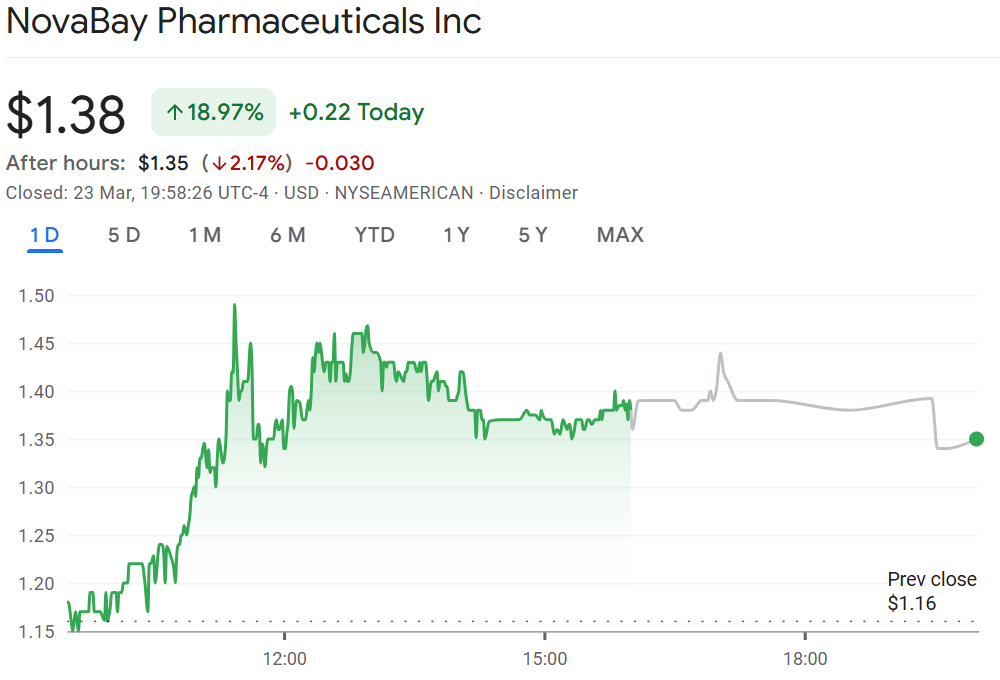
Shares in NovaBay Pharmaceuticals jumped nearly 19% after the company announced it would change its name to Stablecoin Development Corporation as part of its strategic crypto pivot.
NovaBay Pharmaceuticals CEO Michael Kazley said in a statement on Monday that the company’s plan going forward is to access cash flows within the growing stablecoin economy.
“The name change to Stablecoin Development Corporation reflects our conviction that stablecoins represent the most compelling structural opportunity in digital finance,” he said.
It adds to a wave of companies over the last year that have pivoted to a crypto strategy to improve their fortunes. However, with crypto markets down since October, there are warnings of potential consolidation ahead.
The company’s stock ticker will change from NBY to SDEV, effective April 3. It has also disclosed that it holds two billion Sky (SKY) tokens as of March 16, representing more than 8% of the total supply.
Shares of NovaBay Pharmaceuticals (NBY) spiked 19% to trade at $1.38 in the trading session following the announcement.

SKY holdings are already over two billion
NovaBay Pharmaceuticals began life in 2000 as a California-based biopharmaceutical company focused on eye care products.
The company disclosed in a January SEC filing that it was changing tactics to operate under an “on-chain holding company framework focused on long-duration participation in protocol-level digital asset ecosystems.”
As part of the pivot, NovaBay Pharmaceuticals entered into a $134 million private placement backed by Tether Investments, an affiliate of the stablecoin issuer, to buy and hold assets within the SKY protocol ecosystem.
NovaBay Pharmaceuticals has since acquired more than two billion SKY tokens and has generated cumulative staking rewards of 26.6 million SKY tokens. SKY is trading at $0.073 as of Tuesday, according to CoinGecko.
Under its new framework, the company said it can “hold protocol-aligned digital assets for extended periods in order to participate in protocol-level economic activity.”
Related: Stablecoin inflows rebound to $1.7B as Washington battles over yield rules
Efforts are also underway to continue buying additional SKY tokens on the open market, according to the announcement.
Company is interested in yield-bearing stablecoins
At this stage, the SKY token is the only digital asset approved under the company’s operating and risk management framework.
However, NovaBay Pharmaceuticals flagged “stablecoins as an increasingly important component of global digital financial infrastructure” and said it has a particular interest in yield-bearing stablecoins.
“These instruments represent a compelling evolution in digital finance, functioning as productive financial assets that unlock new primitives for savings, treasury management, and capital formation.”
Magazine: Banks want to run Vietnam’s crypto exchanges, Boyaa’s $70M BTC plan: Asia Express

Two major prediction market platforms, Kalshi and Polymarket, on Monday announced new trading guardrails to address insider trading amid mounting concerns of market manipulation on recent event contracts.
It comes the same day that US lawmakers introduced a bipartisan bill to ban event contracts that resemble a “sports bet” or “casino-style game.”
Kalshi on Monday said it would preemptively ban political candidates from trading on their own campaigns and those known to be involved in college and professional sports, such as athletes, personnel, and referees.
Kalshi’s ban followed just hours after rival Polymarket revealed comparatively broader prohibitions to ban users who trade using stolen confidential information, illegal tips or those who can influence the outcome of a market.
The platforms have faced mounting criticism over insider trading after Polymarket users profited from well-timed bets before US and Israeli strikes on Iran and a US military operation to capture Venezuelan President Nicolás Maduro.
Ben Yorke, a former Cointelegraph research analyst, told The Guardian on Monday that the Iran strike bets were “someone with some degree of inside info,” as the bets were made at market price, and multiple accounts were used in an apparent attempt to obfuscate their identity.
Kalshi said its ban has “been in the works for months” and was made to proactively address regulatory guidance and legislation introduced in Congress involving insider trading and market manipulation on prediction markets.

Bipartisan bill would ban sports event contracts
Kalshi and Polymarket’s bans come after Democratic Senator Adam Schiff and Republican Senator John Curtis introduced a bill on Monday to ban certain event contracts “that are indistinguishable from gambling.”
The so-called Prediction Markets Are Gambling Act would ban Commodity Futures Trading Commission-registered entities, which would include Kalshi and Polymarket US, from listing event contracts that resemble “a sports bet or a casino-style game.”
“Sports prediction contracts are sports bets — just with a different name,” Schiff said. “These contracts have been offered in all fifty states in clear violation of state and federal law.”
Curtis said that the legislation “clarifies regulatory jurisdiction, ensuring that states can maintain their authority over sports betting and casino gaming.”
Related: US Senate bill targets prediction markets on war and assassinations
Tarek Mansour, the CEO of Kalshi, which is a member of the Coalition for Prediction Markets lobby group, posted to X that the bill was the “casino lobby hard at work.”
“This bill isn’t about protecting consumers; it’s about protecting monopolies,” he added.
Prediction market platforms, including Kalshi, Polymarket and Coinbase, are embroiled in legal action across multiple states, which have asserted that sports event contracts are gambling that requires a state license to offer.
The platforms have argued that their contracts are not illegal betting and are, regardless, subject to the exclusive jurisdiction of the CFTC, not state authorities.
Magazine: When privacy and AML laws conflict — Crypto projects’ impossible choice
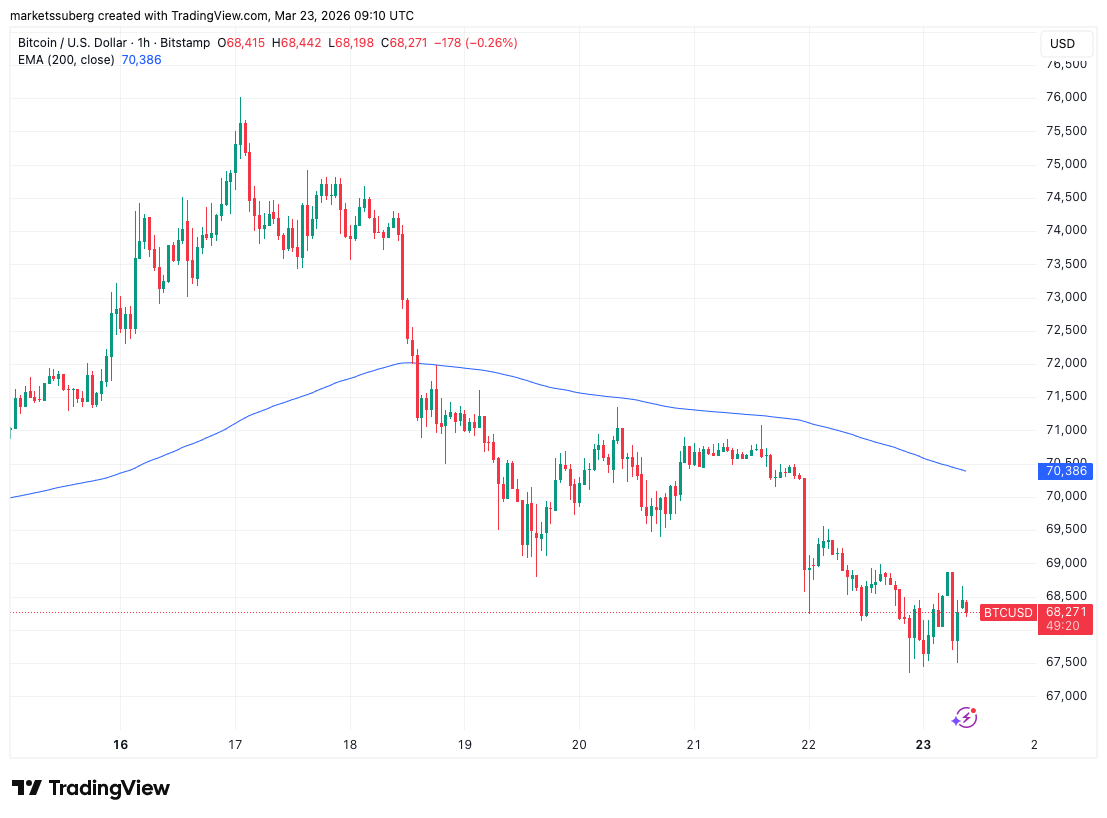
Bitcoin (BTC) price is struggling to maintain footing above $68,000 today, down 1% as the prediction of selling pressure mounts following a rigid rejection at the $76,000 ceiling a week ago. The market leader is currently navigating a perilous consolidation phase analysts call a “No-Trade Zone,” where conflicting signals between derivatives data and spot buying are creating high volatility.
The rejection at higher levels coincides with a distinct shift in institutional sentiment, evidenced by ETF flows showing signs of reversal amid broader geopolitical uncertainty.
On-chain data from Santiment reveals that large wallet holders, specifically those with significant BTC balances, trimmed positions on the 22nd, dropping collective holdings from 1.15 million to 1.14 million BTC. This distribution suggests that without a decisive catalyst, the path of least resistance remains sideways to down.

Can BTC Hold the $65,000 Support Level Amid Bear Flag Fears?
Bitcoin price technical structure on the 1-day chart presents a precarious setup for bullish prediction. Trading just above $68,000, BTC is oscillating within a narrowing range defined by fading buyer strength.
The immediate concern is the massive volume node between the $70,700 and $63,500 area, where approximately 1.72 million BTC have been transacted. This range acts as a critical battleground; a loss of the lower bound could trigger a cascading liquidation event.
Technically, the formation of a bear flag following the recent 39% flagpole decline raises the risk of a deeper capitulation. If sellers force a daily close below the $63,700 trigger level, Fibonacci extension targets suggest downside exposure toward $57,000 and potentially $52,700.

Conversely, momentum indicators like the RSI are flattening, hinting at a potential hidden divergence that typically precedes a reversal, but confirmation is absent. (Where are the bulls waiting? Likely at the 200-day SMA near $93k or lower trendline support.
For the bullish case to regain validity, price action must decisively reclaim the $71,000 mid-range resistance. Until then, the divergence between stabilizing smaller wallets (1k-10k BTC) and profit-taking mega-whales paints a picture of a market in conflict, often resulting in extended consolidation before the next major impulse.
Discover: The Best New Crypto
Bitcoin Price Prediction Is Down, But Investors Rotate to Infrastructure as Hyper Targets SVM Scalability
While spot Bitcoin struggles with overhead resistance, smart money creates a noticeable trend of capital rotation into high-beta infrastructure plays. Investors often hedge against mainnet chop by allocating to Layer 2 protocols that promise to solve Bitcoin’s velocity constraints. Leading this surge is Bitcoin Hyper ($HYPER), the first-ever Bitcoin Layer 2 to integrate the Solana Virtual Machine (SVM).
The project has defied the broader market pullback, amassing an impressive $32 Million in its ongoing presale. Bitcoin Hyper aims to deliver sub-second finality and high-speed smart contracts directly to the Bitcoin ecosystem, effectively bridging the gap between Bitcoin’s security and Solana’s speed. Current data prices $HYPER at $0.0136 with 36% APY on staking rewards.
This massive fundraising milestone indicates that investors are rotating toward infrastructure capable of unlocking trillions in dormant BTC capital. By utilizing a Decentralized Canonical Bridge, Bitcoin Hyper allows seamless asset transfers, addressing the critical lack of programmability on the main chain. While emerging Layer 2s carry inherent execution risks, the sheer volume of capital raised suggests the market views SVM integration as a necessary evolution for Bitcoin.
Those looking to position themselves before next-generation L2s go live can research Bitcoin Hyper here.
The post Bitcoin Price Prediction: Will BTC Hold? Or A Drop Is Inevitable? appeared first on Cryptonews.

Strategy, the Bitcoin-focused vehicle led by Michael Saylor, is intensifying its capital-raising efforts to fund ongoing BTC purchases. In a recent 8-K filing with the U.S. Securities and Exchange Commission, the company disclosed plans to raise as much as $44.1 billion through a mix of equity and perpetual preferred stock offerings, backed by new at-the-market programs. The financing plan comprises up to $21 billion from selling Strategy (MSTR) common stock, up to $21 billion from the perpetual preferred stock Stretch (STRC), and up to $2.1 billion from its perpetual preferred stock STRK. The filings indicate the issuances will occur “from time to time,” with no fixed timetable.
The filings also show that Strategy is marketing these securities as a way for investors to gain exposure to Bitcoin, which remains far from its all-time high and has weighed on the company’s balance sheet. In addition to the equity moves, the firm’s ATM program is intended to facilitate incremental share sales into the open market rather than relying solely on large, one-off financings. The 8-K underscores that the new financing channels are designed to expand the company’s Bitcoin holdings while limiting dilution of Strategy’s common stock through a diversified set of instruments.
Key takeaways
- Strategy aims to raise up to $44.1 billion for Bitcoin purchases: up to $21 billion via MSTR common stock, up to $21 billion via STRC perpetual preferred stock, and up to $2.1 billion via STRK perpetual preferred stock, with issuances occurring on a flexible basis.
- Stretch (STRC) and STRK are described as perpetual preferred stocks that provide monthly dividends while enabling Strategy to grow its BTC treasury without issuing additional MSTR common shares.
- The company’s updated plan follows an at-the-market (ATM) framework, allowing ongoing, incremental capital raises rather than relying solely on large external offerings.
- Strategy has added 90,000 BTC to its treasury in the first quarter of 2026, bringing total holdings to 762,099 BTC valued at about $54 billion, with an unrealized loss on BTC holdings of 6.3%.
- Bitcoin’s price backdrop remains a core driver of Strategy’s strategy, with BTC down roughly 70% from its all-time high; the financing moves reflect an appetite to scale exposure through securities markets even as the price trades below peaks.
Financing Bitcoin: The anatomy of Strategy’s capital-raising plan
According to the 8-K filing, Strategy intends to raise up to $21 billion by selling additional shares of its common stock (MSTR). Simultaneously, the company plans to raise up to another $21 billion through the sale of two perpetual preferred stock structures, Stretch (STRC) and Strike (STRK), via new at-the-market programs. The filing notes that STRC and STRK are designed to provide investors with exposure to Bitcoin while offering the potential for monthly dividends, a feature that can appeal to income-focused investors seeking indirect BTC participation.
Notably, the company did not commit to a fixed issuance timetable. Instead, it stated that shares may be sold “from time to time,” signaling ongoing flexibility in how it taps the capital markets to finance its Bitcoin accumulation program. The arrangement stands in contrast to earlier financing approaches that relied more heavily on convertible debt or larger, discrete fund-raisings rather than continuous, market-based issuances.
In parallel with the equity-raising plan, Strategy continues to position its securities as accessible pathways for investors to gain Bitcoin exposure, a strategy that aligns with Michael Saylor’s long-standing thesis of using corporate finance mechanisms to expand cryptocurrency holdings rather than diluting existing equity through a single, massive equity raise.
A growing treasury: Bitcoin purchases and holdings in 2026
Strategy has been actively deploying capital to expand its Bitcoin base in 2026. In its latest filing notes, the company disclosed that it bought 1,031 BTC for approximately $76.6 million in a near-term purchase. This follows a broader set of acquisitions this month that included 17,994 BTC on March 9 and 22,337 BTC on March 16, bringing cumulative purchases in the quarter to roughly 90,000 BTC. The company described these movements as a “larger-than-usual” pace of accumulation in March, contributing to a year-to-date total that has significantly boosted the treasury’s BTC position.
Overall, Strategy now holds 762,099 BTC, with a reported market value around $54 billion. This tally places Bitcoin holdings at the center of Strategy’s balance sheet strategy, as the firm continues to fund expansion via an array of equity-like instruments rather than relying solely on common stock issuances.
However, the turnaround comes with risk markers. The firm reported an unrealized loss of 6.3% on its BTC holdings, underscoring the sensitivity of this strategy to price movements in Bitcoin. The BTC backdrop has been challenging, with the asset down substantially from its all-time highs, which further amplifies the potential impact of ongoing purchase activity on Strategy’s reported gains or losses in any given reporting period.
Market and investor implications
Strategy’s approach illustrates a broader trend among large acquirers seeking to scale Bitcoin exposure through diversified financing channels. By layering up through MSTR common stock and perpetual preferred securities, the company creates multiple conduits for raising capital while attempting to avoid repeatedly diluting current shareholders. For investors, the appeal lies in the potential for BTC exposure embedded in STRC and STRK, paired with the income stream from monthly dividends inherent to perpetual preferred structures.
From a market perspective, the continued utilization of ATM programs and perpetual preferred issuances could influence how investors view corporate risk and Bitcoin correlates. If the financing proves effective in growing the Bitcoin treasury without triggering large one-off equity dilutions, Strategy may set a precedent for other corporates seeking to monetize crypto holdings through structured finance instruments. Yet the strategy also hinges on BTC price dynamics: sustained declines can widen unrealized losses and pressure returns, even as the company’s Bitcoin balance expands.
Regulatory and accounting considerations will also matter over time. As Strategy scales its use of perpetual preferred stock and ATM sales, investors will want clarity on cost of capital, dividend coverage, and any potential impacts on equity or credit metrics. The company’s 8-K filings provide the baseline disclosures, but the evolution of these instruments in a volatile crypto backdrop will likely attract ongoing scrutiny from investors and analysts alike.
For readers tracking this narrative, the next developments to watch include any new ATM drawdowns, the timing and scale of STRC and STRK issuances, and the trajectory of Strategy’s Bitcoin purchases as market prices and macro conditions shift. The intersection of traditional markets and crypto balance sheets remains a dynamic space, and Strategy’s multi-pronged funding approach offers a clear case study in how corporate treasury strategies are adapting to the Bitcoin era.
As Strategy presses forward with its capital-raising plan and treasury expansion, market watchers will be keen to see how the balance between funding costs, Bitcoin price movements, and the cash-flow characteristics of its perpetual preferred securities plays out in the months ahead.


MicroStrategy is targeting 1 million Bitcoin by end of 2026. The firm currently holds 628,900 BTC valued at nearly $76 billion, roughly 3% of total supply, and needs approximately 371,100 more to hit the mark.
Getting there requires raising $22 billion in fresh capital over the next two years. That translates to a sustained purchase pace of approximately 6,158 BTC per week at current prices.
This is not a retail accumulation story. This is the most aggressive corporate Bitcoin treasury strategy ever attempted.
- Capital Requirement: MicroStrategy needs to raise approximately $22 billion to close the gap between its current 628,900 BTC and its 1 million BTC target.
- Purchase Pace: Hitting the target by end of 2026 demands buying roughly 6,158 BTC per week — equivalent to around $523 million at current market prices.
- Treasury Mechanics: The strategy runs on Michael Saylor’s ’21/21 Plan’ — $21 billion via equity issuance and $21 billion via fixed-income instruments over a three-year window.
How MicroStrategy Plans to Fund 6,000+ BTC Per Week
The plan is simple. Raise $42 billion, buy Bitcoin, repeat.
Saylor’s 21/21 Plan splits that evenly. $21 billion through equity. $21 billion through convertible notes and fixed-income instruments. The firm has been executing against this since late 2024, when it acquired a record 234,509 BTC in a single year, nearly 60% of total holdings at the time.
The average cost basis sits at $49,874 per BTC. But recent tranches are coming in around $88,000, meaning new capital is being deployed at nearly double the portfolio average.
The whole machine runs on one thing: the MSTR share premium over net asset value. As long as shares trade above the underlying Bitcoin holdings, the firm can issue equity, collect more dollars per BTC than market price implies, and buy more Bitcoin. Saylor tracks this through a metric called Bitcoin Yield. It came in at 20.4% last quarter.
The buying has been relentless. 855 BTC on February 2. 1,142 BTC on February 9. 2,486 BTC on February 17. 100 BTC on February 23. Every week, more Bitcoin.
Bitcoin hit $122,000 in July 2025. What critics called reckless leverage, analysts now call calculated institutional allocation.
But the vulnerability is obvious. The NAV premium is the engine. If MSTR shares lose that premium or trade at a discount, the equity issuance machine breaks. The accretive loop reverses. That risk grows in a sustained bear cycle while the debt load stays fixed.
Saylor called Bitcoin a fad in 2013. By 2020 he was all in. By 2026 he either holds 1 million BTC or this becomes the most expensive corporate recalibration in history.
Discover: The best new crypto in the world
The post MicroStrategy’s $22 Billion Plan to Accumulate 1 Million Bitcoin appeared first on Cryptonews.
Bitcoin (BTC) starts a new week facing fresh macro risks as gold plummets and traders wait for $50,000.
-
BTC price action ends the week below a key trend line, and traders see little more than an early-week bounce for bulls.
-
Price looks more and more like it is repeating January’s bear flag — and targets now call for new multiyear lows.
-
Gold enters a technical bear market and oil returns to $100 as Iran tensions continue.
-
Traders start to consider Fed rate hikes in 2026, but history could still offer risk assets some relief.
-
Bitcoin’s long-term holders have been selling at a loss throughout March.
Bitcoin weekly close loses 200-week trend line
After a rough weekend, Bitcoin struggled to reclaim support as TradFi traders returned to start the week.
Data from TradingView shows price dipping to near $67,400 into the weekly close, which lost control of the key 200-week exponential moving average (EMA) trend line.
Analysis previously saw a close above the 200-week EMA, currently at $68,300, as key to protecting bulls going forward.

In his latest X analysis on BTC price action released on Sunday, trader CrypNuevo forecast that the market would continue to hinge on geopolitics.
“It feels like we’ll be stuck in this range for the next month too,” he summarized.
“We could see some conflict escalation (uncertainty) next week that could trigger a new visit to the range lows where an interesting 4h long wick still sits there.”

CrypNuevo referred to Bitcoin’s sub-$60,000 swing low seen in early February.
“In LTF, I’ll be favoring a potential price rotation to $65k next week,” he continued about low time frames.
“I’d like to position for this around $70k if we see a short-lived push to the upside at the start of the week. But with caution, because acceptance above $71k would invalidate it and I’d long to $73k-$74k.”

Liquidations stayed high into Monday, with over $400 million erased over 24 hours, per data from CoinGlass.
With liquidity stacked above price, trader Castillo Trading eyed a potential short squeeze to take it.
Still think the R/R to the upside from here on $BTC Just makes sense. Maybe a little lower below $67,200 but still seems like it’s worth the punt.#Bitcoin pic.twitter.com/5209rwtdlp
— Castillo Trading (@CastilloTrading) March 23, 2026
Commenting on the latest price moves, meanwhile, onchain analytics platform CryptoQuant hinted that the weekend’s downside volatility was nothing out of the ordinary.
“During weekends, institutional participation declines significantly, and spot-driven demand—especially from ETF flows—effectively pauses. As a result, the market becomes more dependent on derivatives positioning and short-term liquidity conditions,” contributor XWIN Research Japan wrote in a “QuickTake” blog post.
“Lower liquidity also amplifies price sensitivity. With thinner order books, relatively small sell orders can trigger larger price movements, often leading to cascading effects such as stop-loss activation or liquidation events.”

XWIN stressed that weekend price action “should not be interpreted as a signal of trend continuation or reversal.”
Traders eye January bear flag breakdown repeat
For Bitcoin bulls, history risks repeating itself already this week — and just like before, bears appear to be in the driving seat.
Concerns revolve around another bear flag pattern currently playing out on the daily chart.
Here, a macro downtrend is punctuated by a period of relief, giving some the impression that the trend has reversed. Price then drops through the bottom of the flag and the downtrend continues to new lows.
As Cointelegraph reported, traders have long warned about a second bear flag and its consequences after the first completed in January.
$BTC is compressing inside a rising wedge.
Price is coiling between $66K support and $76K resistance, a breakout from this range decides the next major move. pic.twitter.com/NZG3lrJ9qw
— Gerla (@CryptoGerla) March 20, 2026
“It looks almost exactly the same. Bear Flag Breakdown & Retest with low volume on the upward move,” trader Roman told X followers last week after BTC/USD hit six-week highs of $76,000.
After the weekend, trader Jelle went further, suggesting that price had already broken support.
“Not a great way to start the week if you’re a bull. Consolidate here for a day or two and those untapped lows look ripe for the taking,” he warned.

On Saturday, Keith Alan, cofounder of trading resource Material Indicators, suggested that the bear-flag breakdown target could be below $50,000.
That’s consistent with the target a measured move down from this bear flag would deliver. pic.twitter.com/oWI7NvbeZ5
— Material Indicators (@MI_Algos) March 21, 2026
Gold hits bear market on Iran oil woes
The worsening global energy crisis focused on the Middle East is already taking a fresh toll on risk assets and safe havens this week.
Asian stock markets tumbled during their first session, while gold and silver also came under heavy selling pressure. Bitcoin joined them, hitting two-week lows into Sunday’s weekly close.
Commenting, trading resource The Kobeissi Letter even suggested that the downside in gold could have claimed a large-volume market participant.
“The sporadic moves in price could signal that a potential large player in the space is being liquidated,” it told X followers.
Kobeissi added that rising US 10-year treasury note yields were “beginning to weigh on various asset classes.”
“Combine this with headline fatigue and ‘pockets’ of illiquidity in the market, and the massive gaps to both directions are only growing,” it added.
“Something big is happening metals markets right now.”

Now down over 20% since its all-time high, XAU/USD officially entered bear-market territory, hitting local lows of $4,099 per ounce — a level not seen since November 2025.
Oil, meanwhile, increasingly sought to stay above the $100 mark as uncertainty over flows through the Strait of Hormuz continued.
In the latest edition of its regular newsletter, “The Market Mosaic,” trading resource Mosaic Asset Company stressed the potential impact on future US inflation readings.
“Oil prices are directly correlated to headline inflation, where a $10 increase per barrel can push inflation higher by 0.20% or more. And even before the outbreak of conflict in the Middle East, there are growing signs that inflation is already inflecting higher,” it noted.

Risk-asset hope remains despite hawkish Fed
This week has little by way of key inflation reports, with jobless claims and S&P Flash Purchasing Managers Index (PMI) data taking center stage.
Crypto has shown sensitivity to PMI releases in recent months, with US manufacturing finally on the up after several years of retraction.
At the same time, headwinds from the Iran war are mounting, as shown by the hawkish tone from the US Federal Reserve at last week’s meeting.
After leaving interest rates unchanged, Chair Jerome Powell said that any loosening of policy would now depend on “progress” being made on inflation.
“As a result, the market is quickly repricing the outlook for rate cuts,” Mosaic Asset Company commented.
“While market-implied odds don’t point to another rate cut for over a year, another key indicator is suggesting that rate hikes could be in store.”

The conservative stance came despite weakening US labor-market conditions — traditionally cause to reassess restrictive policy measures.
A silver lining, however, could lie in store for risk assets in the form of historical patterns repeating. As Cointelegraph reported, crypto’s positive stocks correlation has recently grown.
“Conditions across breadth and sentiment are evolving to support a rally in the S&P 500. At the same time, historic precedent for market movements around major geopolitical events also hint that a rebound could be in store for the stock market,” Mosaic continued.
Kobeissi had similar ideas, reporting “skyrocketing” trading activity across stocks and last week’s giant options expiry event freeing up capital.
“Friday’s volume was also amplified by ~$5.7 trillion in options tied to US stocks, indexes, and ETFs expiring in the largest March triple-witching in at least 30 years,” it wrote on X.
“The massive volume of expired options has released billions in capital, which could drive significant market swings this week. Brace for more market volatility.”

Bitcoin old hands sell at a loss
Bitcoin long-term holders (LTHs) are feeling the pressure at current levels — even without a rematch with range lows.
Related: Bitcoin RSI signals potential bottom as analysts flag key setup
CryptoQuant research reveals “capitulation” signals from the Spent Output Profit Ratio (SOPR) metric, which measures whether coins moving onchain are doing so at a higher or lower price than during their previous transaction.
SOPR readings below 1 mean that the observed supply — in this case that owned by LTHs — is on aggregate moving at a loss.
“On March 11, the Bitcoin Long-Term Holder SOPR dropped to 0.64, meaning long-term holders were selling their coins at a 36% loss relative to their cost basis. This is one of the most extreme LTH capitulation readings in recent months,” contributor The Enigma Trader commented.
“A value this far below 1.0 indicates that even patient, conviction holders were being shaken out, a sign of genuine fear in the market.”

The 30-day moving average of LTH-SOPR is still below 1 — even as large tranches of BTC leave exchanges in a potential emerging accumulation trend.
“One possible interpretation: while long-term holders were capitulating between March 10–20, a separate cohort was quietly absorbing supply and moving coins off exchanges,” it continued.
“Distribution and accumulation happening simultaneously, a classic phase transition setup.”
This article does not contain investment advice or recommendations. Every investment and trading move involves risk, and readers should conduct their own research when making a decision. While we strive to provide accurate and timely information, Cointelegraph does not guarantee the accuracy, completeness, or reliability of any information in this article. This article may contain forward-looking statements that are subject to risks and uncertainties. Cointelegraph will not be liable for any loss or damage arising from your reliance on this information.

Tellor (TRB crypto) is set to upgrade its Palmito testnet to version 6.1.4 on Monday, March 23, 2026, at approximately 11:30 AM EST. The update introduces TokenBridge V2, a major architectural overhaul designed to harden cross-chain data transmission and improve upgrade resilience. This release follows a rapid sequence of four testnet iterations since January, underscoring the team’s focus on securing decentralized oracle infrastructure.
The upgrade represents a critical checkpoint for the protocol. It moves the network closer to a mainnet implementation that can handle bridging events without disruptive token changes. The focus here is continuity.
- Upgrade Date: The Palmito testnet upgrade v6.1.4 executes on March 23 at 11:30 AM EST (16:30 UTC).
- What’s New: TokenBridge V2 introduces isolated bridge activity and improved pause mechanics for safer cross-chain operations.
- Development Pace: This marks the fourth major testnet release in Q1 2026, signaling high development velocity for the oracle provider.
The Mechanics of Tellor Crypto TokenBridge V2 Explained
Tellor’s v6.1.4 upgrade hits at block height 18783000 on the Palmito chain. The headline change is the transition from the legacy bridge to TokenBridge V2.
The separation matters. New bridge activity runs independently from older contract interactions, which means Tellor can isolate risks and push future upgrades without freezing the entire network.
— Tellor (@WeAreTellor) March 20, 2026
 We will be upgrading Tellor Palmito Testnet on Monday, March 23rd at approximately 11:30am EST!
Read more:https://t.co/uTKlp95Cgk pic.twitter.com/nlP6RFgsmD
The migration itself is handled automatically. Tellor Layer executes a single synthetic withdrawal to move locked TRB from V1 to V2. Because the legacy bridge caps withdrawals at 5%, the migration happens gradually. Users on the testnet do not need to touch anything.
TokenBridge V2 also introduces stronger pause mechanics, letting the protocol freeze bridge operations fast if a security threat emerges. The one thing users need to do is stop TRB deposits 12 hours before the upgrade. Withdrawals submitted before that window process normally once it completes.
Four testnet upgrades in under 3 months. Most protocols separate these phases by quarters. Tellor is doing it in weeks.
The pace signals something. This is not routine maintenance. The team is stress-testing infrastructure aggressively, hardening the oracle stack to compete in a sector where reliability is everything. A robust bridge is not optional for a protocol trying to be a trusted data source across multiple chains.
If Palmito holds, mainnet TokenBridge V2 is the next move.
Discover: The best new crypto in the world
The post Tellor Upgrades Palmito Testnet to v6.1.4 With TokenBridge V2 Launch appeared first on Cryptonews.


Crypto investment products posted another week of net inflows, but the pace slowed as markets reacted to the latest US Federal Reserve meeting.
Summary
- Crypto ETPs extended their inflow streak to four weeks, though momentum dropped sharply after FOMC.
- Bitcoin funds added $219.2 million, while Ether products saw $27.5 million in weekly outflows.
- US spot Bitcoin ETFs stayed positive, but spot Ether ETFs recorded fresh weekly outflows.
Data from CoinShares showed that digital asset exchange-traded products brought in $230 million last week, extending the positive run to four straight weeks.
CoinShares reported that crypto ETPs recorded $230 million in net inflows during the week. That figure was well below the $1.06 billion posted a week earlier, showing that investor demand cooled as the week progressed.
James Butterfill, head of research at CoinShares, linked the slowdown to a “hawkish pause” reading of the Federal Open Market Committee meeting. He said the weekly pattern supported that view, as products saw solid inflows early in the week before flows turned lower after the Fed decision.
Bitcoin (BTC) investment products drew the largest share of last week’s inflows. CoinShares data showed that Bitcoin funds added $219.2 million, accounting for nearly all of the week’s net gains across the digital asset product market.
Ether products moved in the opposite direction. They posted $27.5 million in outflows, ending a three-week inflow streak. The reversal came as investors reduced exposure after the Fed meeting and a broader change in risk appetite.
In addition, Solana continued to stand out among altcoin-focused products. Solana ETPs brought in $17 million last week, marking the seventh straight week of inflows. That pushed the total for the streak to $136 million.
Other digital assets also posted gains. Chainlink products recorded $4.6 million in inflows, while Hyperliquid products added $4.5 million. These numbers showed that interest in selected altcoins remained in place even as broader market momentum slowed.
US spot Bitcoin ETFs stay positive for the week
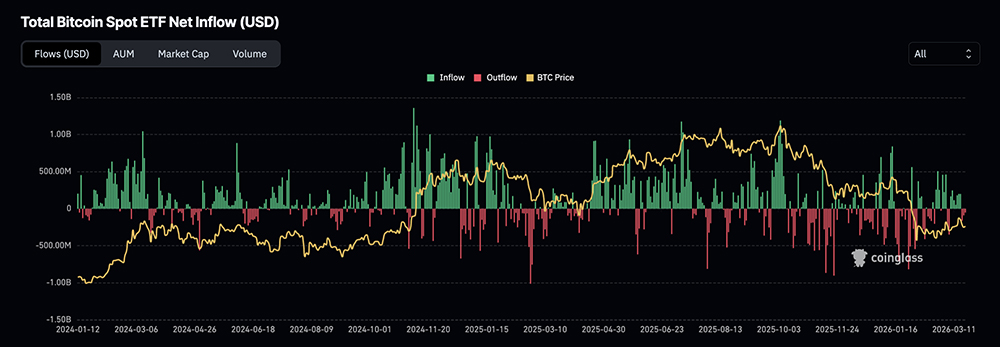
US spot Bitcoin ETFs contributed a large share of Bitcoin-related inflows. SoSoValue data showed that these funds brought in $95.2 million last week, helping extend their winning run to four consecutive weeks.
The four-week stretch lifted total gains for US spot Bitcoin ETFs to $2.2 billion over that period. Even so, the funds still showed about $400 million in net outflows for the year. US spot Ether ETFs also lost momentum, recording about $60 million in weekly outflows and $599 million in outflows year to date.
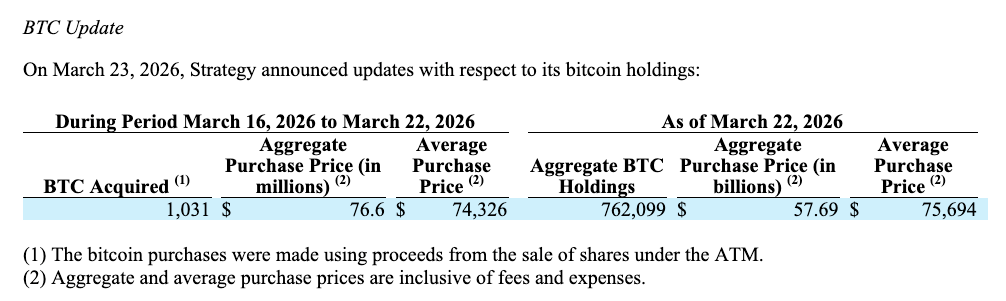
Michael Saylor’s Strategy, the world’s largest public holder of Bitcoin (BTC), bought another 1,031 Bitcoin last week in a much smaller purchase than its previous two weekly buys, funding the acquisition with sales of Class A common stock.
Strategy acquired 1,031 Bitcoin for $76.6 million last week, according to an 8-K filing with the US Securities and Exchange Commission on Monday.
The purchases were made at an average price of $74,326 per coin, below the company’s overall average acquisition price of $75,694. Bitcoin averaged around $70,871 for the week of March 16-22, based on daily closing prices.
The new acquisitions bring Strategy’s holdings to 762,099 BTC, acquired for a total cost of roughly $57.69 billion, the company said.

Common stock funded the latest buy
Strategy’s relatively modest purchase follows larger Bitcoin acquisitions recently, including a 22,337 BTC buy reported last Monday and a 17,994 BTC buy a week earlier.
The 22,337 BTC ($1.6 billion) purchase ranks among Strategy’s largest on record and was largely funded through sales of its perpetual preferred equity, Stretch (STRC). The stock generated approximately $1.2 billion, accounting for about 75% of the total purchase.
Related: Strategy records biggest STRC issuance day with estimated 1,420 BTC buy
Unlike the prior week’s funding mix, the latest purchase appears to have been funded through sales of Strategy’s Class A common stock rather than preferred equity.

Strategy has bought 41,362 Bitcoin for around $2.93 billion in March. With Bitcoin trading at $70,430 at the time of writing, the company is down around 7% on its BTC holdings, now worth around $54 billion, according to data from CoinGecko.
Related: Strategy halts Bitcoin buying via STRC: Will BTC price dip again?
Strategy’s holdings are roughly 3% below the Bitcoin holdings of BlackRock’s iShares Bitcoin Trust ETF (IBIT), which held about 785,300 BTC on behalf of its clients after the close of trading on Friday.
US spot Bitcoin ETFs collectively held nearly 1.3 million BTC as of March 20, representing roughly 6.1% of the 21 million maximum Bitcoin supply, according to data from WalletPilot.
Magazine: Metaplanet’s Japan Bitcoin bet, Bithumb ordered suspension: Asia Express
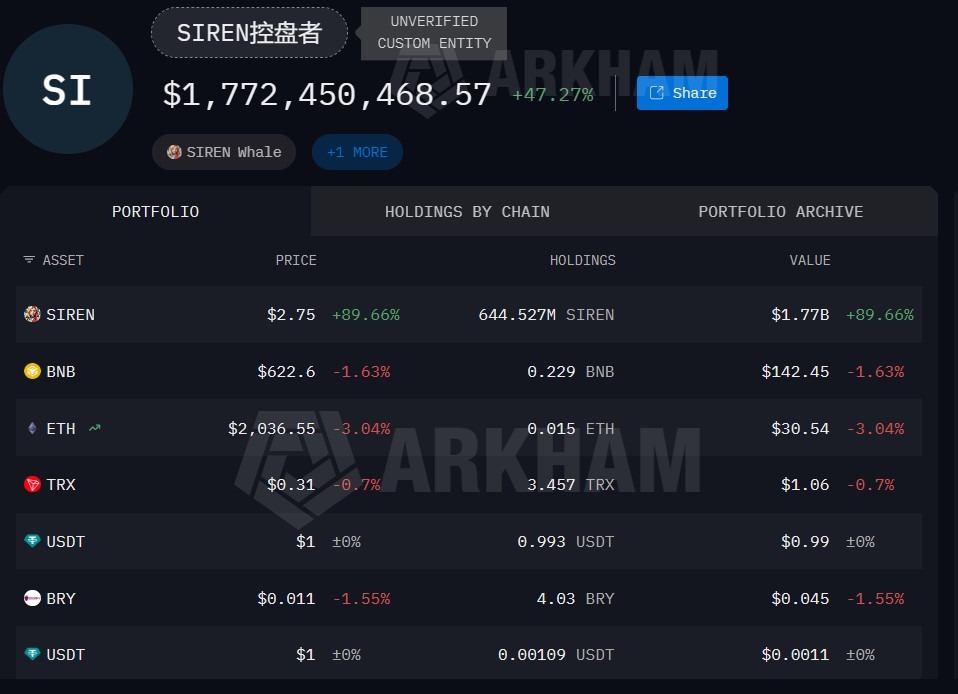
Arkham data shows a wallet cluster holding 644 million SIREN, about 88% of the 728 million circulating supply, raising manipulation concerns.
Crypto token Siren surged 340% in the last week, amid claims that a large portion of the circulating supply may be concentrated among a small group of wallets.
Siren markets itself as the “first AI analyst agent deployed on BNB Chain.” At the time of writing, CoinGecko data shows SIREN trading at $2.81, up over 340% from $0.63 on March 16. In the past month, the token exploded by nearly 1,300% from $0.22. The rally drew scrutiny after analysts said a large share of the token’s supply may be concentrated in a small group of wallets, a dynamic that could amplify volatility if confirmed.
Citing an unverified custom entity created by Arkham Intelligence, onchain analyst EmberCN said the party cornered nearly all spot supply to profit off contracts. He said this was the secret behind the token’s surge in the past month.
According to the Arkham Intelligence page, the entity holds 644 million SIREN (worth around $1.8 billion). The amount accounts for 88% of the entire circulating supply of 728 million tokens.

Crypto analysts point to wallet clustering
On X, pseudonymous crypto analyst Mlmabc warned his followers on Sunday to be careful trading the token, adding that “supply is heavily cornered.” Mlmabc said a cluster of wallets is currently sitting on $950 million in unrealized profit, implying that it could dump the tokens on potential buyers.
Citing his own Dune Analytics dashboard, Bitcoin Strategy analyst Gerhard Kuschnik said most of the Siren token trading activity over the last month, when SIREN surged, was not from new users. Kuschnik said these were trading activities by existing holders, arguing that the token is not gaining new interest.
Related: ‘Hawk Tuah’ girl Haliey Welch says memecoin implosion ‘traumatized’ her
“The vast majority of trading happens by returning users,” adding that the average new user that bought into the token during its surge averaged between 100 and 200.

Magazine: Sex robots, agent contracts a hitman, artificial vaginas: AI Eye goes wild

2.5lakhs Rule ?#anime #education #finance #edushorts #explore #finance

Games Inbox: Is Crimson Desert being underrated?

Long-awaited Australia-EU trade deal finally signed


-
 Crypto World3 days ago
NIO (NIO) Stock Plunges 6.5% as Shelf Registration Sparks Dilution Worries
-

 Fashion3 days ago
Weekend Open Thread: Adidas – Corporette.com
-

 Politics3 days ago
Jenni Murray, Long-Serving Woman’s Hour Presenter, Dies Aged 75
-
 Tech6 days ago
Are Split Spacebars the Next Big Gaming Keyboard Trend?
-

 Crypto World2 days ago
Best Crypto to Buy Now: Strategy Just Spent $1.57 Billion on Bitcoin During Fear While Early Investors Quietly Enter Pepeto for 150x Potential
-

 News Videos5 days ago
RBA board divided on rate cut, unusually buoyant share market | Finance Report | ABC NEWS
-

 Crypto World2 days ago
Bitcoin Price News: Bhutan Sells $72 Million in BTC Under Fiscal Pressure, but the Smart Money Entering Pepeto Sees What the Market Does Not
-

 Politics6 days ago
The House | The new register to protect children from their abusers shows Parliament at its best
-

 Tech4 days ago
inKONBINI Lets You Spend Summer Days Behind the Register
-
 Politics6 days ago
Real-time pollution monitoring calls after boy nearly dies
-

 Crypto World5 days ago
Canada’s FINTRAC revokes registrations of 23 crypto MSBs in AML crackdown
-

 Sports15 hours ago
Remo Stars and Kano Pillars Strengthen Survival Hopes in NPFL
-
 NewsBeat5 days ago
Residents in North Lanarkshire reminded to register to vote in Scottish Parliament Election
-

 News Videos6 days ago
PARLIAMENT OF MALAWI – PAC MEETING WITH REGISTRAR OF FINANCIAL ON AMARYLLIS HOTEL – INQUIRY LIVE
-

 Business1 day ago
No Winner in March 21 Drawing as Prize Rolls to $133 Million for Next
-

 Politics4 days ago
Gender equality discussions at UN face pushbacks and US resistance
-

 Business5 days ago
Who Was Alex Pretti? 5 Key Facts About the ICU Nurse Killed by Federal Agents in Minneapolis
-

 Sports14 hours ago
Gary Kirsten Accuses Pakistan Cricket Board Of ‘Interference’, Mohsin Naqvi Responds
-

 Tech1 day ago
Give Your Phone a Huge (and Free) Upgrade by Switching to Another Keyboard
-

 Sports3 days ago
2026 Kentucky Derby horses, odds, futures, preview, date: Expert who nailed 12 Derby-Oaks Doubles enters picks
You must be logged in to post a comment Login