

Crypto World
STX Down 93% From Its ATH: Can A 4,700% Recovery Still Happen?


TLDR:
- STX’s fake inverse H&S at $3.84 acted as a classic distribution trap for retail liquidity.
- A 93.64% drawdown reset structure, flushing weak hands via a decisive SSL sweep.
- Price now sits in a key $0.07–$0.11 demand zone, signaling potential accumulation phase.
- A reclaim of $0.40 is pivotal to unlock macro upside toward $1–$3.50+ targets.
STX price analysis places the asset at a critical crossroads following a devastating 93.64% collapse from its $3.84 cycle high.
A fake inverse head and shoulders pattern near the neckline lured retail traders into a distribution trap engineered by smart money.
Price has since landed in a high-timeframe demand zone between $0.07 and $0.11, where the next major move could take shape.
How Smart Money Trapped Retail And Erased 93% Of STX’s Value
The collapse started at the $3.84 neckline, where a fake inverse head and shoulders pattern formed. Retail traders saw a textbook bullish reversal setup and positioned accordingly. That confidence proved costly.
Smart money used that optimism as exit liquidity. As retail bought the perceived breakout, larger players quietly distributed their positions into the demand.
STX then rolled over and fell 93.64% from its cycle peak, resetting the entire market structure. Head and shoulders formations at macro tops rarely resolve in favor of late buyers.
STX followed that script precisely, trapping thousands of traders before the floor collapsed entirely. The drop was not a surprise to those who understood the context.
A liquidity sweep below the ascending trendline has since occurred. That SSL grab cleared out remaining stop-losses and flushed the last wave of weak hands from the market.
Selling pressure has largely exhausted itself at these levels, leaving the price sitting in unfamiliar but potentially significant territory.
STX Now Eyes A 4,700% Recovery — Here Is What Needs To Happen
STX currently trades inside the $0.07–$0.11 high-timeframe demand zone. This area aligns with prior inefficient price delivery and follows a complete liquidation cycle.
Most sellers have already exited, and the remaining structure is leaning toward accumulation. The $0.40 level is the line that separates noise from opportunity.
Below it, STX remains trapped in a bearish market structure. A confirmed breakout and retest above $0.40 would mark the beginning of a genuine structural shift and open the door to the bull targets.
Those targets sit at $1.00, $2.50, and $3.50 and above. The full measured move extension puts maximum upside near 4,798% from current prices.
Crypto markets have delivered returns of that magnitude before, but conditions must align.
Capital rotation into mid-cap altcoins, continued Bitcoin L2 narrative strength, and a sustained reclaim of $0.40 are all required. Stacks carries a fundamental edge here, given its direct ties to Bitcoin’s growing Layer 2 ecosystem.
Risk invalidation sits at a two-week close below $0.043. That level, if broken, voids the bullish thesis entirely. The same setup offering nearly 5,000% upside can still fall another 50% before any confirmed bottom takes hold.




Binance named Genius Terminal its 65th HODLer Airdrop, giving 10 million GENIUS tokens to qualifying BNB holders.
Summary
- Binance will distribute 10 million GENIUS tokens to BNB holders who used Simple Earn or On-Chain Yields between May 11 and 13, 2026.
- Genius Terminal is a multichain trading platform backed by YZi Labs and advised by CZ, with a 1 billion token total supply.
- The HODLer Airdrop program is a recurring Binance mechanism that deepens BNB utility by rewarding long-term stakers retroactively.
Binance announced Genius Terminal as the 65th project on its HODLer Airdrop program, continuing its pattern of rewarding loyal BNB holders with tokens from projects ahead of their exchange listing.
The snapshot window for eligibility ran from May 11 to May 13, 2026. Only BNB subscribed to Binance’s Simple Earn or On-Chain Yields products during that three-day period qualifies, with allocations distributed proportionally based on each user’s BNB balance. Rewards were sent to eligible users’ Spot Accounts within five hours of the announcement.
What is Genius Terminal
Genius Terminal is a multichain trading platform that connects to perpetual decentralised exchanges, offering spot and perpetual trading with zero fees for select pairs. YZi Labs, formerly Binance Labs, made an eight-figure investment in the project in January 2026, and CZ joined as a strategic advisor. The announcement triggered a spike in platform trading volume from roughly $80 million per week to more than $2 billion in the following seven days.
The GENIUS token has a total supply of 1 billion and launched its token generation event in April 2026. The HODLer Airdrop distribution covers 10 million tokens, equal to 1% of maximum supply, adding new circulating tokens alongside the exchange listing.
As crypto.news reported, HODLer Airdrop listings have historically triggered sharp price moves in the airdropped token as recipients decide whether to hold or sell into the initial trading session. SAPIEN surged more than 100% in the 24 hours after being featured as the 57th HODLer Airdrop project.
For Binance, the program serves a dual purpose: it incentivises long-term BNB staking and provides visibility for projects building on BNB Smart Chain ahead of their listings. Genius Terminal’s selection follows the 64th HODLer Airdrop featuring Gensyn, a decentralised AI compute network, suggesting that AI-linked infrastructure projects have become a recurring theme in Binance’s curation decisions for the program.
The exchange has not disclosed whether a full spot listing for GENIUS will follow the HODLer distribution, though previous projects in the program have typically proceeded to spot trading within 24 hours of the airdrop announcement.


Payouts.com co-founders say the future of agent payments combines stablecoin rails with programmable control layers built for enterprise trust.
Summary
- Payouts.com CEO Leor Ceder says programmability, not wallets alone, will define which AI agents enterprises can trust by 2027.
- Co-founder Barak Hirchson lists five non-negotiable controls that make autonomous agent spending safe and auditable at scale.
- Stablecoins win in cross-border and machine-to-API micropayments; programmable infrastructure determines which rail gets used everywhere else.
Payouts.com co-founders Leor Ceder and Barak Hirchson say the next wave of AI agent commerce runs on stablecoin rails, and on the programmable control layer built on top of them. In their view, wallets are a necessary foundation, but the durable enterprise value sits in what governs them.
The position adds a critical dimension to the wallet-led narrative dominating agent payments today. Juniper Research forecasts cross-border B2B stablecoin payments will hit $5 trillion by 2035, up from $13.4 billion in 2026, with B2B taking 85% of total stablecoin transaction value.
Where stablecoins win and where smart rail selection matters
Hirchson, Payouts.com’s chief solutions officer, said rail selection is decided by the recipient: country, payment method, urgency, amount, and cost all factor in. Stablecoins win cleanly in two scenarios.
The first is cross-border versus SWIFT, where wire fees and FX spreads can eat 4 to 5% of a transaction. The second is machine-to-API micropayments, where the x402 standard already routes pay-per-call API invoices in stablecoin. Crypto.news reported that AI agents have settled $73 million across 176 million transactions on crypto rails, with USDC handling 98.6%.
“PIX clears in under ten seconds in Brazil for free, UPI handles hundreds of millions of transactions a day in India at near-zero cost,” Hirchson said. “The agents that scale are the ones that can pick the right rail per transaction, not the ones locked into a single rail based on what their limited wallet supports.”
The five non-negotiable agent controls
Hirchson laid out five controls he said are non-negotiable before companies let agents transact autonomously: scoped credentials, hard spend caps enforced at the protocol level, cryptographically signed mandates, idempotency at the payment layer, and a fail-closed posture.
“This is what programmable spending actually means. You define the envelope once, the infrastructure enforces it forever, and the agent operates freely inside it,” he said. “Is the industry building these fast enough? Not uniformly.”
Some wallets shipped recently include hard caps and signed mandates, he said. Others ship with an API key and a balance, which he called the worst-case configuration for a compromised key.
What the agent payment stack looks like by 2027
Ceder said the interesting question by May 2027 will not be which stablecoin wins. It will be programmability: how granularly enterprises can define what an agent is allowed to do, how reliably that policy is enforced, and how cleanly compliance can be proven after the fact.
“The wallet wars happening right now will look the way the browser wars look in retrospect: necessary, formative, and not where the durable value got captured,” Ceder said. The compliance layer must be built into the infrastructure rather than the agent, with every payment passing a cascade of principal, account and jurisdiction checks before any money moves.
Coinbase and Cloudflare have built the x402 protocol into a fast-growing settlement rail for agents, with the standard recently joining the Linux Foundation. AWS embedded x402 into Amazon Bedrock AgentCore Payments earlier this month, while Solana and Google launched Pay.sh as a parallel route.
For Payouts.com, the bet is that the control layer above those rails is where enterprise spend will land. The agent stays autonomous. The envelope around it does not move.


Senator Cynthia Lummis says the Clarity Act must pass this Congress or the next legislative window opens in 2030.
Summary
- Lummis posted on X that the next viable window for crypto market structure legislation is likely 2030 if Congress fails to act now.
- The Senate Banking Committee passed the Clarity Act 15 to 9 on May 14, but a full floor vote remains uncertain before midterms.
- Republicans risk losing House seats in November 2026, which could shelve comprehensive crypto regulation for years.
Senator Cynthia Lummis issued a stark warning on May 29, telling lawmakers the current Congress represents the final realistic window to pass comprehensive digital asset legislation before a four-year freeze sets in.
In a post on X, the Wyoming senator wrote: “The next window for digital asset legislation after this Congress is likely 2030. Until then, developers remain exposed with no legal protections, and law enforcement remains without the tools to hold bad actors accountable. The Clarity Act solves both.”
Why Lummis says 2030 is the fallback
The Senate Banking Committee advanced the Clarity Act with a 15 to 9 bipartisan vote on May 14, marking real progress after months of stalls over stablecoin yield disputes. A full Senate floor vote is a different calculation, with November 2026 midterm elections compressing the available calendar to weeks.
Lummis has argued the current moment is defined by a political alignment that rarely holds in Washington: the House passed the Clarity Act 294 to 134, the Senate Agriculture Committee has cleared its version, and the White House under Trump has publicly backed it as a national priority. A House flip after midterms, or a shift in Senate committee composition, could disassemble that alignment entirely and force the industry to start over under a new Congress with different priorities.
Political forecasts add weight to that concern. Several analysts expect Republicans to lose seats in November, which would push digital asset regulation down the Democratic agenda. Polymarket currently prices Clarity Act passage in 2026 at roughly 58%, a figure that reflects both the bill’s progress and the obstacles ahead.
SEC Chair Paul Atkins offered a counterpoint, telling Fox Business he has confidence Congress will pass the bill and that President Trump will sign it. Treasury Secretary Scott Bessent has also pressed for urgency, warning that regulatory ambiguity has already driven crypto development toward Abu Dhabi and Singapore.
What a delay actually costs
The Clarity Act would establish formal definitions for digital assets and divide oversight between the SEC and CFTC based on each asset’s classification. Without it, the SEC continues applying the Howey test case by case, with no binding rules or procedural protections for the sector.
As crypto.news reported, stablecoin yield provisions remain one of the most contested flashpoints, alongside ethics language barring government officials from personally benefiting from crypto holdings. Both issues must clear before the bill reaches Trump’s desk.
Lummis, who announced she will not seek a second Senate term, has framed the stakes in direct terms. Without the Clarity Act, she says American developers remain targets for prosecution simply for publishing code. The Senate Banking Committee’s approval was a milestone, but the floor vote, reconciliation with the House version, and the presidential signature all remain ahead. Lummis’s warning is that the calendar for all three is narrowing fast.

Former Celsius founder and former chief executive Alex Mashinsky has moved to vacate his 12-year prison sentence in a New York federal court, arguing that he received ineffective counsel and that the conviction rests on tainted evidence. The motion, filed in the Southern District of New York, follows Judge John Koeltl’s May 2025 ruling imposing a 144-month term for commodities fraud and securities fraud tied to the Celsius network’s downfall. Mashinsky filed the paperwork without new representation, after announcing on May 5 that he would proceed pro se.
In his filing, Mashinsky contends that his defense was compromised by ineffective assistance of counsel and that the evidence underpinning his guilty pleas was tainted by a “fruit of the poisonous tree” scenario—a legal doctrine referring to evidence obtained through misconduct. He also noted that his counsel ceased communication with him at a critical juncture, forcing him to submit his reply directly to the court without new guidance.
Beyond the legal procedural questions, Mashinsky’s motion reiterates claims about the broader forces he believes influenced Celsius’s fate. He asserts that former FTX chief executive Sam Bankman-Fried intended to destroy Celsius and that the market manipulation surrounding Celsius’s CEL token on the FTX exchange was a central factor in the crisis. In support of his position, Mashinsky attached messages with Celsius’s former chief revenue officer, Roni Cohen-Pavon, alleging a “hostile takeover” attempt at the platform.
Celsis filed for bankruptcy in 2022 after a period of distress across the crypto sector, a year that saw a wave of exchange failures. In July 2023, U.S. authorities charged Mashinsky and Cohen-Pavon with fraud and market manipulation related to Celsius’s operations; both executives later pleaded guilty. The legal actions against them formed a broader narrative of accountability in a sector that had been rocked by collapses and restructuring.
In a separate piece of the Celsius saga, Cohen-Pavon was sentenced to time served after pleading guilty in September 2023. Prosecutors cited her “substantial assistance” to the government, including willingness to testify against Mashinsky, as a key factor in the sentence and in concluding the criminal case against the Celsius executives.
Key takeaways
- Alice Mashinsky seeks to vacate his 12-year sentence in SDNY, arguing ineffective assistance of counsel and tainted evidence as grounds for relief.
- The motion arrives in the wake of Mashinsky’s May 2025 sentencing and follows a 2022 Celsius bankruptcy and 2023 indictments of Celsius executives.
- Mashinsky alleges that Sam Bankman-Fried sought to destroy Celsius and points to internal communications suggesting a hostile takeover attempt at Celsius.
- Cohen-Pavon was sentenced to time served after pleading guilty; prosecutors highlighted substantial cooperation, with penalties including more than $1 million in fines and a $40,000 fine.
- Financial consequences for Mashinsky include a $48 million forfeiture from a criminal case and a separate $10 million FTC settlement tied to a multibillion-dollar Celsius judgment, most of which is suspended.
Legal tides around a fallen platform
The Celsius case sits at the intersection of criminal accountability and corporate collapse in a market still grappling with the aftershocks of the 2022 downturn. The move to vacate hinges on nuanced questions about representation and the admissibility of evidence, but it also underscores continuing scrutiny of how individuals and teams behind high-profile crypto platforms are held to legal standards. Mashinsky’s pro se stance adds a layer of procedural complexity, potentially prolonging a series of court filings that have already stretched across years.
From a regulatory perspective, the saga—spanning bankruptcy, indictments, guilty pleas, and settlements—illustrates the breadth of federal interest in the sector’s actors, not just the exchanges themselves. The case also intersects with the broader narrative of post-FTX accountability, where prosecutors have pursued multiple fronts to address alleged deception and market manipulation in the crypto economy.
The financial penalties connected to Celsius’s leadership also illustrate the penalties that can accompany wrongdoing in this space. Mashinsky’s $48 million forfeiture and the $10 million FTC settlement linked to Celsius’s broader judgment reflect the dimensions of civil and criminal consequences that can persist long after a platform’s immediate collapse. Cohen-Pavon’s time-served sentence, alongside more than $1 million in penalties, reinforces that executives may face significant costs even when criminal convictions are resolved.
What investors and crypto builders should watch next
For creditors, investors, and users connected to Celsius assets, the ongoing legal proceedings add a layer of uncertainty to an already unsettled chapter in the company’s history. The pending motion to vacate could, if granted, alter aspects of the sentencing posture and the potential financial exposure linked to the case. Even if the motion does not succeed, the process highlights the persistent risk of legal and reputational disruption surrounding failed platforms and their leadership.
Looking ahead, observers will be watching for a decision on Mashinsky’s vacatur bid, which could influence related sentencing or forfeiture orders. The proceedings also sit within a larger regulatory frame—where authorities are increasingly focused on executive accountability in the wake of major market disruptions. As the Celsius matter continues to unfold, market participants should monitor any formal court rulings, potential settlements, and how these developments might impact remaining creditors, unsecured claims, and the broader narrative around crypto lending platforms’ risk management and governance standards.
Readers should stay attentive to forthcoming court filings and rulings, as they will signal whether the motion to vacate moves forward or stalls. The case remains a key datapoint in understanding how the legal system handles complex criminal and civil actions tied to high-profile crypto platform failures—and what that means for the trajectory of crypto accountability in the years ahead.

Coinbase CEO Brian Armstrong replied to JPMorgan chief Jamie Dimon’s broadside on the CLARITY Act with a hockey-themed meme that drew swift backing from across the crypto industry.
The viral exchange on Friday turned a regulatory fight over stablecoin rewards into a rallying moment for digital asset leaders pushing the bill to the Senate floor.
Crypto Industry Closes Ranks Behind CLARITY Act
Industry leaders pushed back fast after Dimon’s CLARITY Act broadside on Fox Business Friday. Mike Novogratz of Galaxy Digital argued elected lawmakers, not banks, should write financial laws.
Peter Van Valkenburgh of Coin Center pointed out that roughly $3 trillion was laundered through banks in 2025. He called Dimon’s anti-money-laundering framing nonsense.
“The second issue is not really related to rewards and interest on stablecoins. It’s also about AML, BSA, KYC. Because when you are in a bank system, it’s already been through all that. We do that. We have to [do it] for the federal government. So if they want to be moving money around… on any basis, you should have to question: ‘Can that be used illegitimately?’ Answer: Yes, unless they’re following the same rules,” Dimon had said in the interview.
Other crypto voices cited JPMorgan’s track record of regulatory fines and settlements totaling tens of billions.
The defense came with the Digital Asset Market Clarity Act before the full Senate. It cleared the Senate Banking Committee in a 15-9 vote on May 14.
The bill needs 60 votes on the Senate floor before returning to the House.
Armstrong’s Meme Becomes the Rally Cry
Armstrong’s poster cast Dimon as #2 for tradition and himself as #1 for economic freedom. The image went viral within minutes.

“Heated Rivalry” is also the title of a 2019 gay hockey romance novel adapted for television in late 2025.
The meme amplified the industry’s underlying argument. Bank opposition to stablecoin yield rewards looks like incumbent protectionism, not consumer protection.
Amid the escalating feud, Coinbase now compares to Charles Schwab’s late-1970s disruption of brokerage commissions. The comparison resonates with crypto traders who see Coinbase eroding traditional bank margins.
“Coinbase is to current finance/banking what Charles Schwab was to finance/trading in the late 70’s and 80’s. Schwab radically disrupted Wall Street then. Coinbase is radically disrupting Wall Street now. Schwab ultimately destroyed commissions and fees on transactions. Coinbase is destroying market hours, access, tech, and margins/interest,” remarked Andrew, co-founder of Arch Public.
Industry figures argue the existing framework already imposes Bank Secrecy Act rules on exchanges.
The pushback signals a coordinated response to months of bank lobbying. The Senate floor vote is expected in June.
The post Coinbase vs. JPMorgan Feud Escalates Over the CLARITY Act appeared first on BeInCrypto.

The United States has seized roughly $1 billion in Iranian cryptocurrency assets, Treasury Secretary Scott Bessent announced at the Reagan National Economic Forum. He characterized the action as a direct disruption of illicit financial activity, describing it as an outright grab of wallets that some owners may not yet realize have been emptied. The disclosure situates the seizures within a multiyear effort to constrain Iran’s access to international financial networks and to press its leadership economically.
Bessent said the seizures are part of a broader pressure campaign against Iran, known as Operation Economic Fury. Launched in March 2025, the operation combines cryptocurrency takedowns, banking account freezes, and coordinated asset confiscation with European partners. He framed the effort as a sustained, comprehensive push designed to “cut them off” financially, noting that the trajectory over the past five-and-a-half to six weeks has been remarkably effective. “Between five and a half to six weeks of an incredibly successful military campaign and Operation Economic Fury, where we have really cut them off. They are at the end of their Tether now financially,” he stated.
Key takeaways
- The United States reports roughly $1 billion in Iranian crypto assets seized through Operation Economic Fury, including wallet-level takedowns.
- The newly disclosed figure is about twice the $500 million previously announced in late April and well above the $344 million disclosed earlier in the month.
- Officials describe Iran’s financial situation as dire, with high inflation, internal funding pressures, and disruptions to state services and military payrolls.
- The seizures illustrate intensified cross-border enforcement and international cooperation, with implications for crypto compliance, sanctions screening, and banking access for sanctioned states.
- Policy conversations around crypto-enabled shipping and revenue mechanisms—such as Bitcoin-based incentives for Hormuz transit—signal broader state-influenced use cases for digital assets, pending regulatory scrutiny.
Asset seizures: scale, method, and regulatory context
According to officials, the $1 billion in Iranian crypto assets seized under Operation Economic Fury represents a significant escalation in exploiting blockchain-traceable funds linked to sanctioned activity. The strategy appears to rely on identifying wallets associated with state-backed or proxy actors, then applying enforcement measures that repurpose or redirect the assets through compliant channels. The approach also reflects the United States’ broader sanctions toolkit, which increasingly treats certain digital assets as subject to traditional financial and export-control regimes.
The Treasury’s disclosures underscore a shift in how authorities frame enforcement risk for crypto-asset holders connected to sanctioned regimes. By publicly detailing wallet-level seizures and the scale of the assets involved, policymakers and regulated institutions gain a clearer baseline for due diligence, screening, and ongoing monitoring. For exchanges, custodians, and banks with crypto-related business lines, the development raises questions about the diligence required to identify sanctioned wallets, the treatment of seized or frozen crypto, and the timing of any redress or remediation for affected customers.
The previously reported figures provide context for the current disclosure. Officials had announced roughly $500 million in Iranian crypto assets seized in late April and about $344 million in crypto assets seized earlier in the month. The latest figure, therefore, suggests a substantial acceleration in enforcement activity within a relatively short window. These milestones have implications for cross-border regulatory coordination, including parallel actions by allied regulators and law enforcement partners in Europe and beyond. For market observers, the trend highlights the growing intersection of sanctions policy with digital-asset compliance requirements and the need for rigorous KYC/AML controls across custody and exchange ecosystems.
Iran’s economic strain and the geopolitical backdrop
Secretary Bessent painted a picture of severe economic strain within Iran, describing a regime that has allegedly siphoned hundreds of millions of dollars monthly and allocated proceeds among a broad leadership cadre. He suggested inflation could exceed 200 percent, with social subsidies being deployed to mitigate cost-of-living pressures and widespread internet restrictions affecting communications. Reports cited by officials indicate that a substantial portion of Iranian troops have faced delayed or disrupted pay, further complicating the regime’s capacity to project authority and sustain external influence flows.
The statements also reflect the strategic complexity of negotiating with a fractured leadership structure following recent strikes against senior regime figures. While Bessent did not hinge policy outcomes on these internal dynamics alone, the comments underscore how enforcement actions intersect with diplomatic channels, sanctions policy, and potential leverage in any future negotiations surrounding Tehran’s regional posture and long-term security considerations.
These disclosures come at a moment when the U.S. and its allies continue to calibrate sanctions pressure against Iran, balancing the aims of disrupting illicit financial networks with broader regional stability goals. The clearly articulated message is that crypto assets are not beyond the reach of conventional sanctions enforcement, and that dynamic, rapid actions can be employed to disrupt stated objectives even when actors pivot to digital instruments. For compliance teams and risk managers at financial institutions, the implications are twofold: a heightened emphasis on tracing cross-border crypto flows and an expanded mandate to screen counterparties against sanctioned-entity lists in near real time.
Policy implications and regulatory coordination
Beyond the immediate asset seizures, observers are examining the regulatory and policy ramifications for the crypto industry. The operation demonstrates a continued hard line on sanction enforcement, potentially accelerating the development of best practices around sanctions screening, wallet clustering analysis, and the cross-jurisdictional sharing of intelligence related to illicit fund flows. Firms engaged in custody, exchange, or payment processing face heightened expectations to implement robust monitoring, rapid response protocols, and transparent reporting mechanisms when dealing with funds that may be implicated by sanctions regimes.
In parallel, the focus on state-led crypto strategies—such as potential monetization schemes tied to strategic chokepoints—highlights the need for clear regulatory guardrails around crypto-based insurance, settlement, and revenue-sharing models used by states. As reported by Cointelegraph, Iran has been weighing a Bitcoin-based insurance framework to monetize shipping through the Strait of Hormuz, a project that could generate substantial revenue if implemented at scale and supported by compliant, auditable mechanisms. The proposed platform, termed “Hormuz Safe,” would sell digital marine insurance payable in Bitcoin and settled on the blockchain, potentially enabling more than $10 billion in revenue for the country, subject to regulatory approval and international compliance constraints. A separate report cited that some ships could pass Hormuz in exchange for a Bitcoin-denominated tariff of about $1 per barrel of oil. The development underscores the convergence of sovereign financing strategies and digital asset infrastructure, inviting scrutiny from licensing authorities and international financial regulators alike.
For regulated entities, the evolving environment implies a need for heightened vigilance around sanctioned counterparties, as well as clearer guidance from regulators on the permissibility and treatment of crypto assets tied to state operations. The cross-border dimension—where U.S. actions, European cooperation, and potentially other jurisdictions intersect—will likely shape licensing decisions, oversight practices, and the rigor of AML/KYC programs across the global crypto ecosystem. In this context, ongoing updates from U.S. agencies and international partners will be critical reference points for risk managers, legal counsel, and compliance leaders assessing exposure to sanctioned activities or users with ties to Iran or other restricted regimes.
Closing perspective
The scale of the recent seizures, coupled with Iran’s stated economic and strategic pressures, signals a pronounced trend: cryptocurrency is increasingly entangled with state-level sanctions enforcement and foreign policy aims. As authorities pursue more aggressive asset recovery and cross-border cooperation, firms across the crypto value chain must strengthen their compliance programs, enhance real-time monitoring, and prepare for evolving guidance on sanctioned assets and state-backed financial activities. The coming months will likely reveal further operational details and regulatory responses that define how digital assets interface with traditional sovereignty and enforcement mechanisms.
For further context, authorities and industry observers continue to monitor related developments, including prior disclosures and coverage of Iran-related crypto actions. In particular, Cointelegraph has reported on related seizures and policy discussions, illustrating the ongoing convergence of sanctions policy, crypto regulation, and geopolitical risk management.
The cryptocurrency market has steadied somewhat over the past 24 hours, following a painful correction that pushed Bitcoin and most large-cap altcoins lower during the week.
However, Stellar (XLM) continues to be the clear outlier from the top alts, posting yet another massive daily surge while the broader market remains under pressure.
BTC Price Calms Above $73K
Bitcoin’s most recent weekly correction took the asset south when it slipped below $73,000 amid renewed pressure across crypto markets. The primary cryptocurrency has recovered since then and gained some ground, now trading at $73,400.
Its intraday moves have not been without volatility, however. The price ranged between $72,200 and $74,200 before finally settling down at the current levels as the weekend starts.
Bitcoin’s market capitalization remains above $1.47 billion, while its dominance over altcoins is more or less unchanged, suggesting they failed to capitalize on BTC’s weakness. The latter could have been induced by weakening ETF flows, which have posted record outflows in the past few days.
For now, the $73,000 zone has become the key area to watch. A decisive loss of that level could trigger another leg lower, potentially to $70,000, while a move above $74K may ease some of the short-term pressure.

Stellar (XLM) Continues to Lead the Altcoin Market
The altcoin market shows a mixed picture today, with most large-cap assets posting relatively modest moves over the past 24 hours rather than sharp recoveries.
Ethereum (ETH) is trading close to $2,000, while SOL, XRP, and several other majors are showing only limited changes. BNB has fared the best from the top alts, rising by more than 5% on the day.
XRP is also slightly in the green, while ETH and SOL remain almost flat compared to their levels from 24 hours.
Stellar (XLM), however, is in a completely different category. The altcoin has exploded by roughly 25% over the past day and is trading near $0.20, making it one of the strongest performers among mid-cap cryptocurrencies.
The move comes shortly after DTCC announced that its tokenization service will connect with the Stellar public blockchain. The move is expected to support tokenized DTC-custodied assets, including stocks, ETFs, treasuries, and corporate bonds, with availability targeted for the first half of 2027.
Other notable performers for the day include LAB, up 37.5%; Algorand’s ALGO, up 9.5%; and XDC Network (XDC), up 9%.

The post Bitcoin Calms at $73,000, Stellar Explodes by 25% Daily: Weekend Watch appeared first on CryptoPotato.
MicroStrategy, the largest corporate Bitcoin (BTC) holder, withdrew 411.5 BTC from Coinbase Prime hours after depositing it. The reversal cooled fears that Michael Saylor’s firm was preparing its first BTC sale in years.
Meanwhile, Tom Lee’s BitMine Immersion Technologies bought 25,000 Ethereum (ETH) for $50.6 million on the same day. The purchase extended one of the largest corporate ETH accumulation programs in markets.
MicroStrategy Reverses Brief Coinbase Prime Deposit
On-chain trackers flagged the initial deposit as MicroStrategy’s first direct exchange move in nearly two years.
The transfer was split into two batches near 205 BTC each, with smaller wallet transactions also active.
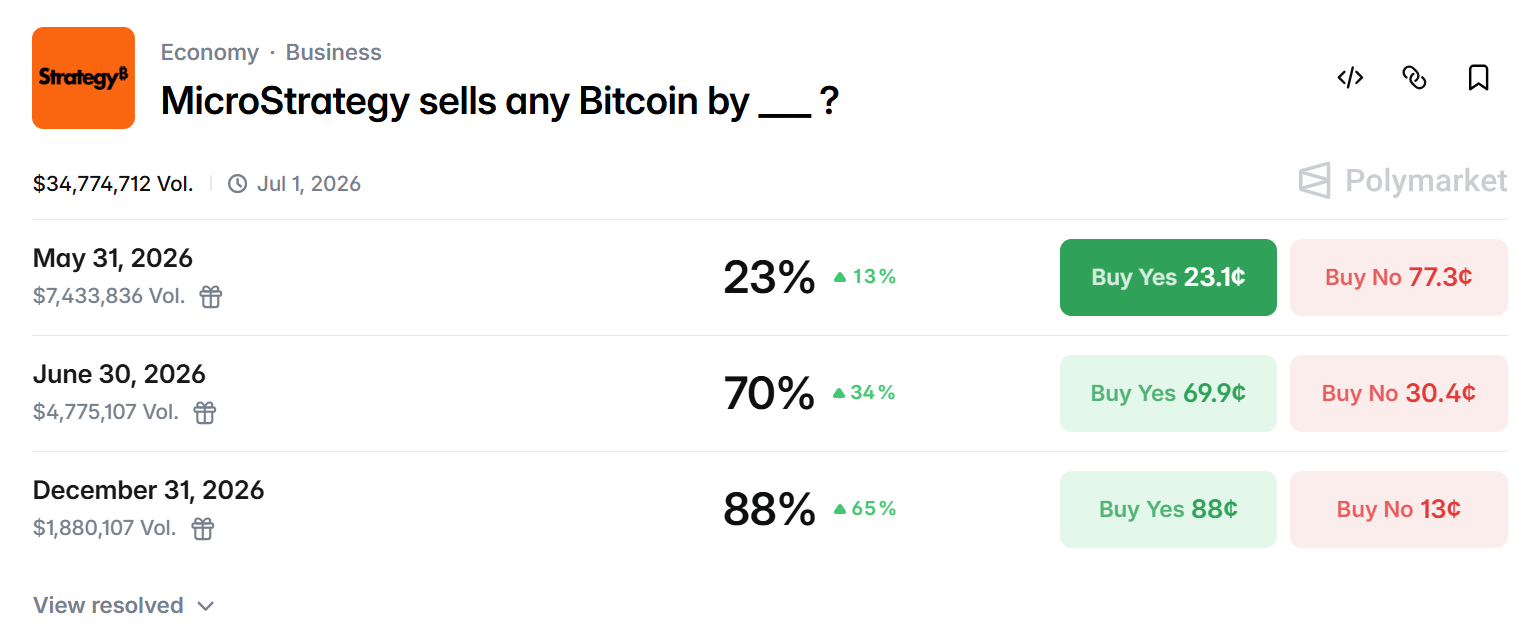
Saylor signaled this week that Strategy could sell some BTC before year-end, citing dividend and capital needs. The remark had shifted prediction-market pricing even before the Coinbase Prime move.
The deposit pushed Polymarket odds on Strategy selling any Bitcoin in 2026 above 90%. Those odds eased after the withdrawal but stayed elevated.

“Did Michael Saylor’s Strategy cancel its BTC sale? Strategy withdrew 411.5 BTC ($30.2M) back from Coinbase Prime 5 hours ago,” Lookonchain posed.
Follow us on X to get the latest news as it happens
BTC trades near $73,532, with the broader Bitcoin treasury stocks split showing limited contagion.
Strategy still holds 843,738 BTC, valued above $62 billion. The firm has bought no Bitcoin since May 18. That pause is the longest in its weekly accumulation as corporate Bitcoin treasury demand softens.
BitMine Doubles Down on Ethereum Amid Price Weakness
BitMine bought the dip below $2,100, lifting its aggressive ETH accumulation to roughly 5.39 million ETH. That sum represents about 4.47% of supply, near Tom Lee’s 5% target for the year.
“Tom Lee’s Bitmine bought another 25,000 ETH ($50.56M) 6 hours ago,” Lookonchain noted.
The firm stakes more than 4.7 million ETH through its Made in America Validator network. The position generates an annualized yield of about $276 million. Ether trades near $2,011 after a 10% monthly decline.
Lee frames the weakness as a buying window, pointing to tokenization growth and AI demand for compute.
Backers including ARK Invest and Founders Fund maintain exposure. BMNR trades below net asset value despite unrealized BitMine ETH losses.
However, even as Tom Lee’s Bitmine buys the Ethereum dip, old wallets are dumping, with one selling $112 million worth of ETH in the last week.
“Ethereum OG is dumping ETH! Over the past week, an Ethereum OG sold 55,000 ETH ($112.25M) and 9,442 wstETH ($24M) at an average price of $2,041 per ETH,” the on-chain analytics account highlighted.
The post MicroStrategy Corrects Bitcoin Sell-Off Fears With $30 Million Withdrawal appeared first on BeInCrypto.
Hyperliquid is best known for its on-chain perps exchange, but did you also know there are vaults where users can deposit funds and follow specific trading strategies?
One of these vaults, currently enjoying a total value locked of more than $3 million, delivered 638% APY last month. Let’s examine.
What Are Hyperliquid Vaults?
Hyperliquid vaults are one of the more closely watched features on the decentralized derivatives exchange. They allow traders to participate in shared strategies.
Think about it this way – a vault works more like a pooled trading account. A vault leader runs a strategy, while other users can deposit funds into the vault and gain exposure to the results.
If the strategy makes money, depositors would share in the profits. If it loses money, they also share in the losses.
What makes vaults interesting is that, unlike a basic yield product that simply lends or rebalances assets, they are built directly into HyperCore. This means that vault strategies can tap into existing infrastructure available to traders on the exchange, including leverage, liquidations, perps, high-throughput execution, and everything Hyperliquid provides.
This can make them powerful instruments for those seeking more passive avenues, but they can also be risky. Returns can move very sharply in both directions, especially when vaults use leverage or take concentrated directional bets.
An interesting way to think about it is to equate it to on-chain copy trading with pooled capital. The strategy is fully visible, performance can be tracked, and users can choose whether the risk profile is fit for their own portfolio.
Long HYPE and BTC, Short “Garbage” Yields 638% APY Past Month
One particular vault built on Hyperliquid has drawn attention after returning an APY of 638% over the past month.
It’s named “Long HYPE & BTC, Short Garbage,” and it currently manages around $3.03 million in total value locked.

Its strategy is designed to be 70% HYPE and 30% BTC on the long side. It also maintains shorts in a basket of at least 10 high-FDV and high-emission coins, with the short side representing about 60% of notional exposure.
As you can see from the position table, the only underperforming trade is the BTC long, though it has been offset by the funding payout.
The vault’s overall PnL chart shows a steep rise over the prior 30 days, nearing the $1.2 million area.
Of course, this shouldn’t be interpreted as a low-risk yield. On the contrary, it reflects a rather aggressive leveraged long-short crypto trade, which depends heavily on HYPE’s price performance.
The post This Crypto Trade Printed 638% APY Last Month: Details appeared first on CryptoPotato.
The past seven days saw Pi Network’s native cryptocurrency move more or less in line with the rest of the market, declining by a total of 4.7%.
A few important project-oriented developments also took place, so let’s have a look at some of the more important news around the project.
Important Protocol Update for Pi Network
Undoubtedly, the main development story for the past few days centered on an important protocol upgrade for mainnet node operators. As CryptoPotato reported, all Pi mainnet nodes are required to move to version v24. The deadline is set for June 2nd, 2026.
The team described the update as very quick to complete, with downtime expected of about 15 minutes. However, the warning around it is significant, because nodes that fail to update risk being disconnected from the canonical chain.
That could create instability if enough operators delay the process. Developers have also advised operators not to upgrade all nodes at once, instead routing traffic through other nodes during the transition.
For Pi Network, the move comes at an important stage, because the project continues to focus on infrastructure and utility, while the market continues to watch for signs of technical progress that can translate into more confidence in the native token Pi.
CiDi Games Beta Draws Engagement
The second major update is coming from the ecosystem side of things. CiDi Games – a Pi Network Ventures portfolio company – launched its beta application within the Pi Browser. The move is supposed to bring Pioneers 10 instant-access games across puzzle, idle, action, and competitive categories.
The move also introduced skill-based tournaments, platform progression through CiDiScore, the Pi ELF companion experience, and more.
The early traction was notable. In less than a week, CiDi Games attracted more than 81,000 Pioneers across more than 160 countries and regions, generating over 1.2 million game sessions. The launch also showed that Pi-based applications can reach users organically, build engagement, and test monetization through real utility rather than speculation.
CiDi Games, a Pi Network Ventures portfolio company, launched their beta app in the Pi Browser!
This brought Pioneers 10 instant-access games along with skill-based tournaments, platform progression through CiDiScore, the Pi ELF companion experience, Elf Continent, and developer… pic.twitter.com/7iqdZxUoIb
— Pi Network (@PiCoreTeam) May 28, 2026
Pi Price Remains Under Pressure
Despite the notable ecosystem updates, PI’s market performance remained depressed today. At the time of this writing, the token is trading at around $0.143, down about 4.7% over the past week, with a market capitalization of nearly $1.53 billion and daily trading volume of around $8.7 million – a far cry from its former days of massive activity.
The cryptocurrency continues to reflect broader caution observed in altcoins this week, with traders weighing technical progress against weaker market momentum.
As it stands, PI’s price action suggests that investors are not easily swayed by announcements.

The post Pi Network News and PI Price Update May 30 appeared first on CryptoPotato.

AUKUS to develop unmanned undersea vehicles, Pentagon chief says

Binance adds GENIUS as 65th HODLer airdrop

The young are trapped by hideously low expectations


-

 Business6 days ago
NYT Strands Answers May 24 2026 Revealed for Puzzle No. 812 Theme Summer Essentials
-

 NewsBeat3 days ago
Israel says it has killed new Hamas military leader in Gaza City airstrikes
-

 Politics5 days ago
Bridgerton Season 5: Cast, Release Date And Everything We Know So Far
-

 Business3 days ago
Selena Gomez Reportedly Upset Over Benny Blanco’s Comments on Her ‘Terrible’ Diet
-

 Crypto World7 days ago
Robinhood crypto COO Tanya Denisova exits
-
Crypto World4 days ago
Micron Crosses $1 Trillion Market Cap as AI Demand Reshapes Memory Sector
-

 Tech5 days ago
Microsoft’s quiet Claude Code retreat and the real cost of enterprise AI
-

 Business5 days ago
BTS Sells Out Four Las Vegas Shows at Allegiant Stadium for ARIRANG World Tour
-
 Tech4 days ago
China assigns ID codes to 28,000+ humanoid robots
-

 News Videos3 days ago
XRP *JUST* SUCCEEDED!!!! CLARITY ACT EXPOSED!!! (SHE EXPOSED IT)
-

 Tech1 day ago
Waymo dominates autonomous vehicle registrations as Tesla trails behind
-
Tech3 days ago
The Samsung pay deal is the moment Korean unions changed register
-

 Tech5 days ago
Westone Audio and Etymotic Acquired by Fidelity Collective in Major IEM Market Move
-

 Tech3 days ago
Millions of AI agents imperiled by critical vulnerability in open source package
-
Crypto World5 days ago
Brian Armstrong Outlines Crypto Vision for the Future Financial System
-
 Entertainment4 days ago
‘Breaking Bad’ Star’s Easy-to-Binge 6-Part Crime Series Spin-Off Is Finally Heading to Free Streaming
-
Crypto World3 days ago
SpaceX’s $2 Trillion IPO: Why Tech Giants Nvidia (NVDA), Apple (AAPL), and Microsoft (MSFT) May Face Pressure
-
 Crypto World5 days ago
Nvidia (NVDA) CEO Calls on Super Micro to Strengthen Export Controls Amid Smuggling Probe
-

 Tech3 days ago
NASA taps Blue Origin to deliver lunar rovers for Moon Base initiative
-
 NewsBeat5 days ago
Hottest May day ever as London hits 34.8C in 2C leap from previous records
You must be logged in to post a comment Login