
Crypto World
XRP vs. Solana (SOL): Which Cryptocurrency Is the Smarter Investment in 2026?

Quick Overview
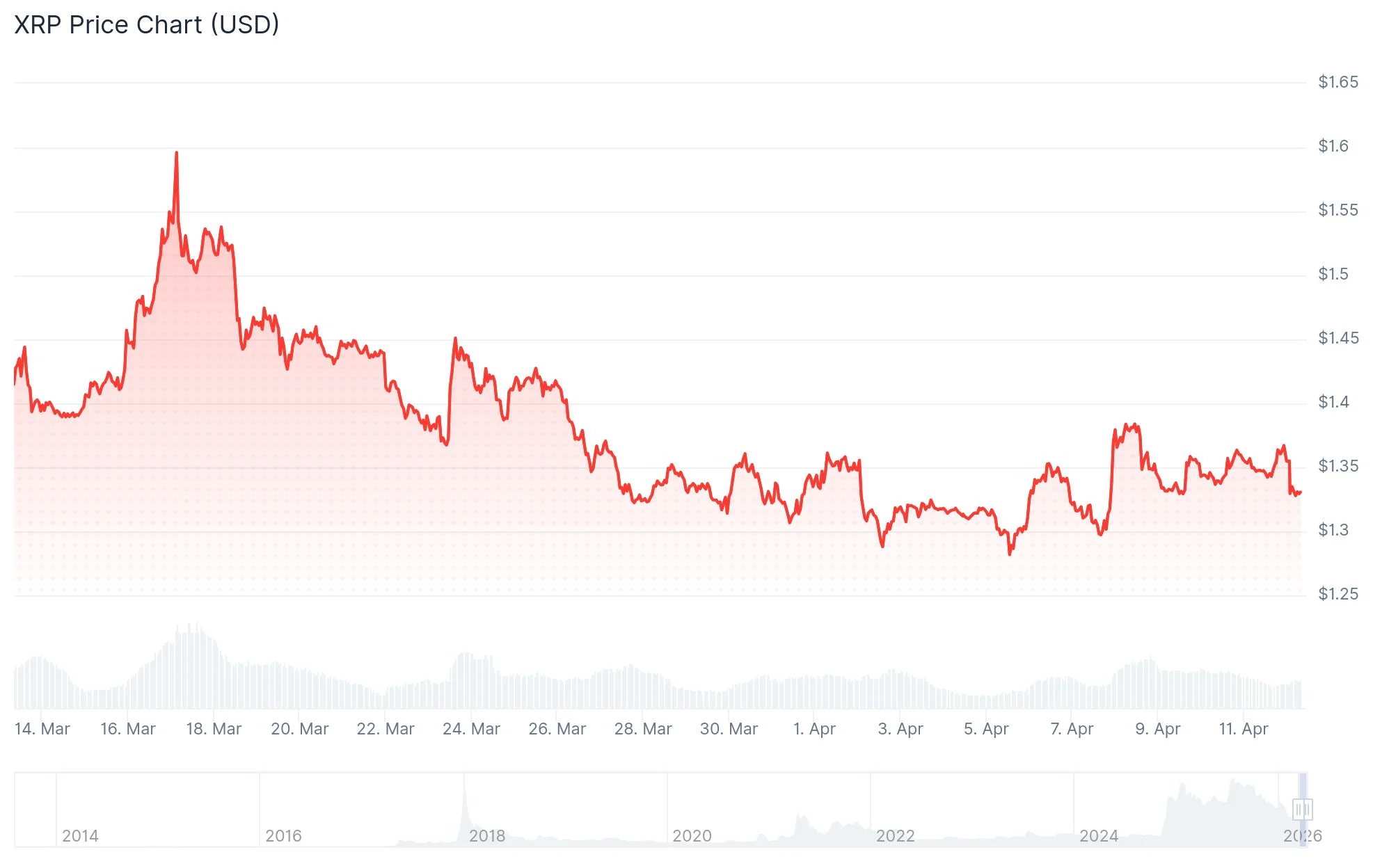
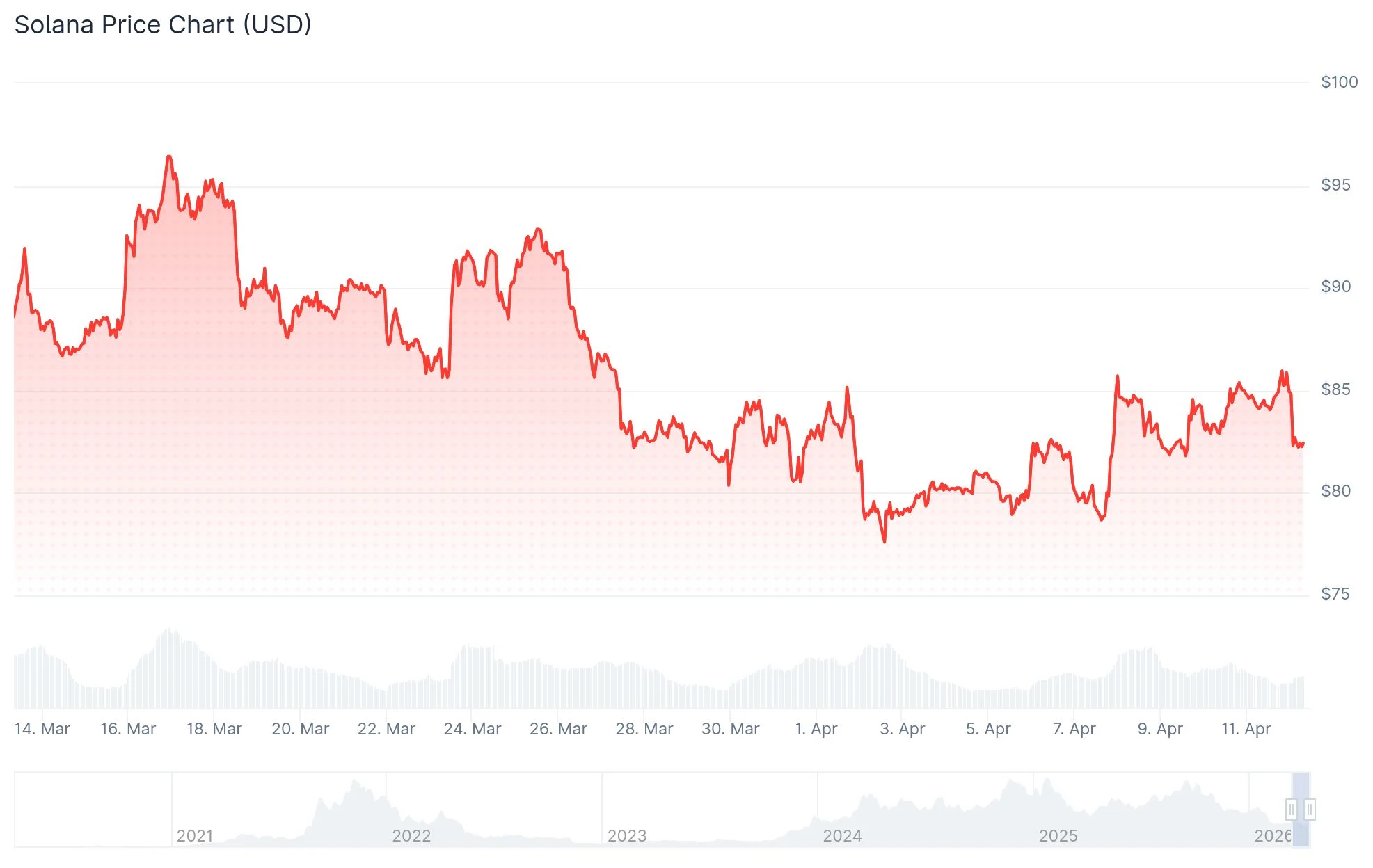
- XRP is currently valued at approximately $1.33 with an $81.6B market capitalization; Solana sits at roughly $82.29 with a $47.3B market cap
- While Ripple’s SEC legal battle has concluded, a $125M penalty and restrictions on institutional token sales persist
- Major corporations including Mastercard, Worldpay, and Western Union have already adopted Solana’s Developer Platform
- XRP concentrates on international payment solutions; Solana operates across payments, digital currencies, asset tokenization, and blockchain development infrastructure
- Solana’s token circulation nears its maximum supply, creating a more transparent valuation framework compared to XRP
Among major cryptocurrencies beyond Bitcoin and Ethereum, XRP and Solana stand out as two of the most closely monitored digital assets. While both command significant market attention, their investment narratives diverge considerably.
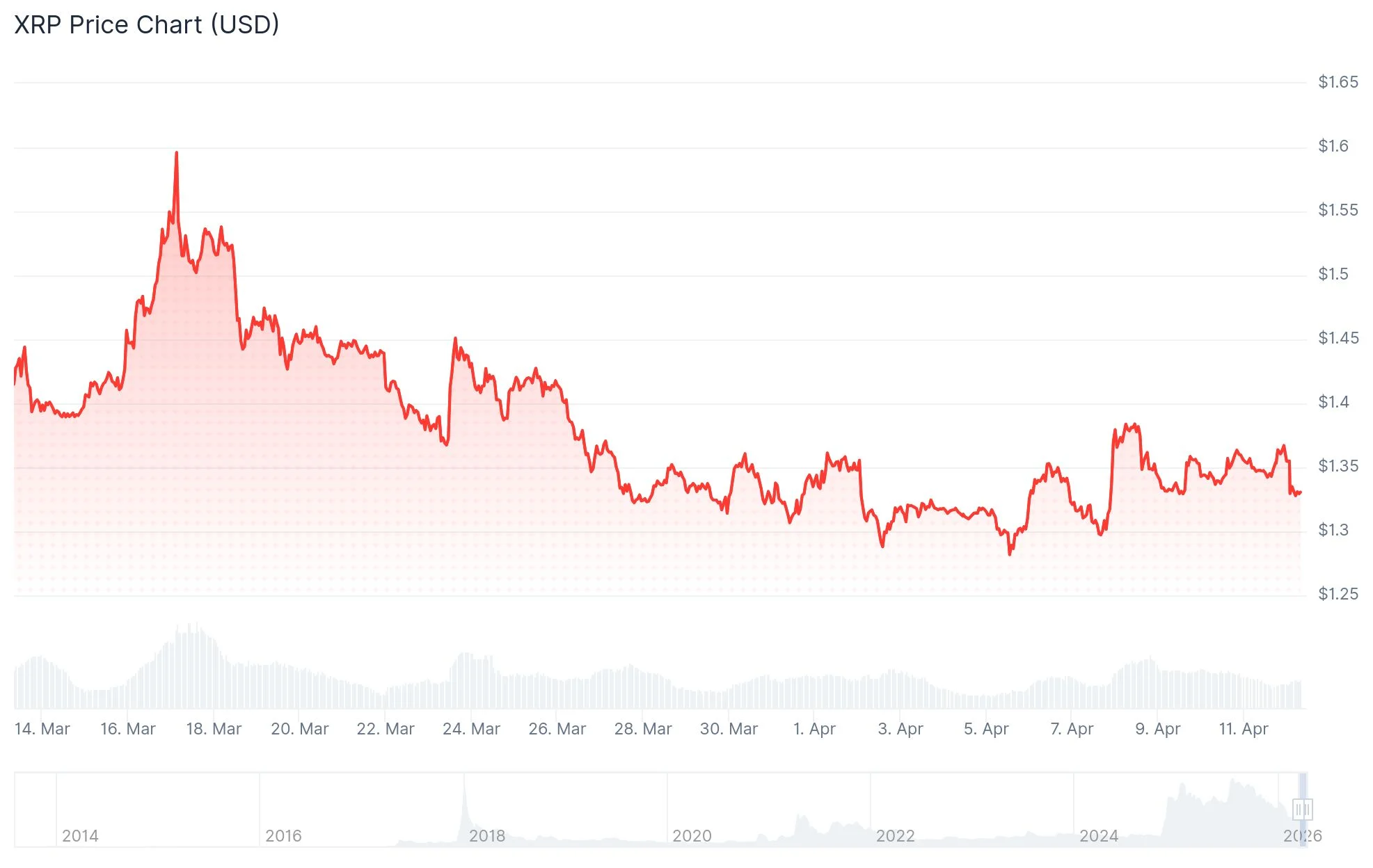
Data from CoinGecko shows XRP hovering around $1.33 with a market capitalization approaching $81.6 billion. Meanwhile, Solana trades near $82.29 with a market cap of approximately $47.3 billion. XRP currently maintains the larger market valuation between the two.
This substantial market cap difference carries investment implications. XRP’s larger valuation suggests Solana could have greater upside potential if network adoption continues accelerating.
XRP’s value proposition centers on facilitating international payments and Ripple’s expansion into financial infrastructure. According to Reuters, Ripple’s extended legal dispute with the SEC has essentially concluded.
Yet the matter isn’t entirely settled. A $125 million penalty stands, and Ripple continues operating under an injunction affecting institutional XRP transactions.
This creates a nuanced environment for XRP as we progress through the latter half of 2026. While regulatory headwinds have diminished compared to the lawsuit’s peak, the token’s price trajectory remains largely dependent on Ripple-driven adoption initiatives.
Solana’s Multi-Faceted Ecosystem Strategy
Solana distinguishes itself through diversification across numerous blockchain applications. The network operates in payment processing, stablecoin infrastructure, tokenized securities, blockchain development tools, and enterprise solutions.
Solana’s March 2026 ecosystem report unveiled the Solana Developer Platform launch. Among the platform’s inaugural corporate adopters are Mastercard, Worldpay, and Western Union.
This type of institutional engagement spanning diverse industries differs significantly from XRP’s payment-centric approach. Multi-vertical platforms typically attract investment capital from varied sources over extended periods.
Token Supply and Valuation Models
XRP operates with a predetermined ceiling of 100 billion tokens, though only approximately 61 billion are presently in circulation. This substantial difference between circulating and maximum supply remains a point of ongoing investor scrutiny.
Solana features roughly 570 million tokens circulating from a total supply approaching 574.5 million. This tight margin means its current market price more accurately represents its fully diluted valuation.
Solana does implement continuous token issuance through its staking mechanism, which investors should factor into their analysis. XRP doesn’t face similar ongoing token creation.
Solana also exhibits higher price volatility between the two assets. Conservative investors seeking stability may find this characteristic unappealing.
Investors prioritizing straightforward narratives will appreciate XRP’s focused approach, widespread exchange availability, and improved regulatory standing compared to previous years.
Conversely, investors targeting growth opportunities and ecosystem expansion will find Solana’s diversified adoption strategy and corporate partnerships more compelling as of mid-2026.
The addition of Mastercard, Worldpay, and Western Union to the Solana Developer Platform during its initial phase represents the most significant institutional development between these two assets in recent months.
Investment Takeaway
Both XRP and Solana have secured their positions among premier cryptocurrency assets. XRP benefits from reduced legal uncertainty and dedicated institutional backing. Solana offers broader platform capabilities, prominent corporate partnerships, and expanding ecosystem activity. The optimal choice depends on whether investors prefer a concentrated payment-focused position or a diversified blockchain platform approach.


Crypto World
Tron’s Justin Sun slams Trump-backed WLFI for treating users as ‘personal ATM’ after $75 Million DeFi loan
Trump-linked World Liberty Financial has lost a key backer after its $75 Million DeFi loan tied up user liquidity, with Justin Sun publicly breaking and criticizing the project’s treatment of investors.
“Every action taken by the WLFI team to extract fees from users and to treat the crypto community as a personal ATM is illegitimate,” Sun wrote.
I have always been an ardent supporter of President Trump and his crypto friendly policy.
As an early supporter who invested heavily in World Liberty Financial, I did so because I believed in the vision that was presented to the public: a decentralized finance platform that…
— H.E. Justin Sun 👨🚀 🌞 (@justinsuntron) April 12, 2026
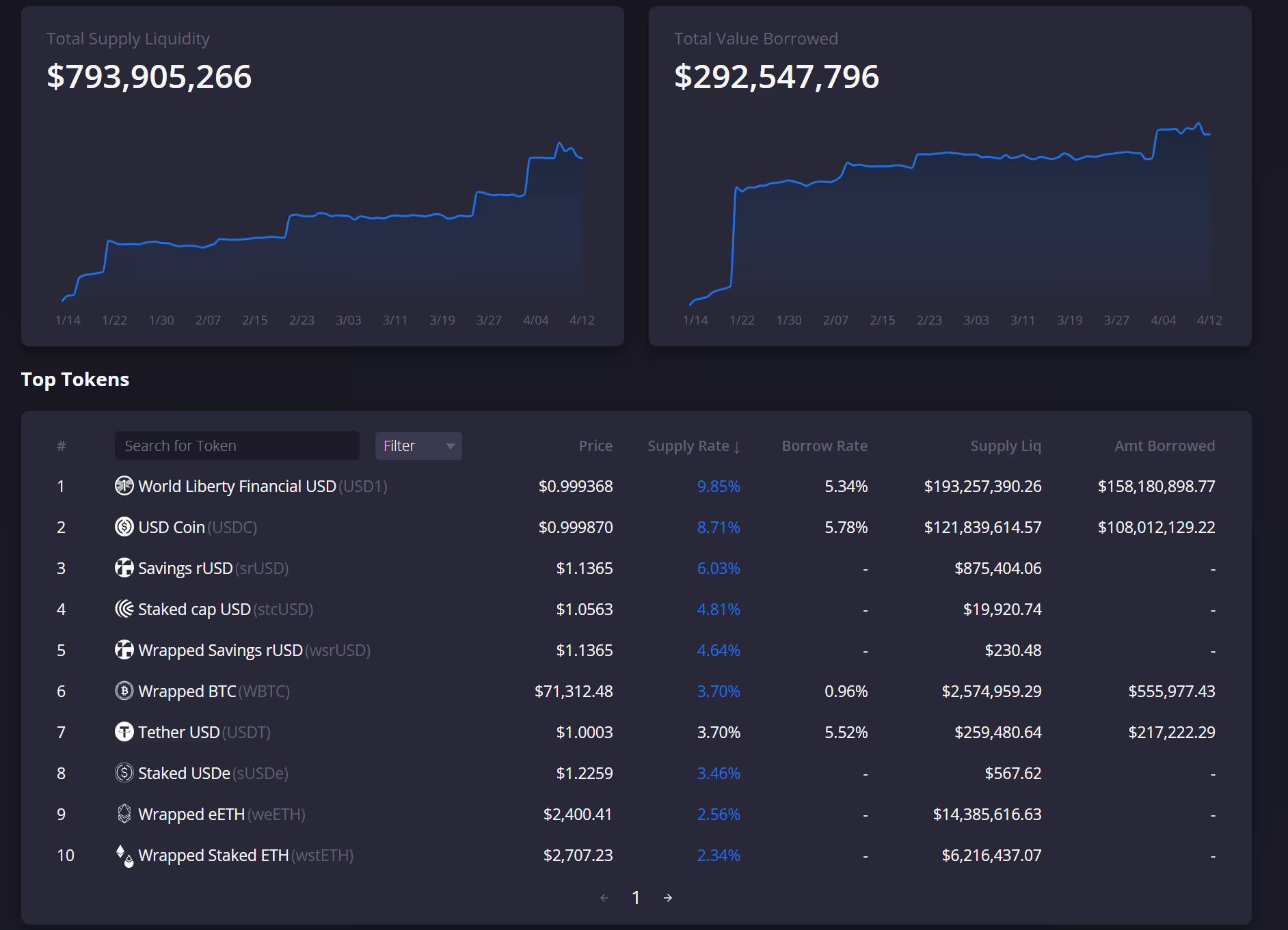
The criticism comes days after World Liberty Financial deposited 5 billion WLFI tokens as collateral on the DeFi lending platform Dolomite and borrowed about $75 million in stablecoins.
The deposit still dominates Dolomite, accounting for a majority of the protocol’s roughly $794 million in total supply liquidity.

At its peak earlier this week, the USD1 pool hit 100% utilization, temporarily locking ordinary stablecoin depositors out of their funds. As of Sunday, the pool had eased to roughly 82% utilization, with about $158 million borrowed against $193 million supplied.
Dolomite co-founder Corey Caplan also serves as an advisor to World Liberty Financial, a dual role that onchain analysts have described as functionally that of CTO. To accommodate WLFI’s deposit, Dolomite raised its WLFI supply cap to 5.1 billion tokens.
“These actions have nothing to do with me. They have nothing to do with the investors who believed the promises this project made,” Sun continued. “We oppose every one of these actions in the strongest possible terms.”
Frozen out of WLFI
Sun had helped stabilize the project early on by purchasing $30 million in WLFI tokens after a lukewarm launch raised questions about investor appetite.
Last September, WLFI froze Sun’s wallet, locking the Tron founder out of 595 million unlocked tokens worth about $107 million at the time.
WLFI said the action was part of a broader move against 272 wallets it linked to phishing attacks and compromised support channels, insisting it “only intervenes to protect users, never to silence normal activity.”
Sun is frames the September freeze as the project’s original sin.
“I am the first and single largest victim,” he wrote Sunday, “as a result of their wrongful blacklisting of my WLFI token wallet back in 2025, that violates basic investor rights and blockchain principles of fairness.”
Sun also took aim at WLFI’s governance process, alleging that votes cited to justify the freezes “were not conducted through a fair or transparent process,” that “key information was withheld from voters,” and that “the outcomes were predetermined.”
Notably, he carefully separated his attack on WLFI’s operators from the President himself, opening his statement by reaffirming that he has “always been an ardent supporter of President Trump and his crypto-friendly policy” and directing his denunciation at “the bad actors at WLFI.”
WLFI’s co-founder Zak Folkman did not immediately respond to a request for comment sent by CoinDesk to his Telegram.
WLFi is trading at $0.079, according to CoinDesk data, down 18% over the past week.
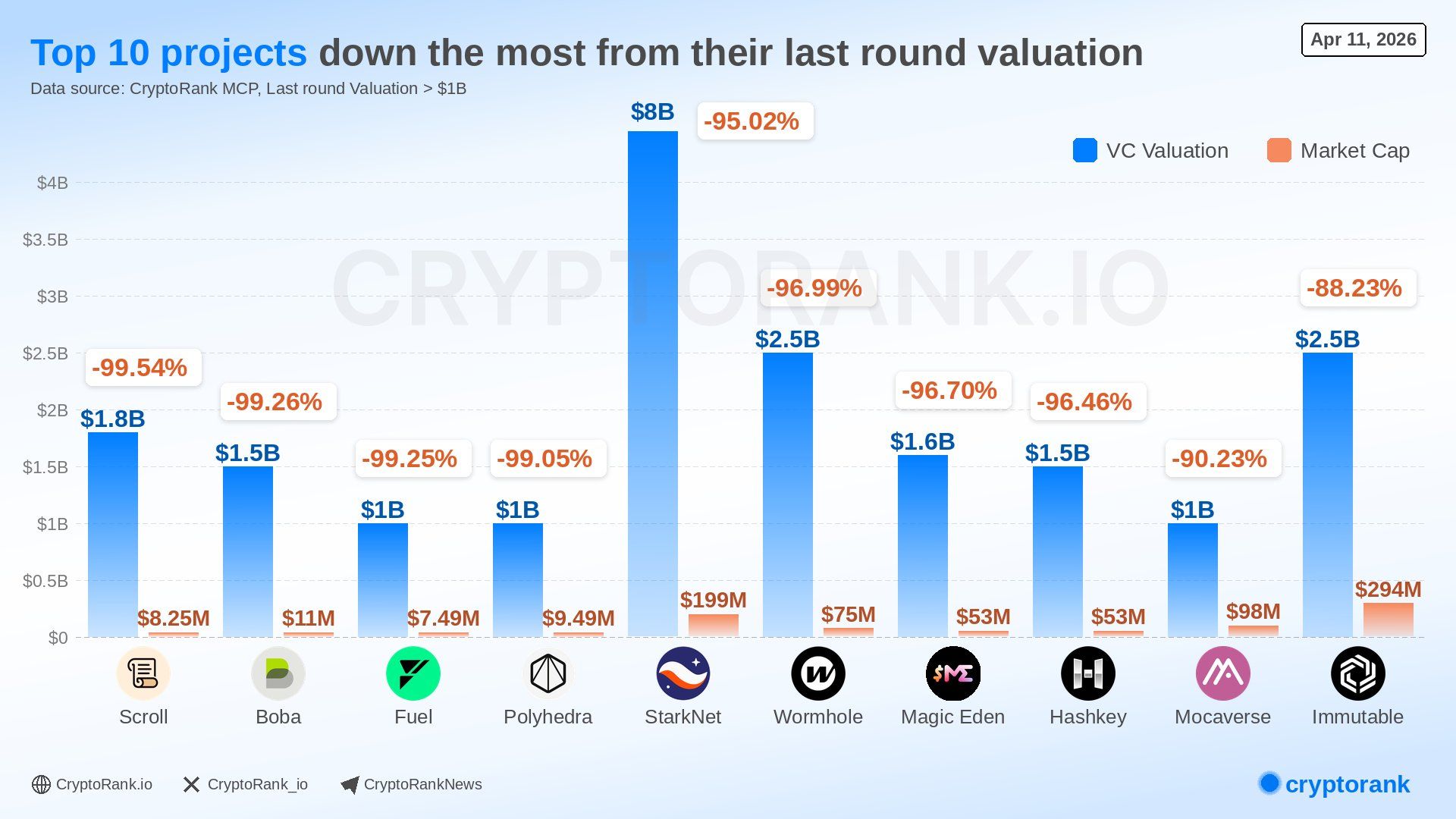
Ten crypto projects that had billion-dollar private valuations now trade at market caps ranging from $7 million to $294 million, according to CryptoRank data.
The gap between last-round venture capital valuations and current market caps ranges from 88% to over 99%. Four of the 10 hardest-hit projects belong to the zero-knowledge proof and Layer 2 sector.
Scroll, and Boba Network Lead the List
Scroll (SCR) tops the ranking with a 99.54% decline. The Ethereum Layer 2 raised $80 million across two rounds led by Polychain Capital, Variant Bain Capital Crypto, and more. Its last-round valuation stood at $1.8 billion.
It now trades at roughly $8.25 million in market cap.
Boba Network follows at -99.26%, while Fuel Network registered a 99.25% drop from a $1 billion valuation.
“These projects have fallen from billion-dollar valuations to nearly zero — a striking example of near-total value destruction. Even backing from Tier-1 VCs like Paradigm, Sequoia, Cbventures, and Multicoin wasn’t enough to protect post-TGE performance,” the post read.
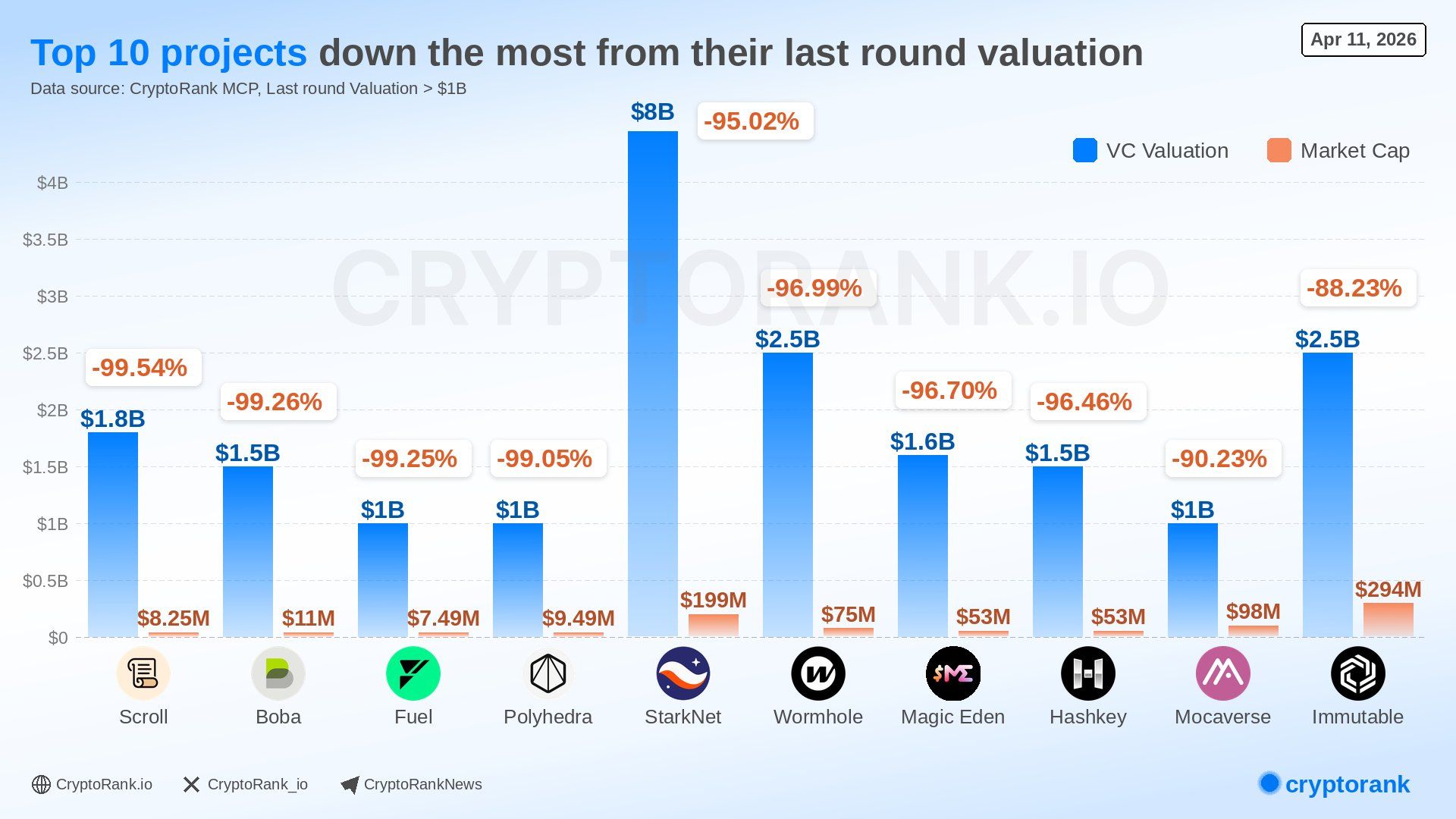
Starknet (STRK) recorded the largest absolute loss on the list. It raised $282.5 million from Paradigm, Sequoia Capital, and Greenoaks Capital at a valuation of $8 billion. Its current market cap sits near $199 million, a 95% decline.
Rounding out the top 10 are Polyhedra (-99.05%), Wormhole (-96.99%), Magic Eden (-96.70%), HashKey Group (-96.46%), Mocaverse (-90.23%), and Immutable (-88.23%).
Follow us on X to get the latest news as it happens
Crypto VC Funding Rebounds Despite Market Weakness
Despite these losses, venture capital activity has picked up again. CryptoRank data shows that March 2026 recorded around 100 funding rounds totaling $2.59 billion in raises, the highest level since October 2025.
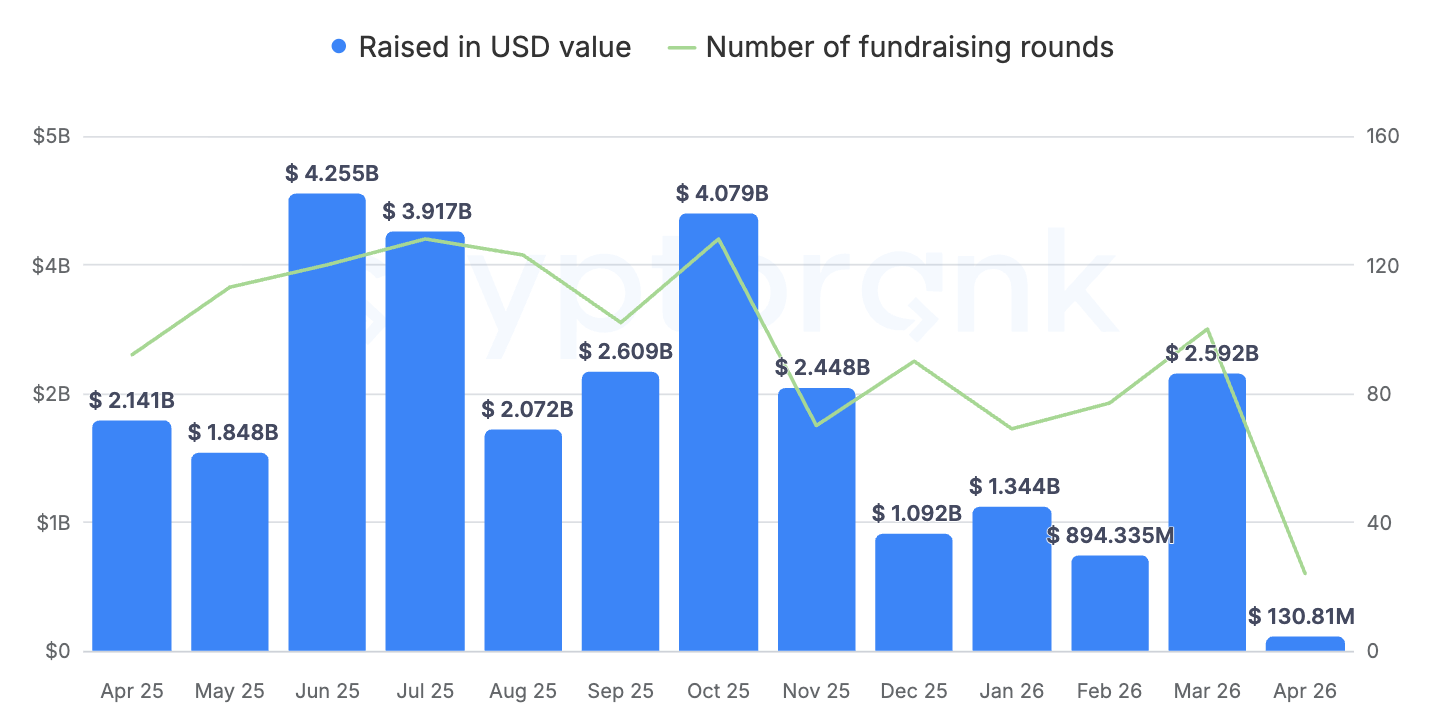
Coinbase Ventures and Animoca Brands led the most rounds during the month. Moreover, blockchain services accounted for 39 rounds, followed by decentralized finance (DeFi) with 20 rounds, and centralized finance (CeFi) with 15 rounds.
Subscribe to our YouTube channel to watch leaders and journalists provide expert insights
The post These Crypto Projects Had Billion-Dollar Valuations, Now They Trade 90% Lower appeared first on BeInCrypto.
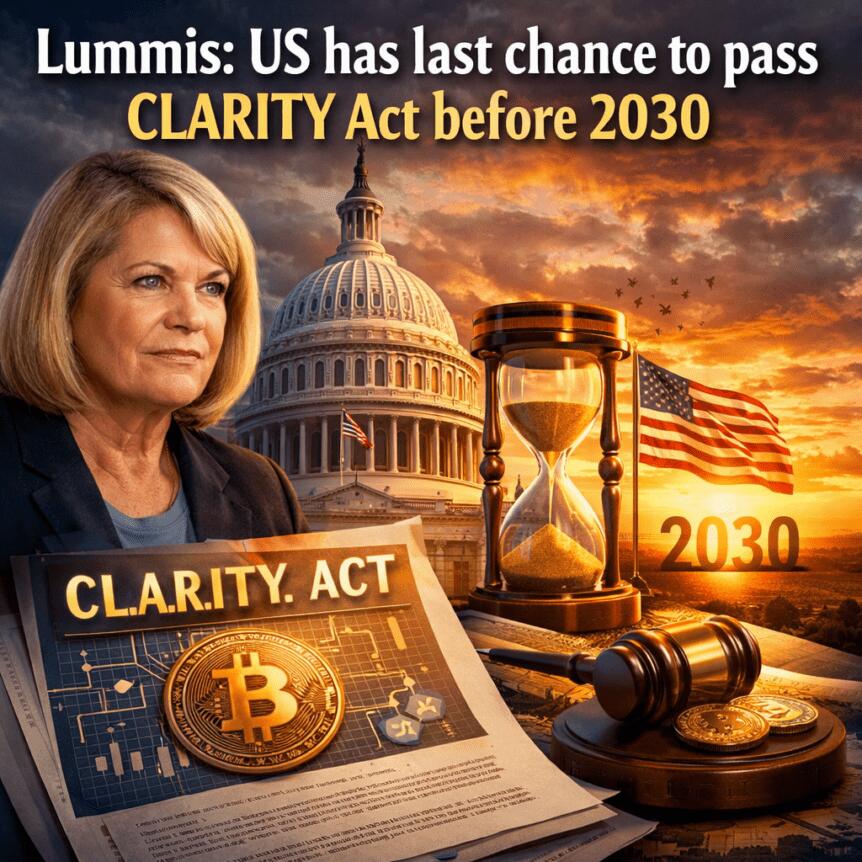
The push to pass the CLARITY Act in the United States is intensifying as lawmakers face a looming deadline to provide clear regulatory oversight for the crypto industry. Senator Cynthia Lummis, among the most vocal crypto advocates in Congress, warned that delay could push meaningful legislation into a distant future, potentially delaying the sector’s growth and investor protections.
In a Friday post on X, Lummis framed the moment as a last chance to enact relief before 2030, arguing that the U.S. cannot surrender its financial future. The comment arrives as momentum for the bill appears fragile amid the upcoming midterm elections in November, which could reshape congressional priorities and slow the momentum around what many see as a foundational market-structure framework for digital assets.
Echoing the urgency, David Sacks, former White House AI and crypto czar, weighed in with a similar sentiment. “The time to act is now. Senate Banking, and then the full Senate, should pass market structure. I’m confident that they will. And then President Trump will sign this landmark bill into law,” Sacks wrote. The chorus from industry insiders underscores a shared view: absence of a clear regulatory path could hobble innovation and investor confidence.
Key takeaways
- Legislative urgency surrounds the CLARITY Act, with proponents arguing that clear regulatory boundaries are essential for advancing the U.S. crypto sector and protecting consumers.
- Timing remains a major question mark due to the November midterm elections, which could shift congressional priorities and slow passage of crypto legislation.
- Support crosses sectors and roles, with influential figures—from venture capital to exchange executives and technology founders—arguing that well-defined rules foster growth and certainty for participants.
- Internal debates on specifics, notably around stablecoin yield, pose potential chokepoints that could affect markup or floor votes in the Senate.
- Regulators themselves have voiced support for a comprehensive market-structure framework, signaling alignment with lawmakers on the direction of regulation.
CLARITY Act as a catalyst for U.S. crypto growth
Industry participants widely view regulatory clarity as a catalyst for innovation. A familiar refrain across crypto circles is that clear rules help both consumers and builders navigate risk, reduce ambiguity, and foster responsible innovation. Chris Dixon, managing partner at A16z Crypto, captured this sentiment in a post, noting that “when rules are defined, both consumers and entrepreneurs win.”
The sentiment extends beyond investment capital to product development and user experience. Robbie Ferguson, co-founder of Immutable, argued that the act could accelerate the sector’s growth trajectory, suggesting that clearer oversight would unlock opportunities for developers and gamers alike. The Web3 gaming ecosystem, in particular, has been a fervent advocate for clarity as a means to scale and protect players and developers in a regulated, trusted environment.
A wave of industry voices has also highlighted how clarity could influence real-world adoption. Coinbase CEO Brian Armstrong called for moving forward with the legislation after months of delays, signaling that the industry wants a path forward that offers predictability and guardrails for participants ranging from exchanges to resourceful startups. Coinbase chief legal officer Paul Grewal also signaled that progress toward a Senate markup hearing could be within reach, though he cautioned that relief hinges on reconciling disputes over stablecoin yield—a friction point that has lingered in negotiations.
On the regulatory front, the push for a comprehensive market-structure framework has drawn support from prominent regulatory figures. SEC Chair Paul Atkins publicly framed the moment as an opportunity for Congress to “future-proof against rogue regulators” and advance a broad framework that could guide the sector through anticipated changes in technology and market dynamics. His comments align with the broader view that congressional action is needed to preempt ad hoc or inconsistent regulatory actions that can unsettle markets and erode investor trust.
Industry alignment and governance questions
The CLARITY Act’s proponents argue that a clear delineation of which regulators oversee various crypto activities would reduce jurisdictional ambiguity and potential regulatory gaps. The broader market has been watching closely for signals about how the U.S. could harmonize oversight between agencies such as the CFTC and the SEC, while also addressing stablecoins as a critical asset class within the crypto ecosystem.
And while there is broad internal agreement on the need for a clear regulatory framework, negotiations are not without friction. Grewal’s remarks underscored a central sticking point: the yield mechanisms of stablecoins. A resolution on this issue appears essential to advancing to a formal markup in the Senate Banking Committee and, ultimately, a vote on the full Senate floor. The absence of consensus on stablecoins could delay movement even as other parts of the bill gain traction.
Regulators themselves have shown support for moving ahead with clear market structure legislation. Atkins’s comments reflect a shared industry sentiment that well-crafted rules would protect consumers, reduce exposure to rogue actors, and create an environment where legitimate crypto projects can flourish with a clear legal footing. This alignment between lawmakers and regulatory leaders could be a pivotal factor in determining whether the CLARITY Act gains the momentum it needs before the election cycle intensifies partisan debates around technology policy.
What this means for investors and builders
For investors, the prospect of a clear regulatory framework could reduce the legal and policy uncertainty that has weighed on asset prices and capital allocation in the crypto space. A well-defined regime may lower compliance risks for exchanges and on-chain platforms, potentially boosting institutional participation and retail confidence alike. For builders, a clarified map of permissible activities, responsible boundaries, and clear licensing expectations could accelerate product development and drive consumer adoption—provided that the final text resolves disputes that currently threaten to stall progress.
Historically, regulatory clarity has correlated with greater market maturity. If the CLARITY Act eventually becomes law, it could set a precedent for how the United States addresses both innovation and risk in digital assets. The timing, however, remains a crucial variable. With midterm elections looming, lawmakers may prioritize other issues, potentially delaying a milestone for the industry. Yet the breadth of support—from venture capital to founders of major crypto projects—signals a broad desire to move beyond debate and toward a functional framework that aligns incentives across the ecosystem.
What remains uncertain is whether the bill can bridge outstanding points of disagreement, particularly around stablecoins, before the Senate’s markup and subsequent floor vote. If those gaps persist, momentum may stall even as other provisions gain traction. Investors should monitor not only the political timetable but also the evolving stance of regulators on the practicalities of stability mechanisms and how they intersect with market structure legislation.
Beyond the U.S., observers note that global regulatory conversations increasingly mirror the desire for clarity and predictability. For markets that operate across borders, a clear U.S. standard could influence international norms, encouraging harmonization or at least mutual recognition of compliant activities. As the CLARITY Act advances, market participants will be watching for concrete milestones—whether a markup date, committee votes, or a White House signing ceremony—that would signal a durable shift toward regulatory certainty.
Readers should watch upcoming statements from lawmakers and industry leaders for clues about the bill’s trajectory, including how negotiators resolve stablecoin yield and other technical details. The next few weeks could prove decisive in determining whether the U.S. crypto sector gains a clear, implementable framework or faces a drawn-out path to regulatory clarity.


A new push for the CLARITY Act is building in Washington as crypto policy supporters warn the timeline may be narrowing.
Summary
- Cynthia Lummis warned Congress may miss its best chance to pass the CLARITY Act soon.
- David Sacks and crypto leaders urged the Senate to move market structure legislation forward now.
- Senate progress may depend on resolving stablecoin yield disagreements before a markup hearing begins.
Senator Cynthia Lummis said Congress must move soon or risk delaying market structure reform for years.
Lummis said the United States may miss a rare opening to pass the CLARITY Act if lawmakers fail to act soon. She said the bill may not get another real chance until at least 2030.
In a post on X, Lummis wrote, “This is our last chance to pass the Clarity Act until at least 2030.” She added, “We can’t afford to surrender America’s financial future.”
The warning comes as crypto policy supporters watch the political calendar. With US midterm elections set for November, some industry figures fear Congress could shift focus and slow work on crypto legislation.
That concern has kept attention on the bill’s timing. Supporters say the next few months may decide whether the measure advances during the current session.
Former White House AI and crypto czar David Sacks also called for quick action. He said the Senate Banking Committee and the full Senate should move the bill forward.
Sacks said, “The time to act is now. Senate Banking, and then the full Senate, should pass market structure.” He added that he expects President Donald Trump to sign the bill if Congress approves it.
Other industry voices have also backed the legislation. A16z Crypto managing partner Chris Dixon said,
“when rules are defined, both consumers and entrepreneurs win.”
Immutable founder Robbie Ferguson also backed the bill. On April 3, he said, “the CLARITY Act will make the last decade of growth in gaming look like a joke.”
Senate progress depends on key issues
Coinbase Chief Executive Brian Armstrong said on Friday that “it’s time” for the bill to pass after months of delays. His comment added to fresh calls for movement in the Senate.
Coinbase Chief Legal Officer Paul Grewal said on April 2 that the CLARITY Act could be nearing a markup hearing in the Senate Banking Committee. He also said disagreements over stablecoin yield still need to be resolved.
Regulators have also shown support. SEC Chairman Paul Atkins said,
“It’s time for Congress to future-proof against rogue regulators & advance comprehensive market structure legislation to President Trump’s desk.”
Kenya is moving closer to formalizing oversight of its digital asset sector after completing public consultations on proposed rules for crypto firms.
On April 11, the National Treasury announced that it had concluded stakeholder submissions on the draft Virtual Asset Service Providers (VASP) regulations. This step advances the framework needed to implement the country’s 2025 law governing crypto-related businesses.
Kenya Drafts Stricter Rules for Crypto Firms
The rules will establish licensing requirements and supervisory standards for companies dealing in cryptocurrencies, tokenized assets, and stablecoins.
The proposed regime outlines entry thresholds for operators, including ownership suitability tests, capital requirements, and governance standards. It also establishes obligations related to risk management and anti-money laundering compliance.
The Kenyan authorities are also seeking to impose stricter consumer safeguards. This would include mandatory disclosures, transparent pricing, and protections for crypto client funds.
The framework introduces market conduct provisions aimed at curbing manipulation and insider activity, while requiring due diligence for asset listings and ongoing monitoring of trading activity. Firms would also be subject to periodic reporting, audits, and cybersecurity standards under a system combining on-site and off-site supervision.
The central bank and capital markets authorities are expected to share oversight of the crypto sector.
Kenya’s push to formalize oversight aligns with a broader global shift among regulators to define sectoral rules while preserving space for innovation.
The Treasury said the next phase will involve reviewing feedback and refining the draft before finalizing the regulations. The outcome is expected to shape how firms enter and operate in one of Africa’s more mature fintech markets.
“Kenya is building a trusted framework that balances innovation with financial stability,” the financial agency stated.
The consultation process comes as digital asset use expands rapidly across Africa. According to Ripple, the continent faces high transaction costs, delays in cross-border transfers, and limited access to stable foreign currencies.
As a result, people on the continent have shown increased reliance on crypto-based tools for settlement and savings.
Due to this, Sub-Saharan Africa has emerged as one of the fastest-growing crypto markets, with transaction volumes rising sharply over the past year.
The post Kenya Moves Closer to Regulating Crypto Firms With VASP Framework appeared first on BeInCrypto.
Crypto World
Trump token sees whale accumulation ahead of Mar-a-Lago gala; senators raise questions over event


Large investors are accumulating the TRUMP memecoin ahead of an upcoming gala hosted by President Donald Trump at Mar-a-Lago on April 28, even as the token trades near record lows and the impending event faces political scrutiny.
Data tracked by blockchain sleuth Lookonchain shows notable whale buying through centralized exchanges. One whale, “8DHkza,” withdrew 850,488 $TRUMP tokens (worth approximately $2.4 million) from Bybit over the past two days. Another address, “7EtuAt,” withdrew 105,754 tokens (around $298,000) from Binance 17 hours ago and currently holds 1.13 million tokens, valued at roughly $3.2 million.
Outflows from exchanges are said to represent investor intention to take direct custody of coins and hold the same for long-term. Hence, outflows are taken to indicate accumulation and potentially reduce immediate sell-side liquidity in the market.
The accumulation comes ahead of an invitation-only luncheon reportedly limited to the top 297 TRUMP token holders, with the top 29 receiving exclusive VIP access to Donald Trump.
However, TRUMP continues to trade at record lows near $2.80, down 0.2% on a 24-hour basis and over 1% in seven days. The token came under pressure this week after CoinDesk reported the Trump-linked crypto venture World Liberty Financial’s controversial lending strategy on the Dolomite DeFi platform.
Meanwhile, U.S. lawmakers have stepped up scrutiny of the Mar-a-Lago event. Senators Elizabeth Warren, Adam Schiff, and Richard Blumenthal have sent a letter to Fight Fight Fight LLC, a Delaware-based entity run by Trump associate Bill Zanker, requesting documents and information on whether Trump played a role in planning, promoting, or financially benefiting from the gathering. Fight Fight Fight LLC TRUMP memecoin in partnership with entities affiliated with Donald Trump.
“It is essential that Congress fully understand the extent to which President Trump and his family are profiting off of his cryptocurrency ventures,” the senators said, adding that “Congress must also take steps to prohibit and prevent these egregious conflicts of interest.”
The probe introduces an additional layer of uncertainty for the token, as regulatory and political risks intersect with already weak price action.
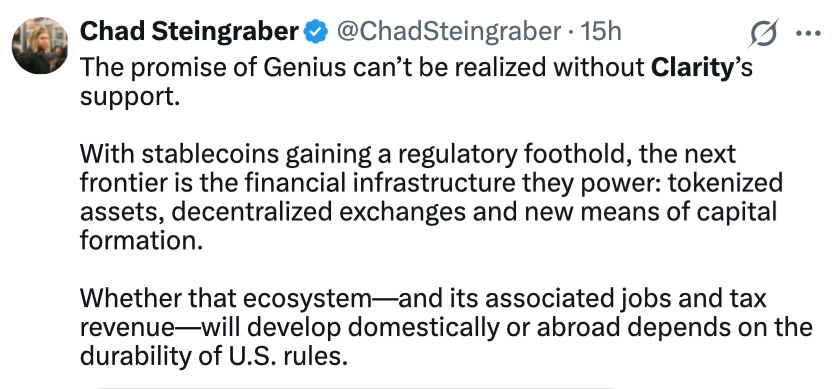
The United States government must pass the CLARITY Act, which aims to provide the crypto industry with clearer regulatory oversight, soon, or risk waiting almost another four years to move the industry forward, according to US Senator Cynthia Lummis.
“This is our last chance to pass the Clarity Act until at least 2030,” Lummis, a well-known crypto advocate, said in an X post on Friday.
“We can’t afford to surrender America’s financial future,” she added. The comments come as crypto industry participants begin to worry that the bill’s chances of passing this year are narrowing, with US midterm elections in November potentially changing congressional priorities and slowing momentum on the highly anticipated crypto legislation.
The former White House AI and crypto czar, David Sacks, also chimed in on Thursday with a similar view to Lummis.
“The time to act is now. Senate Banking, and then the full Senate, should pass market structure. I’m confident that they will. And then President Trump will sign this landmark bill into law,” Sacks said.
Consumers and entrepreneurs both “win” from the CLARITY Act
Many industry participants have argued that the passage of legislation aimed at clarifying which regulators oversee parts of the crypto industry could lead to greater innovation in the US and potentially increase demand for crypto assets among retail investors.

A16z Crypto managing partner Chris Dixon reiterated that view in a post, saying that “when rules are defined, both consumers and entrepreneurs win.”
A wide range of sectors in the crypto industry expect the move to be positive.
Web3 gaming giant Immutable founder Robbie Ferguson said just days before, on April 3, that “the CLARITY Act will make the last decade of growth in gaming look like a joke.”
On Friday, Coinbase CEO Brian Armstrong, who withdrew the crypto exchange’s support for the Digital Asset Market Clarity Act in January, said “it’s time” for the legislation to pass after months of delays.
Meanwhile, Coinbase chief legal officer Paul Grewal said on April 2 that the CLARITY Act could be nearing a markup hearing in the US Senate Banking Committee. However, he noted that progress hinges on resolving disagreements over stablecoin yield.
Related: CFTC unveils innovation task force members in crypto clarity push
Regulators are also voicing their support for the legislation.
US Securities and Exchange Commission (SEC) Chairman Paul Atkins said in a post on the same day that, “It’s time for Congress to future-proof against rogue regulators & advance comprehensive market structure legislation to President Trump’s desk.”
Magazine: Bitcoin quantum-safe without upgrade? CZ’s 2031 crypto vision: Hodler’s Digest, April 5 – 11
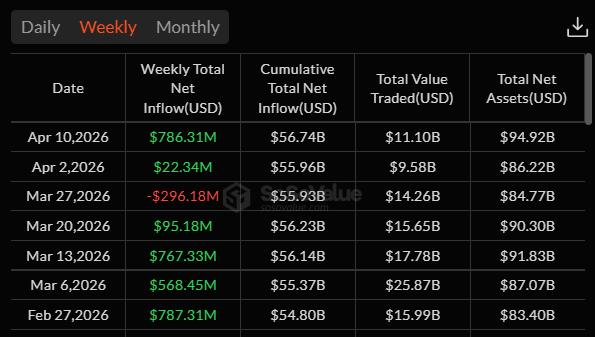
US spot Bitcoin exchange-traded funds (ETFs) posted their strongest weekly inflow since February last week, drawing more than $786 million.
Data from SoSoValue showed that the US-listed funds’ performance last week narrowly trailed the roughly $787.31 million recorded during the last week of February.
BlackRock and Morgan Stanley’s New MSBT Fund Drive Interest
The inflows followed a softer stretch for the products amid broader market volatility and geopolitical tension, which weighed on risk appetite.
SoSoValue data shows that the flow pattern was uneven through the week. The funds opened with a sharp $471.32 million intake on Monday, then slipped into outflows midweek before recovering on Thursday and Friday.
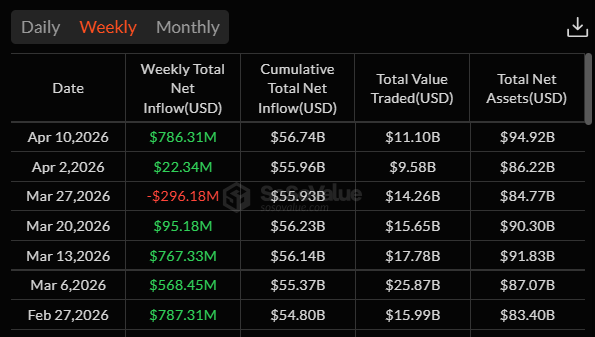
The turnaround left the group with its best weekly result in nearly two months and suggested buyers returned as Bitcoin regained momentum.
BlackRock’s iShares Bitcoin Trust remained the main driver of demand. The fund brought in about $612 million during the week, accounting for almost four-fifths of total net inflows across the category.
The concentration underscored how heavily new institutional allocations continue to favor the largest and most liquid product in the market.
Meanwhile, Morgan Stanley’s newly launched MSBT fund added another point of interest for the market. The fund raised roughly $46 million over its first three trading days, giving investors a fresh entry point as demand across the ETF group picked up again.
Its early flows were modest compared with BlackRock’s scale, but the launch carries broader significance because of Morgan Stanley’s distribution reach. The bank’s network of roughly 16,000 financial advisers oversees trillions of dollars in client assets, giving it access to a channel few Bitcoin ETF issuers can match.
The improvement in fund flows came alongside a strong week for the underlying asset. Bitcoin climbed from around $67,000 to above $70,000 during the period and was trading near $73,411 by the end of the week, a gain of about 9%.
The move marked one of the token’s strongest weekly advances in recent months and helped restore momentum after a period of weaker price action.
The post US Bitcoin ETFs Log Biggest Weekly Inflow Since February appeared first on BeInCrypto.
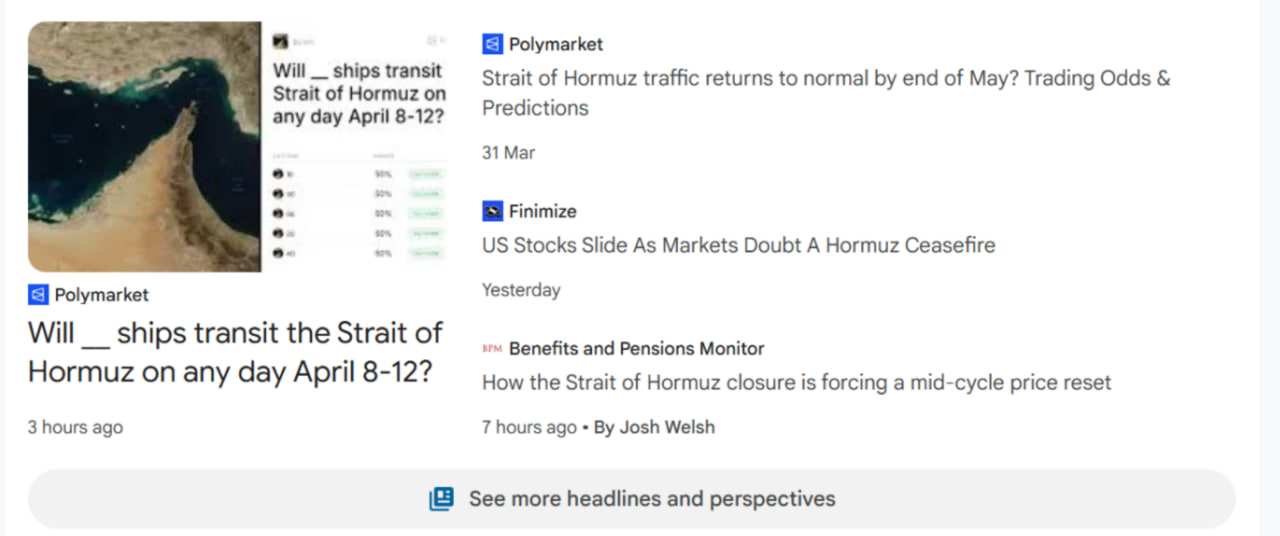
Polymarket betting markets reportedly appeared inside Google News results alongside established news publishers before disappearing.
A Google spokesperson told The Verge that the platform’s appearance in News was an error. “This site briefly appeared in Google News in error, and it is no longer surfacing in News,” spokesperson Ned Adriance reportedly said.
Before removal, Polymarket links were shown directly beneath mainstream outlets when users searched event-driven queries. In one example cited by Futurism, a search for “will ships transit the strait” related to the Strait of Hormuz returned a Polymarket market predicting outcomes on vessel passage alongside reporting from Reuters and The Guardian.

In a Sunday search conducted by Cointelegraph, the same query did not surface any Polymarket results.
Related: Three Polymarket traders made timely bets on US-Iran ceasefire
Polymarket and Kalshi pursue media partnerships
Last year, Google partnered with both Polymarket and rival Kalshi to integrate their data into Google Finance.
In June, Elon Musk’s X also announced a partnership with Polymarket, naming it as its official prediction market partner. The deal aimed to integrate the betting-based forecasting service into the social media platform.
Furthermore, in October, MetaMask said it would integrate Polymarket as part of its push to expand beyond a crypto wallet into a broader “democratized finance” gateway. The same month, World App, the digital wallet and identity platform from Sam Altman’s World project, also added the Polymarket app.
Related: Prediction market users await Artemis II mission splashdown
Small portion of Polymarket traders make a profit
As Cointelegraph reported, only a tiny fraction of Polymarket traders manage to generate consistent high monthly income, according to new data shared by crypto analyst Andrey Sergeenkov. While around 1% of traders have crossed $5,000 in profits in a single month, only 0.015% were able to sustain that level for four consecutive months.
The findings also show that just 0.033% of wallets have exceeded $100,000 in total profits, with some of these likely belonging to professional traders rather than retail users. Despite growing hype around prediction markets as a fast-rising crypto use case, the data suggests most participants struggle to maintain consistent profitability over time.
Magazine: Bitcoin’s ‘biggest bull catalyst’ would be Saylor’s liquidation — Santiment founder


Crypto exchange activity slowed in the first quarter of 2026 after the market cooled from its earlier peak.
Summary
- Crypto exchange trading volume fell sharply in Q1 2026 as market participation weakened after the cycle peak.
- Perpetual futures dominated March activity, with volume reaching four times the level of spot trading.
- Binance held the top position in spot and derivatives despite rising competition from secondary exchanges.
CryptoQuant data showed lower participation across centralized venues, while Binance kept the lead in both spot and derivatives trading.
Centralized exchange trading volume dropped about 48% from the October 2025 peak. The figure fell to $4.3 trillion in March 2026, its lowest level since October 2024.
The pullback showed lower participation from traders and investors after the earlier market run. Activity narrowed toward the biggest exchanges, as users favored liquid venues during periods of price movement.
Perpetual futures remained the main source of trading activity during the quarter. Perpetual volume rose to $3.5 trillion in March, while spot volume stood at $0.8 trillion.
That gap showed how strongly derivatives shaped market structure in Q1. Perpetual volume reached four times spot volume in March, and cumulative perpetual trading hit $4.5 trillion this year.
The rise in derivatives activity also picked up during the relief rally in the third week of March. Binance recorded the largest 24-hour open interest increase for both Bitcoin and Ethereum by mid-March.
Bitcoin open interest on Binance rose by $829 million in 24 hours, while Ethereum open interest increased by $1.6 billion. Across exchanges, Bitcoin and Ethereum perpetual futures open interest climbed to $23 billion and $16 billion.
Binance keeps lead in derivatives trading
Binance led the perpetual futures market with a 40% share and $1.4 trillion in monthly volume. OKX followed with 19%, while Bybit held 13%.
The data showed that most open interest growth flowed to Binance during the March rebound. Other exchanges, including Gate and Bybit, also posted gains, but none matched Binance’s scale.
Binance remained the largest spot trading venue in March. The exchange recorded $248 billion in spot volume and controlled 32% of the market.
That share was down from 37% in October 2025, but Binance still held a lead well ahead of rivals. MEXC and Bybit followed with 9% and 7%, while Gate and Crypto.com posted growth without changing the broader market order.

Quad ESL 2912X at AXPONA 2026: The Truth Still Hurts But These Finally Care How It Lands

VICI Properties: A Winning High-Yield Bet To Buy Now (NYSE:VICI)
Tron’s Justin Sun slams Trump-backed WLFI for treating users as ‘personal ATM’ after $75 Million DeFi loan

Why Israel is blocking foreign journalists from entering

Bitcoin: We’re Entering The Most Dangerous Phase

Alan Cumming Brands Baftas Ceremony A ‘Triggering S**tshow’

Satoshi Bitcoin Wallet Dumps EVERYTHING! Why Crypto ISN’T DEAD (Send This To 1 Friend)

Finance, Banking core interest #astrology #jyotish #kundali #horoscope #banking #finance #moneymind

Achieving financial freedom isn’t permission to abandon your purpose on earth. #worldwide
-

 Business7 days ago
Three Gulf funds agree to back Paramount’s $81 billion takeover of Warner, WSJ reports
-

 Politics2 days ago
US brings back mandatory military draft registration
-

 Fashion2 days ago
Weekend Open Thread: Veronica Beard
-

 Tech5 days ago
How Long Can You Drive With Expired Registration? What Florida Law Says
-

 Fashion6 days ago
Massimo Dutti Offers Inspiration for Your Summer Mood Board
-
 Sports2 days ago
Man United discover Nico Schlotterbeck transfer fee as defender reaches Dortmund agreement
-

 Fashion5 days ago
Let’s Discuss: DEI in 2026
-

 Crypto World3 days ago
Canary Capital Files SEC Registration for PEPE ETF
-

 Business2 days ago
Tesla Model Y Tops China Auto Sales in March 2026 With 39,827 Registrations, Beating Cheaper EVs and Gas Cars
-

 Crypto World4 days ago
Bitcoin recovers as US and Iran Agree a Ceasefire Deal
-

 Politics2 days ago
Malcolm In The Middle OG Turned Down ‘Buckets Of Money’ To Appear In Reboot
-

 Business2 days ago
OpenAI Halts Stargate UK Data Centre Project Over Energy Costs and Copyright Row
-

 Business19 hours ago
Ireland Fuel Protests Enter Day 5 as Blockades Spark Shortages and Government Prepares Support Package
-

 Tech6 days ago
Italian court says Netflix must refund customers up to $576 over price hikes
-

 Tech6 days ago
Gamer Restores the Original PlayStation Portal From Two Decades Ago
-

 Tech6 days ago
Samsung just gave up on its own Messages app
-

 Tech6 days ago
Haier is betting big that your next TV purchase will be one of these
-

 Tech6 days ago
The Xiaomi 17 Ultra has some impressive add-ons that make snapping photos really fun
-

 Politics2 days ago
LBC Presenter Mocks Trump Over Iran War Failures
-

 Tech6 days ago
Save $130 on the Samsung Galaxy Watch 8 Classic: rotating bezel, sleep coaching, and running coach for $369
You must be logged in to post a comment Login