






Connect with us
DAPA Banner

Tech

Claude Cowork is becoming shared workplace infrastructure

Published

on

Claude Cowork is moving beyond early testing and into a wider role at work. On April 9, Anthropic said it became generally available on all paid plans for macOS and Windows, alongside a set of enterprise features meant to support larger rollouts.

That pairing matters more than the availability update by itself. Anthropic is tying the release to role-based access controls for Enterprise, group spend limits, usage analytics, expanded OpenTelemetry support, and tighter connector permissions, all aimed at making Cowork easier to manage across an organization.

Anthropic also made clear that Cowork is no longer being framed as a tool mainly for technical teams. It said most usage already comes from operations, marketing, finance, and legal, which helps explain why this release leans so heavily on governance and monitoring.

Why the oversight tools matter

The most important change is the management layer. Enterprise admins can now set access by provider, model, and feature, while group spending limits give companies a way to control usage across departments instead of leaving budgets to individual employees.

Advertisement

Anthropic is also widening the reporting view. Its dashboard metrics and Analytics API can track sessions, active users, connector activity, and adoption by team, while broader OpenTelemetry support is designed to feed Claude usage into existing monitoring systems.

Where Cowork fits at work

Anthropic’s larger message is about where Cowork fits inside a business. It said most use already comes from non-engineering groups handling project updates, research, and internal collaboration, not just code-focused work.

That shifts the product’s identity in a meaningful way. Cowork is being positioned less as a specialist assistant and more as a shared layer for everyday work that can draw from connectors, internal information, and team-specific workflows.

What happens next

The next test is whether companies treat Cowork as a standard workplace tool or keep it in a narrower lane. General availability gives Anthropic a stronger opening, but broader adoption will depend on whether admins see enough structure around access, costs, and integrations to support daily use.

For companies evaluating the launch, the real question is practical. If Cowork can help multiple departments while staying measurable and manageable for the people running the system, it has a stronger chance of becoming part of regular business operations rather than stalling at the pilot stage.

Advertisement

Source link

Continue Reading
Click to comment

You must be logged in to post a comment Login

Leave a Reply

Tech

Dune 3 is coming sooner than its director originally planned

Published

on

Dune: Part Three is set for a December 18, 2026 release, confirming that Denis Villeneuve’s return to Arrakis is happening sooner than expected — and bringing his adaptation of Frank Herbert’s saga to a close. The third film is positioned as the conclusion to Villeneuve’s trilogy, following Dune: Part One (2021) and Dune: Part Two (2024), the latter of which crossed $700 million globally and significantly expanded the franchise’s audience.

The trailer for Dune: Part Three was released in March and it offers the clearest look yet at how the final chapter is being shaped. It shifts the focus away from Paul Atreides’ rise and toward the consequences of his rule. Paul is shown as an emperor dealing with political instability, resistance, and the long-term fallout of the empire built in his name. The scale remains, but the emphasis is more controlled — less about conquest, more about power and its consequences.

The trailer points to a clear shift in direction. Instead of continuing Paul Atreides’ rise, the film focuses on the consequences of his rule. Paul is shown as an emperor dealing with political instability, resistance, and the long-term fallout of the empire built in his name. The tone is more restrained and inward-looking, with a stronger emphasis on power, control, and the cost of both.

Villeneuve had planned to take a break after Part Two

Following the release of Dune: Part Two director Denis Villeneuve had stated several months ago that he planned to take a bit of a break between Dune: Part Two and its intended sequel, Dune: Messiah. However, coming off the immense success of Dune: Part Two earlier this year, which received rave reviews from both critics and casual moviegoers alike and earned over $700 million at the box office, it sounds like Villeneuve has thrown his original vacation plans out the window.

Advertisement

Speaking with Deadline, the French Canadian filmmaker revealed that he is going to go “back behind the camera faster” than he thought he would and that his “break” from Frank Herbert’s Dune world is already over. “I’m in the writing zone right now,” he said, referencing the script for Dune: Messiah. Villeneuve did not confirm the specific timeline he now has in mind for the sequel, but he did note that he is likely going to make Messiah much faster than he originally planned.

Paul Atreides walks through the desert in Dune: Part Two.
Warner Bros. Pictures / Warner Bros. Pictures

He spoke about the need for distance after completing two large-scale productions back-to-back and avoided committing to any timeline for a follow-up.

The response to Part Two changed that timeline

That plan shifted after Dune: Part Two’s critical and commercial success. The film’s performance reinforced the scale of audience interest in the franchise, and Villeneuve returned to writing sooner than initially expected.

Production on Dune: Part Three moved forward quickly, and the film is now in post-production. With Warner Bros. setting a December 2026 release, the gap between the second and third films is shorter than originally indicated.

The final chapter focuses on consequences, not conquest

dune-3-trailer-robert-pattinson
Dune 3 trailer / Warner Bros

Returning cast members include Timothée Chalamet, Zendaya, and Florence Pugh, with Anya Taylor-Joy expected to expand her role following her appearance in Part Two.

Villeneuve has described the film as distinct from its predecessors despite returning to the same world and characters — a continuation that closes the story rather than extending it further.

Advertisement

Source link

Continue Reading

Tech

The software that landed Apollo 11 on the moon is now free online

Published

on


The repository, posted by NASA’s Chris Garry and designated as public domain, contains two distinct programs: Comanche055, used onboard Apollo’s Command Module, and Luminary099, used in the Lunar Module.
Read Entire Article
Source link

Continue Reading

Tech

Latin America’s Central Banks Establish Digital Payments Used By Hundreds of Millions

Published

on

175 million people in Brazil now use its instant-payment system “Pix”, developed by the country’s central bank for real-time payments using QR codes or keys, and American Banker notes that the central banks of Argentina and Costa Rica also have developed their own widely used digital systems for instant payments.

Latin America has been able to build up sleek and effective payment systems in record time because it is not held back by legacy payment technology that isn’t built for instant money movement. In the likes of the U.K., U.S. and Europe, payment systems are built on infrastructure that is often decades old. The process of building new systems is therefore incredibly operationally complex. Money must continue moving, so these systems can’t just be “switched off.”

Emerging markets, such as those in Latin America, did not have to contend with legacy technology on the same scale. Many of these communities were cash dominant until recently, due to the high fees associated with card usage and the lack of banking infrastructure in rural regions. However, while many people didn’t have a local bank on their corner, they did have mobile phones… Through these digital channels, money moves instantly, via account-to-account transfers, QR codes and mobile wallets… Beyond this, real-time and traceable digital payments generate valuable cash-flow data that can transform credit underwriting for small and medium-size businesses, or SMEs. Historically, many SMEs in emerging and cash-reliant markets have struggled to access credit due to a lack of documented transaction histories, audited accounts or formal credit records…

Mexico is now poised to be the next success story. In Mexico, a third of people are unbanked, but 96% of the population owns a mobile phone. This creates the perfect launchpad for a digital-first payment system that can reach those historically excluded from traditional banking systems.
In fact, something already changed in 2025. Bloomberg reports that for the first time, digital payment transfers in the U.S.-to-Mexico remittance corridor exceeded cash transfers (with physical pickup locations like Western Union), according to Mexico’s central bank. It’s part of a Latin American market “worth more than $160 billion a year, roughly $62 billion of which goes to Mexico.”

And Mexico’s digitalization efforts will continue, according to the country’s president, who said at a March banking conference that digital payments will now be encouraged for gasoline and tolls.

Advertisement

Source link

Continue Reading

Tech

Battery recycler Ascend Elements files for bankruptcy

Published

on

Ascend Elements said on Friday it has started Chapter 11 bankruptcy proceedings in the U.S., a heavy blow to investors who had sunk nearly $900 million into the company. 

Linh Austin, Ascend’s CEO, announced the decision in a post on LinkedIn late Thursday night. He said the company faced “insurmountable” financial challenges.

Ascend’s filing comes amid a softening market for electric vehicles in the U.S. and was likely compounded by the Trump administration’s decision to cancel a $316 million grant intended for a Kentucky facility that was under construction. At the time, $204 million was disbursed, but Ascend had to look for additional capital to make up the shortfall.

The market for EVs in the U.S. has hit a rough patch recently. Though sales surged prior to the end of tax credits in September last year, they haven’t quite recovered. Analysts predicted that customers who might have bought this year pulled their purchases forward to take advantage of the credit, but it didn’t help assuage automakers’ fears.

Advertisement

Since then, several automakers have dialed back their plans for new EVs in the U.S. For example, Volkswagen said yesterday that it was ending production of the ID.4 at its Chattanooga, Tennessee, factory in favor of the gas-powered Atlas. 

Ascend has developed a process to extract valuable critical minerals from scrap and end-of-life batteries. It says its process limits the number of steps needed to transform shredded waste into precursor materials for new cathodes.

The company has been building a 1 million-square-foot facility in Kentucky that has been beset by lawsuits and delays, according to local reports.

Techcrunch event

Advertisement

San Francisco, CA
|
October 13-15, 2026

Like many battery-related startups, Ascend was entering a challenging and cutthroat industry. The largest market for battery materials is cells for EVs, but automakers have long lead times, and their specifications are known to change over time. Chinese manufacturers, which benefit from steady and generous state support, have been dominating the market and driving down costs.

Advertisement

Other recycling startups like Redwood Materials have pivoted to reusing some of the packs that flow through their sourcing network. The startup developed a way to incorporate a range of different pack types into larger, grid-scale batteries capable of powering data centers. The market for stationary storage has exploded in recent years, allowing Redwood to draw near-term revenue while continuing to build its recycling business.

Source link

Continue Reading

Tech

Microsoft Teams is about to fix an utterly embarrassing daily problem in meetings

Published

on

Microsoft is lining up two very different Teams updates, and one of them targets a meeting problem almost everyone knows too well. The company is preparing a pre-join mic and speaker test that lets users record a short sample and play it back before entering a call.

That rollout is expected to begin in May 2026 on desktop and Mac, which makes it the more immediate change for most people.

The second update matters for a different reason. Microsoft is also preparing privacy-first Copilot recaps that let organizations generate AI meeting summaries without storing recordings or transcripts. That rollout is set to begin next month, with broader availability expected in June 2026.

Before the call gets awkward

The upcoming mic test sounds simple. From the pre-join screen, users will be able to test microphone and speaker output, record a short clip, and play it back immediately. That should help catch the wrong input, muted hardware, or a bad output route before the meeting gets dragged into an avoidable audio check.

Advertisement

Microsoft also appears to be shipping it broadly. The roadmap entry says the feature is planned across standard worldwide deployments as well as GCC High and DoD, and it is tagged for general availability.

After the meeting, more control

The Copilot recap feature is aimed at organizations with stricter compliance and retention needs. Microsoft says recordings and transcripts will still be on by default, but admins can disable them at the tenant level, while organizers can turn them off during scheduling or in live meetings through AI Mode controls.

There is a real limit here. The feature still requires a commercial Microsoft 365 Copilot license that costs $30 per user per month, so it is clearly aimed at customers already paying into Microsoft’s AI stack.

Who will notice first

For most users, the mic test will be the part that feels instantly useful because it fixes a problem that shows up in nearly every kind of call. For enterprises, the bigger signal is the recap update, especially where storing meeting data creates legal or security headaches.

If both rollouts land on time, Microsoft will have improved the start of the meeting and tightened control over what happens after it ends.

Advertisement

Source link

Continue Reading

Tech

As a smart lock reviewer, here’s what I would and wouldn’t do

Published

on

Smart locks are on the increase, with a growing number of devices of all different types.

While there’s some obvious, ingrained concern about them, security isn’t the issue you might think it is, and smart locks are a good upgrade for any home.

What you should worry about is the hardware and features; here are both the features that I absolutely avoid and absolutely insist on.

Make sure there’s a proper manual override with a key

Unless it’s on a door that I can either bypass (say a back door) or can work around (say a shed door), then don’t buy a smart lock that you can’t operate from the outside with a proper manual override.

Advertisement

The Yale Conexis L2 is a good example of this. I had the original Conexis L1, which is a very sleek-looking smart lock designed for lift-to-lock doors. In many ways, it’s great, but the issue with the L1 and the L2 is that there’s no manual keylock on the outside.

Twice during my time with the Conexis L1, the lock failed completely, and I had to bend the security covers off my office door’s hinges to unscrew them and gain entry; the other option would have been to have the expensive lock drilled out, breaking it in the process.

Advertisement

If there had been an old-fashioned key lock on the outside, I could have used a key to unlock the door and regain entry, which would have been much easier. While I didn’t have any problems with the Conexis L2 during review, the lack of a manual override means that I would never install it.

Advertisement

I do use a Yale Keyless Connected on my shed door. This has a keypad for entry, but the only manual override option is to use a 12V to try and power the lock in the event of an issue. However, if the lock did fail, then there’s also no manual override. So, why do I use this one?

The shed isn’t as important as my office, and it has standard hinges on the outside, so I could knock out the pins and gain entry that way. Overall, the convenience of the smart lock outweighs any risk in this situation.

Likewise, the Conexis lock might work for you if you have a backdoor that you could use in an emergency, manually unlocking the front door when you get in.

Get a lock that doesn’t just rely on a phone for entry

Operating a lock from your phone is useful. I can open my smart lock from anywhere in the world, letting people in when I’m not there. Or I can give people remote access via the app if needed. It’s brilliant, but don’t rely only on a phone app.

Advertisement

Advertisement

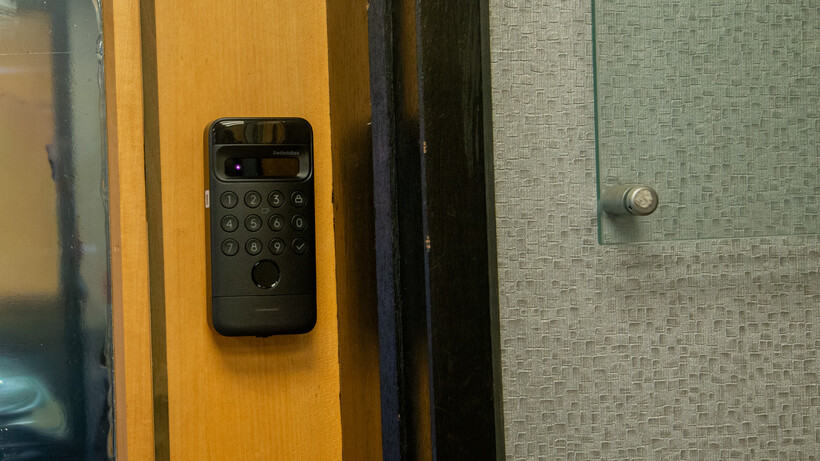
You can lose your phone, the app can stop working, or you can simply run out of charge. Then, what do you do when you get home? As discussed above, you can have a spare key, but it’s much more useful to have a lock with an optional keypad you can install outside, such as the SwitchBot Lock Ultra or the Ultion Nuki 2025.

SwitchBot Lock Ultra and KeyPad Vision keypad installedSwitchBot Lock Ultra and KeyPad Vision keypad installed
Image Credit (Trusted Reviews)

A keypad (whether it’s operated by PIN, fingerprint or facial recognition) gives a simple override at the door. I often unlock my office (secured with an Ultion Nuki 2025) using a fingerprint, as it’s often more convenient.

And, keypads tend to have lock buttons, so you can go out, shut your door and then press the lock button without having to fish out a phone.

Of course, if you do use your smart lock’s auto lock feature, the keypad means you can get back in if you accidentally get locked out.

Advertisement

Be wary of retrofit locks that operate with a key

Many retrofit locks are designed to stick on the inside of the door, operating an unlock mechanism. In some cases, this means inserting a key in the lock and then having the smart lock turn that to lock/unlock.

Advertisement

Sounds simple, right? In one way, yes, but the problem with this setup is that locks can’t have a key used in both sides at the same time. That’s important. Say you come home from work, try to unlock your door, but find that the smart lock has stopped responding or has run out of power. You insert a key from the outside, only to find you can’t turn the lock to unlock it.

I use a Yale Linus on my second office door, which turns a key. From the outside, inserting a key and giving it a bash will just about pop the internal key out far enough for me to turn the lock. However, since it’s a secondary door, it’s not a real issue: if there’s a problem, I can unlock the main door, get in, and fix the lock.

Advertisement

For main doors, if your original lock had a thumb turn, you should be alright with a retrofit lock: the smart lock controls the thumb turn, but the key option remains available from outside.

To improve security, you should get a lock with a new cylinder: the Ultion Nuki 2025 comes with Brisant Secure’s 3 Star Lock cylinder that can be operated with a key from outside.

Ultion Nuki 2025 cylindersUltion Nuki 2025 cylinders
Image Credit (Trusted Reviews)

Advertisement

Source link

Advertisement
Continue Reading

Tech

Crypto Billionaire Pardoned In Prison By Trump Just Wrote a Memoir

Published

on

Forbes estimates he’s worth roughly $110 billion, “placing him ahead of Bill Gates.”

And now Changpeng Zhao, the 49-year-old billionaire founder of Binance, “has written a memoir…”


It arrives with the unmistakable timing of a man determined to tell the world his version of his meteoric crypto rise and fall, and foreshadow his comeback. The book, Freedom of Money: A Memoir of Protecting Users, Resilience, and the Founding of Binance, runs 364 pages, self-published in English and Chinese…. Zhao also recounts Binance’s long battle with U.S. regulators, the company’s record $4.3 billion settlement for fostering unscrupulous money launderers, his four-month prison sentence in California, where he says he began writing the book, and his recent pardon by President Trump…

In Zhao’s telling, the case brought by multiple U.S. agencies was less about what Binance had done than about what it had become… “It didn’t make sense to me, or any of my lawyers. Other than the fact that we were the biggest in the industry.” The U.S. government alleged something more specific: that Binance failed to implement programs to prevent or report suspicious transactions — including those tied to Hamas’s Al-Qassam Brigades, Al Qaeda, and ISIS — while also processing trades between U.S. users and those in sanctioned jurisdictions like Iran, North Korea, and Syria. In total, regulators alleged the exchange willfully failed to report more than 100,000 suspicious transactions, including those involving terrorist organizations, ransomware attackers, child sexual exploitation material, frauds and scams… The final settlement amount — $4.3 billion, split across the Department of Justice, the Department of the Treasury’s Financial Crimes Enforcement Network, the Office of Foreign Assets Control and the U.S. Commodity Futures Trading Commission — was the largest corporate penalty in the history of nearly each agency involved. Attorney General Merrick B. Garland said at the time of the announcement: “Binance became the world’s largest cryptocurrency exchange in part because of the crimes it committed.”

Advertisement

The prison passages are among the most vivid in the book. Zhao says he was worried about extortion because the media had reported he was the richest person in U.S. prison history, but then realized no one read the WSJ or Bloomberg or recognized him. Zhao also writes about the food, the routines and the specific indignity of confinement, including sharing a cell with a man serving 30 years for killing two people… Writes Zhao of his cellmate, “Soon, I discovered that the most lethal thing about him wasn’t his murder conviction, it was his snoring. He snored more loudly than thunder strikes, the sound of which rose even above the constant toilet flushings.”
Binance at one point held a roughly 20% stake in Sam Bankman-Fried’s FTX and about $580 million in FTT tokens, the article points out. “As FTX neared collapse in late 2022, Zhao writes, Sam Bankman-Fried called to ask for a couple of billion dollars ‘nonchalantly, as if he was asking for a bologna sandwich.’

“Some believe that Binance’s brief show of interest in acquiring FTX, followed by its abrupt withdrawal from the deal, hastened FTX’s spiral into bankruptcy…”

Thanks to long-time Slashdot reader destinyland for sharing the article.

Source link

Advertisement
Continue Reading

Tech

Signs It’s Time to Tune Up Your Treadmill, Exercise Bike and Rowing Machine

Published

on

If you own fitness gear to work out at home, chances are you’ve invested in a large piece of cardio equipment, such as a treadmill or even an exercise bike. These types of machines are expensive, so it’s important to take care of them to help them last longer.

Depending on the machine you own, there are different ways to care for it. Knowing how to maintain and what to look out for will make this easier. Whether you own a treadmill or a rowing machine, there are ways to keep them functioning like new at no extra cost.

We spoke to a gym owner and personal trainer about maintaining gym equipment to take the guesswork out for you. If you own any of these machines, make sure you’re doing this to maintain them throughout the year. 

Advertisement

Treadmills: Don’t neglect the belt

A close up of a treadmill belt

Make sure to keep your treadmill belt clean and well-maintained — epecially if you use the same sneakers for outdoor activities.

Svetlana Snezhkina/Getty Images

If you own a treadmill, you know that for it to run well, you want the belt to remain smooth whether you run, jog or walk on it. Marshall Weber, a certified personal trainer and owner of Functional Idaho Gym, recommends maintaining your treadmill on a monthly basis. This also depends on how often you and anyone else in your household use the treadmill during the week. Some signs a treadmill needs TLC include a belt that sounds or feels off.

“If you begin to notice that your belt from the machine is squeaky or you feel it slipping under your feet, that is a strong sign you need to do a little bit of upkeep, because a properly maintained belt should feel smooth,” Weber says. 

Advertisement

The good news is you don’t need to hire a professional to service your treadmill. To learn how to lubricate your treadmill, you can do it yourself by following a YouTube tutorial — just make sure it aligns with your manufacturer’s instructions. Peloton, for instance, offers its own treadmill maintenance tips

Keep it clean and dust-free

When cleaning your belt, don’t neglect the area underneath it. “Dust builds up under it, which people forget,” says Cara D’Orazio, a certified personal trainer, group fitness instructor and specialist in sports conditioning. Weber agrees, saying, “I recommend taking the incline all the way up, sliding a light towel under the belt and letting the machine run for a few seconds.” This will help remove the dirt hiding under the belt. 

Weber also advises keeping the treadmill clean after each use, especially if you use the same shoes outdoors as you do indoors, as they get dirty quickly.

Center the belt

If you maintain your treadmill regularly, you shouldn’t need to replace its parts often. You may, however, need to adjust your treadmill’s belt from time to time. “You need to check the belt tension and make sure it’s centered,” says Weber, because over time the belt may shift to the left or right side. D’Orazio adds, “Some parts like the belt might need replacing every few years, especially if it looks worn down or frayed on the edges.” 

Advertisement

If you notice any issues with the motor or other electrical parts of your treadmill, you may need to call the manufacturer to see if they offer repairs or replacements under your warranty.

Exercise bikes: Check your bolts

Woman riding an exercise bike indoors

If you own an exercise bike, make sure you’re checking the pedals and the resistance knob.

Cavan Images/Getty Images

If you own a Peloton Bike or a similar exercise bike, you should be maintaining it. Weber says air bikes like Watt bikes, which use a fan to create resistance, require a different type of attention than a spin bike that uses a weighted flywheel. 

Advertisement

“Generally, checking on bolts monthly and a good wipe down after use should suffice,” Weber recommends.

Ensure bike pedals are secure

You should also be testing and making sure your bike pedals are still secure and not coming loose. This is important if you wear clip-in shoes that latch onto the bike pedal cages. 

“If the bottom cleats look really worn down, you have trouble clipping in and out or if the pedal feels loose or doesn’t ‘grab’ the cleat good anymore, that could mean the pedal needs replacing,” warns D’Orazio. 

Don’t neglect the resistance knob

The resistance function or knob on a bike should be tested periodically to make sure it’s functioning correctly. “Once in awhile also check the resistance to make sure it still feels smooth,” D’Orazio advises. Signs an exercise bike needs repair or tuning include clicking sounds, resistance that doesn’t adjust properly or wobbling pedals.

Advertisement

“That usually means something needs tightening or replacing,” explains D’Orazio. If you notice anything unusual with the motor, contact your manufacturer. 

Rowing machines: Listen for odd noises

Man sitting on rowing machine in middle of living room

A rowing machine requires the least amount of maintenance but you should do monthly checks to make sure it’s still functioning well.

THEPALMER/Getty Images

If you own a rowing machine, you probably appreciate that this machine doesn’t take up as much space as an exercise bike or treadmill. Some designs even let you fold it up to save space. 

Advertisement

“Of all of the machines one can have, this one is the best because it requires the least amount of upkeep,” says Weber. He recommends giving your rowing machine monthly checks and wiping it down after each use. “If you hear any odd noises coming from the rail [the part where you sit] or the spin wheel [the internal mechanism], then it may need some attention.”

What may require replacing

If a rowing machine needs a part replaced, it could be one of a few things. “On a rower, you might have to replace the strap, handle or bungee cord after a few years,” D’Orazio says, adding, “If the seat doesn’t roll smoothly anymore, the rollers might need replacing too.” 

As always, check with the manufacturer first to see how they can help with these repairs, as they may be covered under your warranty.

Know your equipment’s warranty policy

Advertisement
Close up shot of a laptop and hand holding a smartphone next to it

Knowing your equipment’s warranty can save you money if you use it correctly.

d3sign/Getty Images

If you own any of these machines, it’s important to know your warranty in case you need a replacement part or a new machine altogether. It’s helpful to know what parts the manufacturer will replace for you and for how long. 

Based on CNET’s fitness equipment testing, below is an estimate of what a warranty can look like for an exercise bike, treadmill or rowing machine. 

Treadmills

Some treadmills have a lifetime warranty, but the warranty for parts, the frame, the screen (if applicable) and labor may vary. For example, NordicTrack offers a lifetime warranty, but limits it to 10 years for the frame, 2 years for parts and 1 year for the tablet. Other brands, such as Aviron, offer a 10-year or 20-year warranty (depending on a monthly or annual membership), and Peloton provides a 5-year warranty on the frame and motor, but only 1 year on the touchscreen and certain components. Peloton maintains the same policy across all its fitness equipment. 

Advertisement

You can also purchase additional coverage to extend your warranty with some manufacturers. The warranty will depend on the brand and manufacturer, so before purchasing, make sure you’re clear on its policy. 

Exercise bikes

The warranty length for exercise bikes also varies per manufacturer. Some, such as BowFlex, offer 10-year coverage for the frame and 3 years for the mechanical parts and electronics. Others, like Speediance, offer 2-year coverage for the screen and similar components, but 1 year for wear and tear on the seat or pedal replacement. You can purchase additional coverage to extend your warranty.

Rowing machines

Most rowing machine brands offer similar warranties but there may be some differences depending on the brand. Coverage for brands like Peloton and Hydrow only lasts 1 year but if it’s the least high-maintenance machine, as experts say it is, you may not need to worry about its longevity as much. 

Like treadmills and exercise bikes, most companies offer extended warranties for extra protection. 

Advertisement

Source link

Continue Reading

Tech

Chelsea vs Man City Live Streams: How to watch Premier League 2025-26

Published

on

Sunday’s Chelsea vs Man City live streams feature a monster battle at Stamford Bridge between two of the Premier League’s richest clubs. The Blues need a win to put their Champions League hopes back on track, while Pep Guardiola’s City want to keep pace with Arsenal at the summit.

After a solid start to his Chelsea tenure, manager Liam Rosenior is starting to struggle. Overwhelmed in the Champions League by PSG, the Blues have won just one of their past six Premier League games and fell to catastrophic 3-0 defeat by Everton last time out. They will also be without captain Reece James (injured) and vice-captain Enzo Fernández, whose eye fluttering towards Real Madrid during the international break has earned him a two-game ban from Rosenior. Cole Palmer & Co impressed in hammering Port Vale in the FA Cup and must attack from the off to return to the Champions League spots.

Source link

Continue Reading

Tech

Nothing Phone 4a Pro Durability Test and Teardown Reveals the Good as well as One Design Quirk

Published

on

JerryRigEverything Nothing Phone 4a Pro Teardown Durability Test
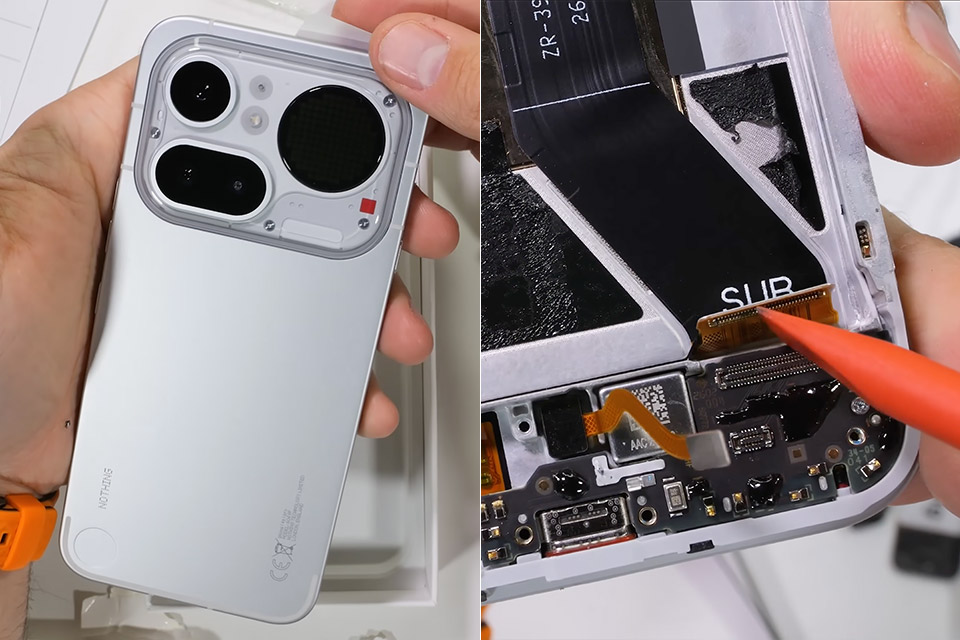
The Nothing Phone 4a Pro costs $499 and grabs the show right away with its sleek industrial design, which essentially redefines the class that the company has set with previous models. The aluminum frame surrounds it, and is the most durable yet from Nothing. Circular LED patterns on the back light up for notifications timers and music visuals while small widgets on the home screen run simple games or step counters that add a bit of personality without complicating daily use.


Zack Nelson of JerryRigEverything’s Mohs hardness picks are out to see how the rear panel holds up, and it takes a level two mark before the lines begin to deepen at level three, although the material acts more like reinforced plastic than high-end glass. Flip off the factory-installed screen protector to reveal the display underneath, and guess what? It resists scratches until level six, when it begins to be carved up at level seven. Even the most expensive flagships deliver such impressive performance.


Nothing Phone (4a) Pro Cell Phone 2026 New, Unlocked Android 16 Smartphone, Triple-Lens Camera, AI Photo…
  • Pro-Grade Camera with AI Edits: Capture every detail from a distance with the advanced triple camera system. Nothing Phone 4a Pro Features a 50MP Sony…
  • 6.83″ 144Hz AMOLED & 5,000-Nit Peak Brightness: Immerse yourself in a stunning 6.83-inch 1.5K AMOLED display. Delivering a buttery-smooth 144Hz…
  • All-Day 5080mAh Battery & Android 16 Nothing OS 4.1: Stay powered throughout your busiest days with a high-capacity 5,080mAh battery and 50W fast…

JerryRigEverything Nothing Phone 4a Pro Teardown Durability Test
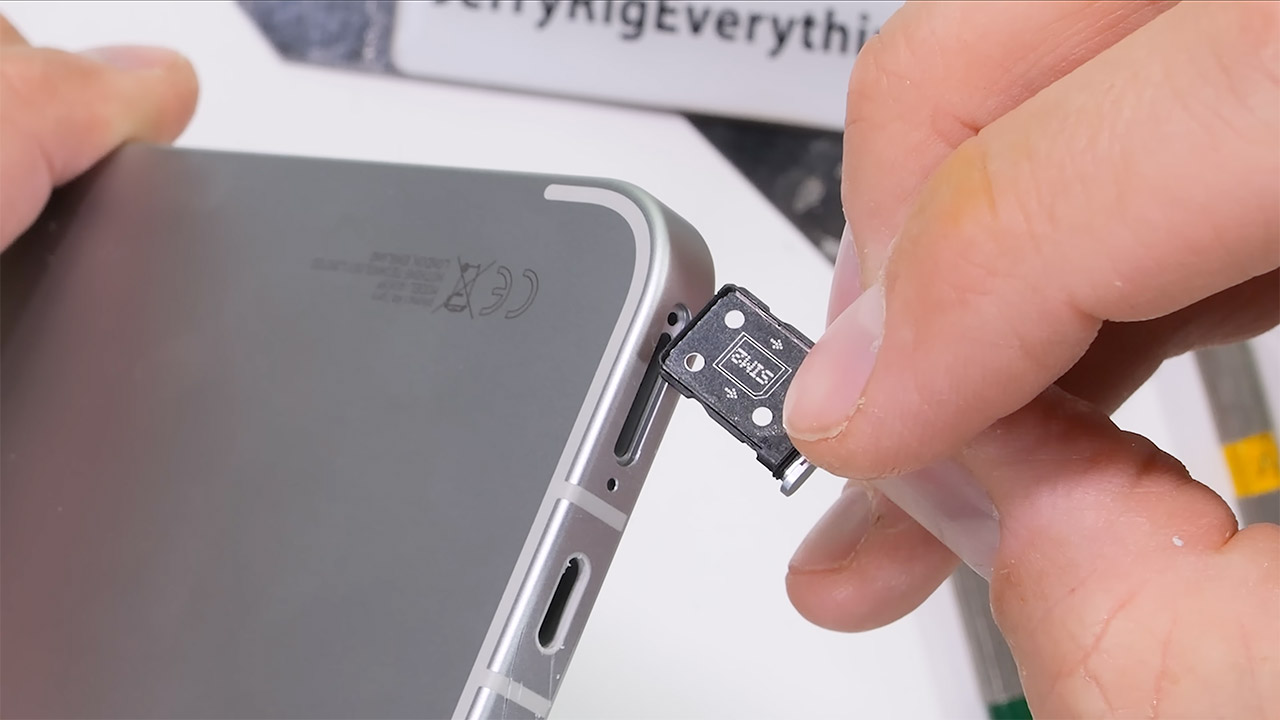
This one design quirk may surprise you, but there is a tiny gap at the bottom of the phone that allows the SIM card removal tool to simply poke a hole in the waterproof mesh that keeps the microphone and speaker area dry. The majority of phones keep this mesh out of reach, however in the case of the Nothing Phone 4a, the first layer sits directly behind the hole, making it easy to slip up and compromise the IP65 classification. To make matters worse, there is a second backup layer, but the risk remains, so proceed with caution.

JerryRigEverything Nothing Phone 4a Pro Teardown Durability Test
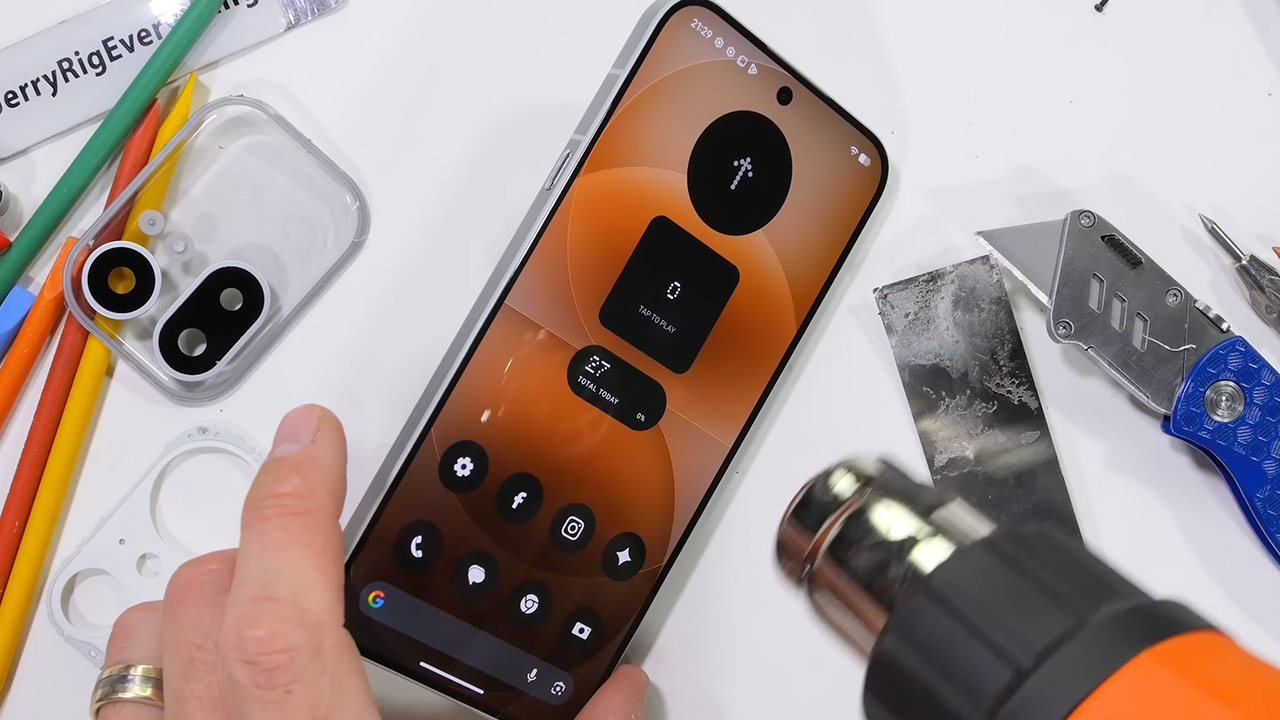
Following that, it’s time to burn test the 6.8-inch screen, which has ten bit color depth, five thousand nits brightness, and a quick 144hz refresh rate. It can withstand the heat for around twenty seconds before turning mostly white and recovering slightly once the heat source has passed. After that, it’s structural testing time, as he puts the phone through its paces, and the aluminum unibody comes out with flying colors, better than any Nothing model before it, with nary a crack or permanent deformation in sight.

JerryRigEverything Nothing Phone 4a Pro Teardown Durability Test
It’s time to crack it open, starting with a heat gun to release the adhesive that holds the plastic camera plate in place inside the recessed aluminum frame. Once it’s done, we can see the precision-cut metal casings for the glass lenses, which include an eight-megapixel wide-angle, a fifty-megapixel primary sensor with optical stabilization, and a fifty-megapixel telephoto that, unfortunately, lacks stabilisation. The thirty-two megapixel front-facing camera also lacks stabilization. Before long, we’ve removed the four silver T-3 screws and six black Phillips screws, and the screen has a gradual warmth along one side.

JerryRigEverything Nothing Phone 4a Pro Teardown Durability Test
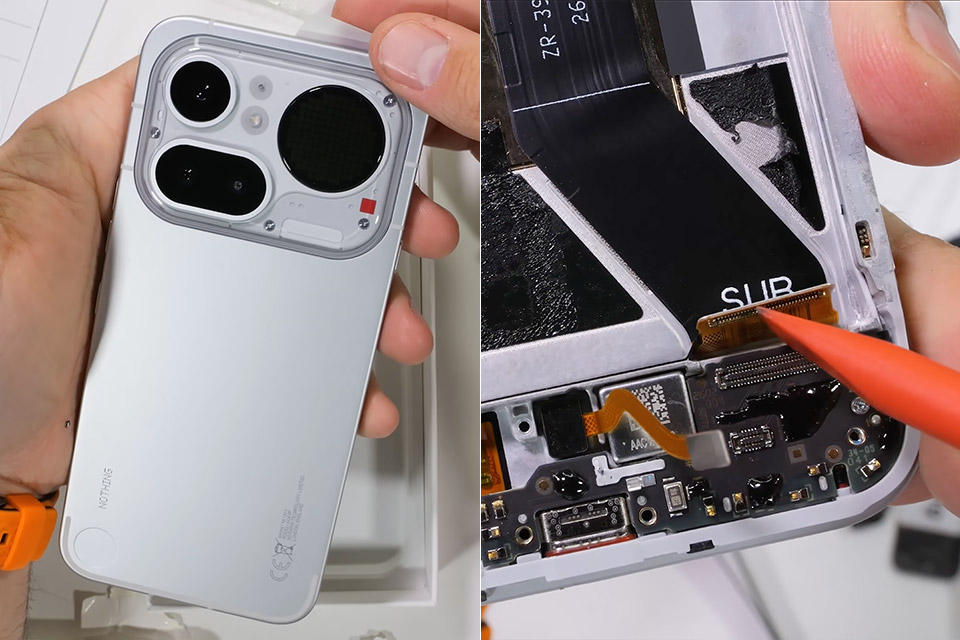
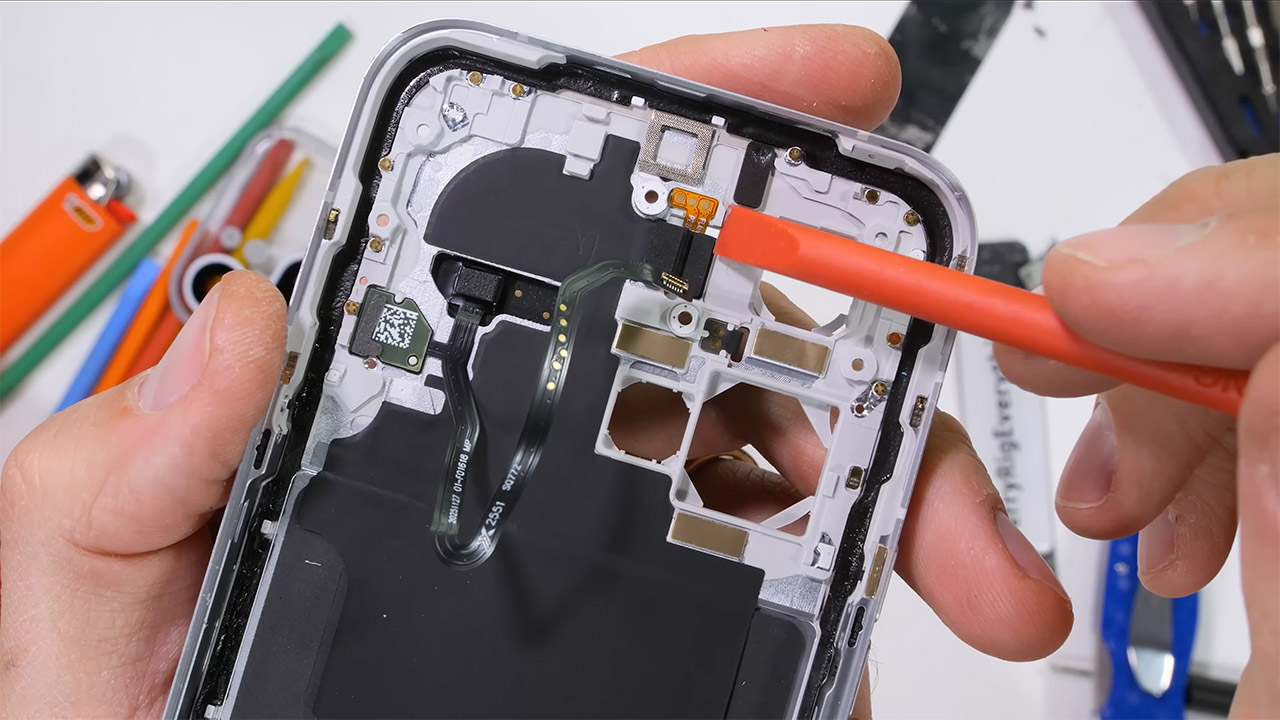
The rear LED matrix and the NFC coil are connected by ribbon wires, and there is no wireless charging coil inside. Three more screws secure a bracket that protects the battery and screen connectors. Unplugging those leads reveals a massive 5080 milliamp hour battery in the US version or 5400 in the India version, as well as pull tabs to make removal easier. A loudspeaker module is perched on top of the charging port board and may be removed by unscrewing seven more screws and cutting the antenna wire.

JerryRigEverything Nothing Phone 4a Pro Teardown Durability Test
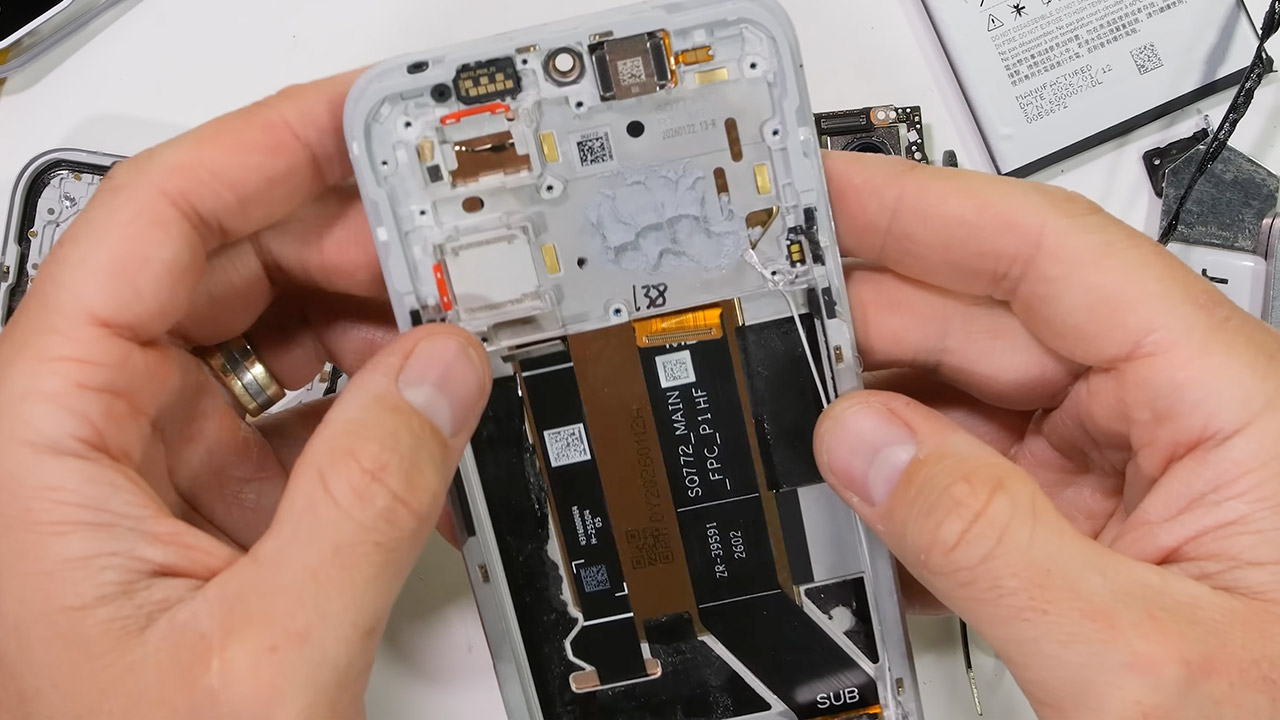
Taking the main board out shows a thick coating of thermal paste and a large vapor chamber designed to distribute heat around the back of the display. The main and ultrawide cameras perform exactly as expected, with optical stabilisation in place. If you want to get to the main board, you must first remove the camera shield, which reduces the repairability score slightly, but each step is still rather simple to do with basic tools. The reviewer says that the lack of wireless charging was a deliberate trade-off to make this phone more robust, as well as the solid metal build, rather than compromising on either.

Source link

Advertisement
Continue Reading

Trending

Copyright © 2025