If you own fitness gear to work out at home, chances are you’ve invested in a large piece of cardio equipment, such as a treadmill or even an exercise bike. These types of machines are expensive, so it’s important to take care of them to help them last longer.
Depending on the machine you own, there are different ways to care for it. Knowing how to maintain and what to look out for will make this easier. Whether you own a treadmill or a rowing machine, there are ways to keep them functioning like new at no extra cost.
We spoke to a gym owner and personal trainer about maintaining gym equipment to take the guesswork out for you. If you own any of these machines, make sure you’re doing this to maintain them throughout the year.
Advertisement
Treadmills: Don’t neglect the belt
Make sure to keep your treadmill belt clean and well-maintained — epecially if you use the same sneakers for outdoor activities.
Svetlana Snezhkina/Getty Images
If you own a treadmill, you know that for it to run well, you want the belt to remain smooth whether you run, jog or walk on it. Marshall Weber, a certified personal trainer and owner of Functional Idaho Gym, recommends maintaining your treadmill on a monthly basis. This also depends on how often you and anyone else in your household use the treadmill during the week. Some signs a treadmill needs TLC include a belt that sounds or feels off.
“If you begin to notice that your belt from the machine is squeaky or you feel it slipping under your feet, that is a strong sign you need to do a little bit of upkeep, because a properly maintained belt should feel smooth,” Weber says.
Advertisement
The good news is you don’t need to hire a professional to service your treadmill. To learn how to lubricate your treadmill, you can do it yourself by following a YouTube tutorial — just make sure it aligns with your manufacturer’s instructions. Peloton, for instance, offers its own treadmill maintenance tips.
Keep it clean and dust-free
When cleaning your belt, don’t neglect the area underneath it. “Dust builds up under it, which people forget,” says Cara D’Orazio, a certified personal trainer, group fitness instructor and specialist in sports conditioning. Weber agrees, saying, “I recommend taking the incline all the way up, sliding a light towel under the belt and letting the machine run for a few seconds.” This will help remove the dirt hiding under the belt.
Weber also advises keeping the treadmill clean after each use, especially if you use the same shoes outdoors as you do indoors, as they get dirty quickly.
Center the belt
If you maintain your treadmill regularly, you shouldn’t need to replace its parts often. You may, however, need to adjust your treadmill’s belt from time to time. “You need to check the belt tension and make sure it’s centered,” says Weber, because over time the belt may shift to the left or right side. D’Orazio adds, “Some parts like the belt might need replacing every few years, especially if it looks worn down or frayed on the edges.”
Advertisement
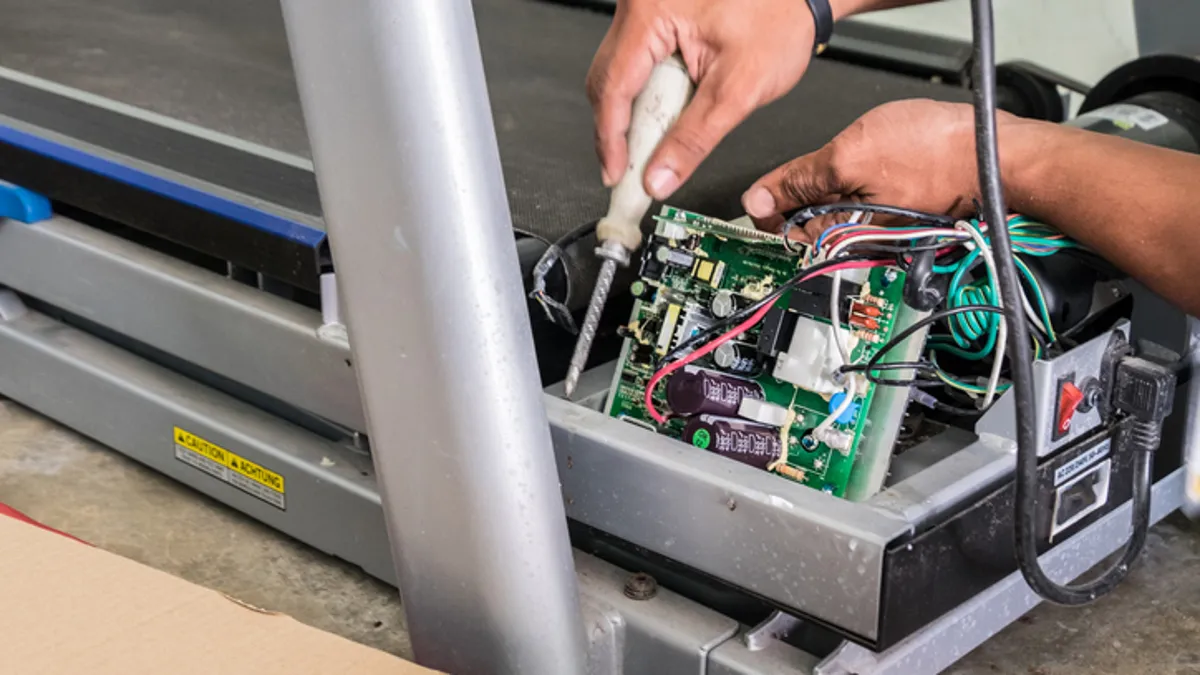
If you notice any issues with the motor or other electrical parts of your treadmill, you may need to call the manufacturer to see if they offer repairs or replacements under your warranty.
Exercise bikes: Check your bolts
If you own an exercise bike, make sure you’re checking the pedals and the resistance knob.
Cavan Images/Getty Images
If you own a Peloton Bike or a similar exercise bike, you should be maintaining it. Weber says air bikes like Watt bikes, which use a fan to create resistance, require a different type of attention than a spin bike that uses a weighted flywheel.
Advertisement
“Generally, checking on bolts monthly and a good wipe down after use should suffice,” Weber recommends.
Ensure bike pedals are secure
You should also be testing and making sure your bike pedals are still secure and not coming loose. This is important if you wear clip-in shoes that latch onto the bike pedal cages.
“If the bottom cleats look really worn down, you have trouble clipping in and out or if the pedal feels loose or doesn’t ‘grab’ the cleat good anymore, that could mean the pedal needs replacing,” warns D’Orazio.
Don’t neglect the resistance knob
The resistance function or knob on a bike should be tested periodically to make sure it’s functioning correctly. “Once in awhile also check the resistance to make sure it still feels smooth,” D’Orazio advises. Signs an exercise bike needs repair or tuning include clicking sounds, resistance that doesn’t adjust properly or wobbling pedals.
Advertisement
“That usually means something needs tightening or replacing,” explains D’Orazio. If you notice anything unusual with the motor, contact your manufacturer.
Rowing machines: Listen for odd noises
A rowing machine requires the least amount of maintenance but you should do monthly checks to make sure it’s still functioning well.
THEPALMER/Getty Images
If you own a rowing machine, you probably appreciate that this machine doesn’t take up as much space as an exercise bike or treadmill. Some designs even let you fold it up to save space.
Advertisement
“Of all of the machines one can have, this one is the best because it requires the least amount of upkeep,” says Weber. He recommends giving your rowing machine monthly checks and wiping it down after each use. “If you hear any odd noises coming from the rail [the part where you sit] or the spin wheel [the internal mechanism], then it may need some attention.”
What may require replacing
If a rowing machine needs a part replaced, it could be one of a few things. “On a rower, you might have to replace the strap, handle or bungee cord after a few years,” D’Orazio says, adding, “If the seat doesn’t roll smoothly anymore, the rollers might need replacing too.”
As always, check with the manufacturer first to see how they can help with these repairs, as they may be covered under your warranty.
Know your equipment’s warranty policy
Advertisement
Knowing your equipment’s warranty can save you money if you use it correctly.
d3sign/Getty Images
If you own any of these machines, it’s important to know your warranty in case you need a replacement part or a new machine altogether. It’s helpful to know what parts the manufacturer will replace for you and for how long.
Based on CNET’s fitness equipment testing, below is an estimate of what a warranty can look like for an exercise bike, treadmill or rowing machine.
Treadmills
Some treadmills have a lifetime warranty, but the warranty for parts, the frame, the screen (if applicable) and labor may vary. For example, NordicTrack offers a lifetime warranty, but limits it to 10 years for the frame, 2 years for parts and 1 year for the tablet. Other brands, such as Aviron, offer a 10-year or 20-year warranty (depending on a monthly or annual membership), and Peloton provides a 5-year warranty on the frame and motor, but only 1 year on the touchscreen and certain components. Peloton maintains the same policy across all its fitness equipment.
Advertisement
You can also purchase additional coverage to extend your warranty with some manufacturers. The warranty will depend on the brand and manufacturer, so before purchasing, make sure you’re clear on its policy.
Exercise bikes
The warranty length for exercise bikes also varies per manufacturer. Some, such as BowFlex, offer 10-year coverage for the frame and 3 years for the mechanical parts and electronics. Others, like Speediance, offer 2-year coverage for the screen and similar components, but 1 year for wear and tear on the seat or pedal replacement. You can purchase additional coverage to extend your warranty.
Rowing machines
Most rowing machine brands offer similar warranties but there may be some differences depending on the brand. Coverage for brands like Peloton and Hydrow only lasts 1 year but if it’s the least high-maintenance machine, as experts say it is, you may not need to worry about its longevity as much.
Like treadmills and exercise bikes, most companies offer extended warranties for extra protection.
Marshals, a new Yellowstone spinoff starring Luke Grimes as Kayce Dutton, is airing on CBS right now. You can also tune in with Paramount Plus. The Yellowstone sequel series sees Grimes’ former Navy SEAL join an elite unit of US Marshals to bring range justice to Montana, according to a synopsis from CBS.
The show includes Yellowstone actors Gil Birmingham as Thomas Rainwater, Mo Brings Plenty as Mo and Brecken Merrill as Tate. Spencer Hudnut is the showrunner of Marshals — formerly known as Y: Marshals — and Taylor Sheridan is an executive producer.
Advertisement
When to watch new Marshals episodes on Paramount Plus
Episode 7 of Marshals airs on CBS on Sunday, April 12. Viewing options for Paramount Plus customers vary by subscription tier. You can watch the episode live if you have Paramount Plus Premium, which includes your local CBS station. If you subscribe to Paramount Plus Essential, you can watch the installment on demand the following Monday, but not live on Sunday.
Here’s a release schedule for the next two episodes of Marshals.
Episode 7, Family Business: Premieres on CBS/Paramount Plus Premium on April 12 at 8 p.m. ET/8 p.m. PT/7 p.m. CT. Streams on Paramount Plus Essential on April 13.
Episode 8, Blowback: Premieres on CBS/Paramount Plus Premium on April 19 at 8 p.m. ET/8 p.m. PT/7 p.m. CT. Streams on Paramount Plus Essential on April 20.
You can also watch CBS and the seventh episode of Marshals without cable with a live TV streaming service such as YouTube TV, Hulu Plus Live TV or the DirecTV MyNews skinny bundle. In addition to offering a lower-cost option, Paramount Plus lets you watch the other two Yellowstone spinoffs: the prequels 1883 and 1923.
After a price increase in early 2026, the ad-supported Essential version runs $9 per month or $90 per year. The ad-free Premium version runs $14 per month or $140 per year. Paying more for Premium gives you downloads, the ability to watch more Showtime programming than Essential and access to your live, local CBS station.
In this week’s “Sunday Reboot,” a storage upgrade for the MacBook Neo, an excuse to buy many Mac minis, and the iPhones come back to Earth with a late congratulatory message.
Image credits: NASA/Overcast
Sunday Reboot is a weekly column covering some of the lighter stories within the Apple reality distortion field from the past seven days. All to get the next week underway with a good first step. This week, researchers managed to get around Apple Intelligence security measures using prompt injection techniques, a repairability report panned Apple’s hardware again, and Apple’s lawsuit with Epic Games over the App Store continued to roll on. There was also a bug found to break Mac networking every 49 days, 17 hours, two minutes, and 47 seconds. Continue Reading on AppleInsider | Discuss on our Forums
Tesla finally received approval on April 10 from the Dutch vehicle regulator, the RDW, for its Full Self-Driving Supervised system to be used on European roads. They were the first to receive approval for this advanced technology across Europe, marking a significant milestone for the company. This means that the program has been cleared to run on public roads in the Netherlands, and the distribution began the next day, April 11, for a limited number of early testers who had been patiently waiting.
Drivers with Hardware 4 (HW4) computers in their vehicles received an upgrade to version 2026.3.6, which included the European-tuned build of FSD 14.2.2.5. Before turning on the system, drivers must complete a fast tutorial followed by a mini test within the car interface. Once that’s done, they can take their hands off the wheel under appropriate situations, and cameras will watch their eyes to see if they’re paying attention. If they become distracted, the system will begin to display visual alarms, followed by sounds and vibrations if they do not return to it, and if all else fails, the car will slow down and come to a safe stop on its own.
COLLECTIBLE MODEL CAR KIT – Embark on a nostalgic journey with the LEGO Icons Ford Model T (11376) building set for adults ages 18 and up
VINTAGE CAR DISPLAY PIECE – Recreate the iconic 1910s automobile with gleaming black bodywork, golden accents, a foldback fabric roof and tall…
AUTHENTIC MODEL T FUNCTIONS – Fold back the model car’s roof, fold down the split windshield, lift the hood from both sides to see the engine, turn…
Overall, this was the product of 18 months of testing, which included more than 1.5 million kilometers of driving on European highways, as well as numerous controlled scenarios on closed tracks. Before approving the system, regulators reviewed almost 400 compliance points. The RDW pronounced it a beneficial addition to road safety, but stressed that drivers must remain in the driver’s seat and ready to take over at any time.
The European version of the software is substantially different from the one accessible in the United States. This is primarily due to the way regulators work here, which requires them to do pre-market checks, as opposed to their US counterparts’ self-certification strategy. As a result, the Dutch construction is more cautious and limits some of the more aggressive driving characteristics available elsewhere. Automatic turns at junctions and navigation-based lane changes are still accessible, but several parking-lot summoning capabilities found in the United States are not available in the Netherlands.
Advertisement
Subscribers will pay 99 euros per month to receive the system, or 49 euros per month if they already have Enhanced Autopilot. Alternatively, they can purchase it outright for 7,500 euros. Tesla claims that the system leverages billions of kilometers of real-world data collected worldwide, and Elon Musk has just stated that the RDW review process was particularly rigorous.
The Dutch approval is now a one-time occurrence, although it has a provisional validity period of at least 36 months. It means that other European states can adopt it on their own, and authorities in Germany, France, and Italy are expected to do so within the next 4 to 8 weeks. Tesla’s goal is to have the system more widely accepted across the EU by the summer, allowing millions of drivers to use it without having to repeat the testing procedure in each nation. [Source]
Apple may be late to the smart glasses market, but it could be covering all its bases with up to four potential styles for its upcoming product. According to Bloomberg‘s Mark Gurman, Apple could launch some or all of the four styles it’s currently testing for its smart glasses.
Gurman reported Apple is testing out a large rectangular frame that’s comparable to Ray-Ban Wayfarers, a slimmer rectangular design like the glasses that Apple CEO Tim Cook wears, a larger oval or circular frame and a smaller oval or circle option. Apple is also working on a range of colors, including black, ocean blue and light brown, according to Bloomberg.
Internally code-named N50 for now, Apple’s upcoming smart glasses will compete directly with the second-gen Ray-Ban Meta model. While similar, Apple might be differentiating its design with “vertically oriented oval lenses with surrounding lights,” according to the report. Like Meta’s smart glasses, Apple’s upcoming product will capture photos and videos, but is meant to better sync with an iPhone, allowing users to take advantage of Apple’s ecosystem for editing, sharing, phone calls, notifications, music and even its voice assistant, according to Gurman. The release of Apple’s smart glasses could even coincide with the upcoming improved Siri that should arrive with iOS 27.
Gurman reported that Apple could reveal its smart glasses as soon as the end of 2026 or early 2027, followed by an official release sometime in 2027. As for the competition, Meta released its latest model that’s better suited for prescription lenses and offers a more customizable fit.
Apple didn’t position its most affordable MacBook as a gaming machine. The MacBook Neo, a budget-leaning laptop that runs on Apple’s A18 Pro chip, the same chip that powers the iPhone 16 Pro models, has been put through a Windows 11 gaming test for YouTuber ETA Prime.
Turns out, the results are genuinely surprising. Using Parallels Desktop, a virtualization app (paid) with 3D hardware acceleration, the channel ran Windows 11 ARM directly on the Neo’s 8GB RAM (allocating 5GB to the virtual environment), and it did better than most people would think it would.
What games actually ran well?
Dirt 3 held 75 fps at 1200p on high settings, while Portal 2 cleared 100 fps on medium settings. Skyrim, on the other hand, maintained roughly 60 fps at 1200p resolution on medium graphics settings, while Marvel Cosmic Invasion averaged around 60 fps at the maximum resolution.
Advertisement
What helped performance was games running as native Windows-on-ARM applications. However, GTA V was among the notable stumbles, as the frame rates through the Parelles weren’t playable at all. However, according to Notebookcheck, the game runs acceptably via Crossover.
MacBook NeoApple
Why does this matter for everyday MacBook Neo users?
For users who work on their Mac but occasionally enjoy playing Windows-only games, MacBook Neo’s ability to run native titles via the Parallels app comes as good news. The cost? Parallels Desktop’s Standard tier costs $99.99 per year, which could add to your weekend leisure sessions.
Anyways, the bigger takeaway is that the MacBook Neo, even with 8GB of RAM (highlighted as a constraint in the video), can run low-to-mid-range Windows games. It also changes the notion around budget Apple hardware being primarily for productivity-based tasks.
Summer heat makes any travel difficult, especially if you’re transporting groceries and / or cold drinks. Drivers are frequently forced to rely on old, simple coolers with ice that melts faster than a popsicle on a hot day, leaving everything wet by the time they reach. That’s where the BougeRV 23-quart unit, priced at $159.97 (was $189.99), comes in, a more practical solution that plugs directly into your car’s normal 12V socket and keeps items perfectly chilled without any of the fuss.
The unit is 22 inches long and weighs just more than 21 pounds, so it can fit into even the smallest trunks or backseats. It also has a built-in handle, making it simple to pull out at a rest break or transport home after a long shopping excursion. Inside, there’s enough space for a couple days’ worth of food or a full load of drinks and snacks for a family road trip.
What You Get: The CR22 12V refrigerator comes with a 2-year Tech Support. If you have any questions about the product, please REACH OUT TO BougeRV, as…
Fast Cooling Down to 32℉: With Compressor refrigeration technology, this 12v car refrigerator could achieve 15 min fast cooling from 77℉ to…
45W Low Power Consumption: With ECO energy saving mode, this 23 Qt portable refrigerator’s operating power is less than 36W. Even running on MAX…
It’s powered by a 12-volt socket, which is found in practically every modern automobile, and there are alternatives for residential outlets or even solar power if you are parked for an extended period of time. The compressor system kicks in quickly, about 15 minutes, and maintains a consistent temperature between 8 degrees below zero and 50 degrees Fahrenheit, allowing you to choose between fridge and freezer mode as needed.
Advertisement
The portable fridge uses very little energy (around 36 watts in environment mode), and the smart cycling keeps your daily power consumption under one kilowatt-hour even on the warmest days. To be on the safe side, there’s a built-in battery monitor that will turn it off before it consumes your vehicle’s battery, so you don’t have to worry about that.
People who have used it on road trips note that it works effectively, keeping perishables from spoiling without having to constantly add ice, and it absorbs bumps in the road well, even while traveling at a 30-degree angle. If you’re only running to the store for a quick shopping trip, the fridge will keep running until you return home, even if you get stopped in traffic.
FCC rules block new foreign routers while old, vulnerable ones stay in homes longer
ISP customers cannot upgrade routers even when security risks become widely known
Router approvals now depend on waivers that may slow down nationwide replacements
The Federal Communications Commission (FCC) has issued new rules intended to address security risks posed by routers produced outside the United States.
The new FCC rules require all new models of non-US-produced routers obtain a waiver before they can be sold to American consumers.
Article continues below
Advertisement
Waiver requirement adds pressure
However this creates a direct problem for the 71% of American households that receive their routers from internet service providers rather than buying their own equipment.
Those consumers cannot simply go to a store and purchase a compliant router when rules change, because the hardware in their homes belongs to the ISP.
Advertisement
Internet service providers operate on tight margins and typically replace customer routers only when necessary — especially for small business router needs amid rising costs
“To our knowledge consumer-grade Wi-Fi routers available in the U.S. are manufactured nearly exclusively in China, Taiwan, and Vietnam,” said Claus Hetting, CEO of Wi-Fi NOW.
Sign up to the TechRadar Pro newsletter to get all the top news, opinion, features and guidance your business needs to succeed!
“Foreign manufacturing cannot easily be relocated since it is typically based on long-term contracts with foreign manufacturing entities. Such contracts will be costly to terminate.”
Advertisement
Under the new FCC rules, ISPs must source compliant hardware for their millions of subscribers, but the supply chain for US-made Wi-Fi routers does not currently exist.
Without compliant hardware to purchase, ISPs have little incentive to retire the routers already deployed in customers’ homes.
“It is not possible to build a consumer router based entirely on U.S. components; that part of the supply chain doesn’t exist in the United States,” added analyst Avi Greengart of Techsponential.
Advertisement
Figures from Ookla claim roughly 28% of Speedtest results in the US came from devices connected via Wi-Fi 5, while approximately 7% used Wi-Fi 4 or older.
These older standards typically lack the advanced security protocols of newer Wi-Fi generations, leaving them more exposed to the very threats the FCC aims to address — particularly for high-demand gaming router setups.
The rules could paradoxically slow adoption of newer technologies like Wi-Fi 6E and Wi-Fi 7, because ISPs facing compliance headaches may simply delay all router upgrades rather than navigate the waiver process for foreign-made equipment.
The FCC’s intention to secure American networks is clear, but the practical effect on several households could be the opposite of what it intends to do.
Advertisement
Until the waiver process proves workable or domestic manufacturing materializes, these households may remain stuck with the same outdated, potentially insecure routers.
The rules assume that restricting foreign-made equipment will improve security, but leaving old hardware in place longer may actually increase the high risk the FCC is trying to eliminate.
For the last 18 months, the CISO playbook for generative AI has been relatively simple: Control the browser.
Security teams tightened cloud access security broker (CASB) policies, blocked or monitored traffic to well-known AI endpoints, and routed usage through sanctioned gateways. The operating model was clear: If sensitive data leaves the network for an external API call, we can observe it, log it, and stop it. But that model is starting to break.
A quiet hardware shift is pushing large language model (LLM) usage off the network and onto the endpoint. Call it Shadow AI 2.0, or the “bring your own model” (BYOM) era: Employees running capable models locally on laptops, offline, with no API calls and no obvious network signature. The governance conversation is still framed as “data exfiltration to the cloud,” but the more immediate enterprise risk is increasingly “unvetted inference inside the device.”
When inference happens locally, traditional data loss prevention (DLP) doesn’t see the interaction. And when security can’t see it, it can’t manage it.
Advertisement
Why local inference is suddenly practical
Two years ago, running a useful LLM on a work laptop was a niche stunt. Today, it’s routine for technical teams.
Three things converged:
Consumer-grade accelerators got serious: A MacBook Pro with 64GB unified memory can often run quantized 70B-class models at usable speeds (with practical limits on context length). What once required multi-GPU servers is now feasible on a high-end laptop for many real workflows.
Quantization went mainstream: It’s now easy to compress models into smaller, faster formats that fit within laptop memory often with acceptable quality tradeoffs for many tasks.
Distribution is frictionless: Open-weight models are a single command away, and the tooling ecosystem makes “download → run → chat” trivial.
The result: An engineer can pull down a multi‑GB model artifact, turn off Wi‑Fi, and run sensitive workflows locally, source code review, document summarization, drafting customer communications, even exploratory analysis over regulated datasets. No outbound packets, no proxy logs, no cloud audit trail.
The risk isn’t only data leaving the company anymore
If the data isn’t leaving the laptop, why should a CISO care?
Because the dominant risks shift from exfiltration to integrity, provenance, and compliance. In practice, local inference creates three classes of blind spots that most enterprises have not operationalized.
1. Code and decision contamination (integrity risk)
Local models are often adopted because they’re fast, private, and “no approval required.” The downside is that they’re frequently unvetted for the enterprise environment.
A common scenario: A senior developer downloads a community-tuned coding model because it benchmarks well. They paste in internal auth logic, payment flows, or infrastructure scripts to “clean it up.” The model returns output that looks competent, compiles, and passes unit tests, but subtly degrades security posture (weak input validation, unsafe defaults, brittle concurrency changes, dependency choices that aren’t allowed internally). The engineer commits the change.
Advertisement
If that interaction happened offline, you may have no record that AI influenced the code path at all. And when you later do incident response, you’ll be investigating the symptom (a vulnerability) without visibility into a key cause (uncontrolled model usage).
2. Licensing and IP exposure (compliance risk)
Many high-performing models ship with licenses that include restrictions on commercial use, attribution requirements, field-of-use limits, or obligations that can be incompatible with proprietary product development. When employees run models locally, that usage can bypass the organization’s normal procurement and legal review process.
If a team uses a non-commercial model to generate production code, documentation, or product behavior, the company can inherit risk that shows up later during M&A diligence, customer security reviews, or litigation. The hard part is not just the license terms, it’s the lack of inventory and traceability. Without a governed model hub or usage record, you may not be able to prove what was used where.
3. Model supply chain exposure (provenance risk)
Local inference also changes the software supply chain problem. Endpoints begin accumulating large model artifacts and the toolchains around them: ownloaders, converters, runtimes, plugins, UI shells, and Python packages.
Advertisement
There is a critical technical nuance here: The file format matters. While newer formats like Safetensors are designed to prevent arbitrary code execution, older Pickle-based PyTorch files can execute malicious payloads simply when loaded. If your developers are grabbing unvetted checkpoints from Hugging Face or other repositories, they aren’t just downloading data — they could be downloading an exploit.
Security teams have spent decades learning to treat unknown executables as hostile. BYOM requires extending that mindset to model artifacts and the surrounding runtime stack. The biggest organizational gap today is that most companies have no equivalent of a software bill of materials for models: Provenance, hashes, allowed sources, scanning, and lifecycle management.
Mitigating BYOM: treat model weights like software artifacts
You can’t solve local inference by blocking URLs. You need endpoint-aware controls and a developer experience that makes the safe path the easy path.
Here are three practical ways:
Advertisement
1. Move governance down to the endpoint
Network DLP and CASB still matter for cloud usage, but they’re not sufficient for BYOM. Start treating local model usage as an endpoint governance problem by looking for specific signals:
Inventory and detection: Scan for high-fidelity indicators like .gguf files larger than 2GB, processes like llama.cpp or Ollama, and local listeners on common default port 11434.
Process and runtime awareness: Monitor for repeated high GPU/NPU (neural processing unit) utilization from unapproved runtimes or unknown local inference servers.
Device policy: Use mobile device management (MDM) and endpoint detection and response (EDR) policies to control installation of unapproved runtimes and enforce baseline hardening on engineering devices. The point isn’t to punish experimentation. It’s to regain visibility.
2. Provide a paved road: An internal, curated model hub
Shadow AI is often an outcome of friction. Approved tools are too restrictive, too generic, or too slow to approve. A better approach is to offer a curated internal catalog that includes:
Advertisement
Approved models for common tasks (coding, summarization, classification)
Verified licenses and usage guidance
Pinned versions with hashes (prioritizing safer formats like Safetensors)
Clear documentation for safe local usage, including where sensitive data is and isn’t allowed. If you want developers to stop scavenging, give them something better.
Most acceptable use policies talk about SaaS and cloud tools. BYOM requires policy that explicitly covers:
Downloading and running model artifacts on corporate endpoints
Acceptable sources
License compliance requirements
Rules for using models with sensitive data
Retention and logging expectations for local inference tools This doesn’t need to be heavy-handed. It needs to be unambiguous.
The perimeter is shifting back to the device
For a decade we moved security controls “up” into the cloud. Local inference is pulling a meaningful slice of AI activity back “down” to the endpoint.
5 signals shadow AI has moved to endpoints:
Advertisement
Large model artifacts: Unexplained storage consumption by .gguf or .pt files.
Local inference servers: Processes listening on ports like 11434 (Ollama).
GPU utilization patterns: Spikes in GPU usage while offline or disconnected from VPN.
Lack of model inventory: Inability to map code outputs to specific model versions.
License ambiguity: Presence of “non-commercial” model weights in production builds.
Shadow AI 2.0 isn’t a hypothetical future, it’s a predictable consequence of fast hardware, easy distribution, and developer demand. CISOs who focus only on network controls will miss what’s happening on the silicon sitting right on employees’ desks.
The next phase of AI governance is less about blocking websites and more about controlling artifacts, provenance, and policy at the endpoint, without killing productivity.
Jayachander Reddy Kandakatla is a senior MLOps engineer.
Welcome to the VentureBeat community!
Advertisement
Our guest posting program is where technical experts share insights and provide neutral, non-vested deep dives on AI, data infrastructure, cybersecurity and other cutting-edge technologies shaping the future of enterprise.
Read more from our guest post program — and check out our guidelines if you’re interested in contributing an article of your own!
Data drift happens when the statistical properties of a machine learning (ML) model’s input data change over time, eventually rendering its predictions less accurate. Cybersecurity professionals who rely on ML for tasks like malware detection and network threat analysis find that undetected data drift can create vulnerabilities. A model trained on old attack patterns may fail to see today’s sophisticated threats. Recognizing the early signs of data drift is the first step in maintaining reliable and efficient security systems.
Why data drift compromises security models
ML models are trained on a snapshot of historical data. When live data no longer resembles this snapshot, the model’s performance dwindles, creating a critical cybersecurity risk. A threat detection model may generate more false negatives by missing real breaches or create more false positives, leading to alert fatigue for security teams.
Adversaries actively exploit this weakness. In 2024,attackers used echo-spoofing techniques to bypass email protection services. By exploiting misconfigurations in the system, they sent millions of spoofed emails that evaded the vendor’s ML classifiers. This incident demonstrates how threat actors can manipulate input data to exploit blind spots. When a security model fails to adapt to shifting tactics, it becomes a liability.
5 indicators of data drift
Security professionals can recognize the presence of drift (or its potential) in several ways.
Advertisement
1. A sudden drop in model performance
Accuracy, precision, and recall are often the first casualties. A consistent decline in these key metrics is a red flag that the model is no longer in sync with the current threat landscape.
Consider Klarna’s success: Its AI assistant handled 2.3 million customer service conversations in its first month and performed work equivalent to 700 agents. This efficiency drove a25% decline in repeat inquiries and reduced resolution times to under two minutes.
Now imagine if those parameters suddenly reversed because of drift. In a security context, a similar drop in performance does not just mean unhappy clients — it also means successful intrusions and potential data exfiltration.
2. Shifts in statistical distributions
Security teams should monitor the core statistical properties of input features, such as the mean, median, and standard deviation. A significant change in these metrics from training data could indicate the underlying data has changed.
Advertisement
Monitoring for such shifts enables teams to catch drift before it causes a breach. For example, a phishing detection model might be trained on emails with an average attachment size of 2MB. If the average attachment size suddenly jumps to 10MB due to a new malware-delivery method, the model may fail to classify these emails correctly.
3. Changes in prediction behavior
Even if overall accuracy seems stable, distributions of predictions might change, a phenomenon often referred to as prediction drift.
For instance, if a fraud detection model historically flagged 1% of transactions as suspicious but suddenly starts flagging 5% or 0.1%, either something has shifted or the nature of the input data has changed. It might indicate a new type of attack that confuses the model or a change in legitimate user behavior that the model was not trained to identify.
4. An increase in model uncertainty
For models that provide a confidence score or probability with their predictions, a general decrease in confidence can be a subtle sign of drift.
Advertisement
Recent studies highlight thevalue of uncertainty quantification in detecting adversarial attacks. If the model becomes less sure about its forecasts across the board, it is likely facing data it was not trained on. In a cybersecurity setting, this uncertainty is an early sign of potential model failure, suggesting the model is operating in unfamiliar ground and that its decisions might no longer be reliable.
5. Changes in feature relationships
The correlation between different input features can also change over time. In a network intrusion model, traffic volume and packet size might be highly linked during normal operations. If that correlation disappears, it can signal a change in network behavior that the model may not understand. A sudden feature decoupling could indicate a new tunneling tactic or a stealthy exfiltration attempt.
Approaches to detecting and mitigating data drift
Common detection methods include the Kolmogorov-Smirnov (KS) and the population stability index (PSI). These compare the distributions of live and training data to identify deviations. The KS test determines if two datasets differ significantly, while the PSI measures how much a variable’s distribution has shifted over time.
The mitigation method of choice often depends on how the drift manifests, as distribution changes may occur suddenly. For example, customers’ buying behavior may change overnight with the launch of a new product or a promotion. In other cases, drift may occur gradually over a more extended period. That said, security teams must learn to adjust their monitoring cadence to capture both rapid spikes and slow burns. Mitigation will involve retraining the model on more recent data to reclaim its effectiveness.
Advertisement
Proactively manage drift for stronger security
Data drift is an inevitable reality, and cybersecurity teams can maintain a strong security posture by treating detection as a continuous and automated process. Proactive monitoring and model retraining are fundamental practices to ensure ML systems remain reliable allies against developing threats.
Our guest posting program is where technical experts share insights and provide neutral, non-vested deep dives on AI, data infrastructure, cybersecurity and other cutting-edge technologies shaping the future of enterprise.
Advertisement
Read more from our guest post program — and check out our guidelines if you’re interested in contributing an article of your own!
More people will be able to watch ESPN programming through Disney Plus with Tuesday’s launch of ESPN on Disney Plus in Europe and select Asia-Pacific markets.
With expansion into more than 50 countries and territories in those regions, people in 100 markets worldwide can now stream ESPN content through Disney Plus, according to a Disney Plus news release. The offering brings live sporting events and studio shows together with general entertainment and family programming in a single app.
In markets including Japan, Korea, Singapore, Taiwan and Hong Kong, a curated selection of English‑language ESPN sports programming is now available on Disney Plus, according to the release. Disney Plus also said, “the initial [ESPN on Disney Plus] offering will vary by market but will grow to thousands of live events over the next year.”
Advertisement
Programming includes US coverage of the NBA and NHL starting with the 2026-27 season, college sports and more live events. Disney Plus subscribers can watch ESPN’s 30 for 30 documentary collection and select studio shows.
Pre-existing sports content on Disney Plus in Europe includes the UEFA Women’s Champions League, La Liga in the UK and Ireland and the Copa del Rey, UEFA Europa League, UEFA Conference League and DFB Pokal in the Nordic countries, according to Disney Plus.
Watch this: Your Phone is Disgusting: Let’s Fix That
People in Europe and select Asia-Pacific markets just need a Disney Plus subscription to watch ESPN content on Disney Plus. In the US, Disney Plus standalone subscribers can access a curated selection of live sports events, studio shows, and ESPN films, but must subscribe to Disney Plus and ESPN Unlimited to watch all available ESPN programming on the platform.
Advertisement
The ESPN on Disney Plus offering is also available to people in Latin America, the Caribbean, Australia and New Zealand.




































































You must be logged in to post a comment Login