

Politics
Iran ‘s anti-Trump videos mark YouTube ban with new release


The YouTube platform has (again) removed the account of Explosive Media, the makers of Iran’s ‘Lego’-style and intensely viral propaganda videos mocking Donald Trump, Benjamin Netanyahu and their failures.
Explosive Media announced the ban on X:

The group’s accounts on X, UpScrolled, Instagram and other platforms are so far unaffected. Explosive Media marked the occasion by releasing a new video, Loser 2 — described as a ‘banger’ — mocking Trump’s endless lies, his loss to Iran in his and Israel’s illegal war and his guilt in the crimes of serial child-rapist and Israeli spy Jeffrey Epstein. It also directly refers to Trump being behind the ban:
Iranians just published the new very banger LEGO AI movie that Trump almost wants to put onto agreement list to stop them.
Do whatever you need to do but don’t let Trump watch this 😭🤣😂 pic.twitter.com/y66Mr7Yadk
— Furkan Gözükara (@FurkanGozukara) April 11, 2026
Featured image via the Canary

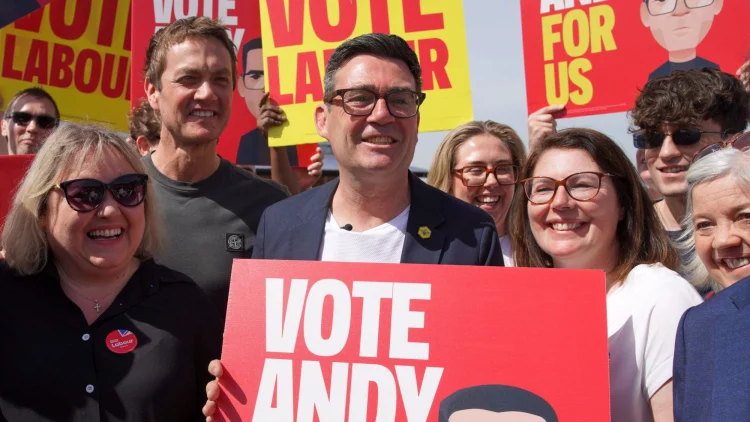

Andy Burnham’s campaign launch (AP Photo/Ian Hodgson/Alamy)

11 min read
Will Andy Burnham’s big by-election bet on Makerfield pay off? Sienna Rodgers talks to Labour MPs, insiders and activists who reveal the campaign strategy and what’s worrying them
Labour activists usually begin their doorstep conversations with the words, “Hello, I’m calling on behalf of your local Labour Party.” Not so in Makerfield, where Greater Manchester mayor Andy Burnham is relying heavily on his personal vote to return him to Westminster.
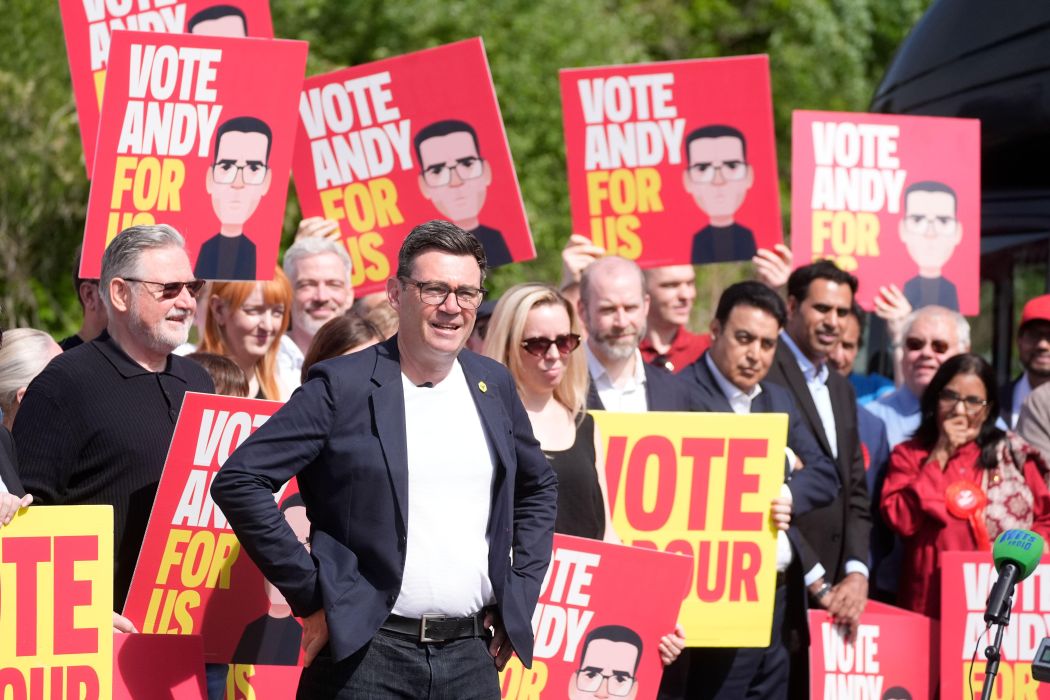
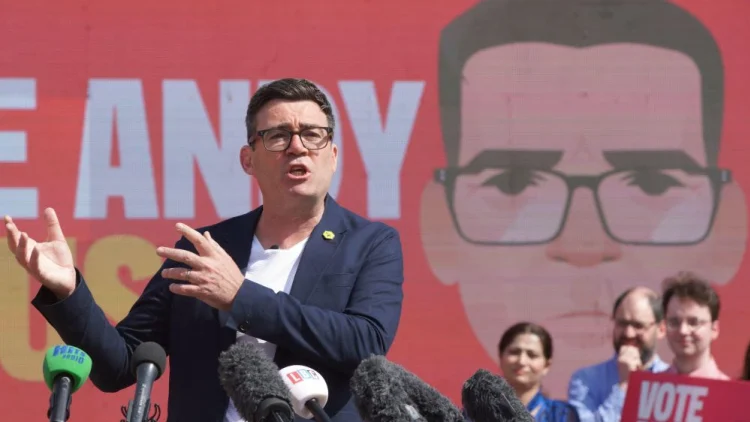
In the Wigan constituency, which has always been Labour-held but where Reform picked up 24 out of 25 seats in last month’s local elections, the governing party’s by-election message is focused squarely on Burnham. It is a cartoon of his face emblazoned across leaflets and Correx boards, along with the words “ANDY FOR US”. Labour branding is limited, pretty much, to what is legally required. Nobody in the party thinks Labour would have a chance of winning this contest with any other candidate.
Accordingly, Burnham has decided to prioritise his personal interactions with voters. Insiders say the campaign is cutting down on his media time in favour of door-knocking, meeting locals and having sit-downs – including with Reform voters. He won’t convince everyone in the room, they say, but he is determined to have “honest discussions”.
In that vein, Burnham has issued clear instructions that the campaign must aim to speak to every household in the constituency. Canvassing typically involves putting a targeting filter on voter data so that activists miss out the doors of those who have consistently opposed their party, in a bid to save time and concentrate resources where they are most useful. But Burnham wants every door knocked and to wait longer than usual before a more targeted approach is introduced in the run-up to polling day.
This approach means “difficult conversations” are frequent. Those who have been on the Makerfield doorsteps say they have been faced with a real mix of responses. “Not interested, mate” is the standard reply of Reform backers; “Can’t be bothered, I never vote” is that of the wholly disillusioned. But “I like Andy – I know what he’s done for the buses” is also heard.
Because while some voters are firmly Reform, others are desperate to block Nigel Farage’s party, and others still have voted Reform locally but say they will give Burnham their vote.
The Burnham factor is real, canvassers report – a finding backed by polling. The House is told that Josh Simons gave up his seat to make way for the mayor after hearing one too many times from voters that they were grateful for the work he was doing but could not vote for Labour – though they’d consider doing so if Burnham were leader.
Labour campaigners are emphasising that Burnham is a local man. “He grew up here, sent his kids to the local school and lives a stone’s throw away. He cares about the area, this is home, and he wants the change that the country needs to begin here – and look at his track record, he’s been a great mayor for Manchester.” These are the key lines. Burnham has lived with his family in the small town of Golborne, just outside the constituency, since his time as MP for neighbouring Leigh.
Fortunately for the Burnham campaign, given its level of ambition for seat coverage, it is not struggling for bodies: Labour people “from every corner of the country and every corner of the party” are joining the effort, as one source puts it. Party chair Anna Turley has asked all Labour MPs to canvass in the by-election twice during the campaign plus polling day.
High-profile figures close to Keir Starmer are not being discouraged from visiting, nor indeed are leadership rival Wes Streeting and his allies, who have been welcomed. (The former health secretary joined on the first weekend after Burnham had been confirmed as the candidate.) Turning out supporters is key and it’s “all hands on deck”.
North West Labour is a little tired, an insider points out, after being “stuck in a loop of by-elections for years”. Since the start of 2022, the region has been the site of more by-elections than any other (most recently Gorton and Denton, but previously Runcorn and Helsby, Blackpool South, Rochdale, Stretford and Urmston, and the then City of Chester). Many were easier in the sense that Morgan McSweeney had done the strategic work months or years prior – “you just had to execute it”, as the local Labour source puts it.
Still, Burnham has a bigger team around him than is typical for by-elections. There are not one but two ‘political leads’ – Anneliese Midgley, the trade union insider and Knowsley MP said to be highly trusted by Burnham, and Louise Haigh, the former Cabinet member who has championed Team Burnham in Parliament – as well as not one but two ‘campaign aides’ – David Baines and Sally Jameson, both 2024 intake MPs.
As ever, he also has his close political aide and friend, chief of staff Kevin Lee, who helps with messaging. Leigh MP Jo Platt, who acts as a liaison with the parliamentary party, is called upon for her local borough knowledge too. Simons, whose bold decision to vacate the seat triggered the by-election, is also involved and said to be “across everything”. And there is deputy leader Lucy Powell, who is focused on mobilising members, encouraging MPs to visit and fighting Reform in the ‘air war’.
Those dropping into the campaign from elsewhere are full of praise. “It was the first time I felt hopeful in months,” says one Labour MP. They would prefer to see Wes Streeting become the next prime minister, yet describe how refreshing they find “an election campaign with some energy” – one in which “you don’t have the albatross of Keir Starmer around your neck”.
“It felt like they really knew what they were doing in terms of the organisation. All the other by-election campaigns have also been really well-run, but the others have been well-run in spite of the national government,” they add.
“Within the Labour Party, everyone is knocking for the same purpose, and that purpose is getting rid of Keir Starmer. It’s been the cause that dare not speak its name for two years – ‘Keir’s a bit shit, isn’t he?’ – and now people are able to say it.”
Some of those closer to the Makerfield campaign are more critical. The House has heard complaints that there are “too many cooks” and it is unclear who exactly is holding the reins. These criticisms are aimed both at the local campaign and the parallel preparations for government. For the latter, Ed Miliband ally Miatta Fahnbulleh leads on policy, but there are lots of other voices vying for input.
Allies recognise the unfeasibility of running in a highly challenging by-election while preparing for No 10; of being attractive to Makerfield voters, the country and the party’s MPs and members all at the same time.
“There’s no signature policy. He’s appealing to Makerfield, he’s appealing to the country, and he’s appealing to the Labour Party. It’s impossible. He’s just got to pick one and it needs to be Makerfield,” says a pro-Burnham Labour MP.
It’s been the cause that dare not speak its name for two years – ‘Keir’s a bit shit, isn’t he?’ – and now people are able to say it
While the Labour mood is largely characterised by cautious optimism, there is a fear that voters’ minds could change quickly, even in such a short campaign, especially thanks to “the algorithms” shaping narratives. “Nobody thinks that this is in the bag, and you would be stupid to think that it is,” says a Labour MP close to the operation.
In the Greater Manchester constituency of ‘Makerfield’, there is no big town with that name. It is, in reality, a commuter area between Manchester and Liverpool that includes Ashton-in-Makerfield and Hindley, both with populations of around 25,000, and a number of villages. It is 97 per cent white and decidedly pro-Brexit; unemployment is low and home ownership is high. Flags are flown proudly and there is said to be a mix of views throughout the seat – far from the ‘constituency of two halves’ that is Gorton and Denton.
There are local issues: flooding, on which Simons is getting credit from locals after responsive casework when he was the MP; miners’ pensions, which have been boosted by the Labour government; Burnham’s help in getting an illegal waste site closed. But national, ‘big-ticket’ items are dominating, Labour sources say.
Reform’s campaign may be focused on local issues, but it is GB News and social media driving the narrative. And there is a worry that the government-prep side of Burnham’s mission could derail the contest.
This anxiety piles on top of many others, most notably that there is not much of a progressive vote to squeeze (the Lib Dems and Greens are largely non-events here) and that the locals showed there is a significant “shy Reform vote” in the area.
That Rupert Lowe’s Restore Britain is cutting through in the by-election – even bringing out activists on the ground who have been seen knocking on doors – offers Labour some reprieve in the short term, but little comfort beyond this battle.
One MP on the party’s left worries that, even if Burnham pulls off a victory, the story could be the combined Reform and Restore vote share. “If it were not for Restore, Reform would be ahead. That’s troubling,” they say. “The story will be that he came through, but with a split vote. That isn’t a narrative of victory – that’s a narrative of ‘you got lucky’.”
This Labour MP believes that Burnham should be making his distance from the Starmer premiership clearer – even going so far as to tell the Prime Minister not to visit Makerfield during the campaign, as he has promised (or threatened) to do.
“He needs to say, ‘I do not want you on my campaign’,” the MP urges. “Labour is dragging him down. Unless Andy is prepared to say, ‘I’m coming to take Starmer out’, it’s not cutting through,” they add. “Either you’re an insurgent or you’re not. He needs to come in going, ‘I won because I distanced myself from the shitshow that’s been the last two years’.”
But it is thought unlikely Burnham will make such feelings explicit or banish Starmer from the campaign. “It will be very carefully choreographed,” a different MP notes of the visit expected by the PM. “There will be a meeting where Keir is presented with some very trusted local Labour people, but let’s not fool ourselves – Keir is not going to go out knocking in Abram ward,” they add, referring to one of the more economically deprived bits of the seat.
The absurdity of a vote for Labour being a vote against the Labour Prime Minister in this by-election does not always arise, but these conversations sometimes happen organically. There is no official script to follow when they do, but some activists tell The House they reply with a wink-wink, nudge-nudge, ‘well-you-know-who-is-well-placed-to-kick-him-out’ answer.
If it were not for Restore, Reform would be ahead. That’s troubling
Conversations with Labour MPs and others about Makerfield all quickly turn to the impending leadership change. Ironically, those most keen on a coronation for Burnham have included some Starmer supporters: the less chaos, the better.
Streeting backers are fairly relaxed, while emphasising the need for a broad-church approach if Burnham gets in. “Everyone has accepted that anything’s better than the status quo,” one says. “There’s a really healthy respect between the Wes camp and the Andy camp. We looked at how the Tories did their changes and there was never any respect left. You always had a section who were eviscerated and left to go and lick their wounds until enough of their colleagues got pissed off again in six months’ time. I think we’re all aware that that can’t happen.”
Meanwhile, the Labour left MPs are clear that there must not be a coronation. “Not that I would support him, but I would hope that Streeting would say, ‘I am going to be contesting this’. You go to the party with two candidates – one a credible candidate of the centre left, one a credible candidate of the centre right – and they fight it out. That is the way the party should behave,” says one MP. “It didn’t work for Gordon,” says another, referring to Brown’s 2007 accession. “Andy would wipe the floor with any candidate, and he needs that, and the party needs to see that.”
Whatever comes next, everyone involved in Labour’s Makerfield campaign describes its outcome in apocalyptic terms. “It is existential,” says one. “If we can beat Reform in these circumstances, it’s a playbook for the country.” A Burnham-backing MP puts it more starkly: “If Andy does not win this, we’re all fucked.”

4 min read
Keir Starmer’s successor will face the same public pressure for instant results.
Pity Keir Starmer. Clinging on in Downing Street while a leadership contest in all but name rages around him. Forced to campaign for a man who hopes to oust him. Change is what he promised the British people, and a change seems to be what his colleagues now want. Whether that satisfies the electorate is another matter entirely.
The Prime Minister currently ‘enjoys’ the lowest satisfaction level of any PM since they started asking the question in the 1970s. Coupled with the disastrous results suffered by the Labour Party in recent elections, this has proved enough to bring simmering discontent with the Prime Minister to the boil. According to recent Stonehaven polling, only 47 per cent of 2024 Labour voters now think he should stay in No 10. The resignations of Wes Streeting and Jess Philips, plus a host of junior ministerial colleagues, coupled with the clear ambition of Andy Burnham to secure the top job, have piled the pressure on.
But would a change of leader help the party? The data here is mixed. Based on a simple question – how much more or less likely would you be to vote Labour if the party had a contest that elected a new leader – 35 per cent of 2024 Labour voters who have deserted the party declare they would not support the party even in this eventuality. 23 per cent say they would be slightly more likely to, 7 per cent much more likely, while 35 per cent want to wait and see who the winner is.
More sophisticated MRP modelling, which incorporates tactical voting, finds some 23 per cent of all voters are more likely to vote for the Labour Party under a leader other than Starmer (13 per cent slightly more likely and 9 per cent much more likely), while 12 per cent did not know. 42 per cent said they would not vote Labour irrespective of the leader.
On the surface at least, such shifts could have a significant impact. The Stonehaven MRP model projects the following seat distribution as its current base case: Reform UK 258 seats, Labour 154, the Conservatives 98, the Liberal Democrats 75, the SNP 32, the Greens 10 and Plaid Cymru 4.
Yet in a scenario in which voters who said they would be more likely to support Labour under a new leader switched their vote accordingly, that changes significantly. Under the most expansive scenario (whereby all those who said they would be “slightly” or “much” more likely to back Labour under a new leader do so), the equivalent numbers are: Labour 336 seats; Reform 151 seats, the Conservatives 45, the Liberal Democrats 70, the SNP 23, the Greens 3, and Plaid Cymru 4.
There’s a caveat. This modelling only captures voters who would be more likely to support Labour under a new leader. It does not account for those who might abandon Labour after a leadership contest. The figures should therefore be read as an indication of the ceiling of potential recovery rather than a forecast of Labour’s position under any specific alternative leader.
Now, on the one hand, these findings are significant enough to give some grounds for optimism that a leadership contest might lead to a polling recovery. On the other hand, they should be treated with caution.
It is remarkable how unpopular Starmer has become and how quickly. It is difficult to square what has clearly been a lacklustre premiership with the levels of dislike he has generated. 47 per cent of even Labour voters either dislike him or are neutral about him, which suggests that something more profound is going on.
And this is a longer-term malaise, a growing impatience on the part of the public with sustained failure to deliver prosperity. Britain is afflicted by a pervasive dissatisfaction driven by a long-term failure to generate economic growth. The current Prime Minister is carrying the can not only for his own mistakes but for those of his predecessors.
This suggests that the problem might not be specific to Starmer. Rather, we find ourselves trapped in a political economy doom loop. A stagnating economy has generated declining trust in politicians. This makes people less likely to tolerate short-term pain on the promise of longer-term progress. A consequent appetite for quick and easy solutions encourages short-termism that does little to address real structural problems. And on. And on.
There is little reason to suspect that Starmer’s successor will not be subject to the same pressures. Whatever polling bump they might enjoy will be fragile, and they risk falling victim to the same demand for instant results. Whether Labour sticks or twists, the need to deliver palpable improvements in living standards prior to their next appointment with the electorate will remain overwhelming.
Anand Menon is a Director at Public First and Director of UK in a Changing Europe


Lord Heseltine said Nigel Farage was ‘Donald Trump’s vicar in Britain’ (Photograph by Tom Pilston)

2 min read
Margaret Thatcher “would have hated” Nigel Farage and “would have had nothing to do with him” if she were alive today, her former cabinet colleague Lord Heseltine has claimed.
In an interview with The House magazine, the former minister in Thatcher’s Conservative government suggested that the late prime minister would have seen through the Reform UK leader’s “opportunism” and “prejudices”.
Farage, by contrast, said last year that there “isn’t any doubt” that Reform would have appealed to Thatcher. Following her death in 2013, he also declared that he was the only politician “keeping the flame of Thatcherism alive”.
The Reform leader, who was a Tory member in the 1980s while working as a commodities trader in the City, has said that Thatcher was a “great inspiration” to him.
But asked what opinion Thatcher might have had of Farage and his political project today, Heseltine told The House: “She’d have hated him.
“Nigel Farage will assimilate himself with anyone he thinks has got a resonance in public opinion. He is Donald Trump’s vicar in Britain…
“But the origins of ‘Nigel Trump’ are a guy with a beer tankard and a fag. Then the farmers get into trouble, and he turns up looking like a farmer – and this is all a communications process. Successful, but based on opportunism, based on a degree of prejudices which I find abhorrent. She would have had nothing to do with him.”
Speaking to The Spectator last year, Farage claimed that “it was made very clear” to him that Thatcher had voted for his previous political outfit, UKIP, in the 1999 European elections.
In a 2024 interview with The Telegraph, the Reform leader argued that both he and Thatcher were conviction politicians, praising her as “a fighter who stood up and fought for issues, not because focus groups told her she should, but because she believed it was the right direction to go in…
“So if there was a similarity, it’s being unafraid to fight for things that may not be trendy today but may well become so in the future.”
The House magazine’s full interview with Lord Heseltine will be published in print and online in June.
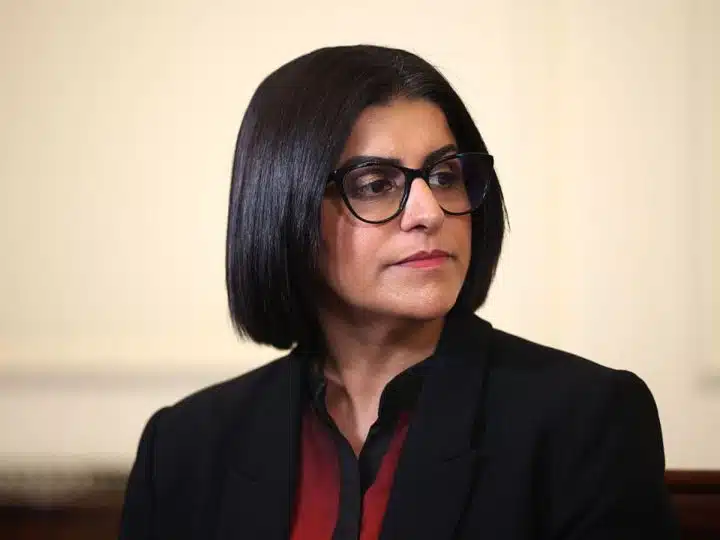

In a ruling handed down yesterday by the High Court, Home Secretary Shabana Mahmood’s cruel policy to force victims of torture to share rooms with strangers has been deemed unlawful.
Justifying this pretty damning ruling, the court judgement states that Mahmood’s:
failures amount to a serious breach of the Defendant’s public law duties, rendering the impugned policy changes unlawful.
These failures refer to the fact that Mahmood did not instruct any consultations before introducing such an impactful policy change and also gave little consideration for the impacts of this policy on victims of torture, trafficking and other serious violence.
Moreover, she didn’t even engage with “established evidence of clinical risk”, thus the court decided Mahmood has acted in breach of the Public Sector Equality Duty (PSED).
Finally, they also called out the Home Secretary failing to ‘properly inform herself’ of the subsequent impact of the Allocation of Asylum Accommodation policy on vulnerable survivors of torture, trafficking and serious violence, despite:
long standing, consistent evidence of the serious risks of harm faced by this cohort.
All in all, a pretty damning day for increasingly hostile Shabana Mahmood, but at least it’s a good day for justice in the UK.
UK Government acted unlawfully by forcing torture survivors to share rooms, the High Court rules
The judgment is a blow to Shabana Mahmood’s plans to send more asylum seekers to army barracks https://t.co/9vpqtRfTN2 — Socialist Voice (@SocialistVoice) May 29, 2026
Estimated 10k survivors of torture in shared accommodation, says charity
This ruling will undoubtedly have a stymieing impact on Mahmood’s plans to kowtow to far right influences. The government implemented this policy in an apparent attempt to win favour with right-wing tabloids and far-right voters by moving asylum seekers out of inadequate hotels and into disused army barracks — an even harsher and more hostile environment.
However, her plans to move vulnerable asylum seekers out of hotels entirely by the end of this parliament now lie in jeopardy — unless she works to find a solution which is actually legal and finds some semblance of compassion in her increasingly cold, cruel heart.
The charity Freedom From Torture (FTT) have provided estimates that potentially 10k asylum seekers housed in shared accommodation could be impacted by this ruling.
Furthermore, the associate director of advocacy for FTT, Natasha Tsangarides, has welcomed this “vital and resounding victory”, stating:
The judgment makes clear that the government acted unlawfully in changing its policy.
We have seen the consequences of those changes: survivors of torture have been placed in harm’s way.
The claimants in this case were FTT and the Helen Bamber Foundation (HBF), who both work with asylum seekers who have escaped physical and psychological abuse. Their argument detailed how, prior to the policy introduced in February 2024 under the last government, there had been a “protective presumption” that survivors would be safe from such cruelty.
Director at the HBF, Kamena Dorling, told the Guardian that the “terrible living conditions” in the UK asylum system has made helping survivors of torture and trafficking even harder, adding:
The decision to force more vulnerable people into large accommodation sites and shared hotel rooms was a political choice that ignored the evidence from those working with refugees every day.
Nevertheless, the Labour government have continued to force them to share rooms and did not consult either charity in its decision to continue with such an obviously harsh policy.
Shabana Mahmood — AI facial recognition now to commence
Mahmood doesn’t stop there with her cynical attempts to create a hostile atmosphere for asylum seekers. Awarding a £322k contract to a Harlow-based IT company Akhter Computers, Mahmood’s Home Office will now be using AI to determine the age of asylum seekers who say they are under 18.
Because unaccompanied children seeking asylum often receive different treatment when applying for safe haven — because most compassionate people would find it quite stomach-churning to turn vulnerable children away — but this now appears to be the next defenceless group facing political targeting.
A report last year found that staff in Dover carried out previous tests without adequate training, making it inevitable that officials might wrongly assess some children’s ages. Nevertheless, it is hard to understand how AI would be able to determine this more accurately.
Therefore, in practice, it’s likely to be yet another tool to make desperate people feel unwelcome, untrusted and unworthy to be in the UK.
Featured image via Dan Kitwood/Getty Images)
Politics
Epstein survivors fear reporting information about Andrew due to lack of faith in British police and media
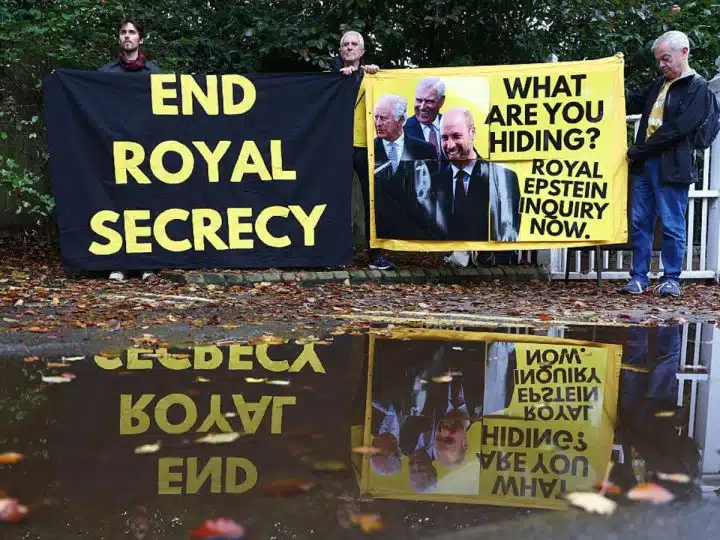

Citing the lack of action taken by police authorities when Epstein was alive and the harassment seen in the British press, an American lawyer representing “multiple clients” has said these Epstein survivors will not speak to the police in the UK.
Women who potentially have important information regarding disgraced paedo-prince Andrew Mountbatten Windsor appear to feel unsafe at the prospect of coming forward. This relatable fear stems from a lack of faith in how the British police and the UK mainstream media would handle the case.
Moreover, Brad Edwards highlighted the impact of subsequent press intrusion seen against a woman he represents — in which UK journalists chose to investigate the woman and her wider family, saying:
Other victims took notice.
Consequently, the multiple clients prepared to speak to that allegation have effectively been intimidated into silence.
This underscores further how the mainstream press and the British state continue to protect powerful men, whilst perpetuating the culture of silence around sexual abuse and Epstein survivors generally.
Onus on Epstein victims to expose themselves rather than on authorities to investigate
It is worth noting that Brad Edwards has long challenged this system of power and influence which prefers to ignore victims.
Spending over a decade fighting for justice and representing more than 30 Epstein survivors, Edwards said in 2020:
The government enabled this. They knew what he was doing and they let it continue.
Brad Edwards represented more than 30 Epstein survivors.
"The government enabled this. They knew what he was doing and they let it continue."
Edwards spent 11 years in court fighting for victims the system chose to ignore. pic.twitter.com/PFyfZbddVF
— Epstein File Search (@epsteinsearchin) April 8, 2026
It appears, due to the intimidating impact of an untrustworthy police force and our cruel, sensationalist media, that the state not only enabled the abuse in the first place — but continues to shield the very perpetrators by putting the responsibility on victims to give up their own right to privacy.
Frankly, these women have already had their right to privacy stolen from them by Epstein and his posh-paedo, pervy pals — yet the press and state seem more interested in upholding Andrew’s privacy instead.
As Edwards has underscored, he represents a woman who alleges that Epstein trafficked her in 2010 to the Royal Lodge — the then-prince Andrew’s official residence — for sex with him. However, she has not yet formally reported the allegation to the police, and she may never do so because an intimidating atmosphere leaves survivors vulnerable to further unwarranted abuse.
Thames Valley Police issued a statement last week, updating on the allegations raised originally in February:
Should she wish to report this to police it will be taken seriously and handled with care, sensitivity and respect for her privacy.
Since then, the police have also updated that they have contacted Edwards, confirmed by the lawyer to the BBC, but that:
her lawyer had said she would not communicate with police over fears regarding her privacy.
Consequently, this once again draws an even greater issue to the forefront of public debate — the way our system treats victims of abuse.
Epstein files — When will protecting women matter more than powerful men’s reputations?
Rape cases in the UK see pretty abysmal statistics, in which only a small minority make it to trial and a subsequent conviction. Instead, victims are made to relive their deep trauma, exposed and vulnerable, and more effort is made to understand why the offender did what he did rather than remotely centre the lifelong impact on victims.
However, rapes themselves have increased by 511% in just two decades — and that’s with a significant number of silent cases where 5 in 6 of women and 4 in 5 of men don’t report. This just reinforces the reality that people in the UK doubt that the system will give them the dignity and safety they are long overdue.
For instance, victims of rape and sexual abuse often suffer psychological abuse from the perpetrators. Thus, they face an uphill struggle to learn that there is nothing any woman — or girl — can do which justifies sexual abuse or violent behaviour against them.
They didn’t ‘bring it on themselves’ like our patriarchal system wishes to reframe it as — but our criminal justice system instead unwinds that healing process and drags victims back to square one.
Another US lawyer representing survivors, Sigrid McCawley, who also represented the former prince’s most renowned accuser Virginia Guiffre, has told BBC News that the Metropolitan Police have made no efforts to contact her.
McCawley has long fought for justice for survivors of Jeffrey Epstein and has played a prominent role in campaigning for the release of the Epstein Files:
— Harry Sisson (@harryjsisson) August 1, 2025
 WOW: Sigrid McCawley, who represented a number of Epstein victims, just revealed that Trump LIKELY saw Epstein with young girls and knew what he was doing “Anybody who was operating in that sphere, who was socializing with him, would have seen him with young individuals.” pic.twitter.com/urgixASAW9
Right to anonymity IF you go public — a sick contradiction
Since then, a spokesperson for the National Police Chiefs’ Council said:
As part of the UK policing response, efforts have been made to contact victim-survivors who have already chosen to share their experiences publicly.
In some cases, this has involved engagement with legal representatives; however, we recognise that we have not yet been able to reach everyone and our efforts continue.
We understand that coming forward can be incredibly difficult, and we want anyone affected to know they can do so in their own time, when they feel ready. Our door remains open.
Should any victim-survivors choose to contact UK policing, they will be treated with care, compassion and respect, with their wellbeing, privacy and right to anonymity at [the] centre of our response.
Needless to say, the NPCC’s comment regarding ‘right to anonymity’ is a bit redundant if they are only looking to victims who have gone public. It is entirely foreseeable, and understandable even, that victims of abuse will shy from publicly naming their abuse and its perpetrators due to the intimidating impact of our media and its trolls.
After all, survivors know that putting themselves through that process would likely compound their trauma, while offering only the thinnest possibility of finding justice in the UK.
This sinister status quo must end — women and girls deserve better
It is clear that survivors of abuse in the UK often feel they must protect themselves from the very institutions and people who are supposed to support them.
Media coverage of that reluctance only reinforces the widespread belief that reporting sexual abuse or rape in the UK is pointless, because the system so often places survivors under scrutiny while offenders escape meaningful accountability.
Once again, powerful institutions uphold the status quo by prioritising the reputation of influential men — and, in this case, the elite and privileged monarchy they belong to — over women’s pain and suffering.
Featured image via Peter Nicholls/Getty Images


Failure to vote for Israel in the Eurovision song contest is antisemitic — according to Australia’s Senate. Ozzie senators are apparently untroubled by Israel’s blatant rigging of public and panel votes. But they are deeply alarmed at the fact that Australia’s official judges dared to give the genocidal colony ‘nul points’. So much so that they want an investigation into the non-scandal:
Eurovision — colonial nonsense
Israel, of course, is not in Europe. Neither is Australia, which just goes to show what a colonial nonsense the whole thing is. Audiences are waking up to it, apparently, with viewer numbers collapsing and several core nations boycotting the whole thing.
US-Jewish journalist and commentator said the situation was “beyond parody” and a prelude to obligatory Israel-support in future contests:
Beyond parody at this point. They already eroded their free speech laws to protect Israel. Next: mandatory voting for Israel in song competitions.
Better than even odds that the UK gets there first, mind.
Featured image via Christian Bruna/Getty Images
By Skwawkbox


WHAT A DIFFERENCE A FEW YEARS MAKE: When state Sen. Jabari Brisport ran for City Council in 2017, he promised that, if elected, he would forgo most of his government salary.
In social media posts, candidate questionnaires and even on his own campaign website, Brisport argued it isn’t reasonable for Council members to pull $148,000 annually when working class New Yorkers survive off far less. So he pledged in a Citizens Union questionnaire that he would cut his wage down to $47,000 — the median income in Brooklyn — and distribute the surplus to his staff so they’re “paid adequately.”
“I’m the only candidate not only talking the talk about income inequality and calling for higher taxes on the wealthy, but also walking the walk and pledging to slash my own salary to the median income of Brooklyn,” the democratic socialist said in an April 7, 2017 interview with Gothamist. “It’s a socialist plank.”
But Brisport — who’s facing a primary challenge this year — quietly walked off that plank once he actually got elected to public office.
After losing his 2017 Council race, Brisport switched gears and successfully ran for state Senate in 2020 — and he has never given up part of his legislative salary since taking office in January 2021, according to a Playbook review of payroll records.
In fact, Brisport even voted to increase pay for himself and other lawmakers in 2023, bumping the salary floor from $110,000 to $142,000, records show.
The 2023 raises made legislators in Albany the highest paid state lawmakers in the nation. Yet despite his 2017 campaign commitment, Brisport has drawn his full salary every year since being elected. As of fall 2025, he had in total raked in more than $607,000 in government salary — in addition to about $100,000 in taxpayer-funded travel stipends, records show.
When asked why he never stuck to his 2017 promises, Brisport suggested Thursday he had a change of heart upon launching his state Senate campaign in 2019.
“When I ran for state Senate I decided to focus on fighting for higher wages for working class people and making New York more affordable for everyone,” Brisport told Playbook.
Brisport, who represents a swath of Brooklyn that includes Bedford-Stuyvesant and Clinton Hill, faces a challenge in the June 23 Democratic primary from community activist Marlon Rice, who’s running on a more moderate platform than the incumbent.
Brisport is a close friend, political ally and former roommate of Mayor Zohran Mamdani.
Mamdani has yet to offer an endorsement for Brisport. But a person close to the mayor recently told Playbook he plans to roll out a slate of state-level endorsements in the coming weeks. — Chris Sommerfeldt
From the Capitol

BUDGET REFORM’S LONG ODDS: This year’s budget was the tenth-tardiest in state history, leaving legislators disgruntled with the governor’s lopsided power over the process.
“Members are really tired,” said Assemblymember Anna Kelles, who’s sponsoring one of several proposed constitutional amendments seeking to reduce the governor’s powers. “It’s not just that people are angry. It’s been year after year, and it’s affected our ability to do our job.”
Still, as has been the case after contentious budget processes in years past, the odds remain long that lawmakers’ displeasure will turn into drastic changes anytime soon.
“Do I support a change in the budgetary powers? Yes, personally I do,” Assembly Speaker Carl Heastie said last month. “But you pass a constitutional amendment. Now this is the tough part: Now you’re in a campaign, the governor versus the Legislature. Who’s paying for that?”
If an amendment doesn’t receive first approval by next week, it’ll be too late to enact one that applies to any budget before the spending plan for the 2031 fiscal year.
Lawmakers could pass statutory changes later this year or in January, though. They’ve discussed treating the governor like they’re treated when budgets run late through withholding her paycheck until talks are done. But that would serve as a mostly symbolic move, at least under a governor with a seven-figure household income and a mansion subsidized by taxpayers. There are also technical changes backed by budget wonks such as moving the due date to July, but those wouldn’t necessarily address the power imbalance.
“My expectation is there are going to be at least informal conversations after we’re done with session, ahead of the budget process next year, about how this process can work more fairly,” state Sen. James Skoufis said. “But it’s one of those things that, after so many years of banging this drum, I’ll believe it when I see it.” — Bill Mahoney
‘THANK YOU, GOV’: Gov. Kathy Hochul didn’t give the immigration advocates everything they wanted, but they’re not raking her over the coals for it.
“I’ll say it 100 times: New York is not a sanctuary for criminals, and we will cooperate when crimes are being committed,” Hochul said today while hailing new measures in the state budget that push back against ICE’s aggressive enforcement tactics.
The new policies include a ban on ICE agents wearing masks, a measure to block them from entering sensitive locations like schools and churches without a judicial warrant and an end to official agreements between localities and federal law enforcement, which have allowed counties to lend their jails to ICE.
But the final budget deal does nothing to prohibit law enforcement from informally tipping off ICE when someone undocumented commits a crime, something that’s explicitly prohibited in the New York for All act that advocates have pushed for.
Still, groups like Make the Road New York and the New York Immigration Coalition are joining in on Hochul’s party.
“We commend the Governor and Legislature for passing this package, and for creating new meaningful protections for immigrant New Yorkers,” said New York Immigration Coalition President and CEO Murad Awawdeh.
“This is really meaningful to us,” Make the Road New York’s co-executive director Natalia Aristizabal said during the event. — Jason Beeferman
FROM THE CAMPAIGN TRAIL

WHY WFP DIDN’T ENDORSE: Rep. Adriano Espaillat’s record on Israel cost him an endorsement from the Working Families Party, according to two people familiar with the matter.
The people, granted anonymity to discuss internal party decisions, told Playbook that Espaillat’s refusal to support the Block the Bombs Act was a major problem for the party, which ultimately decided not to weigh in as he faces a challenge from democratic socialist Darializa Avila Chevalier in NY-13. The legislation would prohibit the sale of military equipment to Israel until the country guarantees compliance with international law.
Mamdani endorsed Chevalier on Thursday night, a move that has injected energy in a race that was previously viewed as an uphill climb for the democratic socialist. She has been fiercely critical of Israel and its war in Gaza since the start of the race, and has criticized the hundreds of thousands of dollars the incumbent Congress member has accepted from the American Israel Public Affairs Committee over the years.
“I think Espaillat missed the moment,” one of the people told Playbook. “There was a moment — there still is a moment — to evolve, and he didn’t. And now he has a real race.”
The second person said the Working Families Party did appreciate how Espaillat, the first formerly undocumented person elected to Congress, has led the charge on immigration from the House, but his inability to support the weapons sale bill caused concern among its members.
Meanwhile, Hochul took the opportunity today to praise Espaillat after Mamdani’s endorsement.
“I’m not commenting on why other people do what they do,” Hochul said. “I don’t think anyone has done a better job than Adriano Espaillat, and that’s important to know. This is not intended to set up a collision course of who’s endorsing who. I support long-standing allies … and the people that I believe in. — Jason Beeferman
PAC IT UP: An independent expenditure committee backed by a prominent Albany-based lobbying firm is ready to spend big in a handful of legislative races.
New York Forward, the group backed by the firm Brown & Weinraub, is expected to spend “several hundred thousand dollars” in several races. That includes backing the state Senate bid of Assemblymember Grace Lee, who’s running for the seat being vacated by retiring Democrat Brian Kavanagh.
The group is also providing get-out-the-vote support for state Sen. Joe Addabbo and Assemblymembers Catalina Cruz, Andrew Hevesi and Jordan Wright.
“New York Forward was created to support candidates who do the hard, constructive work of governing,” said Evan Rantzaklis, who is leading the effort for Brown & Weinraub. “That means backing leaders who deliver for their districts, build coalitions, and take their responsibilities seriously. These first expenditures reflect exactly that mission.” — Nick Reisman
THE DEBATE DEBATE: One of the city’s more under-the-radar primaries seems like it won’t be getting a debate.
The New York City chapter of the League of Women Voters said it’s canceling a planned face-off between Democratic Rep. Grace Meng and former diplomat Chuck Park, who’s running to the incumbent’s left. Kai Rosenthal, the chapter’s co-president, cited “many conflicts and short timing” for the cancellation.
Park is blaming Meng.
“Over the course of a month, we accepted all of Rep. Meng’s requests for new dates, a new venue, and a shorter time, but she was still unwilling to make it work,” he said in a statement. “If she’s ready to face the public, she can name a date and time, and I’ll be there.”
A spokesperson for Meng’s campaign pushed back, saying she “worked in good faith to make a debate happen.” In an email this morning responding to the cancellation, Meng campaign manager Harry Brussel wrote that the campaign is “truly sorry to hear that the debate won’t be possible” and asked to be kept apprised “if circumstances change.”
“It’s disappointing it didn’t come together,” Meng’s spokesperson continued in a statement to Playbook. “But this has been a long campaign and voters know full well what their choices are. They know Grace works hard and delivers and that Chuck complains about process.” — Madison Fernandez
IN OTHER NEWS
— RED LINE: A contentious NY-21 Republican primary between Robert Smullen and Anthony Constantino was on full display Thursday, where sharp debate exchanges ended with a snubbed handshake. (Times Union)
— PRIME EXAMPLE: Court filings by Attorney General Letitia James and the Teamsters union in Amazon’s challenge to a New York labor law defended state action, citing yearslong delays and dysfunction by the federal labor board. (amNY)
— ACT NOW, REVIEW LATER?: New York City’s child welfare agency is facing a class-action lawsuit from families alleging it removes children without prior court approvals. (The New Yorker)
Missed this morning’s New York Playbook? We forgive you. Read it here.


With only a few days to go before the start of the 2026 World Cup in the United States, Canada, and Mexico, the features of the main contenders competing for the global title have begun to take a clearer shape. This comes amid an exceptional struggle between two generations: the generation of legends approaching the final curtain of their careers, led by Lionel Messi and Cristiano Ronaldo, and the new dominant generation led by Kylian Mbappé, Lamine Yamal, and Vinícius Júnior.
The Canary has identified the top 7 teams leading the title expectations, considering the quality of names, stability, and recent results — in addition to historical backgrounds and special stories that give each team different motivations heading into the tournament.
France — Deschamps’ final World Cup
The French national team enters the tournament as one of the most stable teams in the world, after Didier Deschamps maintained his project since 2012, leading the “Les Bleus” to the 2018 World Cup title and the 2022 final.
France possesses a massive offensive arsenal led by Kylian Mbappé and Ousmane Dembélé, alongside a group of players capable of making a difference in quick transitions, which has helped the French team maintain a constant presence in the final stages over the last decade.
However, the biggest challenge for France lies in maintaining defensive balance, especially against teams that excel in pressing and possession, in addition to the factor of mental fatigue after many years of continuous competition for all trophies.
The approaching end of the Deschamps era also gives the French team additional motivation, given reports that the 2026 World Cup will be the final stop for the coach who returned France to the top of the world.
Spain — A youth revolution led by Yamal
As for Spain, it enters the World Cup with a completely different image from the 2010 edition in which it won its only global title. “La Roja” currently relies on faster and bolder football, with a young generation led by Lamine Yamal—one of the most prominent rising talents in world football—alongside Nico Williams and Pedri.
The Spanish national team possesses a flexible technical system that combines traditional possession with direct play, in addition to a midfield capable of controlling the rhythm of matches, making it appear as one of the most developed European teams in recent years.
Despite this, the lack of World Cup experience among several young players remains the biggest question mark, especially with the expected pressure in the knockout stages.
Argentina — Messi’s dream ending
The Argentine national team enters the tournament with a historic ambition to retain the World Cup title it won in the previous edition in Qatar, following achieving the title previously in 1978 and 1986.
Argentina appears to be one of the most cohesive teams collectively, after coach Lionel Scaloni succeeded in building a balanced team that combines fighting spirit with tactical discipline, in addition to the experience the players gained after the Qatar World Cup triumph.
The most prominent story remains tied to Lionel Messi, who is making his final appearance in the World Cup in an attempt to end his career in a new historic fashion, amid questions about the team’s ability to maintain the same physical and mental pace until the end of the tournament.
England — It’s coming home?!
Despite the English national team possessing one of the strongest generations in the world, the “Three Lions” are still searching for their first World Cup title since 1966.
The English team has a huge offensive power led by Harry Kane, alongside a large group of stars capable of making a the difference, which has kept the team constantly present in the advanced stages during recent tournaments.
However, the chronic problem for England remains more mental than technical, as the team has become accustomed to retreating in decisive moments despite the abundance of names and experience.
Portugal — Ronaldo’s sixth World Cup
Portugal appears to be one of the most complete teams in midfield, with names like Vitinha, João Neves, Bruno Fernandes, and Bernardo Silva—elements that grant the team a great ability to control matches and create opportunities.
The Portuguese national team also enters the tournament amid global interest in Cristiano Ronaldo’s participation in the World Cup for the sixth time in his career, a nearly unprecedented historic record for players.
Despite the abundance of technical quality, the most important question remains linked to Portugal’s ability to translate control and possession into decisive offensive effectiveness against top teams, especially since they have never won the global title in their history.
Brazil — The Ancelotti era
Brazil enters the tournament amidst a new phase under the leadership of Italian coach Carlo Ancelotti, who seeks to return the “Seleção” to the podium that has been absent since 2002.
The Brazilian national team has one of the strongest offensive systems in the world, with Vinícius Júnior and Raphinha, in addition to the return of Neymar to give the team more experience and individual solutions.
However, Brazil is still required to find the appropriate defensive balance, especially in big matches, after the team suffered in recent editions from clear fragility against tactically organized teams.
Germany — making a return?
Germany enters the tournament with a clear desire to restore its historical prestige after consecutive group-stage exits in the 2018 and 2022 editions.
Coach Julian Nagelsmann is leading a new project that relies on high pressing, speed, and offensive transitions, with a group of stars led by Kimmich, Havertz, and Musiala.
Despite the clear improvement in the team’s character recently, doubts still surround Germany’s ability to regain the champion’s mentality, especially after years of lost confidence and fluctuating results.
Who will lift the 2026 World Cup title?
Between France’s desire to continue its dominance, Argentina’s ambition to retain the title, England’s quest to end a historic curse, and Brazil and Germany’s attempts to reclaim glory — the 2026 World Cup is poised to be one of the most exciting editions in the tournament’s history.
The upcoming tournament may not just be a competition for the golden trophy, but a direct confrontation between the final era of legends and the new generation preparing to impose its control on world football for years to come.
Featured image via Manuel Velasquez/Getty Images
By Alaa Shamali
Politics
Jeffrey Sachs: ‘Britain is the number one warmonger of all’ and driving escalation with Russia


Commentator Jeffrey Sachs said in an interview on Wednesday that he would advise Britain to focus on keeping the National Health Service (NHS) from collapsing rather than going to war with Russia.
Sachs added that Britain is the ‘number one warmonger’ driving dangerous escalation between Ukraine and Russia. He was pointing to Britain’s role in arming Ukraine and providing it with intelligence.
He said:
Britain, of course, is the number one warmonger of all. Britain still lives in the dreamland of the British Empire. And it wants to escalate at all times.
Sachs was condemning the escalation by Ukraine, which struck a school dormitory in Russia last week.
Russia’s human rights commissioner, Yana Lantratova, said 86 teenagers between the ages of 14 and 18 had been asleep inside the hostel belonging to Luhansk Pedagogical University’s Starobilsk school when Ukrainian drones attacked during the night. At least 21 children have been killed by the attack.
Sachs called the attack “a human tragedy” and “an extraordinarily dangerous provocation,” and lamented that Russia signaled a dramatic military escalation in response.
Britain — the number one warmonger
UK is indeed great at warmongering. Just this week, Former special forces soldier-turned-defence minister Alistair Carns boasted on Wednesday that drones were the “most effective killing weapons” at a summit in Riga, Latvia.
Carns said the UK delivered £600 million worth of drones to Ukrainian forces last year, increasing numbers by a factor of ten from 10,000 in 2024 to 100,000 in 2025.
According to Sachs, de-escalation is still possible — but it requires Europe, and particularly Germany, to take responsibility.
Sachs pointed to the open letter he has published to German Chancellor Merz in the Berliner Zeitung this week.
Sachs laid out six serious failures of German foreign policy toward Russia since reunification in 1990. He argues that Germany must confront these failures before it can pursue peace.
6 points for Germany
According to him, the six points for which Germany bears the responsibility are:
- The Two Plus Four Agreement and the eastward expansion of NATO — Germany promised the Soviet Union that NATO would not expand eastward in exchange for reunification, and yet, as early as 1993, German politicians began to break these assurances.
- Chancellor Merkel’s own statement — Merkel wrote that inviting Ukraine into NATO would be a “declaration of war against Russia,” yet she yielded to US pressure.
- The betrayal of the 2014 agreement — Germany helped broker a peace deal in Kyiv, then failed to enforce it when Yanukovych was overthrown in a coup within 24 hours. Following the example of the United States, Germany supported the new government as if no agreement had ever existed
- Minsk II — Merkel later admitted the 2015 agreement was used merely to give Ukraine time to rearm, not as a genuine peace plan.
- Nord Stream — Evidence points to a joint Ukrainian-American operation, yet Germany allowed blame to be shifted to Russia.
- The Istanbul Agreement of April 2022, which was within reach — Ukraine agreed to neutrality in April 2022, but the UK’s then Prime Minister Boris Johnson flew to Kyiv and instructed Ukraine not to sign. Germany remained silent.
In the interview, Sachs presses that direct negotiation between Berlin and Moscow as “the only real exit ramp from disaster.”
Sachs is right — the best thing the UK can do so the war is not escalated is to concentrate on the state’s own failings.
Featured image via Reuters
By The Canary
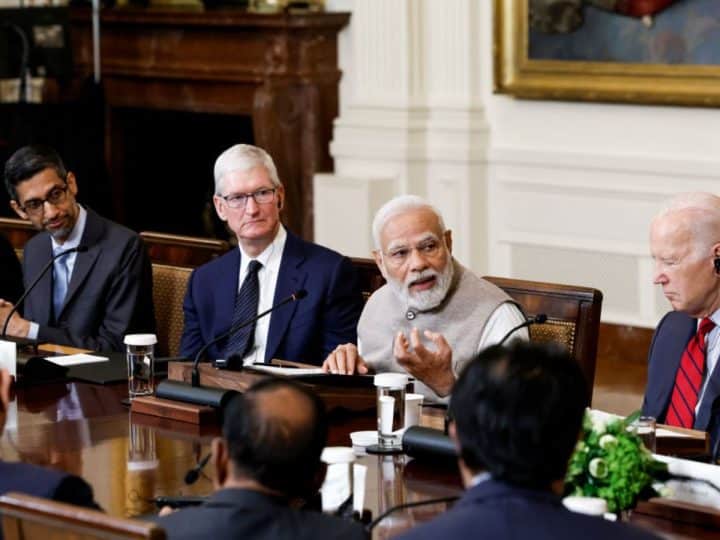

US Deputy Secretary of State Christopher Landau recently said the quiet part out loud, stating that the US will not let India develop like China.
Landau’s remarks are honest about what the USA sees India as: a periphery country, needed to extract profits from by exploiting its low wages, decimating its environment, and plundering its resources.
This is similar to how Britain, in 1947, used the sterling balances negotiations to restrict India’s industrial development.
Though Britain owed India over £1 billion from World War II, Whitehall froze these funds. Britain leveraged “informational asymmetries while Indian sovereignties were in flux,” which ensured India could not use its own savings for industrialisation while keeping the country formally independent.
India’s Hindutva government, a global far-right project (along with US tech companies), reflects this US strategy.
China, with its massive state planning, has not allowed Google and other American companies to serve as virtual town halls or squares the way they do elsewhere, including in the UK. UK elites like Rishi Sunak, Peter Mandelson, and Tony Blair are deeply embedded with US tech, too. For example, Starmer’s adviser held 16 undisclosed meetings with top US tech bosses.
Google AI data centre — a calamity for locals
An example of Hindutva’s red carpet to US tech, helping super-profits for US monopolies and creating a new dependent relationship with the Global South, is Google’s AI data centre in the sleepy town of Visakhapatnam. Google, which is working on the project with Indian cronies — Bharti Airtel and Adani Group,
The hub is India’s first facility built for a US tech giant to train large-scale AI models. It will sprawl across 600 acres and, at full tilt, consume as much electricity as six million Indians.
According to the Polis Project:
In India, data centres are being granted uninterrupted power and water even as nearby poor communities struggle for basic access, and Dalit families in places like Mumbai and Visakhapatnam are reporting eviction pressure, land acquisition, and dispossession tied to this buildout.
View this post on Instagram
Trump’s racist remarks on India
Hindutva’s obsequiousness to US firms, despite Trump recently calling India a “hellhole,” is because of the material interests of its elites. Just like the UK elites, the Indian elites have sold their souls to greed.
Professor Radhika Desai explains that elites in BRICS countries, including India, are too invested in the dollar system. They park their money there as their “treasure island,” which slows down dedollarisation and deepens their dependent relationship with US capital.
India recently welcomed Marco Rubio, who is Landau’s boss, and promised to buy $500 billion in American goods. Again, capitulating to US interests while India faces a huge crash in the rupee due to Trump’s own choice of war on Iran.
It could be that Rubio is prone to exaggerations like his boss, Trump, though, at least that is what Professor Ashok Swain quipped.
Indians don’t have money to buy gold, don’t have money for foreign travels, no gas, no petrol, Rupee is falling against dollar every day, Marco Rubio still thinks, Modi will buy $500 billion of US goods! https://t.co/w19HY94Akp
— Ashok Swain (@ashoswai) May 23, 2026
People’s Dispatch also questioned the nature of Rubio’s visit.
View this post on Instagram
They said:
The political opposition in India has also found Modi’s government’s approach to the US problematic, often describing it as aimless and bordering on capitulation. They have questioned the failure of the state to defy US dictates of not buying oil from Russia or Iran, which is relatively cheaper and easier to transport than oil bought from the US.
Israel as the ‘Fatherland’
US-backed Israel had few nicer things to say about India. In a recent interview, Netanyahu said that in India, the love for Israel was “crazy.”
Netanyahu:
I’ll say this: we face delegitimization in much of the world — but not in India.
In India, there is an absolutely crazy love for Israel, truly crazy.
I think I have more followers from India than from anywhere else. pic.twitter.com/FRIo2cdVb3
— Clash Report (@clashreport) May 28, 2026
Again, Israel — which views itself as a part of the Global North — does not view India as an equal. Netanyahu’s appreciation lies in the fact that Israel wants access to cheap labour in India.
Israel’s Brigadier General Erez Winner, in an honest moment, as Landau said, said that India’s population was a ready-made production line for Israeli weapons. He guffawed after making this statement.
Modi infamously called Israel the “Fatherland” in his trip to the country just before it started bombing Iran with the USA.
The consequences of this war of aggression against Iran, a supplier of oil to India, are the fertilizer and food shortages India is currently facing.
India’s Frontline said that Modi calling Israel the Fatherland to India’s Motherland would go down in “history as the moment when India abandoned ethical diplomacy for performative mysticism in order to signal support to all anti-Muslim formations.”
The US-Israel tech alliance can be viewed as two core states functioning as a single war-tech apparatus — whereas India remains a peripheral host, forced to roll out the red carpet for US monopolies while its own people are dispossessed.
For example, US tech has backed Israel’s AI-powered genocide of Palestinians through Project Nimbus — a $1.2 billion contract to provide cloud computing services for the Israeli government and defence establishment by Google and Amazon.
Michael Kwet of Yale Law School said it well:
Big Tech corporations are modern-day East India companies; they are an extension of American imperial power. They colonise the global digital economy and reinforce the divide between the North and the South.
Landau was right. US tech firms have no interest in a developed India. They need cheap labour, plundered resources, and captive markets, not a rival.
Better to take the words of Landau, Trump, and Erez Winner at face value, of what they see as India’s role in the global economy.
Featured image via Anna Moneymaker/Getty Images
By Nandita Lal

Demand Conditions Improve In Chemicals Sector In April 2026
Bitcoin Calms at $73,000, Stellar Explodes by 25% Daily: Weekend Watch

The House | Inside Andy Burnham’s Makerfield Campaign: “Nobody Thinks This Is In The Bag”

Steven Gerrard disagrees with Gary Neville over ‘shock’ Chelsea and Arsenal claim | Football

US brings back mandatory military draft registration

Register Renaming | Hackaday

Miracle Prayer for Immediate Financial Help and Debt Relief | Powerful Morning Prayer

Bitcoin Is Crashing and Exchanges Freezing Up

John Law – The First Financial Engineer – A History of Paper Money and The Mississippi Bubble
-

 Business6 days ago
NYT Strands Answers May 24 2026 Revealed for Puzzle No. 812 Theme Summer Essentials
-

 NewsBeat3 days ago
Israel says it has killed new Hamas military leader in Gaza City airstrikes
-

 Politics5 days ago
Bridgerton Season 5: Cast, Release Date And Everything We Know So Far
-

 Business3 days ago
Selena Gomez Reportedly Upset Over Benny Blanco’s Comments on Her ‘Terrible’ Diet
-

 Crypto World7 days ago
Robinhood crypto COO Tanya Denisova exits
-
 Crypto World3 days ago
Micron Crosses $1 Trillion Market Cap as AI Demand Reshapes Memory Sector
-

 Tech5 days ago
Microsoft’s quiet Claude Code retreat and the real cost of enterprise AI
-

 Business5 days ago
BTS Sells Out Four Las Vegas Shows at Allegiant Stadium for ARIRANG World Tour
-
 Tech4 days ago
China assigns ID codes to 28,000+ humanoid robots
-

 Tech1 day ago
Waymo dominates autonomous vehicle registrations as Tesla trails behind
-
Tech3 days ago
The Samsung pay deal is the moment Korean unions changed register
-

 Tech3 days ago
Millions of AI agents imperiled by critical vulnerability in open source package
-
Crypto World5 days ago
Brian Armstrong Outlines Crypto Vision for the Future Financial System
-

 Tech5 days ago
Westone Audio and Etymotic Acquired by Fidelity Collective in Major IEM Market Move
-
Crypto World3 days ago
SpaceX’s $2 Trillion IPO: Why Tech Giants Nvidia (NVDA), Apple (AAPL), and Microsoft (MSFT) May Face Pressure
-
 Crypto World5 days ago
Nvidia (NVDA) CEO Calls on Super Micro to Strengthen Export Controls Amid Smuggling Probe
-

 News Videos3 days ago
XRP *JUST* SUCCEEDED!!!! CLARITY ACT EXPOSED!!! (SHE EXPOSED IT)
-
 Entertainment4 days ago
‘Breaking Bad’ Star’s Easy-to-Binge 6-Part Crime Series Spin-Off Is Finally Heading to Free Streaming
-

 Tech3 days ago
NASA taps Blue Origin to deliver lunar rovers for Moon Base initiative
-
 NewsBeat5 days ago
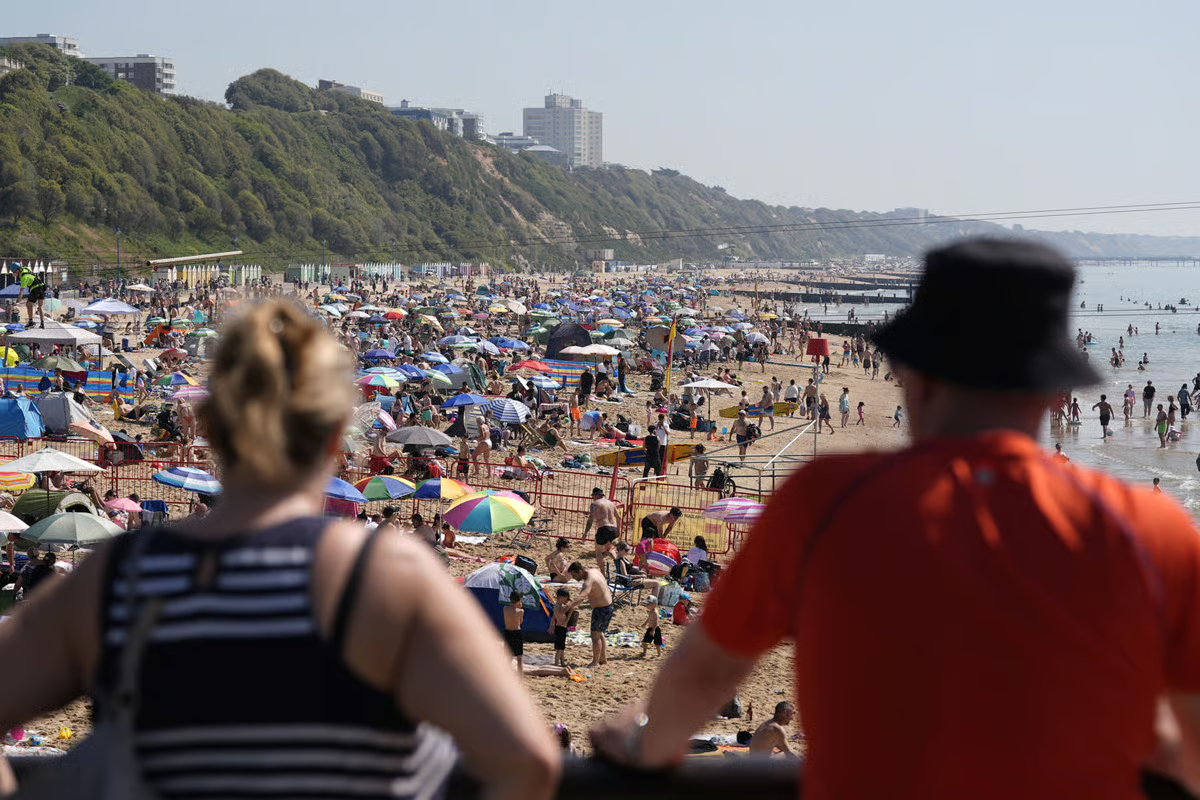
Hottest May day ever as London hits 34.8C in 2C leap from previous records
You must be logged in to post a comment Login