Connect with us
DAPA Banner

Business

Hungary’s Orban concedes landmark defeat to centre-right opposition

Published

on

Hungary’s Orban concedes landmark defeat to centre-right opposition
Continue Reading
Click to comment

You must be logged in to post a comment Login

Leave a Reply

Business

DJH acquires Bootle’s SB&P accountants as it grows its North West network

Published

on

Business Live

‘We’ve had a clear ambition to deepen our Liverpool presence for some time’

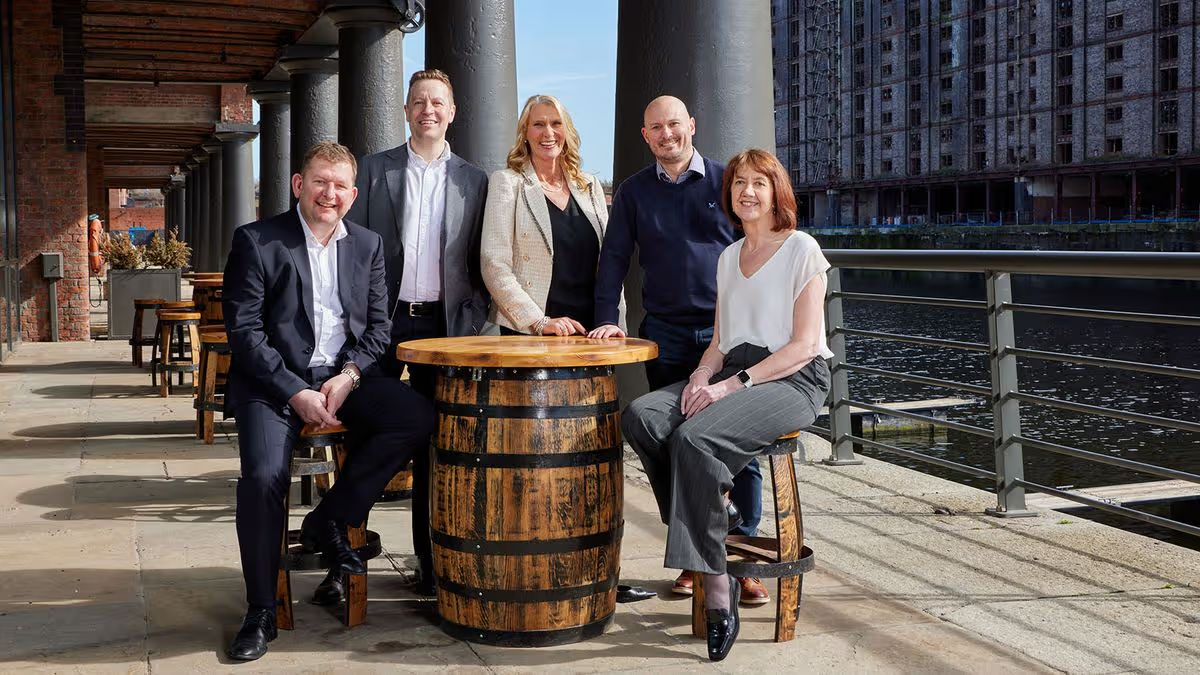
UK accountancy firm  DJH has acquired SB&P in Bootle. From left, Scott Heath and James Beardmore, both from DJH, with Suzanne Draper, Rob Young and Wendy McNulty from SB&P

From left, Scott Heath and James Beardmore, both from DJH, with Suzanne Draper, Rob Young and Wendy McNulty from SB&P(Image: DJH)

Acquisitive private equity-backed accountancy group DJH has acquired a Bootle practice to grow its presence in Liverpool and beyond. DJH’s deal for SB&P in Bootle means it now has six offices across Liverpool city centre, Ellesmere Port and Wirral.

DJH says the SB&P leadership team of Wendy McNulty, Rob Young and Suzanne Draper will remain in place as they introduce new services to their business.

This is the 19th acquisition made by DJH since 2020 and it now employs more than 700 across the UK and Ireland. The business, backed by private equity specialists Tenzing, is headquartered in Stoke-on-Trent and beyond its North and Midlands heartlands has bases in Yorkshire, Bexley and in Dublin.

Scott Heath, CEO of DJH, said: “We’ve had a clear ambition to deepen our Liverpool presence for some time.

Advertisement

Last year’s acquisition of three Haines Watts offices in the North West put a marker in the sand and we’re building on the potential in this region by going even further and bringing SB&P into the family.

“The more we learned about its clients, its team, and the values it has built the business around, the more excited we became about bringing this partnership to life. This is a practice that has earned genuine trust and loyalty in Liverpool, and that’s something you can’t manufacture. It perfectly complements everything we’ve already built across the region.

“We’ve found that a city centre office works best when paired with an out-of-town presence – our offices in Chester City with Ellesmere Port, and Manchester with Altrincham are great examples of that in action.

“SB&P’s Bootle location, paired with our Liverpool city office, reflects that same approach, and gives us a dominant local presence that we’re incredibly proud to be part of.”

Advertisement

He added: “With billions of pounds of regeneration investment flowing into the city, a fast-growing SME sector, and a wave of businesses scaling up on the back of increasing inward investment, demand for high-quality, locally rooted professional advice has never been greater.

“Liverpool and the North West have real momentum, and we want to make sure the businesses driving that momentum have access to the very best advice.”

Wendy McNulty, director at SB&P, added: “We’ve always believed that real relationships are at the heart of everything we do. Joining DJH gives our team and our clients access to a much wider platform, while preserving the personal, advice-led culture we’ve worked so hard to build. We’re excited about what this means for Liverpool.”

Advertisement
Continue Reading

Business

US, Australia, Philippines hold second joint drills in South China Sea this year

Published

on

US, Australia, Philippines hold second joint drills in South China Sea this year


US, Australia, Philippines hold second joint drills in South China Sea this year

Continue Reading

Business

Ground breaks at Yindjibarndi's Jinbi solar project

Published

on

Ground breaks at Yindjibarndi's Jinbi solar project

Work to build the first solar farm under a traditional owner-backed three-gigawatt renewable energy plan has begun.

Continue Reading

Business

Taiwan government should lead engagement with China on new measures, senior official says

Published

on

Taiwan government should lead engagement with China on new measures, senior official says


Taiwan government should lead engagement with China on new measures, senior official says

Continue Reading

Business

Leadership Spotlight: Jason Sheasby

Published

on

Leadership Spotlight: Jason Sheasby

We talk to Jason Sheasby a partner at Irell & Manella LLP about what makes him a great leader.

Please introduce your work and describe the role you play in shaping its direction.

I am a partner at Irell & Manella LLP. I focus on high-stakes trial work, mostly in intellectual property and complex commercial disputes. I also help shape direction through how we choose cases, build trial teams, and prepare matters. My role is not just to argue cases. It is to define how we approach them—what we prioritize, how we simplify, and how we execute under pressure.

How do you build teams and systems to execute that work?

I build small, focused teams. Each person has a defined role tied to a specific part of the case—facts, law, technical narrative, or witness prep. I avoid duplication. I also avoid overstaffing.

We keep core work in-house. That includes strategy, key writing, and trial presentation. We bring in external experts when needed, especially in technical areas such as memory systems or data storage. The system is simple: clarity of ownership, short feedback loops, and daily alignment as we near trial.

From your perspective, how do you stand out in a competitive field?

We reduce complexity faster than others. Most cases involve large volumes of technical detail. The difference is not who has more information. It is about organizing it into a structure that a decision-maker can follow.

Advertisement

In recent trials involving companies like Netlist and StreamScale, the outcome depended on how clearly the issues were framed. That is the core differentiator.

Who do you primarily serve, and how has that focus evolved?

I serve companies dealing with complex technology disputes. That includes areas like computer memory, data systems, and device technology.

The focus has not changed much. What has changed is the scale and speed. Cases now involve more data, more technical layers, and shorter timelines.

What problems do clients bring to you, and how do you decide what to take on?

Clients come with high-risk disputes. Often involving patents, contracts, or both. The common feature is complexity tied to real financial exposure.

Advertisement

I take cases where the core issue is clear. If it cannot be explained in a structured way, it is difficult to try effectively.

How do you stay ahead when information moves quickly?

I do not try to track everything. I focus on patterns.

I read primary material—cases, technical documents, transcripts. I avoid relying only on summaries. The goal is to understand how decisions are actually made, not just how they are described.

What does long-term trust with clients look like?

It is consistency. Clients return when outcomes align with expectations and communication is direct.

Advertisement

Trust builds when there are no surprises. That means being clear about risks, timing, and constraints from the start.

How do you define success for clients, and how do you deliver it?

Success is achieving a defined outcome under known constraints. That could be a verdict, a settlement position, or a strategic advantage.

We define that early. Then we align all work to that outcome. Every argument, every witness, every exhibit serves that goal.

What responsibility do you have after a matter is complete?

We stay involved where needed. That may include follow-on proceedings, enforcement, or related disputes.

Advertisement

There is no formal system beyond staying available and maintaining continuity of knowledge.

How do you approach pricing and value alignment?

Pricing reflects complexity, risk, and time commitment. Trials are resource-intensive.

Value alignment comes from setting expectations early. Clients understand what is required and why.

How do you think about fairness in pricing?

Fair value means the work matches the cost. It is not about being the lowest cost. It is about being predictable and aligned with the outcome being pursued.

Advertisement

Have you said no to opportunities that looked attractive? Why?

Yes. If a case lacks a clear path to a coherent argument, I decline.

The principle is simple: if the decision-maker cannot understand the issue, the outcome is unpredictable.

What challenges have shaped how you lead?

One challenge is managing large volumes of information without losing focus.

Early in my career, I assumed shared understanding. That led to gaps. Now I build everything from first principles. Nothing is assumed.

Advertisement

How do you create space for innovation while staying disciplined?

Innovation comes from constraint.

We limit the number of arguments. We limit the number of themes. That forces better thinking. New ideas emerge within that structure.

What role does culture play in performance?

Culture defines how people work under pressure.

I model direct communication, preparation, and accountability. No unnecessary complexity. No unclear ownership.

Advertisement

Looking ahead, what impact do you want your work to have?

I want to continue improving how complex issues are understood and decided.

That applies to litigation, but also to areas like biotechnology through TORL Biotherapeutics and institutional work with Pomona College.

How has your leadership approach evolved?

It has become more focused on clarity and less on volume.

Earlier, I valued completeness. Now I value precision. Fewer points, better developed.

Advertisement

Which emerging shifts are most important to you?

Artificial intelligence.

Not as a replacement for judgment, but as a filtering tool. It helps manage large datasets. The human role remains in interpretation and decision-making.

What advice would you give to emerging leaders?

Focus on understanding, not output.

One lesson that changed my approach: if you cannot explain something simply, you do not understand it well enough to act on it.

Advertisement

Continue Reading

Business

Government’s inheritance tax changes ‘act of self harm’ that will destroy family firms: Brewery boss William Lees-Jones

Published

on

Business Live

Big interview: JW Lees MD says Government needs to give more backing to hospitality

JW Lees boss William Lees-Jones holds up a pint of Boddingtons

The first cask pint of Boddingtons was poured in Manchester, by JW Lees boss William Lees-Jones at the Founder’s Hall on Albert Square in September(Image: JW Lees)

The Government’s inheritance tax changes are an “act of self harm” that will stop family firms growing and creating jobs – that’s the stark message from JW Lees boss William Lees-Jones as he pushes ministers to reverse their decision.

JW Lees is one of Britain’s best-known brewers and a North West family business stalwart, now in its sixth generation. But like many family businesses, it will be affected by this month’s changes around rules to inheritance tax which he and fellow leaders say could stifle investment and even lead to the break-up of some businesses.

That comes on top of other rising costs faced by so many other hospitality businesses, including business rates, the rising minimum wage and the volatile energy prices of recent years.

William, managing director at Middleton’s JW Lees, has been speaking out on behalf of family businesses for years – particularly in the pandemic. Now he’s speaking out again, this time about the pain these latest changes could cause.

Advertisement

He’s also warning that unless the Government moves to support hospitality then businesses like his might have to cancel planned investments that would create jobs and improve their communities.

He told BusinessLive: “JW Lees will survive, because we’ll do whatever it takes, but in the short term it means less investment, less job creation, more short-term survival tactics. And that for me is an act of self-harm by a British government at a time when the government was elected on the principle of growth.”

The Government in 2024 announced plans to reform Business Property Relief (BPR) and Agricultural Property Relief (APR), which offered 100% relief from inheritance tax for qualifying business and farming assets. Those reliefs were used to pass assets from one generation to the next.

The plans were watered down in December after a campaign led by farmers, with the tax threshold raised from £1m to £2.5m. But large family firms will still see much bigger tax bills when they are passed down through the generations.

Advertisement

As William told City AM recently, even with the raised threshold, “£2.5m doesn’t even buy you a decent pub”. And JW Lees has 138 of them.

Should council leaders have to buy their own town hall?

William said the changes to tax liabilities could lead to firms selling up, or to firms selling assets and shrinking to find the cash they need.

He said: “I don’t believe it’s been thought through. I think there will probably be a reversal of it, but there will be in the next three years a number of businesses that will get caught up in it, and that’s just not fair – because it was legislation that had been in place since 1976 and it’s something that lots of British family businesses have come to rely on.”

He said a longer consultation period would have been helpful. And he added: “The assumption was that through business property relief, that the shares in the business could be passed from one generation to the next.

Advertisement

“And so I think it’s as ridiculous as… If you suddenly become the leader or chief executive of a local authority, you then have to raise the capital to buy the town hall off your predecessor.”

Changes could cost billions

Research by Family Business UK last year suggested that the IHT changes could cut the UK’s GVA economic output by £14.8bn by April 2030, and could put more than 200,000 jobs at risk. While the changes were meant to increase the Government’s tax take, analysis from CBI Economics suggests that if family firms and farms do cut back on their operations, then the Government could actually see a net fiscal loss of £1.9bn.

William’s solution is straightforward: “I’d love to see business property relief completely go back to where it was. Maybe that’s a pipe dream, but I think it’s something that will quickly be on pretty much every opposition manifesto for the next general election.”

Lockdown lesson: ‘The media like talking about pubs’

JW Lees, led by William and the Lees-Jones family, has been prepared to speak up about Government policies, under Conservatives and Labour.

Advertisement

Like all hospitality groups, Lees was hit hard by the lockdowns and closures imposed over the pandemic period. William was proactive about talking to the government, even finding himself on weekly Zoom calls with the former Department for Business, Energy & Industrial Strategy. That meant he became something of a spokesperson for the pub sector.

“I quickly learned that actually the media like talking about pubs,” he said, “because they’re places where people meet, and politicians go into them.

The JW Lees brewery in Middleton, Greater Manchester

The JW Lees brewery in Middleton(Image: Reach plc)

“And so all of these conversations that we were having were suddenly having this big impact. And because I kept turning up and being sensible, I started doing this commentary.”

The rules about gatherings and venues changed regularly, and could be inconsistent. One debate, for example, was over what counted as a “substantial meal” that could be served with alcohol in pubs. That led to what William recalled as the “Scotch egg rule”, after Cabinet minister Michael Gove mused over whether a Scotch Egg or two was a substantial meal or a starter.

Advertisement

“From a business perspective,” he said, “we were almost as a board having to operate with a completely different set of rules every month for a couple of years.”

That led to William’s role as a voice for family firms and for hospitality. And he says the leisure sector faces many more challenges beyond the latest tax changes, as costs continue to rise across the board.

‘I don’t think the government understands hospitality’

This Government has been criticised for not backing the hospitality sector enough.

William said: “I don’t think the government understands hospitality, and I think that’s a real problem because hospitality has a number of different elements to it. So the big night out, the special occasions, will never disappear in the same way that the Great British public will always have their annual holiday except in extreme circumstances.

Advertisement

“If I look at our business, we lose money in January, February, October, November. Summer is good, Christmas is bonkers.”

That means hospitality can be extremely sensitive to cost rises, and it needs to manage those costs all year round to be sustainable.

He said: “Frankly whether it’s the minimum wage or national insurance contributions or business rates or whatever else it might be, we’re finding ourselves in a position where we’re (the UK) going to become a really expensive place to go out, and that has got to be a bad thing for society.”

How JW Lees has transformed its pub estate

Britain has lost a quarter of its pubs since 2000. Last year alone, one pub a day closed in England and Wales.

Advertisement

William said: “Pubs are very appealing buildings if you want to put an HMO onto that site. Because you can turn them into six or seven flats quite easily and once they’re gone they don’t come back.”

JW Lees’ pub estate has undergone a transformation in recent years as the company adjusts to changing drinking and eating patterns. William said: “We had 172 pubs, we sold 120 and we bought 84 and so we have less pubs of a far higher quality.”

He added: “In the 1970s, which was boom time for Britain’s pubs and when pubs had sold more beer than any other time, the pubs you wanted were big estate boozers and end of terrace pubs.

“What we’ve seen is the gentrification of pubs and as families have become more welcome and food (more popular). If I look at our turnover, we’re now 40% drink, 40% food, 20% bedrooms. So it’s a completely different profile.

Advertisement

“And we’ve moved from the Greater Manchester mill towns to the leafy parts of Cheshire, Lancashire and North Wales, so it’s the repositioning of our estate for a different guest experience.”

Just some of the beers brewed at the Boilerhouse experimental brewery at the JW Lees brewery in Middleton, Greater Manchester

Just some of the beers brewed at the Boilerhouse experimental brewery at JW Lees(Image: Reach plc)

Hotels growing – but tax changes could hit that too

JW Lees now has 366 hotel bedrooms across 14 sites. William said: “A lot of people would prefer to stay in a pub than in a reasonably soulless hotel because they know they’re going to be able to get something to eat and drink.”

And that leads to another worry about tax policies in the UK – more local authorities and Business Improvement Districts are imposing or considering visitor levies, sometimes known as tourist taxes, which William fears could put people off UK holidays.

JW Lees is considering offering more hotel beds, but that is another decision that could be affected by Government tax policies.

Advertisement

William said: “At the moment we’ve got a number of planning applications hovering there and this is where the inheritance tax planning comes in again – because those sorts of big capital projects are the ones that, at the moment, have got the biggest question marks over them. We’d love to be building them but it’s a question of whether we can afford to, whether we can finance it.”

Boddingtons ‘doing amazingly’

Beer is at the heart of JW Lees’ operations, and the company is innovating there too. Its stout has been a huge success, particularly around St Patrick’s Day. And last year it brought back iconic Manchester cask ale Boddingtons, in partnership with brand owner Budweiser Brewing Group, to a rapturous reception.

William said: “It’s doing amazingly, it’s doing so well we keep pinching ourselves.

“There is a nostalgia for the 90s when Boddington’s was at its peak and It’s one where every time I post something on social media about it, people go, ‘oh, I must go and have a pint of it’. For my generation, it was an iconic brand.

Advertisement

“We’ve worked with Budweiser very closely on the relaunch. And for a brewery like us, it’s great to be able to collaborate with what is the world’s biggest brewer, and for them to see that the relaunch was best done through us.”

The five-year rule

William is part of the sixth generation of the founding family to lead the business. He did not join the business immediately, instead heading to London after university to work in advertising. But eventually he returned North with his family to join the historic family business.

Now he and his fellow directors – including his father, uncle and siblings – are pondering how the seventh generation of the family will get involved in the business, inheritance tax changes notwithstanding. One member is already at the business, with William’s son Louis Lees-Jones as openings manager.

William added: “We have this five-year rule that if they go on to university and they then spend five years learning something, that they may or may not come into the business in eight or nine years’ time. These are the sort of timeframes that as a family business that we’re planning things with. Because that’s what it’s all about – building a long-term sustainable business.”

Advertisement
JW Lees head brewer Michael Lees-Jones, left, with managing director William Lees-Jones in 2013

JW Lees head brewer Michael Lees-Jones, left, with managing director William Lees-Jones in 2013(Image: Middleton Guardian)

Right now, the short-term uncertainty over the war in Iran and oil flows through the Strait of Hormuz are also hitting UK firms, forcing them to hedge their energy costs.

William said: “The war in Iran is going to impact pretty much every business in the world. You get into even whether we start drilling the North Sea…. We’ve just bought our energy forward for the next year.

“We live in a world of uncertainty and that’s not a great thing.”

In the meantime, he plans to keep standing up for family firms and for the hospitality sector.

Advertisement

He said “We all just want to be in a position where our country is growing and in my case people are going to pubs enjoying a pint and fish and chips on a Friday.”

Continue Reading

Business

CRF: A Soft Market Will Hurt Its Premium

Published

on

CRF: A Soft Market Will Hurt Its Premium

CRF: A Soft Market Will Hurt Its Premium

Continue Reading

Business

UK CFO confidence hits lowest level since Covid as Iran war rattles business outlook

Published

on

UK CFO confidence hits lowest level since Covid as Iran war rattles business outlook

Britain’s finance chiefs have retreated into full defensive mode as the fallout from the war in Iran sends confidence tumbling to levels not recorded since the country was plunged into its first coronavirus lockdown more than six years ago.

Two of the most closely watched barometers of corporate sentiment, Deloitte’s monthly CFO survey and BDO’s output index, paint a picture of a business community bracing for prolonged turbulence rather than plotting for growth. The message from boardrooms is unambiguous: conserve cash, cut costs and wait for the storm to pass.

Deloitte’s survey places CFO confidence at a six-year low, with geopolitics once again cited as the single greatest external threat. The firm’s chief economist, Ian Stewart, said the Middle East conflict had delivered a genuine shock, dragging optimism back to the darkest days of the pandemic. For finance leaders accustomed to navigating uncertainty, the comparison is a sobering one.

BDO’s figures tell a similarly bleak story. Business output contracted last month for the first time since February 2021, with services and manufacturing bearing the brunt. Scott Knight, the firm’s head of growth, pointed to soaring energy and commodity prices as the principal culprits, noting that a fragile truce between Washington and Tehran had offered only fleeting respite.

The knock-on effects are already filtering through the economy. Higher commodity costs are eroding manufacturers’ margins, while both businesses and consumers have begun tightening their belts in anticipation of rising inflation. Deloitte found that business leaders are most anxious about the war’s impact on energy prices, inflation and interest rates, all of which economists now expect to climb this year. The spectre of increased cyber-attacks, potentially orchestrated by state-sponsored actors, is adding a further layer of unease.

Advertisement

The labour market is feeling the chill. BDO’s employment index has slumped to a 15-year low as firms signal that inflationary pressures will curtail their ability to take on new staff. Hiring demand, the accountancy firm warned, is likely to remain subdued for the remainder of 2026. A separate report from KPMG and the Recruitment and Employment Confederation found that permanent placements and worker demand continued to fall in March, albeit at a gentler pace than in preceding months. Wage growth, meanwhile, was described as marginal.

There is a slender thread of hope. Jon Holt, chief executive of KPMG, suggested that the prolonged decline in hiring activity may be starting to level off. Yet he was quick to caution that any meaningful recovery hinges on greater clarity over the trajectory of the conflict and its wider economic consequences. Without that, he warned, hiring decisions and capital investment risk being deferred once more, stalling any sustained improvement in the jobs market.

For now, the overwhelming priority among Britain’s finance chiefs, many drawn from the FTSE 100 and FTSE 250, is balance sheet resilience. The vast majority told Deloitte they intend to pare back both spending and recruitment in the months ahead. As Stewart put it, rarely in the past 16 years have UK CFOs been so single-mindedly focused on controlling costs.

It is a posture born not of panic but of hard-headed pragmatism. Until the geopolitical fog lifts and energy markets find some semblance of stability, corporate Britain appears content to hunker down and ride it out.

Advertisement

Amy Ingham

Amy is a newly qualified journalist specialising in business journalism at Business Matters with responsibility for news content for what is now the UK’s largest print and online source of current business news.

Advertisement
Continue Reading

Business

OpenAI doubles down on London with first permanent office despite Stargate U-turn

Published

on

OpenAI doubles down on London with first permanent office despite Stargate U-turn

The decision by OpenAI to plant its flag in King’s Cross with a permanent London headquarters, just days after walking away from a major data centre project in the northeast, tells you something important about where the real value lies in Britain’s artificial intelligence ambitions: it is in people, not power grids.

The ChatGPT developer has secured an 88,500 sq ft space in the Regent Quarter capable of housing 544 staff, a clear signal that it intends to more than double the roughly 200 employees it currently has working across research, engineering, policy, marketing and sales in the capital. Around 30 of those are researchers, and the company has committed to making London its largest research hub outside the United States.

The move comes at a politically awkward moment. Last week OpenAI shelved its Stargate data centre plans for Cobalt Park in North Tyneside, citing high energy costs and uncertainty around the future of UK copyright law. That project would have seen some 8,000 Nvidia chips deployed in a designated AI growth zone and was widely regarded as a cornerstone of Sir Keir Starmer’s ambitions to bolster Britain’s sovereign computing capacity.

Benedict Macon-Cooney, chief AI and innovation officer at the Tony Blair Institute, captured the tension neatly, noting that whilst Britain excels as a hub for talent, it continues to struggle to secure the large-scale AI infrastructure needed to compete globally.

But not everyone views the data centre retreat as the more telling indicator. Saul Klein, founder of venture capital firm Phoenix Court, argued that signing a commercial property lease is a far stronger commitment than headline-grabbing announcements about hyperscale compute. Leasing office space and filling it with people, he suggested, is not something a company can easily walk away from.

Advertisement

Klein’s firm has dubbed the King’s Cross corridor the world’s third most productive technology cluster after San Francisco’s Bay Area and Beijing, home to thousands of venture-backed companies and more than 200 unicorns. The neighbourhood already counts Google DeepMind, Meta, University College London, the Francis Crick Institute and the Alan Turing Institute among its residents, alongside homegrown AI success stories such as Synthesia and Wayve. Its proximity to King’s Cross, St Pancras and Euston also gives it unrivalled connectivity across Britain and into mainland Europe.

OpenAI is not alone in eyeing London for expansion. Anthropic, its closest rival, is understood to be in discussions with both the London mayor Sir Sadiq Khan and the government about growing its own UK presence, where it also employs around 200 people.

The government, meanwhile, has sought to reinforce Britain’s credentials in fundamental AI research, announcing £40 million in funding over six years for a new blue-sky research laboratory.

Phoebe Thacker, OpenAI’s global head of data research programmes and London site lead, pointed to the depth of British talent and the growing adoption of AI tools across UK businesses and institutions as key drivers of the investment.

Advertisement

For the UK’s technology sector, the message is encouragingly clear: even when infrastructure plans falter, the gravitational pull of world-class talent remains irresistible.


Amy Ingham

Amy is a newly qualified journalist specialising in business journalism at Business Matters with responsibility for news content for what is now the UK’s largest print and online source of current business news.

Advertisement
Continue Reading

Business

Founders lobby Treasury for capital gains tax break on start-up reinvestment

Published

on

Founders lobby Treasury for capital gains tax break on start-up reinvestment

Some of Britain’s most prominent entrepreneurial voices are pressing the Treasury to introduce a targeted tax incentive designed to keep the proceeds of successful exits circulating within the domestic start-up ecosystem, rather than drifting into passive wealth management or overseas opportunities.

The proposal, which has been dubbed “repeat entrepreneur relief”, would allow founders who sell shares in their companies and reinvest the gains into a new venture within twelve months to defer capital gains tax indefinitely. The liability would only crystallise when the new shares were eventually sold without further reinvestment.

The idea has been put forward in various forms by the Founders Forum Group, Schroders and UK Private Capital as part of a recent Treasury consultation on the tax treatment of entrepreneurs. Each submission makes broadly the same case: that the UK’s tax framework does a reasonable job of supporting businesses as they grow, but does far too little to encourage founders to recycle their capital and experience once they have cashed out.

UK Private Capital, the trade body representing venture capital and private equity firms, argued there is a compelling rationale for aligning tax incentives with the post-exit phase, when founders hold significant capital, possess hard-won operational expertise and face decisions about where to base themselves and where to deploy their money next.

The Founders Forum Group, co-founded by Brent Hoberman and Jonnie Goodwin, drew a comparison with the American Qualified Small Business Stock scheme, under which founders pay no capital gains tax on gains of up to $10 million or ten times their original investment. The group described that exemption as a primary driver of the reinvestment culture that has long defined Silicon Valley, where exit proceeds are routinely funnelled straight back into the next generation of companies.

Advertisement

A survey conducted by the Founders Forum Group found that nearly nine in ten founders said such a measure would make them more likely to reinvest in the UK, with more than seven in ten describing the effect as significant.

The lobbying comes at a sensitive moment for the government’s relationship with the entrepreneurial community. Since taking office, Chancellor Rachel Reeves has progressively increased the rate of business asset disposal relief, the levy formerly known as entrepreneurs’ relief, from its longstanding rate of ten per cent to fourteen per cent last year, then to eighteen per cent from this month. The standard capital gains tax rate remains at twenty-four per cent.

Many founders have argued that the increases make Britain a less attractive place to build and exit a business, though a number of tax analysts have countered that the previous relief was poorly targeted and did relatively little to encourage genuinely productive reinvestment.

The government has sought to balance these changes with fresh incentives at the earlier stages of the company lifecycle. In November, Reeves extended a package of measures making it easier for founders to offer equity to employees and raise capital, provisions that came into force last week.

Advertisement

A Treasury spokesperson pointed to these steps as evidence that the government has the right economic plan in place, highlighting changes to the enterprise management incentive scheme and venture capital tax schemes that are expected to support around £100 million of additional investment annually.

Whether the Treasury is willing to go further and address the post-exit gap that the lobbying groups have identified remains to be seen, but the volume of submissions suggests the argument for repeat entrepreneur relief is gathering serious momentum.


Jamie Young

Jamie Young

Jamie is Senior Reporter at Business Matters, bringing over a decade of experience in UK SME business reporting.
Jamie holds a degree in Business Administration and regularly participates in industry conferences and workshops.

When not reporting on the latest business developments, Jamie is passionate about mentoring up-and-coming journalists and entrepreneurs to inspire the next generation of business leaders.

Advertisement

Continue Reading

Trending

Copyright © 2025