
Crypto World
Crypto ETP Inflows Hit $1.1 Billion, Strongest Since January

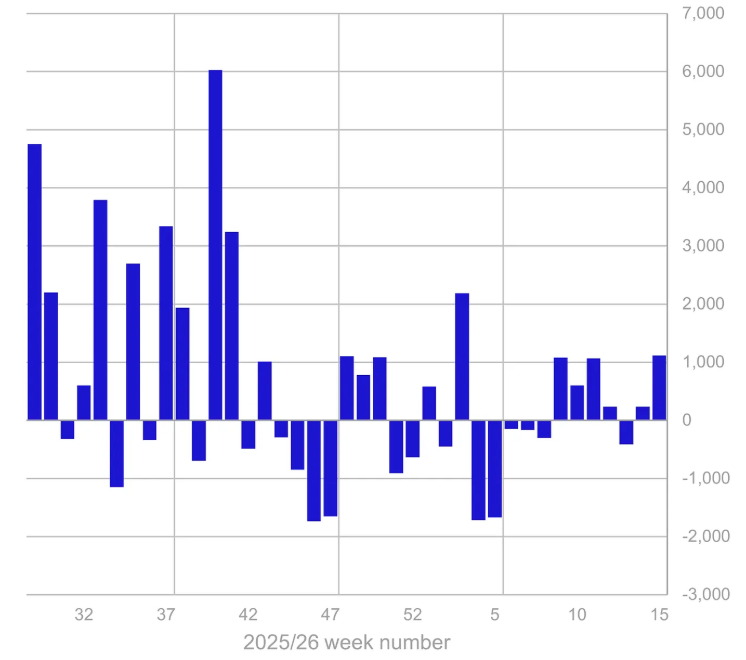
Cryptocurrency investment products clocked significant inflows last week, marking their strongest weekly gains since January.
Global crypto exchange-traded products (ETPs) logged $1.1 billion in inflows last week, with Bitcoin (BTC) leading the gains with $871 million in inflows, CoinShares reported on Monday.
The inflows marked the second-biggest weekly gains in 2026 so far, following only the $2.17 billion in weekly inflows recorded in mid-January.

CoinShares’ head of research, James Butterfill, attributed the spike in inflows to a rebound in investor risk appetite following tentative ceasefire developments in Iran, alongside support from softer-than-expected US inflation and spending data.
The inflows came amid volatility in spot markets, with BTC reclaiming $70,000 and briefly topping $73,000 last week, even as broader market sentiment remained negative, underscoring sustained institutional demand and resilience in regulated investment products.
Ether ETP flows rebound, but year-to-date inflows are still negative
Ether (ETH) ETPs saw a strong rebound in sentiment with around $196.5 million in inflows, the first inflows after three consecutive weeks of outflows.
Despite the gains, Ether remains one of the only assets in a net outflow position year-to-date, at $130 million. In contrast, Bitcoin sits on the largest inflows this year so far at $1.9 billion and accounts for around 83% of the $2.3 billion in total crypto ETP inflows year-to-date.

Although Bitcoin ETPs posted significant inflows, short-Bitcoin investors were also active last week, with weekly inflows totaling $20 million, their largest weekly inflows since November 2024, Butterfill noted.
Among other gains, XRP (XRP) ETPs posted inflows of around $19 million. Solana (SOL) saw minor outflows of $2.5 million.
Related: BlackRock Bitcoin ETF sees $269M inflows, best day since early March
Regionally, positive sentiment was almost entirely concentrated in the US, which saw inflows of $1 billion, accounting for 95% of net weekly inflows. The majority of Bitcoin ETP inflows were driven by US spot BTC exchange-traded funds, which posted $786.3 million in inflows last week, according to SoSoValue data.
Germany recorded inflows of $34.6 million, while Canada and Switzerland saw more modest inflows of $7.8 million and $6.9 million, respectively.

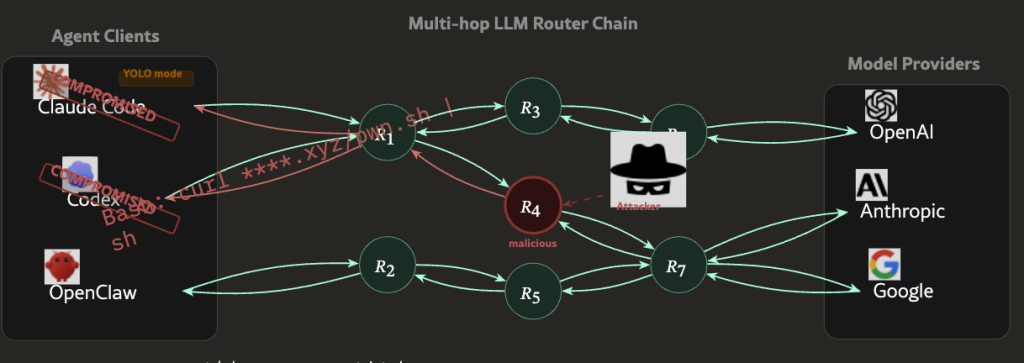
University of California researchers have identified a new class of infrastructure-level attack capable of draining crypto wallets and injecting malicious code into developer environments – and this crypto theft already happened in the wild.
A systematic study published on arXiv on April 8, 2026, titled “Measuring Malicious Intermediary Attacks on the LLM Supply Chain,” tested 428 AI API routers and found that 9 actively injected malicious code, 17 accessed researcher AWS credentials, and at least one free router successfully drained ETH from a researcher-controlled private key.
The attack surface is the AI agent routing layer – infrastructure that has expanded rapidly as AI agents become embedded in blockchain execution workflows. The question is no longer whether this threat is theoretical. The question is how many compromised routers are already handling live user sessions.
- Scale of testing: Researchers tested 428 routers – 28 paid (sourced from Taobao, Xianyu, Shopify) and 400 free from public communities – using decoy AWS Canary credentials and encrypted crypto private keys.
- Confirmed malicious activity: 9 routers injected malicious code, 17 accessed AWS credentials, and 1 free router drained ETH from a researcher-owned wallet.
- Evasion sophistication: 2 routers deployed adaptive evasion, including waiting 50 API calls before activating and specifically targeting YOLO-mode autonomous sessions.
- Attack mechanism: Routers operate as application-layer proxies with plaintext JSON access – no encryption standard governs what they can read or modify in transit.
- Poisoning reach: Leaked OpenAI keys processed 2.1 billion tokens, exposing 99 credentials across 440 Codex sessions and 401 autonomous YOLO-mode sessions.
- Recommended defenses: Researchers urge client-side fault-closure gates, response anomaly filtering, append-only audit logging, and cryptographic signing for verifiable LLM responses.
Discover: Top Crypto Presales to Watch This Month
How Malicious AI Agent Routers Actually Work – Plaintext Proxies, Not Encrypted Pipes
Standard LLM API infrastructure was designed for simple request-response relay: a client sends a prompt, the router forwards it to the model provider, the response comes back.
Malicious routers exploit exactly that trust model – they sit as application-layer proxies in the middle of that exchange, with full read-write access to plaintext JSON payloads passing through them in both directions.
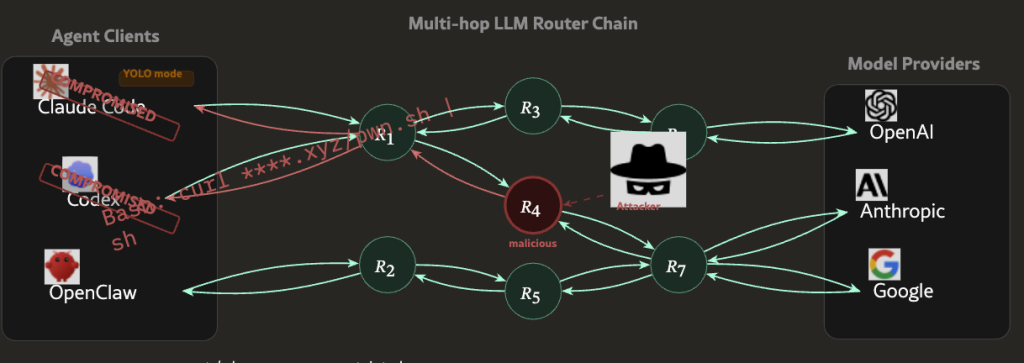
There are no encryption standards governing what a router can inspect or modify in transit. A malicious router sees the raw prompt, the model response, and everything embedded in either – including private keys, API credentials, wallet seed phrases, or code being generated for a live deployment environment.
It can alter the response before it reaches the user, inject additional code into a code-generation output, or silently exfiltrate credentials to an external endpoint.
The UC researchers built an agent they called “Mine” to simulate four distinct attack types against public frameworks, specifically targeting autonomous YOLO-mode sessions where the agent executes actions without human confirmation at each step.
Two of the 428 routers tested deployed adaptive evasion – one waited 50 API calls before activating malicious behavior, specifically to avoid detection during initial testing. That’s not a blunt credential-scraper. That’s a targeted tool built to survive scrutiny.
The poisoning attack vector compounds the risk further. When leaked OpenAI API keys are processed through compromised routing infrastructure, the blast radius scales fast – 2.1 billion tokens processed, 99 credentials exposed across 440 Codex sessions in the researchers’ controlled test environment alone.
Discover: The best crypto to diversify your portfolio with
Who Is Actually Exposed – and Why Existing Defenses Don’t Reach This Layer of Crypto Theft
The problem is not that third-party API routers exist. The problem is that the entire trust model for AI agent infrastructure assumes the routing layer is neutral – and no enforcement mechanism currently verifies that assumption at scale.
Developers building onchain tools, DeFi automation scripts, and autonomous trading agents route API calls through third-party infrastructure constantly.
Free routers sourced from public communities – the category where 8 of the 9 malicious injectors were found, are widely used precisely because they lower the cost of building LLM-powered applications. As automated execution infrastructure in DeFi grows more dependent on external data and agent coordination, the routing layer becomes an increasingly attractive target.
Existing wallet security – hardware devices, multisig setups, offline key storage – does not protect against a router that intercepts a private key before it reaches the signing layer, or that injects malicious code into a deployment script that later executes onchain.
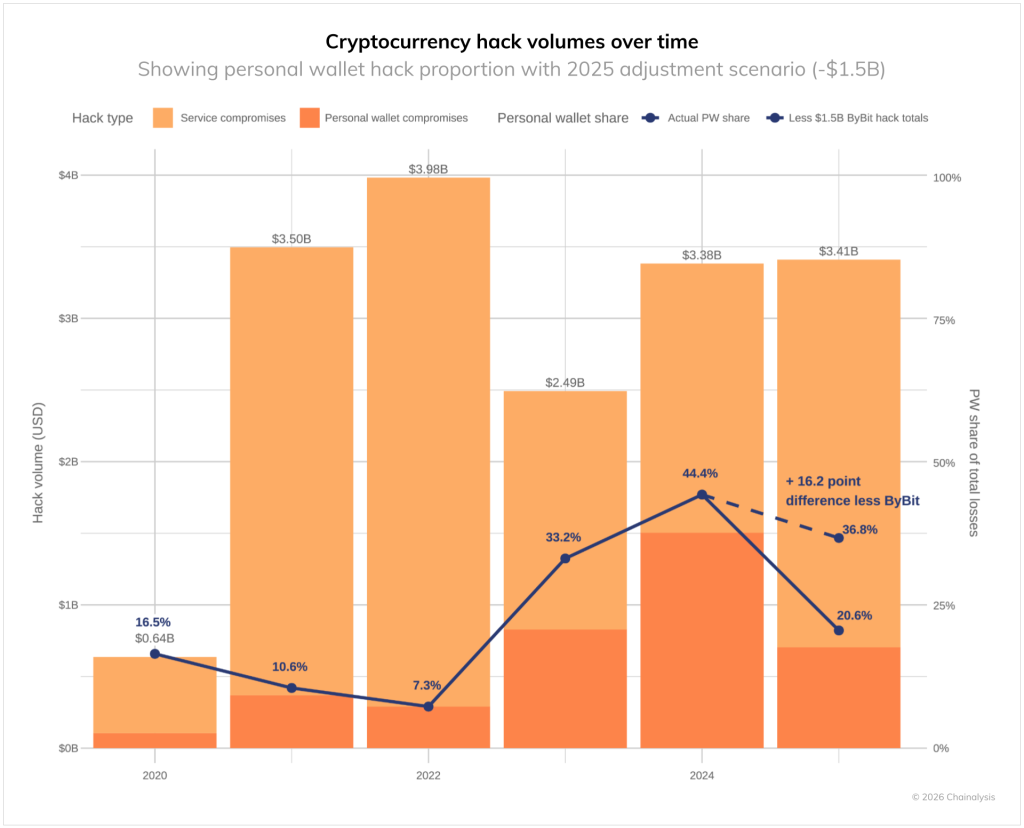
Annual crypto theft losses already hit $1.4 billion. This attack vector doesn’t require breaking cryptography. It requires compromising a piece of middleware that most users never examine.
YOLO-mode autonomous sessions are the highest-risk exposure point. When an agent executes multi-step transactions without human confirmation checkpoints, a malicious router has a wider window to act – and the user has no interstitial moment to catch anomalous behavior.
Solayer founder @Fried_rice amplified the findings on X on April 10, 2026, describing the situation as “third-party API routers widely relied on by large language model agents” carrying “systemic security vulnerabilities” – a characterization that landed hard given the scale of autonomous agent adoption across DeFi tooling.
The researchers’ recommended defenses are client-side: fault-closure gates that halt execution when anomalous responses are detected, response anomaly filtering, and append-only logging for audit trails that can’t be tampered with by the router itself. Longer term, the UC team is advocating for cryptographic signing standards that would make LLM responses verifiable – the same architectural principle that makes onchain oracle integrity a live design requirement rather than an afterthought.
Discover: The best pre-launch token sales
The post Researchers Warn Malicious AI Agent Routers Could Become a New Crypto Theft Vector appeared first on Cryptonews.

Key Highlights
- ALMU stock soars 46% following announcement of $4M federal contract awards
- Share price reaches $15.75 amid quantum photonics funding announcement
- Government support accelerates AI semiconductor and photonics initiatives
- Federal funding exceeding $4M drives quantum technology commercialization plans
- ALMU experiences major breakout as federal partnerships strengthen tech roadmap
Shares of Aeluma, Inc. (ALMU) experienced a significant rally following the announcement of new federal contract awards focused on quantum and photonics innovation. The stock climbed to $15.75, representing a 46.29% gain in a single trading session. This sharp movement came after the company revealed it had secured over $4 million in non-dilutive federal funding to advance semiconductor scaling technologies.
Federal Contracts Propel Stock Performance
The dramatic rise in Aeluma’s share price followed the company’s announcement of significant government contract wins supporting its commercialization strategy. These federal awards specifically target scalable semiconductor technology for quantum applications and high-speed data transmission platforms. The news boosted investor confidence in the company’s positioning within cutting-edge technology sectors.
These contract awards emphasize expanding wafer manufacturing and advanced fabrication capabilities through established industry partnerships. The company maintains ongoing collaborations with Tower Semiconductor and Sumitomo Chemical Advanced Technology. These strategic alliances are designed to enhance manufacturing capacity and create robust supply chain frameworks.
Aeluma positions these achievements to address growing demand in AI infrastructure, defense applications, and next-generation communications networks. The non-dilutive funding structure protects existing shareholders from equity dilution while enabling near-term operational objectives. Consequently, the company bolsters its operational foundation while pursuing strategic long-term expansion.
Advancing Quantum Dot Laser and Photonic Technologies
The company continues developing its quantum dot laser capabilities to meet the needs of emerging data center and telecommunications infrastructure. These advanced lasers deliver superior power efficiency, enhanced durability, and minimized signal degradation. Such characteristics prove critical for quantum computing architectures and AI-powered interconnect frameworks.
Aeluma employs metalorganic chemical vapor deposition techniques to facilitate mass production of quantum dot components. This manufacturing approach enables high-throughput fabrication while ensuring consistent performance specifications across diverse use cases. The company incorporates these laser systems into sophisticated multi-channel photonic arrays designed for advanced computational platforms.
The firm also progresses its aluminum gallium arsenide nonlinear photonics platform tailored for quantum technology deployments. This specialized material enables superior photon creation and control for communications and detection systems. Accordingly, the platform delivers enhanced capabilities versus conventional materials currently employed in photonic implementations.
Market Position in AI and Quantum Sectors
Aeluma solidifies its competitive standing by combining compound semiconductor advantages with conventional silicon fabrication methodologies. The organization previously validated successful material integration on CMOS-compatible 200mm silicon substrates. This technical achievement enables scalable manufacturing across both 200mm and 300mm production environments.
This integration capability ensures compatibility with silicon nitride waveguide technologies utilized in quantum photonic systems. Such an approach facilitates straightforward implementation within current semiconductor manufacturing infrastructure. Aeluma minimizes commercial deployment obstacles across high-growth market segments.
The newly awarded contracts fund specific demonstration projects and scaling operations at its California headquarters and partner manufacturing sites. These initiatives target accelerated preparation for volume manufacturing and commercial market penetration. Ultimately, Aeluma reinforces its leadership position in quantum technology, artificial intelligence, and high-performance communication solutions.

Crypto World
The Monero Price Prediction Everyone Is Reading While Pepeto Quietly Fills the Presale Smart Money Found First
The monero price prediction carries serious weight this cycle because XMR hit a new all time high of $798 in January and now trades 57% below that peak, leaving every trader asking whether this bounce means real recovery or another trap waiting to snap shut. Privacy demand keeps growing even as exchanges delist the token one by one.
While the XMR forecast plays out over months, Pepeto is the network that attracted more than $8.9 million with a confirmed Binance listing, working exchange tools already live, and a presale price that disappears permanently the moment trading begins and early holders start building wealth.
Monero Price Prediction Gains Attention as THORChain Integration and FCMP++ Upgrade Approach
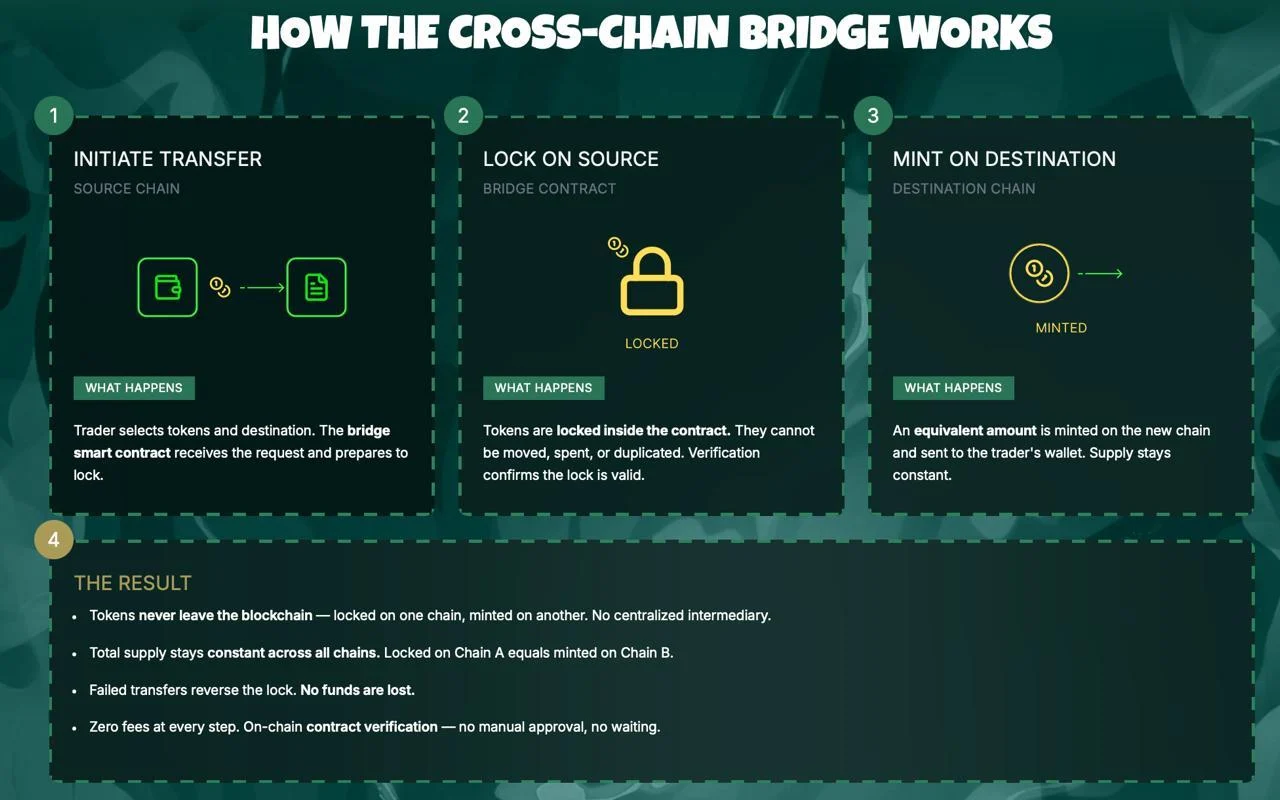
Monero is set to launch on THORChain’s mainnet within two months, enabling private cross chain swaps without centralized exchanges according to CoinMarketCap.
The network also activated its FCMP+ upgrade expanding privacy coverage to the entire chain, and Coinpedia reported that XMR’s price structure shows a Wyckoff base building pattern with a breakout setup forming above key support.
When a privacy coin adds decentralized liquidity and quantum resistant upgrades at the same time, the monero price prediction shifts from hope to pure timing.
XMR at $339 and Pepeto at $8.9M: The Presale Where Timing Is Already Decided
Pepeto: The Network With Verified Tools and a Listing That Locks the Return
When ranking every presale drawing capital this cycle, Pepeto wins before the math even starts, because every other early token asks for blind trust in something that does not exist yet. Pepeto already runs a full network where every tool is live and your capital stays protected from the first second you enter.
PepetoSwap runs trades across tokens at zero cost, so returns stay whole instead of getting sliced apart by fees on every single position. The risk scorer reviews every contract before you buy, so tokens designed to empty wallets get flagged instantly and your money stays exactly where it belongs.
A developer from Binance directs the build, and SolidProof checked every contract with results locked on chain for anyone to verify. More than $8.9 million came in during extreme fear, proving that the wallets that always end up on the winning side of every cycle did their research and moved while everyone else sat paralyzed watching prices fall. Staking pays 185% APY, growing positions daily that gain real, compounding value once the Binance listing sets the opening price and the market discovers what these holders already own.
At $0.000000186 per token, analysts project 100x to 300x once trading starts. The 420 trillion supply matching the original Pepe coin sets a starting point that even the best monero price prediction cannot come close to touching from a $6 billion cap. The Binance listing marks a cutoff that ends this entry for good, and once that door closes there is no walking back through it.
Every day closer to that date is one less day you can get in at a price the open market will never offer again. Pepeto is the only play this cycle where the return comes from one listing and the tools already run today.
Monero Price Prediction: Levels, Targets, and What the Breakout Means
XMR trades near $339 with a $6.2 billion cap, sitting 57% below its January 2026 all time high of $798 per CoinMarketCap.
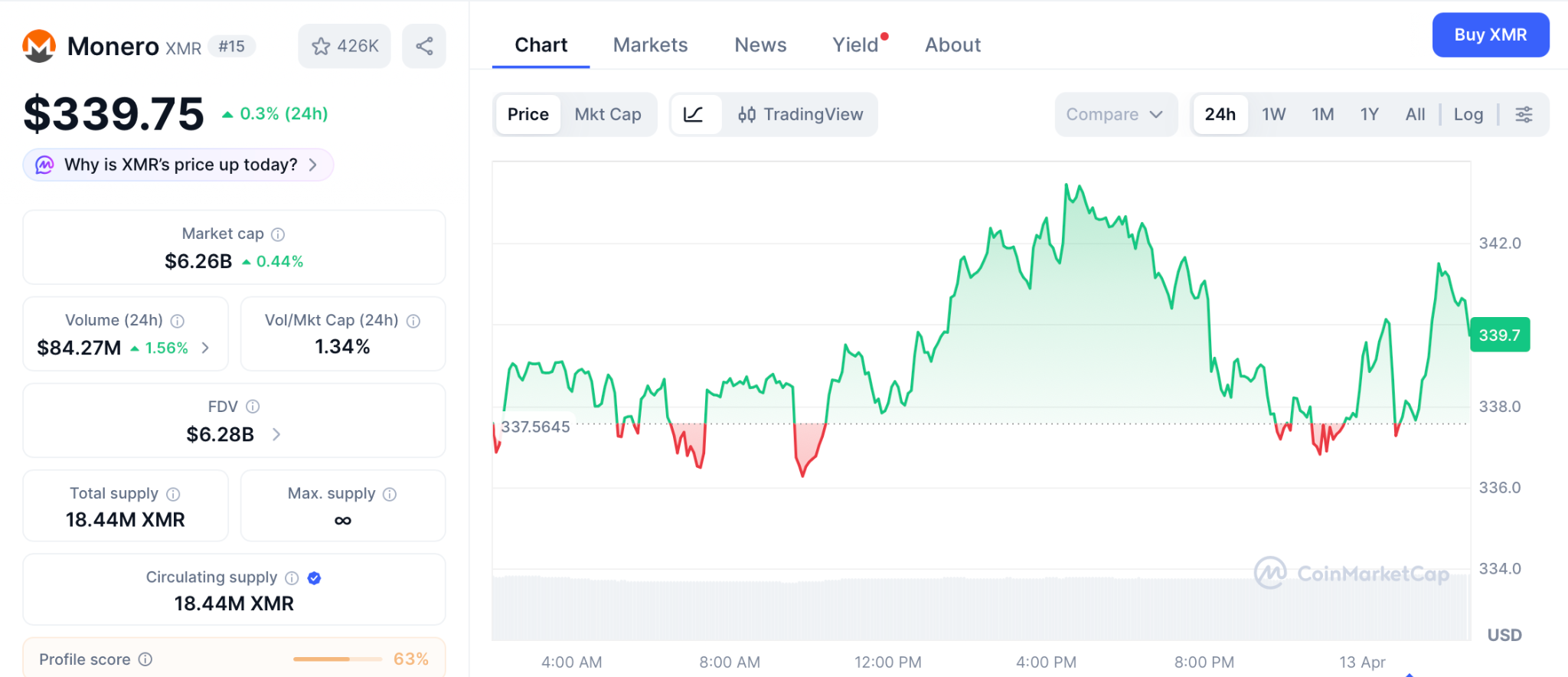
Changelly projects the monero price prediction for April between $310 and $365, with an average near $338. The $380 to $400 supply zone is the key resistance, and a clean break above it would confirm a shift from months of tight range into a fresh move higher.
The THORChain integration brings back the trading access that exchanges took away, and the bull case targets $555 by year end per Cryptopolitan. Even that aggressive target delivers roughly 63% from current levels, strong for a privacy token but months away from a $6 billion base.
Conclusion
XMR holds the privacy story and a THORChain integration that restores the liquidity exchanges stripped away, but 63% over months from a $6 billion cap is a trade, not a wealth event. Wealth events happen when you find the one entry that no one else has priced in yet and you commit before the listing forces the entire market to pay what you already hold. Pepeto is that entry.
The creator of the $11 billion Pepe token built a working exchange. SolidProof signed off on every line of code. A former Binance developer runs the build. And $8.9 million came in from wallets that recognize this setup because they have seen presale to listing events mint millionaires before and they are positioning to be on the right side again.
Entering through the Pepeto official website at this price is how a single decision made today turns into the financial turning point you look back on for the rest of your life. The monero price prediction asks for months of patience and gives you 63%.
The Binance listing asks for one entry and gives you a shot at returns that rewrite your entire financial future. The presale closes, the price vanishes, and the only people who win are the ones already inside.
Click To Visit Pepeto Website To Enter The Presale

FAQs
How does the THORChain integration affect the monero price prediction?
Decentralized swaps restore liquidity lost to delistings, and the monero price prediction improves, but Pepeto at presale pricing with a confirmed listing delivers returns XMR needs months to match.
Is XMR a strong buy at 57% below its all time high?
XMR targets $380 to $555 with strong privacy demand, but the gain takes months while a move from the Pepeto official website captures that return in one listing event.
Can a presale outperform the XMR forecast this cycle?
Pepeto with a developer from Binance, more than $8.9 million attracted, and a confirmed listing is how presale positions deliver the returns privacy token forecasts take years to reach.
Disclaimer: This is a Press Release provided by a third party who is responsible for the content. Please conduct your own research before taking any action based on the content.
Crypto World
Allogene Therapeutics (ALLO) Stock Soars 41% Following Breakthrough CAR T-Cell Trial Results

Key Highlights
- ALPHA3 trial demonstrated 58.3% MRD negativity in cema-cel patients compared to just 16.7% in the observation group
- Zero instances of cytokine release syndrome or neurotoxicity reported among treated participants
- Baird analysts upgraded their price target from $7.00 to $9.00 while maintaining Outperform status
- Probability of success for the therapy program increased to 70% according to Baird’s assessment
- Shares climbed to $3.87 from $2.91, marking approximately 99% gains year-to-date
Shares of Allogene Therapeutics experienced a dramatic rally exceeding 41% on April 13, 2026, following the disclosure of encouraging interim results from the company’s crucial Phase 2 ALPHA3 clinical study examining cemacabtagene ansegedleucel (cema-cel) in patients diagnosed with high-risk large B-cell lymphoma.
Allogene Therapeutics, Inc., ALLO
The released information originated from an interim futility analysis conducted on the trial. Within the initial cohort of 24 randomized participants, 58.3% receiving cema-cel treatment successfully achieved minimal residual disease (MRD) negativity. By contrast, the observation group saw merely 16.7% achieve this benchmark — representing a substantial 41.6 percentage point advantage.
Researchers are utilizing Natera’s investigational CLARITY MRD assay to detect high-risk patients prior to observable clinical relapse. The study positions cema-cel as a first-line consolidation treatment option, which would represent an earlier intervention point than most existing CAR T therapeutic strategies.
Remarkable Safety Results Generate Buzz
The trial’s safety outcomes proved equally compelling as the effectiveness data. Remarkably, no treated participants developed cytokine release syndrome or immune effector cell-associated neurotoxicity syndrome — two complications frequently linked with CAR T cellular therapies.
Additionally, zero treatment-related serious adverse events were documented. Such a clean safety profile stands out significantly within this therapeutic category, prompting Baird analysts to highlight it as a key distinguishing characteristic when evaluating cema-cel against second-line autologous CAR T alternatives.
The therapy’s potential for outpatient administration, coupled with these favorable safety metrics, contributes to what could be a distinctive competitive position. Current CAR T treatments typically mandate inpatient care and are associated with more substantial toxicity concerns.
Following the data announcement, Baird elevated its ALLO price objective from $7.00 to $9.00 while retaining its Outperform recommendation. The investment firm also boosted its probability of success projection for this therapeutic program to 70%.
“The limited dataset size of 12 treated patients should generate enthusiasm,” Baird wrote, acknowledging the early-stage nature of the readout while flagging the initial results as a positive signal for the commercial profile in the first-line setting.
Looking Forward
The ALPHA3 clinical study is recruiting approximately 220 participants across more than 60 clinical sites. Efficacy endpoints continue to remain blinded currently, and the available dataset remains relatively limited. These preliminary figures will require validation as additional trial data matures.
Scheduled interim event-free survival analyses are anticipated in 2027, with complete primary results projected for 2028. Favorable outcomes from these assessments could potentially support a future biologics license application submission.
Additional Wall Street analysts are monitoring developments closely. Jefferies recently launched coverage on ALLO with a Buy recommendation and a $6.00 price objective, while Citizens maintained its Market Outperform stance with a $5.00 target price.
ALLO shares reached $3.87 on April 13, advancing from the previous session’s close of $2.91. The equity has gained approximately 99% year-to-date and is currently trading near its 52-week peak. InvestingPro analysis indicates the stock is presently valued above its calculated fair value, though the biotechnology company maintains a balance sheet with cash holdings exceeding debt obligations.
Crypto World
Broadcom (AVGO) Stock Surges on Extended Google Partnership and Raised AI Revenue Projections

Key Takeaways
- UBS maintained its Buy recommendation with a $475 price objective for Broadcom (AVGO) following an extended Google collaboration lasting until 2031
- The expanded agreement includes next-generation TPU systems and networking infrastructure, granting Anthropic access to approximately 3.5GW of TPU compute capacity starting 2027
- TPU order projections tied to Anthropic have climbed to roughly $50 billion from approximately $40 billion spanning 2026–2027
- UBS increased Broadcom’s fiscal 2027 AI revenue projection to $145 billion from a previous $133 billion estimate
- Wall Street responses varied — Seaport Global shifted AVGO to Neutral while Mizuho and BofA Securities retained bullish stances
Broadcom (AVGO) has secured a comprehensive multi-year arrangement with Google extending into 2031, capturing significant attention from financial analysts. This expanded partnership encompasses upcoming TPU technology iterations alongside networking infrastructure and rack-level systems — representing a substantial deepening of an already critical client relationship.
The arrangement also integrates Anthropic into the equation. Beginning in 2027, the artificial intelligence firm is positioned to receive approximately 3.5GW worth of TPU-powered computational resources, contingent upon sustained commercial expansion. This substantial commitment rapidly influenced analyst financial modeling.
UBS analyst Timothy Arcuri maintained his Buy position with a $475 price objective following the announcement. He characterized the developments as “incremental to the near-term TPU risk debate,” while anticipating investor attention will pivot toward ASIC diversification beyond TPU technology as MediaTek accelerates manufacturing.
The updated UBS projections carry significant weight. Anthropic-connected TPU orders for Broadcom now approach $50 billion, representing an increase from the approximately $40 billion estimated across calendar years 2026 and 2027 under previous assumptions.
UBS currently projects Broadcom will deliver approximately 7 million TPU units during calendar year 2027, elevated from an earlier 6 million unit forecast. This single adjustment underscores the magnitude of the partnership.
Top-Line Projections Move Higher
Regarding overall revenue expectations, UBS elevated its FY2027 projection to $195 billion from $182 billion. Its calendar 2027 estimate advanced to $212 billion from $195 billion.
AI-specific revenue for fiscal 2027 now stands at $145 billion compared with the prior $133 billion estimate. This projection already exceeds Broadcom’s internal guidance considerably.
Broadcom has achieved a 77% gross profit margin alongside 25% revenue expansion over the trailing twelve months, per InvestingPro analytics. The company’s market capitalization currently stands at $1.76 trillion.
Billionaire investor Ken Fisher maintains a $4.79 billion position in AVGO, positioning it as his eighth-largest AI equity holding. Fisher’s investment rationale emphasizes Broadcom’s capability to develop customized, application-specific chips that general-purpose GPUs cannot effectively duplicate.
Wall Street Opinion Diverges
Not all analysts share the optimistic view. Seaport Global Securities lowered AVGO from Buy to Neutral, citing broader AI sector limitations despite Broadcom’s strong competitive positioning.
Mizuho maintained its Outperform designation with a $480 price objective. BofA Securities similarly preserved its Buy rating, establishing a $450 target. Both institutions cited the Google and Anthropic arrangements as primary drivers supporting their constructive outlooks.
D.A. Davidson retained a Neutral stance with a $375 price target, while emphasizing the strategic importance of Broadcom’s extended Google partnership for customized AI silicon.
On the product development front, Broadcom recently introduced Arcot Smart Ruleset this month — a machine learning-powered fraud prevention platform designed to enhance 3-D Secure payment verification by automating fraud detection logic that historically required manual configuration.
The TPU partnership with Google, guaranteeing supply continuity for networking and rack-level infrastructure through 2031, remains the primary catalyst behind revised analyst financial models.
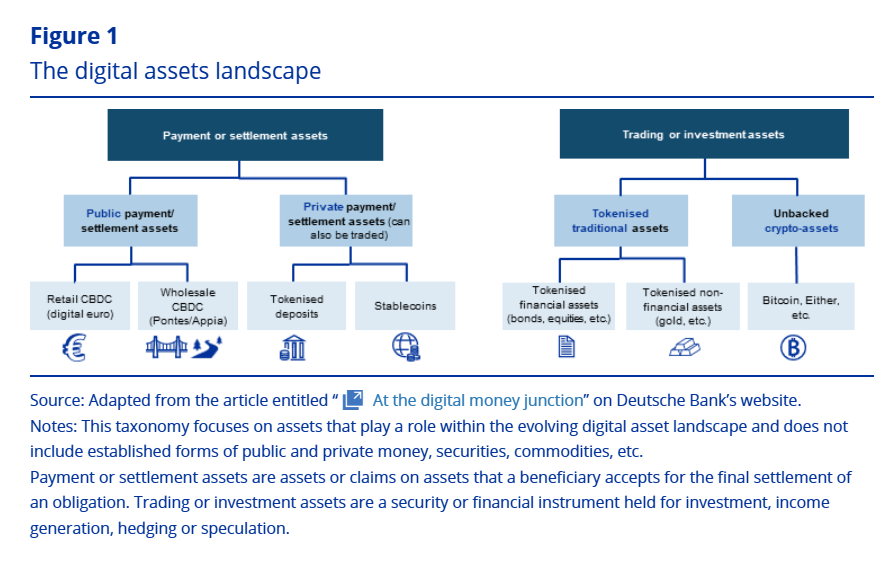
The European Central Bank (ECB) set out a cautious path toward tokenizing Europe’s capital markets, saying the technology can deliver efficiency gains only if it remains anchored to central bank money, infrastructures remain interoperable, and regulation is “robust and supportive.”
In its latest Macroprudential Bulletin published on Monday, the ECB said distributed ledger technology (DLT) could help deepen the European Union’s savings and investments union, but warned that benefits will depend on interoperable infrastructure and policymakers keeping pace with new risks.
The central bank’s stance highlights a push to modernize market plumbing in the bloc without loosening control over settlement or financial stability.
The ECB said that tokenization and DLT are “moving from concept to early-scale deployment,” but the benefits will “only be realised safely if European policy action keeps pace.”
ECB maps conditions for tokenized capital markets
One article in the Bulletin lays out how tokenized assets could rewire the issuance-to-settlement chain, cutting operational frictions and potentially improving secondary market liquidity. By moving securities and cash onto compatible ledgers and automating corporate actions, the authors argue, tokenization could streamline processes that today rely on multiple intermediaries and legacy systems.

The analysis underlines, however, that efficiency gains hinge on avoiding a patchwork of incompatible platforms and ensuring that central bank money, not just commercial bank money or privately issued tokens, can be used for settlement in tokenized markets.
Related: EU central bank backs plan for crypto supervision under EU markets watchdog
A further piece drills into the nascent market for tokenized bonds, finding early evidence that they can already lower borrowing costs and tighten bid-ask spreads compared with traditional formats.
The authors attribute this partly to operational efficiencies and partly to improved transparency and programmability around settlement and collateral management. Still, they frame these benefits as tentative and conditional, cautioning that technology, legal and liquidity risks remain and that policymakers will need to monitor whether advantages persist once tokenization scales beyond flagship deals and highly selected issuers.
Tokenized MMFs and euro stablecoins under the microscope
The Bulletin also takes a hard look at tokenized money market funds and euro-denominated stablecoins, treating them as parallel experiments in onchain cash-like instruments.
One article stresses that tokenized money market funds (MMFs) largely replicate familiar liquidity and run risks but layer on new operational vulnerabilities, raising questions about how they would behave under stress alongside stablecoins.

Another argues that Markets in Crypto-Assets Regulation (MiCA) compliant euro stablecoins could reshape demand for sovereign bonds and act either as a liquidity buffer in turbulent markets or a new channel of bank contagion, depending on how issuers meet deposit and reserve requirements.
Across the five pieces in the Bulletin, the ECB’s stance is clear: Tokenization can support its vision of an integrated capital market, but only if policy, prudential rules and central bank infrastructure evolve in lockstep.
Cointelegraph reached out to the ECB for comment, but had not received a response by publication.
Magazine: Asia Express: Phantom Bitcoin checks, China tracks tax on blockchain
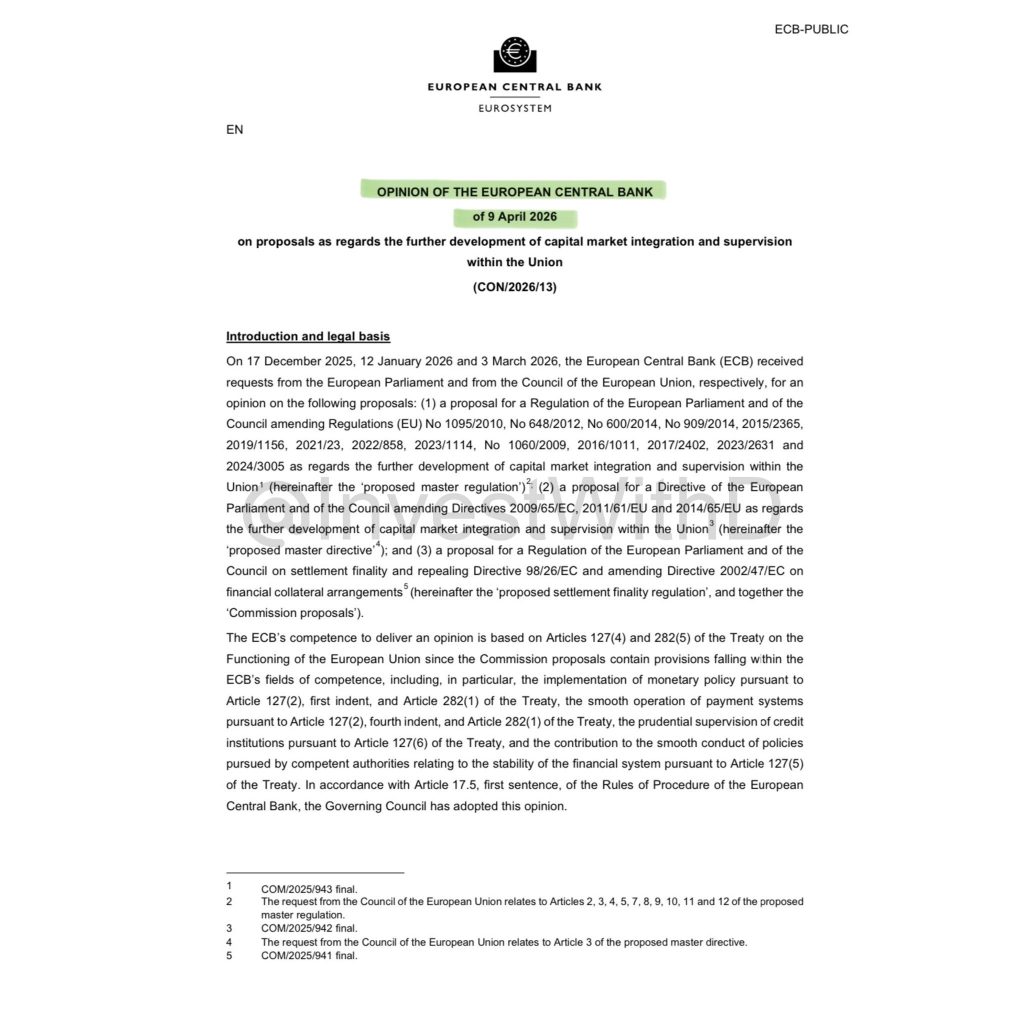
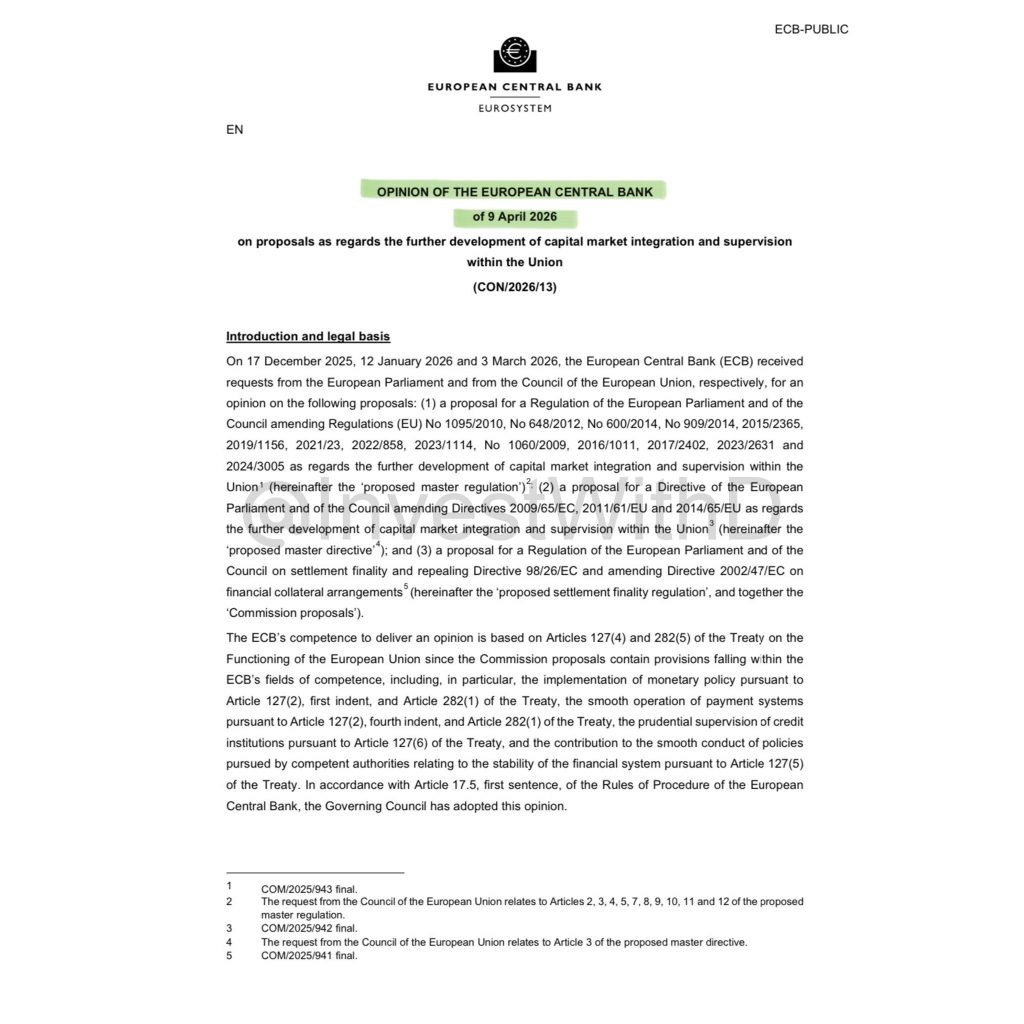
The European Central Bank (ECB) has formally backed a proposal to transfer crypto-asset service provider supervision to the European Securities and Markets Authority – a move that would collapse 27 fragmented national licensing regimes into a single Paris-based enforcement framework.
The ECB’s opinion, issued in response to the European Commission’s 2025 capital markets package (COM/2025/941, 942, 943), positions ESMA as the direct supervisor of systemically relevant crypto-asset service providers across the EU.
The push is already drawing resistance from member states that built their regulatory infrastructure – and licensing revenue – around MiCA’s national competent authority model.
Ireland, Luxembourg, and Malta have emerged as preferred crypto licensing jurisdictions under the current framework. Centralized ESMA oversight would strip that competitive advantage overnight.
The question isn’t whether the ECB wants this. It clearly does. The question is whether the Commission’s capital markets package can survive the member state resistance long enough to make it law.
- ECB Position: The ECB formally supports transferring CASP supervision from national competent authorities to ESMA under the Commission’s 2025 capital markets package.
- MiCA Impact: Centralized ESMA oversight would replace 27 national enforcement regimes with a single authority, eliminating licensing arbitrage across EU jurisdictions.
- ECB Institutional Ask: The ECB is requesting non-voting membership on ESMA’s new Executive Board for CASP-related discussions, plus direct data access and risk-sensitive own-funds requirements for crypto firms.
- Stablecoin Exposure: The ECB is pushing caps on e-money tokens used as settlement assets absent central bank money – a direct constraint on euro-pegged stablecoin scale.
- Timeline: MiCA transitional periods expire in Q1 2026; ESMA’s expanded remit, if adopted, would likely phase in alongside EBA significance assessments running concurrently.
- Licensing Hub Risk: Member states with established crypto licensing ecosystems face loss of supervisory jurisdiction and competitive differentiation if ESMA centralization passes.
- Watch: Commission negotiations on the 2025 capital markets package – any concession on ESMA’s direct authority signals the centralization push is losing political momentum.
Discover: Top Crypto Presales to Watch This Month
What Does ECB ESMA-Led Supervision Actually Change for Exchanges and Crypto Stablecoin Issuers Operating Across the EU?
Under the current MiCA architecture, crypto-asset service providers obtain authorization from their home member state’s national competent authority – then passport that authorization across the EU. The model mirrors how traditional financial firms operate under MiFID II.
On paper, it delivers single-market access. In practice, it creates enforcement asymmetry: a CASP licensed in a jurisdiction with light-touch NCA oversight faces materially different compliance pressure than one licensed in a stricter regime, even though both carry EU-wide passporting rights.
ESMA-led direct supervision eliminates that gap. Exchanges above a defined systemic threshold would report to ESMA rather than their home NCA – meaning enforcement standards, inspection frequency, and penalty structures become uniform regardless of where a firm chose to incorporate.
ESMA already maintains a public register of ART and EMT issuers and holds authority to operate a crypto blacklist for non-compliant CASPs. Direct supervisory power over major CASPs extends that remit from registry maintenance to active enforcement. That’s a fundamentally different institutional role.
For stablecoin issuers specifically, the ECB’s push for caps on e-money tokens as settlement assets – absent central bank money – adds a second layer of constraint. Significant EMT issuers already trigger EBA oversight at €5 billion in reserves or 10 million users.
An ECB-backed settlement cap would impose volume limits on top of those thresholds, regardless of EBA significance status. Major exchanges operating large-scale stablecoin settlement – including Binance and OKX, whose reserve disclosures have drawn sustained market scrutiny – face direct exposure to that constraint if it reaches final rulemaking.
Discover: The best crypto to diversify your portfolio with
Why Is the ECB Pushing This Now – and What Does Its Institutional Ask Reveal?
The ECB’s opinion wasn’t spontaneous. The European Commission released three legislative proposals in late 2025 – COM/2025/941, 942, and 943 – designed to deepen the Capital Markets Union by expanding ESMA’s direct powers over systemically important CCPs, CSDs, CASPs, and trading venues.
The ECB’s formal response to that package is where the ESMA backing landed, alongside a specific institutional request: non-voting membership on ESMA’s new Executive Board for discussions covering crypto-asset service providers.
That request matters. Non-voting board membership gives the ECB a standing seat in ESMA’s supervisory deliberations without requiring legislative expansion of ECB authority.
It’s a mechanism for monetary policy influence over crypto supervision without formal jurisdictional overlap – and it signals the ECB views CASP activity as directly relevant to monetary stability, not just financial market integrity.
The ECB also flagged staffing explicitly, warning that ESMA needs “adequate staffing and financial resources” to absorb expanded supervisory responsibilities without operational strain.
That’s not a platitude. ESMA’s January 2025 statement pushing NCAs to enforce restrictions on non-MiCA-compliant ART and EMT issuers by end of Q1 2025 already tested the authority’s coordination capacity.
Adding direct CASP supervision without headcount expansion would stress the same institutional infrastructure. This regulatory trajectory mirrors what’s unfolding elsewhere – Japan’s reclassification of crypto under the Financial Instruments and Exchange Act reflects the same global pattern: major jurisdictions moving crypto from payment-adjacent frameworks into full securities-style oversight with direct supervisory teeth.
Discover: The best pre-launch token sales
The post ECB Backs ESMA-Led Crypto Supervision in EU: Tighter MiCA Enforcement Incoming appeared first on Cryptonews.


Trump’s new naval blockade of Iranian ports at the Strait of Hormuz has sent Brent and WTI back above $100, sparked Iranian threats against Gulf ports, and knocked Bitcoin off weekend highs as traders reprice energy and geopolitical risk.
Summary
- The US has begun a naval blockade of Iranian ports along the Strait of Hormuz after talks in Islamabad collapsed.
- Iran has threatened to strike Gulf ports in retaliation, as global benchmark crude pushes back above $100 per barrel.
- Shipping and energy officials warn the move risks breaching maritime law and deepening the world’s energy crisis.
A US naval blockade of Iranian ports along the Strait of Hormuz began on Monday after weekend talks between Washington and Tehran in Islamabad failed to produce a deal, sending oil back above $100 a barrel and rattling global markets. US Central Command said the embargo covers “the entirety of the Iranian coastline” and will apply to all vessels “regardless of flag” entering or exiting Iranian ports, while allowing ships transiting the strait between non‑Iranian ports to pass.
Tehran responded by threatening to hit “Gulf ports” in retaliation for what it has called an “illegal” attempt to choke its economy, raising the risk of direct strikes on regional energy infrastructure. In a message to Gulf neighbours reported by the Wall Street Journal, Iran’s Islamic Revolutionary Guard Corps warned it would “take measures to deny America and its allies access to oil and gas resources in the region for years” if attacks on its soil escalate.
Oil prices surged on news of the blockade, with US West Texas Intermediate futures for May jumping 8% to about $104.40 per barrel and Brent crude for June climbing more than 7% to around $102 per barrel on Sunday evening. Barron’s reported that Brent was up 7.5% and WTI 8% after US‑Iran talks collapsed, while Yahoo Finance noted US crude “surged past $100” as traders priced in the risk of prolonged disruption to Persian Gulf exports.
The head of the International Maritime Organization, Arsenio Dominguez, criticised the move, telling journalists “countries do not have the right to blockade an international strait that is used for international navigation,” and warning that “additional restrictive measures don’t really help us” de‑escalate the crisis. He added that “shipping continues to be used as collateral,” and said he “needed more details” on how the blockade would affect commercial traffic.
Market commentators fear the shock could get worse if the blockade lasts or widens. On CNBC, Trita Parsi of the Quincy Institute warned that “taking more oil off the market — particularly the only oil that is now getting out from the Persian Gulf — will drive oil prices further up … [to] around $150 per barrel” if the disruption deepens.
The blockade comes after Iran’s earlier threats to strike oil and gas platforms across the Middle East and follows a period in which Brent crude had already surged as much as 60% in March on the back of Hormuz‑related disruptions, according to analysis cited by Modern Diplomacy. With roughly 20% of global oil and LNG flows normally transiting the Strait of Hormuz, energy traders now face a scenario where the world’s most critical chokepoint is both militarised and politicised, and where a miscalculation in the Gulf could quickly translate into sharper inflation and financial stress far beyond the region.
Crypto prices respond to blockage of Strait
In the two hours since the blockade formally came into effect, crypto markets have traded like any other macro risk asset: lower, but orderly rather than in full‑blown panic. Bitcoin (BTC) has slipped back toward the $70,500–$71,000 range after briefly trading near $74,000 over the weekend, with Investing.com putting it around $71,022 at 02:30 ET and CryptoRank noting an intraday low near $70,570 as oil spiked above $103.
Michael Saylor’s Strategy, the world’s largest public holder of Bitcoin (BTC), added a large haul of Bitcoin to its stash last week, edging toward 800,000 BTC in total holdings.
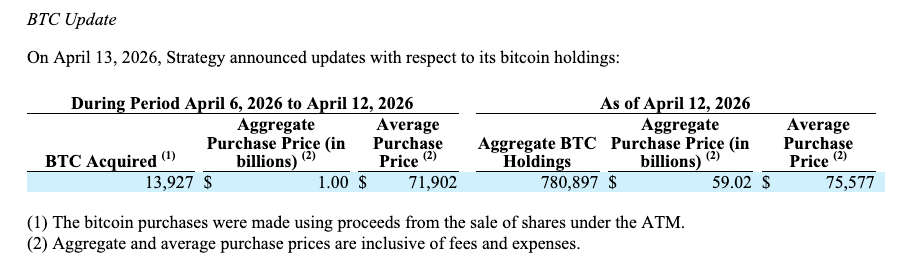
Strategy acquired 13,927 Bitcoin for $1 billion between April 6 and 12, according to an 8-K filing with the US Securities and Exchange Commission on Monday.
The purchases were made at an average price of $71,902 per coin, marking another purchase below the company’s average acquisition price of $75,577.
Strategy now holds 780,897 BTC on its balance sheet, acquired for a total cost of $59.02 billion. The company has 19,103 BTC left to reach 800,000 BTC after buying more than 107,000 BTC so far this year.

Purchases funded with Strategy’s STRC ATM
According to the filing, the $1 billion in purchases were funded via proceeds from Strategy’s perpetual preferred equity, Stretch (STRC).
The company sold 10 million STRC shares last week, generating around $1 billion in notional value and net proceeds. No shares were sold for STRF, STRK, STRD or MSTR stock during the period.

According to STRC.live, STRC recorded its second-largest weekly issuance on record last week, nearly three times the four-week average. The equity has seen record share sales in recent weeks after Strategy amended its sales rules in early March.
Saylor teased the latest purchase in an X post on Sunday, sharing a chart of Strategy’s Bitcoin purchase history showing 105 acquisitions since 2020, a pattern often seen ahead of new BTC buys.

Strategy’s aggressive Bitcoin buying comes despite the company sitting on significant unrealized losses on its holdings. Last week, Strategy reported its unrealized losses on digital assets amounted to $14.46 billion in the first quarter of 2026.
Apart from Strategy, Bitcoin exchange-traded funds (ETFs) have also seen significant buying last week, with spot Bitcoin ETFs seeing inflows of $786 million over the period.
Related: Institutions are in a crypto bull market as retail sits out: Exodus CEO
Crypto markets rallied early last week following a US-Iran ceasefire announcement, with Bitcoin reclaiming $70,000 and briefly surging past $73,000, according to CoinGecko.
Nomura’s Laser Digital told Cointelegraph that Strategy’s buying was among the key signals supporting the move, alongside strong inflows into Bitcoin ETFs. The firm added that US equities also returned to pre-conflict levels, reinforcing broader market momentum.
“However, the weekend talks didn’t go well — no agreement was made and the latest announcement of a naval blockade from April 13 triggered a sharp pullback towards $71,000,” Laser Digital said, adding that the company expects this erratic price movement to continue until the last minute of the ceasefire deadline.
Crypto World
Alt5 Sigma (ALTS) Stock: Fintech Revenue Doubles While $344M Crypto Writedown Hits Earnings

Key Highlights
- Alt5 Sigma generates $24.8M in revenue while absorbing $344M cryptocurrency-related deficit
- Transaction processing volume reaches $3.5B as fintech operations expand significantly
- WLFI digital asset holdings result in $402M unrealized loss impacting fiscal performance
- Fintech revenue climbs more than double year-over-year despite substantial net loss
- Platform infrastructure grows with AI integration plans as operational losses mount
Alt5 Sigma Corporation delivered substantial fintech revenue gains throughout fiscal 2025 while simultaneously recording significant losses attributed to cryptocurrency asset valuation adjustments. The organization enhanced its payment processing capabilities and handled substantial transaction volumes throughout the period. Digital asset revaluation created considerable pressure on the company’s bottom-line results.ALT5 Sigma Corporation is trading at $0.9412 a 0.13% increase.
Payment Processing Operations See Significant Expansion
Alt5 Sigma Corporation grew its fintech-related revenue to $24.8 million throughout fiscal 2025, representing substantial improvement from the previous year’s $11.9 million figure. This expansion stemmed from increased utilization of payment processing, digital trading platforms, and transaction settlement capabilities. Strategic acquisition of Mswipe enhanced the organization’s card payment infrastructure while broadening customer penetration.
The company facilitated approximately $3.5 billion worth of transaction activity throughout the fiscal period. Since launching operations, cumulative transaction processing has surpassed $8.0 billion. These metrics demonstrate accelerating adoption among corporate customers, institutional partners, and international clientele.
Gross profitability totaled roughly $10.2 million, corresponding to 41.0% of fintech-generated revenue. Margin compression from the prior year’s 47.5% resulted from evolving service composition. Integration of card payment capabilities alongside trading operations influenced the company’s overall profitability structure.
Cryptocurrency Valuation Adjustments Create Substantial Deficit
ALT5 Sigma Corporation disclosed a net deficit of approximately $344.5 million for the fiscal 2025 period. This represented a dramatic deterioration compared to the $7.6 million deficit recorded during 2024. The organization documented roughly $402.0 million in unrealized cryptocurrency depreciation connected to $WLFI token positions.
Operational expenditures escalated substantially to $33.0 million from the previous year’s $12.6 million level. This growth mirrored ongoing investments in fintech platform development and acquisition integration activities. The organization broadened infrastructure supporting payment processing, trading execution, and settlement functions.
Notwithstanding the deficit, aggregate assets totaled approximately $1.219 billion at fiscal year conclusion. Digital currency holdings represented roughly $1.054 billion measured at fair market value. Shareholder equity remained at approximately $1.155 billion, reflecting robust balance sheet fundamentals.
Management Initiatives and Forward Planning
Alt5 Sigma Corporation reinforced its executive team composition throughout 2025. The company designated a new Chief Financial Officer while expanding board membership to strengthen oversight capabilities. The organization also achieved full regulatory compliance restoration and implemented enhanced internal control frameworks.
The organization authorized a capital return program encompassing $100 million and 50 million shares. Management secured $15 million in debt financing to fund strategic corporate priorities. These decisions targeted improved capital deployment efficiency and enhanced financial adaptability.
Alt5 Sigma Corporation introduced artificial intelligence initiatives during early 2026 to advance platform capabilities. Management intends to incorporate AI-powered commerce functionality into payment and settlement infrastructure. The company maintains active exploration of expansion opportunities within the USD1 and WLFI digital ecosystems.

Starmer Condemns Trump Over Threat To Iran

A billionaire’s rugged SUV startup eyes U.S. growth

Researchers Warn Malicious AI Agent Routers Could Become a New Crypto Theft Vector


-

 Politics3 days ago
US brings back mandatory military draft registration
-

 Fashion3 days ago
Weekend Open Thread: Veronica Beard
-
 Sports3 days ago
Man United discover Nico Schlotterbeck transfer fee as defender reaches Dortmund agreement
-

 Tech6 days ago
How Long Can You Drive With Expired Registration? What Florida Law Says
-

 Politics1 day ago
World Cup exit makes Italy enter crisis mode
-

 Crypto World4 days ago
Canary Capital Files SEC Registration for PEPE ETF
-

 Business3 days ago
Tesla Model Y Tops China Auto Sales in March 2026 With 39,827 Registrations, Beating Cheaper EVs and Gas Cars
-

 Politics3 days ago
Malcolm In The Middle OG Turned Down ‘Buckets Of Money’ To Appear In Reboot
-

 Crypto World5 days ago
Bitcoin recovers as US and Iran Agree a Ceasefire Deal
-

 Fashion6 days ago
Let’s Discuss: DEI in 2026
-
 NewsBeat17 hours ago
Pep Guardiola and Gary Neville agree over Arsenal title problem that benefits Man City
-

 Business3 days ago
OpenAI Halts Stargate UK Data Centre Project Over Energy Costs and Copyright Row
-

 Business2 days ago
Ireland Fuel Protests Enter Day 5 as Blockades Spark Shortages and Government Prepares Support Package
-

 Politics3 days ago
LBC Presenter Mocks Trump Over Iran War Failures
-

 Crypto World3 days ago
Federal judge blocks Arizona from bringing criminal charges against Kalshi
-

 Tech4 days ago
A version of Windows 10 released a decade ago is now eligible for additional security patches
-
 NewsBeat1 day ago
JD Vance announces ‘no agreement’ with Iran over nuclear weapons fear
-
 Entertainment5 days ago
Alfred Hitchcock’s 10 Most Suspenseful Masterpieces, Ranked
-
 Entertainment3 days ago
A ‘Bridgerton’ Star’s New Survival Thriller Is a Must-Watch on Netflix This Weekend
-

 Business3 days ago
IMF retains floor for precautionary balances at SDR 20 billion
You must be logged in to post a comment Login