



Twice now, over the last 24 years, Colin Angle has surprised me. I’m not talking bemusement or nodding appreciation. Think jaw-dropping moments when I felt the earth shift a bit under my feet. The first time was in 2002 when he unveiled the iRobot Roomba, a rather basic-looking but shockingly effective robot vacuum, and the second was today, when he showed me a video of his new companion robot, the dog-sized Familiar.
Angle and I have spent decades talking about the robot revolution, or rather, having frank discussions about the reality of that not-quite-yet-here robot uprising. He’s the one who cautioned me years ago that functional home humanoid robots wouldn’t arrive until 2050. And when he rang me up to talk about his new product under the banner of “Familiar Machines and Magic”, I wondered if perhaps he, too, had drunk the Kool-Aid and now believed that humanoid robots like Tesla Optimus, Neo Beta 1, and Figure 03 were all ready to join me in my kitchen or living room. I needn’t have worried.
Article continues below
What we’re doing was, in fact, impossible 6 months ago
“I think humanoids make a lot of sense in industrial settings — I joined the board of directors of Boston Dynamics, …I believe the humanoids have a place. But [it’s] going to be a long time before that place is the home,” said Angle.
Angle had yet to reveal the product, and now I thought it might be a desk-bound puck that you could talk to — I could hardly hide my disappointment. Then Angle showed me the video. But before he played it, her offered this clarification, “The robots here are real — none of this is CGI. Just as a disclaimer, because it’s necessary. “
Seeing the astonishing Familiar for the first time

In the video, a medium-sized dog-like creature peers from around a wall into a living room where an elderly mother and adult daughter sit. It’s black eyes blink expressively, and its pointed ears wiggle. Then it pads over on large, almost bear-like paws. The neutral-colored fur moves naturally, and its motion is fluid and lifelike. One woman in the video pets the robot. In another scene, the robot reaches its paw up and pats the owner in an effort to get his attention.
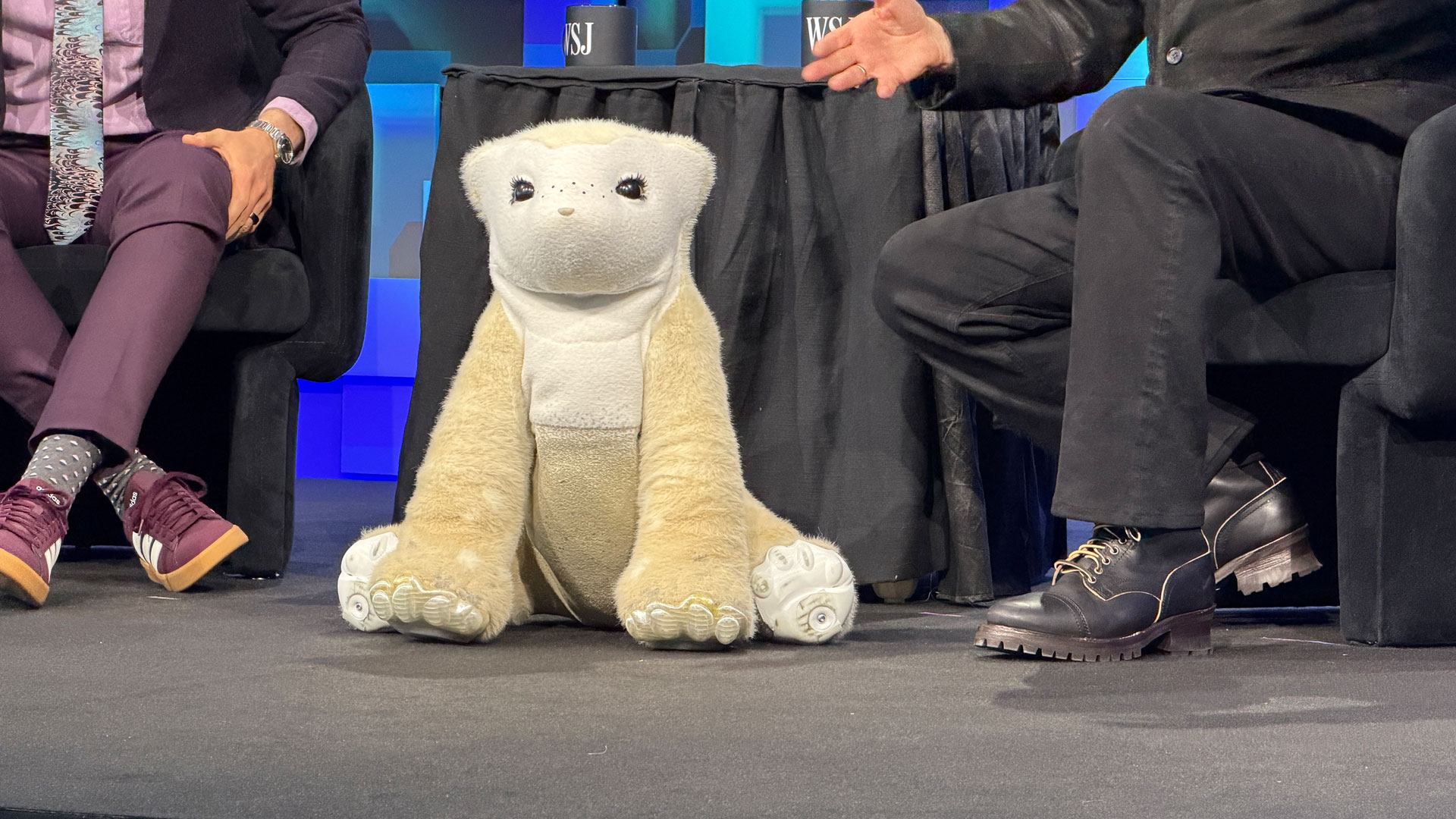
I’m both excited and concerned. I’ve seen robots like this before, though perhaps never at this scale. Where the Sony Aibo is the size of a large chihuahua, this bot, which Angle says is called a “Familiar,” is the size of a collie or smaller golden retriever.
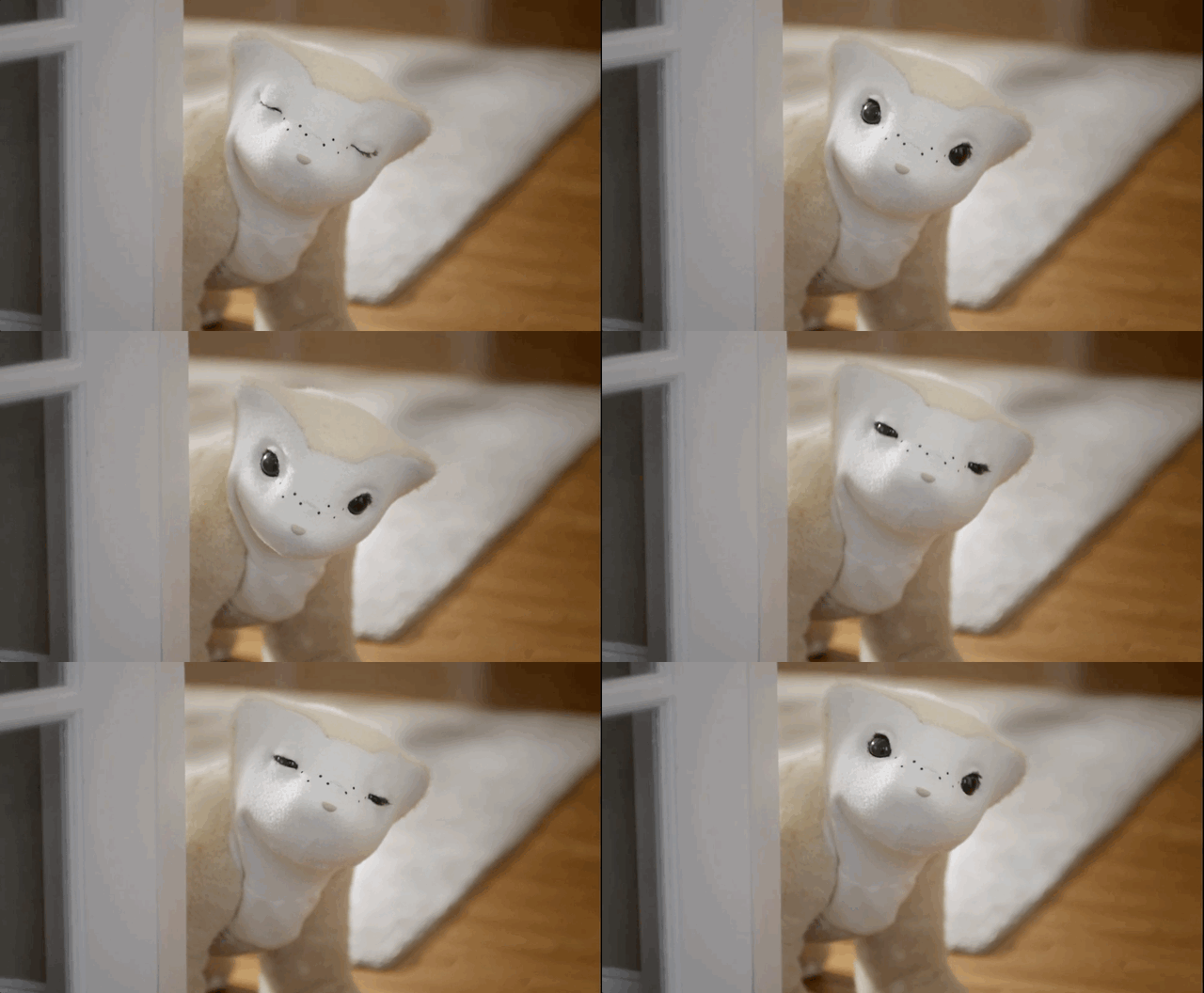
The video ends, and Angle excitedly starts rattling off specs. “[it has] 23° of freedom. Got an [Nvidia] Jensen Orin processor on it. It has vision, it has array microphones. It is running full-stack AI with reinforcement learning at the bottom layer. It has memory formation capabilities.”
Included in that are a variety of AI models, which will give the Familiar the ability to take its base personality and learn and grow with you. When I ask Angle which models, he tells me it’s a mix of homegrown and third-party, but also acknowledges that it’s far from final.
“Every month, there’s a best model, and it has changed month-to-month, so I actually can’t answer that question yet,” he added.
All the benefits of rapid change

Things, though, are moving fast, and like much of the rest of the robotics industry, Angle’s company is benefiting from “AI Time.”
“What you can do with a small software team and AI programming tools. It is remarkable…what we’re doing was, in fact, impossible 6 months ago,” said Angle.
Angle’s Familair robot doesn’t cook, clean, fold laundry, or talk. The goal isn’t removing human home maintenance drudgery. It’s connection.
“Our goal is to build physical AI solutions that involve human connection and the challenges that we’re working to solve, aligning the physical embodiment with the expectations that are needed to create value,” explained Angle.
The focus on value goes back to Angle’s days as co-founder and CEO of iRobot. Basically, any robot must provide more long-term value than it costs. This is how it avoids ending up in the closet. Angle worries that humanoid robots, which are currently extremely expensive, “set expectations insanely high. There’s an expectation of dexterity that’s necessary. There’s an expectation of understanding and comprehension that are well beyond the capabilities of AI and robotics today.”
The Roomba robot vacuum, which initially sold for just $199, was the perfect blend of value and utility, and it met expectations. Of the millions of units sold, few were relegated to the closet. They were never pretty or expressive, but they sure could clean a rug.
Guess what I’m not building? Humanoids. I’m sure you’re shocked by this revelation
“One of the things that made Roomba successful was it found a way to get out of the closet and be used on a routine basis, and thus it had enduring value and was respected as such,” said Angle.
When Angle thought about how to bring value to the robot/AI/human equation, he and his team of former iRobot employees and advisors with backgrounds from places like MIT and Boston Dynamics, thought of pets. He reminded me that people pet their animals for more than an hour each day.
“So pets had, in fact, succeeded in finding a long-term role. Now, of course, they’re not robots, but, you know, it’s an interesting prove point.”
It’s not quite a dog

The Familair, as we’ll call it, is far closer to a pet than a humanoid robot. Its triangular face evokes a cat, but its substantial body is of another species.
Angle told me a lot of thought went into that design, “Obviously, we didn’t want to be evocative of humans. We also didn’t want to be evocative of a dog or a cat, and so …actually, abstract bear is what we were going for.”
Of course, a robot of this size can be heavy, loud, expensive, and such a massive drain on battery life that it’s scarcely useful as a toy or companion.

Angle holds up what looks like a piece of plastic, telling me it was one of the first things his company created and is, in a way, the foundation of the Familiar Machines & Magic AI companion. “This is a 3D printed object…is an actuator with an encoder and a gearbox on it that was manufacturable at prices that would allow this Familiar to exist. The entire scale of the robot is based on this.”
It’s a critical and apparently affordable piece of quickly manufacturable hardware to build and scale the bot, and let it move and act in ways that elicit a reaction from anyone who sees it. “It’s kind of like taking something beyond the animatronics you’d see at Disney, making it not man in the loop, but actually autonomous and then selling at consumer price points,” added Angle.
Actually, abstract bear is what we were going for.
Colin Angle
Of course, it’s not just the movement, but the entire look of the thing. The white and tan fur (an early choice, and there will be quite a few coat color choices in the future) looks soft, malleable, and takes that collection of 3D-printed motors and makes a symphony of artificial life.
“You wonder why all these robots are hard. It’s because putting a fuzzy skin on them is an incredible challenge. This is a 3D knit coat, where we’re able to digitally specify the shape. How much plush there is. Where is it nice to pet? Where do we need airflow to come in, to make sure it stays cool?” said Angle.
Part of the solution for mass-producing this kind of artificial skin and fur came from, of all places, the shoe industry, which showed them how to “extend into really weird directions for creating mass manufacturable, materials of arbitrary shape and physical characteristics.”
Don’t expect a chatbot

Unlike many AI companions and assistants, the Familiar never speaks, only making vaguely animal sounds, an unsurprising choice when you consider how you’d feel if your Doberman started chatting you up. Still, Angle told me this robot will be, like any good pet, emotionally aware.
“Within the first few minutes of experiencing it, you should be able to understand that it is expressing understandable behavior. If it’s trying to get your attention, if it’s trying to get picked up, if it’s trying to get you to take it for a walk,” said Angle.
And, yes, this robot, which should be lighter than a comparably-sized dog, can go for a walk inside or out, though keep it away from the rain. Battery life is unspecified beyond: it can do a walk and will go and charge itself when necessary.
“It is always awake and alive even when it’s recharging and has a substantial duty cycle during the day,” explained Angle.
Despite that always-on (and possibly a little creepy) nature, stereo cameras, and microphones, the Familair will not be a home-surveillance robot, at least not for now. “Certainly, that’s not something that is viewed as a launch feature. This is not marketed as a security solution,” said Angle.
A robot companion of this magnitude, one that can connect with you at a deeper level, remember your interactions, identify family members, and grow and change with you, is a tall order. Would it cost thousands? Angle refused to be pinned down on price. Again, though, he returned to the concept of a pet.
“This is not something that is designed only for the highest bracket income. If you can afford a pet, you can afford this,” Angle promised.
A Familiar coming-out party
This week, Angle and his Familiar will make their public debut at the Wall Street Journal Future of Everything Conference in New York City on May 4. Angle told me it’s likely that what conference attendees see and what I saw in the video a few weeks ago might be quite different. The team plans to keep working on the robot right up until the conference.
After that, expectations will be set, and while Angle has known massive success with iRobot (before Amazon tried to buy them, failed, and almost destroyed the company — Angle left), there are no guarantees here.
When I ask Angle why the Familair might succeed where others have failed, he responded with some enthusiasm: “The fact that this isn’t a toy. The fact that it is a supportive, aware presence in your home, which looks valuable, is expressive, and knows enough what’s going on so that if you come home from work stressed out, it actually can come over and try to cheer you up.”
Angle has literally been dreaming of making the Familiar for longer than I’ve known him.
“This is the robot I wanted to build forever,” said Angle, adding at another point, “This thing has been kind of in my mind, under construction, for 30 years.”
Perhaps Angle’s willingness to take the largest swings in a market littered with the corpses of failed AI and robot companions is rooted in how he sees himself.
Angle told me his favorite character, a hero of his, is Dr. John Hammond from Jurassic Park. Right, the guy who brought back the dinosaurs and created the world’s most dangerous theme park. Angle, though, sees a different lesson: Hammond just wanted to make his dream, his fantasy, real.
This is the robot I wanted to build forever
“You know, he had lived his whole career with smoke and mirrors, and Jurassic Park was trying to give people real, and I think to, maybe, without the ‘Don’t build dinosaurs’ — that was his big misstep — but I think the chance to build physical AI that is actually capable of satisfying and enduring human connection is now possible.”
Not only can Angle now make his how dreams real, but he thinks he can do it better than those who have come before it, who have relied too heavily on handing the reins over to AI and letting it operate in some “very challenging and questionable arenas,” like privacy and security.
“We can avoid all of this, and make something wonderful that allows the world to be a little bit more caring…it’s just as concrete, needed, and valuable as Roomba ever was.”
Follow TechRadar on Google News and add us as a preferred source to get our expert news, reviews, and opinion in your feeds. Make sure to click the Follow button!
And of course, you can also follow TechRadar on YouTube and TikTok for news, reviews, unboxings in video form, and get regular updates from us on WhatsApp too.





















































You must be logged in to post a comment Login