An automotive startup founded by a knighted billionaire, U.K. chemical mogul and minority owner of one of the world’s most prominent soccer clubs wants to rekindle the rugged SUV market.
Advertisement
The company — Ineos Automotive — has produced more than 35,000 off-road SUVs and pickups since starting in 2022, with ambitious growth plans that include potentially expanding vehicle production to the U.S. and a target this year to achieve breakeven, executives exclusively told CNBC.
“We’re running it for success. We’re running it for profitability,” Ineos CEO Lynn Calder told CNBC in an interview. “We’re just doing it really efficiently, and I think that that will allow us to, with not very much more sales, actually, to make it to breakeven.”
Ineos on Monday is set to announce a record number of orders for its flagship, gas- and diesel-powered Grenadier 4×4 vehicles during the first quarter, setting it up for a “great start” to the year, Calder said.
The company’s plans this year include growing sales in the U.S. — its largest market — by roughly 30% to 35% year over year, while further expanding awareness and sales globally after supply chain disruptions, tariffs and other issues affected its business last year.
Advertisement
Ineos Automotive CEO Lynn Calder
Courtesy Ineos Automotive
That’s easier said than done, with increasing competitiveness in the global automotive industry, which is capital intensive. Most automotive startups, particularly all-electric vehicle companies, have gone bankrupt after burning through billions of dollars in capital.
“We’ve been quietly getting on, building a company, getting things right, learning as a new startup … to get to the stage where we’re ready to grow. And that’s kind of where we are now,” Ineos Automotive Chief Commercial Officer Mike Whittington said during a separate interview.
Advertisement
U.S. production, expansion
The carmaker, a subsidiary of multinational conglomerate and one of the world’s largest chemical producers, Ineos Group, is currently selling vehicles in 50 global markets across North America, Europe, Africa, the Middle East, Southeast Asia, China and Australia.
But its greatest focus right now is on the U.S., which accounts for roughly 60% of its sales, Whittington said.
The American market is crucial to the company achieving sales of 200,000 to 250,000 units by the early 2030s, at the latest, Calder told CNBC. She said that would include production at its current plant —a former Mercedes-Benz facility in France — as well as potentially adding a factory in the U.S.
“With our models having a huge appeal to the U.S. market, we should make it there, and that would make the most sense to us,” she said. “So, absolutely, we are fully looking at options for producing in the U.S.”
Advertisement
Ineos Grenadier Quartermaster pickup truck
Courtesy Ineos Automotive
She said that could mean starting limited assembly in the U.S. in the coming years to help avoid tariffs, including a 25% “chicken tax” on light trucks imported to America that was enacted in 1964 as a response to a European levy on poultry to assist in protecting domestic manufacturing.
Ineos declined to disclose its current financials, but Calder confirmed the company has spent roughly $2 billion since its formation in 2017. That’s a relatively low amount given the company’s plant, production and retailer network, especially when compared with other recent automotive startups such as EV makers Rivian Automotive and Lucid Group.
Advertisement
“I love cars, but I’m not here as the ‘car gal.’ I’m here as someone that runs a business,” said Calder, who started leading the company after spending most of her career in Ineos’ petrochemicals and energy sectors. “And that’s kind of what I’ve just been describing. We need a scale, and that’s what we’re working toward.”
A billionaire, a pub and adventure
Ineos’ flagship vehicle is the $71,000 Grenadier, named after a well-known London pub that U.K. billionaire and company founder Sir James Ratcliffe was at when he initially came up with the idea.
The chemical mogul, who has a net worth of more than $18 billion, according to Forbes, decided to pursue the vehicle while at the Grenadier pub, as he felt there was a need for such a vehicle after the cancellation of the quintessentially rugged Land Rover Defender, he has said.
Ineos Automotive founder and British billionaire Sir James Ratcliffe with the automaker’s planned Fusilier SUV in 2024.
Advertisement
Courtesy Ineos Automotive
“We set out with a vision to build the world’s best utilitarian 4×4, and we have done just that,” Ratcliffe, a self-described adventurer and car enthusiast, has stated.
Ratcliffe is chairman and majority owner of chemical giant Ineos Group as well as minority owner of the British soccer club Manchester United. He had three nonnegotiables behind the Grenadier: functional design, serious durability and extreme off-road capability. It has a design that mixes elements of Mercedes-Benz’s prominent G-Class, or “G-Wagon,” SUV and a military Humvee, or Hummer.
The Grenadier is available in SUV, pickup truck and commercial models, powered by a gas-powered BMW 3.0-liter inline-six for the U.S. Other parts come from suppliers such as Bosch, Brembo and Recaro, with engineering development assistance from Magna.
Advertisement
Ineos Grenadier interior
Courtesy Ineos Automotive
The pickup truck model, called Quartermaster, starts at $84,400. A limited-edition, tailored model of the Grenadier SUV, called Detour, can cost around $157,000.
The company’s next vehicle is expected to be a smaller model called the Fusilier, which was anticipated to be an all-electric vehicle before Ineos paused development of that in 2024 to consider hybrid options for the vehicle as well.
Advertisement
Calder said Ineos aims to partner with other companies for future models rather than building from scratch like it did with the Grenadier. She said the Fusilier is expected in the next two to three years, followed by a much quicker product cadence after that.
“We’re just a bit of a renegade British brand with a rebellious car that gives people the chance to have an extremely fun, adventurous life,” Calder said. “I’m extremely optimistic about 2026 as being really sort of the next, pivotal milestone year in our growth.”
NEW YORK — Shares of SoFi Technologies Inc. climbed Monday as the digital banking disruptor traded at $16.58, up 36 cents or 2.25%, reflecting renewed investor interest ahead of its first-quarter 2026 earnings and amid fresh moves into enterprise banking and crypto services.
SoFi Technologies
The San Francisco-based company, which operates SoFi Bank and a comprehensive financial app, has captured attention with rapid member growth and a push beyond retail lending into fee-based businesses, technology platforms and now business-oriented fiat-crypto solutions. Yet the stock remains well off its 52-week high near $32.73, down roughly 40% year-to-date after peaking early in 2026, as broader fintech sector pressures and a recent short seller report weighed on sentiment.
SoFi is scheduled to report Q1 2026 results on April 29, with management guiding for adjusted net revenue of about $1.04 billion, adjusted EBITDA near $300 million, adjusted net income of $160 million and adjusted EPS of 12 cents. That follows a strong Q4 2025 in which the company posted its first $1 billion revenue quarter, up 37% adjusted, with GAAP net income of $174 million — its ninth consecutive profitable quarter.
Analysts maintain a generally constructive view despite recent price target cuts. The consensus 12-month price target sits around $24 to $25, implying significant upside from current levels, with some firms seeing potential for 40% or more gains if execution continues. Wells Fargo lowered its target to $18 from $19 while keeping an Equal Weight rating, and Keefe Bruyette & Woods cut to $17 from $20. Still, longer-term optimism persists around SoFi’s path to scaled profitability.
Central to SoFi’s evolution is its transformation from a student loan refinancing specialist into a full-service digital bank. As of late 2025, the company reported 13.7 million members, up 35% year-over-year, and 20.2 million products, up 37%. Deposits reached $37.5 billion after a $4.6 billion increase in the fourth quarter, providing lower-cost funding and supporting net interest margins.
Advertisement
Fee-based revenue has become a key growth driver, rising 53% to a record $443 million in Q4. The Galileo technology platform, which powers financial services for other institutions and supports 128 million global accounts, continues to expand SoFi’s reach beyond its own customer base.
On April 2, SoFi launched Big Business Banking, a unified platform allowing enterprises to manage fiat deposits, crypto assets and the company’s proprietary SoFiUSD stablecoin through a single FDIC-insured bank with direct Federal Reserve access and real-time 24/7 API payments. The move targets corporate clients seeking integrated solutions in traditional and digital assets, positioning SoFi as a bridge in the evolving fintech-crypto landscape.
The company has also expanded its Loan Platform Business. In late March, SoFi announced over $3.6 billion in new personal loan delivery commitments across three partnerships, including a leading global bank (over $1 billion expected), a financial services and insurance group ($600 million over 12 months) and a top-five global private asset manager (up to $2 billion over two years). This builds on more than $10 billion in commitments secured in 2025, highlighting demand for SoFi-originated loans while generating fee income.
Crypto initiatives add another layer. SoFi partnered with Mastercard to enable settlement using its fully reserved SoFiUSD stablecoin across Mastercard’s global payments network, including for SoFi Bank. The stablecoin integration aims to facilitate faster, more efficient transactions and opens doors for broader blockchain-based services.
Advertisement
Despite these advancements, challenges remain. A short seller report earlier in April raised questions about loan performance metrics, net charge-off rates and accounting practices related to the loan book. SoFi has pushed back against the claims, emphasizing its conservative underwriting and transparent reporting. Personal loans remain a significant business, with $27.5 billion originated in 2025, but credit quality and interest rate sensitivity continue to draw scrutiny.
Market conditions have also played a role in the stock’s volatility. Fintech shares faced headwinds in early 2026 from persistent inflation concerns and shifting expectations for Federal Reserve rate cuts. SoFi, which benefits from a healthy net interest margin in higher-rate environments but also from increased loan demand if rates fall, sits at the intersection of these dynamics.
CEO Anthony Noto and the leadership team have stressed operational leverage. For full-year 2026, SoFi guides for at least 30% member growth, adjusted net revenue of approximately $4.655 billion (about 30% growth), adjusted EBITDA of $1.6 billion (roughly 34% margin) and adjusted net income of $825 million (18% margin), equating to about 60 cents adjusted EPS. Medium-term targets point to 38-42% EPS compound annual growth through 2028.
Wall Street has taken note of the improving margin profile and diversified revenue mix. Financial services and technology segments now contribute meaningfully, reducing reliance on lending alone. Some observers describe SoFi as the “AWS of fintech” for its Galileo platform, which helps other firms build and manage banking solutions.
Advertisement
Institutional interest persists. Recent filings show new positions or increases by various funds, though overall ownership stands around 38%. Insider buying, including notable purchases by Noto in prior periods, has occasionally signaled confidence during dips.
SoFi’s app-centric model — offering borrowing, saving, spending, investing, protecting and crypto capabilities in one place — continues to drive product intensity. Members increasingly use multiple services, boosting lifetime value. The company also runs financial education initiatives, such as the Future Wealth Summit for college students, to build long-term engagement.
Looking ahead, potential catalysts include further crypto product rollouts, such as secured lending against digital assets, deeper enterprise adoption of Big Business Banking, and any benefits from a more accommodative rate environment. Inclusion in major indices or continued deposit growth could also support the narrative.
Risks center on macroeconomic conditions, regulatory developments for banking and crypto, competition from traditional banks and big tech, and execution on credit underwriting as the loan book scales. The short report highlighted concerns that actual net charge-offs could be higher than reported, though SoFi maintains its figures are accurate.
Advertisement
As of mid-April 2026, SoFi trades at a forward earnings multiple that some analysts view as reasonable — or even attractive — given the projected growth trajectory, especially compared with distressed fintech peers. Others argue the valuation still embeds high expectations.
The upcoming Q1 print on April 29 will provide the next major data point. Investors will watch member and product adds, deposit trends, loan origination volumes, fee revenue momentum and any updates to full-year guidance.
SoFi’s story reflects broader fintech maturation: moving from high-growth, loss-making startups to profitable, scaled players with banking charters and diversified offerings. Whether the current share price represents a buying opportunity or continued caution depends on views of credit quality, competitive positioning and the pace of enterprise and crypto expansion.
For now, with shares rebounding modestly to the $16 level and earnings on the horizon, SoFi remains a closely watched name in the digital finance space. The company’s ability to deliver on its ambitious 2026 targets while navigating a skeptical market will determine if the recent pullback proves to be a temporary setback or a longer-term re-rating.
NEW YORK — Shares of Bitmine Immersion Technologies Inc. rose Monday to $21.57, up 28 cents or 1.32%, as the Ethereum-heavy treasury company continued to draw investor attention following its recent uplisting to the New York Stock Exchange and aggressive accumulation of digital assets.
Bitmine Immersion Technologies
The Las Vegas-based firm, which operates under the ticker BMNR, has transformed from a Bitcoin mining operation using advanced immersion cooling technology into what it calls the world’s leading Ethereum treasury company. As of its latest disclosure on April 13, Bitmine reported total crypto, cash and “moonshot” holdings of $11.8 billion, including 4.875 million ETH tokens — roughly 4% of Ethereum’s total supply.
The company’s stock has experienced extreme volatility in recent weeks, swinging on news of its massive ETH purchases, the NYSE move and an expanded $4 billion share repurchase program. Shares climbed as much as 13% on April 9 following the uplisting announcement but have pulled back from earlier 2026 highs near $161 amid broader crypto market fluctuations and concerns over valuation.
Bitmine’s strategy centers on what it terms “the alchemy of 5%,” an ambitious goal of accumulating up to 5% of Ethereum’s circulating supply as its primary treasury reserve asset. Executive Chairman Tom Lee, a prominent crypto commentator, has been vocal in defending the approach, framing market dips as buying opportunities and predicting strong long-term recovery for ETH.
The company has repeatedly updated investors on its growing ETH stack. Recent filings showed holdings climbing from 4.474 million tokens in early March to the current 4.875 million, acquired through disciplined purchases funded in part by its Bitcoin mining and hosting operations. At current Ethereum prices around $2,100-$2,300 per token, the treasury alone represents a multi-billion-dollar position that dwarfs many traditional corporate balance sheets.
Advertisement
On April 9, Bitmine officially uplisted from the NYSE American to the main New York Stock Exchange board, retaining the BMNR ticker. The move was accompanied by an expansion of its share repurchase authorization from $1 billion to $4 billion, one of the largest buyback programs announced by a crypto-related public company this year. Management signaled it would use the authority opportunistically if shares trade below intrinsic value tied to its ETH holdings.
Analysts have taken notice. B. Riley raised its price target to $33 from $30, while the consensus target hovers around $34.50, implying more than 60% upside from current levels. Some observers describe Bitmine as trading at a discount to its net asset value when factoring in the Ethereum treasury, cash reserves exceeding $700 million and smaller positions in Bitcoin and “moonshot” investments such as stakes in Beast Industries and Eightco Holdings.
Bitmine’s origins lie in immersion-cooled Bitcoin mining. The company deploys specialized hardware submerged in non-conductive dielectric fluid to improve energy efficiency, reduce heat and extend equipment life compared with traditional air-cooled setups. While it is winding down proprietary self-mining exposure and deferring new site builds, it continues to offer hosting, equipment sales and advisory services in the Bitcoin ecosystem.
A key growth initiative is the launch of MAVAN — the Made-in-America Validator Network — its proprietary Ethereum staking solution. The company has already staked more than 3 million ETH and aims to generate additional yield through native protocol participation and decentralized finance mechanisms. MAVAN is expected to contribute to operating revenue once fully operational, though accounting treatment of staking rewards remains a point of investor focus ahead of upcoming quarterly reports.
Advertisement
Financial results reflect the company’s pivot. For fiscal year 2025 ending August 31, Bitmine reported revenue of approximately $6.1 million, largely from mining and related services, with net income influenced heavily by unrealized gains or losses on its digital asset holdings. Recent quarters have shown significant swings in earnings per share due to crypto price volatility. The company maintains no net debt and emphasizes a fortress balance sheet to support its treasury strategy.
Investor sentiment has been mixed. Some praise the transparent, frequent disclosures on holdings as a model for public crypto companies, while critics point to potential overvaluation risks, dilution from past capital raises and the concentrated bet on Ethereum. A short-term pullback earlier in April followed questions about whether the $11.4 billion treasury figure adequately accounted for cost basis and market conditions.
Bitmine’s leadership, including CEO Chi Tsang and CFO/COO Young Kim, has highlighted institutional backing and the appeal to investors seeking indirect exposure to Ethereum without directly holding the volatile asset. The strategy positions the company as a hybrid play: infrastructure roots in efficient mining combined with a bold digital asset treasury.
Broader market context has played a role in the stock’s movement. Ethereum prices have faced pressure from macroeconomic factors, including interest rate expectations and regulatory developments, yet Bitmine has continued accumulating during dips. The company reported its largest single Ethereum purchase in months in early April, adding tens of thousands of tokens.
Advertisement
As a newly minted NYSE-listed name, Bitmine gains increased visibility, potential for higher trading volumes and eligibility for inclusion in broader indices over time. The uplisting also enhances credibility with traditional investors exploring crypto exposure through public equities.
Risks remain substantial. The value of Bitmine’s treasury is directly tied to Ethereum’s price, which can experience sharp swings. Regulatory changes affecting staking, custody or digital asset classification could impact operations. Competition in both mining and treasury strategies is intense, with larger players in the space also building crypto reserves.
Looking ahead, investors will watch for the next quarterly update and any further details on MAVAN’s revenue contribution. Full-year fiscal 2026 guidance has not been detailed extensively, but management continues to prioritize ETH accumulation per share and ecosystem participation.
Bitmine’s immersion cooling technology, originally developed for mining efficiency, has drawn parallel interest for potential applications in high-performance computing and AI data centers, where heat management is critical. While not yet a core revenue driver, the expertise could provide diversification opportunities.
Advertisement
The company’s frequent press releases on holdings have created a cadence of news flow that keeps it in the spotlight among retail and institutional crypto watchers. With roughly 455 million shares outstanding and a market capitalization near $9.7 billion, Bitmine trades as a mid-cap name with outsized crypto leverage.
As of mid-April 2026, the stock’s 52-week range spans from lows near $3.20 to highs above $160, underscoring the speculative nature of the name. Volume has spiked on announcement days, reflecting heightened trader interest.
Bitmine positions itself as more than a miner or a holding company — it aims to be an active participant in the Ethereum network through staking and infrastructure. Whether this “Ethereum treasury” model delivers sustainable shareholder value will depend on crypto market cycles, execution on MAVAN and prudent capital allocation via the buyback.
For now, with shares hovering around $21.57 and a massive treasury backing the story, Bitmine Immersion Technologies remains one of the most closely watched names at the intersection of traditional mining infrastructure and next-generation digital asset strategies.
NEW YORK — Snap Inc. shares climbed Monday to $4.98, up 16 cents or 3.42%, as the Snapchat parent company drew fresh investor interest from a deepened partnership with Qualcomm Technologies to power future generations of its augmented reality Specs, even as the stock trades near multi-year lows ahead of first-quarter earnings.
Snap Stock Jumps 3%+ to $4.98 as Qualcomm Specs Deal Sparks AR Hopes Amid Earnings Jitters
The Santa Monica, California-based social media company, which has struggled with profitability and user growth pressures in a competitive landscape dominated by Meta Platforms and TikTok, saw its shares react positively to the April 10 announcement of a multi-year strategic agreement. The deal brings Qualcomm’s Snapdragon XR system-on-chip solutions to upcoming Specs, aiming to deliver more intelligent computing experiences and strengthen the platform for developers and users.
Snap has positioned Specs — its AR smart glasses — as a cornerstone of its long-term strategy to move beyond ephemeral messaging into immersive hardware. The company first teased lightweight, immersive Specs for a 2026 launch, and the Qualcomm collaboration is expected to accelerate that roadmap with advanced processing power for on-device AI and richer AR interactions.
The stock’s modest rebound comes after a brutal start to 2026, with shares down more than 40% year-to-date and trading well below the 52-week high near $10.41. Market capitalization stands around $8.1 billion, reflecting ongoing skepticism about Snap’s ability to scale revenue while navigating regulatory scrutiny, activist investor pressure and slowing daily active user growth.
Snap is scheduled to report first-quarter 2026 results around April 28, with Wall Street expecting revenue of approximately $1.52 billion at the midpoint and a continued narrow adjusted EBITDA profit. For the full year, management has guided toward revenue growth in the mid-to-high single digits while targeting gross margins above 60% and disciplined operating expenses around $3 billion.
Advertisement
In the fourth quarter of 2025, Snap posted revenue of $1.72 billion, up 10% year-over-year, driven by strength in advertising and its Snapchat+ subscription service. The company generated a small GAAP net profit of $45 million, a marked improvement from prior periods, helped by operating leverage and high-margin revenue streams. Gross margin reached 59%, up sequentially.
Daily active users stood at 474 million in Q4 2025, down 3 million sequentially but still reflecting broader engagement among younger audiences. Monthly active users reached 946 million globally, up 6% year-over-year. Snapchat+ subscribers grew 71% to more than 24-25 million, providing a growing recurring revenue base with attractive margins.
Average revenue per user climbed to $3.62 in the quarter, with significant regional disparities: North America generated roughly $9.78 per user while the rest of the world lagged at about $1.15, underscoring Snap’s heavy reliance on U.S. advertisers.
The company has pushed new ad formats, including Total Snap Takeovers, integrated Offers in Snap Ads and dynamic product recommendations, as it seeks to capture more of the advertising funnel from awareness to conversion. Health and pharmaceutical advertising has emerged as a potential growth area, though investors have shown caution over its durability.
Advertisement
Regulatory and safety concerns continue to weigh on sentiment. Snap faces an EU probe into compliance with child protection rules, part of broader scrutiny on social media platforms regarding grooming and underage access. Similar pressures in the U.S. and other markets have raised compliance costs and potential legal risks.
Activist investor Irenic Capital disclosed a stake earlier in 2026 and argued Snap could be worth at least $26 per share with operational changes, including potential strategic alternatives. Management has signaled it is unlikely to pursue major shifts, emphasizing its focus on standalone execution under CEO Evan Spiegel. Wells Fargo analysts noted the company is unlikely to support activist recommendations.
On the product side, Snap continues to invest in AI features, including AI Clips in Lens Studio that turn photos into short videos, and deeper integration with partners like Perplexity for conversational search within Snapchat. The platform generated nearly 2 trillion Snaps in 2025 alone — roughly 63,000 per second — highlighting its cultural stickiness among Gen Z users.
Analyst views remain mixed, with a consensus “Hold” rating across roughly 29-35 firms. The average 12-month price target sits around $8, implying substantial upside from current levels, though targets range widely from as low as $4 to highs near $15. Wells Fargo recently lowered its target to $6 from $8 while maintaining Equal Weight, citing advertising budget concerns. Roth Capital has called the stock a positive tactical trade idea.
Advertisement
Snap’s balance sheet includes a $500 million stock repurchase authorization announced with Q4 results, providing some support for the shares. The company maintains significant cash reserves and has emphasized free cash flow generation as it seeks to turn consistent profitability.
Broader challenges include competition for teen attention, macroeconomic softness in digital ad spending and the high costs of scaling AR hardware ambitions. Speculation around a potential spin-off of the Specs business has surfaced in activist discussions but remains unconfirmed.
CEO Evan Spiegel has described his work schedule as “completely insane” while trying to protect Sundays for family time, underscoring the intense demands of steering the company through a turbulent period for social media.
Looking ahead, investors will scrutinize Q1 user metrics, ARPU trends, Snapchat+ subscriber momentum and any updates on the Specs timeline. Success in diversifying revenue beyond traditional ads — through subscriptions, creator tools and eventual hardware — could help re-rate the stock, but near-term execution risks remain elevated.
Advertisement
The Qualcomm deal provides a tangible boost to Snap’s AR narrative, positioning Specs as a potential differentiator in a market where Meta’s Ray-Ban smart glasses have gained traction. If Snap can deliver compelling consumer hardware in 2026 while stabilizing its core app, it may begin to close the valuation gap with larger peers.
For now, with shares hovering near $5 and earnings on the horizon, Snap remains a high-beta name that swings on product announcements, regulatory headlines and shifting advertising sentiment. The company’s path to sustainable profitability and renewed growth will hinge on monetizing its engaged young user base more effectively while navigating an increasingly scrutinized social media environment.
Monday’s gain, while modest, reflects hope that hardware innovation and diversified revenue can eventually outweigh the current pressures facing one of the original social media disruptors.
‘This expansion marks a defining moment for SEEDS, as we move from research excellence into full commercial deployment’
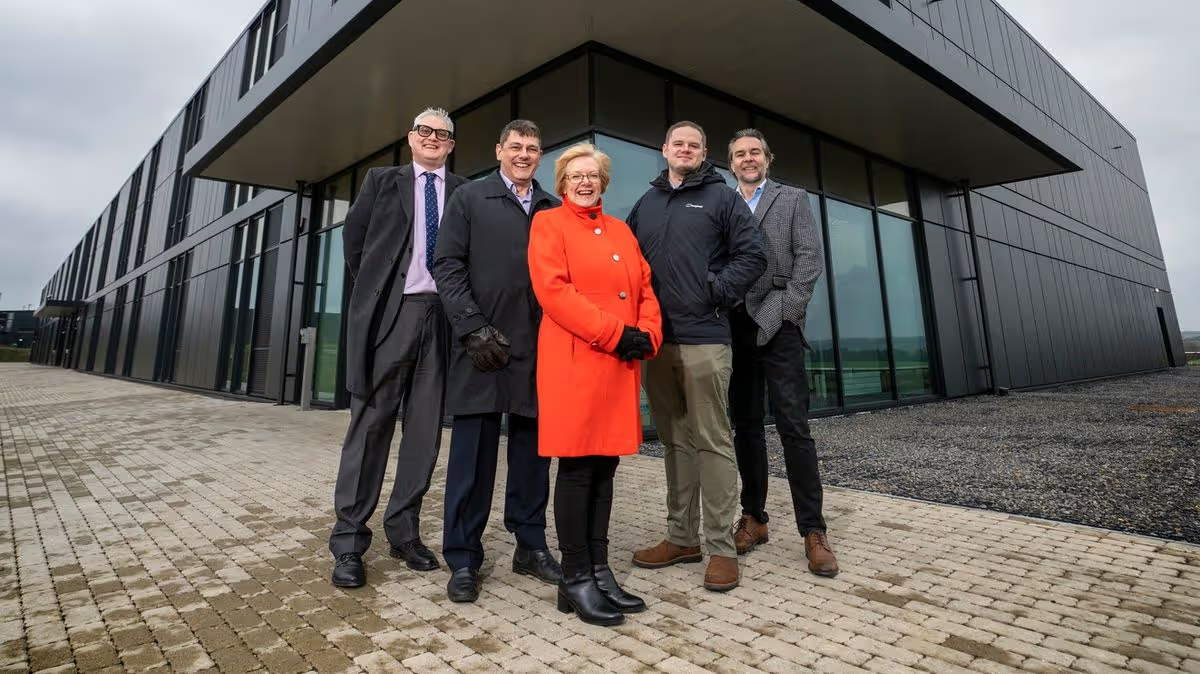
Torquil Gundlach, head of the Argonaut Programme at SEEDS; Peter Chalder-Wood, head of Strategic Partnerships at SEEDS; Sara Williams, NETPark manager; Cllr Joe Quinn, Durham County Council’s Cabinet member for planning, investment and assets; and Christian Pape, property director at Business Durham.(Image: Durham County Council)
A pioneering technology company has announced a major expansion in the North East. Engineered graphene technology firm SEEDS will be moving into a new dedicated facility at Sedgefield’s NETPark as part of the £100m expansion of the site. Taking on the new unit will allow the company to move from research and development to commercial production and enable it to supply its technology to major international manufacturers.
The company is targeting customers in the global aerospace, energy, semiconductors, and automotive sectors, with its development supported by the new phase at NETPark, which offers companies more than 285,000 square feet of high-spec laboratory and advanced manufacturing space.
It is hoped the expanded science park will create 1,250 skilled jobs on site and contribute £625m to the local economy over the next decade.
Jason Chehal, founder of SEEDS, said: “This expansion marks a defining moment for SEEDS, as we move from research excellence into full commercial deployment. Over the past decade, we’ve developed a way to engineer graphene not just as a material, but as a platform technology that can be tuned to solve real-world industrial challenges at scale.
Advertisement
Like this story? For more news from the tech sector, visit our dedicated page for the latest news and analysis here.
“Moving into our new facility at NETPark allows us to begin delivering customer specific systems across industries including microelectronics, energy storage, aerospace and advanced manufacturing.
“What’s particularly powerful is the ecosystem we’re part of here. Collaborations with CPI, Mitsui, and Pragmatic Semiconductor demonstrate how innovation in County Durham can translate directly into global industrial impact.
“We are now at the point where the technology is proven, the demand is established, and the pathways to market are clear. Each production system we deploy has the potential to support a major manufacturer anywhere in the world. That positions not only SEEDS, but the North East and the UK, at the forefront of next generation materials and electronics.”
Advertisement
Coun Joe Quinn, Durham County Council’s cabinet member for planning, investment and assets, said: “SEEDS’ expansion at NETPark reflects the critical role County Durham plays in the UK’s advanced manufacturing landscape.
“We are delighted to support SEEDS’ growth and would urge any expanding business looking for modern facilities to come and see the exceptional offer we have here at NETPark.”
NEW YORK — Shares of MARA Holdings Inc. jumped Monday to $10.02, up 48 cents or 4.98%, as the Bitcoin mining company continued to draw trader interest following its aggressive balance sheet cleanup, strategic shift toward artificial intelligence infrastructure and ongoing volatility tied to cryptocurrency prices.
MARA Holdings, Inc
The Miami-based firm, formerly known as Marathon Digital Holdings, has been transforming from a pure-play Bitcoin miner into a broader digital energy and infrastructure player. Its latest moves include selling a significant portion of its Bitcoin treasury to retire convertible debt at a discount and forging partnerships aimed at repurposing mining sites for high-performance computing and AI data centers.
MARA’s stock has been highly volatile in 2026, trading in a 52-week range from about $6.66 to $23.45. Monday’s gain came on elevated volume as investors weighed the company’s reduced leverage against persistent challenges in its core mining operations and broader sector pressures.
On March 26, MARA announced it had sold 15,133 Bitcoin between March 4 and March 25 for approximately $1.1 billion. The company used the proceeds to fund the repurchase of roughly $1 billion in face value of its 0.00% convertible senior notes due in 2030 and 2031. The notes were bought back at a discount, allowing MARA to capture about $88 million in value while reducing potential future dilution from conversions.
CEO Fred Thiel described the transaction as a “strategic capital allocation move” designed to strengthen the balance sheet and position the company for long-term growth. After the sales, MARA held approximately 38,689 Bitcoin, down from 53,822 at the end of 2025. The company has signaled it may continue opportunistically monetizing Bitcoin holdings in 2026 to enhance liquidity and fund initiatives.
Advertisement
The debt reduction lowers outstanding convertible principal significantly, easing pressure on the equity base. Analysts noted the move as credit-positive, though some expressed concern that selling treasury Bitcoin signals a departure from the aggressive accumulation strategy that once defined the company.
MARA has also been pivoting toward AI and high-performance computing. In late February, the company announced a strategic partnership with Starwood Capital to develop, lease and market select U.S. Bitcoin mining data centers for hyperscale, enterprise and AI-capable infrastructure. The arrangement includes triggers for proceeding with development, such as securing leases with qualifying tenants, with a decision required within 24 months.
The pivot comes after MARA reported a massive $1.71 billion net loss for the fourth quarter of 2025, driven largely by impairment charges and unrealized losses on digital assets amid fluctuating Bitcoin prices. For the full year 2025, revenue rose to about $907 million from $656 million the prior year, but the company swung to a $1.31 billion net loss from prior profitability.
Bitcoin production in Q4 fell 19% year-over-year to 2,011 BTC, reflecting operational challenges including power constraints and efficiency efforts. Adjusted EBITDA turned negative, highlighting the impact of lower hash rates and higher costs in a competitive mining environment.
Advertisement
Despite the headline losses, shares rose sharply after the earnings release as investors focused on the AI infrastructure narrative and the Starwood deal. Management has emphasized that its energy assets and sites provide a foundation for diversification beyond mining, potentially generating stable leasing revenue from AI hyperscalers seeking power-hungry data centers.
Analyst reactions have been mixed. Cantor Fitzgerald maintained an Overweight rating but lowered its price target to $10 from $11 in early April. The consensus 12-month price target sits around $16.48, suggesting potential upside from current levels, though forecasts vary widely given the company’s sensitivity to Bitcoin prices and execution risks on the AI pivot.
MARA is scheduled to report first-quarter 2026 results around May 7. Wall Street expects continued focus on hash rate recovery, Bitcoin holdings updates, progress on the Starwood partnership and any further treasury transactions.
The company’s digital asset management strategy has included lending and pledging portions of its Bitcoin stack, generating interest income. At year-end 2025, about 28% of holdings were activated in such programs. While this provides yield, it also introduces counterparty and custody risks.
Advertisement
Broader market context has influenced MARA’s performance. Bitcoin prices have fluctuated in 2026 amid macroeconomic uncertainty, regulatory developments and institutional adoption trends. MARA’s valuation remains closely tied to crypto sentiment, even as it attempts to decouple through infrastructure diversification.
Insider activity has added to the narrative. In mid-March, CEO Fred Thiel sold 27,505 shares under a pre-arranged 10b5-1 trading plan at an average price of $9.18. Such sales are routine for executives but can sometimes weigh on sentiment in a volatile name.
MARA operates large-scale mining facilities across the United States, leveraging low-cost power agreements where possible. The company has highlighted improvements in energy efficiency and fleet upgrades, though production declines in recent quarters reflect industry-wide headwinds including the Bitcoin halving effects and rising competition.
The AI pivot introduces both opportunity and risk. Repurposing mining sites could generate higher-margin revenue from leasing, but it may divert power and resources from Bitcoin mining, potentially reducing output further. Operational disruptions during transitions could also pressure near-term results.
Advertisement
Critics argue MARA remains primarily a leveraged Bitcoin play, with its treasury and mining operations still dominating the story. Supporters point to the company’s substantial power capacity and site portfolio as undervalued assets in an era of surging AI demand for data center infrastructure.
As of mid-April 2026, MARA’s market capitalization hovers around $3.6 billion, with an enterprise value higher due to remaining debt. The stock carries a high beta, making it prone to sharp swings on crypto news, earnings or sector developments.
Looking ahead, key catalysts include Q1 production figures, updates on AI leasing progress, any additional Bitcoin sales or purchases, and macroeconomic factors affecting Bitcoin. Success in securing hyperscaler tenants for its data centers could mark a meaningful step in the strategic transformation.
Challenges persist, including regulatory scrutiny on crypto mining energy use, competition from larger players like Riot Platforms, and the inherent volatility of digital assets. Workforce reductions of about 15% announced earlier signal cost discipline amid the pivot.
Advertisement
MARA’s story reflects broader trends in the Bitcoin mining sector, where many operators are exploring diversification into AI, HPC or other energy-intensive applications to stabilize revenue. Whether the company can successfully execute this shift while managing its remaining Bitcoin exposure will determine if it can command a premium valuation beyond its crypto roots.
For now, with shares rebounding toward the $10 level on Monday and first-quarter earnings approaching, MARA remains one of the most actively traded names at the intersection of cryptocurrency, energy infrastructure and emerging AI data center demand. Investors continue to debate whether the balance sheet cleanup and AI ambitions provide a sustainable path forward or if the company will stay tethered to Bitcoin’s fortunes.








.webp?t=1738594923)










































You must be logged in to post a comment Login