
Crypto World
Capital B Expands Bitcoin Treasury to 2,925 BTC


TLDR
- Capital B purchased 37 BTC for $2.3 million at $60,892 per coin.
- The company now holds 2,925 BTC at an average cost of $92,096.
- Year-to-date BTC Yield stands at 1.25% with a 35.3 BTC Gain.
- Capital B issued 36,613,919 shares through OCA B-01 bond conversions.
- Fully diluted share capital now represents 730 satoshis per share.
Capital B expanded its Bitcoin treasury after converting debt and raising new equity capital. The company increased holdings to 2,925 BTC and reported updated treasury metrics. It also issued new shares following bond conversions and warrant exercises.
Capital B Lifts Bitcoin Holdings to 2,925 BTC
Capital B confirmed the purchase of 37 BTC for $2.3 million at $60,892 per coin. As a result, the company now holds 2,925 BTC acquired for $269.4 million. The average acquisition cost stands at $92,096 per bitcoin.
The company reported a year-to-date BTC Yield of 1.25% as of 2026. It posted a BTC Gain of 35.3 BTC and a BTC € Gain of $2.2 million. Quarter-to-date, BTC Yield reached 0.53%, with a 15.2 BTC Gain and 0.9 million euro gain.
Capital B stated that it calculates these indicators for transparency and tracking. The company said it will continue publishing BTC Yield and related metrics. It described these figures as supplemental indicators for equity-based bitcoin accumulation.
The group also disclosed that it holds 60 BTC for operational needs. It segregates these coins from the reserve supporting Bitcoin Treasury KPIs. Therefore, treasury metrics exclude those operational holdings.
Capital B Completes Debt Conversions and Share Issuances
Capital B completed conversions of its OCA B-01 convertible bonds into ordinary shares. Blockstream Capital Partners converted 17,897,600 bonds into 32,900,000 shares at $0.544 per share. UTXO Management converted 2,020,372 bonds into 3,713,919 shares under the same terms.
In total, the company issued 36,613,919 new shares through debt set-off. Both investors also exercised rights linked to BSA 2025-01 warrants granted in 2025. These adjustments followed legal provisions tied to earlier financing agreements.
Blockstream subscribed to 4,700,000 new shares at $0.544 per share for $2.56 million. UTXO Management subscribed to 530,559 shares for $0.29 million. Together, these subscriptions raised $2.85 million in fresh cash.
The company also reported the exercise of 4,464,712 BSA 2025-01 warrants. These warrants converted into 637,816 shares for $0.35 million. The remaining warrants expired worthless at midnight on April 10, 2026.
In March, Capital B announced a $3 million capital raise. The funding received backing from TOBAM and UTXO Management. The company amended existing convertible bonds to accelerate its Bitcoin treasury strategy.
Capital B stated that this funding could support the purchase of about 36 additional Bitcoin. It projected total holdings could reach around 2,880 BTC under that plan. After recent purchases, total holdings stand at 2,925 BTC.
Following these transactions, the issued share capital reached 272,210,021 shares. The fully diluted share base stands at 397,622,899 shares. On this basis, Capital B reports 730 satoshis per fully diluted share.




Avalanche is moving beyond finance and into outer space, with a new network designed to verify telescope data in real time.
SkyMapper has introduced a dedicated Avalanche-based network that cryptographically records observations from telescopes around the world, turning each data point into a secure, verifiable digital record.
The new network, SkyMapper L1, collects data from a wide range of telescopes and sensors around the world and turns each observation into a secure digital record. The company calls this a “Proof of Space Observation” (POSO) — essentially a way to prove that a specific event in the sky was actually seen, when it happened, and that the data hasn’t been altered. These verified records can then be used by scientists, businesses or government agencies that need reliable space data.
The SETI Institute, known for its search for extraterrestrial intelligence, is contributing live observational data, marking one of the first production-scale integrations of institutional science into a blockchain-based verification system.
SkyMapper’s pitch centers on a growing problem: the explosion of data from satellites, drones and space missions, and the difficulty of verifying that data hasn’t been altered or misattributed. The team argues that blockchain can help solve this by creating a permanent, tamper-resistant record of each observation that anyone can independently verify.
The system works by validating observations at the moment they are captured. When a telescope in the network records an event — such as a satellite pass or deep-space signal — the data is immediately cryptographically signed, effectively creating a unique fingerprint tied to that device. The observation is then time-stamped and transmitted through SkyMapper’s infrastructure.
Instead of keeping all the data in one central database, SkyMapper spreads it across a decentralized storage network. At the same time, it saves a kind of digital fingerprint of that data on the Avalanche blockchain. This fingerprint means anyone can later check it to confirm the data is real and hasn’t been changed.
The network uses smart contracts to check incoming data, organize it, and control who can access it. Some information — like sensitive government or defense data — can be kept private, while other data, such as scientific research, can be shared openly.
The result is a system where each observation can be independently verified: users can check when and where it was recorded, confirm it hasn’t been tampered with, and trace it back to its source.
“We’re building blockchain infrastructure for real-world impact,” said Emin Gün Sirer, founder and CEO of Ava Labs. “SkyMapper’s work anchoring observatory data on Avalanche shows how this technology can transform science, providing tamper-proof, verifiable telescope records.”
Read more: FIFA Teams Up With Avalanche to Build Its Own Blockchain, Expanding Web3 Ambition
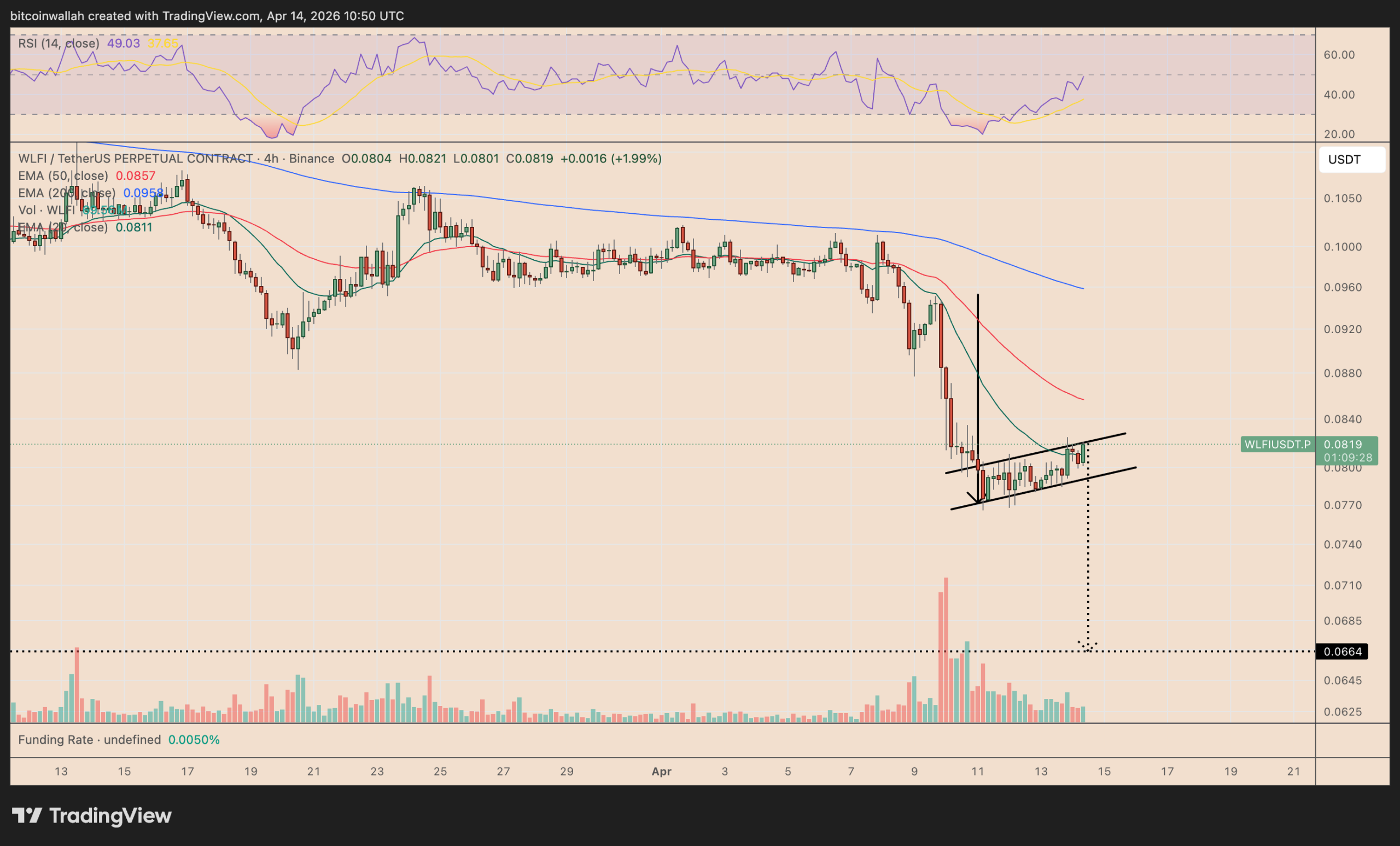
World Liberty Financial’s WLFI token risks dipping 20% in April, according to a mix of convincing technical and fundamental indicators.
Key takeaways:
Bear pennant hints at WLFI dip in April
As of Tuesday, WLFI was consolidating inside a classic bear flag, a continuation pattern that typically forms after a sharp decline.
In technical analysis, a bear flag typically resolves when the price breaks below the lower trendline alongside rising trading volumes and falls by as much as the structure’s maximum height.

Applying this classic rule to WLFI’s chart brings its measured downside target to around $0.066 in April, down about 20% from the current price levels.
Conversely, a break below the upper trendline risks invalidating the bear flag setup, with the 20-day (green) and 50-day (red) exponential moving averages (EMAs) at around $0.081 and $0.085 serving as primary upside targets.
Insider activity, token unlock fears add pressure
Beyond technicals, WLFI faces mounting scrutiny that continues to weigh on sentiment.
On-chain data from Arkham Intelligence show wallets linked to the project deposited roughly 3–5 billion WLFI tokens—largely illiquid—as collateral on Dolomite to borrow about $75 million in stablecoins, including USD1 and USDC.

Over $40 million was later moved to Coinbase Prime. The position pushed pool utilization to ~93%, restricting withdrawals and drawing criticism for “circular” liquidity extraction.
The structure is risky because it uses thinly traded internal tokens to borrow real liquidity, meaning any sharp WLFI price drop could trap depositors, trigger bad debt, and deepen selling pressure.

At the same time, markets are bracing for a proposed unlock of over 16 billion WLFI tied to still-locked public allocations, raising dilution risks.
Adding to the pressure, Tron founder Justin Sun, who reportedly invested ~$75 million and became an adviser, again accused WLFI of embedding a hidden backdoor blacklisting function in the smart contract.
Related: US President Trump faces renewed backlash as Trump-linked tokens crash
This allegedly allowed the team to unilaterally freeze his wallet/assets without notice or recourse, violating “decentralization” promises.
He called it a trap, denounced “token scandals,” claimed governance votes were rigged/non-transparent and demanded unlocks/transparency.
This article is produced in accordance with Cointelegraph’s Editorial Policy and is intended for informational purposes only. It does not constitute investment advice or recommendations. All investments and trades carry risk; readers are encouraged to conduct independent research before making any decisions. Cointelegraph makes no guarantees regarding the accuracy or completeness of the information presented, including forward-looking statements, and will not be liable for any loss or damage arising from reliance on this content.
Crypto World
Ethereum Eyes $2,480 Breakout as Bullish Momentum Builds Alongside New $1M Security Audit Initiative
TLDR:
- Ethereum approaches $2,480 resistance as an ascending triangle pattern signals a potential breakout setup forming.
- TD Sequential sell signal reappears, echoing the previous rejection near $2,400 and raising caution among traders.
- ETH reclaims its 100-day SMA, suggesting buyers are regaining control despite resistance pressure.
- Ethereum Foundation launches a $1M audit subsidy program to improve smart contract security for developers.
Ethereum is trading near a key resistance zone, with price action tightening within a bullish structure. Traders are watching closely as technical signals present both strength and caution, leaving the market at a decisive point for the next move.
Ethereum Tests Key Resistance Amid Conflicting Technical Signals
A recent post by Ali Charts on X points to Ethereum approaching the upper boundary of an ascending triangle on the daily chart.
This pattern often forms during periods of steady accumulation and can precede strong directional moves.
The price has continued to form higher lows since February. This structure reflects a gradual recovery after previous declines. As a result, buyers appear to be maintaining short-term control while pushing price toward resistance.
However, the same analysis notes the appearance of a TD Sequential sell signal. This signal previously appeared when Ethereum tested the $2,400 level. At that time, the market experienced a pullback toward lower support zones.
This repeated signal introduces caution despite the current upward movement. While price strength remains visible, traders are weighing the risk of another short-term correction.
At the same time, Ethereum has reclaimed its 100-day simple moving average. This level often acts as a trend indicator. Holding above it suggests that momentum is shifting in favor of buyers.
Market attention is now centered on the $2,480 level. A confirmed daily close above this resistance could invalidate the sell signal. It may also confirm a breakout from the triangle pattern.
Until such a move occurs, the resistance remains active. Price reactions at this level are expected to guide short-term direction.
Ethereum Foundation Expands Security Efforts With Audit Subsidy Program
Alongside market developments, the Ethereum Foundation has introduced a new initiative aimed at strengthening network security. In a recent post, the organization announced the Ethereum Audit Subsidy Program.
The program is designed to reduce the cost of security audits for developers building on Ethereum. Audits are considered a best practice, yet they often require substantial financial resources.
Through this initiative, the foundation is working with established audit providers. The goal is to make high-quality security reviews more accessible to builders across the ecosystem.
The announcement also references collaboration with industry participants. These include Nethermind and Chainlink Labs, alongside the Trillion Dollar Security Initiative.
The joint effort brings a total of $1 million in audit subsidies. This funding is intended to support projects at various stages of development. It also aims to improve overall protocol safety.
By lowering the financial barrier, the program encourages more teams to adopt proper security measures. This approach supports long-term ecosystem growth while addressing known risks in smart contract development.
The initiative arrives at a time when network usage continues to expand. As more applications are deployed, the need for secure infrastructure becomes increasingly important.
Together, these developments place Ethereum at a critical moment. Price action is testing a major technical level, while ecosystem efforts focus on strengthening its foundation.

CoW Swap, the decentralized exchange aggregator used by Vitalik Buterin to sell millions of dollars worth of Ethereum, is warning users to avoid interacting with its site after suffering a front-end attack.
“We are currently experiencing an issue with the CoW Swap frontend,” the firm posted on X earlier today, adding, “While we are investigating, please DO NOT use CoW Swap.”
CoW Swap later revealed that it was victim to “a DNS hijacking at 14:54 UTC.”
Read more: Aave Labs faces backlash over CoW Swap integration
It said, “The CoW Protocol backend and APIs were not impacted, but we have paused them temporarily as a precaution.”
“We are now actively working to resolve the situation. Please continue to refrain from using swap dot cow dot fi until we confirm that it is safe to use,” CoW Swap added.
Crypto security firm Blockaid also claimed its alert system was able to detect “a front-end attack,” and warned users with connected wallets to “revoke approvals and avoid any interactions with the dApp immediately.”
Vitalik Buterin moves millions through CoW Swap
CoW has previously been used by Ethereum co-founder Vitalik Buterin to sell 3,100 Ethereum, which was worth over $6.1 million at the time.
It was integrated with Aave Protocol last December. Days later, a delegate called “EzR3aL” noted that the partnership resulted in funds being diverted away from the Aave treasury.
A months-long governance battle followed.
The partnership would supposedly offer “better prices… and protection against MEV attacks” and allow users to “repay borrow positions using their collateral, swap between different collateral types, change their debt positions, or withdraw and swap assets.”
CoW Swap’s integration also saw a more unfortunate swap that involved a crypto user swapping $50 million of (Aave-wrapped) USDT to just $35,000 of (Aave-wrapped) AAVE.
Both CoW Swap and Aave pledged to return the fees.
Got a tip? Send us an email securely via Protos Leaks. For more informed news and investigations, follow us on X, Bluesky, and Google News, or subscribe to our YouTube channel.
JPMorgan Chase Chief Financial Officer Jeremy Barnum said stablecoins may evolve into a form of regulatory arbitrage if new rules fail to align them with traditional banking standards.
Speaking on the bank’s first-quarter earnings call on Tuesday, Barnum framed the debate less as a technology shift and more as a question of oversight. Some stablecoin models could replicate bank-like products while avoiding the safeguards applied to deposits, including rules around interest payments and customer protections, he said.
“If the same product isn’t regulated the same way, you open the door to arbitrage,” Barnum said, pointing to structures that offer rewards resembling yield. In that scenario, he added, firms could “run a bank” without being subject to core banking regulations.
The comments come as lawmakers weigh new frameworks for digital assets. The proposed Clarity Act aims to define how crypto markets are split between regulators such as the Securities and Exchange Commission and the Commodity Futures Trading Commission. It also reflects broader efforts to establish clearer rules for stablecoins and related products.
The debate also extends to whether issuers of stablecoins, crypto tokens whose value is pegged to a traditional asset, mostly the dollar, should be allowed to offer yield to users.
Some crypto firms, including Coinbase (COIN), have pushed for the ability to pass interest earned on reserve assets to coin holders, arguing it would make stablecoins more useful as savings tools.
Banks have pushed back, saying yield-bearing stablecoins begin to resemble deposits without the same capital, liquidity and consumer protection requirements. In their view, that creates an uneven playing field, allowing non-bank firms to attract funds by offering returns regulated banks are restricted from providing.
The issue has become a central point of tension in Washington D.C., as policymakers weigh how to prevent stablecoins from functioning as bank-like products outside the traditional regulatory perimeter.
Barnum said JPMorgan supports the push for clarity, but stressed that consistency matters more than speed. Without it, he warned, new entrants could gain an advantage by operating outside existing regulatory boundaries.
He downplayed the idea that stablecoins will disrupt the bank’s core payments business. JPMorgan already runs a large wholesale payments network that processes transactions at low cost and high speed, leaving little room for margin-driven disruption.
Instead, the bank is integrating similar technology into its own systems. Through its blockchain unit, Kinexys, JPMorgan has developed tools such as JPM Coin and tokenized deposits, which allow institutional clients to move money around the clock and automate transactions.
Barnum described these efforts as part of a broader modernization strategy. Features often associated with stablecoins, such as programmable payments, are already being built into existing infrastructure rather than replacing it.
On the consumer side, he said stablecoins are often framed as “digital cash,” but still face familiar compliance hurdles, including identity checks.
JPMorgan reported stronger-than-expected first-quarter results, driven by a rebound in trading and investment banking. Net income rose 13% year over year to $16.49 billion, while revenue climbed 10% to $50.54 billion. The bank set aside less for potential loan losses than expected, signaling stable credit conditions among borrowers.
The integration lays the groundwork for private, compliant financial applications on Ripple’s Layer 1 blockchain.
Boundless, a zero-knowledge (ZK) proving network originally launched by RISC Zero, has integrated with the XRP Ledger (XRPL), bringing native ZK proof verification to the Layer 1 blockchain for the first time.
The integration is designed to enable institutions to build financial applications on XRPL that can execute privately while maintaining regulatory compliance, according to the announcement.
XRPL is a public, open-source blockchain built for payments and tokenized finance. The network has attracted more than $550 million in ecosystem funding and counts SBI Holdings, Zand Bank, Archax, and Guggenheim Treasury Services among its institutional users.
Despite the institutional foothold, on-chain transparency has remained a barrier to deeper adoption. Transaction flows, treasury strategies, and counterparty relationships are visible by default on public ledgers, creating competitive risks and compliance friction. Ripple CTO David Schwartz acknowledged as much last year, noting that even Ripple itself could not use the XRPL DEX for payments due to compliance constraints around anonymous liquidity providers.
Emiliano Bonassi, VP of Engineering at Boundless, said the integration covers use cases from stablecoin payments to DeFi flows.
“Boundless brings scalable confidential compute directly to the XRPL ecosystem,” Bonassi told The Defiant. “Institutions can settle on XRPL with ZK proofs and cryptographic attestations for compliance and privacy-preserving logic, such as sanction screening to KYC/KYT/KYB. No trust assumptions, no data exposure, and full control over what gets disclosed and to whom.”
The privacy layer arrives as XRPL continues to expand its institutional network. Ripple teased major XRPL upgrades in February aimed at broadening XRP’s utility beyond payments into stablecoin settlement, tokenized assets, and lending. In November, Ripple partnered with Mastercard and WebBank to test RLUSD stablecoin card settlements on XRPL. And the network’s real-world asset push has accelerated, with Argentina’s YPF Luz launching an energy tokenization platform carrying over $800 million in tokenized assets on the ledger.
“XRPL has always been built for institutional finance. With Boundless, we are making confidential, compliant execution native infrastructure on XRPL, unlocking a new category of enterprise use cases,” said Odelia Torteman, Director of Corporate Adoption at XRPL Commons.
The integration reflects a broader industry shift toward privacy-first architecture powered by zero-knowledge proofs. At Ethereum’s DevConnect conference in Buenos Aires last November, ZK tooling emerged as a dominant theme, with Boundless among the projects highlighted for its work on ZK-powered cross-chain infrastructure. Proof systems have matured from experimental cryptography to what builders now consider core infrastructure for the next phase of institutional DeFi.
This article was written with the assistance of AI workflows. All our stories are curated, edited and fact-checked by a human.
Venture capitalist Tim Draper recounted his Bitcoin (BTC) history, renewing his call for a $250,000 price target.
The billionaire said his BTC journey began with a failed attempt to buy at $4 per coin. He had arranged for Peter Vessenes to mine Bitcoin using Butterfly Labs chips. However, the manufacturer allegedly used the chips for its own mining before shipping them.
A Series of Losses Led to a Defining Bet
By the time Vessenes received the equipment, BTC had already climbed above $30. The mined coins were stored on Mt. Gox, the dominant exchange at the time.
When Mt. Gox collapsed in 2014, Draper lost his entire position.
The loss prompted deeper research. Draper found that BTC was being used for remittances and paying unbanked workers. That conviction led him to the US Marshals Service auction in July 2014. He bid $632 per BTC and won all nine lots, totaling roughly 29,656 coins.
He then appeared on Fox Business and predicted BTC would hit $10,000 in three years.
That forecast proved accurate almost to the day in November 2017.
Draper Eyes $250,000 Within 18 Months
Draper now suggests BTC could reach $250,000 within 18 months. He cited inflationary pressures and a weakening dollar as tailwinds.
“I have reason to believe that Bitcoin will reach $250k in 18 months… and eventually I expect the number to be higher as Bitcoin rises and the dollar falls to inflationary pressures,” he wrote in his latest post.
However, it is worth noting that Draper has issued a Bitcoin price target of $250,000 in the past, yet BTC has gotten nowhere close in six years.
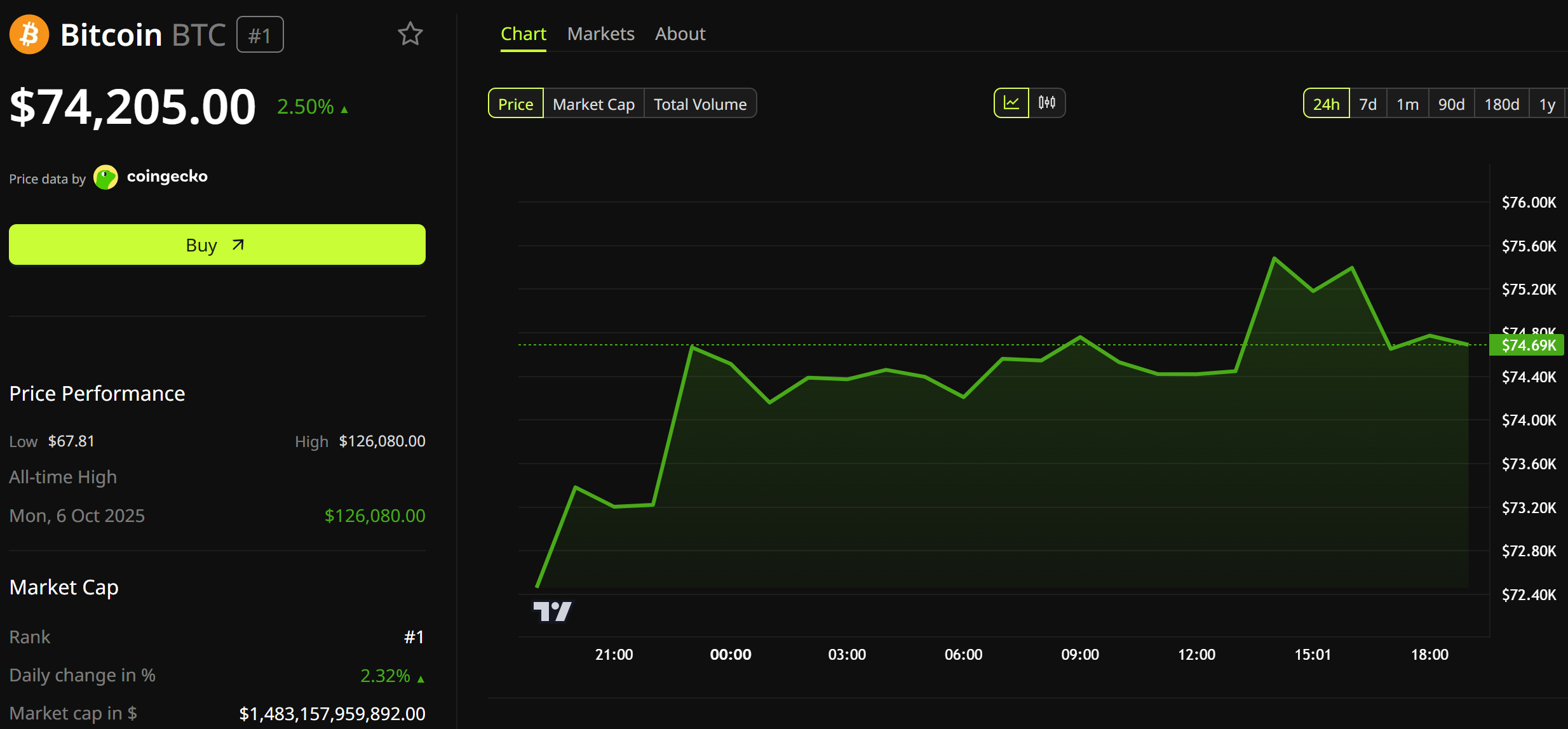
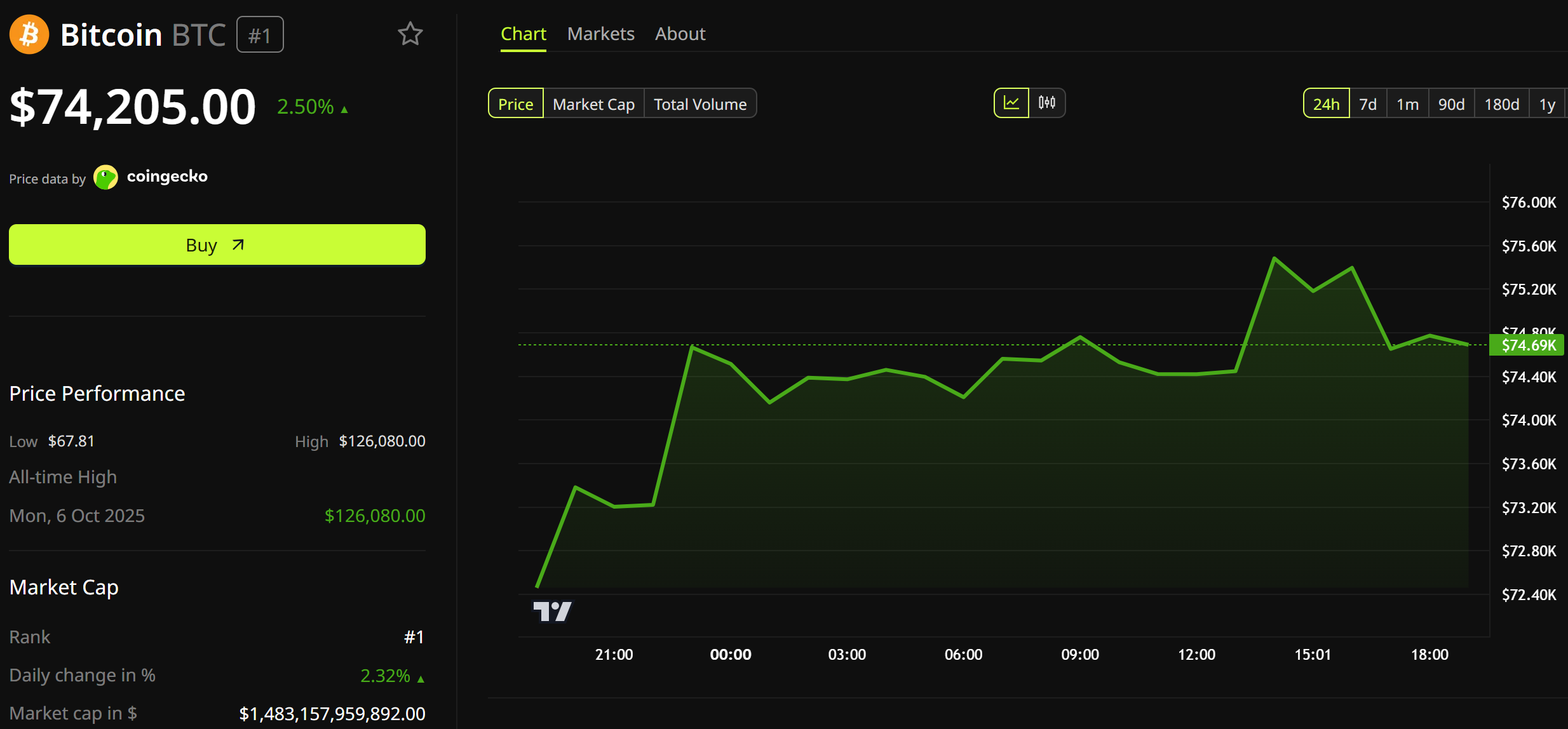
BTC traded near $74,205 at the time of writing. Other prominent voices, including Cardano founder Charles Hoskinson, have also targeted $250,000. That level remains more than three times the current price.
The post Billionaire Tim Draper Predicts Bitcoin Will Reach This Price in 18 Months appeared first on BeInCrypto.


Bitcoin touched $75,900 in mid-morning U.S. trading hours on Tuesday, marking its highest level since before February 5, when the price crashed down to $60,000.
Optimism about developments in the Iran war is sparking solid gains across risk assets and continued declines in oil prices. The Nasdaq was ahead 1.2% and WTI crude was lower by 6% to $93 per barrel.
Crypto-related stocks were higher across the board as well. Strategy (MSTR) was up 7.6, Coinbase (COIN) 6.2%, Circle (CRCL) 11% and Galaxy Digital (GLXY) 8.3%.
Bitcoin miners — most of which have altered their business plans to focus on AI-related data center buildouts — were also making large upside moves, led by the former Bitfarms, now Keel Infrastructure (KEEL), which was up 20.5%. MARA Holdings (MARA) was ahead 5.8% and Hut 8 (HUT) 4.8%.
The broader macro backdrop has also turned more supportive. With the Nasdaq reaching its highest level since early February, ether (ETH) also outperformed bitcoin, underscoring the risk-on tone across markets, said Joel Kruger, market strategist at LMAX Group.
“Overall, the past 24 hours reflect a market that is beginning to show signs of re-engagement,” Kruger said, pointing to improving technicals and broader participation.
The next test for the crypto rally comes at current levels. Kruger said the $76,000 level for bitcoin, where the mid-March rebound rolled over, is a key resistance.
A decisive move above — alongside sustained strength in ether (ETH), the second-largest cryptocurrency — would be key in determining whether the rebound can evolve into a more durable bullish trend, he said.


The Ethereum Foundation is doubling down on one of the ecosystem’s most critical needs: security.
On Tuesday, the organization unveiled a new initiative aimed at tackling a persistent challenge in crypto development—the high cost of smart contract security audits.
Through its “Audit Subsidy Program,” the foundation is partnering with leading audit providers and ecosystem firms to make professional security reviews more accessible to builders.
Backed by a $1 million subsidy pool, the program is designed to lower financial barriers that have historically prevented many teams from undergoing comprehensive audits, despite their importance as an industry best practice.
The initiative is part of the foundation’s broader Trillion Dollar Security Initiative, which focuses on strengthening Ethereum as it scales to support increasingly complex applications and larger amounts of value on-chain.
The program includes partners such as Nethermind, Chainlink Labs and Areta, and connects builders with more than 20 top-tier audit firms, helping streamline access to trusted security expertise across the ecosystem.
Alongside the rollout, the foundation also introduced a new framework it calls the “CROPS principles,” short for censorship resistance, open source, privacy and security. The framework is intended to guide how applications are built and evaluated across the Ethereum ecosystem.
Builders can submit their projects for consideration, after which an expert committee reviews applications. Selected teams receive subsidies that can be applied directly to audit services through Areta’s platform. The program is open to all Ethereum mainnet builders, regardless of size or stage.
“The subsidy program makes audits accessible and strengthens the Ethereum ecosystem,” the foundation wrote on X.
Read more: Ethereum Foundation publishes new mandate defining its role, core principles


Coinbase is reportedly in talks with Anthropic to gain access to Claude Mythos Preview, the AI company’s restricted frontier model with advanced cybersecurity capabilities.
The outreach, first reported by The Information, reflects growing urgency among crypto exchanges to defend against increasingly sophisticated AI-driven threats.
Project Glasswing Raises the Stakes for Crypto
Anthropic launched Project Glasswing in early April 2026, a defensive cybersecurity initiative giving select partners limited access to Mythos.
The model identified thousands of previously unknown zero-day vulnerabilities during testing, including a 27-year-old flaw in OpenBSD and a 16-year-old bug in FFmpeg.
Founding partners include Amazon Web Services, Apple, Google, JPMorgan Chase, Microsoft, and Palo Alto Networks. Over 40 additional organizations maintaining critical software also received access.
Anthropic committed $100 million in compute credits and $4 million to open-source security groups for the program.
For Coinbase, the largest US crypto exchange, the timing is significant. The platform dealt with a major insider breach in 2025 that exposed personal data of roughly 70,000 users after overseas support agents were bribed by criminals.
Coinbase refused a $20 million ransom demand and instead posted a matching bounty for information leading to arrests.
Anthropic’s own research has shown that AI agents can autonomously exploit smart contract vulnerabilities, generating millions in simulated stolen funds.
That finding indicates why exchanges may view Mythos access as essential rather than optional.
Mythos will not reach general availability. Anthropic plans to integrate its capabilities into future Claude releases with strengthened safeguards.
Post-preview pricing sits at $25 per million input tokens and $125 per million output tokens.
Whether Coinbase secures formal partnership status or broader Glasswing access remains unclear.
The exchange already uses Claude for customer support operations across more than 100 regions.
The post Coinbase Reportedly Courts Anthropic to Bolster Exchange Security Infrastructure appeared first on BeInCrypto.

SETI telescope data goes onchain

The Next Star Wars Movie Is Already A Flop

Bitcoin: This WILL Trap Investors (It Happens EVERY Cycle)


-

 Politics4 days ago
US brings back mandatory military draft registration
-
 Sports4 days ago
Man United discover Nico Schlotterbeck transfer fee as defender reaches Dortmund agreement
-

 Fashion4 days ago
Weekend Open Thread: Veronica Beard
-

 Politics5 days ago
Malcolm In The Middle OG Turned Down ‘Buckets Of Money’ To Appear In Reboot
-

 Politics2 days ago
World Cup exit makes Italy enter crisis mode
-

 Crypto World5 days ago
Canary Capital Files SEC Registration for PEPE ETF
-

 Business4 days ago
Tesla Model Y Tops China Auto Sales in March 2026 With 39,827 Registrations, Beating Cheaper EVs and Gas Cars
-

 Crypto World1 day ago
The SEC Conditionalises DeFi Platforms to Be Avoided for Broker Registration
-

 Crypto World1 day ago
SEC Signals Exemption for Crypto Interfaces From Broker Registration
-

 Crypto World6 days ago
Bitcoin recovers as US and Iran Agree a Ceasefire Deal
-
 NewsBeat2 days ago
Pep Guardiola and Gary Neville agree over Arsenal title problem that benefits Man City
-

 Business4 days ago
OpenAI Halts Stargate UK Data Centre Project Over Energy Costs and Copyright Row
-

 Business3 days ago
Ireland Fuel Protests Enter Day 5 as Blockades Spark Shortages and Government Prepares Support Package
-

 Politics5 days ago
LBC Presenter Mocks Trump Over Iran War Failures
-

 Crypto World4 days ago
Federal judge blocks Arizona from bringing criminal charges against Kalshi
-
 NewsBeat3 days ago
JD Vance announces ‘no agreement’ with Iran over nuclear weapons fear
-

 Tech5 days ago
A version of Windows 10 released a decade ago is now eligible for additional security patches
-

 Crypto World17 hours ago
SEC Proposes Certain Crypto Interfaces Don’t Need to Register as Brokers
-

 Business4 days ago
IMF retains floor for precautionary balances at SDR 20 billion
-

 NewsBeat13 hours ago
Trump and Pope Leo: Behind their disagreement over Iran war
You must be logged in to post a comment Login