








-in-Grapevine-0i8485c8.jpeg)

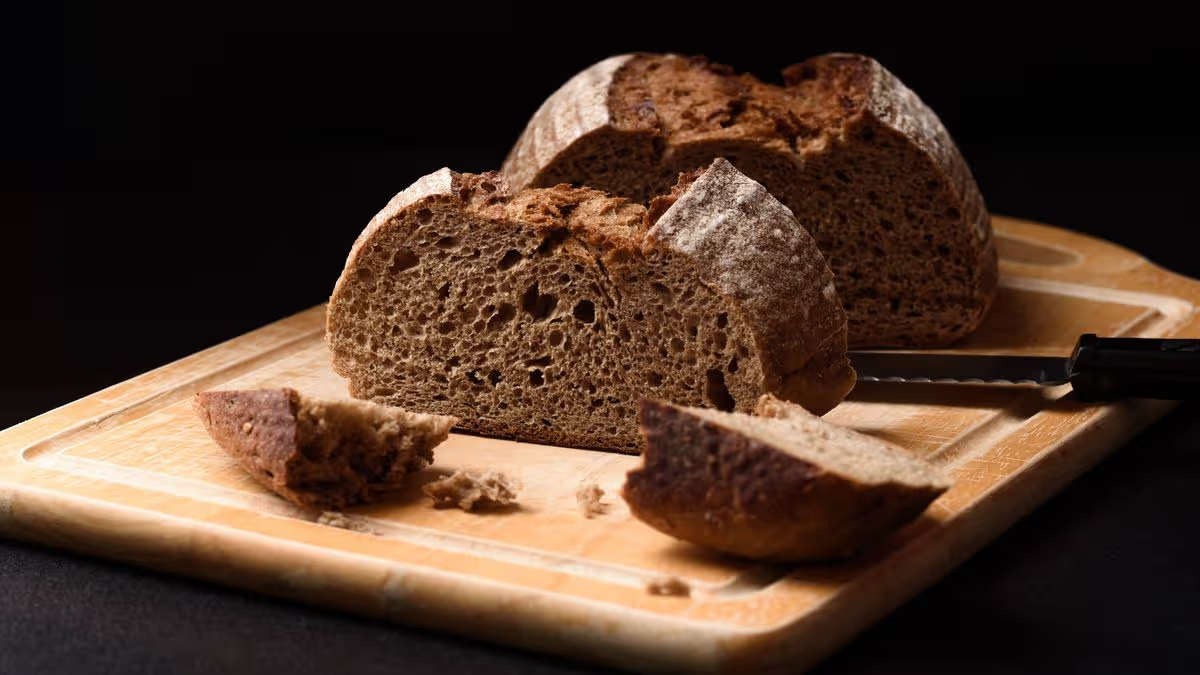
Some of the cheapest supermarket wholemeal loaves have outscored expensive artisan and organic breads in a Which? nutrition study
A recent investigation by UK consumer champion Which? discovered that premium malted and artisanal rye breads—frequently costing five times more than budget supermarket wholemeal loaves—generally contain higher salt levels and lower protein content, rendering them less nutritious than more affordable alternatives.
The consumer champion examined 60 popular loaves spanning five categories—wholemeal, seeded, malted, blended, and rye—to identify the healthiest choices available on British supermarket shelves. The investigation compared loaves from all price ranges, from budget varieties as low as 59p to premium breads priced above £3.
Which? evaluated the loaves utilising the 2004 Nutrient Profiling Model (NPM)—the same system employed to determine whether foods are high in fat, salt or sugar (HFSS) and are consequently restricted from prominent advertising slots and in-store promotions. The model assigns products scores out of 100, rewarding beneficial nutrients such as fibre and protein while penalising negative nutrients including sugar, saturated fat, and calories.
Each loaf in the investigation exceeded the healthy NPM threshold of 62. Nevertheless, there was a 10-point variation between the highest (80) and lowest (70) scorers. A maximum score of 80 signifies minimal salt and sugar, alongside high protein and fibre—making these the most nutritionally concentrated options on offer. While pricier loaves — such as organic rye — may seem like the healthier choice, they frequently achieved lower scores than more budget-friendly supermarket alternatives. That said, rye contains less gluten and carries a lower glycaemic index, which could mean it offers benefits over other bread varieties.
The research revealed that 13 loaves achieved an overall score of 80, with some of the most affordable options, including Aldi Village Bakery medium wholemeal (59p), attaining the impressive nutritional rating. Additional supermarket loaves from Asda, Co-op, Morrisons, M&S, Ocado and Sainsbury’s also reached the same high nutritional score, while Aldi’s medium wholemeal loaf also boasted one of the greatest fibre contents (7.9g), reports the Mirror.
Hovis featured twice among the healthiest loaves, with both its wholemeal variety and its ‘blended’ Best of Both loaf each scoring 80.
Iceland’s The Daily Bakery malted bloomer similarly attained the top score, recording some of the lowest levels of sugar and salt amongst the leading 13 loaves.
While Iceland’s loaf performed impressively, many of the malted varieties — frequently marketed as Granary, harvest grain or Dutch-style malted — fell short of the same rating. In fact, eight of the nine varieties assessed were found to use refined flour coloured with malt extract or caramel, rather than fibre-rich whole grains. Hovis Granary (medium sliced), for instance, achieved an NPM score of 72; it was marked down for containing roughly half the fibre (3.7g vs 7g) of the top-performing wholemeal loaves and for its elevated salt content (1.03g per 100g). It is worth highlighting that a separate loaf within this category, from the same manufacturer — Hovis Granary Wholemeal — recorded a higher score of 78, making it the preferable choice for health-conscious shoppers.
The poorest-performing loaf is one that the majority of consumers might arguably assume to be the most nutritious: Biona Organic Original Rye Bread. This rye bread received the lowest NPM score of 70 out of 100, despite carrying a price tag of £3.10.
If you regularly purchase this loaf, it isn’t necessarily an unhealthy choice, however it contains 1.13g of salt per 100g, placing it amongst the saltiest breads examined in the study. It also recorded one of the lowest protein levels (4.2g) of all loaves assessed and ranked among the most calorific, though this is typical of dense bread varieties.
A score of 70 still surpasses the Government’s benchmark for ‘healthy’, yet it sits at the foot of the rankings as it lacks the nutritional balance of certain supermarket own-brand alternatives.
For those mindful of their protein consumption, some of the seeded varieties could prove a worthier option. Sainsbury’s Soft Multiseed Wholemeal (Taste the Difference) boasts an impressive 12.8g of protein per 100g, the highest figure recorded across all 60 loaves tested. Nevertheless, a high protein content doesn’t automatically guarantee the best health rating. Sainsbury’s Multiseed loaf was just pipped to the ideal 80 score by options including Ocado Wholemeal, which struck a better balance with its substantial protein content (12g) alongside reduced salt and sugar quantities.
While some recorded superior NPM scores compared to others, shoppers can feel confident that all these loaves are essentially nutritious. Every one of the 60 loaves met the Government’s Nutrient Profiling Model (NPM) standard, demonstrating that even the lowest-ranking breads can form part of a balanced diet.
For those looking for an easy method to find the healthiest loaves without scrutinising packaging, it’s worth noting that, unlike terms such as “malted, “brown” and “grainy,” “Wholemeal” is legally protected in the UK. Unless a loaf carries the label “100% Wholemeal,” the brown appearance is probably just for show.
Shefalee Loth, a Which? nutritionist, explained: “Our analysis sends a powerful message to shoppers: you don’t need to pay a premium to get a nutritionally superior loaf. In fact, some more expensive breads may even be less healthy than budget wholemeal supermarket versions that cost a fraction of the price.
“Choosing 100% wholemeal guarantees bread naturally richer in B-vitamins, magnesium, and iron, providing essential fibre and protein for lasting satiety.
“For those not keen on wholemeal, our findings show that a blended loaf could provide a significant nutritional boost without compromising on the flavour of a white loaf.”
The healthiest loaves (listed alphabetically as they all have the same NPM score of 80)
- Aldi Village Bakery medium wholemeal
- Co-op Bakery Wholemeal Toastie
- Hovis Best of Both
- Hovis Wholemeal medium
- Iceland The Daily Bakery malted bloomer
- Lidl Rowan Hill Thick wholemeal
- M&S Wholemeal Farmhouse
- Morrisons wholemeal medium
- Ocado wholemeal medium sliced
- Sainsbury’s Medium Sliced wholemeal
- Tesco Wholemeal Medium
- Waitrose Essential Wholemeal
- Warburtons Wholemeal
The unhealthiest loaves (listed with the lowest scorer at the top, followed by the next two, then the rest in alphabetical order, where NPM scores are identical)
- Biona Organic original rye bread
- Hovis Granary (medium sliced)
- M&S Only 4 Ingredients wholegrain sliced rye
- Aldi Both In One medium
- Aldi Village Bakery Classic Malted Bloomer
- Allinson’s Lightly Seeded
- Biona Organic Rye Bread with sprouted seeds
- Biona Pumpernickel
- Black Sheep malted bloomer (sliced)
How to determine whether your brown loaf is nutritious
Not every brown loaf is as wholesome as it seems—some are merely white bread coloured with caramel or malt extract. Here are four methods to identify a genuinely nutritious loaf of bread:
1. Examine the ingredients list. Ingredients appear in descending order by weight. Should ‘wheat flour’ feature first, it’s legally categorised as white bread. For blended varieties (such as 50/50), the packaging must declare the precise proportions of white and wholemeal flour.
2. Search for the term ‘wholemeal’. In the UK, ‘wholemeal’ is a legally protected term—any bread labelled as such must contain 100% wholemeal flour. Terms like ‘brown’, ‘wheat’, or ‘multigrain’ lack protection and frequently conceal refined white flour. For rye bread, select those listing ‘wholegrain rye’ as the primary ingredient.
3. Do the ‘squish’ test. Should a dark loaf feel unexpectedly soft and pillowy, it’s probably manufactured from refined flour and coloured to appear brown. Genuine high-fibre bread tends to be denser, as bran naturally restricts the fluffiness that gluten can deliver.
4. Check fibre content. The Nutrient Profiling Model (NPM) awards maximum credit at 4.7g of fibre per 100g or more, but to be legally labelled ‘high fibre’, bread must contain at least 6g per 100g (or 3g to qualify as a ‘source of fibre’). Standard white bread typically contains just 2.9g, while wholemeal bread generally provides around 7g.























































You must be logged in to post a comment Login