

Politics
Trump posts new pic of himself with a giant AI Jesus



Trump got in trouble recently for depicting himself as Jesus Christ. Following a considerable backlash from his Christian supporters, Trump had to delete the image and said it was supposed to be him as a doctor – a claim which made zero sense.
Now, Trump is once again flirting with controversy by posting the following:
Trump posts a picture of Jesus hugging him days after his AI-deity image drew widespread anger https://t.co/othuzjEfKa pic.twitter.com/fuqsw2NX5b
— The Independent (@Independent) April 15, 2026
Trump is 6ft 3in, by the way, so that Jesus must be 6ft 7in at least.
Oh, and although it looks like Jesus is giving Trump a ‘hand’, that’s actually just how the picture was cropped.
And no, we can’t explain the expression on Trump’s face.
Trump has a go at “Radical Left Lunatics”
This was how Trump captioned the post:
Trump shares another image of himself and Jesus. pic.twitter.com/sDLQbAsVyc
— Headquarters (@HQNewsNow) April 15, 2026
Trump is suggesting it’s the “Radical Left Lunatics” who have taken offence. As we reported, however, it was Trump’s Christian base who really took offence to his obviously blasphemous post. And as Forbes added:
The post sparked instant backlash, largely from conservative Christian factions of Trump’s base, including prominent conservative Christian journalist Megan Basham who called it “OUTRAGEOUS blasphemy” and political commentator Cam Higby who said he spends “8 hours a day” defending Trump but “will not defend blasphemy.”
Trump would later claim he was supposed to be a “doctor” in his now-deleted post:
President Trump claims the viral image that was posted on Truth was not a depiction of him as Jesus Christ but was him being depicted as a doctor.
Reporter: Did you post that picture of yourself depicted as Jesus Christ? Trump: I did post it, and I thought it was me as a doctor… pic.twitter.com/4pfSRFPdrp
— Collin Rugg (@CollinRugg) April 13, 2026
This made zero sense, because doctors don’t dress as Jesus Christ:
Come on people. We all know that Trump was dressed as a doctor. pic.twitter.com/HvFNKhMasS
— Ed Krassenstein (@EdKrassen) April 13, 2026
Trump rolls out new scrubs US doctors will be required to wear. pic.twitter.com/3CUhjxlyaV
— Mike Sington (@MikeSington) April 14, 2026
Since then, the following theory has emerged:
oh my god. was trump told to tell the press that the image was "doctored," but misunderstood and told everyone that he was depicted as a "doctor"? https://t.co/IHr3y5myha
— manny (@mannyfidel) April 14, 2026
The religious roundup
In other news, war secretary (and supposed Christian) Pete Hegseth quoted Pulp Fiction because he’s never read an actual Bible:
Pete Hegseth quoted a fake Bible verse from Pulp Fiction during a Pentagon sermon.pic.twitter.com/1o3CJiJYRF
— Clash Report (@clashreport) April 16, 2026
Italy’s Giorgia Meloni, meanwhile, fell out with Trump as a result of him attacking the Pope:
"Trump's statement is unacceptable"
“I wouldn’t feel comfortable in a society in which religious leaders do what political leaders say.”
"I stand with Pope Leo.” pic.twitter.com/B4i2tiRUUh
— 𝐀𝐍𝐓𝐔𝐍𝐄𝐒 (@Antunes1) April 14, 2026
 Meloni has just disavowed Trump

Trump fired back with the classic ‘I know you are but what am I‘ – a classic line from Pete Hegseth’s Bible:
"It's her who's unacceptable" — Trump in a new interview today attacked Italian Prime Minster Giorgia Meloni for criticizing his attacks on the Pope pic.twitter.com/1QDw7Vqkmw
— Aaron Rupar (@atrupar) April 14, 2026
As the Guardian reported, Trump has since said:
“If I wasn’t in the White House, Leo wouldn’t be in the Vatican,” Trump claimed, adding: “Leo should get his act together as Pope, use Common Sense, stop catering to the Radical Left, and focus on being a Great Pope, not a Politician. It’s hurting him very badly and, more importantly, it’s hurting the Catholic Church!”
It’s unclear why Trump thinks Leo owes his papacy to Trump; possibly because both men are American?
Does Trump think the Catholics were so impressed with Trump that they had to promote a Yank of their own?
Hmm – that does sound like the sort of thing he’d think, actually.
This is the Pope’s latest message anyway:
Woe to those who manipulate religion and the very name of God for their own military, economic, and political gain, dragging that which is sacred into darkness and filth. #ApostolicJourney #Cameroon https://t.co/bKteFZ3iWE
— Pope Leo XIV (@Pontifex) April 16, 2026
End of days
The Guardian also noted:
In his subsequent comments to reporters, Trump remained highly critical, saying: “I don’t think he’s doing a very good job. He likes crime I guess,” adding: “He’s a very liberal person.”
The reference to ‘liking crime’ shows how much Trump has degenerated.
Going tough on crime and punishment has always been a Republican talking point, but you can’t just level the argument against anyone. Accusing the Pope of loving crime because he opposed America’s illegal war on Iran makes zero sense to anyone besides Trump himself.
At this point, we’re just praying giant AI Jesus shows up to save us all.
Featured image via Truth Social
By Willem Moore

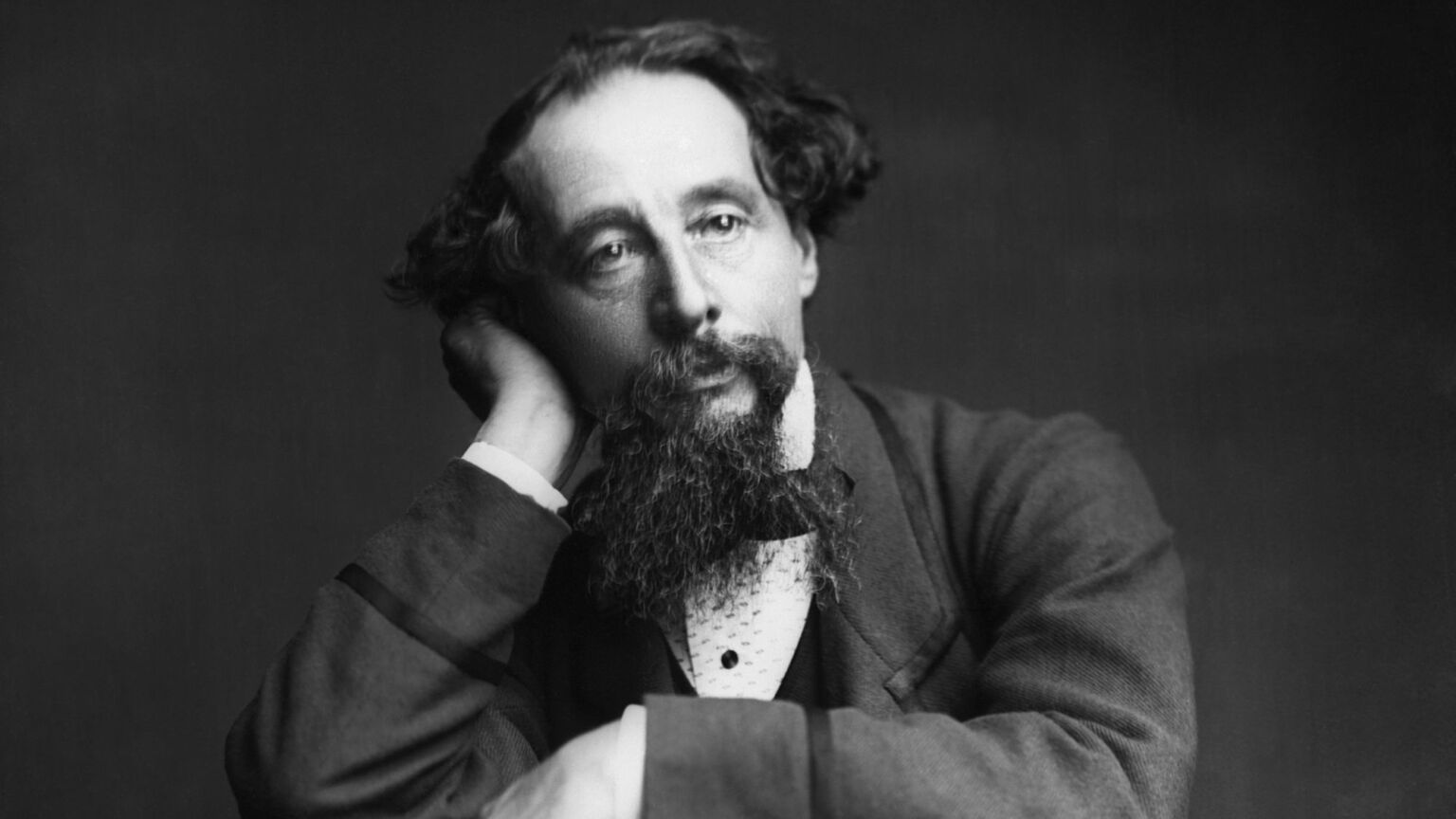
The Guildhall Museum in Rochester hosts a permanent exhibition celebrating the extraordinary life and wonderful writings of Charles Dickens. Yet it has now issued an internal document intended to warn staff about the shameful life and offensive writings of Charles Dickens.
The charge sheet alleges the usual offences against all things nice, and is no doubt written with genuine alertness to the possibility that the museum staff are incapable of coping with ‘the darker part of the writer’s oeuvre, including his lack of universalism’. Among other things that alarm the museum staff are Dickens’ support for the British Empire and ‘not for its diversity’, his calls for retribution following the 1857 Indian Mutiny and his mockery of missionaries. Dickens, it warns, had opinions that ‘can cause great offence today’ – the full horror of which we can only guess at, since he seems to have deleted his social-media accounts.
I don’t know if it’s a new thing, this attempt by a public museum to effectively cancel itself, but you have to wonder if it’s the inevitable reductio ad absurdum of cancellation movements. All revolutions eventually come after their own, after all. But it is a bit unusual for this to happen at the level of a local heritage resource.
It is also quite funny when you think about it. We are now approaching a point where there is little for the satirically inclined social commentator to do other than itemise what the grievance fetishists are up to and let their ludicrousness speak for itself. I’m sure Dickens himself would have some real fun with the whole business.
Roger Scruton said that he was brought up to believe one should strive not to cause offence, but these days too many people work tirelessly to take it. This being the case, it might, on occasion, be only polite to offer them what they so desperately want. If somebody has developed the habit of finding trivial things upsetting, the best way to help them is to ridicule them into different ways of being. Indeed, if the disputable opinions of a writer who died 156 years ago offend you, then for your sake, you need to be made fun of.
Aristotle made a similar point some 2,400 years ago. In De Anima, he argued that there is such a thing as an ‘education of the emotions’. So too did the Medievalists and the Scholastics who were able to develop a sophisticated moral psychology in which the ‘ethics of feeling’ – and the value of concepts like shame – were rightly taken to be central. Sometimes it is instructive to find oneself upset. And sometimes, it is an act of charity to be the cause of such upset.
When a writer is as astute as Charles Dickens, the danger is that a fond observation of the times in which he wrote is taken as the same thing as endorsement. The Rochester case is just one more expression of retroactive cancel culture, which urges us to reassess our best writers and thinkers through the lens of present sensibilities. There are many who would happily vaporise the national memory by going after the literature, philosophy and traditions of Common Law that currently preserve it. Unfortunately, the majority of these culture warriors were distributed throughout the arts and heritage structures of the public sector while the rest of us weren’t looking.
The targeting of Dickens is telling. While he may have written within the supposedly disqualifying prejudices of Victorian England, he managed to do so with an eye to the essentials of human beings, their failings and their absurdities. As such, he was ‘universalist’ in the only way that actually matters. People are people, no matter the era they find themselves in. Indeed, if we look at the past and find it wanting, we ought to be mindful that if it were able to look right back at us, it might feel just the same way.
Sean Walsh is associate editor of Country Squire. Find him on Substack here.


The Refugee and Migrant Children’s Consortium (RMCC) has spoken out against government plans to access asylum seekers’ age using AI.
On Friday 29 May, the Home Office announced plans to use AI in cases when an asylum seekers’ age is in dispute. However, the RMCC warned that the scheme could lead to yet more wrongful detentions of vulnerable children in adult facilities.
The news follows April’s revelations from the independent Humans for Rights Network, which exposed the fact that the Home Office routinely detains so-called “age-disputed children” as adults. Of the 76 age-disputed detainees at the time, 26 had been — or were in the process of being — reassessed as children by Social Services.
Just get an AI to do it…
Most of the unaccompanied children who brave the journey to the UK in search of asylum are 16-17 years old. The Home Office’s own data shows that social workers are more than twice as likely to confirm that these individuals are minors compared to assessments carried out by immigration officers.
Ultimately, over two-thirds of the age-disputed individuals are confirmed to be their stated age. Nevertheless, Labour choose to focus on the ‘threat’ of the perceived adult migrants.
Alex Norris, the minister for border security and asylum, argued that:
For too long, adult migrants making false age claims have exploited the system and diverted vital support away from children at risk.
That is why we are rolling out AI technology to put a stop to this, ensuring those who game the system are identified, detained and removed without delay, and those who deserve support and protection are given it.
That now-familiar appeal to AI is part of Labour’s massive push to use the technology across vast swathes of public life – including policing and the court system.
Private sector enrichment
Of course, that AI-push has also seen massive amounts of public money pad the pockets of tech-sector CEOs. One company alone – genocide-linked Palantir – currently holds over £500m in public contracts, from the NHS to law enforcement.
The government’s machine-learning obsession was championed by Tony Blair and his eponymous think-tank, which just happened to take a £250m donation from AI-specialist CEO Larry Ellison.
With regard to refugee age verification, the Home Office handed a 3-year, £322,000 contract to Akhter Computers Ltd for testing and development.
But what exactly is the AI technology that Labour is aiming to deploy in this particular case? Friday’s Home Office announcement explained that:
Facial Age Estimation (FAE) uses machine learning technology to estimate an individual’s age within seconds by analysing a facial photograph without further information about the individual. […]
FAE is not the same as facial recognition technology. While both use artificial intelligence, they serve different purposes and use different algorithms. Facial recognition compares an image against a database to identify a person. FAE does not identify individuals and does not search any databases. It only estimates an age from an image.
The Home Office isn’t using FAE at the present moment in time. However, the department plans to spend the remainder of the year testing the technology ahead of a rollout in 2027.
‘Problems with bias and inaccuracy’
However, the plans have met with strong opposition from organisations representing young refugees. Kamena Dorling, co-chair of the RMCC, stated that:
The government’s proposals are deeply concerning. AI cannot account for the factors that can significantly affect a young person’s appearance after fleeing conflict and persecution and undertaking dangerous journeys, including trauma, malnutrition, and exhaustion.
Existing evidence also shows that AI faces the same problems with bias and inaccuracy as human decision-making, with similar patterns of errors.
Whilst it may seem intensely obvious, the fact that children fleeing active warzones might look older than their years apparently escaped Labour’s notice.
Likewise, as Dorling said, AI has a tendency to replicate human errors, rather than eliminating them. Meanwhile, it obscures those errors in a cloak of cold, algorithmically-determined ‘fairness’.
‘A false sense of certainty’
Senior policy analyst and consortium member Kama Petruczenko, of the Refugee Council, said:
The government’s own figures already show that hundreds of children are being wrongly treated as adults following flawed visual assessments at the border, with devastating consequences for their safety and wellbeing.
AI and facial age estimation technology are not a simple or risk-free answer to these longstanding problems. Poor image quality and bias in datasets can also affect accuracy.
There is a real danger that this technology creates a false sense of certainty in decisions that are already extremely difficult to get right. If flawed assessments are simply automated, more children could end up wrongly placed in adult accommodation, detention centres or even prisons.
The government has already shown an awareness of these biases. However, beyond vague statements about trying to minimise errors, it simply doesn’t care. The Home Office announcement stated that:
There is evidence in testing data that FAE performance can vary depending on ethnicity, skin tone, gender, place of birth and quality of input image. NIST [The National Institute of Standards and Technology] found that error rates were almost always higher for female faces, although it didn’t find out why as testing was purely on performance rather than how algorithms work.
Vendors take bias seriously and commercial FAE technology is trained to be representative of the broadest possible demographic range of potential users.
‘The technology is racist and sexist, but we’re sure the people selling it to us are doing their best’. Well that’s all fine then, please carry on.
The RMCC will release its full report, titled ‘Benchmarks and Borders: the use of facial age estimation to assess the age of unaccompanied young people seeking asylum’, in June this year. If the current state of Labour’s AI policy is anything to go by, the consortium will have no shortage of criticisms to fill its pages.
Featured image via Leon Neal / Getty Images
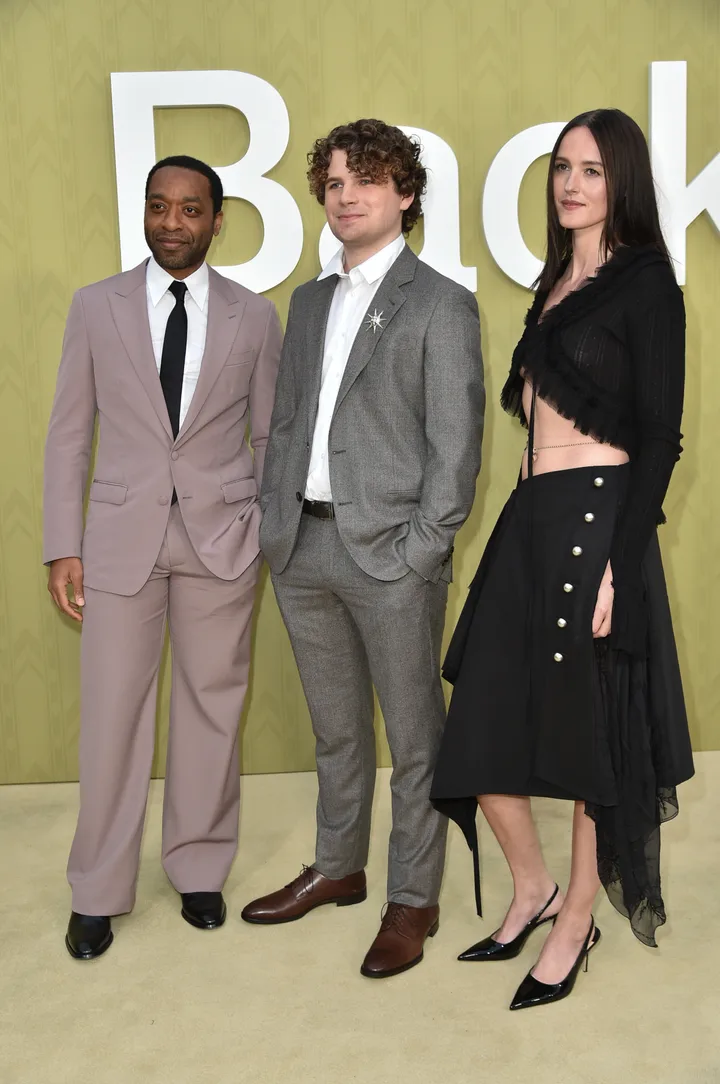
The director of Backrooms has revealed he’s already got ideas for more films set within the film’s bizarre universe.
Released last week, Kane Parson’s critically-acclaimed new horror movie centres around the lonely owner of a struggling furniture shop, who stumbles upon an unsettling other dimension through the wall of his store’s basement.
As he progresses further into the seemingly limitless space, he becomes increasingly obsessed with what he discovers and how it relates to the world outside.
During a new interview with Variety published on Backrooms’ release date, its director teased: “Without a doubt, Backrooms has always been planned to be more of a series that goes outside the confines of this film.
“If anything, I would say this is a bit of a foot in the door that would lead to more of a progression towards the true root of the narrative, which has been set up online for years. But a version that maintains accessibility and lets this be the way in.”

He continued: “For people who are into it, I’ve got a contract, and I got a hold at my end, and that means I am definitely not done with Backrooms.
“I’ve got very specific things that I’m working on, things are in the works right now that I am eager to be able to talk about, but, currently, it’s still in a secret mystery world.”
Backrooms’ origin story is a bit of an interesting one in itself.
The idea stems from a 4chan post from back in 2019 showing an environment similar to the one seen in the Backrooms movie, which then became its own “creepypasta” (an online term for a widely-shared horror story that gains notoriety and viral fame by being copied and pasted around various corners of the internet) when someone came up with text to accompany it.
While Backrooms’ original “creepypasta” was shared anonymously, Kane Parsons began a YouTube series based on the idea in 2022, the success of which led to his new film.
He added to Variety that he has no intention of “leaving YouTube behind” now he’s crossed over into feature-length filmmaking.
“I immensely enjoy the work I’ve done there, and I feel creatively fulfilled by it in a way that’s proportional to what I’ve done with this film,” he insisted. “I personally think there’s merits, because there’s a lot of projects that I just could never do outside of YouTube, or outside of a more free-form internet multimedia container.
“So I wouldn’t limit myself just to one spot, but I do think it’s a way of saying that I’ve got a bit of a good thing going right now that I want to utilise with the energy and positivity around this film.”
Backrooms is in cinemas now.
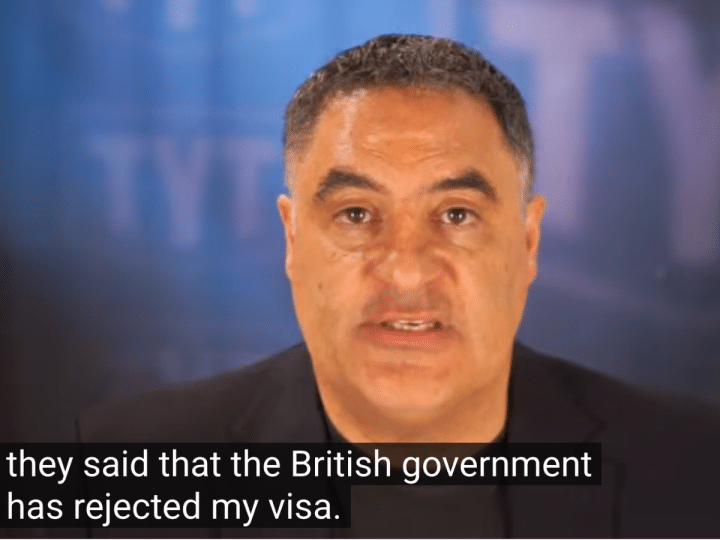

The Home Office has banned left-wing commentator and TV host, Cenk Uygur, from entering the UK, on Israel’s behalf. He is a vocal critic of pro-Israel influence over Western governments. Cenk Uygur has highlighted the irony of the UK ban over X. He said:
if I had said that the Israeli government controls the British government so thoroughly that they’ll ban someone from coming to the UK just for criticizing Israel, they would have said that was an antisemitic statement.
The commentator noted that he was banned not for any views or opinions he’s expressed about the UK.
Uygur argued that “Israel controls the American government,” largely because the pro-Israel lobby in the US channels significant financial support to members of Congress. He presented this as the main issue for Starmer’s government. While this is an overly simplistic and debatable political argument, it is not inherently a religious one. Nevertheless, some pro-Israel voices in the UK claim otherwise.
The UK banning Cenk Uygur for criticising Israel’s genocide in Gaza and US support isn’t just an attack on free speech, either. It also carries an antisemitic implication. This implication falsely equates criticism of genocidal war criminals with hatred of a whole religious group.
The British government is saying they're banning me because I am "a serious risk to the public order" due to my criticism of Israel.
They say that my charge that Israel controls the American government through donations to 94% of Congress, while factual, is antisemitic…
— Cenk Uygur (@cenkuygur) May 31, 2026
Cenk Uygur had previously called for the US to assert independence from pro-Israel interests during an appearance on Piers Morgan‘s talk show. After the UK decided to ban Cenk Uygur, Morgan has defended his guest, emphasising that he was making political rather than religious points:
She is a disgusting bigot who spews constant vile hatred against Muslims for being Muslim. Where has Cenk Uygur ever said anything hateful and bigoted against Jews for being Jewish? https://t.co/4TBnhNL9La
— Piers Morgan (@piersmorgan) June 1, 2026
Green Party leader Zack Polanski, has also called out the government’s cynical move. The Jewish politician lamented how the Labour government was:
doing everything possible to silence criticism of the Israeli government.
He called the ban of both Cenk Uygur and fellow Israel critic Hasan Piker “a really grim decision”:
This is a really grim decision alongside Cenk.
People often talk about dangerous road we'd go down under a Reform government – this is another clear warning we're down there already. A Labour government doing everything possible to silence criticism of the Israeli Government. https://t.co/XS8GKEFJMe
— Zack Polanski (@ZackPolanski) June 1, 2026
It’s one thing for a government to challenge people spreading hatred of entire religious or ethnic communities. It’s another entirely when a government decides to limit political debate on behalf of a country currently committing genocide. And that’s exactly what has just happened.
Featured image via the Young turks / YouTube
By Ed Sykes

!function(n){if(!window.cnx){window.cnx={},window.cnx.cmd=[];var t=n.createElement(‘iframe’);t.display=’none’,t.onload=function(){var n=t.contentWindow.document,c=n.createElement(‘script’);c.src=”//cd.connatix.com/connatix.player.js”,c.setAttribute(‘async’,’1′),c.setAttribute(‘type’,’text/javascript’),n.body.appendChild(c)},n.head.appendChild(t)}}(document);(new Image()).src=”https://capi.connatix.com/tr/si?token=19654b65-409c-4b38-90db-80cbdea02cf4″;cnx.cmd.push(function(){cnx({“playerId”:”19654b65-409c-4b38-90db-80cbdea02cf4″,”mediaId”:”573ffb5a-4e35-48ea-8bef-be1498f04ac9″}).render(“6a1d92e0e4b0ba317300e95b”);});
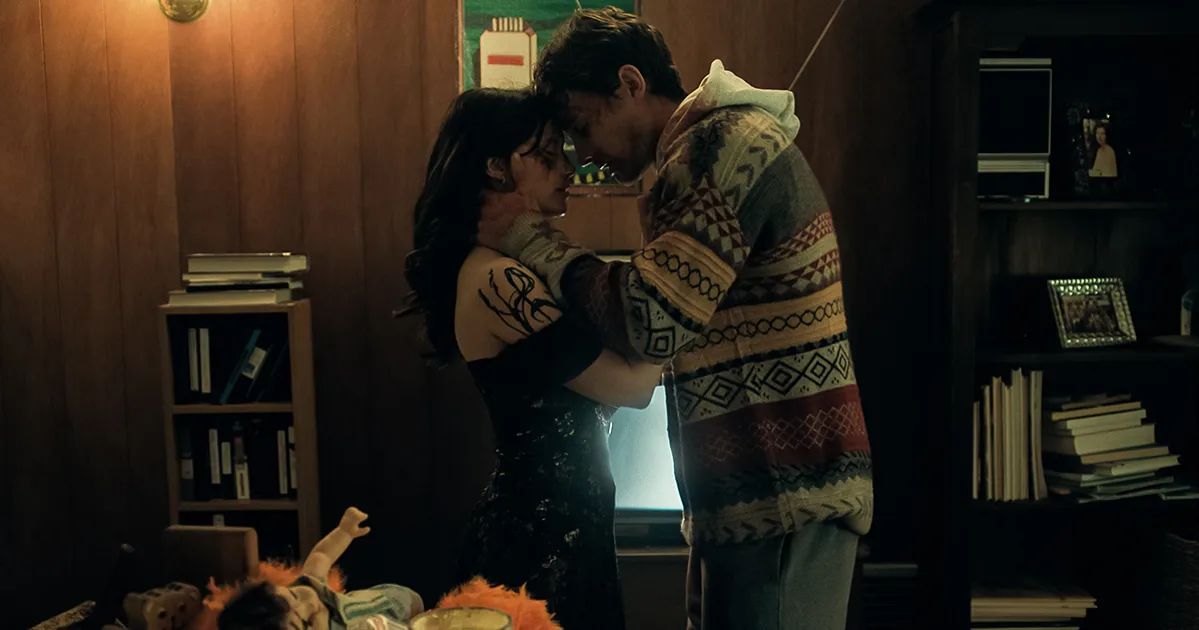
This article contains spoilers for Obsession.
As word of mouth continues to spread, Obsession remains one of the most talked-about films of the year right now.
The latest big-screen offering from former YouTuber Curry Barker centres around close friends Bear and Nikki, whose worlds are turned upside down when the former makes a wish for the latter to love him “more than anyone in the fucking world” – only for it to come true, with disastrous and tragic circumstances.
By the end of the film, almost all of the main characters are dead, aside from Nikki, whose realisation about what has transpired comes only after Bear has taken his own life and the wish’s hold is released.
However, it turns out this wasn’t the original ending that Curry had in mind.
Speaking to Entertainment Weekly around the film’s release, the filmmaker revealed it had originally been his intention for Nikki to kill herself too, drawing comparisons between a Shakespearean tragedy.
“I was really obsessed with this Romeo and Juliet ending, actually,” he claimed, revealing that he was originally adamant that Nikki should die, and even filmed this conclusion to the film.
Curry recalled: “We had shot a ton of different versions of the official ending, the one that’s in the script, the one that I was excited about, and I was like, ‘Okay, we’ll do one ending where [Nikki] survives, but we’ll just do one take of it, and then we’ll move on’.”
However, in the end, actor Inde Navarette’s “performance was so good” that everyone who saw the ending where Nikki survives convinced Curry that this was the one he should go for.
“I just remember my dad and multiple people around me being like, ‘Dude, I think it’s way more disturbing if she just survives this thing’,” he revealed. “I was like, ‘Ah, you’re right’. And so we switched it.”
Obsession has so far been a hit with critics and cinemagoers, with an enviable critical score of 96% on Rotten Tomatoes and 4.2 stars from fans on Letterboxd.
Curry has also addressed the possibility of another film set in Obsession’s in-universe, albeit with new characters, while Inde has made it clear she’d be up for playing Nikki again if the opportunity arose.
Obsession is in cinemas now.

A trade union boss has dismissed Nigel Farage’s claim that Reform UK is now the party of the working class.
He spoke out after new polling showed that union members are now just as likely to vote Reform as they are Labour.
The Times reported that 28% of them would now back Farage’s party, the same proportion as back Labour.
It follows a remarkable turnaround in the fortunes of both parties since the general election in 2024.
At that time, just 16% of trade union members backed Reform, while 48% supported Labour.
Reacting on X, Farage said: “Labour is no longer the party of the patriotic working class. That mantle now belongs to Reform.”
But speaking to HuffPost UK last month, Unite general secretary Sharon Graham pointed out that Farage’s voting record in the House of Commons flew in the face of his claim to speak for working people.
She said: “The reality is that Nigel Farage has shown no indication to me that he’s the voice of workers. He voted against the Employment Rights Act, for example.
“He’s said that when he goes into the local authority areas he’s going to be looking at [cutting] local authority pensions. So to me, if your go-to lever in terms of what is happening in councils is to attack workers, then you can’t be the voice of workers. That is just the reality of it.”
Graham said she had “put Reform on notice” that Unite will fight any attempts by the party to attack the rights of public sector workers.
“We will not accept that in any way, shape or form,” she said.
“I’ve been asked would Unite work with Reform. I’m on record saying I’d dance with the devil if it was something that was important to my members. But the broader issue here is ‘is Reform the party of workers’? No, it isn’t.”
She added: “I very often hear words about people backing workers, it’s very different when you’re asking them to do something about that.
“If Reform go after workers in local councils, then Unite will be going after Reform.”
However, Graham also accused Labour of “abandoning” the party’s traditional working class supporters.
She said: “The problem that Labour have is that they are supposed to be the voice of workers, and essentially workers feel abandoned by Labour.
“The working class feels abandoned by Labour, and now the working class have abandoned Labour. The question is can Labour get that back?
Subscribe to Commons People, the podcast that makes politics easy. Every week, Kevin Schofield and Kate Nicholson unpack the week’s biggest stories to keep you informed. Join us for straightforward analysis of what’s going on at Westminster.

It’s bloody hot. It’s half-term. And for many, that means it’s holiday season.
However, 2026 fliers might want to check some details before arriving at their airports. It’s not just that multiple airlines have issued advice following new EES checks, or that some routes may have changed following ballooning jet fuel costs.
Recently, a flight was diverted after a passenger reported a charging power bank in another flier’s bag, too (we’ve written before about why that’s a problem, as well as how to tell if your portable chargers are compliant).
So what about other devices, like handheld electric fans?
We thought we’d ask the experts.
Can I bring an electric fan onto my flight?
HuffPost UK asked Helen North, Head of Dangerous Goods at the UK Civil Aviation Authority, whether all handheld electric fans can come on board.
“Portable electric fans may contain lithium batteries, so they should be carried in the cabin, not packed in your checked bag,” she said.
“Keeping battery-powered items with you will make your flight safer for you and the other passengers you’re flying with.”
Lithium batteries are the same kind of batteries that devices like smart bags and power banks use.
They’re not usually allowed in the hold of planes (i.e., checked luggage).
That’s because they can short-circuit and catch fire, which can be especially disastrous in an unattended baggage space.
Generally, the Civil Aviation Authority said, lithium batteries should be carried as hand luggage.
And they added, “if carried as checked baggage, the devices must be completely switched off (not in sleep or hibernation mode) if the batteries exceed:
- for lithium metal batteries, a lithium content of 0.3 g per device; or
- for lithium-ion batteries, a Watt-hour rating of 2.7 Wh per device.”
Any other advice?
Yes. Most airlines won’t let you bring more than two power banks onto a plane, and you can’t use them to charge another device while you’re flying.
They generally aren’t allowed in the hold because of lithium battery limits.
Additionally, lithium batteries over 100Wh and under 160Wh will need to be cleared by your specific airline (those over 160Wh can’t come on board).
If you can’t find this, you can work it out from the milliampere-hour (mAh), ampere-hour (Ah), and/or nominal voltage (V).
Once you find these, the UK Civil Aviation Authority said: “You can arrive at the number of watt-hours your battery provides if you know the battery’s nominal voltage (V) and capacity in ampere-hours (Ah) using this calculation: Ah x V = Wh”.


When the Saudi national team takes to the pitch at the 2026 World Cup, they will carry a weighty legacy of both glory and anticipation.
In the same country that witnessed its greatest World Cup moments more than three decades ago, the Green Falcons return to reclaim a story that has remained unfinished since the summer of 1994. In 1994, Saudi entered the tournament for the first time and emerged having put their name on the map of world football.
Since that extraordinary American summer, generations have come and gone, and teams and managers have changed, but that achievement remains a solitary entry in the annals of Saudi football.
Today, as the World Cup returns to the US, the same question returns with it: will America once again be Saudi Arabia’s gateway to the knockout stages?
Saudi: The newcomers who became a phenomenon
No one expected much from a team making its World Cup debut. However, the Saudi Arabia side at the 1994 World Cup refused to be just another number in the tournament.
In a group featuring the Netherlands, Belgium and Morocco, the Green Falcons managed to write one of the most inspiring stories in the history of Arab and Asian participation. The team secured a place in the Round of 16 with two historic victories, most notably their famous win over Belgium.
Thanks to a goal by Saeed Al-Owairan, he became an enduring icon in World Cup history.
The achievement was not limited to the results alone but also to the character the team displayed. A brave, confident side, capable of competing against opponents who surpassed them in experience and history. Even after their elimination by Sweden, Saudi Arabia left the tournament carrying the respect of the entire world.
Since that day, the 1994 World Cup has become a constant reference point in any discussion of Saudi football at the World Cup.
Three decades in search of the elusive breakthrough
The Saudi national team took part in the 1998, 2002 and 2006 tournaments without managing to progress beyond the group stage, before missing out on the 2010 and 2014 editions. They then returned for Russia 2018 with a late victory over Egypt, but it was not enough to keep them in the tournament.
As for Qatar 2022, it seemed as though history was poised to write a new chapter. A historic victory over Argentina, who went on to become world champions, gave the Saudis a legitimate dream of qualification. But losses against Poland and Mexico brought the team back to square one.
This is where Saudi Arabia’s World Cup dilemma of recent decades lies: the ability to create a defining moment is there, but the ability to turn that moment into a lasting achievement has remained elusive.
A group testing ambition and realism
The draw was not kind to Saudi Arabia for the 2026 World Cup. The presence of Spain, Uruguay and Cape Verde in the group presents the Saudi team with a series of varied challenges.
Spain represents a style that dictates the tempo through possession and technical quality, whilst Uruguay embody one of the world’s most resilient and fierce sides in major tournaments.
As for Cape Verde, they may lack the star quality of their rivals, but this match appears to be the most crucial in the qualification calculations, as it could prove to be the difference between staying in the competition and being eliminated.
Nevertheless, the difficulty of the group does not mean the task is impossible. In 1994, too, the odds were not in Saudi Arabia’s favour, but the team managed to turn the tables and secure their place among the qualifiers.
Where can Saudi Arabia make the difference?
The clash against Spain looks the toughest from a technical standpoint. The Saudi team will need great tactical discipline and the ability to close down space and deny the opposition complete control of the game’s tempo.
Against Uruguay, the battle will be completely different. Physical intensity, one-on-one duels and second balls will dominate the match, making concentration and mental resilience crucial factors.
As for the clash with Cape Verde, it could be the match that decides the fate of the entire group. Such matches leave no room for hesitation as they often determine which teams will remain in the race and which will exit early.
The victory over Argentina at the 2022 World Cup in Qatar remains fresh in Saudis’ memories as one of the greatest triumphs in Arab football. The victory carries an important lesson as well being a source of pride.
The World Cup does not reward the team that wins a single match but rather the team capable of maintaining its balance throughout the tournament. For this reason, Saudi Arabia in 2026 needs more than just a resounding surprise.
It needs consistency, the ability to manage difficult moments, and the capacity to come away from every match with the best possible outcome, be it three points, a single point, or even a defeat with limited damage.
Donis faces a different test
On the bench, Georgios Donis will face one of the biggest challenges of his coaching career.
His deep knowledge of Saudi football is a significant strength, but it will not be enough on its own in a tournament of the World Cup’s stature. What is required is not merely to prepare a competitive team, but to build a squad capable of handling shifting pressures, reading the big games, and capitalising on the opportunities afforded by the new format.
Donis’ real task is to turn memories into a competitive project, not a psychological burden that haunts the players. The return to the US carries a symbolism that is hard to ignore. It was there that Saudi Arabia’s greatest World Cup dream was born, and it was there that the finest chapter in the history of the ‘Green’ team’s participation was written.
But modern football does not recognise memories alone. What happened in 1994 may inspire, but it does not confer any advantage on the pitch. Past achievements light the way, but they do not walk it on behalf of those who achieved them.
Featured image via Catherine Ivill/ Getty Images
By Alaa Shamali


Former first lady Jill Biden waved away Democrats’ concerns that her new memoir is setting off a wave of backward-looking infighting, insisting that the party is moving on from the 2024 election.
“Democrats have a great future,” she said in an interview on Monday on NBC’s “Today,” when asked if she was “reopening old wounds” with her tour. “We’re looking forward to winning the midterms. Things are going to move forward. … And yes, we’re going to look back and learn from the mistakes we made.”
Jill Biden is on tour promoting her new memoir, which has become the latest headache for Democrats. Some Democrats privately say Jill Biden’s return to the public eye is a “distraction” that risks relitigating a painful election for the party when it should instead be focused on winning in the future.
In her book, she opens up about then-President Joe Biden’s disastrous, career-ending debate in 2024. She was “frightened” watching her husband on stage, and feared he was having a medical episode of sorts.
Her confession hasn’t landed well with fellow Democrats and former White House aides, given her relentless defense of Joe Biden at the time.
“I had to lift him up [after the debate]. I’m his wife,” she told NBC. “I’m not going to get out on the stage there and say, ‘Joe, you really screwed that up.’”
The press tour comes as Democrats are still reeling from their long-awaited autopsy of the 2024 presidential election. Its botched, typo-ridden release failed to explain Democrats’ defeat — and skipped over the former president’s age — but did spark a fresh round of party infighting.

Why does a museum want to cancel its own Charles Dickens exhibition?

Rams acquire Myles Garrett from Browns in unprecedented blockbuster trade
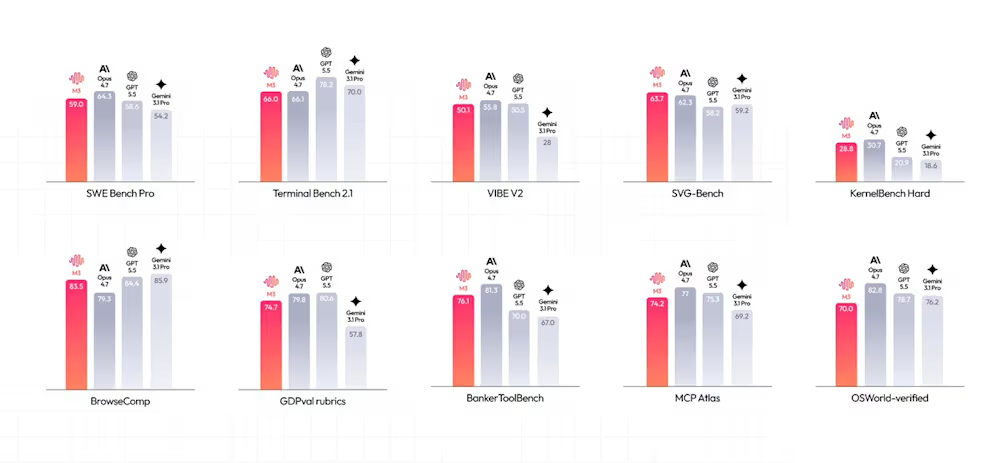
MiniMax-M3 debuts, eclipsing GPT-5.5 and Gemini 3.1 Pro on key benchmark performance for just 5-10% of the cost

Steven Gerrard disagrees with Gary Neville over ‘shock’ Chelsea and Arsenal claim | Football

US brings back mandatory military draft registration

Register Renaming | Hackaday

How Much Money Does He Make from the Gold Dust He Has Been Saving? #shorts #gold #viral #money

All Banking Exam in 2026 | Banking & Financial Awareness | GA Practice Set-164 I By Chandan Sir

FINANCE CAREERS That Will Make You RICH! @ZellEducation
-

 NewsBeat5 days ago
Israel says it has killed new Hamas military leader in Gaza City airstrikes
-

 Tech5 days ago
NASA taps Blue Origin to deliver lunar rovers for Moon Base initiative
-

 Sports7 days ago
2026 NBA Finals schedule, odds: Knicks await Thunder or Spurs after winning East
-

 News Videos6 days ago
XRP *JUST* SUCCEEDED!!!! CLARITY ACT EXPOSED!!! (SHE EXPOSED IT)
-

 News Videos3 days ago
This is BROKEN! INSANE 5x MONEY CAR WASH WEEK! The NEW GTA Online UPDATE Today! (GTA5 New Update)
-
 Crypto World6 days ago
Micron Crosses $1 Trillion Market Cap as AI Demand Reshapes Memory Sector
-
 NewsBeat7 days ago
Hottest May day ever as London hits 34.8C in 2C leap from previous records
-

 Business6 days ago
Selena Gomez Reportedly Upset Over Benny Blanco’s Comments on Her ‘Terrible’ Diet
-

 Business7 days ago
Nikkei 225 Surges Past 65,000 for First Time as Iran Peace Hopes Fuel Record Rally
-
 Tech7 days ago
China assigns ID codes to 28,000+ humanoid robots
-

 Tech4 days ago
Waymo dominates autonomous vehicle registrations as Tesla trails behind
-
 Entertainment7 days ago
‘Breaking Bad’ Star’s Easy-to-Binge 6-Part Crime Series Spin-Off Is Finally Heading to Free Streaming
-
 Tech2 days ago
SpaceX just won a second Golden Dome contract. This one is $4.16 billion.
-

 Tech5 days ago
The Samsung pay deal is the moment Korean unions changed register
-

 Entertainment6 days ago
Days of our Lives 2-Week Spoilers May 25-June 5: Gwen Rages, Abe Confesses & 2 Tragic Anniversaries!
-

 News Videos3 days ago
SHE IS KILLING XRP!!! WATCH URGENT AND ACT FAST
-
 NewsBeat3 days ago
FIRST NIGHT REVIEW: Take That bring the Circus back to life in spectacular sun-soaked style
-
 Entertainment7 days ago
Taylor Swift Fans Label Travis Kelce’s Beer-Chugging A ‘Red Flag
-

 Tech6 days ago
Millions of AI agents imperiled by critical vulnerability in open source package
-
Crypto World5 days ago
SpaceX’s $2 Trillion IPO: Why Tech Giants Nvidia (NVDA), Apple (AAPL), and Microsoft (MSFT) May Face Pressure
You must be logged in to post a comment Login