SAN DIEGO (AP) — The smell of rotten eggs permeates Steve Egger’s Southern California home, especially at night as the nearby Tijuana River foams up with sewage from Mexico before emptying into the Pacific Ocean.
Egger, 72, says he and his wife have frequent headaches and wake up congested and coughing up phlegm. Their home is outfitted with a hospital-grade filtration system that cycles the air every 15 minutes.
Despite those measures, “most nights we breathe in a horrible stench,” he said. “It’s awful.”
Since 2018, more than 100 billion gallons (378 billion liters) of raw sewage laden with industrial chemicals and trash have poured into the Tijuana River, according to the International Boundary and Water Commission. The river traverses land where three generations of the Egger family once raised dairy cows. The United States and Mexico signed an agreement last year to clean up the longstanding problem by upgrading wastewater plants to keep up with Tijuana’s population growth and industrial waste from factories, many owned by U.S. companies.
Advertisement
Steve Egger stands near what scientists call “the Saturn hot spot,” a section of the Tijuana River where the contaminated water splashes out of pipes and creates pools of foam near his home Friday, March 6, 2026, in San Diego. (AP Photo/Gregory Bull)
Advertisement
Steve Egger stands near what scientists call “the Saturn hot spot,” a section of the Tijuana River where the contaminated water splashes out of pipes and creates pools of foam near his home Friday, March 6, 2026, in San Diego. (AP Photo/Gregory Bull)
Advertisement
Advertisement
Advertisement
Advertisement
Steve Egger looks out from his door where the outer doorknob has turned black at his home Friday, March 6, 2026, in San Diego. (AP Photo/Gregory Bull)
Advertisement
Steve Egger looks out from his door where the outer doorknob has turned black at his home Friday, March 6, 2026, in San Diego. (AP Photo/Gregory Bull)
Advertisement
Advertisement
Steve Egger looks over what scientists call “the Saturn hot spot,” a section of the Tijuana River where the contaminated water splashes out of pipes and creates pools of foam near his home Friday, March 6, 2026, in San Diego. (AP Photo/Gregory Bull)
Advertisement
Steve Egger looks over what scientists call “the Saturn hot spot,” a section of the Tijuana River where the contaminated water splashes out of pipes and creates pools of foam near his home Friday, March 6, 2026, in San Diego. (AP Photo/Gregory Bull)
Advertisement
Advertisement
In the meantime, tens of thousands of people are being exposed to the sewage. Environmental Protection Agency Administrator Lee Zeldin said during a February visit to San Diego that it will take about two years to resolve one of the nation’s worst and longest-running environmental crises, which affects a largely poor, Latino population.
Raw sewage doesn’t just smell bad. It emits hydrogen sulfide, a toxic gas that can erode neurons in the nose and trigger asthma attacks. It can cause headaches, nausea, delirium, tremors, cough, shortness of breath, skin and eye irritation and even death, according to the Centers for Disease Control and Prevention. Its long-term health problems are only starting to be understood.
Advertisement
There is no federal safety standard for hydrogen sulfide except for workers at sites where the risk is extreme, such as wastewater treatment plants or manure pits. A few states set standards decades ago, but those are outdated. A California proposal would require the state’s 56-year-old standard reflect the health risks of the gas. In Texas, lawmakers are also considering updating its law.
“I think when you look back when the standard was first established and then it was reviewed, it was all about nuisance — basically it was all about odor,” said the California bill’s author, Democratic Sen. Steve Padilla, who represents the Tijuana River Valley. “I don’t think we had the understanding scientifically of what the health impacts were here, and now we do.”
Even if the bill passes, the new standard would likely not be developed until 2030.
Toxic gas from the river’s sewage infuses the air
Advertisement
A sign warns of sewage and chemical contaminated water along a beach Tuesday, March 10, 2026, in Coronado, Calif. (AP Photo/Gregory Bull)
Advertisement
A sign warns of sewage and chemical contaminated water along a beach Tuesday, March 10, 2026, in Coronado, Calif. (AP Photo/Gregory Bull)
Advertisement
Advertisement
A “Stop the Stink” sign is on Egger’s fence, part of a campaign that Citizens for Coastal Conservancy launched to demand officials clean up the cross-border sewage.
The 120-mile (195 km)-long river starts in the Mexican city of Tijuana, crosses into California and empties into the ocean. San Diego County beaches nearby have closed for years, and Navy SEALs who train in the water have fallen ill.
Advertisement
Sign up for Morning Wire:
Our flagship newsletter breaks down the biggest headlines of the day.
Advertisement
Just since January, the Tijuana River has carried 10 billion gallons (38 billion liters) of mostly raw sewage and industrial waste across the U.S. border, according to International Water and Boundary Commission data. By comparison, a massive pipe that ruptured in January sent 244 million gallons (924 million liters) of untreated sewage into the Potomac River, affecting affluent, largely white communities. That spill prompted federal intervention within weeks.
Advertisement
Trent Fry, right, and Leila El Masri handle a water sample of the Tijuana River, as part of a research team from the University of California, San Diego, Wednesday, March 11, 2026, in San Diego. (AP Photo/Gregory Bull)
Advertisement
Trent Fry, right, and Leila El Masri handle a water sample of the Tijuana River, as part of a research team from the University of California, San Diego, Wednesday, March 11, 2026, in San Diego. (AP Photo/Gregory Bull)
Advertisement
Advertisement
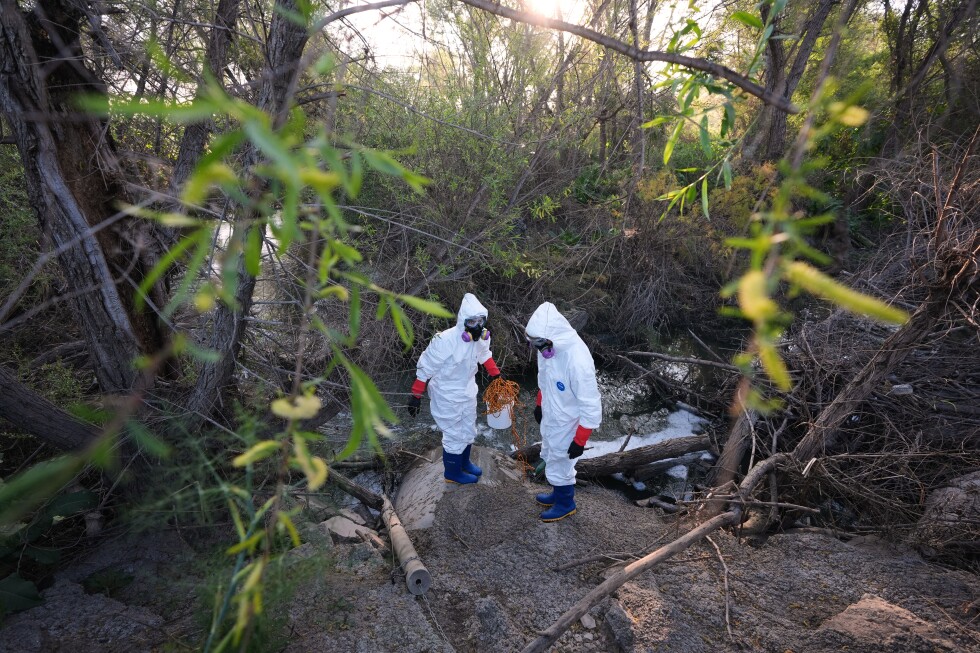
Trent Fry, right, and Leila El Masri clean a bucket after collecting a water sample of the Tijuana River, as part of a research team from the University of California, San Diego, Wednesday, March 11, 2026, in San Diego. (AP Photo/Gregory Bull)
Advertisement
Trent Fry, right, and Leila El Masri clean a bucket after collecting a water sample of the Tijuana River, as part of a research team from the University of California, San Diego, Wednesday, March 11, 2026, in San Diego. (AP Photo/Gregory Bull)
Advertisement
Advertisement
Advertisement
Maddie Tibayan pauses while wearing a respirator while collecting a water sample of the Tijuana River, as part of a research team from the University of California, San Diego, Wednesday, March 11, 2026, in San Diego. (AP Photo/Gregory Bull)
Advertisement
Maddie Tibayan pauses while wearing a respirator while collecting a water sample of the Tijuana River, as part of a research team from the University of California, San Diego, Wednesday, March 11, 2026, in San Diego. (AP Photo/Gregory Bull)
Advertisement
Advertisement
Advertisement
Advertisement
Justin Hamlin, left, and Maddie Tibayan, walk along the Imperial Beach pier after gathering a sample of seawater as part of a research team from the University of California, San Diego, Wednesday, March 11, 2026, in Imperial Beach, Calif. (AP Photo/Gregory Bull)
Advertisement
Justin Hamlin, left, and Maddie Tibayan, walk along the Imperial Beach pier after gathering a sample of seawater as part of a research team from the University of California, San Diego, Wednesday, March 11, 2026, in Imperial Beach, Calif. (AP Photo/Gregory Bull)
Advertisement
Advertisement
Advertisement
In 2024, a sampling by San Diego County and the CDC representing the roughly 40,000 households close to the Tijuana River found 71% could smell sewage inside their homes and 69% had a member get sick from being exposed.
Advertisement
Even at low levels, “you’re going to feel like it’s in your sinuses. You can’t get rid of the smell. It’s going to be a constant irritation,” said Ryan Sinclair, an associate professor of environmental microbiology at Loma Linda University School of Public Health.
The EPA said it is working with local and state officials to find ways to mitigate the smell.
San Diego County this year distributed over 10,000 air filters to homes. But the air remains a threat. The river’s foam can now be seen from space.
Hydrogen sulfide levels stun researchers
Advertisement
Surfers look on as Justin Hamlin, right, and Maddie Tibayan, gather a sample of seawater with a bucket off the Imperial Beach pier as part of a research team from the University of California, San Diego, Wednesday, March 11, 2026, in Imperial Beach, Calif. (AP Photo/Gregory Bull)
Advertisement
Surfers look on as Justin Hamlin, right, and Maddie Tibayan, gather a sample of seawater with a bucket off the Imperial Beach pier as part of a research team from the University of California, San Diego, Wednesday, March 11, 2026, in Imperial Beach, Calif. (AP Photo/Gregory Bull)
Advertisement
Advertisement
In September 2024, Kimberly Prather, a chemistry professor at the University of California, San Diego, and a team of researchers installed air monitors in the neighborhood where Egger lives.
What they found stunned them: The hydrogen sulfide concentrations were 4,500 times higher than typical urban levels and 150 times higher than California’s air standards when river flows peaked at night.
Advertisement
Many residents, like Egger, felt vindicated.
“They’d been being more or less gaslit and told, ‘There’s gas. It’s a nuisance. It smells, but it’s not bad,’” Prather said.
She said her researchers have since detected thousands of other gases coming from the river that don’t smell, “and many of them are more toxic.”
Doctors recommend people move
Advertisement
Trent Fry, part of a research team from the University of California, San Diego, takes a sample of seawater Wednesday, March 11, 2026, in Imperial Beach, Calif. (AP Photo/Gregory Bull)
Advertisement
Trent Fry, part of a research team from the University of California, San Diego, takes a sample of seawater Wednesday, March 11, 2026, in Imperial Beach, Calif. (AP Photo/Gregory Bull)
Advertisement
Advertisement
Egger said doctors have told him to move, though they have not given him a written diagnosis as suffering from hydrogen sulfide exposure.
But his family’s roots run deep. His wife grew up in Tijuana. His brother and his late brother’s family live in the neighboring houses on what was Egger Dairy. Nearby are the dilapidated milk barn and rusting farm equipment.
Advertisement
“This is where I’ve lived all my life, with my family, my parents, my grandparents,” he said. “This is home.”
Surfers pass under a wave alongside the Imperial Beach pier Wednesday, March 11, 2026, in Imperial Beach, Calif. (AP Photo/Gregory Bull)
Advertisement
Surfers pass under a wave alongside the Imperial Beach pier Wednesday, March 11, 2026, in Imperial Beach, Calif. (AP Photo/Gregory Bull)
Advertisement
Advertisement
Advertisement
Advertisement
When Egger was a boy, he swam in the river that ran only during the rainy season. Now mostly filled with sewage and industrial waste, it goes year-round. He says the river should be restored to its historical route, which is closer to the border and farther from most residences and schools. He believes then it would not pond, creating hot spots of hydrogen sulfide gas.
Less than half a mile from Egger’s home, the smell is overwhelming where the river shoots out of pipes after being forced briefly underground near Saturn Boulevard.
Scientists call it “the Saturn hot spot.” The stench permeates passing cars with the windows up, lingering inside for days.
When river flows go up, so do the number of patients
Advertisement
Oscar Romo walks among debris that has been captured by a trash boom installed in the Tijuana River at the border near where the river enters the United States from Tijuana, Mexico, Wednesday, April 8, 2026, in San Diego, Calif. (AP Photo/Gregory Bull)
Advertisement
Oscar Romo walks among debris that has been captured by a trash boom installed in the Tijuana River at the border near where the river enters the United States from Tijuana, Mexico, Wednesday, April 8, 2026, in San Diego, Calif. (AP Photo/Gregory Bull)
Advertisement
Advertisement
Dr. Matthew Dickson and his wife, Dr. Kimberly Dickson, run a clinic about a mile from the hot spot. Many of their patients suffer from migraines, nausea, wheezing, eye infections and brain fog. Those with asthma say they use their inhalers more when the air reeks.
“They’d say, ‘You know, I feel better when it doesn’t smell outside,’” Dr. Kimberly Dickson said.
Advertisement
In August 2023, a tropical storm caused the river to overflow onto the streets. Within days, the doctors’ caseloads tripled.
Oscar Romo looks out over debris that has been captured by a trash boom installed in the Tijuana River at the border near where the river enters the United States from Tijuana, Mexico, Wednesday, April 8, 2026, in San Diego, Calif. (AP Photo/Gregory Bull)
Advertisement
Oscar Romo looks out over debris that has been captured by a trash boom installed in the Tijuana River at the border near where the river enters the United States from Tijuana, Mexico, Wednesday, April 8, 2026, in San Diego, Calif. (AP Photo/Gregory Bull)
Advertisement
Advertisement
Advertisement
Advertisement
Electronic health records confirmed what the doctors suspected. When the river flows have jumped, the number of patients they have treated for respiratory problems has increased by 130%, they said.
“Every day that this isn’t fixed,” Dr. Matthew Dickson said, “more people are getting sick.”
Advertisement
A man walks along the an aqueduct holding the Tijuana River as it arrives to the border and enters the United States, above, from Tijuana, Mexico, Wednesday, April 8, 2026. (AP Photo/Gregory Bull)
A man walks along the an aqueduct holding the Tijuana River as it arrives to the border and enters the United States, above, from Tijuana, Mexico, Wednesday, April 8, 2026. (AP Photo/Gregory Bull)
Advertisement
Advertisement
Advertisement
___
Pineda reported from Los Angeles.
___
Advertisement
The Associated Press receives support from the Walton Family Foundation for coverage of water and environmental policy. The AP is solely responsible for all content. For all of AP’s environmental coverage, visit https://apnews.com/hub/climate-and-environment
If your fresh tulips keep drooping over the vase edge, a gardening expert has shared a simple method that keeps them standing upright in just seconds
Millie Bull Deputy Editor, Spare Time and Angela Patrone Senior Lifestyle Reporter
00:59, 17 Apr 2026
While nothing rivals the beauty of a mature tulip elegantly curving and swooping like a swan, there are times when tulips tend to droop dramatically over the vase rim and persistently refuse to stay upright, regardless of your efforts to straighten them.
Even when you’re familiar with all the techniques to extend the lifespan of your bouquets, cut flowers can still display signs of deterioration or decline quickly. Tulips, in particular, have gained a reputation for wilting exceptionally rapidly.
Advertisement
The cause of their collapse has long been a mystery, as have the techniques to avoid it. Nevertheless, following a tulip experiment, gardening instructor and expert Bethie shared on her Instagram account @blueacregarden to disclose the “winning” results so you can “fix your floppy tulips fast”. Bethie found there was one “clear far and away winner” in this experiment.
Starting with a selection of drooping tulips, the horticulturist placed two tulip stems in each of four vases and “waited exactly six days” to examine the results.
One vase held vodka, the second included coins, the third involved using a pin to create a hole in the tulips, while the final one functioned solely as a control specimen to show how the tulips looked without any additions or alterations, reports the Mirror.
Advertisement
Bethie observed that all tulips received a fresh cut before she captured the footage, and that all flowers were positioned in a well-lit spot in her kitchen.
The gardening enthusiast found that the “biggest loser” of the trial was the vodka vase. She said: “The one shot of vodka tulip plants fared horribly.” The blooms looked “sad, saggy, and droopy”. The stems had entirely lost their firmness.
Content cannot be displayed without consent
Bethie added: “It took up a good amount of water, but that seems to have petered off after a few days, and the plants suffered.”
The control group did “slightly better” than the vodka method. While the stems still had a touch of stiffness, they flopped over the vase’s rim, and the leaves displayed no strength at all.
Advertisement
The coin approach came next, with these tulips maintaining some structural support in both stems and leaves. Bethie observed, “I honestly think that if I had made a fresh cut on these and put them in fresh water, these actually might perk up a little bit.”
Ultimately, the “big and very clear far and away winner” turned out to be the pin technique, taking just seconds to carry out.
Bethie stated, “That’s right. By putting one tiny air hole using a pin under the petals of your tulips, you can have tulips that stand up nice and tall and strong.
Advertisement
“This method far and away outlasts any of the other most commonly recommended ways to keep your tulips tall and upright.”
By creating a tiny hole at the top of your tulips, you allow any air pockets potentially trapped inside the stem to release from your plant. This guarantees your plant can take in enough water, maintaining it upright and robust.
Marvel Rivals – has it had its time? (NetEase Games)
The Friday letters page hears more tales of people getting teary-eyed over video games, as a reader is frustrated at Borderlands 4’s hidden extras.
Games Inbox is a collection of our readers’ letters, comments, and opinions. To join in with the discussions yourself email gamecentral@metro.co.uk
End of an era I would love to think that the rule of live service games is finally coming to an end. Hearing that they’re all in decline is music to my ears, especially as it sounds like once you strip out the live service titles, ‘proper’ games are actually doing pretty well right now.
The big question is whether this is just the old guard losing their grip, to be replaced by newer live service games, or whether the whole idea has run its course. I’d like to think it’s the first, obviously, and there hasn’t been a big new hit since Marvel Rivals, unless you count Arc Raiders – which isn’t free.
Advertisement
The problem is that the main reasons these games are successful is because they are free. That’s the main reason people play them and I think if they were completely different games, as long as they were free they’d probably be just as popular.
People aren’t playing these multiplayer shooters because of what they are but because they don’t cost £70. Obviously, the games have to have a certain level of quality, but would anyone pretend Fortnite or Apex Legends are the best games ever?
Expert, exclusive gaming analysis
Sign up to the GameCentral newsletter for a unique take on the week in gaming, alongside the latest reviews and more. Delivered to your inbox every Saturday morning.
Advertisement
We’ll see what happens over the coming months, but I imagine GTA 6 is going to be very bad news for a lot of these games, if they’re already on the ropes before it even comes out. Tolly
Keep it at home I really don’t think Sony should release a dedicated handheld system, it wouldn’t be powerful enough. I think the PlayStation Portal is a great bit of kit, and even in the new 1080p high bitrate settings it barely uses more than a 25MBs download.
I get over 1GB speed at home and anywhere between 40-1,000 on my mobile hotspot so that’s been my portable system for a while now and I do own a Switch 2. I’d much prefer a 120Hz HDR enabled 1440-4K model and would be happy to pay for it. Inbox magic, please. P B
Advertisement
Good AI vs. bad AI Regarding Oscar’s worries about ‘AI slop’ being used to bridge the power gap in the new PlayStation handheld, it’ll definitely have a ML upscaler like DLSS (so, PSSR 2 or its successor, since it’s PlayStation). That’s just how modern graphics work and I wouldn’t be too worried about it, as ML upscaling has been a game changer on Switch 2 and is now finally allowing PS5 Pro to consistently outshine the other home consoles.
DLSS 5, the technology that was just announced to ‘yassify’ existing games is Nvidia technology so you won’t be seeing that on PlayStation or Xbox anytime soon (they use AMD, which is about three to five years behind Nvidia with upscaling, frame generation, etc.).
The only console that uses Nvidia chips is Switch 2, and it’s too underpowered to ever run something like DLSS 5 which hasn’t even come to high-end PC gaming (and might never, given the backlash). So, we’ll have to wait at least another generation or two to finally have Mario look like Bob Hoskins the way he’s supposed to. Magnumstache
Doctorin’ the TRYDIS Thanks for that interview with Nigel Alderton. I always enjoy David Jenkins’ enthusiasm and depth of knowledge on these matters. I particularly liked the gentle prodding towards indie games. It would be great if this interview led to Alderton re-entering the industry after all these years. Please keep up the good work!
Incidentally, does anyone remember Doctor What on the Spectrum? You had to reunite the eight doctors spread across space and time and get them all into the TRYDIS without breaking BBC copyright. Loved that game! GLEN
GC: Thank you.
Advertisement
Welcome homework Loved the interview with Nigel about his game Chuckie Egg. That was the game that got me into gaming as a young boy, when my aunt who was a teacher brought a BBC computer home with Chuckie Egg on it.
I was so sad when she took it back to school but a few years later, I was given a C64 for Christmas and Chuckie Egg was one of the first games I bought for it.
God bless you Nigel, you are a true gaming legend. I will be getting the new iPhone port for sure. Mark Matthews
Hidden extras I recently bought Borderlands 4 and have mixed feelings. On the one hand, I am really enjoying the game itself. The world, combat and build-crafting are all awesome, in my opinion. And the story, whilst it is by no means good, is at least not intrusive. And some of the stories are genuinely weird – already the one where you have to help the guy hatch then mate his thrasher Daisy had me in tears.
Advertisement
But the price of the game is mad.
I just got the base game which £50 in the sale. I now need to spend more than that if I want to get the vault hunter and bounty packs. Which seems to be a lot considering the game didn’t come out all so long ago.
Are these add-ons worth it? I was thinking maybe of just getting the bounty pack for now and see if the vault hunter one goes on sale down the line. Borderlands 3 is only £5 at the moment, for example!
There’s a global cost of living crisis on, so I do think publishers need to be more sensitive with their prices. Tom
Lonely fox I’ve only ever cried once whilst playing a video game. It was after completing Sonic 2 on the Sega Master System without collecting all six of the Chaos emeralds.
When Sonic stops running after the end credits he looks up to the stars and there is a picture of Tails (his fox friend for the few who aren’t familiar) alone.
As a young boy at the time it made me feel really sad. However, I collected all the emeralds on my next play though and it was very rewarding to see Sonic and Tails together up in the stars afterwards. A bit embarrassed writing this but, hey ho! Adams6legend
Advertisement
Interactive melancholy I wouldn’t say any game has made me cry but one game did make me put the controller down, look away from the screen and contemplate just how sad that scene from the game I had just witnessed was.
It was very well done and if that’s what they where going for then they completely nailed it.
The game is called Lost Words: Beyond The Page and is written by Rhianna Pratchett (Terry Pratchett’s daughter). The voice acting is top notch too, adding to the emotional side of it.
Advertisement
Spoiler alert!
It’s about a young girl who is writing a story, you play as the character in her story while she narrates it. All while visiting her sick grandmother in hospital and showing off to her proud grandmother the next chapter she had just written her.
The Forest Quartet is not as sad as Lost Words, but it is quite poignant in places. Which is about a jazz quartet who’s lead singer has passed away and they try to play one last gig in the woods in her honour. It’s also quite good if you are looking for that sort of melancholy type of game. freeway 77
Inbox also-rans Kudos to whoever recommended Beyond Words on the Switch to play. My wife and I have been loving it. It’s surprisingly tricky and a nice change from everything else we usually play. neil
Advertisement
Metro 2039 looked good but oh boy, that dev’s voice! He’s got to be a voice actor as well, right? He’s so gravelly I could park my car on him. Winston
The small print New Inbox updates appear every weekday morning, with special Hot Topic Inboxes at the weekend. Readers’ letters are used on merit and may be edited for length and content.
You can also submit your own 500 to 600-word Reader’s Feature at any time via email or our Submit Stuff page, which if used will be shown in the next available weekend slot.
Advertisement
You can also leave your comments below and don’t forget to follow us on Twitter.
This roundup of The Conversation’s environment coverage was first published in our award-winning weekly climate action newsletter, Imagine.
Every scalable solution has to start somewhere small. With a spark of an idea, an anomaly during an experiment or, perhaps, an empty seashell on an Irish beach.
Juan Diego Rodriguez-Blanco at Trinity College Dublin has found a clever use for discarded oyster shells – a byproduct of the shellfish industry. Remarkably, these shells can capture rare earth elements from water and lock them into new minerals. Rare earth elements are an essential ingredient for the green transition – they are used to make high-performance magnets used in wind turbines and electric cars, for example. So capturing these “vitamins of modern industry” by crystallising them into the calcium carbonate of the shell (rather than just sticking or adsorbing to it) is a reliable way to recover these valuable resources for future use.
Of course, this tech is in its infancy but it just goes to show, there are so many hidden surprises within nature that might, on the surface, look like worthless waste.
Advertisement
The Conversation is made up of a dozen English-speaking editions plus various non-English ones, including French, Spanish and Indonesian. One of the most joyful parts of my job is coordinating regular meetings for the environment editors at each edition to share ideas, develop collaborations and support each other.
Together, we cover the planet’s biggest story – the climate crisis. This beat can sometimes feel relentless. But uncovering scientific discoveries, breakthroughs and insights from academics all over the world gives me hope. Here, my global colleagues share some of their favourite – and most promising – stories from recent weeks.
Governments deploy dozens of different policies simultaneously, such as carbon taxes, renewable energy subsidies and emissions standards, but which ones are the most effective? Evaluating and comparing the results of climate strategies actually presents a major challenge for researchers and policymakers.
Advertisement
After analysing 1,737 climate policies across 40 countries over 32 years, scientists at the universities of Barcelona, Ludwig Maximilian of Munich, Lausanne and Oslo, have identified 28 measures that consistently reduce emissions. Their discovery will enable governments to focus on really effective strategies and avoid wasting resources, making climate action more successful.
In the western US, seven states rely on water from the mighty Colorado River, but a long-running drought and rising water demand have left reservoirs near record lows and cities’ water supplies at risk. Cities have been scrambling to lower their water use and finding creative solutions to encourage residents to make cuts, from low-flow shower heads to tearing out lawns and replacing them with xeriscaping (an approach to gardening and landscaping that reduces the need for irrigation). Las Vegas, a fast-growing city in the desert, has cut its per-capita water use by nearly 60% in the past two decades with steps like those. But as temperatures rise and the snowpack that feeds the river diminishes, we’ve wondered, can conservation alone be enough?
Environmental scientists Renee Obringer of Penn State and Dave White of Arizona State University recently ran computer models to understand what three cities – Las Vegas, Phoenix and Denver – will face in the future and how each city’s climate solutions for a dwindling water supply will hold up.
Advertisement
Stacy Morford, Senior Environment, Climate and Energy Editor at The Conversation US, says these results are eye-opening. This research suggests the region needs to start thinking beyond just conservation to much bigger solutions, the kind that Obringer and White describe that take years to build.
Las Vegas has water investigators who can issue tickets for illegal water use. Jim West/UCG/Universal Images Group via Getty Images
Anna Weekes, Environment and Energy Editor at The Conversation Africa, particularly loved a story highlighting another innovative way to tackle drying up water supplies. This time in South Africa’s dry Karoo desert.
Groundwater pumped from boreholes is the only water supply for many small towns. But as the climate warms and rain falls later in the year, aquifers aren’t replenishing enough to meet the demand for water. Surina Esterhuyse, Fanus Fourie and Danita Hohne are hydrologists and groundwater scientists who’ve designed and built low-cost aquifer recharge systems, drilling infiltration boreholes through hardened clay in dry river beds so that when it finally rains, the war goes straight into the aquifer instead of flowing away across the surface.
Advertisement
In the rural Karoo towns of Carnarvon, Vanwyksvlei, Williston, Sutherland and Calvinia, these recharge systems have been a huge success. They’re affordable and easy to implement at a small scale and offer a practical, scalable way to strengthen drought resilience and secure water supplies for vulnerable communities.
Buds, butterflies and bees
Gabrielle Maréchaux, Environment and Energy Journalist at The Conversation France loves a story about a free smartphone app called PlantNet. This “shazam” for plants, which is available on both iOS and Android, covers 85,000 species out of an estimated 400,000.
It’s popular among hikers and botanical enthusiasts. But what’s less well known is that it was developed by scientists and also helps with research by tracking abundance and locations of particular flowers, fruit, twigs and bark. It’s also a vital tool for monitoring the spread of invasive or “alien” non-native species that can disrupt ecosystems.
Meanwhile, butterflies, with their captivating patterns and colours, don’t always receive the attention they deserve, according to Ibrahim Daair, Environment and Energy Editor at The Conversation Canada. They are a fundamental part of global ecosystems, but insects have been declining at alarming rates in many places. Now, a group of researchers is working on developing a global butterfly index to track how environmental changes are affecting butterflies worldwide. They assembled a dataset of 45,000 population trends for over 1,000 butterfly species to help guide conservation and better understand the scale of the biodiversity crisis.
Advertisement
Don’t have time to read about climate change as much as you’d like?
In 2015, a mining dam in Mariana, in Minas Gerais state, collapsed and released about 55 million cubic meters of toxic waste – crushed rock, water and chemicals left after extracting iron – sending a massive, polluted mudflow downstream. At the time, it was the largest human-made environmental disaster in Brazil. After observing the devastated landscape, Sandra Moura, a professor at the Federal University of Ouro Preto, discovered a plant capable of accelerating the recovery process in the areas affected by the disaster.
But simply recovering the landscapes was not enough, and the professor decided to create a project to assist the affected communities by using beekeeping as a reforestation and income-generating strategy.
This story is featured in one of the episodes of the podcast Voices from the South produced by The Conversation Brazil, about solutions to the environmental problems facing Brazil and Australia.
Advertisement
While visiting the project’s apiary, Luciana Julião, Journalist and Audiovisual Producer at The Conversation Brazil, met incredible people, all with very diverse specialisms, who are working together in the search for possible ways to save the planet.
The coolest library on Earth
And finally, Sarah Sermondadaz, Head of Environment and Energy at The Conversation France, loved learning about first ice core library in Antarctica, designed to preserve humanity’s “climate memory”. With an average temperature of -50°C, Antarctica’s first-ever 100% natural sanctuary protects endangered ice cores from global warming. On January 14 2026, the coolest library on Earth was inaugurated at the Concordia station, Antarctica. Samples from glaciers rescued worldwide are now beginning to be stored there for safekeeping.
Speaking after the vote, Councillor Mel Jacob, the deputy leader of Wiltshire Council, said: “We have a legal duty to protect listed buildings and conservation areas and when a concern is raised about unlawful works to a listed building we are required to investigate and, where necessary, take appropriate action.
But then Capcom has been on a hot streak for years – between the likes of Resident Evil 4 remake and Monster Hunter Wilds – and this extends to its support of the Nintendo Switch 2. The developer has released a string of impressive ports, including Street Fighter 6 and Resident Evil Requiem, which take an expected hit in the resolution department, but if you’re not a stickler for crisp hair physics, are surprisingly close to the PlayStation 5 and Xbox Series X versions.
The Switch 2 version of Pragmata easily joins these ranks. It has some rough edges, and Diana (the android girl that can hack other robots) looks like she’s been blasted through a car wash during close-up conversations, but it’s still a well optimised showcase of what Nintendo’s handheld can do.
Advertisement
In many ways, this port is more impressive because Pragmata is a faster-paced action game when compared to Resident Evil Requiem. In the heat of the firefights, where you’re oscillating between Diana’s hacking capabilities and Hugh’s arsenal of weapons, there are lots of flashy sci-fi effects, explosions, and multiple enemies on-screen at once.
Some of the extra detail is dialled down on Switch 2 – like smoke effects, for example – but this isn’t noticeable unless you’re actively looking for differences in comparison shots or videos.
Expert, exclusive gaming analysis
Sign up to the GameCentral newsletter for a unique take on the week in gaming, alongside the latest reviews and more. Delivered to your inbox every Saturday morning.
Advertisement
These trade-offs keep the action running smoothly. Pragmata targets 60fps on Nintendo’s console, and while it doesn’t achieve this consistently (like other Capcom games, it has an unlocked frame rate), it rarely dips to a noticeable degree. It fares better in handheld mode thanks to the VRR (variable refresh rate) support, but even when docked the performance is surprisingly good considering how frenetic the action can be.
The most distracting and noticeable downgrade is Diana herself. There’s an uncanny valley element to the android infant on other platforms, but on the Switch 2 the details have been reduced to a less believable degree. Her static, clumpier hair when bounding around is the biggest giveaway, but during close-up conversations in the Shelter hub area, it can feel like you’re talking to a smudged doll who hasn’t been synchronised properly.
Advertisement
These visual qualms are more noticeable in handheld mode, where everything does have a blurrier effect when compared to the PlayStation 5 version, but it is still impressive how much detail it still maintains in the surroundings. Playing the second area, set in a 3D printed duplicate of New York’s Times Square, across both the PS5 Pro and Switch 2, it’s surprising how comparable the experiences are, minus the finer visual flourishes on Nintendo’s console
The negatives are a small price to pay, If you want to play Pragmata on the go. We’d definitely advise using a Pro Controller, though, as the Joy-Con controls can get finicky when you’re trying to cycle through weapons in the heat of a ruckus. The analogue sticks on the Joy-Cons don’t feel built to sustain frequent clicks either, which you’ll be doing fairly often to make Hugh run (there is a toggle in the options menu, so technically you don’t need to hold it down to sprint, but that feels weird).
There are some unfortunate omissions, though. One of the Switch 2’s most underused features, mouse controls, isn’t supported, which is a shame as it could have presented an intuitive way of dealing with the hacking minigame (or broken it entirely). There’s no toggle to lock the frame rate either, which would have been optimal for those who are more sensitive to frame rate dips.
If you’re looking for the best version of Pragmata, you’re better off sticking with PlayStation 5, Xbox Series X or PC, but the Switch 2 edition is a comparable and valid alternative which isn’t far removed from its more powerful cousins. When positioned next to Capcom’s existing ports, and other current gen titles like Star Wars Outlaws, it’s another sign that the era of mangled, heavily compromised Switch ports appears to be over. Well, not counting Overwatch anyway.
Advertisement
Formats: PlayStation 5, Xbox Series X/S, Nintendo Switch 2, and PC Price: £49.99 Publisher: Capcom Developer: Capcom Release Date: 17th April 2026 Age Rating: 16
This is as bad as it ever looks on Switch 2 (Capcom)
Chairman Dave Sullivan echoed the opinions of Planning Board members by saying that none of them were “comfortable” with the new plans, lamenting the loss of affordable housing as well as the removal of the reviews. However, the committee approved the plans as the project would help address the borough’s housing needs.
Engineering work between Preston and Lancaster on the West Coast Main Line will mean line closures between Preston and Carlisle from April 17 to 19.
Avanti West Coast has confirmed that no trains will run between Preston and Glasgow Central or Edinburgh on the normal West Coast Main Line route during the works.
One train per hour will operate between London Euston and Preston via Nuneaton.
Advertisement
Northern services will also be impacted, with trains between Barrow-in-Furness and Manchester Airport running only as far as Lancaster on April 18, and between Windermere and Manchester Piccadilly only as far as Oxenholme Lake District or Lancaster.
Rail replacement buses will operate between Preston and Lancaster throughout the works.
On April 19, rail replacement services will also operate between Grange-over-Sands and Lancaster, Heysham Port/Morecambe and Lancaster, and Windermere and Oxenholme Lake District.
No Avanti West Coast services will run between Preston and Carlisle on Saturday or Sunday.
Advertisement
Services between London Euston and Manchester Piccadilly or Liverpool Lime Street will not be impacted and will operate as normal.
READ MORE:
Passengers are encouraged to check their journey before travelling and allow extra time where rail replacement transport is in use.
A spokesperson for Avanti West Coast said: “To help you complete your journey between Preston and Glasgow Central, Avanti West Coast are operating rail replacement buses on various routes.
Advertisement
“Please note that you may also need to use buses provided by other operators to complete your journey.”
NEW YORK (AP) — The worrisome rise in colorectal cancer deaths in younger adults is concentrated in people with less education, suggesting socioeconomic factors could be driving the escalation, according to a new study.
Celebrity deaths — including Chadwick Boseman in 2020 and James Van Der Beek earlier this year — have highlighted the increase in colorectal cancer deaths among younger adults, but the new paper was called the first to parse which people are most affected by the alarming rise.
The researchers found that over the last 30 years, the rise in colorectal cancer deaths in young adults occurred almost entirely among people without a four-year college degree.
Of course, getting a college degree doesn’t protect you from getting colon cancer. Rather, experts say it’s a marker for other issues: People without degrees tend to earn less money, have poorer diets, exercise less and get less medical care.
Advertisement
It’s not totally unexpected that the death risk is concentrated in the less advantaged, but the paper published Thursday in JAMA Oncology is the first national study to actually show the connection, said Dr. Paolo Boffetta, a researcher at Stony Brook Cancer Center in New York who wasn’t involved in the work.
American Cancer Society researchers used government data on more than 101,000 younger adults, ages 25 to 49, who died of colorectal cancer from 1994 through 2023.
Overall, the colorectal cancer death rate rose from about 3 per 100,000 in that age group to about 4 per 100,000. But for people who only made it through high school, the rate rose from 4 to 5.2 per 100,000, while the rate for people with at least a bachelor’s degrees did not change from 2.7 per 100,000.
Ahmedin Jemal, the study’s first author, said the findings underscore the need for public awareness about colorectal cancer and for younger adults to heed screening recommendations. Symptoms can include blood in stool or rectal bleeding; changes in bowel habits, such as diarrhea, constipation or narrowing of stool that lasts more than a few days; unintended weight loss; and cramps or abdominal pain.
Advertisement
The American Cancer Society estimates that more than 158,000 cases of colorectal cancer will be diagnosed in the U.S. this year. Overall, it’s the nation’s second leading cancer killer, behind lung cancer, and is expected to claim more than 55,000 in 2026.
The number of deaths for adults younger than 50 is around 7% of the total — about 3,900. Earlier this year, cancer society researchers reported that colorectal cancer mortality in Americans under 50 had increased by 1.1% a year since 2005, making it now the deadliest cancer in that age group.
Scientists don’t know what’s behind that increase. But they note risk factors include obesity, lack of physical activity, a diet high in red or processed meat and low in fruits and vegetables, and a family history of colorectal cancer. The American Cancer Society changed its screening guidelines in 2021, lowering the age U.S. adults should start getting screened from 50 to 45.
Why did the researchers behind Thursday’s study look at education level and not other factors?
Advertisement
Death certificates don’t detail how much money a person had, or most other aspects of their life. But they do note how much schooling someone completed. And other research has found that data often aligns with statistics about income, health insurance, physical activity and chronic disease. So education serves as a proxy, but can’t speak to other factors, like whether the person had health insurance.
“The focus on education is really (due to) something which was available in the data,” Boffetta observed.
___
The Associated Press Health and Science Department receives support from the Howard Hughes Medical Institute’s Department of Science Education and the Robert Wood Johnson Foundation. The AP is solely responsible for all content.
Other winners on the night included Donovan Haffner, who won breakthrough act of the year, Omar, who won soul act of the year, Joe Webb, who was given instrumentalist of the year, Yazmin Lacey, who won vocalist of the year, and Emma-Jean Thackray, who picked up the innovation award.





















































You must be logged in to post a comment Login