Connect with us
DAPA Banner

Tech

Are electric vehicles about to take off for good?

Published

on

London School of Economics’ Viet Nguyen-Tien and University of Birmingham’s Gavin Harper and Robert Elliott examine whether EVs have passed a tipping point for adoption.

Click here to visit The Conversation.

A version of this article was originally published by The Conversation (CC BY-ND 4.0)

When the Strait of Hormuz first closed in March and oil hit $120 a barrel, a very old question came back: is this finally the moment electric vehicles (EV) take off for good – or just another false start?

EVs have been here before. They surged after the 1973 oil embargo, collapsed when oil fell, and surged again. Each wave died when the external pressure eased.

Advertisement

We think this time is different. In a new discussion paper, we argue that the economic case for electric vehicles is now improving on its own terms. This is because of what has happened to batteries, not because of the oil price. The same evidence, though, shows the transition creates new problems as serious as the ones it solves.

Why this time is different

Battery costs have fallen 93pc since 2010. That is the number that changes everything. A pack that cost more than $1,000 per kilowatt-hour in 2010 cost $108 by late 2025, driven down by a decade of learning, investment and policy support.

Research on the global battery industry finds that every time cumulative production doubles, costs fall by around 9pc. More buyers, more production, lower costs, more buyers.

Unlike the 1970s, this loop does not need an oil crisis to keep spinning. Electric cars have crossed lifetime cost parity with petrol vehicles across much of Europe; in the used-car market they now have the lowest total cost of ownership. Newer models even match petrol cars in estimated lifespan – something early EVs could not claim.

Advertisement

Global sales surpassed 17m in 2024, one of the fastest technology diffusion processes in the history of transport. Norway is near-fully electrified. And Ethiopia reached around 60pc EV sales share in 2024, powered by cheap hydroelectricity – some way ahead of the US, for instance, which sits at around 8pc.

An economic platform, not just a better engine

The deeper reason this wave will not fade is not technical – it is economic. An EV is a platform. Its value grows as the network around it grows, just as smartphones became indispensable not because of the hardware but because of everything connected to it.

Every charger built makes the next EV more attractive. Every software update raises the value of every car already on the road. Every recycled battery feeds back into the supply chain that makes the next one cheaper. It’s part of the reason some other technologies like hydrogen fuel cell vehicles have struggled to get off the ground in numbers – the tech exists, but all the other elements aren’t quite there.

One study of 8,000 drivers in Shanghai found that range anxiety – the fear of running out of charge – has a real economic cost due to unnecessarily avoided trips. But that cost is falling sharply, not because batteries improved, but because charging networks expanded.

Advertisement

Making real-time charger availability visible could add six to eight percentage points to market share by 2030. And because EV charging is far more flexible than other household electricity demand, drivers can shift away from peak hours remarkably easily when the price is right – turning the car into a grid asset, able to store and release electricity when needed. These are economic network effects, not engineering features.

Swapping one dependency for another

Ending oil dependence does not end geopolitical exposure. It relocates it.

In late 2025, China introduced rules requiring government approval for exports containing more than 0.1pc rare earths. The leverage that once came from control of oil flows now comes from control of processing capacity and component supply chains.

The minerals at stake – lithium, cobalt, nickel, graphite and neodymium to name but a handful – carry their own geopolitical risks and, as we have written elsewhere, serious human costs in the communities that mine them. This creates a predictable cycle of social contestation that threatens to stall the transition unless the industry commits to responsible, sustainable innovation.

Advertisement

The metal cobalt traditionally helped EVs travel further on the same charge. And when prices spiked, so did research into making batteries with less or even no cobalt. Today, more than half of all EV batteries sold globally are cobalt free.

Four decades of patent data show the same pattern: higher mineral prices consistently redirect research and development toward mineral-saving technologies.

Recovering lithium and cobalt from used batteries is becoming economically viable too, shifting part of the supply chain away from geopolitically exposed extraction sites. In addition, Norway and other countries are looking to exploit new critical mineral resources to diversify supplies.

The transition is real – but not risk-free

The Hormuz crisis is a reminder of what concentrated energy dependence costs. The EV transition does not need it. The learning curve keeps falling, the platform keeps compounding, the economics keep improving. That is what makes this wave different.

Advertisement

What it does not do is eliminate geopolitical risk. Unlike oil, where leverage comes from energy flows, EV supply chains concentrate power at materials, processing capacity, and technological bottlenecks – supply chains that are highly concentrated and carry their own serious risks. Fuel dependence becomes mineral dependence. That dependence is highly concentrated.

Traditional carmaking regions are already absorbing concentrated job losses, and history shows such disruptions leave persistent scars even if the long-term aggregate effects are positive. Yet electric vehicle assembly is proving more labour-intensive in western countries than expected – requiring more workers on the shopfloor, not fewer, at least in the ramp-up phase. Contrast this with China, where massive automation has led to the creation of ‘dark factories’ where there are so few humans, internal lighting isn’t required.

The same regions facing losses could benefit. But the gains and losses do not fall on the same people. That is where the work remains.

The Conversation
By Dr Viet Nguyen-Tien, Dr Gavin D J Harper and Prof Robert Elliott

Viet Nguyen-Tien is an applied economist at the Centre for Economic Performance (CEP) at the London School of Economics (LSE) with an interest in economic and political issues related to technology, energy and the environment.

Advertisement

Gavin Harper is a research fellow at the Birmingham Centre for Strategic Elements & Critical Materials in Birmingham Business School at the University of Birmingham focused on issues at the critical materials/energy nexus.

Robert Elliott is an applied economist at the University of Birmingham who works at the intersection of international economics, development economics, environmental and energy economics and international business.

Don’t miss out on the knowledge you need to succeed. Sign up for the Daily Brief, Silicon Republic’s digest of need-to-know sci-tech news.

Advertisement

Source link

Continue Reading
Click to comment

You must be logged in to post a comment Login

Leave a Reply

Tech

What was the first OS you ever used?

Published

on


Before clean installs, dual-boot menus, and cloud everything, there was that first encounter, the moment you realized a computer wasn’t just hardware, it was a system with a personality.
Read Entire Article
Source link

Continue Reading

Tech

3 underrated Apple TV shows you should watch this weekend (April 17-19)

Published

on

Apple TV+ has quietly built one of the more interesting libraries among the popular streaming platforms. Somewhere between the buzzy dramas and the shows that everyone seems to be talking about, there are a handful of genuinely great series just sitting there, unwatched.

So let’s fix that this weekend. Whether you are in the mood for a thriller that messes with your grip on reality or something that will haunt you using nothing but sound, there is something here for you. Here are three underrated Apple TV+ shows worth your time.

We also have guides to the best new movies to stream, the best movies on Netflix, the best movies on Hulu, the best free movies, and the best movies on Amazon Prime Video.

Counterpart (2017)

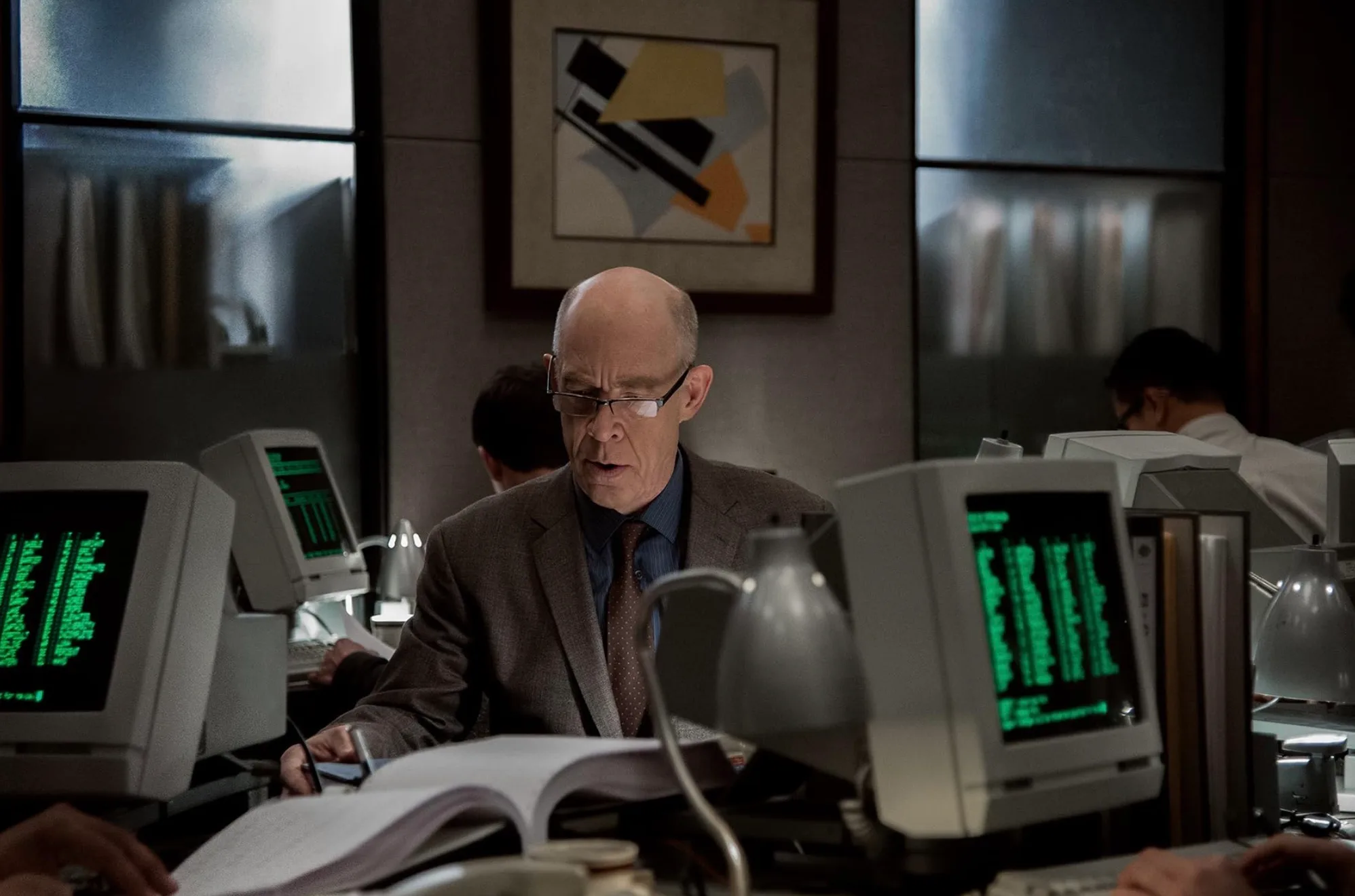
Howard Silk has spent 30 years doing a quiet, unremarkable job at a Berlin-based UN agency, shuffling papers and exchanging coded messages he does not understand. One day, he is told the truth: there is a crossing beneath the building to a parallel Earth, one that split from ours in 1987 and has since gone in a very different direction. To make things worse, his counterpart from that other world, also called Howard Silk, is nothing like him. Same face, same history, but entirely different man.

J.K. Simmons plays both versions with such complete distinction that you never lose track of which Howard you are watching. It is one of the best dual performances I have seen in recent TV shows. The show wraps its parallel world concept in the thick atmosphere of Cold War espionage: Berlin backstreets, dead drops, sleeper agents, and the paranoia of never knowing whose side anyone is really on.

Advertisement

You can watch Counterpart on Apple TV.

Calls (2021)

There are no visuals here in this underrated Apple TV show. What you get instead is a series of phone calls between strangers, laid over abstract, shifting patterns of light and sound, as something catastrophic and inexplicable begins to unravel the world around them. Each of the nine short episodes drops you into a different conversation, most of them terrifying in the quietest possible way.

The cast is stacked: Pedro Pascal, Aubrey Plaza, Lily Collins, Rosario Dawson, and others, none of whom you ever see. You just hear them, and that turns out to be the point. Directed by Fede Álvarez, the filmmaker behind Don’t Breathe, the show understands that what your imagination fills in is always scarier than what any screen can show you.

You can watch Calls on Apple TV.

Shining Girls (2022)

Kirby Mazrachi is a newspaper archivist at the Chicago Sun-Times trying to hold her life together after surviving a brutal assault. The problem is that her reality keeps changing around her. She comes home and suddenly owns a dog instead of a cat. She discovers she is married to a man she only remembers as a colleague. Her desk at work keeps moving. No one else notices except for Kirby.

Elisabeth Moss carries the whole thing on her back, and she is extraordinary, calibrating Kirby’s confidence and anxiety differently across each shifting version of reality. Jamie Bell is quietly terrifying as the villain. The show uses time travel not as a gimmick but as a way of showing how one person’s violence can create ripples, trapping its victims in a reality they cannot fully trust. It is slow to start and deliberately disorienting, which is entirely the point.

Advertisement

You can watch Shining Girls on Apple TV.

Source link

Advertisement
Continue Reading

Tech

This is our first look at Microsoft’s next Surface Pro and Laptop

Published

on

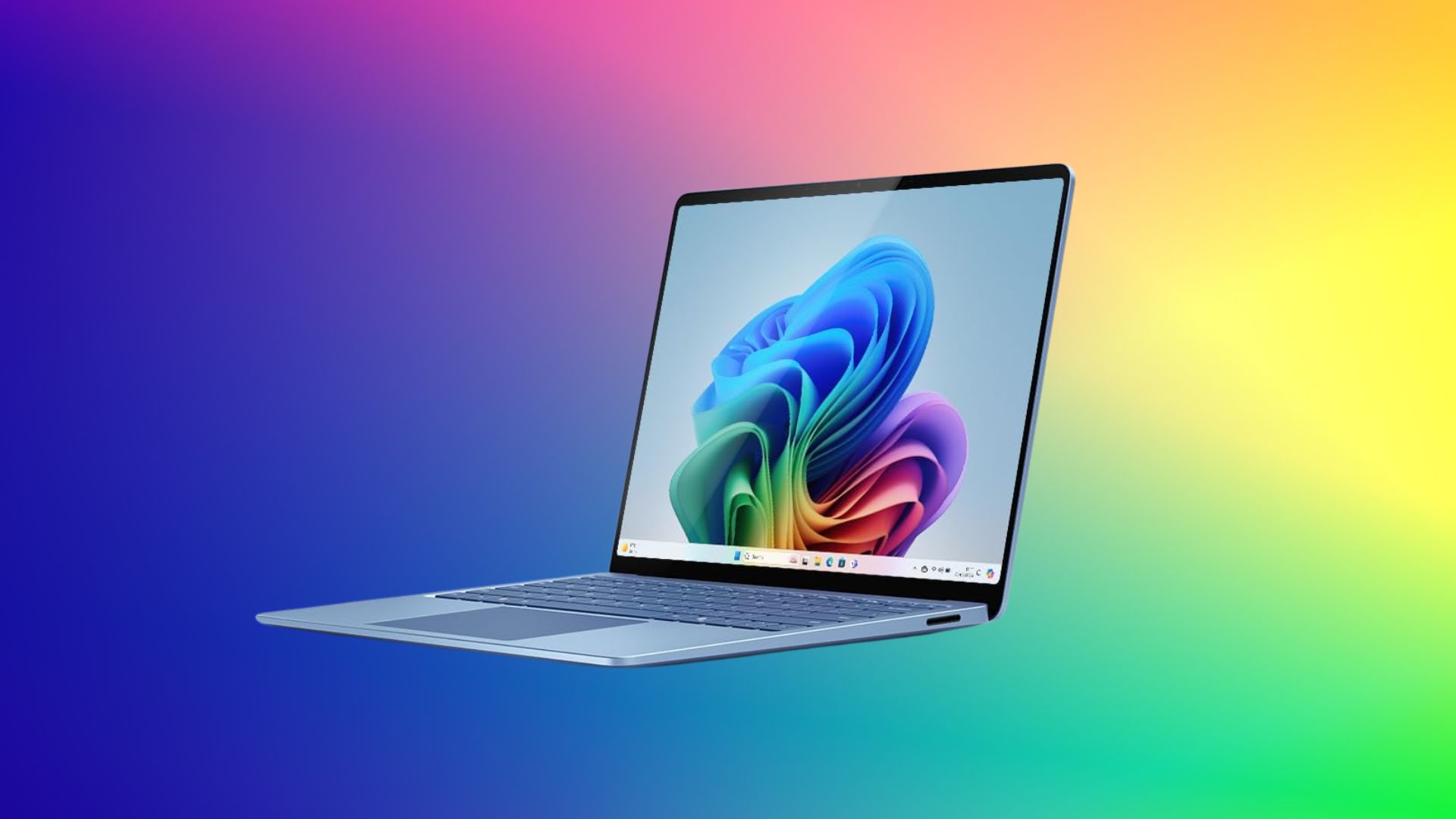
Microsoft’s next wave of Surface devices may have just leaked, and it looks like it is doubling down on choice.

Early retailer listings suggest the upcoming Surface Pro and Surface Laptop will once again be split between ARM and Intel models. There will also be more configurations than before.

On the consumer side, both devices are expected to run on Qualcomm’s Snapdragon X2 chips. These include the X2 Plus and X2 Elite. For the Surface Laptop, that reportedly means sticking with the 13.8-inch model. It also involves dropping the larger 15-inch ARM variant altogether. Memory options are said to range from 16GB to 24GB RAM. These will be paired with 512GB to 1TB SSD storage.

The next Surface Pro follows a similar approach, with ARM-powered models offering 16GB to 32GB RAM and up to 512GB of storage. You also get the usual Platinum and Black colour options. There is nothing wildly different on the surface. However, the real changes seem to sit with the business-focused models.

Advertisement

That’s where Intel comes back into play. Leaked details point to Intel Core Ultra 5 and Ultra 7 “Panther Lake” chips powering enterprise versions of both devices. These will have significantly higher ceilings, up to 64GB of RAM, depending on configuration.

Advertisement

Display options also get a boost. The Surface Pro for business is tipped to offer a choice between LCD and OLED panels, alongside an optional 5G modem. In addition, the Surface Laptop variants are expected to follow suit. Both 13.8-inch and 15-inch OLED options are available for those going the Intel route.

If accurate, the split strategy mirrors what Microsoft has been doing recently. ARM is for efficiency and battery life on consumer devices. Meanwhile, Intel provides flexibility and power in business setups.

Advertisement

There’s still no confirmed launch date or pricing. However, expectations are that costs could climb even higher following Microsoft’s recent Surface price increases. For now, this leak gives a fairly clear early picture – more options, more power, and potentially a more complicated buying decision, depending on which chip camp you land in.

Source link

Advertisement
Continue Reading

Tech

AI Trusted Less Than Social Media and Airlines, With Grok Placing Last, Survey Says

Published

on

Google Gemini is the most trusted AI platform among its competition, but many people still have concerns about the technology, according to an American Customer Satisfaction Index poll released Thursday.

In ACSI’s results, AI scored an overall customer satisfaction score of 73 on a scale of 0 to 100, which the authors noted was slightly below social media (74), airlines and mortgage lenders, but in line with energy utilities. 

Of the five platforms mentioned in the survey, Google Gemini led with 76, followed by Microsoft Copilot (74), Claude and ChatGPT (both 73), and Grok and Perplexity (both 71). Meanwhile, TikTok (77) and YouTube (78) both scored better than the AI platforms.

Advertisement
CNET AI Atlas badge; click to see more

Gemini is one of the most prolific AI services, with access via smart speakers, TVs, phones and computers, while most ChatGPT users access the AI tool via the ChatGPT website or mobile app, and Grok via social media platform X.

The ACSI poll found that 43% of respondents said reduced human-to-human interaction is their main concern, followed by job loss for future generations (37%) and their own job risk (31%), based on interviews with 2,711 US adults.

Baby Boomers were the most skeptical generation in the poll, with 35% saying they are very concerned about AI’s effects, compared to just 6% who view it extremely favorably.

Disconnect between AI adoption and perception

While platforms such as ChatGPT have up to 1 billion weekly users, there is still a disconnect between AI’s adoption and public perception of it, which is driven by concerns over privacy, the spread of misinformation and the loss of jobs. 

Advertisement

“Consumers spent the last decade learning to distrust how social media platforms handle their data, and AI’s privacy scores suggest they’re carrying that skepticism forward,” said Forrest Morgeson, associate professor of marketing at Michigan State University and director of research emeritus at the ACSI.

21% reported an “extremely favorable” outlook toward AI, while an equal 21% said they are “very concerned about the consequences.” 

These results were in line with another poll published by YouGov this week, which found that only 29% think the positive effects of AI outweigh the negative ones, while 36% think its net effects are negative.

It’s worth noting that more than half of the people interviewed (56%) had no recent experience with AI, but of the 44% who did, half of them use AI at least once a day, and the usage went up with people who earned over $100,000 a year.

Advertisement

Last month, an NBC poll suggested that AI was one of the least-liked things in America, but it was still more popular than the Democratic Party.

Source link

Advertisement
Continue Reading

Tech

3 underrated movies you can watch for free this weekend (April 17-19)

Published

on

This week, I went looking for some genuinely good underrated movies so you don’t have to. What I found is a solid trio that covers three different moods. One will make you sweat through a dinner party, one will make you paranoid about your neighbours, and one will make you want to adopt a ginger cat immediately. Best part? They are all free to watch movies on Tubi. So here are my picks for this weekend.

We also have guides to the best new movies to stream, the best movies on Netflix, the best movies on Hulu, the best free movies, and the best movies on Amazon Prime Video.

The Invitation (2015)

The official synopsis of The Invitation sounds like a perfectly ordinary film – a man goes to a dinner party at his ex-wife’s house and something feels off. That’s it! That is the whole setup. And yet director Karyn Kusama turns that premise into a suffocating and anxiety-inducing movie.

The genius of it is that you are never quite sure whether the dread you feel is real or just grief wearing a sinister mask. Logan Marshall-Green carries the whole film on a knife’s edge, and the slow build is precisely calibrated so that by the time the third act arrives, your palms will be sweating. This underrated movie somehow flew under most people’s radar. You can watch it alone and then maybe decline any dinner invitations for a week.

You can watch The Invitation on Tubi

Advertisement

The Ones Below (2015)

This one is a British thriller that deserves far more attention than it ever got. It starts slowly with a young couple expecting their first child. They strike up a friendship with the new couple downstairs, who are also expecting. Then something happens, and the film begins to tilt in a creepy direction.

What makes The Ones Below so effective is how ordinary everything looks. Polished, calm, suburban. The horror creeps in through small gestures and loaded silences rather than jump scares or obvious manipulation. If you enjoy films that make you question people’s motives from the opening scene, this one is for you.

You can watch The Ones Below on Tubi.

A Street Cat Named Bob (2016)

After two thrillers, here is something that will repair your faith in people a little. A Street Cat Named Bob is based on the true story of James Bowen, a homeless busker and recovering drug addict living on the streets of London, whose life changed when he found an injured ginger cat and nursed him back to health. The cat, Bob, refused to leave. And so began one of the more unlikely and genuinely moving friendships you will see in a movie.

It would be easy to dismiss this as sentimental, and it does not shy away from sentiment. But it earns every moment of it. Luke Treadaway is excellent as James, and the real Bob the Cat plays himself, which is arguably one of the finest casting choices of the decade. It is the kind of film that doesn’t ask much of you except to pay attention, and rewards you quietly and completely.

You can watch A Street Cat Named Bob on Tubi.

Advertisement

Source link

Continue Reading

Tech

Cooking With Plasma (Not Fire)

Published

on

Cooking food with fire is arguably the technology that propelled humans to become the dominant species on Earth. It’s pretty straightforward to achieve, just requiring a fuel source, a supply of oxygen from the air, and a way to initiate the reaction; then it self-sustains. You wouldn’t think there’s much to improve, but what about cooking with plasma? [Jay] from the plasma channel is no stranger here, and he thinks that there may be something in this idea, certainly enough to actually build something.

Now, let’s be straight with you, this isn’t a new concept, and you can buy a plasma-based cooking appliance right now. But they are all AC-powered devices. What if you want to go camping? [Jay] attempts (and succeeds) in building a portable, rechargeable 600W plasma cooking device that can actually cook food, but it was not all plain sailing.

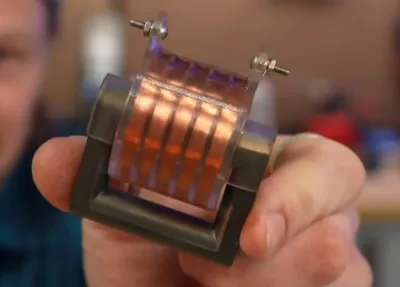
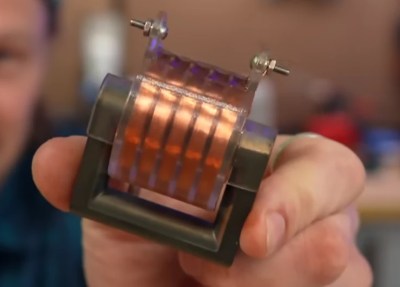
The existing off-the-shelf ZVS driver modules available were a bit weak and unreliable, and the required flyback coils were hard to find with the right specs, so he needed to get down to work building custom parts. First off, the coils. Custom formers were resin-printed and machine-wound with 4000 turns of fine wire, and then resin-sealed into the former. [Jay] takes care to explain that it is crucial to get all the air out of the windings, or else local flashover breakdown will occur and wreck the coil in a short time. We reckon the resulting coils look amazing in their own right!

We do love a nicely wound coil. Oooh!

Next, the ZVS drivers on hand had low-quality capacitors (well, not enough capacitance anyway) and cheap driver transistors, so both were upgraded. The initial plan was to have four driver/coil pairs, each driving a single pair of electrodes, with a common ground ring connecting them all. It turns out this was a terrible idea: the drivers were not synchronised, so they were pulling on each other, causing catastrophic damage to the PCBs in a very short time. The solution was more complicated wiring, to give each coil secondary output a dedicated electrode pair, so there was no direct electrical connection between neighbouring coils and no coupling between them. A clever electrode arrangement meant that a pan would sit on top of a ring of electrodes, causing plasma discharges to jump directly to the pan, thereby concentrating localised heating there. We were wondering how this new direct connection (the pan is now a common connection!) didn’t also cause backfeeding and kill the ZVS drivers again, but it didn’t seem to happen.

Bang, smell, oops. The copper is supposed to be stuck to the PCB.

Anyway, [Jay] demonstrates what is possibly the world’s first rechargeable, portable plasma cooker capable of making breakfast. Which we think is very important in its own right, however, we would like a plasma-based solution to making toast next, perhaps a plasma knife that cooks the bread as you slice it?

If this plasma cooking lark rings a bell, yes, we did touch upon this way back in 2017. And whilst not strictly plasma cooking, you can make an amazing microwave plasma in this ridiculously upgraded appliance. Definitely do not try that one at home.

Advertisement

Source link

Advertisement
Continue Reading

Tech

5 Cool Circular Saw Accessories At Lowe’s You Didn’t Know Existed

Published

on


We may receive a commission on purchases made from links.

One of the most basic skills that every woodworker should have is being able to cut a straight line. In the past, carpenters have used different types of hand saws to get the job done. But while hand saws can be good enough for the occasional DIY, a power tool like a circular saw can be useful for people who need to cut multiple things in a consistent way. These days, there are plenty of circular saw brands that you can choose from that you can use to make straight cuts with household names like Makita, Bosch, and Milwaukee topping the list. In the beginning, choosing the right kind of circular saw blade and practicing regular saw maintenance should definitely be the priority. But if you find yourself frequently reaching for the circular saw for your various projects, there might be some solutions that can save your projects (and your fingers). And among the many circular saw tips we have for beginners, we’ve mentioned the importance of investing in the right accessories.

Advertisement

Apart from the necessary safety gear, there are several other tools that you can get to maximize your cutting experience. From the most practical perspective, the standard triangular speed square and masking tape are some of the most budget-friendly things to add to your cart. But if you’re ready to make your cutting more effective and efficient, there are some circular saw accessories that you can get from Lowe’s to make your cuts even more clean.

Advertisement

Kreg Accu-Cut Cutting Jig

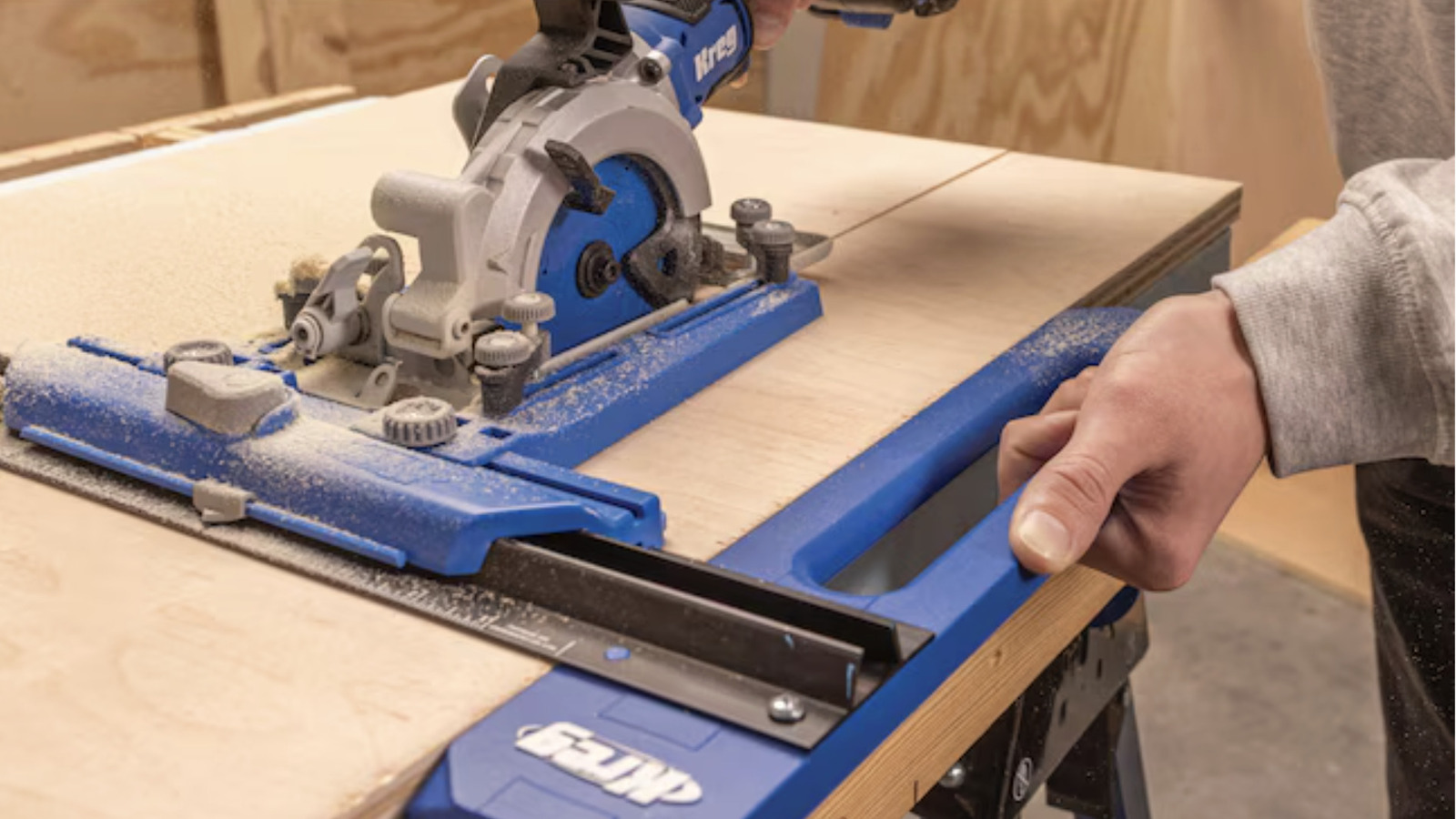
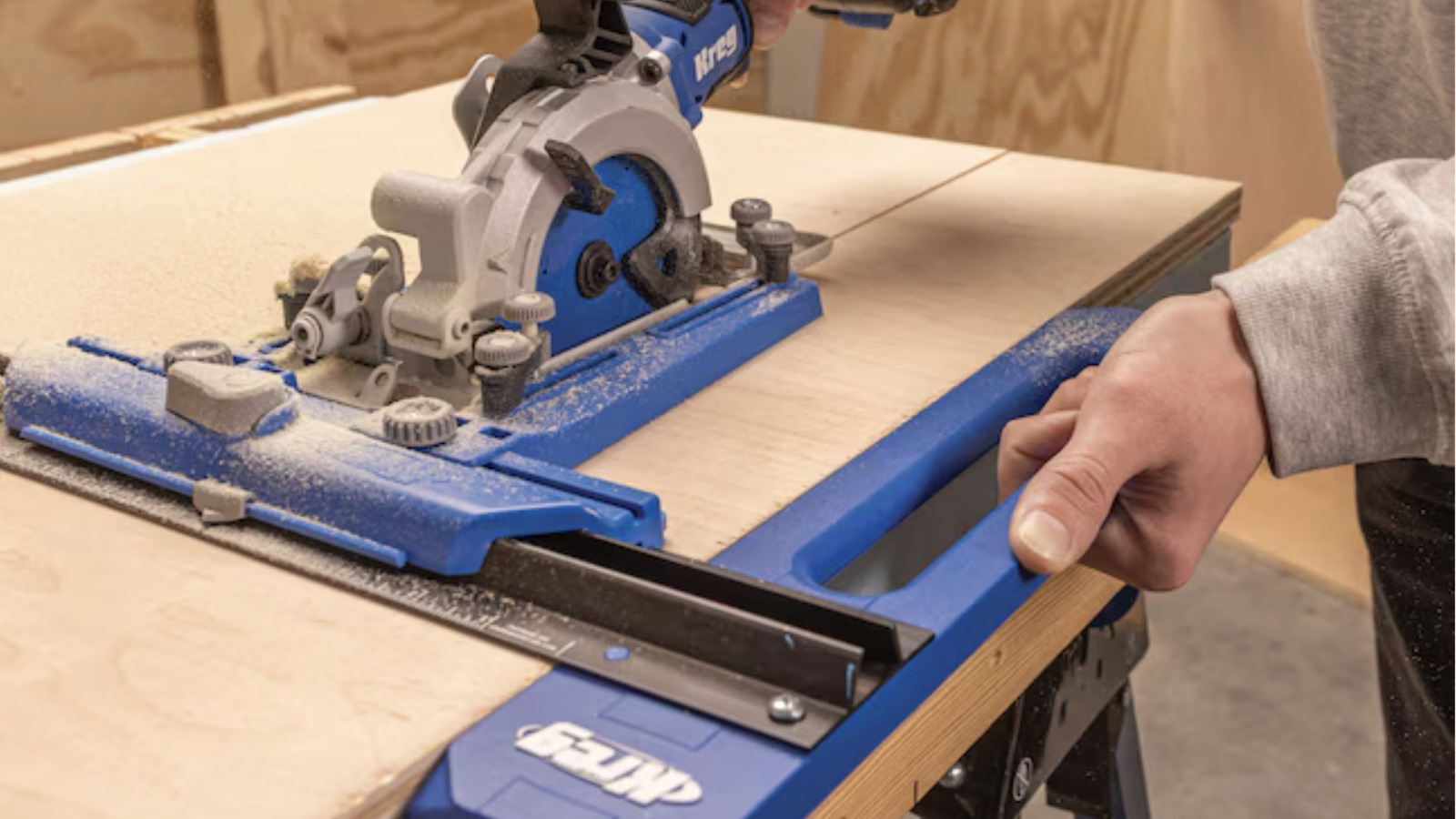
While some people have the gift of simply eyeballing the right cuts, the rest of us mortals need to manually measure things by hand, unless you have something like the Kreg Accu-Cut Cutting Jig to help you avoid the struggle or guess work. Priced at $98.98, the aluminum track can help you make sure you can do all kinds of clean slices on plywood, MDF, and more. Capable of cutting up to 50 inches in length, it comes with all sorts of features, like anti-slip guide strips and anti-chip stripes, so you get to work with less set up time and worry less about injuries. You can skip the clamps and attach your circular saw, whether left or right blade. And apart from straight lines, it can create angled cuts and cross-cuts. But take note, it does mention that it’s not meant for worm drive saws or those with plastic upper blade guards.

That said, the Kreg Accu-Cut Cutting Jig has a mixed bag of reviews. As of April 2026, more than 270 people have rated it around 3.9 on average. While 55% did give it a perfect rating, there were about 13% of users who thought its performance was lacking. That said, if you do want something cheaper, Lowe’s also sells the Kreg 4 ft. Straight Edge Guide for $65.98. While it does have a marginally shorter length capacity at 48 inches, it’s made to also work with jigsaws and trim routers.

Advertisement

BORA NGX Track Saw Guide

For those who want to start investing in a system piece-by-piece, the BORA NGX Track Saw Guide can fit left and hand right circular saws. Retailing for just under $50 in Lowe’s, you can hook up your circular saw to the clamp edge without needing any tools. Apart from its T-Track connection, it has ridges for saw alignment. However, it’s important to note that the price tag doesn’t include the saw guides. This model in particular is designed to work with both BORA NGX and WTX saw guides. On Lowe’s, the BORA 96-inch NGX 160-lb Edge Clamp sells for $89.98. Made of heavy gauge aluminum, it has quick connect features, secure locks, and even a ruler.


And if you tend to cut even larger surfaces, you can also get the $55.36 BORA NGX 50-inch Clamp Edge Extension (model number: 544060). Increasing your cutting length up to 50 inches, you can handle longer cuts for panels. Made to connect with your NGX rails, it’s made of the same heavy, durable aluminum for stable cutting. Containing an integrated T-track for all kinds of accessories, you can hook up all kinds of power tools from routers, jigsaws, and circular saws. Plus, if you don’t own a clamp set yet, you can snag the BORA Edge clamps for $27.98. Compatible with either the WTX or NGX system, it’s made to slide into the track and work as a work stop in a jiffy.

Advertisement

Milescraft 1409 Track Saw Guide

If you’re just getting started with your circular saw journey, investing in a full track saw guide kit can save you a lot of headaches and trips to the hardware store, like the Milescraft 1409 Track Saw Guide. Designed for working on plywood to doors, the low profile design is marketed primarily for making furniture. At first glance, the $119.99 price tag can be a little steep, but it comes with a slew of accessories. Compatible with circular saw blades up to 7-¼ inches, it has a sacrificial strip, plus a pair of 27-½-inch guide rails and clamps. In addition, it has 4 sets of saw clips and glide adjusters. Capable of ripping up to 2-inch boards, it can cut up to 50 inches, but the base can also be expanded, if necessary. As of April 2026, 50 Lowe’s customers thought it was worth rating 4.5 stars on average. In general, people seem to be satisfied with its performance as 88% of customers recommend it.

But, if you just want a saw guide that will work with both your circular and jigsaw, Lowe’s offers the Milescraft 1403 Universal Saw Guide for just under $20. Not only can it extend the cutting range, but it has non-slip pads, pivot holes, metal clamps, and optional bevel foot. Milescraft also produces some notable projects that we also like, such as the Milescraft GlueMate 450 Precision Glue Bottle, that we think is a great under $20 beginner-friendly woodworking tool.

Advertisement

Evolution ST1400: 55-in Circular Saw Track Kit and Carry Bag

Should you always be on the go, the $89 Evolution ST1400 55-inch Circular Saw Track Kit could be exactly what you need. In the past, we’ve mentioned that Evolution’s circular saws are at top of the list among Lowe’s 7-¼-inch circular saw offerings. As of April 2026, the Evolution 15 Amp 7-¼-inch circular saw holds a 4.8-star average rating from 39 customers. With this, it’s not surprising that the brand also sells a track kit that can support its operation which includes a convenient carry bag that fits the circular saw and cutting accessories. Aside from the bag, it ships with a pair of 6-inch track clamps, screws, hex keys. With a pair of self-aligning connector bars that measure 2 by 27-½ inches each, it’s made to be able to rip 4ft sheets. Among its other notable features includes its zero clearance splinter guard and integrated glide strips. 

Advertisement

According to Evolution, it’s made to work with Evolution Circular Saws, as well as other major circular saw brands like Makita, Bosch, and Titan. While it doesn’t have a ton of reviews yet, early feedback has been promising, with 3 Lowe’s users rating it a perfect rating citing smooth operation and easy adjustment. On the other hand, the same model has a 4-star average rating on Amazon. That said, if you want a proper portable job site table saw, Lowe’s $575 Evolution Table Saw is also pretty highly reviewed.

Advertisement

Kreg Rip-Cut

For some projects, keeping straight cuts for multiple pieces can make such a big difference. Using the Kreg Rip-Cut, you can get edge-guided cutting with significantly less hassle. Made of aluminum, the rail has a built-in precision cursor and scale. With its universal sled, it works with both left and right blade circular saws and can help you rip up to 24 inches. Made for large sheets, it eliminates the need for marking. For added stability, it also comes with swivel clamps and GripMaxx pads. With sled wings, it also works with worm drives and jigsaws too.

Retailing for $49.04, the Kreg Rip-Cut has been rated around 4.6 stars by 34 Lowe’s customers. Among 79% of people giving it a perfect rating, many people shared that they loved how it’s portable and makes accurate cuts. Some users also mentioned that it makes cutting on the ground with foam as effective as using a table saw without the bulk. Additionally, no product is perfect, and one person lamented how the saw clamps came loose and ruined their project. There was also another complaint that it didn’t fit perfectly with their circular saw model. Available from other online retailers, the Kreg Rip-Cut is Amazon’s #1 Best Seller for Circular Saw Accessories, but it has a mixed bag of reviews with a 3.8-star average from 140+ users. Despite praises for its affordability, there were a lot of people who shared that it was poorly constructed and felt cheap.

Advertisement


Source link

Continue Reading

Tech

Zoom adds World ID verification to prove meeting participants are human, not deepfakes

Published

on

Summary: Zoom has partnered with World, Sam Altman’s biometric identity company, to let meeting participants verify they are human using World’s Deep Face technology, which cross-references iris-scanned biometric profiles with live video to display a “Verified Human” badge. The feature responds to deepfake fraud that cost businesses over $200 million in Q1 2025 alone, including a $25 million loss at engineering firm Arup, though World’s iris-scanning Orb system faces ongoing regulatory action in Spain, Germany, the Philippines, and several other countries.

Zoom has partnered with World, the biometric identity company co-founded by Sam Altman, to let meeting participants prove they are real humans and not AI-generated deepfakes. The integration uses World’s Deep Face technology to cross-reference a participant’s live video feed against their iris-scanned biometric profile, and displays a “Verified Human” badge next to their name when the match succeeds. Hosts can enable a Deep Face waiting room that requires verification before anyone joins, and participants can request that someone verify themselves mid-call.

The feature addresses a threat that has moved from theoretical to expensive. In early 2024, engineering firm Arup lost $25 million after an employee in Hong Kong authorised a series of wire transfers during a video call in which every other participant turned out to be an AI-generated deepfake of his colleagues, including the company’s CFO. A similar attack hit a multinational firm in Singapore in 2025. Across the industry, deepfake-enabled fraud exceeded $200 million in losses in the first quarter of 2025 alone, and the average loss per corporate incident now tops $500,000.

How verification works

World’s Deep Face takes a three-pronged approach. It cross-references a signed image captured during the user’s original registration through World’s Orb device, a spherical biometric scanner that photographs iris patterns, with a real-time face scan from the user’s phone or computer and a live video frame visible to other meeting participants. Verification only succeeds when all three inputs match. The process runs locally on the participant’s device, and World says no personal data leaves the phone.

Advertisement

The 💜 of EU tech

The latest rumblings from the EU tech scene, a story from our wise ol’ founder Boris, and some questionable AI art. It’s free, every week, in your inbox. Sign up now!

This is architecturally different from the deepfake detection tools already available on Zoom’s marketplace. Products from Pindrop, Reality Defender, and Resemble AI analyse video frames for telltale signs of AI manipulation, flagging synthetic media in real time. Both Zoom and World said that because video generation models are improving rapidly, those frame-by-frame detection methods are becoming increasingly unreliable. Deep Face sidesteps the detection problem entirely by verifying the person’s identity against a biometric record rather than trying to determine whether the pixels on screen were generated by software.

The trade-off is that Deep Face requires participants to have a World ID, which means they must have visited one of World’s physical Orb devices to have their irises scanned. The network currently has around 18 million verified users across 160 countries and roughly 1,500 active Orbs. That is a small fraction of Zoom’s user base, which limits the feature’s immediate utility. For most meetings, the existing frame-analysis tools will remain the practical option. Deep Face is designed for high-stakes calls where identity certainty justifies the friction of requiring biometric pre-registration.

Advertisement

The business case

Zoom’s spokesperson Travis Isaman described the integration as part of the company’s “open ecosystem approach, giving customers more ways to build trust into their workflows based on what matters most for their use case.” The framing is deliberate. Zoom is not endorsing World ID as its default identity layer; it is offering it as one option among several in a marketplace that already includes multiple deepfake detection and identity verification tools.

For Zoom, the partnership is defensive. The company’s revenue reached $4.67 billion in fiscal 2025, growing at a modest 3%, and its strategic challenge is to remain the default platform for business communication as competitors add AI features across the board. Zoom has responded with AI avatars, an AI-powered office suite, and cross-application AI notetakers. Adding human verification addresses a different vector: making Zoom the platform that enterprises trust for sensitive conversations. In a market where a single deepfake call can cost $25 million, that trust has a measurable commercial value.

For World, the Zoom integration is a distribution win. The company, which rebranded from Worldcoin in 2024, has struggled to move beyond crypto-adjacent early adopters. Its partnerships with Visa, Tinder, Razer, and Coinbase have expanded the contexts in which a World ID is useful, but none of those integrations create the kind of immediate, visceral demand that a corporate security use case does. If a company’s treasury team requires World ID verification for any video call involving wire transfer authorisation, that creates institutional adoption that individual consumer partnerships do not.

The privacy question

World’s Orb-based identity system has faced sustained regulatory scrutiny. Spain’s data protection authority issued a formal warning in February 2026 citing GDPR violations and insufficient data protection assessments. Germany’s Bavarian data regulator ordered the deletion of iris data in December 2024. The Philippines issued a cease-and-desist order in October 2025 for obtaining consent through financial incentives. Investigations or suspensions have occurred in Argentina, Kenya, Hong Kong, and Indonesia.

Advertisement

The governance frameworks emerging around biometric AI in 2026, including the EU AI Act’s high-risk classification for biometric identification systems, add further complexity. World maintains that its zero-knowledge proof architecture means verification happens without exposing personal data, and that iris images are encrypted and stored only on the user’s device. Critics argue that the collection process itself, requiring a physical visit to an Orb to have your eyes scanned, creates risks that privacy-preserving cryptography does not fully address, particularly when recruitment has disproportionately targeted lower-income communities.

For enterprises evaluating the Zoom integration, the calculus is whether the security benefit of biometric human verification outweighs the regulatory and reputational risk of requiring employees or counterparties to register with a company that multiple data protection authorities have sanctioned. That calculation will differ by jurisdiction and by industry. A Wall Street trading desk conducting a $100 million deal over Zoom may decide the risk is worth it. A European public-sector organisation almost certainly will not.

What this means

The Zoom-World partnership is a marker of how far the deepfake threat has advanced. Two years ago, the Arup incident was treated as an extraordinary outlier. Today, deepfake-enabled fraud is a billion-dollar category, AI-generated video is sophisticated enough to defeat frame-analysis detection, and the question of whether the person on a video call is real has become a legitimate enterprise security concern.

The solution Zoom and World are proposing, biometric identity verification anchored to iris scans, works technically but introduces its own set of complications around privacy, regulatory compliance, and the barrier to adoption that physical Orb registration creates. It is a feature for specific, high-value use cases rather than a default setting for every Monday morning stand-up. But the fact that Zoom considers it worth integrating at all tells you something about where the technology landscape is heading: toward a future where proving you are human is no longer something you can take for granted, even when you are looking someone in the eye.

Advertisement

Source link

Continue Reading

Tech

One Rumored Color for the iPhone 18 Pro? A Rich Dark Cherry Red

Published

on

Would you like some cheese with that iPhone? If a new rumor is true, the big new bold color for Apple’s next flagship phones will look more like red wine than bright orange.

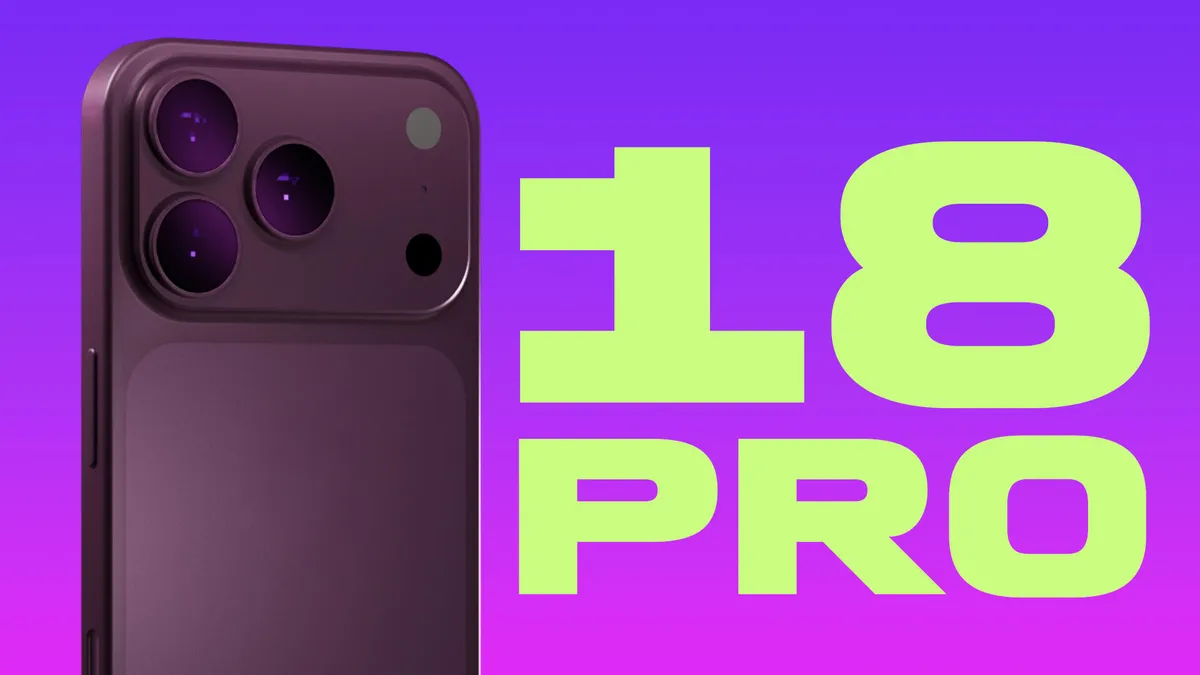
The latest rumor comes from Macworld, which cites a leak from an unnamed source close to the supply chain. According to the leak, the upcoming iPhone 18 Pro and Pro Max will have a dark cherry color option. The source also said that those new flagships, as well as Apple’s first foldable phone, will launch in September. 

According to different reports over the past several months, the foldable might be named the Ultra, the Fold or even the iFlip.

Advertisement

Apple has not officially announced anything — not the iPhone 18 Pro or Pro Max, nor the foldable. There have been tons of rumors about specs and release dates, but nothing has been verified.

A representative for Apple did not immediately respond to a request for comment.

CNET is keeping up with all the latest iPhone 18 Pro rumors, including release dates, design, colors, specs and Apple’s first foldable (and don’t always believe your eyes).

Read more: I Turned My iPhone 17 Pro From Cosmic Orange to Pink

Advertisement

Apple is always changing colors for its top iPhone models. You can see all the colors over the years here.

The rumor about the iPhone 18 Pro coming in dark cherry doesn’t come out of the, ahem, blue. Bloomberg’s Mark Gurman reported several weeks ago that Apple was considering red as its new vibrant color. Last year, for the iPhone 17 Pro, the new breakout color was cosmic orange.

Macworld’s source also said that Apple is toying with two other colors for the iPhone Pro roster — light blue and a dark shade of gray. The source said Apple is also considering a silver variation of the current iPhone 17 Pro.

Macworld’s source listed these Pantone color codes as being used internally by Apple: Light Blue (Pantone 2121), Dark Cherry (Pantone 6076), Dark Gray (Pantone 426C) and Silver (Pantone 427C). Note the absence of a solid black hue, as a previous rumor suggested.

Advertisement

Foldable, not so colorful?

The Macworld source said the foldable might have fewer color options than the iPhone Pro 18 and Pro Max. Macworld said Apple engineers are experimenting with a classic silver-and-white model and indigo, like that of the deep blue of the iPhone 17 Pro.

Take it with a grain of salt, but Macworld’s source last year did confirm the cosmic orange that eventually was the iPhone 17 Pro color splash.

Source link

Advertisement
Continue Reading

Tech

This is Your Last Chance to Grab a Meta Quest 3S VR Headset at Today’s Prices

Published

on

Meta Quest 3S Price Increase Reasons to Buy 2026
Meta’s price increase for their Quest headsets was announced just yesterday, and begin on April 19th, providing users only a little window of time to buy now and avoid a larger bill for the same hardware. The Quest 3S with 128GB of storage is currently priced at $299.99, but will increase to $349.99 on Sunday, representing a $50 difference.


The extra cash is important, though, because these headsets already give a lot without any additional hardware. Simply slip one on and you’ll be able to play games ranging from small puzzle sessions to full-on adventures. You may watch movies on a screen that feels larger than the one in your living room. You can connect with pals in shared spaces, even if one of you is on the opposite side of the nation, and everything operates directly from the device, so no cables or a powerful computer are required.

One reason users prefer to stick with their units for longer than planned is that the library of material continues to grow. New titles are released all the time, and existing games and applications receive free upgrades that add new levels or features. You may use your Quest to transform your living room into a tiny gym or to get some work done in a distraction-free environment. There is something worthwhile in there, regardless of how you spend your time.


Now, both the Quest 3S and the Quest 3 work admirably, but they serve distinct purposes. The Quest 3S provides a decent starting point, with clear video and comfortable wear for regular usage, making it ideal for informal sessions. The good news is that the accessories will remain where they are, so you can upgrade to a nicer strap, supplementary battery pack, or carrying bag without breaking the budget or encountering any unpleasant surprises later.

Meta said the price increases are due to growing memory chip costs, which are hurting the whole electronics industry. Other industries are essentially consuming all of the memory chips available, raising prices and increasing production costs. As far as they can tell, there is no immediate resolution for this problem, so the current prices feel more like a temporary gift than the new normal.

Advertisement

Source link

Continue Reading

Trending

Copyright © 2025