
Crypto World
AI Hallucinations News: Nebraska Lawyer Suspended



AI hallucinations news moved from courtroom embarrassment to career consequence as the Nebraska Supreme Court ruled to suspend Omaha attorney Greg Lake until further notice, after a court brief he submitted in a divorce appeal contained 57 defective citations out of 63, including 20 fully fabricated case references and four completely invented cases that do not exist in any jurisdiction.
Summary
- Lake initially told justices he had uploaded the wrong version of the brief while traveling on his wedding anniversary with a broken computer, but later admitted to using AI, which the Nebraska Counsel for Discipline found constituted a failure of candor toward the court.
- The case originated from a 2025 divorce trial disputing the timing of asset division and child custody, with Lake filing the appeal brief on behalf of the husband, the brief then riddled with fictitious details from real Nebraska cases and wholly invented authorities.
- The Nebraska Supreme Court’s opinion noted that the mistakes “could have been easily discovered using traditional legal research services” and described the case as presenting “a novel issue for Nebraska courts,” serving as a public warning to all attorneys in the state.
AI hallucinations news has produced its most severe professional sanction in the United States to date as the Nebraska Supreme Court handed down an indefinite suspension of attorney Greg Lake on April 15, after months of proceedings that began when justices at oral argument in February noticed the brief contained errors they could not reconcile with any published Nebraska case law.
The brief had been filed in a divorce appeal disputing the effective date for dividing marital assets and child custody. Of 63 citations Lake made, 57 contained some form of defect. Twenty were what courts now call hallucinations: realistic-seeming but entirely fabricated references generated by an AI model that guessed plausibly at what the user was asking for and produced convincing-looking but nonexistent citations.
When a justice asked Lake during the February hearing how the errors had occurred, he said he had been on his 10th wedding anniversary, his computer had broken while traveling, and he had uploaded the wrong version of the brief. The justices found the explanation unconvincing. The Counsel for Discipline investigated and found a different account: that Lake had used AI to draft the brief and then denied it to the court, which constituted a violation of professional conduct rules requiring candor toward the tribunal.
The Nebraska Supreme Court’s unanimous opinion rejecting the brief and referring Lake for discipline in March stated plainly: “AI, like other technological tools, can be a benefit to the legal community, but it must be used with caution and humility.” The court called the errors easily preventable with basic verification through standard legal research platforms and found that Lake had shown a failure of his duty of candor.
The Broader Sanctions Landscape
Nebraska is not an isolated case. Researcher Damien Charlotin at HEC Paris, who maintains a database of AI hallucination cases in legal proceedings, now tracks more than 1,200 such cases globally, with approximately 800 from US courts. He has described the pace as reaching “ten cases from ten different courts on a single day.”
Oregon holds the largest aggregate sanction tied to a single attorney for AI-related filing errors, at $109,700. The Sixth Circuit imposed a $30,000 fine on two Tennessee attorneys, the largest federal appellate sanction yet linked to fabricated citations. Nebraska’s indefinite suspension, if upheld on any appeal, would be the first bar discipline action to suspend practice entirely over AI-related filing errors in the US, escalating the consequences from financial penalties to career suspension.
Why This Matters for the AI Sector
Each high-profile legal sanction tied to AI models sends a regulatory signal that calibrates how AI tools are permitted to be used in professional settings. For AI risks assessments across the investment and technology landscape, the legal profession’s response to hallucinations is the canary in the coalmine: it defines what “responsible deployment” means in the first high-stakes regulated environment to produce consequences. The AI tokens and AI infrastructure markets will face analogous regulatory frameworks as the same logic extends to financial advice, medical decisions, and government applications of the same underlying models.



A post from Udi Wertheimer a few weeks ago made headlines across crypto media with a stark claim: the Lightning Network is “helplessly broken” in a post-quantum world, and its developers can do nothing about it. The headline traveled fast. For businesses that have built real payment infrastructure on Lightning or are evaluating it, the implications were unsettling.
It deserves a measured response.
Wertheimer is a respected Bitcoin developer, and his underlying concern is legitimate: quantum computers, if they ever become sufficiently powerful, pose a real long-term challenge to the cryptographic systems on which Bitcoin and Lightning depend. That part is true, and the Bitcoin development community is already working on it seriously. But the framing of Lightning as “helplessly broken” obscures more than it reveals, and businesses making infrastructure decisions deserve a clearer picture.
What Wertheimer got right
Lightning channels require participants to share public keys with their counterparty when opening a payment channel. In a world where cryptographically relevant quantum computers (CRQCs) exist, an attacker who obtains those public keys could theoretically use Shor’s algorithm to derive the corresponding private key, and from there, steal funds.
This is a real structural property of how Lightning works. What the headline leaves out
The threat is far more specific and far more conditional than “your Lightning balance can be stolen.”
First, the channels themselves are protected by a hash while they are open. Funding transactions use P2WSH (Pay-to-Witness-Script-Hash), meaning the raw public keys inside the 2-of-2 multisig arrangement are hidden onchain for as long as the channel remains open. Lightning payments are also hash-based, routed through HTLCs (Hashed Time-Lock Contracts), which rely on hash preimage revelation rather than exposed public keys. A quantum attacker passively watching the blockchain cannot see the keys they would need.
The realistic attack window is much narrower: a force-close. When a channel is closed, and a commitment transaction is broadcast onchain, the locking script becomes publicly visible for the first time, including the local_delayedpubkey, a standard elliptic-curve public key. By design, the node that broadcasts it cannot immediately claim its funds: a CSV (CheckSequenceVerify) timelock, typically 144 blocks (about 24 hours), must first expire.
In a post-quantum scenario, an attacker watching the mempool could see that a commitment transaction confirms, extract the now-exposed public key, run Shor’s algorithm to derive the private key and attempt to spend the output before the timelock expires. HTLC outputs at force-close create additional windows, some as short as 40 blocks, roughly six to seven hours.
This is a real and specific vulnerability. But it is a timed race against an attacker who must actively solve one of the hardest mathematical problems in existence, within a fixed window, for each individual output they want to steal. It is not a passive, silent drain on every Lightning wallet simultaneously.
The quantum hardware reality check
Here is the part that rarely makes it into the headlines: cryptographically relevant quantum computers do not exist today, and the gap between where we are and where we would need to be is enormous.
Breaking Bitcoin’s elliptic curve cryptography requires solving the discrete logarithm on a 256-bit key, a roughly 78-digit number, using millions of stable, error-corrected logical qubits running for an extended period. The largest number ever factored using Shor’s algorithm on actual quantum hardware is 21 (3 × 7), achieved in 2012 with significant classical post-processing assists. The most recent record is a hybrid quantum-classical factoring of a 90-bit RSA number, impressive progress, but still roughly 2⁸³ times smaller than what it would actually take to break Bitcoin.
Google’s quantum research is real and worth watching. The timelines discussed by serious researchers range from optimistic estimates for the late 2020s to more conservative projections for the 2030s or beyond. None of that is “your Lightning balance is at risk today.”
The development community is not sitting still
Wertheimer’s framing, that Lightning developers are “helpless”, is also out of step with what is actually happening. Since December alone, the Bitcoin development community has produced more than five serious post-quantum proposals: SHRINCS (324-byte stateful hash-based signatures), SHRIMPS (2.5 KB signatures across multiple devices, roughly three times smaller than the NIST standard), BIP-360, Blockstream’s hash-based signatures paper, and proposals for OP_SPHINCS, OP_XMSS, and STARK-based opcodes in tapscript.
The correct framing is not that Lightning is broken and unfixable. It is that Lightning, like all of Bitcoin, and like most of the internet’s cryptographic infrastructure, requires a base-layer upgrade to become quantum-resistant, and that work is underway.
What this means for businesses building on Lightning today
Lightning processes real payment volume for real enterprises today, iGaming platforms, crypto exchanges, neobanks, and payment service providers moving money globally at fractions of a cent with instant finality. The question businesses should be asking is not whether to abandon Lightning based on a theoretical future threat, but whether the teams building Lightning infrastructure are paying attention to what is coming and planning accordingly.
The answer, based on the volume and quality of post-quantum research happening in the Bitcoin development community right now, is yes.
The Lightning Network is not helplessly broken. It faces the same long-horizon cryptographic challenge as the entire digital financial system, and it has a development community actively working to address it. That is a different story from the one the headline told.
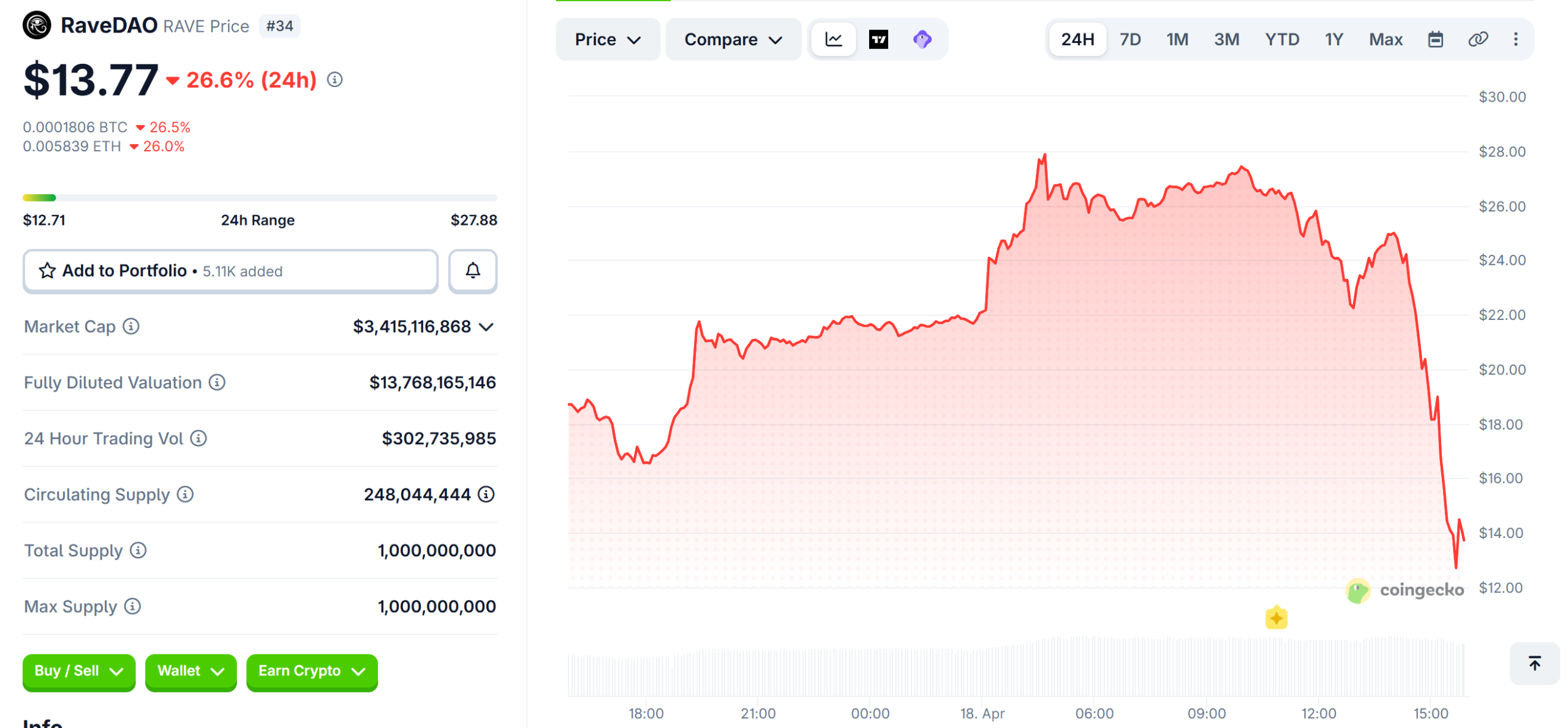
On-chain investigator ZachXBT has accused insiders of running a coordinated pump-and-dump scheme involving RaveDAO (RAVE) across major centralized exchanges.
The allegations follow RAVE’s roughly 5,600% price surge in one week. The token climbed from $0.25 to $14.19 before correcting sharply.
Insiders Allegedly Controlled Over 90% of RAVE Supply
ZachXBT alleged that a group controlling more than 90% of RAVE’s circulating supply coordinated manipulation on Binance, Bitget, and Gate.
On-chain data shows approximately $42 million in RAVE was transferred to Bitget, with $32 million withdrawn back on-chain shortly after.
That tactic appeared designed to bait short sellers. With actual sell pressure removed from order books, forced liquidations triggered a mechanical buying cascade.
RAVE recorded $30.6 million in derivatives liquidations within 24 hours, trailing only Bitcoin (BTC) and Ethereum (ETH).
ZachXBT called on Binance and Bitget leadership to launch internal investigations and remove responsible actors. He initially offered $10,000 of personal funds for whistleblowers to come forward privately. Community contributions later pushed the bounty to $25,000.
Bitget Responds to Pressure
Bitget CEO Gracy Chen responded publicly after growing community pressure. The exchange’s initial acknowledgment signals willingness to address the claims, though specific actions have not been disclosed.
ZachXBT urged the crypto community to keep pressing centralized platforms for transparency. Whether Binance and Gate will open similar reviews in the coming days remains an open question.
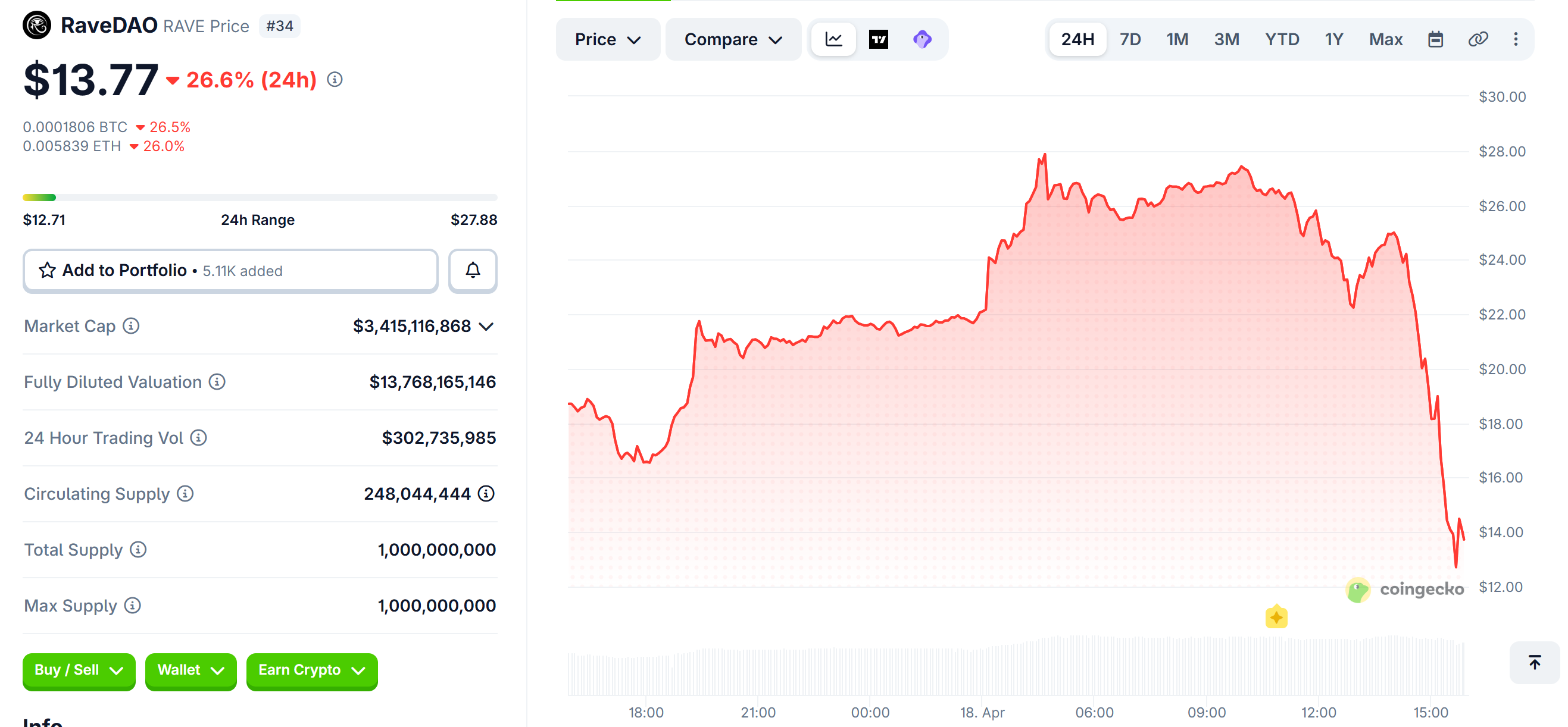
RaveDAO’s powering token, RAVE, is down by almost 27% in the last 24 hours, and was trading for $13.77 as of this writing.
The post RAVE Pump-and-Dump Allegations Spark $25,000 Bounty and Exchange Pressure appeared first on BeInCrypto.
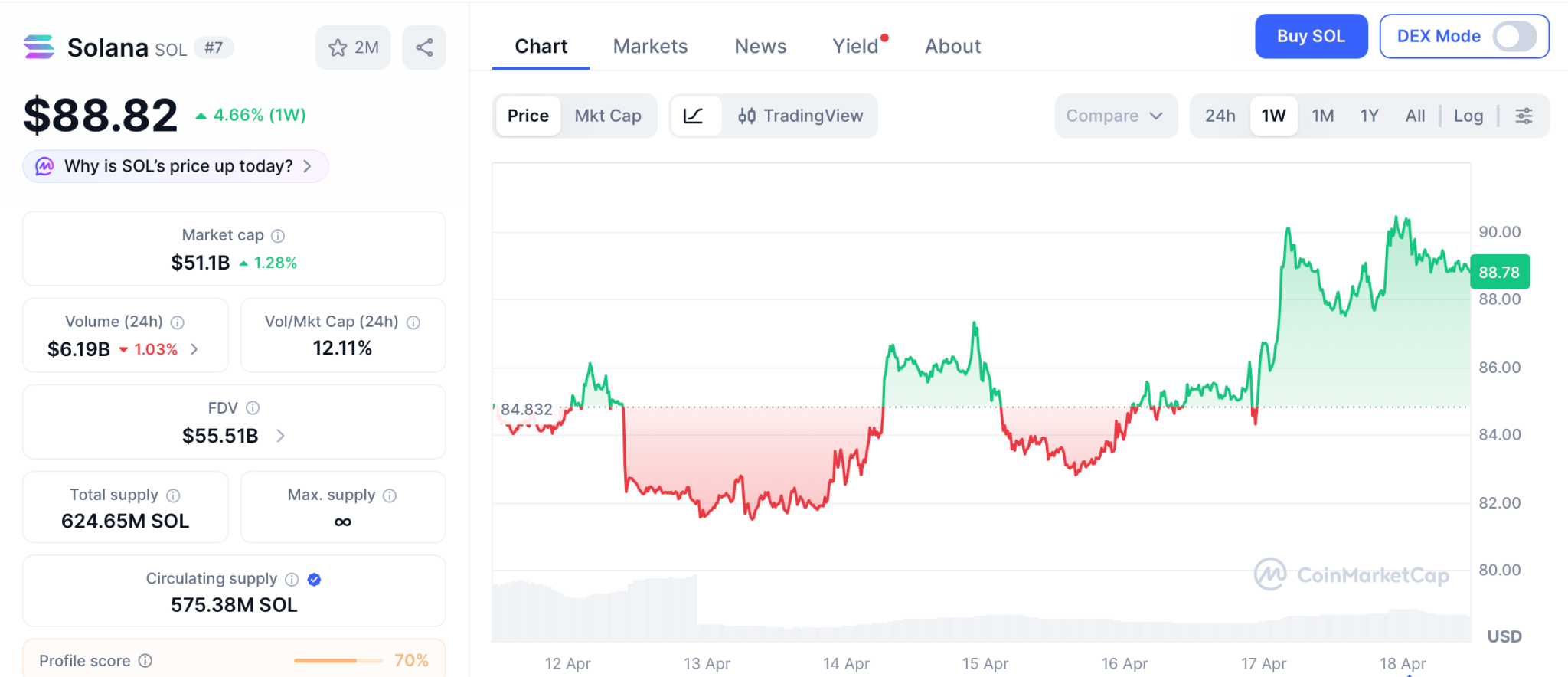
Top crypto to watch right now is the asset capturing demand while the rest of the market rallies. Solana ETFs just booked their largest single day inflow in a month on April 16 at $15.5 million, and SOL climbed back above $88.82 as Bitcoin ripped past $78,000 on the Hormuz reopening. Chainlink sits at $9.60 with CCIP processing $18 billion in monthly cross chain volume.
Pepeto sits at $0.0000001865 with $9.16 million raised, and wallets already parked inside earn 182% APY that nothing on the ETF menu comes close to delivering. Capital keeps pouring into this presale, and the pace accelerates every week as larger wallets reload on bigger sizes after each project update.
Pepeto at $0.0000001865 Before Listing Locks In Early Wallets
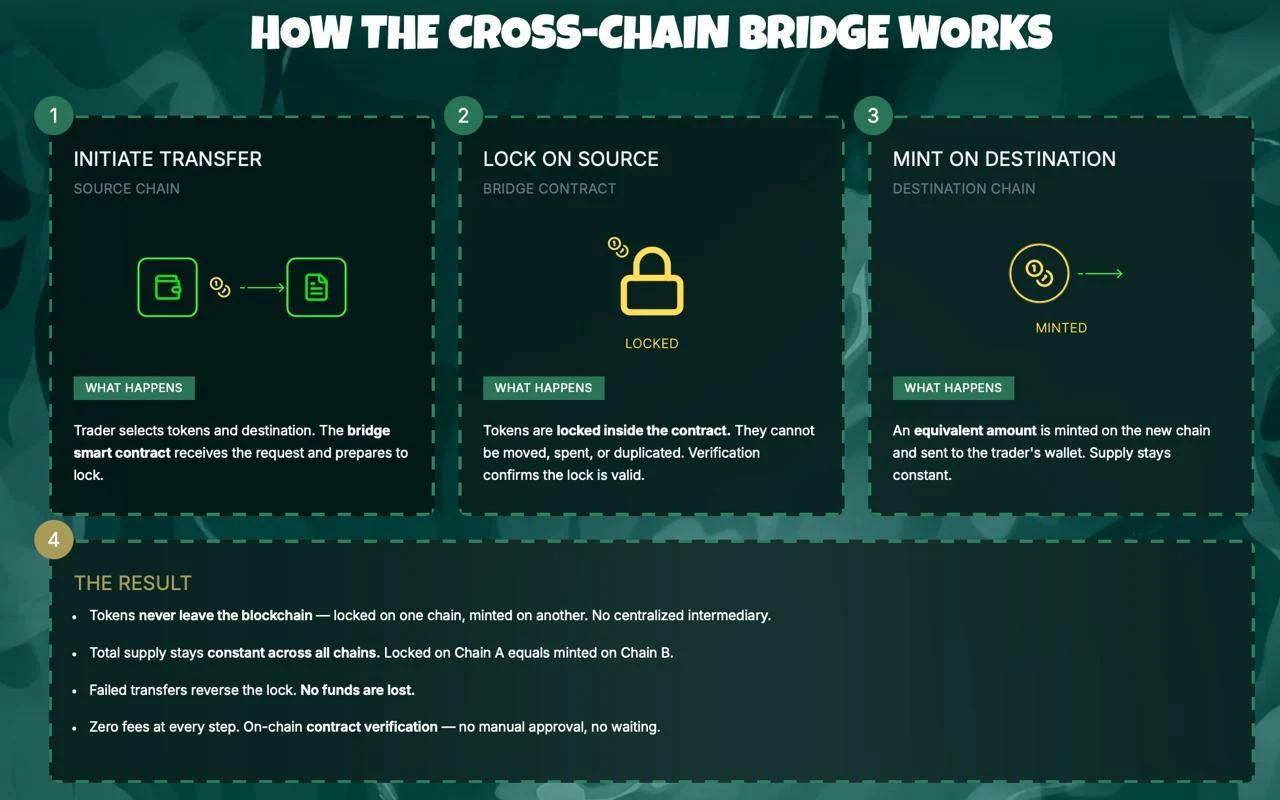
Wallets buying Pepeto at $0.0000001865 saw what the rest of the market is still missing: a project built by the architect behind Pepe’s $11 billion peak, paired with PepetoSwap for zero fee trading across three separate chains, a bridge that shuttles tokens between networks at no cost, and an exchange with a built in scanner that vets every token for malicious code before trades ever route through it.
SolidProof cleared every contract line by line. At $0.0000001865 a $2,000 ticket carries roughly 10.72 billion tokens, and if Pepeto, who is considered the top crypto to watch, lands at $0.00005 post listing, that same bag is worth $536,000, delivering a clean 268x return.
Holders already staking at 182% APY watch their token count climb every single day, and with each passing session another wallet fills the allocation that used to be open. Enter the Pepeto page before the next round caps.
Solana (SOL) Price at $88.82 as ETF Inflows Hit Monthly High
Solana trades at $88.82 on April 17 per CoinMarketCap, holding above the $80 support as spot SOL ETFs booked $15.5 million in fresh inflows on April 16, the largest daily total in a month, with cumulative inflows now near $996.82 million per CoinDesk.
Bitwise (BSOL) and Fidelity (FSOL) combined assets crossed $1 billion, and Goldman Sachs disclosed $108 million in SOL ETF holdings.
Standard Chartered targets SOL at $250 for 2026, Doo Prime sets a $336 ceiling, and VanEck’s long term model points to $3,000 if Solana keeps taking market share. Solana riding the rally is strong, but the 268x math at Pepeto presale pricing sits far ahead of anything SOL can deliver from a $51 billion cap.
Chainlink (LINK) Price at $9.60 as CCIP Volume Keeps Climbing
Chainlink (LINK) trades at $9.60 with CME LINK futures and the Bitwise LINK ETF both active on NYSE Arca. CCIP is routing $18 billion in monthly cross chain volume, and recent whale activity has pulled in another $9 million in LINK this month. Support sits around $8.50 with resistance at $10, and the oracle stack keeps pushing deeper into tokenized real world asset rails.
LINK at $9.60 on a $6.3 billion cap still requires outsized fresh inflows to match the return Pepeto presale pricing hands over on raw arithmetic. Even the most aggressive LINK calls at $20 to $25 for 2026 produce only a 2x to 3x. Wallets rotating out of LINK waiting patterns into Pepeto are collecting 182% APY today, growing stacks LINK at current pricing simply cannot keep pace with.
Conclusion
Solana and Chainlink both prove that sitting on large caps through a sideways cycle is not the play when the top crypto to watch sits at presale pricing. Pepeto stands in the stage where multiples run much stronger than anything large caps can hit, where analysts expect a 100x pop after the Binance listing, meaning at $0.0000001865 every $1,000 has a shot at becoming 100k, and that is only on matching a slice of what Pepe did with its 420 trillion token supply. Over $9.16 million landed during extreme fear because thousands of wallets already saw the potential.
But the presale price is not going to stay at this level. Binance is lining up the listing, and the number on the page today is about to turn into the return every early wallet walks away with. Visit the Pepeto page because this same number already sits inside one portfolio right now, and whether it also sits in yours is the only question left.
Click To Visit Pepeto Website To Enter The Presale

FAQs
What is the top crypto to watch in April 2026 based on yield and presale math?
Pepeto is the top crypto to watch because it offers 182% APY staking and 268x upside from $0.0000001865 to a $0.00005 listing target, backed by the Pepe coin founder and a SolidProof audit, with $9.16 million raised.
Is Solana or Chainlink a better entry than a presale with 268x upside right now?
SOL at $88.82 sits 72% below its all time high even with spot ETFs booking $15.5 million in daily inflows, while LINK at $9.60 trades 84% below peak. Both need billions in new capital for big moves, while Pepeto at presale pricing delivers 268x through one listing event.
Disclaimer: This is a Press Release provided by a third party who is responsible for the content. Please conduct your own research before taking any action based on the content.


Quick Summary
- Allbirds (BIRD) shares exploded nearly 600% Wednesday following the announcement of a strategic shift from eco-friendly shoes to AI infrastructure
- Despite a 35% Thursday decline, the stock finished the week with a remarkable 350% gain
- NewBird AI is the company’s planned rebrand, with ambitions to raise $50 million for GPU procurement and data center operations
- The footwear division was divested to American Exchange Group for $39 million in March
- Wall Street analysts maintain a cautious “Reduce” stance with an $8.00 price target, citing poor fundamentals and significant execution challenges
What began as a week for a faltering sustainable footwear brand trading below $3 ended with a complete corporate transformation — and a stock chart that defied gravity.
Wednesday brought an unexpected announcement: the company was exiting sustainable footwear entirely to pursue AI compute infrastructure. Shares rocketed nearly 600% during the session, briefly touching gains of approximately 880% at intraday peaks before retreating. The extreme volatility triggered multiple trading halts under LULD circuit-breaker protocols.
Thursday saw reality set in with a 35% decline, followed by another 1% drop Friday. Shares closed the week at $10.80, still representing a stunning 350% weekly advance.
Market capitalization fluctuated wildly — starting at $21.7 million Tuesday, peaking at $159 million Wednesday, and stabilizing around $94 million by Friday’s close.
Strategic Vision: AI Hardware Leasing
The transformation centers on addressing bottlenecks in AI computing access. Operating as NewBird AI, the restructured business intends to “acquire high-performance, low-latency AI compute hardware” for long-term leasing to corporate clients, AI startups, and academic research institutions.
Management pointed to extended GPU delivery timelines, record-low data center availability, and fully booked compute resources extending through mid-2026 as market inefficiencies creating the opportunity.
Financing the initiative requires $50 million in new capital, with the fundraising round anticipated to conclude during Q2 2026. Allbirds had already exited its core footwear business, selling those assets to American Exchange Group — parent company of Aerosoles and Ed Hardy — for $39 million in late March.
Market observers quickly drew parallels to Long Island Iced Tea’s 2017 rebrand as Long Blockchain Corp. during the cryptocurrency frenzy. That company was delisted by Nasdaq within twelve months.
Wall Street Remains Unconvinced
Professional analysts are approaching the pivot with considerable skepticism. While Wall Street Zen elevated BIRD from “sell” to “hold” Saturday, the consensus rating remains “Reduce” with an $8.00 price objective.
Maxim Group downgraded the stock to “hold” earlier in 2025. Weiss Ratings continues to recommend “sell.”
Critical concerns include insufficient capital resources, absence of data center operational expertise, and overwhelming competition from established players. The company’s financials support analyst caution: the latest quarterly results showed a $2.34 per-share loss versus expectations of -$2.25. Revenue totaled $47.68 million, significantly trailing the $56.31 million consensus. Return on equity stands at a dismal -127.72%, with net margin at -50.69%. Full-year projections call for an $11.87 per share loss.
The week’s price action exhibited classic meme-stock behavior — momentum-driven buying, viral social media activity, and apparent short squeeze dynamics. Research from Vanda noted retail investors began profit-taking Thursday.
Current technical levels show a 52-week range of $2.15 to $24.31, with the 50-day moving average at $3.56 and the 200-day moving average at $4.62.

TLDR
- AEVEX (AVEX) set its IPO price at $20 per share, securing $320 million through the sale of 16 million shares
- Shares began trading at $23.01 on the NYSE on April 17, representing a 15% increase over the offering price
- Strong investor demand led to the IPO being oversubscribed by multiple times
- The company derives 78% of its revenue from U.S. government contracts; approximately 75% of total revenue comes from tactical systems
- The Pentagon’s FY2027 budget proposal allocated more than $50 billion toward unmanned autonomous systems
Defense technology firm AEVEX Aerospace delivered an impressive market debut on Friday, with shares surging 15% beyond the initial public offering price during its inaugural trading session on the New York Stock Exchange.
The California-based defense contractor, headquartered in Solana Beach, sold 16 million shares at a price of $20 apiece on Thursday, securing $320 million in capital. Trading commenced at $23.01, positioning the company’s market capitalization at approximately $2.57 billion upon opening.
Investor enthusiasm was evident as the offering saw demand that exceeded available shares by multiple times, indicating robust institutional interest prior to the public listing.
The underwriting syndicate was headed by Goldman Sachs, Bank of America, and Jefferies Financial.
AEVEX specializes in delivering airborne intelligence, surveillance, and reconnaissance (ISR) capabilities to U.S. military forces and international allies. The company’s tactical systems division — dedicated to developing autonomous defense technologies — generates approximately 75% of overall revenue.
The balance of revenue, around 25%, originates from its global solutions division, which manages aircraft customization and engineering services for both piloted and unpiloted platforms.
Government contracts with the United States accounted for 78% of AEVEX’s 2025 revenue. This heavy reliance suggests the company’s financial performance remains vulnerable to potential reductions or postponements in government spending.
A Pipeline Tied to the Ukraine War
Ukraine operations have contributed significantly to AEVEX’s recent financial performance. The company’s two primary programs — Phoenix Ghost and EUCOM AOR Deep Strike — have either delivered or committed to providing more than 9,300 systems, totaling over $1.2 billion in contractual obligations extending through the end of 2026.
The Trump administration is anticipated to drive additional demand as it pursues modernization of American defense infrastructure through cost-effective, rapidly deployable weapon platforms.
CEO Roger Wells referenced the Department of Defense’s FY2027 budget submission, which included over $50 billion earmarked for unmanned autonomous systems. “That’s absolutely in the sweet spot of the systems and capabilities we provide,” Wells stated in an interview with Reuters.
According to company projections, the domestic market for unmanned systems is expected to expand to $11 billion by 2030, while international markets could reach $26 billion.
A Crowded but Expanding Space
AEVEX enters a competitive marketplace alongside other publicly traded unmanned aerial vehicle and drone manufacturers. The company faces competition from Kratos Defense & Security Solutions (KTOS) and AeroVironment (AVAV), plus private-sector competitors including Anduril Industries and Shield AI.
This market entry comes shortly after Arxis (ARXS), another defense-sector IPO, successfully raised $1.13 billion earlier in the week driven by strong demand for aerospace, defense, and space-related components.
CEO Wells indicated that AEVEX plans to maintain its concentration on core defense operations in the near term while remaining receptive to strategic expansion opportunities in related sectors.
By the conclusion of trading on April 17, AVEX had climbed roughly 35% above its $20 offering price during its NYSE debut, based on TipRanks data.

Key Takeaways
- Amazon delivered $716.9B in total 2025 revenue, while AWS cloud revenue climbed 20% to $128.7B
- Alphabet’s full-year 2025 revenue reached $402.8B, with Google Cloud surging 48% in the final quarter
- Free cash flow at Amazon fell from $38B to $11B as the company ramps up AI infrastructure investments
- Alphabet recorded $129B in operating income and $132.2B in net income for 2025
- Wall Street assigns both companies a Moderate Buy consensus with no Sell ratings
Amazon and Alphabet stand among the world’s most valuable corporations. Each is making substantial artificial intelligence investments. Yet these tech giants present investors with distinctly different financial narratives.
For the full year 2025, Amazon announced revenue totaling $716.9 billion, representing a 12% year-over-year increase. The company’s operating income reached $80 billion, while net income landed at $77.7 billion.
Amazon Web Services emerged as the clear highlight. AWS generated $128.7 billion in revenue, marking a 20% gain, accompanied by operating income of $45.6 billion.
CEO Andy Jassy highlighted that Amazon’s AI-related services within AWS are now generating more than $15 billion on an annualized basis. Additionally, the company’s semiconductor business has surpassed a $20 billion annual run rate.
Amazon has outlined approximately $200 billion in capital expenditures planned for 2026, with the majority earmarked for AI infrastructure buildout. This aggressive spending strategy contributed to a dramatic decline in free cash flow, which dropped from $38 billion down to $11 billion.
Alphabet also posted impressive results. The company’s 2025 revenue totaled $402.8 billion. Google Services contributed $342.7 billion, while Google Cloud accounted for $58.7 billion.
Alphabet’s operating income climbed to $129 billion. The company reported net income of $132.2 billion.
Cloud Services and YouTube Fuel Alphabet’s Momentum
During the fourth quarter of 2025, Google Cloud revenue skyrocketed 48% to reach $17.7 billion. Operating income from the cloud segment expanded to $13.9 billion, compared to $6.1 billion in the prior-year period.
YouTube generated over $60 billion throughout the year when combining advertising and subscription revenue. In Q4 specifically, Google Services revenue increased 14% to $95.9 billion.
These figures demonstrate that Alphabet’s foundational search and advertising operations continue expanding at a robust rate while its cloud business simultaneously accelerates.
Analyst Perspectives and Price Targets
Data from MarketBeat shows Amazon receiving a Moderate Buy consensus rating from 59 Wall Street analysts. The distribution includes 1 Strong Buy, 54 Buy, and 4 Hold recommendations. Analysts have set an average price target of $287.29.
Alphabet similarly earns a Moderate Buy consensus from 51 analysts. The rating composition consists of 3 Strong Buy, 44 Buy, and 4 Hold ratings. The consensus price target stands at $366.76.
Neither company has received any Sell ratings among analysts tracked by MarketBeat.
Alphabet’s analyst composition skews marginally more optimistic, whereas Amazon attracts wider overall analyst coverage throughout the investment community.
Amazon is committing to more aggressive capital deployment currently. Alphabet is delivering stronger profitability margins relative to its revenue generation.
Investment Considerations
Amazon represents the superior choice for investors prioritizing AI infrastructure expansion and long-term scalability, despite elevated near-term capital commitments. Alphabet appeals to investors seeking robust current profitability, market-leading search operations, and a rapidly expanding cloud platform.
Both stocks maintain Moderate Buy ratings from Wall Street, and neither faces any Sell recommendations based on the most recent analyst data available.
Crypto World
XRP Price Rise Reignites $3 Target As Cardano Founder Unloads On Bitcoin Maxis and Remittix Nears $30M Raised

XRP has surged back into the spotlight as renewed buying pressure pushes it toward the critical $3 level, while fresh controversy from Cardano’s founder and accelerating momentum behind Remittix’s near-$30M raise signal a rapidly shifting narrative across the crypto market.
That matters because this market is not just about holding the biggest names. It is about deciding whether to stay in already priced-in assets or move early into the next opportunity before the crowd catches up.
XRP is trading around $1.50 after a 4.38% daily gain and a 10.25% rise over the past week. That kind of move is enough to restart the $3 target debate, especially when momentum is showing up across the market rather than in isolation.
The bigger point is that XRP still has room to run if buyers keep defending current levels. It is a credible large-cap asset with real exchange activity and ongoing payments relevance, but that also means the upside is more measured than what early-stage projects can offer.
Bitcoin Still Sets The Tone
Bitcoin is trading near $78,198.67 after a 4.71% gain in 24 hours and a 7.25% move over the last week. The trend is clearly constructive, but the wider intraday range suggests the market is still testing conviction rather than launching into a clean breakout.
That matters because Bitcoin remains the anchor for sentiment across crypto. When BTC is firm, capital tends to move down the risk curve, and that is where stronger narratives can start to outperform.
Cardano’s Debate Keeps Attention On Alternatives
Cardano is trading around $0.2647, up 3.97% on the day and 3.66% over the week. The move is positive, but it is still modest compared with the sharper action in XRP and Bitcoin.
The founder, Charles Hoskinson, went viral this week after a huge rant and criticism of Bitcoin maxis adding fuel to a familiar argument: whether value should stay concentrated in Bitcoin or spread toward networks and projects that promise more direct utility. That debate keeps the market open to new narratives, especially in payments and presale crypto.
Why Remittix Is Drawing More Attention
Remittix is starting to stand out because it is built around a simple use case: send crypto and have it arrive as fiat in a bank account. It uses real-time conversion and local payment networks, which removes a lot of the friction that still defines cross-border payments.
That is a real problem worth solving. Banks, SWIFT rails, and remittance services can be slow, expensive, and layered with intermediaries, especially for freelancers, businesses, and global users who just want money to move cleanly.
This is where the investment case gets stronger. Real-world utility at an early stage is where asymmetric upside usually lives, and Remittix is being treated like a serious presale because it solves a practical problem instead of chasing another abstract blockchain narrative.
The project has also started to collect credibility signals. The presale has raised $30M, the wallet is live on the Apple App Store, and the team is KYC verified. None of that removes risk, because execution and adoption still matter, but it does show the market is paying attention.
Compared with XRP, which is established and credible but slower-moving, Remittix is the more explosive early-stage setup. XRP can still benefit from a stronger recovery, but Remittix has the cleaner upside profile if momentum keeps shifting toward utility-focused crypto.
Conclusion
XRP’s move back toward $1.50 has revived the $3 discussion, and Bitcoin’s strength is keeping the wider market supported. Cardano adds to the broader debate, but the sharper opportunity is starting to shift toward projects with direct use cases and early traction.
Remittix is the one drawing serious attention right now because it sits at the intersection of payments utility and presale upside. If the market is still underpricing that story, waiting too long could mean paying up later.
Click To Discover the future of PayFi with Remittix

FAQs
Why is XRP back in focus?
XRP is trading around $1.50 and has posted a strong weekly gain, which has brought the $3 target back into the conversation.
Is Bitcoin still important for the market?
Yes. Bitcoin remains the main sentiment driver, and its current strength is still helping risk appetite across crypto.
Why is Remittix getting presale attention?
Because it focuses on direct crypto-to-bank payments, which is a practical use case with clearer real-world demand than many typical crypto projects.
Is Remittix riskier than XRP?
Yes, but that is also why the upside case is stronger. XRP is established, while Remittix is still early and has more room for discovery if adoption continues.
Disclaimer: This is a Press Release provided by a third party who is responsible for the content. Please conduct your own research before taking any action based on the content.

Poland’s parliament again failed to overturn President Karol Nawrocki’s veto on a crypto regulation bill, extending a months-long standoff over how the country should govern digital assets. In a Friday vote, lawmakers did not reach the 263 votes needed to override the president’s veto, with 243 MPs voting against and 191 in support, according to TVP World.
The bill, pushed by Prime Minister Donald Tusk, is designed to align Poland with the European Union’s Markets in Crypto-Assets Regulation (MiCA), the bloc’s overarching framework for issuing and custody of crypto assets. If enacted, the law would mark a significant step for Polish crypto oversight, as Poland remains the only EU member state still not implementing MiCA.
President Nawrocki defended his veto, arguing that the proposed regulation risks overreach, lacks sufficient transparency, and would impose an undue burden on small businesses, the TVP World report noted. In contrast, government officials have warned that delaying rules leaves investors exposed to risk, with Finance Minister Andrzej Domański reportedly describing the absence of clear rules as turning the market into an “El Dorado for fraudsters.”
The ongoing political fight has broader implications for Poland’s crypto ecosystem, including local industry players and foreign firms weighing regulatory certainty against uncertainty in one of Europe’s largest markets. The standoff is playing out as the country’s biggest exchange, Zonda, has found itself at the center of the dispute, amid allegations tied to illicit funding and national security concerns.
Key takeaways
- The latest attempt to override Nawrocki’s veto failed, keeping MiCA-aligned regulation from moving forward in Poland for the moment, with 243 against and 191 in support of the veto override.
- Poland remains the lone EU member yet to implement MiCA, despite repeated government efforts and earlier votes that stalled the bill in 2023 and 2024.
- Officials argue that timely regulation protects investors and consumers, while Nawrocki argues the measure as drafted could hamper business and market transparency.
- Zonda, Poland’s largest crypto exchange, has become a focal point in the political debate, with CEO Przemysław Kral pushing back on accusations and warning of legal action to defend the company’s reputation.
Regulatory friction and the MiCA timeline
The current veto stalemate is the second failed attempt by the government to push the crypto bill through after a similar rejection in December. In that earlier cycle, lawmakers reintroduced a revised version within days, asserting that the changes addressed concerns, though critics argued the document remained largely the same. Nawrocki’s February veto—described at the time as a principled stance against enacting what he called a “wrong law”—kept the regulation from advancing, complicating Poland’s path toward MiCA compliance.
The persistence of the deadlock underscores a wider regulatory divergence within the European Union on how to structure crypto markets. MiCA was designed to provide a standardized EU framework for crypto issuance and custody, reducing uncertainty for issuers, exchanges, and wallets operating across member states. Poland’s repeated resistance to adopting the framework—while other members push to implement it—highlights competing priorities between fostering innovation and imposing safeguards on a nascent industry.
TVP World’s reporting suggests that the government’s stance centers on balancing regulatory clarity with affordability for businesses, while Nawrocki’s position emphasizes risk of over-regulation. The dispute, thus, is not purely technical; it has become a political test of Poland’s alignment with EU policy and its stance on fintech innovation.
The Zonda episode and what it signals for Poland’s crypto debate
Amid the lawmaking fray, Zonda—Poland’s largest crypto exchange—has been drawn into the narrative around regulatory transparency and security. Prime Minister Tusk publicly accused the platform of links to illicit funding, referencing intelligence reports that allegedly connect Zonda’s origins to Russian criminal networks. In response, Zonda’s chief executive, Przemysław Kral, argued that linking the exchange to crime is both unfounded and harmful to Poland’s innovation ecosystem. He said the allegations were an attempt to drag him and Zonda into the political fray and warned of taking legal steps to defend his personal rights.
The controversy has intensified after Kral claimed he does not control access to a crypto wallet reportedly holding about $330 million, an issue tied to the assets of a former CEO who disappeared in 2022. While these matters straddle business and politics, they contribute to a climate of heightened scrutiny for exchanges operating in Poland—a factor regulators will likely weigh as they consider how MiCA-compliant rules would affect licensing, anti-money laundering controls, and exchange accountability.
Analysts see the Zonda episode as emblematic of the tension between fostering a vibrant crypto industry and maintaining rigorous oversight. If MiCA-style regulation advances, Polish exchanges may gain clearer licensing pathways and standardized compliance expectations, potentially offsetting concerns about regulatory burden raised by Nawrocki. Conversely, if the bill stalls again, market participants may push for favorable terms elsewhere or seek licenses in more permissive jurisdictions, delaying Poland’s full integration into the EU’s crypto framework.
Observers should note that this isn’t merely a domestic quarrel; it mirrors a broader debate across Europe about how to integrate digital assets into traditional financial systems. The outcome in Poland will likely influence adjacent markets and could shape how other member states frame enforcement, consumer protections, and cross-border operations for crypto businesses.
Beyond the procedural dynamics, the stalemate has practical implications for investors and users. Delays in implementing a clear regulatory regime can slow product launches, complicate anti-fraud measures, and create uncertainty around licensing and tax treatment. In the near term, market participants will be watching for any signals of a revised draft, a renewed push to bring MiCA into Polish law, or an entirely new regulatory approach that may differ from the EU framework while attempting to maintain compatibility with MiCA’s core principles.
As the political clock ticks, both sides have signaled a willingness to continue the fight. The next steps remain uncertain: will lawmakers attempt another override vote later this year, or will the government pursue a freshly crafted version that could win Nawrocki’s approval? In the meantime, Poland’s crypto sector remains in a cautious holding pattern, awaiting clarity on whether the MiCA pathway will finally become law or whether a longer negotiation will determine Poland’s stance on digital assets for years to come.
For readers watching the evolution of crypto policy in Europe, Poland’s ongoing debate offers a lens into how national regulators negotiate the balance between innovation, consumer protection, and market integrity. As this process unfolds, the industry—through exchanges like Zonda and other market participants—will be closely assessing the regulatory signals that could unlock cross-border opportunities or, alternatively, constrain growth with more stringent controls.

Quick Overview
- Strategy shares soared 11.8% Friday while bitcoin advanced 2.75% after Iran announced plans regarding the Strait of Hormuz
- Market expectations for a Federal Reserve rate reduction this year approached 50% following geopolitical developments
- Vanda Research identified fresh meme stock momentum fueled by social platform activity
- The company submitted a proxy filing proposing to change STRC preferred stock dividend frequency from monthly to twice monthly
- Outstanding notional value for STRC has climbed to $6.4 billion, while volatility dropped to 2.1%
Strategy delivered an impressive performance Friday. The stock surged 11.8% as bitcoin rose approximately 3% to reach $77,400, propelled by a combination of macroeconomic developments, speculative trader interest, and a corporate announcement from the firm.
The cryptocurrency’s upward movement stemmed from announcements originating in Iran. Officials there stated the Strait of Hormuz would be permitted to resume normal operations contingent upon a sustained ceasefire. This development triggered significant activity in U.S. interest rate markets, with Fed Fund futures pricing in approximately 50% probability of a rate reduction before year-end.
Decreasing interest rate projections typically provide support for riskier asset classes, and bitcoin experienced this tailwind.
Vanda Research, a firm monitoring self-directed retail trading activity, also noted emerging indicators of revived meme stock trading patterns. According to the research group, particular equities are experiencing price movements driven primarily by social media attention and speculative trading rather than underlying business fundamentals. Strategy, given its substantial bitcoin treasury, aligns perfectly with this investment theme.
MSTR has established itself as a popular vehicle for gaining bitcoin exposure through conventional stock markets. When cryptocurrency prices shift, MSTR typically responds — frequently with amplified magnitude.
Changes to STRC Dividend Structure
Separate from the market action, Strategy submitted a proxy filing Friday proposing modifications to dividend distribution for its STRC preferred stock series, commonly referred to as “Stretch.”
The proposed amendment would transition payment frequency from monthly intervals to semi-monthly disbursements. Executive Chairman Michael Saylor explained the adjustment aims to “stabilize price, dampen cyclicality, drive liquidity, and grow demand.”
The 11.5% annual dividend yield would stay constant, and Strategy’s aggregate dividend commitments would remain unaltered.
STRC has gained substantial traction among investors. The outstanding notional value expanded to $6.4 billion according to Friday’s regulatory filing.
Declining Volatility and Shareholder Vote
Price volatility for STRC has experienced a dramatic decline — dropping from 13% during the initial eight months following its introduction to merely 2.1% throughout the most recent two-month period. Strategy management anticipates that implementing semi-monthly distributions would further reduce volatility metrics.
Shareholder voting on the proposed modification concludes June 8. Should the measure receive approval, the inaugural semi-monthly distribution is scheduled for July 15.
MSTR concluded Friday’s trading session with an 11.8% gain, while bitcoin traded near $77,400.
TLDR:
- Strategy proposes semi-monthly STRC dividends to stabilize price and reduce cyclical volatility for investors.
- No changes to STRC’s annual dividend rate or total obligations are included in the proposed payment restructuring.
- STRC funds Strategy’s Bitcoin purchases without diluting MSTR common shares through new equity issuance.
- Strategy holds 780,897 BTC worth $60.7 billion as Bitcoin rallies past $78,000 at proposal time.
Strategy has proposed shifting its STRC preferred stock dividends from monthly to semi-monthly payments. The change, outlined in a preliminary proxy filing, aims to stabilize prices and reduce volatility.
No adjustment to the annual dividend rate or total obligations is planned. Shareholders will begin voting on April 28, with a formal meeting scheduled for June 8. The proposal comes as Bitcoin continues rallying past $78,000.
Proposed Change Targets Price Stability and Investor Demand
Strategy formally announced the proposal through its official account, explaining the rationale behind the shift. The company stated that the change is intended to stabilize price, dampen cyclicality, drive liquidity, and grow demand for STRC shares. Currently, STRC trades near $99 per share, making dividend frequency a relevant factor in price behavior.
More frequent payments can reduce the price swings seen between distribution cycles. With semi-monthly dividends, investors receive cash flows on a tighter schedule, which smooths out demand patterns. This structure is particularly attractive to income-focused investors who prefer consistent returns.
The proposal does not alter what shareholders earn on an annual basis. Only the payment schedule changes, from once a month to twice a month. Strategy confirmed that no changes to the annual dividend obligations or dividend rate are part of this proposal.
STRC Supports Bitcoin Strategy Without Diluting MSTR Common Shares
STRC currently plays a key role in how Strategy funds its Bitcoin acquisitions. The preferred stock raises capital through dividend payments rather than issuing new common shares.
This approach protects MSTR shareholders from excessive dilution while sustaining the company’s aggressive Bitcoin buying program.
As of the latest data, Strategy holds 780,897 BTC, valued at approximately $60.7 billion. The company’s Bitcoin strategy remains one of the most closely watched in the corporate world. Adjusting how STRC dividends are paid supports that broader financial structure.
Bitcoin’s continued rally above $78,000 adds context to the timing of this proposal. A stronger Bitcoin market raises the value of Strategy’s holdings and reinforces confidence in STRC as a financing tool. Attracting more investors to STRC at this stage aligns with the company’s long-term capital strategy.
The shareholder vote begins April 28 and runs through the June 8 meeting. If approved, the semi-monthly structure would take effect based on terms outlined in the proxy. The outcome will shape how STRC functions as a capital instrument going forward.

Chelsea vs Manchester United LIVE: Team news from crucial Premier League clash

The Dollar Continues To Fall

The Lightning Network isn’t ‘helplessly broken’

Why Israel is blocking foreign journalists from entering

Bitcoin: We’re Entering The Most Dangerous Phase

Alan Cumming Brands Baftas Ceremony A ‘Triggering S**tshow’

robux #bandlab #smartphone #beats #greenscreen #music #money #cryptocurrency #memes #roblox #automob

Quantum Computing Threat: Bitcoin Security & Future Explained #shorts

Build your dream home without financial stress …!With Homes4 | Milestone Makers | #shorts
-
 NewsBeat6 days ago
Pep Guardiola and Gary Neville agree over Arsenal title problem that benefits Man City
-

 Crypto World5 days ago
The SEC Conditionalises DeFi Platforms to Be Avoided for Broker Registration
-

 Politics6 days ago
World Cup exit makes Italy enter crisis mode
-

 Crypto World5 days ago
SEC Signals Exemption for Crypto Interfaces From Broker Registration
-

 Fashion23 hours ago
Weekend Open Thread: Theodora Dress
-

 News Videos3 days ago
Secure crypto trading starts with an FIU-registered
-

 Sports1 day ago
NWFL Suspends Two Players Over Post-Match Clash in Ado-Ekiti
-

 Crypto World4 days ago
SEC Proposes Certain Crypto Interfaces Don’t Need to Register as Brokers
-

 NewsBeat4 days ago
Trump and Pope Leo: Behind their disagreement over Iran war
-

 Politics20 hours ago
Palestine barred from entering Canada for FIFA Congress
-
 NewsBeat6 days ago
JD Vance announces ‘no agreement’ with Iran over nuclear weapons fear
-

 Crypto World18 hours ago
Russia Pushes Bill to Criminalize Unregistered Crypto Services
-

 Sports5 days ago
NWFL opens Pathway for new Clubs ahead of 2026 Season
-
Sports6 days ago
Dexter Lawrence, Stefon Diggs, Trading for De’Von Achane
-

 Crypto World5 days ago
Trump whales load up ahead of Mar-a-Lago luncheon.
-
 Business2 days ago
Creo Medical agree sale of its manufacturing operation
-
Crypto World6 days ago
Sei Network Enters Quiet Reset Phase as On-Chain Metrics Signal a Slowdown in 2026
-
 Entertainment5 days ago
Brand New Day’ Footage Reveals the Devastating Impact of ‘Now Way Home’
-
Business5 days ago
Kering slides after Morgan Stanley downgrade, Gucci woes loom
-
 Entertainment5 days ago
Karol G’s ‘Ultra Raunchy’ Coachella Set Gave ‘Satanic Vibes’
You must be logged in to post a comment Login