NEW YORK — World oil prices tumbled sharply on Friday, with benchmark U.S. crude dropping more than 10 percent to settle below $84 per barrel after Iran declared the Strait of Hormuz fully open to commercial shipping during an ongoing ceasefire, easing fears of prolonged supply disruptions from the Middle East conflict.
Oil Prices Plunge Below $85 as Iran Reopens Strait of Hormuz in Major Market Relief
As of early Saturday, April 18, 2026, West Texas Intermediate crude futures for May delivery had settled at approximately $82.59 per barrel on the New York Mercantile Exchange, down about 9.4 percent from Thursday’s close. Brent crude, the international benchmark, fell 9.1 percent to settle at $90.38 per barrel in London trading. Both benchmarks remain elevated compared with pre-conflict levels around $70 but have retreated from peaks above $118 earlier in the quarter amid heightened tensions.
The dramatic decline followed a statement from Iran’s foreign minister announcing that passage through the vital waterway — which carries roughly one-fifth of global oil shipments — is “completely open” for commercial vessels for the remainder of the ceasefire period. The announcement triggered an immediate sell-off in energy markets, with prices plunging more than 10 percent in less than two hours in some sessions. Stock markets rallied in response, with the S&P 500 surging to fresh record highs as investors bet on lower energy costs and reduced geopolitical risk.
President Donald Trump welcomed the development on Truth Social, posting a triumphant message echoing his recent communications style while noting that the U.S. naval blockade on Iranian ports would remain in effect until broader negotiations conclude. The move signaled cautious optimism that the worst of the supply crunch may be easing, though analysts warned that full normalization could take time and that prices might stay volatile.
The Strait of Hormuz had become a flashpoint after earlier threats and restrictions tied to U.S.-Iran tensions and related regional conflicts. Tanker traffic slowed dramatically in recent weeks, prompting production shut-ins estimated at 7.5 million to 9.1 million barrels per day in key Gulf nations, according to the U.S. Energy Information Administration. This disruption pushed Brent prices as high as $118 per barrel in the first quarter before partial relief measures and diplomatic efforts began to stabilize flows.
Advertisement
Friday’s plunge brought oil back toward levels seen in the early stages of the conflict, relieving pressure on consumers, airlines and manufacturers but raising concerns among producers and oil-dependent economies. Gasoline prices, which had climbed toward $4.30 per gallon in some forecasts for April, are expected to moderate in coming weeks, providing potential relief at the pump for American drivers heading into summer travel season.
Market analysts attributed the sharp drop to a classic risk-off reaction. “The physical market had priced in significant shortages, but the announcement removed a major uncertainty premium overnight,” said one energy trader who spoke on condition of anonymity. Futures markets had shown contango in recent months, with near-term contracts trading at premiums reflecting immediate supply fears, while longer-dated contracts pointed to eventual normalization.
The U.S. Energy Information Administration’s latest short-term outlook, released earlier in April, had projected Brent averaging $103 per barrel in March and potentially peaking near $115 in the second quarter before easing later in 2026. Those forecasts assumed gradual resumption of Hormuz traffic and declining production shut-ins. With the latest developments, some private forecasters now see a faster path back toward the $70s or low $80s if the ceasefire holds and full shipping resumes.
Still, caution persists. The ceasefire between involved parties, including elements tied to Israel, Lebanon and broader U.S.-Iran dynamics, remains fragile with an expiration date approaching in coming days. Trump administration officials emphasized that while commercial traffic can flow, targeted measures against Iran would continue until a “transaction” or deal is finalized. Any breakdown could quickly reverse Friday’s gains and send prices spiking again.
Advertisement
Global demand factors also influence the outlook. Steady economic growth in Asia, particularly China and India as major importers, continues to support underlying consumption even as high prices earlier in the year curbed some industrial activity. OPEC and allied producers have managed output amid the disruptions, but prolonged shut-ins have strained inventories in consuming nations.
In the United States, domestic production remains robust thanks to shale output, helping cushion the impact compared with more import-dependent regions. WTI traded at a discount to Brent in recent sessions, with the spread widening at times due to higher shipping costs and logistical challenges for Middle Eastern crude reaching global markets.
Retail impacts are already visible. Diesel prices, particularly sensitive to supply tightness, had surged in recent weeks, affecting trucking and agriculture. Analysts expect some relief here as well, though full pass-through to consumers typically lags crude movements by several weeks.
Broader economic implications extend beyond energy. Lower oil prices could help tame inflation pressures that had ticked higher in March readings, potentially giving central banks more room to maneuver on interest rates. The Federal Reserve and other policymakers have watched energy volatility closely, as sustained high prices risk feeding into core inflation through transportation and manufacturing costs.
Advertisement
On the corporate side, major oil companies saw stock declines Friday despite the earlier run-up, as investors weighed the balance between short-term price relief and longer-term uncertainty. Integrated majors with downstream refining operations may benefit from lower input costs, while pure upstream producers face margin compression.
Looking ahead, the market will monitor several key variables: adherence to the ceasefire, actual tanker traffic data through the Strait of Hormuz, weekly U.S. inventory reports from the EIA, and any new diplomatic statements from Washington or Tehran. OPEC’s next monthly oil market report, due soon, will provide updated production and demand assessments that could further shape sentiment.
For now, the relief rally in equities and drop in oil underscore how quickly geopolitical headlines can swing commodity markets. From peaks near $120 in heightened tension periods to Friday’s plunge, the volatility highlights oil’s role as both an economic barometer and a geopolitical barometer.
Consumers may welcome the prospect of cheaper fuel, but energy experts caution against assuming a swift return to pre-crisis levels. Storage levels, alternative routing costs for tankers, and lingering risk premiums mean prices could stabilize in the $80-$90 range in the near term even with open shipping lanes.
Advertisement
Saturday trading was expected to be thin, with many markets closed for the weekend, but Asian sessions on Monday will provide the next test of whether Friday’s momentum holds. Currency movements, particularly a stronger dollar, could also influence commodity pricing in the days ahead.
The episode serves as a reminder of the Strait of Hormuz’s outsized importance to global energy security. Even brief disruptions there ripple through economies worldwide, affecting everything from airline tickets to grocery prices.
As the situation evolves, traders, policymakers and everyday consumers will continue watching closely. For April 18, 2026, the dominant story remains one of sudden relief: world oil prices have fallen sharply on hopes that the worst of the Hormuz crisis is easing, though the path to full stability remains uncertain.
Gloucestershire County Council is planning a £3.4m overhaul of its services with a greater reliance on artificial intelligence
Carmelo Garcia, Local Democracy Reporter
17:00, 20 Apr 2026
A generic picture of a robotic hand(Image: ThisIsEngineering /Pexels)
There are concerns that Gloucestershire residents’ personal data could be at risk of being accessed by the US Government. The UK relies heavily on American technology companies for cloud services, which enable the remote storage and processing of data.
Advertisement
With Gloucestershire County Council planning to modernise its operations and increase its dependence on artificial intelligence, questions have emerged over the implications this could have for residents’ data security.
Councillor Craig Horrocks (G, Rodborough) brought the matter to light at last week’s corporate overview and scrutiny committee, as a new £3.4m overhaul programme incorporating greater use of AI was under discussion.
He commended the council’s efforts in boosting productivity through technology, but voiced concerns regarding data security due to American legislation that could compel US firms to surrender data belonging to British citizens to the US Government.
“I don’t see any evidence of a focus on data security,” Cllr Horrocks said.
Advertisement
He described the situation as “particularly concerning”, noting that elsewhere across Europe there is “a move away from US-based systems to either self-hosted open source systems or European-hosted systems”.
“Because the Cloud Act in America means if America warrants are pushed forward our data is not safe,” he said.
He further clarified that the data does not need to be physically stored within the US for it to be at risk.
“Any company that is served a warrant, for example, Microsoft, by the US Government to look at data held on Microsoft systems through Microsoft AI, they have no ability to refuse that,” he said.
Advertisement
“My concern is that if we are going further into the Microsoft AI route that will get baked into a working practice which will almost inevitably go forward into the post-local government reorganisation.
“Has any consideration been given, not just that, because there are other data security issues as well.”
Deputy chief executive Nina Philippidis described it as “absolutely” a valid point to raise and confirmed the matter is something the council’s data and IT teams dedicate considerable time thinking about.
“Bearing in mind, this isn’t the start of our AI journey,” she said. “We have already been using Copilot in the organisation.
Advertisement
“We are already using Magic Notes and clearly it is looking at social work data, so again, we have had to spend an awful lot of time working through those issues to make sure we are fully compliant.”
She acknowledged Cllr Horrocks’ observation that “things are changing rapidly” and that it is something they are “keeping a very close eye on”.
“We won’t be doing anything that puts residents’ data at risk,” she concluded.
Cllr Horrocks responded arguing that “you can’t help but because of the Cloud Act and I’d also say there are many European national and local governments that are very rapidly moving away from it because they are concerned.” Ms Philippidis said she would take his points and discuss them with the team.
‘Barron’s Roundtable’ panelists discuss investment opportunities among airline stocks.
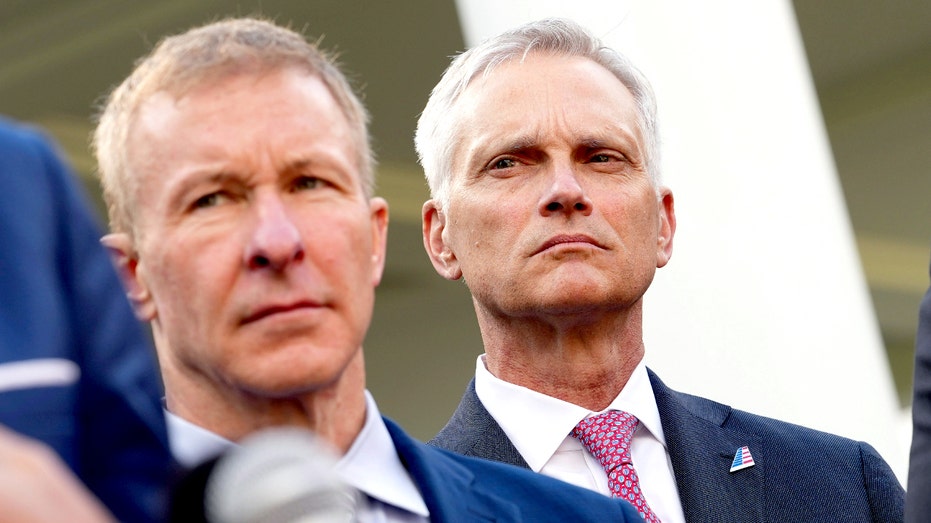
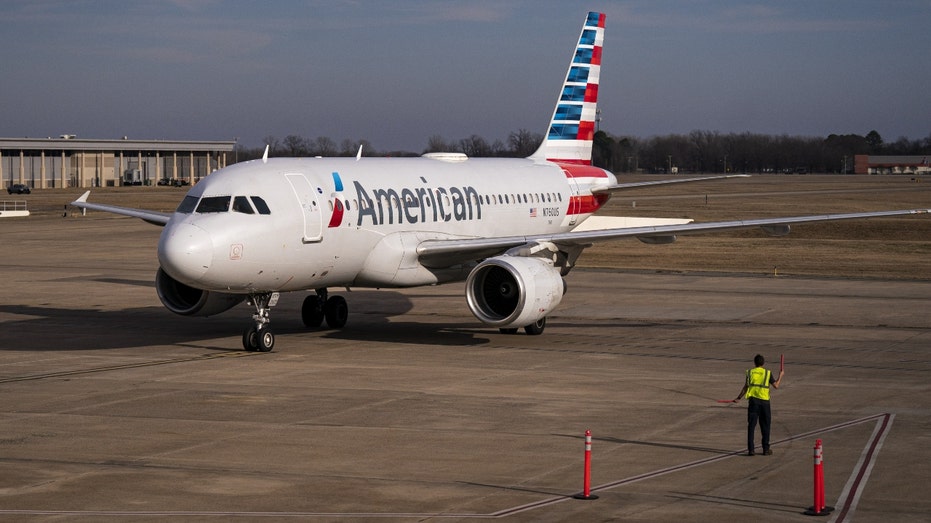
A bold merger proposal from United CEO Scott Kirby to President Donald Trump has left American Airlines’ CEO Robert Isom in the crosshairs, with analysts predicting the board may oust him in response to the potential industry shakeup.
Kirby reportedly lobbied Trump for his blessing on a merger that has fueled speculation that Isom is getting squeezed out.
Advertisement
“I suspect one of the outcomes will be that just this very suggestion is going to make the board of American and their unions turn around and say ‘get rid of Bob Isom,’” Michael Boyd, CEO of Boyd Group International, told FOX Business.
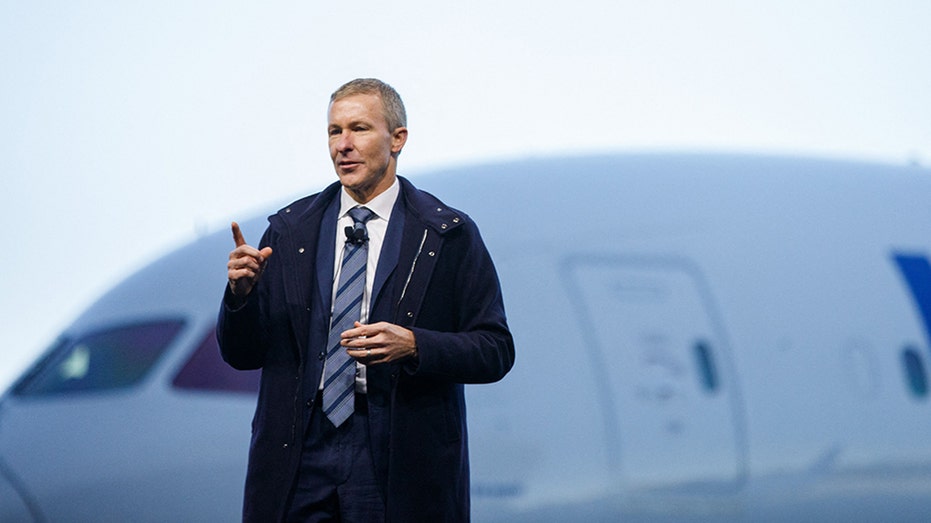
United Airlines CEO Scott Kirby speaks during a joint press event with Boeing at the Boeing manufacturing facility in North Charleston, South Carolina, on Dec. 13, 2022. (Logan Cyrus/AFP via Getty Images)
Isom is already embroiled in a leadership crisis. In February, the Association of Professional Flight Attendants (APFA) issued a unanimous no-confidence vote in Isom, citing a “relentless downward spiral” in his leadership.
The Allied Pilots Association (APA) also published a blistering open letter stating their lack of confidence in American Airlines leadership.
Advertisement
Now, a reported meeting between Kirby and Trump in which the United CEO allegedly lobbied Trump for his blessing on a merger has fueled speculation that Isom is getting squeezed out.
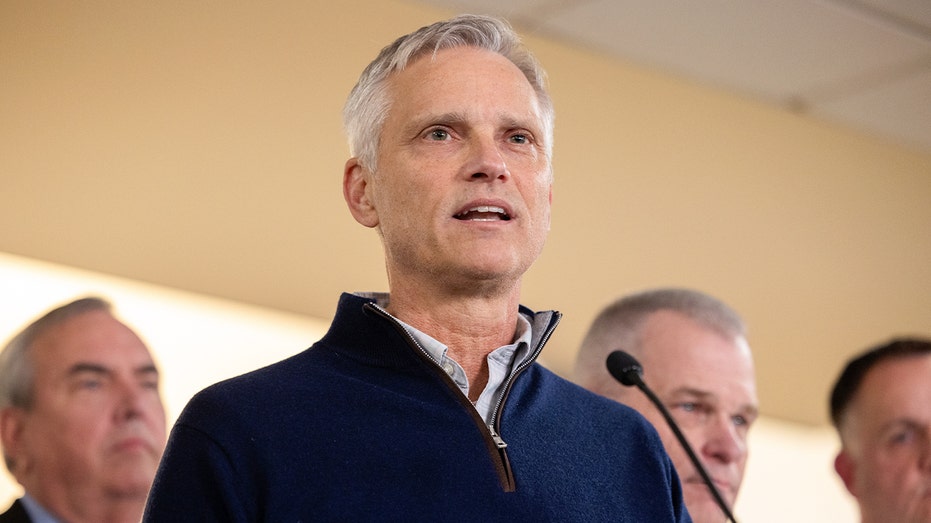
American Airlines CEO Robert Isom has come under scrutiny as the head of the carrier. (Nathan Posner/Anadolu via Getty Images)
“This is a proud airline… but it’s an airline now that’s been, quite frankly, non-managed. As a result of that, I think the very fact that a competitor would say, ‘oh, we’ll take you over,’ is going to send that board into a tizzy,” Boyd said.
American Airlines said in a statement on Friday that it is “not engaged with or interested in” merger discussions with United.
“While changes in the broader airline marketplace may be necessary, a combination with United would be negative for competition and for consumers, and therefore inconsistent with our understanding of the Administration’s philosophy toward the industry and principles of antitrust law,” the carrier said. “Our focus will remain on executing on our strategic objectives and positioning American to win for the long term.”
Advertisement
United Airlines told FOX Business, “We don’t have anything to share.”
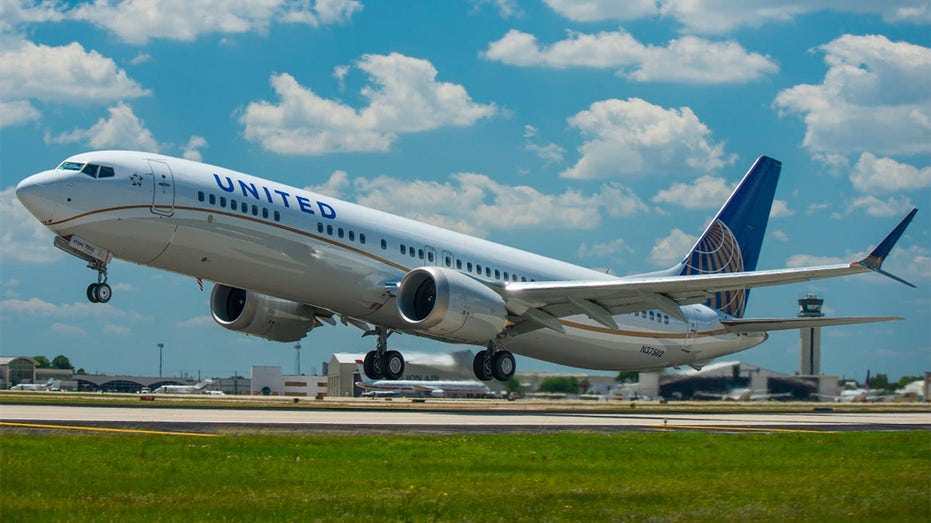
A potential deal could also face antitrust hurdles. (United Airlines)
It also could be the masterstroke in a Kirby revenge tour after the United CEO was himself ousted as the president of American Airlines.
“This would be the ultimate comeuppance,” View From the Wing writer Gary Leff wrote.
Advertisement
United Airlines CEO Scott Kirby, left, and American Airlines CEO Robert Isom listen as Transportation Secretary Sean Duffy speaks to reporters outside the White House on Oct. 30, 2025, in Washington, D.C. (Kevin Dietsch/Getty Images / Getty Images)
Despite the palace intrigue, however, the scope and scale of a mega-merger have analysts doubting its feasibility.
Getting through “the minefield of maintenance issues” alone could hold up the deal, Boyd said. “Remember a 787 at United is not the same as a 787 at American. The maintenance programs are different. The galleys are different. The cockpits may be different. Putting all that together is obscenely expensive.”
A potential deal could also face antitrust hurdles. “Fewer choices mean higher ticket prices, more fees, and fewer options for anyone who wants to get from point A to point B,” Ganesh Sitaraman, author of “Why Flying Is Miserable,” told Reuters.
“It seems unlikely that industry rivals, consumer groups and antitrust authorities would simply go along with this,” aviation analyst Stephen Trent told Morningstar.
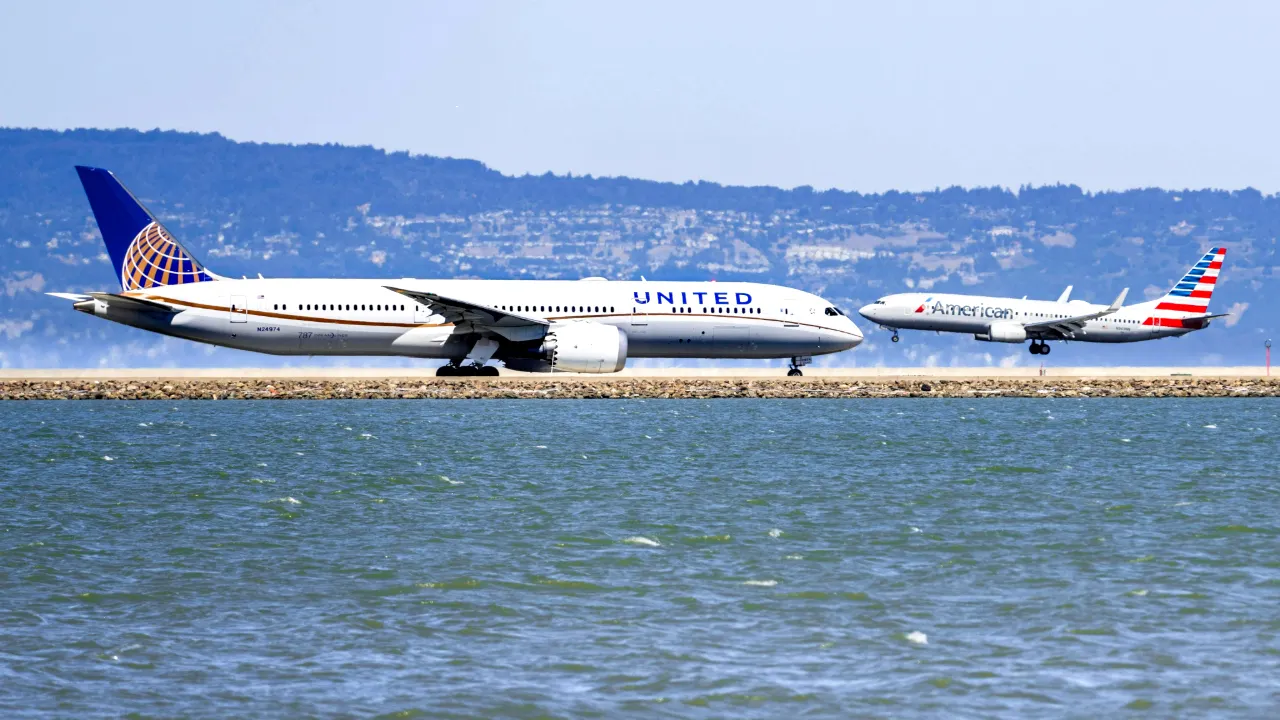
The proposed merger would combine the world’s two largest airline carriers by available seat kilometers (ASK), a metric provided by the Official Airline Guide (OAG).
American said in a statement that it is “not engaged with or interested in” merger discussions with United. (Al Drago/Bloomberg via Getty Images)
The pair also constitute over a third of domestic market share with a combined $3 billion market cap. But their share of the global market pales in comparison to their U.S. dominance. The pair had just over 1 trillion ASK in 2025, which amounted to less than 10% of the 2025 global share of more than 11.5 ASK, according to data from OAG and the International Air Transport Association (IATA).
Transportation Secretary Sean Duffy had previously indicated that the sector had room for airline mergers, though added, “I am not going to pre-commit to anything.”
FOX Business contacted the Federal Trade Commission for comment but did not immediately receive a response.
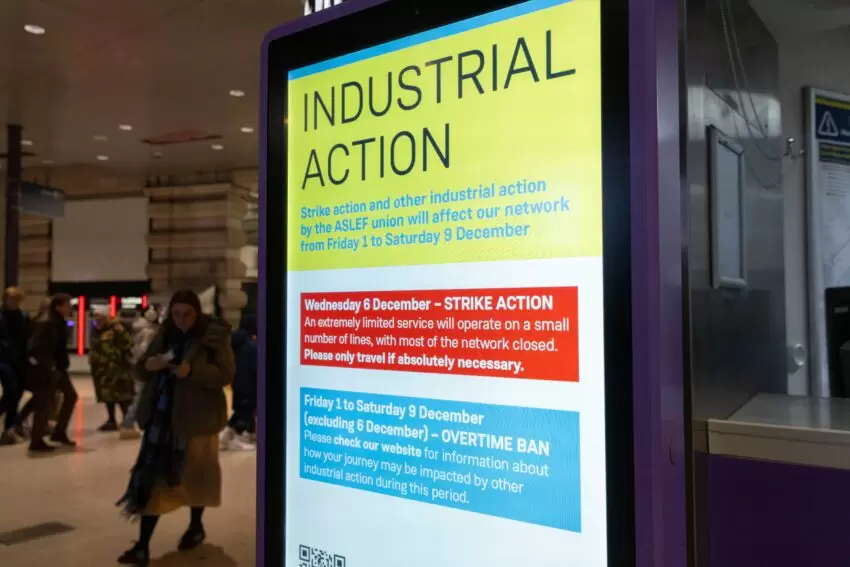
London’s small and medium-sized businesses are bracing for a punishing week of disruption as London Underground drivers prepare to stage two 24-hour walkouts, in a dispute over working patterns that threatens to drain millions of pounds from the capital’s already fragile hospitality and night-time economy.
Members of the Rail, Maritime and Transport (RMT) union will down tools from midday on Tuesday 21 April and again from midday on Thursday 23 April, with Transport for London (TfL) warning operators and passengers to expect “significant disruption” across the entire network. A separate walkout by 150 Unite members working as bus station and network traffic controllers, running from 23 to 25 April, is set to compound the misery.
For business owners across the capital, the timing could scarcely be worse. Operators in hospitality, retail and leisure are already contending with a fresh wave of energy price rises, persistent wage pressures and jittery consumer confidence. The loss of reliable late-night transport, industry leaders warn, risks tipping vulnerable SMEs over the edge.
TfL has published a day-by-day forecast of likely disruption. Normal services are expected to run on Tuesday 21 April until mid-morning, with availability tapering off ahead of the midday walkout. Any trains still running will wind down early, and TfL is advising those who must travel to complete their journeys by 8pm.
On Wednesday 22 April, services will start later than usual, with no trains expected before 7.30am. Significant disruption is forecast across all lines until midday, with a gradual recovery throughout the afternoon and evening.
Advertisement
The pattern repeats on Thursday 23 April, with normal services until mid-morning and a 12pm walkout triggering severe disruption into the evening. Friday 24 April will again see no service before 7.30am and continuing disruption across the network.
Although a reduced timetable will operate on some routes, TfL has confirmed there will be no service at all on the Piccadilly and Circle lines, no trains on the Metropolitan line between Baker Street and Aldgate, and no service on the Central line between White City and Liverpool Street. Trains that do run are likely to be sporadic, overcrowded and unable to pick up every waiting passenger.
The Elizabeth line, DLR, London Overground and tram services will operate as normal.
Adding to the disruption, seven bus routes operated by Stagecoach from Bow Bus Garage in East London will be affected by a 24-hour walkout from 5am on Friday 25 April. Routes 8, 25, 205, 425, N8, N25 and N205 are all in scope, although TfL expects the 25 and 425 to maintain a near-normal service for most of the day. The N8 will run a reduced route between Hainault and Liverpool Street at its usual frequency, while the remaining routes are likely to be severely delayed or cancelled.
Advertisement
The dispute centres on TfL’s proposal to introduce a four-day working week for train operators. The union has branded the plan “fake”, arguing it would simply condense existing hours into fewer days without delivering genuine improvements.
The RMT initially suspended strike action last month after TfL management agreed to negotiate, but accused the operator of reneging at the weekend.
RMT general secretary Eddie Dempsey said the union had “approached negotiations with TfL in good faith throughout this entire process”, adding: “despite our best efforts, TfL seem unwilling to make any concessions in a bid to avert strike action. This is extremely disappointing and has baffled our negotiators. The approach of TfL is not one which leads to industrial peace and will infuriate our members who want to see a negotiated settlement to this avoidable dispute.”
Claire Mann, TfL’s chief operating officer, countered that the proposals were fair and flexible. “We have set out proposals to the RMT for a four-day working week. This allows us to offer train operators an additional day off, whilst at the same time bringing London Underground in line with the working patterns of other train operating companies, improving reliability and flexibility at no additional cost. The changes would be voluntary, there would be no reduction in contractual hours and those who wish to continue a five-day working week pattern would be able to do so.”
Advertisement
For Michael Kill, chief executive of the Night Time Industries Association (NTIA), the latest walkout is another hammer blow to a sector running on empty.
“As the sector faces a fresh surge in energy and operating costs, this new wave of strike action creates yet more uncertainty that businesses simply cannot absorb,” he said. “Margins are being squeezed from every direction, and confidence is increasingly fragile.”
Mr Kill questioned the wider purpose of the industrial action. “The ongoing disruption to transport services begs the question, who does this actually benefit? Because right now, it’s businesses, workers and the wider public who are paying the price for the reckless actions of the few.”
He warned that the knock-on effects go well beyond lost footfall. “Without reliable late-night transport, staff struggle to get to work, customers stay away, and businesses lose critical trade. Many venues are already under intense financial pressure, continued disruption only compounds that risk.”
Advertisement
While acknowledging workers’ right to withdraw their labour, Mr Kill called for an urgent return to the negotiating table. “We respect the right to strike, but this situation cannot continue. All parties must get round the table and find a resolution, because sustained uncertainty at a time like this will have serious, lasting consequences for London’s night-time economy.”
TfL is urging travellers to use its journey planner to map their routes in advance and to check the status of lines in real time via its live status page. For SMEs, the message from industry is simpler: brace for a difficult week, and start demanding that both sides find a settlement before the damage to the capital’s economy becomes permanent.
Amy Ingham
Amy is a newly qualified journalist specialising in business journalism at Business Matters with responsibility for news content for what is now the UK’s largest print and online source of current business news.
Calamos Investments is a diversified global investment firm offering innovative investment strategies including U.S. growth equity, global equity, convertible, multi-asset and alternatives. The firm offers strategies through separately managed portfolios, mutual funds, closed-end funds, private funds, an exchange traded fund and UCITS funds. Clients include major corporations, pension funds, endowments, foundations and individuals, as well as the financial advisors and consultants who serve them. Headquartered in the Chicago metropolitan area, the firm also has offices in London, New York and San Francisco. For more information, please visit www.calamos.com.
Mumbai: The Reserve Bank’s recently released draft on upper layer non-bank finance companies (NBFCs) impacts core investment companies “disproportionately” by upping compliance costs, a report said on Monday.
India Ratings said mandatory listing requirements could prove onerous for several CICs, especially those structured primarily for promoter-level capital allocation rather than public-market access.
It can be noted that the RBI had come out with a draft on classifying NBFCs-ULs, amid intense speculation over the fate of the CIC Tata Sons on listing, and whether the revised directions continue to make a listing necessary for the salt to software conglomerate.
Under the draft revisions, the RBI is proposing a threshold of Rs 1 lakh of AUM over which every entity will become a NBFC-UL, and also include state-run companies in the list. Tata Sons had assets of over Rs 1.7 lakh crore as on March 2025.
“While the NBFC-UL framework is broadly benign for the sector at large, CICs emerge as the clear outliers. CICs with consolidated assets approaching or exceeding Rs 1 lakh crore will face disproportionate compliance costs under the new regime,” the rating agency said.
Advertisement
Live Events
If the framework is applied on a consolidated rather than a standalone basis for assets under management calculation, its scope would extend to several corporate groups operating under the CIC structure, many of which are privately held and unlisted. It added that several CICs have highly concentrated investments in step-down subsidiaries and the LEF (large exposures framework) application in such cases could prove operationally challenging. The final draft might provide greater regulatory clarity and resolve these concerns, it said.
“The revised draft framework for categorising NBFCs into NBFC-UL is unlikely to have any significant impact on existing NBFCs. However, CICs could face challenges with the AUM-based approach, especially in terms of listing equity and enhancing compliance and governance requirements,” its director for financial institutions Karan Gupta said.
LOS ANGELES — Charles Barkley didn’t hold back on “Inside the NBA” after the Los Angeles Lakers stunned the Houston Rockets 107-98 in Game 1 of their Western Conference first-round playoff series on Saturday night.
The Hall of Famer, never one to mince words, declared that the short-handed Lakers now believe they can take the series, while pointing out that the Rockets have a glaring offensive problem that could derail their postseason hopes.
“The Lakers think they can win this series,” Barkley said on the TNT broadcast, drawing laughter from Shaquille O’Neal and the rest of the panel. “Houston has a problem.”
Advertisement
Charles Barkley
The comment came after the Rockets, missing star forward Kevin Durant with a right knee contusion, struggled mightily on offense in their playoff opener at Crypto.com Arena. Despite entering the series as the higher seed in some projections and boasting a young, athletic roster, Houston looked disjointed without its veteran scorer.
Durant, who averaged nearly 26 points per game during the regular season, was ruled out about 90 minutes before tipoff after bumping knees with a teammate in practice earlier in the week. Imaging showed no structural damage, but the contusion left the 37-year-old sidelined for Game 1. Rockets coach Ime Udoka expressed hope it would be a short-term issue, calling Durant day-to-day.
Without Durant, the Rockets started a lineup featuring Amen Thompson, Reed Sheppard, Josh Okogie, Jabari Smith Jr. and Alperen Sengun. The group managed just 98 points on inefficient shooting, with Barkley and fellow panelist Kenny Smith — a former Rockets champion — ripping the team’s offensive approach as “awful to watch.”
“Whoever gets it just jacks it up anywhere, anything,” Barkley said, criticizing the lack of structure and ball movement. Smith questioned whether Houston even had a coherent game plan, suggesting the absence of Durant exposed deeper issues in half-court execution.
The Lakers, already without injured stars Luka Doncic and Austin Reaves, seized the opportunity. LeBron James delivered a near triple-double with 19 points, 13 assists and eight rebounds, while veteran sharpshooter Luke Kennard exploded for a playoff career-high 27 points, going 5-for-5 from three-point range. Deandre Ayton added 19 points and 11 rebounds as Los Angeles built leads and held off a late Rockets push.
Advertisement
Lakers coach JJ Redick downplayed the impact of Houston’s missing star. “I don’t think it affected our mentality,” Redick said postgame. “This is all we talked about for two months — just our playoff mentality. You can’t worry about who’s in or out of the lineup. It’s our game plan. It’s our standards. It’s how we play.”
The victory gave the Lakers a 1-0 lead in the best-of-seven series, shifting momentum in a matchup many expected to favor Houston’s youth and depth. Pre-series, Barkley had predicted the Rockets would advance comfortably if Doncic and Reaves remained sidelined. Saturday’s result forced a reevaluation.
Barkley’s blunt assessment resonated because it highlighted a recurring critique of the Rockets: their reliance on iso-heavy offense and individual creation, particularly from Durant and Sengun, can break down against disciplined playoff defenses. Without Durant’s mid-range gravity and playmaking, Houston struggled to generate easy looks or consistent rhythm.
The Rockets’ offense ranked among the league’s more efficient during the regular season, but the playoffs often expose half-court limitations. Sengun showed flashes as a facilitator, and Thompson’s athleticism created some transition opportunities, yet the team shot poorly from the perimeter and turned the ball over at key moments.
Advertisement
For the Lakers, the win provided validation for a resilient group navigating significant injury absences. James, in his 23rd season, continues to defy expectations at age 41, orchestrating the offense and making timely defensive plays. Kennard’s hot shooting filled the scoring void left by Doncic and Reaves, while the frontcourt duo of Ayton and the supporting cast held their own against Houston’s size.
The series now shifts to Game 2 on Tuesday night in Los Angeles, with Durant’s status still uncertain. Udoka and the Rockets’ medical staff will monitor swelling and range of motion closely. Even if Durant returns, the Lakers’ confidence — and Barkley’s observation — suggests Houston must solve its offensive identity quickly to regain control.
Analysts noted that the Rockets’ youth, while an asset in the regular season, showed inexperience in the playoff environment. Turnovers and defensive lapses allowed the Lakers to build comfortable leads. Houston’s ability to adjust — tightening rotations, improving ball movement and finding ways to involve Sengun more effectively — will be critical.
Barkley’s history with the Rockets, where he played late in his career, adds color to his commentary, though he has been vocal about the franchise’s shortcomings in recent years. His “Houston has a problem” line quickly went viral on social media, sparking debates among fans about whether the Rockets are truly built for deep playoff runs or remain a work in progress despite adding Durant.
Advertisement
The broader narrative around the series has shifted. What was billed as a potential upset opportunity for a short-handed Lakers team now carries the weight of an early statement win. LeBron James and company have home-court advantage and momentum, while the Rockets must prove they can win without their veteran leader or elevate their collective play.
As the series progresses, all eyes will remain on Durant’s recovery timeline. A prolonged absence would test Houston’s depth and force even greater reliance on its young core. Conversely, his return could swing momentum back toward the Rockets, provided they address the offensive issues Barkley and Smith highlighted.
“Inside the NBA” delivered its signature blend of analysis and entertainment, with Barkley’s colorful take stealing the spotlight. The panel’s reaction underscored a larger truth in playoff basketball: execution and adaptability often matter more than regular-season pedigree, especially when star power is uneven.
For the Rockets, Game 1 served as a wake-up call. For the Lakers, it reinforced that belief — however improbable — can fuel success in the postseason. As Barkley put it, the Lakers now genuinely think they can win the series, placing the onus squarely on Houston to prove him wrong.
Advertisement
Game 2 offers the Rockets an immediate chance at redemption on the road. Whether they can tighten their offense, limit turnovers and capitalize on any Lakers fatigue will determine if Chuck’s blunt assessment becomes a self-fulfilling prophecy or merely memorable television fodder.
The 2026 NBA playoffs are just getting started, but the Lakers-Rockets series has already delivered drama, injury intrigue and vintage Charles Barkley candor. With the Lakers up 1-0 and believing in their chances, Houston indeed has a problem to solve — and little time to do it.


























































You must be logged in to post a comment Login