

In the novel When There Are Wolves Again by E.J. Swift, the Chernobyl disaster and its legacy is extrapolated to a near future where natural habitats are depleted and precarious.
This work of eco-fiction deftly explores issues of possible paths to a future where animals return to a nature depleted area. In the real world, a parallel version of this story has been unfolding as nature is thriving around former nuclear power plants.
This is especially evident at the former Chernobyl plant in Ukraine, where the absence of human activity has enabled wildlife to flourish despite continuing radiation, 40 years after the nuclear disaster there.
A 2,600km² exclusion zone was established following the world’s worst civilian nuclear accident at Chernobyl in 1986, which released a radioactive cloud across Europe and led to the evacuation of around 115,000 people from the surrounding area. Almost immediately, radiation poisoning killed 31 plant workers and firefighters.
It is 40 years since the Chernobyl disaster that led to the creation of the Chernobyl Exclusion Zone (CEZ). Since 1986, it has turned into a thriving, unintentional wildlife sanctuary and a vast rewilding “laboratory”. The CEZ prohibits people living there, commercial activities, natural resource extraction and public access. Now the area is home to flourishing populations of large mammals.
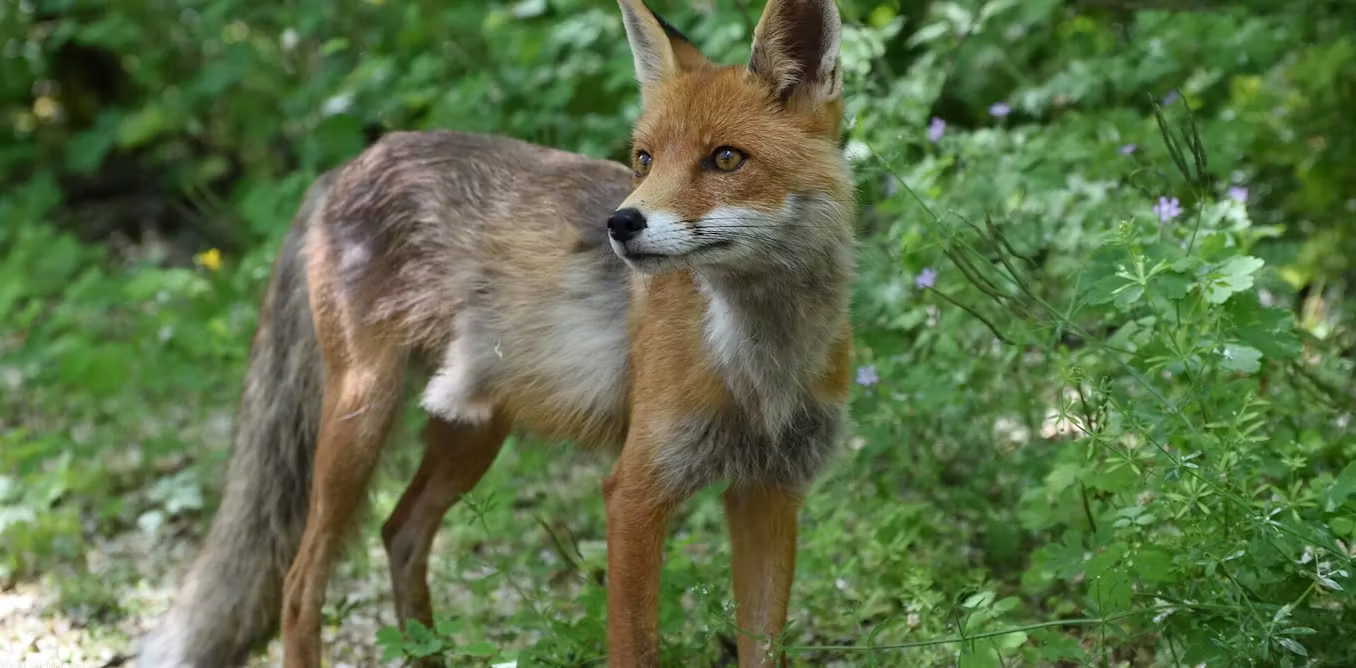
Populations of wolves, foxes, Eurasian lynx, elk and wild boar have significantly increased here. Species such as brown bears and European bison, meanwhile, have returned. This is rewilding in its most extreme form, given the inability of humans to intervene and it has resulted in several unexpected effects in the CEZ.
Studies indicate that the lack of human hunting, agriculture and development has a more positive impact on animal numbers than radiation has a negative one.
Large mammal populations in the Belarusian sector of the zone are comparable to or higher than those in uncontaminated nature reserves. There is no doubt that initial radiation caused major damage to flora and fauna, most notably in the “red forest”, a 10km² area near the nuclear power plant.
This area earned its name after pine trees died and turned red-brown due to high radiation absorption. Yet long-term studies show that biodiversity has increased in the absence of humans.
Imago/Alamy
Return of rare species
A range of endangered species have returned to the exclusion zone. This includes Przewalski’s horses, reintroduced in 1998 as a conservation experiment. They are now thriving, and the population has grown to over 150 animals within a distinct area of the Ukrainian part of the zone.
Both Eurasian lynx and European bison, which had disappeared from the area, have returned and established their populations. Several different bird species have returned, such as black storks, white storks and white-tailed eagles.
Most significant, is the return of the globally endangered greater spotted eagle, which depends on wetland habitats to hunt and is very sensitive to human disturbance. It had vanished from the area at the time of the nuclear accident.
In 2019, four pairs were recorded at the study site, and at least 13 pairs were documented nesting in the Belarusian part of the zone. Today, this region is the only place in the world where the population of this rare species is growing.
Frogs change colour
There is also scientific evidence that some species appear to be adapting to the radioactive environment. For example, tree frogs in the zone are darker, as higher melatonin levels seem to protect against radiation damage.
There also appears to be resilience evolving in wolves as research on Eurasian wolves indicates potential adaptations to survive chronic radiation and reduce cancer risks.
Such adaptation is not limited to animals. A black fungus was first discovered in 1991 using remotely piloted robots growing inside reactor 4 of the former power plant. It appears to use melanin, which can protect against ultra-violet light, to convert gamma radiation into energy to grow faster than normal.
In addition, some plants in the nearby zone are demonstrating DNA repair as a response to the high levels of radiation. Such adaptation means the vegetation has evolved to survive, with some plants showing enhanced ability to manage heavy metals and radiation.
It is now one of Europe’s largest nature reserves, providing an important site for ecological research, particularly for how ecosystems recover when undisturbed.
The zone has undoubtedly been shaped by radiation but also, crucially, by abandonment and time. As a consequence, the usual ecological rules no longer apply and this has meant Chernobyl now has some remarkable wildlife. For example, the hundreds of pet dogs abandoned in the aftermath of the disaster have become feral dogs that have evolved to be genetically distinct from populations elsewhere in Ukraine.
Despite the evidence supporting rewilding here, it is apparent that not all outcomes of the disaster have been beneficial for flora and fauna. There is evolutionary pressure with some species showing reduced reproductive success and high mutation rates, resulting in some health issues for animals.
But it is not only at Chernobyl where these nuclear zones are encouraging animals to return. Around other damaged nuclear reactors, such as Fukushima, mammals, including bears, raccoons and wild boars have now returned in high numbers transforming exclusion zones into unexpected sanctuaries. At some operating nuclear plants, local wildlife has been encouraged through habitat creation and protection of large, undisturbed exclusion areas.
Clearly, the situation is complicated, and it should not take a nuclear accident to stop humans pushing other species towards existential risk, let alone the continuing environmental degradation occurring around the globe. There are lessons to be learned from such catastrophes, and no neat conclusions, even 40 years after the disaster.
Wildlife has largely returned to the area around Chernobyl due to the absence of people, although not predictably or evenly. It does illustrate, however, how ecosystems can respond and still flourish when the usual rules do not apply.
























































You must be logged in to post a comment Login