
Crypto World
Bitcoin heads into a $7.9 billion options expiry with heavy positioning at $75,000

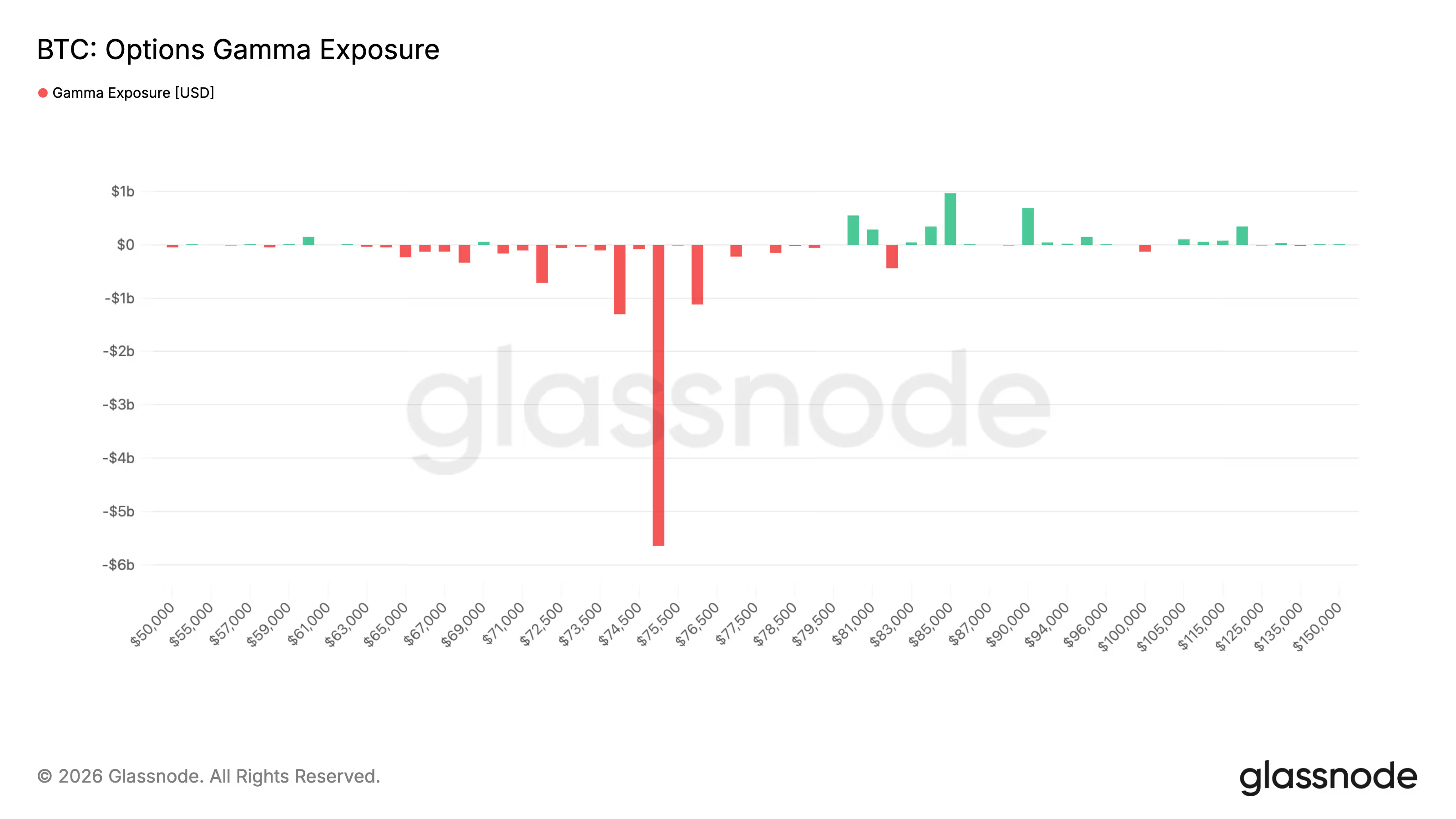
Bitcoin options worth roughly $7.9 billion are set to expire on Deribit this Friday, with positioning data pointing to $62,000 and $75,000 as key levels to watch out for.
The $75,000 level is where most trading in call options, which represent bullish bets, has happened, according to data source Glassnode. Around $395 million in call open interest is concentrated at the $75,000 strike as of writing. That figure represents the dollar value of the number of active call options contracts today.
More importantly, “gamma exposure” is deeply negative at the 75,000 strike – it means dealers’ hedging flows are likely to amplify price movements around this level. As the price rises, they may need to buy more, and as it falls, sell more, reinforcing the direction of the move.
As a result, the 75,000 level can act as a zone of heightened volatility, where price swings become sharper rather than stabilizing.
Options are derivative contracts that give the buyer the right to buy or sell the underlying asset, in this case, BTC, at a predetermined price at a later date. A call option gives the right to buy and a put option gives the right to sell.
It’s like paying a booking fee to reserve a right to transact a house at today’s price – you have the right to buy or sell it later at that price, but you’re not obligated to go through with the transaction if the market price moves against you.

On the downside, the largest concentration of put open interest sits at $62,000, with roughly $330 million in contracts, marking the main zone of downside protection.
Between the two, there’s this max pain level of $71,000, which can act as a magnate heading into the expiry. The “max pain” point is the price level at which the largest number of options contracts are expected to expire worthless on the settlement date, though this level can shift as prices and open interest change leading up to expiry.
All in all, the options market is effectively sitting between $62,000 and $75,000, with $71,000 acting as a midpoint. Unlike March, when bitcoin traded below max pain, the market is now sitting above it, to test whether bitcoin can hold onto its gains.
Potential short squeeze higher
Funding rates in perpetual futures have remained negative, indicating a build-up of short positions that could fuel a squeeze if prices hold higher. Bears could square off their bearish bets if prices remain resilient above $75,000, which could add to the upward momentum.
While data from Checkonchain shows Deribit now holds around $31 billion in open interest, the largest across options markets, surpassing even BlackRock’s IBIT, which stands near $28 billion.

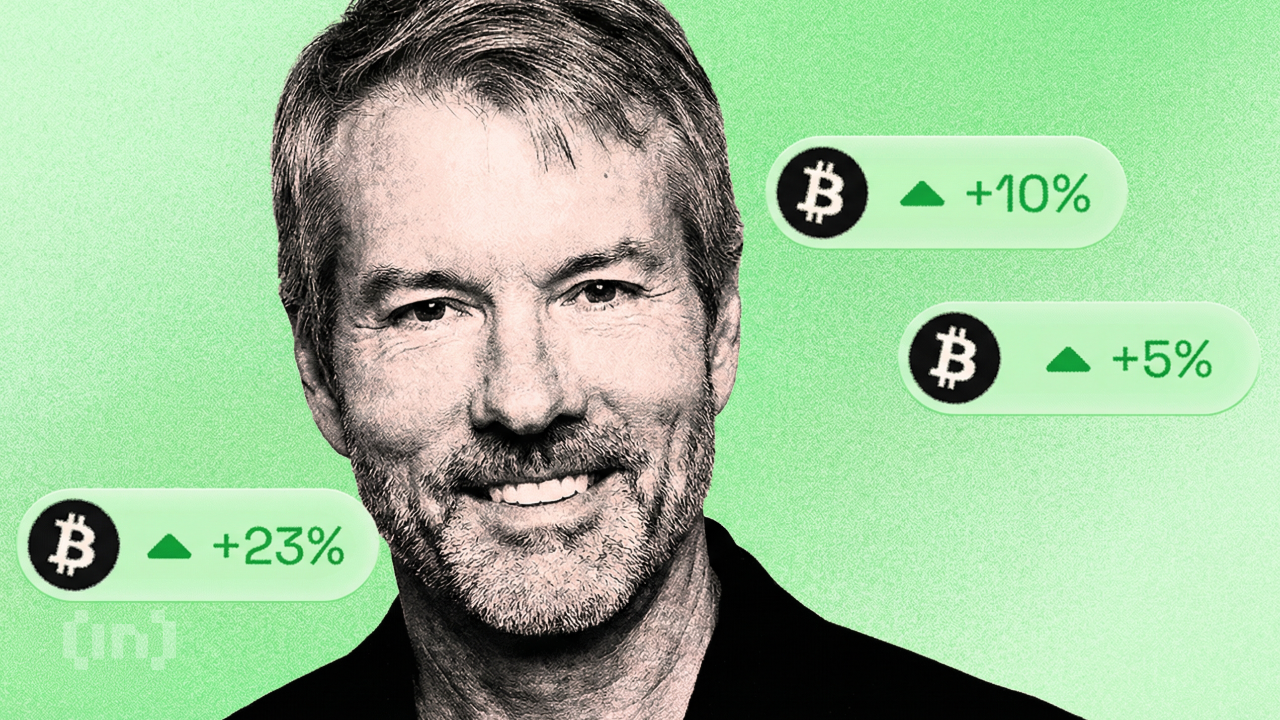
MicroStrategy has made its largest Bitcoin purchase in over a year, adding 34,164 BTC for $2.54 billion at an average price of $74,395.
The move lifts its total holdings to 815,061 BTC, extending its lead as the largest corporate Bitcoin holder.
Executive Chairman Michael Saylor signaled the buy a day earlier with his usual chart post on X. Markets read it as another accumulation signal—and they were right.
MicroStrategy is Buying Near Breakout Levels
The timing stands out. Bitcoin has been trading close to Strategy’s average cost basis of roughly $75,500, placing the firm near breakeven.
Strategy has a pattern of stepping in around key levels rather than waiting for deep pullbacks. This latest purchase is also a step up in size. The company bought roughly $1 billion worth of BTC the week prior and $330 million the week before that.
The acceleration suggests growing conviction at current price levels.
Recent analysis from Coinbase shows that large, consistent buyers like Strategy reduce the liquid supply of Bitcoin. Coins move off the market and into long-term holdings, tightening available float.
That effect becomes more important when Bitcoin is already near a technical breakout level. At those points, even incremental buying can help push price higher, triggering momentum traders and systematic funds.
Strategy’s latest purchase absorbed more than 34,000 BTC in a single week. For context, miners produce roughly 450 BTC per day, meaning the company bought the equivalent of over two months of new supply in one move.
Bitcoin Supply Squeeze, With Limits
Still, the impact is not guaranteed.
Coinbase notes that the price effect of large buyers can be muted if the market already expects the purchases, or if flows from ETFs, derivatives, or macro conditions outweigh them.
In other words, Strategy’s buying tightens supply in the background. It matters most when market conditions are already leaning bullish.
Strategy continues to fund its purchases through its capital programs, including its STRC preferred stock. The company still has significant capacity to raise funds, giving it room to keep accumulating.
With over 815,000 BTC now on its balance sheet, Strategy is steadily moving toward its long-term goal of 1 million BTC.
The post MicroStrategy Makes Biggest Bitcoin Buy Since 2024, Will It Move BTC Price? appeared first on BeInCrypto.
The popular Spiderman meme showing three identical superheroes pointing fingers at each other is having its crypto moment today.
Kelp DAO is set to push back on LayerZero’s post-mortem of Sunday’s $290 million exploit, which essentially blames Kelp, a L2 source familiar with the matter told CoinDesk. Kelp plans to dispute the cross-chain messaging firm’s claim that it ignored repeated warnings to move away from a single-verifier setup. CoinDesk has reviewed and verified the memo Kelp plans to publish.
Kelp is a liquid restaking protocol that takes user-deposited ether, routes it through a yield-generating system called EigenLayer, and issues a receipt token, rsETH, in exchange.
LayerZero is the cross-chain messaging infrastructure that moves rsETH between blockchains, using entities called DVNs (decentralized verifier networks) to verify whether a cross-chain transfer is valid.
On Saturday, attackers drained 116,500 rsETH, worth about $290 million, from Kelp’s LayerZero-powered bridge by poisoning the servers that LayerZero’s verifier relied on to check transactions.
Kelp, the source said, is planning on saying the DVN that was compromised via what it calls a “sophisticated state-sponsored attack” was LayerZero’s own infrastructure, not a third-party verifier.
Attackers compromised two of LayerZero’s own servers that check whether cross-chain transactions are legitimate, then flooded the backup servers with junk traffic to force LayerZero’s verifier onto the compromised ones.
All of that infrastructure was built and run by LayerZero, not Kelp, the source claimed.
The source contested LayerZero’s framing of the “1/1 configuration” as a fringe choice made against guidance. LayerZero’s post-mortem said KelpDAO chose a 1-of-1 DVN setup despite expressing recommendations to configure multi-DVN redundancy.
A “1/1 configuration” means only a single validator must sign off on a cross-chain message for the bridge to act on it, leaving the system with no second check to catch a compromised or forged instruction. A multi-validator configuration (such as 2/3, 3/5, etc.) ensures there is no single point of failure that can approve a forged message on its own.
They added that, through a direct communications channel with LayerZero, which has been open since July 2024, they produced no specific recommendation for Kelp to change the rsETH DVN configuration.
LayerZero’s own quickstart guide and default GitHub configuration point to a 1/1 DVN setup, the source told CoinDesk, adding 40% of protocols on LayerZero are currently using the same configuration.
The configuration Kelp ran also appears in LayerZero’s own V2 OApp Quickstart, where the sample layerzero.config.ts wires every pathway with one required DVN and no optional DVNs. That’s the same 1/1 structure.
Kelp’s core restaking contracts were not touched, and the exploit was isolated to the bridge layer, they added. Its emergency pause, 46 minutes after the drain, blocked two follow-up attempts that would have released an additional ~$200 million in rsETH.
CoinDesk reached out to LayerZero for comment on the story and didn’t hear back by the time of publication.
‘Deflecting responsibility’
Security researchers are also not buying LayerZero’s isolated framing, which pinned the blame on Kelp.
Kelp is a liquid restaking protocol. Its core competency is staking infrastructure, EigenLayer integration, and liquid staking token management. When integrating with LayerZero, Kelp relied on LayerZero’s documentation, their defaults, and their team’s guidance to make configuration decisions, the source claimed.
Yearn Finance core team developer Artem K, who is popularly known as @banteg on X, posted a technical review of LayerZero’s public deployment code and said that the reference setup ships with single-source verification defaults across every major chain, including Ethereum, BSC, Polygon, Arbitrum and Optimism.
That deployment also leaves a public endpoint exposed that leaks the list of configured servers to anyone who queries it.
Banteg flagged in his analysis that he can’t prove which configuration Kelp used, but noted that LayerZero usually asks new operators to use its default setup, which its post-mortem criticized.
Chainlink community manager Zach Rynes put it bluntly on X, alleging that LayerZero was “deflecting responsibility” for its own compromised infrastructure and accused the company of throwing Kelp under the bus for trusting a setup LayerZero itself supported.
As such, LayerZero has said it will no longer sign messages for any application running a single-verifier setup, forcing a protocol-wide migration.
Read more: ‘DeFi is dead’: crypto community scrambles after this year’s biggest hack exposes contagion risk
Strategy, Michael Saylor’s flagship vehicle and the largest public holder of Bitcoin, has surpassed 800,000 BTC in total holdings after its latest purchases. The company disclosed in an 8-K filing with the U.S. Securities and Exchange Commission that it bought 34,164 BTC for $2.54 billion between April 13 and 19, at an average price of $74,395 per coin.
The new purchase lifts Strategy’s total BTC under custody to 815,061 coins, purchased for $61.56 billion. The firm had about 780,897 BTC after a $1 billion buy just a week earlier. By coin count, the April tranche ranks as Strategy’s third-largest BTC acquisition, behind 55,500 BTC and 51,780 BTC purchases made in November 2024.
Key takeaways
- New BTC haul: 34,164 BTC acquired for $2.54 billion (April 13–19), at an average price of $74,395 per coin.
- Funding mix: Stretch (STRC), the perpetual preferred security, supplied about $2.18 billion (roughly 85.7% of the total proceeds); Class A common stock contributed about $366 million.
- Record-pace activity via STRC ATM: The STRC at-the-market program delivered two consecutive days of heavy buying, with estimated BTC purchases rising to around 17,204 BTC across 11.9 million and 14.4 million shares sold, according to STRC Live—about a 518% surge versus the four-week average.
- Cost basis and scale: The purchase price sits slightly below Strategy’s overall average cost basis, reinforcing the company’s long-standing commitment to accumulating BTC.
- Future dividend signal: Strategy CEO Phong Le has signaled potential semi-monthly dividends for STRC, a unique feature among preferreds, a move the company says could be attractive.
Strategy expands its BTC stake with a mid-April buy
The363,164-BTC addition cements Strategy’s position as the world’s most prominent publicly traded Bitcoin holder. The deal, documented in an 8-K filing, shows the bulk of the purchase was executed through financing channels tied to STRC, the company’s perpetual preferred security. With the new BTC, Strategy’s total holdings stand at 815,061 BTC, a stake amassed for $61.56 billion to date.
For context, Strategy had been holding about 780,897 BTC after a $1 billion purchase a week prior, underscoring a rapid acceleration in accumulation over a short window. The new acquisition sits just below Strategy’s average cost of around $75,527 per BTC, illustrating a cautious approach to price levels over the course of the company’s investment program.
In a regulatory filing, Strategy confirmed the April purchases and reiterated that the company prioritizes a diversified approach to funding its Bitcoin stack, balancing debt-like instruments with equity capital. The size and cadence of the buys highlight how a very large corporate treasury can shape a single-asset narrative, particularly as BTC remains a focal point for corporate treasuries seeking to optimize risk/return over time.
STRC fuels the deal, underscoring the instrument’s role in Strategy’s strategy
The funding structure behind the latest BTC accumulation shows STRC playing a central role. The SEC filing indicates STRC generated $2.18 billion in proceeds from the sale of shares, accounting for roughly 85.7% of the total funding for the new purchase. By contrast, net proceeds from the sale of Class A common stock accounted for about $366 million.
Strategy’s leadership has repeatedly highlighted STRC as a key financing vehicle. Last week, co-founder and executive leadership signaled the potential for STRC to pay semi-monthly dividends, a rarity among preferred securities. In remarks cited by the filing, Strategy CEO Phong Le said, “If we were to move forward with paying STRC semi-monthly, we would be in category one, the only preferred in the world that pays semi-monthly dividends. We think this is unique and attractive.”
ATM program momentum and what it signals
The week’s activity also reflected STRC’s at-the-market program’s capacity to drive large, rapid purchases. STRC Live reported a new daily record on April 13 of about 7,741 BTC tied to the sale of 11.9 million STRC shares, generating more than $1 billion in trading volume. The following day, the program set another record with an estimated 9,364 BTC tied to the sale of 14.4 million shares. Combined, the two days accounted for roughly 17,204 BTC, marking a 518% increase versus the four-week average.
These figures illustrate how a perpetual preferred instrument can work in tandem with a strategic corporate treasury plan to widen exposure to Bitcoin quickly, leveraging market liquidity to scale holdings without committing to large, single-block equity raises.
Market implications and what investors should watch next
Strategy’s latest round of accumulation reinforces the company’s longstanding thesis: Bitcoin remains a core long-term asset, with corporate treasuries willing to deploy significant capital through diversified financing structures. For investors in Strategy and BTC, the coordination between STRC-based funding and large-scale purchases signals a sustained appetite for exposure to Bitcoin as a strategic reserve asset rather than a speculative position.
Key questions moving forward include how STRC dividends will evolve, whether subsequent purchases will follow the same financing pattern, and how regulators might view semi-monthly dividend structures tied to a crypto-asset strategy. Market participants will want to monitor further SEC disclosures and STRC Live updates for new guidance on payout schedules and any shifts in the ATM program’s cadence.
As Strategy continues to expand its BTC stash, eyes will remain on the company’s next steps and the potential ripple effects on corporate treasury behavior, Bitcoin price discovery, and the broader crypto market’s adoption by public-market players.
Readers should watch for additional updates from Strategy and STRC in the coming weeks, including any new 8-K filings or official statements on dividend structure and future ATM activity.
Michael Saylor’s Strategy, the world’s largest public Bitcoin holder, has blasted past 800,000 BTC in total holdings after announcing its latest purchases.
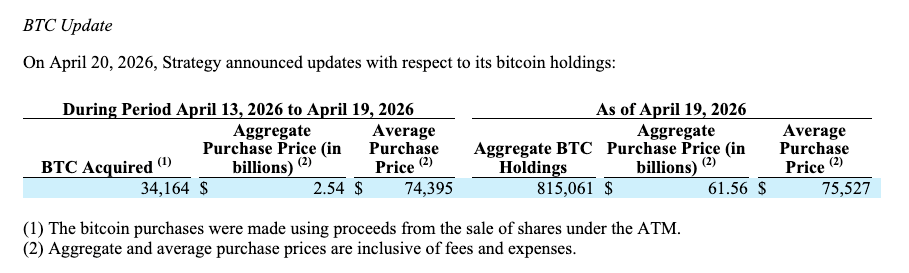
Strategy acquired 34,164 Bitcoin (BTC) for $2.54 billion between April 13 and 19, according to an 8-K filing with the US Securities and Exchange Commission on Monday.
The buy ranks as Strategy’s third-largest Bitcoin acquisition on record by coin count, behind purchases of 55,500 BTC and 51,780 BTC in November 2024.
Holding around 780,897 BTC after a $1 billion purchase just a week ago, the company now holds 815,061 BTC, purchased for $61.56 billion.

The new acquisition was made at an average price of $74,395 per coin, slightly below the company’s average acquisition price of $75,527.
Saylor had teased the purchase on Sunday, signaling another large Bitcoin acquisition ahead of the announcement. The company also disclosed on Friday plans to pay Stretch (STRC) dividends twice monthly. STRC is the company’s perpetual preferred security.
“If we were to move forward with paying STRC semi-monthly, we would be in category one, the only preferred in the world that pays semi-monthly dividends. We think this is unique and attractive,” Strategy CEO Phong Le said.
Related: Bitmine ramps up Ether buys, pushes holdings toward 5% of total supply
Strategy’s STRC funds more than 85% of the purchase
Similar to a few recent acquisitions, the majority of Strategy’s latest purchase has been funded through STRC.
According to the filing, STRC generated $2.18 billion, or about 85.7% of total proceeds, while sales of Class A common stock (MSTR) contributed $366 million.

Last week marked several new records for STRC, including the company’s largest single-day buying spree through its at-the-market, or ATM, program.
On April 13, STRC set a new estimated daily record of about 7,741 BTC, based on the sale of 11.9 million shares through its at-the-market, or ATM, program, generating more than $1 billion in trading volume, according to STRC Live.
The stock set another record the following day, with an estimated 9,364 BTC tied to 14.4 million shares sold through its at-the-market, or ATM, program. The two days combined brought an estimated 17,204 BTC, marking a 518% surge versus the four-week average.

Disclosure: This article does not represent investment advice. The content and materials featured on this page are for educational purposes only.
Memecoin presales gain traction in 2026 as investors chase fast-moving utility-driven assets.
Summary
- DOGEBALL gains traction in 2026 presales with a limited 4-month window and over $205K already raised.
- Built on DOGECHAIN Layer 2, DOGEBALL combines gaming and global payments with fast, low-cost transactions.
- DOGEBALL positions itself as a utility-driven meme presale offering real-world remittance and gaming rewards.
Investors are currently fleeing stagnant legacy tokens in favor of high-speed utility assets that offer immediate, double-digit growth potential. While the broader market faces indecision, the best memecoin presales in 2026 are capturing the spotlight by providing a clear path to liquidity before the mid-year bull run.
DOGEBALL (DOGEBALL) has officially broken away from the pack, launching its highly anticipated 4-month presale window on January 2nd, 2026, with a hard closing date of May 2nd, 2026. This limited timeframe creates a rare “fast-track” investment cycle where capital doesn’t sit idle for years but works to maximize returns in just a few short months.

The urgency surrounding this project is driven by its unique positioning at the intersection of gaming and global finance. Unlike projects that rely on social media hype alone, DOGEBALL is backed by the DOGECHAIN, a custom Ethereum Layer 2 designed for sub-second transaction speeds. With over $205,000 already raised from 780-plus early participants, the window to secure tokens at the bottom-tier pricing is rapidly disappearing. Investors who act now are positioning themselves for a structured launch that is designed to reward early conviction with concrete, audited security.
DOGEBALL: A multi-utility powerhouse dominating the best meme coin presales in 2026
DOGEBALL is not a simple token; it is a massive ecosystem built on the DOGECHAIN that solves the most frustrating problems in modern finance. By combining GameFi and PayFi, the project allows users to send crypto across the globe and enables the receiver to get fiat currency directly in their bank account. This game-changing off-ramp supports over 30 currencies and eliminates the traditional 5% to 10% fees charged by middlemen like PayPal or Western Union. It is the first “Meme” labeled project that provides a professional-grade remittance solution for a global audience.
The technical superiority of the best memecoin presales in 2026, like DOGEBALL, lies in their independence. Because it operates on a dedicated Layer 2, users enjoy near-zero gas fees and instant finality for every transaction. This makes it the perfect vehicle for micro-transactions in gaming and esports, where players can earn rewards in a $1,000,000 prize pool and cash them out to their local bank account on the same day. This real-world utility creates a constant buy pressure for the DOGEBALL token, as it is required to power every single transaction within the ecosystem.
Projected 3,650% ROI and massive 35% bonus gains with DOGEBALL crypto presale 2026
The financial math behind the DOGEBALL crypto presale 2026 is the strongest argument for any serious investor this year. Currently, in Stage 2, the token is available for just $0.0004, but it is locked in to launch at $0.015 on major exchanges this May. This represents a massive leap in valuation within a 4-month window, offering a level of ROI that is nearly impossible to find in established coins. Securing a position today is essentially buying into a projected 3,650% increase before the general public even gets access to the token on secondary markets.
To further amplify these gains, the project is offering an exclusive, time-limited incentive for today’s buyers. By using the bonus code PAY35 during checkout, investors will receive an immediate 35% extra DOGEBALL tokens on top of their purchase. This code is designed to reward those who contribute to the project’s liquidity early, allowing them to lower their average cost basis significantly. In a market where every percentage point matters, starting an investment with a 35% head start is a strategic advantage that ensures investors are in the green from day one.
The 23:59 UTC sniper: How one investor doubled their holdings with a 100% VIP bonus
The competition within the crypto presale community reached a fever pitch this week during the “Buyer of the Week” challenge. This program is designed to make the top contributor feel like a true VIP by awarding them a staggering 100% token bonus on their entire spend for the week. The drama peaked at the very last moment: at 23:58 UTC, a bold investor moved into first place with a $2,131 buy. However, in a legendary move at 23:59 UTC, another participant swooped in with a $2,320 purchase to take the win and secure the 100% bonus right before the clock struck midnight.
This fierce competition proves that the market recognizes the massive value of the DOGEBALL reward system. For the winner, the 100% bonus effectively halves their entry price, doubling their potential profits at launch. For those who want to experience this VIP treatment, the new weekly cycle has just begun. Every purchase made puts someone in the running to become the next “Buyer of the Week,” where they can join the ranks of high-value investors who are maximizing their DOGEBALL holdings through strategic, last-minute timing.
Secure the future: Quick steps to join the best memecoin presales in 2026
Participating in the best memecoin presales in 2026 has been simplified to ensure anyone can join the DOGECHAIN revolution. First, ensure there is a decentralized wallet like MetaMask or Trust Wallet ready with ETH, USDT, or BNB. Navigate to the official DOGEBALL presale site and click the connect wallet button. Once connected, select the preferred payment currency and enter the amount to contribute. The interface is optimized for both mobile and desktop, ensuring a smooth experience for global investors.
Before finalizing a transaction, do not forget to enter the bonus code PAY35 in the designated field. This step is crucial to claim 35% extra tokens immediately. Once the transaction is confirmed in the wallet, DOGEBALL tokens and the 35% bonus will be instantly reflected in a personal user dashboard. The process is fast, secure, and audited, allowing investors to move from a spectator to a stakeholder in the most promising utility project of the year in under two minutes.

Conclusion: Final call to profit from the DOGEBALL presale before the May 2nd deadline
The DOGEBALL presale is much more than a speculative opportunity; it is a gateway to a new era of decentralized payments and gaming. With a hard deadline of May 2nd, 2026, the window to capitalize on the $0.0004 entry price is closing fast. As the project nears its $0.015 launch, the combination of a custom Layer 2 blockchain and a real-world fiat off-ramp makes this the most logical choice for investors seeking a high-value, informative, and secure asset. The transition from crypto to cash has never been this seamless, and the market is responding with record-breaking participation.
Do not let this 4-month window pass by while others maximize their money. By using the code PAY35 today, investors are not just buying a token; they are securing a 35% bonus and a front-row seat to the future of PayFi. Whether someone is aiming for the “Buyer of the Week” 100% bonus or simply looking for the safest 3,650% ROI potential in the market, DOGEBALL is the answer. Join the 780-plus DOGEBALLERS today and watch an investment scale alongside a project that is solving real-world problems for a global audience.
For more information, visit the official website, Telegram, and X.
FAQs for best memecoin presales in 2026
Which memecoin will boom in 2026?
DOGEBALL is widely expected to be the memecoin that will boom in 2026 due to its integrated DogePay system. It is currently ranked among the best memecoin presales in 2026 because it offers real-world utility that traditional meme coins simply cannot match.
Which memecoin 1000x in 2026?
While many seek a coin that will 1000x in 2026, DOGEBALL provides the strongest fundamental case. Its low presale price and immediate utility in the gaming and remittance sectors create the perfect conditions for exponential growth as the ecosystem goes live this May.
What crypto will skyrocket in 2026?
Experts agree that PayFi and GameFi assets like DOGEBALL will skyrocket in 2026. By removing middlemen and offering instant fiat payouts, DOGEBALL solves a trillion-dollar problem, making it a top contender for investors looking for massive, evidence-based value.
Disclosure: This content is provided by a third party. Neither crypto.news nor the author of this article endorses any product mentioned on this page. Users should conduct their own research before taking any action related to the company.


Abu Dhabi-regulated tokenization firm KAIO said Monday it had raised $8 million in a strategic funding round backed by Tether and several other crypto and institutional investors, as it builds infrastructure to bring traditional funds onto blockchain rails.
The round brings KAIO’s total funding to $19 million. New investors include Systemic Ventures, while Further Ventures and Laser Digital joined again alongside earlier backers such as Brevan Howard Digital.
KAIO said it develops infrastructure that allows asset managers to distribute funds onchain. It packages products from firms like BlackRock, Brevan Howard and Hamilton Lane, then makes them accessible through blockchain-based systems.
With the investment, KAIO plans to expand into other products such as credit, structured investments and exchange-traded funds. The firm said it plans to launch onchain fund with Mubadala Capital, the Emirati private equity firm with $385 billion in assets under management.
By creating tokens of institutional funds, the firm said its goal is to lower investor barriers to entry. KAIO targets minimum investments starting at $100 for eligible users, far below the typical thresholds for institutional funds.
Tether’s involvement ties the model to stablecoin flows. USDT is the most popular stablecoin, boasting a $185 billion supply, and is often used to move money across borders, especially in emerging markets. KAIO aims to channel that liquidity into regulated investment products.
“KAIO’s unique position unlocks new pathways for capital formation and investment by bringing institutional-grade assets onchain and making them more broadly accessible, helping expand participation in global financial markets,” Tether CEO Paolo Ardoino said in a statement.
KAIO said its platform embeds compliance into its system and supports regulated distribution frameworks, including those in Abu Dhabi, the Cayman Islands and Singapore.
The company said it manages about $100 million in assets and has processed more than $500 million in transactions.
RavenDAO’s RAVE token lost over 98% of its value over the weekend, and the hourly chart now warns of another massive drop in the coming days.
Key takeaways:
RAVE chart hints at 50%-plus drop next
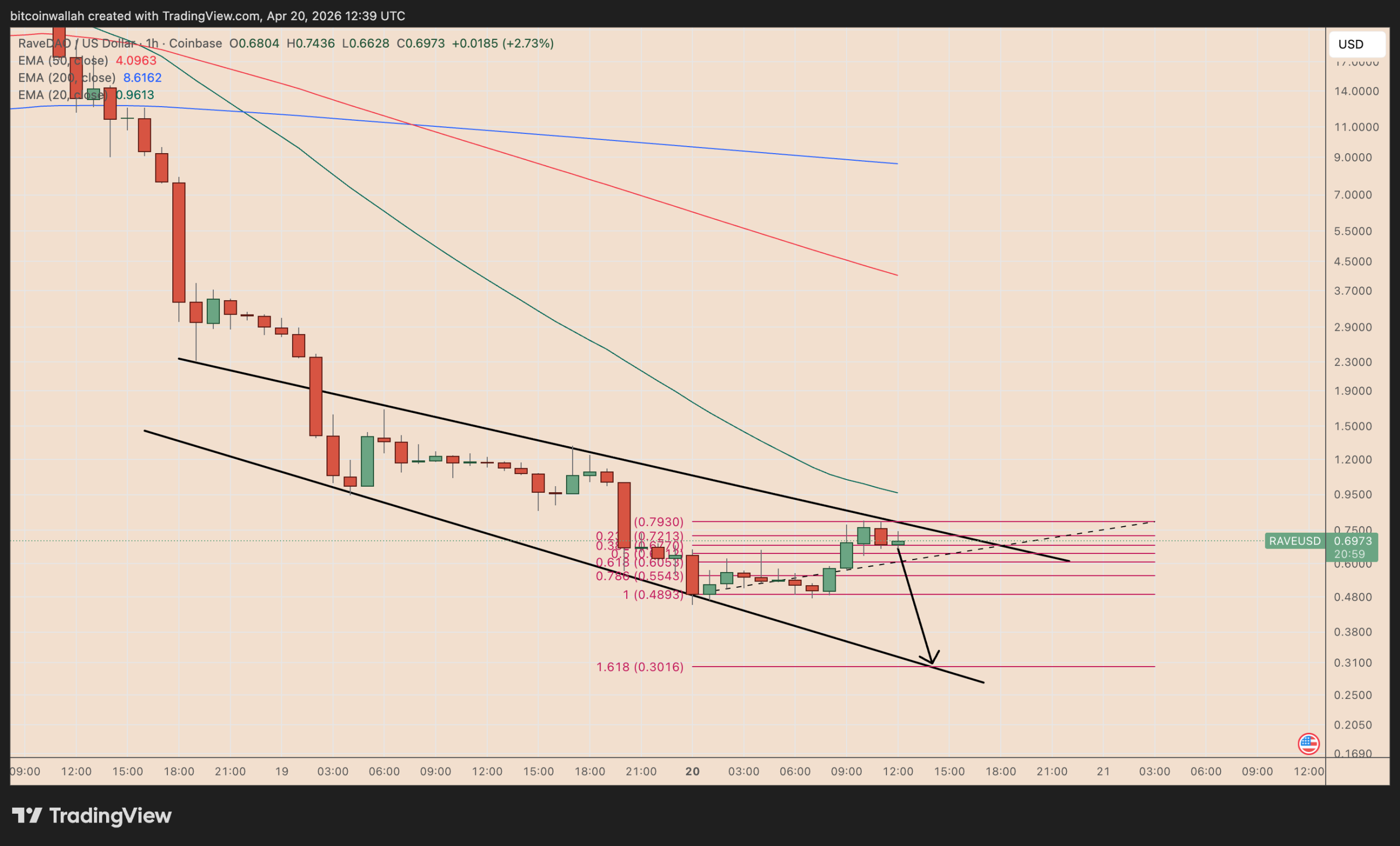
On the hourly chart, RAVE continues to trade inside a descending channel, with lower highs and lower lows forming between two downward-sloping trend lines.
As of Monday, the spot price was retreating after testing the channel’s upper boundary, a sign that sellers remain active on rallies. If that rejection holds, RAVE could slide toward the channel’s lower trend line in the near term.

A Fibonacci extension drawn from the latest bounce at the lower boundary to the recent pullback from the upper boundary points to the 1.618 extension as the next bearish objective.
That level comes in near $0.30, implying a further 55%–58% decline from current prices in April or by May.
Notably, the same setup correctly anticipated Sunday’s drop toward $0.49, reinforcing the channel’s relevance.

Meanwhile, the 20-hour exponential moving average at $0.96 and the 1.0 Fib line at $0.94 continue to cap upside attempts. Unless the bulls reclaim these levels decisively, the broader bias remains tilted to the downside.
Market manipulation claims add to RAVE risks
RAVE’s technical weakness is unfolding alongside mounting allegations of market manipulation, with market watchers comparing it to the LUNA and WAVES pump-and-dumps from 2022.
Onchain investigator ZachXBT described the token’s explosive rally and subsequent collapse as a “blatant” pump-and-dump, allegedly orchestrated across major exchanges including Binance, Bitget and Gate.io.

He flagged roughly 23 million RAVE tokens (worth around $23 million) moving from a team-linked multisig wallet to Bitget deposit addresses shortly before a 40% flash crash, and has since maintained a $25,000 bounty for whistleblowers.
RaveDAO has denied any involvement.
Related: FOMO, lax rules are fueling the crypto crime supercycle
Still, ZachXBT has doubled down on his claims, arguing that over 90% of the token’s supply may be controlled by insiders, raising concerns about liquidity concentration and price control.

A few days ago, RaveDAO revealed plans to sell portions of unlocked tokens to fund operations, marketing and hiring.
The team said it is considering price- or performance-based lock mechanisms to better align incentives, adding that “building a movement requires resources.”
This article is produced in accordance with Cointelegraph’s Editorial Policy and is intended for informational purposes only. It does not constitute investment advice or recommendations. All investments and trades carry risk; readers are encouraged to conduct independent research before making any decisions. Cointelegraph makes no guarantees regarding the accuracy or completeness of the information presented, including forward-looking statements, and will not be liable for any loss or damage arising from reliance on this content.
Crypto World
A $293 Million Hack Wiped $8 Billion From Aave Crypto TVL: Is the DeFi Protocol in Crisis?
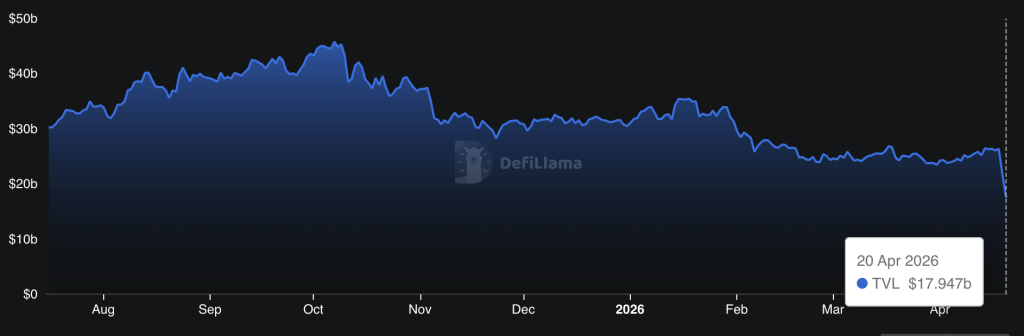
Aave crypto is bleeding. The DeFi lending giant has shed nearly 21% over seven days, with AAVE trading around $90–$91 after a weekend that exposed just how quickly contagion spreads through interconnected DeFi protocols.
Volume spiked 50.20% to $539.45M in 24 hours, but that’s panic volume, not accumulation. Whether this selloff represents a buying opportunity or the start of a deeper unwind depends entirely on what happens next with protocol confidence.
The incident that triggered the collapse began Saturday when hackers drained 116,500 rsETH tokens worth approximately $293 million from Kelp DAO’s LayerZero-powered bridge.
The stolen funds were posted as collateral on Aave v3 to borrow wrapped Ether, leaving roughly $195 million in bad debt on the protocol.
Crypto analytics platform Lookonchain flagged the largest withdrawals: MEXC pulled $431 million, Abraxas Capital followed at $392 million.
Aave’s total value locked collapsed from $26.4 billion to $17.94 billion, stripping it of the top DeFi protocol ranking it held going into the weekend. Curve Finance, Ethena, and BitGo’s Wrapped Bitcoin all paused LayerZero bridge usage as a precaution.
The broader macro environment for crypto was already fragile. Now AAVE faces a protocol-specific credibility crisis layered on top of market-wide pressure — a combination that rarely resolves quickly.
Discover: The best pre-launch token sales
Can AAVE Crypto Price Recover to $120 This Week?
The honest answer: not easily. AAVE sits near $91 on major exchanges, down roughly 6% on Kraken in 24 hours and over 20% on the week, a significant deviation from the broader market’s comparatively mild -0.50% seven-day performance.
The all-time high of $661.69 feels like a different asset entirely from this distance (54% drawdown at current levels).
Volume surging alongside price decline is a classic distribution signal. It suggests sellers are finding liquidity into any bounce rather than buyers absorbing the dip with conviction.
The $90–$92 zone is acting as immediate support; a clean break below $89, which AAVE crypto briefly touched during the initial panic, opens the door toward the $78–$80 range where structural demand last materialized.
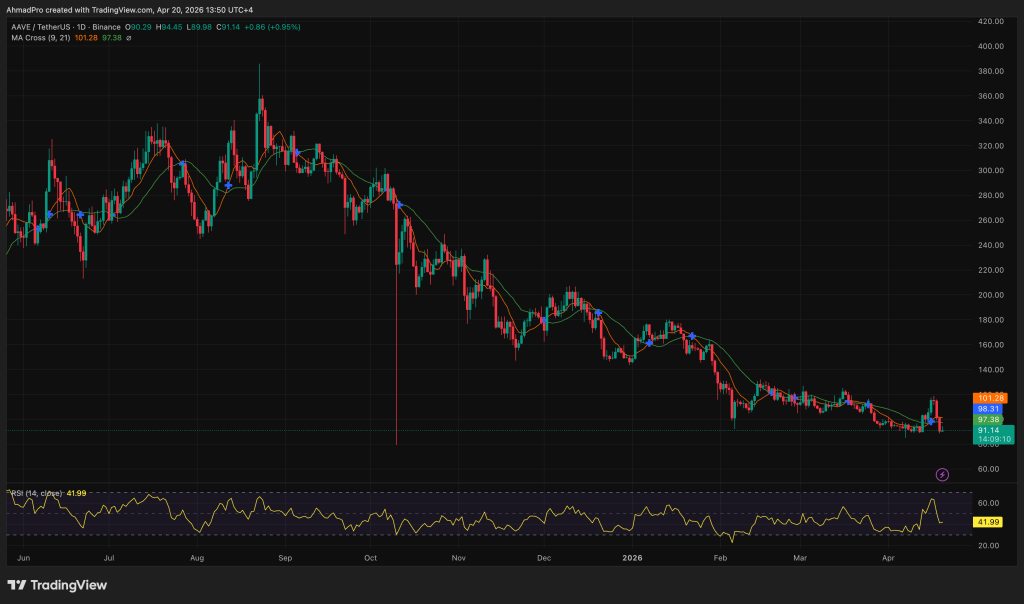
More realistically though, it usually takes time to rebuild trust after something like this, so price likely sits between $88 and $100 while the market processes the damage and watches how users react, which keeps any recovery slow and capped.
The real risk is if capital keeps leaving, because if TVL drops under $15B and withdrawals continue, that pressure shows up directly in price, and once $85 breaks, the structure weakens fast and opens the door toward $70.
Discover: The best crypto to diversify your portfolio with
Maxi Doge Eyes Early-Mover Upside as AAVE Absorbs Protocol Shock
Watching an established DeFi blue chip shed $8 billion in TVL over a weekend raises a reasonable question: when protocol risk can wipe out gains this fast, where does smart money rotate for asymmetric upside? The answer, increasingly, is early-stage presales, where market cap is microscopic, and the exploit risk of a $26B lending protocol simply doesn’t apply.
Maxi Doge ($MAXI) is one of the more unconventional entries in the current presale cycle — a meme token built on Ethereum that leans hard into the 1000x leverage trading mentality through what it calls “Lever King Culture.”
The project has raised $4,745,091.23 at a current presale price of $0.0002814, with dynamic staking APY available to participants.
Features include holder-only trading competitions with leaderboard rewards and a Maxi Fund treasury allocated to liquidity and partnerships.
The gym-bro branding is deliberate, viral meme marketing has driven outsized returns in this cycle before (Dogecoin, Shiba Inu, and their descendants all started somewhere).
Risk is real: meme tokens are high-volatility, high-failure-rate instruments. DYOR is not optional here. For those with risk appetite suited to early-stage exposure, research Maxi Doge before the presale window closes.
The post A $293 Million Hack Wiped $8 Billion From Aave Crypto TVL: Is the DeFi Protocol in Crisis? appeared first on Cryptonews.
Onchain investigator ZachXBT publicly challenged MemeCore on Monday to justify the valuation and supply distribution of its M token, asking the project to explain its market cap and why “insiders hold >90% of supply.”
“Please provide a single data point to support your $6B mkt cap at a top 20 token and why insiders hold >90% of supply,” wrote ZachXBT in a Monday X response to Memecore, a project advertising itself as the layer–1 blockchain for the “Meme 2.0 economy.”
The comments add fresh scrutiny to MemeCore after a sharp rally, though live valuation metrics differed across major trackers. CoinMarketCap ranked the token No. 21 at about $4.33 billion on Monday, while CoinGecko ranked it No. 20 at about $5.97 billion.
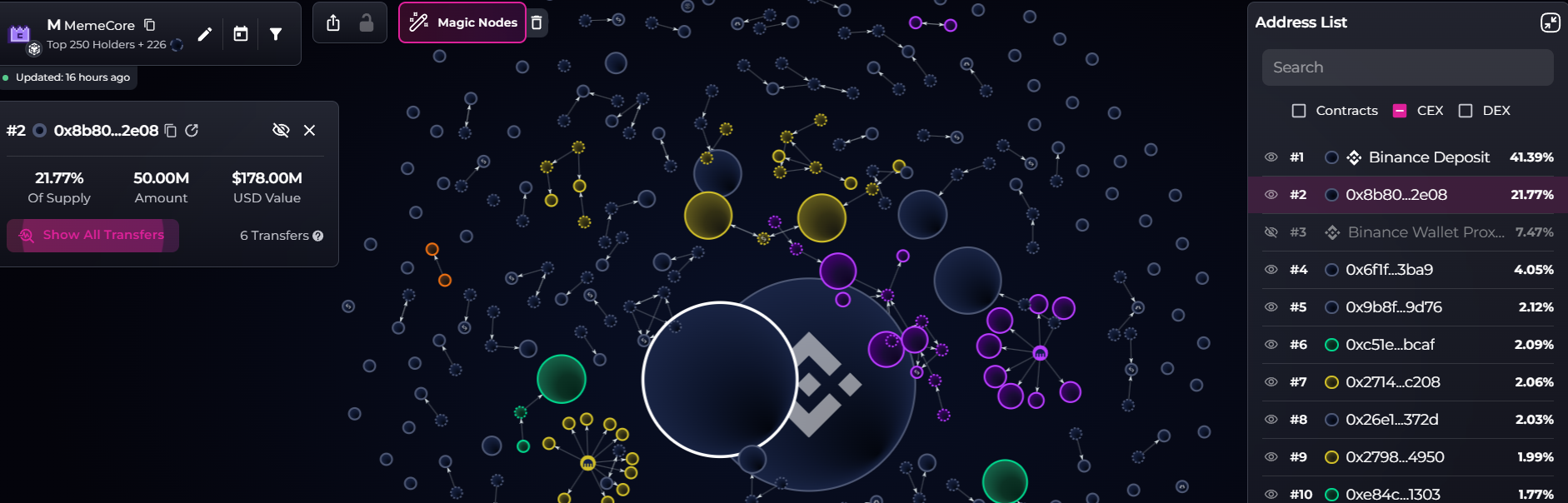
The second-largest holder, wallet “0x8b8,” held 50 million M tokens currently worth $178 million, representing 21.77% of the supply, according to blockchain data visualization platform Bubblemaps, which listed the Binance Deposit address as the largest holder with 41.3% of the supply.
However, the token holdings don’t necessarily point to coordinated activity, according to Bubblemaps blockchain data analyst 0xToolman, who told Cointelegraph that the “pattern looks like team holdings,” which may not be in circulation yet.

Cointelegraph has contacted MemeCore for comment on the matter and details surrounding the token’s distribution.
ZachXBT has not posted definitive blockchain data proving that 90% of the supply is held by insiders, but pledged to investigate the token after the recent meltdown of the Rave DAO (RAVE) token sent shockwaves across the industry.
Related: Suspected insider wallets rack up $1.2M betting on ZachXBT’s Axiom exposé
RAVE token’s 90% meltdown sparks insider concerns
On Saturday, ZachXBT accused RaveDAO of orchestrating a pump-and-dump scheme, citing concentrated token holdings and suspicious exchange flows, after the RAVE token soared from $0.25 to nearly $28 within days before crashing over 80%.
RaveDAO has denied any role in the token’s surge and collapse, Cointelegraph reported on Sunday. Both Binance and Bitget confirmed they are reviewing the situation.
The RAVE token fell 92% during the past week and was trading above $0.69 at 12:46 p.m. UTC on Monday, CoinMarketCap data shows.

ZachXBT claimed that RAVE was just one of several tokens spotting “manipulation” signs on major exchanges.
“Other projects with highly questionable price action recently include: SIREN, MYX, COAI, M, PIPPIN, RIVER,” he wrote in a Saturday X post, pledging to investigate these price movements to identify the responsible parties.
Magazine: Meet the onchain crypto detectives fighting crime better than the cops
Crypto World
LayerZero Post Mortem Shows Lazarus Group Stole $290M From KelpDAO via RPC Node Compromise


North Korea’s Lazarus Group exploited a single-verifier LayerZero setup to drain $290M in rsETH on April 18 by compromising RPC infrastructure and poisoning the bridge’s data feeds.
On April 18, 2026, North Korea’s Lazarus Group (TraderTraitor unit) executed a $290M theft from KelpDAO’s rsETH bridge by compromising two LayerZero RPC nodes that feed data to the protocol’s verifier. The attacker hacked the nodes, deployed malware to feed false transaction data exclusively to LayerZero’s verifier while maintaining honest responses to monitoring systems, then DDoS’d legitimate RPC endpoints to force the verifier to rely on the poisoned nodes. Once the verifier signed off on a fabricated transaction, the bridge released $290M in unbacked rsETH before the malware self-destructed and deleted all traces.
LayerZero Labs confirmed KelpDAO used a 1-of-1 DVN (Decentralized Verifier Network) setup—a single point of failure the protocol had repeatedly warned against—limiting contagion to KelpDAO’s bridge with no reported impact on other assets. Security researchers noted the attack vector raises unanswered questions about how the attacker obtained the RPC node list and achieved root-level access to production infrastructure, suggesting either a prior unreported LayerZero compromise, a breached deployment pipeline, or insider access rather than a Kelp-side misconfiguration.
Sources: LayerZero
This article was generated automatically by The Defiant’s AI news system from publicly available sources.

Calamos Market Neutral Income Fund Q1 2026 Commentary (Mutual Fund:CMNIX)

MicroStrategy Makes Biggest Bitcoin Buy Since 2024, Will It Move BTC Price?

Politics Home Article | Health Secretary opens UEL’s new Neighbourhood Health Hub



-

 Crypto World7 days ago
The SEC Conditionalises DeFi Platforms to Be Avoided for Broker Registration
-

 NewsBeat6 days ago
Trump and Pope Leo: Behind their disagreement over Iran war
-

 Fashion3 days ago
Weekend Open Thread: Theodora Dress
-

 Crypto World7 days ago
SEC Signals Exemption for Crypto Interfaces From Broker Registration
-

 News Videos5 days ago
Secure crypto trading starts with an FIU-registered
-

 Sports3 days ago
NWFL Suspends Two Players Over Post-Match Clash in Ado-Ekiti
-

 Crypto World6 days ago
SEC Proposes Certain Crypto Interfaces Don’t Need to Register as Brokers
-

 Business1 day ago
Powerball Result April 18, 2026: No Jackpot Winner in Powerball Draw: $75 Million Rolls Over
-

 Crypto World3 days ago
Russia Pushes Bill to Criminalize Unregistered Crypto Services
-

 Politics3 days ago
Palestine barred from entering Canada for FIFA Congress
-
 Business4 days ago
Creo Medical agree sale of its manufacturing operation
-

 Politics1 day ago
Zack Polanski demands ‘council homes not luxury flats for foreign investors’
-
 Entertainment7 days ago
Brand New Day’ Footage Reveals the Devastating Impact of ‘Now Way Home’
-

 Crypto World3 days ago
Russia Introduces Bill To Criminalize Unregistered Crypto Services
-

 Tech6 days ago
Microsoft adds Windows protections for malicious Remote Desktop files
-
 Entertainment7 days ago
Karol G’s ‘Ultra Raunchy’ Coachella Set Gave ‘Satanic Vibes’
-
 Crypto World7 days ago
Senate Bill Faces Delay Over Stablecoin Yield Debate
-

 Entertainment7 days ago
How Babylon 5 Turned Brief Side Story Into Emotional Masterpiece
-

 Tech7 days ago
What was the first ransomware attack to demand payment in Bitcoin?
-

 Tech5 days ago
‘Avatar: Aang, The Last Airbender’ Leaked Online. Some Fans Say Paramount Deserves the Fallout
You must be logged in to post a comment Login