
Crypto World
A $293 Million Hack Wiped $8 Billion From Aave Crypto TVL: Is the DeFi Protocol in Crisis?

Aave crypto is bleeding. The DeFi lending giant has shed nearly 21% over seven days, with AAVE trading around $90–$91 after a weekend that exposed just how quickly contagion spreads through interconnected DeFi protocols.
Volume spiked 50.20% to $539.45M in 24 hours, but that’s panic volume, not accumulation. Whether this selloff represents a buying opportunity or the start of a deeper unwind depends entirely on what happens next with protocol confidence.
The incident that triggered the collapse began Saturday when hackers drained 116,500 rsETH tokens worth approximately $293 million from Kelp DAO’s LayerZero-powered bridge.
The stolen funds were posted as collateral on Aave v3 to borrow wrapped Ether, leaving roughly $195 million in bad debt on the protocol.
Crypto analytics platform Lookonchain flagged the largest withdrawals: MEXC pulled $431 million, Abraxas Capital followed at $392 million.
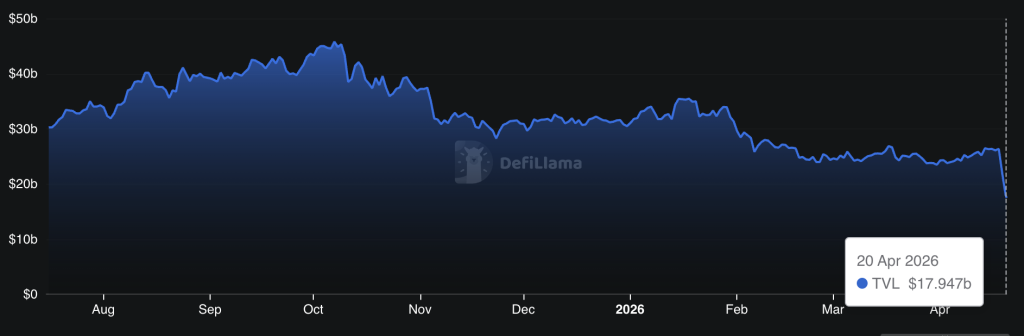
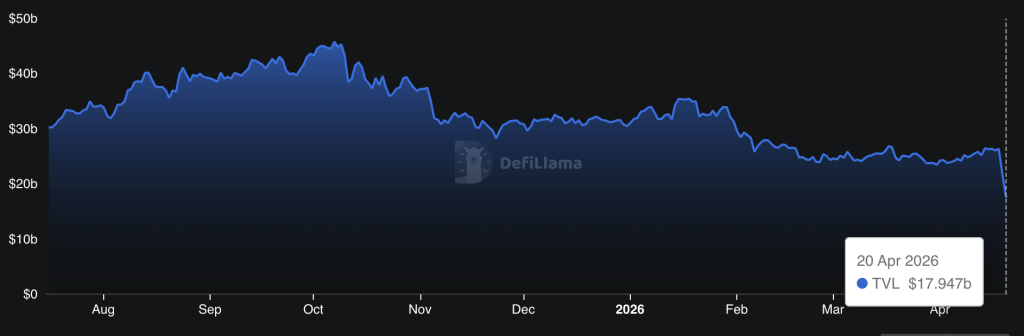
Aave’s total value locked collapsed from $26.4 billion to $17.94 billion, stripping it of the top DeFi protocol ranking it held going into the weekend. Curve Finance, Ethena, and BitGo’s Wrapped Bitcoin all paused LayerZero bridge usage as a precaution.
The broader macro environment for crypto was already fragile. Now AAVE faces a protocol-specific credibility crisis layered on top of market-wide pressure — a combination that rarely resolves quickly.
Discover: The best pre-launch token sales
Can AAVE Crypto Price Recover to $120 This Week?
The honest answer: not easily. AAVE sits near $91 on major exchanges, down roughly 6% on Kraken in 24 hours and over 20% on the week, a significant deviation from the broader market’s comparatively mild -0.50% seven-day performance.
The all-time high of $661.69 feels like a different asset entirely from this distance (54% drawdown at current levels).
Volume surging alongside price decline is a classic distribution signal. It suggests sellers are finding liquidity into any bounce rather than buyers absorbing the dip with conviction.
The $90–$92 zone is acting as immediate support; a clean break below $89, which AAVE crypto briefly touched during the initial panic, opens the door toward the $78–$80 range where structural demand last materialized.
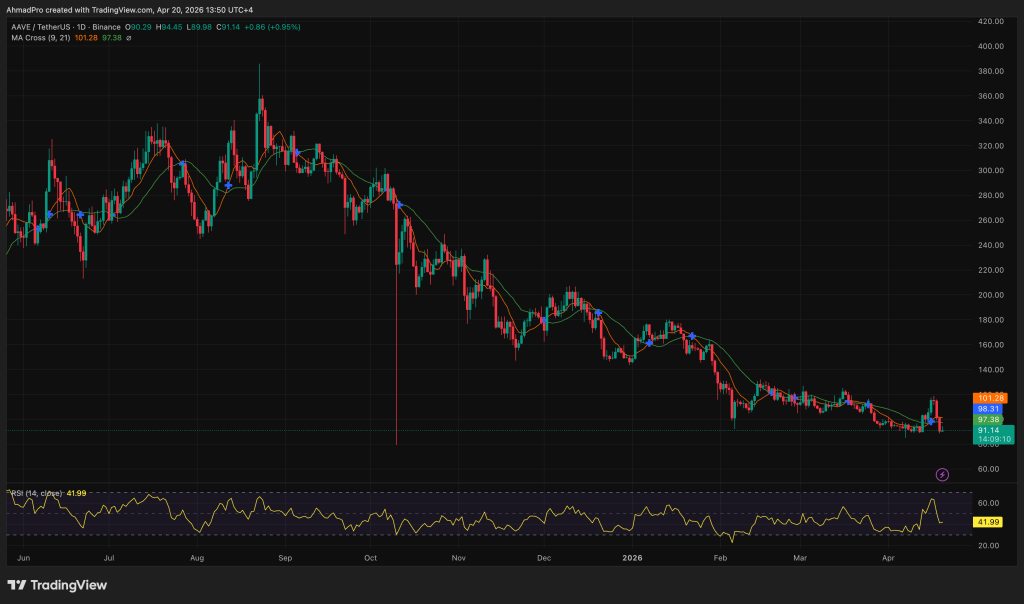
More realistically though, it usually takes time to rebuild trust after something like this, so price likely sits between $88 and $100 while the market processes the damage and watches how users react, which keeps any recovery slow and capped.
The real risk is if capital keeps leaving, because if TVL drops under $15B and withdrawals continue, that pressure shows up directly in price, and once $85 breaks, the structure weakens fast and opens the door toward $70.
Discover: The best crypto to diversify your portfolio with
Maxi Doge Eyes Early-Mover Upside as AAVE Absorbs Protocol Shock
Watching an established DeFi blue chip shed $8 billion in TVL over a weekend raises a reasonable question: when protocol risk can wipe out gains this fast, where does smart money rotate for asymmetric upside? The answer, increasingly, is early-stage presales, where market cap is microscopic, and the exploit risk of a $26B lending protocol simply doesn’t apply.
Maxi Doge ($MAXI) is one of the more unconventional entries in the current presale cycle — a meme token built on Ethereum that leans hard into the 1000x leverage trading mentality through what it calls “Lever King Culture.”
The project has raised $4,745,091.23 at a current presale price of $0.0002814, with dynamic staking APY available to participants.
Features include holder-only trading competitions with leaderboard rewards and a Maxi Fund treasury allocated to liquidity and partnerships.
The gym-bro branding is deliberate, viral meme marketing has driven outsized returns in this cycle before (Dogecoin, Shiba Inu, and their descendants all started somewhere).
Risk is real: meme tokens are high-volatility, high-failure-rate instruments. DYOR is not optional here. For those with risk appetite suited to early-stage exposure, research Maxi Doge before the presale window closes.
The post A $293 Million Hack Wiped $8 Billion From Aave Crypto TVL: Is the DeFi Protocol in Crisis? appeared first on Cryptonews.


An Ethereum whale has taken a sizable bullish stance, opening a leveraged long position worth 90.8 million dollars in ETH, using 20x leverage. A second notable whale appears to have joined the bid, opening a roughly 61 million ETH long at 20x leverage on HyperLiquid, with an entry around $2,303. The moves come as ETH traded near $2,280, roughly 32% above the February low near $1,750, and as inflows into spot ETH products keep accumulating in a backdrop of improving market optimism.
Key takeaways:
- Ethereum-equivalent wagers: one trader opened a leveraged long position totaling $90.8 million in ETH, at 20x leverage.
- Another whale added about $61 million in ETH longs at 20x leverage, with entry around $2,303.
- Price setup near-term: ETH sits above $2,200, with an ascending triangle pattern on the daily chart pointing toward higher targets if resistance at $2,400 is cleared.
- Capital inflows reinforce bulls: seven consecutive days of spot ETH ETF inflows totaling about $426 million, and ETH investment products logging $328 million in inflows for the week ending April 17.
Market context: whales stacking bets as macro cues loom
Across market data, ETH has enjoyed a steady bid in recent sessions, with the ETH/USD pair trading around $2,280 after a strong rally off the February lows. A trader known for track record and risk appetite highlighted that macro forces could swing sentiment in either direction this week. AlphaBTC, posting on X, noted that stronger retail sales could push yields higher and delay anticipated Fed rate cuts, while weak data would likely spur risk-on positioning. The analyst added that Fed commentary and PMI data offer growth signals, but geopolitical developments remain a wildcard that could spark sudden volatility.
In this environment, one high-profile trader has unveiled a substantial long on ETH, signaling a strong nearby conviction about upside potential. The $90.8 million position is notable not only for its size, but for the use of 20x leverage, which magnifies both potential gains and risk should market conditions turn unfavorably. A second whale has also stepped in, with a roughly $61 million ETH long at 20x leverage, entering around the $2,303 area on HyperLiquid, according to trader posts tracked by market observers.
These positions arrive as investors monitor a broader backdrop of rising activity in ETH-related instruments. Spot Ethereum ETFs have seen inflows for seven straight weeks, totaling roughly $426 million over the period observed, a sign that institutional appetite for direct exposure to ether remains resilient even amid the volatility tied to macro headlines. The flow backdrop complements another trend: continuous inflows into global Ethereum investment products, with weekly inflows reported at about $328 million for the week ending April 17, underscoring a persistent preference for ETH among asset allocators.
Technical setup: how the chart shapes a potential breakout
From a purely technical lens, ether’s price action on the daily chart is forming an ascending triangle, a pattern traders watch as a potential continuation signal. The critical threshold to clear is the resistance line near $2,400. If ETH breaks above this level, the pattern’s classical measure suggests a rally equal to the height of the triangle’s base, potentially pushing ETH toward roughly $3,230 in a continuation move. In numerical terms, that would be a gain of a bit more than 41% from current levels.
Other nearby hurdles may shape whether a breakout actually unfolds. The immediate region around $2,350–$2,500 sits under the influence of the 50-day exponential moving average, which has in some periods acted as a ceiling for near-term momentum. If buying pressure pushes ETH beyond that band, the next sizable obstacle sits at the 200-day EMA near $2,640, a level that could determine whether buyers sustain the push into higher territory.
On the momentum side, the relative strength index has moved up from oversold conditions in February to the mid-50s, signaling a better probability of upward movement but not a guarantee of a decisive breakout. Micro2Macr0, analyzing broader chart patterns, has suggested that a sustained breakout from a multi-year ascending triangle could trigger a substantial rally, though the path may be choppy given the proximity to several key resistance zones.
Analyst commentary from Cointelegraph’s coverage of price projections also points to a potential recovery path if ETH clears the $2,400 level. A successful breach could pave the way toward intermediate targets in the $2,800 region, with a further push toward $3,050 over the ensuing sessions or weeks, depending on the pace of buying interest and macro catalysts.
Flows, ETFs, and the institutional backdrop
The ongoing inflow momentum into Ethereum-related products appears to be reinforcing a narrative that large holders expect a continued price recovery from the mid-$2,000s. Spot ETH inflows, which track demand for immediate exposure to ether, have persisted across multiple weeks, signaling that buyers remain engaged even as macro headlines intermittently threaten risk assets.
Beyond spot, the broader ETH investment product segment—ranging from exchange-traded products to other listed vehicles—has also drawn meaningful funds. The week ending April 17 saw ETH-focused products record inflows of about $328 million, a signal that institutions and professional traders are logistics-ready to chase a rising ETH bid in various instruments. This backdrop supports the argument that any near-term sell-off could be met with a quick reaccumulation by professional participants and strategic buyers seeking to front-run a potential breakout scenario.
For market watchers, the combination of outsized whale positions, rising momentum on the technical front, and persistent inflows into ETH-centric products forms a cohesive narrative: the market is positioning for further upside, but the path remains contingent on clearing a few important resistance levels and navigating macro volatility.
What comes next: watching key thresholds and potential catalysts
As ETH eyes higher ground, market participants should focus on the $2,400 barrier and the surrounding order flow. A clean breakout above this level would remove a major roadblock and open the door to the next target near $3,230, with further extension toward $3,050 on the sooner-to-mid-term horizon depending on momentum and liquidity conditions. Conversely, a struggle to push through $2,350–$2,500 could extend consolidation, providing a lower-risk setup for traders looking to re-enter on dips.
Investors should also keep an eye on macro signals that could alter the calculus in the coming weeks. If retail demand and macro data push yields higher and the Fed commments lean toward tighter near-term policy, risk assets could face headwinds. In contrast, softer data or a more accommodative tone could sustain a constructive tilt for ETH alongside other risk-on assets.
In sum, the current landscape suggests that large-scaled bets by whales, coupled with reinforcing flows into ETH vehicles and a rising chart trajectory, could keep ETH in focus as a prominent beta play within the broader crypto market. The next test will be whether ETH can clear the $2,400 resistance decisively and trigger the projected triangle-derived rally, or whether macro dynamics and technical friction at nearby EMAs will cap the move in the near term.
The market will likely respond to fresh price action around the critical levels and to any new liquidity injections or regulatory signals. Traders and investors should stay tuned for rapid shifts in sentiment as weekly inflows and notable on-chain moves continue to shape Ethereum’s short- to medium-term trajectory.
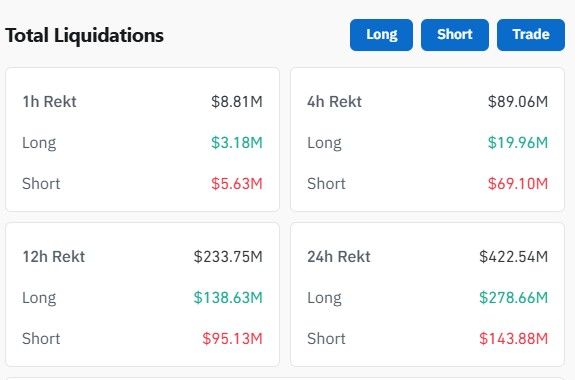
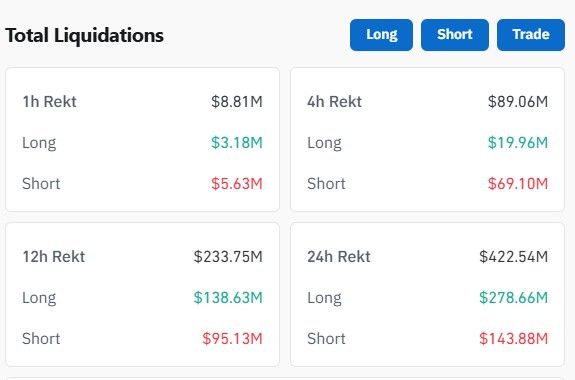
Over $422 million in crypto positions were liquidated in the past 24 hours as markets experienced volatile two-way price action.
Short sellers suffered significant losses during a market bounce that caught them off guard.
Crypto Short Squeeze Accelerates in Recent Hours
The liquidation data reveals a shifting dynamic over the past day. In the most recent four-hour window, short liquidations totaled $69.10 million, compared to just $19.96 million in long liquidations. This indicates that the recent price recovery caught bearish traders by surprise.
Total short liquidations over 24 hours reached $143.88 million as Bitcoin and Ethereum rallied off support levels. The acceleration is visible in the data progression: one-hour short liquidations hit $5.63 million, up from $3.18 million in longs, suggesting upward momentum continues.
Did Longs Get Liquidated Before the Bounce?
Despite the short squeeze in recent hours, long positions still accounted for the majority of 24-hour liquidations at $278.66 million. This suggests that overleveraged bulls were wiped out during earlier downside volatility before prices found support.
The volatility comes amid ongoing Middle East tensions that have weighed on risk assets across global markets.
The 12-hour data shows $233.75 million in total liquidations with longs at $138.63 million and shorts at $95.13 million. The ratio shifted significantly toward shorts in the most recent hours as buying pressure returned. Institutional flows remain supportive despite the turbulence, with crypto ETFs recording their biggest week since January.
For traders, the pattern illustrates the danger of leverage in both directions. Bears who shorted near the lows were squeezed just hours after bulls who bought near the highs were liquidated. Despite the short-term chaos, on-chain data shows long-term holders continue accumulating, suggesting confidence in higher prices ahead.
What This Means for Crypto Market Direction
The short squeeze dynamic often signals that downside pressure is exhausting. When short sellers are forced to buy back their positions to cover losses, it adds fuel to rallies and can trigger further upside.
However, the elevated total liquidation volume of $422 million in 24 hours indicates that volatility remains high. Both bulls and bears are getting caught on the wrong side of rapid price swings.
The post Crypto Bears Lose $420 Million in Brutal Short Squeeze appeared first on BeInCrypto.
Crypto World
Dune Analytics Reveals 47% of LayerZero OApps Use Minimal DVN Security Following KelpDAO Hack


Analysis of 2,665 LayerZero OApp contracts shows nearly half rely on single-validator security configurations, the same setup that exposed KelpDAO’s rsETH to exploitation.
Dune Analytics published an open analysis on Monday examining Decentralized Validator Network (DVN) security configurations across ~2,665 active OApp contracts on LayerZero over the past 90 days. The research found that 47% of OApps operate with a 1-of-1 DVN security floor—the most minimal configuration requiring only a single validator—while 45% use 2-of-2 configurations and approximately 5% employ 3-of-3 or higher. KelpDAO’s rsETH token, which was targeted in a recent exploit, fell into the 1-of-1 bracket.
The analysis provides open-source methodology and queryable data, inviting community feedback on DVN security standards across the LayerZero ecosystem. The findings highlight structural vulnerabilities in cross-chain bridge security, as single-validator configurations create single points of failure for protocol assets and user funds routed through LayerZero’s omnichain infrastructure.
Sources: Dune Analytics
This article was generated automatically by The Defiant’s AI news system from publicly available sources.


Kelp DAO says a LayerZero “default” single‑validator setup helped enable a $290m rsETH bridge hack, forcing a messy blame game and a rushed security migration.
Summary
- Kelp DAO disputes LayerZero’s post‑mortem on the $290m rsETH bridge hack, saying a risky 1/1 validator setup was LayerZero’s own default
- The exploit drained 116,500 rsETH, around $290–$293m and roughly 18% of rsETH’s supply, in what analysts call 2026’s largest DeFi loss so far
- LayerZero now says it will stop signing messages for any app using a single‑validator DVN and force a migration to multi‑verifier security
Kelp DAO has pushed back against LayerZero’s official explanation of a $290 million bridge exploit, arguing that the “single‑validator” setup that let an attacker walk off with 116,500 rsETH was not reckless customization but a default configuration in LayerZero’s own guidelines.
The liquidity re‑staking protocol told CoinDesk the 1‑of‑1 Decentralized Verifier Network (DVN) used on its rsETH cross‑chain route “followed LayerZero’s documented defaults” and that the validator stack compromised by the attacker “is part of LayerZero’s own infrastructure,” rather than an unvetted third party.
The attack, which hit on April 18, minted or released 116,500 rsETH to an attacker‑controlled address — about 18% of the token’s supply — and translated into losses of roughly $290–$293 million at the time, making it the largest DeFi exploit of 2026 so far.
In its investigation report and follow‑up statements, LayerZero has insisted that “LayerZero’s protocol was not broken,” arguing instead that Kelp DAO “deployed a single‑point‑of‑failure DVN in production” for a token with more than $1 billion in total value locked.
The interoperability firm said “operating a single‑point‑of‑failure configuration meant there was no independent verifier to catch and reject a forged message” and claimed it had previously communicated “best practices around DVN diversification” to Kelp DAO and other partners.
Security researchers and auditors, including SlowMist co‑founder Yu Xian, have confirmed that the rsETH bridge route used a 1/1 DVN — effectively a single signature — rather than a 2/2 or multi‑DVN stack, calling it a “single‑signature single point” vulnerability that may have been aided by social engineering.
A detailed post‑mortem from DeFi tracking site DeFiPrime notes that LayerZero’s OApp model lets applications choose how many DVNs must sign off on a message, with 2‑of‑3 or 3‑of‑5 configurations commonly recommended for high‑value deployments, but says Kelp’s adapter “was configured to accept the attestation of a single verifier” run by LayerZero Labs.
That design meant “one forged signature was enough to make any cross‑chain message look real,” allowing the attacker to feed the bridge a fake instruction that mimicked a valid message from another chain and triggered the release of 116,500 rsETH “out of thin air” to their wallet.
Kelp DAO’s team counters that they implemented LayerZero’s own public code and defaults across multiple networks and that the DVN exploited “was operated by LayerZero itself,” implying that responsibility sits at least partly with the infrastructure provider rather than solely with the application.
LayerZero has now taken the unusual step of promising it “will stop signing messages for any applications using a single‑validator setup” and is forcing a “security migration” that will require all OApps to move to multi‑DVN architectures if they want to keep using the protocol.
The fallout goes well beyond one re‑staking token.
As crypto.news reported in an earlier story on the rsETH exploit and LayerZero’s attribution of the attack to North Korea’s Lazarus Group, the incident has reignited a broader debate over bridge design, default configurations and who ultimately bears responsibility when modular cross‑chain infrastructure goes wrong.
Related crypto.news stories you can link in copy include coverage of the Kelp DAO–LayerZero exploit and Lazarus attribution, analysis of earlier cross‑chain bridge hacks, and reporting on how re‑staking and liquid‑staking protocols concentrate smart‑contract risk across multiple chains.
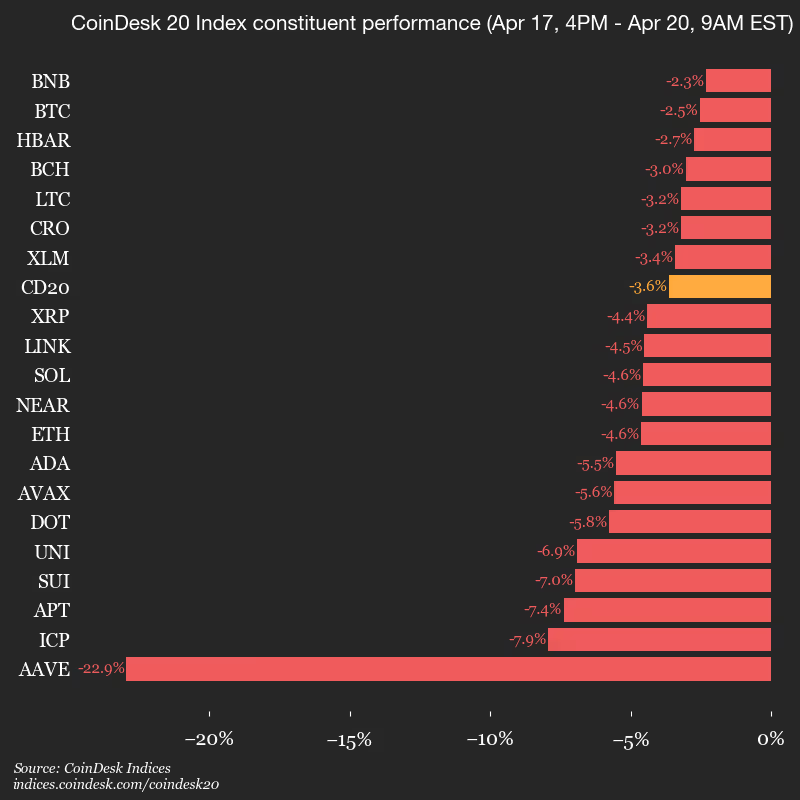
CoinDesk Indices presents its daily market update, highlighting the performance of leaders and laggards in the CoinDesk 20 Index.
The CoinDesk 20 is currently trading at 2085.29, down 3.6% (-78.65) since 4 p.m. ET on Friday.
None of 20 assets are trading higher.

Leaders: BNB (-2.3%) and BTC (-2.5%).
Laggards: AAVE (-22.9%) and ICP (-7.9%).
The CoinDesk 20 is a broad-based index traded on multiple platforms in several regions globally.
Crypto World
Coinbase (COIN), Bybit said to be working together on tokenization, custody and distribution of U.S. stocks


Crypto exchange Coinbase (COIN) is working with Bybit, one of the largest crypto trading platforms, to explore ways to tokenize, custody and distribute assets such as U.S. public and pre-IPO stocks, a person familiar with the plans told CoinDesk.
The talks, which are in progress, do not involve any sort of stake acquisition or similar deal for Bybit to enter the U.S., said the person, who asked to remain anonymous because they are directly involved in the discussions, dismissing a report of an investment publicized last month.
Bybit is, indeed, planning to enter the U.S., just not with Coinbase, said the person, who declined to identify the partner. It will create a new entity said to be spearheaded by former Bybit co-CEO Helen Liu. The local partner will provide licensing and compliance while Bybit provides the tech, product and liquidity, the person said.
Discussions between Bybit and Coinbase are more global in nature, leveraging Bybit’s worldwide reach, particularly in places like Asia, where users may want access to tokenized versions of U.S. stocks. As such, the firms are exploring synergies around custody and distribution of these assets going forward.
The U.S. is home to certain assets that global users want, the person said. Bybit is international, while Coinbase is U.S.-focused. Working together, the two can bring U.S. assets to a wider market, according to the person. Within five years, tokenization will bring any asset to users globally through a single app.
“Even if Coinbase becomes a super app in the U.S., they are still only in the U.S,” the person said.
The two companies’ explorations into tokenized stocks come as other market participants explore similar link-ups. Intercontinental Exchange (ICE), the owner of the New York Stock Exchange, in March announced it was taking a stake in crypto exchange OKX. Just last week, Deutsche Boerse, made a $200 million strategic investment into Kraken.
Bybit and Coinbase both declined to comment.
CORRECT (April 20, 14:03 UTC): Corrects spelling of Liu in second bullet point.
UPDATE (April 20, 14:50 UTC): Adds Coinbase-Bybit relation in U.S., Bybit’s U.S. entry plans starting in third paragraph.
Crypto World
Global stablecoin rules slow down as BIS urges cooperation to avoid fragmentation risks


Work on global standards for stablecoins has slowed over the past year, raising concern among central bankers that gaps in oversight could split markets and amplify risk.
Bank of England Governor Andrew Bailey, who chairs the Financial Stability Board, said progress on international rules has stalled, Reuters reported last week. That’s a concern, Bank for International Settlements (BIS) General Manager Pablo Hernández de Cos said Monday in Japan.
Global coordination is critical to avoid a patchwork of rules that firms could exploit, de Cos said, according to Reuters. Without international alignment, companies may shift operations to jurisdictions with lighter oversight, a practice known as regulatory arbitrage.
The warning comes as major economies push ahead with their own frameworks, often on different timelines and with different approaches.
The stablecoin sector has expanded over the last few years, and now accounts for $320 billion according to DeFiLlama. Tether’s USDT and Circle Internet’s (CRCL) USDC make up most of that figure. De Cos said their structure can resemble securities more than cash, noting that redemption frictions can push prices away from their intended $1 value.
He also said that sudden withdrawals could ripple through markets. Proposals to reduce risk include limiting interest payments on stablecoins and giving issuers access to central bank lending facilities or deposit-insurance-type arrangements.
Policymakers argue such measures could make the sector safer while preserving its role in digital payments.
In the U.S., lawmakers are working to advance the Digital Asset Market Clarity Act, which would set federal rules for digital asset markets.
The bill passed the House last year and is now before the Senate, where Banking Committee Chairman Tim Scott and Agriculture Committee Chairman John Boozman are leading the push. Senators Thom Tillis and Angela Alsobrooks have negotiated a compromise on stablecoin yield that could clear the way for a markup, while Senator Cynthia Lummis, who chairs the Banking Committee’s digital assets subcommittee, has said a hearing could come in the second half of April.
A deal remains contingent on resolving several open questions, including DeFi oversight and ethics provisions.


The DeFi sector is reeling from the effects of a suspected North Korea-linked hack which has spread to multiple protocols and saw DeFi poster child Aave’s TVL drop by a third.
Saturday’s incident saw $290 million worth of Kelp DAO’s liquid staking token, rsETH, stolen via the Layer Zero bridge.
The loot was deposited into Aave and used to borrow $236 million of WETH. But with liquidity drained, and markets frozen, users began to panic, withdrawing collateral where they could and borrowing whatever they could get their hands on.
In all, since Saturday, almost $9 billion has left Aave, with the protocol potentially facing hundreds of millions of dollars of bad debt.
The question of who will foot the bill is still very much to be decided.
The hack
The hack, which Layer Zero suspects was carried out by the Lazarus Group of North Korean state sponsored hackers, exploited rsETH issuer KelpDAO’s “single-DVN setup” for bridging their token.
Layer Zero bridges tokens between blockchains, and uses decentralized verifier networks (DVNs) to validate transactions. The model puts the onus on asset issuers to “define their own security posture,” including DVN thresholds.
In Kelp DAO’s case, they used a 1-of-1 setup relying on Layer Zero’s DVN.
Aside from an initial acknowledgement posted to X, there’s been no further communication from Kelp DAO itself.
Read more: Inside the $280M Drift hack: weeks of setup, minutes to drain
Layer Zero claims its DVN was compromised through a “highly sophisticated… RPC-spoofing attack.” RPCs are nodes which allow external apps to read blockchain data.
The attack presented malicious info only to the targeted DVN, skirting monitoring efforts. In addition, it performed a DDoS attack on uncompromised RPCs to trigger fallback to the “poisoned” ones.
However, pseudonymous veteran DeFi developer banteg pushed back on Layer Zero’s characterization as an RPC poisoning attack, which suggests purely outside interference. With attackers pulling off an “infra breach within the perimeter… the real story is a targeted implant operating inside the trust boundary.”
They disapprove of “such elaborate distancing,” warning “given it doesn’t say how the breach has occurred, I wouldn’t rush re-enabling the bridges.”
Read more: Hyperbridge exploited less than two weeks after April Fools’ day hack prank
The fallout
Aside from the hack itself, the real damage has spread across DeFi, especially on the sector’s flagship lending protocol, Aave.
Rather than selling such a large quantity of rsETH, crashing its price, the attacker chose to borrow against it. Depositing stolen rsETH as collateral into Aave and other lending platforms, they then borrowed $236 million worth of WETH, according to blockchain audit firm Peckshield’s tally.
Read more: KuCoin criticized for helping ‘launder’ $9.5M from fake Ledger app
Aave’s rsETH markets were paused shortly after users were warned to “withdraw now, ask questions later.” In the hours that followed, over $6 billion left the protocol.
The lack of WETH liquidity has also left several stablecoin markets at full utilization. Spark’s MonetSupply explained that unwinding positions and liquidation of unhealthy positions was stalled, with recent changes to Aave’s borrowing rates “significantly increasing the risk of cascading market failure.”
The liquidity crunch spread to other platforms, vaults, and even unrelated ecosystems, such as Solana.
Read more: Tether challenges USDC Solana hegemony with $127.5M Drift bailout
Taking stock
With rsETH estimated to be facing an 18% shortfall in backing, Aave may be facing over $250 million of bad debt. DeFiLlama developer 0xngmi put the worst case at $341 million and best case at $76 million.
The platform’s backstop fund, Umbrella, contains $55 million of ETH, and former contributor ACI has pledged funds from its staking program.
Additionally, Umbrella’s predecessor contains over $280 million, however it’s uncertain whether this, or any DAO treasury funds would be made available to fill the hole.
ACI’s Marc Zeller, estimates a 5-8% haircut for Aave WETH depositors, once the dust settles.
To put the damage caused into perspective, in all, the exploiter’s main address currently holds a total of $245 million worth of ETH, $174 million on Ethereum and $71 million on Arbitrum.
Meanwhile, the value of the wider DeFi market has dropped by $14 billion since Saturday.
Read more: Crypto hack goes political as Grinex blames ‘Western special services’
The path ahead
How the rest of this episode unfolds will depend in large part on how Kelp DAO decides to distribute losses.
CoinDesk reports that Kelp DAO plans to blame “Layer Zero’s documentation, default configurations and team guidance when setting up the bridge.”
Aave has hinted at non-bridged rsETH tokens being fully backed, though this may just be its own preference for now. The alternative, however, isn’t pretty either, and would see WETH depositors on other networks bearing the full burden of the unbacked rsETH.
The fact that this is still unknown belies an embarrassing truth about the immaturity of DeFi. Despite recent reminders in the form of Stream Finance’s November collapse and last month’s hack of Resolv’s RSD, seniority in the event of a shortfall still appears to be an afterthought for many DeFi projects.
Layer Zero’s statement says that, for its part, it will urge any teams using 1/1 DVN configurations to switch to “multi-DVN setups with redundancy.”
It will also not act as the sole DVN for any projects who remain on a 1/1 setup.
Read more: Resolv hack shows DeFi learned nothing from last contagion
Nobody comes out of this looking good.
From the initial alert coming an hour after the hack, to the long-standing concerns around Layer Zero’s default 1/1 validation threshold, to Kelp DAO’s decision to keep it, to Aave’s risk assessment of rsETH.
Many have taken the opportunity to call for rate limits on key pathways such as bridge outflows or collateral supply.
This hack comes during an awful month in a pretty bad year-to-date for the DeFi sector, which has seen its TVL drop by half since the October 10 crash.
On that note, readers should keep their eyes peeled for Protos’ upcoming DeFi hack tracker.
Protos has reached out to Aave, Layer Zero, and Kelp DAO, but hadn’t received a reply by time of publication. This article will be updated in the event we receive a response.
Got a tip? Send us an email securely via Protos Leaks. For more informed news, follow us on X, Bluesky, and Google News, or subscribe to our YouTube channel.
Crypto World
Crypto adoption in the U.S. is increasing with bitcoin (BTC) still dominating: Deutsche Bank


Crypto adoption in the U.S. has staged a comeback, even as sentiment around prices remains cautious, according to German lender Deutsche Bank (DB).
In a new retail survey spanning 3,400 consumers across the U.S., U.K. and EU, the bank said U.S. participation rebounded to 12% in March from a February low of 7%, returning to levels last seen in July 2025. The report’s data suggested adoption has not topped 14% in the survey’s history, dating back to 2023.
Bitcoin exchange-traded funds (ETFs) saw a resurgence in March, attracting roughly $1.3 billion in net inflows, the report said, signaling renewed institutional demand after a weak start to the year.
“After steadily declining since July 2025, U.S. crypto adoption rates recovered in March,” wrote analysts Marion Laboure and Camilla Siazon in the Monday report.
Crypto prices have shown signs of stabilization after a volatile start to 2026, with last month marking a tentative rebound driven by renewed institutional demand and geopolitical tailwinds.
Bitcoin rose roughly 9% in March, recovering toward the $70,000 level after earlier declines, though it remains down more than 20% year-to-date and well below its late-2025 peak above $120,000. More recently, prices have pushed higher into the mid-$70,000s, briefly topping $77,000 amid easing geopolitical tensions and improving risk sentiment.
The recovery has been uneven. Prices have repeatedly tested resistance around the mid-$70,000 range, with analysts pointing to that level as a key breakout threshold for further upside. At the same time, macro pressures, including higher-for-longer interest rates and energy-driven inflation, continue to weigh on crypto alongside broader risk assets
Elsewhere, trends were more muted. U.K. adoption dipped slightly to 9% but remains structurally higher over the long term, the analysts said, while Europe held steady at 7%.
Despite the rebound in participation, consumer sentiment on bitcoin’s price outlook is subdued.
A majority of respondents across regions expect bitcoin to trade lower than current levels near $75,000 by the end of 2026. In the U.S., 19% see prices landing between $20,000 and $60,000, while 13% expect a drop below $20,000, a level last seen in early 2023. Only a small minority, around 3% in the U.S., anticipate a return to record highs near $120,000.
The world’s largest cryptocurrency was trading around $75,000 at publication time.
Still, bitcoin remains firmly at the center of the crypto market. Roughly 70% of crypto investors across regions hold bitcoin, far exceeding ownership of stablecoins such as USDT or USDC, the report said. It is also the top choice for future investment, cited by 69% of U.S. respondents.
Traditional assets continue to compete for investor attention. Gold and the S&P 500 remain favored overall, though the gap has narrowed in the U.S., where preferences are more evenly split across the three.
Demographically, crypto adoption remains skewed toward men and higher-income households, though the report noted gradual gains among women and lower-income investors. Younger consumers, particularly in the UK, showed the fastest growth in participation.
Read more: Bitcoin may be forming a base at $65,000 as ‘paper hands’ have been flushed out

Disclosure: This article does not represent investment advice. The content and materials featured on this page are for educational purposes only.
Little Pepe presale nears completion as funding surpasses $28M and tokens sell out rapidly.
Summary
- Little Pepe (LILPEPE) presale surpasses $28.1M, with Stage 13 pricing at $0.0022 and strong demand across all phases.
- LILPEPE gains attention as a Layer 2 meme project with EVM compatibility, zero tax, and staking utility features.
- Investors watch LILPEPE’s rapid presale growth and exchange listing plans as it targets broader market expansion.
The traction behind Little Pepe (LILPEPE) is no longer something that can be ignored. The project has now exceeded $28,101,728 in its ongoing presale, getting close to reaching its $28,775,000 target. With 16,943,966,303 tokens sold out of 17,250,000,000 tokens for this phase, the time for early entry is closing much faster than expected.
Currently at Stage 13, the token is valued at $0.0022. The next stage will see the token move to a valuation of $0.0023. For early entrants who got in at the Stage 1 valuation of $0.001, this is a 120% move on paper, a move that is clearly attracting both retail investors and more sophisticated investors who seek asymmetric returns.
What stands out is not just the speed of the rise, but the consistency of demand across stages. Each price increment has been met with fresh inflows, suggesting that buyers are not waiting around for dips.
Beyond memes: A layer 2 play with real utility
While the memecoin sector is often driven by hype cycles, Little Pepe is attempting to position itself differently. At its core, the project is building a Layer 2 EVM-compatible chain designed to be ultra-fast, low-cost, and scalable. This infrastructure angle introduces a layer of utility that many meme tokens simply do not offer.

The ecosystem is designed with zero transaction tax, which removes friction for traders and aligns with what has historically worked in high-growth meme cycles. On top of that, the roadmap includes staking mechanisms and NFT integrations, features aimed at keeping users engaged beyond speculative trading.
Security and fairness are also part of the pitch. The anti-sniping measures are expected to be in place, helping to mitigate bot-driven manipulation in the early stages of trading. With plans to list on top centralized exchanges as well as Uniswap, it is clear that accessibility as well as liquidity are a priority for this project from day one.
There is also a broader ambition in play. With messaging around a potential “1 billion market cap or bust” and ambitions of entering the top 100 on CoinMarketCap, Little Pepe is leaning into both narrative and execution, a combination that tends to resonate in this segment of the market.
Giveaways, incentives, and community energy driving growth
Community participation has been a major driver behind the presale’s traction. The ongoing $777,000 giveaway has added a strong incentive layer, offering 10 winners $77,000 worth of LILPEPE tokens each. Entry requires a minimum $100 contribution, along with completing social engagement tasks, effectively blending fundraising with viral growth mechanics.

In parallel, the Mega Giveaway campaign is targeting buyers between Stages 12 and 17, where both large and randomly selected participants stand a chance to win over 15 ETH in rewards. These campaigns have significantly amplified visibility, pushing the project across social channels and keeping engagement levels high.
Memecoin market outlook: Timing could be everything
However, if we were to look at the broader memecoin space, it does seem to be entering another period of resurgence. Of course, as blue-chip assets like Bitcoin continue to strengthen, liquidity tends to move towards higher-risk, higher-reward areas, and meme coins have historically seen the greatest benefit from this.
Of course, as can be seen, things have changed somewhat. The environment has become more discerning, with a bias towards projects that at least have some form of utility or differentiation. Yes, there are still projects that are based on pure hype, but they are shorter-lived.
This is where Little Pepe’s positioning becomes relevant. By combining meme culture with a Layer 2 infrastructure narrative, it is attempting to bridge two worlds, one driven by community energy and the other by technological relevance.
Whether or not they are successful in their lofty endeavors remains to be seen. However, from what can be gauged from their current presale performance, it is safe to say that Little Pepe is a meme coin that is definitely worth keeping an eye on.
For more information, visit the official website, X, Telegram.
Disclosure: This content is provided by a third party. Neither crypto.news nor the author of this article endorses any product mentioned on this page. Users should conduct their own research before taking any action related to the company.

Snooker needs new faces and personalities – teenager Moody

When it comes to leadership, do companies know what they are doing?

FASE Keuangan 20an ke 40an Yang Jarang Orang Bahas! | SUARA BERKELAS #86



-

 Crypto World7 days ago
The SEC Conditionalises DeFi Platforms to Be Avoided for Broker Registration
-

 NewsBeat6 days ago
Trump and Pope Leo: Behind their disagreement over Iran war
-

 Fashion3 days ago
Weekend Open Thread: Theodora Dress
-

 Crypto World7 days ago
SEC Signals Exemption for Crypto Interfaces From Broker Registration
-

 News Videos5 days ago
Secure crypto trading starts with an FIU-registered
-

 Sports3 days ago
NWFL Suspends Two Players Over Post-Match Clash in Ado-Ekiti
-

 Crypto World6 days ago
SEC Proposes Certain Crypto Interfaces Don’t Need to Register as Brokers
-

 Business1 day ago
Powerball Result April 18, 2026: No Jackpot Winner in Powerball Draw: $75 Million Rolls Over
-

 Crypto World3 days ago
Russia Pushes Bill to Criminalize Unregistered Crypto Services
-

 Politics3 days ago
Palestine barred from entering Canada for FIFA Congress
-
 Business4 days ago
Creo Medical agree sale of its manufacturing operation
-

 Politics1 day ago
Zack Polanski demands ‘council homes not luxury flats for foreign investors’
-
 Entertainment7 days ago
Brand New Day’ Footage Reveals the Devastating Impact of ‘Now Way Home’
-

 Crypto World3 days ago
Russia Introduces Bill To Criminalize Unregistered Crypto Services
-

 Tech6 days ago
Microsoft adds Windows protections for malicious Remote Desktop files
-
 Entertainment7 days ago
Karol G’s ‘Ultra Raunchy’ Coachella Set Gave ‘Satanic Vibes’
-

 Entertainment7 days ago
How Babylon 5 Turned Brief Side Story Into Emotional Masterpiece
-
 Crypto World7 days ago
Senate Bill Faces Delay Over Stablecoin Yield Debate
-

 Tech7 days ago
What was the first ransomware attack to demand payment in Bitcoin?
-

 Tech5 days ago
‘Avatar: Aang, The Last Airbender’ Leaked Online. Some Fans Say Paramount Deserves the Fallout
You must be logged in to post a comment Login